
How to Choose Your First Snowboard: The Only Guide You’ll Ever Need
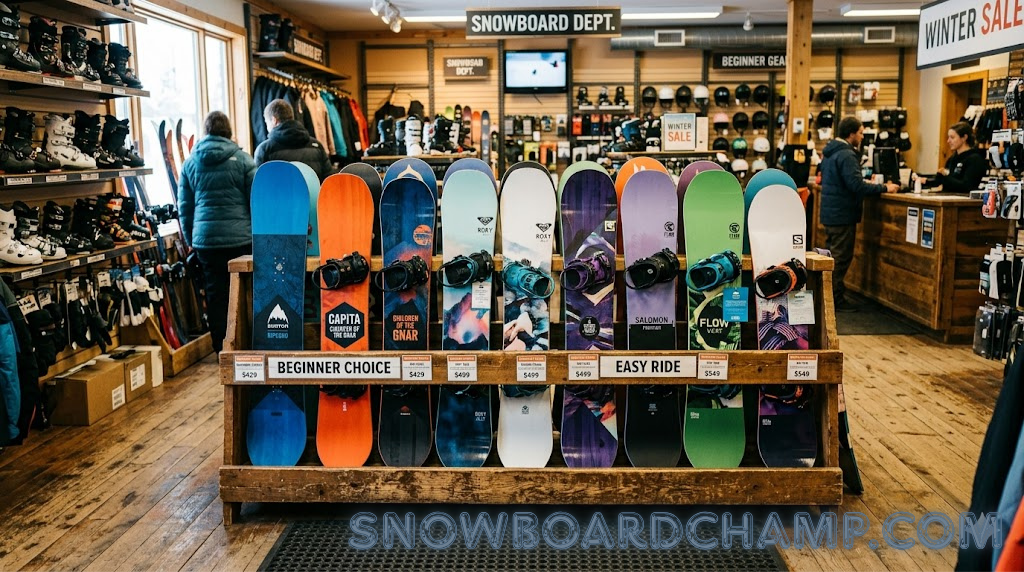
A properly matched board, boots, and bindings will accelerate your learning curve dramatically — here’s how to get it right the first time.
You’ve decided to snowboard. Maybe you watched someone carve effortlessly down a groomed run on a winter trip, or you’ve been dreaming about it since your first ski resort visit as a kid. Either way, walking into a shop — or opening a browser tab — and trying to choose your very first snowboard can feel completely overwhelming. There are hundreds of boards, dozens of brands, a wall of confusing jargon (rocker, camber, BTX, directional twin, sintered base…), and salespeople who either tell you everything at once or steer you toward whatever has the best margin that week.
This guide cuts through all of it. Whether you have $300 or $900 to spend, whether you’re 5’2″ or 6’4″, whether you plan to take lessons or figure it out on your own, everything you need to confidently choose your first snowboard is right here. We’ll cover sizing mechanics, flex ratings, board profiles, binding systems, boot selection, and budget strategy — with real-world context for what actually matters when you’re just starting out.
Let’s get into it.
01 Why Your First Snowboard Matters More Than You Think
Most people dramatically underestimate how much their equipment affects the learning process. When you’re fighting a board that’s too stiff, too long, or designed for expert-level edge hold, your body expends energy just to keep upright instead of actually developing the muscle memory and balance instincts that make snowboarding click. The wrong board doesn’t just make things harder — it can make the sport feel genuinely impossible, leading riders to quit after a day or two and write off the whole thing as “not for me.”
The right first board does something remarkable: it gets out of the way. A properly spec’d beginner setup is forgiving enough that your inevitable mistakes don’t result in dramatic yard sales (the snowboarding term for a spectacular wipeout where your gear scatters across the mountain). It responds predictably to input, lets you feel the terrain, and gives you honest feedback as your technique improves. It’s the difference between a sport that feels attainable and one that feels like punishment.
The Myth of Buying Ahead of Your Level
Walk into any ski shop during peak season and you’ll see it happen constantly: a beginner, excited and well-intentioned, is talked into a stiffer, more “versatile” board because it’ll “last them longer.” This advice sounds economically sound on the surface but leads to a frustrating first season. Stiff boards require precise technique that beginners simply haven’t developed yet. They punish poor form, demand more ankle and knee engagement, and feel sluggish at low speeds — all the speeds beginners spend most of their time at.
The secret the industry doesn’t advertise loudly enough: a purpose-built beginner board will have you skiing — sorry, riding — twice as many runs per day because you’re not exhausted from fighting the equipment. That speed of progression means you might actually outgrow a beginner board and be ready for something intermediate by your second season, which is exactly where you want to be.
For more context on the complete financial picture of getting started, the snowboard gear cost amortization analysis breaks down what a multi-season budget really looks like when you account for how long each component lasts.
Renting vs. Buying for Your First Season
Before we go further, let’s address the elephant in the room: should you even buy a board for your first season? There’s a legitimate argument for renting, especially if you’re not sure whether snowboarding will stick as a hobby. Rental shops at most resorts offer reasonably modern equipment tuned for beginners, and it’s a zero-commitment way to discover whether you love the sport before investing several hundred dollars.
However, there are meaningful advantages to owning your setup from day one. You’ll get boots that actually fit your feet — rental boots are almost universally poorly fitted, and foot pain from bad boots is one of the top reasons beginners have a miserable first experience. You’ll also get a board tuned to your exact weight and skill level. And psychologically, owning your own setup tends to increase commitment to the sport. If you’re planning more than two or three days on the mountain, the math often favors buying.
If foot pain is already a concern or you’ve had poor boot experiences before, the guide on why your feet hurt snowboarding is essential reading before you make any boot decisions.

Burton Ripcord Snowboard — Our Top Beginner Pick
The most forgiving, reliably spec’d beginner board on the market. Channel-based binding system, lightweight core, and V-Rocker profile make learning significantly less punishing.
View on Amazon →02 Snowboard Sizing: Length, Width & Body Weight
Snowboard sizing is the single most important decision you’ll make, and it’s also the one most commonly botched. Boards that are too long are difficult to initiate turns on and feel sluggish. Boards that are too short feel twitchy, lack stability at speed, and can “chatter” (vibrate) uncomfortably. Getting this right is not complicated once you understand the three variables in play: your height, your weight, and your riding style.
The Height-as-Starting-Point Method
The old rule of thumb — that a board should reach somewhere between your chin and your nose when standing upright — is a rough starting point, not a final answer. It was developed when boards were much heavier and rider populations were less diverse. Use it only to establish a baseline range, then adjust from there.
Weight Is More Important Than Height
Of the two physical measurements, your weight has more influence on ideal board length than your height. A heavier rider on a short board will flex it excessively, reducing edge hold and making the board feel unstable. A lighter rider on a long board won’t be able to generate enough pressure to flex the board properly, making turning laborious. Every board specification sheet includes a recommended weight range — this is the number that matters most.
| Rider Weight | Suggested Length Range | Notes for Beginners |
|---|---|---|
| Under 100 lbs (45 kg) | 120–135 cm | Kids / small adults — prioritize soft flex |
| 100–130 lbs (45–59 kg) | 135–145 cm | Go shorter end of range for easier turning |
| 130–160 lbs (59–73 kg) | 145–155 cm | Most versatile beginner range |
| 160–190 lbs (73–86 kg) | 152–160 cm | Favor mid-range for balance of control and stability |
| 190–220 lbs (86–100 kg) | 158–165 cm | Longer board handles weight better |
| Over 220 lbs (100 kg+) | 163 cm+ | Look for boards with wider waist width too |
Width: The Underrated Dimension
Board width — specifically waist width — is critically important for riders with larger feet. If your boots overhang the edges of the board, they will drag in the snow during turns, causing what’s known as “toe drag” or “heel drag.” This doesn’t just slow you down; it can send you face-first into the snow at the worst possible moment. As a general rule, you want no more than about 1–1.5 cm of boot overhang on either side.
Wide boards (designated “W” in most brands’ model lineups, e.g., Burton Custom Wide) solve this problem for riders with US size 11+ feet. Don’t be embarrassed to ask for a wide board — it’s a mechanical necessity, not a cosmetic preference.
Diagram: Proper boot alignment across the board’s waist. Overhang beyond 1.5cm causes toe/heel drag during turns.
For a comprehensive walkthrough of all sizing variables — including stance width and stance angles — the snowboard sizing guide by height and weight goes deeper into the math behind the perfect fit.

Arbor Element Rocker — Best Beginner Board for Learning Turns
Available in a wide size range (138–159 cm), System Rocker profile lifts the tip and tail for catch-free turn initiation. Perfect for weight ranges 110–200+ lbs.
View on Amazon →03 Flex Rating Explained: From Noodle to Plank
Flex is the stiffness of the board — how much it bends under pressure. Almost every brand rates flex on a 1–10 scale (or sometimes 1–5), where 1 is the softest (most flexible) and 10 is the stiffest. As a beginner, flex is the single most impactful spec for your experience on the mountain, because it determines how much effort is required to make the board do what you want.
Why Soft Flex Is Your Friend
Soft boards (rated 1–3) are exceptionally forgiving. When you lean too far forward or back — which happens constantly when you’re learning — a soft board absorbs that mistake rather than punishing you for it. They’re also easier to initiate turns with, respond quickly to small weight shifts, and are much more comfortable at the slow speeds beginners operate at. Think of a soft board as a board that’s helping you rather than demanding perfection from you.
A stiff board (rated 7–10), by contrast, requires precise, confident weight application to respond. At low speeds and with uncertain technique, it simply doesn’t want to turn. Stiff boards excel at high-speed carving, aggressive edge hold on hard-packed ice, and demanding terrain — none of which you’ll be encountering or needing on your first few days.
✓ Soft Flex (1–3) — Ideal for Beginners
- Forgiving of poor weight distribution
- Easy to initiate turns at low speeds
- More comfortable on groomed beginner runs
- Less tiring on legs and ankles
- Better for small-feature jibbing later
✗ Stiff Flex (7–10) — Avoid as a Beginner
- Punishes imprecise technique
- Unresponsive at slow learning speeds
- Requires sustained edge pressure to turn
- Fatiguing for undeveloped leg strength
- Designed for expert-level riding
The Flex Sweet Spot: Ratings 2–4 for Beginners
Most beginner boards fall in the 2–4 range. A rating of 2 is truly for complete novices — the board almost turns itself. A rating of 3–4 is the sweet spot for riders who want something slightly more responsive as they improve through their first season. Some boards marketed as “all-mountain” fall in the 4–5 range; while not necessarily bad, they’ll feel noticeably stiffer and less forgiving than a dedicated beginner board.
The flex scale: beginners should stay in the 1–3 zone, aiming for 2–3 as an ideal starting point for most adults.
Longitudinal vs. Torsional Flex
Here’s something most beginner guides skip over: there are actually two types of flex. Longitudinal flex (the one everyone talks about) runs tip-to-tail and determines how the board responds to forward/backward weight shifts and carving. Torsional flex runs rail-to-rail (edge-to-edge) and affects how easily the board transitions from one edge to the other. A board can be longitudinally soft but torsionally stiff, or vice versa.
For beginners, you ideally want both longitudinal and torsional flex to be relatively soft. This is the combination that makes edge transitions forgiving and turn initiation effortless. Budget boards sometimes cut corners by keeping longitudinal flex soft but using stiffer torsional construction — which results in a board that feels easy to press but surprisingly snappy when initiating heelside or toeside turns.
04 Board Profile & Camber Types Decoded
If there’s one area of snowboard jargon that causes the most confusion among new buyers, it’s board profile — also called camber type or rocker profile. This refers to the shape of the board when it’s lying flat on a surface, viewed from the side. And it has a profound impact on how the board behaves on snow.
The Four Main Profiles You’ll Encounter
Side-profile comparison of the four main snowboard camber types. For beginners, rocker and hybrid profiles are the safest choices.
Traditional Camber
Traditional camber (also called positive camber) is the classic shape: the center of the board arches upward when placed on a flat surface, with contact points near the tip and tail. When you stand on it, that arch flattens out, loading the edges and creating natural spring (called “pop”). Camber boards reward experienced riders with excellent edge hold and powerful ollie ability, but they’re notorious for “catching edges” — when the board’s edge unexpectedly bites into the snow and sends you tumbling. For beginners, this is a real hazard. Leave camber boards until you’re solidly intermediate.
For a deep-dive into camber profiles once you’re ready to advance, the camber vs. rocker profile comparison covers the physics of edge control, pop generation, and float in deep powder.
Full Rocker (Reverse Camber)
Full rocker is essentially the opposite of camber — the board curves upward at both tip and tail, like a banana. Only a small portion of the center contacts the snow. The main benefit for beginners: edge catches become much harder to trigger, because the tips and tails naturally lift away from the snow surface. The tradeoff is reduced edge hold and a looser, slightly imprecise feel that some intermediate riders find frustrating. For pure beginners, however, rocker is extremely forgiving and confidence-building.
Flat Profile
A flat board lies perfectly flat on the ground — no arch, no curve. It’s a middle-ground option that provides more stability than full rocker while still being less prone to edge catches than full camber. Many budget-friendly beginner boards use flat profiles. They’re predictable and versatile, though they lack the natural pop of camber and the ultra-forgiving feel of rocker.
Hybrid Profiles (The Best of Both Worlds)
Most modern beginner boards use some form of hybrid profile — typically flat between the bindings (for stability and edge engagement) combined with rocker in the tip and tail zones (for that catch-free feel at the front and back). This is almost universally the best choice for new riders. You get stability underfoot, decent edge hold during turns, and the forgiving rocker tips that prevent the dreaded edge catches during turn transitions.

Lib Tech Skate Banana — Iconic Rocker Board for Beginners
The board that popularized rocker for all skill levels. BTX construction, eco-friendly materials, and an incredibly forgiving ride. Available from 147–162 cm.
View on Amazon →05 Board Shapes: Directional, Twin & Tapered
Beyond the profile (the side-view shape), snowboards also have a planshape — the shape when viewed from above. This determines how the board handles in different directions and on different terrain. For beginners, understanding the three main shapes will help you pick a board that matches how you’ll actually ride.
True Twin
A true twin board is perfectly symmetrical — the tip and tail are identical in shape, and the board performs exactly the same whether you’re riding forward or backward (called riding “switch”). True twins are the standard choice for park riding and freestyle snowboarding, since riders regularly ride switch or perform tricks that require the board to behave the same in both directions. For beginners who are purely focused on learning basic turns and gaining confidence on groomed runs, a twin can work well but isn’t specifically optimized for forward riding.
Directional
Directional boards are designed to be ridden with one foot forward and one back — there’s a defined nose (front) and tail (back). The nose is typically longer and/or softer to help it float through snow and absorb terrain, while the tail is stiffer and shorter for powerful edge hold and pop off the back foot. Directional boards are excellent for all-mountain riding and are often considered more intuitive for complete beginners because the board naturally wants to go in one direction.
Directional Twin
The directional twin splits the difference. The shape looks nearly symmetrical from above, like a true twin, but the flex pattern is slightly stiffer toward the tail and the stance is set back slightly from center. This gives the board a directional feel in powder (the nose floats better) while still riding fairly well in switch. Most all-mountain beginner boards are directional twins, and for good reason — they’re versatile, forgiving, and don’t lock you into pure freestyle or pure freeride territory.
| Shape | Best For | Switch Riding | Beginner Suitability |
|---|---|---|---|
| True Twin | Park, freestyle, urban | Excellent | Good |
| Directional | All-mountain, powder, freeride | Limited | Very Good |
| Directional Twin | All-mountain versatility | Good | Excellent |
| Tapered Directional | Powder, backcountry | Not designed for it | Not recommended |
For a more detailed exploration of shape physics and how directional vs. twin boards affect edge displacement and turn geometry, the directional vs. twin snowboard comparison goes into the science. And if you’re curious about your riding stance before even hitting the slopes, the goofy vs. regular stance guide will help you figure out which foot should go in front.
Top-view (planshape) comparison. The directional twin’s near-symmetrical outline with a slightly setback stance is the most versatile choice for new riders.
06 Base Types: Sintered vs. Extruded
The base of your snowboard is the polyethylene surface that contacts the snow. It affects glide speed, durability, and maintenance requirements. There are two main types: sintered and extruded. For beginners, this is a lower-priority decision than sizing and flex, but understanding the difference will help you evaluate boards and manage expectations.
Extruded Bases
Extruded bases are made by melting polyethylene and pushing it through a mold — the same basic process used to make many plastic products. They’re common on budget and beginner boards because they’re less expensive to manufacture. The trade-off is that extruded bases are less porous than sintered, meaning they absorb wax less effectively and don’t hold it as long. They’re also slower at the top end, though at beginner speeds this difference is largely academic.
The big advantage: extruded bases are more forgiving of maintenance neglect. If you forget to wax for a few sessions, an extruded base won’t deteriorate as dramatically as a sintered one. For someone still figuring out the sport, this durability buffer is genuinely valuable.
Sintered Bases
Sintered bases are made by compressing and heating polyethylene powder rather than melting it into shape. The result is a much more porous surface that absorbs and retains wax far more effectively. Sintered bases are significantly faster than extruded, which is why you’ll find them on intermediate, advanced, and performance boards. They’re also more durable against rocks and debris — but they require proper waxing to realize their full potential.
For beginners who plan to take maintenance seriously, a sintered base on a beginner board is worth the slight extra cost. If you’re more likely to ride your board hard, forget about upkeep, and bring it in for a tune once a year, extruded is the more practical choice.
| Feature | Extruded Base | Sintered Base |
|---|---|---|
| Manufacturing method | Melted & molded | Compressed & heated powder |
| Wax absorption | Low | High |
| Glide speed | Moderate | Fast |
| Maintenance needs | Low | Regular waxing |
| Cost | Budget-friendly | Higher |
| Beginner suitability | Good (low-maintenance) | Good (faster, more durable) |
When you’re ready to learn base maintenance, the snowboard waxing physics guide explains why wax works at a molecular level, and the at-home waxing tutorial walks you through the process step by step. The sintered vs. extruded comparison dives even deeper into the performance math.

Snowboard Starter Wax Kit — Keep Your Base Running Fast
A basic wax kit lets you maintain any base at home. Includes all-temperature wax, scraper, and brush. Essential even for beginners who want to keep their glide consistent.
View on Amazon →07 Choosing Your First Snowboard Bindings
Bindings are the mechanical connection between your boots and your board, and they have a bigger impact on your riding feel than most beginners realize. The right bindings transmit your foot movements into the board efficiently, let you fine-tune your stance, and protect you in falls. The wrong ones can create pressure points, reduce responsiveness, or simply not fit your boots properly.
The Three Main Binding Systems
Traditional Strap Bindings
Strap bindings — featuring a toe strap and an ankle strap that buckle over your boots — are the industry standard and account for well over 80% of all bindings sold. They’re reliable, adjustable, compatible with virtually every snowboard boot on the market, and available at every price point. For beginners, strap bindings are the recommended starting point simply because of their compatibility, repairability, and the wide range of options available.
Step-On Bindings
Burton’s Step-On system eliminates the straps entirely — you simply step onto the binding and it clicks in place, much like a ski binding. The convenience factor is significant: no more sitting in the snow to strap in, no more fighting frozen buckles on the lift line. The downsides are higher cost, proprietary compatibility (you need specific Step-On boots), and a slightly different flex feel. For beginners interested in this system, the Burton Step-On review covers the three-point connection system in detail, and the Nidecker Supermatic vs Burton Step-On comparison is worth reading if you’re considering going strap-free from day one.
Rear-Entry (Speed-Entry) Bindings
Rear-entry bindings, where the highback folds down and you step in from behind, offer a middle ground in convenience. They’re faster than strap bindings but don’t require proprietary boots. However, they’ve lost popularity because the flex and feel has historically been considered inferior to traditional straps. Some riders love them; most experienced snowboarders don’t use them.
Key Binding Specs for Beginners
Flex Rating
Just like boards, bindings have a flex rating. For beginners, soft to medium-flex bindings (rated 1–4) are appropriate. Stiffer bindings transmit energy more efficiently but feel harsh on undeveloped legs and ankles. A softer binding is more forgiving of imprecise boot positioning and creates a more comfortable ride during those first exhausting days.
Baseplate Material
Budget bindings typically use nylon or polypropylene baseplates. These absorb vibration reasonably well but can be less durable. Mid-range and premium bindings use glass fiber or carbon-reinforced composites that are lighter, stronger, and more responsive. For beginners, nylon baseplates are fine — durability over a first season is rarely an issue.
Compatibility: Board-Binding Interface
Most bindings use the 4×4 or 2×4 disc pattern, which works with the vast majority of boards. Burton uses their proprietary Channel system on their own boards, and also provides compatibility discs for most universal patterns. Always verify compatibility before purchasing a board-binding combo separately.
For a complete guide to the binding landscape — from entry-level strap options to premium carving-specific designs — the snowboard bindings guide covers every category. If you’re on a tighter budget, the tested bindings under $200 roundup has solid options in every style. The BOA vs. speed-lace comparison for heel lock is also worth reading before your boot purchase since binding-boot heel hold is a joint system.

Union Force Bindings — Reliable, Versatile, Beginner-Approved
Medium flex, UltraLink response mapping, and multi-density EVA cushioning. One of the best value all-mountain bindings available. Compatible with virtually every board on the market.
View on Amazon →08 Choosing Your First Snowboard Boots
We saved boots for after boards and bindings, but in terms of priority for your actual comfort and learning experience on the mountain, boots might be the most important piece of equipment you’ll buy. Bad boots ruin days on the mountain. Good boots disappear — you stop thinking about them and start thinking about your riding. Your feet spend hours in these things while exposed to cold, moisture, and physical strain. Getting this right is non-negotiable.
Fit Is Everything
Boot fit in snowboarding is different from regular shoe fit. Snowboard boots should feel snug — even slightly tight — when you first try them on. This isn’t how you’d shop for a hiking boot or running shoe. The reason: boots pack out (compress and soften) as you wear them, often becoming half a size to a full size looser over the first 5–10 days of use. If they feel perfect in the shop, they’ll feel sloppy after a few sessions. If they feel just slightly too snug on the shelf (with no painful pressure points), they’ll fit beautifully by your third day on the mountain.
Flex Rating for Boots: Start Softer Than You Think
Boot flex works similarly to board and binding flex — softer is more forgiving, stiffer is more demanding. Beginner boots typically rate 1–4 on the standard 1–10 scale. A soft boot is more comfortable, forgiving, and easier to control in the early stages when your leg muscles and ankles haven’t yet developed snowboard-specific strength and endurance. Medium-flex boots (rating 4–6) are appropriate once you’re consistently linking turns and spending full days on intermediate terrain.
Resist the temptation to buy a stiffer boot because it sounds more “performance-oriented.” A stiff boot on an undeveloped rider creates ankle pain, shin bang (painful impact of the shin against the boot tongue during aggressive forward lean), and general misery. The best snowboard boots comparison by flex and weight metrics provides detailed specs for each category.
Lacing Systems: Traditional, BOA, and Speed Lace
Traditional Laces
Old-school lace-up boots are the most affordable option and offer the most customizable fit — you can tighten the lower zone independently from the upper, which some riders prefer for ankle support. The downside: lacing up with cold, stiff fingers in sub-zero temperatures is genuinely unpleasant, and laces eventually wear out and need replacing.
Speed Laces (Quick-Pull / Zone Lacing)
Speed lace systems use a simple pull tab that cinches the boot quickly and evenly. Most modern beginner boots use some version of this. It’s fast, reliable, and generally warmer to operate than traditional laces. The downside is slightly less zone-specific adjustment.
BOA Dial System
BOA is a proprietary dial-and-cable system that lets you micro-adjust tension with a single twist of a dial even while wearing gloves. High-end boots often feature dual-BOA setups with one dial for the lower zone and one for the upper. BOA is widely loved for precision and convenience, though it adds cost and requires BOA-authorized repair if a cable breaks. For an in-depth comparison of the systems, the BOA vs. speed lace heel lock comparison breaks down the mechanics of each. Also, understanding lace tensile strength specifications is more relevant than most beginners realize — lace failure mid-run is genuinely dangerous.
Boot Width and Snowboard Width Compatibility
As discussed in the sizing section, boot width must be matched to board width. Riders with wide feet (US size 11+) should look specifically for wide boots or verify that the boots they’re considering won’t cause toe/heel drag with their chosen board. The best snowboard boots for wide feet guide covers the market options specifically for this often-underserved demographic.
What About Vans Snowboard Boots?
Vans has a strong reputation in skateboarding and makes popular snowboard boots, particularly among park-oriented riders. Their sizing tends to be consistent with street shoe sizing, which the Vans snowboard boot true-to-size liner compression analysis examines in detail. For beginners interested in a brand with cultural crossover appeal and solid build quality, Vans boots are a legitimate choice.

K2 Snowboard Boots — Best Value for First-Time Buyers
K2’s beginner line offers soft flex, heat-moldable liners, and intuitive speed-lace closure. The urethane endo construction delivers bounce-back response session after session. Check out the full K2 boots review for more.
View on Amazon →09 Building a Complete Setup on Any Budget
Let’s get concrete. One of the most anxiety-inducing parts of buying your first snowboard setup is not knowing how much to spend and where to allocate your budget across board, bindings, boots, and essential accessories. Here’s a framework that works across three budget tiers.
💡 The 40/25/25/10 Budget Rule
As a starting allocation: spend roughly 40% of your total gear budget on your board, 25% on boots, 25% on bindings, and 10% on accessories (stomp pad, helmet straps, etc.). Boots are slightly more important than bindings from a comfort perspective — don’t cut corners there. The best time to buy snowboarding gear analysis also shows that end-of-season sales (March–April) can slash board prices by 30–50%.
Budget Tier: $400–$600 Complete Setup
At this price point, you’re looking at entry-level boards (Burton Ripcord, GNU Gremlin, Ride Agenda), basic soft bindings (Burton Mission, Ride CL), and soft-to-medium boots (Burton Ritual, Ride Anthem). These setups are completely functional for all-mountain beginner riding and will carry you comfortably into your second season. The boards and bindings at this range typically use extruded bases and nylon components, which means slightly more maintenance but solid durability.
Mid-Range Tier: $700–$1,000 Complete Setup
This is where things get meaningfully better. Boards in this range often feature sintered bases, better core materials (poplar or paulownia wood rather than lower-density alternatives), and more refined flex profiles. You’ll also get bindings with better dampening and lighter baseplates. Mid-range boots bring heat-moldable liners (which conform precisely to your foot shape) and better ankle support. This tier represents the sweet spot for beginners who plan to ride regularly and want equipment that genuinely grows with them.
Premium Tier: $1,100–$1,600+ Complete Setup
At the premium level, you’re getting the same boards that top intermediate and some expert riders use, paired with high-end bindings featuring carbon or magnesium components and boots with dual-BOA systems and professional-grade liners. For a true beginner, much of this performance premium will be wasted — you simply won’t have the technique to feel the difference between a $400 and an $800 board in your first season. However, if you know you’re committed to the sport long-term and don’t want to upgrade in year two, buying once at a mid-to-high level is economically defensible.
| Component | Budget ($400–600 total) | Mid-Range ($700–1000 total) | Premium ($1100–1600 total) |
|---|---|---|---|
| Board | $180–260 | $350–480 | $550–750 |
| Bindings | $80–130 | $160–220 | $250–380 |
| Boots | $100–160 | $180–260 | $280–400 |
| Base type | Extruded | Sintered | High-speed sintered |
| Liner quality | Standard foam | Heat-moldable | Custom heat-mold + BOA |
For a detailed financial model of gear costs across multiple seasons — including amortization of how cost-per-day decreases as you accumulate sessions — the gear amortization life cycle analysis is the most rigorous breakdown available. If you want to find the best timing to purchase, the inventory liquidation analysis covers when retailers drop prices most aggressively throughout the year.

Complete Beginner Snowboard Package — Board + Bindings Bundle
Package deals combine compatible board and binding sizes, eliminating the compatibility guesswork. Great entry point for first-time buyers who want a proven pairing right out of the box.
View Packages on Amazon →10 Top Beginner Board Picks for 2025–26
With the framework in place, let’s look at the specific boards that consistently earn high marks from beginners, instructors, and first-season riders. These aren’t ranked in strict order — the right pick depends heavily on your size, budget, and where you’ll be riding.
Burton Ripcord
V-Rocker profile, lightweight core, and Channel binding system. Forgiving at every speed. Available in wide versions for larger feet.
Amazon →Arbor Element Rocker
System Rocker, sustainably sourced materials, and a progressive shape that rewards improving riders. Read the full Arbor Element Rocker review.
Amazon →Lib Tech Skate Banana
BTX rocker-camber hybrid, Magne-Traction edges for grip, and a poppy feel that grows with you. The Skate Banana review covers the tech.
Amazon →GNU Gremlin
Compact shape, C3 camber-rocker hybrid, and volume-shifted geometry for a lively ride at a budget-friendly price. See the GNU Gremlin review.
Amazon →Capita DOA
Super Flying V profile, biax fiberglass, and a versatile twin shape that transitions from groomed runs to light park. Full Capita DOA review here.
Amazon →Burton Custom Flying V
Flying V rocker-camber hybrid, directional twin shape, and a sintered base that handles everything a beginner-to-intermediate rider will encounter. Full Burton Custom Flying V review.
Amazon →How These Boards Compare: Quick Reference
| Board | Profile | Flex | Shape | Price Range | Best For |
|---|---|---|---|---|---|
| Burton Ripcord | V-Rocker | 2 (Very Soft) | Directional Twin | $250–320 | True beginner |
| Arbor Element Rocker | System Rocker | 2–3 | Directional | $380–450 | Eco-conscious riders |
| Lib Tech Skate Banana | BTX (Hybrid) | 3 | True Twin | $400–500 | Fast progressors |
| GNU Gremlin | C3 (Hybrid) | 2–3 | Directional Twin | $300–380 | Budget-conscious |
| Capita DOA | Super Flying V | 3 | True Twin | $450–520 | Park + all-mountain |
| Burton Custom Flying V | Flying V (Hybrid) | 4 | Directional Twin | $520–620 | One-board quiver |

Capita DOA — Most Versatile Beginner-to-Intermediate Board
Designed with a Super Flying V hybrid rocker-camber profile that works across groomed runs, powder days, and the occasional park feature. One of our highest-rated picks for riders who plan to progress quickly.
View on Amazon →11 Essential Protective Gear for New Riders
Board, bindings, and boots are the core of your setup, but there’s a suite of protective gear that every new rider should take seriously. Snowboarding is a physically demanding sport with a real injury risk — particularly for beginners who fall frequently while learning. The right protection won’t make you invincible, but it will meaningfully reduce the consequence of the inevitable wipeouts.
Helmet: Non-Negotiable
A properly fitted snowboard helmet is the single most important piece of protective equipment you’ll own. Head injuries in snowboarding, while not the most statistically common injury type, can be catastrophic. Modern helmets are not just impact absorbers — they’re thermally regulated, ventilated, goggle-compatible systems that often include MIPS (Multi-directional Impact Protection System) technology for rotational force protection. The best snowboard helmets with MIPS integration review covers the top options across price points, and the MIPS technology explanation is worth reading to understand why it matters.
Goggles
Snowboard goggles protect your eyes from UV radiation, wind, and debris while improving your ability to read the terrain in variable light conditions. The difference between cheap goggles and quality ones is enormous in terms of optical clarity, lens tint adaptability, and anti-fog performance. The best snowboarding goggles by photometric VLT analysis gets into the science of lens contrast and visible light transmission, while the photochromic vs. polarized goggle comparison helps you choose between self-tinting lenses and fixed polarized options. If you’re considering a specific model, the Oakley Flight Deck vs. Flight Path comparison is particularly thorough.
Wrist Guards
Wrist fractures are the most common snowboarding injury — the instinctive response to a fall is to throw out your hands to catch yourself, and the wrist takes the full impact. Wrist guards with rigid splints dramatically reduce this risk. If you’re going to wear any protective gear beyond a helmet, wrist guards are the highest-return item per dollar spent. The best wrist guards for snowboarding guide covers integrated-glove options as well as standalone guards that fit under your gloves.
Impact Shorts
Your tailbone (coccyx) and hips are the primary impact zones for backward falls. Impact shorts — padded shorts worn under your outerwear — provide cushioning that can make the difference between a bruise and a fracture. A dedicated kinetic energy dissipation analysis of impact shorts provides testing data on how much energy the best options actually absorb. Also consider the impact shorts review roundup for practical use-case assessments.
Knee Pads
Knee injuries are less common than wrist injuries in snowboarding but can be severe when they occur, often involving the MCL or ACL. Low-profile snowboard knee pads are now thin enough to wear comfortably under most snowboard pants, and they provide meaningful protection during falls onto hard-packed snow. The best snowboard knee pads review covers options from ultra-slim to full-coverage designs.
Back Protector
For riders venturing into terrain parks or steeper terrain, a back protector is worth considering. Modern CE-rated back protectors are surprisingly thin and flexible. The back protector for snowboarding guide explains what CE certification levels mean and which situations warrant the extra protection layer.
Clothing: Layering for Performance and Warmth
The snowboarding clothing system is built around three layers: a moisture-wicking base layer, an insulating mid-layer, and a waterproof, breathable shell. The complete snowboard layering guide explains how each layer functions in the system. For base layers specifically, the merino wool vs. synthetic base layer comparison is one of the most practical gear decisions you’ll make. For your shell layer, knowing whether to choose snowboard pants vs. ski pants (yes, there are meaningful differences) and understanding hydrostatic head ratings — explained in the best baggy snowboard pants analysis — will help you stay dry and comfortable.
Hand protection is equally important. For most beginners, the mittens vs. gloves thermal conductivity comparison makes a compelling case for mittens from a warmth-per-dollar perspective, while the durability analysis of mittens explains why they’re the dominant choice among experienced riders.
Don’t overlook snowboard socks — standard athletic socks or thick wool socks create folds and pressure points inside a tight-fitting boot that cause blisters and restrict circulation. The best snowboard socks roundup covers technical options from major brands like Stance, Darn Tough, and Smartwool. And if you’re planning to travel to the mountain with your new gear, the snowboard bag packing checklist and best snowboard bags review will help you get everything there safely.

Smith Snowboard Helmet with MIPS — Our Top Helmet Recommendation
MIPS technology for rotational force reduction, ventilation ports for temperature regulation, and Koroyd impact material that outperforms standard EPS foam. Goggle-integrated magnetic clip system.
View on Amazon →Lessons: The Investment That Pays Dividends
One more piece of the essential gear equation: professional instruction. Many beginners skip lessons to save money, assuming they can figure it out from YouTube videos and a patient friend. This is almost always a false economy. A certified instructor can identify and correct fundamental technique errors in the first session that self-teaching will let fester into bad habits for entire seasons. A single two-hour group lesson can accelerate your learning by several days’ worth of independent trial and error. For a detailed analysis of the cost-benefit ratio of snowboard instruction, the snowboard instruction financial modeling guide is the most rigorous resource available. Also review the beginner tips success blueprint before your first day on the mountain.
12 Frequently Asked Questions
What length snowboard should a beginner buy?
The ideal length for a beginner snowboard is primarily determined by body weight, not height. As a general guide: riders 100–130 lbs should look at 135–145 cm boards; 130–160 lbs should target 145–155 cm; and 160–190 lbs should aim for 152–160 cm. Within the manufacturer’s suggested weight range, beginners typically do better at the shorter end since shorter boards are easier to turn and more maneuverable at learning speeds. Always check the manufacturer’s weight range spec, which is listed on every board and is the most reliable guide.
Is it better to rent or buy a snowboard as a beginner?
If you plan to ride 3 or more times in a season, buying usually makes more financial sense than renting, especially when it comes to boots — rental boots are notoriously poorly fitted, and foot discomfort is one of the top reasons beginners have a frustrating first experience. Owning a setup also allows you to tune equipment to your exact weight, foot size, and skill level. Rent only if you’re trying snowboarding for the first time to see whether you enjoy it before committing to a purchase.
What flex rating should a beginner look for in a snowboard?
Beginners should look for a flex rating of 1–3 on the standard 1–10 scale. A rating of 2–3 is the sweet spot for most adult beginners — soft enough to be forgiving of imprecise technique and weight distribution, but not so noodle-like that it feels unstable. Avoid boards rated 4 and above for your first season; they require more precise technique to turn effectively and can make learning significantly harder.
What is the best board profile for a beginner snowboarder?
Rocker or hybrid flat-to-rocker profiles are best for beginners. These profiles lift the tip and tail of the board slightly off the snow surface, making edge catches much harder to trigger during turn transitions. Traditional camber (which creates a convex arch underfoot) is the most demanding profile for beginners because it increases edge engagement and catch risk. Look for terms like “V-Rocker,” “System Rocker,” “BTX,” or “Flat-to-Rocker Hybrid” when shopping for beginner boards.
How do I know if a snowboard is too wide for my boots?
Place your boot across the widest part of the board (the waist). If either the toe or heel of the boot extends more than 1–1.5 cm past the board’s edge on either side, you have toe or heel drag — the boot will catch the snow during turns. Conversely, if the board is wider than your boot by more than about 3–4 cm on each side, you’ll struggle to engage the edges during turns. Most shops have simple alignment tools for this check; always perform it before purchasing a board.
Should I buy a complete snowboard package or individual components?
Complete packages (board + bindings bundled) offer the best value at the entry level and eliminate compatibility concerns. They’re a great choice if you’re on a strict budget or don’t want to research individual components. The downside is less flexibility — you might end up with bindings that aren’t perfectly matched to your riding style or boot size. If you have more time and a slightly larger budget, selecting board, bindings, and boots individually allows you to optimize each component. Always buy boots separately for proper fitting, never in a package.
What stance should a beginner use on their snowboard?
Most beginners do well starting with a shoulder-width stance (roughly 21–23 inches for average-height adults), with binding angles of approximately +15° on the front foot and 0° to -3° on the back foot. This “duck” stance (toes pointing slightly outward on both feet) is the most natural and forgiving for all-mountain riding. Avoid extreme angles (front foot at 30°+) until you understand how binding angle affects your turn initiation and switch riding. The complete stance setup guide covers every variable in detail.
How long does it take to learn to snowboard as a beginner?
Most adults can learn to link basic turns (the foundational skill of snowboarding) within 3–5 full days on the mountain with proper instruction and a correctly sized setup. The first 1–2 days are the hardest — you’ll fall frequently and your legs will fatigue quickly. By day 3, most riders begin linking turns consistently. By day 5–7, comfortable riding on green (beginner) and easy blue (intermediate) runs becomes realistic. Progression is faster with professional lessons and slower without them. Having the right board dramatically affects how quickly these milestones arrive.
Is snowboarding or skiing easier for a beginner?
Skiing is generally considered easier to learn in the first 1–3 days because you face forward and can use your arms for balance, which feels more natural. Snowboarding has a steeper initial learning curve — you’re sideways, both feet are strapped to one board, and falls tend to be harder at first. However, many riders feel they plateau less quickly on a snowboard and that the path from “beginner” to “confident intermediate” can be faster. The ski vs. snowboard learning curve comparison covers this topic with longitudinal data from multiple studies.
What are the best beginner snowboard resorts to learn at?
The best beginner resorts have large, well-groomed green terrain zones, quality ski schools with certified instructors, and gentle gradient bunny slopes that allow learning at truly slow speeds without intimidating steepness. In the US, resorts like Park City (UT), Breckenridge (CO), and Mammoth Mountain (CA) have extensive beginner terrain. The beginner snowboarding resorts terrain progression guide covers what to look for in a beginner-friendly resort specifically for snowboarders. For Colorado specifically, the Colorado snowboard resort hydrostatic snow density guide provides unique insight into riding conditions by region.
13 Conclusion: Your First Snowboard Decision, Simplified
We’ve covered a lot of ground. Let’s compress it into a practical decision framework you can use right now.
Start with your weight — it determines your length range more than any other factor. Within that range, go shorter rather than longer for your first board. Choose a soft flex (2–3 on the 1–10 scale). Choose a rocker or hybrid flat-to-rocker profile — this single choice will prevent more frustrating early falls than anything else. Pick a directional twin shape for the most versatile all-mountain performance. Check that your boots won’t create toe or heel drag on the board’s waist width. Spend what your budget allows, knowing that a mid-range setup outperforms a budget setup meaningfully, but a beginner setup outperforms an intermediate one for someone just starting out.
- ✅ Size by weight, not height — use the manufacturer’s weight range as your primary guide
- ✅ Choose flex 2–3 — soft enough to learn, responsive enough to grow into
- ✅ Pick rocker or hybrid profile — fewer edge catches, faster confidence-building
- ✅ Fit boots carefully — snug with minimal heel lift; heat-moldable liners if budget allows
- ✅ Wear a helmet always — MIPS recommended for rotational impact protection
- ✅ Take at least one lesson — the ROI on instruction is higher than any gear upgrade
The boards covered in this guide — the Burton Ripcord, Arbor Element Rocker, Lib Tech Skate Banana, GNU Gremlin, Capita DOA, and Burton Custom Flying V — represent some of the best options across price points for the 2025–26 season. Any of them, paired with appropriately sized bindings and properly fitted boots, will give you a genuinely strong foundation for learning one of the most rewarding sports on the planet.
Now get on the mountain. The learning is on the snow, not on the spec sheet.
Continue your snowboard education: First Ride Success Blueprint · Full Sizing Guide · How to Carve · Pre-Season Fitness Checklist · Board Maintenance Basics


