

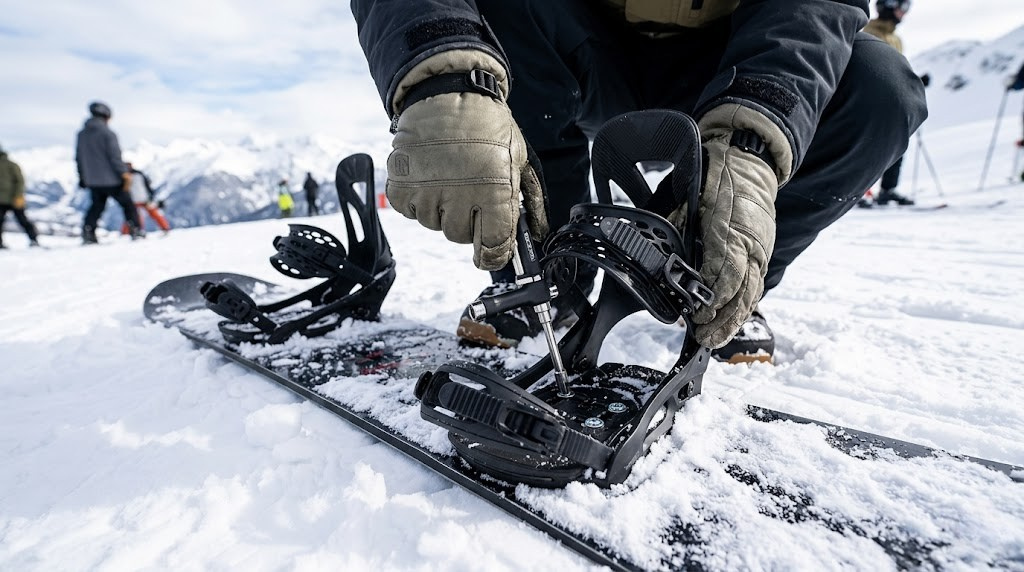
You’ve bought the board. You’ve got the boots. You even pulled the trigger on a proper set of bindings. But there’s one invisible lever between all that hardware and actual performance on snow — your stance setup. Get it right and every turn clicks into place, your body flows naturally, and riding feels like an extension of your own movement. Get it wrong and you’ll be fighting the board all day, developing bad habits, and wondering why snowboarding feels like such hard work.
This guide covers every meaningful variable in snowboard stance setup: width, angles, setback, centering, highback rotation, forward lean, canting, and the micro-adjustments that only experienced riders ever talk about. Whether you’re just choosing your first stance configuration or rebuilding from scratch after years on the wrong angles, you’ll find the exact numbers, the logic behind them, and a clear path to feeling absolutely locked in.
Before we touch a screwdriver, let’s acknowledge something crucial: there is no single perfect stance. What works is deeply personal — influenced by your height, inseam, hip width, riding style, terrain preference, and the specific board you’re riding. This guide will give you a methodology for finding your perfect stance, not some generic template designed for an average rider who doesn’t actually exist.
1. Why Stance Is Everything in Snowboarding
Your stance is the foundation of every physical interaction you have with your snowboard. It determines your center of gravity, the leverage you can apply to your edges, your ability to absorb terrain, how easily you can initiate turns, and critically — how much energy your body expends doing all of it. A well-dialed stance means your skeleton and the board’s geometry work together. A poor stance means your muscles are constantly compensating for mechanical disadvantage.
Think of it this way: a stance that places your weight distribution even 5% too far back creates a chain reaction. Your heel edge becomes sluggish to engage. Your toe edge gets too powerful. You develop a habit of leaning back “defensively,” which transfers to icy groomed runs where it becomes a liability. Conversely, too much forward weight creates an aggressive, nose-heavy feel that hunts on powder days and makes switch riding a nightmare.
FIG 1 — Stance foundation: front foot, back foot, width, and board axis orientation
The science behind why stance width and angles matter comes down to biomechanics. Your hip flexors, glutes, and knee stabilizers all operate at different efficiency levels depending on how wide your feet are and how your toes are pointed. Research in alpine sport biomechanics consistently shows that a stance within 10–15% of shoulder width produces the best combination of stability and mobility for most people — but the keyword is “most.” Body proportions vary enormously.
Understanding your stance also helps you get more out of your equipment. If you ride a directional board like those analyzed in our camber vs. rocker profile deep dive, the setback position of your stance interacts directly with how the camber engages underfoot. A centered stance on a directional board wastes some of its design intent.

2. Regular vs. Goofy Stance — Finding Your Natural Lead Foot
Before you can set anything else, you need to know which foot goes forward. This is the most fundamental decision in snowboarding, and it predates everything else. Ride regular means your left foot leads. Ride goofy means your right foot leads. Neither is better — it’s purely about which foot feels natural as your dominant, steering foot.
About 70% of snowboarders ride regular. But that statistic tells you nothing about which stance is right for you. There are several reliable tests for determining your natural stance. The sliding sock test (slide across a hardwood floor in socks — whichever foot naturally goes forward is your lead foot) has scientific backing. The skateboard push test and the “imagine running and sliding on ice” mental test both reliably identify lead foot preference.
FIG 2 — Regular (left foot forward) vs. Goofy (right foot forward) stance orientation
One nuance worth knowing: your skateboard or surfboard stance, while usually the same as your snowboard stance, isn’t guaranteed. Some people have split dominance — their lead foot for gliding is actually their non-dominant leg in other sports. If you’ve never snowboarded before, try both stances for a session before committing. Most rental shops will reset the binding orientation at no charge.
The implications of getting this wrong are significant. Riding on your non-natural lead foot means your stronger leg is in the back, which creates awkward turn initiation, poor edge-change timing, and exhausting compensatory muscle work. Our dedicated goofy vs. regular biomechanics breakdown covers the neurological basis of foot dominance if you want the full science.
3. Stance Width Deep Dive — The Numbers Behind the Feel
Stance width is the horizontal distance between the center of your front binding and the center of your rear binding. It’s measured in inches or centimeters along the board’s running length, and it’s the single most impactful measurement in your entire setup. Get this wrong and no amount of angle tweaking will fully compensate.
The Shoulder-Width Starting Point
The universal starting point for stance width is shoulder width. Stand naturally, measure from the outside of one shoulder to the outside of the other (this is usually done with a tape measure while relaxed, not tensed), and that number in inches becomes your starting stance width in inches between binding centers. Most adults land somewhere between 19 and 24 inches (48–61 cm).
This works because your shoulders define the outer boundaries of your natural center of gravity. A stance inside shoulder width concentrates weight unnaturally, reducing board leverage and making edge initiation twitchy. A stance significantly wider than shoulders creates over-leverage, increases knee torque, and tires out your inner thighs on longer runs.
FIG 3 — Stance width comparison: stability, mobility, and use case by width range
Adjusting from the Starting Point
The shoulder-width baseline is just a starting point. From there, you adjust based on several factors:
- Riding style: Park riders and butter specialists typically run 1–2 inches wider than shoulder width. This lowers the center of gravity and makes spins and presses more accessible. Carvers and racers sometimes go 1 inch narrower for sharper edge-to-edge transitions.
- Inseam length: If your inseam is unusually long relative to your height, your natural balance point may favor a slightly wider stance. Short inseam relative to height often means shoulder width works fine without adjustment.
- Board length and waist width: A longer board can support a wider stance without mechanical disadvantage. Always check that your stance doesn’t place bindings outside the recommended insert pattern on your board.
- Knee health: Riders with a history of knee issues should be especially careful not to go too wide. Extreme width concentrates lateral torque directly on the knee joint — notably the medial collateral ligament — under hard turns.
| Rider Height | Estimated Shoulder Width | Starting Stance Width | Park Adjustment | Carve Adjustment |
|---|---|---|---|---|
| 5’2″ – 5’4″ | ~16–17″ | 17–18.5″ | +1″ | –0.5″ |
| 5’5″ – 5’7″ | ~17–18″ | 18.5–20″ | +1.5″ | –0.5″ |
| 5’8″ – 5’10” | ~18–19.5″ | 20–21.5″ | +1–2″ | –1″ |
| 5’11” – 6’1″ | ~19–21″ | 21.5–23″ | +2″ | –1″ |
| 6’2″ – 6’4″ | ~21–22″ | 23–24.5″ | +2″ | –0.5″ |
One often overlooked factor: if you’re riding a board specifically designed around your stance (such as a flex-indexed board where the flex zones align with binding positions), deviating significantly from the manufacturer’s recommended stance range breaks the design intent. Always check your board’s recommended stance range when trying new width configurations. This applies especially if you’re riding performance boards covered in our directional vs. twin shape analysis.
4. Binding Angles Explained — Degrees That Change Everything
Binding angles tell each of your feet how much they’re rotated relative to the board’s centerline. A 0° angle means your foot points perfectly sideways, perpendicular to the board. Positive angles point your toes toward the nose. Negative angles point your toes toward the tail. This variable, more than any other, defines the “feel” of your stance and determines your natural body positioning during every turn, jump, and trick.
FIG 4 — Binding angle orientations: positive (toward nose), zero (perpendicular), negative (toward tail)
The Duck Stance
The most popular configuration in modern snowboarding is the duck stance: positive front angle, negative back angle. For example, +15°/–6°, +18°/–9°, or +15°/–15°. Duck stance gets its name because your feet splay outward like a duck’s feet — both toes pointing away from the board’s centerline.
Duck stance became dominant for several compelling reasons. First, it makes riding switch (backwards) much more natural since neither foot is dramatically more forward-facing. This is essential for freestyle riding, park laps, and trick progression. Second, it distributes lateral load more symmetrically across both knees, reducing the torque differential between your front and back leg during hard turns.
Understanding the Front Angle
Your front binding angle directly influences how your hips open toward the nose during heel-edge turns, and how much you naturally rotate into toe-edge turns. Higher positive front angles (21–24°) promote a very open hip position and are favored by carvers who want maximum leverage over the toe edge on steep terrain. Lower positive front angles (9–15°) work well for all-mountain and freestyle riders who want more lateral hip mobility.
There’s an important anatomical variable here: hip external rotation range. If you have naturally wide hip external rotation (you can comfortably sit cross-legged with deep hip flexion), you can run lower front angles comfortably. If your hips are tight — common in many adult beginners — slightly higher front angles will feel more natural without requiring forced hip rotation. Consider this especially if you’re transitioning from skiing, where your hips are always forward-facing.
Understanding the Back Angle
The back foot is your power foot — it drives the tail through turns and initiates most of the “pop” for jumps and ollies. The back binding angle affects how naturally your knee tracks over your foot during loading and unloading movements.
Strong negative back angles (–12° to –15°) are common in park riders because they make switch tricks and spins feel balanced. However, very deep negative back angles on riders without corresponding external hip rotation can create valgus knee stress — where the knee collapses inward during turns. If you regularly experience inner knee discomfort, your back angle may be too negative for your anatomy.
The Forward Stance for Carving and Alpine
Some riders — particularly dedicated carvers, alpine boarders, and those who rarely ride switch — prefer a fully forward stance where both angles are positive. A +24°/+9° or +27°/+12° setup dramatically improves toeside leverage and allows a much more “skier-like” body position during carved turns. The tradeoff is riding switch becomes noticeably less comfortable and the body position feels less natural for flat ground or slow terrain.
For those exploring carved turns, our edge control and angulation guide explains exactly how your stance angles translate to carved turn mechanics.

5. Setback & Centering — Positioning Your Stance on the Board
Once you know your width and angles, you need to decide where along the board’s length to position your stance. This is determined by two related measurements: stance centering (how centered your stance is between the nose and tail) and setback (how far your stance is shifted toward the tail from a perfectly centered position).
FIG 5 — Setback positions: centered (twin/park), mild setback (all-mountain), deep setback (powder/directional)
Why Setback Matters
Setback shifts your weight distribution toward the tail of the board. Even 1.5 cm of setback noticeably increases the effective nose float — the board’s tendency to rise above snow — which matters enormously in powder conditions. It also makes the tail more responsive to pressing and reduces the nose’s tendency to dive through variable snow.
A perfectly centered stance on a true twin board makes both ends of the board behave identically, which is ideal for park riding and anything where switch riding is important. As soon as you introduce setback, you’re prioritizing forward riding performance over switch riding symmetry.
Setback Guidelines by Board Type
| Board Type | Recommended Setback | Why | Riding Context |
|---|---|---|---|
| True Twin (park/jib) | 0 – 0.5 cm | Symmetrical feel for switch tricks | Park / Street |
| Directional Twin (all-mtn) | 1 – 2.5 cm | Slightly more nose float without killing switch | All-Mountain |
| Directional (resort/carve) | 2 – 3.5 cm | Weight back for control on steep groomed terrain | Freeride |
| Powder / Floaty | 3 – 6 cm | Maximum nose float in deep snow | Powder / Backcountry |
| Splitboard | 2 – 4 cm | Similar to powder boards; board design handles the rest | Backcountry |
Note that some boards, especially powder-specific shapes, have the insert pattern set back from factory. When you “center” your stance on these boards, you’re actually already running significant setback relative to the board’s total length. Always read your board’s manual or check the insert hole pattern to understand where “centered” actually sits.
If you ride a board with strong camber underfoot — as explored in our camber vs. rocker profile comparison — setback interacts with where the camber peak sits under your feet. Positioning your back binding over the peak camber point maximizes pop and energy return. Most board designers build this into the recommended stance range, which is another reason to stay within those guidelines.
6. Complete Stance Presets by Riding Style
Now that we’ve covered each individual variable, let’s bring them together into complete stance profiles for the five major riding disciplines. These are starting points — real-world fine-tuning always comes on snow — but they’ll get you within two sessions of your optimal setup.
FIG 6 — Complete stance presets for five major riding disciplines at a glance
All-Mountain Preset
The all-mountain preset is the most versatile and forgiving. Shoulder-width stance, a moderate duck angle of +18°/–6° to +15°/–9°, and 1.5–2 cm of setback covers groomed runs, natural terrain, light park, and soft powder days without any single weakness becoming painful. Most all-mountain riders check back in at this baseline after experimenting elsewhere.
Pair this with an all-mountain binding like those reviewed in our affordable all-mountain bindings guide, and you’ll have a complete platform that doesn’t fight you in any condition.
Park / Freestyle Preset
Park riding demands symmetry. True duck (+15°/–15° or +12°/–12°) and a centered stance lets you land switch, initiate spins equally in both directions, and approach rails, boxes, and kickers without your body compensating for directional bias. Width runs 1–2 inches wider than shoulder to lower the center of gravity for landings.
Park Stance Pros
- Identical switch and regular feel
- Lower CG = more stable landings
- Even hip loading through spins
- Natural body position for presses
Park Stance Cons
- Deep negative back angle can strain knees
- Less efficient for long groomed runs
- Wider width tires inner thighs faster
- Hard turns feel less powerful
Freeride / Powder Preset
Deep setback (3–6 cm), a slightly forward front angle (+18–21°), and minimal back angle negativity (–3° to 0°) optimize your body position for the backseat riding required in deep snow. This preset biases the nose float, allows aggressive tailing through powder fields, and keeps your hips naturally open toward the nose — where you’re looking and steering.
If you’re heading into serious backcountry terrain, read our backcountry safety protocol guide alongside this stance setup — because proper gear setup and mountain awareness go hand-in-hand.
Carving Preset
Carving requires angular precision. Narrower-than-shoulder width reduces the lever arm between your bindings, which translates to sharper, more responsive edge transitions on hardpack. High positive angles on both feet (+24°/+9° or even +27°/+12°) lock your hips into a forward-facing position that drives your core weight over the toe edge — the dominant power edge in carved toeside turns.
Plate bindings and hard boots take this further, but even with traditional strap bindings, a strong forward stance dramatically improves carved performance. Learn the full carving technique mechanics in our carving edge control guide.

7. Binding Hardware Setup — Discs, Straps, and Tools
Setting stance isn’t just about angle numbers on a chart. The physical process of mounting and adjusting your bindings involves several hardware components, each with their own setup considerations. Getting this mechanical layer right ensures your dialed angle settings actually transfer to the snow the way you intended.
FIG 7 — Binding hardware anatomy: disc, baseplate, highback, toe strap, and ankle strap
The Mounting Disc System
Modern snowboard bindings use a rotating disc system to set stance angle. The disc sits in the center of the baseplate and connects to the board’s insert holes via 4 screws. The disc has degree markings — typically in 3° increments — that you align to your desired angle before tightening the screws. This is the actual angle adjustment mechanism.
Most bindings ship with a 3° or 6° disc (the most common increment), but some premium bindings offer 1° discs for ultra-fine adjustment. When setting your angle, always cross-tighten the four mounting screws (tighten opposite corners alternately) to ensure the disc sits flat and all four screws reach their final torque at approximately the same time. Loose mounting screws are a significant safety issue — the binding can shift during hard landings.
Insert Hole Patterns
Snowboards come with one of three dominant insert systems: 4×4 (standard holes in a 4×4 grid), the Burton 3D (triangular pattern with a 3-hole layout), and EST (Channel system, Burton exclusive). These determine which bindings are compatible with which boards.
| Insert System | Pattern | Stance Increment | Compatible Brands | Notes |
|---|---|---|---|---|
| 4×4 | 4-hole grid, 4cm spacing | 2–4 cm width increments | Universal (non-Burton) | Most common, maximum compatibility |
| Burton 3D | Triangular, 3 holes | 3 cm increments | Burton bindings | Requires specific Burton disc |
| The Channel (EST) | Continuous channel | Any width (infinite adjustment) | Burton EST & Re:Flex | Allows minute stance tweaks; Burton boards only |
Required Tools and Torque Specs
You need a #3 Philips screwdriver (or a proper snow tool with a #3 bit) for standard 4×4 binding screws. Many bindings now use T10 or T15 Torx bolts, so having a full snowboard tool is valuable. Binding screws should be tightened to approximately 3–4 Nm — firm but not overtightened. Over-torquing can strip the threaded insert in the board’s core, which is an expensive repair.
Apply a small drop of blue Loctite (medium-strength threadlocker) to each mounting screw before final tightening. This prevents vibration-induced loosening during riding without making the screws impossible to remove later. Never use red Loctite on binding screws — it bonds permanently and you’ll tear out the insert trying to remove them.
8. Highback Rotation & Forward Lean — The Underrated Variables
Most riders spend time dialing width and angles but almost no time on their highbacks. This is a mistake. Highback rotation and forward lean significantly affect how responsive your heel edge feels, how much ankle flex you have, and whether your back knee tracks properly over your back foot during turns.
FIG 8 — Highback positions: no rotation (misaligned), rotated-aligned (optimal), forward lean (aggressive edge engagement)
Highback Rotation
Highback rotation refers to rotating the highback so its spine aligns with the angle of your binding. If your back binding is set to –9°, your highback’s center spine should point 9° toward the tail (matching the binding angle). Most bindings have a small rotational adjustment screw or clip on the side of the highback that enables this adjustment.
Without proper highback rotation, the highback pushes against the wrong part of your calf during heel edge turns. The result is either dead spots in heel edge response or uncomfortable lateral calf pressure that causes bruising on long days. Proper alignment is one of the quickest wins available to most recreational riders — and one of the most commonly ignored adjustments.
Forward Lean
Forward lean is the angle at which the top of the highback leans toward the nose of the board when locked in. Zero forward lean means the highback is perpendicular to the board — upright and neutral. High forward lean (15–20°) means the highback is leaning significantly forward, preloading your ankle into a flexed position and making heel edge initiation much more direct and powerful.
Forward lean preferences break down broadly by riding style:
- Park / Freestyle: 0–5° forward lean. Maximum ankle flex and mobility for pressing, buttering, and landing tricks. More lean restricts the range of motion needed for creative riding.
- All-Mountain: 5–12° forward lean. Balanced between mobility and edge response. Allows good heel edge leverage without sacrificing the ability to flex deeply through moguls or variable terrain.
- Freeride / Carving: 10–20° forward lean. Aggressive preload translates immediately to powerful heel carves. Leg fatigue increases at higher lean settings, so build toward this gradually.
9. Fine-Tuning Your Stance on Snow — The Feedback Loop
Numbers on a workbench are just a starting point. The real stance calibration happens on snow, through a deliberate process of riding, feeling, and adjusting. This process typically takes 2–3 sessions and requires you to be honest with yourself about what you’re feeling versus what you think you should be feeling.
FIG 9 — The stance calibration feedback loop: ride, feel, adjust one variable, repeat
The One-Variable-at-a-Time Rule
The most common mistake in stance tuning is changing multiple variables at once. If you move your width, change your front angle, and increase your setback all in the same session, you have no idea which change produced which result. The discipline of changing exactly one variable per session is what separates purposeful stance dialing from random thrashing.
Start with width. If width feels wrong, nothing else will feel right regardless of how well your angles are set. Once width feels natural — your knees track over your feet in a comfortable athletic position and turns don’t feel like they require effort to initiate — lock it in and begin adjusting angles.
Diagnostic Checklist: Symptoms and Fixes
| Symptom on Snow | Likely Cause | Fix |
|---|---|---|
| Toes catching on heel turns | Stance too wide or overhang | Narrow width or adjust angles to reduce overhang |
| Heels catching on toe turns | Same as above | Same fix; check boot-to-binding fit too |
| Inner knee pain (medial) | Back angle too negative for anatomy | Reduce back angle negativity by 3–6° |
| Lower back fatigue / pain | Stance too wide + forward lean too high | Narrow slightly; reduce forward lean 3–5° |
| Heel edge feels mushy/slow | Forward lean too low or highback misaligned | Increase forward lean 3–5°; fix highback rotation |
| Nose diving in powder | Not enough setback | Increase setback 1–2 cm |
| Feels stiff, can’t press | Forward lean too high + angle too aggressive | Reduce forward lean; soften angle if carving-oriented |
| Switch feels completely different from regular | Stance not duck enough / asymmetric angles | Balance duck symmetry; bring back angle more negative |
| Quad burning on short runs | Stance too narrow; center of gravity too high | Widen slightly; check forward lean isn’t too aggressive |
Also consider your boots in this equation. A stiff boot with too much forward lean can make a moderate forward lean binding setting feel extreme. Conversely, a soft boot may need more forward lean to achieve the same heel edge response. Our deep dive on snowboard boot flex and kinetic response explains how boot stiffness interacts with binding setup.
10. The 10 Most Common Snowboard Stance Mistakes (and How to Fix Them)
After thousands of riders have gone through the stance dialing process, certain mistakes repeat themselves so consistently they deserve their own section. Here’s what to watch for.
Mistake 1: Copying a Pro’s Stance Without Anatomical Context
Travis Rice runs +15°/–15° and 23″ wide. Shaun White rode +21°/+6° for most of his career. These setups reflect their specific bodies, years of adaptation, and competitive priorities. Copying them without considering your own hip mobility, inseam, and riding goals is a recipe for discomfort. Use pro stances as data points, not templates.
Mistake 2: Not Adjusting Between Board Models
If you run the same stance on a stiff directional freeride board as on a soft park twin, you’re leaving performance on the table. The optimal stance is board-specific. When you buy a new board — or demo one — always set up the stance fresh rather than assuming your previous settings transfer. This connects especially to our analysis of how directional vs. twin shape affects control.
Mistake 3: Ignoring Boot Overhang
Boot overhang is how much your boot extends beyond the edge of the board. Too much overhang and your boot scrapes the snow during turns before your edge fully engages — a phenomenon called “boot drag” that ruins carved turns at high lean angles. The ideal overhang is 1–1.5 cm on each side. More than 2 cm and you need to either angle your bindings more aggressively, get a narrower board, or accept the limitation. If you have wide feet, check our wide-feet boot guide for boards with appropriate waist widths.
Mistake 4: Running the Same Stance in All Conditions
Your optimal stance in groomed resort conditions isn’t identical to your optimal stance for a powder day in the backcountry. Carry a tool and don’t hesitate to add 1–2 cm of setback when you arrive at a resort with reported 30+ cm of fresh. Having your stance setup kit ready is one of the signs of a thoughtful rider, like having a quality packed bag for every condition.
Mistake 5: Overtightening Mounting Screws
We mentioned this in the hardware section, but it bears repeating: stripped inserts are expensive and often unfixable without serious repair. Three to four Nm is the correct torque — just firm. If you’re using a manual screwdriver (rather than a torque-limited tool), the “snug but not straining” feel is the right stopping point.
Mistake 6: Setting Up Angles Without Testing Hip Mobility
Before you finalize your angle settings, do a simple hip mobility assessment: stand at shoulder width, toes pointed at your intended front angle, and attempt a deep squat. Does your front knee track over your second toe? Do your hips stay level? If not, either your angle is too low (hips won’t open enough) or your hip flexors need specific stretching before angles that aggressive will feel natural. Injury prevention starts here — see our snowboarding injury prevention guide for the full pre-season mobility work.
Mistake 7: Forgetting Canting
Canting is the inward or outward tilt of the footbed relative to the board’s horizontal plane. It’s a more advanced adjustment than angle or width, but it matters for riders with knock knees, bow legs, or natural pronation. Some bindings offer adjustable canted footbeds. If you’ve correctly set everything else and still experience persistent knee tracking issues, canting may be the missing piece.
Mistake 8: Too Much Negative Back Angle for the Riding Level
Deep negative back angles look cool and match what many park footage shows, but they require significant hip flexibility to execute safely. Beginner and intermediate riders who run –15° or more on their back binding often develop compensatory movements — specifically a “twist and lunge” initiation pattern that’s inefficient and hard on the lower back. Start with –6° or –9° and only go deeper once your technique is solid.
Mistake 9: Not Adjusting When Switching Boot Models
A stiffer boot with more built-in forward lean changes the effective forward lean of your entire setup even if you haven’t touched your bindings. When you buy new boots, spend a session recalibrating your stance feel before committing to the new normal. Our reviews of K2 boot construction and Vans boot liner compression detail how significantly different boot architectures feel underfoot.
Mistake 10: Never Reassessing After a Season
Your body changes. Fitness levels, hip mobility, strength imbalances, and riding style evolution all affect your optimal stance over time. The stance you dialed in three seasons ago may no longer match the rider you are today. Make an annual reassessment part of your pre-season checklist alongside pre-season fitness preparation.
11. Stance Setup for Kids and Beginners
Beginner stance setup has its own specific priorities. For new riders, the stance needs to minimize the learning curve — not optimize for advanced performance characteristics. This means more emphasis on stability, less emphasis on efficiency.
FIG 10 — Recommended beginner stance: shoulder width, +15°/0°, 1–1.5 cm setback, low forward lean
Why Beginners Should Ride Close to Forward Stance
New riders spend most of their time on their heel edge — it’s more intuitive to brake with your heels digging in. A moderately forward front angle (+15° to +18°) makes heel turns more natural from day one because your hips face slightly toward the nose, which is where you’re looking and where you need to steer.
Very deep duck stances (+15°/–15°) look cool and match what you see in park videos, but they create hip-opening confusion for beginners who are still trying to sort out which way their body should face in a turn. Keep the back angle minimal (–3° to 0°) until basic turns are comfortable.
Kids’ Stance Specifics
Children have proportionally wider hips relative to their shoulder width compared to adults, which often means their natural stance runs a bit wider relative to shoulder width. Start at shoulder width and allow them to go 0.5–1″ wider if they seem more comfortable. For very young riders (under age 8), rental stance setups are almost always fine — their bodies are adaptable enough that precise setup matters far less than having fun and staying safe. Our guide on the best age to teach children to snowboard covers the full developmental readiness picture.
For older kids and teenagers entering their growth phase, check stance width annually. A 12-year-old who was comfortable at 18″ may need 20″ by their next season simply due to hip development. The same goes for boot overhang — foot size changes fast during growth spurts.

12. Advanced Stance Topics — Canting, Step-On Systems, and Split Setup
For riders who’ve mastered the fundamentals and want to push further, these advanced stance considerations address specific technical scenarios and modern binding systems.
Canting and Lateral Footbed Tilt
Canting is the lateral tilt of the footbed — essentially whether your footbed tilts your foot slightly inward (medial cant) or outward (lateral cant). The goal is to align the natural angle of your tibia with the footbed, which places your knee directly over your second toe in your athletic stance on the board.
Riders with natural valgus (knock-knee) alignment typically benefit from slight medial canting (inside of foot slightly higher). Riders with varus (bow-legged) alignment often benefit from slight lateral canting. Off-the-shelf orthotic insoles designed for your particular alignment can achieve canting even when bindings don’t offer the adjustment. Addressing lower limb alignment issues here can prevent the knee pain patterns that plague many intermediate and advanced riders — see our heel lift and insole guide for related solutions.
Step-On and Boa Systems
Step-On bindings (Burton’s three-point clip system) and Boa-laced boots change the stance equation in one important way: they make on-the-fly adjustments easier. The mechanical connection between boot and binding is direct and instantaneous, but stance adjustment — width, angle, setback — is still a manual process on the board’s inserts.
If you’re using a Step-On system, all the same stance principles apply. The key additional consideration is boot fit quality, because Step-On relies on the boot’s sole features (cleat positions) for the three-point connection — a boot that fits poorly won’t clip securely. Our Burton Step-On analysis covers the full three-point connection mechanics and sizing considerations.
Splitboard Stance Setup
Splitboards require a unique stance consideration: the binding system must work in both tour mode (forward-facing, ski-like) and ride mode (standard snowboard position). Most splitboard binding systems achieve this through a rotating interface that locks in two positions. In ride mode, all standard stance setup principles apply.
The additional complication is that touring efficiency benefits from a more forward-facing stance in tour mode, which is why many splitboarders run slightly higher positive angles (closer to +21° front) than comparable resort riders — it makes the touring movement pattern feel more natural. If you’re venturing into backcountry splits, our splitboard fundamentals guide covers the full system in context.
The Asymmetrical Board Consideration
Asymmetrical snowboards have different effective edge lengths, turning radii, and flex properties on the heel side versus the toe side — designed around the biomechanical difference between how your toes and heels initiate turns. If you’re riding an asymmetrical board, the manufacturer’s recommended stance angles aren’t just suggestions — they’re calibrated to match the asymmetrical design. Running significantly different angles on an asymmetrical board can actually negate its design advantage. Read more about why asymmetrical snowboards work before adjusting their stance.
Frequently Asked Questions
For beginners, shoulder width is the best starting point for stance width. Measure the outside of your shoulders and match that measurement in inches between the centers of your front and rear bindings. This gives you a stable, balanced foundation without creating knee torque or over-leveraging the edges. Most adult beginners land between 19–22 inches. Start there and widen slightly (half an inch) if turns feel unstable, or narrow (half an inch) if heel and toe edges feel equally slow to respond.
The most popular all-mountain binding angle configuration is +18°/–6° (front/back). This duck stance configuration provides good switch riding capability, natural hip opening for heel turns, and responsive toe edge control without the knee stress of deeper negative back angles. Riders who prefer more forward-oriented all-mountain riding can go +21°/–3° or +21°/0°, which improves heel edge power and long-radius carving at the expense of switch comfort. Start at +18°/–6° and adjust from there based on what feels most natural after 2–3 sessions.
For powder riding on an all-mountain or directional twin board, 2–3.5 cm of setback is a good powder-day adjustment. On a dedicated powder or freeride directional board, these boards typically ship with their insert pattern already set back, and you may run “centered” on those inserts (which equates to 3–6 cm of physical setback from the board’s actual center). The goal is enough nose float to prevent the tip from diving. If you’re sinking too much, try another 1 cm of setback. Avoid going beyond 5–6 cm on most boards — extreme setback makes flat terrain and groomed runs feel awkward and unbalanced.
The most reliable test for determining your natural stance is the sliding sock test: put on socks on a smooth hardwood or tile floor, take a running start, and slide. Whichever foot instinctively goes forward to lead the slide is your front foot. Regular riders lead with their left foot; goofy riders lead with their right. Other good tests include asking someone to push you gently from behind unexpectedly — the foot you step forward to catch yourself is your lead foot. Skateboard or surfboard stance also correlates with snowboard stance for most people (around 90%+ consistency).
Yes — stance setup is one of the most common contributors to snowboard-related knee pain. The most frequent culprits are (1) a back binding angle that’s more negative than your hip external rotation can accommodate, creating inward knee valgus under load; (2) a stance that’s too wide, which increases lateral knee torque on every turn; and (3) poor highback alignment that forces your knee out of its natural tracking path. If you’re experiencing medial (inner) knee pain, reduce your back binding’s negative angle by 3–6° and check your highback rotation. If you experience general knee fatigue, try narrowing your stance by half an inch and see if that relieves pressure.
A duck stance is a binding angle configuration where the front binding has a positive angle (toes pointing toward the nose) and the rear binding has a negative angle (toes pointing toward the tail). The result is both feet splaying outward, resembling a duck’s feet — hence the name. For example, +15°/–9° or +18°/–6° are typical duck stances. Duck stance became the dominant freestyle and all-mountain configuration because it makes riding switch (backward) more natural, distributes lateral loading more symmetrically across both knees, and creates a more centered, versatile body position compared to fully forward stances used in carving and alpine snowboarding.
Binding straps should be snug but not circulation-restricting. The ankle strap should secure your heel firmly in the binding’s heel cup — no heel lift during hard push-off — without pressing so tight that you feel numbness or tingling. The toe strap or cap should hold the toe box of your boot against the binding’s toe wall without deforming the boot. A simple test: with straps buckled at your normal riding tightness, you should be able to slide one finger under each strap. If you can’t, loosen slightly. If your foot shifts inside the binding during hard turns, tighten the ankle strap first. Avoid overtightening toe straps, which can restrict natural forefoot flex and cause arch pain.
You should check your binding mounting screws every riding day — vibration and impact can loosen them. For the stance configuration itself (width, angles, setback), a full reassessment is valuable at the start of each season, whenever you buy new boots or a new board, and any time you notice persistent discomfort or performance issues. Many intermediate and advanced riders also make condition-specific adjustments — adding setback for powder days, changing angles when switching between park and freeride sessions. Carrying a snow tool and checking the board before you ride rather than halfway through the day is a simple discipline that pays dividends.
Highback rotation is the adjustment that rotates the spine of the highback to align with your binding’s angle setting. It genuinely matters. When your highback is not rotated to match your binding angle, the highback pushes against the wrong part of your calf muscle and Achilles region during heel edge turns. This creates a pressure point rather than even support, and it delays heel edge response because the force pathway through your leg is inefficient. To check alignment: look at the highback from above — its center spine should point along the same line as your foot when the binding is at its set angle. Most bindings have a rotation screw on the highback’s side plate. It’s a 30-second adjustment that riders consistently report as one of the most impactful they’ve ever made.
You don’t need to physically change your stance for switch riding — that’s the entire point of a duck stance. However, if you find switch riding especially difficult, the most effective stance adjustment is to make your duck stance more symmetrical. This means matching your front and back angles in absolute value — for example, if your front is +15°, change your back from –6° to –15° for true symmetry. Also ensure your stance is perfectly centered (zero setback) on a twin board if switch is a priority. The closer your duck is to perfectly symmetrical and the more centered your stance, the more identical regular and switch riding will feel.
Conclusion: Your Stance Is a Living Setup
There is no final perfect stance. The riders who ride best have gone through dozens of iterations — small adjustments, careful observation, and honest assessment on snow. What you’ve learned in this guide gives you the framework to make those adjustments intelligently rather than randomly.
Start with your natural foot forward. Set your width at shoulder measurement. Choose a moderate duck stance appropriate for your riding style — +18°/–6° for all-mountain is a near-universal starting point. Add 1–2 cm of setback unless you’re a pure park rider. Set your highback rotation to match your binding angle. Apply 5–10° of forward lean depending on your preference for heel edge response. Then go ride.
After 2–3 sessions, come back to this guide’s diagnostic table. Identify the one thing that feels most wrong and adjust only that variable. Repeat. By mid-season, you’ll have a stance that feels like it was built specifically for you — because through this process, it genuinely was.
Pair your dialed stance with quality gear — see our complete bindings guide, best boots guide, and snowboard sizing guide — and you’ll have a complete platform that does exactly what you need it to do every time you strap in.
Ready to Build Your Perfect Setup?
Explore our complete gear guides and find the boards, bindings, and boots that match your newly dialed stance configuration.
Explore Gear Guides →


