
The Ultimate Snowboard Comparison: Five Elite Boards Tested & Ranked
Burton Process · Lib Tech T.Rice Pro · Jones Flagship · CAPiTA Mothership Connection · CAPiTA Resort V2 — which one deserves your mountain?
Overview: What We’re Comparing — and Why It Matters
Choosing a snowboard isn’t a quick decision. The market is flooded with options from hundreds of brands, and every season brings new technologies, updated graphics, and revised construction methods that can radically change how a board rides. If you’ve been trying to cut through the noise and actually understand how the best boards compare on the mountain, this is the snowboard comparison you’ve been waiting for.
In this guide, we take five of the most talked-about boards on the mountain — the Burton Process, the Lib Tech T.Rice Pro, the Jones Flagship, the CAPiTA Mothership Connection, and the CAPiTA Resort V2 — and break them down in exhaustive detail. We examine construction, profile, flex, terrain suitability, edge hold, pop, float, and real-world feel so you can make an educated decision before you spend your hard-earned cash.
Whether you’re an intermediate rider graduating to a higher-performance deck, an advanced all-mountain shredder looking for a quiver upgrade, or a powder hunter seeking that one board that can do it all, this guide covers every angle. We’ve also linked in expert analysis on specific technologies like camber vs. rocker profiles and directional vs. twin shapes throughout the article so you can go deeper on any concept that catches your interest.
Snowboard Buying Guide: What to Know Before You Shop
Before diving into individual board reviews, let’s cover the fundamentals that will help you evaluate every board in this comparison — and any board you consider in the future. Understanding these variables makes the difference between a board that transforms your riding and one that collects dust.
Shape: Twin vs. Directional
A true twin board is perfectly symmetrical nose-to-tail, making it equally comfortable going regular or switch. This is the foundation for freestyle and park riding. A directional board has a longer nose and shorter tail, with more surface area in front — ideal for powder float and freeride performance. Directional twin boards split the difference with a slightly set-back stance location but near-symmetrical shape. Our guide on directional vs. twin snowboards goes much deeper on this topic.
Camber Profile
The profile of a snowboard — how it arches or curves when unweighted — dramatically affects its ride character. Traditional camber provides power, edge hold, and pop. Rocker (or reverse camber) delivers a playful, catch-free feel with great float. Most modern boards use hybrid profiles that blend both. See our deep-dive on camber vs. rocker for the full breakdown.
Flex Rating
Flex is measured on a scale of 1–10 (softest to stiffest). Softer boards (1–4) are forgiving, easier to butter, and ideal for park and beginners. Medium flex (4–6) suits all-mountain versatility. Stiff boards (7–10) reward aggressive riders with powerful edge hold and high-speed stability. The key is matching flex to your weight, ability level, and preferred terrain.
Sizing
Snowboard length affects stability, maneuverability, and float. Heavier or faster riders benefit from longer boards; park riders often prefer going shorter. Width must accommodate your boot size to prevent heel and toe drag. Our snowboard sizing guide covers this in detail.
- Size right for your body: Board length should typically reach between your chin and nose. Always check the manufacturer’s weight range recommendation for your specific model.
- Match flex to your skill: Beginners benefit from softer flex. Advanced riders charging groomers and cliffs need stiffer boards for stability and response.
- Think about your terrain: Park and jib riders want twin shapes. Backcountry and pow enthusiasts need directional designs with setback stance and taper.
- Invest in quality construction: Sintered bases last longer and go faster. Wood core blends affect pop and dampening. These details matter for longevity and performance.
- Don’t ignore binding compatibility: Some boards use proprietary mounting systems (like Burton’s The Channel™). Make sure your bindings are compatible before purchasing. See our guide on snowboard bindings.
Burton Process Snowboard — Deep Dive Review

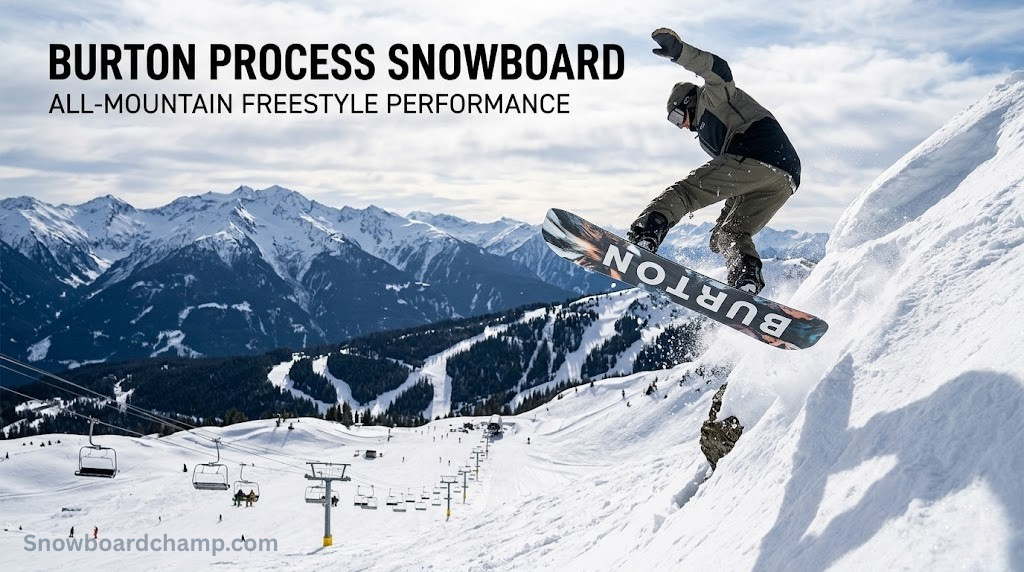
The Burton Process has earned its reputation as one of the most balanced and capable all-mountain freestyle boards on the market. Developed in collaboration with World Champion rider Mark McMorris, it’s the kind of board that genuinely does everything you ask of it — from slapping rails in the park to hunting side-hits in the trees to making buttery carves on morning groomers before the crowds arrive.
At the core of the Process is Burton’s Super Fly II 700G wood core with Squeezebox profiling. This technology thins out the core between the inserts and thickens it underfoot, channeling energy to the tip and tail for explosive snap and enhanced stability exactly where you need it most. The core is complemented by a Carbon Highlights fiberglass layup — a 60°/45° dual-angle fiber arrangement that provides torsional responsiveness alongside a full tip-to-tail carbon layer that fine-tunes the overall ride without adding weight.
Shape and Profile
The twin shape ensures perfect symmetry for freestyle riding, switch landings, and buttering. The PurePop Camber profile is an evolution of traditional camber: it features subtle flat zones just outside the binding inserts that soften the transition between carving power and catch-free playfulness. Beyond those flat zones, the nose and tail have early rise sections that make the Process remarkably forgiving in variable terrain while preserving the lively pop that camber boards are known for.
This is why the Process sits in a sweet spot between a dedicated park board and an all-mountain ripper. It’ll happily huck kickers and stomp switch landings, but it also holds a confident edge on hardpack and tracks cleanly through chop. Understanding the nuances of board profile selection is key to appreciating this design — and our article on camber vs. rocker profiles breaks down exactly why Burton’s hybrid approach works so well for versatile riders.
Performance on the Mountain
On groomed runs, the Process feels confident and precise at moderate speeds. It initiates turns easily without feeling loose, and the PurePop profile gives you a satisfying spring out of each carve. It’s not a race board — it won’t lock into aggressive high-speed trenches the way a full-camber freeride deck will — but for the vast majority of resort riding situations, it’s absolutely capable. One limitation reviewers consistently note is that the board becomes slightly unstable at very high speeds; it’s best enjoyed at a moderate-to-fast, playful pace rather than being pushed to absolute velocity limits.
In the park, the Process genuinely earns its Pro model credentials. The twin flex is perfectly symmetrical from tip to tail, meaning butters, presses, and nose/tail tricks feel equally effortless regardless of which end you’re working. Pop off kickers is lively and predictable, and the board rewards good technique without punishing minor errors.
Off the groomers, the Process handles moderate powder reasonably well for a twin, though its minimal setback means it’s not a dedicated powder board. It won’t swim on deep days the way a directional board would, but it’ll get through most resort-depth powder confidently. In choppy, heavy, or wet snow conditions, the Process can feel a little active underfoot — this is a characteristic of its poppy, energy-transferring core rather than a flaw per se.
Construction Quality
The sintered base on the Process is fast, durable, and holds wax beautifully. The Dual Zone Engineered Grain Direction (EGD) in the core improves overall grip and response, while the Trix glass construction stiffens the torsional feel for precise underfoot feedback. Build quality across Burton’s Process line is consistently excellent, and the Channel™ mounting system remains one of the most versatile and user-friendly binding interfaces available — compatible with all major binding brands, not just Burton’s.
- Exceptional all-mountain freestyle versatility
- Lightweight Super Fly II 700G core
- Lively, predictable pop on ollies and kickers
- Burton Channel™ system fits all major bindings
- Sintered base — fast and wax-friendly
- Balanced twin flex for switch and regular riding
- Mark McMorris pro model credentials
- Feels unstable at very high speeds
- Not ideal for deep powder (minimal setback)
- Bucks slightly in thick, messy snow
- Not suited for pure beginners
- Can feel somewhat “average” at the top end for experts
Lib Tech T.Rice Pro — Deep Dive Review

The Lib Tech T.Rice Pro is one of the most celebrated snowboards of the modern era, and for good reason. Designed with the input of Travis Rice — widely considered the greatest all-mountain and big mountain snowboarder alive — this board has been refined over decades into a machine that performs brilliantly on every conceivable surface. Its legendary reputation is built on two innovations that changed the snowboard industry forever: Magne-Traction® edge technology and the Hybrid C2 Camber profile.
What makes the T.Rice Pro genuinely special in a crowded market is how it manages to combine freestyle agility with freeride capability. It’s a board that can rip park laps in the morning, charge powder stashes through the trees at noon, and hold a razor edge on groomed hardpack in the afternoon — without making any of those things feel like a compromise. That said, this board is built for capable riders. It rewards good technique and punishes poor form, making it best suited to intermediate-advanced and advanced riders looking for genuine growth potential from their equipment.
Magne-Traction: The Edge Technology That Changed Everything
Magne-Traction features seven strategically placed serrations along the running edge — similar in concept to the cutting edge of a steak knife. Each serration creates an additional contact point with the snow surface, dramatically improving grip on hard-packed snow and ice. The beauty of this technology is that it works without requiring a stiffer flex or more aggressive camber. You get the edge hold benefits without sacrificing float or playfulness. For riders who deal with icy East Coast conditions, variable mountain terrain, or the kind of firm, wind-affected snow you find on exposed ridgelines, Magne-Traction is a genuine game-changer.
Comparing edge technologies across brands is something we cover in depth when discussing GNU’s own Magne-Traction implementation — since both companies sit under the Mervin Manufacturing umbrella — but the T.Rice Pro’s application is particularly dialed for aggressive all-mountain use.
Horsepower Core Construction
The HP (Horsepower) core is a 60/40 blend of aspen and paulownia wood. Aspen provides strength and pop; paulownia reduces weight without sacrificing structural integrity. The result is a core that feels lively and energetic underfoot without the weight penalty that comes with denser wood blends. Surrounding the core is a Tri-Ax/Bi-Ax glass layup with basalt alloy stringers. The Tri-Ax orientation creates torsional responsiveness; the Bi-Ax builds in pop, stability, and forgiveness. The basalt stringers absorb chatter and vibration without adding significant mass — giving the T.Rice Pro a notably smooth, planted ride even when snow conditions deteriorate.
Hybrid C2 Camber Profile
The Hybrid C2 profile combines camber underfoot with subtle rocker zones toward the tip and tail. This means you get the grip, power, and edge precision of camber exactly where it matters most — between your feet — while the rocker zones in the nose and tail prevent catching edges on variable terrain and add a touch of float in powder. It’s a more nuanced profile than pure camber, and it rewards riders who’ve developed a balanced, centered stance. For those still working on edge control, this profile is more forgiving than true camber while still providing genuine response and snap.
The board’s performance in icy conditions is particularly noteworthy. Even when riding hard-pack with minimal give, the T.Rice Pro tracks confidently and initiates turns with authority — the combination of Magne-Traction and camber-dominant profile making it arguably the best board in this comparison for mixed-condition resort riding. If you’re looking for a deep comparison of similar all-mountain freestyle boards, our Lib Tech T.Rice Pro deep-dive review covers the full spectrum of this board’s capabilities.
- Magne-Traction delivers exceptional edge hold on ice
- Lightweight HP aspen/paulownia core
- Basalt alloy reduces chatter and vibration
- Sintered competition-grade base
- Handles every terrain type with authority
- Suitable for twin freestyle and aggressive all-mountain
- 20th anniversary edition — premium graphic by top artists
- Best suited for intermediate-advanced riders and above
- Not a dedicated powder board
- Premium price point
- Can feel demanding in thick, uneven snow
Jones Flagship Snowboard — Deep Dive Review
Look at a Jones Flagship and you immediately understand its intentions. The enormous nose, the aggressive rocker profile through the tip, the veneer-finished topsheet — this is a board built for riders who take their craft seriously and spend time in terrain that less capable boards simply can’t handle. The Flagship is one of the most respected freeride and big mountain boards available at the resort level, offering confidence-inspiring performance in powder, crud, and steep groomers without ever feeling like a single-trick pony.
The Flagship’s target rider is advanced to expert — someone who wants to charge, not putter. Its medium-stiff flex (around 7–8 out of 10) combined with its directional shape and camber-dominant profile creates a ride that’s immediately demanding but spectacularly rewarding for those willing to meet it. If you’ve been riding all-mountain twins for a few seasons and find yourself craving more authority on steep lines and deeper snow, the Jones Flagship represents a genuine leap forward in your snowboard quiver.
Directional Shape & Setback Geometry
The Flagship’s directional shape features a 20mm setback from center and 12mm of taper (nose is 12mm wider than the tail). This geometry creates more surface area beneath your front foot and less resistance behind the rear binding — the physical recipe for float in deep snow and stability at high speed. When the nose encounters deep pow, the increased surface area lifts it naturally, allowing you to glide over the top rather than plowing through. When you’re charging groomers at speed, the narrower tail releases cleanly from each turn, giving you that snappy exit that high-speed carving demands.
Jones’s proprietary 3D Contour Base 3.0 technology adds graduated uplift through the nose specifically — creating even more float at the tip without requiring a traditional rocker profile that would compromise edge hold underfoot. The result is a board that maintains the benefits of camber-dominant edge performance while excelling in conditions where most camber boards would dive. Our comparison of Jones Flagship vs. Mountain Twin offers another angle on how this board’s directional DNA sets it apart.
Power Core Construction
The Triple-Density Full Wood Core blends different wood densities in strategic zones to optimize strength, flex, and weight distribution. Bamboo and basalt stringers run through the core to provide dampening and energy return — bamboo for springy pop, basalt for vibration absorption. The result is a board that feels planted and quiet at high speeds while still delivering genuine snap on ollies and turn exits. The sintered base is fast and holds wax well for season-long performance without significant degradation.
On-Snow Performance
On groomed runs, the Flagship is an absolute confidence machine. It has no meaningful speed limit — the camber profile and firm flex pattern track obediently regardless of how hard you push. Even on firm or icy groomers, the board locks in and maintains line without washing or chattering. The mellow setback camber (slightly less aggressive than many 2025-era freeride boards) actually makes the Flagship more forgiving than its stiff flex and aggressive shape might suggest — it’s willing to skid a turn when needed rather than fighting you at every edge engagement.
In powder, the Flagship’s geometry comes fully alive. The directional setback, nose surface area, 3D Contour base, and taper all conspire to deliver effortless float. Riders who’ve spent time on the Flagship in deep conditions consistently describe it as the closest a non-specialist all-mountain board gets to a dedicated pow stick. It won’t match a board like a Jones Hovercraft or a dedicated swallowtail in bottomless conditions, but for powder mixed with groomers on a typical big mountain day, it’s revelatory. If you’re venturing beyond the resort into true backcountry environments, our backcountry snowboarding guide is essential reading to pair with a board this capable.
- Exceptional powder float for a non-specialist board
- Unlimited groomer speed — no ceiling
- Bamboo + basalt dampening for smooth, quiet ride
- Forgiving directional camber despite stiff flex
- Legendary build quality from Jones Snowboards
- Stunning veneer topsheet aesthetic
- Not for beginners or intermediates
- Poor switch riding capability
- Park performance is very limited
- Heavier than some competitors
- On the pricier end of the market
CAPiTA Mothership Connection Wide — Deep Dive Review

CAPiTA has long been one of snowboarding’s most respected brands — not just for the quality of their boards but for their unwavering commitment to sustainable, eco-conscious manufacturing. Every CAPiTA snowboard is built at The Mothership™ in Austria, the world’s most advanced snowboard factory powered entirely by renewable energy through a combination of on-site hydro-activated thermal systems and solar panels. If you care about where your gear comes from and how it’s made, CAPiTA stands in a category of its own.
The Mothership Connection Wide takes that philosophy into a wide-platform design specifically engineered for riders with larger feet (US size 10 and up) who have historically struggled with heel and toe drag on standard-width boards. Drag-free riding at full width is not a luxury — it directly affects every turn you make, your ability to engage edges cleanly, and your overall fatigue across a full day’s riding. Finding the right width is just as critical as finding the right length, as we explain in our guide on snowboard boots for wide feet.
Park-Ready Construction
At its heart, the Mothership Connection is a park and resort-oriented board with a true twin shape and a symmetrical flex pattern. This means it’s equally capable riding regular and switch, making it a natural choice for riders who spend time lapping the terrain park and want to approach every feature with the same toolset in either direction. The traditional camber profile between the feet provides the pop and precision that park riding demands — you want that snap when you’re approaching a kicker or setting up for a trick on a rail.
CAPiTA’s eco-manufacturing extends to the materials throughout the board. The PLT™ topsheet technology (exclusive to CAPiTA) magnetically bonds the topsheet to the pressed board without the traditional chemical adhesives, creating a more durable bond with less environmental impact. The water-based inks and UV-curing processes throughout mean the Mothership Connection has one of the lowest chemical footprints in the snowboard industry.
Wide-Platform Performance on Snow
Riding the Mothership Connection Wide, the immediate impression is of confidence and accessibility. The extra width means riders with larger boots can apply edge pressure cleanly without the lateral leg strain that comes from fighting heel or toe contact on narrower boards. This matters across a full day — you’re spending energy on riding, not compensating for equipment that doesn’t fit your anatomy. The symmetrical flex responds predictably to butter and press maneuvers, and the park-tuned profile makes it easy to load and release on kickers.
On groomers outside the park, the Mothership Connection rides capably if unspectacularly. It’s not an aggressive carver, and its park-focused character means it’s not the board you’d choose for charging variable mountain terrain at speed. But as an all-day companion for resort riding with an emphasis on the park, it delivers reliably and consistently. For those building a full setup around this board, our guide on affordable park bindings has strong pairing recommendations.
- Wide platform eliminates heel/toe drag for large boots
- Eco-manufactured at The Mothership™ clean energy facility
- True twin — equally good regular and switch
- PLT™ topsheet tech for durable, chemical-free bonding
- Consistent, predictable park performance
- Excellent for freestyle-focused resort riders
- Not built for powder or aggressive freeride
- Wide profile can feel cumbersome for smaller-footed riders
- Limited high-speed groomer capability
- Park-specific character limits all-mountain versatility
CAPiTA Men’s Resort V2 — Deep Dive Review

The CAPiTA Resort V2 is CAPiTA’s answer to the question most riders actually need answered: “What’s the best board for riding the entire mountain — groomers, occasional park laps, light powder, trees — without any single area being a painful weakness?” The Resort V2 is CAPiTA’s all-terrain daily driver, built for the rider who wants a single board that handles everything a modern ski resort has to offer without requiring the skill level or commitment of the more performance-oriented boards in this comparison.
Where the Jones Flagship requires significant rider ability to unlock its best performance and the Lib Tech T.Rice Pro rewards those with refined technique, the Resort V2 is more democratic in its approachability. It’s a genuinely fun, forgiving ride that helps intermediate riders feel confident while offering enough capability to keep more experienced riders engaged. For those just getting started in the sport, our beginner snowboarding tips guide is a great companion read to help you get the most out of a board like this.
All-Mountain Design Philosophy
The Resort V2’s construction reflects CAPiTA’s belief that sustainability and performance are not mutually exclusive. The board is manufactured at The Mothership™ in Austria using the same clean energy processes as every CAPiTA product. The core construction balances responsiveness with dampening for a ride that feels lively on groomed surfaces while absorbing chatter in variable conditions. The all-mountain shape sits between true twin and directional, offering enough setback and nose volume for casual powder days while maintaining the stability and turn engagement that resort groomer riders expect.
On-Snow Character
On groomed runs, the Resort V2 is consistently enjoyable. It initiates turns easily, holds an edge predictably, and provides a stable platform for riders still refining their technique. The flex profile is forgiving enough that mistakes don’t punish catastrophically, but there’s still enough structure to give you feedback about your riding and encourage improvement over time. This feedback quality is what separates a genuinely good beginner-to-intermediate board from one that’s simply soft and unresponsive.
In the park, the Resort V2 handles casual features with reasonable competence. It’s not a dedicated park board, and it won’t feel as at-home as the Mothership Connection on technical features or the Burton Process on kickers, but for riders who want to do a few park laps without switching boards, it’s adequate. In light powder, the board floats acceptably — not the revelation that the Jones Flagship provides, but functional for typical resort powder conditions.
One of the most compelling aspects of the Resort V2 for intermediate riders is that it won’t hold your skill development back. It’s capable enough to grow into through multiple seasons, meaning you’re investing in a board that stays relevant as your ability improves. If you eventually decide to expand your quiver, the Resort V2 remains an excellent second board for foul-weather days or lending to friends who want to try the sport. Don’t underestimate the value of a board that genuinely supports rider progression — it’s one of the underrated considerations in our full guide to choosing your first snowboard.
- Excellent all-terrain accessibility
- Forgiving flex encourages skill progression
- Eco-manufactured at CAPiTA’s Mothership™
- Competent across groomers, park, and light powder
- Good value for quality received
- Ideal for intermediate riders
- Not suited for expert riders demanding peak performance
- Limited deep powder capability
- Feels underpowered at high speed on steep terrain
- Less distinctive in an ultra-competitive market segment
Head-to-Head: Full Spec Comparison Table
Now that we’ve examined each board in depth, let’s put all five side-by-side in a direct specification comparison. This table is your quick-reference guide to the technical differences that drive real-world performance. Use it alongside the individual reviews to identify which board aligns with your priorities.
| Specification | Burton Process | Lib Tech T.Rice Pro | Jones Flagship | CAPiTA Mothership Wide | CAPiTA Resort V2 |
|---|---|---|---|---|---|
| Shape | True Twin | True Twin | Directional | True Twin (Wide) | All-Mountain Shape |
| Profile | PurePop Camber (Hybrid) | Hybrid C2 | Directional Camber | Traditional Camber | Hybrid Camber |
| Core | Super Fly II 700G | HP (60% Aspen / 40% Paulownia) | Triple-Density Full Wood | CAPiTA Eco Core | CAPiTA Core |
| Edge Tech | Standard | Magne-Traction® (7 serrations) | Standard + Traction Tech | Standard | Standard |
| Base | Sintered | Sintered (Competition-grade) | Sintered | Sintered | Sintered |
| Flex Rating | 5–6 / 10 (Medium) | 5.5–6.5 / 10 (Med-Stiff) | 7–8 / 10 (Stiff) | 4.5 / 10 (Medium-Soft) | 4–5 / 10 (Medium-Soft) |
| Rider Level | Intermediate–Advanced | Intermediate–Expert | Advanced–Expert | Beginner–Advanced | Beginner–Intermediate |
| Setback | Minimal | None (Centered) | 20mm | None (Centered) | Slight |
| Taper | None | None | 12mm | None | Minimal |
| Best For | Park + All-Mountain Freestyle | All-Terrain / Ice & Hardpack | Freeride + Powder | Wide-Foot Park Riders | All-Mountain Resort |
| Switch Riding | Excellent | Excellent | Poor | Excellent | Good |
| Powder Performance | Moderate | Good | Excellent | Limited | Limited |
| Binding Mount | The Channel™ (Universal) | 4×4 / 2×4 | 4×4 / 2×4 | 4×4 / 2×4 | 4×4 / 2×4 |
Terrain & Riding Style Matchup Guide
Different boards excel in different environments. Use this guide to match your primary riding style and terrain preferences to the right board from our comparison. If you regularly ride more than one type of terrain, weight the factors toward your most frequent conditions and skill development direction.
Park & Freestyle Riders
If you spend the majority of your time in the terrain park — hitting rails, boxes, kickers, and working on technical tricks — you want a true twin board with a medium-soft to medium flex. Of our five boards, the Burton Process and CAPiTA Mothership Connection Wide are your best options. The Process has the edge for riders who mix park with natural terrain features; the Mothership Connection Wide is the superior choice if you have larger feet and want drag-free performance on technical rails and boxes.
Riders building toward more technical freestyle should also look into our freestyle trick progression guide to understand how board characteristics support skill development at each stage.
Groomer-Focused Resort Riders
For riders who primarily carve groomers and want confident, energetic resort performance, the Lib Tech T.Rice Pro stands above the rest in this comparison. Its Magne-Traction edge technology provides superior grip on hardpack and firm snow, and the Hybrid C2 profile delivers responsive, rewarding carve feedback with every run. The Jones Flagship is the choice if you want to push high-speed resort riding to its absolute limits — it has no speed ceiling and tracks like a laser. For a thorough understanding of carving mechanics, our article on how to carve on a snowboard pairs perfectly with either of these boards.
Powder Seekers
No board in this comparison matches the Jones Flagship for powder performance. Its directional geometry, 20mm setback, 12mm taper, and 3D Contour base create a float experience that approaches dedicated pow board territory. For riders who want a board that handles powder but also works on every other terrain, the Lib Tech T.Rice Pro is the best twin-shaped option — Magne-Traction provides enough edge grip on firm transition zones between pow and groomed so you’re never caught off guard. If you’re planning dedicated powder trips to resorts known for consistent snowfall, our guides on Utah snowboard resorts and Japan snowboarding are worth reading alongside your board selection.
All-Mountain Versatility Seekers
If you want one board to rule them all — something that handles groomers, park laps, occasional powder, and tree runs without major compromises — the Burton Process is the most genuinely versatile option in our test. It handles every terrain type adequately to competently, with park and all-mountain freestyle being genuine strengths. The CAPiTA Resort V2 offers similar all-terrain capability at a more accessible entry point for intermediate riders who want reliable performance across the entire mountain without the commitment of a higher-performance board.
| Riding Style | Best Choice | Runner-Up | Avoid |
|---|---|---|---|
| Park & Jib | Burton Process | CAPiTA Mothership Wide | Jones Flagship |
| Hardpack/Groomers | Lib Tech T.Rice Pro | Jones Flagship | CAPiTA Resort V2 (for speed) |
| Deep Powder | Jones Flagship | Lib Tech T.Rice Pro | CAPiTA Mothership Wide |
| All-Mountain General | Burton Process | Lib Tech T.Rice Pro | Jones Flagship |
| Wide Foot Riders | CAPiTA Mothership Wide | Burton Process (some sizes) | Standard-width options |
| Beginners/Intermediates | CAPiTA Resort V2 | CAPiTA Mothership Wide | Jones Flagship |
Board Profiles Explained: A Visual Guide
Snowboard profiles might be the single most important technical characteristic that affects how a board rides. Yet they remain one of the most confusing aspects for riders trying to choose between models. The diagram below visualizes the three major profile types you’ll encounter across the boards in this comparison.
Why Profile Choice Changes Everything
The profile diagram above illustrates why the Burton Process and Lib Tech T.Rice Pro ride so differently from the Jones Flagship despite all being high-performance boards. The Flagship’s directional camber provides maximum edge engagement from tip-to-effective-edge — there’s no soft rocker zone to relieve pressure. You’re always on the edge, which is exactly what aggressive freeride riding demands. The hybrid C2 profiles used by Lib Tech and Burton’s PurePop create a more forgiving, versatile ride character that excels in everyday mountain conditions.
If you want to go even deeper on this topic, our comprehensive guide on camber vs. rocker profiles covers every major profile type with real-world riding implications, and our piece on asymmetrical snowboard benefits explores an advanced design consideration that’s becoming increasingly relevant in modern board engineering.
Setup, Stance, Binding Pairing & Maintenance Tips
Owning a great board is only the first step. How you set it up, what bindings you pair it with, and how well you maintain it over time will determine whether you’re extracting its full potential or riding a fraction of what it’s capable of. Here’s what each board in our comparison responds best to.
Stance Setup
For twin-shaped boards like the Burton Process and Lib Tech T.Rice Pro, start with a reference stance (centered) and equal angles on front and rear feet. A common starting point is +15°/+0° or +18°/-3° for all-mountain freestyle riding. For the Jones Flagship, use the setback insert position with your rear foot’s reference mark and dial your front foot slightly more forward — exploiting the intentional setback geometry for powder days.
Our detailed guide on snowboard stance setup walks through binding positioning, angle selection, and width adjustments for every style of riding. If you’re unsure whether you ride regular or goofy, our goofy vs. regular stance guide covers that too.
Binding Pairings
The Burton Process works with virtually any binding via The Channel™ system. If you’re using non-Burton bindings, Channel inserts are included. For performance pairings, Burton Cartel X or Mission bindings are natural choices. With the Lib Tech T.Rice Pro, stiff-to-medium bindings like Union Atlas, Union Force, or Lexa complement the mid-stiff flex well. For the Jones Flagship, stiffer bindings that match its freeride orientation — Union Atlas or Ride Maestro — unlock its full potential. Our comparison of Union Force vs. Atlas bindings is a useful read for anyone considering those options.
Waxing & Base Maintenance
All five boards in our comparison use sintered bases, which means they benefit significantly from regular waxing. A properly waxed sintered base will be dramatically faster than a dry one — and the good news is that sintered bases hold wax better than extruded alternatives. For most riders, waxing every three to five riding days is the sweet spot. If you want to do this at home, our at-home snowboard waxing guide is a comprehensive walkthrough, and our article on waxing frequency helps you calibrate your maintenance schedule to your riding habits.
Edge maintenance is equally important, particularly for the Lib Tech T.Rice Pro where Magne-Traction serrations require careful attention to ensure they don’t rust over the off-season. Our guide on removing rust from snowboard edges is essential reading for anyone who stores their board between seasons. For a complete overview of board care across all aspects, our snowboard maintenance basics guide covers everything from base repair to binding care.
At the end of each season, apply a thick coat of warm-temperature wax to your base and leave it on without scraping. This “storage wax” keeps the base from drying out and oxidizing during months of non-use. It takes two minutes and can meaningfully extend your board’s life and base quality across multiple seasons.
Boots — Your Most Overlooked Variable
The board you ride matters. But the boots you wear matter just as much — arguably more for comfort and responsiveness. Poorly fitted boots will sabotage any board’s performance, and boot fit directly affects how effectively you can apply pressure and edge engagement to your board. Our comprehensive snowboard boots guide covers flex ratings, fit systems, and pairing recommendations in detail. For riders specifically interested in the BOA vs. lace debate for their setup, our BOA vs. speed lace comparison is worth reading before committing to a boot purchase.
Final Verdicts: Which Snowboard Should You Buy?
After examining all five boards from every angle, here’s our definitive verdict on who should buy what. The right answer depends entirely on your riding style, skill level, and what you value most from your equipment.
Buy the Burton Process if…
You’re an intermediate to advanced rider who wants to do it all — park, groomers, trees, natural features — without needing multiple boards. You value a playful, forgiving ride that rewards progression and doesn’t punish minor technique errors. You appreciate the versatility of Burton’s Channel™ mounting system and want compatibility with any binding you own or buy in the future. The Burton Process is the safest all-mountain choice in this roundup for the widest range of riders, and it’s hard to go wrong with it as your primary or only board.
Buy the Lib Tech T.Rice Pro if…
You ride a lot of icy or variable conditions, value precision and edge grip above everything else, and want a board that performs brilliantly across every terrain type without major weaknesses. If you ride an area with notoriously hard-packed snow or frequently encounter firm, wind-affected ridgeline conditions, Magne-Traction will be the most impactful technology upgrade you can make. The T.Rice Pro is the most technically accomplished all-mountain board in this comparison and rewards riders who are ready to push its limits. For more context on this board’s lineage, see our full T.Rice Pro review.
Buy the Jones Flagship if…
You’re an advanced to expert rider with freeride ambitions. If powder days, steep lines, backcountry-adjacent terrain, and high-speed groomer charging are your primary motivations, the Flagship is the board that will transform those sessions. It’s not a board for casual riders or those looking for park performance, but for its intended purpose — big mountain all-terrain assault — it’s exceptional. Our comparison at Jones Flagship vs. Mountain Twin provides additional context if you’re weighing it against Jones’s twin-oriented options.
Buy the CAPiTA Mothership Connection Wide if…
You have US size 10.5+ feet and have been struggling with heel or toe drag on standard-width boards. The Mothership Connection Wide solves that problem while delivering genuine park and resort performance. If eco-manufacturing matters to your purchase decisions, CAPiTA’s commitment to clean energy production at The Mothership™ factory is the most thorough sustainability program in the industry. It’s also a solid choice for riders who want a board centered on park and freestyle riding without the premium price of a full race-pedigree deck.
Buy the CAPiTA Resort V2 if…
You’re an intermediate rider looking for a reliable, accessible all-mountain board that will carry you confidently through your progression without holding you back. The Resort V2 is the most approachable board in this group, offering forgiving performance across groomers, occasional park laps, and light powder without the intimidation factor of a stiffer, more performance-oriented deck. If budget is also a consideration, the Resort V2 delivers excellent value relative to the more premium options in this lineup. For those early in their snowboarding journey, our ski vs. snowboard learning curve guide and beginner snowboarding tips are worth pairing with this board choice.
Frequently Asked Questions
Conclusion: Find Your Board, Own the Mountain
Snowboarding is one of those rare pursuits where the right equipment genuinely amplifies every aspect of the experience. The boards we’ve covered in this snowboard comparison — the Burton Process, Lib Tech T.Rice Pro, Jones Flagship, CAPiTA Mothership Connection Wide, and CAPiTA Resort V2 — represent the best of what modern snowboard engineering can deliver across very different riding philosophies.
If there’s one takeaway from this guide, it’s that there is no universally “best” snowboard. The best snowboard is the one that matches your skill level, your preferred terrain, and your vision of what a perfect day on the mountain looks like. The Burton Process gives you the widest appeal. The Lib Tech T.Rice Pro gives you the most advanced all-terrain precision. The Jones Flagship makes you feel invincible on big mountain terrain. The CAPiTA boards deliver excellent performance with an unmatched commitment to sustainable manufacturing.
Whatever you choose, invest in quality gear that surrounds it — good boots, properly fitted bindings, and a solid maintenance routine. The mountain rewards prepared riders, and your board is only as good as the setup surrounding it. For more guidance on building your complete snowboard kit, explore our full snowboard comparison hub and our comprehensive coverage of everything from snowboard helmets to high-performance goggles.
Now stop researching and go ride. The mountain is waiting.
🏔️ Shop Top Snowboards on Amazon →


