
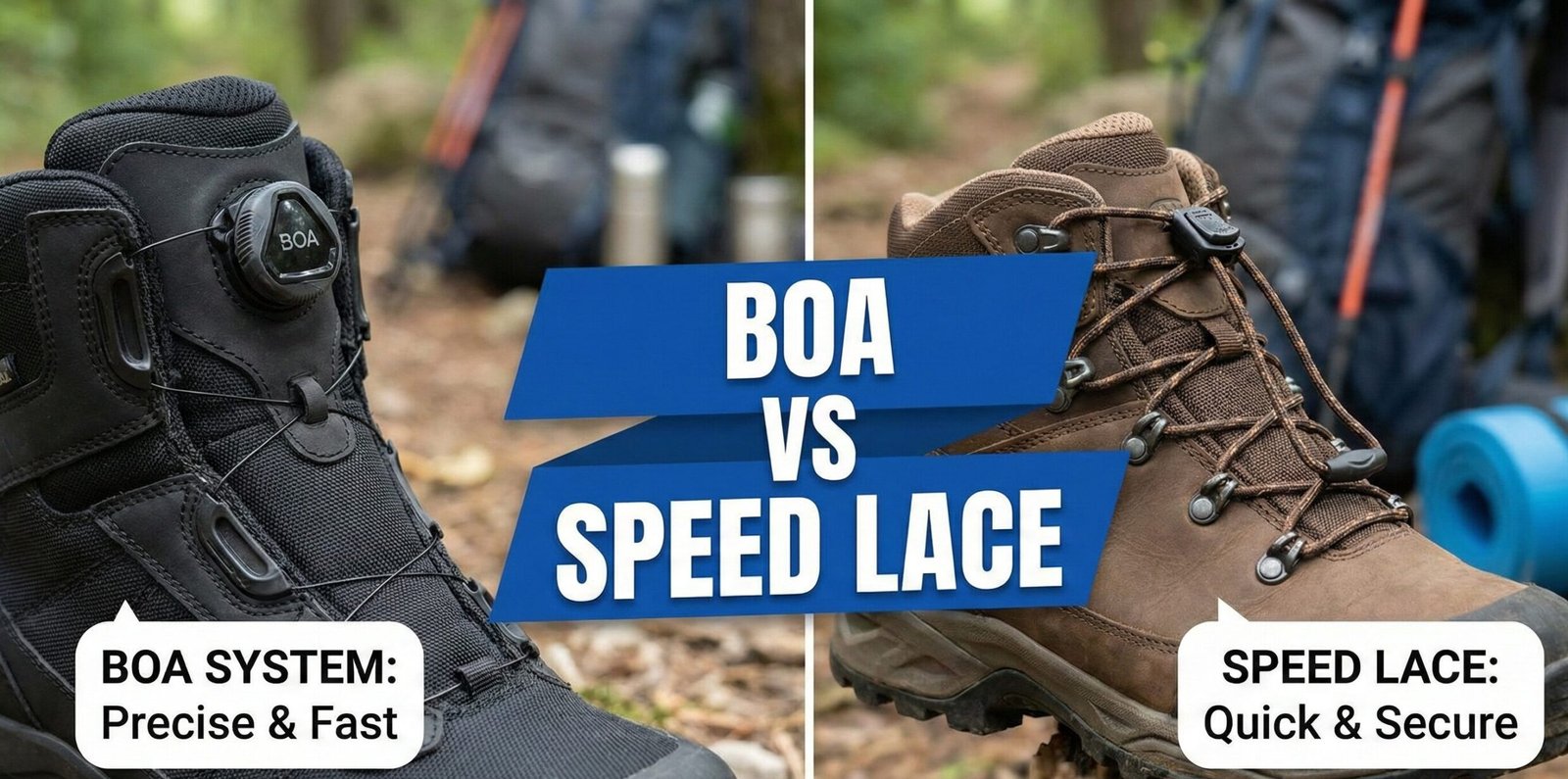
BOA vs. Speed Lace: The Ultimate 2026 Snowboard Boot Lacing Guide
There is a specific moment of dread every snowboarder knows. It’s 8:30 AM in the parking lot. It’s 10 degrees below freezing. You have your baggy snowboard pants on, and you are trying to jam your cold foot into a stiff boot. The struggle is real, and as we move deeper into 2026, the technology has reached a pinnacle where choosing between BOA and Speed Lace is no longer just about convenience—it’s about biomechanical efficiency.
Choose BOA for unparalleled ease of use and micro-adjustments. Modern H4 Coiler systems have virtually eliminated the “snapping” issues of the past, making them the top choice for all-mountain riders.
Choose Speed Lace if you are a freestyle purist or backcountry explorer who needs independent tension zones and a “softer” lateral flex that only textile cords can provide.
Choose Traditional Laces if you want infinite tension customization, the lightest possible setup, and a “pure” connection to your board without any mechanical intermediaries.
1. The BOA System: Engineering the Perfect Fit
The BOA Fit System has undergone a massive evolution. In 2026, we aren’t just looking at a dial and a wire; we are looking at a system engineered to distribute pressure across the dorsal bridge of the foot. The mechanical advantage provided by the dial allows riders to achieve a level of tightness that is physically impossible with traditional laces. This is crucial for high-speed carving where even a millimeter of “heel lift” can result in a lost edge.
The physics of the BOA system relies on low-friction guides. Unlike speed laces that can catch on eyelets, the BOA cable glides smoothly, ensuring that the tension applied at the dial is distributed evenly to the very toe of the boot. However, this “evenness” was historically a drawback, leading to the development of the multi-zone BOA. By 2026 standards, a single BOA is considered entry-level, while Triple-BOA systems are emerging for professional freeriders who need to lock down the ankle, the forefoot, and the upper cuff independently.
Furthermore, the durability of these systems has been reinforced. Modern cables are often braided with ultra-high-molecular-weight polyethylene (UHMWPE), making them stronger than steel per weight unit. If you’re tackling backcountry snowboarding, the security of knowing your lacing won’t fail in sub-zero temperatures is worth the premium price point. We’ve seen a shift where the “failure points” are now the plastic guides rather than the cables themselves, a testament to how far the hardware has come.
How the BOA H4 Coiler System Works
The H4 Coiler is the flagship BOA mechanism found in most 2026 snowboard boots. It operates on a simple but elegant principle: a stainless steel or UHMWPE cable threads through a series of low-friction guides sewn into the boot’s upper, then connects to a spring-loaded dial mounted on the tongue or side of the boot. When you turn the dial clockwise, it pulls the cable tighter, compressing the boot’s upper around your foot with uniform pressure. When you want to release, you pull the dial outward, and the spring mechanism instantly loosens the entire system.
The “Coiler” designation refers to the internal spring mechanism that automatically takes up slack in the cable as you turn. This prevents the cable from becoming loose or snagging, which was a common complaint in earlier BOA generations. The H4 dial itself is rated to withstand over 50,000 open-close cycles, which translates to several seasons of daily riding before any wear becomes noticeable. The dial also features a micro-adjustment capability — each click of the dial tightens the cable by approximately 1 millimeter, giving you surgical precision over your fit.
In 2026, BOA has introduced the H4 Coiler V2 with enhanced grip texture on the dial surface, specifically designed for riders wearing thick winter gloves. This seemingly minor change has a significant impact on the mountain — being able to adjust your tension mid-run without removing your gloves means less cold exposure and more time riding. The V2 also features an upgraded internal ratchet mechanism that provides a more tactile “click” feeling, letting you know exactly how many increments you’ve tightened.
Single vs. Dual vs. Triple BOA: Which Configuration Do You Need?
The number of BOA dials on a boot directly correlates with how precisely you can control the fit across different zones of your foot. Understanding these configurations is essential for choosing the right boot for your riding style.
Single BOA: A single dial controls one cable that runs across the entire boot. This is the simplest and most affordable BOA configuration. The cable typically runs in an X-pattern across the tongue, tightening the entire boot uniformly. While adequate for beginners and casual riders, the single BOA has a fundamental limitation: you cannot independently adjust the tension over your forefoot versus your ankle. If you tighten the dial enough to lock your heel down, you may find your toes are uncomfortably compressed. Single BOA boots are typically found in the $200–$350 price range and are best suited for riders who are just starting out or who ride fewer than 20 days per season.
Dual BOA: Two dials control two independent cable zones. The most common configuration places one dial on the tongue (controlling the upper cuff and ankle zone) and one dial on the side (controlling the lower forefoot zone). This separation is transformative. You can crank the ankle zone tight for maximum heel hold while keeping the forefoot zone looser for comfort and blood flow. Or you can reverse the configuration — tight forefoot for technical precision, looser ankle for freestyle flex. Dual BOA is the sweet spot for most intermediate to advanced riders and represents the best value proposition in 2026. Expect to find dual BOA configurations in boots ranging from $350 to $550.
Triple BOA: Three dials provide independent control over the upper cuff, the ankle zone, and the forefoot. This is the configuration of choice for professional freeriders and backcountry guides who demand total control over every aspect of their fit. With triple BOA, you can create a boot that is rock-solid at the ankle for steep descents, slightly relaxed in the forefoot for comfort during long tours, and precisely tensioned in the upper cuff for edge control. Triple BOA boots are premium products, typically priced between $500 and $700, and are found in flagship models from brands like Burton, Ride, and K2.
| BOA Configuration | Zone Control | Ideal Rider | Typical Price Range |
|---|---|---|---|
| Single BOA | Full boot (one zone) | Beginners, casual riders | $200 – $350 |
| Dual BOA | Upper cuff + forefoot | Intermediate to advanced all-mountain | $350 – $550 |
| Triple BOA | Cuff + ankle + forefoot | Pro freeriders, backcountry guides | $500 – $700 |
BOA Warranty and Lifetime Support
One of the most significant advantages of the BOA system is the lifetime warranty. BOA Technology guarantees every dial and cable for the lifetime of the product. If a cable snaps, a dial jams, or a guide breaks, you can order a free repair kit directly from BOA’s website. The repair process typically takes 15 to 30 minutes and requires only the hex tool included with the kit. This warranty is transferable — even if you buy a used boot with BOA, the warranty still covers the lacing system. This is a massive advantage over Speed Lace and traditional laces, which offer no comparable warranty protection.
The practical value of this warranty cannot be overstated. A broken Speed Lace or traditional lace on a backcountry trip can be a serious safety issue. A broken BOA cable is an inconvenience, not a crisis, because the repair kit is compact enough to carry in a pack and the repair can be done trailside. This peace of mind is one of the primary reasons that mountain guides and patrollers increasingly favor BOA-equipped boots.
2. Speed Lace: The Choice of Precision and Feel
Speed Lace systems (like Burton’s New England Ropes or Nitro’s TLS) continue to dominate among riders who prioritize “feel.” While BOA provides a rigid, mechanical lock, Speed Lace utilizes nylon or Dyneema cords that possess a natural, microscopic elasticity. This allows the boot to move slightly with the rider’s natural ankle articulation, providing a more “organic” connection to the board. For park riders who spend their day tweaking grabs and landing in high-impact scenarios, this subtle give can be the difference between a landed trick and a bruised shin.
The 2026 iteration of Speed Lace has solved the “slip” issue that plagued older models. Advanced locking cleats now utilize serrated teeth that bite into the lace, ensuring that the tension you set at 9:00 AM is the same tension you have at 4:00 PM. The primary advantage remains the “Zonal Control.” You can leave the bottom zone loose—allowing your toes to move and stay warm—while cranking the upper zone to maximum tightness for immediate toe-side response. This customization is often the key to solving why feet hurt when snowboarding.
Weight is another factor often overlooked. Speed Lace systems are inherently lighter than the mechanical dials and internal housing required for BOA. In the world of 2026 gear, where “light is right,” many touring and splitboarding enthusiasts stick to Speed Lace to shave off every possible gram for the ascent. The repairability also remains a massive “Pro”; a spare lace and a multi-tool are all you need to fix a break in the middle of a forest, whereas a BOA failure often requires a specific replacement kit.
How Speed Lace Locking Mechanisms Work in 2026
The locking cleat is the heart of any Speed Lace system. In 2026, the best cleats use a spring-loaded cam mechanism with hardened steel or titanium teeth. When you pull the lace tight and push it into the cleat, the cam engages and bites into the cord, preventing any backward slip. The spring force ensures that the teeth maintain consistent pressure on the cord regardless of vibration, impact, or temperature changes.
Burton’s New England Ropes system uses a dual-zone configuration where two separate laces run through independent cleat systems. The lower lace controls the forefoot zone by threading through eyelets on the boot’s lower shell, while the upper lace controls the ankle and cuff zone through a separate set of guides. Each lace has its own pull handle and locking cleat, allowing completely independent tension adjustment. The laces themselves are made from a proprietary Dyneema-core cord that is rated to over 2,000 pounds of tensile strength — far more than any human could generate through hand-pulling.
Nitro’s TLS (Twister Lacing System) takes a different approach with a single-pull mechanism. Instead of threading through multiple eyelets, the TLS uses two lace channels that converge at a single pull handle. When you pull the handle, both channels tighten simultaneously, distributing tension across the boot. The locking mechanism then engages with a satisfying click, securing the laces at the chosen tension. While this system is faster than traditional dual-zone Speed Lace, it sacrifices independent zone control — both zones tighten together rather than separately.
The evolution of Speed Lace cleat materials deserves attention. Early cleats used stamped steel that could bend or dull over time, causing the teeth to lose their grip. Modern cleats use investment-cast stainless steel or titanium with precision-machined teeth that maintain their sharpness for thousands of cycles. Some manufacturers now offer ceramic-coated cleat teeth that resist corrosion from salt, road grime, and moisture — a significant upgrade for riders who drive through winter conditions to reach the mountain.
Speed Lace Repair and Field Maintenance
One of Speed Lace’s greatest strengths is field repairability. Unlike BOA, which requires a specific hex tool and cable kit, Speed Lace repairs can be performed with a knife, a lighter, and a spare length of cord. If your Speed Lace snaps mid-day, you can cut the broken section, re-thread the cord through the eyelets, tie a secure knot (a double fisherman’s knot works best), and be back on the mountain in minutes. Many experienced riders carry a 3-foot length of matching Speed Lace cord and a small lighter in their pocket specifically for this scenario.
The ability to re-lace in the field also means that riders can experiment with different lacing patterns without any special equipment. Some riders prefer to route the lower lace through fewer eyelets to create a looser forefoot, while others skip eyelets to reduce pressure points. This level of customization is impossible with BOA systems, which are locked into their factory routing. For riders who are willing to invest the time in experimenting, Speed Lace offers a level of personalization that no mechanical system can match.
The Feel Factor: Why Pros Prefer Speed Lace for Park
There is a reason why the majority of professional park and street riders use Speed Lace or traditional laces rather than BOA: feel. In freestyle snowboarding, the ability to sense the board through your feet is paramount. When you are locking into a 50-50 on a handrail, balancing on a nose press, or absorbing a massive landing, the micro-vibrations and feedback that travel through your boot to your foot are critical information sources.
BOA’s cable system, while excellent for uniform pressure distribution, creates a slightly more rigid interface between the boot and the foot. The cable doesn’t stretch or flex — it maintains whatever tension you set. Speed Lace, by contrast, has a natural compliance that allows the boot to “breathe” with your foot’s movements. This compliance creates a more intuitive connection to the board, which is why experienced park riders often describe Speed Lace boots as feeling “more alive” underfoot.
This doesn’t mean BOA is bad for park riding — far from it. Many all-mountain riders who spend time in the park use dual BOA with the forefoot zone loosened slightly for better board feel. The point is that Speed Lace offers a specific type of feedback that some riders strongly prefer, and that preference becomes more pronounced as riding skill increases and the demands on foot sensitivity become more acute.
3. Traditional Laces: The Immortal Standard
Traditional laces remain the benchmark for reliability in 2026. While they may seem “slow,” many professional riders refuse to switch. Why? Because you can customize the tension at every single eyelet. By using different knots (like the “surgeon’s knot”), a rider can create five or six different tension zones. This level of granularity is unmatched even by Triple-BOA systems. If you’re wondering how long snowboard boot laces are, they are typically 90 to 110 inches, providing ample length for custom wrapping techniques.
The affordability of traditional laces also keeps them relevant. As the cost of high-end boots pushes toward $600+, lace-up models offer a “pure” riding experience at a fraction of the cost. They are the ultimate “failsafe.” In 2026, we see many “Hybrid” models—boots that use traditional laces for the main closure but include a small BOA dial specifically for heel retention (the “Conda” system). This marriage of old and new tech offers the best of both worlds: the reliability and flex of laces with the mechanical heel-lock of BOA.
Advanced Lacing Techniques for Custom Tension
The beauty of traditional laces lies in the infinite customization they offer. By varying the tightness at each eyelet, you can create a fit that is tailored to the exact contours of your foot. Here are several advanced techniques that experienced riders use to optimize their lace-up boots:
The Surgeon’s Knot Method: Instead of tying a standard bow knot at the top, use a surgeon’s knot at each eyelet pair. A surgeon’s knot is a simple overhand knot with an extra twist, which creates significantly more friction and prevents the lace from slipping. By tying a surgeon’s knot at each eyelet level, you lock in the tension at that specific point independently. This creates discrete tension zones — tight at the ankle for heel hold, looser at the midfoot for comfort, and moderate at the forefoot for circulation.
The Lock-Off Technique: Thread the lace through the bottom eyelets and pull tight. Then tie a simple overhand knot right against the eyelet to “lock” that tension in place before moving to the next pair of eyelets. Repeat up the boot. This creates a cascading series of locked tension zones. The downside is that adjusting individual zones requires untying and retying each lock-off, which is time-consuming. But for riders who know their ideal tension and don’t need to adjust frequently, this technique provides the most secure and customized fit possible.
The Wrap-Around Method: Instead of threading the lace straight up through the eyelets, wrap the lace around the tongue at each crossover point. This distributes pressure more evenly across the tongue and reduces the “biting” sensation that some riders experience with traditional lacing. The wrap-around method is particularly effective for riders with sensitive shins or those who experience pressure points from the eyelet hardware pressing against the tongue.
The Hybrid Zone Method: Use traditional laces for the lower three to four eyelet pairs (forefoot and midfoot zones) and a separate Speed Lace pull for the upper cuff. This is not a factory configuration — it requires a boot that accepts both lacing types, which is rare. However, some riders modify their boots by adding aftermarket lace hooks at the lower eyelets while retaining the original Speed Lace or BOA system at the top. This creates a “best of both worlds” scenario: customized lower tension with quick upper adjustment.
Traditional Lace Materials and Selection
Not all traditional laces are created equal. The material, thickness, and weave of your laces significantly affect durability, grip, and feel. Here’s a breakdown of the most common lace materials available in 2026:
Nylon: The most common and affordable lace material. Nylon laces offer a good balance of strength, flexibility, and grip. They are available in various thicknesses — thinner laces (2mm) are lighter and thread more easily through eyelets, while thicker laces (3mm+) are more durable and easier to grip with cold hands. Nylon laces stretch slightly when wet, which can require re-tightening after riding in snowy conditions.
Dyneema-core: The premium choice for performance riders. Dyneema-core laces feature a Dyneema (ultra-high-molecular-weight polyethylene) center wrapped in a nylon or polyester sheath. Dyneema is fifteen times stronger than steel by weight and has virtually zero stretch. This means your tension stays exactly where you set it, regardless of moisture, temperature, or how aggressively you ride. Dyneema-core laces are more expensive ($15–$25 per pair vs. $5–$10 for nylon) but last significantly longer and provide a more consistent fit throughout the day.
Kevlar-reinforced: A niche option for extreme durability. Kevlar-reinforced laces incorporate aramid fibers that resist abrasion and cutting. These are overkill for most riders but are popular among snowboarders who ride in rocky terrain or who have had laces frayed by sharp binding edges. Kevlar-reinforced laces are stiffer than nylon or Dyneema-core options, which some riders prefer for the added structure they provide.
Waxed cotton: A throwback material that still has a small but devoted following. Waxed cotton laces have a distinctive “grippy” feel that prevents slipping at the knots. They are heavier and less strong than synthetic options, but some riders prefer the organic feel and the way waxed cotton molds to the eyelet pattern over time. Waxed cotton laces are also more environmentally friendly than synthetic alternatives, which matters to eco-conscious riders.
4. How Lacing Systems Affect Boot Flex and Response
One of the most overlooked aspects of choosing a lacing system is how it interacts with your boot’s flex rating. Flex rating measures how stiff or soft a boot is, typically on a scale of 1 (softest) to 10 (stiffest). But the lacing system itself can modify the effective flex of a boot, sometimes significantly. Understanding this relationship is critical for choosing the right combination of boot and lacing system for your riding style.
The Flex Scale Explained
Park, jib, beginners
All-mountain, freestyle
All-mountain, freeride
Freeride, racing, alpine
BOA and Flex: Because BOA distributes tension uniformly across the boot’s upper, it tends to make a boot feel slightly stiffer than its rated flex. The rigid cable creates a consistent compression that limits the boot’s natural lateral flex. This is desirable for riders who want maximum response and edge control, but it can be problematic for park riders who need a soft, forgiving flex for jibbing and buttering. To compensate, some dual-BOA boots allow riders to loosen the forefoot dial to restore some lateral flex while maintaining ankle stiffness.
Speed Lace and Flex: Speed Lace preserves more of the boot’s natural flex profile because the textile cords have a slight elasticity that allows the boot to move more freely. The independent zone control also means you can selectively stiffen one area while leaving another soft. For example, tightening only the upper zone while leaving the lower zone loose creates a stiff ankle with a soft forefoot — a configuration that park riders love for rail tricks but that is impossible to achieve with single-zone lacing systems.
Traditional Laces and Flex: Traditional laces offer the most control over effective flex because you can vary tension at every eyelet point. By tying the lower eyelets loose and the upper eyelets tight, you create a graduated flex profile that is softer at the toe and stiffer at the cuff. This mimics the feel of an expensive custom-tuned boot and is one of the primary reasons that professional riders continue to use traditional laces despite the convenience advantages of BOA and Speed Lace.
Every lacing system can shift a boot’s effective flex by 1 to 2 points on the flex scale. A boot rated at flex 5 with traditional laces tightened uniformly might feel like a flex 6 with BOA (due to the rigid, uniform compression) or a flex 4 with Speed Lace (due to the slight cord elasticity). Keep this in mind when comparing boots across different lacing systems — the flex rating on the spec sheet is a starting point, not an absolute.
Response Time: How Fast Does Your Boot React?
Response time refers to how quickly your boot transmits your body movements to the board. A highly responsive boot turns almost instantly when you shift your weight, while a less responsive boot has a slight delay or “mushy” feeling. Lacing system choice has a direct impact on response time.
BOA provides the fastest response because the rigid cable creates a direct mechanical connection between your foot and the boot shell. There is no stretch, no slack, and no lag. When you tilt your ankle, the boot responds immediately. This is why BOA is favored by aggressive all-mountain and freeride riders who need instantaneous edge response at high speeds.
Speed Lace provides slightly slower response than BOA due to the minimal stretch in the textile cord. However, this delay is measured in milliseconds and is only noticeable at the highest levels of performance. For 95% of riders, the response difference between BOA and Speed Lace is imperceptible. The trade-off — slightly softer response in exchange for better feel and comfort — is a bargain that most riders are happy to make.
Traditional laces have the slowest response when they are not perfectly tight. A loosely tied boot has slack in the laces that must be taken up before force is transmitted to the board. This creates a perceptible delay, especially during quick edge changes. However, when traditional laces are tied tightly and secured with lock-off knots, their response is comparable to Speed Lace. The key is ensuring that there is zero slack in the lace system — any looseness directly translates to reduced responsiveness.
5. Lacing Systems for Different Riding Styles
Your primary riding style should heavily influence your lacing system choice. While any system can work for any style, the strengths of each system align naturally with specific disciplines. Here is a detailed breakdown of how each lacing system performs across the major snowboarding disciplines.
Park and Freestyle Lacing Recommendations
Park riding places unique demands on your lacing system. You need a boot that provides excellent board feel for rail tricks, enough ankle support for landing jumps, and enough flex for buttering and pressing. The most important factor is that the lacing system allows you to customize flex across different zones of the boot.
Best choice: Dual Speed Lace or Traditional Laces. Speed Lace’s natural compliance and zone control make it ideal for park riding. You can keep the forefoot loose for maximum board feel on rails while tightening the ankle zone for jump landings. Traditional laces offer even more granularity, allowing you to create a custom flex profile that is perfectly tuned to your specific trick repertoire. Many professional park riders use traditional laces because they can tie the boot differently depending on whether they are hitting the jump line, the rail section, or the halfpipe.
Acceptable choice: Dual BOA with forefoot zone loosened. If you prefer BOA’s convenience, a dual-BOA boot with the forefoot dial set to a lower tension provides decent park performance. The ankle dial keeps your heel locked in for landings, while the looser forefoot allows enough flex for jibbing. However, the rigid cable connection means you will never get the same level of board feel that Speed Lace or traditional laces provide.
Least ideal: Single BOA or Triple BOA. Single BOA provides no zone control, making it difficult to achieve the soft forefoot / stiff ankle configuration that park riding demands. Triple BOA is overkill for park riding — the third zone adds weight and complexity without providing meaningful benefits for freestyle disciplines.
All-Mountain Lacing Recommendations
All-mountain riding demands versatility. You might carve groomers in the morning, hit the terrain park at lunch, and explore trees in the afternoon. Your lacing system needs to perform adequately across all these conditions without being optimized for any single one.
Best choice: Dual BOA. The dual-BOA configuration is the quintessential all-mountain lacing system. The ability to independently adjust ankle and forefoot tension means you can quickly adapt to changing conditions. Crank both dials for a high-speed groomer run, loosen the forefoot for a park lap, and find a middle ground for tree riding. The mechanical consistency of BOA also means that your tension stays the same throughout the day, regardless of temperature changes or how hard you are riding.
Excellent choice: Dual Speed Lace. Speed Lace performs nearly as well as BOA for all-mountain riding, with the added benefit of better board feel. The trade-off is that Speed Lace may require occasional re-tightening during a full day of varied riding, while BOA maintains its tension more consistently. For riders who are willing to spend an extra 30 seconds per lift ride checking their tension, Speed Lace is a compelling all-mountain option.
Freeride and Backcountry Lacing Recommendations
Freeride riding in big mountain terrain demands maximum reliability, heel hold, and the ability to adjust tension with gloved hands in harsh conditions. When you are skiing a steep line in 30 mph winds, you cannot afford to have your lacing fail or require bare-hand adjustments.
Best choice: Dual or Triple BOA. BOA’s mechanical reliability, gloved-hand usability, and lifetime warranty make it the clear winner for freeride. The H4 Coiler dial is designed specifically for operation with thick winter gloves, and the cable system is virtually failure-proof in extreme conditions. Triple-BOA systems provide the additional zone control that backcountry guides need for long tours followed by aggressive descents.
Acceptable choice: Dual Speed Lace with high-quality cleats. Speed Lace works for freeride if you choose a boot with premium locking cleats that won’t slip in wet or frozen conditions. The field repairability of Speed Lace is also valuable in the backcountry, where a broken BOA cable would require a specific repair kit that you might not have. However, Speed Lace requires bare-hand or thin-glove operation for adjustments, which is a significant disadvantage in extreme cold.
Carving and Racing Lacing Recommendations
Carving and alpine racing demand the most rigid, responsive connection between boot and board. Every millimeter of flex or lag translates directly into reduced edge control and slower response times. For these disciplines, maximizing stiffness and response is the primary goal.
Best choice: Triple BOA or hard-shell alpine boots with traditional laces. For recreational carving, a triple-BOA boot provides the rigid, uniform compression that maximizes edge response. For competitive alpine racing, traditional hard-shell boots with traditional laces remain the standard because they provide the stiffest possible interface. The lace-up alpine boot is essentially a rigid shell with no flex — this is intentional, as racing demands instantaneous power transfer with zero energy loss.
6. Snowboard Boot Fit and Lacing: Finding Your Perfect Match
The relationship between boot fit and lacing system is intimate and often misunderstood. A perfectly fitted boot with the wrong lacing system can feel mediocre, while a slightly loose boot with the right lacing system can feel excellent. Understanding how fit and lacing interact is essential for building a complete setup that performs at its best.
The Importance of Proper Boot Sizing
Before you even consider lacing systems, your boot must fit correctly. Snowboard boots are sized using the Mondo Point system, which measures foot length in centimeters. A Mondo Point 27 fits a foot that is 27 centimeters (approximately 10.6 inches) long. Unlike shoe sizing, which varies wildly between brands and countries, Mondo Point is consistent across all manufacturers.
A properly fitted snowboard boot should feel snug but not painful. Your toes should lightly brush the front of the boot when you stand upright, and pull back slightly when you bend your knees into a riding stance. There should be no heel lift when you walk — your heel should feel firmly locked into the back of the boot at all times. The boot should feel like a firm handshake: secure, supportive, and comfortable, but not crushing.
Boot width is another critical factor that many riders overlook. Boots come in standard, wide, and narrow widths. A boot that is too narrow will compress your forefoot, causing numbness and pain. A boot that is too wide will allow your foot to slide laterally, reducing edge control. The correct width allows your foot to sit flat on the footbed with no overhang and no excessive space on either side.
Buying boots too large: Many riders buy boots one or two sizes too big because they feel comfortable in the store. A boot that feels “comfortable” when standing still will feel loose and sloppy when riding. Snowboard boots are designed to fit tight when new — they pack out 10 to 15 percent over the first 10 to 15 days of riding. Buy them snug, and they will mold to your foot over time.
Ignoring width: A size 27 boot from one brand might feel completely different from a size 27 boot from another brand because of width differences. Always try boots on in person, and if you have wide or narrow feet, specifically seek out brands that offer width options.
Trying boots on with thin socks: Always try snowboard boots with the same thickness of sock you will ride in. Most riders use medium-weight merino wool or synthetic snowboard socks. Thin dress socks or thick cotton socks will give you an inaccurate fit impression.
How Lacing System Choice Affects Fit
Different lacing systems interact with boot fit in different ways, and understanding these interactions can help you make a more informed choice.
BOA and fit: BOA provides the most consistent fit over time because the cable does not stretch or slip. Once you set your tension, it stays set. This consistency means that a BOA boot that fits well on day one will fit well on day fifty. However, BOA’s uniform pressure distribution can create pressure points in boots that don’t match your foot shape perfectly. If you have a bunion, a high instep, or any other foot irregularity, the rigid cable may press on that area uncomfortably. Dual and triple BOA mitigate this by allowing you to reduce tension in specific zones.
Speed Lace and fit: Speed Lace’s slight elasticity allows the boot to conform more naturally to foot irregularities. If you have a bunion, the Speed Lace cord will stretch slightly over that area rather than pressing into it. The independent zone control also allows you to reduce tension around problem areas while maintaining tightness elsewhere. The downside is that Speed Lace may loosen slightly over the course of a hard riding day, requiring periodic re-tightening.
Traditional laces and fit: Traditional laces offer the most customizable fit because you can vary tension at every eyelet point. This makes them the best choice for riders with unusual foot shapes or specific fit issues. If you have a wide forefoot and a narrow heel, you can tie the lower eyelets loosely and the upper eyelets tightly — a configuration that no other lacing system can replicate with the same precision.
Heat Moldable Liners and Their Interaction with Lacing
Most mid-range and high-end snowboard boots in 2026 feature heat moldable liners. These liners use a special EVA foam that softens when heated, allowing the liner to conform precisely to the shape of your foot. The heat molding process is typically performed at a snowboard shop, where the liner is heated in a special oven for 8 to 10 minutes and then worn while the foam cools and sets to your foot shape.
The interaction between heat-molded liners and lacing systems is important. After heat molding, your liner will have a custom shape that perfectly matches your foot. A BOA system will then compress this custom-shaped liner uniformly, maintaining the custom fit while adding support. Speed Lace will compress the liner with slightly more give, preserving more of the custom shape’s natural contours. Traditional laces allow the most freedom for the custom-molded liner to maintain its shape while still providing the tension needed for support.
For riders who invest in heat-molded liners, traditional laces or Speed Lace often provide a better overall fit experience because they complement the custom shape rather than overriding it with uniform mechanical compression. However, this is a nuanced preference — many riders with heat-molded liners use BOA and are perfectly happy with the results. The key is that heat molding and lacing system choice are two independent variables that both contribute to your final fit, and understanding how they interact helps you optimize both.
7. Lacing System Maintenance and Care
Regardless of which lacing system you choose, proper maintenance extends the life of your boots and ensures consistent performance. A well-maintained lacing system will perform the same on day 100 as it did on day one, while a neglected system will degrade gradually, often in ways that riders don’t notice until the performance loss becomes severe.
BOA Maintenance
BOA systems are low-maintenance by design, but they benefit from periodic attention. After each riding day, wipe the dial and cable with a dry cloth to remove snow, ice, and debris. Salt from road spray and parking lot chemicals can accelerate corrosion on the cable and dial mechanism — if you ride in coastal or urban areas where roads are salted, rinse your BOA components with fresh water after each session.
Once per season, apply a small drop of lubricant (BOA recommends their proprietary lubricant, but any dry-film Teflon lubricant works) to the cable where it enters the dial. This keeps the cable gliding smoothly and prevents the stiffness that can develop over time. Do not use wet lubricants like WD-40, which attract dust and debris that can jam the mechanism.
Check the cable for fraying or kinking every few sessions. Modern BOA cables are incredibly durable, but a kink in the cable creates a weak point that can eventually snap. If you notice a kink, contact BOA for a replacement cable under the lifetime warranty — it is free and easy to install.
Speed Lace Maintenance
Speed Lace systems require more attention than BOA because the textile cords are exposed to more wear. After each riding day, inspect the laces for fraying, particularly at the points where they pass through the locking cleats. The cleat teeth can gradually abrade the cord surface, creating weak points that eventually lead to snaps.
Once per season, remove the laces completely and inspect the full length for damage. Clean the laces by soaking them in warm water with a mild detergent, then air dry completely before reinstalling. This removes salt, dirt, and oils that can degrade the cord fibers over time. While the laces are removed, inspect the locking cleats for debris that may have accumulated in the teeth — use a toothpick or small brush to clear any packed snow, dirt, or lint.
If your Speed Lace shows signs of fraying near the cleats, replace the lace before it snaps. Replacement laces are available from the boot manufacturer and typically cost $10 to $20. Keep a spare set in your gear bag for emergency trailside replacement.
Traditional Lace Maintenance
Traditional laces are the simplest to maintain because they have no mechanical components. After each session, inspect the laces for fraying, particularly at the knot points and where they contact the eyelet hardware. Frayed laces should be replaced immediately — a snapped lace on a steep run is not only inconvenient but potentially dangerous.
Wash traditional laces periodically by hand-washing in warm, soapy water. This removes body oils, dirt, and salt that can weaken the fibers over time. Nylon laces can be machine-washed in a mesh laundry bag on a gentle cycle. Air dry all laces — never put them in a dryer, as high heat can weaken nylon and damage wax coatings.
Store your boots with the laces loosely threaded but not tied. Tight laces compress the liner and shell during storage, which can cause the boot to develop a permanently compressed shape. Loosely threaded laces maintain the boot’s shape while allowing air circulation that prevents mold and mildew growth.
If you ride frequently (30+ days per season), consider owning two pairs of boots and rotating between sessions. This gives each pair a full day to dry completely between uses, which dramatically extends the life of the liner, shell, and lacing system. Moisture is the number one enemy of snowboard boot longevity, and a rotating system is the most effective way to manage it.
8. Budget Guide: What You Get at Every Price Point
The snowboard boot market in 2026 spans a massive price range, from entry-level boots under $200 to professional-grade models exceeding $700. Understanding what you get at each price tier — and how lacing systems factor into the value equation — helps you make the best purchasing decision for your budget and riding level.
Entry Level: $150 – $250
At this price point, you will typically find single BOA, basic Speed Lace, or traditional lace-up boots. The liners are typically non-moldable EVA foam, and the outsoles use basic rubber compounds. These boots are perfectly adequate for beginners who are learning the basics and riding fewer than 20 days per season. The lacing systems at this tier are functional but may lack the premium feel of higher-end models — single BOA dials may feel plasticky, Speed Lace cleats may not lock as securely, and traditional lace eyelets may be stamped rather than forged.
The most important thing to look for at this price point is comfort and fit. A $175 boot that fits your foot perfectly will outperform a $500 boot that doesn’t, regardless of lacing system. Prioritize fit over features when shopping on a budget.
Mid-Range: $250 – $450
This is the sweet spot for most riders. Mid-range boots typically feature dual BOA or dual Speed Lace, heat-moldable liners, and improved outsole compounds. The lacing systems at this tier are significantly more refined than entry-level models — BOA dials feel solid and click precisely, Speed Lace cleats lock firmly with minimal effort, and traditional lace eyelets are forged for durability and smooth lace gliding.
If you are an intermediate rider who rides 20 to 40 days per season, this price range offers the best value. You get genuine performance features without paying the premium for top-tier materials and construction. A mid-range dual-BOA boot from a reputable brand (Burton, Ride, Nitro, K2, ThirtyTwo) will serve you well for three to five seasons of regular riding.
Premium: $450 – $600
Premium boots feature the latest lacing technology (Triple BOA, advanced Speed Lace cleats, hybrid systems), premium heat-moldable liners with multiple foam densities, Vibram or proprietary high-traction outsoles, and advanced shell construction. The fit and finish at this level are noticeably superior — stitching is tighter, materials feel more refined, and the overall boot feels like a precision instrument rather than a piece of sports equipment.
Premium boots are worth the investment for advanced riders who ride 40+ days per season and demand consistent performance in all conditions. The improved lacing systems, better liners, and superior outsoles translate directly into better performance on the mountain. If you are committed to snowboarding as a long-term pursuit, a premium boot is a worthwhile investment.
Professional: $600+
At the top of the market, you find boots designed for professional riders and guides who demand absolute performance and reliability. These boots feature the most advanced lacing systems available (Triple BOA with custom routing, premium Speed Lace with titanium cleats), the stiffest and most responsive shells, the highest-quality heat-moldable liners, and outsoles designed for specific terrain types. The fit and construction are flawless, and every component is chosen for maximum performance rather than cost savings.
Professional boots are overkill for casual and intermediate riders. The performance gains at this level are incremental — you are paying for marginal improvements in precision, response, and durability that only highly skilled riders can perceive. Unless you are a competitive rider, instructor, or mountain guide who rides 60+ days per season, a premium boot in the $450–$600 range will meet your needs.
9. Lacing Systems for Specific Foot Types
Every rider’s feet are different, and certain foot types benefit more from specific lacing systems. Understanding how lacing interacts with your foot shape can help you choose a system that provides the best comfort and performance for your anatomy.
Wide Feet
Riders with wide feet (also called “high volume” feet) often struggle with boots that pinch across the forefoot. This is especially problematic with BOA systems, where the uniform cable compression can press painfully on the metatarsal heads. Best lacing choice: Dual Speed Lace or Traditional Laces. Speed Lace’s elasticity allows the cord to conform slightly to the wider forefoot rather than compressing it. Traditional laces offer even more flexibility — you can tie the lower eyelets loosely to accommodate the width while tightening the upper eyelets for ankle support. If you prefer BOA, look for boots specifically designed for wide feet, which have a wider shell that provides more room before the cable compression becomes uncomfortable.
Narrow Feet
Riders with narrow feet (low volume) often find that boots feel sloppy, particularly in the forefoot area. A boot that is too wide for your foot allows lateral sliding, which reduces edge control and causes blisters. Best lacing choice: Dual or Triple BOA. BOA’s uniform compression is actually an advantage for narrow feet because it pulls the boot tight against the foot from all directions, eliminating the dead space that causes sliding. The micro-adjustment capability of BOA allows you to dial in a very tight fit that would be difficult to achieve with Speed Lace or traditional laces.
High Instep
A high instep (the arched area on the top of your foot) can create pressure points with any lacing system, but the severity varies. Best lacing choice: Dual Speed Lace with upper zone loosened. The Speed Lace system allows you to reduce tension specifically over the instep area while maintaining ankle and forefoot tightness. Traditional laces also work well because you can skip or loosely tie the eyelet pair that crosses the instep. BOA is the least ideal for high insteps because the cable path typically runs directly over the instep, and the uniform compression cannot selectively reduce pressure in that area.
Flat Feet and Low Arches
Riders with flat feet often experience overpronation, which can cause the foot to roll inward inside the boot. This creates uneven pressure distribution and can lead to knee and ankle pain. Best lacing choice: Dual BOA or Dual Speed Lace. The independent zone control in both systems allows you to lock the ankle zone firmly to prevent the foot from rolling, while keeping the forefoot zone comfortable. Traditional laces can also work if tied with a tight focus on the ankle and midfoot zones. A good aftermarket insole with arch support is essential for flat-footed riders regardless of lacing system.
Foot Pain and Common Issues
If you experience chronic foot pain while snowboarding, the lacing system may be contributing to the problem. Pain on the top of the foot often indicates excessive pressure from the lacing — try loosening the specific zone where the pain occurs. Pain on the bottom of the foot is usually related to arch support or footbed fit rather than lacing. Pain around the ankle can indicate that the ankle zone is too tight (reducing natural articulation) or too loose (allowing the foot to slide and rub). Experimenting with lacing tension at different zones is often the first step in resolving foot pain before resorting to custom orthotics or boot modifications.
If you develop a hot spot or pressure point mid-ride, stop and adjust your lacing immediately. For BOA, loosen the specific zone dial by one or two clicks. For Speed Lace, push the cleat and release a small amount of tension on the affected zone. For traditional laces, untie and re-tie the specific eyelet pair that is causing pressure. Addressing discomfort early prevents it from becoming a painful injury that ruins your day.
10. Lacing for Backcountry and Touring
Backcountry snowboarding and splitboarding place unique demands on your lacing system that resort riding does not. In the backcountry, your boots must perform during both the ascent (walking/touring) and the descent (riding). This dual-purpose requirement creates specific lacing needs that narrow your options.
The Ascent: Comfort and Walk Mode
During the uphill skinning or walking portion of a backcountry tour, you want your boots to be comfortable and allow natural ankle articulation. Many touring-specific boots feature a “walk mode” that unlocks the upper cuff, allowing the boot to flex more freely for a natural walking gait. Your lacing system must accommodate this flex without becoming loose or uncomfortable.
Speed Lace excels for touring because the textile cords flex with the boot’s walk mode without creating pressure points or requiring adjustment. The lighter weight of Speed Lace systems is also valuable during long ascents where every gram matters. Many splitboard-specific boots use Speed Lace exclusively for this reason.
BOA works for touring but requires more attention during the transition from walk mode to ride mode. When you lock the cuff for the descent, you need to retension the BOA dial to ensure a secure fit. The H4 Coiler makes this fast and easy, but it is an additional step that Speed Lace riders don’t need to perform.
The Descent: Maximum Security
During the descent, backcountry riders need the same level of security and performance as resort freeriders. Heel hold is critical because backcountry terrain is often steep, variable, and unforgiving. A heel lift on a 40-degree spine is a much more serious consequence than a heel lift on a groomed run.
For the descent, BOA’s rigid cable system provides superior heel hold compared to Speed Lace. This is why some splitboarders use a hybrid approach: Speed Lace for touring comfort during the ascent, then tightening a BOA heel-lock system (if available on their boot) for the descent. Not all boots offer this hybrid capability, but the ones that do represent the cutting edge of backcountry boot technology in 2026.
Emergency Repair Considerations
Backcountry riders must consider the repairability of their lacing system as a safety factor. In the backcountry, you are your own repair shop. A broken lacing system that cannot be fixed in the field can turn a fun day into a dangerous situation.
Speed Lace is the most field-repairable system. A spare cord, a knife, and a lighter are all you need to replace a broken lace. The repair takes minutes and requires no special tools or knowledge. Many backcountry guides carry a spare Speed Lace cord in their emergency kit specifically for this scenario.
Traditional laces are similarly easy to repair. A replacement lace can be sourced from any outdoor store or even improvised from paracord in an emergency. The simplicity of traditional laces makes them a reliable choice for remote backcountry travel.
BOA is the least field-repairable system. If a BOA cable snaps in the backcountry, you need a specific replacement cable and the hex tool to install it. While BOA repair kits are compact and lightweight, they must be carried proactively — you cannot improvise a BOA repair with random materials. Backcountry riders who use BOA should always carry a repair kit and know how to use it before heading into remote terrain.
11. Lacing for Women and Youth Riders
Women and youth riders have specific lacing needs that are often overlooked in generic gear guides. Anatomical differences, strength considerations, and riding style preferences all influence the optimal lacing system choice for these demographics.
Women’s Boot Lacing Considerations
Women’s snowboard boots are not simply smaller versions of men’s boots. They are designed with a narrower heel, a wider forefoot relative to overall size, a lower cuff height, and different flex profiles. These anatomical differences affect how lacing systems perform.
Women generally have less grip strength than men, which makes the lacing system’s ease of operation an important factor. BOA is the easiest system for riders with limited hand strength because the dial requires only a twisting motion rather than a strong pull. This is why BOA is extremely popular among women riders — it eliminates the struggle of pulling Speed Laces tight or tying traditional knots with cold, tired hands.
The narrower heel that many women have also makes heel hold more critical. BOA’s uniform compression excels at locking the heel into the back of the boot, which is one of the primary reasons that women-specific boot models increasingly feature BOA as the standard lacing system. Dual BOA is particularly effective because the ankle zone can be cranked tight for heel hold while the forefoot zone is kept looser for comfort.
However, many experienced women riders prefer Speed Lace or traditional laces for the same reasons that experienced men do: better feel, more customization, and a more natural flex profile. The trend toward BOA in women’s boots is driven partly by genuine performance benefits and partly by marketing — riders should choose based on their personal preference rather than assuming that the women-specific default is the best option for them.
Youth Boot Lacing Considerations
For children and teenagers, the lacing system choice is often more about independence than performance. A child who cannot tighten their own boots is dependent on a parent or guardian for every adjustment, which limits their autonomy on the mountain and can lead to frustration.
BOA is the undisputed winner for young riders. The dial requires minimal hand strength and no knot-tying skills. A five-year-old can tighten a BOA dial with one hand. This independence is not just convenient — it teaches young riders to take ownership of their equipment and develop the habit of adjusting their fit throughout the day. Many children’s snowboard boot models now feature BOA exclusively, and for good reason.
Speed Lace can work for older children and teenagers who have sufficient hand strength to pull the laces tight and operate the locking cleats. The pull-handle design is more intuitive than tying knots, making Speed Lace a reasonable second choice for youth riders who have outgrown the need for BOA’s simplicity.
Traditional laces are generally not recommended for young riders. The knot-tying requirement is a significant barrier for children under 10, and even teenagers often struggle to achieve consistent tension with traditional laces. If a youth rider is using traditional lace boots, it is worth investing time in teaching them a simple, repeatable knot technique before they hit the mountain.
12. Common Lacing Problems and Troubleshooting
Even the best lacing systems develop issues over time. Knowing how to diagnose and fix common problems can save your day on the mountain and extend the life of your boots.
BOA Troubleshooting
Problem: The dial won’t tighten. This is usually caused by debris in the dial mechanism or a kinked cable. Remove the dial (pull firmly outward) and inspect the cable path for obstructions. Clean the dial with a dry brush and reassemble. If the cable is kinked, replace it under warranty.
Problem: The dial loosens on its own. This indicates a worn ratchet mechanism inside the dial. The teeth that engage the cable have worn down and no longer grip properly. This is a warranty issue — contact BOA for a replacement dial.
Problem: One zone feels tighter than the other on a dual-BOA boot. This is usually caused by uneven cable routing or a misaligned guide. Check that the cable is running smoothly through all guides without twisting or crossing. If the routing looks correct, the issue may be that your foot is asymmetric — most people have one foot slightly larger than the other, and this can cause uneven feel between zones.
Speed Lace Troubleshooting
Problem: The lace slips in the cleat. This is caused by worn cleat teeth or a glazed lace surface. Clean the lace with warm soapy water to remove any coating that may be reducing friction. If the cleat teeth are worn, the cleat needs to be replaced — contact the boot manufacturer for replacement parts.
Problem: The lace is fraying near the cleat. This is normal wear from the cleat teeth gripping the cord. If fraying is minor, continue using the lace but monitor it closely. If fraying is severe (more than 20% of the cord diameter), replace the lace before it snaps. Carry a spare lace in your gear bag as insurance.
Problem: The pull handle breaks. Pull handles can crack or break from repeated use or impact. Replacement handles are available from boot manufacturers and are usually inexpensive ($5–$15). The repair typically involves threading the existing lace through the new handle and tying a knot to secure it.
Traditional Lace Troubleshooting
Problem: The laces keep coming untied. This is caused by using a knot that doesn’t hold sufficient friction. Switch to a surgeon’s knot or a double bow knot, which provide more friction and resist loosening from vibration and movement. Waxed laces also hold knots better than unwaxed laces.
Problem: The laces are stretching. Nylon laces stretch over time, especially when wet. Replace stretched laces with new ones, and consider upgrading to Dyneema-core laces which have virtually zero stretch. Keep your current laces as emergency spares.
Problem: The lace broke mid-ride. If the lace breaks at the knot, you can often re-thread and re-tie it. If the lace breaks at the eyelet (where the lace contacts the metal hardware), you may need to replace the entire lace. In an emergency, a length of paracord can serve as a temporary replacement to get you down the mountain safely.
13. Seasonal Lacing Tips and Conditions
Different weather and snow conditions affect how your lacing system performs. Adapting your approach to the conditions can improve your comfort and performance throughout the season.
Early Season: Cold and Icy
Early season conditions are typically cold with firm, icy snow. Cold temperatures make all lacing systems stiffer and harder to operate. BOA dials may feel stiffer due to the internal spring contracting in the cold, and Speed Lace cords can become less flexible. To mitigate this, operate your lacing system a few times before heading to the mountain to warm up the mechanisms. In extreme cold (below -20°F / -29°C), BOA’s gloved-hand operation becomes a significant advantage over Speed Lace and traditional laces, which are difficult to adjust with thick mittens.
Mid Season: Variable Conditions
Mid-season conditions vary widely — powder, groomers, ice, crud, and everything in between. This is when dual-zone lacing systems shine because you can adjust your tension to match the conditions. Tighten up for icy groomers, loosen for powder, and find a middle ground for variable conditions. The ability to make these adjustments quickly and easily is one of the primary reasons that dual BOA and dual Speed Lace dominate the mid-season market.
Late Season: Warm and Slushy
Late season riding often involves warm temperatures and soft, slushy snow. Your feet sweat more, your boots get wetter, and your lacing system is exposed to more moisture and debris. Speed Lace cords absorb more water than BOA cables, which can make them feel heavier and slightly less responsive. If you ride late season frequently, rinse your Speed Lace cords after each session to remove absorbed moisture and prevent mildew growth. Traditional laces made from waxed cotton resist moisture better than nylon, making them a surprisingly good choice for spring riding.
14. The Technology Behind Modern Lacing
The lacing systems in 2026 snowboard boots represent decades of engineering refinement. Understanding the technology helps you appreciate why modern boots perform so much better than those from even ten years ago.
Materials Science
The cables, cords, and laces used in modern snowboard boots are engineered materials designed for specific performance characteristics. BOA’s UHMWPE cables have a tensile strength exceeding 500 pounds while weighing fractions of an ounce. The nylon used in Speed Lace cords is formulated for low moisture absorption, high abrasion resistance, and consistent elasticity across a wide temperature range. Even traditional laces benefit from modern materials science, with Dyneema-core and Kevlar-reinforced options that outperform the cotton and basic nylon laces of previous decades.
Mechanical Design
The mechanical components of BOA dials and Speed Lace cleats are precision-engineered for reliability and ease of use. BOA’s H4 dial uses a planetary gear system that multiplies the force applied by your fingers, allowing you to generate significantly more cable tension than you could achieve by pulling a lace directly. Speed Lace cleats use spring-loaded cam mechanisms that automatically adjust their grip pressure based on the tension in the cord, preventing both slippage and over-tightening.
Integration with Boot Design
Modern snowboard boots are designed from the ground up around their lacing system. The internal cable routing, guide placement, and dial mounting points are all engineered as part of the boot’s overall structure rather than being added as afterthoughts. This integration means that the lacing system contributes to the boot’s structural integrity — the BOA cable guides, for example, are sewn into reinforced channels that distribute the cable’s compression force evenly across the boot’s upper, preventing localized pressure points.
15. Environmental and Sustainability Considerations
As environmental awareness grows in the snowboarding community, riders are increasingly considering the sustainability of their gear choices, including lacing systems.
Material Sustainability
BOA cables are made primarily from stainless steel and UHMWPE — both materials that are recyclable but energy-intensive to produce. The lifetime warranty reduces waste by eliminating the need for replacement lacing systems, but the initial manufacturing footprint is higher than textile-based alternatives. Speed Lace cords are made from nylon or Dyneema, which are petroleum-based synthetics but are highly durable and can be recycled through specialized programs. Traditional laces made from waxed cotton are the most environmentally friendly option, as cotton is a natural fiber and wax coatings are biodegradable.
Repairability and Longevity
The most sustainable lacing system is the one that lasts the longest and is most easily repaired. BOA’s lifetime warranty and field-replaceable components make it a strong sustainability choice — a single dial and cable can last the entire life of the boot. Speed Lace is similarly sustainable if laces are replaced rather than discarding the entire boot. Traditional laces are the easiest to replace but may need more frequent replacement than BOA or Speed Lace systems. Regardless of which system you choose, proper maintenance is the key to maximizing sustainability — a well-maintained boot lasts significantly longer than a neglected one.
16. Lacing Accessories and Add-Ons
Several aftermarket accessories can enhance your lacing system’s performance, comfort, and convenience.
Lace Locks and Cleats
Aftermarket lace locks can be added to traditional lace boots to create discrete tension zones. These small metal or plastic devices clamp onto the lace at any point, preventing it from slipping back through the eyelet. They effectively convert a traditional lace boot into a zone-laced boot, providing some of the independent tension control that Speed Lace offers. Lace locks are inexpensive ($5–$10 for a pack) and easy to install — no tools required.
Lace Covers and Guards
Lace covers are neoprene or fabric sleeves that wrap around the exposed lacing on the boot’s exterior. They serve two purposes: protecting the laces from abrasion (particularly useful for park riders who drag their boots on rails) and preventing snow and ice from packing into the lace channels. Some lace covers also add a small amount of insulation, which is a welcome bonus on cold days. Lace covers are available for all lacing systems and typically cost $15–$25.
Replacement Laces and Cables
Always carry a spare set of laces or cables appropriate for your lacing system. For Speed Lace, a 3-foot length of matching cord and a lighter are sufficient for field repairs. For traditional laces, a full replacement lace ($5–$15) should be in your gear bag. For BOA, a complete repair kit (available free from BOA’s website) should be in your pack for backcountry riding. These spare parts weigh almost nothing and can save your day — or your safety — in an emergency.
Aftermarket Insoles and Footbeds
While not directly a lacing accessory, aftermarket insoles interact significantly with how your lacing system performs. A high-quality insole (from brands like Sole, Superfeet, or Remind) provides arch support, heel cushioning, and forefoot padding that changes how your foot sits inside the boot. This can affect how tight you need to set your lacing, how pressure distributes across your foot, and how comfortable you feel at the end of a long riding day. Investing in a good insole is one of the most cost-effective upgrades you can make to any snowboard boot, regardless of lacing system.
17. Expert Tips and Pro Rider Preferences
What do the professionals actually use? Here is a look at how professional riders and industry experts approach lacing system choice.
Park and Street Pros
The majority of professional park and street riders use traditional laces or Speed Lace. The preference for traditional laces comes from the ability to customize tension at every eyelet — crucial for tweaking grabs and landing rails. Speed Lace is the second choice for its zone control and slightly better feel than BOA. Very few pro park riders use BOA, though this is changing as dual-BOA technology improves.
All-Mountain Pros
All-mountain professionals are split roughly 60/40 between BOA and Speed Lace. Dual BOA is favored for its consistency and gloved-hand adjustability, which matters during long days on the mountain in variable conditions. Speed Lace is preferred by riders who prioritize feel and don’t mind occasional re-tightening.
Freeride and Backcountry Guides
Mountain guides and backcountry professionals overwhelmingly prefer BOA for its reliability, gloved-hand operation, and lifetime warranty. When your job depends on your equipment performing flawlessly in extreme conditions, BOA’s mechanical consistency provides peace of mind that textile-based systems cannot match. Triple BOA is the configuration of choice for guides who need maximum zone control.
Alpine Racers
Competitive alpine snowboard racers use traditional laces exclusively, paired with rigid hard-shell boots. The tradition of lace-up alpine boots goes back decades, and the performance of this combination at the highest level of the sport is well established. Speed lace and BOA have made minimal inroads into competitive alpine racing because the rigid shell construction doesn’t benefit from mechanical lacing systems.
The single most common mistake that snowboard boot fitters see is riders choosing a lacing system based on what their friends use rather than what suits their own needs. Your foot shape, riding style, hand strength, and personal preferences are unique. A lacing system that works perfectly for your riding buddy may be wrong for you. Take the time to try different systems, ask questions at your local shop, and make your decision based on your own experience — not someone else’s recommendation.
18. The Future of Snowboard Boot Lacing
The lacing technology landscape continues to evolve, and several emerging trends are shaping the future of how we secure our boots.
Electronic and Motorized Lacing
The concept of motorized lacing — boots that tighten themselves at the push of a button — has been explored for decades. While no production snowboard boot has yet achieved mainstream adoption of fully motorized lacing, the technology exists and is being refined. The challenges are weight (motors and batteries add grams), reliability (electronic components in a wet, cold, impact-prone environment), and cost (a motorized lacing system would significantly increase boot prices). However, as battery technology improves and miniaturization continues, it is likely that we will see a production motorized snowboard boot within the next five to ten years.
Smart Lacing Systems
A more near-term innovation is the “smart” lacing system that provides feedback to a smartphone app. By integrating sensors into the dial or cleat mechanism, these systems can track your lacing tension throughout the day, alert you when tension has decreased, and even suggest optimal tension settings based on the terrain you are riding. Some prototypes have demonstrated the ability to auto-adjust tension in real-time based on data from pressure sensors in the boot’s footbed. While these systems are still in development, they represent the logical next step in lacing technology evolution.
Advanced Materials
Material science continues to push the boundaries of what lacing systems can achieve. Graphene-infused cables that are stronger and lighter than current UHMWPE options are in development. Self-healing polymers that can repair minor cuts and abrasions autonomously could extend the life of Speed Lace cords indefinitely. Shape-memory alloys that change stiffness based on temperature could create lacing systems that automatically adjust their tension in response to cold and warm conditions. These innovations are years away from production, but they point toward a future where lacing systems are not just mechanical conveniences but active performance-enhancing components.
Sustainability Innovations
The snowboarding industry is increasingly focused on sustainability, and lacing systems are no exception. Bio-based polymers derived from plant sources are being explored as alternatives to petroleum-based nylon in Speed Lace cords. Recycled stainless steel and aluminum are being used for BOA dials and guides. Some manufacturers are experimenting with modular boot designs where the lacing system is a separate, replaceable component — extending the boot’s overall lifespan by allowing worn lacing systems to be swapped without replacing the entire boot.
Complete 2026 Comparison: Every Factor That Matters
| Feature | Dual/Triple BOA | Modern Speed Lace | Traditional Lace |
|---|---|---|---|
| Precision | Micro-adjustable (1mm clicks) | Zonal (Top/Bottom) | Infinite Customization |
| Reliability | High (Lifetime Warranty) | High (Field Repairable) | Maximum (Universal Parts) |
| Primary Use | All-Mountain / Beginners | Park / Freestyle / Touring | Street / Pro / Budget |
| Cold Weather | Excellent (Gloves on) | Good (Requires pull) | Poor (Requires bare hands) |
| Weight | Heaviest (dial + housing) | Lightweight (cord + cleat) | Lightest (cord only) |
| Feel / Board Feedback | Rigid, consistent | Organic, compliant | Variable (knot-dependent) |
| Zone Control | Dual or Triple (dial-per-zone) | Dual (lace-per-zone) | Infinite (eyelet-by-eyelet) |
| Ease of Use (Gloves) | Excellent | Fair | Poor |
| Field Repairability | Moderate (kit required) | Excellent (cord + knife) | Excellent (cord + knot) |
| Break-In Period | Minimal (cable adjusts instantly) | Short (cord stretches slightly) | Short (laces stretch slightly) |
| Flex Modification | Reduces effective flex by ~1 point | Preserves natural flex | Adjustable per eyelet |
| Response Time | Fastest (zero cable stretch) | Fast (minimal cord stretch) | Variable (depends on tightness) |
| Durability (Lacing Only) | 50,000+ cycles (dial rated) | 2–3 seasons (cord wear) | 1–2 seasons (knot abrasion) |
| Warranty | Lifetime (BOA guarantee) | Manufacturer dependent | None (consumable) |
| Typical Price Impact | +$50–$100 over lace version | +$30–$60 over lace version | Baseline cost |
| Best For Wide Feet | Fair (uniform compression) | Good (elastic cord conforms) | Excellent (custom tension) |
| Best For Narrow Feet | Excellent (tightens from all sides) | Good (zonal tightening) | Good (custom tightening) |
| Youth / Kids Friendly | Excellent (dial is easy) | Fair (requires grip strength) | Poor (requires knot skills) |
| Backcountry Suitability | Good (glove-friendly, reliable) | Excellent (light, field repairable) | Good (light, repairable) |
| Sustainability | Moderate (metal + polymer) | Moderate (polymer cord) | Good (cotton option available) |
Top Rated Boots of 2026

Burton Moto BOA
The gold standard for progression. Its 2026 iteration features a reinforced heel cup and the latest BOA H4 dial for effortless entry.
View on Amazon
ThirtyTwo Lashed
The freestyle king. Known for its heat-moldable liners and the most reliable speed-lace cleats in the industry.
View on Amazon
Dakine Boot Locker
Essential for 2026 travel. Keep your high-tech boots protected from moisture and impact during transit.
View on AmazonFrequently Asked Questions (FAQ)
Yes. BOA provides free repair kits under their lifetime warranty. While it requires a specific hex tool (usually included), most riders can complete the repair in 15 minutes. Simply pull the dial off, thread the new cable through the guides, attach the new dial, and tighten. YouTube tutorials from BOA make the process straightforward even for mechanically inexperienced riders.
It can. Because BOA is mechanical, it’s easy to over-tighten. Modern boots use “The Coiler” and textile paths to mitigate this, but user error is still the main cause of pressure points. Dual and triple BOA systems reduce this issue significantly by allowing independent zone control. If you are prone to pressure points, try loosening the specific zone dial by one or two clicks rather than using a one-size-fits-all tightness.
With heavy use, a set of speed laces will last 2-3 seasons. Check for fraying at the locking cleats regularly to prevent mid-day snaps. Riders who wash their laces after each session and carry spares extend the effective life of their Speed Lace system significantly. Dyneema-core Speed Laces last longer than standard nylon options.
Pros value the specific “flex” and the ability to tie the boot differently for different terrains (e.g., looser for rails, tighter for big jumps). Traditional laces also provide the most direct connection between foot and board, which experienced riders describe as better “feel.” Additionally, the ability to replace laces anywhere in the world with no special parts is valuable for traveling professionals.
Absolutely. Single BOA often overtightens the top while leaving the bottom loose. Double BOA is the minimum we recommend for intermediate riders. The ability to independently adjust ankle and forefoot tension is a significant upgrade that directly improves comfort and performance. The $50–$100 price premium over single BOA pays for itself in ride quality.
In an emergency, yes, but standard laces are too thin and stretchy. Use dedicated heavy-duty snowboard laces for safety and response. Shoelaces lack the tensile strength and abrasion resistance needed for snowboard boot lacing, and they stretch significantly when wet, making them a poor long-term substitute.
Heel lift is when your heel rises inside the boot during a turn. It is caused by insufficient ankle support or a poor-fitting boot. BOA systems with a dedicated “heel lock” dial are generally the best at eliminating this because they provide uniform, rigid compression around the ankle. Dual Speed Lace with the upper zone cranked tight is the second-best option. Traditional laces can also address heel lift by tying the upper eyelets very tightly, but the result is less consistent than mechanical systems.
Technically, the steel cables don’t insulate as well as nylon laces, but modern boot liners are so advanced that the difference in warmth is negligible. If you are concerned about warmth, focus on your liner quality and sock choice rather than lacing system. A premium boot with a Thinsulate-lined liner and merino wool socks will keep your feet warm regardless of whether it uses BOA, Speed Lace, or traditional laces.
Lower-end models might, but high-end boots from Burton or Nitro use locking mechanisms that actually get tighter as you lean forward into the boot. The cam-action cleat is designed to be self-tightening — forward pressure on the boot pushes the lace into the cleat teeth, increasing grip. Premium Speed Lace systems from major brands rarely loosen during a normal riding day.
BOA is the undisputed winner for kids. It allows them to tighten their own boots without needing the hand strength required for speed laces or traditional knots. A child who can operate their own BOA dial becomes more independent on the mountain and develops good equipment habits early. Most children’s snowboard boot models now feature BOA as the standard lacing system.
If you consistently need to tighten your lacing system multiple times per run, your boot may not fit correctly. A properly fitted boot should hold its tension once set. Frequent re-tightening suggests that your foot is sliding inside the boot, which is a fit issue, not a lacing issue. Visit a professional boot fitter to determine whether you need a different size, width, or heat-molded liner.
In most cases, no. Lacing systems are integrated into the boot’s shell construction during manufacturing. The eyelet placement, cable routing channels, and dial mounting points are all specific to each lacing system. Some “hybrid” boots are designed with features of multiple systems (like traditional laces with a BOA heel lock), but converting a BOA boot to Speed Lace or vice versa is not feasible without major boot modification.
A broken BOA dial typically fails in the “open” position, meaning your boot becomes loose but does not lock tight. You can usually finish your day by tightening the boot manually (pulling the cable tight and tucking the excess) or by using a Velcro strap as a temporary closure. A broken dial is covered by BOA’s lifetime warranty for free replacement. If you ride backcountry, carry a spare dial in your pack.
Yes. Hybrid boots exist that combine traditional laces for the main closure with a small BOA dial specifically for heel retention. The most well-known example is boots using the “Conda” system, where traditional laces handle the overall fit and a BOA dial on the heel provides mechanical heel lock. This hybrid approach offers the customization of laces with the heel-hold security of BOA.
BOA boots typically have the shortest break-in period because the cable distributes pressure evenly from day one, allowing the liner to conform to your foot shape quickly. Speed Lace boots break in slightly faster than traditional laces because the cord’s elasticity allows the boot to adjust to your foot naturally. Traditional laces may require the longest break-in because the independent eyelet tension can create localized pressure spots that take time to soften. Regardless of lacing system, heat-molding the liner accelerates the break-in process significantly.
Wide-calved riders benefit most from BOA systems with adjustable cuff tension. The dial allows you to loosen the upper zone enough to accommodate larger calves without sacrificing ankle or forefoot tightness. Speed Lace also works if the upper lace can be routed to avoid the widest part of the calf. Traditional laces are the most flexible because you can skip eyelet pairs at the calf level to eliminate pressure. Avoid boots with fixed, non-adjustable cuffs — they cannot accommodate calf variation regardless of lacing system.
Replace traditional laces every 1 to 2 seasons or at the first sign of significant fraying. Replace Speed Lace cords every 2 to 3 seasons or when fraying near the cleats becomes noticeable. BOA cables rarely need replacement unless they are kinked or visibly damaged — the lifetime warranty covers any cable failure. Carrying spare laces in your gear bag ensures you are never caught without a functioning lacing system.
Yes. Traditional laces are the lightest option (typically adding 20–30 grams to a boot). Speed Lace systems add approximately 40–60 grams for the cords and cleats. BOA systems are the heaviest, adding 80–120 grams for the dial, cable, and internal housing. While these differences seem small, they add up over a full day of riding. Weight-conscious riders, particularly touring and splitboarding enthusiasts, often choose Speed Lace or traditional laces specifically for this reason.
Extreme cold (below -30°F / -34°C) can affect all lacing systems. BOA dials may become stiffer due to internal spring contraction, though they remain functional. Speed Lace cords can become less flexible and more brittle, increasing the risk of snapping if pulled too aggressively. Traditional laces made from nylon can stiffen and lose flexibility. To mitigate cold-weather issues, operate your lacing system a few times before heading out to warm up the mechanisms, and avoid aggressive tightening in extreme cold.
Snowboard instructors typically ride 6 to 8 hours per day, 5 to 6 days per week. For this volume of riding, BOA’s consistency and ease of adjustment are major advantages. The ability to make micro-adjustments with gloved hands throughout the day without losing tension is invaluable when you are teaching and cannot stop frequently to retie laces. Dual BOA is the top choice for most full-time instructors, with Speed Lace as a close second for those who prioritize feel and lighter weight.
Final Verdict: Which Lacing System Should You Choose in 2026?
Beginners and casual riders: Go with BOA. The ease of use, consistent fit, and lifetime warranty make it the most forgiving and lowest-maintenance option for riders who are still developing their skills and don’t want to think about their lacing system.
Park and freestyle riders: Choose Speed Lace or traditional laces. The superior feel, natural flex, and zone customization that these systems provide are essential for the precise foot control that park riding demands.
All-mountain riders: Dual BOA is your best friend. The versatility, consistency, and gloved-hand adjustability of dual BOA handle the variety of conditions that all-mountain riding throws at you.
Backcountry and touring riders: Speed Lace for weight savings and field repairability, or BOA for maximum reliability and gloved-hand operation. Your choice depends on whether you prioritize weight or mechanical consistency.
Competitive carvers and racers: Triple BOA for recreational carving, traditional laces in hard-shell boots for competitive alpine racing.
Women riders: BOA for ease of use and heel hold, Speed Lace for better feel. Choose based on your personal priorities, not what the marketing suggests.
Youth and kids: BOA, no question. The independence that a simple dial provides is invaluable for young riders learning to manage their own gear.
The lacing system you choose is one of the most personal equipment decisions in snowboarding. It affects your comfort, your performance, your convenience, and your safety. Take the time to try different systems, ask questions, and choose based on your own experience. The “best” lacing system is the one that disappears from your consciousness — the one that you never think about while riding because it just works perfectly, every time, in every condition.


