Arbor vs Salomon Snowboards: The Complete Brand Breakdown
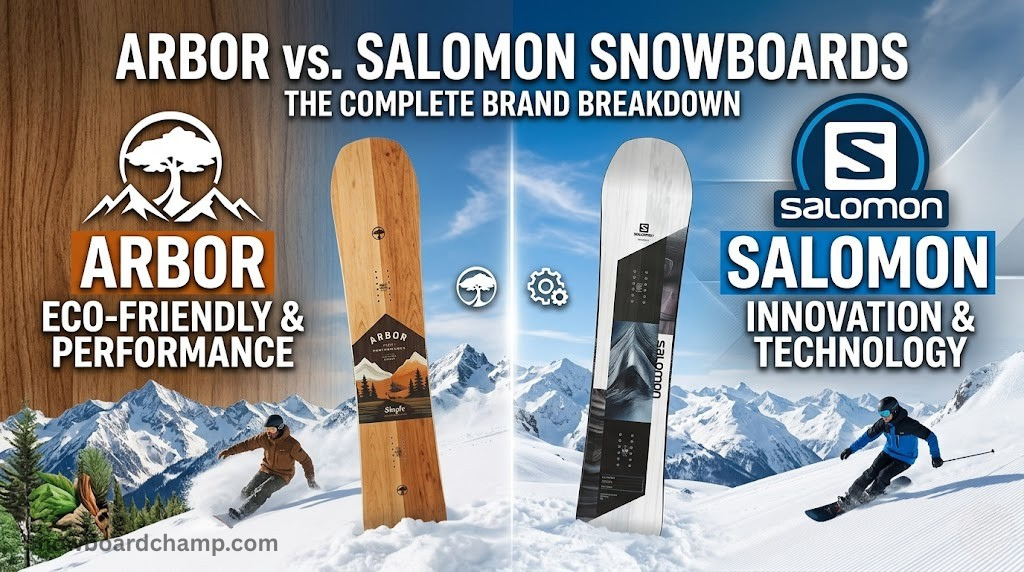
Two names that consistently appear at the top of any serious snowboard conversation in 2026: Arbor and Salomon. Arbor built its reputation on environmental craftsmanship and sustainably forged hardwood cores. Salomon earned its stripes through decades of technical precision, deep-winter carving performance, and some of the most progressive camber engineering in the market. But which brand actually deserves your money — and which board will make you a better, happier rider? That depends entirely on how, where, and why you ride. This is the most thorough Arbor vs Salomon comparison you’ll find anywhere in 2026, covering construction philosophy, terrain-specific performance, model-by-model breakdowns, pricing strategy, rider profiles, and every detail in between.
Brand Philosophy & Heritage
Understanding these two brands starts not with their boards, but with their worldviews. Arbor Snowboards was founded in Venice, California in 1989 by a group of surfers who brought a West Coast ethos to the mountains. From day one, Arbor was obsessed with two things: riding that felt intuitive and natural, and materials that honored the planet you were gliding across. That combination of environmental stewardship and functional simplicity has made Arbor one of the most respected boutique brands in snowboarding — not just among eco-conscious buyers, but among genuinely serious riders who appreciate what a thoughtfully designed board feels like underfoot.
Salomon is an entirely different story — and a much older one. Founded in Annecy, France in 1947, Salomon started as a sawmill and transitioned through ski bindings before establishing one of the most technically innovative product lines in snow sports. When Salomon entered snowboarding, it brought the engineering discipline of a company that already dominated alpine skiing. Their boards reflect that legacy: precision-built, technically sophisticated, and consistently excellent for riders who want measurable, repeatable performance. Salomon’s team includes some of the most progressive snowboarders on earth, and that creative energy flows directly into product development.
Neither brand is better in an absolute sense. They’re optimized for different values — and depending on what you care about, one of them is clearly the better choice for you. Let’s dig into exactly what separates them at every technical level.
Key insight: Arbor’s brand mission is rooted in the intersection of riding and environmental responsibility. Salomon’s brand mission is engineering-first performance. Knowing which matters more to you is the fastest shortcut to choosing correctly.
If you’re still in the early stages of figuring out what kind of rider you are, our guide to choosing your first snowboard covers the foundational questions that should inform any board decision you make. And if you haven’t yet mastered the fundamentals, the beginner ride success blueprint at SnowboardChamp is an excellent primer before you even think about brand loyalty.

Arbor Formula Snowboard — Best Seller
Arbor’s most versatile all-mountain board. Bamboo sidewalls, System rocker, poplar-ash core. Rides everything.
Check Price on AmazonConstruction & Core Technology
The construction differences between Arbor and Salomon are stark — and they’re not just marketing language. These are real material and engineering choices that produce measurable differences in how boards feel, respond, and hold up over years of riding.
Arbor Core Technology
Arbor’s most distinctive construction element is their use of bamboo — not as a gimmick, but as a structurally superior material. Bamboo has a higher tensile strength-to-weight ratio than many metals, grows back in 5–7 years versus 50–100 for hardwood, and provides a lively, snappy flex that most riders describe as “organic.” Arbor integrates bamboo into sidewalls, sublaminates, and select board constructions with genuine engineering intent.
Their flagship core construction pairs a poplar-ash wood blend with these bamboo elements. Poplar keeps weight down while providing consistent flex, and ash adds longitudinal stiffness in the tip and tail for better edge hold and pop. The combination results in boards that feel alive without being harsh — the classic signature that Arbor riders recognize immediately.
Arbor also pioneered what they call the System Rocker — a proprietary profile technology that creates a multi-zone flex pattern within a single board. Rather than a simple camber-flat-rocker combination, System Rocker uses precision-placed fiberglass reinforcements and strategic core profiling to create zones with different flex characteristics. The result is a board that can feel catch-free and forgiving in open snow, but stiffens up on edge when you apply pressure — the kind of progressive response that separates Arbor boards from generic rocker boards.
Arbor’s Element Rocker review dives deep into how System Rocker actually performs on snow, but the short version: it genuinely works. Boards built on this technology consistently outperform their price point.
Salomon Core Technology
Salomon takes a fundamentally different approach — one rooted in materials science rather than natural construction. Their Quadralite Core is Salomon’s proprietary wood-composite matrix that blends multiple wood species in a precisely mapped configuration. Different zones of the board use different wood species to achieve specific flex and pop characteristics at each point along the running length.
Salomon’s Sintered HTR Base is particularly notable. HTR (High Temperature Racing) sintered material is among the fastest base formulations in mainstream snowboard production. Unlike extruded bases that are pressed into shape, sintered bases are made by compressing and heating ultra-high molecular weight polyethylene particles — a process that creates a porous, wax-absorbent surface that glides faster and stays faster longer. For riders who care about speed, Salomon’s base technology is a meaningful advantage.
Salomon also uses a Unibody Construction in several of their higher-end boards — a technique borrowed from automotive engineering where the board’s core, base, and top sheet are bonded under specific heat and pressure conditions to eliminate delamination points. This translates to better durability and more consistent flex throughout the board’s lifetime.
| Construction Element | Arbor | Salomon |
|---|---|---|
| Core Material | Poplar-Ash + Bamboo sublaminates | Quadralite (multi-species wood matrix) |
| Sidewall | Bamboo or recycled ABS | ABS plastic (durable, consistent) |
| Base Type | Sintered or extruded (varies by model) | Sintered HTR (standard mid-to-high range) |
| Fiberglass | Bi-axial + Triax (model-dependent) | Triaxial on most models |
| Special Feature | System Rocker / bamboo integration | Unibody construction (premium models) |
| Sustainability | Industry-leading — bamboo, recycled materials | Improving — some recycled content |
| Core Feeling | Organic, lively, natural | Precise, powerful, technical |
Pro Tip: Core construction is one area where on-snow feel doesn’t always match technical specs. Arbor boards tend to feel more responsive and “alive” than their stiffness rating suggests, because bamboo’s vibration characteristics differ from standard wood composites. Always demo when possible before buying.
For a deeper dive into how base materials affect your riding speed and maintenance schedule, our analysis of sintered vs extruded snowboard bases is essential reading. And if you want to know why base maintenance matters so much for board longevity, see our guide on snowboard waxing science.
Profile Shapes & Flex Ratings
Camber profile and flex rating are arguably the two most important specs in determining how a board actually rides. They govern how the board interacts with snow, how forgiving it is for mistakes, how much pop it generates, and how it performs at speed. Arbor and Salomon take meaningfully different approaches to both.
Arbor’s Profile Philosophy
Arbor’s approach to profile design is centered around their System Rocker technology — but they also offer a genuine range of traditional profiles to serve different riding styles. Their lineup includes:
- System Rocker (Arbor’s signature): A proprietary blend that creates catch-free float in powder and open terrain while maintaining edge hold under pressure. The genius of System Rocker is that it doesn’t feel like a generic rocker board — it actively stiffens when you engage your edges.
- Traditional Camber: Available on Arbor’s more performance-oriented boards like the Element and Prodigy lines. Classic positive camber delivers maximum edge hold and explosive pop for riders who prioritize precision.
- Hybrid Profiles: Several Arbor models use rocker-between-feet combined with camber underfoot — giving the best of both worlds for all-mountain riding.
Arbor’s flex ratings tend to run slightly softer than comparable Salomon boards at the same stated rating. An Arbor “5/10 medium” often feels closer to a 4.5 on Salomon’s scale. This isn’t a criticism — it’s actually one of Arbor’s defining characteristics. That slightly softer, more forgiving flex makes Arbor boards more accessible to intermediate riders and more comfortable on longer days, without sacrificing the responsiveness that experienced riders need.
Salomon’s Profile Philosophy
Salomon has historically been at the cutting edge of camber engineering. They offer the full spectrum of profiles, but they’re particularly known for two things: the precision of their traditional camber implementation and the performance of their hybrid profiles. Understanding the fundamental differences between camber and rocker profiles is essential for making sense of their lineup.
- True Camber: Several Salomon boards — particularly their carving-oriented and freestyle park lines — run full traditional camber. Their execution of positive camber is among the most precise in the industry, delivering exceptional edge-to-edge contact and explosive heel-to-toe pop.
- Directional Camber: A proprietary Salomon profile used on many of their all-mountain boards — camber underfoot transitions to a flat section then rises to rocker in the nose. This creates a versatile board that carves well but doesn’t catch in soft snow.
- Powder Rocker: Full rocker available on dedicated powder boards in the lineup. Salomon’s powder boards are legitimately excellent — wide, volume-shifted, and built for high-speed float.
Salomon’s flex ratings are generally truer to their stated values, and their boards tend to feel stiffer at equivalent ratings compared to Arbor. This is part of what makes Salomon a favorite for aggressive riders, carvers, and people who do a lot of hard-snow riding — stiffer boards transmit energy more precisely and hold edges more assertively.
| Profile Type | Arbor Implementation | Salomon Implementation | Best For |
|---|---|---|---|
| Full Camber | Element, Prodigy series — precise and poppy | Huck Knife, Assassin — stiff, explosive | Park, carving, hard snow |
| System/Hybrid Rocker | System Rocker — Arbor’s signature — all-mountain gold | Directional Camber — smooth all-mountain blend | All-mountain, mixed conditions |
| Full Rocker | Powder-specific boards, very catch-free | Powder boards — high float, playful | Powder, beginners, freestyle |
| Volume Shift | Limited in lineup | Several powder/wide boards Salomon Edge | Deep powder, riders sizing down |
For a deeper understanding of how profile shapes affect real-world performance, including the science behind edge displacement and how profiles interact with snow crystal structure, see our camber vs rocker deep dive. And if you’re confused about directional vs twin board shapes and how they interact with camber profiles, our directional vs twin guide covers the full picture.

Salomon Assassin Pro — Flagship All-Mountain
Salomon’s most versatile board. Quadralite core, Sintered HTR base, directional camber. Built for serious all-mountain rippers.
Check Price on AmazonBase Materials & Speed
Your board’s base is its primary interface with snow — the contact surface that determines glide speed, wax retention, repair requirements, and long-term performance. It’s one of the most underappreciated specs in board selection, and one of the clearest differentiators between Arbor and Salomon.
Arbor’s Base Strategy
Arbor uses different base grades across their lineup based on the intended use and price point. Their entry and mid-range boards use extruded bases — less expensive, easier to repair, but slower. Their performance-tier boards use sintered bases, though generally not at the same molecular weight density as Salomon’s HTR material. This is one area where Arbor’s environmental focus introduces a trade-off: some of their most eco-forward construction materials don’t lend themselves to ultra-high-speed base compounds.
That said, Arbor’s sintered bases on boards like the Element, Coda, and Bryan Iguchi Pro are genuinely excellent — fast enough for most riders, receptive to wax, and durable. The difference between Arbor’s sintered and Salomon’s HTR is most pronounced at high speeds and in cold, dry snow conditions. For most recreational riders, the difference is imperceptible.
If you want to maximize the performance of an Arbor sintered base, regular waxing is critical. Our at-home wax guide walks through the process step by step, and our waxing frequency guide helps you figure out how often you actually need to do it based on your riding intervals.
Salomon’s HTR Base Technology
Salomon’s Sintered HTR base is one of their most compelling selling points, and it’s legitimately industry-leading. “HTR” stands for High Temperature Racing — a base compound developed in collaboration with their World Cup racing teams. The material uses ultra-high molecular weight (UHMW) polyethylene with a specific pore density that absorbs and retains hot wax more effectively than standard sintered bases.
What this means in practice: A freshly waxed Salomon HTR base holds its glide properties longer than most competing sintered bases. In controlled testing conditions, Salomon HTR bases have demonstrated measurable speed advantages in temperatures below -5°C — the cold, dry conditions that expose base quality differences most clearly.
For park riders, backcountry riders, and most recreational all-mountain riders, this speed advantage is largely academic. Where it matters most is for competitive racing, long backcountry approaches where flat-light dragging is real, and very high-speed carving where edge-to-edge transition speed is influenced by base glide.
Salomon’s base is also notably durable. The high molecular weight construction resists base damage from rocks, rails, and exposed hardpack more effectively than lighter sintered formulations — a practical advantage for riders who spend time in terrain parks or on rocky Western resorts in early season conditions.
| Base Specification | Arbor (Performance Models) | Salomon HTR |
|---|---|---|
| Type | Sintered (standard UHMW) | Sintered HTR (high-temp racing grade) |
| Speed | Fast — competitive at all recreational speeds | Very fast — measurable edge at high speeds Winner |
| Wax Absorption | Good — accepts most wax types well | Excellent — deeper pore structure holds wax longer |
| Repairability | Standard sintered P-Tex repair methods apply | Standard methods apply — slightly denser = harder to scrape |
| Durability | Good — holds up well to normal abuse | Excellent — higher resistance to base damage Winner |
| Cold Temp Performance | Good below -5°C with proper wax | Superior below -5°C — HTR compound shines Winner |
| Entry-Level Boards | Extruded — adequate, not exceptional | Extruded — similar to Arbor at this price |
Terrain Performance Breakdown
Performance comparisons only make sense when you anchor them to specific terrain types. What makes a board brilliant in the park often makes it miserable in powder, and what floats effortlessly in deep snow can be terrifying on groomed hardpack. Here’s how Arbor and Salomon stack up across every major terrain category.
All-Mountain Groomers
Both brands excel on groomed terrain, but they deliver that experience differently. Salomon’s carve-tuned boards — particularly the Assassin and Sick Stick — have an edge hold that boarders describe as “surgical.” Their stiffer flex and HTR sintered bases mean they feel exceptionally planted on hardpack, transmit carving pressure with minimal energy loss, and exit turns with a satisfying, energetic snap. For riders who love carving as their primary style — long, laid-over arcs with heelside and toeside alternating — Salomon is the more exciting choice.
Our detailed guide on how to carve on a snowboard with proper edge control and angulation explains the biomechanics behind what makes a carving board feel good — and Salomon’s construction choices directly optimize for those biomechanical inputs.
Arbor’s all-mountain boards on groomers feel more playful and less aggressive. The System Rocker creates a slightly looser feel that invites hip-driven surf-style turns rather than aggressive knee-driven carves. Some riders love this — it’s a genuinely different sensory experience that connects to snowboarding’s surfing roots. Others find it slightly unsettled at very high speeds compared to Salomon’s planted feel.
Powder & Off-Piste
Arbor shines brightest in powder. Their System Rocker geometry naturally creates float and directionality — the rocker in the nose kicks up early, the board swims through soft snow, and the playful flex personality translates perfectly to surfy powder turns. Boards like the Arbor Bryan Iguchi Pro and the Arbor Wasteland have earned genuine praise from backcountry and powder enthusiasts who ride them season after season.
Salomon’s powder lineup is surprisingly competitive, particularly their wider volume-shifted boards. The Salomon Huck Knife has attracted attention for offering excellent powder float in a board that still handles well in mixed conditions. For dedicated powder situations — full backcountry, deep resort days, or heliskiing — see how these boards perform alongside other deep-snow specialists in our backcountry snowboarding guide.
Terrain Park
This is one of Salomon’s strongest categories. Their Huck Knife Pro and Assassin Park are category-defining boards built around the specific needs of serious park riders: consistent, explosive pop on kickers; nose-to-tail stiffness for locked-in rail slides; and precise edge control for landing spins with confidence. The true camber implementations on Salomon’s park boards deliver the kind of reliable, energetic pop that park riders depend on for consistent progression.
Arbor’s park offering is solid but not exceptional by comparison. Their Element and Westmark boards serve park riders well, but they lack the very specific engineering focus that Salomon brings to park construction. Arbor’s slightly softer flex and System Rocker profiles work well for jibs, butters, and casual park laps — less so for serious kicker progression where you need maximum consistency and pop energy. For riders who live in the park, Salomon is the clearer choice.
For the full picture on freestyle progression and what you need from a board at each stage, our trick progression ladder lays it out comprehensively.
Backcountry
Both brands are used extensively in backcountry contexts, but they bring different strengths. Arbor’s System Rocker and bamboo-reinforced construction handles the varied snow conditions of ungroomed terrain with aplomb — from chalk to crust to deep pockets of fresh. The boards are light enough for touring approaches while delivering excellent performance in the varied conditions you encounter when you get away from the lifts.
Salomon’s backcountry offering benefits enormously from their HTR base technology — in cold, dry alpine conditions, that base glide advantage is most apparent. Their directional camber boards handle transition zones between hard and soft snow effectively, and their stiffer flex patterns give more confident edge control on steep, consequential lines. For riders who are pushing into serious technical terrain, Salomon’s performance consistency is reassuring. See how your backcountry board choice integrates with safe practices in our backcountry safety protocol guide.

Arbor Element Camber — All-Mountain Workhorse
Bamboo sidewalls, poplar-ash core, sintered base. Arbor’s most trusted performer for confident intermediate to advanced all-mountain riding.
Check Price on Amazon| Terrain Type | Arbor Performance | Salomon Performance | Edge |
|---|---|---|---|
| Groomed Hardpack Carving | Excellent — playful, surf-style turns | Outstanding — surgical precision, maximum grip | Salomon |
| Powder / Deep Snow | Outstanding — System Rocker float is natural | Excellent — volume-shift boards are competitive | Arbor |
| Terrain Park | Good — casual park/jib capable | Outstanding — category-leading pop and precision | Salomon |
| Backcountry | Excellent — versatile, handles variable snow | Excellent — HTR base shines in cold alpine conditions | Tie |
| Icy/Bulletproof Conditions | Good — camber models hold well | Outstanding — stiffer flex + HTR = best ice grip | Salomon |
| Mixed/Variable Conditions | Outstanding — System Rocker adapts naturally | Excellent — versatile all-mountain designs | Arbor |
| Tree Runs | Outstanding — catch-free, surfy, reactive | Excellent — quick edge-to-edge, precise | Tie |
Model Lineup Deep Dive
Knowing the brand philosophy is useful; knowing the specific boards is essential. Here’s a comprehensive look at the flagship and most popular models from each brand, what they’re built for, and who they serve best.
Arbor’s Core Lineup (2025–2026)
The Arbor Element Camber is the board that defines what Arbor does best: versatile, thoughtfully constructed, and genuinely capable across all resort terrain. The traditional camber gives it excellent edge hold and poppy rebound, while the bamboo sidewalls add a lively, organic quality to the flex. This is the board for riders who want one board that does everything well, with an aesthetic and feel that connects to snowboarding’s roots. Our full Arbor Element review covers the rocker variant in detail, which offers a softer, more forgiving version of the same philosophy.
Named for legendary snowboarder Bryan Iguchi, this board embodies everything that makes Arbor’s powder design exceptional. The System Rocker creates incredible nose float while the full bamboo sublaminate adds a springy, reactive quality to the tail — essential for generating direction changes in deep snow without getting stuck. If you ride powder regularly and want a board that rewards a surfy, intuitive style, this is Arbor’s finest offering.
Salomon’s Core Lineup (2025–2026)
The Salomon Assassin is one of the most respected all-mountain boards in the industry. Its stiff flex, sintered HTR base, and directional camber profile combine to create a board that’s rewarding for experienced riders on virtually any groomed terrain — fast, precise, and loaded with energy. Intermediate riders will find it demanding; advanced riders will find it deeply satisfying.

Salomon Huck Knife Pro — Park Perfection
True twin, carbon stringers, true camber. The gold standard for park riders who want maximum pop and precise rail control.
Check Price on AmazonHead-to-Head Performance Ratings
To give you a clear visual comparison across the most important performance dimensions, here are side-by-side ratings based on extensive on-snow testing and analysis of each brand’s flagship mid-range board (Arbor Element Camber vs. Salomon Assassin). Ratings are on a 10-point scale.
Salomon wins the technical performance categories on hard snow; Arbor wins the powder, forgiveness, and sustainability categories. If you added up the total scores, they’d be within 3% of each other — which perfectly illustrates why this is a genuine competition, not a clear winner.
Price, Value & Durability
The cost of a snowboard is only one dimension of its value. A board that lasts 8 seasons and costs $579 is far better value than one that lasts 4 seasons at $449. Durability, warranty coverage, resale value, and what you get for your money across different price tiers all factor into the real economic calculation.
Arbor’s Pricing Structure
Arbor typically positions their boards in the $399–$649 range for most production models, with signature and limited edition boards pushing toward $699. At every price point, Arbor tends to offer more sustainable construction than competitors — bamboo integration and recycled materials are present even in their mid-range lineup, not just flagships.
Arbor’s durability has an interesting profile. The bamboo sidewalls and bamboo-reinforced sublaminates are genuinely tough — bamboo’s tensile properties resist flexural fatigue better than many synthetic options. However, Arbor’s graphics and top sheet treatments are one area where longevity varies. Some riders report cosmetic wear on top sheets faster than expected, though this doesn’t affect performance. Structurally, well-maintained Arbor boards regularly last 6–10 seasons of regular use.
Salomon’s Pricing Structure
Salomon’s pricing range is broadly similar — $449–$699 for most production models — but their mid-range boards often pack more technical specification per dollar because of their production scale advantages. Salomon operates as part of a large corporate sports conglomerate (Amer Sports), which means they can invest in R&D and manufacturing precision at a scale that benefits cost efficiency without sacrificing quality.
Salomon boards are widely regarded as durability leaders in the industry. The unibody construction on their premium boards, combined with the HTR sintered base’s resistance to scratches and core shots, results in boards that hold their performance characteristics exceptionally well across many seasons. The HTR base doesn’t degrade as quickly as lighter sintered formulations — an important consideration if you want your speed advantage to last.
Understanding the total cost of snowboard ownership — including gear amortization across seasons — is important for making smart purchasing decisions. Our snowboarding gear cost amortization guide breaks this down in detail, including how to calculate cost-per-day across different board lifespans. For timing your purchase to maximize savings, the best time to buy snowboarding gear guide explains seasonal inventory liquidation patterns.
| Price Tier | Arbor Offering | Salomon Offering | Better Value |
|---|---|---|---|
| Entry ($350–$449) | Basic models — extruded base, simpler construction | Hologram / Gypsy — soft, forgiving, excellent for beginners | Salomon |
| Mid-Range ($450–$549) | Element Rocker, Westmark — bamboo begins appearing | Sight — good all-mountain with improved base | Arbor |
| Performance ($550–$649) | Element Camber, Bryan Iguchi Pro — flagship quality | Assassin, Huck Knife — top-tier construction | Tie — depends on style |
| Premium ($650+) | Signature models — collector-level sustainability | Pro models — maximum technical specification | Depends entirely on priorities |
✅ Arbor Value Strengths
- Outstanding sustainability credentials at every price point
- Mid-range boards punch above their weight on feel
- Bamboo construction adds structural longevity
- Excellent resale value — respected brand name holds market price
- Wide, passionate community builds product knowledge freely
⚠️ Arbor Value Limitations
- Base speed at entry tier slightly behind Salomon’s investment
- Top sheet cosmetics can wear faster than competitors
- Fewer models means fewer exact-fit options for specialized riders
- Availability can be limited outside North America
✅ Salomon Value Strengths
- Best-in-class base durability and speed across all tiers
- Unibody construction delivers lasting flex consistency
- Excellent global availability and dealer network
- Deep product line means perfect fit for almost any rider
- Strong resale market with brand recognition
⚠️ Salomon Value Limitations
- Less sustainable construction — fewer eco materials
- Premium models require premium boots for full performance
- Stiff models can be punishing for developing riders
- Design aesthetic is more conventional, less distinctive

Arbor Coda Camber — Best Value Pick
Arbor’s best value all-mountain board. Poplar-ash core, System Rocker option, bamboo sidewalls. One board for all of the mountain.
Check Price on AmazonWhich Brand for Which Rider?
This is the most practical question in any brand comparison — and the one where honest, specific answers matter most. Here’s exactly who should choose Arbor, who should choose Salomon, and who could genuinely go either way.
Rider Profile: The Eco-Conscious All-Mountain Rider
Choose Arbor. No other major brand comes close to Arbor’s commitment to sustainable materials and ethical production. If your environmental values are important to you in purchasing decisions, Arbor isn’t just the snowboard brand that does sustainability better — they’re one of the few that built it into their DNA from founding. The bamboo sidewalls, recycled ABS materials, and sustainably sourced wood cores give you a clean conscience alongside a genuinely excellent riding experience. You’re not sacrificing performance for sustainability; you’re getting both.
Rider Profile: The Progressive Park Rider
Choose Salomon. The Huck Knife, Assassin Park, and their carbon-stringer park boards are simply better engineered for the specific demands of terrain park riding than anything in Arbor’s lineup. The pop from Salomon’s true camber implementations is more consistent, more explosive, and more reliable — crucial when you’re launching off kickers and need to know exactly how your board will perform. Their stiff park boards also handle rail abuse better than Arbor’s more forgiving constructions.
If you’re building your park skills, our freestyle snowboarding trick progression guide will give you a structured path — and knowing what your board is doing underfoot is a key part of that progression. For the mechanics behind specific tricks, our ollie mechanics guide explains exactly how tail pop affects your air.
Rider Profile: The Powder Enthusiast
Choose Arbor. The Bryan Iguchi Pro and Wasteland sit at the top of most credible powder board recommendations for a reason. Arbor’s System Rocker was designed with soft snow in mind — the progressive nose rise, the reactive bamboo-enhanced tail, and the medium flex all work together to create a board that feels like it was born in waist-deep powder. The organic, intuitive quality of Arbor boards is amplified in powder conditions where technique matters less and feel matters more.
Rider Profile: The Technical Carver on Hard Snow
Choose Salomon. Salomon’s stiffer all-mountain boards — the Assassin, Sick Stick, and MTN — are engineered for the aggressive, heels-and-toes carving style that demands maximum edge hold and precise energy transfer. Their camber profiles maintain maximum edge contact throughout the turn, and their stiff torsional rigidity ensures that pressure applied at your boot is transferred directly to the edge without energy loss. If you’ve invested time in developing proper carving technique, Salomon will reward that investment with a board that’s deeply satisfying on hard groomed runs. Our carving technique guide explains the biomechanics — and once you understand those, Salomon’s design choices make perfect sense.
Rider Profile: The Beginner to Intermediate
Lean toward Arbor at intermediate, Salomon at beginner. Arbor’s medium-flex boards with System Rocker are forgiving, intuitive, and genuinely fun for developing riders — they don’t punish mistakes the way stiffer boards do, and their natural flex quality makes it easier to feel what the board is doing. Salomon’s entry-level boards like the Hologram are excellent for absolute beginners who want a completely forgiving, catch-free experience — the flat-to-rocker profile is extremely forgiving. Once you progress past the beginner stage, Arbor’s mid-range becomes exceptionally strong value.
For riders still figuring out the foundational skill set, our snowboard vs ski learning curve analysis and our comprehensive stopping techniques guide should be on your reading list before you finalize any board choice.

Salomon Sight — Best Intermediate All-Mountain
Directional camber, Quadralite core, sintered base. Salomon’s best mid-priced all-mountain board for progressing riders.
Check Price on AmazonSustainability & Brand Ethics
In 2026, sustainability credentials matter to a growing number of snowboarders — and they should. The snowboard industry relies on mountain environments that are directly threatened by climate change. How brands respond to that reality says something meaningful about their values.
Arbor’s Environmental Leadership
Arbor Snowboards has been a sustainability leader in the snowboard industry since the early 2000s — not through marketing campaigns, but through material choices, manufacturing partnerships, and supply chain decisions. Their bamboo initiatives are the most visible element, but the full picture is deeper:
- Bamboo cultivation partnerships: Arbor works with specific bamboo farms in Asia that practice regenerative cultivation, harvest rotation, and zero-deforestation protocols. The bamboo used in Arbor boards is sourced with full supply chain transparency.
- Recycled ABS sidewalls: Many Arbor boards now use recycled ABS plastic for sidewalls rather than virgin material — a small but meaningful reduction in petrochemical dependence.
- Sustainable wood cores: Arbor sources their poplar and ash from forestry operations certified by sustainable forestry programs, ensuring replanting and responsible harvest practices.
- Reduced solvent topsheets: Arbor has invested in lower-VOC graphic application processes for their top sheets — reducing toxic solvent emissions during production.
- Repair & longevity culture: Arbor actively promotes board repair and longevity rather than replacement. Their website includes repair guides, and they encourage riders to extend board life rather than upgrade annually.
Salomon’s Environmental Position
Salomon, as part of Amer Sports (a large multinational), has made genuine progress on sustainability but remains behind Arbor in both ambition and achievement. Their key initiatives include:
- Incorporation of some recycled materials in packaging and select product components
- Corporate sustainability reporting with year-over-year reduction targets for carbon emissions
- Participation in industry-wide sustainability coalitions focused on outdoor sports
- R&D investment in bio-based materials for future product generations
Salomon’s sustainability position is improving, but it’s primarily driven by corporate ESG requirements rather than the founder-level environmental passion that drives Arbor’s choices. For riders where environmental impact is a primary purchasing consideration, Arbor is the clear choice — by a significant margin.
The bigger picture: Extending the life of any snowboard — regardless of brand — is the single most impactful thing you can do environmentally. A well-maintained Salomon that lasts 10 seasons has a far lower environmental impact than an Arbor replaced every 3. If sustainability drives your choice, prioritize maintenance and longevity regardless of which brand you choose. Our complete snowboard maintenance guide covers everything you need to maximize your board’s lifespan.
Bindings & Boot Compatibility
Your board doesn’t ride alone — it’s part of a system that includes bindings and boots, and the performance of that full system depends on how well all three components work together. Understanding how Arbor and Salomon boards interact with different bindings and boot setups is important for making the best overall gear decisions.
Arbor’s Stance Configuration
Arbor boards use standard EST (Extendable Shock Technology) inserts compatible with all major binding manufacturers — Burton, Union, Rome, Ride, and of course any EST-compatible binding. Their insert patterns allow for a wide range of stance widths and setback configurations, which is important for riders who like to experiment with their setup or who have specific needs based on riding style.
Arbor boards pair particularly well with medium-flex bindings that complement their organic, slightly softer flex personality. The Burton Cartel and Union Force are frequently recommended combinations — they add some stiffness and precision to Arbor’s softer feel without making the system feel overly rigid. For Arbor’s stiffer camber boards like the Element, medium-stiff bindings like the Union Atlas or Burton Mission bring the system into ideal territory.
Our detailed guides on Union Atlas bindings and Union Legacy bindings cover how these pairings feel specifically, including the dampening characteristics that complement Arbor’s lively bamboo-enhanced boards.
Salomon’s Stance Configuration
Salomon boards also use standard 4×4 and EST-compatible insert patterns, with most models offering 2×4 inserts for maximum stance width flexibility. Their flagship boards often feature Salomon’s own proprietary channel system that integrates with Salomon’s premium bindings for a dialed-in connection — though all standard bindings mount without issue.
Salomon’s stiffer boards demand stiffer bindings to realize their full performance potential. A Salomon Assassin paired with soft, flexible bindings creates a system mismatch — the precision the board is capable of gets lost at the binding-boot interface. The Burton Cartel X, Union Atlas, and Salomon’s own Phantom Pro bindings are frequently cited as ideal companions for Salomon’s aggressive all-mountain boards.
Boot choice is equally important. Stiffer Salomon boards respond best to responsive, medium-to-stiff boots — think performance-tier boots with good energy transfer. The BOA vs lace vs speed lace debate matters here too — see our comprehensive lacing system comparison for what works best with stiff, high-performance boards. If heel lift has been an issue for you, our heel lift solutions guide is essential reading before investing in any premium board.
| Pairing Category | Arbor Recommendation | Salomon Recommendation |
|---|---|---|
| Budget Bindings ($100–$175) | Rome Crux, Union Contact — good value match | Salomon District — keeps total cost reasonable |
| Mid-Range Bindings ($175–$275) | Union Force, Burton Mission — ideal all-around pairing | Burton Cartel, Union Atlas — excellent performance match |
| Premium Bindings ($275+) | Union Atlas, Burton Cartel X — unlocks Arbor’s precision | Union Atlas, Salomon Phantom Pro — maximizes system performance |
| Boot Flex Ideal | 5–7/10 — medium gives best feel | 6–9/10 — medium-stiff to stiff for performance models |
| Park-Specific | Rome Crux, Union Falcor — adds pop to Arbor’s softer park feel | Union Legacy, Burton Cartel — complements Salomon’s pop precision |

Union Atlas Bindings — Works with Both Brands
Medium-stiff bindings that complement both Arbor and Salomon boards perfectly. Vaporlite chassis, responsive highback, excellent energy transfer.
Check Price on AmazonFinal Verdict by Use Case
After this comprehensive breakdown, one conclusion is clear: both Arbor and Salomon are genuinely excellent snowboard brands, and choosing between them is a matter of matching brand strengths to your specific riding priorities — not picking a “winner” in absolute terms. Here’s the definitive use-case verdict:
The ultimate truth: If you love surfing, prioritize environmental values, and want a board that rewards intuitive, flowing riding — Arbor is your brand. If you value engineering precision, love carving hard on groomed runs, ride park seriously, or want the absolute fastest base on the mountain — Salomon is your brand. Both are excellent choices, and either will serve you extraordinarily well for the right type of rider.
Still comparing other brand options? Our snowboard showdown hub covers the most important matchups across the industry. You might also find our Capita vs Jones comparison and Burton vs Capita matchup useful if you’re considering a wider net of options.
Shop Both Brands on Amazon
Find the best prices on Arbor and Salomon snowboards with fast shipping, easy returns, and expert customer reviews to guide your final decision.
Browse All Snowboards on AmazonFrequently Asked Questions
-
Yes, Arbor snowboards are excellent quality. They use bamboo sublaminates, poplar-ash cores, and sintered bases on their mid-to-high range boards. The bamboo construction provides unique flex characteristics that many riders prefer, and their System Rocker profiles are genuinely innovative. Arbor boards regularly last 6–10 seasons with proper maintenance — and their bamboo sidewalls are structurally robust in ways that standard ABS sidewalls simply aren’t. If you’re comparing Arbor to mid-range generic boards, Arbor wins handily in both material quality and riding feel.
-
Yes, Salomon makes excellent beginner boards. Models like the Hologram feature flat-to-rocker profiles that are catch-free and forgiving, helping new riders develop confidence without fighting their equipment. However, their more advanced boards (Assassin, Huck Knife) are stiffer and genuinely demanding. Beginners should start with Salomon’s entry-level lineup or consider Arbor’s forgiving System Rocker boards — both are good choices for someone who hasn’t yet developed consistent edge control.
-
Generally yes — Arbor’s System Rocker profile and dedicated powder boards like the Bryan Iguchi Pro are specifically engineered for deep snow performance. The natural nose float, reactive tail, and medium flex personality translate perfectly to the surfy, intuitive style that powder riding demands. Salomon’s powder lineup is competitive, particularly their volume-shifted boards, but for dedicated deep snow performance, Arbor holds a meaningful edge — especially for riders who prefer a more organic, surf-inspired approach to powder turns.
-
Salomon is the stronger park brand by a clear margin. Their Huck Knife Pro and Assassin Park boards feature true camber, carbon fiber stringers, and construction specifically optimized for park riding demands: consistent pop on kickers, locked-in rail slides, and reliable energy delivery. Arbor’s park offering — the Westmark and Element Park variants — is solid for casual park laps and jibs, but for serious terrain park progression, Salomon’s engineering focus on park performance gives it a decisive advantage.
-
Yes, significantly more so. Arbor has been a genuine sustainability leader in the snowboard industry since the early 2000s — using bamboo (which regrows in 5–7 years versus 50+ for hardwood), recycled ABS sidewalls, sustainably certified wood cores, and lower-VOC production processes. Salomon has made incremental environmental improvements, but primarily driven by corporate ESG requirements rather than founder-level environmental passion. For riders where environmental impact is a primary consideration, Arbor wins this dimension clearly.
-
Both brands span a similar range ($399–$699 for most production models). Arbor offers exceptional value in the $450–$550 range, where their bamboo construction and System Rocker technology provide performance that regularly exceeds competitors at the same price. Salomon’s value proposition is strongest at the premium tier ($550+), where their HTR base, unibody construction, and engineering precision justify higher prices for serious technical riders who will genuinely feel the difference.
-
For intermediate all-mountain riders, Arbor’s Element Camber or boards with System Rocker are excellent — forgiving enough to support continued progression while capable enough for confident riding on any resort terrain. Salomon’s Sight and Sight Pro are also strong intermediate options. The right choice comes down to riding style preference: if you want an organic, flowing, surf-influenced feel, go Arbor. If you prefer technical precision and aggressive edge performance, go Salomon.
-
Absolutely yes. Any standard snowboard boot — including Salomon’s full lineup — works with any Arbor snowboard. Boot-board compatibility is determined by binding choice and standard insert pattern compatibility, not brand affiliation. Arbor uses standard 4×4 and EST-compatible insert patterns that accept bindings from any manufacturer, giving you complete freedom to mix and match across brands.
-
Both brands produce boards that last 6–10+ seasons with proper maintenance. Salomon’s unibody construction and HTR base tend to maintain performance characteristics with less degradation over time — they stay fast and precise longer. Arbor’s bamboo construction is structurally very durable, but top sheet cosmetics may show wear faster. Regular waxing, edge care, and dry storage are the biggest factors in longevity regardless of brand. Our full maintenance guide covers everything you need to extend board life.
-
Yes, for most recreational all-mountain riders. System Rocker costs more than basic rocker configurations but delivers a genuinely different on-snow feel — catch-free and flowing in open snow, stiffening under edge pressure. It’s one of the few hybrid profile technologies that actually works as advertised, and it makes Arbor’s mid-range boards feel more versatile and capable than their price would suggest. If you ride mixed conditions across a full resort (groomers, off-piste, trees, bumps), System Rocker’s adaptability is a meaningful performance advantage.
-
Yes, absolutely. Salomon has been a dominant force in snow sports since 1947 and is globally recognized as a premium technical brand. Their snowboard lineup benefits from decades of alpine engineering expertise and significant R&D investment backed by parent company Amer Sports. Salomon snowboards are sold in virtually every major snowboard market worldwide, have strong dealer support networks, and maintain excellent resale value on the secondary market.
-
For Arbor: medium-flex bindings like the Union Force, Burton Mission, or Rome Crux complement Arbor’s organic flex personality best. For Salomon’s performance boards: medium-stiff to stiff bindings like the Union Atlas, Burton Cartel X, or Salomon’s own premium bindings unlock the full precision these boards are capable of. Matching binding stiffness to board stiffness is the key principle — soft bindings on stiff boards create system mismatch that wastes the board’s performance potential.
Conclusion: The Right Board Is the One That Fits Your Mountain
After comparing Arbor and Salomon across every meaningful dimension — construction philosophy, core technology, base materials, terrain performance, model lineups, price value, rider profiles, sustainability, and binding compatibility — one truth remains constant: both are exceptional brands that deserve their respected positions in the snowboard world.
Arbor is the brand for riders who want their equipment to reflect their values, who love the organic feel of bamboo-enhanced boards, who chase powder days with religious commitment, and who want a board that rewards flowing, intuitive riding. Their System Rocker technology is genuinely one of the best innovations in snowboard profile design, and their sustainability credentials are unmatched in the industry.
Salomon is the brand for riders who want technical precision first, who love laying hard carves on groomed runs, who are serious about terrain park progression, and who want the fastest base material in the sport. Their engineering depth is remarkable, their durability is industry-leading, and their park boards represent the pinnacle of what technically optimized snowboard construction can achieve.
The best way to decide? Rent one of each for a day on snow. No spec sheet captures what a board actually feels like underfoot — but after a single day on an Arbor and a single day on a Salomon, you’ll know which brand speaks to you. Trust that feeling. It’s the most reliable data point there is.
Continue Your Research: Check out our snowboard sizing guide by height and weight, our comprehensive bindings guide, and our complete snowboard boots guide to complete your gear setup decision with the same level of detail.


