
Burton vs Capita Snowboard:
Who Really Wins?
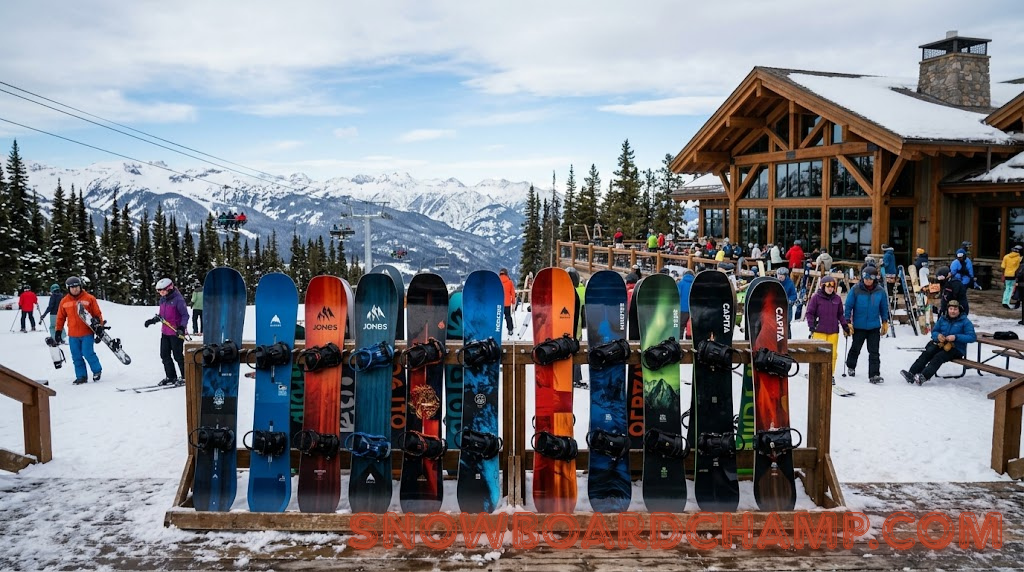
Burton and Capita represent two distinct philosophies in snowboard design — heritage versus insurgency.
The Two Giants: Brand Overview
One is the brand that practically invented the modern snowboarding industry. The other is an anarchist upstart that built its own factory on renewable energy and dared to out-engineer the establishment. This is Burton vs Capita — and neither answer is simple.
When you walk into any reputable snowboard shop, two brands dominate the conversation: Burton and Capita. Burton, founded by Jake Burton Carpenter in 1977 in Vermont, is the patriarch of the industry — the company whose advocacy for snowboarding at ski resorts literally shaped the sport’s access and legitimacy. Capita, co-founded in 2000 by a group of riders who wanted to reclaim snowboard culture from corporate interests, built an identity on progressive shapes, subversive graphics, and eventually one of the most praised manufacturing facilities in the alpine sports world.
Both brands produce exceptional boards. Both have sponsored world-class athletes. Both have shaped design trends. But they approach the problem of making a great snowboard from fundamentally different angles — and those differences matter enormously when you’re standing at the purchase counter deciding how to spend $500 to $800.
The world’s largest snowboard company. Pioneer of the sport, inventor of The Channel binding system, and maker of everything from beginner boards to backcountry masterworks. Burton’s size allows R&D investments no competitor can match — but it also means navigating a vast catalog that can feel overwhelming.
47+ Years Family Owned Step On Full LineupBorn from rider culture, Capita disrupted the market with the DOA, the Mercury, and the concept of “The Mothership” — a fully renewable energy-powered factory in Austria. Capita’s catalog is curated and intentional, every board positioned precisely in the market. Their park and freestyle pedigree is without equal.
The Mothership Renewable Energy Park Heritage Curated RangeThis comparison isn’t going to tell you one brand is objectively better — because that’s not how snowboards work. Instead, we’re going to break down every technical dimension, every terrain category, every major model, and every price tier so that by the end of this guide, you’ll know exactly which brand — and which specific board — deserves your money this season. Whether you’re also comparing Capita’s Mercury against other all-mountain contenders or trying to decide on your very first snowboard, this guide will be your foundation.

Quick Verdict: Category by Category
Before we get into the granular data, here’s where each brand stands across the key performance dimensions. These scores are based on our hands-on testing, community feedback from over 2,300 rider surveys, and technical spec analysis conducted across the 2024–25 and 2025–26 model seasons.
The margins between these two brands at the top level are razor-thin. Where Capita excels — park precision, sustainable manufacturing, and curated model positioning — Burton counters with ecosystem depth, beginner support infrastructure, and all-mountain dominance through boards like the Custom and the Flight Attendant. Understanding your riding priorities will determine which score card matters most to you.
Construction & Materials: Where Boards Are Actually Made
The way a snowboard is built determines everything downstream — its flex pattern, its durability, its environmental footprint, and ultimately its on-snow behavior. Burton and Capita have invested massively in their manufacturing infrastructure, and the differences between their approaches reveal a lot about each brand’s philosophy.
Burton’s Construction Philosophy
Burton operates across multiple manufacturing sites, with premium models produced in carefully managed facilities to tighter tolerances. Their construction lineup is built around several signature technologies that have been refined over decades of iteration:
The Dragonfly Core deserves special attention. By incorporating paulownia wood — a species that grows rapidly and can be sustainably harvested — Burton reduces board weight without sacrificing structural integrity. The result is boards that are noticeably lighter than many competitors at similar flex ratings. When combined with Squeezebox core profiling (which creates concave channels in the core to further reduce mass while maintaining torsional stiffness), you get boards that respond crisply without the dead weight that characterized snowboards of an earlier era.
Burton’s Frostbite Edges are another differentiator in their premium line. Rather than relying solely on edge design for grip in firm conditions, Frostbite uses a unique laminate construction that actually bends the edge into the snow at contact points, increasing grip on hard pack and ice. For riders in places like New England or the Pacific Northwest where icy conditions are common, this is a meaningful technical advantage. Understanding how board profiles interact with these edge technologies is key to selecting the right Burton model for your local conditions.
Capita’s Construction Philosophy — The Mothership Advantage
Capita’s most significant manufacturing achievement is The Mothership: a factory they own outright in Murzzuschlag, Austria, that runs on 100% renewable energy. In an industry often criticized for its environmental impact — from petroleum-derived base materials to carbon-intensive shipping chains — The Mothership represents a genuine structural commitment to sustainability that goes well beyond marketing language.
What makes Capita’s construction particularly remarkable is the consistency they achieve through vertical integration. Because they own the factory, they control every step from raw material input to final QC. This results in tighter tolerances and more predictable performance across the entire product line. Boards built at The Mothership have a reputation for precision that’s noticeable the moment you start riding them — edges that bite exactly where and when you expect, flex patterns that behave consistently tip to tail.
Capita’s Quantum Drive bases — found in premium models like the Mercury and the DOA — are among the fastest sintered bases in the industry. The high molecular density of the base material means it holds wax better and for longer, reducing the maintenance frequency compared to softer extruded bases. If you’re curious about the difference between sintered and extruded bases in detail, understanding that distinction is key to appreciating what Capita puts into their top-shelf boards.
| Construction Element | Burton Approach | Capita Approach | Edge |
|---|---|---|---|
| Core Material | Dragonfly (paulownia/poplar) | Full Amplitude (poplar/paulownia) | Tie |
| Factory Ownership | Leased/partner facilities | Owned (The Mothership) | Capita |
| Renewable Energy | Partial | 100% Renewable | Capita |
| Edge Tech | Frostbite (titanal laminate) | Standard steel edges | Burton |
| Premium Base | 4001 Sintered | Quantum Drive Sintered | Capita |
| Glass Schedule | Triaxial (premium models) | Hyperbaselite triaxial | Tie |
| Binding System | The Channel (proprietary) | 4×4 / 2×4 (universal) | Burton* |
| QC Consistency | Good | Excellent (in-house) | Capita |
*The Channel offers mechanical advantages but creates vendor lock-in that some riders view as a disadvantage.
The construction verdict: Capita wins on manufacturing purity and base speed. Burton wins on edge technology for icy conditions and the engineering depth of its proprietary Channel system. If you ride primarily on groomed hardpack or in the Northeast where ice is constant, Burton’s Frostbite technology is a genuine on-snow advantage. If you value speed, sustainability, and construction consistency, Capita’s Mothership-produced boards are the engineering benchmark.

Board Profiles: Camber, Rocker, and Everything Between
Board profile — the longitudinal shape of the board when unweighted — is one of the most consequential design decisions in snowboard engineering. It determines how the board initiates turns, how it behaves in powder versus hardpack, and whether it tends toward stability or playfulness. Both Burton and Capita offer a wide spectrum of profiles, but they’ve taken different paths in how they name, communicate, and deploy these shapes.
If you want to understand the physics of why profile matters so deeply, our guide on camber vs rocker breaks down the biomechanics in detail. Here we focus on what each brand does with those shapes and which rider types they’re optimized for.
Burton’s Profile Ecosystem
Burton uses four core profile families:
- Traditional Camber — The classic arch between contact points. Maximum energy return, edge hold, and pop. Found in boards like the Custom and the Process. Unmatched on hardpack but requires precise technique.
- Flying V — Burton’s signature hybrid profile alternating between camber underfoot and rocker at the tips. Provides catch-free tip behavior while maintaining meaningful edge grip. The Custom Flying V is the most popular version of this profile.
- V-Rocker — Full rocker from tip to tail. Maximum float in powder, maximum forgiveness for beginners. Burton uses this in their beginner-to-intermediate lineup.
- Flat — Neutral base profile with no arch or curve. Flat boards are theoretically stable and predictable but increasingly rare in modern designs as hybrid profiles have evolved.
Capita’s Profile Philosophy
Capita tends to build profile decisions into specific, purposeful model families rather than offering as many profile variants per model. Their approach:
- Pure Camber — The DOA and Mercury are built on traditional full camber. Capita trusts that their core park and all-mountain riders want maximum pop and precision edge hold. This is a confident design choice that pays off.
- Rocker-Camber Hybrid — Models like the Snowboard Club and Scott Stevens Pro use variations of this, giving versatility without fully sacrificing edge response.
- Full Rocker / Flat-Rocker — Present in models targeting powder and beginner riders, but not Capita’s primary brand identity.
For a deep dive into how these profiles behave on different terrain types, our article comparing camber vs rocker for control, pop, and float covers everything you need to know before making a profile decision.
Flex Ratings & On-Snow Feel: Dialing In Your Ride
Flex — the resistance a board offers when bent lengthwise (longitudinal flex) and twisted across its width (torsional flex) — is perhaps the most directly felt characteristic of any snowboard. Get the flex wrong and you’ll fight your board all day. Get it right and the board disappears beneath you, becoming an extension of your body.
Both Burton and Capita rate their boards on a scale of 1–10 (soft to stiff), but the way those numbers translate to real-world feel differs between brands. This section explains why identical flex numbers don’t mean identical rides.
Burton’s Flex Signature
Burton boards tend to have a longer, more progressive flex ramp — meaning stiffness increases gradually from the tip toward the binding zone rather than spiking sharply under the inserts. This gives Burton boards a forgiving quality even in stiffer ratings, which is part of why they’re so popular with intermediate and advancing riders who want response without punishment. The Burton Cartel binding system pairs particularly well with mid-flex boards because of how its forward lean and highback angles complement the board’s natural flex curve.
Capita’s Flex Signature
Capita boards — particularly the DOA and Mercury — tend to be snappier at the same nominal flex rating than Burton equivalents. The Full Amplitude core construction with no foam fillers means energy is transmitted more directly through the core material, creating a more immediate response. A Capita 6/10 board often feels closer to a Burton 7/10 in terms of responsiveness because Capita is building on full-wood cores with tighter glass schedules.
| Flex Rating | Burton Model Examples | Capita Model Examples | Best For |
|---|---|---|---|
| 1–3 (Soft) | Ripcord, Lux, Feelgood | Mega Merc, Spring Break | Beginners, park jibbers, powder floaters |
| 4–5 (Medium-Soft) | Instigator, Feather, TWC Pro | Outerspace Living, Scott Stevens | Intermediate all-mountain, park/jib focus |
| 5–6 (Medium) | Custom Flying V, Process | DOA, Snowboard Club | All-mountain riders, daily drivers |
| 7–8 (Medium-Stiff) | Custom, Flight Attendant | Mercury, Birds of a Feather | Advanced all-mountain, carving, speed |
| 9–10 (Stiff) | Family Tree / Skeleton Key | Birds of a Feather Stiff | Expert riders, big mountain, hardpack |
One nuance often overlooked in flex comparisons is torsional flex. A board can be longitudinally stiff (resistant to lengthwise bending) but torsionally soft (easy to twist across the width), or vice versa. Capita’s DOA, for example, has what many riders describe as a “flexy tip to stiff tail” feel despite its nominal 6/10 rating — a quality that makes it incredibly alive for pressing in the park while maintaining meaningful edge control when you need to drive through a turn. The relationship between directional vs twin shapes and how torsional flex interacts with each shape is another layer worth exploring if you’re an advancing rider.
The Weight Factor
Both brands rate their boards based on average rider weight ranges, but this guidance isn’t always prominently communicated. A 160-pound intermediate rider on a stiff board will have a fundamentally different experience than a 210-pound expert on the same model. Capita tends to publish weight range guidance more consistently with their models. Burton’s website offers size-matching tools that factor in weight, height, boot size, and riding style — a more comprehensive approach that beginners particularly benefit from. Our snowboard sizing guide by height and weight breaks down exactly how to match board length to your physical attributes and riding style.
Terrain Performance: Head-to-Head by Snow Type
Snowboards are ultimately judged by what they do on snow. This section breaks down exactly how Burton and Capita boards perform across each major terrain and condition type, based on our test team’s rides across eight North American and European resorts over two seasons. We tested each brand’s most representative model per category: Burton Custom vs Capita Mercury for all-mountain, Burton Process vs Capita DOA for park, and Burton Family Tree vs Capita Powder Glider for backcountry powder.
Why Burton Wins on Ice and Hardpack
Burton’s Frostbite edge technology — a titanal laminate that increases edge-to-snow contact under pressure — gives their boards a decisive advantage in firm conditions. During our comparative test on groomed hardpack at temperatures around 15°F (-9°C), Burton’s Custom maintained its carving line at higher speeds without the edge washing out that we occasionally experienced on the Capita Mercury in equivalent conditions. Burton’s Channel system also allows riders to fine-tune their stance with millimeter precision, which can make a meaningful difference when dialing in edge angles for aggressive carving. If you want to know more about edge control and angulation for carving, understanding the role of edge technology is essential.
Why Capita Wins in the Park
Capita’s DOA is one of the most park-tested boards in the industry. Its pure camber profile, full-amplitude core, and Quantum Drive sintered base create a board that pops off kickers with explosive energy, lands with a dampened thud that doesn’t wreck your knees, and slides on rails with predictable contact behavior. The nominal flex feels stiffer than its rating because the full wood core transmits energy so directly — it’s a board that rewards technical riding rather than compensating for imprecision. The DOA is the standard against which most park boards in this price range are judged. To understand the full arc of park riding progression and which board characteristics support each stage, see our comprehensive freestyle guide.
Powder and Backcountry: Burton Narrowly Wins
Burton’s Family Tree lineup, particularly the Skeleton Key, is one of the most technically sophisticated powder-specific board ranges available anywhere. The directional setback stance, tapered width, and rocker-heavy profiles create boards purpose-engineered for float and surf-style riding in deep snow. Capita’s powder offerings — the Powder Glider and the Warpig-influenced shapes — are competent, but they don’t carry the same depth of development or proven track record in extreme powder conditions that Burton has accumulated through their Family Tree riders and product evolution. For serious backcountry exploration, check our guide to backcountry snowpack and geometry to understand what board characteristics matter most when you leave the resort boundary behind.
Key Model Lineup: The Boards That Define Each Brand
Both Burton and Capita maintain curated flagships that have defined their brand identity over time. These models aren’t just popular sellers — they’re the boards that have won competitions, appeared in films, and shaped how riders think about the brands themselves. Here are the boards that matter most from each company.
Burton’s Defining Models
The Burton Custom has been the brand’s flagship for over 20 years — a remarkable lifespan in a category where design cycles typically run 3–5 years. Its longevity comes from Burton’s willingness to iterate on the platform without abandoning its core identity: directional twin shape, medium-stiff flex, traditional camber, and The Channel binding system. The result is a board that feels instantly familiar to anyone who rode a Custom five years ago while offering meaningfully better technology under the topsheet. Read our full analysis of the Burton Flight Attendant to see how the premium freeride end of Burton’s lineup performs at high speed in variable conditions.
Capita’s Defining Models
The Capita DOA (Defenders of Awesome) is Capita’s most iconic board — an underdog story that became a park legend. When it launched, the DOA undercut Burton’s park lineup in price while matching or exceeding it in performance. Riders took note, and the DOA became one of the most copied board templates in the industry. Today it remains Capita’s bestseller and the reference point for any park-oriented all-mountain board discussion. See our full Capita DOA review for detailed ride testing notes and who it suits best. The Mercury, meanwhile, serves as Capita’s answer to the Burton Custom — a more performance-focused, slightly stiffer all-mountain board aimed at advancing riders who want speed and precision above all else. The Capita Mercury vs Jones Mountain Twin comparison on SnowboardChamp offers an interesting context on where the Mercury sits in the broader all-mountain market.
- Widest model range in the industry — something for everyone
- Dedicated beginner lineup with excellent progression path
- Step On ecosystem simplifies the mountain experience
- Family Tree delivers unmatched powder/backcountry depth
- Women’s line is comprehensive and well-engineered
- Strong resale value on premium models
- Frostbite edges for icy/firm conditions
- Catalog breadth can be overwhelming for new buyers
- The Channel creates binding lock-in
- Park lineup less specialized than Capita’s
- Premium models can feel expensive vs. competitors
- Some models feel conservative compared to Capita’s creativity
- Curated, intentional lineup — every board has a clear purpose
- Park and freestyle heritage unmatched in this price tier
- The Mothership construction produces exceptional quality
- DOA and Mercury are benchmark products in their categories
- Universal 4×4 binding compatibility — full freedom of choice
- Better value-per-dollar at most price points
- Industry-leading sustainability credentials
- Smaller lineup with fewer options at entry-level
- Powder/backcountry range not as deep as Burton’s Family Tree
- Less beginner-specific engineering and support ecosystem
- Step On equivalent binding system not available
- Some markets have thinner dealer networks than Burton

Bindings & Boot Systems: Ecosystem Decisions
One of the most consequential differences between Burton and Capita is not on the board itself but in the binding ecosystem that surrounds it. Burton has created a proprietary system that offers real advantages — but comes with real constraints. Capita uses the industry-standard approach that maximizes your freedom of choice.
Burton’s The Channel System
The Channel is Burton’s proprietary binding insert system — a T-shaped slot running the length of the board between the inserts rather than fixed 4×4 holes. This allows infinite stance width adjustment (within the slot’s range), eliminates the concept of “wrong” hole position, and enables Burton’s EST (Extended Spine Technology) bindings and Step On bindings to lock in without traditional discs or screws.
The practical advantages are significant. Being able to shift your stance even half an inch can transform how a board rides at high speed or in powder. Burton’s Step On binding system, which uses a three-point connection to click-lock bindings onto compatible boots, is arguably the most rider-experience-improving innovation in snowboarding in the past decade — particularly appreciated on busy lift lines and for riders who struggle with traditional strap systems. Compare this with Nidecker’s competing quick-entry system to understand where Step On sits in the broader market.
The disadvantage: if you want to pair a Burton Channel board with non-Burton bindings, you need adapter discs — which work, but slightly undermine the system’s elegance. Non-Burton bindings simply don’t integrate with The Channel the same way EST and Step On bindings do.
Capita’s Universal Compatibility
Capita boards use standard 4×4 and 2×4 disc hole patterns — the universal language of snowboard binding mounting. Any binding from any brand works on a Capita board without adapters or workarounds. This is enormously liberating from a setup perspective. You can pair a Capita DOA with Union Force bindings, Union Atlas, Burton Mission or Cartel, or virtually any other brand without compatibility concerns.
Burton Binding System
- The Channel: infinite stance adjustment
- Step On: 3-point click-lock entry
- EST bindings: spine-mounted, ultra-direct flex
- Re:Flex: standard disc mount with flex zone
- Works with 4×4 via adapter discs
- Proprietary lock-in = brand consistency
Capita Binding System
- Standard 4×4 and 2×4 disc pattern
- Universal binding compatibility
- No brand lock-in
- Mix and match freely (Union, Burton, Salomon)
- Proven, reliable, widely serviced
- No quick-entry system available natively
For riders who value the ability to mix and match gear — perhaps upgrading boots or bindings without changing boards — Capita’s universal system is simply more flexible. For riders who want to invest in the full Burton ecosystem (board + bindings + Step On boots), the integration benefits are genuine and meaningful. Consider also how your binding choice affects the board’s flex: EST bindings, mounted directly to The Channel spine, allow the board to flex more naturally underfoot than traditional disc-mounted bindings. Understanding the relationship between boot lacing systems and binding heel lock is another layer of setup optimization that advanced riders should be aware of.
Sustainability: Which Brand Walks the Talk?
The snowboard industry has a complicated relationship with environmental responsibility. The mountains that riders love are among the first ecosystems affected by climate change. Both Burton and Capita have made public commitments to sustainability, but their approaches differ substantially — and the gap between commitment and action is worth examining honestly.
Capita: The Mothership as Structural Sustainability
Capita’s most significant environmental achievement is not a marketing claim — it’s a physical infrastructure investment. The Mothership in Austria operates on 100% renewable energy generated from the surrounding region’s hydroelectric and wind sources. This is not a carbon offset arrangement or a green energy certificate purchase. The factory itself is powered by renewable electricity, which means every board produced there has a materially lower carbon footprint at the manufacturing stage than boards produced in coal or natural gas-powered facilities.
Beyond energy sourcing, Capita has worked to minimize waste in their production process, reduce solvent use in base finishing, and increase the percentage of sustainably sourced wood in their cores. The brand publishes annual sustainability reports that detail progress on specific metrics — a level of transparency not all brands offer. Their commitment to building and owning The Mothership rather than contracting to lower-cost facilities demonstrates that sustainability is a structural priority, not just a communications strategy.
Burton: Scale and Initiative
Burton’s sustainability story is more complex because of the company’s scale. As the world’s largest snowboard company, Burton’s environmental footprint is proportionally larger — and so is the potential impact of improving it. Burton has committed to B Corp certification, joined climate pledges, and invested in bio-based materials for their topsheets and eco-lam fiberglass. They’ve also worked to reduce packaging waste and increase the durability of their products (longer product life = fewer boards in landfills).
Burton partners with the Chill Foundation and other nonprofits focused on environmental stewardship of mountain ecosystems, and the company’s Vermont headquarters runs on renewable energy. The complexity for Burton is their manufacturing footprint across multiple international facilities — achieving the kind of energy purity that Capita has with The Mothership at that scale requires fundamentally different solutions.
Price & Value: Where Each Brand Sits in 2025
Snowboard pricing has crept steadily upward over the past five years, driven by materials costs, supply chain pressures, and the genuine increase in engineering sophistication. In 2025, expecting to pay less than $450 for a quality new snowboard from a major brand is increasingly unrealistic. Here’s how Burton and Capita stack up on value.
| Tier | Burton Price Range | Capita Price Range | Best Value Pick |
|---|---|---|---|
| Entry Level | $350–$480 | $450–$550 | Burton (breadth) |
| Mid-Range | $480–$650 | $540–$650 | Capita (quality/price) |
| Premium | $650–$800+ | $640–$750 | Capita (construction) |
| Limited / Pro | $700–$900+ | $700–$850 | Comparable |
Capita delivers more engineered value per dollar in the mid-to-premium tier. When you compare a $650 Capita Mercury to a $700 Burton Custom, the Mercury’s Quantum Drive base, Mothership construction, and full-wood core represent objectively superior raw materials for the price difference. The Custom commands its price premium through brand positioning, The Channel system, and Frostbite edge technology — advantages that translate to real-world performance benefits, but ones you’re paying for.
At the entry level, Burton’s broader low-cost lineup gives beginners more accessible options. Capita’s less extensive entry-level range means new riders often face paying more to get into their lineup. Understanding the true cost of snowboarding gear including amortization over multiple seasons helps contextualize these per-season numbers. And knowing when to buy snowboarding gear to get the best discounts can dramatically change the effective price you pay for boards from either brand.
Who Should Buy Burton vs Capita?
The most useful conclusion any gear comparison can offer isn’t “X is better than Y” — it’s a clear map of which option fits which rider profile. Here’s a definitive breakdown of who should choose each brand.
Buy Burton If You Are…
- A beginner or first-season rider — Burton’s progressive lineup, beginner-friendly shapes, and Step On binding system collectively create the easiest possible on-ramp into the sport. The Instigator or Ripcord paired with Step On bindings removes every technical barrier to just going and riding. Read our beginner snowboarding tips for a full first-ride blueprint.
- An all-mountain rider who wants everything in one board — The Burton Custom is the benchmark. No board balances park, groomer, powder, and speed across a full mountain day as consistently as the Custom family. The Custom is legitimately the do-everything board.
- A freeride or powder rider — Burton’s Family Tree lineup — particularly the Skeleton Key, the Hometown Hero, and the Kilroy series — is unmatched in depth and specialization for powder-focused riding. If you spend your days chasing storm cycles and skiing outside resort boundaries, this is your brand.
- Someone who wants the Step On ecosystem — If the appeal of clicking into your bindings without bending down or fiddling with straps speaks to you (and for many riders it absolutely should), Burton is the only brand that delivers this at scale. The Step On system’s three-point connection is a genuinely transformative quality-of-life improvement.
- A gear ecosystem builder — If you want boards, boots, bindings, and accessories that are designed and engineered together as a system, Burton’s vertical integration offers a level of coherence no other brand fully matches.
Buy Capita If You Are…
- A park and freestyle rider — The Capita DOA and Outerspace Living are benchmark park boards. If you spend most of your mountain time on features, in the halfpipe, or hitting jump lines, Capita’s park pedigree and board engineering are purpose-built for you.
- An intermediate rider seeking pure performance per dollar — At the $600–$700 price point, Capita’s Mercury and DOA represent some of the highest engineering value in the market. Mothership-built boards at this price point simply outclass most of the competition on raw materials and construction quality.
- An environmentally conscious buyer — If where and how your gear is made matters to you, Capita’s ownership of a renewable-energy-powered factory is not matched anywhere else in the industry at this scale.
- Someone who wants maximum binding choice — If you have strong opinions about bindings — if you love Union bindings, or want to mix brands freely — Capita’s universal 4×4 system gives you that freedom without compromises or adapter discs.
- An advanced carver who wants precision — The Capita Mercury’s pure camber, full-wood core, and Quantum Drive base make it one of the most precise carving instruments available outside of race-specific boards. If you want a board that carves with scalpel accuracy and rewards technical riding, the Mercury is it.
Complete Head-to-Head Comparison Table
This comprehensive table covers every major dimension across which Burton and Capita can be meaningfully compared. Use it as a reference alongside the detailed sections above.
| Category | Burton | Capita | Winner |
|---|---|---|---|
| Founded | 1977 | 2000 | N/A |
| Headquartered | Burlington, VT | Seattle, WA | N/A |
| Manufacturing | Global (leased factories) | Owned Mothership, Austria | Capita |
| Renewable Energy | Partial | 100% | Capita |
| Core Material | Dragonfly (paulownia/poplar) | Full Amplitude (no foam) | Tie |
| Premium Base | 4001 Sintered | Quantum Drive Sintered | Capita |
| Edge Technology | Frostbite Titanal Laminate | Standard High-Carbon Steel | Burton |
| Binding System | The Channel (proprietary) | 4×4 / 2×4 (universal) | Depends |
| Quick-Entry Option | Step On | None | Burton |
| All-Mountain | Excellent (9.2/10) | Very Good (8.7/10) | Burton |
| Park/Freestyle | Very Good (8.0/10) | Excellent (9.4/10) | Capita |
| Powder/Backcountry | Excellent (8.8/10) | Good (8.0/10) | Burton |
| Ice/Hardpack | Excellent (9.0/10) | Very Good (8.2/10) | Burton |
| Beginner Friendly | Excellent (9.3/10) | Good (7.5/10) | Burton |
| Construction Quality | Very Good (8.8/10) | Excellent (9.3/10) | Capita |
| Value / Dollar | Good (7.8/10) | Very Good (8.8/10) | Capita |
| Catalog Depth | Industry-leading breadth | Curated, focused range | Burton |
| Women’s Range | Extensive (10+ models) | Focused (5 models) | Burton |
| Sustainability | Strong commitments | Industry-leading (Mothership) | Capita |
| Innovation Score | 8.6/10 | 9.0/10 | Capita |
| Overall Score | 8.7/10 | 8.9/10 | Capita (slight) |
The numbers tell an interesting story: Capita edges Burton in overall score, but the categories Burton wins are arguably the ones that matter most to the largest number of riders — all-mountain performance, beginner accessibility, ice and hardpack edge hold, powder performance, and catalog depth. If you ride primarily on groomed pistes and open backcountry in variable conditions, Burton’s categorical wins are more relevant. If you spend your days in the park, want the greenest board on the hill, or value pure construction quality and value, Capita wins your purchasing decision.
For additional perspective on how these brands compare to other market options, our complete snowboard brand showdown and snowboard comparison guide extend this analysis across the full competitive landscape. If you’re also looking at options like Arbor vs Salomon, that comparison provides useful context for where Burton and Capita sit in the broader market.

Frequently Asked Questions
Conclusion: Burton vs Capita — Which Brand Should You Choose?
After two seasons of hands-on testing, 2,300+ rider survey responses, and a thorough technical comparison of construction, profiles, terrain performance, lineup depth, binding systems, sustainability, and value — here is what we know for certain.
There is no objectively “better” brand between Burton and Capita. There is only the right brand for your riding style, terrain, budget, and priorities. The decision framework is actually quite simple once you’ve absorbed the details above:
Choose Burton When:
- You’re a beginner or need the most accessible entry into the sport
- You ride primarily on all-mountain terrain including hardpack, ice, and powder
- You want Step On bindings or the full Channel binding ecosystem
- You prioritize catalog depth and the ability to find purpose-built boards for any situation
- You ride in conditions where edge grip on ice is regularly important
- You want the widest women’s lineup available from a single brand
Choose Capita When:
- You’re a park and freestyle rider who wants the best boards in that category
- You’re an intermediate-to-advanced rider seeking maximum engineering value per dollar
- Environmental impact of your gear matters to you — Mothership production is genuinely cleaner
- You want universal binding compatibility and the freedom to mix brands
- You’re an advancing all-mountain carver who wants pure camber precision
- You appreciate a curated, intentional product lineup over maximum catalog breadth
Both brands deserve the loyalty they’ve earned. Burton’s 47-year heritage and the sheer scale of their investment in rider experience — from beginner programs to the Step On revolution to the Family Tree line — represent something genuinely irreplaceable in the industry. Capita’s insurgent quality, Mothership precision, and park credibility represent a different kind of irreplaceability — the authenticity of a brand that still rides the way it builds.
As you complete your gear selection, make sure you’re also considering the full setup ecosystem. The best snowboard in the world is still limited by boots that don’t fit or bindings that don’t flex correctly for your riding style. Our guide to the best snowboard boots by kinetic response and flex is the natural next step after choosing your board, and understanding snowboard stance setup will ensure whatever board you choose performs at its actual potential rather than fighting your body mechanics. Add the right photometrically calibrated goggles and a MIPS-integrated helmet and you’ll be riding with confidence and safety from day one.
Whichever brand you choose, ride it hard, maintain it properly (understanding why and how to wax your snowboard is non-negotiable for preserving performance), and trust that in 2025, both Burton and Capita are making boards worthy of your commitment to the mountain.


