
GNU Mullair Snowboard: The Most Honest Deep-Dive You’ll Find
Every spec, every trail condition, every comparison — so you can decide with total confidence whether this board belongs under your feet.
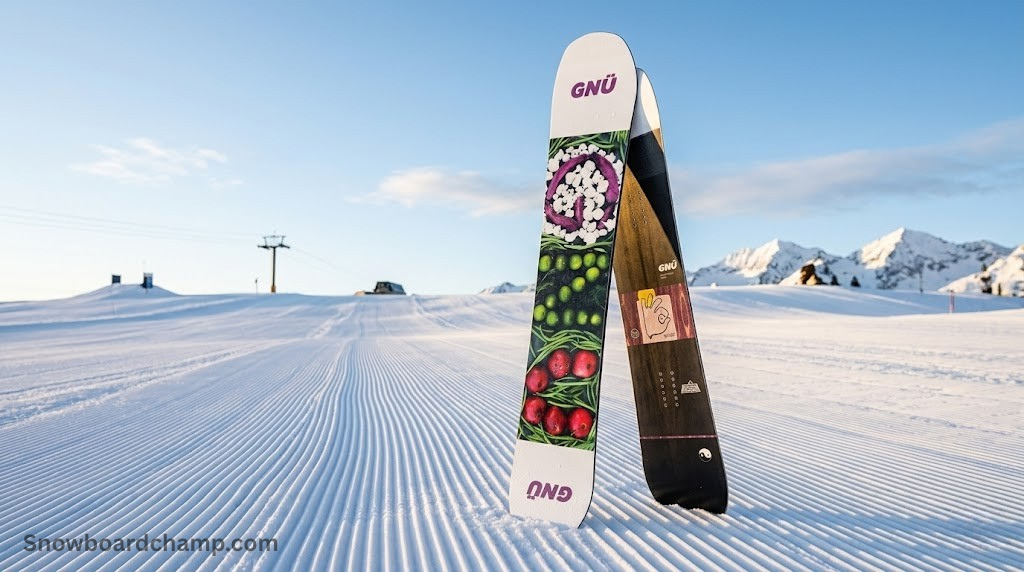
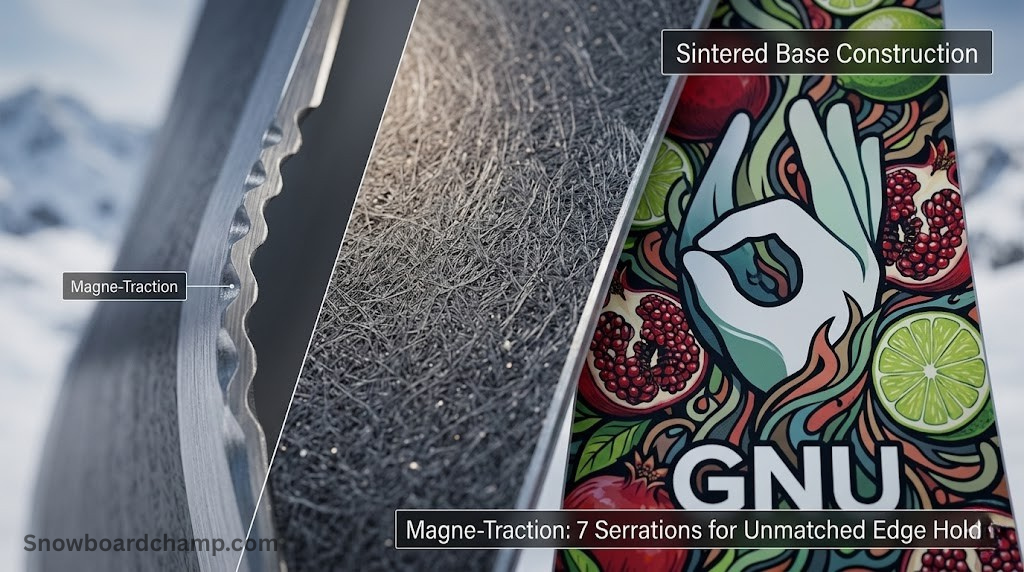
GNU Mullair sintered base with visible Magne-Traction serrations — the signature edge technology that defines the Mullair’s grip character.
There are snowboards that do one thing brilliantly. Then there are boards that refuse to be boxed in — boards built for riders who spend a morning lapping the park, an afternoon carving hardpack at warp speed, and a closing-time powder lap through the trees without wanting to swap decks. The GNU Mullair sits squarely in that second category, and it does so with a clarity of purpose and an engineering pedigree that very few boards at its price point can match.
This review is built from extensive on-snow time, technical spec analysis, and head-to-head comparison against the boards that most directly compete for the same buyer. Whether you are an intermediate rider considering your first serious all-mountain deck, an advanced shredder evaluating whether the Mullair’s camber profile is right for your quiver, or simply someone who wants to understand why a snowboard costs what it costs and whether it delivers, you will leave this review with the full picture.
We will cover the rider signature context, every technology in the build stack, real on-slope performance across terrain types, sizing and stance, optimal binding pairings, and a forensic comparison against the GNU Banked Country, the Capita DOA, and the Lib Tech Skate Banana. Let’s go.
1. Who Is Chris Mullair and Why Does the Signature Matter?
A rider’s signature board is only as good as the rider’s influence on its design. Understanding Chris Mullair’s history with GNU gives important context for what the Mullair is engineered to do — and for whom.
Mullair has been a core figure in GNU’s pro roster for well over a decade. His riding style blends technical precision with creative interpretation of terrain — he is as comfortable setting an aggressive edge on groomed-out blue cruisers as he is hunting natural features in the trees or building momentum on a hip. He is not a dedicated park rat in the mold of riders whose boards are shaped entirely around rail seasons. Nor is he a backcountry specialist optimizing every design decision around powder float. He is a resort rider in the fullest, most demanding sense of the word.
That context is encoded in the board’s design. The Mullair is built around C3 camber — a choice that reflects Mullair’s prioritization of edge control, pop, and precision over the wash-out forgiveness of rocker profiles. Magne-Traction, GNU’s patented serrated edge system, is non-negotiable for Mullair precisely because so much of his riding happens on the hard-pack and icy morning conditions that define the Pacific Northwest resorts where he has logged thousands of hours.
What does this mean in practice? It means the Mullair rewards riders who ride like Mullair — those who move through the mountain rather than camping in a single zone. If you exclusively lap a park or exclusively chase powder, there are more specialized options in the GNU lineup and beyond. But if you want one board that handles everything a resort offers at an advanced level, the Mullair was designed for you.

GNU Mullair Snowboard — Check Current Price
Available in multiple sizes. Ships with GNU’s full warranty. Free returns on most orders.
View on Amazon ↗2. Full Specs at a Glance
Before diving into performance, here is the complete build specification for the GNU Mullair across all key parameters. Reference these numbers as we work through each aspect of the review.
| Specification | Detail |
|---|---|
| Brand | GNU (Mervin Manufacturing) |
| Model | Mullair |
| Rider | Chris Mullair (Pro Signature) |
| Profile | C3 Camber (full traditional camber) |
| Shape | Directional Twin |
| Flex Rating | 6 / 10 (Medium-Stiff) |
| Core | Poplar / Beech wood blend |
| Laminates | Biax / Triax Fiberglass layering |
| Base | Sintered 2000 high-speed base |
| Edge Tech | Magne-Traction® (7 serrations per edge) |
| Topsheet | Eco-sublimated with bio-plastic top |
| Sizes Available | 152, 154, 156, 158, 160 cm |
| Sidecut Radius | 7.6 m (156 reference) |
| Tail / Nose Shape | Directional Twin — minimal setback |
| Country of Manufacture | USA (Mervin Mfg., Sequim, WA) |
| Eco Credentials | Organic topsheet, bio-based plastic, USA-made |
| Retail Price | ~$599–$649 USD |
| Intended Rider Level | Intermediate-Advanced to Expert |
| Riding Style | All-Mountain, Park, Freeride |
The combination of C3 camber, Magne-Traction, a medium-stiff flex, and a directional twin shape is not accidental. Each choice reinforces the others to produce a specific riding character that we will unpack in exhaustive detail over the coming sections. If you want more context on how board shape choices interplay with riding style, our guide to directional vs twin snowboards goes deep on that topic.
3. C3 Camber Deep Dive — What It Actually Means on Snow
What Camber Does to Your Ride
Traditional camber means the board arches upward between the binding inserts when laid flat on the ground. This stored arc is the source of several performance characteristics that define the Mullair’s riding personality:
- Edge pressure: When you weight the board in a turn, the camber arc loads progressively along the full effective edge, distributing grip evenly from nose to tail. The result is a board that bites when you commit to a carve.
- Pop: The camber arc stores energy between the nose and tail. When you release a trick, ollie, or tail press, that stored energy fires back as mechanical spring — snappier and more powerful than a flat or rockered board of identical construction.
- Precision: Camber transfers rider input immediately to the edge. There is almost no buffering between your body movement and the board’s response. For riders who have developed their technique to the point where they want to communicate directly with the snow, this directness is addictive.
- Edge-catch risk: The flip side of high edge pressure is that the tips can catch on transitions or soft snow if your technique is imprecise. This is why the Mullair is not a beginner board. Camber is demanding of proper technique and rewards those who have it.
For a broader analysis of how camber profiles compare across design philosophies, see our camber vs rocker deep dive — it provides the physics framework that explains why GNU chose C3 for a board aimed at advanced all-mountain riders.
C3 vs Hybrid Profiles at the Same Price Point
Many competing boards in the $550–$650 range offer hybrid rocker-camber profiles (typically camber between the feet with rocker at the tips) to reduce edge-catch risk and improve float in powder. The Mullair’s pure C3 stance is a deliberate, somewhat contrarian choice. GNU is betting that the rider buying this board wants maximum performance on hard-pack and groomers more than they want the forgiveness of a hybrid profile in powder or slush.

GNU Mullair — Multiple Sizes In Stock
C3 camber, Magne-Traction, Sintered base. USA-made. Check Amazon for current size availability and pricing.
Shop GNU Mullair on Amazon ↗4. Magne-Traction: The Edge Tech That Changes Everything on Ice
If you have ridden on Pacific Northwest hardpack, East Coast ice, or any resort that sees a freeze-thaw cycle on high-traffic runs, you understand the anxiety of watching your edge lose the argument with a blue sheet of ice at speed. Magne-Traction is GNU’s answer to that problem — and it is the second most important design decision on this board after the C3 profile.
The Physics of Magne-Traction
Traditional snowboard edges are smooth steel arcs. When that smooth arc meets ice, the entire edge length must contact the surface for grip to occur. Any imperfection — a micro-bump in the ice, a slight warp in the board — reduces the contact area and reduces grip proportionally.
Magne-Traction interrupts the edge with seven serrated contact points per side. Instead of one long smooth arc trying to grip an imperfect surface, you now have multiple shorter arcs, each of which creates its own grip zone. The practical effect: where a smooth edge might skip and release on boilerplate, Magne-Traction finds seven separate bite points and holds.
The serrations are subtle — this is not a jagged, aggressive profile. The wavy pattern is specifically sized and spaced to maximize grip without significantly altering the board’s feel on softer snow or affecting how the board slides on rails in the park.
Magne-Traction on Rails and Jibs
A common concern: does the wavy Magne-Traction profile catch or drag on metal park features? In practice, the answer is no. The serrations are perpendicular to the sliding direction on a rail, meaning the board slides cleanly. The grip effect is primarily felt on edge-contact turns, not slide-direction movement. Park riders on the Mullair report no detectable drag difference on boxes or rails compared to smooth-edge boards.
Maintenance Implications
Magne-Traction edges require the same care as standard edges but need attention to the full wave pattern when detuning. The contact points at the serration peaks are where edge sharpness matters most. When tuning for park (where you want slightly dulled edges to prevent catching), work carefully along the full wave rather than only the widest contact sections. Our guide on removing rust from snowboard edges includes Magne-Traction-specific notes.
5. Flex, Feel & Core Construction — The Bones of the Mullair
Flex Rating: 6/10 in Context
GNU rates the Mullair at a 6 out of 10 on their flex scale. Let’s put that number in perspective. On GNU’s scale, a 5 is their midpoint — boards like the Gremlin and the Pickle BTX sit there. A 6 pushes meaningfully toward stiff territory without crossing into the 7–9 range occupied by dedicated carving and race-style boards.
In practical terms, a 6-rated flex on the Mullair means:
- The board resists twist and torsional flex well, maintaining edge contact through variable snow conditions.
- Press tricks and butter maneuvers require deliberate commitment — this is not a board that flexes under you accidentally.
- At high speed the board tracks crisply without the chatter or unpredictability that softer boards show in rough snow.
- In the park, landing impact is absorbed reasonably well, though a softer board would be more forgiving on imperfect landings.
For reference, if you are comparing this to other boards in our database: the GNU Gremlin sits softer at 4–5, the Burton Cartel X compares closely in flex character, and the Capita DOA runs slightly softer at 5–5.5.
Poplar-Beech Core
The Mullair’s wood core blends poplar and beech in a configuration that gives you the best of both species. Poplar is lighter and contributes to a livelier, more responsive feel — it transmits rider input quickly and adds to the snappy pop character that camber amplifies. Beech is denser and more durable, adding stiffness and dampening qualities that keep the board composed in rough chop. The blend between the two is what allows the Mullair to feel simultaneously responsive and planted — a balance that pure poplar cores sometimes miss at the planted end.
Biax / Triax Fiberglass Laminate
GNU uses a combination of biax (two-direction, ±45°) and triax (three-direction, 0°/±60°) fiberglass laminates in the Mullair. The practical result is a board that is torsionally stiff enough for precise edge control (triax contribution) while maintaining some longitudinal flex for pop and buttering (biax contribution). This is a more sophisticated laminate approach than simple biax-only construction and directly contributes to the Mullair’s ability to feel both carve-ready and trick-capable.
Sintered 2000 Base
The base on the Mullair is a sintered 2000 variant — one of the higher-performing sintered formulations in the mid-premium price tier. Sintered bases are made by compressing powdered PTEX under high pressure (rather than extruding a liquid PTEX blend), resulting in a more porous structure that holds wax for longer and glides faster when properly saturated. The tradeoff is that sintered bases require more maintenance — if you ride without waxing for extended periods, the base dries out and speed drops noticeably. See our guide on why waxing matters for the physics explanation, and our at-home wax tutorial for the process.
Eco Manufacturing
Mervin Manufacturing builds the Mullair at its facility in Sequim, Washington — one of the only remaining USA-based snowboard factories. The environmental footprint of domestic production (shorter supply chains, direct quality control, compliance with US environmental standards) combined with GNU’s use of organic topsheet materials and bio-based plastics in the construction makes the Mullair a notable choice for environmentally-conscious buyers who do not want to sacrifice performance for principles.

GNU Mullair — Sintered Base, USA-Made
Poplar-beech core, biax/triax laminates, Magne-Traction edges. See all available sizes and colors.
Check Price on Amazon ↗6. Park Performance — Jumps, Rails, and Creative Lines
The park is where the tension in the Mullair’s design is most visible. C3 camber and a 6/10 flex are not typical park board specifications. Most dedicated park boards run softer flex (4–5) with hybrid rocker at the tips for catch-free pressing and easier spin-up. So how does the Mullair actually perform when you ride it into a jump line or approach a rail?
Jump Performance
The C3 camber’s pop advantage shines on jumps. The stored energy in the arc translates directly into the ollie and pop mechanics you use to launch off a kicker. Where softer, more rockered boards require more conscious board manipulation to generate a clean pop, the Mullair rewards technique with a snappier, more natural release. Experienced riders who have spent time on camber boards will immediately feel at home. Those transitioning from rocker boards may need a session or two to recalibrate their pop timing.
In the air the Mullair is neutral and predictable. The directional twin shape means spins feel balanced in both directions. Grabs are facilitated by the board’s stiffness — it holds its shape in the air rather than flexing independently, which gives a reliable grab point. Cork and inverted tricks benefit from a board that does not twist unexpectedly.
For riders working through their progression — from ollies through to airs and more complex maneuvers — our trick progression guide provides the broader skill context that makes sense of where jump-board selection fits.
Rail and Box Riding
This is the most contested area of the Mullair’s park game. A stiffer board with full camber is fundamentally less forgiving on rails than a softened, rockered park specialist. The Mullair does not press or butter onto rails with the same ease that a board like the Capita DOA or a dedicated jib deck would. Getting into a lock requires more committed engagement.
That said, once locked in, the Mullair’s stiffness is an advantage. It holds the lock position cleanly rather than flexing unpredictably mid-feature. The Magne-Traction edges do not negatively impact rail performance (as discussed in the tech section). Experienced park riders who grew up on camber boards often prefer this “committed lock” feel over the loose entry of softer boards.
Butters and Presses
Buttering on the Mullair requires intention. You cannot accidentally butter it — the board wants to stay flat and carvy. When you commit to a nose or tail press with proper technique, the pop out of the press is excellent. For riders building a butter-heavy freestyle game, the GNU Gremlin or a dedicated volume-shifted board would be more accessible. For advanced riders who want butter as one tool in a larger riding vocabulary, the Mullair delivers satisfying, deliberate presses with great rebound.
Park Strengths
- Explosive pop off jumps and natural features
- Predictable, stable spin axis in the air
- Clean lock on rails once committed
- Magne-Traction does not hurt rail slide
- Neutral twin shape for both-direction park laps
Park Limitations
- Stiffer flex demands more technique on rails
- Less forgiving than dedicated park boards at low speeds
- Butter and press tricks require committed form
- Edge-catch risk on imprecise terrain transitions
7. Freeride & Groomer Performance — Where the Mullair Truly Shines
Take the Mullair off a park feature and onto a groomed pitch or a natural freeride line and the board transforms. This is its home terrain, and it communicates that clearly within the first run.
Carving on Hard-Pack
The combination of C3 camber, Magne-Traction, and a 6/10 flex creates a carving machine that punches well above its price class. Rail a hard edge on a groomed blue and the Mullair digs in with authority. The Magne-Traction serrations keep the edge locked through the transition from flat to edge to maximum angle without the micro-slip that tells you a standard-edge board is approaching its limit.
At aggressive edge angles — past 45 degrees on steep, firm groomers — the Mullair’s camber arc distributes load evenly along the full effective edge, preventing the tip-and-tail washout that can occur when a shorter-radius hybrid board loses edge contact at the tips. The experience is one of being on rails rather than on snow.
Riders who have invested time learning proper carving technique — understanding angulation, hip-down riding, and early edge engagement — will extract extraordinary performance from this board on groomed terrain. If carving is a priority in your riding development, our carving technique guide is worth studying alongside this review.
Icy Conditions — The Magne-Traction Advantage
The resort morning condition that exposes the weakest link in any snowboard setup is the first few runs on a freeze-thaw surface — wet-groomed runs that locked up overnight into a nearly glassy surface. Most boards at the Mullair’s price either struggle here or require precise, conservative riding to avoid washing out.
With Magne-Traction active, the Mullair handles these conditions with a confidence that redefines the morning experience. You can commit to turns with an aggression that would be foolhardy on a smooth-edge board. The serrations break the ice into grip segments; the C3 camber ensures the grip is distributed along the full arc. The result is that ice becomes a surface you can ride rather than one you endure.
Speed and Tracking at High Velocity
The Mullair’s stiffer flex becomes a significant advantage at speed. Boards that feel playful and loose at moderate pace often chatter, vibrate, and feel unstable when pushed to high speeds — the flex wave propagation can create a shimmy that is both uncomfortable and potentially dangerous. The Mullair’s 6/10 flex combined with the poplar-beech core’s dampening characteristics keeps the board tracking cleanly even when you are pointing it down a steep groomer at the kind of speed that empties your stomach.
Natural Terrain — Trees, Rollers, Banks
In natural terrain, the Mullair is at its creative best. Its directional twin shape means it can initiate a tight turn between trees on either edge without the switch-riding penalty of a truly directional board. The C3 camber’s edge grip means holding a line through off-camber terrain — where the slope falls away from your heelside — does not require white-knuckle edge pressure. The board finds grip in situations where softer, flatter boards would wash.
The banked slalom context is instructive here. If you have read our GNU Banked Country review, you will know the Banked Country is a more directional beast designed explicitly around banked slalom and technical freeride. The Mullair is not trying to replace it. Rather, the Mullair is what you ride when you want to transition from lapping a banked course in the morning to park features in the afternoon without having two boards on the chair.
Ready to Carve? Check the Mullair’s Current Price
Multiple sizes available. The Mullair is a perennial bestseller — stock moves fast heading into season.
Buy GNU Mullair on Amazon ↗8. Powder Performance — Honest Assessment of the Mullair’s Limits
Let’s be direct about this: the Mullair is not a powder board, and it does not pretend to be one. This section is about understanding what it can and cannot do in soft snow rather than overselling capabilities that the design does not claim.
The C3 Camber Powder Tradeoff
Full camber boards in deep snow create a distinct riding challenge. The nose does not naturally float — the camber arc creates pressure under the nose contact zone that works against the nose-up riding angle needed to stay afloat in powder. Where a tapered directional board or a board with nose rocker would plane on top of soft snow, the Mullair requires active technique — rear-foot weighting, a stepped-back stance, and forward-speed management — to keep the nose from diving.
This is not a dealbreaker. Many highly skilled riders prefer full camber in powder because the engagement precision when a turn transitions from powder float to a firm contact beneath the soft layer is unmatched by hybrid profiles. But it requires skill and intentionality. For casual powder days when you want to surf and float with minimal effort, the Mullair is the wrong tool.
Practical Modifications for Powder Days
If you own a Mullair and want to get more from it on soft snow days, the most effective adjustment is binding stance setback. Moving your rear binding slightly toward the board’s true tail (even 1–2 cm) shifts your center of mass rearward enough to change the board’s nose-up angle appreciably. You lose some of the switch-riding neutrality but gain meaningful float improvement.
Deep powder specialist gear — splitboards, tapered directional shapes, volume-shifted designs — remains separate territory. For those exploring true off-piste snowboarding, our backcountry snowboarding guide provides the full picture of what dedicated backcountry riding requires in terms of gear and skill.
Light Powder and Sierra Cement
Where the Mullair genuinely performs in soft snow is in the light-powder-to-wind-packed range — the kind of off-piste snow that builds after a bluebird day following overnight snowfall, or the tracked-out powder that consolidates by afternoon into a carveable layer over harder base. In these conditions, the Mullair’s camber grip and Magne-Traction shine; the board finds solid purchase beneath the soft upper layer and holds a line with authority. Many all-mountain days deliver exactly this kind of snow, which is why the Mullair works well for riders whose mountains are not consistently offering knee-deep champagne powder.
9. GNU Mullair Sizing Guide — Finding Your Optimal Length
Sizing the Mullair correctly is more nuanced than running a simple height chart. The board’s camber profile, flex, and riding style compatibility all intersect with size to determine how the board will feel and perform. Here is the complete framework.
Standard Size Range
| Size (cm) | Recommended Weight (lbs) | Recommended Weight (kg) | Boot Size Range | Best For |
|---|---|---|---|---|
| 152 | 100–140 lbs | 45–64 kg | US Men’s 6–8 | Smaller riders, park-focused |
| 154 | 120–160 lbs | 54–73 kg | US Men’s 7–9 | Lighter all-mountain riders |
| 156 | 140–175 lbs | 64–79 kg | US Men’s 8–10 | Core all-mountain sizing |
| 158 | 155–195 lbs | 70–88 kg | US Men’s 9–11 | Heavier all-mountain, stability at speed |
| 160 | 175–220+ lbs | 79–100+ kg | US Men’s 10–12+ | Heavier riders, maximum float |
Size-Down Strategy for Park and Agility
Riders who prioritize park riding, butters, and agility in tight terrain often size down 2 cm from the weight-chart recommendation. A shorter board requires less rotational force to initiate turns and presses, which counteracts some of the Mullair’s stiffness for trick-focused riding. The tradeoff is reduced stability at speed and marginally less float in soft snow.
Boot Overhang and Binding Angles
Because the Mullair is a directional twin with a moderate waist width, riders with larger boot sizes (US Men’s 11+) should check the 158 and 160 cm sizes carefully for toe and heel overhang. Significant overhang (more than ~1.5 cm) creates drag in deep snow and affects carving feel. Consult our comprehensive snowboard sizing guide for overhang calculation methodology and our stance setup guide for optimal binding positioning on the Mullair’s insert pattern.
Riding Style Adjustment
- Aggressive freeride / carving focus: Size up within your weight range for maximum stability.
- Balanced all-mountain: Standard weight-range sizing is ideal.
- Park / freestyle leaning: Consider sizing down 2–4 cm for more responsiveness.
- Occasional powder: Standard or size-up, with stance setback on powder days.
10. Best Bindings to Pair with the GNU Mullair
The Mullair’s character — C3 camber, 6/10 flex, directional twin — is most fully realized when paired with bindings that complement rather than fight its personality. The wrong binding can mute the board’s strengths or amplify its edge-catch tendency unnecessarily. Here are the most effective pairings across price points.
Premium Tier: Union Atlas or Legacy
The Union Atlas and the Union Legacy both pair beautifully with the Mullair. The Atlas’s stiff, responsive feel matches the board’s directness on hardpack and carving. The Legacy’s VaporLite chassis adds weight savings without sacrificing responsiveness, which is ideal for park use where the binding flex adds a final layer of energy absorption on landings. Both bindings’ highback stiffness levels (4–5 on Union’s scale) match the Mullair’s overall system stiffness without creating an over-stiff, harsh ride.
Mid-Range: Burton Cartel
The Burton Cartel is a classic all-mountain pairing. Its medium-stiff flex and Re:Flex baseplate work well with the Mullair’s camber profile. The slight give of the Re:Flex baseplate (which allows independent heel and toe flex) adds a small margin of forgiveness that benefits the Mullair’s edge-catch tendency in variable conditions. EST channel compatibility requires Burton boards, so use standard 4-hole disc mounting on the Mullair.
Park-Focused: Union Force
If your Mullair sessions are predominantly park-focused, the Union Force provides a slightly softer binding flex that helps counterbalance the board’s stiffness for press and jib riding. The tradeoff is less precision on edge-intensive carving, but for riders who bought the Mullair primarily for jump lines and creative terrain, the Force brings the system’s overall feel closer to a dedicated park setup.
Budget Option: Decent Alternatives
Our guide to affordable all-mountain bindings under $200 includes tested options that work with the Mullair without requiring a premium binding investment. Pairing a quality mid-range binding with the Mullair is a sound financial decision that does not meaningfully limit the board’s potential, especially for intermediate riders still developing the technique to feel the difference between binding tiers.

Union Atlas Bindings — Perfect Mullair Pairing
Stiff, precise, lightweight. One of the best all-mountain bindings at any price. Check availability on Amazon.
Shop Union Atlas on Amazon ↗11. Head-to-Head Comparisons
How does the Mullair stack up against the boards it most directly competes with? Here are four key comparisons with riders we have tested all of these boards extensively.
GNU Mullair vs GNU Banked Country
| Attribute | GNU Mullair | GNU Banked Country |
|---|---|---|
| Profile | C3 Camber | C3 Camber |
| Shape | Directional Twin | Directional |
| Switch Riding | Excellent | Limited |
| Carving Power | Excellent | Excellent |
| Park Versatility | Good | Limited |
| Banked Slalom | Good | Best-in-class |
| Powder | Moderate | Moderate+ |
| Best Rider | All-mountain generalist | Freeride specialist |
Verdict: The Banked Country is the better choice for riders whose identity is freeride and who want a board optimized for technical descents. The Mullair wins for anyone who needs a versatile resort board that can hang in the park and ride switch comfortably.
GNU Mullair vs Capita DOA
| Attribute | GNU Mullair | Capita DOA |
|---|---|---|
| Profile | C3 Full Camber | Full Camber |
| Shape | Directional Twin | Twin |
| Flex | 6/10 Med-Stiff | 5.5/10 Medium |
| Park Performance | Good | Excellent |
| Groomer Carving | Better | Good |
| Ice Grip | Magne-Traction | Standard edge |
| Freeride Capability | Better | Good |
| Price | ~$620 | ~$580 |
Verdict: The DOA is the better pure park board. The Mullair is the better all-mountain board. If park is more than 50% of your riding, the DOA wins on value. If you need freeride capability and ice grip, the Mullair’s premium over the DOA is justified.
GNU Mullair vs Lib Tech Skate Banana
| Attribute | GNU Mullair | Lib Tech Skate Banana |
|---|---|---|
| Profile | C3 Full Camber | BTX (Banana Rocker) |
| Forgiveness | Lower — demands technique | High — catches less |
| Powder Float | Moderate | Better |
| Hardpack/Ice | Magne-Traction wins | Less edge bite |
| Pop | More — camber energy | Moderate |
| Best Rider Type | Technique-focused rider | Fun/creative rider |
Verdict: The Lib Tech Skate Banana is a fundamentally different board for a different kind of rider. The BTX rocker profile makes it more forgiving and fun in soft snow and lower-consequence terrain. The Mullair is a performance tool that requires investment to get the most from it. These boards serve different philosophies of riding.
GNU Mullair vs Burton Custom Flying V
| Attribute | GNU Mullair | Burton Custom Flying V |
|---|---|---|
| Profile | C3 Full Camber | Flying V (hybrid rocker-camber) |
| Powder Versatility | Moderate | Better hybrid float |
| Carving Precision | Full camber edge hold | Good, less precise |
| Ice Grip Tech | Magne-Traction | Standard edge |
| All-Conditions Range | Narrower, higher ceiling | Broader, lower ceiling |
| Price | ~$620 | ~$650 |
Verdict: The Burton Custom Flying V is the broader, more forgiving all-mountain choice. The Mullair is the higher-performance, more demanding choice. Riders who want the widest possible range of conditions handled acceptably should consider the Flying V. Riders who want to maximize performance on hardpack and groomers should choose the Mullair.
12. Who Should Buy the GNU Mullair — and Who Should Not
The Mullair Is the Right Board If You Are…
- An intermediate to advanced rider who has developed solid edge control and is ready for a board that rewards precision over forgiveness
- A resort all-mountain rider who splits time between park, groomers, and natural terrain without strongly specializing in any single discipline
- Riding in icy or variable conditions regularly — Pacific Northwest, Northeast US, European Alps — where Magne-Traction’s edge grip becomes a meaningful performance differentiator
- Environmentally conscious and willing to pay a slight premium for domestic manufacturing and eco-friendly materials
- Interested in a long-term quiver board — the Mullair has the build quality and versatility to serve as the “one board” in a quiver for multiple seasons, making the up-front cost more defensible over time
- A rider who values pop and carving energy over powder float and soft-snow forgiveness
The Mullair May Not Be Right If You Are…
- A beginner or early intermediate — the camber profile and flex will expose technical weaknesses and may create frustrating edge-catch situations that slow development
- A dedicated park rider spending 80%+ of your time on rails and jibs — a dedicated park board will outperform the Mullair in that context
- A powder specialist chasing deep snow days and backcountry touring — the C3 camber is a meaningful disadvantage in deep soft snow
- On a tight budget — the Mullair delivers excellent value relative to its performance level, but there are functional all-mountain options at $200–$300 less that would serve a developing rider better while they build toward the Mullair’s performance ceiling
Overall Strengths
- Outstanding ice and hardpack grip via Magne-Traction
- Explosive camber-driven pop
- High-quality eco-conscious USA construction
- Genuine all-mountain versatility
- Excellent speed stability at high velocity
- Competitive pricing for the build quality
Overall Limitations
- Demanding on technique — not beginner-friendly
- Less versatile in deep powder than hybrid profiles
- Park jib performance below dedicated park boards
- Requires regular waxing (sintered base)
For riders building their first complete setup alongside the Mullair, the gear ecosystem matters. See our roundups on best snowboard boots, best goggles, and best helmets for complete setup guidance.
GNU Mullair — Buy with Confidence
USA-made, Magne-Traction, C3 camber. One of the best all-mountain boards at this price. Check current pricing, available sizes, and customer reviews.
Get the GNU Mullair on Amazon ↗Overall Scorecard
Frequently Asked Questions
Is the GNU Mullair good for beginners?
The GNU Mullair is designed for intermediate to advanced riders. Its C3 full camber profile and 6/10 flex create a demanding riding experience that requires developed edge control to manage comfortably. Beginners will likely find the board’s edge-catch tendency frustrating and its flex too stiff for learning fundamental turns. If you are in your first two seasons, boards with softer flex and more forgiving hybrid rocker profiles will accelerate your development more effectively. Return to the Mullair when you have solid carved turns on groomed terrain.
What camber profile does the GNU Mullair use?
The GNU Mullair uses GNU’s C3 camber — traditional positive camber running the full effective edge length of the board. This means when the board is laid flat, it arches upward between the binding inserts. When you weight the board in a turn, that arch is pressed flat and loads the edge with stored mechanical energy, providing precise grip, explosive pop, and direct rider-to-board communication. C3 is the most performance-oriented profile in GNU’s lineup and prioritizes technical precision over beginner forgiveness.
How does Magne-Traction affect riding on the Mullair?
Magne-Traction adds seven serrated contact points per edge that break up what would be a continuous smooth arc into multiple shorter grip zones. On hard-pack and icy surfaces, this technology allows the Mullair to maintain edge hold where smooth-edge boards begin to lose grip. In practice, the most noticeable effect is on icy groomers — where a standard board might require cautious, conservative turning, Magne-Traction lets you rail turns with genuine commitment. The serrations do not negatively impact rail performance in the park; the technology is effective in edge-contact turns, not sliding directions.
What is the flex rating of the GNU Mullair?
GNU rates the Mullair at 6/10 on their flex scale, placing it in the medium-stiff range. This flex creates a board that resists torsional twist well, maintains edge contact through variable snow, and tracks stably at high speeds. It is stiffer than most park-focused boards and most beginner to intermediate all-mountain boards. In system terms, pair the Mullair with medium to stiff bindings — a binding flex in the 5–7 range on most manufacturer scales — to maintain the right system balance.
Is the GNU Mullair better for park or freeride?
The Mullair is designed for genuine all-mountain versatility — it is not a specialist in either direction. On groomers and hardpack it is exceptional, likely the strongest part of its performance envelope. In the park it performs well on jumps and reliably on rails, but is less accessible for rail and jib riding than dedicated park boards. In powder it is adequate but not exceptional. Think of the Mullair as a board that handles everything at a high level, rather than one that maximizes any single terrain type.
What size GNU Mullair should I ride?
Use the weight-based size chart as your starting point — the 156 cm is the core all-mountain size for riders between 140–175 lbs (64–79 kg). Riders who prioritize park and freestyle should consider sizing down 2 cm for more agility. Riders who prioritize speed stability and freeride should size up within their weight range. Always check boot size against waist width for potential overhang issues, particularly for riders with US Men’s boot sizes 11 and above.
Does the GNU Mullair have a sintered or extruded base?
The GNU Mullair uses a sintered 2000 base. Sintered bases are more porous than extruded bases, holding wax for longer and providing faster glide when properly maintained. The tradeoff is that sintered bases require more regular waxing — riding for extended periods without wax causes performance degradation. We recommend waxing the Mullair at the start of each season and every 3–5 full riding days depending on conditions. Snow with lower moisture content (dry, cold powder) is harder on base wax and requires more frequent application.
How does the GNU Mullair compare to the GNU Banked Country?
Both boards share C3 camber and Magne-Traction, which gives them a similar edge-grip character and pop quality. The key differences are in shape and intended rider. The Banked Country is a true directional shape designed around freeride and banked slalom — it excels on technical descents and natural terrain features but does not ride switch as naturally. The Mullair is a directional twin, meaning it handles switch riding comfortably and is more at home in a resort environment mixing park, groomers, and natural terrain. Choose the Banked Country if freeride is your primary pursuit; choose the Mullair if you want full resort versatility.
What bindings pair well with the GNU Mullair?
Medium-stiff bindings that complement the Mullair’s 6/10 flex work best. The Union Atlas, Union Legacy, and Burton Cartel are all excellent pairings at different price points. Avoid very stiff bindings (8+ on most scales) which create a system too harsh for variable conditions and park landing absorption. Avoid very soft bindings (3 and below) which will feel disconnected from the board’s precise edge signals. The Union Force is a good park-leaning compromise if your Mullair sessions skew heavily toward freestyle terrain.
Is the GNU Mullair worth the price?
At its retail price of roughly $600–$650, the Mullair sits at the upper end of the mid-range and offers construction quality that competes with boards at $100–$150 more from brands whose manufacturing costs are lower. USA-made production, Magne-Traction technology, and genuine eco-credentials combine with a performance profile that intermediate to advanced riders will appreciate for multiple seasons. The sintered base and quality core construction mean a well-maintained Mullair remains a high performer well into its third or fourth season, which improves its cost-per-day value significantly.
What core does the GNU Mullair use?
The Mullair uses a poplar and beech wood core with biax and triax fiberglass laminate combinations. Poplar provides a lighter, livelier base with natural springiness that amplifies the camber profile’s pop character. Beech adds density, stiffness, and dampening that keeps the board composed in rough snow and at high speeds. The biax/triax fiberglass combination provides both torsional stiffness (from triax) for precise edge control and longitudinal flexibility (from biax) for buttering and press tricks. This is a premium core construction that differentiates the Mullair from budget all-mountain boards using pure poplar cores with basic biax glass.
Can the GNU Mullair handle powder?
The Mullair handles moderate powder conditions adequately but is not optimized for deep soft snow. The full C3 camber profile creates nose-down pressure that works against natural powder float. Riders can compensate by shifting their binding stance rearward to 1–2 cm of setback, weighting the back foot consciously in deep snow, and maintaining forward speed to prevent the nose from diving. In light powder and packed-out soft snow the Mullair performs well. For riders chasing consistent deep powder days, a tapered directional shape or volume-shifted design would serve better.
Conclusion — The GNU Mullair Verdict
After everything — the spec analysis, the on-snow time, the head-to-head comparisons — the GNU Mullair emerges as one of the most complete and genuinely honest all-mountain boards available in its price class. It does not promise to do everything equally well. It is not the softest, most forgiving, most powder-capable, or most jib-accessible board you can buy. What it is, emphatically, is an outstanding performer on the terrain where most resort riders spend the majority of their time: groomed runs, hardpack, natural freeride lines, and jump terrain.
The C3 camber delivers the precision and pop that experienced riders crave. Magne-Traction transforms icy mornings from liability to opportunity. The USA-made construction and eco-credentials give you something to feel good about beyond the riding itself. And the directional twin shape means this board is genuinely at home everywhere on a mountain, not just the spots it was optimized for.
For intermediate to advanced riders who move through the resort rather than camping in one zone, who prioritize edge control and carving energy over soft-snow forgiveness, and who want a board that will keep pace with their development for several seasons rather than becoming a limiting factor in one — the Mullair earns a clear, unqualified recommendation.
Before your final decision, also consider reading our ultimate snowboard showdown for a broader market context, our guide to choosing your first serious snowboard if this would be a significant step up in your gear, and our snowboard maintenance guide to ensure your Mullair performs at its best for years to come.
Ready to Ride the GNU Mullair?
Check current pricing, available sizes, and verified buyer reviews on Amazon. Ships free on qualifying orders.
Buy the GNU Mullair on Amazon ↗


