
Quick Verdict
The GNU Pickle BTX is a masterclass in modern volume-shifted design. It rides shorter than your normal board, floats like it’s longer, pops like a park board, and carves with authority you’d never expect from something that looks like a toy. If you want one board that handles your home-resort jibbing, unexpected powder days, and back-country side trips without the penalty of a noodle-like short board, the Pickle BTX belongs at the top of your shortlist. The BTX profile cleverly neutralizes the twitchy downsides of traditional short boards while dialing in catch-free butter sessions and confident edge-to-edge transitions. Minor complaints about icy hardpack responsiveness and high street price are real but manageable. This is a genuinely transformative ride for intermediate-to-expert riders who’ve been craving a quiver-of-one solution.
What Is the GNU Pickle BTX?
GNU’s Pickle BTX is the volume-shifted successor to one of snowboarding’s most beloved short-board experiments — a board that demands you throw out your sizing assumptions entirely.
GNU Snowboards has been pushing design boundaries since the brand’s founding, and the Pickle BTX is one of their most unapologetically progressive ideas yet. The concept is elegant in its ambiguity: take a board that measures anywhere from 142 to 160 cm, give it a dramatically widened stance width and nose-heavy taper, layer in the company’s proprietary BTX (Banana Technology) camber profile, and you end up with something that rides like it’s 6–8 cm longer than it measures. The result is a board that lets 5’10” riders confidently drop to a 150 cm without sacrificing float, speed, or pop.
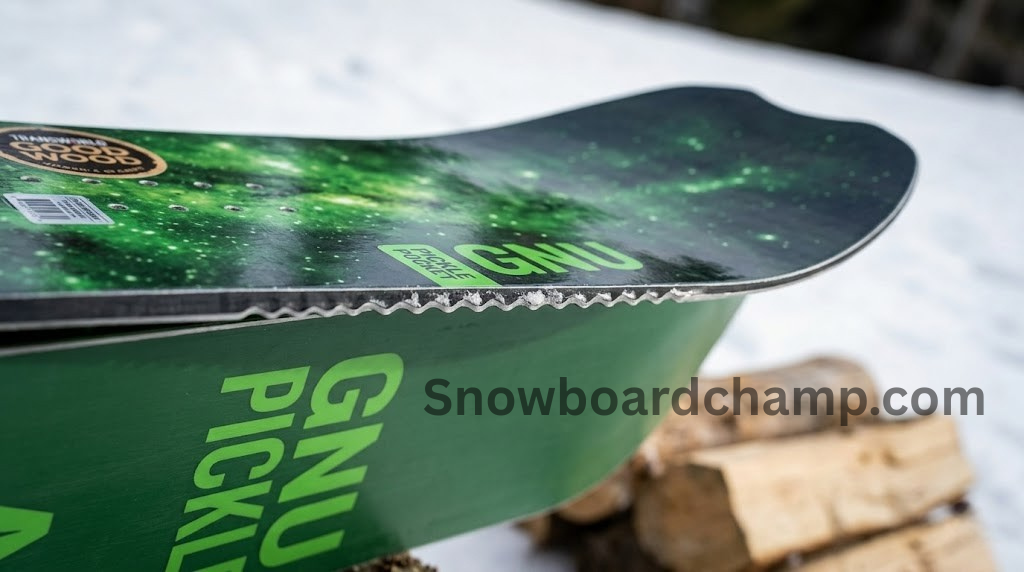
The Pickle line has evolved substantially since its introduction. In its current BTX iteration, it incorporates Magne-Traction® serrated edge technology, a sintered base for superior speed and durability, and a carbon power transfer I-beam structure that differentiates the higher-grade variants. What ties it all together is the fundamentally different relationship between your weight, the contact points, and the snow surface — a relationship the BTX profile was specifically designed to optimize.
To understand why this matters, you need to briefly understand what “volume-shifted” actually means in engineering terms, and why BTX is such a critical enabler for that philosophy to work on actual snow. We’ll break all of that down in the sections ahead, but the short version is this: GNU didn’t just make a shorter snowboard. They redesigned the entire volume distribution to make your short board behave more like a longer one where it counts — in powder, at speed, and during pop-heavy freestyle maneuvers.
For riders who have been frustrated trying to find the perfect intersection between a jib-ready park board, a floaty powder stick, and a reliable all-mountain daily driver, the GNU Pickle BTX is genuinely worth your attention. It won’t satisfy everyone — experienced carvers who hammer hardpack on stiff mountain groomers will want something else — but for the majority of intermediate-to-advanced all-resort riders, this might be the most pleasantly surprising single board you’ve ever ridden.
BTX Technology Explained: The Science Behind the Ride
BTX isn’t just a marketing buzzword. It’s a specific hybrid profile geometry that solves real physics problems created by riding short boards.
What Does BTX Stand For?
BTX stands for Banana Technology (specifically the “X” variant), which refers to the hybrid camber profile GNU developed to combine the best properties of camber, rocker, and flat profiles in a single continuous curve. In the Pickle BTX, the profile uses a flat zone underfoot flanked by slight rocker sections in the nose and tail, with gentle camber between the binding inserts and the contact points.
If you’re familiar with the ongoing debate around camber vs. rocker snowboard profiles, you’ll recognize immediately why this hybrid approach is so appealing. Pure camber gives you energy and carving precision but can be grabby and catchy, especially on short boards where the contact points are close together. Pure rocker boards float effortlessly and forgive edge catches, but they sacrifice pop and feel mushy underfoot. BTX threads the needle: the flat zone underfoot keeps the board stable and predictable, the tip and tail rocker prevent edge catches during powder runs and trick landings, and the retained camber between inserts and contact points preserves pop for ollies and jib tricks.
How BTX Enables Volume Shifting
This is where things get genuinely interesting from a physics standpoint. Volume-shifted snowboard design works by redistributing the planing surface area of the board — specifically by widening the nose dramatically, narrowing the tail, and increasing the sidecut radius to compensate for the shorter overall length. The result is that the nose provides more float than its length would suggest, the tail provides quick pivoting and responsive trick initiation, and the effective edge length (the part of the board that actually contacts and bites the snow during a turn) is proportionally larger relative to the board’s total length.
BTX makes this work reliably by ensuring that the rocker sections at the tip and tail don’t create unpredictable behavior when that large nose is catching air or absorbing pow. Without the right camber geometry underfoot, a short wide board can feel unstable at speed or wander unpredictably. The BTX profile’s flat-to-camber underfoot section anchors your stance and keeps the feel predictable even when the rocker nose is doing its float-enhancing job out front. For more on this dynamic, our analysis of camber vs rocker provides a deeper dive into the physics involved.
BTX vs. C2 vs. C3 in GNU’s Lineup
| Profile | Camber Zones | Pop Level | Catch-Free Rating | Best For |
|---|---|---|---|---|
| BTX | Between inserts & contact pts | High | High | Freestyle, pow, all-mountain |
| C2 Banana | Nose to tail banana (rocker) | Medium | Very High | Beginners, butters, pow |
| C3 Camber | Full camber tip-to-tail | Very High | Low | Carving, hardpack, racing |
| Taper BTX (Pickle) | As BTX + volume shift nose | High | Very High | Short-board riding, all-terrain |
Understanding where BTX sits in GNU’s profile hierarchy helps explain why the Pickle BTX behaves so differently from something like the GNU Gremlin (C3) or the GNU Mullair. Each profile choice is a deliberate engineering trade-off, and the BTX in the Pickle context is optimized specifically for the rider who wants maximum versatility from a shorter-than-normal platform.
Magne-Traction® Integration
One of GNU’s most recognized technologies, Magne-Traction® is a serrated edge treatment that creates seven contact points per edge instead of the standard two. These micro-serrations act like the teeth of a saw along the board’s edge, dramatically improving grip on hard snow and ice conditions where a standard smooth edge would slip. On a volume-shifted board like the Pickle BTX, Magne-Traction® is especially important because the shorter effective edge length would otherwise compromise grip during more aggressive turns. The serrations compensate remarkably well, giving the Pickle BTX far better hardpack confidence than you’d expect from its dimensions.
Full Specs & Sizing: What You’re Actually Getting
Before diving into on-snow performance, let’s look at the actual specifications of the GNU Pickle BTX. These numbers matter more on a volume-shifted board than on a standard snowboard because the relationship between your height, weight, boot size, and the board’s measurements is fundamentally different from conventional sizing rules.
| Spec | 150cm | 154cm | 158cm | 160cm |
|---|---|---|---|---|
| Effective Edge (mm) | 1055 | 1095 | 1130 | 1150 |
| Waist Width (mm) | 261 | 264 | 266 | 268 |
| Nose Width (mm) | 310 | 313 | 316 | 319 |
| Tail Width (mm) | 294 | 297 | 300 | 302 |
| Sidecut Radius (m) | 7.9 | 8.2 | 8.5 | 8.7 |
| Taper (mm) | 16 | 16 | 16 | 17 |
| Stance Width (min–max) | 480–570 | 490–580 | 500–590 | 510–600 |
| Setback (mm) | −10 | −10 | −12 | −12 |
| Flex Rating (1–10) | 4–5 (Medium-Soft) | |||
| Base | Sintered P-tex | |||
| Core | Aspen / Paulownia Biax | |||
| Weight (lbs, approx) | 5.9 | 6.2 | 6.5 | 6.7 |
Core & Base Materials
The Pickle BTX uses a combination of Aspen and Paulownia wood in its core, a pairing that balances lightweight responsiveness (Paulownia) with a little additional density and pop (Aspen). The biaxial fiberglass layup wraps this core, providing torsional flex that is intentionally kept slightly softer than GNU’s carving-focused boards to complement the freestyle-oriented BTX profile.
The sintered base is a genuine highlight at this price point. Sintered bases absorb and retain wax significantly better than extruded alternatives, meaning the Pickle BTX holds its speed longer between tune sessions. If you’re curious about what this means for long-term maintenance costs, our breakdown of sintered vs extruded snowboard bases covers the full picture. A properly hot-waxed Pickle BTX will glide noticeably faster than a comparable board with an extruded base — a meaningful advantage on long runouts and flat sections.
Construction Technology Tiers
GNU Pickle BTX Technology Stack
- BTX Profile: Flat-to-slight-camber underfoot, rocker in tip/tail zones
- Magne-Traction® Edges: 7-point serrated edge contact for ice and hardpack grip
- Sintered Base: High-molecular-weight PTEX for fast glide and wax retention
- Aspen/Paulownia Core: Lightweight + pop-responsive wood combination
- Biax Fiberglass: Torsional flex without over-dampening
- Carbon Amplifiers (select editions): Carbon fiber I-beam for additional snap and energy transfer
- Volume Shift Geometry: Wider nose, directional taper, setback stance for float
Flex, Pop & On-Snow Feel: First Impressions and Beyond
A 4–5 flex on paper doesn’t prepare you for what this board actually feels like underfoot. The BTX profile changes everything.
Flex Pattern In Detail
The GNU Pickle BTX scores a 4–5 on GNU’s 1–10 flex scale, placing it squarely in medium-soft territory. But flex ratings are always contextual, and in the Pickle BTX’s case, the flex pattern is deliberately asymmetric due to the volume-shifted taper. The nose flexes more softly than the tail to facilitate the float it’s designed to provide, while the tail retains just enough stiffness to generate pop off the tail when you need to initiate tricks or carve turns. The result is a board that feels more alive and poppy than its overall flex rating suggests, particularly in the transition zones between buttering and committed turns.
For intermediate riders who are still developing their edge pressure and timing, this softer overall flex is forgiving — mistakes aren’t punished harshly, and the board’s natural tendency is to stay loose and maneuverable rather than locking up. For advanced riders, the board rewards deliberate technique: load the tail with intention and the BTX profile launches you off the snow with more energy than a pure rocker board ever could.
Pop Mechanics: How BTX Generates Snap
One of the most common criticisms of pure banana/rocker boards is their comparatively flat pop response. Without camber underfoot, there’s less stored energy to release during an ollie or nollie. The BTX profile addresses this directly. The camber sections between the binding inserts and the contact points act as a spring mechanism — pressing your weight through your back foot loads that camber section, and releasing it adds a kick that’s distinctly more energetic than flat or full-rocker options.
This matters enormously for park riding. If you’ve been considering learning ollies or progressing your snowboard ollie mechanics, the Pickle BTX gives you a real tool for that progression rather than the mushy, effort-dependent pop of a full-banana board. The pop is not as sharp and snappy as a full-camber board like the DC Lock and Load — see our DC Lock and Load analysis for comparison — but it’s meaningfully better than what you’d expect from a short, wide board with rocker in the tips.
Edge-to-Edge Transition Speed
Thanks to the board’s reduced effective edge length and wide stance platform, edge-to-edge transitions on the GNU Pickle BTX are notably quick. This translates directly to agility on tight terrain features, jibs, and boxes, where you need to shift your weight rapidly and get the board to respond immediately. Riders coming from longer, stiffer boards sometimes need a few runs to recalibrate their expectations here — the Pickle BTX is more responsive to subtle weight shifts than most boards at this flex rating, because the wide platform amplifies lateral movements through the BTX profile rather than dampening them.
Park & Jib Performance: The Pickle BTX’s Natural Habitat
If the Pickle BTX has a spiritual home, it’s a well-built park with variety — rails, jibs, kickers, and natural terrain features.
Rails and Boxes
On rails and boxes, the Pickle BTX is thoroughly in its element. The medium-soft flex combined with the wide stance platform makes balance on rails surprisingly forgiving — the extra waist width gives you a more stable base to work from, and any tendency to overcorrect and dig an edge is mitigated by the BTX profile’s rocker sections near the tips. Grinding switch, 270s off jibs, and boardslide variations all feel natural and intuitive.
The board’s sidecut — a longer radius than you’d expect for its length — helps here too. A tighter sidecut would make the board want to turn more aggressively on angled features, which is exactly the behavior you don’t want when you’re sliding a down-flat-down rail. The Pickle BTX stays relatively neutral and mellow on features, requiring active direction input rather than fighting the board’s geometry.
Kickers and Jumps
On kickers, the BTX pop comes into its own. The board launches cleanly off lips with predictable energy transfer, and the wide stance makes spin setup more comfortable for riders who prefer a slightly wider base for aerial balance. Spins in the 180–540 range feel confident and controlled. Bigger spins (720+) are certainly possible, but more advanced riders will notice that the board’s slightly softer flex means it can feel a touch squirrely during high-speed pre-wind on larger jumps — not a dealbreaker, but a genuine consideration for riders who primarily send massive kickers.
The board’s directional taper is worth noting on kickers specifically. Because the Pickle BTX is a directional board (not a true twin), riding it in your natural stance provides a slightly different feel on takeoff versus landing switch. This is a minor consideration for intermediate riders, but for those who are actively developing their switch riding, the directional vs. twin snowboard trade-off is worth thinking about before committing to the Pickle BTX as your primary park board.
Natural Terrain Features and Tree Lines
Away from dedicated park infrastructure, the Pickle BTX shines in natural terrain parks — the spaces between runs, through glades, and over natural kickers formed by side-country features. Its ability to pivot quickly and handle tight, confined spaces without losing composure makes it an excellent board for creative, freeform riding styles. Riders who want to explore snowboard trick progression — from basic butters through to more advanced jib combinations — will find the Pickle BTX a genuinely supportive tool. Our snowboard trick progression ladder maps out the exact skill path this board is built to support.
All-Mountain & Groomer Test: How Does It Hold Up Beyond the Park?
The Pickle BTX wears an all-mountain label, but what does that actually mean when the board is sized and profiled for freestyle? We took it to corduroy, spring slush, and resort groomers to find out.
Blue and Black Groomer Performance
On well-groomed blue runs, the GNU Pickle BTX handles surprisingly well for what is fundamentally a freestyle-biased board. The Magne-Traction® serrated edges grip the corduroy with authority, and the BTX profile’s underfoot camber section gives you enough traction to initiate clean carves. What you’ll notice, however, is that the sidecut radius and the board’s directional taper limit the depth of carve you can achieve. This board prefers rounder, more drawn-out arcs rather than sharp, aggressive heel-to-toe transitions.
At moderate to medium speeds (20–35 mph), the Pickle BTX is comfortable and predictable on groomers. Push past 40 mph and more experienced riders will start to feel the board’s preference for lower speeds — a characteristic of all shorter, wider boards that prioritizes freestyle geometry over high-speed stability. If your riding heavily features long, fast groomer runs, the Pickle BTX is not optimized for you. For that application, a board like the Capita Mercury or Jones Mountain Twin would serve you better.
Variable Snow Conditions: Chop and Crud
Where the Pickle BTX genuinely surprises on groomers is in variable snow. The combination of Magne-Traction® edges and the BTX profile’s rocker tips makes the board remarkably adept at handling chopped-up snow, wind crust, and the kind of mixed conditions you encounter on busy resort days. The rocker sections float over surface irregularities that would catch a full-camber edge, and the serrated edges maintain bite through patches of ice without the sudden, jarring transition you’d feel on a smooth edge. For the majority of everyday resort conditions, the Pickle BTX handles itself admirably.
Carving Potential: Honest Assessment
If you’re passionate about deep, rail-grinding carves — the kind where you’re laying your hip nearly to the snow — the Pickle BTX will leave you wanting more. Its waist width, though an asset for float and freestyle, creates additional leverage that makes it harder to fully engage the edge at extreme angulation angles. Dedicated carvers should look elsewhere. But for riders who carve casually as part of a varied day rather than as the primary discipline, the Pickle BTX’s carving capability is more than adequate. Understanding how to carve on a snowboard will help you get the most from the board in this regard.
Speed and Stability Window
The Pickle BTX’s ideal speed range for on-mountain riding is roughly 15–38 mph. Below that range, it’s playful and nimble. Above it, experienced riders will feel the board beginning to chatter, particularly if the terrain is steep and the snow is variable. This is not unusual for a board with these design priorities — it’s a deliberate engineering trade-off, and it’s worth being honest about rather than dismissive. The sintered base helps the board reach its top end of this range quickly and comfortably, so you’ll be riding at that sweet spot for most of your day on typical resort terrain.
Powder & Off-Piste: The Volume Shift Advantage
This is where the GNU Pickle BTX genuinely redefines expectations for what a short board can do.
Volume Shift in Powder: How It Works
In powder snow, snowboard performance is primarily determined by planing area — the surface area of the board that sits in contact with the snow surface and generates the upward lift that keeps you floating above the pow rather than plowing through it. Traditional powder board design increases planing area through sheer length. Volume-shifted design increases it through width, particularly in the nose, while simultaneously using a setback stance and tapered shape to encourage the nose to ride high.
The GNU Pickle BTX takes full advantage of this approach. Its wide, rounded nose generates substantial float in soft snow, and the slight negative setback (stance positioned behind center) encourages a natural weight distribution that keeps that nose elevated. Paired with the BTX profile’s rocker tip, the result is a board that floats remarkably well for its size in real powder conditions.
Riders who have been to powder meccas like Japan’s Hokkaido resorts — where light, dry snow makes planing area critical — frequently report that the Pickle BTX holds its own against dedicated powder boards sized 10+ cm longer. For deeper exploration of Japan riding, our Japan snowboarding guide covers exactly this type of terrain and how different board profiles perform in Japow conditions.
Off-Piste Manoeuvrability
Beyond pure float, the Pickle BTX’s shorter length pays huge dividends in tight, technical off-piste terrain. Tree lines, narrow chutes, and complex side-country topography all demand rapid directional changes that longer boards make cumbersome. The Pickle BTX pivots and redirects with a responsiveness that longer powder boards simply cannot match, giving creative, freeform powder riders the ability to thread terrain that would challenge a conventional 160+ cm board.
For those interested in exploring backcountry snowboarding, the Pickle BTX’s combination of float, manoeuvrability, and manageable size makes it a compelling option for accessible side-country laps, though dedicated splitboarders will obviously need specific touring gear for true backcountry objectives.
Powder Day Sizing Recommendation
Because of the volume shift, many powder-focused riders are comfortable sizing down an additional 2–4 cm below the already-shorter volume-shifted recommendation. For example, a 5’11″/185 lb rider who might normally be on a 157 cm might find a 152 cm Pickle BTX rides like a 158 cm conventional powder board. This depends heavily on snow density and your riding style — aggressive speed riders should err toward the larger volume-shifted size, while technical tree riders and freestyle-focused powder hounds can afford to size down further.
Volume Shift Sizing Guide: How to Size the GNU Pickle BTX Correctly
Ignore your normal snowboard sizing charts. Volume-shifted boards require a completely different approach.
One of the most common mistakes riders make when buying a volume-shifted board is applying traditional sizing logic. The old rule — “stand the board up and it should reach your chin to your nose” — is completely irrelevant here. The Pickle BTX’s wider nose and directional taper mean that equivalent float and stability are achieved at 6–8 cm shorter than a conventional board for the same rider. Our comprehensive snowboard sizing guide covers both traditional and volume-shifted approaches in detail, but here’s a quick practical reference for the Pickle BTX specifically:
| Rider Height | Rider Weight | Conventional Size | Pickle BTX Volume Size | Riding Style Modifier |
|---|---|---|---|---|
| 5’4″ / 163cm | 110–130 lbs / 50–59 kg | 148–152cm | 142–146cm | Park: −2cm | Pow: Stay same |
| 5’6″ / 168cm | 130–150 lbs / 59–68 kg | 152–156cm | 146–150cm | Park: −2cm | Pow: Stay same |
| 5’8″ / 173cm | 145–165 lbs / 66–75 kg | 155–159cm | 149–153cm | Park: −2cm | Pow: Stay same |
| 5’10” / 178cm | 160–180 lbs / 73–82 kg | 157–161cm | 151–155cm | Park: −2cm | Pow: Stay same |
| 6’0″ / 183cm | 175–200 lbs / 79–91 kg | 160–164cm | 154–158cm | Park: Stay same | Pow: +2cm |
| 6’2″ / 188cm | 200–225 lbs / 91–102 kg | 162–166cm | 156–160cm | Park: Stay same | Pow: +2cm |
Boot Size and Width Considerations
The Pickle BTX’s wide waist (261–268mm across sizes) accommodates larger boot sizes without drag issues. Riders with US size 10–11 boots can ride the Pickle BTX confidently without needing to angle their stance excessively to prevent toe/heel drag. This is actually one of the practical advantages of the board’s wide platform beyond just float — if you’ve ever struggled with wide-foot snowboard boot fitting issues or the toe drag problem that plagues narrow park boards, the Pickle BTX largely eliminates that frustration. Our detailed guide on snowboard stance setup provides the exact measurements you’ll want to use when mounting bindings on the wide platform.
Intermediate vs. Advanced Sizing Strategy
Intermediate riders should err toward the middle of the volume-shifted size range — the extra forgiveness of a board that’s not too short makes skill development easier. Advanced riders who know their riding style and are primarily park-focused can confidently size to the low end of the volume-shifted range, maximizing the board’s agility and trick-initiation response. Advanced all-mountain riders who want to use the Pickle BTX as their all-terrain daily driver should stay in the upper portion of the volume-shifted range for maximum confidence on groomers and in powder.
Best Bindings to Pair with the GNU Pickle BTX
The right bindings multiply everything the Pickle BTX does well. The wrong ones work against its design intent.
Because the GNU Pickle BTX is a medium-soft freestyle board with a BTX profile optimized for responsiveness and butter tricks, the ideal binding pairing shares similar flex characteristics. Pairing the Pickle BTX with extremely stiff bindings dampens the board’s natural feel and creates a mismatch between the board’s intended pop profile and the transmission of your foot energy through the system. Similarly, bindings that are too soft can make the board feel sloppy at speed and undermine Magne-Traction®’s edge grip potential.
Top Binding Recommendations
Union Legacy
Medium flex, excellent dampening, forgiving highback. Great for park and all-mountain Pickle BTX use. Compatible with GNU’s 4×4 hole pattern. Read our full Union Legacy review.
Burton Cartel X
Stiffer but responsive. Works well if you want more drive on groomers. Check the Burton Cartel X review for full compatibility notes.
Union Strata
Mid-stiff with featherlight construction. Our Union Strata review shows it pairs excellently with volume-shifted freestyle boards.
Affordable Park Under $200
Budget-conscious park riders should check our tested park bindings under $200 guide for cost-effective Pickle BTX pairings.
BOA vs. Traditional Lace for the Pickle BTX
For Pickle BTX riders, the boot closure system matters more than it might on a stiffer, more forgiving board. Because the board rewards precise weight distribution for butters and jib tricks, having a snug, well-dialed boot fit is important. The ongoing BOA vs. speed lace debate comes down largely to personal preference, but for the precision park riding the Pickle BTX invites, a BOA or speed lace system that minimizes heel lift during tricks is recommended. If heel lift is something you’ve struggled with in previous setups, our guide to stopping heel lift in snowboard boots is worth reading before your next boot purchase.
GNU Pickle BTX vs. The Competition: Warpig, Lib Tech Banana, GNU Gremlin, and More
The volume-shifted and short-board market has expanded significantly. How does the Pickle BTX stack up against its closest rivals?
GNU Pickle BTX vs. Lib Tech Skate Banana BTX
The Lib Tech Skate Banana is perhaps the Pickle BTX’s most natural competitor — both use BTX profiles and share design DNA from the same parent company (Mervin Manufacturing). The key difference is the Skate Banana’s true twin shape versus the Pickle’s directional taper. For pure park riding and switch riding, the Skate Banana’s symmetry gives it a slight edge. For powder and variable off-piste, the Pickle BTX’s directional nose and setback stance provide meaningfully better performance. If you primarily ride park and prioritize switch equally to your natural stance, the Skate Banana is worth considering. If you want better all-mountain versatility from a similarly playful platform, the Pickle BTX wins.
GNU Pickle BTX vs. Burton Warpig
The Burton Warpig represents Burton’s take on volume-shifted design. The Warpig is typically a stiffer, more directional board compared to the Pickle BTX — it skews toward all-mountain riding and powder performance more than pure park freestyle. The Pickle BTX’s BTX profile gives it significantly better jib and butter performance, while the Warpig typically holds up better at higher speeds on hardpack. If your riding is 60/40 or more in favor of groomers and powder over park tricks, the Warpig deserves serious consideration. For park-heavy riders and those who want the most freestyle-friendly short board, the Pickle BTX maintains a clear advantage.
GNU Pickle BTX vs. GNU Gremlin
Within GNU’s own lineup, the GNU Gremlin uses a C3 camber profile rather than BTX. The result is a more poppy, edge-focused board that rewards experienced carvers and riders who want the traditional snap of a full camber board in a volume-shifted package. The Gremlin is stiffer, more demanding, and higher-performance in technical carving contexts. The Pickle BTX is softer, more accessible, and significantly more catch-free — better for intermediate riders and anyone who prioritizes butter tricks and soft-snow performance over hardpack aggression. The choice between them is essentially a profiling choice as much as a skill-level choice.
GNU Pickle BTX vs. Lib Tech Travis Rice Pro
The Lib Tech Travis Rice Pro is a higher-performance, stiffer board oriented toward aggressive backcountry and big-mountain riding. It shares Magne-Traction® technology but differs fundamentally in flex, stiffness, and design intent. Against the Travis Rice Pro, the Pickle BTX wins on accessibility, freestyle performance, and price. The Travis Rice Pro wins on power, speed, and big-mountain confidence. These are not competing in the same category.
| Board | Profile | Flex | Best For | Price Range | Pickle BTX vs. |
|---|---|---|---|---|---|
| GNU Pickle BTX | BTX + Vol Shift | 4–5 | Freestyle, pow, all-mountain | $$$ | — |
| Lib Tech Skate Banana | BTX Twin | 4 | Park, butter, switch | $$ | Switch riding edge to Banana |
| Burton Warpig | Flying V-ish | 5–6 | All-mountain, powder | $$$ | Warpig better at speed |
| GNU Gremlin | C3 Camber | 5–6 | Carving, advanced park | $$$ | Pickle more accessible |
| LT Travis Rice Pro | C2x BTX | 7–8 | Backcountry, big mountain | $$$$ | Pickle better park value |
| GNU Banked Country | Progressive Camber | 6 | Carving, banked slalom | $$$ | Different use case entirely |
Who Should Buy the GNU Pickle BTX (and Who Shouldn’t)
Specificity matters. The Pickle BTX is genuinely excellent for certain riders and genuinely wrong for others.
The Ideal GNU Pickle BTX Rider
You are the ideal Pickle BTX rider if you identify with most of the following: You ride a mix of park, groomers, and occasional powder days at your home resort. You want one board that handles all of it competently rather than excelling at one and struggling at others. You enjoy buttering, pressing, and creative riding more than high-speed giant slalom arcs. You’ve been curious about volume-shifted design but weren’t sure it would work for your size or riding level. You’re frustrated that traditional short boards feel too twitchy and traditional long boards feel too cumbersome for park tricks.
The Pickle BTX is also an excellent fit for riders who are working through their freestyle snowboarding trick progression, because the board’s BTX profile is genuinely supportive of the skill-building process — it’s forgiving of errors without being so soft that it teaches bad habits. Similarly, riders who are returning to snowboarding after a break and want a board that will re-engage their skills without punishing them will find the Pickle BTX a great re-entry vehicle.
Riders Who Should Look Elsewhere
The Pickle BTX is a poor fit if you predominantly ride steep, fast groomed runs and rarely touch park terrain. It’s also not the right choice if you’re primarily interested in deep carving and want the maximum edge-lock feedback that comes from a stiff camber board. Advanced freeriders who spend most of their time in big-mountain terrain, charging steep chutes, and riding challenging off-piste at high speeds will want the stiffer, more directional flex of a board like the Lib Tech Travis Rice Pro or a dedicated freeride option.
Pure beginners might also struggle with the Pickle BTX — not because it’s a difficult board to ride, but because the volume-shifted sizing means a true beginner won’t have the board feel and edge awareness to benefit from what makes the Pickle BTX special. If you’re genuinely brand new to snowboarding, our beginner snowboarding tips suggest starting on a more conventional board shape before stepping into something as specifically designed as the Pickle BTX.
The Gender and Ability Range
The GNU Pickle BTX is marketed as a unisex board, and that framing is largely appropriate. Its sizing range and flex characteristics work equally well across gender presentations. Women-specific boards typically feature softer flex and adjusted binding mount positions, which some female riders prefer, but women who prefer a firmer, more responsive feel from their board will be comfortable on the Pickle BTX across its available sizes. For riders specifically looking for women’s-focused options, our women’s snowboarding gear guide provides additional context.
Quick Buy/Skip Guide
- Buy if: Intermediate–advanced, freestyle-focused, want one board for park + powder
- Buy if: You ride a mix of terrain and value catch-free versatility
- Buy if: Wide feet and tired of toe/heel drag on narrow boards
- Skip if: Primarily a carver / groomer charger above 40 mph
- Skip if: Pure beginner — board design advantages are lost at this stage
- Skip if: Budget is a hard constraint — consider a previous-season model instead
GNU Pickle BTX Pros & Cons: The Honest Breakdown
✓ Pros
- Exceptional float for its length in powder — volume shift genuinely works
- BTX profile delivers real pop that full-rocker boards can’t match
- Magne-Traction® gives confidence on hard snow that short boards usually lack
- Sintered base is fast and holds wax well — great for longevity
- Highly catch-free – great for progression and butter tricks
- Wide waist solves toe/heel drag for larger boot sizes
- Quick, nimble edge-to-edge transitions for jibs and features
- Performs well switch due to BTX profile’s neutral feel
- Available in a wide range of sizes to fit volume shift needs
- Distinctive, instantly recognizable graphic design
✗ Cons
- Not ideal for high-speed groomer charging — board chatters above ~40 mph
- Deep carving is limited by wide waist and softer flex
- Premium price point — not budget-friendly
- Directional shape makes true switch riding slightly asymmetric
- Short size limit may not work for very heavy or tall advanced riders
- Spring/wet snow reduces the powder float advantage significantly
- Sizing process confuses first-time buyers — volume shift concept takes getting used to
Building Your Complete GNU Pickle BTX Setup
The Pickle BTX is only one component of a complete riding kit. Getting the rest of your gear dialed to complement the board’s personality maximizes everything it does well and covers for its relative weaknesses.
Boots: The Critical Link
For a medium-soft freestyle board like the Pickle BTX, your boots should align on the softer-medium end of the flex spectrum (flex 4–6). Overly stiff boots on a soft board create a disconnected feel — you’ll be fighting the board rather than letting it respond naturally. Snowboard boots with good kinetic response and appropriate flex for your weight are critical. GNU’s board deserves a quality boot to match.
If you’re riding the Pickle BTX in wet, variable conditions, understanding why feet hurt during snowboarding and proper insole support becomes important — the board’s catch-free profile means you’ll be spending a lot of time on your edges in varied positions, which increases the range of stress placed on your feet throughout a session.
Protective Gear Recommendations
With any freestyle-focused board, fall risk is elevated during skill development. Quality protective gear is worth the investment. The Pickle BTX invites progressive riding, and falls during progression are normal and expected. A good MIPS-equipped snowboard helmet is the single most important safety purchase for any park rider. Pairing it with wrist guards and quality impact shorts rounds out a solid protection package without compromising mobility.
Goggles for Park Riding
Park days involve frequent changes in light — bright sun on groomers, shadows in the trees, harsh flats at the base of the park. A good pair of photochromic or high-VLT goggle lenses handles this variability well. Our comparison of photochromic vs. polarized snowboard goggles covers the optical science behind choosing the right lens for park-heavy riding days.
Maintenance: Keeping the Sintered Base Fast
The Pickle BTX’s sintered base is an asset, but only if you maintain it properly. A sintered base that goes too long between wax applications becomes dry, slow, and more susceptible to base damage. For Pickle BTX riders who use the board frequently in varied conditions, a hot wax every 5–8 days of riding is a sensible baseline. Our home snowboard waxing guide provides the step-by-step process, and our analysis of how often to wax a snowboard by riding interval helps you build the right maintenance schedule. For overall board upkeep, our snowboard maintenance basics guide is the comprehensive reference.
GNU Pickle BTX FAQs
Conclusion: Is the GNU Pickle BTX Worth It?
After a thorough dive into specs, technology, terrain performance, and competitive context — the answer is a clear yes, for the right rider.
The GNU Pickle BTX is one of the genuinely successful executions of volume-shifted design in snowboarding. It delivers on its core promise: take a shorter-than-normal board and make it ride better in more conditions than its length suggests possible. The BTX profile earns its place in that formula by preserving real pop while maintaining the catch-free approachability that makes the board useful for progression. Magne-Traction® extends the board’s hardpack capability beyond what you’d rationally expect from something this compact. The sintered base rewards proper maintenance with genuine speed.
Is it perfect? No. Dedicated carvers will want more edge and more stiffness. High-speed groomers will want more stability above 40 mph. Pure spring-snow riders will find the powder-float advantage evaporates in wet snow. But for the vast majority of intermediate-to-advanced riders who want a single board that handles park, occasional powder, everyday groomers, and creative freeform riding — the Pickle BTX is among the best tools currently available.
If you’re building your kit from scratch, pair the Pickle BTX with a quality medium-flex boot, compatible medium-flex binding, and a properly applied hot wax schedule, and you’ll have one of the most capable all-terrain freestyle setups on the mountain. Read our full GNU Pickle BTX review page for regularly updated pricing and availability information, and explore our snowboard comparison database to see how the Pickle BTX stacks up in our broader test field.
The GNU Pickle BTX earns a 9.0/10. It’s the rare short-board concept that works as advertised — delivering meaningful float, real pop, genuine grip, and all-mountain versatility from a platform that riders consistently choose shorter than anything they’ve ridden before. If that sounds like your kind of ride, buy it. You’ll almost certainly size down further next season.


