
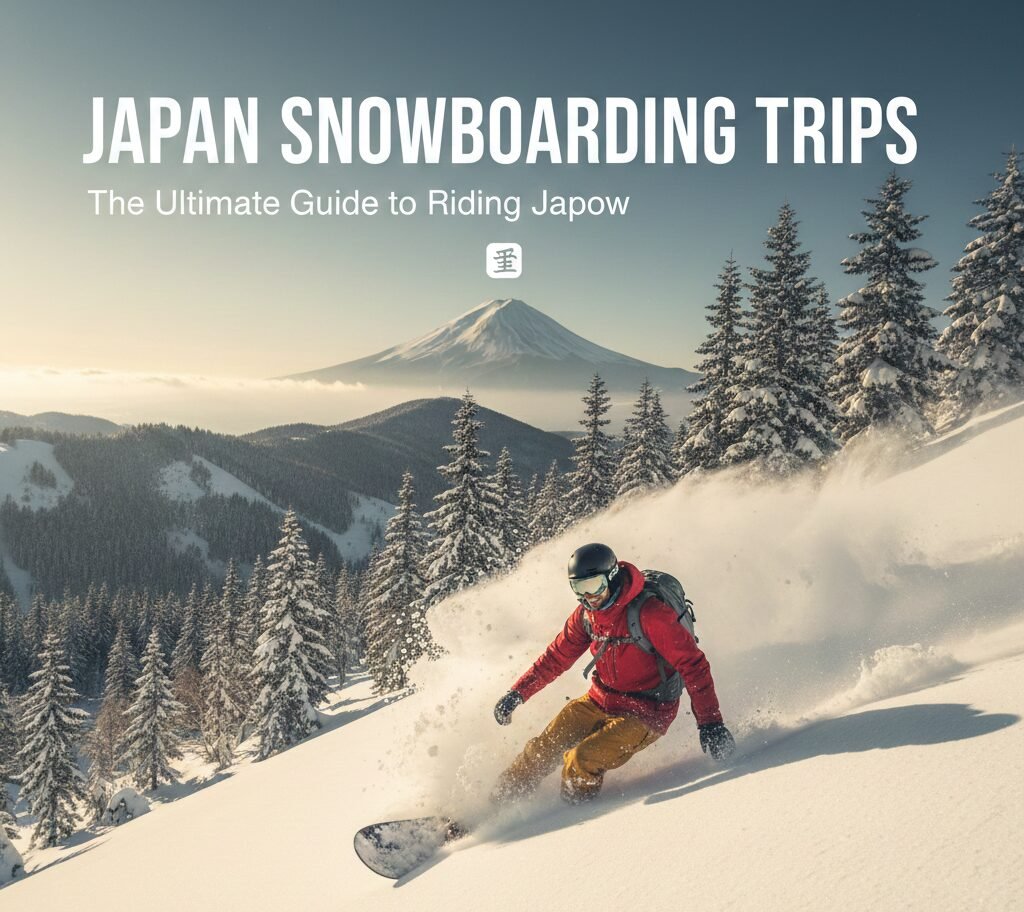
Japan Snowboarding Trips: The Ultimate Guide to Riding Japow
Experience the world’s lightest, deepest snow. This guide covers everything from resort picks and travel hacks to cultural tips for the ultimate Japanese snowboarding adventure.
1. Why Japan is Unique: The Science of Japow
Japan’s snow is legendary due to Siberian winds picking up moisture over the Sea of Japan, then dumping it as ultra-light, low-moisture powder upon hitting the mountains. This creates consistent, frequent dumps of 1-2 feet overnight, often for days in a row. The combination of deep snow, unique tree skiing (“gaijin trees”), and vibrant culture creates an unbeatable snowboarding pilgrimage.
The meteorology behind this phenomenon is worth understanding, because it explains why Japan’s powder feels so different from anywhere else. Cold, dry air masses form over Siberia and sweep east across the relatively warm waters of the Sea of Japan. As they travel, they pick up enormous amounts of moisture through evaporation. When that moist air slams into Japan’s mountainous spine — the same effect that creates lake-effect snow around the North American Great Lakes, but on a larger and more consistent scale — it’s forced upward, cools rapidly, and dumps its moisture as snow. Because the air mass started out so cold and dry, the resulting snow has an unusually low water content, often in the 3-8% range compared to 10-20% or higher in many North American and European snowpacks. That’s the physical reason Japanese powder feels so light and “bottomless” underfoot, and why face shots in Japan are a genuinely different sensation from powder days elsewhere.
This effect is strongest and most reliable in Hokkaido, which sits directly in the path of the Siberian storm track and receives some of the most consistent, driest snowfall on the planet. Honshu resorts, being further south and slightly more sheltered, still receive enormous total snowfall but with marginally higher moisture content on average — though a good Honshu storm cycle can still produce snow indistinguishable from Hokkaido’s best days. Because the storm cycles are driven by a broad, persistent weather pattern rather than isolated fronts, Japan often sees multi-day storm cycles that repeatedly reset the snowpack, which is part of why the country has built such a devoted following among powder-obsessed riders who’ve grown tired of chasing single-day storm windows elsewhere.
Pro Tip: Japan’s snow is so dry that it behaves differently. You’ll need to adjust your stance set-back and learn to float. A dedicated powder board or a directional all-mountain board is highly recommended. For more on board selection, see our guide on directional vs twin snowboards for float and control.
2. When to Go: Chasing the Perfect Storm
The prime season is mid-January to late February. This period offers the most consistent cold temperatures and highest probability of powder days. December and early January can be great but may have variable base depths. March brings warmer temps, longer days, and fantastic “spring powder,” but can be wetter. Avoid late March-April unless targeting higher elevation resorts.
| Month | Conditions | Crowds | Notes |
|---|---|---|---|
| Early-Mid December | Base building, variable coverage | Low | Good value, but some terrain/lifts not yet open |
| Late December | Improving base, holiday storms | High (holidays) | Christmas/New Year pricing spikes sharply |
| Early-Mid January | Deep base, very cold, frequent storms | Medium | Excellent value window right after New Year |
| Late January – February | Peak powder, coldest, most consistent | High | The prime window; book 6+ months ahead |
| March | Warmer, longer days, “spring powder” | Medium | Great for less-crowded, sunnier riding |
| Late March – April | Warmer, wetter, spring conditions | Low | Only worth it at higher-elevation resorts |
Within the prime window, there’s no way to guarantee a specific storm cycle months in advance, so the smarter strategy is to build your trip length around probability rather than trying to time a single dump. A seven-to-ten day trip during peak season in Hokkaido will statistically include several genuine powder days, even in a below-average season, simply because storm systems roll through so frequently. Shorter trips of three or four days carry more risk of catching a quieter stretch, though even “off” days in Japan often outperform an average day at many Western resorts.
3. Top Resorts Overview: Find Your Match
Japan has over 500 resorts. Focus on two main islands: Hokkaido (famous for ultra-light snow, colder temps) and Honshu (the main island, with bigger vertical and more varied terrain). Key destinations include Niseko, Rusutsu, and Furano in Hokkaido; Hakuba Valley, Nozawa Onsen, and Myoko Kogen in Honshu. Each offers a distinct vibe.
Beyond the snow itself, the two islands also differ meaningfully in vertical drop, terrain character, and travel logistics. Hokkaido’s resorts tend to have gentler average pitches and smaller overall vertical than the Alps or Rockies, but they compensate with almost unbelievable snow quality and extensive, well-spaced tree terrain that’s ideal for powder riding at moderate speeds. Honshu’s resorts, particularly Hakuba, offer steeper pitches, bigger vertical drops, and more varied alpine terrain, at the cost of slightly denser snow and a longer, more involved journey from Tokyo. Many experienced Japan riders eventually visit both islands across multiple trips, since they genuinely offer different experiences rather than one simply being a “better” version of the other.
First-time visitors are generally best served by picking one base resort and committing to it for most of the trip, rather than trying to hop between multiple far-flung regions on a first visit. Niseko and Hakuba are the two most common starting points precisely because they offer excellent snow, solid infrastructure, and enough terrain variety to fill a full week without needing to relocate. Save the resort-hopping, multi-region itineraries for a second or third trip once you have a feel for how much time you actually want to spend in transit versus on snow.
4. Niseko United Deep Dive: The International Hub
Niseko is actually four interconnected resorts (Grand Hirafu, Hanazono, Niseko Village, Annupuri). It’s the most foreigner-friendly, with abundant English signage, Western-style accommodations, and a vibrant international apres scene. The tree skiing is phenomenal, but it can get crowded. Perfect for first-timers to Japan who want ease and guaranteed great snow.
Each of the four resorts that make up Niseko United has its own personality. Grand Hirafu is the largest and busiest, with the most lifts, the widest range of terrain, and the biggest concentration of restaurants, bars, and shops in the adjoining village — it’s the natural base for most first-time visitors. Hanazono, immediately next door, has invested heavily in family-friendly infrastructure and a well-regarded terrain park, while still offering excellent tree runs of its own. Niseko Village sits between Hirafu and Annupuri and tends to be quieter, with a more resort-hotel feel centered around a couple of large properties. Annupuri, at the far end of the connected system, is the most laid-back and local of the four, with fewer crowds and a noticeably slower pace, making it a good choice for visitors who want easy access to the full mountain without Hirafu’s bustle.
A single all-mountain lift ticket covers all four resorts, and a shuttle bus (included with some tickets, or available for a small fee) connects the bases, so it’s easy to sample terrain across the whole system even if you’re staying in just one village. The famous “backside” tree runs accessed via gates from Hirafu and Hanazono are some of the most photographed powder terrain in Japan, and while they do get tracked out quickly on a busy powder morning given Niseko’s popularity, the sheer volume of terrain and frequency of storms mean fresh lines are usually still findable with a bit of hiking or an early start.
Niseko Quick Facts
Best For: First-time visitors, deep tree runs, nightlife, families.
Snowfall: 15m+ annually.
Vibe: Bustling, international.
Tip: Buy the All Mountain Pass to access all four resorts.
5. Hakuba Valley Deep Dive: The Honshu Powerhouse
Hakuba Valley consists of 10 individual resorts, each with its own character. It hosted the 1998 Winter Olympics. You’ll find bigger mountain terrain, steep chutes, and less crowded slopes compared to Niseko. The towns are more traditionally Japanese. Hakuba gets tremendous snow, though it can be slightly denser than Hokkaido’s. Ideal for riders seeking varied terrain and a more authentic cultural experience.
Because Hakuba is really a valley of ten separate ski areas rather than one connected resort, planning your days matters more here than in Niseko. Most riders base themselves in Happo, Echoland, or Wadano and use a rental car or the free shuttle loop to reach the other areas. Happo-One is the valley’s flagship, hosting Olympic downhill events in 1998 and offering huge vertical, long groomers, and steep upper-mountain terrain for advanced riders. Hakuba 47 and Goryu are linked by a single lift ticket and gondola, and together they offer some of the best tree runs and terrain park features in the valley, making them a favorite for freestyle-minded snowboarders. Cortina and Tsugaike sit at the quieter end of the valley and are known for reliable powder stashes, gentler pitches, and shorter lift lines, which makes them popular with families and intermediate riders who want fresh tracks without the crowds.
Hakuba’s snow tends to arrive in slightly heavier, wetter dumps than Hokkaido’s ultra-dry Japow, largely because of its more southerly latitude and proximity to the Sea of Japan storm track after it crosses the mountains. That said, a good Hakuba storm cycle can still bury the valley in a meter of snow within 24 hours, and the terrain is steeper and more varied than almost anywhere else in Japan, with genuine alpine bowls, couloirs, and long fall-line pitches that reward strong riders. The valley is also on the Epic Pass network through Hakuba Valley’s partnership program, which has made it increasingly popular with North American visitors looking to use pass credits during a Japan trip.
Hakuba Quick Facts
Best For: Advanced terrain, steep chutes, Olympic history, valley-hopping.
Snowfall: 11m+ annually, denser than Hokkaido.
Vibe: Traditional Japanese towns with a growing international scene.
Tip: Rent a car or buy the multi-resort valley lift ticket to sample Happo, 47/Goryu, and Cortina in one trip.
6. Rusutsu & Furano: Hokkaido’s Hidden Gems
Rusutsu: Just 90 minutes from Niseko, it features incredible, low-angle tree skiing through perfectly spaced birch glades. Fewer crowds, more playful terrain. The resort has a quirky, retro amusement park vibe. A must-do day trip or 2-3 day stay.
Furano: Located inland, it offers drier snow, a more local feel, and fantastic inbound terrain. The town is charming and less developed for tourism. Great for intermediates and experts looking to escape the crowds.
Rusutsu spreads across three connected peaks (Mt. Isola, West Mountain, and East Mountain) and is famous among Hokkaido regulars for having some of the best inbound tree skiing on the island, thanks to widely spaced birch and larch glades that stay skiable even after several days without fresh snow. The resort’s attached hotel and indoor amusement park (complete with a Ferris wheel and merry-go-round) give it a slightly surreal, retro charm that’s part of its appeal. Because Rusutsu doesn’t attract the same crowds as Niseko, powder stashes can still be found days after a storm, which is increasingly rare in Hokkaido’s more famous zones. Furano, meanwhile, sits further inland and is shielded somewhat from coastal weather systems, which means it often records some of the driest, coldest snow in Hokkaido even when Niseko is experiencing a warmer spell. Furano also has a long ski-racing pedigree, having hosted World Cup events, and its groomed terrain is exceptionally well maintained. The town itself is low-key and authentically Japanese, with excellent melon products (Furano is famous for its melons) and a slower pace than the international hubs.
7. Nozawa Onsen, Myoko Kogen & Beyond: Off-the-Beaten-Path Resorts
Once you’ve read up on Niseko and Hakuba, it’s worth considering some of the resorts that don’t make every “best of” list but consistently deliver excellent snow, terrain, and a more local atmosphere. These are the picks seasoned Japan riders often reach for on a second or third trip.
Nozawa Onsen
A classic Japanese onsen town built around a working ski resort, Nozawa Onsen in Nagano Prefecture offers steep pitches, excellent tree runs, and thirteen free public bathhouses scattered through town. The village retains a strongly traditional feel, with narrow lanes, wooden buildings, and a fire festival (Dosojin Matsuri) held every January that draws visitors from across the country. Snowfall is reliable and the terrain suits intermediate through expert riders well.
Myoko Kogen
Myoko is actually a cluster of several small resorts (Akakura Kanko, Akakura Onsen, Suginohara, and Ikenotaira) in Niigata Prefecture, an area known for receiving some of the heaviest snowfall totals in the country. The terrain is a mix of long cruisers and excellent backcountry access, and the area has a loyal following among powder-focused travelers who prefer a quieter, more local vibe over Niseko’s international bustle.
Zao Onsen
Located in Yamagata Prefecture, Zao Onsen is famous for its “snow monsters” (juhyo) — trees so heavily rimed with wind-blown ice and snow that they form ghostly, rounded shapes across the upper mountain. The skiing itself is solid, with a large vertical drop and varied terrain, but the juhyo phenomenon alone makes Zao worth a detour, especially when illuminated at night.
Kiroro, Tomamu & Sahoro
These three Hokkaido resorts are popular with families and those seeking a more upscale, resort-style trip. Kiroro consistently records some of the highest snowfall totals in Hokkaido and pairs its terrain with deluxe condo-style accommodation. Tomamu is known for its all-in-one resort village, indoor wave pool, and family activities, making it a strong choice for mixed groups where not everyone rides every day. Sahoro rounds out the trio with quieter slopes and a laid-back, uncrowded atmosphere.
Other resorts worth researching if you’re planning a second or third Japan trip include Madarao Kogen and Shiga Kogen (both known for excellent tree riding and backcountry access), Lotte Arai (a re-opened luxury resort near Myoko with modern facilities), and Asahidake, a lift-accessed volcanic zone in Hokkaido popular with experienced backcountry riders chasing untracked lines.
Shiga Kogen deserves a special mention as Japan’s largest ski area by connected terrain, spanning 18 linked ski areas under a single lift pass across a high alpine plateau in Nagano Prefecture. Its scale makes it worth several days on its own, and because it sees far fewer international visitors than Hakuba or Niseko, lift lines are rarely an issue even during storm cycles. Madarao Kogen, close by, has built a strong reputation specifically among tree-skiing enthusiasts, with wide, well-spaced glades that hold snow exceptionally well and a smaller, more intimate resort feel that longtime visitors often prefer to the bigger hubs.
For riders chasing the deepest possible untracked terrain and willing to hire a guide, catskiing and heli-skiing operations run out of a handful of Hokkaido locations, offering access to terrain well beyond what lift-served resorts can reach. These trips are considerably more expensive than standard lift tickets, typically running several hundred dollars per day, but they deliver an experience that’s hard to replicate anywhere else — untouched slopes, minimal crowds, and terrain shaped entirely by natural snow deposition rather than resort grooming or traffic.
8. Resort Comparison Table: Which Japan Resort Fits Your Trip?
With so many options, it helps to see the major resorts side by side. Use this table as a quick-reference starting point before diving deeper into any single destination.
| Resort | Region | Best For | Crowd Level | English Ease |
|---|---|---|---|---|
| Niseko United | Hokkaido | First-timers, nightlife, tree runs | High | Excellent |
| Hakuba Valley | Honshu (Nagano) | Steep terrain, valley-hopping | Medium-High | Good |
| Rusutsu | Hokkaido | Tree skiing, low crowds | Low-Medium | Fair |
| Furano | Hokkaido | Dry snow, groomers, local feel | Low | Fair |
| Nozawa Onsen | Honshu (Nagano) | Onsen culture, steep pitches | Medium | Fair |
| Myoko Kogen | Honshu (Niigata) | Heavy snowfall, backcountry access | Low | Basic |
| Zao Onsen | Honshu (Yamagata) | Snow monsters, varied terrain | Low-Medium | Basic |
| Kiroro / Tomamu / Sahoro | Hokkaido | Families, upscale resort villages | Low-Medium | Good |
As a rule of thumb, English ease and crowd levels tend to move together: the resorts that are easiest for non-Japanese-speaking visitors are also the busiest during peak weeks. If solitude and untouched powder matter more to you than convenience, lean toward the smaller Honshu resorts or the Hokkaido family resorts rather than Niseko.
8b. Japan vs. Other Powder Destinations: How It Compares
For riders weighing a Japan trip against a season pass destination closer to home, it helps to know exactly what you’re trading off. Compared to Colorado or Utah, Japan’s snow is generally lighter and drier on average, and storm cycles tend to be more frequent and longer-lasting, though North American resorts often win on sheer vertical drop, steepness, and the scale of lift-served terrain at a single resort. Whistler Blackcomb and other big Canadian resorts offer more overall terrain and vertical than most Japanese resorts, but rarely match Hokkaido’s consistency of light, dry snow across an entire season.
Against the European Alps, the comparison shifts again. Alpine resorts like Chamonix or the Three Valleys offer dramatically bigger vertical, high-alpine glacier terrain, and an extensive lift-served ski touring culture that Japan generally can’t match given its smaller mountains. What Japan offers instead is unmatched tree skiing, a far gentler learning curve for powder riding thanks to the forgiving snow, and a cultural and culinary experience that’s genuinely unlike anything available in the Alps or Rockies. Riders who’ve grown tired of icy, wind-affected conditions common in parts of the Alps in a lean snow year often find Japan’s snow reliability refreshing by comparison.
Cost-wise, Japan tends to sit in a comfortable middle ground: lift tickets and gear rental are generally cheaper than equivalent options in North America or Western Europe, though flights are a bigger consideration for most travelers given the distance involved. For many riders, the calculation comes down to trip length — a longer, once-a-season Japan trip often makes more financial and logistical sense than trying to visit multiple times in a single winter, whereas closer destinations suit more frequent, shorter trips.
9. Travel Logistics: Flights, Trains & Buses
Fly into New Chitose Airport (CTS) for Hokkaido or Narita (NRT) / Haneda (HND) for Tokyo/Honshu. For Hokkaido, book a connecting flight or take the train/bus to your resort (e.g., 2.5-3 hour bus to Niseko). For Hakuba, take the Shinkansen (bullet train) from Tokyo to Nagano, then a bus. Purchase a Japan Rail Pass *before* you arrive if planning extensive train travel.
Getting Around: While many resorts have shuttle buses, renting a car (with 4WD and snow tires) offers ultimate freedom to explore different resorts and onsens. International driving permits are required.
For most international visitors, the trip breaks down into three legs: the international flight into Tokyo or Sapporo, a domestic connection or train to the region, and a final local transfer to the resort itself. If you’re headed to Hokkaido, flying directly into New Chitose Airport is far more efficient than routing through Tokyo, since domestic connections from Narita or Haneda to Sapporo add several hours and another security screening. From New Chitose, private door-to-door shuttle services and shared resort buses run regularly to Niseko, Rusutsu, and Furano, and booking these in advance is strongly recommended during peak weeks, since seats sell out.
For Honshu resorts, the Shinkansen network makes rail travel remarkably efficient. From Tokyo Station, it’s roughly 80-100 minutes to Nagano on the Hokuriku Shinkansen, followed by a 60-70 minute bus transfer to Hakuba, Nozawa Onsen, or Myoko. Travelers heading to Zao Onsen typically take the Yamagata Shinkansen. If you’re visiting multiple regions on one trip — for example, combining a few days in Hakuba with a stop in Nozawa Onsen — the JR Pass or a regional rail pass can pay for itself quickly, though it’s worth running the numbers against point-to-point tickets, since the JR Pass isn’t always the cheapest option for shorter, single-destination trips.
Snow can disrupt travel schedules more than many first-time visitors expect. Heavy dumps occasionally delay or cancel domestic flights, especially into Hokkaido, and mountain roads can close temporarily during whiteout conditions. Building in a buffer day between your arrival and the start of your lift pass, rather than flying in the morning of your first ski day, meaningfully reduces stress if weather causes delays.
10. Lift Passes & Ski Passes: Epic, Indy, and Resort-Specific Tickets
Lift ticket strategy in Japan has changed significantly over the past several years as major North American pass networks have expanded their reach into the country. Understanding your options before you go can save real money, especially on a longer, multi-resort trip.
Epic Pass: Hakuba Valley and parts of the surrounding Nagano region participate in the Epic Pass network, meaning Epic Pass holders (including the Epic Local and Epic Day passes in some tiers) can access days at Hakuba resorts as part of their existing pass. If you already ski Vail-affiliated resorts in North America, it’s worth checking your specific pass tier for included Japan days before purchasing separate lift tickets.
Indy Pass: The Indy Pass includes a number of independent Japanese resorts, generally offering two discounted days at each participating area. This is a solid option for riders who want to sample several smaller, less crowded resorts across a trip rather than committing to one base resort for the whole stay.
Resort-specific multi-day and multi-mountain tickets: Niseko United sells an All Mountain Pass covering all four connected resorts (Hirafu, Hanazono, Niseko Village, and Annupuri), which is almost always worth it over single-resort tickets if you’re staying more than a couple of days. Hakuba Valley similarly offers a Valley Pass covering multiple linked resorts. Buying multi-day passes online in advance is typically cheaper than purchasing single-day tickets at the window, and many resorts offer further discounts for early online purchase.
Pro Tip: Lift ticket prices in Japan remain noticeably lower than comparable resorts in North America or Europe, even at the international hubs. Don’t assume you need a multi-resort pass by default — for a shorter trip focused on one base resort, single-resort day or multi-day tickets are often simpler and still very affordable.
11. Accommodation Tips: From Ryokans to Condos
Book early (6+ months in advance for peak season). Options range from Western-style hotels and apartments to traditional Japanese ryokans (inns with tatami mats and onsens). For groups, renting a chalet or condo is cost-effective. Staying ski-in/ski-out is worth the premium for convenience. Consider the location relative to the lifts and town amenities.

The type of accommodation you choose shapes the character of your whole trip almost as much as the resort you pick. Western-style hotels offer familiar amenities — private bathrooms, elevators, on-site restaurants — and are the easiest option for travelers who want a hassle-free stay. Serviced apartments and self-contained condos, popular in Niseko and Hakuba, give groups a kitchen and living space, which can meaningfully cut down on dining costs over a week-long trip. Traditional ryokans offer a different experience entirely: tatami-mat rooms, futon bedding, communal or private onsens, and often a multi-course kaiseki dinner included in the rate. Staying at least one or two nights in a ryokan is a highlight for most first-time visitors, even if the rest of the trip is spent in a more conventional hotel or condo.
Location matters more in Japan’s ski towns than the map distance might suggest, since deep snow and icy sidewalks can turn a ten-minute walk into a slog while carrying boards. In Niseko’s Hirafu village, properties closer to the Welcome Center and gondola command a premium but save considerable time and hassle each morning. In Hakuba, Echoland and Wadano offer a good balance of nightlife proximity and quieter lodging, while Happo’s base area puts you right at the lifts. If you’re booking a smaller or more remote resort like Myoko or Zao Onsen, confirm shuttle schedules carefully, since public transport options thin out considerably outside the main hubs.
Groups of four or more will often find that renting a private chalet or larger condo works out cheaper per person than booking individual hotel rooms, while also giving everyone shared living space for apres. Many chalet rental agencies in Niseko and Hakuba include daily housekeeping and can arrange airport transfers, private chefs, or childcare, similar to a full-service ski chalet experience in the Alps.
Booking platforms vary in how well they cover Japan’s smaller resort towns. Major international hotel booking sites work fine for the bigger properties in Niseko and Hakuba, but many condo and chalet rentals, especially in quieter regions like Myoko or Furano, are handled through local specialist agencies or property managers rather than the big global platforms. For less internationally known resorts, it’s often worth searching directly for regional accommodation agencies or contacting the resort’s tourism office, since availability and pricing can differ significantly from what’s listed on general booking sites.
A final consideration is heating and insulation standards, which can catch first-time visitors off guard. Older ryokans and smaller local guesthouses sometimes rely on space heaters or kotatsu (heated low tables) rather than centralized heating throughout the building, meaning hallways and bathrooms can be considerably colder than the main room. This isn’t a flaw so much as a different approach to home heating common throughout Japan, but it’s worth knowing in advance, particularly for travelers sensitive to cold, so you can pack accordingly or specifically seek out properties with modern central heating if that’s a priority.
12. Gear & Packing: Be Prepared for Deep Days
Rent or Bring? High-quality demo gear is widely available for rent, often with the latest powder boards. This saves on airline baggage fees. If bringing your own, a powder-focused board is ideal. Pack fully waterproof outerwear (15k+ rating recommended), multiple base layers, and neck gaiters. Don’t forget a durable snowboard bag for the flight. Consider waxing your board frequently for the dry snow.
🛡️ Shop High-Performance OuterwearRental shops near every major resort stock demo fleets from major snowboard brands, and staff are generally very experienced at matching riders to the right board length and flex for deep powder days. Renting is especially sensible if you’re flying a long international route where checked-baggage fees for oversized snowboard bags can add up quickly, or if you’re still deciding whether a dedicated powder shape is worth owning. That said, riders who already know their preferred setup well may still prefer to travel with their own board and simply rent boots if needed, since well-broken-in boots make a noticeable difference in comfort over a multi-day trip.
Beyond outerwear and board gear, a few packing details make a bigger difference in Japan than in many other ski destinations. Because temperatures in Hokkaido can drop well below what riders from milder climates are used to, pack genuine cold-weather layers rather than relying on a single midweight jacket. A well-sealed pair of goggles with a spare lens for flat light is essential, since storm days with heavy snowfall are common and low-visibility conditions happen often. Hand and toe warmers are cheap, widely available, and worth having on hand for the coldest days. Finally, because so much of Japan’s best riding happens in trees and off-piste terrain, a set of the wider, floatier bindings and a slightly longer plank than you might ride at home will make powder days considerably easier, particularly for less experienced powder riders.
13. Backcountry & Avalanche Safety: What to Know Before You Duck a Rope
Japan’s reputation for deep, forgiving powder can create a false sense of security once riders start venturing beyond marked, patrolled terrain. While the snowpack in parts of Hokkaido tends to be more stable than the notoriously touchy continental snowpacks found in places like Colorado, avalanche danger is real throughout the Japanese mountains, and conditions vary significantly by region and storm cycle.
Many resorts, including sections of Niseko and parts of the Hakuba Valley, operate official backcountry gates that provide controlled access to adjacent slackcountry terrain. These gates may be closed during high-avalanche-danger periods, and riders are expected to check conditions and sign out before heading through. Terrain beyond resort boundaries that isn’t accessed through an official gate is generally unpatrolled and unmonitored, meaning no avalanche control work has been done and no rescue infrastructure is guaranteed nearby.
Non-negotiable backcountry basics: Never ride ungroomed, unpatrolled terrain without a beacon, probe, and shovel — and the training to use them. Hire a certified local guide for your first backcountry days in any new area. Check the regional avalanche advisory before heading out, and always tell someone your planned route and expected return time.
Hiring a local mountain guide is genuinely one of the best investments you can make on a Japan trip if backcountry or sidecountry riding is a priority. Local guides know which slopes have recently avalanched, which aspects are holding wind slab, and where the best untracked lines sit relative to current conditions — knowledge that simply isn’t available from a map or a single day’s weather forecast. Guiding companies operate in Niseko, Hakuba, Myoko, and several other regions, offering everything from single-day tours to multi-day cat-skiing and heli-skiing trips for more advanced groups.
It’s also worth understanding a few of the specific hazards that distinguish the Japanese snowpack from other regions. Because storms often arrive in rapid, repeated succession, new snow can bury weaker layers before they’ve had time to bond, occasionally creating persistent weak layers similar to those found in more classically unstable snowpacks. Tree wells — the loose, unconsolidated pockets of snow that form around the base of tree trunks — are a particular hazard in Japan’s dense glade terrain, since a rider who falls headfirst into a tree well can become trapped and suffocate even on a low-angle slope with no avalanche danger at all. Riding trees with a partner, staying within sight of each other, and never riding alone in tree terrain are simple habits that meaningfully reduce this risk, which is statistically a bigger contributor to backcountry and sidecountry fatalities in Japan than avalanches themselves.
14. Budgeting Your Japan Snowboarding Trip
Costs vary considerably depending on which resort you choose, how far in advance you book, and how much of the trip you spend in restaurants versus self-catering. As a general guide, mid-range travelers should budget somewhere in the $200-$300 USD per day range (excluding international flights) for accommodation, lift tickets, food, and local transport, while budget-conscious travelers staying in shared apartments and cooking some meals can often get that figure closer to $120-$180 per day.
| Expense | Budget Range (per day, USD) | Notes |
|---|---|---|
| Accommodation | $40-$250+ | Hostel bunk to private ski-in/ski-out chalet |
| Lift ticket | $45-$75 | Cheaper with multi-day online passes |
| Gear rental | $35-$60 | Board, boots, and outerwear package |
| Food | $25-$70 | Convenience store meals to izakaya dinners |
| Local transport | $5-$30 | Shuttle buses, local trains, taxis |
The single biggest lever for controlling cost is booking timing. Flights and accommodation for peak season (mid-January through February) climb steadily the closer you get to the date, particularly for Niseko and Hakuba. Booking six or more months out, or shifting your trip slightly into early January or March, can meaningfully reduce both airfare and lodging costs while still delivering excellent snow. Self-catering in a condo with a kitchen, sticking to convenience store breakfasts (which are genuinely good in Japan), and saving izakaya dinners for a few nights rather than every night are all easy ways to trim the food budget without sacrificing the experience.
Resort choice itself is another major lever. Niseko and Hakuba command a premium over quieter alternatives like Furano, Myoko, or Zao Onsen, both in accommodation pricing and, to a lesser extent, in food and services aimed at international visitors. A trip built around one of the less internationally famous resorts can deliver comparable or even superior snow quality at a meaningfully lower total cost, particularly for travelers who don’t need English-language infrastructure at every turn. Traveling in a larger group and splitting a chalet or condo rental is another effective way to bring per-person accommodation costs down significantly compared to individual hotel rooms, while also unlocking amenities like a private kitchen and hot tub that would be out of reach at a solo traveler’s budget.
Finally, consider how you handle currency and payments, since fees can quietly erode a travel budget over a longer trip. Using a credit or debit card with no foreign transaction fees, and withdrawing cash in larger amounts less frequently rather than making many small ATM withdrawals (each of which may carry a flat fee), both help minimize unnecessary costs. Airport currency exchange counters typically offer worse rates than ATA withdrawals inside Japan, so it’s usually better to withdraw Yen directly from a convenience store ATM after arrival rather than exchanging a large sum of cash before you fly.
15. Culture & Etiquette: Respect Goes a Long Way
Learn basic phrases (“Arigatou” – Thank you). Remove shoes when entering homes, ryokans, and some restaurants. Be quiet and respectful on public transit. When using onsens (hot spring baths), wash thoroughly before entering the bath, and no clothing or towels in the water. Tattoos can be frowned upon in public onsens; cover them with patches or seek private onsens.
Onsen etiquette deserves a bit more detail, since it’s one of the most common points of confusion for first-time visitors. Public baths are gender-separated, and bathers go in fully nude — swimwear is not worn in traditional onsens. Before entering the communal bath, wash and rinse thoroughly at the seated shower stations provided; the bath itself is for soaking, not cleaning. Long hair should be tied up and kept out of the water. Small modesty towels are common but should never touch the bathwater itself; most bathers rest them on the edge of the bath or on their head. If you have visible tattoos, check ahead of time — some onsens still turn away tattooed guests due to historical associations with organized crime, though this is gradually changing, and many resort towns now have tattoo-friendly or private-reservation onsens specifically to accommodate international visitors.
On the mountain itself, a few small customs go a long way. Queuing for lifts is orderly and quiet compared to some Western resorts — cutting lines or being loud is noticeable and considered rude. Littering, even cigarette butts, is taken seriously. If you’re renting gear or eating at a small local restaurant, a polite bow and a simple “arigatou gozaimasu” are appreciated even if the rest of the conversation happens in English or through gestures. Tipping is not customary in Japan and can even cause confusion if offered at restaurants or to guides; excellent service is simply the cultural default, not something that requires an extra gratuity.
A handful of smaller, easy-to-overlook habits also go a long way toward smoother interactions. Talking loudly on a phone while on a train or bus is generally frowned upon, and most trains have designated quiet zones near priority seating. When exchanging money, a business card, or an item in a shop, it’s common to use both hands as a small sign of respect rather than a one-handed pass. Chopstick etiquette matters at meals: avoid sticking chopsticks upright in a bowl of rice, since this resembles a funeral ritual, and avoid passing food directly from your chopsticks to someone else’s for the same reason. None of these missteps will cause serious offense from a visitor who’s clearly making a good-faith effort, but small courtesies like these are noticed and appreciated, and they tend to make service and interactions noticeably warmer over the course of a trip.
16. Food & Drink Guide: Fueling Your Powder Days
Food is one of the most underrated parts of a Japan snowboarding trip, and resort towns generally punch well above their weight for quality, even in small mountain villages. On-mountain, expect noodle shops serving ramen or udon, curry rice, and grilled skewers rather than the standard cafeteria burger-and-fries lineup found at many Western resorts — a genuine upgrade for lunch breaks. Convenience stores (konbini) like 7-Eleven, Lawson, and FamilyMart are a Japan travel institution in their own right, offering surprisingly good, cheap breakfast and snack options including onigiri rice balls, hot buns, and fresh coffee, making them a reliable stop before an early lift line.
In town, izakaya (casual pubs serving small plates) are the heart of the apres food scene, pairing grilled skewers, tempura, and sashimi with beer, sake, and shochu. Ramen shops range from quick, no-frills counters to destination-worthy spots worth planning a meal around; regional specialties are worth seeking out, such as Sapporo’s miso ramen if you’re in Hokkaido. Sushi and seafood are outstanding throughout the country, but especially strong in Hokkaido thanks to its cold, nutrient-rich coastal waters. For something warming after a cold day, try nabe (hot pot) or oden, both staples of Japanese ski towns in winter.
Dietary restrictions can occasionally be tricky in smaller towns, since Japanese cuisine relies heavily on dashi (fish-based stock) even in dishes that otherwise appear vegetarian. Vegetarian and vegan travelers should research restaurants in advance in smaller resort towns, though Niseko and Hakuba’s more international scene has considerably more options than a decade ago. Carrying a printed allergy or dietary card in Japanese can help enormously in restaurants without English menus.
Drinking culture is a meaningful part of the apres experience for many visitors. Japanese beer (Sapporo, Asahi, and Kirin are the major national brands, with Sapporo naturally being a point of local pride in Hokkaido) pairs well with izakaya food, and most towns have at least a couple of standing bars or small pubs where riders gather after a big powder day. Sake and shochu are worth exploring beyond the basics — many resort regions, particularly in Nagano and Niigata, sit within well-regarded sake-producing areas, and a number of local breweries offer tastings or tours that make for a good non-riding afternoon. Hot drinks matter too: vending machines throughout Japan, including many right at the base of the lifts, stock both cold and heated canned coffee and tea, which is a small but genuinely appreciated comfort on a freezing chairlift-loading morning.
If you’re self-catering in a condo or apartment, Japanese supermarkets are well worth a visit even if you don’t plan to cook every meal. Local supermarkets in resort towns stock high-quality produce, fresh seafood, and prepared foods (bento boxes, pre-made sides, and fresh sushi) at prices considerably lower than eating out for every meal, and browsing the aisles is itself a bit of a cultural experience. Many riders on longer trips settle into a rhythm of cooking simple breakfasts and some dinners at “home” while saving restaurant meals for the nights they want to properly explore the local food scene.
17. Après & Off-Mountain: Unforgettable Experiences
Japan’s apres is more about savoring great food and onsens than rowdy bars. Indulge in ramen, sushi, and izakaya (pub) fare. Visit an onsen daily to soothe muscles. Explore local towns, visit temples, and try sake tasting. In Niseko, the nightlife is more active with international bars.
Beyond eating and soaking, most resort regions offer a handful of memorable off-mountain activities worth building into a rest day. Snowmobile tours and guided snowshoe walks through backcountry forest are widely available near Niseko, Hakuba, and Furano. Zao Onsen’s illuminated “snow monster” trees are worth a dedicated evening trip if you’re in the area. Many towns also host winter festivals, from Nozawa Onsen’s dramatic Dosojin fire festival in January to Sapporo’s massive Snow Festival in early February, which features enormous, elaborately carved snow and ice sculptures and is well worth a day trip if your schedule allows.
18. Families, Groups & Non-Riders: Planning a Mixed Trip
Not everyone on a Japan trip needs to be a dedicated snowboarder for the group to have a great time. Several resorts are particularly well set up for mixed groups that include non-skiing partners, young children, or grandparents. Tomamu, with its indoor wave pool, ice village, and extensive family programming, is purpose-built for this kind of trip. Niseko and Hakuba both offer excellent childcare and ski-school options, with English-speaking instructors widely available at the larger resorts, along with dedicated beginner zones separated from faster through-traffic.
For non-riders, Japan’s ski towns offer plenty to do independent of the slopes: onsen days, cooking classes, sake breweries, snowshoe walks, and nearby cultural day trips to temples or historic villages. Nagano City, within reach of the Hakuba Valley resorts, is home to Zenko-ji Temple and the Jigokudani Monkey Park, where wild snow monkeys famously bathe in hot springs — a genuinely memorable outing for a rest day, regardless of skill level on a board.
Traveling with young children adds a few extra planning considerations. Ski schools generally accept children from around age 3-4, though minimum ages and class structures vary by resort, so it’s worth confirming details directly with the resort or a booking agent before you go. Renting a condo or apartment with a kitchen, rather than a hotel room, tends to make family life considerably easier over a multi-day stay, and many family-oriented resorts offer equipment rental sized for kids, including helmets and mini-boards.
Groups with mixed skill levels — some experts, some beginners, some non-riders — tend to do best at larger resorts with clearly separated terrain zones, like Niseko or Hakuba, where beginners can stick to gentle, well-groomed runs near the base while more advanced riders head further up the mountain, all while regrouping easily for lunch or apres. Booking a private lesson for beginners on the first day or two of the trip, rather than assuming they’ll pick things up by following the group, tends to produce a much better experience for everyone and prevents the frustration that comes from mismatched pacing on the mountain.
For groups traveling with grandparents or older relatives who may not be riding at all, Japan’s resort towns are generally very walkable once cleared of snow, with heated buildings, accessible public transport, and a slower-paced daily rhythm centered around onsens and meals rather than nonstop activity. Many ryokans and hotels offer daytime spa access even for non-guests, which can make for a relaxing standalone day for non-skiing members of a group while the rest of the party rides.
19. Booking Timeline & Final Checklist
6-12 Months Out: Research resorts, book flights.
6 Months Out: Book accommodation and car rental.
3 Months Out: Purchase travel insurance, Japan Rail Pass if needed.
1 Month Out: Book airport transfers, rent gear online (often cheaper).
1 Week Out: Pack, organize visas/permits, download translation apps.
Final Advice: Embrace the adventure. Things may not go exactly to plan, but that’s part of the experience. Be flexible with weather, try new foods, and immerse yourself in the culture. A Japan snowboarding trip is about more than just riding—it’s a cultural immersion that will leave you dreaming of your return.
20. Sample Itineraries: Putting It All Together
If you’re not sure how to structure your trip, these sample itineraries offer a starting framework you can adapt based on your travel dates, budget, and riding ability.
7-Day First-Timer Trip: Niseko Base
Fly into New Chitose, transfer to Hirafu (2.5-3 hours). Spend six days riding across Niseko United’s four connected resorts using the All Mountain Pass, mixing groomer days with tree-run powder mornings. Take one rest day for an onsen visit and a day trip to Rusutsu for a change of terrain. This itinerary minimizes logistics complexity, which makes it ideal for a first Japan trip.
10-Day Hokkaido Powder Tour
Base in Niseko for four days, then relocate to Furano for three days of drier, quieter terrain, finishing with three days in Rusutsu for tree skiing before flying home from New Chitose. This route trades some convenience for a wider sample of Hokkaido’s distinct microclimates and crowd levels, and works well for riders on their second Japan trip who already know they prefer Hokkaido’s snow style.
10-Day Honshu Valley-Hopping Trip
Fly into Tokyo, take the Shinkansen to Nagano, and spend five days in Hakuba Valley sampling Happo, 47/Goryu, and Cortina. Transfer to Nozawa Onsen for two days of onsen culture and steep terrain, then finish with two to three days in Myoko Kogen for quieter, heavier-snowfall riding before returning to Tokyo. This itinerary suits riders who want more cultural immersion and varied terrain over sheer powder volume.
Whichever structure you choose, build in at least one full rest day for every four to five riding days, especially on a trip longer than a week. Deep, heavy powder days are more physically demanding than typical groomed-run skiing, and a rest day spent in an onsen or exploring a nearby town tends to make the back half of a longer trip considerably more enjoyable.
21. Reading Storm Cycles & Snow Forecasting
Once you’re on the ground, keeping an eye on incoming storm cycles can help you decide which day to hit the steepest terrain, which day to stick to groomers, and which day is worth sleeping in for a later, less crowded lift line. Japanese resorts typically post snowfall totals and base depth updates daily, and most have official English-language snow report pages during the season. Local webcams, updated frequently at major resorts, are useful for a quick visual check of current conditions before committing to a longer travel day between resorts.
Storm cycles in Japan tend to follow a recognizable rhythm once you’ve experienced a few: a cold front moves through with heavy, sustained snowfall for one to three days, followed by a clearing, colder “bluebird” period as high pressure briefly builds in, before the next system arrives. Riders chasing the deepest, lightest snow generally want to be on the mountain during the storm itself or on the first clear morning immediately after, when untracked snow is most abundant and least affected by wind or warming. If visibility during a storm is too poor for comfortable riding, tree runs offer far better definition and contrast than open, exposed terrain, which is part of why Japan’s glade skiing culture developed as strongly as it has.
Wind matters more than many first-time visitors expect, particularly in exposed alpine terrain in Hakuba and on the upper mountain at Hokkaido resorts. Wind-loaded slopes can develop dangerous slab conditions even when total snowfall looks moderate, while wind-scoured slopes can be crusty and unpleasant despite recent snow. Checking wind speed and direction alongside snowfall totals, and favoring lee-side, sheltered tree terrain on windy days, will generally produce a better riding experience than chasing open-bowl terrain regardless of forecast.
22. Money, SIM Cards & Practical Logistics
Japan remains a more cash-oriented society than many first-time visitors expect, especially once you’re outside major hotels and chain stores. Small restaurants, local izakayas, some ryokans, and rural shuttle services frequently only accept cash, so carrying a reasonable amount of Japanese Yen at all times is essential rather than optional. Convenience stores (7-Eleven in particular) have reliable ATMs that accept most international cards and are usually the easiest, most consistent way to withdraw cash throughout a trip. Major hotels, larger restaurants, and lift ticket counters at big resorts increasingly accept credit cards and contactless payment, but don’t count on this at smaller, more local establishments.
Staying connected is straightforward these days. Airport counters and many convenience stores sell prepaid tourist SIM cards with data plans sized for a typical trip length, and pocket Wi-Fi rental — a small hotspot device you carry and return at the airport — remains a popular option for groups who want to share one connection across multiple phones. Both can typically be reserved online before you fly and picked up on arrival, which saves time versus purchasing on the spot. Reliable data is genuinely useful in Japan’s ski regions for checking snow reports, translation apps, and transit schedules, so it’s worth arranging before your trip rather than relying solely on hotel Wi-Fi.
Travel insurance that specifically covers snow sports is worth double-checking before you go, since some standard travel policies exclude skiing and snowboarding, or exclude backcountry/off-piste riding specifically. Given the remoteness of some Japanese resort regions and the cost of medical evacuation or repatriation if a serious injury occurs, a policy with genuine winter-sports coverage — including off-piste riding if you plan to use backcountry gates — is a sensible investment relative to its cost.
23. Snowboarding Technique Tips for Japanese Powder
Riding deep, dry Japanese powder rewards a slightly different technique than riding groomed runs or the heavier, wetter powder found in many other regions. Because the snow offers so little resistance, staying centered or even slightly back on the board, rather than driving weight forward as you might on groomers, helps keep the nose from diving. Wider, slower, more deliberate turns generally work better than the tight, aggressive carving style suited to firmer snow, since the board needs a bit more surface area and time to plane up through the low-density snow.
Speed management matters more in deep powder than it does on groomers, somewhat counterintuitively — too little speed and the board sinks and stalls, too much and it becomes difficult to control direction in tight tree terrain. Building speed gradually into open sections before entering trees, and choosing lines with a bit more fall-line pitch rather than flat traverses, generally produces a more controlled, enjoyable ride. For riders newer to powder and tree riding specifically, a lesson or two with a local instructor early in the trip is a worthwhile investment, since Japan’s terrain and snow conditions differ enough from a typical home resort that even strong groomer riders often benefit from a refresher on powder-specific technique before tackling steeper, treed lines.
Falls in deep powder are generally soft, but getting back up can be surprisingly tiring, particularly on steep terrain or in bottomless snow where there’s no firm surface to push against. Learning to use your board as a platform — laying it flat beneath you before standing — and pacing yourself rather than pushing through exhaustion on the last run of a big powder day will make multi-day trips considerably more sustainable.
24. Complete Packing Checklist
Use this checklist as a starting point and adjust based on trip length and whether you’re renting or bringing your own board setup.
On-mountain gear:
- Waterproof jacket and pants (15k+ waterproof rating recommended)
- Base layers (at least two sets for a week-long trip)
- Mid-layer fleece or insulated jacket
- Neck gaiter or balaclava
- Goggles with a spare lens for flat light
- Helmet
- Waterproof gloves or mittens, plus a backup pair
- Thick ski/snowboard socks (avoid cotton)
- Hand and toe warmers
- Snowboard, boots, and bindings (or rental confirmation)
- Durable snowboard travel bag
Travel and practical essentials:
- Passport with sufficient validity and any required visa documentation
- Japan Rail Pass or regional rail pass voucher, if purchased
- Japanese Yen in cash, plus a card with low foreign transaction fees
- Prepaid SIM card or pocket Wi-Fi reservation confirmation
- Travel insurance documents with snow-sports coverage confirmed
- Portable charger/power bank
- Universal power adapter (Japan uses Type A/B plugs)
- Small towel for onsens
- Comfortable, easy-to-remove shoes for indoor spaces
- Basic first-aid kit and any personal medications
- Translation app downloaded for offline use
Pro Tip: Pack one complete change of warm, non-ski clothing in your carry-on, separate from your checked snowboard bag. If checked luggage is delayed, you’ll still be able to function for a day while it catches up.
Japan Snowboarding Trips: Your Questions Answered
What is the best month to go snowboarding in Japan?
Mid-January through February is the peak for consistent cold powder. Late January is often considered the sweet spot. March offers longer days and spring conditions but a higher chance of wetter snow.
Is it better to go to Hokkaido or Hakuba?
Hokkaido (Niseko, Rusutsu) generally has lighter, drier snow and more tree skiing. Hakuba has bigger mountain terrain, more vertical, and a more traditional Japanese culture. For guaranteed deep powder and ease for first-timers, choose Hokkaido. For varied terrain and culture, choose Hakuba.
Do I need to speak Japanese to snowboard in Japan?
No, especially in major resorts like Niseko where English is widely spoken. In more remote areas, learning basic phrases is appreciated. Translation apps and pointing work well. The Japanese are incredibly helpful and patient with visitors.
Should I bring my own snowboard or rent there?
Renting high-quality demo gear in Japan is excellent and often recommended. It saves on airline fees and lets you try a board optimized for Japanese powder. If you’re attached to your own setup, bring it, but ensure it’s a board suited for deep snow.
How expensive is a snowboarding trip to Japan?
It can vary widely. Budget around $200-$300 USD per day excluding flights for mid-range accommodation, lift tickets, food, and transport. Luxury trips cost more. Eating at local izakayas and staying slightly outside the main hubs saves money.
What should I pack besides snowboard gear?
Essentials: waterproof backpack, portable charger, cash (many places are cash-only), sim card or pocket Wi-Fi, small towel for onsens, comfortable shoes for town, and a sense of adventure!
Are there terrain parks in Japan?
Yes, but they are not the main focus. Most major resorts have parks, but they are often smaller than in North America/Europe. Japan’s true draw is the off-piste and tree riding. Check resort websites for current park features.
Is backcountry snowboarding allowed in Japan?
It’s complex. Some resorts have designated backcountry gates with avalanche control. However, much backcountry terrain is unpatrolled and carries high avalanche risk. Never go without a qualified local guide, proper avalanche gear, and training. The snowpack can be unstable.
Can I use my credit card everywhere?
Major hotels, some restaurants, and big shops accept credit cards. However, many smaller restaurants, onsens, and rural businesses are cash-only. Always carry a sufficient amount of Japanese Yen.
How far in advance should I book my trip?
For peak season (Jan-Feb), book flights and accommodation 6-9 months in advance, especially for popular resorts like Niseko. Last-minute trips are possible but limit your options and increase costs.
Is Niseko or Hakuba better for a first-time visitor?
Niseko is generally the easier choice for a first trip thanks to its English-friendly infrastructure, straightforward transfers, and connected four-resort pass. Hakuba suits first-timers who prioritize steeper terrain and a more traditional Japanese town over maximum convenience.
Can I use my Epic Pass or Indy Pass in Japan?
Hakuba Valley resorts participate in the Epic Pass network, and a number of independent Japanese resorts are included in the Indy Pass. Check your specific pass tier for included Japan days before purchasing separate lift tickets.
Is it safe to go off-piste or into the backcountry in Japan?
Only with proper training, avalanche safety gear (beacon, probe, shovel), and ideally a certified local guide. Officially gated slackcountry adjacent to resorts is more controlled, but unpatrolled backcountry terrain carries genuine avalanche risk regardless of how forgiving Japan’s snowpack has a reputation for being.
What’s the best resort for families with young kids?
Tomamu, Niseko, and Hakuba all offer strong ski school programs, English-speaking instructors, and family-oriented amenities. Tomamu in particular is built around an all-in-one resort village with indoor activities, making it especially convenient for mixed-ability families.
How do I get a SIM card or Wi-Fi for my trip?
Prepaid tourist SIM cards and pocket Wi-Fi rentals are available at major airports and online in advance for pickup on arrival. Pocket Wi-Fi is popular with groups since one device can serve multiple phones.


