
Jones Flagship vs Mountain Twin: The Definitive Rider’s Guide
Two legendary Jones boards, two completely different riding philosophies — which one is built for the way you actually ride?
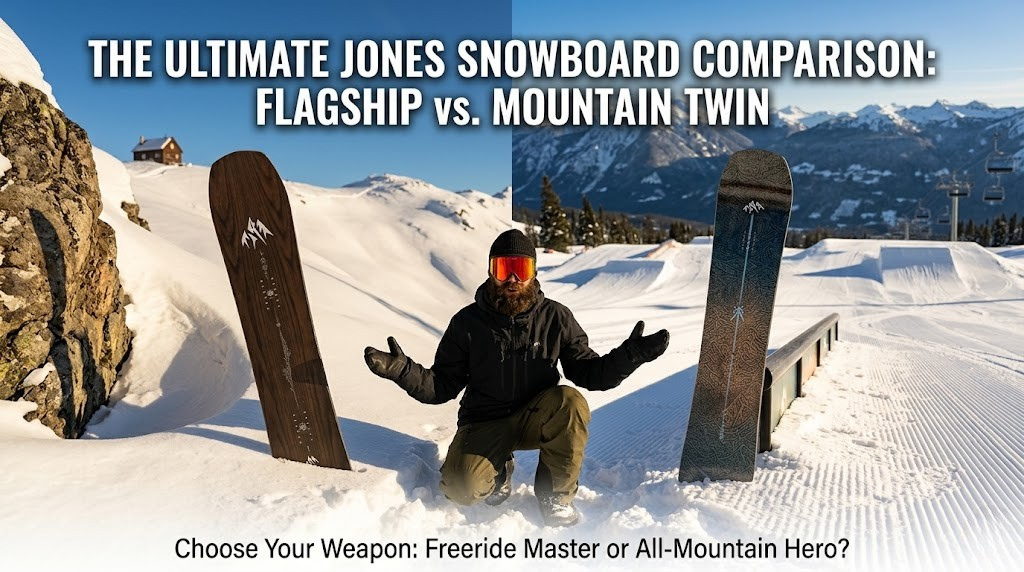
If you’ve spent more than five minutes researching Jones snowboards, you’ve almost certainly stumbled onto this exact question: Flagship or Mountain Twin? Both carry the Jones pedigree, both are built with premium materials and environmental ethics baked into their DNA, and both are widely respected across the snowboard community. But they are not the same board — not even close. One is a directional charger built for aggressive all-mountain riders who want to carve up every aspect of the mountain at speed. The other is a versatile twin-tip workhorse that thrives when you’re hiking sidehits, hitting the park on a whim, or just want the freedom to ride switch without sacrificing performance. Choosing the wrong one for your style won’t just cost you money — it’ll cost you fun runs all season long.
This guide goes deep. We’re talking construction details, actual flex values, camber behavior at speed, how each board behaves in chopped-up afternoon crud, what happens when you stomp a landing on each one, and which rider DNA each board actually rewards. Whether you’re a seasoned intermediate deciding between these two, an expert rider looking to add a second board to the quiver, or someone spending close to $600 on a snowboard for the first time and wanting to get it absolutely right — this comparison was written for you.
Before we dive into the technical breakdown, it’s worth noting that the camber vs rocker discussion underpins almost everything you’re about to read. The Flagship and Mountain Twin handle this profile question in entirely different ways, and that difference cascades through every riding scenario we’ll cover below.
Brand & Board Overview: Who Are These Boards For?
Jones Snowboards has built its reputation on three pillars: performance, craftsmanship, and sustainability. But within their lineup, the Flagship and Mountain Twin occupy very different philosophical positions.
Jeremy Jones didn’t build his company to make beginner boards. Every board in the Jones lineup is designed with performance as the first priority, sustainability as the second, and versatility as the byproduct rather than the goal. That said, performance means different things on different days, and the Flagship and Mountain Twin are each “perfect” for a specific type of rider who defines performance differently.
The Jones Flagship — Purpose-Built for the Mountain’s Best Lines
The Flagship is Jones’s statement board. It’s the board that Jeremy Jones himself rides on expeditions, on the steeps of Alaska, and on every high-consequence line where your board absolutely cannot let you down. Introduced as the flagship all-mountain directional board, it has gone through several evolutions but has always maintained its identity as a tool for riders who prioritize mountain mastery over park tricks and switch riding. The board was built with a clear thesis: if you’re an advanced or expert rider who primarily rides forward, attacks variable terrain, surfs pow pow like a bandit, and charges groomers like they owe you something — this is your board.
What makes the Flagship genuinely different from most all-mountain boards is how uncompromisingly it commits to the directional template. It has a setback stance, a tapered tail, a pronounced nose-to-tail rocker-camber-rocker profile, and a sintered base that rewards maintenance and pays dividends with every wax cycle. It is not trying to be your park board. It is not trying to be your jib board. It is trying to be the best version of a mountain board, and by most accounts, it succeeds.
The Jones Mountain Twin — The Freestyle All-Mountain Compromise Done Right
The Mountain Twin is the Flagship’s philosophical sibling who took a gap year, learned to do backflips, and came back with a different view on what snowboarding should feel like. Where the Flagship commands respect and demands input, the Mountain Twin invites you to play. It’s a true twin shape with a centered stance, predictable flex, and a camber-dominant profile that gives you the pop, energy, and response needed for park runs, sidehits, jibbing, and riding switch all day long without fighting the board to do something it wasn’t designed for.
But here’s where Jones got smart: the Mountain Twin isn’t simply a park board that happens to work on the mountain. It’s genuinely capable of charging all-mountain terrain. Its camber profile gives it legitimate edge-hold on hardpack, its construction quality means it doesn’t chatter on fast groomer runs the way cheap park boards do, and its base speed is competitive with boards twice its price. It earns the “Mountain” in its name. It just earns it differently than the Flagship.
The Flagship is a directional charger that tolerates freestyle riding. The Mountain Twin is a freestyle machine that can genuinely handle charging. Your riding style determines which tolerance you want.
If you’re trying to understand the broader context of directional vs twin snowboard shapes, this comparison is one of the best real-world examples you’ll find. Both boards make a strong case for their respective shape philosophies.

Quick Specs Comparison
Numbers don’t tell the whole story, but they anchor the conversation. Here’s how these two boards stack up across the key metrics that actually matter when you’re on hill.
| Specification | Jones Flagship | Jones Mountain Twin |
|---|---|---|
| Shape | Directional | True Twin |
| Camber Profile | Rocker/Camber/Rocker (Spoon) | Camber Between Bindings |
| Flex Rating | 7–8/10 (Stiff) | 5–6/10 (Medium) |
| Base Type | Sintered (Ultra-High Molecular Weight) | Sintered |
| Core | Biax + Triax Laminate (Carbon Highlights) | Biax Laminate |
| Stance Setback | 25mm Setback | Centered |
| Nose/Tail Taper | Tapered (Spoon Nose) | No Taper / Equal |
| Edge Tech | Serrated “Shark Gill” Edges | Standard Edge |
| Recommended Rider Level | Intermediate–Expert | Intermediate+ |
| Terrain Focus | All-Mountain / Powder | All-Mountain / Park |
| Switch Riding | Limited (Directional) | Excellent (True Twin) |
| Price Range | $600–$680 | $520–$600 |
| Sustainability Rating | High (FSC Wood, Bio Resin) | High (FSC Wood, Bio Resin) |
| Available Lengths | 149–165W | 147–162 |
The flex rating gap between these boards (7–8 vs 5–6) is more significant than it looks on paper. A stiffer board damps vibration better at high speeds and holds edge longer on icy terrain — but it also demands more input to initiate turns and punishes tired legs by the end of the day. Know your fitness level as much as your skill level when choosing.
Shape, Camber & Profile: The Physics of How Each Board Rides
The board’s shape and camber profile aren’t just specs — they’re the fundamental physical laws that determine how each board behaves on every kind of terrain, in every condition.
The Flagship’s Spoon Rocker Profile — What It Actually Means
Jones calls the Flagship’s profile the “Spoon” design, and it’s genuinely one of the most thoughtfully engineered profiles in all-mountain snowboarding. The profile features early rise at the nose (rocker), a flat-to-camber midsection underfoot, and a slight early rise at the tail as well — but critically, less rise at the tail than at the nose. This asymmetrical profile creates a rider experience that is unmistakably directional.
The rocker at the nose does two things: it lifts the tip clear of powder and crud, preventing the dreaded “nose dive” that is every backcountry rider’s nightmare, and it also softens entry into turns so you’re not catching edges when you initiate in variable snow. The camber underfoot then takes over, providing the actual edge-hold and pop you need to complete a carve, spring out of turns, and maintain precision at higher speeds. The light tail rocker adds float and forgiveness without completely eliminating tail-initiated pop.
This is fundamentally different from a pure camber board or a pure rocker board — it’s a hybrid that captures the best of both worlds specifically for the all-mountain directional rider. Understanding how this compares to other profile approaches is crucial, and our deep-dive on camber vs rocker profiles gives you the full technical picture.
The Mountain Twin’s Camber Profile — Clean, Predictable, Energetic
The Mountain Twin uses a more traditional camber profile: continuous camber across the entire board, flat between the feet, with a slight rise at each tip. This is the profile that defined snowboarding for decades, and it continues to define what it feels like when a board is genuinely “alive” underfoot. Full camber means maximum contact between the board and the snow, which translates to exceptional edge-hold, explosive pop off jumps and lips, and a highly responsive feel when you initiate turns.
The downside of full camber for most people is a slightly higher catch edge risk, particularly in soft or variable snow conditions. An inexperienced rider on a full-camber board will catch edges more readily than on a rockered or hybrid-profile board. But for an intermediate-to-advanced rider who has their edge work dialed, camber is simply superior for creating dynamic riding energy. The Mountain Twin’s camber is tuned slightly softer than what you’d find on a dedicated park board, giving it just enough forgiveness to work across the mountain without penalizing you every time you ride through chopped-up terrain.
Directional vs True Twin: The Shape Difference
The Flagship’s directional shape means the nose is longer and wider than the tail. This geometry is purpose-built for forward riding — it naturally wants to go downhill with the nose first. The setback stance (25mm toward the tail) amplifies this by shifting your weight rearward, which helps the nose float in powder and makes the board feel more playful and maneuverable in soft conditions. Riding it switch is possible but will feel awkward and slow, like driving a car in reverse at speed. That’s not a flaw — it’s a design decision.
The Mountain Twin’s perfectly symmetrical shape means the nose and tail are identical. The stance is centered. From the board’s perspective, there is no forward or backward — every direction is home. This is what gives twin-tip boards their freedom and fluidity in freestyle riding: there’s zero penalty for riding switch, landing switch, or spinning out of a jump in any direction. For a full breakdown of how directional twin snowboards sit between these two extremes, that article is worth reading as context.
- Nose geometry optimized for powder float
- Setback stance improves natural balance in deep snow
- Tapered tail cleans up turns in soft snow
- Directional shape amplifies speed stability
- More intuitive for riders who ride primarily forward
- Shark Gill edges bite in mixed conditions
- Perfect symmetry for switch riding
- Centered stance suits progressive all-mountain riding
- Identical nose/tail performance for spins and landings
- Full camber maximizes edge engagement on hardpack
- More forgiving catch-edge behavior than pure directional
- Easier to learn advanced tricks on (equal pop both ends)
Flex & Construction: Materials That Matter
Jones doesn’t cut corners on materials, and both boards reflect that commitment. But the construction approaches differ significantly in ways that directly affect how each board performs on snow.
Flagship Construction — Built Like a Piece of Equipment, Not a Toy
The Flagship’s core is built around Jones’s Biax + Triax Laminate system. The biaxial weave runs at 0°/90° angles to provide longitudinal stability (resistance to twisting along the length of the board), while the triaxial layers add 45°-angle fibers for torsional control. On top of this, the Flagship incorporates carbon highlights — specifically carbon “racing stripes” that run along the length of the board to amplify pop and dampen vibration at high speeds without adding significant weight.
The result is a board with a flex rating around 7–8 out of 10. This is stiff but not punishing. The stiffness is distributed intelligently: the nose softens slightly as it rises into the rocker tip, preventing it from being too grabby in powder, while the midsection and binding zones maintain serious rigidity for precision carving. The tail has a medium-stiff response — firm enough to generate powerful tail-pop, soft enough to absorb landings without sending shockwaves up your legs.
The sintered ultra-high molecular weight base on the Flagship is one of its most underappreciated features. A sintered base is faster than an extruded base (the kind found on budget boards) because it holds wax better and releases it more slowly under friction. For riders who wax regularly, the Flagship’s base speed can be genuinely exceptional. If you want to understand this dynamic more deeply, the analysis at sintered vs extruded snowboard bases is essential reading.
Jones also uses FSC-certified wood cores and bio-based epoxy resins throughout their lineup, and the Flagship is no exception. The poplar and paulownia wood blend provides the perfect balance of strength-to-weight ratio, and the bio resin reduces carbon footprint without sacrificing structural integrity. This is a board you can feel good about riding from an environmental standpoint.
Mountain Twin Construction — All the Quality, Different Configuration
The Mountain Twin uses a similar commitment to materials quality but configures everything around the needs of a freestyle-oriented all-mountain board. The core is a biaxial laminate without the carbon highlights of the Flagship — this keeps the board slightly softer and more playful through the flex pattern, which is the correct design decision for a twin-tip board that needs to butter, press, and flex for jib-oriented moves as well as charge groomers.
The flex on the Mountain Twin rates around 5–6 out of 10 — medium, with a consistent feel from nose to tail. Because it’s a true twin, the flex pattern must be perfectly symmetrical: the board should flex identically when you load either tip. Jones achieves this through careful laminate placement and quality control during manufacturing. A poorly made twin board will have subtle flex differences between nose and tail, which translates to inconsistent pop when spinning. The Mountain Twin’s quality shows in how trustworthy that symmetry feels after seasons of riding.
The base on the Mountain Twin is also sintered, which puts it ahead of most mid-range park and all-mountain boards that default to extruded bases to save costs. This tells you something about how seriously Jones takes the Mountain Twin as a performance board: they didn’t cheap out on the base just because it’s positioned below the Flagship in the lineup.
One feature worth discussing separately is the Flagship’s Shark Gill edges. These are serrated segments on the edges — inspired by the gills of a shark — that are designed to grip ice and hardpack surfaces more aggressively than a conventional smooth edge. The physics here are interesting: the serrations create micro-contact points that dig into hard snow more effectively than a uniform edge bevel would, similar to how a serrated knife cuts bread more effectively than a smooth blade. For riders who frequently encounter icy groomed runs or East Coast hardpack, this is not a marketing gimmick — it genuinely works. The Mountain Twin uses conventional edges, which are appropriate for a board that spends time in the park where sharp serrations would create more grab than desired on boxes and rails.
Both boards are built to a high standard. The Flagship edges ahead on pure performance materials — the carbon highlights and Shark Gill edges give it a technical edge that justifies its higher price. The Mountain Twin’s value proposition is strong: you get nearly the same construction quality at a lower price point, just configured for a different riding style.
For a broader perspective on what makes snowboard construction matter at a molecular level, our deep-dive on why waxing your snowboard matters explains how the base chemistry connects to real-world performance.

Terrain Performance: How Each Board Handles the Full Mountain
A snowboard’s true character reveals itself not in a single condition but across the full complexity of a mountain day — from groomed corduroy to afternoon chopped-up crud to the unexpected off-piste excursion.
Groomed Runs: The Morning Carve Test
If your mountain opens at 8am and you’re there at 8:01 for that first run on fresh corduroy, both boards will make you happy — but for different reasons. The Flagship, with its stiffer flex and more aggressive camber underfoot, rewards high-speed, high-angle carving. Lay it on edge, drive it through the arc, and it comes out the other side with explosive energy and genuine intent. It doesn’t wander; it commits. Riders who’ve spent time on a Burton Custom, a Nitro T1, or a Nidecker Gamma will recognize this feeling — the board feels like it’s locked onto a rail through each turn.
The Mountain Twin on groomed terrain is a different experience. It carves well — better than most boards in its class — but it encourages a more playful interaction with the mountain. You’ll find yourself adding little slashes to the ends of turns, drifting the tail, hitting small rollers off the side of the run. The centered stance and symmetrical shape invite experimentation in a way the Flagship’s directional geometry doesn’t. Neither is better or worse; they just encourage different riding energy.
Variable Snow and Afternoon Crud: The Real Test
This is where the Flagship genuinely separates itself. Afternoon crud — that chopped-up, lumpy mess of tracked-out snow that appears about two hours after lift opening on any popular run — is brutal for boards with a lot of camber and a lot of edge contact. It creates unpredictable forces that try to kick your board in every direction. The Flagship’s nose rocker absorbs these micro-terrain variations instead of trying to follow them, giving you a noticeably smoother, more controlled ride through the kind of conditions that exhaust less-capable boards and riders.
The Mountain Twin handles crud respectably but more directly. You’ll feel the variable snow more acutely, and you’ll need to make more micro-adjustments with your legs to maintain smooth lines. This isn’t necessarily a weakness — many intermediate riders actually prefer this more connected feel because it provides better feedback about what the snow is doing. The Flagship can feel almost too smooth in some conditions, masking important terrain information.
Trees and Off-Piste Terrain
Off-piste riding requires the ability to make quick, decisive edge changes in tight spaces. For tree riding specifically, the ability to redirect quickly and precisely is paramount. The Flagship’s directional shape and setback stance actually work against very tight tree runs — the longer nose can make tight switchbacks feel slightly cumbersome. That said, the Flagship excels in more open off-piste terrain where you have room to carve and float, rather than technical tight-tree situations.
The Mountain Twin is more nimble in trees. Its centered stance and twin shape mean you can initiate turns from either end equally, and the medium flex allows the board to bend around obstacles and adapt to changing terrain more readily than the stiffer Flagship. For riders who spend a lot of time in tight tree runs or narrow off-piste chutes, the Mountain Twin often comes out ahead in pure maneuverability.
| Terrain Type | Jones Flagship | Jones Mountain Twin | Winner |
|---|---|---|---|
| Groomed/Carving | ★★★★★ | ★★★★ | Flagship |
| Afternoon Crud | ★★★★★ | ★★★ | Flagship |
| Tree Runs (Tight) | ★★★ | ★★★★ | Mountain Twin |
| Open Off-Piste | ★★★★★ | ★★★ | Flagship |
| Switch Riding | ★★ | ★★★★★ | Mountain Twin |
| High-Speed Runs | ★★★★★ | ★★★ | Flagship |
| Side-Country Laps | ★★★★★ | ★★★★ | Flagship |
| Park & Features | ★★ | ★★★★★ | Mountain Twin |
| Beginner-Friendliness | ★★★ | ★★★★ | Mountain Twin |
For riders who want to explore beyond the resort boundaries, understanding the safety and gear considerations for backcountry snowboarding is essential, and the Flagship’s design philosophy aligns more closely with that type of riding.
Powder & Deep Snow Performance
This is perhaps the most decisive category in the entire comparison — and the Flagship’s superiority here is not subtle.
Jeremy Jones didn’t build the Flagship in a lab. He built it riding first descents in Alaska, Japanese pow in Hokkaido, and every steep, deep line he could find. The Flagship is, at its heart, a powder board with exceptional hardpack capabilities bolted on as a secondary function. Every design decision — the spoon nose, the setback stance, the tapered tail, the rocker entry — was made with deep snow in mind first.
How the Flagship Performs in Powder
Put the Flagship in 20cm of fresh snow and it transforms. The spoon nose rises effortlessly, the setback stance keeps your weight naturally centered over the sweet spot, and the entire board develops an almost surfboard-like flow that makes riding powder feel less like skiing through cold fluff and more like surfing a wave. The tapered tail helps by allowing the back of the board to cut through snow more cleanly, reducing drag and keeping the nose elevated. At wider widths (the 162W and 165W options), the Flagship provides float that rivals dedicated powder boards without sacrificing the precision you need when you’re back on hardpack.
The rocker-to-camber-to-rocker transition also plays a key role in powder. On a full-camber board, the entire edge is in contact with the snow — which is great on hardpack but creates drag in deep powder. The Flagship’s nose rocker lifts that contact point out of the snow, dramatically reducing the effort required to maintain speed and direction in deep conditions. You’ll notice the difference after about three runs: the Flagship comes out of powder turns with more energy than you put in, while a flat-cambered board in the same conditions feels like it’s constantly working against you.
How the Mountain Twin Handles Powder
The Mountain Twin is not a powder board by design, but it handles soft snow far better than most people expect from a twin-tip. The camber profile creates a well-defined edge that still tracks reliably in softer conditions, and the medium flex allows the board to develop a natural surf-like flex through powder turns that’s actually quite enjoyable. The main limitation is the centered stance and equal nose/tail dimensions — you don’t have the natural float mechanism that the Flagship’s setback provides, so you’ll need to consciously shift your weight back to keep the nose elevated in deep snow.
Many Mountain Twin riders solve this by simply riding it with a slightly more setback stance — most modern bindings allow for 15–20mm of stance adjustment, and moving your rear binding back a hole can meaningfully improve powder performance. It won’t transform the Mountain Twin into a dedicated powder board, but it closes the gap in moderate pow conditions. In deep Utah powder, though? The Flagship wins decisively. For anyone planning serious powder missions, our guide to Colorado snowboard performance in deep snow shows how these physics play out at real mountains.
The Flagship wins this category convincingly. If powder days are what you live for, the Flagship is the better choice — period. The Mountain Twin handles powder fine for an all-mountain board, but the Flagship was literally designed for this condition first and everything else second.
Park & Freestyle Performance
If your mountain day starts at the park and ends at the park, this is the section that matters most. The tables turn decisively here.
Jones Flagship in the Park
Let’s be honest: the Flagship was not designed for park riding, and it knows it. You can take it into the park — Jones riders do, and they’ll tell you it handles jumps fine — but it wasn’t optimized for this environment. The stiff flex means the board doesn’t butter and press as fluidly as a dedicated park board. The directional shape means riding switch through a rail line feels awkward in a way that the board is actively fighting rather than facilitating. The setback stance, which is a virtue in powder, becomes a liability when you’re trying to spin off a jump and need symmetrical pop from both ends.
That said, the Flagship is an exceptional jump board if you’re only hitting kickers and are riding forward. The camber underfoot provides explosive pop off the lip, the stiff flex means the board doesn’t wobble in the air, and the stable high-speed characteristics make it excellent for sending big jumps confidently. It’s the jib features, butterfield lines, and switch-intensive freestyle riding where the Flagship really struggles to keep up.
Mountain Twin in the Park
The Mountain Twin is built for exactly this. The medium flex creates the perfect combination of playfulness and response: soft enough to butter and press, stiff enough to hold together on jump landings and hard groomers. The true twin shape means every trick you know can be executed the same way in both directions — a 360 that sends you switch will land with the same board feel as a 360 that keeps you forward. This consistency is invaluable for learning new tricks, where pattern recognition and muscle memory depend on repeatable feedback from the board.
The camber profile provides genuine pop off jumps and features. A common complaint about rockered all-mountain boards in the park is that they feel “dead” — there’s no spring off the lip. The Mountain Twin’s camber fixes this definitively. Load the nose or tail into a natural lip, a park feature, or even a steep compression at the bottom of a run, and the board springs back with lively energy that makes every feature feel more rewarding. For riders progressing through their freestyle trick progression, this kind of consistent pop feedback accelerates learning significantly.
- True twin = equal pop nose and tail
- Centered stance for balanced spin initiation
- Medium flex ideal for butters and presses
- Camber delivers genuine spring off features
- Switch riding as natural as riding forward
- Consistent feedback accelerates trick learning
- Directional shape fights switch riding
- Stiff flex limits butter and press versatility
- Setback stance unbalances spin landings
- Designed for mountain performance, not park play
- Shark Gill edges can grab rails unexpectedly
- Higher price for performance not used in park
For riders who want to understand the full park progression spectrum, our guide to trick progression from buttering to airs maps out exactly the kind of skill development where the Mountain Twin shines. And if you’re researching bindings that match each board’s park or all-mountain personality, the best park and all-mountain bindings under $200 review is a helpful companion read.
Carving & Hardpack: Where Edge Work Defines Everything
Carving is the purest form of snowboarding — board on edge, g-force pushing you into the snow, speed carrying you through the arc. Both boards carve, but one carves on a different level entirely.
Flagship Carving Characteristics
Carving on the Flagship is one of the most rewarding experiences in snowboarding. The stiff flex keeps the board locked into the arc without the mid-turn flex-out that plagues softer boards. The camber underfoot creates maximum edge contact through the entire turn, and the aggressive Shark Gill edges bite into hardpack with a conviction that borders on violent. At high speeds on steep, groomed terrain, the Flagship feels surgically precise — you’re not hoping the edge holds, you’re certain it will.
The directional shape assists carving in a subtle but important way: the longer nose gives the board a natural tendency to track forward, which means the board wants to complete turns smoothly rather than washing out the tail prematurely. Riders who have spent time on shorter, more symmetrical boards and then try the Flagship often describe the feeling as “the board doing more of the work” — which is exactly right. The geometry assists the physics of carving in ways that twin shapes can’t replicate.
If you want to develop serious carving technique on either board, our guide to edge control and carving angulation breaks down the technique fundamentals that will help you get the most out of either board’s edge performance.
Mountain Twin Carving Characteristics
The Mountain Twin carves better than its park-oriented reputation suggests. Full camber is genuinely excellent for carving — it keeps the entire edge engaged throughout a turn — and the medium flex, while not as confidence-inspiring as the Flagship’s, still provides enough board integrity to hold clean arcs on groomed terrain at moderate speeds. Where the Mountain Twin begins to feel compromised is at the upper end of speed and angulation: at the point where the Flagship digs in harder and holds more confidently, the Mountain Twin starts to require more active rider input to maintain the carve. The board’s symmetrical shape also means you’ll occasionally notice the tail wanting to wash out slightly if you push the edge angle too aggressively.
For intermediate carvers, this is a non-issue — the Mountain Twin carves beautifully within the skill range where most riders operate. It’s only when you start pushing toward expert-level high-speed, high-angle carving that the Flagship’s edge characteristics become relevant. At that point, the Flagship’s design advantages translate into a genuinely different sensory experience.
The Flagship is a superior carving machine at the expert level, full stop. But the Mountain Twin carves surprisingly well and will satisfy most intermediate carvers who don’t routinely push the very limits of their edge angle. If carving makes up more than 60% of your riding, choose the Flagship. If it’s 30–40%, the Mountain Twin is perfectly adequate — and you’ll have fun on the other terrain too.
Rider Profiles: Who Should Choose Which Board
The best board isn’t the most expensive one or the most technically advanced one — it’s the one that matches how you actually ride. Here’s how to identify yourself in this comparison.
Riders Who Should Choose the Jones Flagship
Riders Who Should Choose the Jones Mountain Twin
Before finalizing your choice, it’s also worth considering what type of snowboarder you are in terms of stance and body mechanics. Whether you ride goofy or regular stance doesn’t change which board is better for you, but understanding your natural stance setup helps you configure either board correctly for maximum performance.
Sizing, Stance & Setup Recommendations
Getting the right size and stance configuration is as important as choosing the right board. Here’s exactly how to set up each board for your riding style.
Sizing the Jones Flagship
The Flagship’s directional shape means you should generally size it in the same range you’d use for any all-mountain board, with one caveat: because the setback stance shifts your weight toward the tail, many riders can comfortably size up 1–2cm from their usual all-mountain length. The extra length at the nose doesn’t add handling weight the way it would on a flat-cambered board, and it dramatically improves powder float and stability at speed. A rider who normally rides a 157cm should seriously consider the 159cm or 161cm Flagship.
For stance width and angle, the Flagship’s directional nature makes a forward-leaning stance setup most effective: front foot at 18–21°, rear foot at 0° to +3°. Stance width should be at or just outside shoulder width. The board comes with the stance 25mm setback from center, which is the factory default and is well-calibrated — don’t adjust it unless you have a specific reason. Binding setback should remain at the factory position for all-mountain riding, or move slightly more tail-setback (30mm) if you’re specifically targeting powder days.
Sizing the Jones Mountain Twin
True twin sizing is more straightforward: ride the length that corresponds to your height, weight, and riding style without the upsize consideration. Because the Mountain Twin’s centered stance distributes your weight evenly, there’s no powder-float upside to oversizing — you’ll just get a longer board that’s slightly harder to turn. Consult the Jones size chart using your weight as the primary variable and your height and foot size as secondaries. For reference, a 155–165lb rider typically fits the 154–158cm range, while riders in the 165–185lb bracket generally prefer the 158–162cm options.
Stance setup on a twin is also more flexible. Classic freestyle riders often prefer lower angles (front 12°, back –9° for a “duck stance”) to maximize comfort and natural feel both regular and switch. All-mountain freestyle riders often prefer slightly more forward angles (front 15°, rear –6°) to help on steeper terrain. Whatever angles you choose, the symmetry of the Mountain Twin means you can mirror the angles perfectly — if your front foot is at +15°, your back foot should ideally be at -15° for true twin functionality. Our comprehensive snowboard stance setup guide walks through every variable in detail.
| Rider Weight | Flagship Size | Mountain Twin Size | Notes |
|---|---|---|---|
| Under 130 lbs | 149–152cm | 147–150cm | Consider women’s options for either |
| 130–155 lbs | 152–156cm | 150–154cm | Standard sizing range |
| 155–175 lbs | 156–160cm | 154–158cm | Sweet spot for most male riders |
| 175–200 lbs | 160–163cm | 158–161cm | Consider wide if boot size >11 |
| 200+ lbs | 163–165W | 161–162W | Wide versions recommended |
Boot compatibility is another sizing consideration that’s easy to overlook. Foot overhang — when your boot extends past the edge of the board — causes toe drag or heel drag on deep carves. Our guide to snowboard sizing by height and weight includes a full boot overhang calculator that should be your first stop after reading this comparison.
Bindings & Boot Pairings for Each Board
Even the best snowboard becomes ordinary with mismatched bindings and boots. Here’s how to complete each setup correctly.
Bindings for the Jones Flagship
The Flagship’s stiff, aggressive character calls for bindings that complement rather than fight it. You want bindings with a medium-to-high baseplate stiffness that can transmit the Flagship’s edge signals accurately to your feet without absorbing too much of the board’s feedback in the binding’s own flex. Bindings that are too soft will feel disconnected on a board this stiff and directive. Bindings that match the board’s energy level will feel like an extension of the board rather than a separate component.
The Union Atlas, Union Strata, and Burton Cartel are all well-regarded matches for the Flagship’s character. The Union Atlas in particular pairs exceptionally well — its medium-stiff baseplate and responsive highback create a connection between rider and board that feels almost telepathic on aggressive all-mountain terrain. The Union Strata is another excellent option with slightly more progressive flex that suits riders who split time between charging and more technical terrain.
For boot pairing, the Flagship rewards a stiffer boot — something in the 7–9 flex range. A stiffer boot maintains your ankle positioning at high speeds and ensures that your edge initiation signals travel through the boot efficiently to the board’s contact points. The K2 snowboard boot construction review explains what to look for in boot flex technology for a board like the Flagship.
Bindings for the Jones Mountain Twin
The Mountain Twin’s medium flex and freestyle-oriented character benefits from bindings with a slightly more flexible baseplate and responsive highback that allow the board’s natural flex to move freely. Bindings that are too stiff will deadened the Mountain Twin’s playfulness and turn it into a less-fun version of the Flagship. You want the binding to follow the board’s flex, not restrict it.
The Union Force, Burton Mission, and Jones Meteorite are all popular choices for Mountain Twin pairings. The Union Force vs Atlas comparison is helpful reading here — the Force’s slightly softer response is a better match for the Mountain Twin’s playful character than the stiffer Atlas. For riders who prioritize the park side of the Mountain Twin’s capabilities, the Union Legacy is worth considering for its excellent shock absorption on landings.
Boot flex for the Mountain Twin is more flexible — medium flex boots in the 5–7 range match the board’s character well. Going too stiff with a boot on a medium-flex board creates a mismatch where the boot is trying to hold a rigid platform while the board is trying to flex. Going too soft creates too much slop in the system for effective edge control. For wide-footed riders, the best snowboard boots for wide feet review covers the sizing nuances important for both boards in wide versions.
| Component | Flagship Pairing | Mountain Twin Pairing |
|---|---|---|
| Top Binding Pick | Union Atlas / Burton Cartel X | Union Force / Burton Mission |
| Binding Flex | 7–8/10 (Medium-Stiff) | 5–6/10 (Medium) |
| Boot Flex | 7–9/10 (Stiff) | 5–7/10 (Medium) |
| Strap System | Traditional or BOA | BOA / Speed Lace preferred |
| Highback Style | Forward lean, aggressive | More neutral for freestyle |
The lacing system question is worth addressing separately. For the Flagship, traditional strap bindings with a secure heel hold are optimal for the aggressive all-mountain riding this board enables. For the Mountain Twin, the quick-entry convenience of BOA or speed-lace systems aligns well with the park and freestyle context where you might need to adjust on the lift. The BOA vs speed-lace comparison breaks down the trade-offs in detail.
Price, Value & Long-Term Cost Analysis
Both boards represent premium investments. Here’s how to think about the value proposition of each across multiple seasons of riding.
Understanding the Price Gap
The Flagship typically retails for $620–$680, while the Mountain Twin comes in at $520–$600 depending on size and where you buy. That gap of roughly $60–$100 reflects real differences in materials: the Flagship’s carbon highlights, Shark Gill edge technology, and more complex laminate configuration each add manufacturing cost. From a value-per-dollar standpoint, both boards are priced fairly for what they offer.
The more important value question is: which board will cost you less per great ride over three seasons? A board that perfectly matches your riding style will stay exciting for longer, require fewer mid-season adjustments, and won’t push you toward adding a second board to fill performance gaps. If 60% of your riding is all-mountain charging with serious powder aspirations and you buy the Mountain Twin to save $80, you’ll likely find yourself wanting the Flagship within two seasons. If 60% of your riding is freestyle-oriented and you buy the Flagship to access the premium features you’ll rarely use, you’ve overpaid for performance that your riding doesn’t reward.
Resale and Long-Term Durability
Both Jones boards hold their value better than most in the used market. Jones’s reputation for quality construction means these boards don’t delaminate, don’t crack at binding inserts, and don’t develop the base issues that plague cheaper boards. After two seasons of regular riding, a well-maintained Flagship or Mountain Twin can typically be sold for 50–65% of its original price — better retention than most competitor brands.
Maintenance costs are similar for both boards. Both sintered bases need regular waxing — every 3–5 days of riding depending on conditions. Our guide to how often to wax your snowboard gives the full schedule. Edge maintenance is slightly more involved on the Flagship due to the Shark Gill design — standard edge-tuning tools work fine, but the serrated geometry requires a bit more care to maintain properly. For a home maintenance kit that handles both boards, the best snowboard tune kits review is your starting point. If you’re doing an annual cost analysis of your snowboard gear investment, our financial deep-dive on snowboard gear amortization over life cycles shows exactly how to calculate cost per ride.
When to Buy and Where
Jones boards are in high demand and rarely go on deep sale mid-season, but end-of-season clearances (typically March–April) can produce 20–30% discounts on current-year models. Our analysis of the best time to buy snowboarding gear shows that patience can save $100–$150 on either board without sacrificing performance. However, popular sizes sell out early — if you know you need a 159W Flagship or a 158 Mountain Twin, don’t gamble on end-of-season availability. Buy when the size you need is in stock.
The Mountain Twin offers better value for riders whose riding style doesn’t specifically require the Flagship’s premium features. The Flagship justifies its premium for advanced all-mountain riders and powder-focused riders who will use every technical advantage it provides. Don’t buy the wrong board at any price to save money.
Final Verdict: Flagship vs Mountain Twin — The Definitive Answer
After examining every performance variable, construction detail, and rider scenario, here’s the complete picture.
The Jones Flagship is a masterpiece of intentional board design. It doesn’t try to be everything — it tries to be the best all-mountain directional charger available, and in this goal it succeeds comprehensively. If your riding style matches the Flagship’s design intent, you will love this board with a devotion that borders on irrational. It is one of the great snowboards currently manufactured, full stop.
The Mountain Twin is, in many ways, the more practical choice — but “practical” doesn’t mean lesser. It’s a genuinely excellent snowboard that delivers Jones-level quality, construction, and performance in a format that serves the majority of resort riders better than the Flagship does. Its versatility is not a compromise; it’s a feature. Riders who want to explore the whole mountain without committing to a single terrain focus will be better served by the Mountain Twin for most of their riding lives.
Neither board is the wrong choice if you’ve chosen it for the right reasons. The wrong choice is buying based on price, aesthetics, or someone else’s recommendation without understanding your own riding style. Use this guide as a mirror — the board that excites you most in the performance categories that describe how you actually ride is the right choice.
For a complementary perspective on how this comparison fits into the broader Jones lineup, the Capita Mercury vs Jones Mountain Twin comparison for 2026 shows how the Mountain Twin fares against its closest all-mountain freestyle competitor from another top brand. And if you want to see how both boards compare to the wider Burton catalog, the Burton vs Capita snowboard comparison gives broader context for the premium snowboard market.
- Best-in-class all-mountain charging performance
- Superior powder float and deep snow handling
- Exceptional stability and confidence at high speed
- Shark Gill edges for icy and hardpack terrain
- Carbon construction adds pop and dampens vibration
- Rewards expert technique with expert performance
- Not designed for park or freestyle riding
- Directional shape penalizes switch riding
- Higher price premium for features many won’t use
- Stiff flex demands physical fitness and skill
- Overkill for riders who don’t charge aggressively
- True twin versatility for all-terrain riding
- Excellent park and freestyle performance
- Best switch riding of any Jones board
- Better value for money than the Flagship
- Forgiving for intermediate-level progression
- Full camber for genuine edge hold on groomers
- Outperformed by Flagship in powder and deep snow
- Less stable at very high speeds compared to Flagship
- Standard edges — less bite in icy conditions
- Medium flex limits high-stakes technical performance
Frequently Asked Questions
Make Your Choice — The Mountain Awaits
Whether you’re drawn to the Flagship’s purposeful directional aggression or the Mountain Twin’s liberated all-terrain versatility, you’re choosing from the top tier of snowboard engineering. Both boards represent serious investments in serious riding. Trust your riding style, match the board to the mountain you actually ride, and get out there.


