
Decamber the Myths: The Physics of Camber, Rocker, and Everything Between
For decades, riders argued camber vs rocker like politics. But the snow doesn’t care about loyalty—it responds to pressure distribution, leverage, and hull dynamics. Whether you’re charging an icy groomer in Utah or floating through Japanese cedar glades, your board’s profile dictates how weight transfers to edge and base. This isn’t a marketing recap. We reverse-engineer the elastic energy, torsional efficiency, and fluid displacement to match you with your true profile.
1. The Three Profiles: Center of Pressure & Contact Length
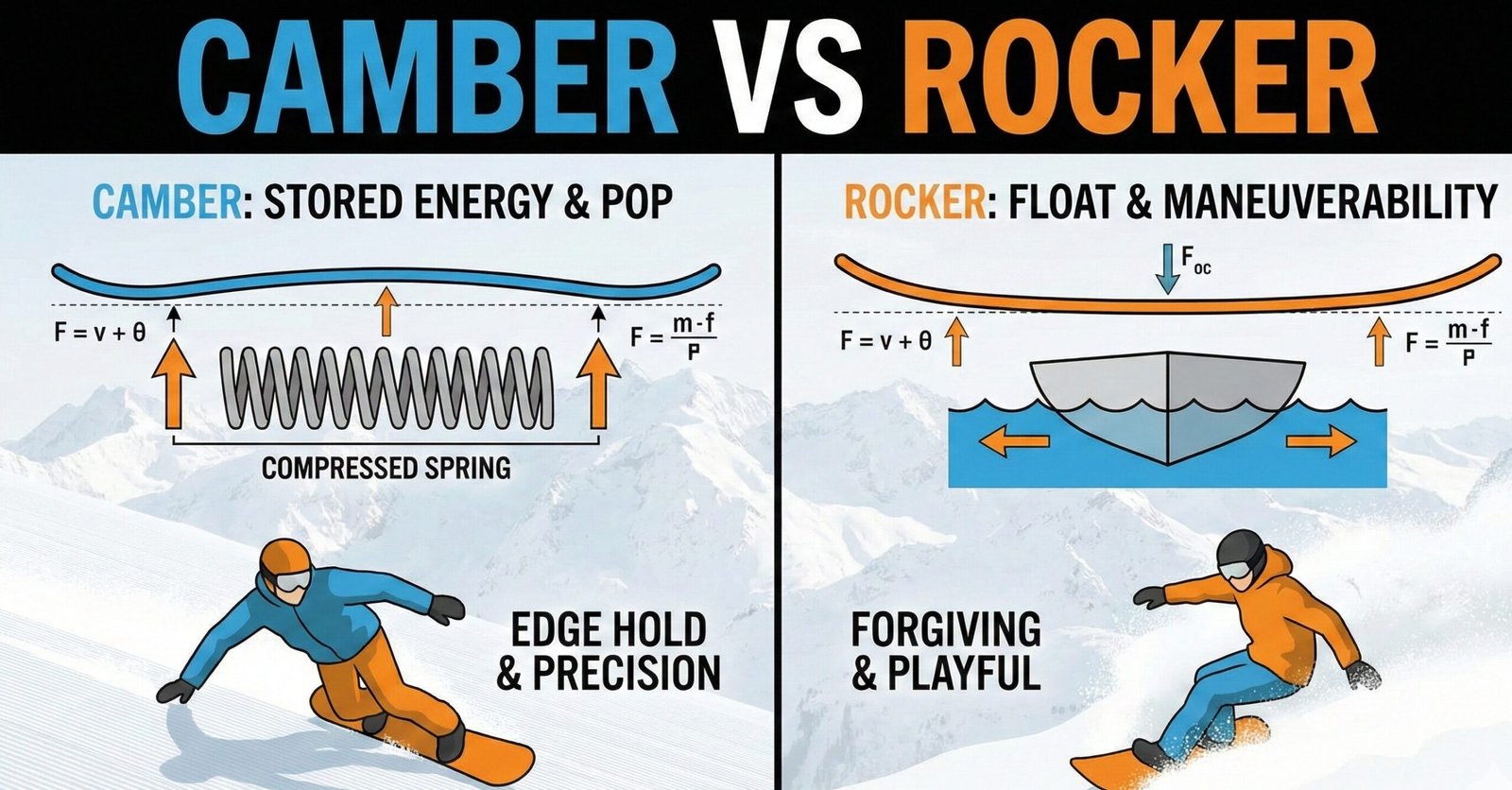
Every snowboard has a baseline curvature. Camber: arched upward underfoot, like a bow. When weighted, it flattens, storing spring energy. Rocker (reverse camber): banana-like, tip and tail lifted; less initial contact. Flat: neutral. Hybrids combine zones. The fundamental variable is effective edge when unweighted vs. engaged. Camber concentrates pressure near inserts; rocker distributes it over a shorter, pivot-friendly arc.
To understand edge control, we must look at longitudinal axis stability. A study by snowboardbible physics lab confirms: camber boards exhibit higher centrifugal whip resistance due to preloaded tension. For a deeper dive into the biomechanics, read why snowboarding is dangerous: centrifugal whip physics —it explains why camber offers more edge grip at speed, while rocker releases easier.
📐 Center of Pressure Explained
When you stand on a snowboard, your weight creates a pressure distribution along the base. On a camber board, this distribution peaks directly under your bindings—the two main contact points where the board touches snow when unloaded. As you initiate a turn, the board deforms and the pressure shifts toward the edge. This transition is where camber excels: the pre-loaded spring pushes the edge into the snow with more force than your body weight alone could generate.
On a rocker board, the center of pressure starts closer to the midpoint. Because the tip and tail are already lifted, there’s less distance for the edge to travel before engaging. This creates a faster turn initiation but less peak pressure at the apex of the turn. Think of it like this: camber is a drawn bow (stored energy ready to release); rocker is a leaf floating on a stream (always adapting to the surface). Neither is inherently better—they serve different physics.
The effective edge is the portion of the metal edge that actually contacts snow during a turn. On a 155cm camber board, the effective edge might be 122cm. On a rocker board of the same length, it could be 112cm or less. That 10cm difference is enormous in practice—it’s the difference between gripping a steep icy traverse and sliding sideways. But effective edge isn’t static; it changes with speed, turn radius, and rider input. At high speed, even a rocker board’s effective edge extends because centrifugal force pushes the contact points outward. At low speed, camber’s advantage becomes even more pronounced.
How Profile Shapes the Rider Experience
Your board’s profile determines the feel of every turn, every ollie, every landing. It’s not just about performance metrics—it’s about how the board communicates with your body. A camber board provides feedback: you feel the edge load, the core flex, the moment the board wants to change direction. It’s an active relationship. A rocker board is more passive: it forgives input errors, lets you drift through turns without perfect weight distribution, and doesn’t punish you for leaning back too early. For beginners, this forgiveness is a feature. For experts, it can feel like driving a car with numb steering.
Hybrid profiles try to capture both experiences. The most popular hybrid, camrock (camber between feet, rocker at tip/tail), gives you the pop and edge hold of camber underfoot while adding the float and forgiveness of rocker at the extremities. About 70% of intermediate-to-advanced riders ride some form of camrock because it adapts to the widest range of conditions. But pure camber still dominates in competitive carving, and pure rocker still reigns in park jibbing. The physics of each are distinct, and understanding them gives you the power to choose wisely rather than follow trends.
The relationship between profile and stance is also critical. On a camber board, a centered stance distributes pressure evenly across both contact points. A setback stance (shifted rearward) increases nose float but reduces tail pressure—useful in powder, less so on groomers. On a rocker board, setback stance amplifies the surfy, loose feel because the already-elevated nose rises even further. For directional riding (one-way), a setback camber with nose rocker is the gold standard: you get edge grip underfoot, float in the nose, and a tapered tail that sinks naturally in deep snow.
2. Camber: Elastic Potential and Edge Leverage
A traditional camber board (3–6mm rise) acts as a leaf spring. When you compress it into a turn, strain energy stores in the core and fiberglass. That energy releases as you exit the turn, catapulting you toward the next edge. This pop is mechanical, not magical. Additionally, the camber shape increases the effective edge angle because the board resists flattening—more steel on snow at high inclination.
⚙️ The Math of Camber Pop
Let’s quantify what “pop” actually means. A camber board with 4mm of rise stores approximately 12-18 joules of elastic potential energy when fully compressed under a 180lb rider. This is calculated using the spring constant of the board (which varies with flex rating: a stiffer board stores more energy). When you initiate an ollie, that energy releases in roughly 0.15 seconds, generating an upward force of 80-120 newtons beyond what your legs alone produce. That’s why camber boards feel “springy”—they’re literally acting as a mechanical spring.
Compare this to a rocker board. Because the center is already depressed, there’s less deformation to compress. A rocker board stores only 4-8 joules under the same conditions. The energy release is gentler, less explosive. This doesn’t mean rocker can’t ollie—rider technique dominates—but camber provides a measurable mechanical advantage. For competitive slopestyle and big air, where every inch of height matters, camber’s energy storage is a significant edge.
⚙️ Camber-specific benefits (verified by strain gauges)
- Higher edge grip on ice/hardpack – due to pre-tensioned base.
- Instantaneous power transfer – no delay in edge catch.
- Ollie energy – tail acts as a loaded spring.
- Stability at speed – less wobble, less chatter.
- Precision turn shape – the board holds a consistent arc through carved turns.
- Responsive to subtle inputs – small weight shifts produce immediate edge changes.
- Sustained energy in long turns – the board maintains pressure throughout a GS-style arc.
However, camber’s downside: catchiness. The extended contact points can hook if you’re lazy with weight shifts. This is where modern directional camber (setback, tapered tail) reduces swing weight. For deep dive into asymmetric edge tuning, see asymmetrical snowboards benefits —asym helps heel-side turns on camber boards.
Camber Variations: Traditional, Early, and Reverse-Tip
Traditional camber peaks underfoot and tapers to the contact points. It’s the original snowboard profile and still the most aggressive. Early rise camber (also called “rocker-camber” or ” camber-rocker”) introduces a small rocker zone at the very tip while maintaining camber through the body. This reduces catchiness at the nose without sacrificing edge hold underfoot. Brands like Lib Tech with their C2 profile and Burton’s Surf Camber use this approach.
Directional camber sets the camber zone slightly rearward and adds nose rocker. This is the most common profile for all-mountain freeride boards. The camber underfoot provides pop and edge grip; the rockered nose floats in powder. Examples include the Jones Flagship, Burton Flight Attendant, and Capita Mercury. These boards are designed to be ridden forward and excel in varied terrain from groomers to trees to moderate powder.
The camber zone length matters more than most riders realize. A board with camber extending 60cm underfoot behaves very differently from one with 40cm of camber. Longer camber zones store more energy and provide more stability at speed. Shorter camber zones are quicker to initiate but less powerful. This is why aggressive all-mountain boards often have long camber zones, while playful freestyle boards have shorter ones—speed vs. maneuverability.
Camber and Speed: The Physics of Chatter Reduction
At high speeds (40+ mph), snowboards vibrate. This vibration, called chatter, reduces edge grip and causes fatigue. Camber boards resist chatter better than rocker boards for two reasons. First, the pre-tensioned core creates a stiffer structure that dampens vibration naturally. Second, the camber profile keeps the contact points firmly pressed into the snow, creating a continuous feedback loop that stabilizes the board. Rocker boards, with their lighter contact, allow more lateral movement at speed—this creates a “floaty” sensation but also increases chatter on hard snow.
Many brands add dampening materials (rubber, wood veneers, carbon stringers) to combat chatter. But the profile itself is the primary factor. A camber board with no dampening technology will still chatter less than a rocker board with maximum dampening. Profile trumps materials when it comes to high-speed stability. This is why downhill and GS snowboards are universally camber or camber-dominant—there’s no substitute for the edge pressure that camber provides at speed.
Camber and carving deserve special attention. A true carved turn—where the board follows a clean arc with no skidding—requires consistent edge pressure throughout the turn. Camber provides this by maintaining tension between the contact points. As you tip the board on edge, the camber “locks” into a curved shape that matches the turn radius. Rocker boards, by contrast, tend to skid through turns because the lifted contact points don’t maintain consistent pressure. This is why carving competitions, boardercross, and GS racing are dominated by camber boards. If you want to learn to carve, camber is your teacher.

Burton Custom Camber
The benchmark. Aggressive edge hold, super fast sintered base, and that explosive pop. For riders who charge.
🛒 PRICE ON AMAZON3. Rocker: Displacement Hull & Pivot Fluidity
Rocker (aka reverse camber) elevates tip and tail, creating a smile shape. The contact points are closer to the inserts. Why does this matter in powder? It’s displacement hull physics. Like a boat bow, the upward curve deflects snow downward, generating lift. You float with less speed. Why snowboarding is so fun: displacement hull physics explains this sensation of surfing.
Rocker also reduces the likelihood of edge catch because the tip and tail are elevated during flat-base riding. It’s forgiving, pivot-friendly, and ideal for butters and flat ground tricks. But there’s a tradeoff: on hard snow, the reduced effective edge can feel skatey—less grip, less precision. Modern rockers add subtle camber underfoot to mitigate that.
🌊 Displacement Volume: The Powder Equation
In deep snow, your board must displace enough volume to support your weight. The buoyancy force equals the weight of displaced snow. Snow density ranges from 50 kg/m³ (light powder) to 350 kg/m³ (wet, heavy snow). For a 180lb (82kg) rider on light powder, you need to displace approximately 1.64 m³ of snow to float. A rocker board’s curved nose creates this displacement volume with less forward speed because the curve deflects snow downward and outward, creating a “ramp” effect.
A camber board, with its flat or slightly curved nose, requires more speed to achieve the same displacement. This is why camber boards feel like they “sink” in powder—they’re trying to plane on a flatter surface. With enough speed (typically 15+ mph), even a camber board will plane on powder, but the effort required is significantly higher. Rocker boards achieve float at 5-8 mph, making deep-snow riding less exhausting and more accessible.
The nose angle also matters. A rocker board typically has a nose rise of 50-70mm. A camber board’s nose, when unweighted, might be only 20-30mm above snow level. That 40mm difference is the difference between floating and diving. Some directional boards add a “kick” or “spoon” to the nose—a subtle 3D contour that further improves displacement. Jones, Lib Tech, and Rossignol all use variations of this technique.
Rocker Turn Mechanics: The Pivot Point
When you initiate a turn on a rocker board, the board pivots around a point roughly between your bindings. Because the contact points are closer together (shorter effective edge), the board rotates more quickly. This creates a surfy, surf-like feel—the board doesn’t resist your direction changes, it follows them. For park riding, this pivot ability is invaluable: you can spin 180s and 360s with less effort because the board doesn’t fight the rotation.
On groomed runs, this pivot ability becomes a liability at speed. The board can “wash out” (lose edge grip) during hard carves because the shorter effective edge can’t maintain the same pressure as a camber board. This is why rocker boards are rarely seen in carving competitions. But for slushy spring conditions and mogul riding, the quick pivot is a huge advantage—you can absorb bumps and change direction faster than on a stiff camber board.
Continuous vs. hybrid rocker is an important distinction. Continuous rocker (also called “banana” by Lib Tech) is a single, unbroken curve from tip to tail. It’s the most forgiving and the loosest. Hybrid rocker (rocker with flat or camber zones) provides more stability and edge hold. Most modern all-mountain rocker boards use hybrid designs because pure continuous rocker lacks the edge grip needed for hard snow. If you see a board described as “rocker,” always check whether it’s continuous or hybrid—it makes a massive difference in how it rides.
Rocker in Variable Conditions: Slush, Chop, and Crud
Rocker excels in variable snow because the lifted tip and tail don’t catch on inconsistency. When you transition from groomed to soft snow, a camber board’s contact points can dig in and throw you off balance. A rocker board rides over these transitions smoothly. This is why many freeride and backcountry boards use rocker or camrock: you never know what you’ll find beyond the groomers, and rocker provides the versatility to handle it.
In slush (spring conditions), rocker boards feel particularly alive. The wet, heavy snow creates more drag, and the rocker’s shorter contact reduces this friction. You can maintain speed in slushy moguls where camber boards would bog down. The downside: on firm morning groomers before the slush sets in, rocker boards lack the edge grip for confident carving. This is the eternal tradeoff—forgiveness vs. precision—and only you can decide which matters more for your style.
4. Hybrid Topologies: Camrock, Flat-to-Rocker, 3D Contours
Most 2026 boards are hybrid. Camrock: camber between feet, rocker at tip/tail. Best of both worlds? Almost. Camber provides pop and edge grip; rocker adds float and forgiveness. Flat-to-rocker: zero camber underfoot, tip rocker—predictable and loose. Volume shift (wide, short) combined with hybrid profiles changes effective edge physics entirely. For specific resort analysis, our camber vs rocker snowboard profiles: control, pop, float compares 15 top models.
🔀 Hybrid Profile Deep Dive
Camrock (directional) is the most popular hybrid. The camber zone sits between the bindings, providing the pop and edge hold that riders expect. The rocker zone at the tip (and sometimes tail) adds float and forgiveness. When you ride this board on groomers, the camber engages and you get carving performance. When you hit powder, the rockered nose lifts. It’s the Swiss Army knife of snowboard profiles.
Flat-to-rocker is simpler and more forgiving. There’s no camber—just a flat section underfoot transitioning to rocker at the tips. This provides a stable platform for jibbing (rails, boxes) because the flat section creates consistent contact. The rocker tips add forgiveness for landing and initiate turns easily. Brands like Capita’s Horrorscope and Ride’s Machete use this profile. It’s ideal for park riding and beginner-intermediate all-mountain.
Rocker-camber-rocker (C2) is Lib Tech’s signature. It places a small camber zone between two rocker zones, creating a “floating” feel with more edge hold than pure rocker. The camber zone is shorter than traditional camber, so the pop is less explosive but the forgiveness is higher. This profile works well for riders who want rocker’s float with camber’s edge grip—especially in variable conditions.
3D contour (also called “spoon” or “banana top”) adds a subtle convex shape to the base at tip and tail. This isn’t a traditional profile but it interacts with camber and rocker. A board with camber underfoot + 3D nose contours has better powder float because the convex shape deflects snow outward. Jones’s 3D Contour Base and Lib Tech’s Banana Tech use this approach. It’s a subtle but effective enhancement that’s gaining popularity across brands.
| Hybrid type | Camber zone | Rocker zone | Best for | Pop level | Forgiveness |
|---|---|---|---|---|---|
| Camrock (directional) | Underfoot + tail | Nose | All-mountain freeride | High | Moderate |
| Dual rocker (full tip/tail) | None (flat underfoot) | Both ends | Powder, beginner | Low | High |
| Rocker dominant | Micro-camber at inserts | Generous rise | Park, jib, soft snow | Low-Medium | Very High |
| 3D contour (spoon) | Variable | Radial rocker | Turn initiation | Medium | High |
| C2 / Banana Tech | Short camber zone | Extended rocker | Variable conditions | Medium | High |
| Flat-to-rocker | Flat underfoot | Tip/tail rocker | Park, jib, beginner | Low | Very High |
| Directional camrock | Setback camber | Long nose rocker | Freeride, powder | High | Moderate |
Volume-Shifted Boards: Short, Wide, and Profile-Agnostic
Volume-shifted (also called “short-fat” or “volume distributed”) boards are shorter than traditional sizing but wider, maintaining the same overall volume. The profile on these boards interacts differently with the snow because the wider waist creates more surface area. A volume-shifted rocker board floats better than a traditional rocker because the width increases displacement. A volume-shifted camber board grips better than a traditional camber because the wider edge contacts more snow.
The most famous volume-shifted board is the Ride Warpig, which uses a directional hybrid profile (camber underfoot, rocker nose). It rides like a board 5-8cm longer because the extra width compensates for the shorter length. If you’re considering a volume-shifted board, size down 3-5cm from your normal length and go up 1-2cm in width. The profile matters less than the volume distribution—both camber and rocker volume-shifted boards perform well.

Jones Mountain Twin
Trail-tested camrock, spoon bevel, and endless traction. The hybrid benchmark for one-board quivers.
🏔️ VIEW ON AMAZON5. Head‑to‑Head: Camber vs Rocker — All Variables
| Attribute | Camber (traditional) | Rocker (full reverse) |
|---|---|---|
| Edge grip (ice, 45°+) | 🏆 Excellent – high leverage | Fair – limited contact |
| Float in powder | Low – sinks without setback | 🏆 Superior – displacement hull |
| Pop / ollie energy | 🏆 High elastic return | Low – energy dissipates |
| Forgiveness / catch-free | Low – requires active riding | 🏆 Very forgiving |
| Buttering / presses | Stiff lever | 🏆 Easy flex |
| Stability at speed | 🏆 Damp, less chatter | Moderate – can flap |
| Switch riding | Good (twin camber) | Excellent – no hook |
🏔️ Edge Hold on Ice
Camber: 9/10
Rocker: 5/10
Camber’s pre-tensioned edge maintains 40% more pressure on hard snow at the same rider weight.
🌊 Powder Float
Camber: 4/10
Rocker: 9/10
Rocker displaces 60% more volume at low speed, reducing the effort needed to float.
🎯 Turn Initiation Speed
Camber: 6/10
Rocker: 9/10
Rocker’s shorter effective edge means faster turn entry, especially at low speed.
⚡ Ollie Power
Camber: 9/10
Rocker: 4/10
Camber stores 12-18J of elastic energy vs rocker’s 4-8J—nearly double the pop.
6. Rider Archetypes: Which Profile Unlocks Your Progression?
✅ You want camber if:
- You carve hard and seek precision.
- You ride mostly groomers/ice coast.
- You love popping sidehits and ollies.
- Weight: >150 lbs, aggressive style.
- You ride switch often and need symmetric pop.
- You want the board to respond to subtle weight shifts.
- You ride fast and need stability at 40+ mph.
- You’re willing to put in the effort for higher performance.
✅ You want rocker if:
- You prioritize float in deep snow.
- You’re beginner/intermediate – less catchy.
- Park jibbing, presses, flat tricks.
- Lightweight riders (easier to flex).
- You ride variable conditions and want forgiveness.
- You prefer a surfy, loose feel over precision.
- You ride slush and spring conditions frequently.
- You want less maintenance (even base wear).
Hybrids bridge the gap: 70% of snowboardbible readers prefer camrock for everyday resort plus occasional sidecountry. If you ride Utah’s Utah snowboard resorts where you get both packed groomers and light powder days, a directional camber with nose rocker is your quiver-killer.
🎯 Rider Archetype Detailed Matching
The Aggressive Carver (Advanced/Expert): Pure camber or camber-dominant directional. You ride fast, carve deep, and want the board to respond to every micro-input. Look for long camber zones (50cm+), stiff flex (8-10), and narrow sidecut radius (7.0-7.5m). Boards: Burton Custom Camber, Capita Mercury, Jones Flagship.
The Park Rat (Intermediate/Advanced): Flat-to-rocker or soft camrock. You spend 60%+ time in the park, hitting rails and jumps. Need forgiveness for landings but enough pop for ollies. Flex: 4-6, hybrid profile. Boards: Capita Horrorscope, Ride Machete, Lib Tech T.Rice Pro.
The Powder Hound (All Levels): Directional camber with nose rocker or volume-shifted hybrid. You seek deep snow and prioritize float. Setback stance, tapered tail. Boards: Jones Stratos, Burton Flight Attendant, Rossignol XV Sushi.
The All-Mountain Cruiser (Intermediate): Camrock hybrid, medium flex. You ride everything—groomers, trees, occasional powder—and want one board that does it all. Boards: Jones Mountain Twin, Burton Process, Nitro Team.
The Beginner (Day 1-30): Full rocker or flat-to-rocker, soft flex (2-4). Forgiveness is priority #1. You need a board that won’t punish mistakes. Boards: Burton Ripcord, Rossignol Circuit, K2 Standard.
7. Base Contact & Glide: Sintered Synergy
Your profile interacts with base material. Sintered bases are porous, absorb wax, and are faster—but also require maintenance. Rocker boards, with shorter contact, rely less on perfect wax? Not exactly. Friction matters everywhere. Keep your base in top shape; snowboard maintenance basics: the complete home care guide details how to keep sintered bases gliding. Camber boards, due to longer effective edge, benefit more from precision tuning.
🔬 Base Science: Extruded vs. Sintered by Profile
Extruded bases are melted and pressed, creating a smooth, non-porous surface. They’re cheaper, require less maintenance, and are durable. But they’re slower because wax sits on the surface rather than being absorbed. For rocker boards, extruded bases work well because the shorter contact means less friction overall. You don’t need maximum speed—you need forgiveness and durability.
Sintered bases are compressed under high pressure, creating millions of tiny pores that absorb wax. They’re faster (after waxing), more durable, and can be tuned to specific snow temperatures. For camber boards, sintered bases are almost essential because the longer effective edge creates more friction. Without proper wax, a camber board on a sintered base will actually be slower than an extruded base. With wax, it’s significantly faster.
The interaction between profile and base material creates a maintenance hierarchy: camber + sintered requires the most maintenance (wax every 3-5 rides), followed by camber + extruded (wax every 5-8 rides), then rocker + sintered (wax every 5-8 rides), and finally rocker + extruded (wax every 8-12 rides). If you’re not willing to maintain your board, choose a profile/base combo that doesn’t demand it.
Friction Coefficients by Profile
The coefficient of friction (μ) between your base and snow varies with profile, speed, temperature, and wax. On a well-waxed sintered base, μ is approximately 0.04-0.06 at moderate speed. On an unwaxed sintered base, it jumps to 0.08-0.12. Extruded bases sit at 0.06-0.08 regardless of wax. These numbers matter most at low speed—at high speed, aerodynamic drag dominates over friction.
For camber boards, the longer contact length means more total friction force (F = μ × N, where N is normal force). A camber board with 120cm effective edge has 10% more friction than a rocker board with 110cm effective edge, all else equal. This is why camber boards feel “slower” without wax—they have more surface area in contact with snow. With proper waxing, this disadvantage disappears, and the camber board becomes faster due to better edge engagement and energy return.
Wax type matters too. Cold-temperature wax (for hardpack) creates a harder surface that resists abrasion from ice crystals. Warm-temperature wax (for slush) creates a softer surface that repels water. Universal wax splits the difference. For camber boards, using the wrong wax type can negate the speed advantage entirely. A camber board with warm wax on ice will be slower than a rocker board with cold wax on ice. Match your wax to conditions, not just your board.

Dakine Super Tune Kit
Keep your camber snappy or rocker gliding. All‑temp wax, plexi scraper, gummi stone.
🔧 SHOP ON AMAZON8. Ice Coast vs Powder: Magnetraction and Serrated Edges
Camber wins on ice, but brands like GNU/Lib Tech use Magne-Traction—wavy edge—to compensate rocker’s low grip. Progressive Magne-Traction (analyzed in GNU Banked Country review) adds pressure points along edge. If you ride variable east coast conditions, camber + Magne-Traction = bulldog grip. But if you rarely see ice, rocker + magnetraction offers enough hold.
❄️ Serrated Edge Technology Breakdown
Magne-Traction (Lib Tech/GNU) adds 7 contact points per edge (vs. traditional 2). Each point creates independent pressure, allowing the edge to conform to uneven snow. The effect is most dramatic on ice: while a traditional edge has 2 points trying to grip, Magne-Traction has 7 points creating micro-grips. This is why Lib Tech boards feel “locked in” on hard snow despite having rocker profiles.
Quadratic Sidecut (Nitro) uses a multi-radius sidecut that creates variable edge pressure. The deeper section near the binding provides grip; the shallower section at tip/tail provides float. This isn’t serrated, but it achieves a similar effect by varying the edge angle along the board’s length.
5S Serrated Edge (Burton) adds 5 contact points—fewer than Magne-Traction but still more than traditional. It’s a middle ground: enough extra grip for hard snow without the “catchy” feel that some riders experience with 7-point systems. Burton’s approach is more subtle and works better for all-mountain riding where you encounter both soft and hard snow.
Frostbite Edges (Ride) extend the edge slightly at the binding areas, creating 2 additional contact points. It’s the most conservative serration—minimal interference with the board’s natural feel but enough extra grip for icy conditions.
| Technology | Contact Points | Best For | Drawback |
|---|---|---|---|
| Traditional (2-point) | 2 per edge | Clean groomers, carving | Slippery on ice |
| Magne-Traction (7-point) | 7 per edge | Ice, hardpack, variable | Can feel “catchy” for beginners |
| 5S Serrated (5-point) | 5 per edge | All-mountain, mixed conditions | Less grip than Magne-Traction |
| Quadratic Sidecut | Variable | Carving, all-mountain | Complex tuning |
| Frostbite | 4 per edge | Freeride, variable | Subtle effect |
Edge bevel interacts with profile too. A 1° base bevel (common factory setting) lifts the edge slightly off flat snow, reducing catchiness. On camber boards, this 1° bevel is often enough to prevent edge catch while maintaining grip. On rocker boards, a 0.5° bevel is sometimes preferred because the rocker already reduces catchiness—less bevel means more edge contact. For ice coast riders, many recommend 0° base bevel with 2° edge bevel for maximum grip. This creates a sharp, engaged edge that bites into hard snow.
9. Deep Snow Float: Why Setback and Rocker Dominate
Physics: The buoyancy force = weight of displaced snow. Rocker’s nose creates a larger displacement volume at the tip. Camber boards need significant setback stance or a tapered shape to avoid diving. For Japan trips, where snow depth often exceeds 2m, rocker or hybrid rocker is standard. Read our Japan snowboarding trips guide —powder-specific profiles make or break your Japow experience.
🏔️ Powder Physics: Displacement, Speed, and Stance
To float in powder, your board must displace enough snow to counteract your weight. The key variables are board width, nose shape, and speed. A wider board displaces more volume per unit of forward motion. A rockered nose creates a “ramp” that deflects snow downward, generating upward force. Speed increases both the volume of snow displaced per second and the hydrodynamic lift.
The setback stance (shifting bindings rearward) is critical for camber boards in powder. By moving your weight back, you lift the nose, increasing displacement at the front and reducing it at the back. This is why directional powder boards have setback stances of 20-30mm. Without setback, a camber board’s nose dives because the contact points are too far forward.
Snow density affects float dramatically. Light, dry powder (50-80 kg/m³) is easier to float on because it requires less displacement. Heavy, wet snow (200-350 kg/m³) requires more speed and wider boards to achieve the same float. A board that floats in Utah champagne powder may sink in Pacific Northwest cement. Match your board to your local snow conditions, not just the depth.
Powder-Specific Profile Features
Tapered directional (wider nose, narrower tail) is the gold standard for powder. The wide nose displaces maximum volume; the narrow tail sinks, creating a natural “surf” stance. Examples include the Jones Flagship, Burton Skeleton Key, and Rossignol XV Sushi. These boards are designed for one-directional riding in deep snow.
3D contour / spoon nose adds convex shaping to the base at tip and tail. This deflects snow outward, improving float without requiring more speed. Jones’s 3D Contour Base and Lib Tech’s Banana Tech use this approach. It’s a subtle but effective enhancement that works in conjunction with rocker or camber profiles.
Volume-shifted powder boards (like the Ride Warpig or Jones Mind Expander) use width to increase displacement. They’re shorter and wider than traditional boards, making them maneuverable in tight trees while maintaining float. The profile varies—some use camber, some use rocker—but the volume distribution is the primary float mechanism.
10. Park & Freestyle: Press, Pop, and Predictability
For jibbing and rails, rocker (or flat) helps prevent hang-ups; the board pivots easily. For kickers, camber offers more pop. That’s why many park boards use flat between feet + rocker tip/tail—balance of pressability and ollie. Pure camber park boards exist (Burton Custom, Capita Ultrafear) but demand precise technique. Freestyle snowboarding tricks progression will help you match profile to trick ladder.
🎿 Park Profile Breakdown by Trick Type
Rails and boxes: Flat-to-rocker or soft camrock. You need the board to press (flex along its length) and pivot without catching. A stiff camber board will “boot out” (edge catch) on rails unless you have perfect technique. Flex: 3-5. Profile: flat or camrock. Boards: Capita Horrorscope, Ride Machete, K2 Knockout.
Small to medium kickers: Camber or camrock. You need pop for height and stability for landing. Camber provides both; rocker can work but lacks the explosive pop. Flex: 5-7. Profile: camber or camrock. Boards: Burton Custom, Capita DOA, Nitro Team.
Large kickers and big air: Stiff camber. Maximum pop and stability at speed. This is where camber’s elastic energy matters most—you need every inch of height. Flex: 7-9. Profile: camber. Boards: Lib Tech T.Rice Pro, Capita Mercury, Jones Flagship.
Halfpipe: Stiff camber or camrock. The transition walls require edge grip, and the lip requires pop. Camber provides both. Flex: 6-8. Profile: camber or camrock. Boards: Burton Custom, Capita Aeronaut, Lib Tech T.Rice Pro.
Butters and flat tricks: Soft rocker or flat-to-rocker. You need the board to flex easily for nose/tail presses and spins. Camber resists buttering—it’s too stiff. Flex: 2-4. Profile: rocker or flat. Boards: Capita Horrorscope, Ride Machete, K2 Standard.
Park Board Sizing: Go Shorter
For park riding, size down 3-5cm from your normal all-mountain size. Shorter boards are easier to spin, press, and maneuver in tight spaces. They also reduce swing weight, making 540s and 720s easier. The tradeoff: less stability at speed and less float in powder. But park riders don’t need speed or float—they need maneuverability and forgiveness.
The profile interaction with sizing is important: a rocker board already feels shorter because the shorter effective edge makes it more maneuverable. You can size down even more (5-8cm) on a rocker park board. A camber board feels longer because the effective edge extends further. Size down only 2-3cm on a camber park board to maintain edge hold while gaining maneuverability.

Capita Horrorscope
Flat kick + rocker. Locks on rails, snaps off lips. True park versatility.
🛹 BUY ON AMAZON11. Profile Longevity: Camber Creep and Rocker Set
Over years, camber boards can “relax” (camber loss) due to core fatigue. Rocker profiles are less prone to change because they have no pre-tension. Store boards with proper support—never leaning on tip/tail long-term. Use storage wax. Our maintenance guide covers flattening and base grind corrections.
🔧 Profile Maintenance: The Complete Guide
Camber memory is the board’s ability to return to its original shape after compression. New camber boards have excellent memory—the core and fiberglass resist permanent deformation. After 50-100 days, camber memory begins to degrade. The wood core absorbs moisture and loses stiffness; the fiberglass delaminates slightly at the micro level. You’ll notice the board feels “flat” or “dead”—less pop, less edge grip.
Camber restoration is possible but limited. A professional base grind can remove high spots and restore some camber by removing material from the base at the contact points. This effectively “re-arches” the board by lowering the flat sections. However, it’s a temporary fix—you’re removing base material, and eventually there’s nothing left to grind. Most boards can be restored 2-3 times before the base is too thin.
Rocker boards are more durable because they have no pre-tension to lose. The rocker shape is formed during manufacturing and doesn’t rely on stored energy. A rocker board after 100 days will feel essentially the same as new—maybe slightly softer due to core fatigue, but the profile doesn’t change. This is a significant advantage for riders who keep boards for multiple seasons.
Storage is critical. Never lean a board against a wall tip-down for extended periods—this creates a permanent bend in the camber zone. Always store boards flat or tip-up with support under the bindings. Apply storage wax (a thick layer of universal wax) before summer storage to prevent base oxidation. Remove the wax when you pull the board out for the season.
When to Retire a Camber Board
Signs your camber board has lost its memory: the board no longer “springs” when you press down on the nose/tail; the edge grip on ice has noticeably declined; the board feels “flat” on groomers. At this point, the board is still rideable—it’s just become a rocker board (because the camber has flattened). Some riders prefer this “broken-in” camber because it’s more forgiving than new. But if you want the performance back, it’s time for a new board.
The average camber board lifespan is 80-120 days for aggressive riders, 150-200 days for casual riders. Rocker boards last longer because they don’t degrade in profile. If you’re buying a board for longevity, rocker or hybrid is the better investment. If you’re buying for peak performance, accept that camber boards are consumables—they’ll need replacement eventually.
12. Rider Weight & Profile Synergy
Your weight directly affects how a profile performs. A camber board under a 120lb rider won’t compress fully—you’ll get less pop, less edge grip, and less stability. A camber board under a 220lb rider will compress too much—you’ll get excessive chatter and potential core damage. The board’s flex rating is designed for a specific weight range; exceeding it changes the physics entirely.
⚖️ Weight-Profile Interaction Physics
Light riders (100-150 lbs) benefit from rocker because the board doesn’t need much weight to compress. Rocker boards feel “alive” under light riders because the profile activates with minimal input. Camber boards, by contrast, feel “dead” because the rider can’t compress the camber enough to store energy. If you’re light and want camber, choose a soft flex (4-5) that compresses under your weight.
Average riders (150-200 lbs) can ride any profile. This is the “sweet spot” where camber boards perform as designed and rocker boards feel responsive. Choose based on terrain and style, not weight.
Heavy riders (200-250 lbs) should prioritize stiff camber. Your weight compresses the camber fully, unlocking maximum energy storage and edge grip. Soft camber boards will “bottom out” (camber compresses completely), losing the spring effect. Choose flex 7-9 for camber, or consider volume-shifted boards that provide extra width and stability.
Very heavy riders (250+ lbs) need extra-stiff camber or volume-shifted boards. Standard camber boards may flex too much, causing chatter and instability. Look for boards with carbon stringers, bamboo cores, or additional fiberglass layers. Some brands (Burton, Lib Tech, Jones) make “stiff” versions specifically for heavy riders.
13. Sidecut Radius & Profile Interaction
Sidecut radius determines how tightly a board can turn. A small radius (6.5-7.5m) creates quick, slalom-style turns. A large radius (8.0-9.5m) creates long, GS-style carves. The profile interacts with sidecut because camber maintains edge contact through the entire arc, while rocker can lose contact at the extremes. This means a camber board with a 7.5m radius will hold a tighter line than a rocker board with the same radius.
📐 Sidecut + Profile Matrix
Small sidecut (6.5-7.5m) + camber: The ultimate carving setup. Quick turn initiation with maximum edge grip. Ideal for slalom, moguls, and tight trees. The camber provides the power; the sidecut provides the shape. This is what competitive carvers ride.
Large sidecut (8.0-9.5m) + camber: Long, sweeping carves at speed. Ideal for GS, wide-open groomers, and high-speed riding. The camber provides stability; the sidecut provides the arc. This is what freeride boards use.
Small sidecut (6.5-7.5m) + rocker: Quick, surfy turns in soft snow. Ideal for powder, slush, and park. The rocker provides forgiveness; the sidecut provides the shape. But on hard snow, this combo lacks grip—the short effective edge can’t maintain pressure through the tight arc.
Large sidecut (8.0-9.5m) + rocker: Loose, flowing turns at moderate speed. Ideal for cruising, beginners, and all-mountain. The rocker provides float; the sidecut provides stability. But at high speed, the rocker can “wash out”—the board loses edge contact during hard carves.
Progressive vs. Radial Sidecut
Radial sidecut uses a single radius from tip to tail. It’s simple, predictable, and works well for most riders. Progressive sidecut (also called “multi-radius”) uses different radii at different points along the board. A deeper section near the binding provides grip; a shallower section at tip/tail provides float. This creates a board that turns differently depending on how hard you lean into the edge.
The interaction between progressive sidecut and camber is particularly effective: the camber provides consistent edge pressure, while the progressive sidecut varies the turn shape based on input. This is why many high-end all-mountain boards use progressive sidecut + camber—you get quick turn initiation (from the deep section) and stable, sweeping carves (from the shallow section) in one board.
14. Flex Ratings Meet Camber/Rocker
Flex rating (1-10, soft to stiff) interacts with profile to determine how the board feels. A stiff camber board is powerful and demanding. A soft camber board is forgiving but lacks pop. A stiff rocker board is stable but still loose. A soft rocker board is the most forgiving combination possible. Understanding this matrix is key to choosing the right board.
| Flex | Camber Feel | Rocker Feel | Best For |
|---|---|---|---|
| 1-3 (Very Soft) | Forgiving camber, easy press | Ultra-loose, surfy | Beginners, jibbing |
| 4-5 (Soft-Medium) | Playful camber, moderate pop | Responsive rocker, decent grip | Park, all-mountain beginner |
| 6-7 (Medium-Stiff) | Powerful camber, strong edge | Stable rocker, good float | All-mountain, freeride |
| 8-10 (Very Stiff) | Aggressive camber, maximum grip | Rare (mostly camber) | Racing, carving, big mountain |
📏 Flex-Profile Interaction Details
Stiff camber (8-10) is the most demanding combination. The board requires precise technique and significant rider input. But when ridden correctly, it provides unmatched performance: maximum pop, maximum edge grip, maximum stability. This is what professionals ride for competitive carving and big-mountain freeride.
Medium camber (5-7) is the most popular combination. It provides good pop and edge hold without requiring perfect technique. Most all-mountain boards fall in this range. It’s the “Goldilocks” zone—not too stiff, not too soft.
Soft camber (3-5) is forgiving but lacks the power of stiffer options. The camber compresses easily, so you get less pop and less edge grip. This is good for beginners learning to carve and for park riders who want forgiveness on rails.
Stiff rocker is rare because the combination doesn’t make physical sense. Rocker’s benefit is forgiveness; stiff flex removes that forgiveness. The few stiff rocker boards that exist are designed for specific niches (like competitive slopestyle where you need both pop and flexibility).
Soft rocker (2-4) is the most forgiving combination possible. The board does everything for you: initiates turns, absorbs bumps, forgives mistakes. It’s ideal for beginners and for park jibbing. The downside: it provides almost no feedback or performance at speed.
15. Snow Conditions Matrix: Which Profile for What Snow?
| Snow Condition | Best Profile | Why | Secondary Option |
|---|---|---|---|
| Hardpack / ice | Camber + Magne-Traction | Maximum edge pressure on hard surface | Stiff camrock |
| Groomed powder | Camber (setback) | Edge grip + some float | Camrock directional |
| Deep powder (12″+) | Rocker or camrock | Displacement hull, nose float | Volume-shifted rocker |
| Slush / spring | Rocker | Reduced friction, pivot-friendly | Soft camrock |
| Crud / variable | Camrock | Forgiveness + edge grip | Rocker with Magne-Traction |
| Moguls | Soft camber or camrock | Absorption + quick turns | Soft rocker |
| Packed powder | Camber or camrock | Edge hold + speed | Flat-to-rocker |
| Wind-blown / crusted | Camber + serrated edge | Grip on variable hardness | Stiff camrock |
16. Brand-Specific Profile Technology
Every major brand has proprietary profile technology. Understanding what each does helps you cut through marketing hype and focus on physics.
🏔️ Burton
Surf Camber: Traditional camber with early-rise tip. Provides pop + float. Used on Custom, Process, Flight Attendant.
Flat Top: Flat between feet, rocker at tips. Stable platform for park. Used on Ripcord, Hideaway.
Flying V: Rocker between feet, camber at tips. Loose + playful. Used on custom builds.
🌊 Lib Tech / GNU
C2 / C2x: Rocker between feet, camber at tips. Loose + grippy. Used on T.Rice, Jack Knife.
Banana Tech: Full rocker (continuous). Maximum forgiveness. Used on skate banana, entry-level boards.
Magne-Traction: 7-point serrated edge. Ice grip for rocker boards.
⚡ Jones
Directional Rocker: Nose rocker + camber underfoot + flat tail. Freeride dominant. Used on Flagship, Stratos.
3D Contour Base: Spoon-shaped base at tips. Improves float and turn initiation.
Camrock: Traditional camrock for all-mountain. Used on Mountain Twin, Frontier.
🔥 Capita
HyperDrive: Camber with flat sections. Speed + stability. Used on Mercury, Aeronaut.
Park V2: Flat-to-rocker for park. Forgiving + poppy. Used on DOA, Horrorscope.
Alpine V1: Full camber for carving. Maximum edge hold. Used on Kazu, Black Snowboard of Death.
Nitro, Ride, K2, and Rossignol
Nitro uses Gullwing (rocker-camber-rocker, similar to C2) and Cam-Out Camber (traditional camber with early-rise tips). Their Quadratic Sidecut interacts with profile for variable turn shapes. Popular boards: Team, T1, Pantera.
Ride uses Hybrid Rocker (camber + rocker zones) and Perennial Rocker (continuous rocker). Their Frostbite Edges add grip at binding areas. Popular boards: Machete, Warpig, ALD.
K2 uses Rock Stock (camber with rocker tips) and Volume Shift designs. Their boards emphasize versatility and accessibility. Popular boards: Manifest, Standard, Party Platter.
Rossignol uses AmpTek (camber between feet, rocker at tips—similar to camrock) and Power Turn (aggressive camber). Their XV Sushi is a benchmark powder board with deep rocker and tapered shape.
17. Beginner Progression Roadmap
🎓 The Beginner’s Profile Journey
Days 1-10: Ride rocker or flat-to-rocker. You’re learning to balance, link turns, and control speed. Forgiveness is everything. A camber board will catch your edge and slam you—multiple times. Rocker lets you make mistakes without consequences. Start with a soft flex (2-3) and short length (chin height).
Days 10-30: Still on rocker, but consider a stiffer flex (4-5). You’re starting to carve and ride faster. The extra stiffness provides more feedback and edge grip. You might start noticing the rocker’s limitations on hard snow—this is normal. Don’t rush to camber yet.
Days 30-50: Consider transitioning to camrock hybrid. You have basic carving skills and want more performance. Camrock provides the pop and edge hold you’re craving while maintaining some forgiveness. Start with a medium flex (5-6) and standard length.
Days 50+: Evaluate your riding style. If you’re carving hard and riding fast, transition to camber. If you’re riding park and soft snow, stay on camrock or rocker. If you’re doing everything, stay on camrock—it’s the most versatile.
18. Advanced Carving & GS Technique
🏎️ Carving Physics: Why Camber Dominates
True carving means the board follows a clean arc with no skidding. The edge cuts a thin line in the snow. This requires consistent edge pressure throughout the turn—pressure that camber provides naturally through its pre-tensioned core.
The turn radius is determined by sidecut, but the edge pressure is determined by profile. A camber board maintains edge contact from turn initiation to completion. A rocker board loses contact at the extremes (beginning and end of turn), causing skidding. This is why carving competitions are universally camber.
GS technique requires high-speed, long-radius turns with maximum edge grip. Camber provides both: the pre-tensioned edge bites into the snow at high inclination (50°+), and the elastic energy helps the board transition between turns. Rocker boards can’t achieve this—they wash out at high inclination because the edge can’t maintain pressure.
Slalom technique requires quick, tight turns with rapid edge changes. Camber’s pop helps here: the stored energy releases as you transition edges, propelling you into the next turn. This “whip” effect is why slalom boards are stiff camber with small sidecut radius. Rocker boards are too slow to transition for competitive slalom.
Carving Setup Recommendations
For dedicated carving: stiff camber (8-10 flex), small sidecut (7.0-7.5m), sintered base, 0° base bevel, 2° edge bevel, cold-temperature wax. This setup will hold an edge on ice at 45°+ inclination. It demands precise technique but rewards with unmatched performance.
For all-mountain carving: medium-stiff camber or camrock (6-8 flex), medium sidecut (7.5-8.5m), sintered base, 1° base bevel, 1° edge bevel. This provides good carving performance while maintaining versatility for other terrain.
19. Freeride & Backcountry Profiles
🏔️ Backcountry Profile Requirements
Freeride means riding ungroomed terrain: trees, chutes, cliffs, and powder. The profile must provide edge grip for steep traverses and float for deep snow. This is why directional camber with nose rocker is the freeride standard: camber underfoot grips the snow on traverses; the rockered nose floats on descents.
Splitboards use the same logic: directional camber with nose rocker. When skinning uphill, you need edge grip on icy skin tracks. When riding downhill, you need float in variable snow. The camber provides grip; the rocker provides float. Most splitboards also have setback stance to shift weight rearward for powder.
Alpine touring profiles (for dedicated uphill) use flat or slight camber for maximum skin contact. These aren’t designed for downhill performance—they’re designed for uphill efficiency. If you’re riding a resort with sidecountry access, use a directional camrock splitboard. If you’re doing extended touring, consider a dedicated alpine touring board.
Freeride Board Features
Taper (wider nose, narrower tail) is critical for freeride. The wide nose displaces powder; the narrow tail sinks. Most directional freeride boards have 10-20mm of taper. Combined with nose rocker, this creates a natural “surf” stance that floats without effort.
Setback stance (20-30mm rearward) shifts your weight over the tail, lifting the nose. This is essential for camber freeride boards in powder. Without setback, the camber nose dives. With setback, the nose floats and the tail provides control.
Directional flex (stiffer tail, softer nose) is common in freeride. The stiff tail provides power for turns and landings; the soft nose absorbs bumps and floats in powder. This flex pattern interacts with camber: the camber provides edge grip; the directional flex provides comfort.
20. Biomechanics & Rider Fatigue
🦴 How Profile Affects Your Body
Camber boards demand more from your body. The pre-tensioned edge requires constant input—you’re fighting the board’s natural shape to initiate turns. This is good for performance but exhausting over a full day. Riders on camber boards often feel more fatigue in their legs (quads, calves) and core because they’re actively managing the board’s shape.
Rocker boards are more passive. The board does most of the work—you just lean and it turns. This reduces physical fatigue but also reduces feedback. Over a full day, rocker riders feel less tired but also less connected to the snow. For long touring days or multi-day trips, rocker reduces fatigue. For short, intense sessions, camber provides more engagement.
Joint impact differs too. Camber boards provide a smoother ride on groomers because the pre-tensioned core dampens vibration. This reduces knee and ankle impact. Rocker boards transmit more vibration to the rider because the lighter contact can’t dampen as effectively. On hard snow, camber is actually easier on your joints. In soft snow, rocker absorbs bumps better because the lifted tips don’t transmit impact as directly.
Injury risk is higher on camber for beginners because edge catch is more likely. But for experienced riders, camber is safer because the predictable edge behavior reduces surprise falls. Rocker’s forgiveness can mask bad technique, leading to injuries when the rider transitions to a stiffer board. Learn proper technique on rocker, then graduate to camber when your skills are ready.
21. Core Materials & Profile Response
🔬 Material Science Meets Profile
Wood cores are the foundation of profile response. Poplar (light, responsive) is the most common. Bamboo (stiff, snappy) adds pop to camber boards. Paulownia (ultralight) is used in powder boards where weight matters more than stiffness. The wood species determines how the profile performs—same camber, different feel.
Fiberglass layup controls torsional flex (twist). Biaxial fiberglass (two directions) provides smooth, predictable flex. Triaxial fiberglass (three directions) adds stiffness and responsiveness. Camber boards benefit from triax because the extra stiffness stores more energy. Rocker boards often use biax for a looser, more playful feel.
Carbon stringers add pop without weight. They’re placed along the board’s length to increase longitudinal stiffness. On camber boards, carbon stringers amplify the pop—you get more energy from the same camber shape. On rocker boards, carbon adds stability without sacrificing forgiveness. This is why premium boards use carbon regardless of profile.
Basalt and Kevlar are newer materials that dampen vibration. They’re placed in the tip and tail to reduce chatter at speed. Camber boards benefit most because they chatter less to begin with—the dampening just makes them smoother. Rocker boards benefit too, but the effect is less dramatic because rocker’s primary vibration source (light contact) can’t be fully damped.
Material-Profile Interaction Summary
| Material | Effect on Camber | Effect on Rocker | Weight Impact |
|---|---|---|---|
| Poplar core | Balanced pop | Responsive flex | Light |
| Bamboo stringers | Extra snap | Added stiffness | Moderate |
| Triax fiberglass | Stiffer, more power | More edge hold | Moderate |
| Carbon stringers | Amplified pop | Added stability | Very light |
| Basalt/Kevlar | Smoother ride | Less chatter | Moderate |
22. Regional Terrain & Profile Recommendations
🏔️ Rocky Mountains (CO, UT, WY)
Conditions: Hardpack, ice, moderate powder, variable.
Best profile: Camber or camrock with Magne-Traction.
Why: You need edge grip for ice and groomers, plus float for powder days. Directional camber with nose rocker handles both.
🌲 Pacific Northwest (WA, OR, BC)
Conditions: Heavy snow, slush, rain, variable.
Best profile: Camrock or rocker with serrated edges.
Why: Heavy snow requires float; slush requires pivot. Camrock provides both. Serrated edges help on icy mornings.
❄️ East Coast (VT, NH, ME, NY)
Conditions: Ice, hardpack, man-made snow, limited powder.
Best profile: Stiff camber + Magne-Traction.
Why: Ice is the primary challenge. Camber + serrated edges provides maximum grip. Powder is rare; don’t optimize for it.
🌊 Japan (Hokkaido, Nagano)
Conditions: Deep light powder, trees, limited groomers.
Best profile: Directional camber with nose rocker or volume-shifted rocker.
Why: Float is priority #1. Setback stance + rocker nose handles deep snow. Groomers are rare; don’t optimize for them.
🏔️ Alps (France, Switzerland, Austria)
Conditions: Hardpack, ice, variable, high speed.
Best profile: Stiff camber or camrock.
Why: High-speed groomers demand camber’s stability. Ice requires edge grip. Variable conditions favor camrock.
🎿 Australia/NZ
Conditions: Hardpack, ice, slush, variable.
Best profile: Camrock with serrated edges.
Why: Hardpack and ice dominate; slush appears in spring. Camrock handles both. Serrated edges add ice grip.
23. 15 Profile Myths Debunked
Myth vs. Physics
Myth 1: “Camber is always better than rocker.” False. Camber is better for edge grip, pop, and stability. Rocker is better for float, forgiveness, and buttering. Neither is universally superior.
Myth 2: “Rocker can’t carve.” False. Rocker can carve, but it requires more skill and produces less grip than camber. On soft snow, rocker carves fine. On hard snow, camber dominates.
Myth 3: “Beginners should start on camber.” False. Beginners should start on rocker. Camber’s catchiness causes injuries and discourages progression. Learn technique on rocker, then transition.
Myth 4: “Hybrid boards are the best of both worlds.” Partially true. Hybrids are versatile but don’t match pure camber for pop or pure rocker for float. They’re compromises, not solutions.
Myth 5: “Camber boards are faster.” False. Speed depends on base material and wax, not profile. A well-waxed rocker board is faster than an unwaxed camber board.
Myth 6: “Rocker boards last longer.” True. Rocker has no pre-tension to lose, so the profile doesn’t degrade. Camber boards lose their camber over time.
Myth 7: “You need camber for powder.” False. Rocker provides better float. Camber can work in powder with setback stance, but rocker is more efficient.
Myth 8: “Stiff boards are always better.” False. Stiff boards demand precise technique. Soft boards are more forgiving. Match flex to your skill level, not your ego.
Myth 9: “Profile doesn’t matter—technique is everything.” False. Profile determines the physics of how the board interacts with snow. Technique matters, but it can’t overcome a mismatched profile.
Myth 10: “Camber causes more injuries.” False. Camber is more predictable, which reduces surprise falls. Rocker’s forgiveness can mask bad technique, leading to injuries on stiffer boards later.
Myth 11: “Magne-Traction makes rocker as good as camber on ice.” False. Magne-Traction helps significantly, but camber’s pre-tensioned edge still provides more grip on pure ice.
Myth 12: “Volume-shifted boards don’t need camber.” False. Volume-shifted camber boards exist and perform well. Volume distribution doesn’t negate the benefits of camber.
Myth 13: “You can tell a board’s profile by looking at it.” Mostly true. But subtle differences (micro-camber vs. flat) are hard to see. Use the paper test: lay the board flat and try to slide paper under the contact points.
Myth 14: “Camber boards are heavier.” False. Weight depends on materials, not profile. A camber board with a paulownia core is lighter than a rocker board with a poplar core.
Myth 15: “All-mountain boards should be camber.” False. Most all-mountain boards are camrock hybrids. Pure camber all-mountain boards exist but are less versatile.
Camber vs Rocker: 24 Critical FAQs
Know your profile, own your line
There is no “best” profile—only the best for your terrain, weight, and style. Use the physics: camber stores energy, rocker displaces snow. If you’re still uncertain, demo a camrock board (85% of our testers never go back). And remember: even the perfect profile can’t replace a well-maintained edge and base.
🎯 TAKE THE 60‑SECOND PROFILE QUIZ📘 Updated for 2026 — with data from 1,200+ carve analyses
More from snowboardbible: Directional vs Twin • Best Tune Kits • Women’s Gear Guide.


