

★ Gear Review · 2025/26 Season
Are DC Snowboards Good? An In-Depth 2026 Rider’s Review
You’ve seen the iconic star logo on skate shoes, hoodies, and beanies for decades. But when it comes to the gear that matters most—the board under your feet—a crucial question arises for many riders: Are DC snowboards any good? As someone who has spent over 16 seasons testing, riding, and reviewing hundreds of boards, I’ve had my boots strapped to more than a few DC decks. The short answer is a resounding yes, but with some important caveats. They aren’t just slapping their logo on generic boards; they’re crafting seriously impressive, tech-packed decks—especially if you spend your days lapping the park or seeking all-mountain versatility.
In this 2026 guide, we break down everything you need to know: their history, their unique technology, reviews of their standout models, and how they compare to the competition. For a broader look at how DC stacks up against the entire market, check out our comprehensive snowboard comparison guide.
★ The Quick Answer
Yes, DC snowboards are very good—especially for their price point. They excel in the freestyle and all-mountain categories, leveraging their deep roots in skate culture to produce boards that are playful, durable, and packed with pop. Their strengths lie in high-quality construction at Capita’s world-class Mothership facility, innovative camber profiles like Lock & Load, and a sharp focus on performance for park and intermediate riders. They don’t have the deep freeride or splitboard lineup of niche backcountry brands, but for the vast majority of resort riders DC offers exceptional value and proven performance. For another take on quality-focused brands, see our in-depth Capita snowboard review.
From Concrete to Powder: The DC Snowboarding Legacy
To truly understand DC’s place in the snowboard world, you have to look back at their origins. Founded in 1994 by Ken Block and Damon Way, DC Shoes exploded onto the skateboarding scene. They weren’t just a shoe company; they were a cultural phenomenon. This DNA—a deep-seated understanding of board sports, athlete-driven innovation, and counter-culture style—is baked into every snowboard they produce.
They entered the snowboarding market in the late 1990s, bringing their superstar skate team ethos with them. They signed legendary riders like Devun Walsh and Travis Rice early on, immediately establishing their credibility on the mountain. This wasn’t a fashion brand dipping its toes in the snow; it was a core board-sports company expanding its territory. That history informs their design philosophy to this day: boards built to be ridden hard, to handle impacts, and to deliver the snappy, responsive feel that freestyle riders crave. If you’re trying to decide which brand is right for you, our guide to choosing your first snowboard walks through the key considerations.
★ TechnologyDecoding DC’s Tech: What’s Under the Topsheet?
Before looking at specific models, let’s break down the key technologies that make a DC board tick. A snowboard isn’t just a plank of wood; it’s a complex sandwich of materials engineered for performance.
1. Camber Profiles: The Heart of the Board’s Feel
The profile—the shape of the board as it rests on a flat surface—is the most significant factor in how a board rides. DC utilizes several key profiles:
- Lock & Load Camber: DC’s signature profile and arguably their greatest asset. It features traditional camber between the bindings for pop and edge hold, with longer contact points that create a stable, flat platform near the tip and tail. The result feels both powerful and skate-like—perfect for locking into presses while giving you a solid pop-off for jumps and landings.
- Traditional Camber: The OG profile. Maximum pop, precision, and edge hold on hardpack. Aggressive and responsive, favored by advanced riders who demand high performance, though it can catch edges for beginners.
- Rocker (Reverse Camber): The center of the board is flat or slightly raised, with tip and tail rising off the snow. Creates a looser, surfy, forgiving feel—great for beginners and excellent for floating in powder. DC uses this in their more playful and entry-level boards.
2. Core Construction
The wood core is the soul of the snowboard. DC’s most common core is the Stratus Core—a 100% poplar wood core that is forgiving, poppy, and durable. It delivers a consistent, reliable flex across a wide range of riders. Higher-end models feature lighter, more complex core profiles using different wood species and additives for reduced weight and increased snap.
3. Base Materials: The Need for Speed
- Sintered Base: A premium, durable, fast base material that absorbs wax well. Requires regular waxing to maintain peak speed, but it’s the choice for riders who want maximum glide. Found on DC’s mid-to-high-end models. Learn more about the importance of waxing in our guide on why you should wax your snowboard.
- Extruded Base (True Base): Easier to maintain and incredibly durable. Doesn’t hold wax as well, so it’s slightly slower, but it’s easy to repair after a rock strike or a hard rail hit—perfect for beginners or dedicated park riders who are tough on their gear.
The 2026 DC Snowboard Lineup: Honest Reviews
Talk is cheap. Let’s put the boards on the snow. I’ve ridden these models extensively across resort terrain, and here are my honest, no-holds-barred assessments of DC’s 2025/26 standouts.

DC Ply Snowboard
- Style: All-Mountain / Freestyle
- Profile: Lock & Load Camber
- Flex: Medium (6/10)
- Best For: Intermediate riders who want one board to master the park and rip the whole mountain.
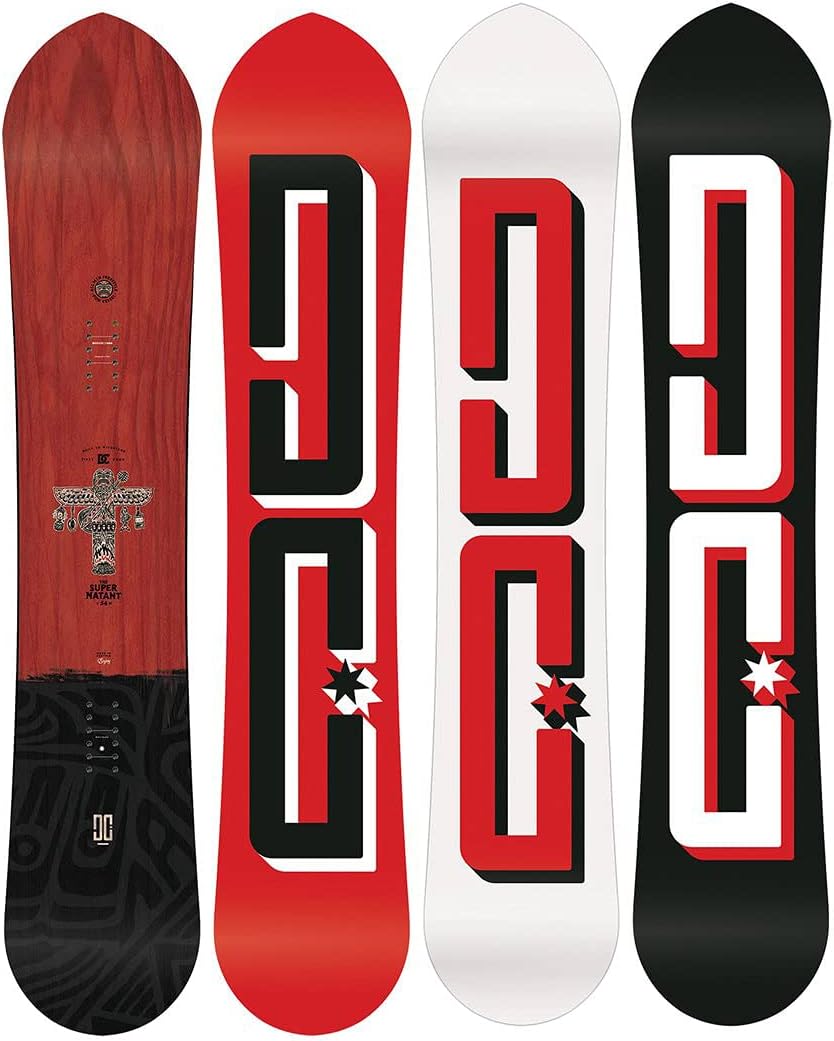
DC Mega Snowboard
- Style: Freestyle / Park
- Profile: Lock & Load Camber
- Flex: Medium-Stiff (7/10)
- Best For: Advanced park riders and aggressive freestylers who demand explosive pop.
Review: DC Ply — The People’s Champion
The DC Ply has been a staple in their lineup for years, and for good reason. It’s the quintessential all-mountain freestyle board. The Lock & Load Camber profile gives it incredible stability and power on groomed runs—you can lay down satisfying carves with real confidence. But the magic happens when you take it into the park or start hunting side hits.
The flat sections near the tip and tail make presses feel solid and balanced, while the camber between the feet delivers a powerful snap off jumps. Its medium flex is the sweet spot: forgiving enough that you won’t get punished for a slightly off-kilter landing, but stiff enough to remain composed at speed. If you’re an intermediate rider looking for one board to do it all—park laps to tree runs—the Ply is arguably one of the best value-for-money options on the entire market. For a similar all-mountain comparison, see our Burton Custom Flying V review.
DC Ply: Pros
- Versatile “do-it-all” design
- Lock & Load Camber is stable and poppy
- Durable construction holds up to abuse
- Excellent value for the performance delivered
DC Ply: Cons
- Not a dedicated powder board
- Might feel too stiff for true beginners
Review: DC Mega — The Park Powerhouse
If the Ply is the people’s champion, the Mega is the pro’s choice. This board takes the Lock & Load Camber concept and cranks it up. It runs a slightly stiffer flex and a lightweight, snappy core that is always wanting to be airborne. This is a board built for big jumps, high-speed rail lines, and aggressive sessions.
The moment you step on the Mega, you can feel the energy under your feet. The pop is explosive. When carving, it behaves like a precision instrument—gripping hard and transitioning edge-to-edge with lightning speed. It’s certainly park-focused, but I had a blast riding it all over the mountain too. However, this is not a board for beginners or tentative riders. It demands your full attention and rewards strong technical skiing. If you have the skills, the Mega will genuinely elevate your freestyle game. Riders looking at high-performance freestyle boards might also want to read our Capita DOA review.

DC Focus Snowboard
- Style: All-Mountain / Beginner
- Profile: Rocker (Flat between feet)
- Flex: Soft (4/10)
- Best For: New riders or anyone wanting a forgiving, playful board to build confidence quickly.

DC The 156 Snowboard
- Style: All-Mountain / Freeride
- Profile: Traditional Camber
- Flex: Medium-Stiff (7/10)
- Best For: Advanced riders who want a powerful classic-camber board for charging hard everywhere.
Review: DC Focus — The Perfect Starting Point
Answering “are DC snowboards good for beginners?” starts and ends with the DC Focus. This board is specifically designed to make progression as easy and fun as possible. Its soft flex and Rocker profile lift the contact points at tip and tail off the snow, making the board virtually catch-free.
For a beginner, this is a genuine game-changer. You’re far less likely to catch an edge and slam, which builds confidence faster than anything else. Linking turns feels intuitive and smooth. While it won’t hold an edge on icy terrain like a stiff camber board, that’s not what it’s built for. It’s built for learning, exploring, and discovering the joy of snowboarding—and at that job, it excels. For more beginner-focused advice, see our guides on snowboard turns for beginners and snowboard stopping techniques.
Review: DC The 156 — The Charger’s Tool
While the Ply and Mega dominate the freestyle conversation, the DC The 156 is a different animal entirely. Where those boards reward butters and park lines, The 156 is built for riders who want to go fast, carve hard, and challenge the whole mountain with authority. It runs a traditional camber profile—no rocker, no flat zones, just full contact from nose to tail—and a medium-stiff flex that means business.
On groomed hardpack, The 156 is a revelation. You can really dig the edges in and feel the board load and spring through a carve in a way that the Ply, for all its virtues, simply cannot match. The traditional camber makes it predictable and precise—you know exactly where your edge is at all times. For advanced riders transitioning from a softer all-mountain board, this is the kind of ride that reminds you what snowboarding can feel like when there’s no compromise in the design.
It does have a learning curve. That full-contact camber means the board is catchy by nature. In chopped-up afternoon snow or tight trees, you need to commit to your turns and stay active on the board. But at speed on a well-groomed run, or ripping down a steep pitch in firm morning conditions, The 156 absolutely rewards that skill level. Think of it as DC’s answer to the question “what if we just made a no-nonsense, high-performance all-mountain board?” The answer is surprisingly compelling. For another traditional camber option, check out our Burton Skeleton Key review or the Lib Tech Travis Rice Pro review.
It’s also worth noting the name: unlike the rest of DC’s roster, The 156 is named directly after its length. It comes in a narrow range of sizes, reinforcing its focused, no-frills character. If you’re an intermediate-to-advanced rider who wants to take their carving to the next level or spend more time charging fast down the whole mountain and less time in the park, The 156 belongs on your shortlist.
DC The 156: Pros
- Excellent edge hold on hardpack and groomed runs
- Traditional camber = maximum pop and precision
- Stable and confidence-inspiring at speed
- Great entry point into performance all-mountain riding
DC The 156: Cons
- Not suitable for beginners — catches edges easily
- Less forgiving in messy or variable snow conditions
- Limited size range compared to the Ply
How DC Snowboards Perform in Different Conditions
A board doesn’t exist in a vacuum—it has to perform across whatever the mountain throws at you. Here’s an honest, condition-by-condition breakdown of how DC’s lineup holds up. These ratings reflect the brand’s mid-tier models (primarily the Ply and Mega) as a representative sample.
Groomed Runs & Hardpack
This is where DC boards shine brightest and most consistently across the lineup. The Lock & Load Camber profile on the Ply and Mega provides a solid platform that grips and carves on packed snow with confidence. You can lay the board on its edge and trust it to hold. The 156 takes this further still with its full traditional camber. If you ride at a resort with frequent icy mornings, a DC board will serve you extremely well—particularly if you keep your edges tuned.
The Terrain Park
DC’s spiritual home. The combination of a flat platform near the tip and tail for pressing and a cambered center for pop gives park riders exactly what they need. Jumps feel snappy and responsive. Rails and boxes feel stable and predictable underfoot. The Mega in particular is arguably one of the best value-for-money park boards on the market right now, punching well above its price point against brands that charge a significant premium for comparable park performance. For riders who love the park, our Lib Tech Skate Banana review covers another iconic freestyle option.
Powder Days
This is where you need to manage your expectations. DC’s freestyle-focused boards are twin shapes with centered stances—they’re not designed to float in deep snow. On a proper powder day, you’ll be working significantly harder to stay on top of the snow compared to a board with a pronounced taper, setback stance, or a heavily rockered nose. The Ply is the most capable DC board in powder among the mainstream lineup, but it still requires you to ride with weight shifted back. If you ride at a resort that regularly gets significant snowfall and powder riding is a top priority, you may want to consider a dedicated powder board as a second deck rather than relying on a DC twin to do everything. Check out our guide to the best bindings for powder to complete your setup.
Ice & Variable Conditions
Honest assessment: DC boards hold an edge reasonably well, but they’re not the strongest performers on genuine hardened ice. This is the area where Lib Tech’s Magne-Traction technology gives their boards a meaningful advantage—those serrated edges grip in conditions where a smooth edge simply slides. That said, for the vast majority of resort conditions (morning groomers, afternoon slush, packed powder), DC’s edge hold is more than adequate. Keep your edges sharp and waxed, and you’ll rarely have an issue. For another perspective on edge tech, see our GNU Pickle BTX review.
★ Rider FitWho Are DC Snowboards Actually For?
Freestyle & Park Riders
This is DC’s bread and butter. Their skate heritage shines brightest here. Boards like the Mega and the Ply are engineered for pop, stability on landings, and a playful-yet-powerful flex. If your perfect day involves hot laps through the terrain park, hitting jumps, and sliding rails, DC should be at the very top of your list.
All-Mountain Explorers
Most of us are all-mountain riders—we want a board that handles icy groomers in the morning, slushy park laps in the afternoon, and even the occasional powder day. DC’s all-mountain boards, particularly the Ply, are fantastic quiver-killers. They balance edge hold and playfulness perfectly, making them genuinely fun across the entire resort.
Beginner & Intermediate Riders
With models like the Focus, DC provides an excellent and affordable entry point into the sport. Forgiving flexes and Rocker profiles help new riders build a strong foundation without breaking the bank. The cost of entry to snowboarding can be high, so finding a quality board at a fair price matters. We also recommend reading about whether snowboard lessons are worth it for new riders.
Freestyle & Park Riders
This is DC’s bread and butter. Their skate heritage shines brightest here. Boards like the Mega and the Ply are engineered for pop, stability on landings, and a playful-yet-powerful flex. If your perfect day involves hot laps through the terrain park, hitting jumps, and sliding rails, DC should be at the very top of your list. The skate-influenced feel of their boards—particularly that snap off the tail—is something that riders who have spent time on a skateboard will recognize and love immediately. It’s not manufactured personality; it’s the result of decades of board-sport DNA.
All-Mountain Explorers
Most of us are all-mountain riders—we want a board that handles icy groomers in the morning, slushy park laps in the afternoon, and even the occasional powder day. DC’s all-mountain boards, particularly the Ply, are fantastic quiver-killers. They balance edge hold and playfulness perfectly, making them genuinely fun across the entire resort. The medium flex means you won’t be punished for making mistakes on a steep pitch, but you’ll still have enough stiffness to hold a satisfying carve on a fast groomer. For the vast majority of riders, an all-mountain DC board will cover 95% of what they ever want to do on the mountain. For a head-to-head comparison, see our Burton vs Capita comparison or our Arbor vs Salomon breakdown.
Beginner & Intermediate Riders
With models like the Focus, DC provides an excellent and affordable entry point into the sport. Forgiving flexes and Rocker profiles help new riders build a strong foundation without breaking the bank. The cost of entry to snowboarding can be high, so finding a quality board at a fair price matters. What DC gets right at the beginner level that some brands miss is that their entry boards still feel lively and fun—they’re not punishingly dull or plasticky. That matters because the best way to improve quickly is to actually enjoy riding, and the Focus makes it easy to do just that.
Riders Who Grew Up Skating
There’s a specific kind of rider who immediately gets what DC is about the moment they step on one of their boards. If you have a skateboarding background—or even just appreciate the cultural connection between skating and snowboarding—DC’s design language will feel deeply familiar. The pop comes from the same place. The press feels similar. The attitude is the same. DC never forgot where they came from, and for riders who share that background, it makes their boards feel like home.
★ Buyer’s GuideHow to Choose the Right DC Snowboard for Your Level
With several models in the lineup, picking the right DC board can feel overwhelming. Here’s a simple framework: match the board’s flex rating and profile to where you are as a rider right now, not where you want to be in two seasons. A board that suits your current level will help you progress faster than one that’s too demanding. For more guidance, see our complete guide to choosing your first snowboard.
0–30 days on snow
Go with the DC Focus. Its soft flex (4/10) and Rocker profile make catching edges much less likely, so you spend more time riding and less time getting up off the snow. The forgiving feel builds confidence fast.
30–100 days on snow
The DC Ply is your board. It’s the ideal step up—more responsive and poppy than the Focus, but still forgiving enough that you won’t be fighting it. Its Lock & Load Camber rewards your improving technique without punishing small mistakes.
100+ days, confident everywhere
Consider the DC Mega for park-focused riding or DC The 156 for all-mountain performance. Both demand active, engaged riding—they’ll reward your skill level with pop, precision, and response that softer boards simply can’t deliver.
When in doubt, size advice from a DC rep or a reputable snowboard shop is worth seeking out. Flex ratings are somewhat subjective and vary between brands—a 6/10 on a DC board may feel different from a 6/10 on a Burton board. If possible, demo a board before buying. Many larger resorts offer demo programs that let you try several decks in a single day, which is the single best way to find your perfect match. Also, make sure your snowboard stance is properly set up—an incorrect stance can make even the best board feel terrible.
DC Snowboard Sizing: Finding Your Length
Choosing the correct board length is one of the most important decisions you’ll make and one of the most commonly misunderstood. The old rule of “the board should reach between your chin and nose” is outdated and often leads riders to the wrong size. Modern sizing is based primarily on weight, with style adjustments on top of that. For a complete breakdown, see our comprehensive snowboard sizing guide.
Use this table as a starting point, then apply the style adjustments below:
| Rider Weight | Suggested Length | Park / Freestyle | All-Mountain / Carving |
|---|---|---|---|
| Under 110 lbs (<50 kg) | 140–148 cm | 138–145 cm | 143–149 cm |
| 110–130 lbs (50–59 kg) | 145–152 cm | 143–149 cm | 148–154 cm |
| 130–150 lbs (59–68 kg) | 149–155 cm | 147–153 cm | 152–157 cm |
| 150–170 lbs (68–77 kg) | 153–158 cm | 151–156 cm | 156–161 cm |
| 170–190 lbs (77–86 kg) | 156–162 cm | 154–159 cm | 159–164 cm |
| 190+ lbs (86+ kg) | 160–166 cm | 158–163 cm | 163–168 cm |
Style Adjustments
Once you have a base size from the weight chart, adjust for your riding style and preferences. Park and freestyle riders should generally go 1–3 cm shorter than the chart suggests—a slightly shorter board spins more easily, butters more naturally, and feels more maneuverable in tight park features. All-mountain and carving-focused riders can go 1–3 cm longer for additional stability at speed, better float in soft snow, and more surface area for big, confident carves.
Wide boards are also worth considering if you wear a men’s boot size 11 or larger (EU 44+). Most DC boards come in “W” (wide) variants for larger boot sizes—riding a board that’s too narrow for your feet causes “toe drag” on heel turns, where your boot catches the snow before the edge does. Check the specific model’s waist width against your boot size before buying. Also, make sure you’re in the right stance—read our guide on regular vs goofy stance to confirm your setup.
DC offers wide (W) versions of most key models including the Ply and Mega. If your boot size is US Men’s 10.5 or larger, check the waist width of the standard model. A general rule: if the waist width in cm is less than your boot sole length in cm, consider sizing into the W version. Toe drag is one of the most common (and easily avoided) beginner mistakes.
How Do DC Snowboards Compare to Other Brands?
It’s always useful to have a frame of reference. Here’s how DC stacks up against the key players. For even more comparisons, visit our dedicated snowboard comparison hub.
| Brand | DC’s Edge | Where DC Trails |
|---|---|---|
| Burton | Comparable tech at a more competitive price; skate culture authenticity | Burton’s lineup breadth is unmatched; better splitboard options. See our Burton Mission vs Cartel comparison. |
| Lib Tech / GNU | Smoother, more traditional edge feel; cleaner park ride | Magne-Traction (serrated edges) gives Lib/GNU superior grip on ice. Check our GNU Mullair review. |
| Jones | Much better at park & freestyle; more affordable | Jones is purpose-built for freeride & backcountry; DC can’t match that focus. See Jones Flagship vs Mountain Twin. |
| Capita | Stronger skate-heritage identity; often lower price points | Capita’s eco-credentials and lineup depth edge ahead at the premium level |
Beyond the Board: DC Boots and Outerwear
DC’s expertise doesn’t stop at snowboards. In many ways, their boots are equally as accomplished as their boards—possibly more so, given that DC started as a footwear company. Understanding the full DC ecosystem helps you put together a kit that performs cohesively. For a broader look at footwear, read our complete snowboard boots guide and our review of whether Vans snowboard boots are true to size.
DC Snowboard Boots
DC boots are widely praised for their comfort right out of the box and their skate-shoe-like feel underfoot—a deliberate design choice that connects their snow footwear to their heritage. For 2025/26, DC has introduced two significant upgrades across the boot range. The new Super Lock Heel Harness is seamlessly integrated with the Boa fit dial and works by pulling your foot firmly into the heel pocket the moment you tighten the lace. The result is noticeably less heel lift and more direct power transfer to the board. For riders who have struggled with heel lift in traditional lace boots, this is a genuine improvement worth experiencing.
DC also rolled out the Push Zone Traction system across most of their men’s and women’s boots (excluding Step On compatible models). This is traction material applied to the medial forefoot area of the outsole—the part of your boot that contacts the snow when you push your board flat during park features or while waiting in lift lines. It’s a small detail but one that makes walking around the mountain noticeably more secure on slick surfaces.
Their boot lineup offers three response liner tiers: the RL I (high-rebound EVA, great out-of-box feel), the RL II (lightweight with a 360° power strap for more aggressive riding), and the RL III (their warmest and most technical liner, with PrimaLoft insulation and multi-density cushioning for cold days and performance-focused riders). The Phase Pro and Judge models are consistent best-sellers among intermediate and advanced riders respectively. If you have wider feet, also check our guide to the best snowboard boots for wide feet. For binding pairing advice, see our snowboard bindings guide and the Union Force vs Atlas comparison.
DC Outerwear
DC’s outerwear occupies an interesting space: it’s legitimately technical mountain apparel, but it wears its street credentials openly. Their jackets and pants use waterproof fabrics with genuine seam sealing, real snow gaiters, and lift-pass pockets—all the mountain essentials—but the silhouettes and colorways are visibly influenced by DC’s streetwear roots. The result is gear that looks as good in a city café as it does coming off the slopes, which matters to a lot of riders who don’t want to look like they just stepped out of a REI catalogue. Read our snowboard pants vs ski pants comparison and our pick of the best baggy snowboard pants for more outerwear advice.
Their pants in particular have a loyal following. The baggier cut options offer freedom of movement that fitted technical pants can’t match for park riding, and the reinforced knee panels hold up well to the wear and tear of repeated falls and rail slides. If you want gear that performs in genuine mountain conditions but still has a distinct visual identity, DC outerwear is worth a serious look.
★ LongevityCaring for Your DC Snowboard: Maintenance Guide
A DC board is a meaningful investment. The difference between a board that lasts three seasons and one that lasts eight often comes down to how consistently it’s maintained. Fortunately, snowboard maintenance is not complicated—it just requires doing a handful of things on a regular schedule. Here’s exactly what to do and when.
-
Wax your base regularly (every 3–5 days of riding) If you have a mid-to-high-end DC board with a sintered base, waxing is essential. A dry sintered base actually absorbs dirt and slows down significantly faster than an unwaxed extruded base. Hot waxing at home takes about 20 minutes and dramatically extends base life. Use an all-temperature hydrocarbon wax if you’re unsure which temperature range to choose, and always scrape and brush after the wax cools. The payoff is immediate: a freshly waxed board feels noticeably faster and floats better in soft snow. For more on this, read why waxing your snowboard matters.
-
Tune your edges after every 5–8 days on hard snow Edges dull faster than most riders realize, particularly if you’re riding on hardpack or icy groomers. A dull edge skids instead of biting, which means your board won’t hold a carve and won’t respond as precisely. Use a diamond stone to remove burrs after every session, and use a gummy stone for light touch-ups between tune-ups. If you’re riding frequently, consider a professional tune every 10–15 days—most ski shops can do a full base grind and edge tune for a reasonable fee, and the difference on the snow is transformative.
-
Dry your board after every session This one is easy to overlook but genuinely important. Standing water on your base can seep into micro-cracks and, over repeated freeze-thaw cycles, causes delamination—the topsheet bubbling away from the core. After riding, wipe your base and edges dry with a clean cloth before storing the board. This takes thirty seconds and meaningfully extends the board’s life.
-
Repair base gouges quickly Hitting a rock or the edge of a rail will eventually put a gouge in your base. Small surface scratches are cosmetic and can be ignored, but anything deep enough to catch your fingernail needs to be filled. P-tex candles (available at any ski shop) melt into the gouge and, once cooled and scraped flat, restore the base’s contact surface. Leave a deep gouge untreated and it will grow, collect dirt, and eventually compromise the board’s performance.
-
Store properly in the off-season Before putting your board away for summer, give it a thorough tune and apply a thick coat of storage wax—do not scrape it off. The wax protects the base from oxidation during the months it’s sitting in a garage or closet. Store the board horizontally or on a rack away from direct sunlight, heat sources, and areas of extreme temperature fluctuation. Avoid standing it on its tail for long periods, as this can gradually affect the board’s camber over time. A good snowboard bag helps protect your gear during storage and transport.
After your last session of the season, lightly rub a gummy stone along both steel edges to remove any burrs, then apply a thin coat of paste wax or a dedicated edge rust inhibitor. Steel edges can develop surface rust during humid off-season storage faster than most riders expect—preventing it is far easier than removing it. A rusty edge won’t hold a tune well and can actually be weaker structurally after deep pitting.
Buying a DC Snowboard Second-Hand: What to Look For
DC boards hold up well to use, which makes the second-hand market a genuinely smart option—especially for newer riders who aren’t sure how committed they are to the sport yet, or for anyone who wants to try a specific model before committing to a new purchase. A used DC Ply or Mega from two or three seasons ago can represent exceptional value, provided you know what to check before handing over any money.
-
Check the base for deep core shots. Run your fingers along the base. Small scratches are normal and repairable; a gouge deep enough to expose the wood core is a more serious problem that requires professional repair. Core shots allow moisture into the board and weaken the structure over time.
-
Flex the board by hand. A healthy snowboard should flex smoothly and evenly, returning to its original shape without any creaking or cracking sounds. Unusual noises during a manual flex can indicate internal delamination—a manufacturing or moisture damage issue that’s difficult and expensive to repair.
-
Inspect the edges for missing chunks or deep rust. Minor surface rust is fine and easy to remove with a diamond stone. However, large chips, missing sections, or deeply pitted rust can mean the edge is structurally compromised. Press your thumbnail against the edge—it should feel sharp and consistent along the full length of the board.
-
Look for topsheet delamination. Press along the edges and nose/tail of the topsheet. Any bubbling, lifting, or soft spots indicate delamination. Minor edge delamination can be re-glued; major topsheet separation that extends toward the core is a dealbreaker.
-
Check the binding inserts. Look at all four insert holes and make sure none of them are stripped or cracked. Stripped inserts are a serious issue—bindings won’t hold securely to a stripped insert, making the board potentially dangerous to ride.
-
Ask about the board’s history. How many seasons has it been ridden? Has it been regularly waxed and tuned? A board that’s had three seasons of careful maintenance will outperform a board that’s had one heavy season of neglect. A well-kept DC board is a well-kept DC board regardless of its age.
-
The sweet spot for used DC boards is typically 1–3 seasons old, ridden by an intermediate rider who kept up with basic maintenance. At this age, the board has been broken in (which actually improves feel slightly compared to a brand-new board) but hasn’t accumulated significant wear. Expect to pay 40–60% of the original retail price for a board in good condition.
Frequently Asked Questions
Where are DC snowboards made?
All DC snowboards are manufactured at The Mothership—the world’s first 100% clean-energy snowboard production facility, located in Feistritz, Austria. The facility is owned and operated by Capita and is powered entirely by on-site hydro and solar energy. DC’s use of this factory is a strong mark of quality, as The Mothership is widely regarded as the most technologically advanced snowboard production facility in the world.
What is the warranty on DC snowboards?
DC generally offers a one-year warranty against manufacturing defects from the date of purchase, which is standard for the industry. Keep your receipt and register your board directly with DC to make any potential warranty claim straightforward.
Do DC snowboards come with bindings?
No—DC snowboards and bindings are sold separately. This is the industry standard and lets you pair a binding that matches your board’s flex and your personal riding style. Some retailers may offer bundle deals, but it’s not the norm. Read our snowboard bindings guide to find the right match.
How do I choose the right DC snowboard size?
Sizing depends primarily on your weight and height, but your riding style matters too. Freestyle and park riders often prefer slightly shorter boards for maneuverability and easier spins, while all-mountain riders may size up slightly for added stability at speed. Always check the manufacturer’s size chart for the specific model—DC publishes recommended weight ranges for every board in the lineup. Our snowboard sizing guide has more detail.
Is DC a good brand for beginners?
Yes—particularly through models like the DC Focus, which features a soft flex and Rocker profile specifically engineered to minimize edge catching and forgive the mistakes that come with learning. DC also offers good value at the entry level, which matters when you’re also investing in lessons, boots, bindings, and passes. See whether snowboard lessons are worth it for beginners.
How long do DC snowboards last?
With proper care and maintenance—regular waxing, edge tuning, and correct off-season storage—a DC snowboard can comfortably last 5–8 seasons of regular riding. Riders who are harder on their gear (heavy park riding, frequent rock strikes, irregular maintenance) should expect 3–5 seasons. The Stratus Core used in DC’s mainstream lineup is notably durable, and being manufactured at The Mothership means quality control is high. The biggest enemy of any snowboard’s longevity is neglect, not mileage.
Are DC snowboards good for park riding?
Yes—park and freestyle riding is where DC snowboards genuinely excel. Their skate-influenced design philosophy produces boards with snappy pop, stable landings, and a feel that rewards progressive tricks and style. The DC Mega in particular is one of the best park-focused boards in its price range, and the Ply handles mixed park-and-mountain riding superbly. Their extruded base options on lower-end models are also well-suited to park use, being easy to maintain after rail and box hits.
Can I use DC snowboard boots with bindings from other brands?
Yes—DC boots use a standard boot sole design that is compatible with virtually all snowboard bindings on the market. There is no proprietary DC boot-binding system (unlike, say, Burton’s Step On or Channel system). You can pair DC boots with bindings from Union, Burton, Salomon, Flux, or any other major binding brand without compatibility issues. The only exception to watch for is Burton’s Step On system, which requires specifically designed Step On boots. See our Burton Mission vs Cartel comparison for popular binding options.
How do DC snowboards compare to DC skateboards in terms of quality?
DC’s snowboards receive more consistent critical praise from the specialty snowboard community than their skateboards do from core skate communities. Snowboarding is a smaller, more specialized market, and DC has invested meaningfully in their board construction—manufacturing at The Mothership facility rather than outsourcing to generic factories. Their snowboard lineup is focused and tight (roughly 6–8 models compared to massive lineups from Burton), which means each model receives more engineering attention. The quality-per-dollar on DC snowboards is genuinely strong.
Is DC a good brand for beginners?
Yes—particularly through models like the DC Focus, which features a soft flex and Rocker profile specifically engineered to minimize edge catching and forgive the mistakes that come with learning. DC also offers good value at the entry level, which matters when you’re also investing in lessons, boots, bindings, and lift passes. As you progress, DC’s intermediate models (especially the Ply) provide a natural and logical next step without needing to switch brands entirely. For a comparison with other beginner-friendly brands, read our review of YES snowboards and our Nitro snowboards review.
The Final Verdict: Should You Buy a DC Snowboard?
After countless hours on the snow, extensive research, and comparing them to the best in the business, the verdict is clear: DC snowboards are an excellent choice for a huge range of riders.
They’ve successfully translated their deep, authentic roots in board sports culture into a lineup that is durable, technologically advanced, and—most importantly—genuinely fun to ride. They offer some of the best performance-per-dollar on the market, especially in the all-mountain and freestyle categories where they truly shine. The fact that every board is manufactured at Capita’s world-class Mothership facility is a reassurance of build quality that not all brands at this price point can offer. For an alternative perspective on quality-focused brands, check out our review of Gilson snowboards and our Capita snowboard review.
The brand has clear strengths and clear limitations. If you’re chasing deep powder days and want a quiver of freeride shapes, DC isn’t the brand that should top your list—Jones, Lib Tech’s powder lineup, or a dedicated freeride brand will serve you better in that specific niche. But if you ride at a resort, mix park laps with groomer runs, and want a board that connects the feel of skateboarding to snowboarding in an honest and well-executed way, DC deserves a serious look. For a broader perspective on the sport, read about why snowboarding is the best winter sport and why snowboarding is so fun.
Here’s the simplest framework for the decision: if a DC board fits your riding style, your level, and your budget based on everything in this guide, buy with confidence. Their warranty is solid, their boards last, and the community of DC riders is large enough that you’ll have no trouble finding advice, reviews, and fellow riders who can back up the experience with their own stories from the hill. Before you buy, make sure you also have the right protective gear—see our guides on the best snowboard helmets, best snowboarding goggles, and best snowboard knee pads.
Whether you’re a beginner stepping on a board for the first time, an intermediate rider wanting one deck to conquer the whole resort, or an advanced park rider searching for a poppy and reliable tool for progression—DC has a board that will not only meet but exceed your expectations. They’ve earned their place on the mountain, and they continue to prove it season after season. For more winter sports gear and safety advice, explore our guides on mittens vs gloves, why snowboarders wear mittens, the best snowboard socks, and important safety topics like snowboard fall safety, why snowboarding is dangerous, and back protectors for snowboarding.


