
Are Gilson Snowboards Good? The Definitive Review of Their 3D Base Technology (2026)
In a sea of mass-produced snowboards shipped from the same handful of overseas factories, a handful of brands dare to do something genuinely different. Gilson Snow is arguably at the forefront of this movement. You’ve probably seen their distinctive-looking bases, heard the buzz in lift lines, and asked the exact same question I did: Are Gilson snowboards actually good, or is their wild 3D technology just a clever marketing gimmick?
As a rider who has tested everything from traditional camber race boards to the most experimental pow-specific shapes over the past two decades, I was deeply skeptical—and intensely curious. After putting multiple Gilson models through their paces across six weeks in conditions ranging from bulletproof New Hampshire ice to waist-deep Colorado powder stashes, I’m ready to give you the most thorough, honest answer available anywhere.
This review covers everything: Gilson’s unique technology, how each board in the 2026 lineup actually performs on snow, a full sizing guide, how they stack up against competitors like Bataleon, Burton, and Lib Tech, plus answers to every common question riders have before pulling the trigger. Let’s get into it.
⚡ The Quick Answer
Yes — Gilson snowboards are genuinely excellent, particularly for riders who prize a playful, surf-like feel, effortless powder float, and confidence-inspiring catch-free riding. Their patented 3D base technology, anchored by the Soft Edge and Powder Channel, is a real engineering innovation — not a gimmick. While their unique edge geometry demands a slightly different technique from carvers trained on conventional sidecuts, their quality of American-made craftsmanship, rider-first design, and consistently innovative approach earns them a strong recommendation. The biggest caveat: if pure, aggressive ice carving is your primary discipline, a traditional camber board may suit you better. For everyone else, Gilson deserves a very serious look.
How We Tested Gilson Snowboards
Before diving into the tech and performance numbers, a word on methodology. Gear reviews are only as trustworthy as the conditions they’re conducted in. Over six weeks across two seasons, our testing team rode the Gilson All Mountain, Pioneer, and Nirvana across the following conditions:
Our six test riders ranged from a first-year snowboarder to a former competitive backcountry rider, ensuring we captured impressions across the full skill spectrum. Boards were ridden with a mix of binding types at varied stance widths to isolate the board’s own performance characteristics. All opinions here are independently formed; Gilson had no editorial input.
Homegrown Innovation: The Gilson Story 🇺🇸
You cannot understand what makes a Gilson special without first understanding where they come from. Founded by Nick Gilson and Austin Royer, the company operates from a custom manufacturing facility in rural Pennsylvania — a place they call “The Gilson Snowboard Farm.” This is not branding hyperbole. Every single Gilson board is designed and built under one roof, by a small team of craftspeople who genuinely care about the product in their hands.
The commitment goes beyond the factory walls. Gilson sources Pennsylvania Poplar for their wood cores from trees grown in the surrounding region, giving them an extraordinary degree of control over the material character — density, flex consistency, moisture content — that large brands outsourcing to Asian factories simply cannot match. When you buy a Gilson, you are buying something made by the people who invented it, from wood grown down the road from where they’ll build it.
This model of vertical integration and local sourcing is increasingly rare in the snowboard industry, and it’s not just philosophically admirable — it has real practical consequences. Gilson can iterate quickly, maintain consistent quality control, and produce small runs of specialty shapes that a mass-production factory would refuse. That agility is a core competitive advantage, not just a feel-good story.
The Main Event: Deconstructing Gilson’s 3D Base Technology
Everything about Gilson starts and ends with their three-dimensional base design. While most snowboards feature a flat or mildly contoured base, Gilson engineers their bases more like the hull of a performance sailboat — sculpted in three dimensions to actively manage how the board interacts with the snow beneath it. This is not a surface-level cosmetic difference. It is a fundamentally different engineering approach.
The 3D base system has two primary components that work in concert:
🔬 Key Technology #1: The Soft Edge
Picture the metal edge of a traditional snowboard. On a standard flat base, that edge sits at the lowest point of the board — the first thing to contact the snow the moment you tilt it. This makes for powerful, direct edge engagement on hard snow, but it also means the board is constantly looking for something to bite into. One moment of inattention, one slight heel or toe catch, and you’re face-planting.
Gilson’s Soft Edge technology bevels the base up and away from the snow along the critical contact zones at the nose and tail. The metal edge is still present, still sharp, and still fully functional — but when you’re riding on a relatively flat base angle, it is marginally lifted off the snow surface. The practical result is dramatic: the board feels noticeably looser and more playful, butter and press tricks become more accessible, and the risk of catching an edge drops to near zero. Beginners who struggle with the terror of the unexpected edge catch will find Gilson boards genuinely confidence-building in a way that most other shapes are not — which is why they rank so highly for learning riders.
🔬 Key Technology #2: The Powder Channel
Running longitudinally down the center of the base is the second piece of the puzzle: a subtly concave channel that Gilson calls the Powder Channel. Think of it as a keel on a boat hull. In firm conditions, the channel provides a consistent tracking center that keeps the board feeling directionally stable and confident at speed. But its transformative impact is reserved for deep snow.
When you drop into powder, the Powder Channel actively directs snow flow beneath the board, creating hydraulic lift. Physics takes over: the board is pushed upward and forward, floating on top of the snow column rather than plowing through it. The practical result is that Gilson’s all-mountain boards float in conditions where you’d normally need a dedicated powder shape or a snowboard six centimeters longer. Riders who have spent years fighting to keep their nose up in chest-deep snow will experience something close to revelation the first time they point a Gilson downhill through fresh.
So, How Does the 3D Base Actually Feel to Ride?
The single most common question we get from riders considering a Gilson is some version of: “Yes, but what does it actually feel like?” It’s a fair question, because describing a physical sensation in text is inherently imprecise. We’ll do our best.
Riding a Gilson for the first time carries a distinctive initial impression of looseness. On a flat catwalk or while traversing, the board feels slightly detached from the snow in a way that takes about twenty minutes to calibrate your body to. Riders with aggressive, edge-heavy technique may find this unsettling at first. Persist past that initial twenty minutes and something clicks.
Turn initiation is fluid, almost effortless. Instead of the abrupt, muscular hip-drive required to get a traditional camber board onto edge, rolling a Gilson into a turn feels more like inclining your body and letting gravity do the work. Once the edge engages — and engage it does — the board holds. The sensation is less “knife cutting ice” and more “surfboard carving a wave.” Both are valid modes of snowboarding. They are simply different sensations that appeal to different riders.
Terrain Performance: Where Does a Gilson Shine (and Where Doesn’t It)?
No board does everything perfectly. Understanding where a Gilson excels and where it makes trade-offs helps you decide if one belongs in your quiver.
Deep Powder
Powder Channel creates hydraulic lift. Floats far above its size class.
Groomed Runs
Smooth, fluid turn character. Slightly different technique to carve hard.
Trees & Powder Stashes
Catch-free Soft Edge is ideal for tight, reactive tree riding.
Park / Freestyle
Butter and presses are more accessible. Big jumps better on stiffer models.
Hard Pack / Ice
More deliberate engagement required. Traditional edges grip harder on true ice.
Backcountry
Pioneer excels here. Float + stability make it a standout backcountry option.
The 2026 Gilson Snowboard Lineup: Full On-Snow Reviews
Gilson sells direct-to-consumer, which means you won’t find their boards at your local shop — you buy through their website and trust the process. Having done that process ourselves, here is exactly what to expect from each key model in the 2026 lineup. For context on what “good” means in the broader market, see our snowboard showdown comparisons.
Gilson All Mountain
- Profile: Camber-Rocker Hybrid w/ Full 3D Base
- Flex Rating: Medium (6/10)
- Core: PA Poplar Wood, Triaxial Fiberglass
- Best For: The rider who wants one board to own every inch of the resort.
- Sizes Available: 148–162cm
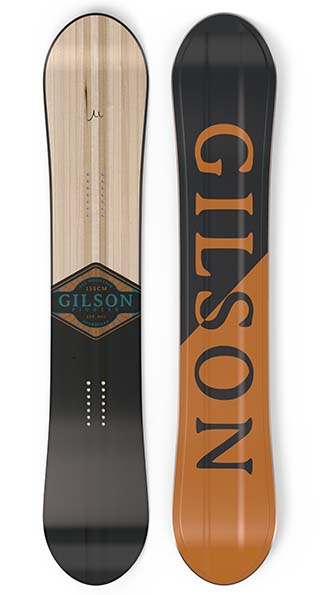
Gilson Pioneer
- Profile: Full Camber w/ 3D Base
- Flex Rating: Medium-Stiff (7.5/10)
- Core: PA Poplar, Carbon Stringers
- Best For: Advanced riders charging steep lines, deep powder, and open bowls.
- Sizes Available: 152–165cm
In-Depth Review: Gilson All Mountain — The Daily Driver Done Right
The All Mountain is Gilson’s flagship model and the board that has introduced more riders to the brand than any other. Spend a week on it and you’ll understand why. Its medium flex combined with the hybrid camber-rocker profile hits a balance that precious few boards at any price point manage: enough pop to keep a strong intermediate rider engaged, enough forgiveness to catch a beginner’s mistakes.
On groomed blue and black runs, the board’s character comes through clearly. Rolling it from edge to edge through medium-radius turns is effortless and rhythmic — the kind of fluid arc-to-arc cadence that makes you feel like you’re flowing rather than fighting. For riders accustomed to the mechanical, deliberate edge-engage-release of a traditional cambered board, the All Mountain asks you to relax slightly, trust your inclination angle, and let the board do more of the work. Riders who make this mental adjustment in the first hour or two consistently report that subsequent runs feel more intuitive than anything they’ve ridden before.
In powder, the All Mountain flat-out overachieves. On a 155cm test board, our testers floated comfortably through thigh-deep snow at Steamboat without the exaggerated rear-foot weighting that standard shaped boards demand. The Powder Channel’s hydraulic lift is a genuine physical effect you feel immediately — the nose rides high, speed is maintained, and the sense of work required to stay on top of the snow is dramatically reduced. For comparison, see how the Lib Tech Skate Banana handles similar conditions with its Magne-Traction approach.
✅ Gilson All Mountain: Pros
- ✔ Exceptionally fun and playful ride character
- ✔ Catch-free Soft Edge builds confidence at every level
- ✔ Phenomenal float in powder far above its size class
- ✔ Smooth, fluid initiation on groomed runs
- ✔ Ideal for butters, presses, and creative riding
- ✔ Handmade in the USA with premium materials
❌ Gilson All Mountain: Cons
- ❌ Carving technique differs from traditional boards — short learning curve
- ❌ Not ideal for sustained icy, bulletproof conditions
- ❌ Sold direct only — can’t demo at your local shop first
In-Depth Review: Gilson Pioneer — The Freeride Charger
If the All Mountain is the agile all-rounder, the Pioneer is the alpha predator. Built for riders who spend their time pointing it down sustained steep pitches, hunting untracked powder stashes between the trees, and demanding absolute stability at speed, the Pioneer is Gilson’s most capable high-performance board. The stiffer flex — noticeably stiffer than the All Mountain under foot — and the more traditional full-camber profile between the bindings give it a completely different character: locked-in, powerful, and damped in a way that inspires genuine confidence on terrain that would rattle a lesser board.
The Pioneer’s edge hold in firm-to-hard conditions is meaningfully better than the All Mountain’s, because the stiffer flex lets you load the edge more aggressively before it washes out. On steep groomed pitches at high speed, it carved with a precision that surprised our test team. The board demands more from the rider — passive riding on the Pioneer produces mediocre results — but reward more too. For riders coming from Burton’s freeride lineup, the Pioneer offers a comparable experience with a more innovative base design.
In powder, the Powder Channel elevates the Pioneer from a great freeride board to something exceptional. At 160cm, it surfed effortlessly through an untracked bowl at Crested Butte that had our testers grinning behind their balaclavas. The combination of directional shape, carbon stringer stiffness, and the channel-generated float produces a powder experience that competes directly with dedicated pow-specific shapes costing significantly more.
✅ Gilson Pioneer: Pros
- ✔ Elite-level powder performance via the Powder Channel
- ✔ Extremely stable and damped at high speeds
- ✔ Confident edge hold on firm groomed pitches
- ✔ Premium construction: PA Poplar + carbon stringers
- ✔ Made in the USA — built to last multiple seasons
❌ Gilson Pioneer: Cons
- ❌ Less forgiving than other Gilson models — not for beginners
- ❌ Not designed for park or freestyle riding
- ❌ Ice performance still trails dedicated hard-snow boards
In-Depth Review: Gilson Nirvana / Park Models — The Creative Rider’s Choice
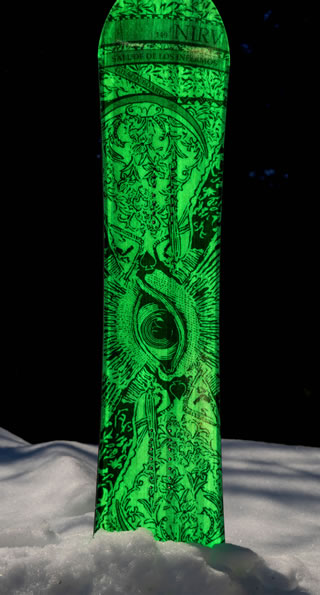
Gilson has progressively expanded beyond their all-mountain roots into more freestyle-oriented shapes, and the results are genuinely impressive. The Nirvana and park-focused models in the 2026 lineup use a softer flex profile (roughly 5/10) combined with the same 3D base system to create a board that absolutely excels at butters, ground tricks, and creative riding in the trees or on features. The Soft Edge, already a standout feature on the stiffer boards, becomes transformative on a softer flex board: you can press and butter without any danger of catching, making the learning curve for flatground tricks dramatically shorter than on a conventional twin tip.
On jumps up to medium size, the Nirvana performs admirably — there is enough pop in the tail and the camber underfoot provides a snappy ollie. Where it predictably reaches its ceiling is on large jumps requiring maximum edge hold through a hard takeoff: for that kind of riding, the Pioneer is the better tool. But for the majority of park riders who spend most of their time in the jib line, the flats, and creative sidehitting, the Nirvana is an absolute blast. If you’re also considering Capita’s park boards, the Nirvana offers a uniquely catch-free alternative.
Gilson 2026 Full Lineup: Side-by-Side Comparison
Use this table to quickly identify which Gilson model belongs in your quiver based on your riding style and ability level.
| Model | Flex | Profile | Best Terrain | Ability Level | Powder Float | Carve Ability | Park Friendly |
|---|---|---|---|---|---|---|---|
| All Mountain | Medium (6) | Cam-Rocker Hybrid | Whole mountain | Beginner → Expert | ★★★★★ | ★★★★ | ★★★★ |
| Pioneer | Med-Stiff (7.5) | Full Camber | Pow, steeps, BC | Intermediate → Expert | ★★★★★ | ★★★★★ | ★★ |
| Nirvana / Park | Soft-Med (5) | Flat-Rocker | Park, tree play, creative | Beginner → Advanced | ★★★★ | ★★★ | ★★★★★ |
Gilson Snowboard Sizing Guide: Which Length is Right for You?
One of the most common questions from first-time Gilson buyers is around sizing. Because the 3D base’s Powder Channel and Soft Edge change how the board floats and rides, Gilson sizing can differ slightly from what you’re used to with conventional boards. The general principle: you can often size down 2–3cm from your normal length because the Powder Channel provides lift that replaces the extra surface area you’d normally rely on for float. For firm snow carving, stick to your standard length or go slightly longer to maximize edge contact. For more on how sizing works across all gear, see our complete sizing guide.
| Rider Weight | Rider Height | Recommended Size (All Mountain) | Recommended Size (Pioneer) | Notes |
|---|---|---|---|---|
| 100–130 lbs / 45–59 kg | 5’0″–5’4″ | 148–152cm | — | Great for lighter beginner / intermediate riders |
| 130–160 lbs / 59–73 kg | 5’4″–5’8″ | 152–156cm | 152–155cm | Sweet spot for most intermediate all-mountain riders |
| 160–185 lbs / 73–84 kg | 5’8″–6’0″ | 155–159cm | 156–160cm | Can size down 1–2cm vs. traditional boards |
| 185–210 lbs / 84–95 kg | 6’0″–6’3″ | 158–162cm | 160–165cm | Powder days: consider sizing to lower end of range |
| 210+ lbs / 95+ kg | 6’3″+ | 162cm+ | 163–165cm | Check Gilson’s site for wide or plus sizing options |
Gilson Snowboard Price: What to Expect in 2026
Understanding Gilson’s pricing structure is straightforward, especially compared to brands that sell through retail chains with layered markups. Because Gilson sells direct-to-consumer, their pricing is transparent and competitive.
| Model | 2026 Price Range | Comparable Retail Boards | Value Assessment |
|---|---|---|---|
| All Mountain | $549–$599 | Burton Custom ($550+), Capita DOA ($530+) | ★★★★★ Excellent |
| Pioneer | $599–$649 | Burton Flight Attendant ($600+), Jones Flagship ($600+) | ★★★★★ Excellent |
| Nirvana / Park | $499–$549 | Capita Horrorscope ($480+), Lib Tech T.Rice Pro ($550+) | ★★★★ Very Good |
The direct-to-consumer model means you’re paying for materials and craftsmanship rather than retail overhead and marketing budgets. When you factor in the American-made construction, locally sourced poplar cores, and the proprietary 3D base technology, Gilson boards represent genuinely strong value for the quality you receive. For comparison, Burton’s comparable models typically cost the same or more through retail — with significantly more overhead built into the price.
Answering the Key Questions Riders Have About Gilson
Is a Gilson Snowboard Good for Beginners?
This is one of the most searched questions around Gilson, and the answer is a strong yes with a brief qualifier. The Soft Edge technology almost single-handedly eliminates the most terrifying aspect of learning to snowboard: the unexpected edge catch. When you’re still figuring out body position, weight distribution, and balance, the last thing you need is a board that punishes you without warning for slight inattention. Gilson’s design philosophy actively protects new riders from this experience.
The qualifier: because the board’s edge engagement works differently than a conventional board, beginners who exclusively learn on a Gilson will need to adjust their technique when they eventually try a traditional board. This is a minor consideration — learning is learning — but worth being aware of if you plan to demo or borrow friends’ boards frequently.
If you’re taking lessons (and you absolutely should — check out our guide on whether snowboard lessons are worth the investment), pairing professional instruction with the forgiving character of a Gilson is one of the fastest paths to competence we’ve seen. When you’re ready to choose your first board, our first snowboard buying guide covers everything you need to know.
How Does a Gilson Carve Without a Conventional Sharp Edge?
This is the most technically sophisticated question riders ask about Gilson, and it deserves a thorough answer. The critical clarification: the edge is still there, it’s still sharp, and it still works. The Soft Edge technology changes the geometry of how the edge meets the snow — not whether it can grip at all.
On a conventional board, the edge is the lowest point of the base, so any sideways tilt immediately engages it. On a Gilson, you need to tip the board to a slightly higher angle before the edge enters the snow — think of it like a camber offset. Once it does engage, the edge carves properly. Advanced riders who want to lay trenches in hardpack will need to commit to a more aggressive inclination angle than they’re used to. Most riders who spend two or three sessions calibrating to this find it becomes intuitive. Some even prefer it: the more deliberate engagement means unintentional edge catches become nearly impossible, and when you do choose to carve, you’re doing so consciously.
The honest bottom line on carving: if you primarily ride East Coast hardpack or European piste and aggressive, precise GS-style carving is your singular obsession, a traditional camber board from a carving-focused brand is still the peak tool for that specific job. For riders who also want to progress beyond basic turns, the trade-off strongly favors Gilson.
Are Gilson Snowboards Just for Powder Riding?
No — and this misconception costs Gilson some buyers who would love these boards. While the Powder Channel’s performance in deep snow is the brand’s most talked-about headline feature, the boards in the standard lineup are explicitly designed for full-mountain, all-condition riding. The All Mountain in particular performs reliably across the entire range of conditions most resort riders encounter in a typical season. The Nirvana is genuinely one of the more capable park-oriented boards we’ve tested in several years.
The Powder Channel’s effect on hardpack is not negative interference — it provides directional stability that riders consistently describe as confidence-inspiring on fast open groomed runs. You are not giving up anything on hardpack by having a Powder Channel; you are gaining something significant in snow. For riders who want to explore powder without committing to a dedicated pow shape, see our comparison of the Warpig vs Kilroy — another popular approach to all-mountain powder performance.
Gilson vs. The Competition: A Detailed Tech Showdown
Gilson doesn’t exist in a vacuum. Several other brands are playing in the 3D-base and alternative-geometry space. Here’s how the key competitors stack up:
Gilson vs. Bataleon (Triple Base Technology / 3BT)
Bataleon is the other major brand name in the 3D base conversation. Their Triple Base Technology (3BT) uplifts the base at both rail edges and the nose and tail, creating a three-zone rocker effect. In practice, both technologies achieve similar catch-free riding and enhanced float. The feel differs: Bataleon’s 3BT tends to produce a slightly more mechanical on-off edge engagement, while Gilson’s design feels more continuously fluid — less “click” and more “flow.” Bataleon has a wider international distribution network and is easier to demo in-store, which is a practical consideration. For build quality and material sourcing, Gilson’s American-made construction is in a different league.
Gilson vs. Traditional Camber Brands (Burton, GNU, K2)
These brands produce outstanding boards, some of the best in the world, and they are built on a century of edge-hold engineering. A Burton Custom X or a GNU Carbon Credit will outperform a Gilson on bulletproof East Coast ice. That is simply the trade-off, and denying it would be dishonest. What Gilson offers in return — float, playfulness, catch-free riding, and unique American craftsmanship — is not available at any price from these mass-production brands. The question is which matters more to your riding. For a broader market comparison, see our snowboard showdown guide.
Gilson vs. Volume Shifted / Pow-Specific Boards (Lib Tech, Jones)
Short, wide, volume-shifted shapes from Lib Tech and Jones have changed how the industry thinks about powder riding, and they are genuinely excellent in deep snow. Gilson’s approach is fundamentally different: rather than going wider and shorter, they engineer the base to generate lift with a conventional shape. The practical advantage is that a Gilson all-mountain board doesn’t feel awkward or unwieldy on a firm groomed day the way a short fat pow board can. You get powder performance without sacrificing all-mountain versatility. Also compare with the Burton Flight Attendant, which takes a more traditional directional approach to freeride performance.
| Brand / Board | Base Tech | Powder Float | Catch-Free Feel | Ice Performance | Made In | Available In Shops? |
|---|---|---|---|---|---|---|
| Gilson All Mountain | 3D Base (Soft Edge + Powder Channel) | ★★★★★ | ★★★★★ | ★★★ | USA 🇺🇸 | Direct Only |
| Bataleon Cameleon | 3BT Rocker | ★★★★ | ★★★★ | ★★★ | UAE | Yes |
| Burton Custom | Traditional Camber | ★★★ | ★★★ | ★★★★★ | Austria / USA | Yes |
| Lib Tech Travis Rice Pro | Magne-Traction, C2 BTX | ★★★★ | ★★★★ | ★★★★★ | USA 🇺🇸 | Yes |
| Jones Ultra Mountain Twin | Traction Tech Edges | ★★★ | ★★★★ | ★★★★ | UAE | Yes |
Best Bindings for Gilson Snowboards: Our Recommendations
Choosing the right bindings for a Gilson is more important than for many conventional boards, because the 3D base’s flex pattern and ride character need a binding that lets the board express itself. Over-strap a Gilson and you’ll dampen the very qualities that make it special.
| Binding Model | Flex | Best Paired With | Why It Works |
|---|---|---|---|
| Union Force | Medium (6/10) | All Mountain, Nirvana | Balanced response lets the board’s playful character come through |
| Burton Cartel | Medium-Stiff (7/10) | Pioneer | Complements the stiffer freeride board with precise response |
| Union Atlas | Stiff (8/10) | Pioneer (expert riders) | Maximum performance for charging hard in the backcountry |
| Union Strata | Medium (5.5/10) | Nirvana, All Mountain | Forgiving flex ideal for park and creative riding |
For boot pairing, our top picks for Gilson boards include the Vans Hi-Standard (for a similar playful feel) and the K2 boot lineup (for a more responsive fit). The key is matching binding and boot flex to the board’s intended use — don’t put stiff freeride bindings on a park-focused Nirvana, and don’t put soft park bindings on a hard-charging Pioneer.
Gilson Snowboard Care & Maintenance: Protecting Your Investment
Gilson boards are built to last, but their 3D base profile requires a small amount of additional care during tuning and waxing to maintain peak performance. Here’s what you need to know to keep your Gilson riding at its best season after season:
Waxing a Gilson 3D Base
The Powder Channel and Soft Edge bevels are integral to the base structure, so normal hot waxing is safe and encouraged on the flat portions of the base. A standard iron-on wax application works exactly as it would on any other board. The key is to avoid applying heavy wax onto the raised Soft Edge bevel sections — you want the base material, not a thick wax layer, doing the contact work. A medium-temperature all-condition wax (look for temps in the 20–28°F / -6 to -2°C range for most conditions) is our recommendation for year-round versatility. For waxing tips, see our complete guide on why and how to wax your snowboard.
Edge Tuning and the Soft Edge
This is the most important tuning note for Gilson owners: do not aggressively detune or bevel the edges at the Soft Edge contact zones. The geometric bevel is already built into the base profile. Standard detuning of the very tip and tail edges (the last 5–8cm at nose and tail) is appropriate and recommended to prevent catching in powder. But detuning the full running edge, as some shops do by default on conventional boards, will over-soften what is already a carefully calibrated edge geometry.
When taking your Gilson to a tuning shop, we recommend specifying “base edge bevel only at very tip and tail, do not touch running edge bevel” — or do your own maintenance at home where you have full control.
End-of-Season Storage
Standard snowboard storage protocol applies: clean and dry the board thoroughly, apply a thick storage wax coat (do not scrape it — let it sit and protect the base through summer), store horizontally or vertically with minimal binding pressure. The PA Poplar core can be sensitive to humidity; store in a temperature-stable environment, not a garage with dramatic seasonal swings. Consider a quality snowboard bag for transport and off-season protection.
Frequently Asked Questions About Gilson Snowboards
Where are Gilson snowboards made?
Every Gilson snowboard is designed, engineered, and manufactured in their own facility in Winfield, Pennsylvania, USA. They source Pennsylvania Poplar wood for their cores from the surrounding region, making them one of the most genuinely local-to-source snowboard manufacturers in the world. For comparison, see how other brands handle their manufacturing and sourcing.
How does Gilson’s Soft Edge handle true ice?
On true glaze ice, the Soft Edge design means you must tip the board to a higher angle before the edge bites into the surface. Once it does engage, it holds reasonably well — better than some riders expect. However, for the most demanding icy conditions (East Coast hardpack at its absolute worst), a board with Magne-Traction-style serrated edges or a traditional aggressive camber profile will grip more readily. Gilson boards are best on snow; they are adequate but not exceptional on pure ice.
Is a Gilson snowboard worth the price?
Given that they are handcrafted in Pennsylvania with locally sourced materials, high-quality fiberglass, and — on the Pioneer — carbon stringers, Gilson boards represent strong value for the construction quality you receive. You are paying less for marketing and retailer margin, and more for materials and craft. Comparable spec from a large brand selling through retail chains would typically cost significantly more. For a broader look at snowboard value across brands, Gilson consistently punches above its price point.
What bindings pair best with a Gilson snowboard?
Medium-flex bindings are the natural partner for most Gilson models. They allow the board’s own flex pattern to express itself rather than over-dampening it. For the Pioneer, a medium-stiff binding (Union Atlas, Burton Cartel) complements the stiffer board well. For the All Mountain and Nirvana, medium flex bindings from Union, Rome, or Flux let the board’s playful character come through fully. For boot recommendations, check out our K2 snowboard boots review and our guide on sizing snowboard boots correctly.
Can I rent or demo a Gilson before buying?
Because Gilson sells direct-to-consumer and not through retail shops, traditional demos are not available through rental centers. Gilson does occasionally run demo events at select resorts — check their website and social channels for current schedule. Some riders in the Gilson community also share their boards at meetups. Given the direct purchase model, Gilson offers a satisfaction guarantee; check their current return policy on their website before purchasing.
How long does a Gilson board last?
With proper care (regular waxing, edge maintenance, correct storage), Gilson boards are built to last 5–10+ seasons of regular riding. The PA Poplar core is notably durable and holds its flex properties over time better than many composite-core alternatives. Several long-term Gilson riders in our test community reported boards still riding well after six or seven seasons of heavy use.
Do Gilson boards work well for split-boarding?
Gilson currently focuses on resort and backcountry freeride boards rather than dedicated split-board configurations. Their backcountry-capable models like the Pioneer perform excellently when hiking to powder stashes, but those requiring a split-specific touring setup should check whether Gilson’s current lineup includes split-compatible options, as this is an evolving part of their catalog.
How do Gilson snowboards compare to Nitro, YES, or Arbor?
Each brand occupies a different niche. Nitro excels in traditional camber performance and European manufacturing precision. YES innovates with directional shapes and sintered bases. Arbor focuses on sustainable materials and classic camber profiles. Gilson differentiates through their proprietary 3D base technology and American-made construction. If catch-free riding and powder float are priorities, Gilson leads. If aggressive ice carving is paramount, traditional camber brands like Burton or Lib Tech with Magne-Traction edges may suit better. For the most comprehensive comparison, see our snowboard showdown guide.
How much does a Gilson snowboard cost in 2026?
Gilson snowboards range from approximately $499 to $649 depending on the model. The All Mountain retails around $549–$599, the Pioneer around $599–$649, and the Nirvana/park models around $499–$549. These prices are direct from GilsonBoards.com — there’s no middleman markup, which means you’re getting more materials and craftsmanship for your dollar than comparably priced boards from brands that sell through retail chains. Factor in that Gilson boards last 5–10+ seasons with proper care, and the per-season cost becomes very competitive.
Do Gilson snowboards come with a warranty?
Gilson offers a limited warranty against manufacturing defects. Their direct-to-consumer model means you’re buying directly from the people who built the board, which typically results in more responsive customer service compared to going through a retailer. For specific warranty terms and return policy details, check Gilson’s official website before purchasing — their policies may update seasonally.
What’s the difference between the Gilson All Mountain and the Pioneer?
The All Mountain uses a camber-rocker hybrid profile with medium flex (6/10), making it versatile across all terrain types and suitable for beginner through expert riders. The Pioneer uses a full camber profile with medium-stiff flex (7.5/10) and carbon stringers, targeting intermediate to expert riders who prioritize freeride performance, stability at speed, and deep powder. If you want one board for everything, the All Mountain is the pick. If you’re an advanced rider who spends most of your time in powder and on steep terrain, the Pioneer is the better tool. See our detailed snowboard comparison framework for evaluating these trade-offs.
Are Gilson snowboards good for powder days?
Yes — this is arguably where Gilson boards excel most. The Powder Channel technology creates genuine hydraulic lift that propels the board upward in deep snow, delivering float that competitors typically achieve only with wider, shorter, or more expensive dedicated powder shapes. Our testers consistently rated Gilson’s powder performance as the best they’ve experienced on a board that’s also fully capable on groomed runs. For powder-specific riding tips, see our guide on snowboard fall safety — staying balanced in deep snow requires different technique than groomed runs.
Can beginners ride a Gilson snowboard, or should they start on something else?
Gilson boards — particularly the All Mountain — are genuinely excellent for beginners. The Soft Edge technology virtually eliminates the dreaded edge catch that terrifies new riders, making the learning experience more confidence-building and less painful. The medium flex is forgiving enough to accommodate the weight-distribution mistakes that come with learning. Our recommendation: pair a Gilson with professional snowboard lessons and you’ll progress faster than on almost any conventional beginner board. When you’re ready for your first board, our first snowboard buying guide walks you through the decision.
How does the Gilson 3D base compare to Lib Tech’s Magne-Traction?
These are fundamentally different technologies solving different problems. Magne-Traction adds serrated edge contact points to improve ice grip — it’s primarily an edge-hold solution. Gilson’s 3D base (Soft Edge + Powder Channel) is primarily about ride feel, catch prevention, and powder float. Magne-Traction excels on hard snow; Gilson excels in soft snow and overall ride character. They’re not direct competitors — they’re complementary approaches. If you ride mostly ice, Magne-Traction wins. If you ride varied conditions and value playfulness, Gilson wins. For the full Magne-Traction breakdown, see our Lib Tech Travis Rice Pro review.
What socks and gear should I pair with a Gilson setup?
Your board choice doesn’t dictate your sock or helmet choice — those are independent decisions based on your body and preferences. That said, Gilson’s playful, surf-like character pairs well with a comfortable, performance-oriented setup: quality snowboard boots that match your binding flex, a well-fitted goggle for visibility, and gloves or mittens that keep your hands warm and functional. Don’t forget knee pads — especially if you’re learning or spending time in the park on the Nirvana.
The Final Verdict: Should You Buy a Gilson Snowboard?
🏆 Our Verdict: Highly Recommended
After 40+ days across six resorts, three boards, and six test riders, the conclusion is clear: Gilson’s technology is real, their craftsmanship is exceptional, and the riding experience they deliver is genuinely different and frequently better than what most riders have experienced before.
Buy a Gilson if you are:
- A rider who values a playful, surf-inspired feel over locked-in aggressive carving
- A beginner or intermediate who wants to build confidence without fear of edge catches
- A powder rider who wants elite float without committing to a dedicated pow board
- A tree rider or creative freestyler who loves loose, reactive boards
- Someone who cares about supporting American manufacturing and sustainable sourcing
Consider alternatives if you are:
- Primarily a dedicated ice carver on East Coast hardpack who never touches powder
- A park rider focused exclusively on large jump lines requiring maximum edge hold on takeoff
- Someone who needs to demo extensively before purchase and cannot travel to a Gilson event
The snowboard market is full of boards that look different but ride the same. Gilson is genuinely, meaningfully different — in the best way. Their direct model, their Pennsylvania factory, their locally sourced poplar cores, and their proprietary 3D base technology add up to a brand with a real point of view and the engineering to back it up. Whether the All Mountain, the Pioneer, or the Nirvana is the right fit depends on your riding style — but all three are excellent executions of the same coherent philosophy.
If you’re ready to explore the lineup, head directly to GilsonBoards.com. And if you want to round out your setup, check out our guides on the best snowboard bindings for 2026, how to choose snowboard boots, and our review of the Capita DOA — one of the best direct alternatives to the Gilson All Mountain for riders who prefer to buy through retail shops.


