
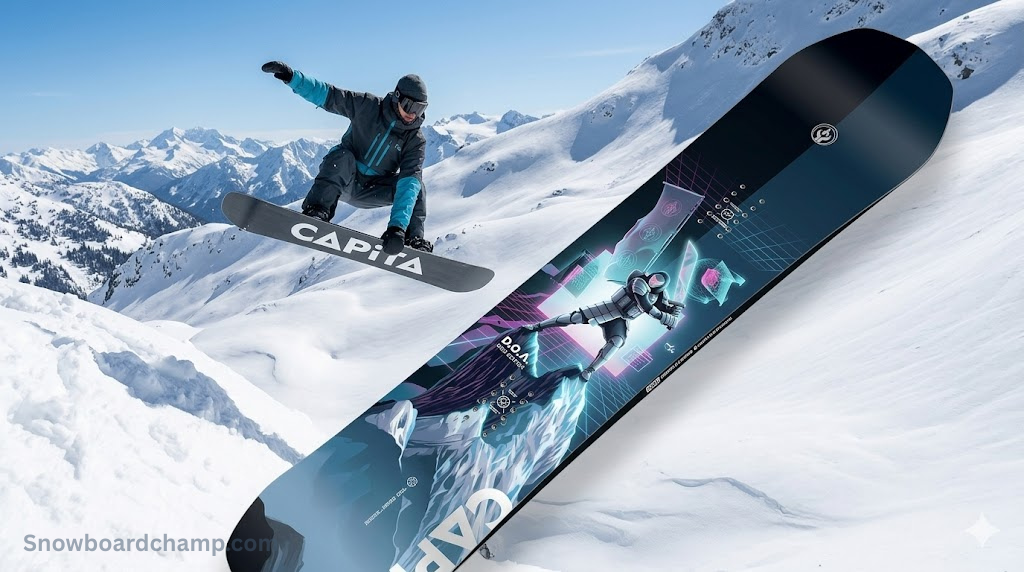
CAPiTA D.O.A. Review:
The Legend Tested, Dissected & Rated



What Is the CAPiTA D.O.A. Snowboard?
The CAPiTA Defenders of Awesome — better known simply as the D.O.A. — isn’t just a snowboard. It is arguably the most decorated all-mountain freestyle board of the past two decades. Seven Transworld Good Wood awards, a near-cult following across North America, Europe, and Japan, and a legacy that has shaped what modern park-capable all-mountain riding looks like. But is the 2026 iteration still worth your money? That’s exactly what this deep-dive review answers.
Born inside CAPiTA’s legendary “Mothership” factory in Austria — one of the world’s most technologically advanced snowboard manufacturing facilities — the DOA has always represented the perfect blend of park-inspired geometry and all-mountain utility. It’s a true twin, which means the nose and tail are completely symmetrical, giving you the same feel in both regular and switch stances. Yet unlike a lot of pure park boards, the DOA’s distinctive Resort V1 camber profile means it doesn’t sacrifice edge grip, speed, or precision on groomers to achieve that park-friendly versatility.
For the 2026 season, CAPiTA made no structural changes to the DOA beyond fresh graphics. The significant technology updates actually arrived in 2023 — most notably a lighter, more pressable P2 Superlight Core and the upgraded Quantum Drive Base. So if you’re riding a 2023, 2024, or 2025 version, you’re essentially on the same fundamental machine. That’s a testament to how dialed-in the platform actually is. If you want a deeper look at how this stands against other all-mountain contenders, check out our CAPiTA Mercury vs Jones Mountain Twin comparison for context.
The DOA is built for riders who want one board that can do it all — send it off side-hits and kickers at speed, lay down clean carves on a groomer before lunch, and hit the park rails in the afternoon. It is not the easiest board to ride. Beginners will find it demanding. But for intermediate to advanced shredders who are comfortable on camber and ready to push their riding, the DOA delivers a riding experience that very few boards at any price can match.
Good to know: Capita’s DOA ranks 6th out of 38 boards in the all-mountain category and 6th out of 36 in the park category — a remarkable double-duty performance rating that few snowboards achieve simultaneously.
Full Specs: CAPiTA DOA 2026
Before diving into the ride feel, let’s establish the technical foundation. Understanding these specs tells you a great deal about how the DOA behaves on snow and why it performs the way it does across different terrain and conditions.
| Specification | Details | Assessment |
|---|---|---|
| Board Type | All-Mountain Freestyle | Versatile |
| Shape | True Twin | Switch-Ready |
| Camber Profile | Resort V1 (Camber + Zero Camber + Rocker blend) | Hybrid |
| Core | P2 Superlight™ (Poplar + Paulownia) | Lightweight |
| Fiberglass | Hybrid HolySheet™ Bi/Bi w/ Carbon Boosters | High-Strength |
| Base | Quantum Drive™ (UHMW Sintered) | Very Fast |
| Sidecut | Blended Radial | Smooth Turns |
| Topsheet | PLT™ Technology (Lacquer-free) | Durable |
| Resin | Magic Bean™ (60% bio-content renewable) | Eco-Forward |
| Flex Rating | Medium (5–6 / 10) | Intermediate+ |
| Skill Level | Intermediate → Advanced → Expert | Not for Beginners |
| Warranty | 2 Years (structural defects) | Standard |
| Price Range | ~$460–$500 USD | Below Average |
Available Sizes & Sizing Reference
The DOA comes in a wide range of sizes to accommodate different body types and riding styles. CAPiTA has expanded the size run significantly over recent seasons, adding Wide options and larger sizes for taller riders. Here’s the current lineup:
| Length | Waist Width | Ref. Stance | Boot Size (US) | Rider Weight |
|---|---|---|---|---|
| 148 cm | 246 mm | 50.8 cm / 20″ | Up to 8 | 110–145 lbs |
| 150 cm | 248 mm | 53.3 cm / 21″ | 7.5–9 | 120–155 lbs |
| 151W cm | 256 mm | 53.3 cm / 21″ | 9.5–11 | 120–155 lbs |
| 153 cm | 250 mm | 53.3 cm / 21″ | 8–10 | 135–170 lbs |
| 155 cm | 252 mm | 53.3 cm / 21″ | 8.5–10.5 | 145–180 lbs |
| 156W cm | 259 mm | 55.9 cm / 22″ | 10–12 | 145–180 lbs |
| 158 cm | 252 mm | 55.9 cm / 22″ | 9–11 | 160–200 lbs |
| 160W cm | 261 mm | 58.4 cm / 23″ | 11–13 | 160–200 lbs |
| 162 cm | 254 mm | 58.4 cm / 23″ | 9–11 | 175–215+ lbs |
| 163W cm | 263 mm | 58.4 cm / 23″ | 12–14 | 175–215+ lbs |
| 164 cm | 254 mm | 58.4 cm / 23″ | 9–11 | 190–230+ lbs |
Sizing note: The 156 cm is a sweet spot for most average-height riders with size 9 boots. If you wear a size 10–12, go Wide. Riding a regular when you need a Wide causes toe/heel drag that kills carving performance. Check our full snowboard sizing guide by height and weight for a more detailed chart.
Resort V1 Profile: The DOA’s Secret Weapon
The Resort V1 profile is the architectural backbone of the DOA, and understanding it is key to understanding why this board behaves the way it does. It is not a simple camber board, and it is not a simple rocker board. It’s a sophisticated three-zone hybrid that extracts the best performance characteristics from traditional camber, zero camber, and reverse camber shapes.
Here’s how each zone of the Resort V1 profile contributes to the DOA’s behavior on snow:
Traditional Camber Zone
The center section of the board arcs slightly above the snow when unweighted. This creates powerful edge-to-edge response, explosive pop off jumps and ollie attempts, and the locked-in feel that groomers demand. It’s what separates the DOA from flat or rocker boards in carving performance.
Flat Kick Transition
Between the camber arch and the tip/tail, there’s a deliberate flat and then lightly upturned section. This makes initiating turns easier than a pure camber board, reduces the likelihood of edge catching when you’re landing off-axis, and adds a bit of float when the tips are surfing over softer snow.
Blended Transition Zones
Rather than a sharp transition between camber and flat sections, CAPiTA blends these zones smoothly. The result is a progressive, predictable feel under your feet — none of the abrupt snapping that early hybrid boards sometimes produced, and none of the dreaded edge-catching that ruins landings.
For deeper context on how different camber shapes affect your riding, read our thorough breakdown of camber vs. rocker snowboard profiles, control, pop, and float. Understanding this fundamentally changes how you choose a board. The DOA’s Resort V1 sits right at the intersection of technical precision and practical accessibility — demanding enough to reward skilled riders, forgiving enough to not punish honest mistakes.
“The camber from center to flat to a little rocker in the tip/tail makes for a somewhat locked-in, technical ride that rewards the rider who can control it. The lively flex bends easily but pops hard back into shape.”
— The Good Ride, multi-year DOA review
P2 Superlight Core: Light, Responsive, Durable
The heart of the DOA is its P2 Superlight™ Core — a carefully engineered blend of poplar and paulownia wood that CAPiTA uses to hit a very specific sweet spot of weight, flex, and energy return. Paulownia is one of the lightest structurally viable hardwoods in existence, while poplar provides the density and strength necessary for edge integrity and impact resistance.
Hybrid HolySheet™ Fiberglass with Carbon Boosters
Wrapping the wood core is CAPiTA’s Hybrid HolySheet™ Bi/Bi fiberglass — a biaxial-over-biaxial configuration integrated with Carbon Boosters. The term “HolySheet” refers to CAPiTA’s proprietary fiber weave architecture, which uses a higher roving count at the same glass weight. The practical result is a stronger, more responsive board that doesn’t add unnecessary grams to the layup.
The Carbon Boosters are targeted reinforcements running lengthwise through the board that stiffen specific flex zones — most noticeably increasing the pop response at the tail and nose. When you ollie the DOA, those carbon fibers are doing real work, storing and releasing energy more efficiently than plain fiberglass would allow. For related context on what carbon does in a snowboard, browse our analysis of DC Lock and Load camber profile and park stability.
Magic Bean™ Resin System
The resin that binds all these layers together is CAPiTA’s Magic Bean™ system, derived 60% from renewable agricultural raw materials. This isn’t just a sustainability talking point — the bio-resin actually performs differently than petroleum-based alternatives. It delivers stronger and more rigid laminate qualities, which allowed CAPiTA to reduce wood core thickness without sacrificing structural performance. The thinner core means a lighter board with a higher energy return per unit of deflection — i.e., more pop per kilogram.
PLT™ Topsheet Technology
The topsheet on the DOA uses CAPiTA’s PLT™ (Precision Laminate Technology) process, which bonds the decorative topsheet directly to the already-pressed board without using toxic, heavy lacquer coatings. The result is sharper, more vibrant graphics that hold up better over time, and a slightly lighter finished product. It’s one of those details that won’t change how the board rides but matters for both longevity and environmental footprint.
Quantum Drive™ Base: Speed That Actually Holds
If the core and fiberglass determine how a board flexes and pops, the base determines how fast it glides and how easy it is to maintain. The DOA’s Quantum Drive™ base is one of the most significant recent upgrades to the platform, representing CAPiTA’s evolution beyond their already rapid Ultradrive base material.
The Quantum Drive base is a proprietary sintered UHMW (Ultra-High-Molecular-Weight) polyethylene formula. What makes UHMW polyethylene special for snowboard bases is its exceptional combination of low friction and wear resistance. The Quantum Drive variant uses a compression process and advanced blend ratios that result in higher molecular density than standard sintered bases. This has two practical effects: the base wicks wax more efficiently than previous generations, holding lubrication longer between sessions, and it has better inherent anti-friction properties even when running dry.
Maintenance tip: Because the Quantum Drive base absorbs wax exceptionally well, it responds especially well to hot waxing over drip waxing. A proper hot wax every 3–5 riding days will keep the base at peak performance. For more on this, read our guide on why waxing your snowboard matters — P-tex porosity and hydrophobic metrics.
In terms of pure speed, the Quantum Drive is among the fastest bases you’ll find on a board in this price class. On packed groomers and high-speed runs, the DOA genuinely accelerates where boards with cheaper extruded bases start to drag. This matters especially on flat sections, cat tracks, and long runouts where speed bleeds fastest. For a direct comparison between base types, our article on sintered vs. extruded snowboard bases — speed and maintenance breaks down the full technical picture.
Durability is also notable. The Quantum Drive is rated for high use without the micro-scratching and oxidation that plagues softer bases. That said, sintered bases do require more care than extruded bases when they run dry — an unlubricated ride on hardpack can dry out and dull the base material faster than extruded alternatives. Keep it waxed, and this base will reward you for years.
How the DOA Actually Rides: An Honest Assessment
All the specs in the world mean nothing if the on-snow experience doesn’t deliver. Here is an honest, experience-based breakdown of how the DOA performs across different snow conditions and terrain types.
First Impression: More Technical Than Expected
If you’re coming from a rocker or zero-camber board, the DOA will feel noticeably different underfoot during your first few runs. The camber means the board is constantly wanting to engage its edges — in a good way, but it demands intent and body position. You can’t be sloppy with your weight distribution and expect the board to compensate. It won’t. It will reward committed turns and punish indecision.
That said, after two to three runs of adjustment, most intermediate riders begin to unlock what makes the DOA special. The medium flex rating (around 5–6 out of 10) sits in a powerful range — stiff enough to hold an edge at speed, soft enough to initiate presses and jib-style maneuvers without tremendous effort. The lively flex pattern means the board bends willingly under pressure but snaps back with stored energy. When you ollie off a kicker, that spring is tangible.
Carving on Groomers
The DOA carves beautifully. The camber section bites into hard groomed snow cleanly, and the Blended Radial Sidecut keeps turn radius smooth and predictable — no abrupt transitions, no hooky exits. On smooth groomed runs, the DOA feels fast and confident. It won’t match a dedicated carving board or a stiff directional board designed specifically for edge hold, but for a twin that also shreds parks, the carving performance is genuinely impressive.
Edge hold on harder conditions — blue ice, morning groomers — is good but not exceptional. The Blended Radial doesn’t give the same locked-in security that boards with Magne-Traction or similar edge tech provide on bulletproof conditions. If you frequently ride icy eastern resorts or hardpack in below-freezing temperatures, this is worth considering. Read our comparison of GNU Banked Country and Magne-Traction carving grip to understand where the DOA falls short by comparison.
Performance Scores by Condition
Switch riding deserves special mention. Because the DOA is a true twin with a centered stance, riding switch feels identical to riding regular. There’s zero adjustment period going backwards — the board responds exactly as expected. For riders building their freestyle game, this symmetry is invaluable. If you’re working on perfecting your switch technique, also review our guide on goofy vs. regular stance biomechanics and setup.
Park Riding: The DOA’s True Home
The DOA was built with the park in mind, even as it expanded its all-mountain capabilities. When you take it into a terrain park, this board lights up. The combination of the Resort V1 profile, the P2 Superlight core, and the Carbon Boosters creates a pop machine that’s as at home on a 50-foot kicker as it is on a rail line.
Jumps & Kickers
Off jump features, the DOA is extraordinary. The camber stores energy through the takeoff and releases it explosively as you leave the lip. The carbon boosters amplify this response, giving you noticeably more height on ollies and off-jump pops compared to similarly priced boards without carbon reinforcement. Landings are stable and damp — the board absorbs impact well, and the flat-kick tips mean you’re far less likely to catch an edge coming down slightly off-axis.
This is one area where the DOA genuinely stands apart from much of its competition. Other boards might match it on specific metrics, but very few deliver the whole package of pop, stability, and landing forgiveness at this price point. For context on how progression in the park works, explore our snowboard trick progression ladder from buttering to airs.
Rails & Jibbing
On rails, the DOA is competent but not a specialist. The medium flex means it requires more effort to lock into butter positions or manual across long box features than a softer, dedicated jib board would. However, this isn’t a soft park board — it’s a hybrid. If you spend 40% or less of your time in the park with rails being the primary focus, the DOA handles them absolutely fine. If you’re a dedicated rail rider who lives in the park doing technical jib lines, you’ll want something softer and more forgiving. The DOA prioritizes jump performance and mountain versatility over pure jib performance.
Sidehits & Natural Features
This is arguably where the DOA truly shines. Natural terrain features — sidehits off powder banks, natural lips on cat tracks, airs off mellow clifftops — are the DOA’s playground. The board reads natural terrain instinctively, launching predictably off uneven takeoffs and landing with poise on inconsistent surfaces. This is real mountain freestyle in its purest form, and the DOA was engineered precisely for it.
All-Mountain Versatility: From Groomers to Trees
While the DOA is often marketed as a park board, calling it just a park board massively undersells its capabilities. When you take it away from the park and explore the rest of the mountain, the board’s all-terrain credentials become undeniable.
Groomed Runs at Speed
At speed on groomed terrain, the DOA is an absolute weapon. The Quantum Drive base accelerates through transitions and maintains speed on flats better than most boards in this price range. Point it down a blue or black run, load your heel edge coming out of a turn, and the board gives you confidence-inspiring feedback through your feet. The Blended Radial Sidecut keeps arc shape consistent turn to turn — no drama, no guesswork. For riders who want to refine their carving form, combine this board with the technique tips in our guide to carving on a snowboard — edge control and angulation.
Off-Piste & Trees
Powder performance is the DOA’s weakest terrain category, though it’s still more capable than most dedicated park boards in this regard. The true twin shape means there’s no directional float bias — the nose doesn’t naturally surf above the snowline the way a setback directional board would. In shallow powder (6″ or less), the DOA handles it perfectly. In deep (12″+) or heavy powder, you’ll need to consciously load the tail and ride with a more aggressive setback to keep the nose up. It’s manageable, just not effortless. If you’re comparing this to boards engineered for powder, read our analysis of backcountry snowboarding, snowpack stratigraphy, and geometry.
Bumps & Variable Conditions
On chopped-up afternoon snow, moguls, and variable windpack, the DOA performs admirably. The medium flex absorbs small chatter well, and the board tracks predictably through varied surfaces. It doesn’t get washed out by sudden changes in snow texture the way softer boards sometimes do. This makes it a strong choice for riders who don’t always have the luxury of riding in perfectly groomed or perfectly fresh conditions — which, let’s be honest, is most of us most of the time.
Which Size DOA Do You Need?
Sizing the DOA correctly is one of the most important decisions you’ll make, and it’s where many buyers make avoidable mistakes. The DOA’s camber profile means sizing slightly short (as you might with a rocker board) isn’t the play here. You want a size that puts you in the recommended weight range without feeling too stiff or too flexy underfoot.
General rule: For freestyle-heavy riding, lean toward the lower end of the weight range. For all-mountain riding at higher speeds, lean toward the upper end or even size up. Boot size matters as much as body weight — always check waist width to avoid boot overhang. See our full snowboard sizing guide for the complete methodology.
| Rider Weight | Recommended Size | Boot Size | Primary Style Bias |
|---|---|---|---|
| 110–130 lbs / 50–59 kg | 148 cm | Up to US 8 | Park-focused freestyle |
| 120–150 lbs / 54–68 kg | 150 – 151W cm | US 7.5–9 (reg) / 9.5–11 (wide) | Park & resort freestyle |
| 135–175 lbs / 61–79 kg | 153 – 155 cm | US 8–10.5 | Park / All-mountain balanced |
| 145–185 lbs / 66–84 kg | 155 – 156W cm | US 8.5–10.5 (reg) / 10–12 (wide) | All-mountain freestyle |
| 160–200 lbs / 72–90 kg | 158 – 160W cm | US 9–11 (reg) / 11–13 (wide) | All-mountain at speed |
| 175–220+ lbs / 79–100+ kg | 162 – 164 cm | US 9–11 (reg) | Mountain charging / power |
For riders between two sizes, the choice comes down to riding style: go shorter for more park and freestyle agility, go longer for more stability, edge hold, and all-mountain confidence. If you’re unsure about your specific feet-to-board fit, check our guide on best snowboard boots for wide feet to understand how boot fit interacts with board width selection.
CAPiTA DOA vs. Key Competitors
The DOA doesn’t exist in a vacuum. It competes directly with several high-profile all-mountain freestyle boards, and understanding how it stacks up is essential for making an informed purchase. Here’s how the DOA compares to its most common alternatives.
| Board | Profile | Flex | Pop | Park | Carving | Price |
|---|---|---|---|---|---|---|
| CAPiTA DOA | Resort V1 (Camber hybrid) | Medium | Excellent | Excellent | Very Good | ~$464 |
| Lib Tech TRS HP | C2 (Camber/Rocker) | Medium | Very Good | Very Good | Very Good | ~$520 |
| Never Summer Proto Type Two | STS (Hybrid Rocker) | Med-Stiff | Very Good | Good | Excellent | ~$520 |
| Yes Greats | SoCo (Flat/Rocker) | Medium | Good | Very Good | Good | ~$480 |
| Nitro Fury | Cam-Out (Flat/Camber) | Medium | Very Good | Very Good | Good | ~$450 |
| GNU Mullair | C2 BTX | Med-Soft | Good | Very Good | Good | ~$470 |
| Jones Frontier | Flying V (Full Rocker) | Med-Soft | Good | Good | Fair | ~$430 |
The DOA’s most notable competitive advantage is how well it scores across both park and all-mountain categories simultaneously. Most boards in this comparison excel in one or the other, not both. If you want more detail on how CAPiTA’s lineup compares internally, read our deep-dive on Burton vs. CAPiTA snowboards, which breaks down brand philosophy and tech approaches. You might also want to read the GNU Mullair review for a close competitor comparison, or the Lib Tech Skate Banana review if you’re considering a rocker-based alternative.
The DOA is also priced below the average snowboard in its competitive segment, which is unusual for a board with this level of accolades and technology. At approximately $464 vs. an average competitive price of $468, it delivers premium performance at very close to mainstream pricing. That value proposition is hard to beat.
DOA vs. Super DOA
Many buyers wonder whether to step up to the Super D.O.A., CAPiTA’s more advanced sibling to the DOA. The differences are meaningful: the Super DOA features the Hybrid HolySheet™ Tri/Tri fiberglass with full Supercarbon (versus the regular DOA’s Bi/Bi configuration) and the new 3D Thermopolymer Starship Core with recycled thermopolymer channels. This gives the Super DOA a noticeably stiffer, more precise feel, faster edge-to-edge response, and more dampening in variable conditions.
The Super DOA is for riders who already know they love the DOA platform and want more performance headroom — particularly advanced riders who charge hard and want maximum carving precision and edge response. At roughly $200 more, the regular DOA remains the sweet spot for most intermediate-to-advanced riders who want the DOA experience without the Super DOA’s more demanding ride character.
Who Should Buy the CAPiTA D.O.A.?
One of the most common mistakes riders make is buying gear that doesn’t match their actual riding needs. The DOA is an exceptional board, but it’s not for everyone. Here’s an honest profile of who will get the most from it — and who might be better served elsewhere.
Buy the DOA If You Are…
Park Enthusiast
You spend 40–70% of your day in the terrain park hitting kickers and some rails, but still want real mountain capability the rest of the time.
Intermediate → Advanced
You’re past the beginner stage, comfortable on varied terrain, and ready for a camber-dominant board that rewards technical riding.
Resort All-Rounder
You ride everything — groomers, trees, sidehits, park — and want one board that handles all of it competently without major compromises.
Switch Rider
Switch riding is important to your progression or style. The true twin shape makes the DOA feel completely identical in both stances.
Speed Seeker
You like to go fast and want a base that truly performs. The Quantum Drive base will noticeably outpace cheaper board bases on flats and groomers.
Value Hunter
You want the best all-mountain freestyle board at or below the average market price. The DOA sits below average in cost for what it delivers.
Look Elsewhere If You Are…
- Beginners or very early intermediate riders who need a forgiving, catch-free rocker board to learn on
- Dedicated jib riders who want a soft, buttery board built primarily for rail lines and technical park jibbing
- Deep powder specialists who need a setback directional board with a lifted nose for consistent float
- Riders who primarily shred icy east-coast hardpack and need aggressive edge-hold tech like Magne-Traction
- Anyone prioritizing pure carving precision over freestyle versatility (consider a stiffer directional alternative)
- Explosive pop and height off kickers and natural terrain features
- A fast, wax-hungry sintered base that holds speed through flat sections
- True twin symmetry for effortless switch riding and trick development
- A board that carves credibly on groomers while thriving in the park
- Award-winning legacy and proven design with ongoing technology refinement
Thinking about your bindings setup for the DOA? It pairs exceptionally well with a medium-flex binding that complements rather than overpowers the board’s natural character. Browse our affordable park and all-mountain bindings under $200 tested for pairing recommendations, or check out the Union Legacy bindings review for one of the most popular DOA pairings on the market. For boots, the DOA works with most mid-to-stiff freestyle boots — read our best snowboard boots review for detailed matching guidance.
One of the most overlooked aspects of maximizing your DOA’s performance is proper maintenance. A board this fast deserves a dedicated wax and tune routine. Learn how to wax a snowboard at home for faster glide and consider picking up a full snowboard tune kit to keep your edges and base in peak condition all season.
CAPiTA DOA Review Verdict: Still Earns Its Crown
After riding the DOA across multiple seasons and examining every technical element that makes it tick, the conclusion is clear: the CAPiTA Defenders of Awesome remains one of the most well-rounded, performance-per-dollar boards available in the all-mountain freestyle category. Seven Good Wood awards aren’t marketing — they’re the result of years of consistent, real-world validation from riders across every terrain and condition type.
Pros & Cons: The Definitive Summary
- Explosive pop: Carbon Boosters and P2 core deliver among the best ollie response at this price
- True twin versatility: Equally capable regular and switch — ideal for freestyle progression
- Quantum Drive base: Fast, wax-absorbent, durable — one of the best bases in its class
- Resort V1 profile: Delivers camber precision without punishing edge catches on landings
- Eco-conscious materials: Magic Bean resin and PLT topsheet show CAPiTA’s real sustainability commitment
- Excellent value: Below-average price for premium all-mountain freestyle performance
- Wide size range: Regular and Wide options from 148 to 164 cm cover virtually all riders
- Proven pedigree: 2-year warranty, factory-tested, Mothership manufacturing quality
- Not beginner-friendly: Camber profile demands solid fundamentals — learning curve for new riders
- Edge hold on ice: Without Magne-Traction or similar tech, icy hardpack is its weakest link
- Powder limitations: True twin with no setback means deep powder requires extra body position effort
- Jibbing stiffness: Medium flex makes technical rail work harder than dedicated softer boards
- No tech upgrade in 2026: Only new graphics — riders wanting latest tech must step to Super DOA
Final Score Breakdown
For riders who want to explore other top performers in the category, consider checking out our reviews of the Rome Ravine Pro, the GNU Pickle BTX, or the Arbor Element Rocker for softer, more catch-free alternatives. And if you’re still deciding on your complete gear setup, our snowboard bindings guide and snowboard boots guide will help you complete the package.
CAPiTA DOA — Frequently Asked Questions
Here are the most commonly asked questions about the CAPiTA Defenders of Awesome, answered based on real riding experience and technical expertise.
No — the CAPiTA DOA is not recommended for beginners. Its Resort V1 camber-dominant profile requires solid edge control fundamentals and confident body positioning to ride properly. Beginners who get on a DOA often find it catches edges unexpectedly and feels unforgiving during turns. A rocker or flat-profile board is far more appropriate for those learning to snowboard. If you’re just starting out, check our beginner snowboarding tips and first ride blueprint. The DOA is best suited for intermediate to advanced riders who already understand edge control.
The CAPiTA DOA has a medium flex rating, typically measured around 5–6 out of 10. This flex profile sits in a powerful intermediate range — stiff enough to maintain edge hold and provide confident carving performance at speed, yet soft enough to initiate presses and basic park maneuvers without excessive effort. The tip and tail sections are slightly softer than the waist, which allows some butter-ability while the center holds firm during high-speed turns. The lively rebound character of the flex — bending easily but snapping back sharply — is one of the DOA’s most appreciated on-snow qualities.
Powder is the DOA’s weakest terrain, though it’s more capable than many pure park boards. As a true twin with no directional setback built in, the nose doesn’t naturally float above the surface in deep snow the way a setback directional board would. In shallow powder under 6 inches, the DOA handles it comfortably. In deeper snow (8–14+ inches), you’ll need to consciously shift your weight to the back foot and may adjust your binding stance toward the tail to improve nose float. It’s manageable with good technique, but riders who spend significant time in backcountry or deep powder might prefer a directional board. Review our breakdown of directional vs. twin snowboards — shape, control, switch, and float for a full technical comparison.
The Super DOA is a significant performance upgrade over the regular DOA. The key differences include: (1) the Super DOA uses Hybrid HolySheet™ Tri/Tri Supercarbon fiberglass (triaxial on top and bottom) versus the DOA’s Bi/Bi configuration — making it stiffer, more precise, and better at dampening at speed; (2) the Super DOA has the 3D Thermopolymer Starship Core, which incorporates recycled thermopolymer channels within the wood matrix for improved dampening and feel; (3) the Super DOA has slightly sharper edge response and more aggressive carving character overall. The regular DOA is the better choice for most intermediate-to-advanced riders and offers more forgiving freestyle performance. The Super DOA rewards expert riders who already know the DOA platform and want more precision and less flex give. Price difference is approximately $200.
Yes, the CAPiTA DOA is excellent value for money. At approximately $464, it is actually priced below the average of its competitive peer group, which typically ranges $460–$550 for boards with comparable tech and performance. When you factor in its 7× Transworld Good Wood awards, its dual ranking in both park and all-mountain categories, the quality of the Quantum Drive base, and CAPiTA’s Mothership factory construction standards, the DOA offers top-tier performance at below-average pricing. To put it in context, boards with fewer accolades and less sophisticated layups often cost $30–70 more. From a value standpoint, it’s one of the strongest buys in the all-mountain freestyle segment. For budgeting your full setup, read our guide on how expensive snowboarding gear is and amortization life cycles.
The DOA pairs best with medium-flex bindings that complement rather than override the board’s natural character. Popular pairings include the Union Force, Union Legacy, Burton Cartel, and Salomon Hologram. For park-focused riding, the Union Legacy bindings are particularly well-matched — their VaporLite dampening pairs beautifully with the DOA’s lively flex. For all-mountain charging, the Burton Cartel provides a stiffer, more precise response that amplifies the DOA’s carving capability. Avoid very soft bindings (under flex rating 3) as they can make the DOA feel disconnected at speed, and avoid extremely stiff bindings (over 8) unless you’re an advanced rider who wants maximum precision at the expense of freestyle feel. See our Union Force vs. Atlas bindings comparison for a detailed breakdown of two of the best options.
With proper care, a CAPiTA DOA typically lasts 4–7 full seasons of regular riding, and some riders get considerably more. The PLT™ topsheet technology is notably durable and resistant to chipping. The Magic Bean resin system produces a stronger laminate than older resin formulations. The main maintenance factors that affect longevity are edge condition and base health. Regular waxing (every 3–5 days of riding), edge tuning when needed, and storage without edge contact will maximize lifespan. CAPiTA backs the board with a 2-year manufacturer warranty for structural defects. Read our guide on snowboard maintenance basics and home care for a full seasonal maintenance protocol.
Both are iconic all-mountain boards with strong all-terrain credentials, but they have different personalities. The DOA is a true twin designed around freestyle versatility — it excels at pop, switch riding, and park performance while maintaining credible all-mountain capability. The Burton Custom uses a directional twin shape with slightly more directional bias (nose longer than tail), making it a stronger carving tool on groomers but slightly less symmetrical in switch. The Custom’s Flying V profile is also more forgiving than the DOA’s camber-dominant Resort V1 — the Custom is somewhat more accessible for riders coming from rocker boards. If your riding is 50%+ park and freestyle, the DOA is the better choice. If you lean more toward all-mountain carving and speed, the Custom competes more directly. Read our Burton Custom Flying V review for a complete side-by-side analysis.
A 165 lb (75 kg), 5’10” rider would typically be well-served by a 155 cm or 158 cm DOA, depending on boot size and riding style. With a boot size of US 9–10, the regular width works perfectly. With US 10.5–11, consider the 156W or 160W to avoid boot overhang. For a rider who prioritizes freestyle and park performance, go 155 cm — it’ll be more agile and easier to press. For all-mountain riding with more emphasis on speed and carving, the 158 cm provides extra stability and edge hold at higher speeds. When in doubt, size up if you lean aggressive; size down if freestyle is the priority. Our snowboard sizing guide by height and weight covers this in much greater detail with a comprehensive chart.
Yes — the DOA is a legitimately good carving board for an all-mountain freestyle twin. The Resort V1 camber profile provides the edge-to-edge pop and grip that effective carving requires. On a well-groomed piste, the DOA draws clean arcs and holds its edge reliably at moderate speeds. The Blended Radial Sidecut keeps turn initiation smooth and the arc consistent through the mid-turn. However, edge hold in icy or heavily-scraped conditions is its carving limitation — without additional edge tech like Magne-Traction, it doesn’t grip as confidently as purpose-built carvers on hard ice. If carving is your primary focus over freestyle, a stiffer directional board would serve you better. But as a freestyle twin that also carves credibly? It’s one of the best options available. Check our carving on a snowboard guide to get the most from the DOA’s carving capabilities.
🏆 Final Take: The DOA Still Delivers
The CAPiTA Defenders of Awesome has been earning its reputation for years, and the 2026 version continues that tradition. It isn’t the flashiest board on paper. It doesn’t have the most exotic construction. But it executes its core mission — explosive park performance combined with genuine all-mountain versatility — better than almost anything else at its price point.
If you’re a solid intermediate or advanced rider who wants a board that can launch you off a kicker in the morning, carve a groomed black run at lunch, and hit the rail park in the afternoon, the DOA is your board. Full stop. It’s been validated by seven Good Wood awards, by years of rider reviews, and by anyone who’s spent real time on one. The legend is still alive — and still earns its place in your quiver.
Buy the CAPiTA DOA on AmazonPrices and availability subject to change. Affiliate link — see our disclosure policy.
Continue Exploring
Deepen your board knowledge and build the perfect setup around your DOA:
- Full CAPiTA Snowboard Brand Review — Full Lineup Analyzed
- Camber vs. Rocker: Complete Profile Guide
- Best Snowboard Boots — Kinetic Response & Flex Metrics
- Best Park & All-Mountain Bindings Under $200
- How to Wax a Snowboard at Home — Step-by-Step
- Snowboard Trick Progression — From Buttering to Airs
- Pre-Season Snowboard Fitness Checklist
- Best Snowboard Helmets — MIPS & Rotational Force Guide
- Best Snowboarding Goggles — VLT & Spectral Contrast Guide
- Complete Snowboard Maintenance & Home Care Guide


