
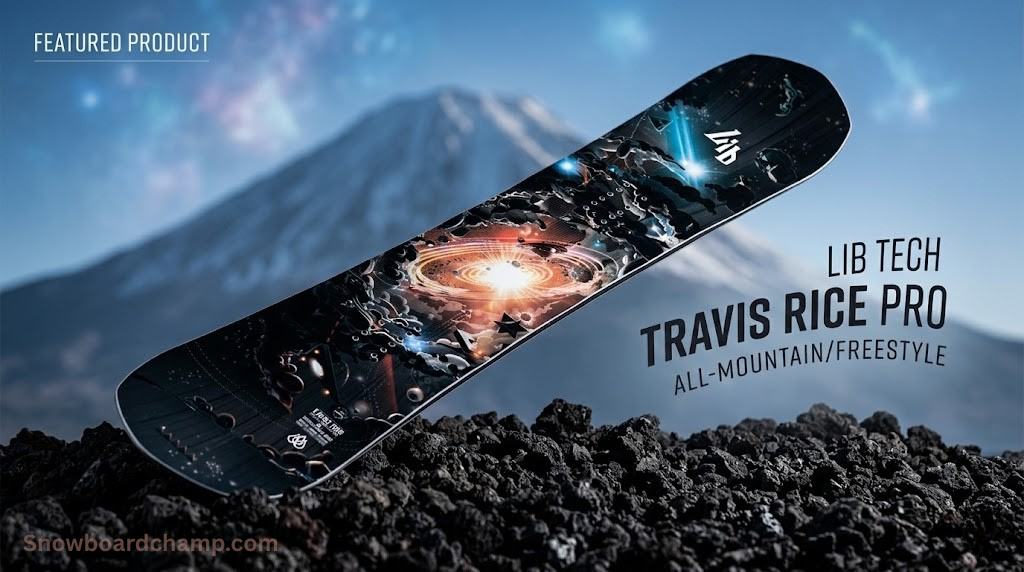
Lib Tech Travis Rice Pro
Snowboard Review

1. Overview & Quick Verdict
There are signature pro boards, and then there is the Lib Tech Travis Rice Pro. For over a decade, this board has sat at the intersection of elite big-mountain freeride performance and obsessive technical engineering. It is the board Travis Rice — arguably the most influential snowboarder alive — chooses when the stakes are as high as Tordrillo Range spines or Revelation Mountain pillow lines. The 2025–2026 edition continues that lineage with refinements to its Aspen/Paulownia wood core, upgraded bio-plant-based resin system, and Lib Tech’s signature wavy serrated Magne-Traction edge technology.
This is not a casual purchase. At its price point and with its demanding flex profile (an 8/10 stiffness), the Travis Rice Pro asks something of you in return: skill. In the right hands, it rewards with a riding experience that is genuinely hard to find elsewhere — a board that can charge 50-foot cliff drops at first light and pivot into a surfy pow session by noon without ever feeling like a compromise.
Quick Verdict: The Lib Tech Travis Rice Pro is a world-class, expert-oriented all-mountain freeride board with unmatched edge security, deep-powder float, and a construction standard that justifies every dollar of its premium price. If you’re an advanced-to-expert rider seeking a quiver-of-one for big, unpredictable mountains — this is as close to perfect as it gets.

Lib Tech Travis Rice Pro Snowboard
Made in USA · C3 BTX Banana Technology · Magne-Traction Edges · Bio-Plant Resin
🏔 Check Price on Amazon →2. Full Specifications & Sizing Guide
Before diving into ride feel, it helps to understand exactly what you’re working with dimensionally. Lib Tech publishes thorough sizing data, and the Travis Rice Pro line covers a meaningful range of sizes with both standard and wide variants for larger-footed riders. Using the right snowboard sizing guide is essential — particularly for this directional shape where the setback stance changes effective edge-to-edge calculations.
Size & Width Chart
| Size (cm) | Rider Weight | Boot Size (US) | Waist Width | Stance Width | Setback |
|---|---|---|---|---|---|
| 149 | 120–155 lbs | Up to US 9 | 248 mm | 490–550 mm | ~20 mm |
| 154 | 140–175 lbs | Up to US 10 | 252 mm | 495–560 mm | ~20 mm |
| 154W | 140–175 lbs | US 10–12 | 262 mm | 495–560 mm | ~20 mm |
| 157W | 150–185 lbs | US 10.5–12 | 265 mm | 500–565 mm | ~22 mm |
| 159 | 165–195 lbs | Up to US 10.5 | 257 mm | 510–570 mm | ~22 mm |
| 163W | 175–210 lbs | US 11–13+ | 270 mm | 520–580 mm | ~24 mm |
Sizing Note: Lib Tech recommends riding the Travis Rice Pro 1–2 cm shorter than a traditional directional board due to the wider waist and pronounced nose rocker. If you’re between sizes, go shorter — the rocker provides plenty of float, and a shorter length increases maneuverability in tight tree runs and steep chutes.


3. Construction & Materials: Built Differently
What sets Lib Tech apart from almost every other major snowboard brand isn’t marketing — it’s the actual factory. Lib Tech is built by Mervin Manufacturing in Sequim, Washington, one of the only remaining major snowboard companies manufacturing boards entirely in the United States. That domestic production isn’t just a talking point; it results in tighter quality control, faster design iteration, and a genuine commitment to eco-friendly manufacturing that would be difficult to enforce through overseas contracts.
Core Construction: Aspen & Paulownia Wood Blend
The Travis Rice Pro uses a blended Aspen/Paulownia wood core. Aspen provides the familiar lively, snappy pop that experienced Lib Tech riders know well. Paulownia is lighter and has a slightly softer, more dampened character — blending the two gives the board a pop that is energetic but not harsh, and a weight that stays surprisingly manageable for a stiff big-mountain board.
This matters a lot when you’re hiking a line in the backcountry — every pound you’re not carrying in your board is energy preserved. Understanding the total cost of a snowboard across its lifespan also reveals another advantage of Lib Tech’s construction: these boards hold up. The resin system they use (discussed below) is genuinely more durable under repeated flex cycles than standard petroleum-based epoxy.
Bio-Plant Fiber Resin System
Lib Tech uses a bio-based, plant-derived resin to saturate their fiberglass layers. Traditional snowboard construction relies on petroleum-based epoxy resins. Lib Tech’s bio-resin is functionally superior in one key area: flex memory. Standard epoxy can develop micro-fractures along the glass layers under repeated high-stress flexes, gradually delaminating the board from the inside out. The bio-resin system is molecularly more flexible, meaning it absorbs repeated flexing without cracking.
Paired with their use of Basalt fiber (a natural volcanic mineral fiber stiffer and lighter than standard fiberglass), the layup schedule produces a board that is unusually stiff for its weight. Knowing how sintered vs. extruded bases differ in speed and maintenance also helps here: the Travis Rice Pro uses a sintered base, which is porous at a molecular level, absorbs wax deeply, and is significantly faster and more durable than an extruded base.
Topsheet & Base Graphics
The Travis Rice Pro’s topsheet for 2025–2026 features Travis’s signature graphic aesthetic — bold, geometric, and visually charged in a way that feels earned rather than designed-by-committee. The base carries a sublimated graphic that won’t chip or peel. Both use UV-resistant print processes that hold their visual intensity through a full season.
Built in the USA. Built to Last.
Mervin Manufacturing’s bio-resin construction is in a class of its own. See current pricing and available sizes below.
View on Amazon →4. C3 BTX Banana Technology: The Profile Decoded
Lib Tech’s C3 BTX (Banana Technology) profile is one of the most significant board shape innovations in modern snowboarding. To understand why it works so well for the Travis Rice Pro’s intended terrain — massive, variable, unforgiving mountains — you need to understand what BTX actually is and why hybrid profiles outperform pure camber or pure rocker in real-world freeride conditions. For a deeper dive into the underlying physics of board profiles, our guide on camber vs. rocker profiles and their impact on control, pop, and float is worth reading before continuing.
How C3 BTX Works
The C3 BTX profile combines three zones of distinct geometry. Between the feet — the section beneath your bindings where the most loading and unloading occurs — Lib Tech runs a continuous rocker. This is the “banana” part: a slight upward bow, like a smiling mouth, that reduces edge contact in the center of the board. The result is a looser, catch-free feel at low and medium speeds, easier pivot turns, and a more forgiving response when landing off-axis in pow.
Outside the bindings, however, toward the nose and tail contact points, camber zones take over. This is where your edge engages hardpack and carves. These camber zones pre-tension the edge into the snow, delivering the same mechanical spring and precision you’d expect from a traditional full-camber board when you lay the board on edge at speed.
The net result is a board that feels loose and fun at slow speeds (easier for building confidence on technical lines) but absolutely locked-in and precise when you’re going fast and hard on edge. It also means the board handles variable terrain — the kind where one turn is on wind slab and the next is on breakable crust — better than a pure-camber board would, because the central rocker absorbs micro-inconsistencies without transmitting them directly through your knees.
This profile is particularly well-suited to the Travis Rice Pro’s design intent. Travis doesn’t just ride groomed runs and park — he drops into zones of the mountain where predictable edge behavior can literally be the difference between a clean line and an avalanche-level incident. The C3 BTX profile’s ability to deliver both float (from central rocker) and precision grip (from camber contact points) without making you choose between them is what elevates this board above single-profile alternatives. Compare this with what a pure camber or pure rocker profile would deliver, and the engineering rationale becomes immediately obvious.
5. Magne-Traction Edge Technology: The Science of Grip
Of all the technologies in the Travis Rice Pro, Magne-Traction is the one most likely to change the way you think about edge grip. Lib Tech’s founder Mike Olson patented this wavy, serrated edge design, and it remains one of the most functionally significant edge innovations in snowboard history. Here’s why it works.
What Magne-Traction Actually Does
A traditional snowboard edge is a continuous straight line of steel that contacts the snow at one point per edge when carving — the apex of your arc. Magne-Traction introduces seven contact bumps per edge, creating a wavy geometry that resembles a sine wave when viewed from above. Each of these bumps acts as an independent contact point.
On packed snow or ice — the conditions where most boards lose grip entirely — these seven contact points dig in independently. Even if two or three of those points hit an ice patch and momentarily lose grip, the remaining four or five maintain bite. The math works: seven chances to grip versus one. On hardpack, it’s a transformative difference. On ice, it’s practically the difference between riding and sliding.
For riders who spend time in the Alps, the Pacific Northwest, or any resort that sees heavy rain or warm spells followed by refreezing, Magne-Traction is less of a “nice to have” and more of a genuine safety technology. The DC Lock and Load camber profile offers interesting comparisons for hardpack stability, but no other manufacturer has replicated the raw effectiveness of Lib Tech’s seven-point serrated edge in an affordable, production-scale snowboard.
Maintenance Note: Magne-Traction edges require slightly more care during tuning. The wavy geometry means you can’t run a simple straight edge tool down the length of the board. Lib Tech and most ski shops have adapted to this, and the result is still a sharper, more effective edge than a straight edge after tuning. See our guide on removing rust from snowboard edges without damaging the base for edge maintenance fundamentals.
6. On-Snow Performance: The Full Ride Report
Theory is useful. Numbers are necessary. But none of it matters until the board is under your feet on a mountain that’s trying to kill you. Here’s a thorough account of how the Lib Tech Travis Rice Pro actually performs across real terrain.
First Impressions and Initial Responsiveness
Out of the lift and onto a moderate groomer for a warm-up run, the Travis Rice Pro’s stiffness is immediately noticeable. There’s no softness in the tip-to-tail flex for the first few turns — this board does not reward casual, passive riding. You need to commit your body weight through it with intention. Once you do, the responsiveness is immediate and precise. Edge engagement happens cleanly, without the delay or slop you sometimes feel from softer all-mountain boards.
The stance setback makes the nose feel ever-so-slightly removed — like the board wants to be ridden with your weight slightly back-center, which is exactly the position you want for charging open terrain. Riders who prefer a very forward stance in aggressive carving may find this takes adjustment, but it pays massive dividends in powder and on choppier terrain.
Speed Stability at High Velocity
This is where the Travis Rice Pro is, without question, among the best boards in any category. Push it above 45 mph on open alpine terrain and it settles into a damped, locked-in charge that gives you confidence to go even faster. The combination of stiff flex, dense core, and Magne-Traction edge bite means that even on sun-affected, variable snow that gets grabby and unpredictable, the board tracks consistently. Compare this to boards that chatter at speed — the vibration and inconsistency that makes fast riding feel precarious — and the difference is dramatic.
The sintered base’s speed in these conditions also matters. Properly waxed (always wax your snowboard for faster glide and follow regular waxing intervals for your riding frequency), the Travis Rice Pro glides with a fluency that feels genuinely fast. You can feel the difference between a board waxed three rides ago and one freshly waxed — keep this one waxed.
7. Powder & Backcountry: Float, Flow, and Fear-Zero Lines
If there’s a single terrain type the Travis Rice Pro was engineered specifically to dominate, it’s deep powder. This is Travis Rice’s natural habitat — helicopter drops into Alaskan spines, Japanese Japow lines, Patagonian couloirs — and every design decision in the board traces back to enabling those experiences. Understanding backcountry technique and safety is vital here too — before charging the most serious terrain, review backcountry snowboard safety protocols and snowpack stratigraphy and geometry for backcountry decisions.
Powder Float Mechanics
Float in deep snow is a function of three interacting variables: nose rocker geometry, effective board surface area, and stance setback. The Travis Rice Pro scores high on all three. The pronounced nose rocker begins early and lifts aggressively, preventing the nose from diving on steep pow faces where boards with flat or camber-only noses will submarine. The wide waist adds surface area that displaces snow laterally rather than plowing through it. And the setback stance ensures your weight naturally biases toward the tail, keeping the nose elevated without requiring active compensation.
In a consistent 60cm blower powder day, the Travis Rice Pro surfs. There’s no other word for it. The combination of rocker and board geometry creates a flow state that’s difficult to achieve on anything less specialized. You can link turns at speed, bank off natural features without losing momentum, and occasionally throw in a tail press or nose press with the front foot in the rocker zone to create playful rebound moments.
Backcountry Splitboard Note
The Travis Rice Pro is not offered as a splitboard in its standard form — though Lib Tech’s wider lineup includes split options. For resort powder days and lift-accessed big-mountain zones, the standard board is ideal. For dedicated backcountry touring, you’d want to look at Lib Tech’s split options or pair a separate splitboard setup — see our overview of what a splitboard is and how snowboarders ride uphill for context.
Variable Pow & Chop
Real pow days are never perfectly consistent. Wind-affected slopes, high-traffic zones, and variable aspect angles all create a chop-and-pow mix that punishes boards that are too stiff (no rebound) or too soft (no control). The Travis Rice Pro threads this needle admirably. The C3 BTX rocker absorbs the inconsistency between your feet, while the stiff tail and Magne-Traction camber zones keep the board tracking consistently when the chop tries to knock you sideways. For those interested in deep science on powder riding terrain, our piece on Colorado snow density and glide metrics is relevant context.
Ready for Your Best Pow Day Yet?
The Travis Rice Pro is built for the moments you’ve been training for. Check current pricing and size availability.
Check Price & Availability →8. Hardpack, Ice & Carving: Where Magne-Traction Pays Off
If the Travis Rice Pro’s powder performance is elite, its hardpack and ice performance is arguably even more impressive — because hardpack demands something that most powder-focused boards sacrifice entirely: edge grip.
Edge Grip on Ice
Most boards marketed as “all-mountain” quietly fail on ice. The edges slip, the body compensates with a defensive posture, speed drops, and confidence evaporates. The Travis Rice Pro does something different. On a refrozen mogul field at midday, where the surface has the consistency of polished concrete, the Magne-Traction edge grips with a reliability that feels almost alarming. You can make aggressive carving turns at angles that would result in a flat-spin out on a standard edge, and the board just holds.
This has real implications for those looking to progress in carving technique. Learning how to carve on a snowboard with proper edge control and angulation becomes significantly less stressful when you know the board won’t slip out from under you mid-carve. The Magne-Traction’s reliability builds confidence loops that accelerate skill development.
Groomer Carving Performance
On a well-groomed blue run, the Travis Rice Pro carves in a manner that borders on addictive. The camber zones in the nose and tail generate genuine mechanical spring — lay the edge hard into a groomed slope and the board stores energy through the arc, releasing it at the exit with a pop that drives the next turn. The directional shape makes the tail feel planted and stable through carves, while the nose rocker means the tip doesn’t catch when initiating.
For riders with a technical carving background, the Travis Rice Pro is simultaneously more specific (directional, setback) and more capable (Magne-Traction) than most dedicated carving boards in a comparable price range. The GNU Banked Country also uses Magne-Traction for carving grip, but the T-Rice Pro’s larger size range and directional shape give it an edge (literally) in high-speed stability.
9. Park & Freestyle: Honest Limitations
Honesty demands acknowledging where the Travis Rice Pro falls short, and the park is that place. This is not a criticism — it’s by design. A board optimized for Alaskan big-mountain riding cannot also be optimized for jibbing rails and small kickers. The physics don’t allow it. But it’s important for prospective buyers to have clear expectations.
What It Can Do in the Park
The Travis Rice Pro handles large natural features and big kickers brilliantly. If your park riding involves 60-foot jumps, massive hip features, or backcountry natural booters — the same features Travis himself likes — the board delivers. The stiff flex returns energy through landings efficiently, the Magne-Traction grips the in-run ice, and the C3 BTX profile’s rocker helps absorb heavy landings.
For riders working through trick progression from butters to airs, the Travis Rice Pro can accommodate medium-skill butters and presses thanks to the rocker between the feet, and its pop supports solid ollies and nollies. Those looking to build freestyle skills will appreciate our guide to the ollie and tail pop mechanics.
What It Struggles With
Small park features, rails, boxes, and urban-style jibbing are a poor match. The stiffness penalizes you on small features where soft boards wrap and flex to give you feel and control. Switch riding is possible but awkward — the directional shape and setback stance make it work, but this board is not designed for a switch-heavy park style. If park is your primary terrain, look at the Lib Tech Skate Banana or Lib Tech’s dedicated park options instead.
Not a Park Board. A Mountain Board.
If your mission is big terrain, open faces, and deep snow — this is your board. Check what sizes are in stock.
See Available Sizes →10. Who Should Buy the Travis Rice Pro?
The best gear decision is one made with honest self-assessment. The Travis Rice Pro is not for everyone, and that’s entirely intentional. Here’s a frank breakdown of who benefits most — and who should look elsewhere.
- An expert or advanced-intermediate rider with solid carving fundamentals
- A big-mountain or all-mountain rider who frequently encounters varied, challenging terrain
- Someone who rides hard snow, ice, or variable conditions and needs reliable edge grip
- A pow hound who wants deep float without sacrificing hardpack capability
- A rider who values US-made, eco-friendly construction and premium materials
- Someone wanting a quiver-of-one for serious all-mountain exploration
- A rider planning backcountry excursions from lift-accessed terrain
- A beginner or early-intermediate rider — the flex will work against you
- Primarily a park and freestyle rider who spends most of their time on rails and small features
- Someone who primarily rides mellow groomers where hardpack performance is secondary
- Looking for a budget-conscious option — premium construction comes with a premium price
- A rider who favors heavy switch riding or a twin-tip symmetrical shape
- Someone whose boot size requires a very narrow waist (the wide variants exist, but standard sizes may not fit large feet)
Ideal Rider Profile
The ideal Travis Rice Pro rider has been snowboarding for at least 5–7 seasons, has strong edge-to-edge technique, and regularly seeks out the steepest, most varied terrain at their home mountain. They’re equally comfortable in the backcountry and on resort groomers. They understand that proper snowboard stance setup is crucial and have dialed in their angles — likely 18–24° front, 0–9° rear for a freeride bias. They also invest in their fitness — core strength for snowboarding and pre-season fitness preparation make a real difference when riding a stiff, demanding board at speed.
11. How It Stacks Up: Competitor Comparison
The all-mountain freeride category is competitive. Several excellent boards target the same capable, serious rider. Here’s how the Travis Rice Pro compares against its most direct competitors.
| Board | Profile | Flex | Shape | Powder | Hardpack | Park | Made In |
|---|---|---|---|---|---|---|---|
| Lib Tech T-Rice Pro | C3 BTX (Hybrid) | 8/10 | Directional | ●●●●● | ●●●●● | ●●○○○ | USA |
| Burton Skeleton Key | Freeflow (Rocker) | 7/10 | Directional | ●●●●○ | ●●●○○ | ●●●○○ | China |
| Jones Flagship | Camber | 8.5/10 | Directional | ●●●●○ | ●●●●● | ●○○○○ | UAE |
| GNU Banked Country | C3 BTX (Hybrid) | 7.5/10 | Directional | ●●●●○ | ●●●●○ | ●●○○○ | USA |
| Arbor Element Rocker | System Rocker | 5.5/10 | True Twin | ●●●○○ | ●●○○○ | ●●●●○ | USA |
| Capita Mercury | Camber | 7/10 | True Twin | ●●●○○ | ●●●●○ | ●●●●○ | Austria |
Travis Rice Pro vs. GNU Banked Country
Both boards share Mervin Manufacturing DNA and Magne-Traction edges, making this one of the most interesting comparisons. The GNU Banked Country is softer and slightly more forgiving, making it accessible to a wider range of riders. The Travis Rice Pro is stiffer, faster, and more demanding — it rewards expert riders with better high-speed stability and more direct edge communication. If you’re between the two: ask yourself honestly whether you charge terrain at speed or prefer to cruise and explore. The T-Rice Pro is for chargers.
Travis Rice Pro vs. Jones Flagship
The Jones Flagship is a pure-camber board — exceptional on hardpack, aggressive on ice, and technically brilliant for carving. It has no rocker at all, which means it’s slightly less playful in powder and slightly more demanding to initiate. The Travis Rice Pro’s C3 BTX hybrid gives it better float and more versatility across terrain types. For purely piste-focused riding, the Flagship may have an edge; for mixed-terrain all-mountain use, the T-Rice Pro wins.
12. Recommended Setup: Bindings, Boots & Stance
The Travis Rice Pro’s performance ceiling is high, but reaching it requires pairing it with appropriate bindings and boots. The wrong setup can make this board feel unresponsive, muted, or even punishing. Get it right and everything clicks.
Binding Recommendations
The Travis Rice Pro demands bindings that are stiff enough to translate your body movements directly to the board without losing energy in flex. Soft or medium bindings create a dead zone between foot pressure and board response that dulls the board’s precision edge communication.
| Binding | Flex | Best For | Compatibility Notes |
|---|---|---|---|
| Union Atlas | 8/10 Stiff | Freeride, Hardpack | Excellent match — ultra-direct, lightweight |
| Burton Cartel X | 9/10 Very Stiff | Aggressive Freeride | Strong match — great for larger riders |
| Union Strata | 7/10 Medium-Stiff | All-Mountain, Versatility | Good match for riders wanting some playfulness |
| Bent Metal Transfer | 8/10 Stiff | Freeride, Carving | Excellent match — dampened feel, great heel cup |
| Union Force | 6/10 Medium | Versatile All-Mountain | Acceptable — loses some of the board’s precision |
Boot Recommendations
Stiff boots (7–9/10) are the natural pairing. The kinetic response of your boots plays a massive role in how the board’s flex translates to edge pressure. Boots to consider include the Burton Ruler BOA, K2 Aspect, or the K2 boot lineup that excels in urethane rebound performance. For riders with wide feet, make sure you’re selecting the Wide (W) board variants to avoid toe and heel drag — our guide to the best snowboard boots for wide feet is useful here. Also critically: ensuring your boots fit well prevents the plantar fascia strain and foot pain common in snowboarding.
Stance Angles & Width
| Setting | Freeride/Big Mountain | Carving Focus | Powder Focus |
|---|---|---|---|
| Front Angle | 21°–24° | 24°–27° | 18°–21° |
| Rear Angle | 3°–9° | 9°–12° | 0°–6° |
| Stance Width | Shoulder-width + 2cm | Shoulder-width | Shoulder-width + 3cm |
| Setback on Board | Use factory setback | Center slightly | Max setback |
For detailed guidance on dialing in your stance, our comprehensive snowboard stance setup guide and the primer on goofy vs. regular stance biomechanics cover everything you need to know about optimizing your position on this board.
Don’t overlook binding hardware. Quality binding components matter, and for a board at this price point, under-investing in bindings is a common and costly mistake. Also consider: BOA vs. speed-lace boot closures affect heel lock and response, and eliminating heel lift in your boots is crucial for maximizing the precise edge communication the Travis Rice Pro is built to deliver.
Complete Your Setup
The Travis Rice Pro is ready for you. Pair it right and it’ll be the best riding decision you’ve ever made.
Buy the Lib Tech T-Rice Pro →Full Pros & Cons Breakdown
- Magne-Traction delivers best-in-class edge grip on ice and hardpack
- C3 BTX profile offers the best of rocker (float, catch-free) and camber (power, precision)
- USA-made with eco-friendly bio-plant resin — durable and conscience-clear
- World-class powder float from pronounced nose rocker and setback stance
- Exceptional high-speed stability for big-mountain charging
- Premium sintered base — fast, wax-absorbent, long-lasting
- Wide variant options accommodate larger boot sizes without toe/heel drag
- Backed by over a decade of Travis Rice’s big-mountain design input
- Aspen/Paulownia core provides ideal pop-to-weight balance
- Lifetime warranty against manufacturing defects from Mervin/Lib Tech
- Stiff flex punishes beginners and casual riders
- Not well-suited to park, rails, or jibbing
- Directional shape limits switch riding effectiveness
- Magne-Traction requires specialized edge tuning tools/skills
- Premium price point may not be justified for occasional riders
- Setback stance requires adjustment for riders used to centered positions
- Heavy relative to ultra-light freestyle boards (though competitive for freeride)
Frequently Asked Questions
Conclusion & Final Verdict
Lib Tech Travis Rice Pro
Expert All-Mountain Freeride Board · Season 2025–2026
The Lib Tech Travis Rice Pro is, by any rigorous measure, one of the finest snowboards ever made for the rider it’s designed for. It is not trying to be everything. It is trying to be the best possible tool for expert-level, all-mountain freeride riding on real, serious, unpredictable terrain — and it achieves that with a consistency and conviction that is genuinely rare.
The Magne-Traction edge technology isn’t a gimmick — it’s a measurable, functional advantage in the conditions that matter most. The C3 BTX profile hybrid isn’t a compromise — it’s a deliberate solution to a real problem that pure-camber and pure-rocker boards each fail to fully address. The USA-made, bio-plant resin construction isn’t marketing copy — it’s genuinely more durable and eco-conscious than standard alternatives.
If you ride hard, ride varied terrain, and want a board that can keep up with your ambitions on any mountain on earth — this is as close to the right answer as the industry currently offers. Travis Rice didn’t put his name on this board as a commercial arrangement. He rides it because it’s the board he needs. That means something.
Before you buy: Make sure you have the right bindings, boots, and stance setup to let the Travis Rice Pro express its full potential. A premium board with a mismatched setup is money wasted. Check our complete snowboard bindings guide and snowboard boots guide for setup help.
Lib Tech Travis Rice Pro — Final Call
Ready to ride the board Travis Rice trusts with his life on the world’s biggest mountains? Check the latest pricing and size availability on Amazon now.
🏔 Buy on Amazon — Best Price →


