
Neither Fish nor Fowl: The Directional Twin Unlocks One‑Board Freedom
1. What Exactly Is a Directional Twin Snowboard?
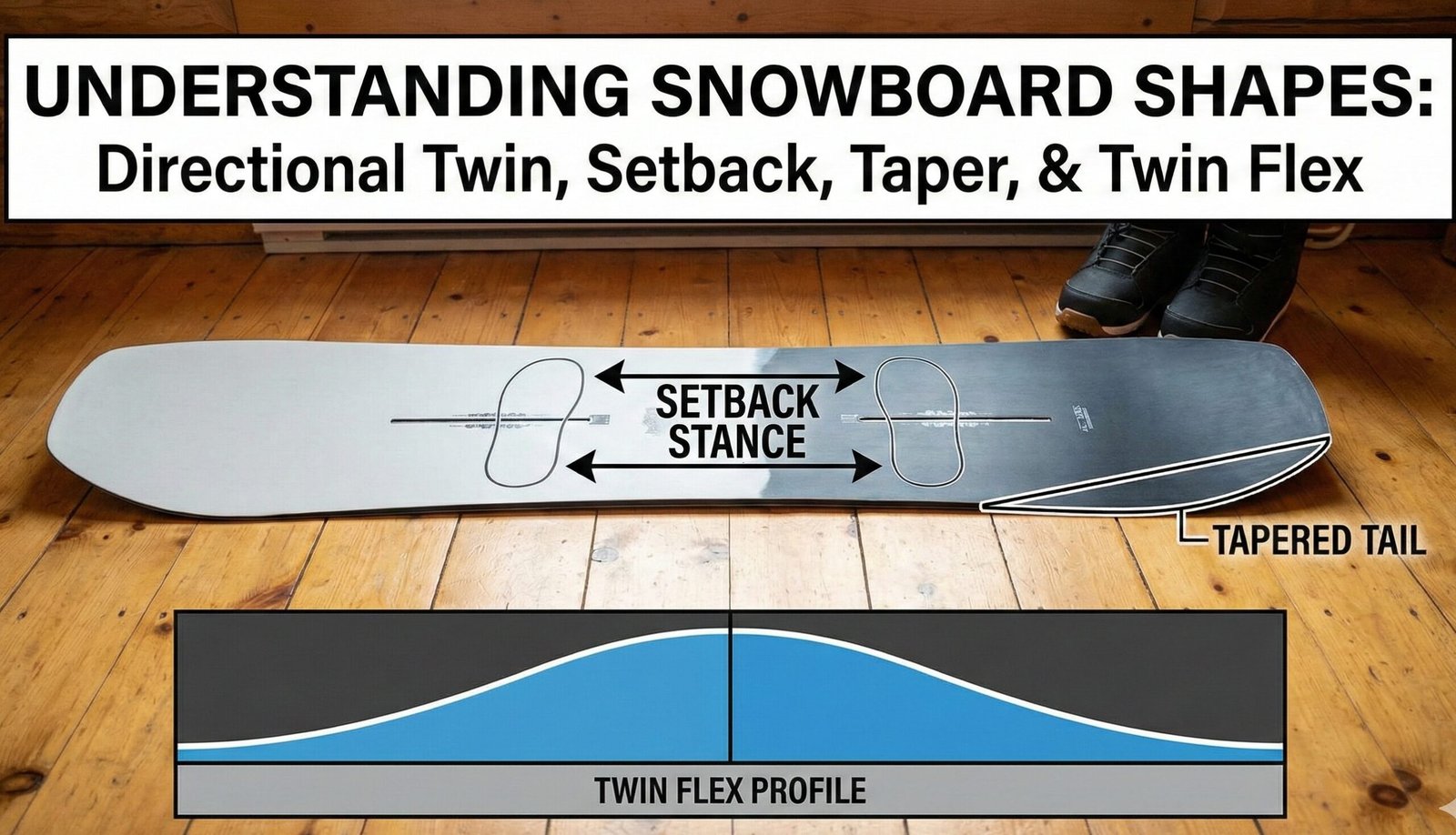
A directional twin is the snowboard world’s most elegant compromise. Visually, it looks like a twin: symmetrical tip and tail shape. But beneath the surface, it’s directional: the inserts are set back (usually 1–2 cm), the nose is slightly softer than the tail, and often the tail is a touch narrower (taper). This allows the board to ride switch adequately, but float powder naturally and charge with authority. It’s the quiver killer for riders who do everything—groomers, trees, occasional park, and sidecountry.
The International Snowboard Manufacturers Association classifies directional twin as: “symmetrical outline, asymmetrical core density and stance offset.” In plain language: it’s a true twin’s body with a directional rider’s soul. The outline measurements are virtually identical from tip to tail when you trace the board on a table, yet the internal architecture—wood grain density, carbon stringer placement, fiberglass layup—is deliberately biased toward the tail for drive and the nose for forgiveness.
What makes this shape class so compelling is that it solves a genuine engineering tension. A true twin excels at switch riding and freestyle but floats poorly in powder. A full directional board crushes deep snow but feels like driving a bus when you try to ride backward. The directional twin threads the needle by keeping the external geometry nearly symmetrical while engineering asymmetry into the internal construction. The result is a board that feels familiar in every direction but rewards a forward-riding stance with better float, cleaner turns, and more aggressive edge hold than any true twin can match.
For deeper shape taxonomy, our directional vs twin snowboards: shape, control, switch, float guide breaks down the full spectrum from perfectly symmetrical to radically directional, with measured examples of each category.
Understanding the directional twin also means understanding what it is not. It is not a volume-shifted board (which changes width-to-length ratios). It is not a hybrid shape (which blends characteristics of two shapes within a single outline). It is not an asymmetrical board (which has different heel and toe sidecut radii). The directional twin is a specific, well-defined geometry: same outline, offset stance, differential flex, optional taper. That clarity is why manufacturers keep returning to it and why riders keep buying it—it works because the engineering is honest and the performance envelope is wide.
2. History & Evolution of the Directional Twin
The directional twin didn’t emerge from a marketing department—it was born from rider frustration. In the early 1990s, snowboard design was polarized. On one side were the true twins: symmetrical boards designed for the emerging freestyle movement. On the other were the directional shapes: setback, tapered, often with swallowtails, built exclusively for powder and speed. Riders who wanted to do both were forced into awkward compromises or bought two boards.
The breakthrough came when shapers like Jake Burton and Tom Burt began experimenting with setback inserts on twin-shaped boards. The concept was radical at the time: keep the outline symmetrical so the board would feel the same in either direction, but shift the binding inserts back so the rider’s weight naturally biased toward the tail. This simple geometric offset transformed how the board handled in powder—the nose rose without the rider needing to lean back, and the tail drove through turns with more authority.
By the late 1990s, brands like Option and Salomon were producing boards that explicitly straddled the twin-directional divide. The Salomon Dialogue, first released in 1998, became a landmark directional twin. Its setback inserts, camber profile, and twin-shaped outline proved that a single board could genuinely excel across terrain types. The Dialogue’s success spawned an entire category—suddenly every manufacturer needed a directional twin in their lineup.
The 2000s brought refinements rather than revolutions. Camber profiles evolved from traditional camber to camber-rocker hybrids (camrock), which improved powder float without sacrificing edge hold. Manufacturers experimented with flex differentials—softer noses for chatter absorption and float, stiffer tails for drive and pop. Taper was introduced as an optional feature: a 2–6 mm narrowing of the tail that enhanced powder performance without noticeably affecting switch riding.
The 2010s saw directional twins become the dominant all-mountain shape. Jones Snowboards, founded by big-mountain rider Jeremy Jones, made the directional twin synonymous with backcountry capability. The Jones Mountain Twin, released in 2013, became the category benchmark—2 cm setback, camrock profile, 6/10 flex. It proved that a directional twin could charge hard-charging terrain while remaining playful enough for park laps. Capita’s Mercury and Ride’s Algorhythm followed, each adding brand-specific innovations like carbon stringers and sintered bases to the directional twin formula.
Today, the directional twin has become the default recommendation for intermediate-to-advanced all-mountain riders. It is the most common shape in rental fleets at destination resorts, the top seller in board shops worldwide, and the shape that most online buying guides recommend first. Its dominance reflects a simple truth: most riders don’t spend 100% of their time in one terrain type, and the directional twin is the best single-board solution for mixed-terrain riding.
The evolution continues. Modern directional twins incorporate 3D base profiles (like Jones’ Spoon technology), multi-axis carbon stringers (like Capita’s HOLYSHEET construction), and AI-designed sidecut geometries that optimize turn initiation and exit for specific rider weights. The fundamental concept—symmetrical outline, offset stance, differential flex—remains unchanged. What changes is the precision with which manufacturers can tune each element.
3. Anatomy: The 4 Pillars of Directional Twin Geometry
📐 1. Setback stance (1.5–2.5 cm)
Reference stance is shifted toward tail. When you center your bindings, you’re already riding slightly tail-heavy. This lifts the nose in deep snow without needing to lean back. The setback distance is carefully calibrated: too little and you lose powder float; too much and switch riding becomes uncomfortable. Most manufacturers settle on 1.5–2.5 cm, which research and rider testing have shown to be the sweet spot where forward performance improves without meaningfully degrading backward performance.
Setback also affects how the board initiates turns. With weight biased toward the tail, the nose becomes the “attack” end of the board—it enters the turn first, unweighted and responsive. This produces a surfing feel that many riders prefer over the locked-in sensation of a centered true twin. On groomed runs, the setback creates a slight delay in turn initiation that experienced riders use to control speed and line through variable terrain.
📏 2. Taper (2–6 mm narrower tail)
Tail width slightly less than nose width. Tail sinks less, releases turns easier, and doesn’t drag in powder. Minimal taper retains switchability. Taper works in concert with setback: the narrower tail sinks into powder, the setback positions weight over the sinking end, and together they produce natural float without rider effort.
The degree of taper matters. At 2 mm, taper is imperceptible in switch riding—it’s a subtle performance boost that most riders never consciously notice. At 4–6 mm, taper becomes more pronounced: the board carves cleaner arcs, the tail releases from turns with less chatter, and powder float improves significantly. However, heavier taper also makes switch riding less comfortable, pushing the directional twin closer to full directional territory. Most directional twins cap taper at 3–4 mm to preserve their dual-direction character.
🔄 3. Flex differential (softer nose, stiffer tail)
The nose absorbs chatter and floats; tail provides pop and drive. Not as extreme as a pure directional, but noticeable. The flex differential is achieved through core profiling: thinner wood at the nose, thicker at the tail, combined with asymmetric fiberglass layups. Some manufacturers add carbon stringers only in the tail section, creating a zone of increased snap and energy return where the rider’s back foot loads the board.
The flex differential creates two distinct performance zones. The nose, being softer, conforms to terrain variations—bumps, crud, powder—rather than fighting them. This produces a smooth, chattery-free ride that absorbs impacts before they reach the rider’s legs. The stiffer tail provides the foundation for powerful turns, aggressive carving, and ollie pop. When you load the tail for a jump, the differential flex stores and releases energy more efficiently than a uniform flex pattern.
⚖️ 4. Symmetrical sidecut radius
Unlike true asymmetrical boards (see asymmetrical snowboards benefits), directional twins usually keep identical sidecut on heel/toe edges, but some add mild heel-side bevel. The symmetrical sidecut ensures that the board turns identically whether you’re on your heel or toe edge—critical for maintaining the twin-like feel that makes switch riding possible.
Sidecut radius determines the board’s natural turning arc. A deeper sidecut (shorter radius, like 7m) produces tight, quick turns ideal for trees and moguls. A shallower sidecut (longer radius, like 9m) creates wide, sweeping arcs suited to groomed runs and open bowls. Most directional twins fall in the 7.5–8.5m range, providing versatility across terrain types. Some boards feature progressive sidecut—multiple radii blended together—that starts with a tight radius at the contact points for easy turn initiation and opens up through the waist for stable, powerful arcs.
4. Camber Profiles for Directional Twins: What’s Under Your Feet
The camber profile—the shape of the board when viewed from the side—is arguably the most important performance variable in a directional twin. While the setback, taper, and flex differential define how the board should behave, the camber profile determines how it actually feels on snow. Most directional twins use one of three camber configurations, each with distinct performance characteristics.
Traditional Camber
The original snowboard profile. The board arcs upward between the contact points, with the center of the board hovering above the snow when unweighted. When the rider stands on it, the camber flattens, distributing pressure evenly across the effective edge. Traditional camber delivers the sharpest edge hold, the most pop, and the most responsive feel. It’s the profile of choice for aggressive riders who prioritize carving performance. The tradeoff: traditional camber is less forgiving. It catches edges more easily, requires precise weight distribution, and doesn’t float as well in powder without proper setback. For a directional twin with built-in setback, traditional camber works well—the setback compensates for the reduced float, and you get maximum carving performance in return.
CamRock (Most Common)
CamRock combines camber underfoot with rocker at the tip and tail. This is the dominant profile for directional twins—and for good reason. The camber zone under your bindings provides edge hold, pop, and carving precision. The rocker zones at the ends provide float, forgiveness, and easier turn initiation. CamRock is the Swiss Army knife of camber profiles: it handles hardpack, powder, park, and crud with equal competence. The rocker at the nose is typically more pronounced than at the tail, which enhances powder float while maintaining the stiffer tail’s drive and pop. Most Jones, Capita, and Ride directional twins use variations of CamRock.
Flat-to-Rocker
Flat-to-rocker replaces the camber zone with a flat section between the bindings. The board sits flat on the snow with gentle rocker rising at both ends. This profile is the most forgiving option: no camber to catch an edge, no aggressive rebound to manage. It’s ideal for intermediate riders stepping up to their first directional twin, or for anyone who prioritizes playful, surfy feel over aggressive carving. The tradeoff is reduced edge hold on hardpack and less pop for ollies and nollies. Some riders find flat-to-rocker directional twins feel “dead” compared to camber versions—the board absorbs energy rather than returning it.
Hybrid Camber (Full Camber + Full Rocker)
A less common but increasingly popular profile: traditional camber through the middle with full rocker at both tips. This creates a board that excels on groomed runs (camber provides edge hold and pop) while still floating in powder (rocker lifts the nose). Hybrid camber directional twins tend to feel stiffer and more planted than CamRock versions, making them better suited to advanced riders who want charging capability without sacrificing versatility.
| Profile | Edge hold | Powder float | Pop | Forgiveness | Best for |
|---|---|---|---|---|---|
| Traditional Camber | Excellent | Moderate | Excellent | Low | Aggressive carving |
| CamRock | Very good | Good | Good | High | All-mountain versatility |
| Flat-to-Rocker | Moderate | Good | Moderate | Very high | Playful all-mountain |
| Hybrid Camber | Excellent | Very good | Very good | Moderate | Charging all-terrain |
For a deeper dive into how camber shapes affect snowboard performance, our camber vs rocker guide explains the physics behind each profile and provides model-specific recommendations.
5. Core Materials & Construction Technology
What separates a $300 directional twin from a $700 one isn’t just the shape—it’s what’s inside. The core construction determines weight, flex pattern, energy return, durability, and ultimately how the board performs on snow. Understanding these materials helps you evaluate whether a higher price tag translates to real performance benefits or just marketing.
Wood Core Types
The core is the skeleton of the board. Most directional twins use one of three wood types, often in combination:
Paulownia is the lightest common core wood, roughly 40% lighter than poplar while maintaining good strength. Boards with paulownia cores feel energetic and quick—less swing weight means easier spins, faster edge-to-edge transitions, and reduced leg fatigue over a full day. Jones and Capita favor paulownia in their premium directional twins. The tradeoff: paulownia is softer and can feel “lively” in ways that aggressive riders may find uncontrolled.
Poplar is the workhorse. Heavier than paulownia but significantly more durable, poplar provides consistent flex and reliable pop over seasons of hard use. It’s the most common core material in mid-range directional twins and offers the best balance of weight, performance, and longevity. Ride and Salomon use poplar-dominant cores in their all-mountain lines.
Beech appears as stringers or reinforcement strips rather than full cores. Beech is extremely stiff and dense—adding beech to a core increases edge hold and power transfer without adding weight across the entire board. Capita’s HOLYSHEET construction uses beech stringers running lengthwise through the core to create zones of targeted stiffness.
Carbon Stringers & Reinforcement
Carbon fiber stringers are thin strips of carbon laminate embedded in the core, usually running tip-to-tail. They serve two purposes: reducing weight (carbon is lighter than wood at equivalent stiffness) and increasing energy return (carbon’s high modulus of elasticity means it stores and releases energy efficiently). A directional twin with carbon stringers will feel snappier, pop more off jumps, and maintain its flex pattern longer than an equivalent board without carbon.
Different manufacturers place carbon differently. Jones uses Power Core construction with carbon stringers running the full length of the board, increasing stiffness uniformly. Capita’s HOLYSHEET uses basalt and carbon in a cross-pattern, creating multi-directional energy transfer. Ride employs Carbon Array technology with carbon strips positioned specifically over the binding areas, concentrating stiffness where the rider’s weight loads the board most.
Fiberglass Layup
Fiberglass provides the board’s torsional stiffness—the resistance to twisting along its length. Most directional twins use biaxial fiberglass (fibers running at 0° and 90°), which provides predictable flex and good torsional response. Premium models add triaxial fiberglass (fibers at 0°, 45°, and -45°) for increased torsional stiffness without adding weight. This produces a more responsive board that holds edges better at high speed and initiates turns with less rider input.
Base Materials
The base is the only part of the board that touches snow, and its material determines speed, durability, and wax absorption. Extruded bases are cheaper, more durable, and require less maintenance—they’re the default for entry-level directional twins. Sintered bases are porous, faster when waxed, and better at retaining wax over time. They require regular waxing but reward the effort with significantly higher top speeds. Most mid-range and premium directional twins use sintered bases, and the difference is noticeable: a well-waxed sintered base will outrun an extruded base by 15–20% in speed tests.
6. Directional Twin vs True Twin: Switch Sacrifice?
True twin = perfectly centered stance, identical nose/tail shape, flex, and width. Ideal for park, halfpipe, and butter tricks. Directional twin retains about 80–90% switch capability. Most riders won’t notice the difference unless riding switch in deep snow or spinning big jumps. For park rats who ride 50% switch, true twin still wins. But for all-mountain riders who occasionally ride switch off sidehits, directional twin is seamless.
The key insight is that switch riding on a directional twin is a matter of degree, not kind. The setback is typically only 1.5–2 cm—barely noticeable in most riding situations. The nose and tail have the same shape, so the board tracks predictably in either direction. The only real difference is the flex differential: the nose is softer than the tail, so when you ride switch, the tail (now your leading end) is stiffer than the nose (now your trailing end). This stiffness difference is minor at low speeds but becomes noticeable in deep powder, where the softer “tail” (your leading end in switch) doesn’t float as well as a true twin’s symmetrical nose would.
| Feature | True twin | Directional twin |
|---|---|---|
| Stance position | Absolute center | Setback 1–2.5cm |
| Nose/tail width | Identical | Tail slightly tapered |
| Flex pattern | Balanced | Softer nose, stiffer tail |
| Switch riding | 100% | 85–90% |
| Powder float | Poor (needs setback) | Good (built-in setback) |
| All-mountain versatility | Moderate | Excellent |
| Carving edge hold | Good | Very good |
| Ollie pop | Balanced | Enhanced (stiffer tail) |
| Price range | $300–$600 | $350–$700 |
7. Directional Twin vs Full Directional: The Freeride Spectrum
Full directional boards (e.g., Jones Flagship, Lib Tech Orca) have exaggerated taper, significant setback (4cm+), and often a swallowtail or pintail. They dominate deep powder and steep couloirs but feel clumsy riding switch and in tight trees. Directional twin splits the difference: you get 75% of the directional’s float with 90% of a twin’s playfulness. It’s the sweet spot for 80% of riders.
The fundamental difference lies in purpose. A full directional board is designed for one thing: riding forward in challenging terrain. Every design choice—deep setback, aggressive taper, stiff flex, rockered nose—is optimized for forward performance in powder and on steep faces. This singular focus produces extraordinary performance in those conditions, but it comes at the cost of versatility. Ride switch on a full directional board and you’ll immediately feel the imbalance: the tapered tail sits higher in snow, the deep setback makes the nose feel light and unresponsive, and the stiffer flex makes the board feel dead underfoot.
A directional twin, by contrast, makes deliberate compromises to preserve versatility. The setback is modest (1.5–2.5 cm vs. 4+ cm), the taper is minimal (2–4 mm vs. 6–10 mm), and the flex differential is subtle rather than extreme. These choices mean the board performs slightly worse than a full directional in deep powder (75% of the float) but dramatically better when riding switch, hitting park features, or navigating tight trees. For the rider who spends 30% of their time in powder, 40% on groomers, 20% in trees, and 10% in the park, the directional twin is objectively the better choice.
The math is straightforward: if you spend more than 70% of your time in deep powder and steep terrain, a full directional board will serve you better. If you spend less than 30% in powder, a true twin will serve you better. For the 40–70% powder riders—the vast majority of resort and backcountry riders—the directional twin is the optimal choice. Our directional vs twin guide includes a float coefficient chart that quantifies these differences across 15 board models.
8. The Physics of Setback + Twin Flex
From a biomechanics perspective, a setback stance shifts the rider’s center of mass rearward. In powder, this lifts the nose via displacement hull physics—the same reason rocker works. But unlike full rocker, a directional twin usually features camber underfoot (or camrock). So you retain edge leverage and pop. The narrower tail reduces swing weight, making pivot turns effortless.
The physics becomes clearer when you examine buoyancy. In powder, a snowboard acts like a boat hull: the board must displace enough snow to support the rider’s weight without sinking. With a centered stance, roughly 50% of the rider’s weight sits over each end of the board. The nose must lift its share of weight while plowing through fresh snow—a recipe for nose-diving. With a setback stance, 60% of the weight sits over the tail and 40% over the nose. The nose, now carrying less weight, rides higher in the snow. The tail, carrying more weight, sinks slightly—exactly the behavior you want, because it keeps the nose elevated while maintaining edge contact.
The twin flex adds another layer. A softer nose deforms more easily over bumps and variable snow, conforming to terrain rather than fighting it. This produces a smoother ride and prevents the chatter that plagues stiff-nosed boards in crud. The stiffer tail provides a solid platform for loading ollies and absorbing landings. The differential creates a natural “energy flow” through the board: the nose absorbs, the waist transfers, the tail releases. This is why directional twins feel more alive and dynamic than true twins with uniform flex—they have built-in energy management.
Swing weight is another critical factor. Swing weight measures how much resistance the board offers when rotated around its center. A directional twin with a narrower tail has lower swing weight than an equivalent true twin, because the mass at the ends is reduced. Lower swing weight means easier spins, faster edge-to-edge transitions, and less effort in butter tricks. This is why many freestyle riders prefer directional twins over true twins for jibbing—the reduced tail mass makes 180s and 360s off features feel effortless.
For a deeper explanation of displacement hull physics and how setback amplifies float without a fully rockered profile, see why snowboarding is so fun: displacement hull physics.
9. The Complete Sizing Guide: Choosing the Right Directional Twin
Choosing the right size directional twin is more nuanced than picking a board that reaches your chin. The setback, taper, and flex differential all affect how the board behaves at different lengths—and getting the size wrong can undermine every other design feature. This guide provides a systematic approach to finding your ideal length and width.
Length Selection
The traditional “chin-to-nose” sizing method is a starting point, but it ignores rider weight, which is the more important variable. A 160 lb rider on a 156 cm board will have a completely different experience than a 200 lb rider on the same board. Modern sizing recommendations use weight-based sizing as the primary factor, with height as a secondary check.
| Rider weight (lbs) | Recommended length (cm) | Recommended width |
|---|---|---|
| 100–130 | 145–152 | Regular |
| 130–150 | 150–155 | Regular |
| 150–170 | 153–158 | Regular |
| 170–190 | 156–162 | Regular/Wide |
| 190–210 | 159–165 | Wide |
| 210–240 | 162–168 | Wide |
Directional twins typically run 1–2 cm shorter than true twins for the same rider weight, because the setback effectively lengthens the effective edge behind your rear foot. A 156 cm directional twin with 2 cm of setback provides the same effective edge as a 158 cm true twin with centered stance. This means you can often size down slightly with a directional twin and still get the stability and edge hold you need.
Width Selection
Board width is determined by boot size. If your boots overhang the board’s edges, you’ll experience toe drag (front foot) and heel drag (back foot)—both of which cause edge-catching in turns. The rule of thumb: your boots should extend no more than 1–2 cm beyond the board’s edges on each side.
| Boot size (US Men’s) | Recommended board width | Typical waist width |
|---|---|---|
| 7–9 | Regular | 248–252 mm |
| 9–11 | Mid-wide | 253–258 mm |
| 11–13 | Wide | 259–265 mm |
| 13+ | Super wide | 266+ mm |
Many manufacturers offer their directional twins in both regular and wide versions. Always check the waist width spec before purchasing—if your boots are US 10.5 or larger, you likely need the wide version.
Size Down or Up? The Directional Twin Factor
Because directional twins have built-in setback, you get effective edge that extends further behind your rear foot than a same-length true twin. This means:
Size down 1–2 cm if: you prioritize maneuverability, you ride mostly trees and park, you’re an aggressive rider who prefers quick edge changes, or you’re coming from a longer true twin and want something more nimble.
Size up 1–2 cm if: you prioritize stability at speed, you ride mostly groomers and open bowls, you weigh near the top of a weight bracket, or you want maximum float in powder (more board surface = more float).
10. Who Should Buy a Directional Twin? (Rider Matrix)
Ideal for:
- All-mountain riders who do everything
- Intermediate to advanced
- One-board travelers (resort + sidecountry)
- Riders who want pop but also float
- Ex-park riders transitioning to freeride
- Weekend warriors with limited slope time
- Riders who explore beyond groomed runs
- Those building their first serious quiver
NOT ideal if:
- You ride switch 40%+ of the time
- You only ride deep powder (go directional)
- You only ride park (go true twin)
- You’re a beginner (flat/rocker may be easier)
- You race or ride exclusively at high speeds
- You’re looking for a dedicated jib board
Weight and height also matter. Lighter riders may not need setback; heavier riders benefit from directional twins with stiffer tails. Always check volume shift options. Riders over 200 lbs should look for boards with reinforced cores and wider waist widths to handle the additional load without sacrificing performance.
The “one-board” rider is the directional twin’s core audience. This rider rides 3–5 days per week during winter, exploring every corner of the resort. They might spend the morning carving groomers, the afternoon in the trees, and the evening lapping the terrain park. They travel to different resorts and want a board that performs everywhere. For this rider, the directional twin isn’t just a good choice—it’s the only choice that doesn’t require compromise.
The “weekend warrior” rides 10–20 days per season and wants maximum versatility from a single board. They don’t have time to tune a quiver or switch boards between conditions. The directional twin’s forgiving nature (camrock profile, moderate setback, balanced flex) means it performs well in all conditions without requiring expert-level skill to extract performance. This is the rider who benefits most from the directional twin’s “good at everything, great at nothing” reputation.

Jones Mountain Twin
The benchmark directional twin. 2cm setback, spoon bevel, trail-friendly flex. One board to rule them all.
VIEW ON AMAZON


