
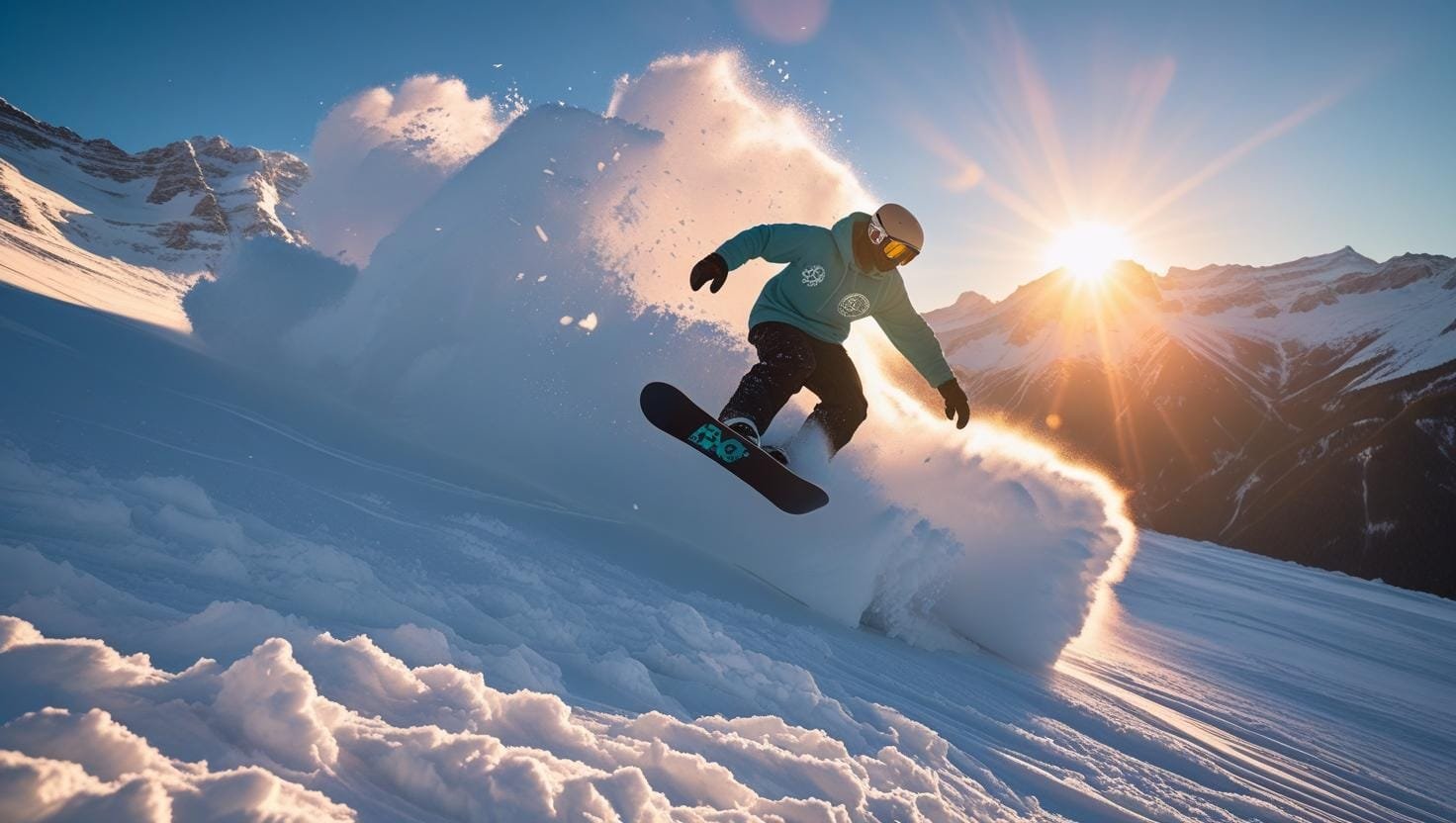
Why Snowboarding Is, Hands Down, the Best Winter Sport
Winter offers a landscape of possibilities. There’s the quiet grace of cross-country skiing, the fierce speed of downhill racing, and the team camaraderie of ice hockey. But only one sport truly captures the soul of the mountain and the spirit of untethered freedom: snowboarding. Welcome to the ultimate manifesto on why riding sideways is the greatest human invention since the wheel.
The Ultimate Blend of Adrenaline and Zen
No other winter sport walks the line between chaos and calm so perfectly. One moment, you’re experiencing a pure adrenaline rush, dropping into a steep, powder-filled bowl or launching off a jump in the terrain park. The next, you’re in a state of flow, making silent, deep carves on a perfectly groomed run, feeling nothing but the rhythm of your board on the snow. It’s a sport of thrilling highs and meditative lows, offering a complete emotional spectrum in a single day.
Biomechanically, this duality is supported by the unique way a snowboarder interacts with gravity. Unlike skiing, where your legs move independently, a snowboarder moves as a single, unified unit. This creates a “long-wave” resonance with the mountain. When you hit a high-speed carve, the centrifugal force pins you to the board, creating a sensation of immense power. Conversely, when floating through glades, the board acts as a displacement hull, allowing for a weightless, cloud-like experience. This shift from high-tension engagement to effortless levitation creates a neurochemical cocktail of dopamine and serotonin that traditional “two-plank” sports struggle to replicate.
This “Zen” state is often referred to by riders as “The Flow.” Because your feet are locked into a fixed stance, you are forced to use your entire body—shoulders, hips, and knees—to steer. This holistic movement pattern promotes a deeper mind-body connection. You aren’t just directing a tool; you are extending your nervous system into the wood and fiberglass beneath you. In 2026, psychologists are increasingly studying the “active meditation” aspects of snowboarding, noting that the intense focus required to read terrain at speed combined with the rhythmic nature of turning creates a state of consciousness that reduces cortisol levels and enhances creative thinking long after you’ve left the slopes.
A Canvas for Creativity and Self-Expression
While many winter sports are defined by rigid techniques and repetitive motions, snowboarding is fundamentally about style. Its roots in skate and surf culture mean there is no single “right” way to ride. The mountain is not a race course; it’s a three-dimensional skatepark. Every roller, wind lip, and tree becomes a feature to interact with. This focus on personal expression makes every run unique and every rider an artist.
In skiing, success is often measured by the efficiency of a turn or the speed of a descent. In snowboarding, success is measured by the “vibe.” This is why “Style over Altitude” is a common mantra in the park. A simple 180-degree spin performed with a smooth, poked-out grab is often more respected than a chaotic triple cork. This emphasis on aesthetic value encourages riders to experiment. You might spend a whole afternoon just learning how to “butter” your board—flexing the nose or tail to spin on flat ground like a top. This playfulness turns the entire resort, from the steepest chutes to the flattest catwalks, into a playground.
Furthermore, the evolution of snowboard shapes—from asymmetrical twins to swallow-tail powder fish—allows riders to curate their experience based on their artistic vision. Some riders gravitate towards the “Soul Shred” movement, prioritizing long, sweeping carves and natural terrain transitions. Others focus on “Street Style,” looking for rails and concrete features. This diversity of sub-cultures within the sport ensures that you never hit a ceiling. There is always a new “language” of movement to learn. Whether you are mimicking the surf-inspired slashes of Gerry Lopez or the skate-tech of Mark McMorris, your board is your brush, and the mountain is your canvas.
A Sport With Many Dialects: The Major Riding Styles
Part of what makes snowboarding such a deep creative well is that it isn’t really one sport — it’s an umbrella over several distinct disciplines, each with its own equipment, terrain, and personality. Understanding this taxonomy reveals just how much room there is to find your own voice on a board.
Freestyle
Centered on tricks, spins, and grabs performed in terrain parks, on rails and boxes, and in the halfpipe. This is the discipline most associated with “jibbing” — riding on non-snow surfaces like rails, ledges, and even urban handrails.
Freeride
Focused on natural, ungroomed terrain — powder bowls, couloirs, and tree-lined glades — without man-made features. Freeride boards tend to be longer, stiffer, and directional, built to “float” through deep snow rather than spin on flat ground.
Alpine / Race
The speed-focused discipline, ridden on stiff, narrow boards with hard boots more similar to ski boots. Includes parallel slalom and parallel giant slalom, where two riders race side-by-side courses through a series of gates.
Boardercross (Snowboard Cross)
Essentially motocross on snow — four to six riders race head-to-head down a single course packed with banked turns, rollers, and jumps. Collisions and tactical blocking are part of the sport, making it one of the most spectator-friendly disciplines.
Slopestyle & Big Air
Judged freestyle events where riders either flow through a course of jumps and rail sections (slopestyle) or launch off a single massive jump to land the biggest, cleanest trick possible (big air).
Backcountry / Big Mountain
Riding entirely outside resort boundaries on unmaintained, unpatrolled terrain, often using a splitboard — a snowboard that separates into two ski-like halves for the uphill climb. This is freeriding’s wilder, more remote sibling.
A True Full-Body Athletic Endeavor
Snowboarding is a surprisingly demanding athletic pursuit that engages your entire body in harmony. Your legs provide the power, your core provides the balance and stability for every turn, and your upper body coordinates dynamic movements. It’s a powerful combination of strength, balance, and endurance that builds functional fitness while you’re having too much fun to notice you’re even working out.
The physiological benefits are vast. A moderate day of snowboarding can burn between 400 and 600 calories per hour, but the type of strength it builds is what’s truly special. It emphasizes “eccentric” muscle control—the ability of your muscles to resist lengthening under load. When you absorb a bump or hold a deep edge against high G-forces, your quads and glutes are performing high-intensity work that builds dense, functional muscle. Unlike gym workouts, this strength is developed through balance. Every micro-adjustment your ankles make to stay on edge develops the stabilizer muscles that are often neglected in traditional sports, leading to better overall joint health and posture.
Moreover, the cardiovascular benefits of “High-Altitude Cardio” are significant. Snowboarding at elevation forces your lungs and heart to work more efficiently. Because the sport involves bursts of high intensity followed by periods of recovery (the lift ride), it functions as a natural form of High-Intensity Interval Training (HIIT). Research has shown that frequent snowboarders have significantly higher VO2 max levels and better proprioception (spatial awareness) than sedentary individuals. By the time the spring thaw arrives, a dedicated rider has developed a level of core “armor” and leg “pistons” that make other summer sports like mountain biking or surfing feel much easier.
In Fairness: How Does the Calorie Burn Really Stack Up Against Skiing?
In the interest of giving you the full picture rather than just the highlight reel, it’s worth being honest about one place where skiing sometimes edges ahead on paper: raw calorie burn. Several fitness comparisons estimate that downhill skiing burns somewhere in the range of 400 to 600 calories per hour, compared to roughly 300 to 500 for snowboarding, largely because skiing’s constant poling motion and the independent leg action required on varied terrain like moguls recruits a broader range of muscle groups continuously. But this comparison undersells one crucial variable: technique and time spent upright. Because snowboarding has a steeper initial learning curve, beginners spend significantly more time getting up off the snow than skiers do — and getting up from a strapped-in seated position is, in the words of one ski instructor, essentially a pushup you perform once per run. The net effect is that a beginner snowboarder on a tough day might out-work a beginner skier purely through repetition, even if an advanced rider of either sport burns roughly comparable totals once the falling stops. The honest takeaway is that the difference between the two sports is close enough that personal effort, terrain choice, and skill level matter far more than which sport you happen to choose.
It’s also worth noting that the two sports build strength in genuinely different places, which matters if you’re choosing based on fitness goals rather than pure calorie counting. Skiing tends to emphasize the outer hip and glute muscles along with sustained quad engagement from the deep squat stance required to control parallel skis, while snowboarding leans more heavily on the front-to-back balance chain — quads, calves, and especially the obliques and deep core muscles needed to rotate the torso independently of a single fixed lower-body platform. Neither pattern is objectively superior; they’re simply different tools for different fitness goals, and plenty of dedicated mountain athletes choose to do both across a season specifically to train both movement patterns rather than picking a side.
Off-Season Training: Building Your Snowboarding Body
The fitness benefits of snowboarding don’t have to be confined to winter. A growing body of research on “sport-specific off-season training” suggests that riders who maintain a targeted fitness routine during the summer months return to the mountain stronger, more resilient, and significantly less prone to the injuries that typically sideline beginners and intermediate riders alike. The key is understanding which physical qualities snowboarding actually demands and then training those qualities during the months when the mountain isn’t available.
The two most critical off-season attributes are eccentric leg strength and rotational core stability. Eccentric strength — the ability of your muscles to absorb force while lengthening — is what keeps you upright when you hit a bump at speed or absorb the landing from a small jump. Bulgarian split squats, single-leg Romanian deadlifts, and slow-descending box jumps are the gold-standard exercises for building this capacity because they mimic the exact loading pattern your quads and glutes experience on the mountain. Rotational core stability — the ability to resist unwanted rotation while generating controlled rotational force — is what allows you to steer a snowboard without exhausting your smaller stabilizer muscles. Anti-rotation presses (Pallof presses), cable woodchops, and Turkish get-ups are the most functional exercises for building this quality because they train your core to resist and produce rotation through the same planes of motion you use while carving and spinning.
Beyond strength, proprioceptive balance training is the off-season investment with the highest return for snowboarders specifically. Because snowboarding demands constant micro-adjustments from your ankles and hips to maintain edge contact on an ever-changing surface, riders who train their balance systems during the off-season report a noticeable improvement in their ability to ride challenging terrain when the first snow falls. Simple tools like a balance board, a BOSU ball, or even single-leg stands with eyes closed can dramatically improve the neuromuscular connections that control your balance. Skateboarding and surfing are also excellent off-season cross-training activities because they develop the same sideways-stance balance and board-control instincts that transfer directly to snow. Many professional snowboarders credit their summer board sports not just as recreation but as a critical component of their competitive preparation.
Finally, flexibility and mobility work — particularly in the hips, thoracic spine, and ankles — is the most commonly neglected aspect of off-season preparation, and it’s the one that most directly affects both performance and injury risk on the mountain. Tight hip flexors limit your ability to absorb terrain; a stiff thoracic spine reduces your capacity to rotate your upper body independently of your lower body (a core snowboarding movement); and restricted ankle dorsiflexion forces your knees to compensate, increasing the load on your ACL and meniscus. A daily 15-minute routine of hip flexor stretches, thoracic rotations, and ankle mobility drills is a modest investment that pays measurable dividends every time you strap in.
The Deepest Connection to Nature’s Terrain
A snowboard is the ultimate tool for interacting with the natural mountain environment. You aren’t just descending a slope; you are flowing with it. The feeling of floating on deep powder, slashing a natural wind lip like a wave, or weaving through a glade of trees creates an intimate connection to the terrain. It’s a surf-inspired dance with gravity and geography that is unique to the sport.
The “sideways” stance of snowboarding is a biological gateway to a different perspective. By looking over your shoulder, your peripheral vision is maximized for the terrain ahead and the slope behind. This stance allows you to use the board’s sidecut to “read” the snow. You feel the difference between “corduroy,” “crust,” and “powder” directly through your feet, without the mechanical interference of poles. This tactile feedback is addictive. You become hypersensitive to the mountain’s micro-topography—a tiny dip in the snow becomes a transition to pump for speed; a small mound becomes a chance to get light.
This connection is at its peak in “The White Room”—the moment on a powder day when you are so deep in the snow that it sprays over your head, temporarily obscuring your vision. In these moments, you are not just on the mountain; you are *part* of the mountain’s hydrological cycle. The board acts as a hull, and you are the pilot. Because a snowboard has more surface area than skis, it provides a much higher “float” factor, which is why snowboarding is objectively superior in deep snow. While skiers plow through, snowboarders plane on top. This difference in physics translates to a difference in “soul.” Surfing the frozen waves of a mountain range provides a spiritual connection to the wilderness that few other human activities can match.
Reading the Mountain: How Weather and Snow Conditions Shape Your Day
One of snowboarding’s subtle but profound pleasures is that no two days on the mountain are ever the same, and a huge part of that variability comes down to weather and snow conditions — variables that experienced riders learn to read, anticipate, and even exploit for better runs. Understanding the basic meteorology and snow science behind a day on the mountain transforms the experience from “showing up and hoping for the best” to an active, engaged process of reading the environment and adjusting your approach accordingly.
The most obvious variable is temperature, and its effects on snow quality are more nuanced than most beginners realize. Very cold temperatures (below 10°F / -12°C) produce “dry” snow — individual ice crystals that don’t bond together well, creating a light, squeaky surface that’s fast but offers less grip. This is the snow that’s often described as “bulletproof” on groomed runs because your edges have trouble biting into the loose granules. Moderately cold temperatures (15–25°F / -9 to -4°C) produce the best all-around conditions: the snow is cold enough to stay fast but warm enough for the crystals to bond slightly, giving your edges something to grip. Warm temperatures (above 30°F / -1°C) produce “spring corn” or “slush” — heavy, wet snow that’s slower and more physically demanding to ride but surprisingly fun for playful, surf-style turns because the soft surface forgives mistakes and absorbs landings.
Wind is the other major variable, and it has a more complex effect than simply making you cold. Wind packs snow on windward slopes, creating hard, windboard-like surfaces that are fast but unforgiving, while depositing soft, deep snow on leeward slopes and in terrain features like gullies and tree wells. Learning to identify wind-affected terrain — and knowing to seek out the sheltered, leeward side of a ridge on a windy day — is one of the skills that separates experienced riders from beginners who simply point their board at the nearest groomed run regardless of conditions. Visibility is the third critical variable, and “flat light” — overcast conditions where the lack of shadows eliminates depth perception — is the most challenging condition for snowboarders specifically because the single-board stance means you’re more dependent on visual terrain cues than skiers, who can rely on the independent leg feedback of two separate skis to “feel” the terrain when they can’t see it. Learning to ride flat light confidently — by slowing down, trusting your feet to read the snow, and staying near tree lines where contrast helps define the terrain — is a rite of passage for every dedicated rider.
Perhaps the most magical weather phenomenon in snowboarding is the bluebird powder day — the combination of fresh overnight snowfall with a clear, sunny morning. This is the scenario that dedicated riders build their entire winter around, and for good reason: the fresh powder provides effortless float and a sensation of weightlessness, while the sunshine provides warmth, visibility, and the visual spectacle of sparkling snow under blue sky. Understanding the weather patterns that produce these days — typically a cold front passing through overnight followed by high pressure moving in — can help you plan your season to maximize the odds of being on the mountain when they happen. Many resorts with reliable snowfall publish snow reports and weather forecasts that allow you to make informed decisions about when to use your precious vacation days. For a complete breakdown of how to choose the right resort for your riding style and conditions preferences, our guide to snowboard comparison covers the terrain and conditions factors that matter most.
Simpler, More Comfortable Gear
From a purely practical standpoint, snowboarding is just more pleasant. You have one piece of equipment to carry, not four. Most importantly, snowboard boots are soft and comfortable, allowing you to walk around the lodge or the village without feeling like you’re wearing a cast on each leg. This small comfort makes a huge difference to the overall enjoyment of a long day on the mountain.
[Image comparing rigid ski boots with flexible, comfortable snowboard boots]Let’s talk about the “Parking Lot Misery Index.” A skier has to manage two long planks and two poles, usually resulting in a clunky, awkward waddle from the car to the lift. A snowboarder simply tucks their board under one arm and walks. Once in the lodge, the advantage becomes even more stark. Ski boots are designed for mechanical transfer of power, which makes them rigid plastic shells that are nearly impossible to walk in safely on stairs or ice. Snowboard boots, by contrast, are essentially heavy-duty, high-tech winter sneakers. They offer arch support, insulation, and the ability to move your ankles, making the “après-ski” experience—or even just a mid-day bathroom break—vastly more civilized.
In 2026, the tech has reached its zenith with “Step-On” and “Supermatic” binding systems. The old complaint that “snowboarders have to sit down to strap in” is officially dead. Modern hardware allows a rider to step directly from the lift into their bindings without ever touching a strap. This means snowboarders are now often faster at the top of the hill than skiers. Furthermore, maintaining one base and two edges is significantly cheaper and easier than maintaining two bases and four edges. From the wallet to the feet, the snowboarding equipment ecosystem is engineered for human comfort and logistical simplicity.
Choosing Your First Setup: A No-Nonsense Guide
For anyone considering their first season on snow, the gear selection process can feel overwhelming — dozens of board brands, multiple boot technologies, and binding systems that seem to reinvent themselves every year. The good news is that the core decision is simpler than the marketing suggests, and understanding a few key principles will prevent you from wasting money on equipment that doesn’t match your needs.
The board is the centerpiece, and the single most important specification is length. For an average-weight adult beginner, the board should reach somewhere between your chin and your nose when stood on its tail — shorter boards are easier to turn (good for beginners and park riders) while longer boards are more stable at speed and float better in powder (good for freeride and heavier riders). The second key specification is width: the board should be wide enough that your boots don’t drag in the snow during deep carves but not so wide that your feet can’t effectively apply pressure to the edges. Most manufacturers publish width charts correlated to boot size, and following them prevents the most common beginner mistake: buying a board that’s too narrow for your feet. For a deeper dive into matching board dimensions to your body and riding style, our snowboard sizing guide walks through the specific measurements that matter.
Boots are where your money should go first, not last. A high-end board paired with mediocre boots will feel worse than a mid-range board paired with boots that fit perfectly. The ideal boot fit is snug — your heel should not lift when you flex your ankle forward — but not painful. Most riders make the mistake of buying boots too large because they feel comfortable in the shop; in reality, boots pack out (the liner compresses) by roughly half a size over the first few days of riding, so you want a fit that feels “almost too tight” when new. For riders with wider feet, specialized wide-fit boots from brands like Vans and DC solve a problem that standard-fit boots can’t address — our guide to boots for wide feet covers the specific models and fit strategies that work.
Bindings are the final piece, and the good news is that binding technology has advanced to the point where most mid-range options ($150–$250) from reputable brands like Burton, Union, and Flux will serve you well for multiple seasons. The key specification is flex: softer bindings (flex rating 1–4) are more forgiving and better for beginners and park riders; stiffer bindings (flex rating 6–10) provide more precise edge control and are preferred by freeride and freestyle riders who need immediate response. For a head-to-head comparison of the most popular binding models, our Union Force vs. Atlas breakdown shows exactly what you get at each price point.
Essential Accessories: What to Wear and Bring
Boots, board, and bindings are the big three, but the accessories you choose can make or break your comfort on the mountain — especially in the first few seasons when you’re still figuring out what you need and when you need it.
Layering is the foundational principle of snowboard clothing, and it’s simpler than the outdoor industry sometimes makes it sound: a moisture-wicking base layer (merino wool or synthetic, never cotton), an insulating mid layer (fleece or light down), and a waterproof-breathable outer shell (jacket and pants). The base layer moves sweat away from your skin; the mid layer traps warmth; the shell blocks wind and snow. This system lets you add or remove layers as conditions change throughout the day — critical because you’ll generate far more body heat riding than standing in the lift line. For riders who prioritize comfort and freedom of movement, our guide to baggy snowboard pants covers the fit philosophy that most park and freestyle riders prefer.
Goggles are non-negotiable safety equipment, not a fashion accessory. The single most important goggle feature is lens technology: a good lens increases contrast in flat light, blocks UV radiation at altitude, and prevents fogging during high-exertion riding. Lenses are rated by “VLT” (Visible Light Transmission) — lower VLT percentages (5–20%) are for bright, sunny days; higher percentages (30–60%) are for overcast or low-light conditions. If you buy only one lens, a mid-range VLT (25–40%) will cover the widest range of conditions. Our goggle guide breaks down the specific lens technologies and frame designs that matter.
Protection is the accessory category that riders most often skip and most often regret skipping. A helmet is the single most important piece of safety equipment — modern snowboard helmets are lightweight, well-ventilated, and designed to integrate seamlessly with goggles, eliminating the “gaper gap” (the exposed forehead between helmet and goggle that was once a hallmark of the clueless beginner). Beyond the helmet, wrist guards are the second most impactful protective investment for snowboarders specifically, since wrist injuries account for roughly 25% of all snowboard-related emergency room visits. Our helmet guide and knee pad guide cover the specific models and fit considerations that keep you riding injury-free.
Snowboarding vs. Skiing: A Side-by-Side Look
No “best winter sport” argument is complete without an honest head-to-head, so here’s how the two compare across the factors people actually care about when deciding which one to learn.
| Factor | Snowboarding | Skiing |
|---|---|---|
| Learning curve | Harder first 2-3 days, but technique transfers quickly once it “clicks” | Easier first day, but mastery takes longer due to more technical ceiling |
| Equipment carried | One board, no poles | Two skis, two poles |
| Boot comfort off-snow | Soft, flexible, walkable | Rigid plastic shell, hard to walk in |
| Powder & deep snow performance | Higher float due to single wide surface | Tips can sink deeper without specialized powder skis |
| Flat ground & lift lines | Slower — riders unstrap a foot to push or walk | Faster — can glide and pole along easily |
| Calorie burn (general estimate) | Roughly 300–500 cal/hour | Roughly 400–600 cal/hour |
Staying Safe: Injury Prevention and Mountain Awareness
No honest conversation about snowboarding is complete without addressing the risk side of the equation — and while the sport is safer than many people assume, it does carry real physical risks that informed riders take seriously. Understanding the most common injury mechanisms, the protective equipment that mitigates them, and the behavioral habits that keep you riding season after season is not a buzzkill; it’s the prerequisite for a long, enjoyable life in the sport.
The most common snowboarding injuries follow a predictable pattern that’s directly related to the sport’s biomechanics. Wrist injuries — sprains, fractures, and scaphoid breaks — account for roughly 25–35% of all snowboard-related ER visits, making them by far the most frequent injury. The mechanism is intuitive: when a snowboarder falls, the natural instinct is to extend the hands to break the fall, directing the full impact force through the wrist joint. Shoulder injuries — dislocations, AC joint separations, and rotator cuff strains — are the second most common, typically caused by falling directly onto the shoulder or by the arm being pulled back during a sideways fall. Knee injuries, while less common in snowboarding than in skiing, still occur — particularly ACL tears from catching an edge during a frontside turn, where the fixed lower body position creates torque that the knee ligaments aren’t designed to absorb.
The good news is that the injury profile of snowboarding is highly preventable with the right equipment and habits. Wrist guards — either built into gloves or worn as standalone inserts — reduce the incidence of wrist fractures by an estimated 50–85% in studies published in the British Journal of Sports Medicine. Modern wrist guard designs are thin enough to fit under standard mittens or gloves without restricting movement, making the “I don’t like how they feel” excuse increasingly obsolete. Helmets reduce the risk of severe head injury by 35–60%, and the stigma that once surrounded helmet use in snowboarding culture has all but disappeared — today, helmet adoption among snowboarders exceeds 80% at most North American resorts.
Beyond equipment, the single most impactful injury prevention strategy is learning to fall correctly. The instinctive reaction — extending your hands — is the worst possible response because it channels all the impact energy through your wrists and shoulders. The correct technique is to make a fist, tuck your chin, and land on your forearm and the meaty part of your upper arm, distributing the impact across a larger, more resilient area. This technique, taught in virtually every beginner lesson, is counterintuitive precisely because your body’s natural reaction is to protect your face and head by extending your arms — but paradoxically, that arm extension is what causes the most injuries. Practicing this falling technique on soft snow at slow speed during your first few sessions builds the muscle memory that protects you when you fall at higher speeds later. Our fall safety guide covers the specific body positions and recovery techniques that experienced riders use to minimize injury risk.
Finally, terrain management and self-awareness are the behavioral habits that separate riders who enjoy decades of injury-free seasons from those who don’t. The most dangerous runs are typically the ones ridden at the end of the day, when fatigue has degraded your reaction time and decision-making — a phenomenon that emergency room physicians call the “last run syndrome.” Riding terrain that genuinely exceeds your skill level is the second most common cause of serious injury, and the solution is straightforward: if a run makes you feel genuinely anxious rather than excited, it’s above your current level, and there’s no shame in taking a different line. Fatigue management, honest self-assessment, and the discipline to call it a day before your body forces you to are the unglamorous but essential habits of riders who make it to their 50s and 60s still charging.
A Global Community Built on Passion
The culture of snowboarding is famously inclusive and laid-back. Born as a counter-culture movement, it has retained its focus on shared passion over elitism. On any given mountain, you’ll find a community bonded by a mutual love for the feeling of sliding on snow. It’s less about where you’re from or what you do for a living, and more about the simple question: “Did you have a good run?”
This community was forged in the 1980s when snowboarders were banned from most resorts. That “outlaw” history created a bond that persists today. There is a universal language of “stoke” that transcends borders. Whether you’re in the Swiss Alps, the Japanese backcountry, or a local hill in the Midwest, a “head nod” or a board-tap at the top of a run signifies a shared understanding. Snowboarding culture values progression and effort over status. If you see a beginner finally link a turn, or an expert land a clean 360, the reaction from the chairlift is the same: pure, unadulterated cheers.
The social hubs of snowboarding—the terrain park and the backcountry lodge—are melting pots of diversity. Because the sport is rooted in individual style, it naturally attracts people from all walks of life who value authenticity. The “No-Fall Zone” creates a level of trust between partners that is rarely found in other sports. When you’re out in the trees, your partner isn’t just a friend; they are your safety net. This reliance on one another builds lifelong friendships. To join the snowboarding community is to join a global tribe that values the mountains as a place of refuge and the board as a tool for liberation.
This community-first ethos also shows up in how the sport treats newcomers. Unlike some athletic subcultures that gatekeep based on gear, jargon, or visible skill level, snowboarding’s working culture genuinely celebrates the beginner who’s having a great time just as much as the expert nailing a difficult line — arguably more so, since everyone on the lift remembers exactly what those first wobbly, fall-heavy days felt like. Strike up a conversation on a chairlift about how your morning is going, and you’ll rarely get a cold reception regardless of your skill level; if anything, riders tend to be unusually generous with tips, encouragement, and “you’ve got this” energy toward people clearly still finding their footing. That welcoming instinct, baked in from the sport’s outsider origins, is part of why so many people who try snowboarding once end up coming back for a second, third, and fortieth season.
Speak the Language: A Starter Glossary
Every culture has its own shorthand, and snowboarding’s is half borrowed from skateboarding, half invented on the chairlift. A few terms worth knowing before your first trip:
- Regular / Goofy
- Whether you ride with your left foot forward (regular) or right foot forward (goofy) — there’s no “correct” answer, just whichever feels natural.
- Switch
- Riding in the stance opposite your natural one — a regular rider riding goofy, or vice versa.
- Pow
- Short for powder — fresh, fluffy, ungroomed snow, and the holy grail for freeriders.
- Bluebird Day
- A clear, sunny day with no clouds, ideally right after a big snowfall.
- Bail
- To fall, crash, or wipe out — something every beginner gets intimately familiar with.
- Stoked
- Excited, psyched, thrilled — the default emotional state of a good day on the mountain.
- Gaper
- An affectionately mocking term for a clueless or poorly-equipped rider, often spotted by the gap between their helmet and goggles.
- Sending It
- Committing fully to a jump, drop, or line without hesitation.
- Flat Light
- Overcast conditions where the lack of shadows eliminates depth perception, making terrain features nearly invisible.
- Corduroy
- The ridged texture left by grooming machines, offering a smooth, predictable surface ideal for carving.
- Side Hit
- A natural feature on the edge of a trail — often a wind lip or roller — that can be used as a small jump.
- Avvy
- Short for avalanche — a serious backcountry hazard that requires specialized training and equipment to manage safely.
A Sport for Every Body: Adaptive and Para-Snowboarding
One of the quieter but most meaningful parts of snowboarding’s inclusive culture is how far adaptive riding has come. Para-snowboarding made its Paralympic debut as a medal event for both men and women at the Sochi 2014 Winter Paralympic Games, opening the sport to athletes with limb differences and other physical disabilities through modified boards, prosthetics, and specialized technique. The existence of a dedicated competitive pathway — alongside grassroots adaptive riding programs at resorts worldwide — reflects something the broader culture has believed for decades: that the feeling of gliding on snow shouldn’t be limited to any single body type or ability level.
The Learning Curve: From First Turns to Lifelong Progression
One of snowboarding’s most defining characteristics — and the one that most reliably separates it from skiing in the “which should I learn?” conversation — is its learning curve. Snowboarding’s curve is steeper at the beginning but flattens faster once you pass the initial threshold, creating a progression pattern that feels genuinely different from other winter sports. Understanding this pattern helps set realistic expectations and prevents the discouragement that causes too many beginners to quit before they reach the payoff.
The first two to three days of snowboarding are, for most people, genuinely difficult. You will fall — a lot. The single-board, sideways-stance design means that your balance system, which has spent your entire life adapting to forward-facing, two-footed movement, is being asked to do something it has never done before. Turning requires coordinating your shoulders, hips, and knees in a rotational pattern that doesn’t exist in everyday life. Edge control — the fundamental skill that allows you to go where you want rather than where gravity takes you — is counterintuitive because the edges you’re trying to engage are on the sides of the board, not the front or back. Most beginners spend their first day or two doing what riders affectionately call “the caterpillar” — alternating between falling, getting up, riding a few feet, and falling again.
But somewhere between the middle of day two and the end of day three, something clicks. The rotational turning pattern that felt alien and exhausting suddenly becomes intuitive. Your edges find their grip. The board starts going where you point it instead of where it wants to go. This “click” moment is one of the most satisfying experiences in all of sports — it’s the transition from “fighting the mountain” to “riding it,” and it’s the reason so many riders describe snowboarding as a sport that rewards patience more than athleticism. After the click, progression accelerates dramatically: you’ll go from tentative turns on green runs to confident carving on blue runs within a single season, and the path to black diamond terrain opens up far faster than most people expect.
The key to surviving those first days — and the reason snowboard lessons are genuinely worth the investment — is understanding that the difficulty is temporary and structural. You’re not failing; you’re rewiring your neuromuscular system to operate in a fundamentally different way. A good instructor doesn’t just teach you to turn; they teach you the body mechanics that make turning feel natural, and they prevent you from developing bad habits (like leaning back, the most common beginner mistake) that become much harder to correct later. If you’re considering whether lessons are worth the cost, our guide to whether snowboard lessons are worth it makes the case that the investment pays for itself in faster progression, fewer injuries, and more enjoyment from day one.
The Intermediate Plateau: Breaking Through to Advanced Riding
After the initial click and the rapid progression that follows, many riders hit an intermediate plateau — a period where they can ride competently but feel stuck, unable to progress to steeper terrain, faster speeds, or more dynamic techniques. This plateau is normal, and understanding its causes is the key to breaking through it.
The most common cause is technique stagnation: riders develop a functional but imprecise turning style that works on groomed runs but fails on variable terrain. The fix is often as simple as committing to a lesson with a certified instructor who can identify the specific mechanical habit — usually insufficient upper-body rotation or inadequate weight distribution — that’s holding you back. Another common cause is terrain habituation: riding the same runs every weekend creates a comfort zone that prevents you from developing the adaptability that advanced riding demands. The solution is deliberately uncomfortable: ride with friends who are better than you, follow them onto terrain that makes you nervous, and accept that the discomfort of riding above your level is the price of progression.
For riders who push through the intermediate plateau, the reward is access to the full spectrum of what snowboarding offers. Advanced riding isn’t just about steeper terrain; it’s about developing the ability to read snow conditions, anticipate terrain changes, and make split-second decisions about line choice that transform every run from a passive descent into an active, engaging puzzle. This is where snowboarding transitions from a physical activity to a cognitive one — and where the “flow state” that we discussed earlier becomes not just possible but consistent. If you’re an intermediate rider wondering what to work on next, our turning technique guide and stopping techniques guide cover the foundational skills that advanced riding is built on.
Limitless Progression for a Lifetime of Fun
The journey of a snowboarder never truly ends. A beginner can find immense joy and a sense of accomplishment by linking their first turns on a gentle slope. An intermediate rider can spend years mastering carving and exploring new terrain. An expert can push their limits in the backcountry or the terrain park. The sport grows with you, always offering a new challenge or a new way to have fun. It’s a pursuit that can last a lifetime.
[Image showing the progression from a bunny hill beginner to a big-mountain expert]The beauty of snowboarding is that the “ceiling” is invisible. Once you master the basics of edge control, the sport splits into dozens of different disciplines. You could spend a decade focused purely on “Jibbing” (sliding on rails and boxes). Or, you could pivot to “Boardercross” racing. As you age, many riders transition to “Freeriding,” using their hard-earned skills to navigate the steepest, most complex natural terrain on the planet. This versatility is what keeps riders coming back for 30 or 40 years. Your style evolves as your body and interests change, but the core thrill of the glide remains identical.
Furthermore, snowboarding is a sport of “firsts.” Your first linked turn, your first cliff drop, your first clean 360, your first waist-deep powder day—these milestones provide a constant stream of dopamine and a sense of personal growth. Unlike sports that become repetitive once you reach a certain level, snowboarding is an infinite game. The mountain is never the same twice; the snow conditions change daily, and your perspective as a rider evolves with every run. It is a lifelong commitment to play, a way to stay young at heart while building a body that is resilient and a mind that is constantly seeking the next line.
The World Stage: Snowboarding’s Olympic Legacy
If there’s one piece of evidence that snowboarding has earned its place among the world’s great winter sports, it’s the Olympic stage. Snowboarding made its Olympic debut at the 1998 Nagano Games with just two events — giant slalom and halfpipe — and has expanded steadily ever since: parallel giant slalom joined at Salt Lake City 2002, snowboard cross debuted at Turin 2006, slopestyle arrived at Sochi 2014, and big air was added at PyeongChang 2018, with a mixed team snowboard cross event rounding things out at Beijing 2022.
By the time the Winter Games returned to Italy for Milano Cortina 2026, with snowboarding events held in Livigno, the sport had grown into an eleven-event competition spanning halfpipe, slopestyle, big air, snowboard cross, and parallel giant slalom for both men and women. The 2026 Games delivered one of the most dramatic snowboarding storylines in Olympic history: South Korea’s Choi Gaon, only 17 years old, stunned the field — and her own mentor, two-time defending champion Chloe Kim — to win halfpipe gold and become the youngest Olympic snowboarding champion ever crowned. Japan’s riders dominated the park and pipe disciplines that year, claiming four of six available golds and landing athletes on all six podiums across those events, while Austria’s Benjamin Karl and Alessandro Haemmerle each defended their Olympic titles, with Karl doing so at age 40 to become the oldest snowboarding medalist in Olympic history — proof, if any more were needed, that this is a sport with room for both teenage prodigies and seasoned veterans at the very top of the podium.
New Zealand’s Zoi Sadowski-Synnott added to her own remarkable Olympic story at those same Games, narrowly missing a third consecutive slopestyle title but still walking away with a silver medal that gave her five career Olympic medals in snowboarding — the most of any rider, male or female, in the sport’s history. Meanwhile Anna Gasser, one of the pioneers of women’s big air competition, capped what was likely her final Olympic appearance at 34 years old, a fitting bookend to a career that helped build the discipline she competed in from the ground up. Stories like these are exactly why the Olympic stage matters to the broader “best winter sport” case: it isn’t just that snowboarding looks impressive on television, it’s that the sport has produced nearly three decades of genuinely compelling competitive narratives — teenage breakthroughs, veteran title defenses, career-capping farewell runs — the same ingredients that make any sport worth following for the long haul.
The sport’s most decorated competitor remains American Shaun White, with three Olympic gold medals, while Lindsey Jacobellis and Jamie Anderson share the record among female riders with two golds and one silver apiece. That kind of staying power and depth of competition — spanning nearly three decades of Olympic history — is hard to find in many other action sports, and it’s a big part of why snowboarding has cemented itself as a permanent fixture of the world’s biggest winter sporting stage rather than a passing trend.
The Soul of the Culture: Music, Film, and Community Identity
Snowboarding isn’t just a sport — it’s a culture with its own soundtrack, its own visual language, and its own mythology, all of which have been shaped by decades of films, music, and community traditions that exist parallel to (and sometimes completely independent of) the competitive side of the sport. Understanding this cultural ecosystem reveals why snowboarding inspires a degree of devotion that purely athletic pursuits often fail to match.
The snowboard film is the sport’s most distinctive cultural artifact. Unlike sports that rely on broadcast television for their visual storytelling, snowboarding has built a parallel media ecosystem through feature-length films that combine jaw-dropping riding footage with curated music, artistic cinematography, and narrative storytelling. The lineage runs from the early VHS tapes of the 1980s — low-budget, rough-edged recordings of riders like Tom Sims and Jake Burton Carpenter pushing the boundaries of what a board could do — through the golden age of the late 1990s and 2000s, when production companies like Standard Films, Mack Dawg, and Absinthe Films created cinematic masterpieces that defined entire eras of riding style. In the 2010s and 2020s, the rise of free, high-quality web edits from brands like Union, Volcom, and Method Mag democratized snowboard filmmaking, making it possible for anyone with a camera and an edit suite to contribute to the culture’s visual archive.
The relationship between snowboarding and music is equally deep and symbiotic. The sport’s DNA is inseparable from punk, hip-hop, and alternative rock — genres that share snowboarding’s anti-establishment ethos and emphasis on individual expression. The iconic snowboard films of the 1990s were set to punk and grunge soundtracks that defined not just how snowboarding sounded but how it felt. In the 2020s, the musical palette has expanded to include electronic, lo-fi, and hip-hop, but the fundamental relationship remains: music isn’t just background noise for snowboarding; it’s an integral part of the experience. Many riders describe their relationship with music on the mountain as deeply personal — the song playing through their helmet speakers during a dawn patrol powder run becomes inextricably linked to the memory of that specific day, creating an emotional archive that extends far beyond the sport itself.
The communal rituals of snowboarding culture — the parking lot tailgate session, the shared thermos of hot chocolate at the top of a lift, the post-ride après gathering at the lodge — are the social glue that transforms a solitary activity into a shared identity. These rituals matter more than they might appear to an outsider: they’re the mechanisms through which knowledge is passed from experienced riders to beginners, through which friendships are forged in the shared vulnerability of learning a difficult skill, and through which the sport’s values — progression, authenticity, mutual support — are transmitted across generations. When a rider describes snowboarding as “not just a sport but a lifestyle,” they’re usually referring to these communal experiences rather than the act of riding itself.
The Evolution of Snowboard Technology
The modern snowboard is a marvel of materials science that bears almost no resemblance to its ancestors — and understanding this evolution helps explain why the sport has progressed so rapidly over the past four decades. The earliest snowboards, built in the 1960s and 1970s by pioneers like Sherman Poppen (whose “Snurfer” was a two-plank wooden toy lashed together with rope), were crude, unpredictable, and genuinely dangerous. The invention of the modern snowboard is usually credited to Jake Burton Carpenter and Tom Sims, who in the late 1970s independently developed boards with metal edges, composite laminates, and bindings that secured the rider’s feet — the fundamental design that persists today.
The material revolution of the 1990s and 2000s transformed snowboarding from a niche pursuit into a performance sport. P-tex sintered bases replaced extruded plastic, providing faster, more durable riding surfaces that absorbed wax for customized glide characteristics. Carbon fiber stringers added stiffness and pop without weight, allowing boards to be lighter, more responsive, and more durable simultaneously. Camber profiles — the curve of the board from tip to tail when viewed from the side — evolved from the traditional camber (an upward arc underfoot) through reverse camber (a downward arc, also known as “rocker”) to hybrid profiles that combine both, giving riders an unprecedented range of options for tuning their board’s behavior to specific terrain and riding styles.
The 2020s have brought the most sophisticated board construction in history. 3D-profiled bases (like Lib Tech’s proprietary “Banana Tech” and Jones’ “3D Contour Base”) create subtle convex or concave surfaces that change how the board interacts with snow, reducing edge catch and improving float in powder. Bamboo and wood-core blends optimize the flex pattern across different zones of the board, making the tip soft enough for playful butters while keeping the tail stiff enough for powerful carves. Sintered graphene-infused bases provide the fastest, most durable riding surfaces ever manufactured. And recycled materials — from bio-based resins to recycled steel edges to sustainably harvested wood cores — are increasingly common as the industry responds to rider demand for more environmentally responsible manufacturing. For riders who want to understand how these technological advances translate to on-snow performance, our snowboard comparison tool breaks down the specifications that matter most.
Measuring Up Against the Competition
A “best winter sport” claim only means something if it survives contact with the alternatives. The intro to this piece name-checked cross-country skiing, downhill ski racing, and ice hockey — so it’s only fair to actually make the case against each of them rather than simply asserting snowboarding’s superiority and moving on.
Cross-Country Skiing: Incredible Fitness, Limited Thrill
Cross-country skiing is, by almost any objective fitness metric, one of the most demanding endurance sports on the planet — elite competitors post some of the highest VO2 max scores recorded in any sport, full stop. What it doesn’t offer is the variety of sensation that makes a day on a snowboard so addictive. A cross-country session is largely one continuous effort across rolling terrain; there’s no equivalent to dropping into a powder bowl, popping off a natural feature, or carving a steep pitch at speed. It’s a phenomenal way to build aerobic capacity, but it asks you to choose endurance over the adrenaline-and-flow duality that defines snowboarding.
Downhill Ski Racing: Speed Without the Style Conversation
Competitive downhill ski racing is unmatched for raw velocity — racers can exceed 80 miles per hour on a course, and the sheer commitment required to hold a tuck at that speed is genuinely awe-inspiring. But racing is, by design, a single-axis pursuit: the entire sport is optimized around shaving fractions of a second off a fixed course. There’s comparatively little room for the personal expression, trick vocabulary, or “style over altitude” ethos that runs through every corner of snowboard culture, from the terrain park to the backcountry. Recreational downhill skiing outside of racing opens that up somewhat, but the sport’s competitive identity remains fundamentally about the clock rather than the canvas.
Ice Hockey: Unmatched Camaraderie, Indoor Limitations
Ice hockey arguably builds the tightest team bonds of any winter sport — there’s a reason “hockey family” is such a recognizable phrase, and the sport’s blend of skill, physicality, and split-second teamwork is genuinely special. But hockey is, for the overwhelming majority of players, an indoor sport played on artificial ice under fluorescent lights. It trades the “deepest connection to nature’s terrain” argument entirely; there is no mountain, no powder, no changing conditions to read. What you gain in structured team competition, you lose in the solitary, terrain-driven, ever-different experience that defines a day on the snow.
Alpine Skiing (Recreational): The Closest Rival
If snowboarding has one true rival for the “best winter sport” title, it’s recreational alpine skiing — and to its credit, skiing wins on a few specific fronts. It’s easier to pick up in your first hour, it’s faster across flat terrain and lift lines, and it generally delivers a marginally higher calorie burn once you’re past the beginner stage, as the comparison table above shows. What skiing doesn’t replicate is the single-board, full-body steering technique, the deeper float in powder, the more walkable boots, or the skate-and-surf-rooted culture of creative self-expression that defines snowboarding’s identity. Skiing is an excellent sport. Snowboarding is simply a more complete one — and that’s the difference that earns it the top spot here.
Other Winter Activities: Where They Fit
It’s worth briefly acknowledging the other winter activities that don’t quite qualify as “sports” in the competitive sense but are part of the winter recreation landscape. Snowmobiling offers speed and power but removes the physical engagement and balance challenge that make snowboarding an athletic pursuit. Ice skating is graceful and demanding but confined to flat, artificial surfaces. Sledding and tubing provide thrill but no skill progression — you can’t “get better” at sledding in the way you can develop your snowboarding technique over years. Cross-country skiing, as discussed above, is exceptional fitness but lacks the adrenaline component. Each of these activities has its place, but none of them offers the complete package of physical challenge, creative expression, natural terrain engagement, skill progression, and community culture that snowboarding delivers as a single, unified experience.
A Day in the Life: What Riding Actually Feels Like
Statistics and style arguments only go so far in explaining why snowboarding holds such a grip on the people who do it. Sometimes the best case is simply describing the texture of an ordinary day on the mountain.
It starts at the base, clicking into bindings while steam rises off your coffee in the cold morning air. The first chairlift ride of the day is quiet — just the creak of the cable and the sound of your own breathing as the valley opens up below. At the top, that first run down a freshly groomed slope feels like drawing on a blank page: no tracks yet, just smooth corduroy and the soft hiss of your edges biting into the snow as you link your first few turns of the day.
By mid-morning, the mountain has woken up. You find a natural side-hit off the main trail, pop a small air, and land it clean — nothing flashy, but enough to put a grin on your face for the next three runs. Lunch is loud and unglamorous, boots half-unbuckled, comparing notes with strangers-turned-friends about which run is holding the best snow today. The afternoon light gets long and golden, the snow softens slightly, and your legs start to feel it in the best possible way — the good kind of tired that comes from hours of engaged, joyful movement rather than monotonous repetition.
The last run of the day is always a little bittersweet. You take it slower, not because you have to, but because you want to feel every turn instead of rushing through it. By the time you’re back at the car, board tucked under one arm, boots already half off, there’s a specific kind of satisfaction that’s hard to put into words — the sense that you spent the day fully present, fully engaged, and fully alive. Ask any rider why they keep coming back, and most of them will eventually land on some version of that same answer: it’s simply the best way they’ve found to feel like themselves.
The Long Game: What Decades on a Board Actually Look Like
It’s easy to talk about “lifelong progression” in the abstract, but the actual shape of a snowboarding life is worth spelling out, because it’s rarely linear and almost never boring. Year one is usually defined by survival — learning to link turns, finding your edge control, and slowly shedding the instinct to lean back. Years two through five tend to bring the first real specialization: maybe you fall in love with the terrain park and start chasing rail tricks, or maybe a single deep-powder day in the trees rewires your brain entirely and you become a freeride obsessive who plans entire vacations around snow forecasts.
Somewhere in the next decade, most riders hit a fork in the road that has nothing to do with skill and everything to do with priorities. Some keep pushing technical difficulty — bigger jumps, harder spins, steeper lines — chasing the same adrenaline that hooked them as beginners. Others pivot toward what longtime riders sometimes call “soul riding”: fewer tricks, more flow, an emphasis on finding beautiful lines through natural terrain rather than landing the hardest possible trick. Neither path is more legitimate than the other, and most riders drift between them depending on the season, their body, and what’s going on in the rest of their life.
What’s remarkable is how gracefully the sport accommodates aging in a way that high-impact pursuits often don’t. A 22-year-old’s knees can absorb the landing from a six-foot drop; a 55-year-old rider’s knees might prefer to find a chest-deep powder stash and float through it slowly instead — and both versions of that day are equally legitimate snowboarding. Modern board technology has made this transition easier than ever. So-called “volume-shifted” boards, which are wider and shorter than traditional shapes, let an aging or simply less aggressive rider turn a board with less torque and lower-impact technique than older board designs demanded, extending the realistic riding lifespan of the sport by years, if not decades, for riders willing to adapt their style rather than fight their changing body.
Career Paths in Snowboarding
For a subset of riders, the love of snowboarding evolves from recreational passion into professional pursuit — and while the path to “pro” status is narrower and less lucrative than in mainstream team sports, the range of career opportunities within the snowboarding industry is broader than most people realize. The most visible path is professional riding: athletes who earn board, binding, clothing, and sponsor endorsements by producing video parts, competing in events, or building a social media following that brands want to associate with. But professional riders represent a tiny fraction of the industry’s workforce; the vast majority of snowboarding careers exist in the ecosystem that supports the sport rather than in the spotlight.
Coaching and instruction is the most accessible career path and arguably the most impactful: certified snowboard instructors shape the experience of every beginner who walks through a resort’s lesson counter, and the best instructors are directly responsible for the sport’s growth rate. Resort operations — from patrol and grooming to terrain park design and events management — employ thousands of people who live and breathe snowboarding culture as their daily work. Equipment design and manufacturing draws engineers, material scientists, and product designers who translate on-snow feedback into the boards, boots, and bindings that riders use. Media and content creation — filmmaking, photography, writing, and social media — has become an increasingly viable career as the demand for high-quality snowboarding content has exploded across YouTube, Instagram, and TikTok. And backcountry guiding and avalanche education combines deep riding expertise with wilderness leadership skills in a career path that’s both physically demanding and intellectually rigorous.
The financial reality of snowboarding careers is worth stating plainly: very few riders make a comfortable living solely from riding, and those who do typically have a combination of exceptional talent, strategic brand partnerships, and business savvy that extends well beyond their on-snow ability. But the industry’s broader employment opportunities — instruction, retail, guiding, media, design — offer viable career paths for people who want to build their working life around the sport they love, even if they never land a triple cork or win an Olympic medal. For many riders, that’s the more realistic and ultimately more sustainable version of “making it” in snowboarding.
Access and Affordability Over Time
One underappreciated part of snowboarding’s longevity as a lifestyle sport is how the cost curve actually bends in your favor the longer you stick with it. The steepest expense is almost always the first season — lessons, rental or starter gear, and lift tickets while you’re still figuring out whether the sport is for you. Once a rider owns a well-fitted board, boots, and outerwear that fit properly, the marginal cost of additional seasons drops considerably, since quality snowboard gear is built to last many seasons of regular use with nothing more than basic maintenance. Season passes, often purchased the spring before the following winter at a steep discount to single-day lift ticket prices, further reward riders who commit to the sport across multiple years rather than treating it as a once-a-year vacation activity. None of this makes snowboarding free, but it does mean that the sport rewards depth of commitment in a very literal, financial sense — the version of “best winter sport” that holds up not just on a single perfect powder day, but across a lifetime of seasons.
Planning Your Snowboard Adventure: Destinations and Timing
One of snowboarding’s greatest pleasures — and one of the strongest arguments for it as a “best winter sport” — is that it can be practiced in spectacular natural settings across the globe, each with its own snow quality, terrain character, and cultural flavor. Learning to plan a snowboard trip effectively — choosing the right resort, the right time of year, and the right accommodations — transforms the sport from a weekend activity into a travel lifestyle that rewards curiosity and planning.
Japan: The Powder Capital
Japan’s northern island of Hokkaido receives some of the deepest, driest powder snow on the planet — the product of cold Siberian air masses sweeping across the relatively warm Sea of Japan and depositing enormous quantities of fine, dry snow on resorts like Niseko, Furano, and Rusutsu. Japanese powder is famously light — often described as “champagne powder” or “Japow” — and its exceptional quality has made Japan the number one bucket-list destination for dedicated freeriders worldwide. Beyond the snow, Japan’s resort culture offers a unique combination of world-class riding, extraordinary food, natural hot springs (onsen), and a deeply respectful service culture that makes the overall experience unlike anything available in North America or Europe. The trade-off is logistics: getting to Japan from North America or Europe requires a long-haul flight and a time-zone adjustment, and the resort infrastructure, while excellent, operates differently from Western resorts in ways that require some advance research. But for riders who make the trip, the snow quality alone justifies the journey — and many find that the cultural experience transforms a powder-chasing vacation into a genuinely life-changing travel experience.
The European Alps: Scale and Culture
The European Alps offer something no other mountain range on Earth can match: scale. The interconnected lift networks of resorts like Chamonix, Verbier, St. Anton, and Zermatt span multiple countries and provide access to thousands of runs across vast terrain areas that would take weeks to explore fully. European resort culture is deeply embedded in centuries of alpine tradition — mountain huts serve fondue and mulled wine, villages are built directly into the slopes rather than around them, and the après-ski tradition is a genuine social institution rather than an afterthought. For snowboarders specifically, the Alps offer exceptional freeride terrain — the massive above-treeline faces, couloirs, and glacial terrain of places like Chamonix and Verbier are among the most challenging and rewarding big-mountain riding on the planet. The trade-off is cost: European resort expenses — lift tickets, accommodation, food, and travel — are generally higher than North American or Asian alternatives, and the sheer size of the terrain can be overwhelming for first-time visitors. But for riders who want to combine world-class snowboarding with world-class travel, the Alps deliver an experience that’s difficult to match anywhere else.
North America: Diversity and Accessibility
North America’s snowboard terrain spans a staggering range of conditions and cultures. The Rocky Mountain resorts of Colorado, Utah, and Wyoming offer dry, cold powder and extensive lift-served terrain that ranges from gentle groomers to genuine big-mountain lines. The Pacific Northwest and British Columbia deliver deep maritime snowpacks, world-class tree riding, and a counter-culture vibe that’s closely aligned with snowboarding’s grassroots identity. The smaller resorts of the Northeast and Midwest — while lacking the vertical and snowfall of Western destinations — offer affordable, accessible riding that serves as the entry point for millions of riders who learned the sport within a few hours of their homes. And Canada’s British Columbia and Alberta provinces — home to legendary destinations like Whistler Blackcomb, Revelstoke, and Lake Louise — combine massive terrain, reliable snowfall, and a riding culture that’s arguably the most dedicated in North America. For riders based in North America, the sheer variety of options within a single continent means that a lifetime of exploration is possible without ever crossing an ocean.
The Southern Hemisphere and Summer Riding
For riders who can’t bear to wait for winter — or who want to extend their season year-round — the Southern Hemisphere offers a summer snowboarding season that runs from roughly June through October. Chile and Argentina’s Andean resorts, particularly Portillo, Valle Nevado, and Las Leñas in Chile and Cerro Catedral near Bariloche in Argentina, provide high-altitude terrain with reliable snow and a riding culture that’s still developing enough to feel uncrowded and adventurous. Australia’s Thredbo and New Zealand’s Coronet Peak and The Remarkables offer more accessible options for riders based in Oceania, with the added bonus of riding in the opposite season — meaning a Northern Hemisphere rider can effectively experience two winters in a single calendar year by following the snow south. Summer glacier riding in the European Alps (at resorts like Zermatt and Les Deux Alpes) and at Timberline Lodge on Oregon’s Mount Hood extends the season even further, creating a global network of year-round riding options for the truly dedicated. For riders building a complete quiver of boards for different conditions and destinations, the Southern Hemisphere’s unique snow characteristics — often faster, more granular, and more variable than Northern Hemisphere snow — provide a testing ground that makes you a more adaptable rider when you return to your home mountains.
When to Go: Timing Your Season for the Best Conditions
The timing of a snowboard trip matters more than most beginners realize, and understanding the basic seasonal patterns of snowfall and resort operations can be the difference between a magical powder day and a crowded, slushy disappointment. In North America, the season typically runs from mid-November through mid-April, with the best overall conditions usually falling in January and February — cold enough for consistent snowfall and low enough sun angle for the snow to remain fast and firm. March often delivers the season’s best overall experience: long days, warmer temperatures, softer snow, and significantly smaller crowds than the peak holiday periods of late December and early January. Late season (April at most resorts) is spring riding: slushy, warm, oftenunny, and ideal for park laps, casual carving, and the relaxed social atmosphere that defines spring riding culture.
In the European Alps, the season runs slightly later and longer, with many resorts operating from December through late April and high-altitude resorts like Zermatt offering year-round glacier riding. The Japanese season is shorter but more intense, with peak conditions typically concentrated in January and February when the Siberian storm cycle is at its most active. Understanding these patterns — and being willing to be flexible with your dates — dramatically increases your odds of catching the conditions you’re looking for. For riders who want to maximize their time on snow across the full season, our guide to snowboard bags covers the travel gear that makes multi-trip seasons logistically manageable.
A Sport That Turns the Whole World Into Your Playground
One final argument worth making is geographic. Snowboarding’s reach as a global pursuit means that “the mountain” isn’t a single place — it’s a constantly shifting set of options spanning every inhabited continent that gets meaningful snowfall, each with its own personality, snow quality, and culture.
The volcanic peaks of Japan deliver some of the lightest, driest powder on the planet, the product of cold Siberian air sweeping across the relatively warm Sea of Japan and dumping enormous quantities of snow on resorts like Niseko and Hakuba. The European Alps offer an entirely different experience: vast, interconnected lift networks spanning multiple countries, towns nestled directly into the mountains rather than built around them, and a centuries-old alpine culture of mulled wine and mountain huts that turns the après-ski tradition into an experience in its own right. North America contributes its own signature terrain — the dry, light “Champagne powder” of the Rockies, the deep maritime snowpack of the Pacific Northwest and Coastal ranges, and the steep, technical chutes that have made places like Jackson Hole legendary among expert riders. Further south, the Andes flip the seasonal calendar entirely, giving Southern Hemisphere riders — and well-traveled Northern Hemisphere ones chasing a second winter — a summer season of riding in Chile and Argentina.
This geographic diversity means a committed rider’s relationship with the sport never has to plateau, even after decades. There is always another snowpack to learn, another resort’s particular quirks to master, another country’s riding culture to experience. A rider who has spent twenty years perfecting their technique on hardpack groomers in the Northeast United States will find themselves humbled and delighted all over again by their first proper powder day in Japan. That sense of perpetual discovery — the knowledge that the learning curve never fully flattens out no matter how many seasons you log — is part of what keeps lifelong riders so devoted to the sport long after the novelty of simply standing up on a board has worn off.
Even within a single resort, this variety compounds day to day. A rider who shows up to the same mountain every weekend of a season will still never experience the exact same run twice — overnight snowfall, wind-loading on certain faces, sun exposure softening one side of a bowl while leaving the shaded side firm, and grooming schedules all conspire to make every single lap a slightly different puzzle to read and respond to in real time. Skiers experience this same variability, of course, but the single-board, full-body steering technique unique to snowboarding means a rider’s relationship to that changing terrain is felt differently with every run — through the feet, the core, and the edges, rather than through two independently steered planks. It’s this constantly renewing puzzle, layered on top of a genuinely global menu of mountains to solve it on, that makes the case for snowboarding as a lifelong pursuit rather than a phase you eventually age out of.
Frequently Asked Questions: Why Snowboarding Rules
1. Is snowboarding actually harder to learn than skiing?
Initially, yes. The first two days of snowboarding involve a lot of falling as you learn to balance on one board. However, once you “get” the feeling of linking turns, the progression to an intermediate level is much faster than in skiing, which has a very high technical plateau.
2. Are snowboarders more prone to injuries?
Snowboarders tend to have more upper-body injuries (wrists and shoulders), while skiers have more lower-body injuries (ACL and MCL tears). In 2026, with modern wrist guards and helmets, the sport is safer than ever for all age groups.
3. Why are snowboard boots so much better?
Ski boots must be rigid to transfer energy to the release bindings. Snowboard boots don’t need to release, allowing them to be made of soft, insulated materials that move with your ankle, making them essentially high-tech winter sneakers.
4. Can I snowboard if I’m older?
Absolutely. Many riders continue well into their 70s. The key is using “volume-shifted” boards that require less effort to turn and maintaining a solid off-season fitness routine. Olympic snowboarding itself has shown real staying power at the top level too — Austria’s Benjamin Karl won an Olympic medal at age 40, becoming the oldest snowboarding medalist in Games history.
5. Is snowboarding more expensive than skiing?
Generally, no. A high-quality snowboard setup is often 20% cheaper than a comparable ski setup, and maintenance costs are halved because you only have one board to wax and tune.
6. What is the “Step-On” technology everyone is talking about?
Step-On is a system from Burton (and others like Clew or Nidecker) that eliminates straps. You just click your boot into the binding and ride. It makes snowboarding just as fast and convenient as skiing when getting off the lift.
7. Why is powder riding better on a snowboard?
Physics. The large surface area of a single board allows you to “plane” on top of the snow like a surfboard. Skiers tend to sink deeper and have to fight harder to keep their tips up.
8. Do I need special gear for the terrain park?
A “Park Board” usually has a “True Twin” shape and a softer flex to make jumping and sliding on rails easier. However, most modern “All-Mountain” boards can handle the park just fine.
9. How do I survive flat sections on a snowboard?
Momentum management. Look ahead, keep your base flat, and avoid carving on the flats. If you do get stuck, unstrapping one foot and pushing like a skateboard is great exercise!
10. What is “Buttering”?
Buttering is using the flex of your board to do tricks on flat snow, like spinning on your nose or tail. it’s one of the most fun ways to develop style and balance.
11. What’s the difference between freestyle, freeride, and alpine snowboarding?
Freestyle is about tricks, rails, and the terrain park. Freeride is about natural terrain like powder bowls and tree glades, ridden on longer, directional boards built for float rather than spins. Alpine (or race) snowboarding is the speed-focused discipline, using stiff boards and hard boots similar to ski boots for carving gates at high speed.
12. When did snowboarding become an Olympic sport?
Snowboarding made its Olympic debut at the 1998 Nagano Games with just halfpipe and giant slalom. It has expanded steadily since, adding parallel giant slalom (2002), snowboard cross (2006), slopestyle (2014), big air (2018), and mixed team snowboard cross (2022), growing into an eleven-event program by the Milano Cortina 2026 Games.
13. Is there an adaptive or Paralympic version of snowboarding?
Yes. Para-snowboarding debuted as a Paralympic medal event for men and women at the Sochi 2014 Winter Paralympic Games, and adaptive riding programs exist at resorts worldwide for athletes with limb differences and other physical disabilities.
14. Does snowboarding really burn fewer calories than skiing?
On paper, general estimates put skiing slightly ahead — roughly 400 to 600 calories per hour compared to snowboarding’s 300 to 500 — largely due to skiing’s continuous poling motion and broader muscle engagement. In practice, the gap narrows considerably for beginners, since snowboarders fall and get back up far more often than skiers do, and getting up repeatedly is its own workout.
15. What’s a splitboard and why would I need one?
A splitboard separates into two ski-like halves with climbing skins attached, letting backcountry riders hike uphill before reassembling the board for the descent. It’s the standard tool for big mountain and backcountry snowboarding, where there are no lifts to get you to the top.
16. What’s the best age to start snowboarding?
There’s no single “best” age — children as young as 3 or 4 can begin learning on gentle terrain, while adults in their 50s, 60s, and even 70s successfully take up the sport for the first time. What matters more than age is physical fitness, a willingness to fall, and access to quality instruction. Kids tend to have lower centers of gravity and less fear, which helps with early progression; adults bring better body awareness and patience, which can accelerate learning once the initial coordination clicks.
17. How do I choose between snowboarding and skiing if I’ve never done either?
Ask yourself two questions: Do you value creative self-expression and a single, unified equipment experience? Snowboard. Do you value a gentler first-day learning curve and the ability to easily navigate flat terrain? Ski. Both are excellent; the “right” choice is the one that matches your personality and what you want from a day on the mountain.
18. Can I snowboard if I have bad knees?
It depends on the specific condition, but many riders with mild to moderate knee issues snowboard comfortably because the sport places less rotational stress on the knee joint than skiing does. That said, snowboarding does load the knees during turns and landings, so riders with significant knee problems should consult a physician and consider starting with gentle terrain and a qualified instructor who can teach proper technique that minimizes joint stress.
19. What should I eat and drink during a day on the mountain?
Hydration is the most commonly overlooked performance factor: altitude and cold air dehydrate you faster than you realize, and dehydration degrades both physical performance and decision-making. Drink water consistently throughout the day, not just when you feel thirsty. For fuel, focus on complex carbohydrates (oatmeal, whole-grain sandwiches, energy bars) and moderate protein for sustained energy; avoid heavy, greasy meals at lunch that can make you sluggish for the afternoon. Electrolyte supplements can help replace the sodium and potassium lost through sweat, even in cold weather.
20. Is snowboarding bad for the environment?
The snowboarding industry, like all outdoor recreation, has an environmental footprint — resort operations consume energy, gear manufacturing uses petroleum-based materials, and travel to resorts generates emissions. However, the industry has made significant strides in recent years: many resorts have invested in renewable energy, brands are increasingly using recycled and bio-based materials in gear production, and organizations like Protect Our Winters (POW) mobilize the snow sports community around climate advocacy. Supporting environmentally responsible brands and resorts, choosing public transit to the mountain when possible, and extending the useful life of your gear through proper maintenance are practical steps every rider can take to minimize their impact.
Ready to Drop In?
The best way to understand the magic of snowboarding is to experience it for yourself. It’s a journey that starts with a single lesson and can lead to a lifetime of adventure. Make sure you’re prepared with the right information:
- Start by understanding the real dangers and how to stay safe.
- Get fitted for the right snowboard boots to ensure comfort and control.
- Protect yourself with the best helmet and goggles for your needs.
- Compare boards, bindings, and boots to find the right setup for your style.
- Learn the proper stance setup before your first run.
Conclusion: It’s More Than a Sport
In the end, what makes snowboarding the best winter sport is that it’s a complete experience. It challenges your body, frees your mind, and connects you to a global community and the raw beauty of nature. It’s not just something you do; it’s a part of who you become.
This article was updated for the 2026 season. All opinions are in good fun. Stay stoked.


