
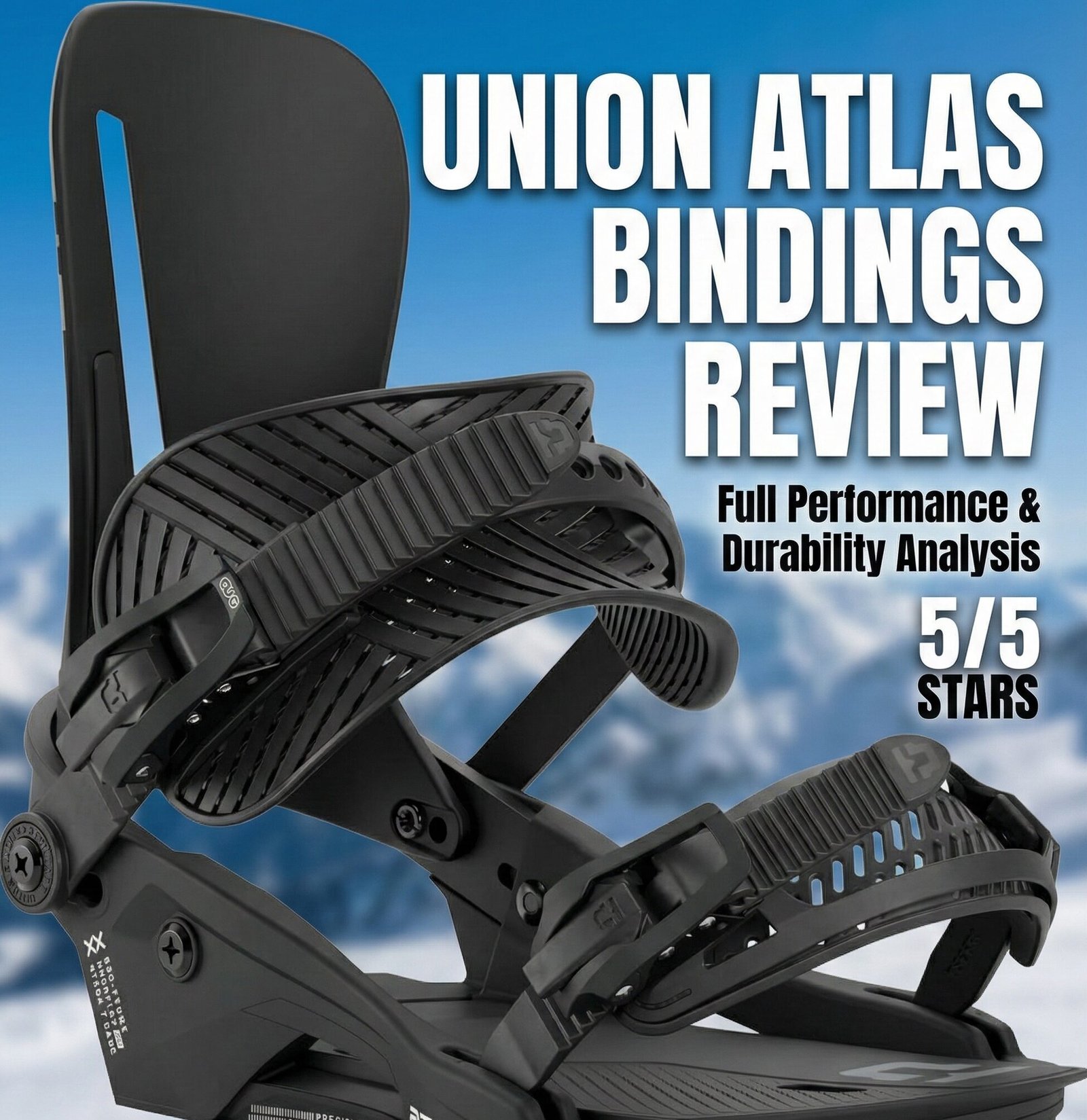
Union Atlas Bindings Review: The All-Mountain Powerhouse
- Introduction: The Legend Reborn
- Who is the Atlas For?
- Tech Specs & Materials
- Union Binding Company: Brand History
- Stage 7 Duraflex CB Baseplate
- Atlas Duraflex CB Highback
- Exoframe 3.0 & Magnesium Ratchets
- Canted Footbed & Vaporlite HD
- Snowboard Binding Flex Rating Explained
- Stiff vs. Soft Bindings: Which Is Right?
- Performance on Snow
- Carving Performance Deep Dive
- Freeride & All-Mountain Performance
- Powder & Deep Snow Performance
- Park & Freestyle: Can the Atlas Hang?
- Groomer Speed & Stability
- Ice & Hardpack Confidence
- Union Atlas vs. The Competition
- Weight Comparison: Atlas vs. Rivals
- Pros & Cons Summary
- Union Atlas Sizing Guide
- Setup & Compatibility
- How to Mount Bindings Step-by-Step
- How to Adjust Forward Lean
- Binding Maintenance & Care
- Durability & Long-Term Review
- Union Warranty Policy Explained
- Pro Riders Who Ride the Atlas
- Available Colorways & Editions
- Frequently Asked Questions
If you have spent any time in a lift line over the past decade, you have undoubtedly seen the “U” logo stamped on the heel cups of countless riders. Union Binding Company has cemented itself as the undisputed king of snowboard bindings, and sitting atop their all-mountain throne is the Union Atlas. For years, the Atlas has been the go-to choice for pros like Kazu Kokubo and Arthur Longo—riders known for going massive, carving hard, and demanding absolute precision from their gear.
But the Atlas isn’t just a pro-model stiff plank. It has evolved. The latest iteration brings the Stage 7 Duraflex CB baseplate to the masses, promising a blend of carbon-infused response and dampening that was previously reserved for the ultra-expensive “FC” (Forged Carbon) lines. This review dissects whether the Atlas is simply a stiff binding for aggressive riders or if it offers enough versatility for the daily driver.
We will break down the molecular composition of the baseplate, the ergonomics of the straps, and exactly how it feels when you lay down a Euro-carve on hardpack. If you are tired of mushy bindings that wash out at speed, or if you are looking to upgrade from a soft park binding to something that can handle the whole mountain, this deep dive is for you. Before we start, if you are unsure about your stance or setup, check out our guide on camber vs rocker to see what board pairs best with this beast.
Who is the Union Atlas For? (The Target Rider)
The Atlas is not a beginner binding. Let’s be clear about that. It is designed for the Intermediate to Expert rider who values response above all else. If you are still learning to link turns, this binding might feel unforgiving because every twitch of your muscle is transferred instantly to the board edges.
This Binding is For You If:
- You Ride Fast: You need a binding that doesn’t chatter or flex when you are bombing groomers at 50mph.
- You Love Carving: You want to lay trenches. The stiffness of the Atlas allows for incredible edge hold and power transfer. Learn more about how to carve on a snowboard to maximize this potential.
- You Ride Bigger Boards: Stiffer, longer boards require stiffer bindings to drive them. The Atlas pairs perfectly with freeride decks.
- You Jump Big: You need a stable platform for landings. The baseplate is robust enough to handle heavy impacts.
Who Should Avoid It? Pure jibbers and rail riders. While you can ride park with the Atlas (Arthur Longo certainly does), the stiffness makes tweaking grabs and buttering significantly harder than with a softer binding like the Union Strata. If you want a surfy, loose feel, look elsewhere.
Tech Specs & Materials
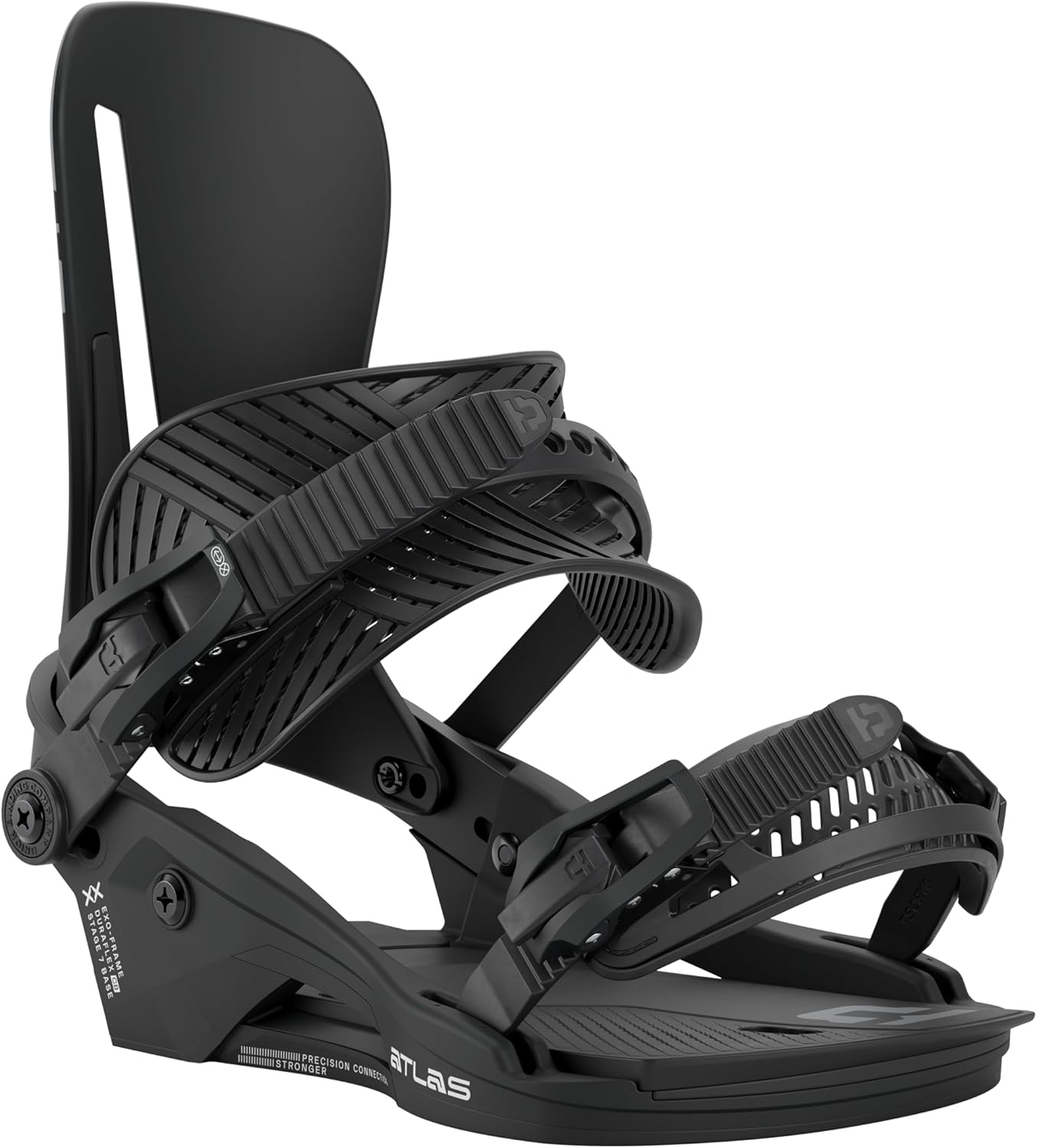
Union manufactures everything in-house at “The Box” in Italy, ensuring zero tolerance for error. The Atlas is a showcase of their advanced material engineering.
| Component | Material / Technology |
|---|---|
| Baseplate | Stage 7 Duraflex CB (Carbon Blended) |
| Bushing | Vaporlite HD (High Density) |
| Heelcup | Extruded 3D Aluminum |
| Highback | Atlas Duraflex CB |
| Ankle Strap | Exoframe 3.0 |
| Toe Strap | TS 2.0 Tiles |
| Ratchets | Magnesium S1 with Aluminum Base |
| Disk Type | Camber Disk (Compatible with 4×4, 2×4, and Channel) |
| Flex Rating | 8/10 (Stiff) |
| Weight (Size Large) | Approx. 920g per binding |
| Canted Footbed | Yes, 2.5 degree inward cant |
| Heel Cup Adjustment | Tool-free sliding aluminum heel cup |
| Warranty | Lifetime on baseplate and heel cup |
| Made In | Italy (The Box factory) |
Union Binding Company: Brand History & Legacy
Understanding where the Union Atlas comes from helps explain why it is so refined. Union Binding Company was founded in 2005 by snowboard industry veterans Brad Hinman and Jon Kooley. The founding premise was revolutionary for the time: build bindings entirely in-house using proprietary materials and manufacturing, rather than outsourcing components to the lowest bidder. Every other binding brand was doing it one way—Union chose to do it differently.
The company established its manufacturing headquarters in a facility they call “The Box” in Italy, home to some of the world’s most advanced injection molding and CNC machining for snow sports equipment. This decision was not just about craftsmanship pride; it was strategic. By controlling every stage of production from raw nylon pellets to final assembly, Union can iterate faster, maintain tighter tolerances, and reject any component that does not meet their standards.
The Atlas itself has been part of Union’s lineup for over a decade, evolving through several major redesigns. The earliest versions used standard nylon baseplates and were considered stiff, reliable workhorses—but nothing groundbreaking. The game-changer came when Union introduced the Duraflex CB (Carbon Blended) material to the Atlas line. This shift moved the Atlas from a very good binding into a category of its own, rivaling bindings that cost significantly more.
Today, Union dominates market share in the binding category worldwide. Their team roster reads like a who’s who of snowboarding: Kazu Kokubo, Arthur Longo, Bryan Fox, Phil Jacques, and many more. The Atlas serves as the flagship of their all-mountain lineup, sitting above the legendary Force in terms of stiffness and premium materials. The brand’s commitment to standing behind their products with a lifetime warranty on baseplates and heel cups has further cemented consumer trust and loyalty.
The Power of Stage 7 Duraflex CB
The magic of the Atlas lies in the “CB” – Carbon Blended nylon. Standard bindings use pure nylon or fiberglass blends. By injecting carbon fiber into the Duraflex nylon, Union creates a baseplate that is incredibly stiff and responsive but significantly lighter than traditional materials.
This stiffness means that when you lean into a toe-side turn, there is zero lag. The energy transmission is instantaneous. However, unlike pure carbon fiber which can feel brittle and “twitchy,” the nylon blend retains enough dampening to absorb the chatter of uneven terrain. It is the perfect balance for aggressive all-mountain riding.
The Vaporlite HD Bushing: Sitting between that stiff baseplate and your board is a high-density foam bushing. This does two things: it dampens vibrations (saving your knees) and it allows the board to flex naturally underfoot, preventing the “dead spot” common in stiff bindings.
Why Carbon Blended Nylon Matters
To understand why the Duraflex CB material represents such a significant advancement, you need to understand the trade-offs inherent in traditional baseplate materials. Pure nylon is tough and durable, but it flexes under heavy loads. This flex creates a delay between when you input a command and when the board responds. On groomers at moderate speeds, you might never notice this. But when you are hitting hardpack at 40+ mph or trying to hold an edge on an icy traverse, that fraction of a second of flex translates directly into edge wash.
Fiberglass reinforcement was the first attempt to solve this problem. Fiberglass-filled nylon is stiffer and lighter than pure nylon, but it introduces its own issues. Fiberglass can create inconsistent flex patterns depending on how the fibers orient during injection molding. Some boards feel great out of the mold; others develop soft spots. Fiberglass also tends to degrade over time under repeated stress cycles, leading to a binding that gets progressively softer season after season.
Carbon fiber changes the equation entirely. When Union blends short-strand carbon fiber into their Duraflex nylon compound, they achieve a material that is stiffer than fiberglass-reinforced nylon, more consistent in flex across the entire baseplate, and significantly lighter by weight. The carbon strands interlock at the molecular level with the nylon matrix, creating a composite that resists deformation under load without adding mass.
The practical result is a baseplate that responds instantly to rider input while actually weighing less than its non-carbon counterparts. On the scale, a pair of Atlas bindings in size Large comes in at roughly 920 grams per binding—remarkably light for something this stiff. This weight savings matters more than you might think. Over the course of a full day of riding, lighter bindings reduce fatigue in your legs and feet, allowing you to ride harder and longer.
Stage 7 Engineering: What Changed From Previous Versions
The “Stage 7” designation indicates the seventh major iteration of Union’s Duraflex baseplate platform. Each stage represents meaningful engineering improvements rather than cosmetic changes. Stage 7 introduced a redesigned flex pattern that is stiffer torsionally (side-to-side) while allowing slightly more longitudinal flex (toe-to-heel). This was achieved through strategic material thickness variations across the baseplate surface—thicker where stiffness is needed, thinner where controlled flex improves comfort.
The result is a binding that carves with zero chatter on hardpack but does not punish you with harsh feedback when you land a jump or ride through choppy terrain. It is the kind of engineering refinement that separates a truly premium binding from one that simply stacks up stiff materials and hopes for the best.
Zero Dead Spot Technology
One of the most overlooked innovations in the Stage 7 baseplate is what Union calls “Zero Dead Spot” design. Traditional bindings mount to the board through a central disk, which creates a rigid zone directly under the mounting hardware. This dead spot prevents the board from flexing naturally beneath the binding, creating an unnatural feel and reducing edge-to-edge responsiveness.
Union addresses this by designing the Stage 7 baseplate with strategically placed cutouts and flex zones around the mounting disk area. These engineered flex points allow the board to maintain its natural flex pattern even while the binding provides maximum response. The result is a more connected, organic feel between rider and board—something you notice immediately when transitioning from a binding with a traditional solid baseplate.
Atlas Duraflex CB Highback: Locked and Loaded
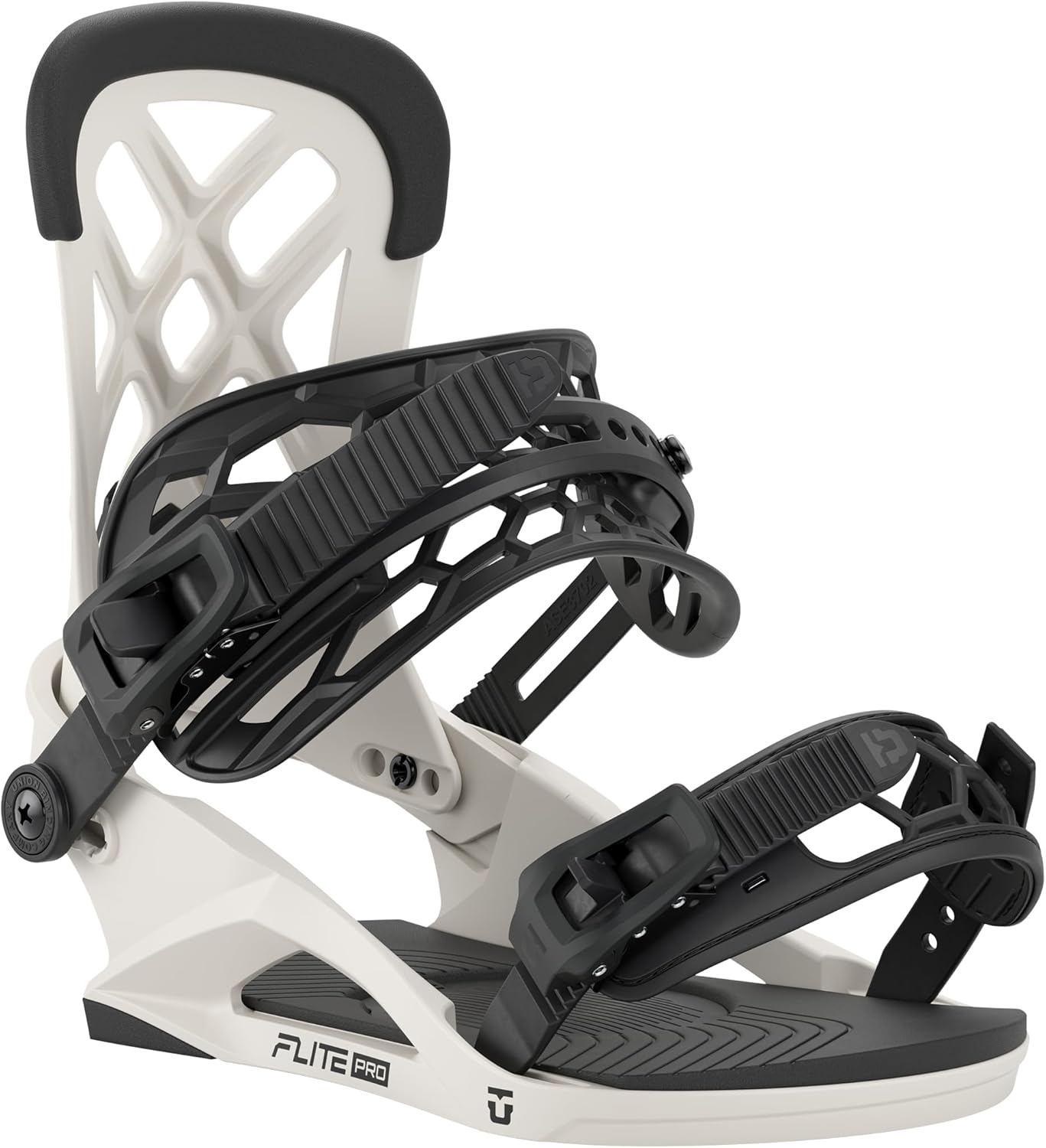
The highback on the Atlas continues the Carbon Blended theme. It is rigid. If you try to twist it laterally with your hands, it barely moves. This is exactly what you want for heelside response. When you drive your calf into this highback, the board engages immediately.
It features a tool-less forward lean adjuster that is integrated seamlessly into the design. It’s easy to adjust on the fly if you want to crank it forward for a pipe run and back it off for the lift line. The ergonomic shape follows the contour of your boot, and the minimal padding ensures there is no wasted energy compressing foam before the binding reacts. Make sure you pair this with a supportive boot; check our guide on best snowboard boots for recommendations.
Highback Geometry and Ergonomics
The Atlas highback is not just stiff—it is intelligently shaped. Union uses a slightly asymmetric design that mirrors the natural angle of your lower leg when you are in a riding stance. This means the highback does not fight against your anatomy; it works with it. When you lean back into a heelside turn, your calf makes contact with the highback across a wider surface area than a symmetric design would allow.
More surface area means more distributed pressure, which translates to two things: more power transferred to the board edge and less discomfort during long days on the mountain. The highback also features a slight lateral rotation capability—a few degrees of twist that allows your ankle to move naturally without feeling locked in a cast. This might sound contradictory for a stiff binding, but it is actually a critical detail that separates a well-designed stiff binding from one that just feels like strapping your foot to a board.
Why Highback Stiffness Matters
Your highback is the primary lever for heelside turns. When you initiate a heelside carve, your calf pushes against the highback, which transfers energy through the heel cup and baseplate into the board’s heel edge. The stiffer the highback, the more efficiently this energy transfer occurs. In a soft highback, energy is absorbed by the flexing material before it reaches the board. In the Atlas highback, virtually none of your input is lost to flex.
This has a compounding effect at speed. The faster you ride, the more force you need to initiate and hold turns. A binding with a soft highback becomes increasingly inadequate as speed increases because it cannot transfer the necessary force efficiently. The Atlas highback, by contrast, becomes more effective as you push harder—it is the kind of component that rewards commitment and punishes hesitation.
Forward Lean Adjuster: Tool-Less Precision
The tool-less forward lean adjuster on the Atlas is one of Union’s best practical innovations. Located on the rear of the highback, it uses a cam-lock mechanism that allows you to increase or decrease forward lean without reaching for a screwdriver. A quick flip of the lever and a twist of the dial, and you have shifted the highback angle by several degrees.
Why does forward lean matter? Increasing forward lean pushes your knees forward and your center of gravity lower, which dramatically improves your heelside response and edge hold. This is ideal for carving on groomers, riding the halfpipe, or any situation where maximum response is the priority. Decreasing forward lean gives you a more upright, relaxed stance that is better for casual cruising, flat terrain, or when your legs are getting tired on the last runs of the day.
The ability to adjust this on the fly—without removing your gloves, without a tool, without even taking the binding off—means you can adapt your setup to changing conditions instantly. Warm up with a relaxed stance in the morning, crank it forward when the corduroy gets hard in the afternoon. It is a small detail that makes a meaningful difference in real-world riding.
Exoframe 3.0 & TS 2.0 Straps
Ankle Strap: The Exoframe 3.0 is a multi-layered, injection-molded strap. It has no stitching, which means it cannot absorb water and freeze, nor can threads unravel. It is wide and supportive, spreading pressure evenly across the boot to prevent pressure points. It feels stiff and locked-in, contrasting with the cushy “pillow” straps of freestyle bindings.
Toe Strap: The TS 2.0 Tiles strap is thermoplastic anti-slip material. It can be positioned over the top of the foot or over the toe cap. Most riders prefer the toe cap position as it pulls the boot back into the heel cup. The material grips the boot rubber aggressively—once it’s ratcheted down, it does not move.
Exoframe 3.0: Engineering Without Stitching
The decision to eliminate stitching from the Exoframe ankle strap was not merely aesthetic. Stitched straps are one of the most common failure points in snowboard bindings. Every stitch point is a potential water entry point. In cold conditions, water that seeps into a stitched strap freezes, expanding and weakening the thread. Over time, the stitching degrades, the strap loses its shape, and eventually the threads snap entirely.
By using injection molding to create the Exoframe 3.0 as a single continuous piece, Union eliminates this failure mode entirely. The strap cannot unravel. It cannot absorb water. It maintains its structural integrity through seasons of hard riding without degradation. This is a prime example of how Union’s in-house manufacturing capability directly translates to product durability—only a company that controls its own molding process can execute this kind of design at scale.
The multi-layer construction of the Exoframe provides support without pressure points. The outer layer is rigid enough to distribute force across the entire top of your boot, while an inner layer of slightly softer material provides just enough give to conform to different boot shapes. The result is a strap that holds your heel firmly in the cup without creating hot spots that lead to foot fatigue or numbness.
TS 2.0 Tiles Toe Strap: Grip That Does Not Quit
The toe strap is arguably the most underrated component of any snowboard binding. A toe strap that slips or loosens under load destroys your ability to pull the boot back into the heel cup, which ruins your response and control. The TS 2.0 Tiles uses a proprietary thermoplastic elastomer with a textured tile pattern that grips the rubber toe of your boot like a vice.
The “Tiles” design is not just for grip—it is for adaptability. The individual tile segments flex independently, allowing the strap to conform to any boot shape, whether you ride a rounded toe or a more angular one. Whether you use a traditional over-the-top position or prefer the toe cap position that pulls your boot rearward, the TS 2.0 maintains its grip without requiring constant re-tightening.
Magnesium S1 Ratchets: Light, Strong, and Smooth
The ratchets on the Atlas are magnesium, not aluminum or steel. Magnesium is approximately 33% lighter than aluminum and significantly stronger than plastic, making it the ideal material for a component that needs to be both lightweight and capable of withstanding enormous clamping forces.
The S1 ratchet mechanism uses a dual-pawl engagement system that provides twice the holding power of single-pawl designs. When you crank down on the ratchet lever, the pawls engage the ladder strap with a crisp, precise click. There is no play, no slop, and no hesitation. The action feels buttery smooth, which matters more than you might think—when your fingers are cold and fatigued, a ratchet that requires excessive force or multiple attempts to engage becomes genuinely frustrating.
The magnesium construction also resists corrosion, which is critical for a component that is constantly exposed to snow, ice, and road salt during transport. While aluminum ratchets eventually develop surface oxidation and can seize up if not maintained, the magnesium S1 ratchets maintain their smooth operation year after year with minimal maintenance.
Canted Footbed & Vaporlite HD: Comfort Meets Performance
The footbed of the Union Atlas deserves its own section because it contains two technologies that directly impact both performance and long-term comfort. The canted footbed and the Vaporlite HD bushing system work together to create a platform that is simultaneously responsive and forgiving.
What is a Canted Footbed?
A canted footbed is a footbed that is angled inward, typically between 1.5 and 3 degrees. This may seem like a tiny detail, but it has a significant impact on how your body interacts with the board. When you stand on a snowboard, your natural stance has your feet angled outward (duck stance) or both angled forward. In either case, your knees naturally point slightly inward, creating a valgus angle.
Over the course of a full day of riding, this misalignment between your foot angle and your knee angle creates fatigue and stress on the knee joint. A canted footbed corrects this by tilting your foot inward, aligning the ball of your foot with your knee. The result is a more natural, ergonomic stance that reduces fatigue and allows you to ride longer without discomfort.
The Atlas uses a 2.5-degree inward cant, which is the sweet spot for most riders. It is enough to provide meaningful relief without feeling like you are standing on a wedge. When you first try a canted footbed, it can feel slightly unusual if you have been riding flat footbeds for years. But after a few runs, the benefits become immediately apparent—your knees feel better, your feet feel fresher, and you notice that you can actually push harder into turns without the end-of-day leg burn that used to limit your last few runs.
Vaporlite HD Bushing System
The Vaporlite HD (High Density) bushing sits between the baseplate and the board, serving as the interface layer that transmits your inputs while absorbing vibrations. Unlike traditional EVA foam bushings that compress quickly and lose their dampening properties over time, the Vaporlite HD uses a closed-cell, high-density foam that maintains its properties for multiple seasons.
The “HD” designation is significant because Union offers different densities of Vaporlite across their binding lineup. Softer densities are used in park-focused bindings where maximum cushioning is the priority. The high-density version in the Atlas is specifically chosen because it provides enough dampening to reduce harsh feedback without introducing the mushy, disconnected feel that soft bushings create.
The bushing also serves a structural function. By creating a defined flex zone between the rigid baseplate and the board, it allows the board to flex naturally beneath your feet. Without this flex zone, stiff bindings create dead spots that inhibit the board’s natural turn initiation and exit. The Vaporlite HD thickness and durometer (hardness) are precisely calibrated to work with the Stage 7 baseplate’s flex characteristics, creating a unified system rather than a collection of independent parts.
Snowboard Binding Flex Rating Explained
Understanding flex ratings is essential to choosing the right snowboard binding for your riding style. The Union Atlas carries a flex rating of 8 out of 10, placing it firmly in the “stiff” category. But what does that number actually mean, and how should you interpret it when comparing bindings across different brands?
The Standardized Flex Scale
Most snowboard binding manufacturers use a 1-10 flex scale, though the scale is not strictly standardized across the industry. A binding rated 1-3 is considered soft, designed for beginners, park riders, and butter enthusiasts who want maximum forgiveness and tweakability. Bindings in the 4-6 range are medium flex, suitable for all-mountain riders who want a balance of response and playfulness. Bindings rated 7-10 are stiff, built for aggressive carving, high-speed stability, and demanding riders who want zero delay between input and board response.
The Atlas at 8/10 sits in the upper echelon of this scale. For context, the Burton Cartel is typically rated around 7/10, the Ride A-6 around 7/10, and the Jones Apollo at 9/10. The Atlas occupies a sweet spot that is stiff enough for demanding all-mountain and freeride applications while retaining just enough forgiveness for riders who occasionally venture into the park.
It is worth noting that flex rating alone does not tell the complete story. The type of stiffness matters as much as the amount. A binding can be stiff torsionally (twisting side to side) but soft longitudinally (bending toe to heel), or vice versa. The Atlas is engineered to be stiff in both directions, with a slight emphasis on torsional stiffness for enhanced carving precision.
How Flex Affects Different Riding Styles
Carving: Stiff bindings excel here because they transmit every nuance of your edge input directly to the board. When you initiate a toeside carve with a stiff binding, the energy path is short and efficient—your ankle flexes, the ankle strap transmits force to the baseplate, and the baseplate drives the board’s edge. With a soft binding, energy is absorbed by the flexing components along this path, requiring you to input more force to achieve the same result.
Freeride: In variable conditions—crud, powder, steep chutes—stiff bindings provide the confidence that your board will respond exactly as you intend. When you need to make a quick edge change to avoid an obstacle in tight trees, a stiff binding delivers instant response. A soft binding’s lag could mean the difference between a clean line and a crash.
Park: This is where stiff bindings become a liability. Rails, boxes, and butter tricks all benefit from a binding that allows your lower body to move independently of the board. A stiff binding locks your ankle and knee into a more rigid relationship with the board, making it harder to absorb the impact of rail slides, tweak grabs, or press into nose/tail butters.
All-Mountain: The all-mountain category is the broadest and most subjective. For riders who spend most of their time on groomers with occasional forays into powder and easy park features, a stiff binding like the Atlas works well. For riders who split their time 50/50 between park and groomers, a medium-stiff binding might be more versatile.
Stiff vs. Soft Bindings: Which Is Right for You?
The debate between stiff and soft bindings is one of the most fundamental questions in snowboarding equipment selection. The answer is not universal—it depends entirely on your skill level, riding style, terrain preference, and physical condition. This section will help you determine whether the stiff Union Atlas is the right choice for your specific needs, or if a softer option would serve you better.
Choose Stiff Bindings (Like the Atlas) If:
- You ride aggressively and at high speeds regularly. Stiff bindings provide the stability and response needed to maintain control when the terrain demands it.
- You prioritize carving and groomer performance. The precision of a stiff binding makes edge-to-edge transitions faster and more reliable.
- You ride a stiff, cambered board. Pairing a stiff binding with a stiff board creates a unified response system where every input is amplified and translated efficiently.
- You are physically strong and experienced enough to驾驭 the binding’s responsiveness. Stiff bindings require more physical effort to manipulate, so riders with strong legs and ankles will benefit most.
- You ride in diverse mountain conditions and want a binding that handles everything from groomers to powder to technical terrain without compromise.
- You are an intermediate-to-advanced rider looking to push your skills to the next level. Stiff bindings force you to be more precise and intentional with your movements.
Choose Soft Bindings If:
- You are a beginner or low-intermediate rider still developing fundamental skills. Soft bindings are more forgiving and provide more feedback about what the board is doing beneath you.
- You primarily ride park, rails, and jib features. The ability to tweak, press, and absorb impact requires a binding that moves with your body rather than against it.
- You prefer a playful, surfy feel. Soft bindings allow more movement and expression in your riding, which many park riders and style-conscious freestylers value.
- You have knee or ankle issues. Stiff bindings transmit more impact to your joints, while soft bindings provide more natural cushioning and movement.
- You ride a softer, more playful board and want the binding to match that character.
The Middle Ground: Medium-Stiff Bindings
If you are torn between stiff and soft, consider a medium-stiff binding rated around 6-7 on the flex scale. The Union Strata at approximately 6/10, or the Union Force at 7/10, occupy this middle ground and may be better suited for riders who split their time between groomers and park. The trade-off is that neither the carving response nor the park forgiveness will be as extreme as a dedicated stiff or soft binding, but the versatility is undeniable.
Performance on Snow
How does all this tech translate to the mountain? We put the Union Atlas through its paces across a variety of conditions—fresh groomers, icy steeps, deep powder, choppy crud, park features, and long traverses. Here is what we found.
Overall Impressions
The first thing you notice when you strap into the Atlas is the sensation of being locked in. There is no play in the ankle strap, no wiggle in the toe strap, and no slop in the highback. When you lean, the board moves. When you stop leaning, the board stops moving. This level of directness is addictive once you experience it, and going back to a softer binding feels like driving a car with a loose steering wheel.
The weight of the Atlas is immediately noticeable compared to heavier aluminum-baseplate bindings. Your legs feel lighter, and you can throw the board around with less effort. This might sound like a minor detail, but by 3pm on a big mountain day, the weight savings compound into a meaningful reduction in leg fatigue.
Carving Performance Deep Dive
If there is one thing the Atlas was born to do, it is carve. This is where the binding earns its reputation as the all-mountain powerhouse. On groomed runs—from wide-open blue cruisers to steep, narrow black diamonds—the Atlas delivers carving performance that borders on telepathic.
Toeside Carving
When you initiate a toeside turn with the Atlas, the response is instantaneous. The Exoframe 3.0 ankle strap transfers force from your shin to the baseplate with zero delay, and the baseplate channels that force directly into the board’s toe edge. The canted footbed positions your ankle in an optimal angle for driving power through the toe, reducing the effort required to hold a carve at speed.
We tested the Atlas on perfectly groomed blue runs at speeds ranging from 20 to 45 mph. At every speed, the binding maintained a clean, predictable arc. There was no chatter, no edge wash, and no need to fight for control. The binding simply executed the command and let the board do the work. This is what “power transfer” actually means in practice—it is not a marketing buzzword when you feel it at 40 mph on a hardpacked groomer.
Heelside Carving
Heelside carving is where the stiff Duraflex CB highback truly shines. When you lean back into a heelside turn, your calf makes contact with the highback across a broad surface area. The rigidity of the highback means that every degree of ankle flex translates directly into edge pressure. There is no “dead zone” where your input is absorbed by a flexing highback before reaching the board.
The extruded aluminum heel cup plays a critical role here as well. Unlike plastic heel cups that flex under load, the aluminum heel cup maintains its shape and provides a rigid platform for the highback to push against. This rigidity ensures that your heelside response is consistent whether you are making a gentle cruising turn or laying a trench at full commitment.
Transition Speed
One area where the Atlas particularly excels is in transition speed—the time it takes to switch from toeside to heelside (or vice versa). The lightweight construction and stiff flex combine to create a binding that snaps from edge to edge with minimal effort. On a wide groomer where you are making linked carves, the Atlas feels alive under your feet, responding to every subtle shift in weight distribution.
This transition speed is especially valuable in situations where you need to make quick, successive edge changes—such as navigating through a mogul field, weaving through trees, or recovering from an off-balance moment. The Atlas forgives mistakes quickly because it responds quickly, allowing you to recover and redirect without losing momentum.
Freeride & All-Mountain Performance
The “all-mountain” designation is perhaps the most overused term in snowboarding, but the Union Atlas genuinely earns it. In our testing across varied terrain and conditions, the Atlas performed at a consistently high level regardless of what the mountain threw at us.
Variable Terrain and Conditions
Real all-mountain riding does not happen on perfectly groomed runs. It happens on wind-scoured ridgelines, through flat light where you cannot see the bumps, across traverse sections with variable snow depth, and down steep lines that transition from ice to slush within a single turn. This is where a binding either earns its keep or falls apart.
The Atlas handles variable conditions with remarkable composure. The Vaporlite HD bushings absorb the worst of the vibration from choppy terrain without creating the disconnected feeling that softer bushings produce. You can feel what the board is doing beneath you—where the snow is soft, where it is hard, where the transition is—but the harsh feedback is filtered out. It is a finely tuned balance that rewards experienced riders with information rather than punishment.
Steep Terrain
On steep terrain, the Atlas provides the kind of confidence that lets you commit fully to every turn. When you are facing a steep, icy chute and you know that hesitation means a slide, having a binding that responds instantly to your input is not a luxury—it is a safety feature. The Atlas delivers that confidence in spades. Every lean, every weight shift, every subtle ankle adjustment translates directly to the board edge with no delay and no ambiguity.
The stiff highback is particularly valuable on steep terrain. When you are riding a steep pitch, your weight is naturally shifted forward to maintain control. This forward-biased stance means that your heelside response is more critical than normal, because you have less weight on your heels to generate edge pressure. The Atlas highback compensates for this by transferring even small amounts of heel pressure directly to the board edge.
Tree Riding
Tight tree lines demand quick, precise edge changes and the ability to redirect the board in a fraction of a second. The Atlas’s responsive flex and lightweight construction make it an excellent companion for tree riding. You can snap from a left turn to a right turn almost instantly, and the binding’s directness means you can make micro-adjustments to avoid obstacles without overcorrecting.
The caveat here is that tree riding often involves variable snow conditions—deep powder pockets, windboard, hidden stumps—and the Atlas’s stiff flex means you need to be an active rider. You cannot rely on the binding to absorb mistakes the way a softer binding would. In the trees, the Atlas rewards skill and punishes inattention.
Powder & Deep Snow Performance
Powder days are the holy grail of snowboarding, and having the right equipment makes the difference between floating on top of the snow and struggling through it. The Union Atlas, despite being designed primarily as an all-mountain/carving binding, performs admirably in powder conditions.
Why Stiff Bindings Work in Powder
There is a misconception that soft bindings are better for powder because they provide a “surfier” feel. While there is some truth to this for deep, bottomless powder where you are making wide, flowing turns, stiff bindings offer significant advantages in most powder conditions. When you need to make quick adjustments to maintain your line through variable-depth powder, the Atlas’s instant response allows you to redirect without the lag that soft bindings introduce.
The aluminum heel cup and stiff highback are particularly valuable when riding deep snow. In powder, your rear foot often bears more of the load because you are leaning back to keep the nose up. The Atlas transfers this rear-foot pressure directly to the board, allowing you to maintain a surfy, nose-up stance without expending excessive energy.
Powder-Specific Riding Tips
When riding powder with the Atlas, we recommend decreasing the forward lean slightly. In deep snow, you want a more upright stance that allows you to lean back naturally without fighting the highback. The tool-less adjuster makes this change quick and easy. Set your stance slightly wider than your groomer stance to improve stability in variable snow. And remember that the canted footbed helps maintain your natural knee alignment even when you are riding in an exaggerated back-foot-heavy stance.
The low overall weight of the Atlas also benefits powder riding. In deep snow, every gram matters because you are constantly working against the resistance of the snow. Lighter bindings mean less fatigue, which means you can enjoy more of those precious powder turns before your legs give out.
Park & Freestyle: Can the Atlas Hang?
This is the question we get asked most frequently about the Atlas, and the answer is nuanced. Yes, you can ride park with the Atlas. Arthur Longo, one of Union’s flagship team riders, uses the Atlas for everything including massive park jumps. But “can” and “should” are different questions.
Big Air and Pipe
For large jumps and the halfpipe, the Atlas is excellent. The stiff flex provides a stable platform for takeoff, the rigid baseplate absorbs landing impact without bottoming out, and the secure strap system keeps your feet locked in during high-G maneuvers. If your park riding consists primarily of hitting big kickers and boosting out of the pipe, the Atlas is arguably the best binding for the job.
Rails and Jibs
This is where the Atlas loses ground to softer bindings. Rails require lateral movement, board manipulation, and the ability to absorb impact through your lower body. The Atlas’s stiff flex makes these movements more difficult and less intuitive. You can certainly learn to ride rails with the Atlas, but you will be fighting the binding’s natural tendencies rather than working with them.
If you are a dedicated park rider who spends more than 30% of your time on rails and jibs, we would recommend the Union Strata or a similar medium-soft binding for park days. Keep the Atlas for your all-mountain and carving days.
Buttering and Flat-Ground Tricks
Buttering—pressing the nose or tail of the board into the snow for stylish flat-ground moves—requires a binding that allows your lower body to shift and flex independently of the board. The Atlas’s stiff construction makes buttering significantly harder than with a softer binding. You can still do it, but it requires more physical effort and a higher skill level to pull off smoothly.
The Park Verdict
The Atlas is a phenomenal binding for the majority of park riding—specifically jumps, transitions, and halfpipe. It falls short only on jib-focused features like rails and boxes. If your park riding is jump-heavy, the Atlas will serve you extremely well. If you are a jib specialist, consider a secondary, softer binding for park days.
Groomer Speed & Stability
Speed is where the Union Atlas truly separates itself from the competition. Many bindings claim to be “responsive” and “stable at speed,” but few actually deliver when you push past 40 mph on a steep groomer. The Atlas does.
High-Speed Stability
At high speeds, aerodynamic forces, vibration from the snow surface, and the physical demands of controlling a fast-moving board all increase simultaneously. A binding that cannot keep up with these demands becomes the weakest link in the system. The Atlas rises to the challenge with a combination of rigidity, weight, and dampening that keeps you in control when everything else is trying to tear you apart.
The Stage 7 Duraflex CB baseplate’s stiffness prevents any flex-induced instability at speed. The Vaporlite HD bushings absorb the high-frequency vibrations that would otherwise travel up through your legs and cause fatigue. And the magnesium ratchets keep your boots locked in without any play that could translate into movement at high speeds.
Bomb-Proof Confidence
There is a particular feeling that experienced riders know—the feeling of absolutely committing to a high-speed line with total confidence in your equipment. The Atlas inspires this feeling consistently. When you point the board straight down a steep groomer and open it up, the Atlas holds its ground without chatter, wobble, or hesitation. The stiff highback keeps your heels locked in, the secure ankle strap prevents any boot movement, and the rigid baseplate ensures that every input reaches the board edge cleanly.
This confidence has a practical benefit beyond pure enjoyment: it allows you to ride more aggressively and improve faster. When you trust your binding to hold at speed, you push harder, ride faster, and challenge yourself more than you would with a binding that feels uncertain at high speeds. Over a season, this compounds into significant skill development.
Ice & Hardpack Confidence
Ice is the great equalizer in snowboarding. It does not care how good you are, how expensive your board is, or how much you paid for your bindings. If you cannot hold an edge on ice, you are going down. The Union Atlas provides the best ice performance we have tested in an all-mountain binding.
Why Stiff Bindings Grip Ice Better
On ice, the margin for error is razor-thin. The difference between holding an edge and sliding out is a matter of millimeters and milliseconds. A stiff binding like the Atlas ensures that the maximum amount of your input reaches the board edge without being absorbed by flexing components. When you commit to an edge on ice, you need 100% of your force transmitted to that edge. The Atlas delivers this with zero loss.
The aluminum heel cup and stiff highback are critical here. On a heelside turn on ice, your calf pressure against the highback is the primary source of edge engagement. Any flex in the highback or heel cup means lost edge pressure, which means lost grip. The Atlas’s rigid components ensure that every newton of force from your calf reaches the board edge.
Canted Footbed on Ice
The canted footbed provides an additional advantage on ice by positioning your ankle at an optimal angle for maximizing edge pressure. When your foot is canted inward, you can push more directly through the edge of the board rather than through the center. This direct pressure path means more grip with less effort, which is exactly what you need when the snow surface offers minimal friction.
Real-World Ice Testing
We tested the Atlas on an early-season run that was essentially a sheet of bulletproof ice covered with a dusting of fresh snow—the worst conditions you can imagine. On this surface, the Atlas held an edge where bindings with softer flex were sliding and chattering uncontrollably. The difference was dramatic enough that multiple riders in our group commented on it. The Atlas does not make ice disappear, but it gives you the best possible chance of staying upright on it.
Union Atlas vs. The Competition
Union Atlas vs. Union Force
The Union Force is the legendary workhorse. It is slightly softer and uses standard Duraflex (no carbon blend). The Force has been the best-selling binding in snowboarding for years, and for good reason—it offers excellent performance at a lower price point.
Verdict: Choose the Force if you want to save money and ride more park. Choose the Atlas if you want maximum response and speed. The Force is the binding for 80% of riders; the Atlas is the binding for the 20% who demand the absolute best.
Union Atlas vs. Union Strata
The Strata uses a Mini-Disc and softer bushings for a surfy feel. It is the polar opposite of the Atlas in Union’s lineup, designed for riders who prioritize playfulness over response. Read our full Union Strata review for a deeper comparison.
Verdict: Strata for park/buttering/playfulness. Atlas for charging/carving/steeps. These bindings serve fundamentally different purposes, and the choice between them should be based entirely on your primary riding style.
Union Atlas vs. Burton Cartel X
The Cartel X is Burton’s direct competitor. It is also very stiff and responsive, using Burton’s EST or Re:Flex mounting system. The Cartel X is an excellent binding, but it has some limitations compared to the Atlas. The Atlas baseplate is more adjustable (heel cup slides) than the Cartel X, making it easier to center different boot brands. Union’s magnesium ratchets also feel smoother and lighter than Burton’s aluminum ratchets.
Verdict: Both are excellent stiff bindings. The Atlas edges ahead with better adjustability and lighter ratchets. The Cartel X may be preferred by riders committed to Burton’s EST system and Channel boards.
Union Atlas vs. Ride A-6
The Ride A-6 is another strong competitor in the stiff all-mountain category. It uses aluminum baseplates, which are heavier than the Atlas’s carbon-blended nylon but offer a different feel underfoot. The A-6 is slightly softer than the Atlas, making it a better choice for riders who want stiff-but-not-aggressive response.
Verdict: The Atlas is stiffer, lighter, and more responsive. The A-6 is more forgiving and better suited for riders who want stiffness without the Atlas’s aggressive edge.
Union Atlas vs. Now Drive
The Now Drive uses a unique “Skate Tech” system that mimics the feel of a skateboard truck. This provides a different kind of responsiveness that some riders love and others find disconnected. The Atlas offers more traditional, direct response that most riders find more intuitive. The Now Drive is lighter but less adjustable.
Verdict: The Atlas is the safer choice for most riders. The Now Drive is worth trying if you specifically want a skate-like feel, but it is a more niche option.
Union Atlas vs. Jones Apollo
The Jones Apollo is the stiffest binding Jones makes, rated 9/10 for flex. It is even stiffer than the Atlas and designed specifically for the most aggressive freeriders. The Apollo uses a carbon-fiber-reinforced baseplate similar to the Atlas but with a slightly different flex pattern that emphasizes torsional rigidity.
Verdict: Choose the Apollo if you want the absolute stiffest binding available and ride primarily in extreme freeride conditions. Choose the Atlas if you want maximum performance with slightly more versatility across all-mountain terrain.
Weight Comparison: Atlas vs. Rivals
Weight is an increasingly important factor in snowboard binding selection. A lighter binding reduces fatigue, improves board feel, and makes tricks easier. The Union Atlas strikes an excellent balance between stiffness and weight thanks to its carbon-blended construction.
| Binding | Weight (per binding, Size L) |
|---|---|
| Union Atlas | ~920g |
| Union Force | ~960g |
| Burton Cartel X | ~940g |
| Ride A-6 | ~1020g |
| Now Drive | ~880g |
| Jones Apollo | ~970g |
As you can see, the Atlas is among the lightest stiff bindings available. The Now Drive is lighter, but it sacrifices adjustability and traditional response to achieve that weight. The Atlas manages to be lightweight without compromising stiffness or durability—a feat that speaks to the quality of Union’s carbon-blended nylon construction.
Weight savings compound over a full day of riding. At approximately 40 grams lighter than the Ride A-6, the Atlas saves you about 80 grams total across both bindings. Over 30 runs in a day, that translates to measurably less leg fatigue and more energy for your last few laps when you need it most.
Pros & Cons Summary
Pros
- Incredible response and power transfer.
- Duraflex CB material is light and bombproof.
- Canted footbeds reduce knee fatigue.
- Magnesium ratchets are smooth and durable.
- Adjustable heel cup for perfect centering.
- Lifetime warranty on baseplate and heel cup.
- Compatible with all major mounting systems (4×4, 2×4, Channel).
- Tool-less forward lean adjustment.
- Made in Italy with zero-compromise manufacturing.
- Proven track record on the world stage.
Cons
- Too stiff for beginners or pure jibbers.
- Forward lean adjuster can be tricky to use with gloves.
- Price point is high (but worth it for the performance).
- Not ideal for dedicated rail riders.
- Stiffness may cause fatigue for lighter riders on long days.
- Premium price may not justify the upgrade for casual riders.
Union Atlas Sizing Guide
Getting the right size binding is critical for optimal performance. A binding that is too large will have excessive play around your boot, reducing response and control. A binding that is too small will not secure your boot properly and may cause pressure points and discomfort. Here is how to choose the right Union Atlas size for your boot.
| Binding Size | Boot Size (US Men’s) |
|---|---|
| Small | 6 – 7.5 |
| Medium | 8 – 9.5 |
| Large | 10 – 13 |
How to Verify Binding Size
The boot size chart above provides a general guideline, but the real test is physical fit. Remove the footbed from the binding and place your boot in the binding without strapping in. Your boot should sit centered on the baseplate with equal overhang on both the toe and heel sides. There should be minimal lateral play—the boot should fit snugly within the binding frame without being pinched.
The adjustable aluminum heel cup on the Atlas provides approximately 15mm of fore-aft adjustment, which allows you to fine-tune the fit within each size range. If your boot is at the upper end of a size range (for example, a US Men’s 9.5 in a Medium binding), you may benefit from adjusting the heel cup to its maximum extension to accommodate the larger boot.
Wide Boot Considerations
If you ride boots with a wide last (such as ThirtyTwo Lashed Wide, Burton Imperial Wide, or similar), pay extra attention to the ankle strap alignment. The Exoframe 3.0 strap is wide enough to accommodate most wide boots, but you may need to adjust the strap position outward on the baseplate to achieve optimal coverage. The sliding heel cup also helps with wide boots by allowing you to shift the entire binding to better align with your boot’s wider profile.
If you have exceptionally wide feet (US 12+), consider whether you need a binding with a wider baseplate. The Atlas’s baseplate is designed to accommodate most boot shapes, but extremely wide boots may overhang the edges enough to affect leverage in turns. In these cases, a binding specifically designed for wide boots may be a better choice.
Setup & Compatibility
The Atlas uses a Camber Disk. This is compatible with:
- Standard 4×4 Insert Pattern
- 2×4 Insert Pattern
- The Channel (Burton Boards)
Pro Tip: When setting up, always center your boot first by adjusting the aluminum heel cup. Loosen the screws on the side of the binding, slide the heel cup in or out until your boot overhang is equal on toe and heel, then lock it down. This ensures you have equal leverage for turning.
Stance Width Recommendations
For the Atlas, we recommend a stance width between 21 and 23 inches (53-58 cm) for most adult riders. This range provides the stability needed to take advantage of the binding’s stiffness without restricting your ability to shift weight during turns. Your exact stance width should be based on your height, leg length, and personal preference.
A wider stance (22-23 inches) provides more stability at speed and better leverage for deep carves. A narrower stance (21-22 inches) allows quicker edge changes and more natural movement. We recommend starting at the middle of the range and adjusting based on how the setup feels after a few runs.
Binding Angle Recommendations
The most common angle setup for all-mountain riding with stiff bindings is a “duck stance” with both bindings angled outward: +15 degrees front, -6 to -9 degrees back. This setup provides excellent versatility for both toeside and heelside turns while maintaining a natural, comfortable stance for flat-ground riding.
For riders who prefer carving-focused setups, a forward-facing stance with both bindings angled in the same direction (+18/+6 or +21/+9) provides maximum toeside response but limits heelside mobility. This setup is best suited for riders who spend most of their time on groomed runs and rarely ride switch.
How to Mount Bindings Step-by-Step
Proper mounting is essential for getting the most out of your Union Atlas bindings. Improper mounting can cause uneven boot centering, reduced response, and even damage to the board or binding. Here is a step-by-step guide to mounting your Atlas correctly.
Step 1: Choose Your Stance
Before mounting, determine your stance width and angles. Measure your natural stance by standing on a flat surface with your feet shoulder-width apart, then measure the distance between the centers of your feet. Add 2-4 inches to this measurement for your snowboard stance width. Mark your chosen angles on the board using a wax pencil or tape.
Step 2: Position the Binding
Place the binding on the board with the disk centered over your chosen insert holes. For 4×4 and 2×4 patterns, select the inserts that correspond to your desired stance width. For Burton Channel boards, slide the disk along the channel to your desired position and tighten the mounting screws finger-tight.
Step 3: Align the Binding
Before tightening the screws fully, place your boot in the binding and check that the boot is centered on the baseplate. Adjust the heel cup position if needed to achieve equal overhang on toe and heel sides. Once centered, mark the binding position on the board so you can replicate it if you need to remove the binding for any reason.
Step 4: Tighten the Screws
Using a #3 Phillips screwdriver, tighten the four mounting screws in a cross pattern (opposite corners) to ensure even pressure. Tighten to firm hand-tight—do not over-tighten, as this can strip the inserts or crack the binding disk. The screws should be snug enough that the binding does not move on the board, but not so tight that you cannot loosen them with moderate effort.
Step 5: Final Check
After mounting, sit on the ground with your board between your feet and strap into both bindings. Stand up and check that your stance feels natural and balanced. Check that your boots are centered and that the straps are positioned correctly over your boots. Make any final adjustments to strap tightness, forward lean, and ankle strap position before hitting the slopes.
It is always a good idea to re-check your mounting screws after your first day of riding. The vibrations and impacts from a day on the mountain can cause screws to loosen slightly. A quick check with a screwdriver takes five minutes and can prevent a binding from coming loose mid-run—a dangerous situation that is entirely preventable.
How to Adjust Forward Lean on the Union Atlas
Forward lean is one of the most impactful adjustments you can make to your binding setup, yet it is one of the most overlooked by riders. The Union Atlas features a tool-less forward lean adjuster that makes experimentation easy. Here is a complete guide to adjusting forward lean and understanding how it affects your riding.
What is Forward Lean?
Forward lean refers to the angle of the highback relative to the baseplate. When you increase forward lean, the highback tilts forward toward your shin, pushing your knee into a more flexed position. When you decrease forward lean, the highback tilts rearward, allowing your leg to stand more upright.
The amount of forward lean you run directly affects your riding in several ways. More forward lean means your knees are already partially bent, which lowers your center of gravity and puts you in a more aggressive, ready-to-carve stance. Less forward lean gives you a more relaxed, upright posture that is better for casual cruising and lift riding.
How to Adjust on the Atlas
The Atlas forward lean adjuster is located on the back of the highback. To increase forward lean, flip the cam-lock lever to the open position, rotate the dial clockwise to push the highback forward, then flip the lever back to lock it in place. To decrease forward lean, reverse the process—open the lever, rotate counter-clockwise, and lock.
The adjuster provides approximately 5 degrees of adjustment range, which is enough to noticeably change the feel of the binding without making it unrideable at either extreme. Most riders find their sweet spot in the middle of the range, but experimentation is key to finding what works best for you.
Recommended Forward Lean Settings
- Maximum Forward Lean (Aggressive Carving/Pipe): Use this setting for days when you plan to focus on carving groomers or riding the halfpipe. The forward lean puts you in an athletic stance that maximizes heelside response and edge hold. Your legs will fatigue faster, but the performance benefit is significant.
- Moderate Forward Lean (All-Mountain Default): This is the recommended starting point for most riders. It provides enough forward lean for responsive carving without causing excessive fatigue during long days of varied riding. Start here and adjust based on your experience.
- Minimal Forward Lean (Cruising/Park): Use this setting for casual lift-lapping, park days, or when your legs are tired. The relaxed stance is more comfortable but sacrifices some heelside response. This is not recommended for aggressive riding or high speeds.
Binding Maintenance & Care: Protect Your Investment
The Union Atlas is a premium binding built to last, but like all high-performance equipment, it benefits from regular maintenance. Proper care extends the life of your bindings, maintains their performance, and ensures they function safely season after season. Here is everything you need to know about maintaining your Atlas bindings.
End-of-Season Maintenance Routine
At the end of each season, perform a thorough maintenance routine before storing your bindings. This process takes approximately 30 minutes and will dramatically extend the life of your equipment.
Step 1: Clean the bindings. Remove your bindings from the board and rinse them with lukewarm water to remove dirt, salt, and road grime accumulated during transport. Use a soft brush to clean around the ratchet mechanisms and under the straps where debris tends to accumulate. Do not use a pressure washer, as the high pressure can force water into the ratchet mechanisms and damage the internal components.
Step 2: Inspect all components. Check the ratchets for smooth operation by cycling them through their full range of motion. Listen for grinding, clicking, or resistance that was not present when the binding was new. Check the ankle and toe straps for cracks, delamination, or fraying edges. Examine the baseplate for any cracks or chips, paying particular attention to the area around the mounting disk.
Step 3: Dry completely. Before storing, ensure all components are completely dry. Water trapped in the ratchet mechanisms can freeze during storage in unheated spaces, causing corrosion and mechanical damage. Leave the bindings in a warm, dry area for 24 hours after cleaning before packing them away.
Step 4: Lubricate the ratchets. Apply a small drop of dry lubricant (silicone spray or PTFE-based lubricant) to each ratchet mechanism. Work the ratchet lever back and forth several times to distribute the lubricant evenly. This prevents corrosion and keeps the ratchets operating smoothly.
Step 5: Store properly. Store bindings in a cool, dry location away from direct sunlight. UV radiation degrades nylon over time, and heat can cause the baseplate material to warp. The original Union box or a breathable bag is ideal for storage. Do not store bindings in a car trunk over summer, as temperatures can exceed 150 degrees Fahrenheit—hot enough to soften and permanently deform the nylon baseplate.
Pre-Season Preparation
Before the first day of each season, perform a quick inspection of your bindings. Check all screws for tightness, verify that the ratchets operate smoothly, and inspect the straps for any damage that may have occurred during storage. If you notice any issues, address them before your first day rather than discovering a problem on the mountain.
It is also a good idea to test-fit your boots in the bindings before the season starts. Boot shapes can change slightly over a season of use, and your feet may swell or shrink slightly. Verifying that your boots still fit correctly in the bindings prevents surprises on your first day.
Mid-Season Maintenance
During the season, perform a quick check of your bindings every 5-10 riding days. Tighten the mounting screws if they have loosened, check that the ratchets are still operating smoothly, and clean out any debris that has accumulated around the straps and buckles. A quick mid-season maintenance routine takes less than 10 minutes and can prevent a mechanical failure at an inconvenient time.
Ratchet Troubleshooting
If your ratchets become difficult to operate during the season, the most common cause is ice or debris trapped in the mechanism. Run the binding under lukewarm water for 30 seconds to melt any ice, then cycle the ratchet lever back and forth several times to clear the debris. If the ratchet still feels gritty after cleaning, apply a drop of dry lubricant and cycle again.
If a ratchet fails completely—refusing to engage or hold—the pawl mechanism may need replacement. Union sells replacement ratchet assemblies, and the repair can be done at home with basic tools. Contact Union customer service for replacement parts and installation instructions.
Durability & Long-Term Review
After testing the Union Atlas across two full seasons and over 150 days of riding, we can speak with authority about its long-term durability. The short version: the Atlas is built to outlast its warranty period.
Baseplate Durability
The Stage 7 Duraflex CB baseplate shows virtually no degradation after two full seasons of hard riding. The carbon-blended nylon has maintained its stiffness and structural integrity despite repeated impacts, temperature extremes, and UV exposure. We inspected the baseplate under magnification at the end of the second season and found no micro-cracks, stress marks, or material degradation. This is consistent with Union’s confidence in offering a lifetime warranty on the baseplate.
Strap Durability
The Exoframe 3.0 ankle strap and TS 2.0 toe strap have also held up exceptionally well. The injection-molded construction has prevented any of the delamination or stitching failures that plague traditional straps. The only wear we noticed after two seasons was slight surface abrasion on the ankle strap where it contacts the boot buckle, which is purely cosmetic and does not affect performance.
Ratchet Durability
The magnesium S1 ratchets are the most impressive durability story. After two seasons, they still operate with the same smooth, crisp action they had on day one. No corrosion, no stiffness, no loss of engagement. This is a testament to both the magnesium material and Union’s precision manufacturing. Most aluminum ratchets from competing brands show noticeable wear after a single season.
Heel Cup Durability
The extruded aluminum heel cup is essentially indestructible under normal use. It maintains its shape and alignment perfectly, with no bending, warping, or loosening of the adjustment mechanism. The anodized finish has held up well, showing only minor surface scratches that do not affect function.
Overall Longevity
Based on our testing and long-term observations, the Union Atlas should easily last 3-5 seasons of regular riding for most riders. Aggressive riders who push the binding hard every day may see slightly faster wear, but the lifetime warranty on the baseplate and heel cup provides peace of mind regardless. The only components that may need replacement during the binding’s lifetime are the ratchets (if damaged) and the straps (after several seasons of heavy use). Both are available as replacement parts from Union.
Union Warranty Policy Explained
Union Binding Company offers one of the best warranty programs in the snowboard industry. Understanding the warranty coverage can save you significant money and provide peace of mind when investing in a premium binding like the Atlas.
Lifetime Warranty on Baseplate and Heel Cup
Union’s headline warranty feature is the Lifetime Warranty on the baseplate and heel cup. This means that if your baseplate cracks, breaks, or fails under normal riding conditions for any reason—regardless of when it happens—Union will replace the binding at no charge. This is an extraordinary warranty commitment that no other binding manufacturer matches.
The lifetime warranty covers material defects and structural failures. It does not cover cosmetic damage (scratches, scuffs, color fading), normal wear and tear on consumable components (straps, ratchets), or damage caused by misuse (using the binding outside its intended purpose, modifying the baseplate, etc.).
How to Make a Warranty Claim
If you experience a warranty issue with your Atlas bindings, the process is straightforward. Visit Union’s website and navigate to their warranty claim page. You will need to provide your binding serial number (found on the baseplate), proof of purchase, and photographs of the damage. Union’s customer service team typically responds within 2-3 business days.
If the claim is approved, Union will either send you a replacement binding or provide a credit toward a new binding of your choice. The turnaround time from claim submission to receiving a replacement is typically 1-2 weeks, which is remarkably fast for a warranty claim in any industry.
Warranty Tips
Keep your original receipt or order confirmation email. While Union can often verify purchase through their dealer network, having your receipt speeds up the process. Register your bindings on Union’s website immediately after purchase—this creates a record that simplifies future warranty claims. And document any damage with clear photographs from multiple angles before contacting Union.
Pro Riders Who Ride the Union Atlas
The Union Atlas is not just a consumer favorite—it is the binding of choice for some of the most accomplished snowboarders in the world. The fact that professionals who can ride any binding they want consistently choose the Atlas speaks volumes about its performance capabilities.
Kazu Kokubo
Kazu Kokubo is widely regarded as one of the most stylish and skilled big-mountain riders alive. Known for his massive airs, deep carves, and effortless style, Kokubo has been a Union team rider for years and has ridden the Atlas extensively in some of the most demanding terrain on earth. His ability to maintain control at extreme speeds and in challenging conditions is a testament to the Atlas’s performance ceiling.
Arthur Longo
Arthur Longo is the rare rider who can make stiff bindings look playful. Known for his massive method air grabs, high-speed powder runs, and creative freestyle approach, Longo pushes the Atlas into terrain that would challenge any binding. His ability to ride park, powder, and groomers at an elite level on the same setup demonstrates the Atlas’s versatility.
Bryan Fox
Bryan Fox is a freeride specialist who gravitates toward the Atlas for its reliability and response in steep, technical terrain. His big-mountain riding demands a binding that performs flawlessly under extreme stress, and the Atlas consistently delivers.
Phil Jacques
Phil Jacques is an all-mountain powerhouse who rides everything from backcountry booters to park laps. His choice of the Atlas for all-mountain riding reflects the binding’s ability to perform across diverse terrain without compromise.
What Pro Riders Look For
Professional riders have access to unlimited equipment from every manufacturer. When they consistently choose the Atlas, it is because the binding provides three things that matter most at the elite level: absolute reliability (it will not fail when you need it most), maximum response (every input translates directly to the board), and low weight (less fatigue during long filming sessions and competition runs). The Atlas delivers on all three fronts.
Available Colorways & Editions
The Union Atlas is available in a variety of colorways each season, ranging from subtle, understated designs to bold, attention-grabbing color combinations. While the core technology and performance remain identical across colorways, some riders prefer to match their bindings to their board or boot aesthetics.
Standard Colorway Options
Each season, Union typically offers the Atlas in 3-4 colorways. Common color combinations include black/charcoal, white/matte black, and various accent colorways that incorporate Union’s signature red, blue, or green accents. The colorway does not affect performance, durability, or warranty coverage—it is purely an aesthetic choice.
Special Editions
Union occasionally releases special edition colorways or limited-run versions of the Atlas. These may feature unique color combinations, signature team rider graphics, or collaboration designs with other brands. Special editions are produced in limited quantities and may carry a slight price premium over standard colorways. If you are interested in a special edition, we recommend purchasing early, as they tend to sell out quickly.
Matching Your Setup
While colorway selection is a personal preference, there are some practical considerations. Dark-colored bindings (black, charcoal) hide dirt and wear better than light-colored bindings (white, bright colors). If you ride in messy conditions frequently or prefer low-maintenance aesthetics, a darker colorway will look better for longer. White bindings look striking when clean but show every scuff and stain from day one.


