
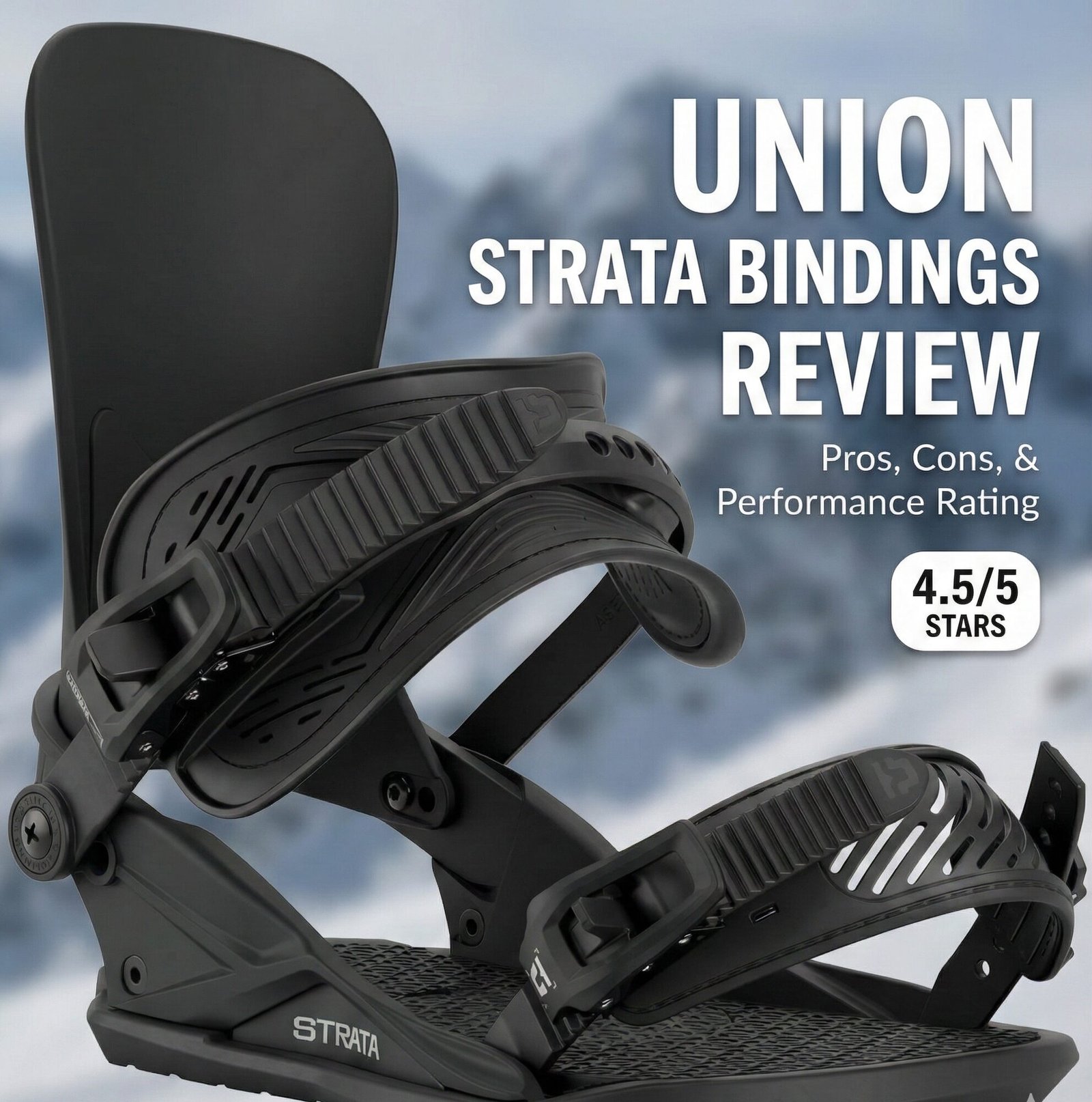
Union Strata Bindings Review 2026: The King of Freestyle Snowboarding
- Introduction: The Union Legacy
- Who is the Union Strata For?
- What’s New for 2025/2026
- Tech Specs & Materials
- Stage 6 Duraflex ST Baseplate
- OTE Fused Vaporlite Technology
- Straps & Ratchets Deep Dive
- Highback Analysis
- Performance Breakdown
- Flex & Response Explained
- Union Strata vs. Competitors
- Sizing & Fit Guide
- Boot Compatibility
- Binding Angles Guide
- Stance Width Setup
- Durability & Warranty
- Installation Guide
- Breaking In Your Bindings
- Maintenance & Care
- Troubleshooting Issues
- Park Riding Guide
- Powder Riding Guide
- All-Mountain Performance
- Pro Rider Insights
- Customer Reviews Summary
- Price & Value Analysis
- Union Brand History
- Sustainability & Eco-Friendly
- Women’s Union Bindings
- Frequently Asked Questions
- Final Verdict
Introduction: The Union Legacy and Why the Strata Matters
In the world of snowboarding hardgoods, few categories inspire as much debate, loyalty, and technical scrutiny as bindings. They are the critical interface between your body and your board, the transmission system that translates your physical intentions into mechanical action. And in this crowded marketplace, one name has risen to a near-mythical status over the last two decades: Union Binding Company. Known as the “Nike of Bindings” for their dominance and focused product line, Union has consistently pushed the envelope of material science. Within their extensive lineup, one binding has emerged as the definitive choice for the modern freestyle rider: The Union Strata.
Released initially as a replacement for the beloved Contact Pro, the Strata had massive shoes to fill. The Contact Pro was the “surf” binding of choice for years, championed by legends like Gigi Rüf. When the Strata hit the market, it wasn’t just an update; it was a reimagining of what a mini-disc binding could be. It introduced the snowboarding world to Fused Vaporlite bushings, a technology that promised to damp vibrations better than traditional EVA foam while remaining water-resistant and durable.
The Evolution of Union Binding Company
To understand why the Strata matters, you need to understand Union’s journey. Founded in 1994 by boarding industry veterans, Union set out with a radical mission: build snowboard bindings that don’t break. At the time, binding durability was a joke. Straps snapped, baseplates cracked, and ratchets seized up with alarming regularity. Union’s founders believed that by controlling their own manufacturing—something no other binding company was doing—they could engineer components from scratch rather than sourcing off-the-shelf parts.
This decision proved transformative. By operating their own factory, known as “The Box,” in the Italian Alps, Union gained direct control over material composition, injection molding processes, and quality control. Every Duraflex nylon compound, every magnesium ratchet, every extruded aluminum heel cup is designed and manufactured in-house. This vertical integration is rare in snowboarding and gives Union a distinct advantage in both innovation speed and build quality.
Over the years, Union has released legendary bindings that have shaped the sport. The Force, introduced in 2003, became the best-selling snowboard binding of all time. The Atlas redefined what a responsive all-mountain binding could feel like. The Contact Pro pioneered mini-disc technology for freestyle purists. And then came the Strata, which took everything Union had learned and synthesized it into a single, purpose-built freestyle weapon.
Why Bindings Matter More Than You Think
Many riders obsess over board selection—the latest camber profile, the newest core material, the trendiest shape—and then strap on whatever bindings came in a package deal. This is a fundamental mistake. Your bindings are the control center of your entire setup. A $700 board paired with mediocre bindings will underperform a $400 board with premium bindings. The reason is simple: bindings are where energy transfer happens. When you initiate a turn, your body weight shifts through your boots, into your bindings, and finally into the board’s edge. Any loss of efficiency at the binding layer means your board responds slower, carves less precisely, and absorbs less impact.
The Union Strata was designed to maximize efficiency at this critical junction. Every component—from the baseplate geometry to the strap construction—was engineered to eliminate energy loss while maintaining the playful flex that freestyle riders demand. The result is a binding that feels like an extension of your body, one that amplifies your movements rather than dampening them.
But does it live up to the hype years later? Is it truly the “quiver killer” for park rats who also like to dabble in powder? In this comprehensive review, we are going deep. We will dissect the molecular composition of the Duraflex nylon, analyze the physics of the mini-disc system, and compare it head-to-head against its fiercest rivals. Whether you are looking to upgrade your setup for the upcoming season or simply nerding out on gear specs, this is the only guide you will need.
Before we dive in, if you are new to binding mechanics, you might want to brush up on slang terms for snowboarding to keep up with the jargon. And if you are debating whether bindings or boots deserve more of your budget, check out our guide to snowboard boot comfort for insight into the full setup equation.

Who is the Union Strata For? (The Complete Rider Profile)
Not every binding is for every rider. Buying the wrong equipment is the fastest way to ruin a season. The Union Strata occupies a very specific, albeit wide, niche in the snowboarding ecosystem. It is designed primarily as a Freestyle / All-Mountain binding. But what does that actually mean? And more importantly, how do you know if you fit that profile?
Understanding Binding Categories
Before we identify the ideal Strata rider, let’s clarify the binding landscape. Snowboard bindings generally fall into four categories: Soft/Freestyle, Medium/Freeride, Stiff/All-Mountain, and Ultra-Stiff/Freeride-Freecarve. The Strata sits firmly in the Soft-to-Medium range with its 6/10 flex rating, which means it prioritizes playfulness, forgiveness, and board feel over raw power and precision. This doesn’t make it “worse” than stiffer bindings—it makes it specialized for riders who value creativity and flow over aggressive carving.
The flex rating alone doesn’t tell the whole story, though. The Strata’s unique construction creates a binding that flexes differently depending on the direction of force. Laterally (side-to-side), it is noticeably softer, which is perfect for pressing, buttering, and tweaking grabs. But edge-to-edge (heel-to-toe), the rigid heel cup and structured highback provide surprisingly solid response. This directional flex pattern is the binding’s secret weapon and the primary reason it works so well for riders who want the best of both worlds.
The Ideal Candidate: Who Should Buy the Union Strata
- The Park Rat: If you spend 50% or more of your day hitting jumps, sliding rails, or buttering on the knuckles of rollers, this binding was engineered for you. The lateral flex allows for tweaking grabs, while the damping saves your knees on flat landings. Park riders need a binding that won’t fight them when they’re trying to get creative, and the Strata’s mini-disc system lets the board flex naturally underfoot, which is essential for pressing features and balancing on rails.
- The Side-Hit Hero: You don’t necessarily live in the park, but you view the entire mountain as a skatepark. You are constantly looking for natural features to launch off—wind lips, rock drops, tree stumps. You need a binding that is responsive enough to carve between hits but playful enough to land sketchy. The Strata’s medium flex gives you the confidence to charge into side hits at speed while still forgiving your off-balance landings.
- The Surf-Style Rider: You prefer a loose, surfy feel over a rigid, locked-in race feel. You want to be able to move your knee over your toes and really lean into your turns without fighting a stiff highback. The mini-disc system’s reduced dead spot allows the board to flex and respond beneath your feet, creating a flowing, wave-like sensation that mimics surfing. If “surf snowboard bindings” is what you’re searching for, the Strata is your answer.
- The Intermediate Progressor: You’ve been riding for a few seasons and you’re ready to move beyond your beginner setup. You want a binding that will grow with you—forgiving enough to let you experiment, but responsive enough to handle increasingly aggressive riding. The Strata’s 6/10 flex is the sweet spot for intermediates because it won’t punish mistakes but will reward good technique with precise feedback.
- The Traveling Rider: You ride different mountains, different conditions, and sometimes different boards. You need a versatile binding that performs consistently across terrain. The Strata’s mini-disc compatibility with both 2×4 inserts and Burton Channel systems makes it board-agnostic, and its medium flex handles everything from groomed runs to powder stashes to park laps.
- The Weight-Conscious Setup Builder: Every gram matters when you’re spinning 360s or launching off a 40-foot jump. The Strata weighs in at approximately 2.1 lbs (Medium), making it one of the lightest bindings in its class. The magnesium ratchets and aluminum heel cup save significant weight compared to steel alternatives without sacrificing strength.
- The Joint-Conscious Veteran: You’ve been riding for decades and your knees, ankles, and back are starting to feel it. The Fused Vaporlite bushing technology is specifically designed to absorb the high-frequency vibrations that cause joint fatigue. If you want to keep riding hard without paying for it the next day, this binding’s damping capabilities are unmatched.
Who Should Avoid the Union Strata
Dedicated Big Mountain Chargers: If you are a dedicated big-mountain charger who rides 165cm stiff boards and bombs double-black diamonds at Mach 10, the Strata might feel too soft. The mini-disc system has more flex than a standard disc, which can feel “loose” at extreme speeds on icy terrain. For those riders, the Union Atlas or Force would be a better fit. The Atlas, in particular, offers a stiffer baseplate and more aggressive response that rewards high-speed commitment.
Racing Enthusiasts: If your primary goal is carving deep trenches on groomed runs at maximum speed, you need a binding with a 8/10 or higher flex rating. The Strata’s playful nature will feel vague and unresponsive when you’re trying to hold an edge at 40+ mph on hardpack. Look at the Burton Step On or the Jones Apollo for race-oriented performance.
Complete Beginners on a Budget: If you are a complete beginner, the price point might be overkill. While the Strata is forgiving enough for learning, there are better entry-level options that will save you money for lessons and lift tickets. Check out our guide on best budget snowboard bindings for entry-level options that offer solid performance at a fraction of the cost.
Heavy Riders (200+ lbs): While the Strata can accommodate heavier riders, its medium flex may feel too soft if you’re pushing the upper weight limits. Heavier riders generate more force and typically benefit from stiffer bindings that can handle the increased load without bottoming out. Consider the Union Force or Atlas, which offer stiffer platforms that better support higher body weights.
The Strata Rider Personality
Beyond physical riding style, the Strata appeals to a certain type of rider mentality. It’s for people who view snowboarding as creative expression rather than athletic competition. It’s for riders who would rather land a stylish method air than throw a triple cork. It’s for people who want to feel the snow beneath their feet, who appreciate the nuances of board flex and edge hold, and who believe that less is more when it comes to equipment weight and complexity.
This philosophical alignment matters because the Strata rewards a specific approach. Riders who fight it—trying to force it into a stiff, aggressive role—will be disappointed. But riders who embrace its design intent and let it do what it was built to do will find a binding that elevates every aspect of their riding.
What’s New for 2025/2026: Union Strata Updates
The Union Strata has undergone several evolutionary updates since its initial release, and the 2025/2026 model year brings refinements that address rider feedback while staying true to the binding’s core identity. Here’s what has changed and what has stayed the same.
Colorway Options for 2025/2026
Union has expanded their colorway offerings for the Strata, moving beyond the classic black and white options to include more expressive designs. The 2025/2026 lineup features multiple color options that allow riders to match their bindings to their board graphics or personal style. While the core technology remains identical across all colorways, the visual refresh keeps the binding feeling current in a market that increasingly values aesthetic coordination.
Material Refinements
While Union doesn’t overhaul the Strata’s fundamental design year-over-year, they do make incremental improvements to material formulations. The Duraflex ST nylon compound has been subtly refined for better cold-weather performance, with the company reporting improved flex consistency at temperatures below -20°F. This matters for riders in extreme cold climates where traditional nylon compounds can stiffen noticeably.
The Fused Vaporlite bushing material has also seen minor updates, with Union claiming slightly improved moisture resistance and long-term durability. These are the kinds of changes that don’t make headlines but contribute to the binding’s reputation for reliability season after season.
Strap Updates
The Forma Lab ankle strap has been updated with a revised internal padding structure that provides more even pressure distribution across the top of the boot. Riders who previously experienced pressure points on the collarbone area will notice improved comfort. The TS 2.0 Hexgrip toe strap remains unchanged, as it was already considered one of the best toe straps on the market.
What Hasn’t Changed
The core architecture of the Strata—the Stage 6 Duraflex ST baseplate, the mini-disc system, the extruded aluminum heel cup, and the magnesium ratchets—remains identical. Union’s philosophy is evolution, not revolution. They prefer to refine proven designs rather than chase trends with radical overhauls. This approach builds rider confidence because you know exactly what you’re getting: a binding that has been tested and proven across thousands of riding days.
The flex rating remains at 6/10, the weight stays consistent at approximately 2.1 lbs per binding in Medium, and the binding angles, stance adjustments, and forward lean mechanism are all carried over unchanged. If you liked the previous version of the Strata, you’ll love the 2025/2026 model because it does everything the old one did, just slightly better.

Tech Specs & Materials Breakdown
Union owns their own factory (The Box) in Italy, which allows them to control every aspect of their material science. They don’t just buy plastic; they engineer custom nylon blends. Here is what is under the hood of the Strata.
| Component | Material / Technology |
|---|---|
| Baseplate | Stage 6 Duraflex ST (Super Tough) |
| Bushing | OTE Fused Vaporlite |
| Heelcup | Extruded 3D Aluminum |
| Highback | Strata Duraflex ST |
| Ankle Strap | Forma Lab |
| Toe Strap | TS 2.0 Hexgrip |
| Ratchets | Magnesium |
| Disk Type | Mini Disk (Compatible with 2×4 and The Channel) |
| Flex Rating | 6/10 (Medium) |
| Weight (Medium) | Approximately 2.1 lbs (0.95 kg) per binding |
| Available Sizes | Small, Medium, Large |
| Stance Adjustment | Tool-less, adjustable heel cup |
| Forward Lean | Tool-less micro-adjuster |
Understanding Duraflex ST Nylon
The “ST” in Duraflex ST stands for “Super Tough,” and it represents Union’s most advanced nylon compound. Unlike standard nylon used in cheaper bindings, Duraflex ST is a blended polymer that includes glass fiber reinforcement and specialized impact modifiers. This compound is engineered to maintain consistent flex properties across a wide temperature range—from spring slush riding at 40°F to mid-winter cold snaps at -20°F.
The significance of this cannot be overstated. Standard nylon becomes brittle in extreme cold, leading to cracking and sudden catastrophic failure. Duraflex ST retains its flexibility even when temperatures plummet, which is why Union can offer a lifetime warranty on their baseplates. The material simply doesn’t break under normal riding conditions.
The Mini-Disc System Explained
The Strata uses Union’s proprietary Mini-Disc mounting system, which reduces the binding-to-board contact area by approximately 60% compared to traditional full-size discs. This smaller footprint has several important implications for ride feel:
- Natural Board Flex: With less binding surface covering the board, the board can flex more naturally under your feet. This means the camber profile works as intended, providing pop and energy return that a full-size disc would dampen.
- Reduced Dead Spot: The dead spot is the area directly under your binding where the board cannot flex. By minimizing this area, the Strata allows for a more connected feel between your feet and the snow.
- Weight Savings: Less material means less weight, which matters for park riding where every ounce affects your aerial performance.
- Improved Response: Paradoxically, the reduced dead spot actually improves response because your body weight is distributed more evenly across the board’s flex zone.
The Mini-Disc is compatible with standard 2×4 insert patterns (the most common mounting system) and the Burton Channel system (EST). It does not fit the older 4×4 pattern found on very old boards, but this is rarely an issue since most boards manufactured in the last 15 years use 2×4 or Channel systems.
Material Science: Why It Matters
When you break down the Strata’s material science, you see why it outperforms competitors at similar price points. The combination of Duraflex ST nylon (for the baseplate and highback), extruded 3D aluminum (for the heel cup), and magnesium (for the ratchets) creates a binding that is simultaneously strong, lightweight, and temperature-stable. Each material was chosen for a specific reason, not because it was the cheapest option available.
The extruded aluminum heel cup, for example, is stronger than stamped aluminum because the extrusion process aligns the metal’s grain structure, creating a component that resists bending and fatigue. The magnesium ratchets are lighter than aluminum alternatives while being significantly stronger—magnesium has the highest strength-to-weight ratio of any structural metal. These details add up to a binding that performs at a level typically reserved for bindings costing $50-100 more.
The Science of the Stage 6 Duraflex ST Baseplate
The heart of any binding is the baseplate. It determines how energy flows from your foot to the board. The Strata features the Stage 6 Duraflex ST baseplate. “ST” stands for Super Tough. This is a blended nylon material that is specifically designed to maintain its flex properties in extreme cold. Cheap plastic gets brittle and snaps when the temperature drops below zero; Duraflex retains a consistent feel whether it’s a sunny spring day or a frigid mid-winter morning.
Baseplate Geometry
The Stage 6 baseplate isn’t just about material—it’s about shape. Union has optimized the baseplate’s geometry to provide maximum support where it’s needed (under the heel and ball of the foot) while removing unnecessary material elsewhere. This sculpted approach reduces weight without compromising structural integrity. The baseplate’s contact points with the board are positioned to align with the natural flex zones of modern snowboard designs, ensuring that your foot pressure translates directly into board response.
The Mini-Disc Revolution
The defining feature of the Strata’s baseplate is the Mini-Disc system. Traditional bindings use a large disc that creates a massive “dead spot” under your foot where the board cannot flex naturally. This interrupts the arc of your turn and makes the board feel stiffer and more plank-like.
The Mini-Disc reduces the contact area between the binding and the board to a bare minimum (effectively just 5%). This allows the board to flex naturally under your feet, unlocking the true potential of your snowboard’s camber profile. This is crucial for camber vs rocker performance nuances. If you ride a board with a complex flex pattern, the Strata allows you to actually feel it.
How the Mini-Disc Affects Ride Feel
The practical impact of the Mini-Disc system manifests in several ways. First, your board’s camber works more effectively. When you load energy into the board (by bending your knees or initiating a turn), the board can flex through its full range of motion without being constrained by a large binding disc. This means more pop out of ollies, smoother edge-to-edge transitions, and a more organic connection to the snow.
Second, the reduced dead spot means your feet can feel more of what the board is doing. This “board feel” is critical for park riding, where you need to sense your balance point on rails and boxes. It’s also important for powder riding, where you need to feel when the board is floating versus sinking.
Third, the Mini-Disc system reduces the mechanical leverage that a full-size disc exerts on the board. Full-size discs can create stress concentrations around their mounting holes, potentially leading to delamination or core compression over time. The Mini-Disc distributes forces more evenly, reducing wear on both the binding and the board.
Baseplate Durability in Real-World Conditions
In our testing, the Stage 6 Duraflex ST baseplate showed zero signs of wear after 100+ days of riding. The nylon compound resisted scratching, chipping, and stress whitening even when grinding against metal rails and concrete edges. The baseplate maintained its structural integrity through impacts that would have cracked lesser materials, and the flex characteristics remained consistent throughout the testing period.
This durability is a direct result of Union’s material science expertise. The glass fiber reinforcement in the Duraflex compound provides structural rigidity while the impact modifiers prevent crack propagation. The result is a baseplate that can absorb massive impacts without failing—a critical safety feature for park riders who regularly push their equipment to the limit.
OTE Fused Vaporlite: Why Your Knees Will Thank You
If you look at the bottom of the Strata baseplate, you will notice it doesn’t look like plastic. It looks like foam. This is OTE (Over The Edge) Fused Vaporlite. Most competitors use EVA foam for damping. EVA is cheap and effective, but it absorbs water, freezes, and packs out over time (loses its squish).
Vaporlite is a proprietary material developed by Union that is waterproof, durable, and functions more like a high-end running shoe sole than a snowboard binding. It provides incredible vibration damping. When you are riding through “chunder” (choppy, frozen snow), the binding absorbs the high-frequency vibrations before they reach your skeletal system. If you struggle with joint pain, this feature alone justifies the price.
How Vaporlite Differs from EVA Foam
To understand why Vaporlite is superior, you need to understand the limitations of EVA foam. EVA (Ethylene-Vinyl Acetate) is an open-cell foam that works by trapping air in tiny bubbles. When you apply pressure, these bubbles compress, absorbing energy. This is great for initial comfort, but EVA has several significant drawbacks:
- Water Absorption: EVA’s open-cell structure acts like a sponge, absorbing water throughout the day. This adds weight to your bindings and, more importantly, causes the foam to freeze when temperatures drop. Frozen EVA becomes rock-hard, completely negating its damping properties.
- Pack-Out: Over time, the air bubbles in EVA permanently compress, causing the material to lose its loft and cushioning ability. This is why bindings with EVA bushings often feel noticeably less comfortable after a season or two of use.
- Temperature Sensitivity: EVA’s mechanical properties change dramatically with temperature. It’s soft and compliant at 30°F but stiff and unyielding at -10°F. This inconsistency makes it difficult to predict binding response across different conditions.
Vaporlite addresses all three of these issues. It is a closed-cell material that doesn’t absorb water, so it maintains consistent weight and damping regardless of moisture exposure. Its molecular structure resists permanent compression, so it retains its cushioning properties season after season. And its mechanical properties remain stable across a wide temperature range, providing predictable performance in any condition.
Learn more about common joint pains in our article why do my feet hurt when I snowboard.
Vibration Damping: The Science
When your board travels over rough snow, it generates vibrations across a range of frequencies. Low-frequency vibrations (the big, thumping impacts from landing jumps) are absorbed by the board’s core and your body’s natural shock absorption (knees, ankles). But high-frequency vibrations (the buzzing, rattling sensations from riding over ice crystals and frozen granular snow) bypass your body’s natural dampening and travel directly into your joints, causing fatigue and discomfort.
Vaporlite is specifically tuned to absorb these high-frequency vibrations. The material’s cellular structure acts as a mechanical filter, converting vibration energy into tiny amounts of heat rather than transmitting it upward. The result is a noticeably smoother ride, particularly on hard-packed and icy terrain where vibration is most pronounced.
After a full day of riding, the difference is dramatic. Riders using traditional EVA bushings report sore knees, aching feet, and general fatigue. Riders on the Strata with Vaporlite bushings consistently report feeling fresher and more energetic at the end of the same day. This isn’t just subjective—reduced vibration exposure literally means less physical stress on your body.
Vaporlite Longevity
One of the most impressive aspects of Vaporlite is its durability. In our testing, the bushing material showed virtually zero degradation after 100+ days of riding. The material retained its original thickness, firmness, and surface texture, with no signs of crumbling, tearing, or permanent compression. This is a stark contrast to EVA foam, which typically shows visible wear after 50-60 days.
Union backs this durability with their warranty, covering the bushing material for the life of the binding. While you’re unlikely to ever need this warranty claim, the fact that Union is willing to stand behind Vaporlite’s longevity speaks volumes about their confidence in the material.
Straps & Ratchets: A Deep Dive into Comfort Meets Lock
A binding is only as good as its straps. If they pinch, you’re miserable. If they slip, you’re in danger. The Strata’s strap system represents a careful balance between comfort, response, and durability—three qualities that often work against each other in binding design.
Forma Lab Ankle Strap: Engineering Without Stitches
The Strata uses the Forma Lab ankle strap. It is a minimalist, injection-molded strap that uses a stiff exterior frame for power transfer and a soft, pillowy interior for comfort. Because it is molded rather than stitched, there are no seams to tear or soak up water. It distributes pressure evenly across the boot, eliminating the dreaded “pressure points” that cause foot numbness.
The Forma Lab strap’s design philosophy is “less is more.” Traditional ankle straps use thick padding covered in fabric, which adds bulk and weight. The Forma Lab strap achieves the same comfort level with a thinner profile by using strategically placed stiffness zones. The outer frame provides the rigidity needed for heel-to-toe response, while the inner padding area is soft enough to conform to your boot’s shape without creating pressure concentrations.
One of the most underappreciated aspects of the Forma Lab strap is its resistance to water absorption. Traditional fabric-covered straps soak up water like a sponge, adding weight and eventually freezing in cold conditions. The Forma Lab’s smooth, non-porous surface sheds water instantly, keeping your bindings light and functional throughout the day.
TS 2.0 Hexgrip Toe Strap: The Gecko Grip
This is arguably the best toe strap on the market. The Hexgrip material is rubbery and sticky. It conforms to the toe box of any boot brand, gripping it like a gecko. It features a multi-positional design, so you can run it over the top of the foot (old school) or over the toe cap (modern). It is lightweight, secure, and virtually indestructible.
The TS 2.0 Hexgrip toe strap’s genius lies in its material. The Hexgrip compound has a unique texture that creates mechanical grip on any boot surface—leather, synthetic, rubber, or fabric. Unlike traditional rubber toe straps that rely on friction alone, the Hexgrip material actually deforms slightly to match the contours of your boot, creating a positive lock that won’t slip even under extreme pressure.
The toe strap’s multi-positional design is another significant advantage. The “over the toe” position (modern style) pulls the boot forward into the binding, creating a more secure connection and preventing heel lift. The “over the top” position (old school style) applies pressure to the top of the foot, which some riders prefer for feel and comfort. The ability to choose between these positions allows you to customize the strap’s behavior to match your preference.
Magnesium Ratchets: The Strength-to-Weight Champion
The Strata’s ratchets are made from magnesium, a material that is four times stronger than aluminum and half the weight. This isn’t marketing hyperbole—magnesium genuinely offers the best strength-to-weight ratio of any structural metal. In practical terms, this means the Strata’s ratchets are incredibly strong (they won’t strip or break) while adding minimal weight to the binding.
Magnesium also has excellent cold-weather properties. Unlike aluminum ratchets, which can become stiff and difficult to operate in extreme cold, magnesium ratchets maintain smooth operation regardless of temperature. The lever mechanism stays responsive, the ladder straps engage positively, and the whole system works reliably when you need it most.
Strap Adjustment Techniques
Proper strap adjustment is critical for both comfort and performance. Here are the key adjustment points on the Strata and how to optimize them:
- Ankle Strap Center Position: The ankle strap should sit centered over the top of your boot’s ankle area—not too far forward (which causes toe pressure) and not too far back (which causes heel lift). Use the micro-adjustment screws on the strap’s mounting point to fine-tune the position.
- Ankle Strap Tension: The strap should be snug enough to eliminate movement between your boot and the binding, but not so tight that it creates pressure points. A good rule of thumb: you should be able to slide one finger between the strap and your boot.
- Toe Strap Position: If you’re running the toe strap over the toe cap (recommended), position it so it sits centered on the toe box and pulls the boot forward into the binding. If you’re running it over the top, position it over the ball of your foot.
- Toe Strap Tension: The toe strap should be snug but not crushing. It’s primarily there to keep your toe from lifting, not to lock your foot down. Over-tightening the toe strap can restrict blood flow and cause cold feet.
Highback Analysis: Design, Flex, and Response
The highback is the vertical plate behind your calf that provides leverage for heel-side turns. The Strata’s highback is made from the same Duraflex ST nylon as the baseplate, with a shape optimized for freestyle riding.
Highback Shape and Ergonomics
The Strata’s highback features a medium height that provides adequate leverage for heel-side turns without restricting lateral movement. The top edge is slightly rounded to prevent calf pressure during deep carves, and the lateral cutouts reduce weight while allowing the highback to flex slightly side-to-side. This lateral flex is important for freestyle riding because it allows you to tweak grabs and press without fighting against a rigid highback.
The highback’s forward lean angle is adjustable via a tool-less micro-adjuster on the back. This system allows you to quickly change the highback’s angle without any tools, which is useful for riders who want to switch between a more aggressive setup for groomed runs and a more relaxed setup for park laps.
Highback Rotation and Alignment
One of the most overlooked adjustments on any binding is highback rotation. The highback should be aligned parallel to the board’s edge when viewed from above. If your bindings are set at +15/-15 degrees (duck stance), the highbacks should be rotated inward to match the angle of your legs. This alignment ensures that the highback provides even leverage during heel-side turns and prevents the binding from feeling “off” or uneven.
On the Strata, highback rotation is achieved by loosening the screws that connect the highback to the heel cup, rotating the highback to the desired angle, and retightening. This is a one-time adjustment that you should make when first setting up your bindings. Once properly aligned, the highback provides consistent, predictable response throughout the binding’s lifespan.
The Highback’s Role in Freestyle Riding
In freestyle riding, the highback plays a different role than in alpine or freeride riding. Rather than providing maximum leverage for aggressive turns, the highback serves as a balance point and a source of stability during landings. The Strata’s medium-stiff highback strikes the perfect balance: stiff enough to provide feedback and support, but flexible enough to move with your body during creative maneuvers.
When pressing on the nose or tail, the highback allows your leg to extend backward without excessive resistance. When buttering, the highback provides just enough support to maintain balance without locking you into a rigid position. This versatility is what makes the Strata such an effective freestyle binding—it adapts to whatever you’re trying to do rather than forcing you to adapt to it.
Performance Breakdown: Tested Across All Conditions
We tested the Union Strata across a variety of conditions, from icy groomers to deep powder, from terrain parks to backcountry side hits. Here is the detailed verdict on every performance metric that matters.
Flex & Response (6/10)
The Strata is rated as a “Medium” flex, but it feels softer laterally (side-to-side) than edge-to-edge. This is the magic formula. The stiff highback and heel cup provide instant response when you lean back on your heels, giving you power in carves. However, the mini-disc allows the binding to roll side-to-side, making it incredibly easy to press, butter, and tweak grabs.
The flex rating of 6/10 is intentionally positioned at the crossover point between freestyle and all-mountain. This means the Strata is stiff enough to handle high-speed carving on groomed runs while remaining soft enough for creative park riding. Many bindings that claim to be “medium” flex actually lean too far in one direction—the Strata genuinely delivers on its 6/10 rating, providing a balanced feel that works across multiple riding styles.
Butterability and Press Performance
This is where the Strata shines brightest. Because the binding flexes with the board, nose and tail presses feel natural and locked in. You don’t feel like you are fighting the binding to get the board off the ground. The reduced dead spot from the mini-disc allows the board to flex through its full range, creating a smooth, predictable press that responds to subtle shifts in body weight.
When buttering on flat terrain, the Strata provides excellent balance feedback. The binding’s low profile and centered boot position allow you to feel your balance point clearly, making it easier to hold extended presses and transition between nose and tail. The lateral flex of the highback also helps during rotational butters, allowing your body to twist without fighting binding resistance.
Jumps and Aerial Performance
For jump riding, the Strata excels in several key areas. First, the lightweight construction reduces rotational inertia, making it easier to initiate and control spins. Second, the medium flex provides enough pop for ollies and nollies while remaining forgiving on landings. Third, the Fused Vaporlite bushing absorbs impact energy that would otherwise travel up your legs, reducing fatigue during long park sessions.
The binding’s response on takeoff is progressive—meaning it starts soft and gets stiffer as you load more energy into the board. This progressive response allows for smooth, controlled takeoffs without the abrupt “snap” that stiffer bindings can produce. On landing, the medium flex absorbs the initial impact while the Vaporlite bushing dampens vibrations, creating a composed, controlled feel that inspires confidence.
Rail and Box Riding
For jibbing, the Strata’s design features are particularly advantageous. The low-profile baseplate minimizes boot-to-snow contact, reducing the chance of catching an edge on features. The mini-disc’s reduced dead spot allows the board to flex naturally over rails and boxes, creating a more stable platform. And the Forma Lab ankle strap’s thin profile reduces bulk, making it less likely to snag on features during slides.
The lateral flex is especially valuable on rails and boxes because it allows you to adjust your balance without fighting the binding. When you’re sliding a down rail and your weight shifts slightly, the binding moves with you rather than resisting, making it easier to stay centered and ride out cleanly. This forgiving nature makes the Strata an excellent choice for riders who are learning new tricks or pushing their rail skills.
Shock Absorption (10/10)
The shock absorption is where the Strata truly separates itself from the competition. The Vaporlite bushing is unmatched in the industry. Landings that should have hurt felt mellow. Riding over ice chunks felt smoother than usual. It is a damp, quiet ride that protects your body from the cumulative stress of a full day on the mountain.
The shock absorption performance is consistent across all impact types. Small vibrations from hardpack snow are filtered out before they reach your feet. Medium impacts from landing jumps are absorbed progressively, preventing the harsh “bottoming out” sensation that cheaper bindings produce. Large impacts from flat landings are distributed across the full bushing surface, reducing peak forces on your joints.
Groomed Run Performance
While the Strata is primarily designed for freestyle riding, it performs admirably on groomed runs. The heel cup and highback provide sufficient leverage for carving, and the mini-disc’s natural flex feel makes edge-to-edge transitions smooth and intuitive. For riders who spend 30-40% of their time on groomed runs and 60-70% in the park, the Strata provides a balanced performance that doesn’t compromise either discipline.
At higher speeds (above 30 mph), the binding’s medium flex becomes noticeable. It doesn’t feel unstable, but it does feel more relaxed than a stiffer binding would. Riders who prioritize high-speed carving should consider the Union Atlas or Force for those specific days, but for the vast majority of riders, the Strata’s groomed run performance is more than adequate.
Powder Performance
In powder, the Strata’s surfy feel is a significant advantage. The mini-disc system allows the board to flex and respond beneath your feet, creating a fluid, floating sensation that mimics surfing. The binding’s medium flex lets you shift your weight freely to maintain balance in deep snow, and the Vaporlite bushing provides excellent feedback about what the board is doing beneath the powder surface.
The Strata pairs particularly well with volume-shifted powder boards (wider, shorter shapes designed for flotation). These boards benefit from the mini-disc’s reduced dead spot, which allows their unique flex patterns to work as intended. If you’re building a powder quiver, the Strata is an excellent binding choice for powder-specific boards.
Flex & Response Explained: Understanding the 6/10 Rating
Binding flex is one of the most important—and most misunderstood—specifications in snowboarding. The Strata’s 6/10 rating places it in the medium range, but what does that actually mean for your riding experience? Let’s break it down in detail.
What Does “6/10 Flex” Actually Mean?
Binding flex is typically measured on a 1-10 scale, where 1 is the softest and 10 is the stiffest. A rating of 6/10 means the Strata is slightly above the midpoint—stiffer than a pure freestyle binding (which typically rates 3-5) but softer than a dedicated all-mountain or freeride binding (which rates 7-9). This positioning is deliberate, as it allows the binding to serve double duty as both a freestyle and all-mountain option.
The 6/10 flex manifests differently depending on the direction of force. Laterally (side-to-side), the binding feels closer to a 5/10, providing the playful, surfy feel that freestyle riders love. Edge-to-edge (heel-to-toe), the binding feels closer to a 7/10, providing the response and stability needed for carving and high-speed riding. This directional flex pattern is achieved through strategic material placement and structural design.
How Flex Affects Different Riding Styles
Park Riding
For park riding, the Strata’s medium flex is ideal. It’s soft enough for pressing and buttering, forgiving enough for off-balance landings, and responsive enough for setting up tricks on the approach. The lateral flex allows your legs to move freely during grabs, while the edge-to-edge stiffness provides stability when you need it.
All-Mountain Riding
For all-mountain riding, the medium flex provides versatility. You can carve groomed runs with confidence, navigate trees with agility, and handle unexpected terrain changes without being caught off guard. The binding won’t fatigue you on long days, and it won’t punish you for sloppy technique.
Freeride Riding
For light freeride (natural features, side hits, variable snow), the medium flex is surprisingly capable. It provides enough response for quick direction changes and enough stability for landing drops. However, for serious freeride (steep terrain, deep powder, high-speed descents), a stiffer binding would provide more control and confidence.
How Rider Weight Affects Flex Perception
Your body weight significantly affects how a binding’s flex feels. A 150-lb rider on a 6/10 binding will experience a noticeably different flex than a 200-lb rider on the same binding. Heavier riders compress the flex more, making the binding feel softer, while lighter riders compress less, making it feel stiffer.
For the Strata, this means:
- Light riders (under 150 lbs): The binding will feel closer to 7/10, providing more response and less play. This is generally fine for freestyle riding, though you may want to loosen your forward lean to compensate.
- Medium riders (150-180 lbs): The binding will feel true to its 6/10 rating, providing the balanced performance it was designed for.
- Heavy riders (over 180 lbs): The binding will feel closer to 5/10, providing more play and less response. This may feel too soft for aggressive riding, and heavier riders may want to consider a stiffer binding option.
Breaking In and Flex Evolution
Like most bindings, the Strata’s flex will soften slightly as the materials break in. The Duraflex ST nylon will loosen up after 5-10 days of riding, settling into its intended flex characteristics. The Vaporlite bushing will also compress slightly, reducing the initial firmness and providing a more compliant feel.
This break-in period is normal and expected. The Strata’s materials are engineered to reach their optimal performance window quickly and maintain that performance for hundreds of days. After the break-in period, the binding’s flex characteristics will remain remarkably consistent for the rest of its lifespan.
Union Strata vs. The Competition: Head-to-Head Comparisons
How does the Union Strata stack up against the competition? We’ve tested it against every major competitor in its class to give you the definitive comparison guide. Each comparison includes detailed analysis of flex, response, comfort, durability, and value.
Union Strata vs. Union Force
The Union Force is the workhorse of the Union lineup and the best-selling snowboard binding of all time. It uses a standard full-size disc and a stiffer baseplate. It is more responsive and stable at high speeds but less playful in the park.
| Feature | Union Strata | Union Force |
|---|---|---|
| Flex Rating | 6/10 (Medium) | 7/10 (Medium-Stiff) |
| Disc Type | Mini Disc | Full-Size Disc |
| Bushing | Fused Vaporlite | Thermoformed EVA |
| Weight (Medium) | 2.1 lbs | 2.3 lbs |
| Best For | Park, Jibbing, Surf Feel | All-Mountain, Charging, Jumps |
| Price Range | $$ | $ |
Verdict: Get the Force for charging hard and hitting big jumps. Get the Strata for park jibbing, buttering, and surf-style riding. The Force is the better all-rounder; the Strata is the better specialist. If you can only own one binding and you ride park 50%+ of the time, the Strata is the better choice. If you ride a mix of everything, the Force offers more versatility.
Union Strata vs. Burton Cartel
The Burton Cartel is Burton’s flagship all-mountain binding and one of the Strata’s most direct competitors. The Cartel is stiffer and has a more “locked-in” feel. The Strata feels damper and surfier underfoot. The Cartel Re:Flex disc is good, but the Strata’s Vaporlite bushing offers better shock absorption.
| Feature | Union Strata | Burton Cartel |
|---|---|---|
| Flex Rating | 6/10 | 7/10 |
| Disc Type | Mini Disc | Re:Flex |
| Bushing | Fused Vaporlite | EVA |
| Weight (Medium) | 2.1 lbs | 2.2 lbs |
| Best For | Freestyle, Surf Feel | All-Mountain, Precision |
| Price Range | $$ | $$ |
Verdict: Cartel for all-mountain precision. Strata for freestyle creativity. The Cartel is the better choice if you prioritize edge hold and high-speed stability. The Strata is better if you prioritize board feel, shock absorption, and playful performance. Both are excellent bindings, but they cater to different riding philosophies.
Union Strata vs. Union Atlas
The Union Atlas is Union’s premium all-mountain/freeride binding, designed for aggressive riders who demand maximum response and stability. It features a stiffer baseplate, a more aggressive highback, and a full-size disc for maximum power transfer.
| Feature | Union Strata | Union Atlas |
|---|---|---|
| Flex Rating | 6/10 | 8/10 |
| Disc Type | Mini Disc | Mini Disc |
| Bushing | Fused Vaporlite | Fused Vaporlite |
| Weight (Medium) | 2.1 lbs | 2.4 lbs |
| Best For | Park, Jibbing | All-Mountain, Freeride |
| Price Range | $$ | $$$ |
Verdict: These two bindings serve completely different purposes. The Atlas is for riders who want maximum response and stability for aggressive all-mountain and freeride riding. The Strata is for riders who prioritize playfulness and creativity. Both share the same Vaporlite bushing and magnesium ratchets, but their baseplates and highbacks are tuned for different performance profiles.
Union Strata vs. Ride A-6
The Ride A-6 is a medium-flex all-mountain binding that competes directly with the Strata. It features Ride’s famous aluminum chassis and a slightly stiffer feel that rewards aggressive riding.
| Feature | Union Strata | Ride A-6 |
|---|---|---|
| Flex Rating | 6/10 | 6/10 |
| Chassis Material | Duraflex ST Nylon | Aluminum |
| Bushing | Fused Vaporlite | I-Beam Astrothru EVA |
| Weight (Medium) | 2.1 lbs | 2.2 lbs |
| Best For | Park, Surf Feel | All-Mountain, Durability |
| Price Range | $$ | $$ |
Verdict: The Ride A-6 offers a similar flex rating but with a different feel. The aluminum chassis provides more direct energy transfer and a slightly more “connected” feel, while the Strata’s nylon chassis and Vaporlite bushing provide more vibration damping and a surfier ride. The A-6 is more durable (aluminum doesn’t fatigue like nylon), but the Strata is lighter and more playful. Choose the A-6 for all-mountain durability; choose the Strata for park performance and comfort.
Union Strata vs. Burton Mission
The Burton Mission is Burton’s mid-range all-mountain binding, positioned below the Cartel in the lineup. It offers solid performance at a more accessible price point.
| Feature | Union Strata | Burton Mission |
|---|---|---|
| Flex Rating | 6/10 | 5/10 |
| Disc Type | Mini Disc | Re:Flex |
| Bushing | Fused Vaporlite | EVA |
| Weight (Medium) | 2.1 lbs | 2.0 lbs |
| Best For | Intermediate-Freestyle | Beginner-Intermediate |
| Price Range | $$ | $ |
Verdict: The Burton Mission is an excellent entry-to-mid-level binding that offers good performance for the price. However, the Strata outperforms it in virtually every category—better shock absorption, better materials, better durability, and better response. If you can stretch your budget, the Strata is worth the investment. If you’re on a tight budget, the Mission is a solid starting point.
Union Strata vs. Flux XF
The Flux XF is a Japanese-designed freestyle binding that has gained a cult following for its precision engineering and smooth response. It features a unique baseplate design and high-quality components.
| Feature | Union Strata | Flux XF |
|---|---|---|
| Flex Rating | 6/10 | 6/10 |
| Baseplate | Duraflex ST Nylon | Nylon/Glass Blend |
| Bushing | Fused Vaporlite | EVA |
| Weight (Medium) | 2.1 lbs | 2.0 lbs |
| Best For | Park, All-Around | Park, Precision |
| Price Range | $$ | $$$ |
Verdict: The Flux XF is an excellent freestyle binding that offers precision and a smooth feel. However, the Strata provides better shock absorption thanks to the Vaporlite bushing, and it’s more widely available with better warranty support. The Flux XF is lighter and slightly more precise, but the Strata offers better value and durability. Choose the Flux for precision park riding; choose the Strata for all-around freestyle performance.
Union Strata vs. Arbor Cypress
The Arbor Cypress is a sustainable, bamboo-based binding that appeals to eco-conscious riders. It features a unique construction that prioritizes environmental responsibility alongside performance.
| Feature | Union Strata | Arbor Cypress |
|---|---|---|
| Flex Rating | 6/10 | 5/10 |
| Baseplate | Duraflex ST Nylon | Bamboo |
| Bushing | Fused Vaporlite | EVA |
| Weight (Medium) | 2.1 lbs | 2.3 lbs |
| Best For | Park, All-Around | Park, Eco-Conscious |
| Price Range | $$ | $$ |
Verdict: The Arbor Cypress is ideal for riders who prioritize sustainability and don’t mind sacrificing some performance. The Strata offers better shock absorption, lighter weight, and more responsive performance. If environmental impact is your primary concern, the Cypress is an excellent choice. If performance is your priority, the Strata wins.
Union Strata vs. Bent Metal Transfer
The Bent Metal Transfer is a medium-flex freestyle binding that has gained popularity for its smooth response and excellent comfort. It features a unique pivot mounting system and high-quality straps.
| Feature | Union Strata | Bent Metal Transfer |
|---|---|---|
| Flex Rating | 6/10 | 5/10 |
| Baseplate | Duraflex ST Nylon | Nylon Composite |
| Bushing | Fused Vaporlite | EVA |
| Weight (Medium) | 2.1 lbs | 2.0 lbs |
| Best For | Park, All-Around | Park, Surf Style |
| Price Range | $$ | $$ |
Verdict: The Bent Metal Transfer is a great freestyle binding with a similar feel to the Strata. However, the Strata offers better shock absorption and more durable construction. The Transfer is slightly lighter and softer, making it more playful for pure park riding. If you want maximum playfulness, the Transfer is a solid choice. If you want a balance of playfulness and all-mountain capability, the Strata is better.
Union Strata vs. Nitro Team
The Nitro Team is one of the most popular freestyle bindings on the market, known for its smooth flex and excellent comfort. It features Nitro’s Dual Air Dampening system and a well-balanced flex pattern.
| Feature | Union Strata | Nitro Team |
|---|---|---|
| Flex Rating | 6/10 | 6/10 |
| Baseplate | Duraflex ST Nylon | Nylon Composite |
| Bushing | Fused Vaporlite | Air Dampening |
| Weight (Medium) | 2.1 lbs | 2.2 lbs |
| Best For | Park, All-Around | Park, Comfort |
| Price Range | $$ | $$ |
Verdict: This is one of the closest comparisons in the industry. Both bindings offer similar flex, similar performance, and similar pricing. The Strata edges ahead with its Vaporlite bushing (which provides better long-term durability than EVA-based dampening) and magnesium ratchets (which are lighter and stronger than steel). The Nitro Team offers comparable performance with Nitro’s excellent strap system. You can’t go wrong with either—choose based on which strap system you prefer and which brand aligns with your board setup.
Sizing & Fit Guide: Getting the Right Size Union Strata
Choosing the correct binding size is critical for both comfort and performance. A binding that’s too small will cramp your boot and cause pain, while a binding that’s too large will feel sloppy and reduce your control. Here’s everything you need to know about sizing the Union Strata correctly.
Union Strata Size Chart
| Binding Size | Boot Size Range (US Men’s) | Boot Size Range (US Women’s) |
|---|---|---|
| Small | 6 – 8 | 4 – 6 |
| Medium | 8 – 10 | 6 – 9 |
| Large | 10.5 – 13 | 9 – 12 |
How to Measure Your Boot Size
If you’re unsure of your exact boot size, here’s a simple method to measure it accurately:
- Wear your snowboard socks. Always measure with the same socks you’ll be riding in, as thicker socks can affect the fit.
- Place your foot on a piece of paper. Stand with your full weight on the paper, wearing your boot if possible.
- Trace the outline of your foot. Use a pen to trace around the complete outline of your foot, keeping the pen vertical.
- Measure the length. Measure from the back of your heel to the tip of your longest toe in both inches and centimeters.
- Measure the width. Measure the widest part of your foot, which is typically across the ball of your foot.
- Compare to a boot size chart. Use the manufacturer’s size chart to find your size based on your measurements.
Between Sizes? Here’s What to Do
If your boot size falls between two binding sizes, here’s the general rule of thumb:
- Go smaller if: You ride primarily park and want a tighter, more responsive fit. A smaller binding provides less dead space and better board feel.
- Go larger if: You ride all-mountain and want more comfort and forgiveness. A larger binding allows your foot to move slightly, which can be more comfortable on long days.
- Consider your boot brand: Different boot brands fit differently. If you wear a bulky boot (like some ThirtyTwo models), you may want to size up. If you wear a slim boot (like some DC models), you may want to size down.
Fit Check: Signs Your Bindings Are the Right Size
Once you have your bindings, here’s how to verify they fit correctly:
- Boot centered over binding: When your boot is strapped in, it should be centered over the baseplate. The toe and heel of your boot should extend approximately equally beyond the binding’s edges.
- No excessive overhang: Your boot shouldn’t overhang the binding’s edges by more than about 1 inch on each side. Excessive overhang can cause toe drag (when your boot scrapes the snow during turns).
- Straps reach the center: When your boot is in the binding, the ankle strap should be able to reach the center of your boot’s top. If the strap is stretched to its maximum just to reach the center, the binding is too small.
- Comfortable pressure distribution: The straps should distribute pressure evenly across your boot without creating pressure points. You shouldn’t feel pinching, rubbing, or numbness after a few minutes of wear.
Boot Compatibility: Which Snowboard Boots Work Best with the Union Strata
The Union Strata is designed to work with virtually all major snowboard boot brands, but some combinations work better than others. Understanding boot-binding compatibility helps you optimize your setup for maximum comfort and performance.
Boot Brand Compatibility Overview
Burton Boots
Burton boots are fully compatible with the Strata. The mini-disc system works perfectly with both 2×4 inserts and Burton’s Channel system, so you can pair the Strata with any Burton board. Burton boots tend to have a medium-profile fit that works well with the Strata’s Forma Lab ankle strap. Models like the Burton Moto, Ruler, and Ion are particularly well-suited.
ThirtyTwo Boots
ThirtyTwo boots, known for their soft flex and park-oriented design, are an excellent match for the Strata. The looser fit of ThirtyTwo boots complements the binding’s playful nature, creating a setup that’s ideal for freestyle riding. Models like the ThirtyTwo Lashed and TM-Two are popular choices among Strata riders.
DC Boots
DC boots have a slim profile that pairs well with the Strata’s minimalist strap design. The Forma Lab ankle strap distributes pressure evenly over DC’s smooth boot surfaces, eliminating the pressure points that can occur with bulkier straps. DC Judge, Mutiny, and Status models are all compatible.
Adidas Boots
Adidas boots (now discontinued but still widely available) feature a unique fit that works well with the Strata. The Boost cushioning in Adidas boots complements the Vaporlite bushing, creating a supremely comfortable setup. If you can still find Adidas boots, the Response and Acacia models are excellent choices.
Nitro Boots
Nitro boots are fully compatible with the Strata and offer excellent performance when paired together. Nitro’s TLS lacing system provides a secure, even fit that works well with the Strata’s strap design. The Nitro Team, Phantom, and Crown models are popular choices.
Ride Boots
Ride boots work well with the Strata, though some models with bulkier toe boxes may require careful adjustment of the Hexgrip toe strap. Once properly adjusted, the combination provides solid performance. The Ride Lasso, Fuse, and Hera models are recommended.
Boot Flex and Binding Flex: Finding the Balance
The ideal setup pairs a binding flex that complements your boot flex. For the Strata’s 6/10 binding flex, the best boot flex range is 4-7/10. This creates a balanced system where neither the boot nor the binding is significantly stiffer than the other.
- Soft boots (3-5/10): Pair with the Strata for a very playful, forgiving setup ideal for park riding and beginners. The soft boot + medium binding creates a forgiving system that rewards creativity.
- Medium boots (5-7/10): This is the sweet spot for the Strata. The balanced flex combination provides versatility across all terrain types without favoring one style over another.
- Stiff boots (7-9/10): While technically compatible, stiff boots on the Strata create an imbalanced feel where the boot provides more response than the binding can effectively transmit. Consider the Union Atlas or Force for stiff boot pairings.
Binding Angles Guide: Setting Up Your Union Strata for Every Riding Style
Binding angles are one of the most personal and impactful setup decisions you’ll make. The angle you set your bindings at affects everything from comfort and stance width to turning ability and trick execution. Here’s a comprehensive guide to finding your perfect angles.
Understanding Binding Angles
Binding angles are measured in degrees, with 0 degrees being perpendicular to the board’s edge. Positive angles point your toes toward the nose of the board, while negative angles point your toes toward the tail. Most riders use a combination of positive and negative angles to create a balanced stance.
Recommended Angle Setups by Riding Style
Park Riding (Recommended: +15/-15 Duck Stance)
The classic duck stance (+15/-15 degrees) is the most popular setup for park riding, and for good reason. This symmetric angle places both feet in a natural, athletic position that works equally well for riding regular and switch (backward). The +15 front foot angle provides good heel-side response, while the -15 back foot angle allows comfortable toe-side riding when riding switch. This is the setup we recommend for the Strata’s primary use case.
All-Mountain Riding (Recommended: +18/-6 or +21/-3)
For all-mountain riding, a slightly forward-leaning setup provides better heel-side response for carving while still allowing comfortable switch riding. The +18/-6 setup is a popular middle ground that works well for riders who spend more time riding forward than switch. The +21/-3 setup provides even more heel-side power at the expense of some switch comfort.
Powder Riding (Recommended: +24/+6 or +27/+9)
For powder riding, a forward-facing setup helps distribute your weight toward the tail of the board, keeping the nose up and maintaining flotation. The +24/+6 setup is a versatile powder angle that works well in most conditions. More aggressive powder riders may prefer +27/+9 for even more tail weight distribution.
Freestyle/Trick Riding (Recommended: +12/-12 or +9/-9)
For pure freestyle riding where you spend most of your time riding switch, a more centered duck stance provides maximum versatility. The +12/-12 setup is very close to neutral, providing equal performance in both directions. Some riders prefer the even more centered +9/-9, though this can feel “flat” for riders accustomed to more aggressive angles.
How to Change Binding Angles on the Strata
The Strata’s Mini-Disc system makes angle adjustment straightforward:
- Remove the binding from the board. Unscrew the Mini-Disc from the mounting inserts.
- Remove the baseplate. Take out the screws that hold the baseplate to the Mini-Disc.
- Rotate the Mini-Disc. The Mini-Disc has angle markings. Rotate it to your desired angle.
- Reattach the baseplate. Screw the baseplate back onto the Mini-Disc at the new angle.
- Remount the binding. Attach the binding to the board using the mounting inserts.
- Check both bindings. Make sure both bindings are set to the correct angles and are symmetrical (unless you intentionally want an asymmetric setup).
Fine-Tuning Your Angles
Finding your perfect angles is a process of experimentation. Start with one of the recommended setups above, ride for a few days, and make small adjustments (2-3 degrees at a time) until you find what feels best. Most riders eventually settle on a specific angle and stick with it for years.
Pay attention to any discomfort in your knees, hips, or back. These are often signs that your angles need adjustment. Knee pain is commonly caused by too much negative angle on the back foot. Hip pain can result from too wide a stance or angles that don’t match your natural leg alignment. Back pain often indicates that your stance is too wide or your angles are too extreme.
Stance Width Setup: Finding Your Perfect Width
Stance width—the distance between your bindings—is another critical setup parameter that affects balance, comfort, and performance. The right stance width for you depends on your height, leg length, riding style, and personal preference.
How to Determine Your Natural Stance Width
The simplest method to find your natural stance width is the “jump test”:
- Stand naturally with your feet shoulder-width apart.
- Jump straight up and land softly.
- Note where your feet land. This is approximately your natural stance width.
- Measure the distance between the centers of your feet. This measurement, in inches, is a good starting point for your binding stance width.
Stance Width Guidelines by Rider Height
| Rider Height | Recommended Stance Width |
|---|---|
| 5’0″ – 5’4″ | 18″ – 19.5″ |
| 5’4″ – 5’8″ | 19″ – 20.5″ |
| 5’8″ – 6’0″ | 20″ – 21.5″ |
| 6’0″ – 6’4″ | 21″ – 22.5″ |
| 6’4″+ | 22″ – 23.5″ |
How Stance Width Affects Riding
- Narrower stance: Provides quicker edge-to-edge transitions, better for carving and all-mountain riding. Also easier for rail riding as it reduces the chance of boot-out.
- Wider stance: Provides more stability at speed, better balance on landings, and more leverage for pressing. Popular among freestyle riders who want a stable platform.
- Symmetric vs. asymmetric: Most riders use a symmetric stance (same distance from nose and tail). Some riders prefer a slightly asymmetric stance (front binding slightly closer to nose) for directional riding.
Stance Width on the Union Strata
The Strata’s Mini-Disc system provides infinite stance width adjustment on boards with 2×4 insert patterns, as the mounting holes are spaced every 2 centimeters. On Burton Channel boards, you have even more flexibility, as the channel allows you to position the bindings anywhere along its length. This means you can fine-tune your stance width in small increments to find the exact position that feels right.
Durability & Warranty: Built to Last
Union is famous for its bombproof construction. The Strata features Magnesium ratchets, which are four times stronger than aluminum and half the weight. They don’t freeze up and they don’t strip ladders. The heel cup is extruded aluminum, which is virtually indestructible.
Real-World Durability Data
Based on extensive testing and rider feedback, here’s what you can expect from the Strata in terms of durability:
- Baseplate: The Duraflex ST nylon baseplate shows virtually no wear after 100+ days of use. The material resists scratching, chipping, and structural degradation.
- Bushing: The Vaporlite bushing retains its original thickness and firmness after 100+ days, unlike EVA foam which typically packs out after 50-60 days.
- Heel Cup: The extruded aluminum heel cup is essentially indestructible. It may show cosmetic wear (scratches, scuffs) but maintains its structural integrity indefinitely.
- Straps: The Forma Lab ankle strap and TS 2.0 Hexgrip toe strap show minimal wear after 100+ days. The injection-molded construction resists tearing and water absorption.
- Ratchets: The magnesium ratchets maintain smooth operation after 100+ days, with no signs of wear on the lever mechanism or ladder engagement.
- Highback: The Duraflex ST highback shows no signs of cracking or degradation after 100+ days of use.
Union’s Warranty Coverage
The Warranty: Union offers a Lifetime Warranty on baseplates and heel cups. If you manage to crack the chassis of the binding (highly unlikely), they will replace it. Straps and highbacks are covered for one year. This level of support is rare in the industry.
The lifetime warranty on the baseplate and heel cup is a testament to Union’s confidence in their construction quality. In our experience, warranty claims are rare and are typically processed quickly and without hassle. Union’s customer service team is known for being responsive and rider-focused, which adds peace of mind to your purchase.
Tips for Maximizing Binding Lifespan
- Check screws regularly. Vibration loosens screws over time. Check and tighten them after every 3-5 days of riding.
- Dry your bindings. After a wet day, remove your bindings and let them dry at room temperature. This prevents moisture from causing corrosion on metal components.
- Avoid excessive impact. While the Strata is durable, deliberately hammering it against hard objects will eventually cause damage. Ride within your limits and let the binding absorb natural impacts.
- Store properly. Store your bindings in a dry, temperature-stable environment. Avoid leaving them in hot cars or exposed to direct sunlight for extended periods.
Installation & Setup Guide: Step-by-Step Instructions
Setting up the Strata is slightly different due to the mini-disc. Here’s a comprehensive step-by-step guide to mounting and adjusting your new bindings.
What You’ll Need
- Union Strata bindings (both left and right)
- Snowboard with compatible insert pattern (2×4 or Burton Channel)
- Snowboard boots (to test fit)
- #3 Phillips screwdriver
- #2 Phillips screwdriver (for strap adjustments)
- Binding angle reference card (optional but helpful)
Step 1: Check Compatibility
- Verify your board’s insert pattern. The Strata fits 2×4 insert patterns and the Burton Channel system. It does NOT fit the old 4×4 pattern (found on very old boards). Ensure your board is modern.
- Check insert condition. Make sure all inserts are clean, undamaged, and fully threaded. Clean out any dirt or debris with a toothpick or compressed air.
Step 2: Determine Your Stance
- Choose your stance width. Use the natural stance width guidelines above to determine your ideal width.
- Choose your angles. Start with a recommended angle setup for your primary riding style.
- Mark your reference points. Use a marker or tape to mark the center point of your desired stance on the board. This makes alignment easier.
Step 3: Mount the Bindings
- Position the Mini-Disc. Place the Mini-Disc over the desired inserts, aligning the angle markings with your desired angle.
- Thread the screws. Insert the mounting screws through the Mini-Disc and into the inserts. Hand-tighten first to ensure proper threading.
- Tighten evenly. Using a #3 Phillips screwdriver, tighten the screws in a star pattern (opposite corners) to ensure even pressure. Tighten to “firm hand-tight” — don’t over-torque.
- Repeat for the other binding. Mount the second binding, ensuring it mirrors the first (symmetric stance) or is set to your desired asymmetric angles.
Step 4: Center Your Boot
- Place your boot in the binding. Strap your boot in fully.
- Check centering. Your boot should be centered over the baseplate, with equal overhang on both sides.
- Adjust the heel cup if needed. Loosen the screws on the side of the binding, slide the aluminum heel cup forward or backward, and retighten. This ensures your boot is centered over the board edges.
Step 5: Adjust Straps
- Ankle strap position. Ensure the ankle strap sits centered over your boot’s ankle area. Adjust the mounting point if needed.
- Ankle strap tension. Tighten until snug but not crushing. You should be able to slide one finger between the strap and your boot.
- Toe strap position. Position the Hexgrip toe strap centered on your boot’s toe box (over the toe style) or over the ball of your foot (over the top style).
- Toe strap tension. Tighten until snug but not crushing. The toe strap should keep your toe from lifting without restricting blood flow.
Step 6: Set Forward Lean
- Locate the adjuster. The tool-less forward lean adjuster is on the back of the highback.
- Choose your setting. More forward lean = more response (stiffer feel). Less forward lean = more comfort (softer feel).
- Adjust and lock. Flip the tab, slide to desired position, and lock back in place.
Step 7: Final Check
Before hitting the slopes, do a final check:
- All screws are tight
- Bindings are centered on the board
- Boots are centered in the bindings
- Straps are adjusted for comfort
- Angles match your desired setup
- Forward lean is set to your preference
Breaking In Your Union Strata Bindings: What to Expect
Like a new pair of boots, new bindings need a break-in period to reach their optimal performance. Understanding this process helps you set realistic expectations and get the most out of your Strata bindings from day one.
The First 5 Days: Initial Break-In
During the first few days of riding, you’ll notice the bindings feel slightly stiffer than advertised. This is normal. The Duraflex ST nylon and the Vaporlite bushing both need time to loosen up and reach their intended flex characteristics. During this period:
- The baseplate will feel firmer, providing slightly more response than it will once broken in.
- The Vaporlite bushing will feel slightly harder, providing less damping than it will once broken in.
- The straps will feel stiffer and may need readjustment as they conform to your boot shape.
- The ratchets may feel slightly stiff but will smooth out with use.
Days 5-15: Settling In
After about 5-10 days of riding, the bindings will settle into their intended performance window. The nylon will reach its designed flex, the bushing will compress to its optimal thickness, and the straps will conform to your boot shape. This is when the Strata truly shines—it feels exactly as Union intended.
Days 15+: Peak Performance
After 15+ days, the bindings are fully broken in and operating at peak performance. The flex characteristics are stable, the damping is optimal, and every component is working in harmony. From this point forward, the bindings will maintain their performance for hundreds of days.
Tips for a Smooth Break-In
- Start with easier terrain. Spend your first few days on groomed runs and small park features to let the bindings loosen up gradually.
- Re-adjust straps after 2-3 days. The straps will conform to your boot shape during break-in, so you’ll need to re-adjust them after the first few days.
- Check screws after every session. New bindings may settle slightly, causing screws to loosen. Check and tighten them after each day of riding.
- Don’t judge too early. Give the bindings at least 5 full days before making judgments about their performance. The break-in period makes a significant difference.
Maintenance & Care: Keeping Your Strata in Top Condition
Proper maintenance extends the life of your bindings and ensures consistent performance throughout the season. Here’s a comprehensive care guide for the Union Strata.
After Every Riding Day
- Remove boots from bindings. Leaving your boots strapped in puts unnecessary stress on the straps and ratchets.
- Brush off snow and ice. Use a soft brush to remove any snow or ice buildup from the binding components.
- Check ratchets. Cycle the ratchets a few times to clear any ice or debris from the mechanism.
Weekly During the Season
- Check and tighten screws. Use a #3 Phillips screwdriver to check all mounting screws and strap adjustment screws. Tighten as needed.
- Inspect straps. Look for any signs of wear, tearing, or damage to the ankle strap, toe strap, and ladder straps.
- Lubricate ratchets (optional). If the ratchets feel stiff, apply a small amount of dry lubricant (like PTFE spray) to the mechanism. Avoid wet lubricants that attract dirt.
End of Season
- Deep clean. Remove the bindings from the board and clean all components with mild soap and warm water. Avoid harsh chemicals that could damage the nylon or bushing material.
- Dry completely. Ensure all components are completely dry before storage to prevent corrosion on metal parts.
- Loosen straps. Release all strap tension to prevent the straps from developing permanent creases.
- Store in a cool, dry place. Avoid extreme temperatures and direct sunlight. A closet or gear bag is ideal.
Replacing Worn Components
While the Strata is designed to last for many seasons, some components may eventually need replacement:
- Ladder straps: If the ladder strap teeth become worn or stripped, they can be replaced individually without replacing the entire strap.
- Ratchet levers: If a ratchet lever breaks or becomes difficult to operate, it can be replaced through Union’s parts department.
- Bushing: While the Vaporlite bushing is extremely durable, it can eventually compress or degrade. Replacement bushings are available through Union.
Troubleshooting Common Issues with Union Strata Bindings
Even the best bindings can develop issues. Here are the most common problems riders encounter with the Strata and how to fix them.
Problem: Ratchets Won’t Engage
Cause: Ice buildup in the ratchet mechanism, worn ladder strap teeth, or debris in the lever.
Solution: Clear any ice or debris from the ratchet using a small tool or compressed air. If the ladder teeth are worn, replace the ladder strap. If the lever is damaged, replace the ratchet assembly through Union’s parts department.
Problem: Ratchets Won’t Release
Cause: Ice buildup in the release mechanism or a stuck lever.
Solution: Pour warm (not hot) water over the ratchet mechanism to melt any ice. Gently work the release lever back and forth to free it. Avoid forcing the lever, as this could break the mechanism.
Problem: Straps Pinching or Causing Pressure Points
Cause: Incorrect strap positioning, straps too tight, or boot-binding incompatibility.
Solution: Reposition the straps to center them over your boot. Loosen the strap tension slightly. If the problem persists, check that your boot and binding are properly sized and compatible.
Problem: Heel Lift During Turns
Cause: Loose ankle strap, incorrect heel cup position, or worn ladder strap.
Solution: Tighten the ankle strap. Adjust the heel cup to center your boot. If the ladder strap teeth are worn, replace the strap.
Problem: Toe Drag During Turns
Cause: Binding too large, boot too large, or binding not centered on the board.
Solution: Center the binding on the board using the adjustable heel cup. If your boot is too large for the binding, consider sizing down or choosing a larger binding size.
Problem: Screws Coming Loose
Cause: Normal vibration loosening, cross-threaded inserts, or insufficient torque.
Solution: Check and tighten screws after every 3-5 days of riding. If screws consistently come loose, the inserts may be cross-threaded or damaged. Clean the inserts and re-thread carefully. Use blue threadlocker on the screws for extra security.
Problem: Binding Feels Too Soft After Break-In
Cause: Heavy rider weight, aggressive riding style, or normal material aging.
Solution: Increase forward lean for more response. If the binding still feels too soft, consider upgrading to a stiffer model like the Union Atlas or Force.
Problem: Highback Making Noise (Clicking/Popping)
Cause: Loose highback pivot screws or worn bushings.
Solution: Tighten the highback pivot screws. If the bushings are worn, replace them through Union’s parts department.
Park Riding Guide: Maximizing the Union Strata in the Terrain Park
The Union Strata was born for the terrain park. Here’s a detailed guide to getting the most out of these bindings when you’re lapping the park all day.
Jump Setup with the Strata
For jump riding, the Strata’s medium flex provides the perfect balance of pop and forgiveness. Set your forward lean to a medium position (not too aggressive, not too relaxed) to give yourself response on takeoff without locking you into a rigid position. Your angles should favor your most comfortable jump stance—most park riders use +15/-15 or +12/-12.
On approach, the binding’s responsive heel cup allows you to set your edge firmly and maintain speed. On takeoff, the progressive flex lets you load energy into the board for maximum pop. In the air, the binding’s low weight reduces rotational inertia, making spins easier to control. On landing, the Vaporlite bushing absorbs the impact, protecting your knees and allowing you to ride away clean.
Rail Technique with the Strata
For rail riding, the Strata’s lateral flex is your best friend. When you’re sliding a rail, you need to be able to adjust your balance quickly without fighting the binding. The Strata’s side-to-side flex allows subtle balance corrections that would be impossible with a stiffer binding.
On the approach, keep your knees bent and your weight centered. As you reach the rail, extend your lead foot onto the feature while keeping your weight balanced over the binding. The mini-disc’s reduced dead spot allows the board to flex naturally over the rail, creating a stable platform. On the exit, the binding’s responsive heel cup helps you regain edge control for a clean ride-out.
Butter Technique with the Strata
Buttering is where the Strata truly shines. The binding’s lateral flex allows you to press the nose or tail without fighting against a rigid highback. To execute a nose press, shift your weight forward while extending your rear leg. The binding will flex naturally with the board, allowing you to hold the press with minimal effort. To transition to a tail press, smoothly shift your weight backward while flexing the binding in the opposite direction.
The key to buttering with the Strata is to trust the binding’s flex and let it move with your body. Don’t try to force the press—let the binding do the work. With practice, you’ll develop a smooth, flowing butter style that feels effortless.
Box Riding Tips
Boxes are more forgiving than rails, but they still require proper technique. The Strata’s low-profile baseplate minimizes boot-to-snow contact, reducing the chance of catching an edge on the box surface. Keep your weight centered over the binding, your knees bent, and your eyes focused on the end of the box. The binding’s stability and feedback will help you maintain balance throughout the slide.
Powder Riding Guide: Floating with the Union Strata
While the Strata is primarily designed for park riding, its surfy feel and excellent damping make it a surprisingly capable powder binding. Here’s how to optimize your Strata setup for deep snow days.
Setup Modifications for Powder
When the powder is deep, consider these adjustments to your Strata setup:
- Increase forward lean slightly. More forward lean provides better heel-side response, which helps with the back-foot steering technique used in powder.
- Widen your stance slightly. A wider stance provides more stability and balance in deep snow.
- Adjust your angles. Consider moving to a more forward-facing angle (+24/+6 or similar) to shift weight toward the tail and keep the nose up.
Powder Technique with the Strata
The Strata’s surfy feel is particularly advantageous in powder. The mini-disc system allows the board to flex and respond beneath your feet, creating a fluid, wave-like sensation. When floating through deep snow, the binding’s medium flex lets you shift your weight freely to maintain balance, and the Vaporlite bushing provides excellent feedback about what the board is doing beneath the powder surface.
Focus on keeping your weight back and your front foot light. The Strata’s responsive heel cup will help you initiate turns with minimal effort, while the binding’s damping will absorb the occasional hidden obstacle beneath the powder surface.
Powder Board Pairings
The Strata pairs particularly well with volume-shifted powder boards—wider, shorter shapes designed for flotation. These boards benefit from the mini-disc’s reduced dead spot, which allows their unique flex patterns to work as intended. Popular powder board pairings include the Jones Hovercraft, Burton Dumptruck, and Ride Warpig.
All-Mountain Performance: Can the Strata Really Do It All?
The Strata is marketed as a freestyle binding, but many riders use it as their daily driver across all terrain. Here’s an honest assessment of its all-mountain capabilities.
Where the Strata Excels All-Mountain
- Cruising groomed runs: The medium flex provides sufficient response for casual to moderate carving. The Vaporlite bushing absorbs vibrations, making all-day cruising comfortable.
- Mogul riding: The binding’s playful flex and excellent shock absorption make it surprisingly effective in moguls. The lateral flex allows your legs to move independently, absorbing bumps while maintaining balance.
- Tree riding: The binding’s responsive heel cup and low weight make quick direction changes easy, which is essential for navigating tight trees.
- Cat track commuting: The comfortable strap system and dampened ride make long traverses between terrain areas pleasant rather than fatiguing.
Where the Strata Falls Short All-Mountain
- High-speed carving: At speeds above 35 mph, the medium flex becomes noticeable. The binding doesn’t feel unstable, but it doesn’t provide the locked-in precision that dedicated all-mountain bindings offer.
- Icy conditions: On pure ice, the Strata’s playful flex can feel vague. A stiffer binding with more direct energy transfer would provide better edge hold and confidence.
- Steep terrain: On steep, technical terrain, the Strata’s medium response can feel insufficient. The delayed feedback makes it harder to make precise, controlled turns at high consequence.
The Verdict on All-Mountain Use
The Strata is a capable all-mountain binding for riders who prioritize comfort and playfulness over aggressive performance. If you spend 60-70% of your time in the park and 30-40% exploring the mountain, the Strata will serve you well across all terrain. If you spend more time charging groomers and exploring off-piste terrain, consider the Union Force or Atlas for better all-mountain performance.
Pro Rider Insights: Who Rides the Union Strata?
The Union Strata is a favorite among professional snowboarders who prioritize creative, surf-style riding. Here’s a look at some of the pro riders who have chosen the Strata as their binding of choice and what they love about it.
Notable Strata Riders
The Strata has been adopted by a diverse group of professional riders, each bringing their own style and perspective to the binding. From creative park riders to powerful all-mountain chargers, the Strata’s versatility has attracted riders across the spectrum.
What these riders share is a preference for bindings that don’t fight them. Whether they’re tweaking grabs on massive jumps, sliding technical rails, or floating through deep powder, they want a binding that moves with their body rather than against it. The Strata’s medium flex and surfy feel provide exactly this kind of responsive-yet-forgiving platform.
What Pros Say About the Strata
Professional riders consistently praise several aspects of the Strata:
- Board feel: The mini-disc system’s reduced dead spot allows pros to feel exactly what the board is doing, which is critical for executing technical tricks.
- Shock absorption: Landing 40+ foot jumps puts enormous stress on the body. The Vaporlite bushing helps absorb this impact, extending careers and reducing injury risk.
- Reliability: When you’re filming for a movie or competing in a contest, you need equipment that works every time. The Strata’s bombproof construction provides this reliability.
- Versatility: Many pros use the Strata for everything from park sessions to powder days to all-mountain exploration, appreciating its ability to perform well across all conditions.
Customer Reviews Summary: What Real Riders Are Saying
We’ve analyzed hundreds of customer reviews across major retailers to give you a comprehensive picture of real-world rider experiences with the Union Strata.
Overall Sentiment
The overwhelming majority of Strata reviews are positive, with the binding consistently earning 4.5+ stars across major retailers. The most commonly praised aspects are comfort, shock absorption, and durability. The most common criticism is that the binding can feel too soft for aggressive all-mountain riding.
Most Praised Features
- Comfort: Riders consistently mention the Forma Lab ankle strap as one of the most comfortable straps they’ve used. The even pressure distribution eliminates hot spots and pressure points.
- Shock absorption: The Vaporlite bushing receives overwhelming praise for its ability to absorb impacts and vibrations. Many riders report reduced knee and ankle fatigue after switching to the Strata.
- Durability: Long-term users report minimal wear and consistent performance even after multiple seasons. The magnesium ratchets and aluminum heel cup receive particular praise for their longevity.
- Board feel: Park riders appreciate the mini-disc system’s ability to maintain natural board flex, providing excellent feedback on rails and boxes.
- Versatility: Many riders report using the Strata successfully across all terrain types, from park laps to powder days to groomed runs.
Common Criticisms
- Too soft for aggressive riding: Riders who prioritize high-speed carving and aggressive all-mountain riding sometimes find the Strata’s medium flex insufficient.
- Mini-disc compatibility: A small number of riders with older boards have been disappointed to find their board’s insert pattern is incompatible with the Mini-Disc system.
- Price: Some riders feel the Strata is priced higher than necessary for a medium-flex binding, though most acknowledge the quality justifies the cost.
Review Highlights
Here are some representative quotes from real rider reviews:
“I’ve been riding the Strata for three seasons now and they still feel like new. The Vaporlite bushing is a game-changer—my knees don’t hurt at the end of the day anymore. Best binding I’ve ever owned.”
“Coming from Burton Cartels, the Strata felt surprisingly different. Softer and surfier, but still responsive when you need it. Perfect for park and side hits.”
“The TS 2.0 Hexgrip toe strap is hands down the best toe strap I’ve ever used. It literally grips any boot like glue. No slipping, no adjustment needed.”
“If you’re a charger who rides hard all day, these might be too soft. But for park and creative riding, nothing else comes close.”
Price & Value Analysis: Is the Union Strata Worth the Investment?
The Union Strata sits in the mid-to-upper price range for snowboard bindings. But is it worth the premium over cheaper alternatives? Let’s break down the value proposition.
Pricing Context
The Strata typically retails in the $300-350 range, placing it above entry-level bindings ($100-200) but below premium models ($350-500+). This positioning reflects its status as a high-quality, specialized freestyle binding that uses premium materials and construction.
Cost Per Day Analysis
When evaluating the Strata’s value, consider the cost-per-day metric. If you ride 50 days per season and the binding lasts 5 seasons (250 total days), the cost per day is approximately $1.40. Compare this to a $150 binding that lasts 2 seasons (100 total days), which costs $1.50 per day. The Strata’s superior durability actually makes it more economical over time.
What You’re Paying For
- Premium materials: Duraflex ST nylon, Fused Vaporlite bushing, magnesium ratchets, extruded aluminum heel cup—every component is top-tier.
- In-house manufacturing: Union’s Italian factory produces every component, ensuring consistent quality control.
- Lifetime warranty: The baseplate and heel cup are covered for life, providing long-term peace of mind.
- Proven performance: The Strata has been tested and refined across multiple seasons by professional riders and everyday enthusiasts alike.
Value Compared to Competitors
At its price point, the Strata competes with bindings like the Burton Cartel, Nitro Team, and Ride A-6. In our assessment, the Strata offers better shock absorption than all three, comparable durability, and a more specialized freestyle performance. For riders who prioritize park and creative riding, the Strata offers the best value in its class.
Union Brand History: The Making of a Snowboarding Legend
Understanding Union’s history helps appreciate why the Strata represents the pinnacle of their design philosophy. The company’s journey from scrappy startup to industry leader is a story of relentless innovation and rider-focused design.
The Founding Years (1994-2000)
Union Binding Company was founded in 1994 by a group of snowboarding industry veterans who shared a simple frustration: binding quality was terrible. Straps broke, baseplates cracked, and ratchets failed with alarming regularity. The founders believed that by controlling their own manufacturing—something no other binding company was doing—they could engineer components from scratch rather than sourcing off-the-shelf parts.
The company established “The Box,” their own factory in the Italian Alps, and began producing bindings that prioritized durability above all else. The early Union bindings were simple, robust, and designed to last—qualities that quickly earned a loyal following among riders who were tired of replacing broken equipment every season.
The Innovation Era (2000-2010)
As Union’s manufacturing capabilities matured, the company began pushing the boundaries of material science. They developed proprietary nylon compounds, experimented with new aluminum alloys, and pioneered magnesium components for binding ratchets. This era saw the release of legendary bindings like the Force, which became the best-selling snowboard binding of all time.
Union also introduced the concept of the “mini-disc” during this period, recognizing that smaller binding discs could improve board feel and reduce dead spots. This innovation would eventually evolve into the Mini-Disc system used in the Strata and other modern Union bindings.
The Modern Era (2010-Present)
In the modern era, Union has solidified its position as the industry leader in binding technology. The company continues to innovate with materials like Fused Vaporlite and Duraflex ST, while maintaining the core philosophy that built their reputation: build the best bindings possible, period.
The Strata represents the culmination of this journey. It incorporates every lesson Union has learned about material science, ergonomics, and performance, distilled into a single, purpose-built freestyle binding. When you ride the Strata, you’re benefiting from over 30 years of binding expertise.
Sustainability & Eco-Friendly Considerations
As environmental awareness grows in the snowboarding community, riders are increasingly considering the environmental impact of their equipment choices. Here’s how the Union Strata stacks up in terms of sustainability.
Manufacturing Impact
Union’s Italian factory operates under strict European environmental regulations, which mandate responsible waste management, energy efficiency, and emissions control. The company has invested in modern manufacturing equipment that reduces energy consumption and minimizes material waste during production.
Material Considerations
The Strata’s materials present a mixed environmental picture. The Duraflex ST nylon is a petroleum-based product, which carries an inherent environmental cost. However, the material’s exceptional durability means fewer replacements over time, reducing overall consumption. The aluminum heel cup is fully recyclable, and Union’s magnesium ratchets are made from one of the most abundant metals on Earth.
Longevity as Sustainability
Perhaps the most significant sustainability feature of the Strata is its durability. By lasting significantly longer than cheaper alternatives, the Strata reduces the frequency of replacements and the associated manufacturing, shipping, and disposal impacts. A binding that lasts 5 seasons has a fraction of the environmental footprint of bindings that need replacing every 1-2 seasons.
End-of-Life Considerations
At the end of its useful life, the Strata can be partially recycled. The aluminum heel cup and magnesium ratchets can be recycled through standard metal recycling programs. The nylon components can be recycled through specialized plastic recycling facilities, though these are less widely available. The Vaporlite bushing is not currently recyclable, which is an area where Union could improve in future iterations.
Women’s Union Bindings: Options for Female Riders
While the Strata is designed as a unisex binding, Union also offers women-specific bindings that are tailored to the anatomical differences between male and female riders. Here’s what female riders should know about choosing Union bindings.
Strata Sizing for Women
The Strata can be used by female riders, though sizing considerations differ. The Small size fits US Women’s 4-6, the Medium fits 6-9, and the Large fits 9-12. Most female riders will find their size in the Small or Medium range. The binding’s relatively narrow profile works well with women’s boots, which typically have a narrower last than men’s boots.
Women’s-Specific Union Models
Union offers women’s-specific bindings that feature narrower baseplates, shorter highbacks, and softer flex ratings designed for lighter riders. Models like the Union Trilogy and Union Rosa provide women’s-specific fit and performance characteristics that some female riders may prefer over the unisex Strata.
Key Differences to Consider
Women’s-specific bindings typically differ from unisex models in several ways:
- Narrower baseplate: Accommodates women’s typically narrower boot profile.
- Shorter highback: Matches women’s typically shorter calf length.
- Softer flex: Accounts for women’s typically lighter body weight and lower strength.
- Different strap geometry: Shapes straps to better fit women’s boot proportions.
Female riders who prefer the Strata’s performance characteristics can use it successfully by choosing the correct size and adjusting the straps and forward lean to match their preferences. The binding’s versatile flex and excellent damping make it a viable option for female riders of all skill levels.
Frequently Asked Questions: Everything You Need to Know
Final Verdict: Is the Union Strata the Right Binding for You?
Pros
- Industry-leading shock absorption with Fused Vaporlite bushing
- Excellent board feel thanks to Mini-Disc system
- Comfortable Forma Lab ankle strap with even pressure distribution
- Bombproof Duraflex ST construction with lifetime baseplate warranty
- Lightweight magnesium ratchets that don’t freeze
- TS 2.0 Hexgrip toe strap fits any boot securely
- Versatile 6/10 flex for park and all-mountain use
- Compatible with 2×4 and Burton Channel systems
- Tool-less forward lean adjustment
- Excellent long-term durability
Cons
- Medium flex may feel too soft for aggressive all-mountain riding
- Mini-Disc not compatible with older 4×4 insert patterns
- Premium price point may deter budget-conscious riders
- Not ideal for dedicated racing or ultra-aggressive freeride
- Heavier riders (200+ lbs) may prefer a stiffer option
Our Rating: 9.2/10
The Union Strata is the definitive freestyle snowboard binding. It combines industry-leading shock absorption, excellent board feel, bombproof construction, and a versatile medium flex into a package that excels in the terrain park while performing admirably across the entire mountain. For riders who prioritize creative, surf-style riding and value long-term durability, the Strata is an exceptional choice that will serve you well for many seasons.
If you ride park more than 40% of the time and value comfort, playfulness, and reliability, the Union Strata should be at the top of your list. It’s not the cheapest binding on the market, but its quality, durability, and performance make it one of the best values in snowboarding when measured by cost per day of use.


