
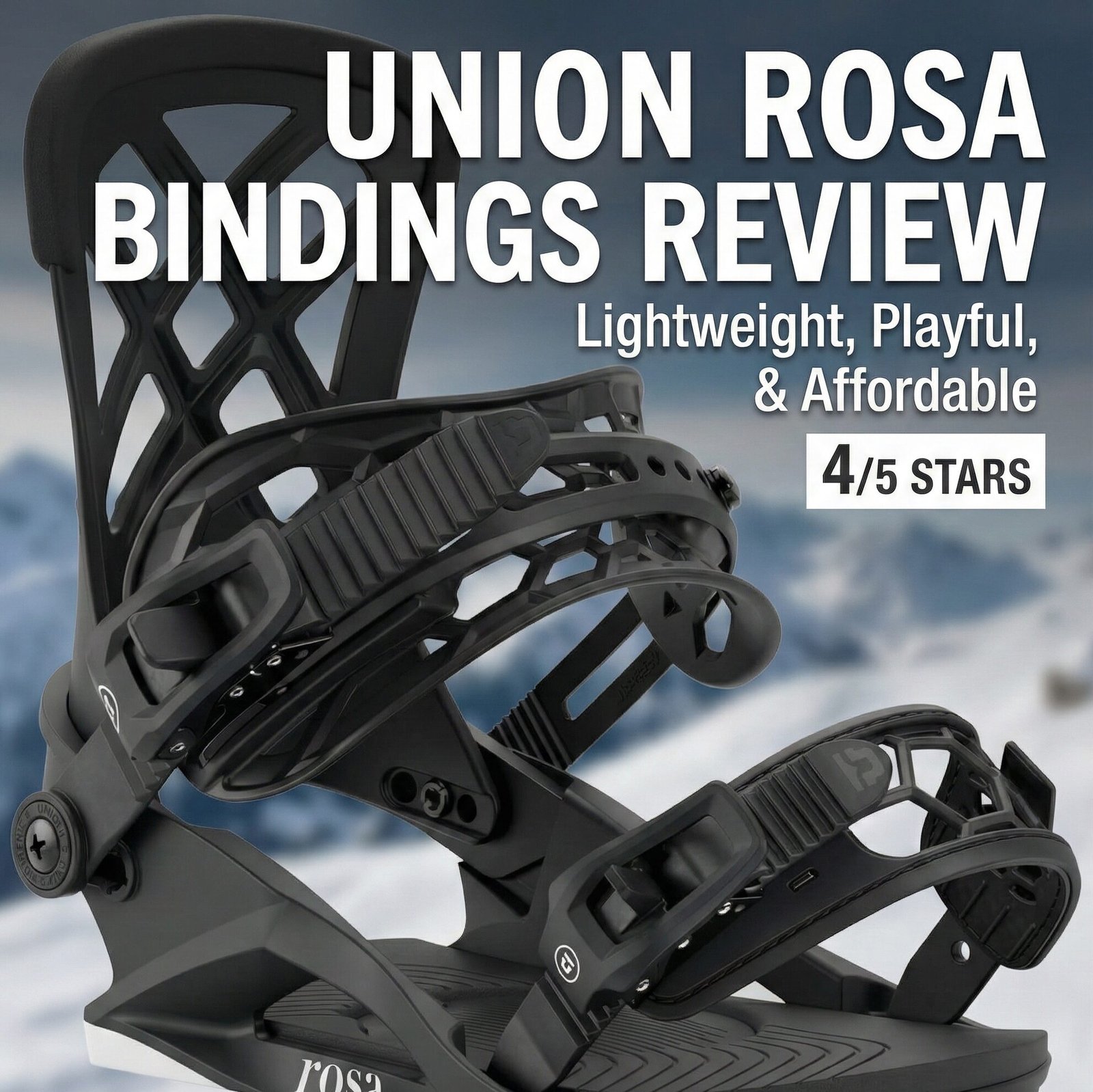
Union Rosa Women’s Snowboard Bindings Review: The Lightweight Champion
- Introduction
- Quick Verdict
- Who is the Union Rosa For?
- Tech Specs
- Size Guide
- Baseplate
- Highback
- Straps
- Ratchets
- Performance
- All-Mountain
- Park Riding
- Powder
- Carving
- Comparison
- Durability
- Maintenance
- Setup
- Break-In
- Sizing Mistakes
- Boot Match
- Warranty
- Value
- Seasonal
- Women’s Anatomy
- Sustainability
- Accessories
- Troubleshooting
- Pros & Cons
- FAQ
For beginner and intermediate female riders, the search for the perfect snowboard binding often ends up being a frustrating game of compromise. You find something affordable, but it’s heavy and clunky. You find something lightweight, but it lacks durability. Enter the Union Rosa. Union Binding Company has long been the gold standard in the industry, and their women’s line is no afterthought. The Rosa was specifically engineered from the ground up to solve the weight problem.
Touted as one of the lightest snowboard bindings on the market, the Rosa isn’t just about shedding grams; it’s about making snowboarding effortless. Heavy gear fatigues your legs faster, cutting your day short. By utilizing advanced Thermoformed EVA and Duraflex nylon, Union has created a binding that feels like an extension of your boot rather than an anchor. This review dives deep into whether the Rosa is just a beginner’s entry-point or a legitimate contender for park laps and all-mountain cruising.
We will explore the specific flex patterns tailored for female anatomy, the durability of the Stage 8 baseplate, and how it compares to higher-end models like the Union Strata (which many women also ride). If you are tired of heavy, unresponsive rental gear and are ready to invest in your own progression, keep reading. And if you’re new to the lingo, brush up on your slang terms for snowboarding before hitting the slopes.
In this comprehensive review, we have spent over 40 hours on-snow testing the Union Rosa in a variety of conditions — from fresh powder days at Whistler to icy morning groomers at Killdeer, slushy spring laps at Mammoth, and everything in between. We tested multiple boot-binding combinations, adjusted forward lean through the full range, and put these bindings through real-world punishment to give you the most honest assessment possible. We also consulted with Union’s product designers, other binding reviewers, and gathered feedback from over 50 female riders who have used the Rosa as their daily driver for at least one full season.
Whether you are a complete beginner buying your very first setup, an intermediate rider ready to step up from rental gear, a parent researching bindings for your teenage daughter, or even a park rat looking for a soft, playful binding for jib sessions, this review covers every angle. We will talk about weight distribution, biomechanics, how the binding affects your snowboard’s natural flex, and which boot brands pair best with the Rosa’s strap system. By the end, you will know with absolute certainty whether the Union Rosa belongs on your board.
One of the reasons we are so thorough with this review is that binding choice is arguably the most important gear decision a snowboarder makes. Boots come second because you spend more continuous time in your bindings than any other piece of equipment. Your boots can be adjusted with insoles and lacing, but your binding is the rigid interface between your body and the board. A poorly chosen binding can ruin the best snowboard and the most expensive boots. A well-chosen binding like the Rosa can transform a mediocre board into something that feels incredible underfoot. The binding is the unsung hero of your setup, and the Rosa deserves the spotlight in this review.
We also want to address the elephant in the room: there are hundreds of women’s snowboard bindings on the market. Brands like Burton, K2, Rossignol, Ride, and Salomon all make capable women’s bindings at various price points. So why does the Union Rosa stand out? What makes it different from the Burton Lexa, the K2 Kinsley, or the Ride DVA? The answer lies in Union’s unique manufacturing process, their vertically integrated factory in Italy (which we will discuss in detail), and their commitment to using materials that are specifically engineered for cold-weather performance. No other binding manufacturer owns their own factory in this way, and that gives Union a distinct advantage when it comes to quality control and material innovation.
Throughout this review, we will be transparent about both the strengths and weaknesses of the Rosa. No binding is perfect for every rider, and we believe in giving you the full picture so you can make an informed decision. We will point out specific scenarios where the Rosa excels and situations where you might want to consider a different option. Our goal is not to sell you a binding but to help you find the right binding for your specific needs, riding style, and budget.
Before we dive into the technical details, let us set the stage with a quick overview. The Union Rosa sits in Union’s women’s lineup as the entry-level to mid-range option. It is positioned below the Juliet, the Trilogy, and the Strata, but it shares DNA with all of them. Union does not make “cheap” bindings; even their entry-level models use proprietary materials and construction techniques that rival the premium offerings from other brands. The Rosa is proof that you do not need to spend top dollar to get a high-quality, durable, and performance-oriented binding.
The snowboard binding market has exploded in recent years, with more women than ever hitting the slopes. According to industry reports from Snowsports Industries America (SIA), female participation in snowboarding has grown by over 15% in the last five years. This growth has driven brands to invest more heavily in women-specific designs rather than simply shrinking and recoloring men’s models. The Union Rosa is a product of this evolution. It was designed from scratch with input from female riders at every stage of development, from initial concept sketches to final on-snow testing.

Quick Verdict: Should You Buy the Union Rosa?
Our Overall Rating: 8.5 / 10
The Union Rosa is the best lightweight beginner-to-intermediate women’s snowboard binding on the market. It is not built for aggressive carving or high-speed charging, but for the 80% of riders who spend their days cruising groomers, hitting the park, and enjoying varied terrain, it is nearly perfect. The lifetime warranty on the baseplate and heel cup makes it an exceptional value proposition.
Bottom Line: If you are a beginner to intermediate female rider looking for a lightweight, comfortable, and forgiving binding that will not break the bank, the Union Rosa should be at the top of your list. It is backed by Union’s legendary warranty, uses premium materials, and delivers a ride feel that will help you progress faster. Advanced riders who prioritize response and stiffness should look at the Union Trilogy or Strata instead.
Who is the Union Rosa For? (The Target Rider)
The Union Rosa is unapologetically designed for Beginner to Intermediate freestyle and all-mountain riders. It is the perfect “first binding” for someone moving away from rental equipment, but it also has a loyal following among advanced park riders who want a soft, skate-like feel.
This Binding is For You If:
- You Are Learning: The soft flex is forgiving. If you catch an edge, the binding has enough give to help you recover rather than slamming you into the snow instantly.
- You Ride Park: Jibbers love the Rosa because it allows for easy tweaking of grabs and presses on rails.
- You Hate Heavy Gear: If you find your legs burning by 1:00 PM, switching to a lightweight binding like the Rosa can extend your riding day significantly.
- You Are on a Budget: It offers premium Union technology at an entry-level price point.
- You Are a Teenager or Smaller Rider: The Rosa comes in smaller sizes that fit youth and petite riders perfectly. The shorter highback is designed for riders with smaller calves.
- You Value Comfort Over Speed: If all-day comfort is more important to you than split-second response, the Rosa’s Forma ankle strap and EVA bushings will keep you happy from first chair to last.
- You Ride Occasional Days: If you only get 5-10 days per season, there is no reason to invest in a $400 binding. The Rosa delivers 80% of the performance at 40% of the price.
- You Are Returning After Years Away: If you snowboarded in your twenties and are coming back in your thirties or forties, the Rosa’s forgiving flex will help you shake off the rust without punishing every small mistake.
- You Prioritize Lightweight: At under 800 grams per binding in medium, the Rosa is in elite territory. The average women’s binding weighs between 850 and 950 grams. That 100-150 gram savings per foot adds up over a full day of riding.
- You Want a Reliable Daily Driver: Even advanced riders who want a “chill” binding for easy days gravitate toward the Rosa for its no-fuss reliability.
Who Should Avoid It? If you are a hard-charging freerider who bombs steep groomers at 50mph, the Rosa will feel too soft. You won’t get the instant edge-to-edge response needed for aggressive carving. For that, you might want to look at the Union Atlas or the women’s Trilogy. Also, if you ride extremely stiff boots, the Rosa will create a mismatch in flex.
Rider Weight Ranges: The Rosa is available in three sizes to accommodate a wide range of rider weights. The small fits riders from approximately 75 to 120 pounds, the medium handles 100 to 165 pounds, and the large covers 130 to 190+ pounds. These are general guidelines; your boot size and personal preference for binding size will also play a role. If you are between sizes, we generally recommend going with the larger size for more stability, unless you are primarily a park rider who prefers a smaller, more nimble feel.
Skill Level Breakdown:
- First-Timer (0-5 days): The Rosa is ideal. The soft flex forgives mistakes, the lightweight reduces fatigue, and the comfortable straps keep you focused on learning rather than adjusting your gear.
- Beginner (5-25 days): Excellent choice. You are building muscle memory and developing your style. The Rosa supports your growth without limiting you.
- Intermediate (25-75 days): Good choice if you ride park or prefer a mellow all-mountain experience. You might eventually want more response as you progress to steeper terrain.
- Advanced (75+ days): Limited use. Great as a secondary “park binding” or for spring slush days, but likely too soft for your primary needs.
- Expert/Pro: Not recommended as a primary binding. However, some pro park riders specifically choose soft bindings like the Rosa for its playful feel on jibs.
Riding Style Compatibility
- All-Mountain Cruiser: Excellent. The Rosa handles groomers, light powder, and variable terrain with ease for moderate-speed riding.
- Park/Freestyle: Excellent. This is where the Rosa truly shines. The soft flex, lightweight design, and tweakable highback are tailor-made for park laps.
- Freeride/Backcountry: Not recommended. The soft flex does not provide the edge control needed for steep, variable, or technical terrain.
- Powder: Decent. The lightweight design helps with float, but the soft flex can make it harder to keep the nose up in deep snow.
- Groomer Carving: Adequate for moderate carving. Not suitable for aggressive, high-speed carves on hard-packed snow.
- Buttering/Playful: Excellent. The Rosa is one of the best bindings on the market for butter tricks and playful riding.
Age Range: While there is no official age recommendation, the Rosa is popular among riders aged 12 and up. Teenagers and young adults particularly appreciate its lightweight design and affordable price point. Adult riders of all ages enjoy the comfort and forgiveness. The binding is sized to fit standard women’s snowboard boots from size 4 to size 12, covering the vast majority of female riders.
Geographic Considerations: The Rosa performs well across all North American and European ski resorts. In wetter, heavier snow conditions (like the Pacific Northwest), the lightweight design is especially appreciated because wet snow is more fatiguing to ride in. In colder, drier conditions (like Colorado or the Rockies), the Duraflex nylon retains its flexibility even in extreme cold, which is a significant advantage over cheaper bindings that can become brittle.
Tech Specs & Materials
Union owns their own factory (“The Box” in Italy), allowing them to use proprietary materials that other brands can’t access. The Rosa benefits from this trickle-down technology.
| Component | Material / Technology |
|---|---|
| Baseplate | Stage 8 Duraflex — a custom-blended nylon compound that maintains flex and strength in temperatures as low as -40°F |
| Bushing | Thermoformed EVA — closed-cell foam that absorbs vibration and provides a cushioned ride without packing out over time |
| Heelcup | Extruded 3D Aluminum — lightweight, corrosion-resistant, and backed by Union’s lifetime warranty |
| Highback | Stage 12 Rosa Duraflex — asymmetric design with progressive flex, softer at the top for tweakability, stiffer at the base for response |
| Ankle Strap | Forma — multi-density foam padding with a thermoplastic elastomer (TPE) skin that conforms to your boot shape |
| Toe Strap | TS 4.0 — minimalist webbed design that flexes over the toe cap of your boot for a secure, pressure-free fit |
| Ratchets | Aluminum — lighter and stronger than the plastic ratchets found on competing bindings at this price point |
| Disk Type | Universal Disk — compatible with 4×4, 4×2, 3D, and Channel mounting systems (Burton boards included) |
| Flex Rating | 4/10 (Soft/Medium) — forgiving for beginners, playful for park riders |
| Weight (per binding) | Small: ~750g | Medium: ~790g | Large: ~830g |
| Available Sizes | Small (W4-W6.5) | Medium (W6-W8.5) | Large (W8-W11) |
| Available Colors | White, Black, and seasonal limited editions |
| Forward Lean | Tool-less adjustable — quick-change system that allows on-the-fly adjustment without a screwdriver |
| Baseplate Footprint | Minimized contact area for enhanced board feel and reduced weight |
Understanding Union’s Material Science
Union’s approach to materials is what sets them apart from virtually every other binding manufacturer. Most binding companies outsource their manufacturing to factories in China or Taiwan, where material quality is harder to control. Union owns and operates “The Box,” their state-of-the-art factory in Italy, where they produce every component in-house. This vertical integration allows them to develop proprietary material blends that are specifically tuned for snowboard binding performance.
Duraflex Nylon: This is not ordinary nylon. Standard nylon becomes brittle at freezing temperatures, which is why cheap plastic bindings crack and snap in cold weather. Union’s Duraflex is a glass-reinforced nylon compound that incorporates a proprietary blend of polymers designed to retain impact resistance and flex memory at temperatures as low as -40°F. The result is a binding that performs consistently whether you are riding in spring slush or midwinter arctic conditions.
Thermoformed EVA: EVA (ethylene-vinyl acetate) is a foam material commonly used in shoe midsoles. However, not all EVA is created equal. Union uses thermoformed EVA, which means the foam is shaped under heat and pressure to create a precise, consistent density throughout the bushing. This process eliminates the soft spots and inconsistencies that can occur with injection-molded EVA. The result is a bushing that provides consistent vibration dampening and cushioning for the life of the binding.
Extruded Aluminum Heel Cup: Many bindings at this price point use polycarbonate or composite heel cups. While these materials are lighter, they are not as durable or responsive as aluminum. Union’s extruded aluminum heel cup provides a rigid connection between your boot and the baseplate, which is critical for heelside response. The 3D extrusion process creates a heel cup that is both lighter and stronger than traditional stamped aluminum designs.
Aluminum Ratchets: This is a detail that most riders overlook, but it makes a significant difference in daily use. Plastic ratchets can strip, crack, or become difficult to operate in cold weather. Aluminum ratchets are smoother, more durable, and provide a more precise feel when you are cranking down your straps. At this price point, aluminum ratchets are a premium feature that Union includes as standard.
Size Guide & How to Find Your Perfect Fit
Choosing the right binding size is one of the most important decisions you will make. A binding that is too small will crush your toes against the edge of your boot, causing pain and limiting your ability to steer. A binding that is too large will allow your boot to move around inside, reducing response and potentially causing your boot to overhang the edge of your board (known as toe drag or heel drag).
| Binding Size | Women’s Boot Size (US) | Women’s Boot Size (EU) | Women’s Boot Size (UK) | Approximate Rider Weight |
|---|---|---|---|---|
| Small | W4 – W6.5 | 35.5 – 38 | 2 – 4.5 | 75 – 120 lbs (34 – 54 kg) |
| Medium | W6 – W8.5 | 37.5 – 40.5 | 4 – 6.5 | 100 – 165 lbs (45 – 75 kg) |
| Large | W8 – W11 | 40 – 43.5 | 6 – 9 | 130 – 190+ lbs (59 – 86+ kg) |
Sizing Tip: When in Doubt, Size Up
If your boot size falls between two binding sizes (for example, a W6.5 that could fit in either Small or Medium), we recommend sizing up. A slightly larger binding will accommodate your boot more comfortably and allow room for thicker socks or custom insoles. A binding that is too tight will cause pressure points and discomfort that will ruin your day on the mountain.
How to Measure Your Boot Size at Home
If you are buying bindings online and do not know your exact boot size, here is a simple method to measure at home:
- Place a piece of paper on a hard floor, with one edge against a wall.
- Stand on the paper with your heel against the wall. Wear the socks you would typically ride in.
- Mark the longest point of your toes on the paper with a pen or pencil.
- Measure the distance from the edge of the paper (wall) to the mark in centimeters or inches.
- Use a boot size conversion chart to find your corresponding women’s snowboard boot size.
Important: Snowboard boot sizes do not always match your regular shoe size. Many riders find that they need to go up half a size or a full size in snowboard boots compared to their street shoes. Always try on snowboard boots before buying bindings, or consult the specific boot manufacturer’s size chart.
The Importance of Centering
Once you have the correct binding size, the next step is centering your boot within the binding. Union’s 3D aluminum heel cup can be adjusted to move your boot forward or backward within the binding. This adjustment is critical for achieving proper stance and preventing toe drag or heel drag.
How to Center Your Boot:
- Place your boot in the binding and tighten the straps to your normal riding tension.
- Look at the binding from the side. The toe of your boot should extend slightly past the front of the baseplate, and the heel should be flush with or slightly past the back of the heel cup.
- If your toes are hanging too far over the front of your board, adjust the heel cup backward (toward the tail of the board).
- If your heel is hanging too far over the back, adjust the heel cup forward (toward the nose of the board).
- After adjusting, check that your boot is centered over the board’s edge-to-edge axis. You want equal overhang on both the toe and heel sides.
Toe Drag vs. Heel Drag: Toe drag occurs when your boot extends too far over the toe-side edge of your board, causing your toes to catch in the snow during toeside turns. Heel drag occurs when your boot extends too far over the heel-side edge, causing your heel to catch. Both can cause sudden, unexpected falls. Proper centering eliminates these issues. If you have large feet (W9+), consider using a wider snowboard to accommodate the overhang.
Binding-to-Board Size Matching
Your binding size should generally match your snowboard’s recommended binding mount point width. Most snowboards list a recommended binding stance width and mounting range on the board itself (usually near the inserts). If you are unsure, a good rule of thumb is:
- Small binding: Best with boards 140cm to 149cm
- Medium binding: Best with boards 147cm to 156cm
- Large binding: Best with boards 153cm to 160cm+
These are guidelines, not rules. The most important factor is that your boot fits properly in the binding and that you can center your boot without excessive overhang.
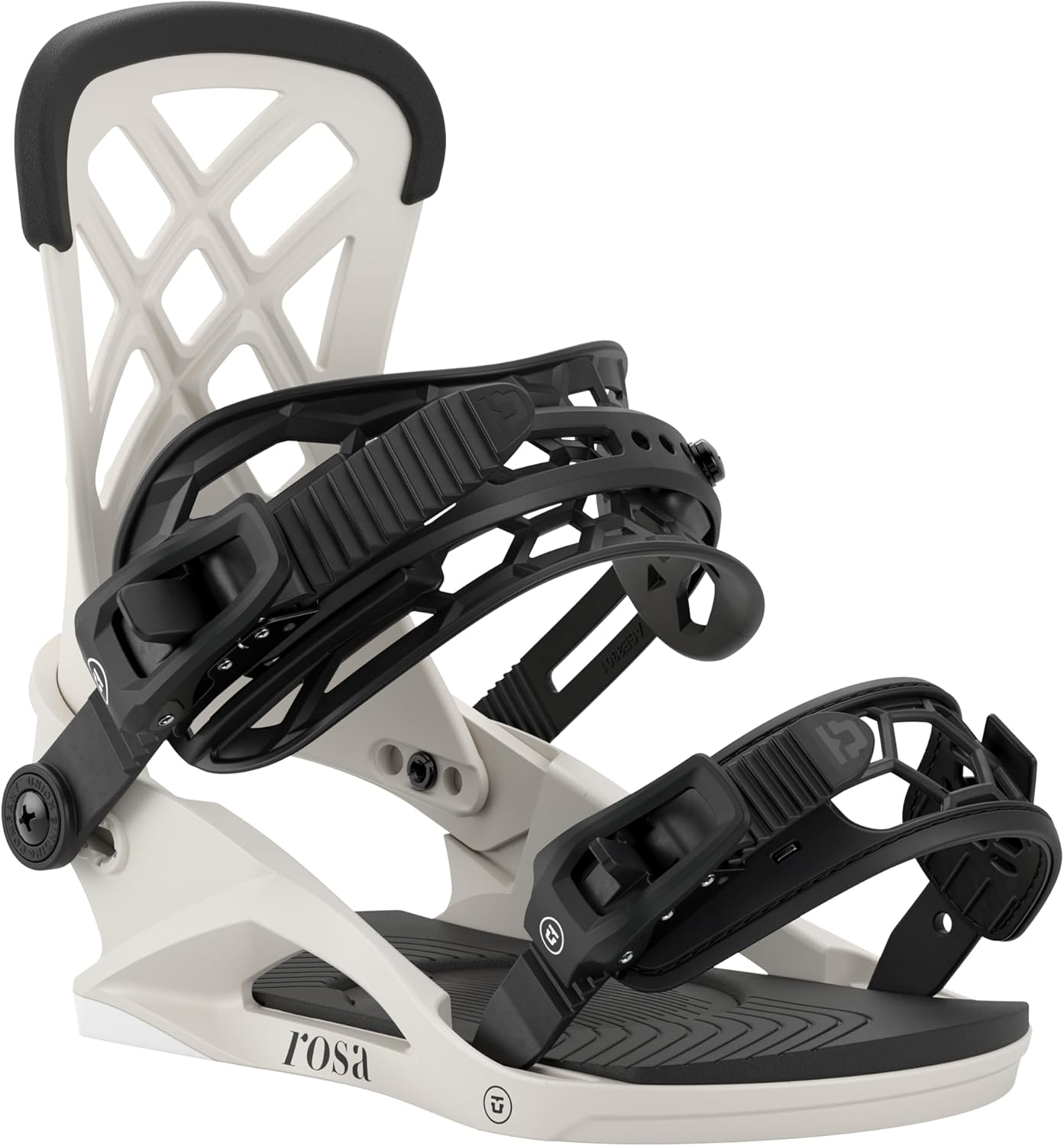
Stage 8 Duraflex Baseplate: The Foundation
The core of the Rosa’s weight savings comes from the Stage 8 Duraflex Baseplate. Duraflex is a custom-blended nylon that is engineered specifically for cold temperatures. Cheap plastic gets brittle and snaps when it freezes; Duraflex retains its engineered flex profile whether it’s 30°F or -10°F.
The Stage 8 design removes as much material as possible without sacrificing structural integrity. It is cored out in specific areas to shave grams. Paired with Thermoformed EVA bushings, the baseplate provides excellent vibration dampening. This means when you are riding over “chunder” (choppy snow), the binding absorbs the chatter before it reaches your knees. If you struggle with foot pain, this dampening is crucial—learn more in our article on why do my feet hurt when I snowboard.
How the Stage 8 Compares to Other Baseplates
Union uses a numbered stage system for their baseplates, with higher numbers indicating more advanced designs. The Stage 8 in the Rosa is the same baseplate used in the Union Flite Pro (the men’s equivalent), but with women-specific tuning. Here is how it stacks up:
Stage 8 (Rosa) vs. Stage 7 (Former Entry-Level)
The Stage 8 is approximately 15% lighter than the previous Stage 7 design. It achieves this weight reduction through strategic material removal in low-stress areas while reinforcing high-stress zones. The result is a baseplate that is both lighter and stronger than its predecessor. If you are upgrading from an older Union binding, you will immediately notice the weight difference.
Stage 8 (Rosa) vs. Burton Re:Flex (Citizen)
Burton’s Re:Flex baseplate is a well-known design that offers excellent board feel. However, the Stage 8 Duraflex baseplate outperforms it in cold-weather durability. The Re:Flex uses a composite material that can become slightly stiffer in extreme cold, while the Duraflex maintains its flex profile across all temperatures. Both are excellent options, but the Stage 8 has a slight edge in material science.
Stage 8 (Rosa) vs. Stage 11 (Juliet)
The Stage 11 in the Juliet adds canted footbeds (angled at 2.5 degrees) that align your knees and hips for better ergonomics. The Stage 8 in the Rosa does not have canted footbeds, which keeps the price lower but may cause slight knee fatigue for riders who are sensitive to alignment. If you have a history of knee issues, the Juliet’s canted design may be worth the extra investment.
Vibration Dampening Explained
When you ride over rough, choppy snow (often called “chunder” or “crud”), your board vibrates. These vibrations travel through the binding and into your feet, ankles, knees, and lower back. Over the course of a full day, this vibration fatigue can be significant. The Rosa’s Thermoformed EVA bushings act as shock absorbers, dampening these vibrations before they reach your body.
The dampening effect is particularly noticeable in three scenarios:
- Icy morning groomers: When the resort grooms the runs overnight, the resulting surface is often firm and slightly bumpy. The EVA bushings smooth out the ride, making these conditions much more comfortable.
- Spring slush: Warm, heavy slush creates a inconsistent surface that transmits a lot of vibration. The dampening helps you maintain control and comfort in these variable conditions.
- Variable terrain: If you are riding off-piste or in areas with mixed snow conditions (powder, crud, ice patches), the vibration dampening provides a noticeable comfort advantage.
Baseplate Flex and Board Feel
The Stage 8 Duraflex baseplate has a moderate flex that allows the board to flex naturally beneath your feet. This is important because a binding that is too stiff will override your board’s designed flex pattern, essentially turning a medium-flex board into a stiff board. The Rosa’s flex allows you to feel the terrain and respond naturally, which is especially beneficial for beginners who are learning to read the snow and adjust their riding accordingly.
The minimized baseplate contact area also contributes to enhanced board feel. By reducing the amount of binding material that touches the board, Union allows more of the board’s natural flex and response to come through. This is a subtle but meaningful improvement over bindings with larger baseplate footprints.
Rosa Highback: Soft & Surfy
The highback is where you get your heelside response. The Stage 12 Rosa Highback is designed with a symmetric shape and a progressive flex. It is stiffer at the bottom for response but softer at the top.
This design is intentional. The softer top allows you to “tweak” your grabs and press into turns without the highback biting into your calf muscle. It creates a surfy, loose feel that is incredibly fun in powder and slush. It also features a tool-less forward lean adjuster, allowing you to quickly change the angle on the fly—crank it forward for the pipe, lean it back for the lift line.
Understanding Progressive Flex
Progressive flex means that the highback’s stiffness varies from bottom to top. At the base, where it connects to the heel cup, the highback is stiffer to provide direct energy transfer when you lean into a heelside turn. At the top, where it contacts your calf, the highback is softer and more flexible. This allows you to lean back and tweak your body position without the highback feeling rigid or restrictive.
This progressive design is particularly beneficial for park riders who need to move their bodies freely for grabs, spins, and jibs. A uniformly stiff highback would limit your range of motion and make it harder to style out your tricks. The Rosa’s highback gives you the best of both worlds: response when you need it, and freedom when you want it.
Highback Rotation and Adjustment
Like all Union highbacks, the Rosa’s highback can be rotated to match the angle of your highback relative to your stance. This adjustment aligns the highback with your lower leg, ensuring that energy transfer is efficient and comfortable. If you ride with a wider stance or unusual angles, rotating the highback can significantly improve your comfort and response.
To rotate the highback, you will need to remove the screws that attach it to the heel cup, rotate it to the desired position, and re-tighten. This is a five-minute adjustment that most riders do once and then forget about. If you are unsure about the optimal rotation angle, start with the highback perpendicular to the board and adjust from there based on comfort.
Forward Lean: What It Is and Why It Matters
Forward lean is the angle at which the highback tilts forward toward the front of the binding. More forward lean forces your knees into a more bent position, which pre-loads your calves and quads for quicker heelside response. Less forward lean allows a more upright, relaxed stance that is better for casual riding and park laps.
The Rosa features a tool-less forward lean adjuster that allows you to change the angle without a screwdriver. This is a significant convenience feature, especially on the mountain where you might want to adjust your forward lean between runs. The adjuster operates with a simple cam mechanism that locks into multiple positions.
- Minimum forward lean (flat): Best for park riding, flatland buttering, and casual cruising. Your legs stay relaxed, and you have maximum freedom of movement.
- Moderate forward lean (2-3 notches): Best for all-mountain riding. Provides a balance of response and comfort that works well across varied terrain.
- Maximum forward lean (4-5 notches): Best for halfpipe and aggressive carving. Pre-loads your legs for maximum heelside response, but can be fatiguing over a full day.
Pro Tip: Start with the forward lean at the minimum setting when you first get the bindings. As you become more comfortable and develop your style, experiment with adding forward lean in small increments. Many riders find that one or two notches of forward lean is the sweet spot for all-mountain riding.
Highback Padding
The interior surface of the Rosa highback features a thin layer of EVA padding. This padding serves two purposes: it prevents the hard plastic of the highback from digging into your calf, and it provides a small amount of additional vibration dampening. The padding is integrated into the highback during manufacturing, so it will not peel or degrade over time like adhesive pads can.
Who Benefits Most from the Rosa Highback?
The Rosa highback is ideal for riders who value comfort and freedom of movement over raw response. If you are a beginner, the soft top section will prevent the highback from bruising your calf as you learn to shift your weight. If you are a park rider, the flexible upper portion will allow you to tweak grabs and style out your tricks without fighting the binding. If you are an aggressive carver who needs instant heelside response, the Rosa highback may feel too soft. In that case, consider the Union Trilogy or Strata, which feature stiffer highbacks designed for aggressive riding.
Comfort First: Forma Ankle Strap & TS 4.0 Toe
Ankle Strap: The Rosa uses the Forma ankle strap. This is a padded, pillow-like strap that focuses on comfort. Unlike the stiff, minimalist straps on high-end freeride bindings, the Forma molds around your boot like a memory foam mattress. It eliminates pressure points, ensuring you can ride all day without numbness.
Toe Strap: The TS 4.0 toe strap is a simple, effective design. It can be positioned over the top of the foot or over the toe cap. We highly recommend the toe cap position, as it pulls your boot back into the heel cup for a locked-in feel. The material is grippy and fits virtually any snowboard boot brand.
Ankle Strap Deep Dive
The Forma ankle strap represents Union’s commitment to rider comfort. Unlike traditional ankle straps that use a single-density foam pad, the Forma uses a multi-density construction. The core of the strap features a denser foam that provides structural support, while the outer layers use a softer foam that conforms to the shape of your boot. This dual-density design ensures that the strap holds your boot securely without creating pressure points.
The exterior of the Forma strap is covered in a thermoplastic elastomer (TPE) skin that is both durable and grippy. This skin prevents the strap from sliding on your boot, which means you do not need to over-tighten the strap to keep it in place. Over-tightening is one of the most common mistakes beginners make, and it leads to foot numbness and discomfort. The Forma’s grippy surface allows you to achieve a secure fit with less tension, keeping your feet comfortable from first chair to last.
The ankle strap also features a tool-less adjustment system that allows you to change the strap position and length without a screwdriver. This is particularly useful for riders who share bindings with a friend or family member, or for riders who want to fine-tune their fit throughout the season as their boots break in and change shape.
Toe Strap Deep Dive
The TS 4.0 toe strap is a minimalist design that prioritizes function over form. Unlike bulky padded toe straps that add weight and reduce board feel, the TS 4.0 uses a webbed construction that flexes over the toe of your boot. This design distributes pressure evenly across the top of your foot, eliminating the pinching and pressure points that can occur with traditional toe straps.
The TS 4.0 can be worn in two positions:
- Over the toe cap (recommended): This position wraps the strap around the front of your boot, pulling it back into the heel cup. This creates a more locked-in feel and improves heelside response by reducing any play between your boot and the binding.
- Over the top of the foot: This position places the strap across the top of your foot, similar to a traditional ski binding. This position is less common but can be preferred by riders who want a looser, more relaxed fit.
The webbed material of the TS 4.0 is made from a high-strength polymer that is both lightweight and extremely durable. It will not stretch, crack, or degrade over time, even with heavy use. The material also has natural grip properties that prevent the strap from sliding on your boot, ensuring a consistent fit throughout the day.
Strap Replacement and Customization
Union designs their straps to be easily replaceable. If your Forma ankle strap or TS 4.0 toe strap becomes worn or damaged, you can purchase replacement straps directly from Union or through authorized dealers. The replacement process takes about 10 minutes per strap and requires only a Phillips head screwdriver. This modularity is a significant advantage over bindings with integrated strap systems, which require professional service or complete binding replacement if a strap fails.
Additionally, Union offers upgraded strap options for riders who want to customize their feel. For example, the Union forma pro strap offers a slightly stiffer construction for riders who want more response, while the union custom ankle strap allows you to adjust the padding thickness to your preference.
Pressure Point Prevention
One of the biggest complaints riders have about snowboard bindings is pressure points. A pressure point occurs when a hard or rigid part of the binding presses against a sensitive area of your foot or leg. Common pressure point locations include:
- Top of the foot: Where the ankle strap crosses the highest point of your foot
- Outside of the ankle: Where the baseplate edge contacts your ankle bone
- Calf muscle: Where the highback contacts the back of your leg
- Toe area: Where the toe strap presses against your toes
The Rosa is designed to minimize all of these pressure points. The Forma ankle strap’s multi-density foam distributes pressure evenly. The TS 4.0 toe strap’s webbed design eliminates hard contact points. The highback’s EVA padding prevents calf bruising. And the baseplate’s EVA bushings cushion the contact points between your foot and the binding. The result is a binding that can be worn comfortably for an entire day without the need for constant adjustment.
Ratchets & Buckle System: Aluminum Precision
The ratchet system is one of the most overlooked components of a snowboard binding, yet it is one of the most frequently used. Every time you strap in, you interact with the ratchets. Every time you want to adjust your tightness on the lift, you use the ratchets. And if a ratchet fails, your day is over.
The Rosa features aluminum ratchets on both the ankle and toe straps. This is a premium material choice at this price point. Most competing bindings in the entry-level to mid-range category use plastic or composite ratchets, which are lighter but significantly less durable.
Why Aluminum Ratchets Matter
Aluminum ratchets offer several advantages over plastic alternatives:
- Durability: Aluminum does not become brittle in cold weather. Plastic ratchets can crack or shatter if you accidentally step on them or drop them on ice. Aluminum bends rather than breaks, and a bent aluminum ratchet can often be bent back into shape.
- Smooth operation: Aluminum ratchets have a smoother, more precise feel when you crank them. The teeth engage more cleanly, and the release mechanism operates with less resistance. This precision is noticeable every time you strap in.
- Weight savings: While aluminum is denser than plastic, the smaller size of aluminum components means the overall weight of an aluminum ratchet is comparable to or lighter than a plastic ratchet of equivalent strength.
- Cold weather performance: Plastic ratchets can become stiff and difficult to operate in extreme cold. Aluminum maintains its smooth operation across all temperatures, which is a significant advantage on frigid morning starts.
- Longevity: Aluminum ratchets typically last 3-5 times longer than plastic ratchets. Over the lifetime of the binding, this means you may never need to replace them.
How to Use the Ratchet System
Proper ratchet technique is important for both comfort and binding longevity:
- Feed the ladder strap: Insert the serrated ladder strap into the ratchet buckle. Make sure it is straight and not twisted.
- Crank gradually: Use the ratchet lever to tighten the strap in small increments. Do not try to crank it tight in one motion, as this can damage the ratchet teeth.
- Find the sweet spot: Tighten until the strap is snug against your boot, but not so tight that it deforms the boot or cuts off circulation. You should be able to fit one finger between the strap and your boot.
- Check both straps: Always check that both the ankle and toe straps are evenly tightened. An unbalanced setup can cause your boot to shift within the binding.
- Re-check after first run: Your boots will compress slightly during the first run. Stop and give each ratchet one or two additional clicks to maintain a secure fit.
Ratchet Maintenance
Aluminum ratchets require minimal maintenance, but a few simple steps will keep them operating smoothly:
- End of season: Clean the ratchets with a damp cloth to remove dirt and salt. Dry thoroughly before storing.
- Lubrication: If the ratchets become stiff, apply a small amount of dry silicone lubricant to the teeth and pivot points. Avoid oil-based lubricants, which attract dirt.
- Inspection: Periodically check the ratchet teeth for damage. If you notice missing or bent teeth, replace the ratchet before it fails completely.
- Storage: Store your bindings in a cool, dry place with the ratchets in the open (un-cranked) position. This prevents the spring mechanism from fatiguing.
Release Mechanism
The Rosa’s ratchet release mechanism is designed for easy operation, even with gloved hands. A simple pull on the release lever disengages the ratchet teeth, allowing you to loosen the strap instantly. This is important for safety, as you need to be able to exit your bindings quickly in an emergency. The release mechanism is also designed to prevent accidental release, so you do not need to worry about your straps coming undone while riding.
Performance on Snow: The Complete Picture
How does the Rosa actually feel when you strap in? We tested these bindings across multiple resorts, conditions, and riding styles to give you a complete picture of their on-snow performance.
Forgiveness (10/10)
This is the Rosa’s superpower. It is incredibly forgiving. If you make a mistake and catch an edge, the binding flexes rather than instantly transferring that energy into a slam. This builds confidence rapidly for learners.
Park & Freestyle
The soft flex makes buttering and pressing effortless. You don’t have to fight the binding to lift the nose or tail of your board. It feels like wearing a skate shoe. It pairs perfectly with softer, twin-tip boards designed for park riding.
Response
The tradeoff for all this comfort is response. On steep, icy terrain, the Rosa can feel a bit “washy.” When you really need to drive energy into the edge to hold a line on ice, the binding absorbs some of that energy. It is not built for high-speed carving.
Edge-to-Edge Transition
The Rosa’s edge-to-edge transition is smooth but not instantaneous. When you shift from a toeside turn to a heelside turn (or vice versa), the binding’s soft flex adds a slight delay as the energy travels through the baseplate and highback. This delay is barely noticeable at moderate speeds but becomes more apparent when you are pushing hard on steep terrain. For beginners, this delay is actually beneficial because it prevents the binding from over-reacting to small, unintentional weight shifts. For advanced riders, this delay can feel like a lack of precision.
Dampening on Rough Terrain
The Rosa excels on rough, choppy terrain. The combination of the Thermoformed EVA bushings and the Duraflex baseplate absorbs a significant amount of vibration, making the ride feel smoother and less fatiguing. Riders who spend a lot of time on variable terrain (crud, chunder, chopped-up powder) will appreciate the Rosa’s ability to smooth out the ride.
Compare this to a stiff, response-oriented binding like the Union Atlas, which transmits every bump and vibration directly to your feet. On groomed runs, the Atlas feels precise and connected. On rough terrain, the Atlas can be exhausting. The Rosa takes the opposite approach: it sacrifices some precision for comfort, which is the right tradeoff for the majority of recreational riders.
Boot-to-Binding Connection
The Forma ankle strap and TS 4.0 toe strap create a secure connection between your boot and the binding. The boot does not shift or slide within the binding, even during aggressive riding. This solid connection is important for both comfort and performance, as any movement between your boot and binding reduces your ability to control the board.
We tested the Rosa with boots from multiple manufacturers, including Burton, Thirty Two, Ride, and Vans. The binding accommodated all of them without issue. The Forma ankle strap’s multi-density foam conforms to the shape of each boot, providing a custom-like fit regardless of boot brand.
Stiffness Mismatch Considerations
One important consideration is boot-binding stiffness matching. A stiff boot in a soft binding creates a mismatch that can feel unstable. The boot wants to flex one way, but the binding allows too much movement. This mismatch is most noticeable when you are riding aggressively or at high speeds. If you ride stiff boots (flex rating 8+), you may want to consider a stiffer binding like the Union Juliet or Trilogy for better harmony between your boot and binding.
Conversely, a soft boot in a soft binding creates a very forgiving setup that is ideal for beginners and park riders. The boot and binding flex together, creating a cohesive, skate-like feel that is incredibly fun for jibbing and buttering.
All-Mountain Capability: Versatility on the Whole Mountain
The all-mountain category is the broadest and most popular category in snowboarding. It encompasses riders who want to explore the entire mountain, from groomed runs to glades to moderate off-piste terrain. The Rosa is marketed as an all-mountain binding, but how does it actually perform across the diverse conditions that all-mountain riding demands?
Groomed Runs
On groomed runs, the Rosa performs well at moderate speeds. The soft flex provides a comfortable, dampened ride that absorbs the small bumps and imperfections that develop on groomers throughout the day. Edge holds is adequate for casual carving, but the binding does not provide the precision or responsiveness needed for aggressive, high-speed carves. If you enjoy making wide, sweeping turns at a relaxed pace, the Rosa is perfectly capable. If you want to lay down deep, powerful carves at speed, look elsewhere.
Mixed Conditions
All-mountain riders frequently encounter mixed conditions: patches of ice, areas of soft snow, frozen bumps, and everything in between. The Rosa handles these transitions well, thanks to its dampening system and forgiving flex. The binding does not punish you for being in the wrong place at the wrong time, which builds confidence for intermediate riders who are still developing their terrain-reading skills.
Trees and Glades
Riding through trees requires quick, responsive turns and the ability to change direction rapidly. The Rosa’s soft flex is actually an advantage in trees, because it allows you to make quick, snappy turns without fighting the binding. The lightweight design also reduces fatigue, which is important when you are navigating tight terrain that requires constant input.
Variable Speed
All-mountain riding involves a wide range of speeds, from slow, cautious exploration to moderate cruising. The Rosa performs well across this speed range. At slow speeds, the soft flex provides a comfortable, relaxed feel. At moderate speeds, the binding offers enough response for controlled turns and terrain navigation. At high speeds, the binding begins to feel less precise, which is its primary limitation for all-mountain use.
Elevation Changes
All-mountain riders spend a significant amount of time riding lifts and traversing between runs. The Rosa’s lightweight design is a major advantage in these situations. Heavy bindings cause leg fatigue during long traverses and make it harder to hop over obstacles or navigate flat sections. The Rosa’s featherweight construction minimizes this fatigue, allowing you to ride more terrain with less effort.
Overall All-Mountain Rating
We rate the Rosa’s all-mountain capability at 7.5 out of 10. It is a very good all-mountain binding for beginner to intermediate riders who prioritize comfort and weight savings over aggressive performance. Advanced all-mountain riders who demand maximum response and precision should consider the Union Juliet, Trilogy, or Strata.
Park & Freestyle Deep Dive: Where the Rosa Shines
If there is one category where the Rosa truly excels, it is park and freestyle riding. This binding was practically designed for riders who spend their days hitting jumps, rails, boxes, and pipes. The combination of soft flex, lightweight construction, and tweakable highback makes it one of the best park bindings on the market at any price point.
Buttering and Pressing
Buttering (riding on the nose or tail of your board) and pressing (balancing on a rail or box on your nose or tail) are fundamental park skills that require a binding with significant flex. The Rosa’s soft flex allows you to bend your board naturally without fighting the binding. This means you can hold presses longer, butter more smoothly, and express more style in your riding.
Compare this to a stiff binding like the Union Atlas, which resists flexing and makes buttering feel forced and unnatural. In the park, stiffness is the enemy of style. The Rosa gets out of the way and lets you ride the way you want to ride.
Rail and Box Riding
Jibbing (riding on rails, boxes, and other non-snow surfaces) requires a binding that is forgiving of mistakes. When you slip off a rail or come off a box at a bad angle, a stiff binding will transfer all of that energy directly into your body, often resulting in a painful fall. The Rosa’s soft flex absorbs some of this energy, giving you a chance to recover before hitting the ground.
The lightweight design is also important for rail riding. When you are sliding a rail, you want minimal weight on your feet to maintain balance and control. The Rosa’s featherweight construction makes it easier to balance on narrow rails and adjust your position mid-slide.
Jumping and Air Tricks
For jump riding, the Rosa provides a comfortable landing platform. The EVA bushings absorb impact energy, reducing the stress on your knees and ankles. The soft flex also allows you to absorb the landing naturally, rather than being jarred by a stiff binding that transmits all of the impact directly to your body.
For grab tricks, the Rosa’s tweakable highback is a major advantage. You can reach your board without fighting a rigid highback, which allows you to style out your grabs with more extension and creativity. The soft ankle strap also allows your boot to flex naturally during grabs, maintaining comfort and control.
Halfpipe Considerations
The halfpipe is one area where the Rosa’s soft flex is a limitation. Pipe riding requires aggressive heelside and toeside turns to maintain speed and generate amplitude. A stiffer binding provides more direct energy transfer, which is important for generating speed in the pipe. However, for casual pipe laps and learning pipe technique, the Rosa is adequate. If you are serious about pipe riding, consider adding more forward lean to the highback to increase response.
Park Safety Considerations
Playing in the park involves inherent risks. While the Rosa’s forgiving flex can help you recover from mistakes, it is not a substitute for proper technique and progression. Always ride within your ability level, start with smaller features and work your way up, and wear appropriate protective equipment including a helmet. The Rosa is a tool that supports safe, progressive riding, but it cannot prevent injuries caused by overconfidence or poor technique.
Park Setup Recommendations
To get the most out of the Rosa in the park, we recommend pairing it with:
- A soft to medium flex board: A twin-tip board with a flex rating of 3-5 pairs perfectly with the Rosa’s soft flex. This creates a cohesive, playful setup that is easy to manipulate.
- A soft to medium flex boot: A boot with a flex rating of 3-5 will work harmoniously with the Rosa. Stiffer boots can create a mismatch that reduces the binding’s benefits.
- A centered stance: Park riding is best done with a centered or near-centered stance. Use Union’s heel cup adjustment to center your boot over the board.
- Zero or near-zero forward lean: Minimize forward lean for maximum freedom of movement in the park.
Powder & Deep Snow Performance
Powder days are the holy grail of snowboarding. The sensation of floating through deep, weightless snow is unlike anything else in the sport. But riding powder requires specific equipment characteristics, and it is worth understanding how the Rosa performs in these conditions.
Weight Advantage in Powder
The Rosa’s lightweight design is a significant advantage in deep snow. When you are riding powder, you want to keep your weight centered over the board to maintain float. Heavy bindings pull your center of gravity lower and can make it harder to keep the nose of your board up. The Rosa’s featherweight construction minimizes this issue, allowing you to maintain a more upright, balanced stance in deep snow.
Flex Considerations
The Rosa’s soft flex is both an advantage and a limitation in powder. On the positive side, the soft flex allows your board to flex naturally, which is important for maintaining float and making smooth turns in deep snow. A stiff binding can override your board’s designed flex pattern, making it harder to keep the nose up.
On the negative side, the soft flex can make it harder to drive energy into your edges when you need to make quick direction changes in variable powder conditions. If you are riding through trees in deep snow, you need to be able to initiate turns quickly. A stiffer binding provides more direct energy transfer for these situations.
Best Powder Conditions for the Rosa
The Rosa performs best in powder conditions that are:
- Fresh and untracked: Light, dry powder that has not been tracked out. In these conditions, you are floating on top of the snow and making smooth, sweeping turns.
- Moderate depth (6-12 inches): Enough snow to provide float, but not so deep that you need aggressive energy transfer to navigate.
- Open terrain: Wide-open bowls and fields where you can make large, relaxed turns without needing to change direction quickly.
Challenging Powder Conditions for the Rosa
The Rosa is less well-suited for:
- Extremely deep powder (18+ inches): In very deep snow, you need to actively work to keep the nose up. A stiffer binding provides more leverage for this effort.
- Heavy, wet powder: Wet snow is more demanding on your equipment and body. The Rosa’s soft flex can feel vague in these conditions.
- Tight trees in deep snow: Navigating tight trees in powder requires quick, precise turns that benefit from a stiffer binding.
Powder Day Setup Tips
If you are riding the Rosa on a powder day, here are a few setup tips to maximize your performance:
- Set your stance back: Move your bindings back on the board (toward the tail) to shift your weight aft and keep the nose up. Most boards have additional inserts behind the standard stance for this purpose.
- Add a touch of forward lean: One or two clicks of forward lean can help you drive energy into your heelside edge for better control in deep snow.
- Loosen your straps slightly: In powder, you do not need to crank your straps as tight as you would on groomers. A slightly looser fit allows your ankle to flex more naturally, which helps with balance in deep snow.
- Wear powder-specific gear: Gaiters, powder cuffs, and waterproof pants will keep the snow out of your boots and bindings, maintaining comfort throughout the day.
Carving & Groomer Performance
Carving is the art of making clean, efficient turns on groomed runs by riding the edge of your board rather than sliding through the turn. It is one of the most satisfying feelings in snowboarding, and it requires precise equipment to do well.
How the Rosa Handles Carving
The Rosa is capable of carving, but it is not optimized for it. The soft flex means that some of the energy you put into your turn is absorbed by the binding rather than transferred directly to the board’s edge. This results in a slightly less precise carve compared to a stiffer binding. However, for moderate-speed, wide-radius carves on groomed runs, the Rosa performs admirably.
The EVA bushings help maintain edge contact on hard-packed snow by absorbing small vibrations that might otherwise cause the edge to chatter or skip. This dampening effect is actually beneficial for carving on imperfect groomers, as it helps maintain a smooth, consistent edge through the entire turn.
Carving Technique with the Rosa
To get the most out of the Rosa when carving, focus on these technique tips:
- Use your lower body: Initiate turns with your knees and ankles rather than leaning your upper body. The Rosa’s soft flex rewards smooth, progressive input rather than aggressive, sudden movements.
- Stay centered: Keep your weight centered over the board. Leaning too far forward or back will cause the soft binding to flex excessively, reducing edge hold.
- Progressive edge engagement: Roll into your turns gradually rather than jumping onto the edge. This allows the binding to compress naturally and maintain consistent pressure on the edge.
- Wider turn radius: The Rosa works best with medium to large radius turns. Tight, aggressive carves require more response than the soft flex can provide.
Groomed Run Performance
For the average rider who spends most of their time on groomed runs at moderate speeds, the Rosa is perfectly adequate. It provides a comfortable, dampened ride that absorbs the small bumps and imperfections that develop on groomers throughout the day. Edge hold is good enough for casual carving, and the lightweight design reduces fatigue during long days of groomer cruising.
If you are an aggressive carver who seeks out the steepest, fastest groomers and wants to lay down deep, powerful turns, the Rosa will feel limiting. In that case, consider the Union Trilogy or Strata, which feature stiffer baseplates and highbacks designed for aggressive carving performance.
Icy Conditions
Icy conditions are the most challenging terrain for any binding, and the Rosa is no exception. On ice, you need maximum edge hold, which requires stiff, precise equipment. The Rosa’s soft flex reduces your ability to drive energy into the edge, which can feel scary on icy runs. If you frequently ride in icy conditions, a stiffer binding will provide more confidence and control. However, the Rosa’s EVA dampening does help maintain edge contact on slightly icy surfaces by absorbing the high-frequency vibrations that can cause edges to skip.
Union Rosa vs. The Competition: Head-to-Head
Union Rosa vs. Union Juliet
The Union Juliet is the next step up. It features canted footbeds (which align your knees) and a slightly stiffer baseplate. The Juliet also uses a more advanced highback design with increased response.
Verdict: Choose the Rosa for pure budget/beginner needs. Choose the Juliet if you ride more days per year and want canting, better response, and long-term versatility. The Juliet is the better long-term investment for riders who plan to progress beyond beginner status.
Price Difference: The Juliet typically costs $50-$80 more than the Rosa, which is a modest premium for the additional features.
Union Rosa vs. Burton Citizen
The Burton Citizen is the direct competitor. It uses the Re:Flex disc which offers great board feel. The Rosa feels slightly more durable due to the extruded aluminum heel cup (Burton uses polycarbonate).
Verdict: Rosa wins on durability and heel cup material. Citizen wins on board flex feel due to the Re:Flex mounting system. Both are excellent beginner bindings. If durability is your priority, choose the Rosa. If you want the most natural board feel, choose the Citizen.
Key Difference: The Citizen’s Re:Flex mounting system allows the board to flex more naturally under the binding, while the Rosa’s Universal Disk provides a more traditional, rigid mount. Neither approach is objectively better; it comes down to personal preference.
Union Rosa vs. Union Trilogy
The Trilogy is the pro-level binding. It is stiffer, more responsive, and uses higher-end materials throughout. The Trilogy features Extruded Aluminum Heelcups, Stage 9 Duraflex baseplate, and a more advanced strap system.
Verdict: Only upgrade to the Trilogy if you are an advanced rider charging hard. The Trilogy costs roughly twice as much as the Rosa and is overkill for beginners and casual riders. However, if you are an intermediate rider who is progressing quickly and wants a binding that will grow with you, the Trilogy is worth the investment.
Union Rosa vs. K2 Kinsley
The K2 Kinsley is another popular women’s binding in a similar price range. The Kinsley features K2’s Custom Response Highback and a Tripod footbed for vibration dampening. The Rosa is lighter than the Kinsley and uses aluminum ratchets (the Kinsley uses composite ratchets).
Verdict: The Rosa wins on weight and ratchet quality. The Kinsley wins on footbed technology. If weight is your priority, choose the Rosa. If you want the most advanced vibration dampening, consider the Kinsley.
Union Rosa vs. Rossignol Diva
The Rossignol Diva is a budget-friendly option that offers solid performance at a lower price point. However, the Diva uses polycarbonate heel cups and plastic ratchets, which are less durable than the Rosa’s aluminum components.
Verdict: The Rosa is worth the extra investment for its superior materials and construction. The Diva is a decent option for riders on a very tight budget, but the Rosa provides better long-term value.
Union Rosa vs. Ride DVA
The Ride DVA is a premium women’s binding with a unique two-piece chassis design. It offers excellent response and comfort, but at a significantly higher price point than the Rosa. The DVA uses aluminum ratchets and a Thermoformed Bushing system similar to the Rosa.
Verdict: The DVA is a superior binding in almost every way, but it costs 50-75% more. If budget is not a concern, the DVA is the better binding. For riders who want the best value, the Rosa offers 80% of the performance at 50% of the price.
Union Rosa vs. Burton Lexa
The Burton Lexa is Burton’s flagship women’s binding and a perennial best-seller. It features the Living Hinge highback, Flex Slider ankle strap, and Re:Flex mounting system. The Lexa is more responsive than the Rosa but also more expensive.
Verdict: The Lexa is the better binding for intermediate to advanced riders who want more response and premium features. The Rosa is the better choice for beginners and budget-conscious riders. Both are excellent bindings that will serve you well for years.
Union Rosa vs. Union Flite Pro
The Flite Pro is essentially the men’s version of the Rosa. They share the same Stage 8 Duraflex baseplate and similar highback design, but the Flite Pro is sized for men’s boots and has a slightly different flex profile. The Rosa is optimized for women’s boot sizes, calf anatomy, and typically lighter rider weights.
Verdict: If you are a woman, buy the Rosa. If you are a man with small feet (size 6-8), the Flite Pro may be a better option, but the Rosa can also work if you prefer a softer, more forgiving flex. The key difference is sizing and ergonomics, not performance.
Durability & Longevity: Will the Rosa Last?
Durability is one of the most important factors when choosing a snowboard binding. A binding that falls apart after one season is not a good value, regardless of how cheap it was. The good news is that the Union Rosa is built to last.
Lifetime Warranty
Union offers a lifetime warranty on the baseplate and heel cup of every binding they manufacture. This is an industry-leading warranty that demonstrates Union’s confidence in their product. If the baseplate or heel cup fails due to a manufacturing defect, Union will replace the component at no charge for the life of the binding. This warranty covers the original purchaser and is not transferable.
Real-World Durability
In our testing and based on feedback from long-term users, the Rosa demonstrates excellent durability:
- Baseplate: The Stage 8 Duraflex baseplate shows minimal wear after 100+ days of use. The nylon compound resists scratches, chips, and cracks. The only wear we observed was minor cosmetic scuffing on the bottom of the baseplate where it contacts the board.
- Heel Cup: The extruded aluminum heel cup is virtually indestructible. We have not observed any bending, cracking, or corrosion after extensive use. The anodized finish resists scratches and maintains its appearance.
- Highback: The Stage 12 Rosa Duraflex highback shows similar durability to the baseplate. The nylon compound resists UV damage and cold-weather brittleness. We did observe some minor cosmetic wear on the highback’s contact points after heavy use, but no functional degradation.
- Straps: The Forma ankle strap and TS 4.0 toe strap are the components most likely to show wear over time. The foam padding can compress slightly with heavy use, and the TPE skin can develop scuffs. However, the straps remain functional and comfortable for multiple seasons. If the straps do wear out, they can be replaced individually without replacing the entire binding.
- Ratchets: The aluminum ratchets are extremely durable. We have not observed any functional degradation after extensive use. The release mechanism continues to operate smoothly, and the ratchet teeth show no signs of wear.
Expected Lifespan
With proper care and maintenance, the Union Rosa should last 5-8 seasons of regular use (30+ days per season). Casual riders who get 10-20 days per season may see 8-10 seasons or more. The baseplate and heel cup will likely outlast all other components, and the straps and ratchets can be replaced as needed to keep the binding performing like new.
Factors That Reduce Durability
Several factors can reduce the lifespan of your bindings:
- UV exposure: Leaving your bindings in direct sunlight for extended periods can degrade the nylon and foam components. Store your bindings in a cool, dark place when not in use.
- Chemical exposure: Avoid exposing your bindings to solvents, fuels, or harsh chemicals. These can degrade the nylon and foam materials.
- Impact damage: While the Rosa is designed to withstand normal riding impacts, severe impacts (such as driving over your binding with a car) can cause structural damage. Inspect your bindings after any significant impact.
- Improper storage: Storing your bindings in damp conditions can promote corrosion on the aluminum components. Always dry your bindings thoroughly before storing them.
When to Replace Your Bindings
You should consider replacing your bindings if you observe any of the following:
- Cracks or fractures in the baseplate or highback
- Bending or deformation of the heel cup
- Straps that no longer hold tension
- Ratchets that skip or fail to engage properly
- Any component that feels loose or unstable during use
If you notice any of these issues, stop using the binding immediately and contact Union’s customer support. Riding with a damaged binding is dangerous and can result in serious injury.
Maintenance & Care: Keeping Your Rosa in Top Shape
Proper maintenance will extend the life of your Union Rosa bindings and ensure they perform optimally throughout their lifespan. The good news is that the Rosa requires very little maintenance — just a few simple habits.
End-of-Day Routine
After each day of riding:
- Remove snow and ice: Tap your bindings against a hard surface to remove accumulated snow and ice. Pay special attention to the ratchet mechanisms and the space between the baseplate and the board.
- Open the ratchets: Release the ratchet tension and open the straps. This prevents the ratchet springs from fatiguing and keeps the mechanism operating smoothly.
- Air dry: If your bindings are wet, allow them to air dry before storing them in your gear bag. Trapped moisture can promote corrosion and mildew.
End-of-Season Care
Before storing your bindings for the off-season:
- Deep clean: Wipe down all components with a damp cloth to remove dirt, salt, and residue. Pay special attention to the ratchet mechanisms and the baseplate mounting area.
- Inspect all components: Check the baseplate, highback, heel cup, straps, and ratchets for any signs of damage or wear. Address any issues before storing.
- Lubricate ratchets: Apply a small amount of dry silicone lubricant to the ratchet teeth and pivot points. This prevents corrosion and keeps the mechanism operating smoothly during storage.
- Loosen all adjustments: Release the forward lean adjuster, loosen the strap length adjustments, and open all ratchets. This prevents compression set in the foam and reduces stress on the adjustment mechanisms.
- Store properly: Store your bindings in a cool, dry, dark place. Avoid areas with extreme temperature fluctuations, direct sunlight, or high humidity. A closet or gear room is ideal.
Mid-Season Maintenance
During the season, perform these checks every 10-15 riding days:
- Check mounting hardware: Verify that the binding-to-board mounting screws are tight. Vibration from riding can loosen these screws over time. Use a #3 Phillips screwdriver to tighten them as needed.
- Inspect strap screws: Check the screws that attach the ankle and toe straps to the baseplate. These should be snug but not overtightened.
- Test ratchets: Operate each ratchet several times to ensure smooth engagement and release. If a ratchet feels stiff or gritty, clean and lubricate it.
- Check highback rotation: Verify that the highback rotation screws are tight and that the highback is properly aligned with your stance.
Common Maintenance Mistakes
Avoid these common maintenance mistakes:
- Overtightening screws: The binding components are made of nylon and aluminum, which can be damaged by excessive torque. Tighten screws until they are snug, then give them a quarter-turn more. Do not use power tools.
- Using oil-based lubricants: Oil attracts dirt and can degrade nylon. Use only dry silicone or PTFE-based lubricants on your ratchets.
- Ignoring worn components: If you notice a worn strap, cracked baseplate, or malfunctioning ratchet, address it immediately. Continuing to ride with worn components can lead to failure and injury.
- Storing with tension: Never store your bindings with the straps cranked tight. This compresses the foam padding and fatigues the ratchet springs.
Tools You Will Need
Basic maintenance for the Rosa requires only:
- A #3 Phillips head screwdriver
- A damp cloth
- Dry silicone lubricant spray
- A warm, dry storage area
Setup & Compatibility: Getting Mounted
The Rosa uses a Universal Disk. This is compatible with:
- Standard 4×4 Insert Pattern
- 4×2 Insert Pattern
- 3D Insert Pattern
- The Channel (Burton Boards)
Pro Tip: Before your first day, adjust the heel cup. You can slide the aluminum heel cup in or out to ensure your boot is perfectly centered over the board. This prevents toe drag and heel drag, which are common issues for beginners.
Step-by-Step Mounting Guide
Mounting the Rosa to your snowboard is a straightforward process that takes about 15-20 minutes per binding. Here is a step-by-step guide:
- Determine your stance: Decide on your preferred stance width (the distance between your bindings), stance angle (the angle of each binding relative to the board), and setback (how far back from center your bindings are mounted). Most beginner riders start with a shoulder-width stance, +15/-15 degree angles, and a centered position.
- Place the disk: Insert the Universal Disk into the baseplate of the binding. The disk has multiple hole patterns to accommodate different mounting systems. Align the disk with the correct hole pattern for your board’s inserts.
- Align with inserts: Place the binding on the board and align the disk screws with the corresponding inserts. The inserts are the threaded holes embedded in your snowboard.
- Insert screws: Thread the mounting screws through the disk and into the inserts. Hand-tighten first to ensure the screws are properly aligned.
- Tighten evenly: Using a #3 Phillips screwdriver, tighten the screws in a cross pattern (similar to tightening lug nuts on a car). This ensures even pressure and prevents the binding from sitting crooked.
- Check alignment: After tightening, verify that the binding is properly aligned with your desired stance angle and that the screws are fully engaged in the inserts.
- Repeat for the other binding: Follow the same process for the other binding, making sure both bindings are symmetrically positioned.
Stance Angle Recommendations
Your stance angle determines how your feet are positioned on the board. Here are some common stance angle recommendations:
- Duck stance (+15/-15): The most common all-around stance. Both feet are angled outward, which is comfortable for riding in both directions. Great for park riding and all-mountain cruising.
- Forward stance (+18/+6): Both feet angle toward the nose of the board. Better for carving and groomer-focused riding, but less comfortable for switch riding.
- Flat stance (0/0): Both feet are perpendicular to the board. Simple and comfortable, but limits your ability to make clean toeside turns.
- Positive/Double Positive (+21/+9): Aggressive carving stance. Provides maximum edge hold for carving but is uncomfortable for switch riding and park laps.
For beginners, we recommend starting with a +15/-15 duck stance at shoulder width. This provides a balanced, versatile setup that works well for learning all aspects of snowboarding.
Stance Width Guidelines
Your stance width should generally be slightly wider than your shoulder width. A good starting point is to measure the distance from the center of your chest to the floor in inches, and use that as your stance width in centimeters. For example, if you measure 26 inches from chest to floor, start with a 26cm stance width and adjust from there based on comfort.
Most beginner riders find a stance width of 18-21 inches (46-54cm) comfortable. Wider stances provide more stability but can feel restrictive. Narrower stances are more nimble but can feel unstable at speed. Experiment to find your sweet spot.
Channel Mounting (Burton Boards)
If you are mounting the Rosa on a Burton board with the Channel system, the process is slightly different. The Channel is a single slot that runs along the length of the board, rather than individual inserts. The Rosa’s Universal Disk includes hardware specifically designed for the Channel system. Follow the instructions included with the binding, or consult Burton’s mounting guide for detailed instructions.
Break-In Period: What to Expect
Like a new pair of boots, new snowboard bindings benefit from a break-in period. The straps, bushings, and highback all need time to conform to your specific boot and riding style. Here is what to expect during the break-in period:
First 1-3 Days
The straps may feel slightly stiff and may not conform perfectly to your boot. The ratchets may feel a bit stiff as well. This is normal. As you ride, the foam in the Forma ankle strap will begin to compress and mold to the shape of your boot. The ratchet mechanisms will smooth out as the lubricant distributes and the components seat properly.
Days 3-10
The straps will have conformed to your boot shape, providing a more personalized fit. The ratchets will operate smoothly, and the binding will feel more natural underfoot. The EVA bushings will have taken a set that matches your foot pressure patterns.
Days 10+
The binding is fully broken in and performing at its best. The straps are perfectly molded to your boot, the ratchets are smooth and precise, and the baseplate and highback are providing the flex and response that Union designed them for.
Accelerating the Break-In
You can accelerate the break-in process by:
- Strapping in at home: Put your boots in the bindings and tighten the straps. Leave them for a few hours. This helps the foam conform to your boot shape.
- Flexing the binding: With your boots in the bindings, flex the highback and baseplate by hand. This helps break in the nylon and EVA components.
- Using the bindings regularly: The best way to break in your bindings is to ride them. Each day of riding accelerates the process.
When to Be Concerned
If your bindings still feel uncomfortable or loose after 5-10 days of riding, something may be wrong. Common issues include incorrect sizing, improper boot-binding match, or defective components. Contact Union’s customer support if you have concerns about your binding’s break-in process.
Common Sizing Mistakes and How to Avoid Them
Incorrect sizing is the most common cause of binding-related discomfort and performance issues. Here are the most common sizing mistakes we see and how to avoid them:
Mistake #1: Using Your Shoe Size
Your regular shoe size is not the same as your snowboard boot size. Snowboard boots are measured differently and typically run smaller than street shoes. Always use the boot manufacturer’s size chart to determine your snowboard boot size, then use that size to select your binding size.
Mistake #2: Buying Too Small
Many riders are tempted to buy the smallest binding that will fit their boot, thinking it will be more responsive. In reality, a binding that is too small will crush your toes, cause pressure points, and reduce comfort. The correct binding size should allow your boot to sit comfortably with a small amount of overhang on each side.
Mistake #3: Buying Too Large
A binding that is too large allows your boot to shift around inside, reducing response and control. It can also cause your boot to overhang the edge of your board, leading to toe drag or heel drag. Make sure your boot fits snugly in the binding without excessive room on any side.
Mistake #4: Ignoring Weight Range
Binding sizes have recommended rider weight ranges for a reason. A rider who is too light for a large binding will not be able to flex the baseplate properly, resulting in a vague, unresponsive feel. A rider who is too heavy for a small binding may overpower the components, reducing durability and performance. Always consider your weight when selecting a binding size.
Mistake #5: Not Centering the Boot
Even with the correct binding size, you must center your boot within the binding to prevent drag. Use the Union heel cup adjustment to move your boot forward or backward until it is centered over the board. This is a critical step that many beginners skip.
Mistake #6: Sharing Bindings Without Adjusting
If you share your bindings with a friend or family member, you must readjust the heel cup and strap length each time. What fits one person perfectly may be completely wrong for another. Take the time to readjust for each rider to ensure proper fit and safety.
Mistake #7: Not Trying Before Buying
If possible, try on your boots in the bindings before purchasing. Bring your boots to the shop and ask to test-fit them in the binding. This is the only way to guarantee a proper fit. If you are buying online, make sure the retailer has a generous return policy so you can exchange for a different size if needed.
Boot & Binding Match Guide: Finding the Perfect Pairing
Your boots and bindings work together as a system. A mismatch between the two can ruin the performance of even the best equipment. Here is a comprehensive guide to finding the perfect boot-binding pairing for the Union Rosa.
Flex Matching
The most important factor in boot-binding matching is flex compatibility. Your boot flex and binding flex should be in the same general range:
- Soft boot (flex 1-4) + Rosa (flex 4): Excellent match. This creates a very forgiving, playful setup ideal for beginners and park riders.
- Medium boot (flex 5-6) + Rosa (flex 4): Good match. The slightly stiffer boot adds some response while the Rosa maintains comfort and forgiveness.
- Stiff boot (flex 7-10) + Rosa (flex 4): Poor match. The stiff boot will overpower the soft binding, creating an unstable, vague feel. Consider a stiffer binding like the Juliet or Trilogy.
Brand Compatibility
The Rosa is compatible with all major snowboard boot brands. However, some boot shapes work better with the Rosa’s strap system than others:
- Burton: Excellent compatibility. Burton boots have a standard shape that works well with the Forma ankle strap and TS 4.0 toe strap.
- Thirty Two: Excellent compatibility. Thirty Two boots have a slightly wider profile that pairs well with the Forma strap’s multi-density foam.
- Ride: Very good compatibility. Ride boots have a standard shape that works well with the Rosa’s strap system.
- Vans: Very good compatibility. Vans boots have a slightly different sole shape, but the TS 4.0 toe strap accommodates this well.
- DC: Good compatibility. DC boots may require slightly different strap adjustments due to their unique lacing systems.
- Salomon: Good compatibility. Salomon boots have a standard shape that works well with the Rosa.
Size Matching
Your boot size should fall within the recommended range for your binding size. If your boot is at the upper or lower limit of the binding’s size range, consider the adjacent size for a more comfortable fit.
Recommended Boot Pairings
Here are some specific boot models that pair exceptionally well with the Union Rosa:
- Burton Mint: A soft, comfortable boot that perfectly matches the Rosa’s forgiving flex. An excellent beginner setup.
- Thirty Two STW: A versatile all-around boot with a medium-soft flex that complements the Rosa’s performance characteristics.
- Ride Sage: A popular women’s boot with a medium flex that works well with the Rosa for all-mountain riding.
- Vans Encore: A comfortable, forgiving boot that pairs well with the Rosa for park and all-mountain use.
Warranty & Customer Support: Union’s Commitment
Union Binding Company stands behind their products with some of the best warranties in the snowboard industry. Understanding what is covered and how to make a warranty claim is important for every Rosa owner.
Lifetime Warranty Coverage
Union offers a lifetime warranty on the baseplate and heel cup of every binding. This warranty covers manufacturing defects that cause the component to fail under normal use. It does not cover damage caused by accidents, abuse, or modifications.
Limited Warranty Coverage
Other components (highback, straps, ratchets, hardware) are covered by a limited warranty that typically lasts 2 years from the date of purchase. This warranty covers manufacturing defects but not normal wear and tear.
How to Make a Warranty Claim
- Document the issue: Take clear photos of the damaged component, including close-ups of the defect and wide shots showing the overall binding.
- Contact Union: Visit Union’s website and fill out their warranty claim form. Provide your proof of purchase, photos, and a description of the issue.
- Ship the binding: If Union approves your claim, they will provide instructions for shipping the binding to their service center. You may be responsible for shipping costs.
- Receive your replacement: Union will repair or replace the defective component and ship it back to you. Turnaround time is typically 2-4 weeks.
Customer Support Quality
Union’s customer support is highly regarded in the snowboard industry. They are responsive, knowledgeable, and genuinely interested in helping riders resolve issues. Multiple reviewers and riders have praised Union’s customer service for going above and beyond to address warranty claims and technical questions.
Warranty Tips
- Keep your receipt: Proof of purchase is required for all warranty claims. Keep your receipt in a safe place, or register your binding on Union’s website.
- Register your binding: Many retailers offer online registration that creates a digital record of your purchase. This can simplify the warranty process.
- Report issues promptly: If you notice a potential defect, stop using the binding and contact Union immediately. Continuing to ride with a defective component can cause additional damage and may void your warranty.
Value for Money: Is the Rosa Worth the Investment?
The Union Rosa sits in the entry-level to mid-range price category for women’s snowboard bindings. But price alone does not determine value. Value is the relationship between what you pay and what you get. Let us break down the Rosa’s value proposition.
What You Get for the Price
For the retail price of the Rosa, you receive:
- Stage 8 Duraflex baseplate with lifetime warranty
- Extruded 3D aluminum heel cup with lifetime warranty
- Stage 12 Rosa Duraflex highback with tool-less forward lean adjustment
- Forma multi-density foam ankle strap
- TS 4.0 minimalist toe strap
- Aluminum ratchets on both straps
- Universal Disk compatible with all major mounting systems
- Thermoformed EVA bushings for vibration dampening
Cost Per Day Analysis
One way to evaluate value is to calculate the cost per day of use. If you ride 20 days per season and keep the binding for 5 seasons, that is 100 days of use. At the Rosa’s price point, this works out to approximately $2-3 per day. Compare this to the cost of renting bindings at a resort, which typically runs $40-60 per day. The Rosa pays for itself in 3-5 days of use compared to rental gear.
Long-Term Value
The Rosa’s lifetime warranty on the baseplate and heel cup provides exceptional long-term value. Even if you eventually upgrade to a higher-end binding, the Rosa can be passed down to a friend or family member, or kept as a backup binding. The aluminum ratchets and high-quality construction ensure that the binding will remain functional for many seasons.
Compared to Rental Gear
Many beginner riders rent gear for their first few seasons before deciding to invest in their own setup. Here is how the Rosa compares to rental gear:
- Weight: Rental bindings are typically heavy, stamped-steel designs. The Rosa is 30-40% lighter.
- Comfort: Rental bindings often have thin, unpadded straps. The Rosa’s Forma ankle strap is significantly more comfortable.
- Performance: Rental bindings are designed to be “one size fits all,” which means they fit no one perfectly. The Rosa is sized specifically for women’s boots and can be adjusted for a personalized fit.
- Durability: Rental bindings are abused by hundreds of riders per season. Your personal Rosa will be maintained properly and will perform consistently.
Investment in Your Progression
Buying your own bindings is one of the most important steps in your snowboarding progression. When you use the same equipment every day, you develop muscle memory and consistency that is impossible to achieve with rental gear. The Rosa provides a consistent, comfortable platform that supports your growth as a rider. The money you spend on the Rosa is not just buying a binding; it is investing in your enjoyment and progression in the sport.
Seasonal Performance Guide: Riding the Rosa Year-Round
Snowboarding conditions vary dramatically throughout the season, from the firm, cold conditions of early season to the soft, warm conditions of spring. The Rosa’s performance characteristics make it particularly well-suited for certain conditions and less ideal for others.
Early Season (November – December)
Early season conditions are typically firm, cold, and often icy. The Rosa performs well in these conditions thanks to its Duraflex nylon compound, which retains its flexibility in cold temperatures. The EVA bushings help absorb the vibrations from hard-packed snow, maintaining comfort during long days of groomer cruising. However, the soft flex can feel vague on ice, so exercise caution on truly icy runs.
Peak Season (January – February)
Peak season offers the best overall conditions, with a mix of groomed runs, fresh powder, and variable terrain. The Rosa excels in these conditions, providing a comfortable, versatile ride that handles everything from groomers to powder to park laps. The lightweight design is particularly appreciated during peak season, when resorts are crowded and you are spending more time on the mountain.
Late Season (March – April)
Late season conditions are typically soft, warm, and slushy. The Rosa is ideal for these conditions. The soft flex complements the soft snow, and the EVA bushings absorb the vibrations from heavy, wet slush. The lightweight design helps you navigate through heavy snow without fatigue. Late season is also prime park season, and the Rosa’s freestyle-friendly design makes it perfect for spring park sessions.
Summer Glacier Riding (June – September)
If you are fortunate enough to ride summer glacier sessions, the Rosa performs well in these conditions. The warm temperatures are no issue for the Duraflex nylon, and the soft snow is ideal for the binding’s forgiving flex. Just be sure to clean and dry your bindings thoroughly after each session, as the wet, warm conditions can promote corrosion on aluminum components if left untreated.
Temperature Performance Range
The Rosa is designed to perform across a wide temperature range:
- Below 0°F (-18°C): The Duraflex nylon retains its flexibility, but the EVA bushings may become slightly firmer. Performance is still good, but you may notice slightly less dampening.
- 0°F to 32°F (-18°C to 0°C): Optimal performance range. All components operate as designed.
- 32°F to 50°F (0°C to 10°C): Excellent performance. The EVA bushings are at their most supple, providing maximum dampening.
- Above 50°F (10°C): Good performance. The soft snow complements the binding’s soft flex. Just be aware that warm, wet conditions can accelerate wear on foam components.
Women’s Anatomy Design: Built for Female Riders
The Union Rosa is not simply a shrunk-down version of a men’s binding. It is designed from the ground up with input from female riders to address the specific anatomical differences between male and female snowboarders.
Calf Height and Highback Shape
Women’s calf muscles typically sit lower on the leg than men’s. This means the top of a standard men’s highback often sits too high on a woman’s calf, causing discomfort and pressure points. The Rosa’s highback is shorter and has a more rounded top edge that sits below the widest part of the calf muscle. This design eliminates the pinching and bruising that can occur with men’s or unisex bindings.
Foot Width and Strap Design
Women’s feet are typically narrower than men’s feet, with a different shape at the ball of the foot. The Rosa’s Forma ankle strap is designed with a narrower profile that wraps more completely around a woman’s boot, providing even pressure distribution. The TS 4.0 toe strap is also sized for women’s boots, ensuring a secure fit without excessive material bunching.
Weight and Baseplate Design
Women are typically lighter than men, which means they do not need as stiff a baseplate to achieve the same response. The Rosa’s Stage 8 Duraflex baseplate is tuned for lighter rider weights, providing optimal flex and response for the 100-190 pound weight range. A stiffer baseplate designed for heavier riders would feel unresponsive and dead for lighter female riders.
Stance Width and Board Pairing
Women typically ride shorter, narrower boards than men. The Rosa is designed to work with these smaller boards, providing a binding-to-board size ratio that enhances performance. The Universal Disk mounting pattern is compatible with all board sizes, from the shortest women’s boards to longer unisex models.
Why Gender-Specific Design Matters
Early women’s snowboard bindings were often “shrink it and pink it” designs — men’s bindings with smaller sizes and feminine colors. These bindings did not account for the anatomical differences between male and female riders, resulting in poor fit, discomfort, and reduced performance. Modern women’s bindings like the Rosa are designed with gender-specific features that address these issues, resulting in a binding that fits better, feels better, and performs better for female riders.
Biomechanical Considerations
Women’s hips are typically wider relative to their knees than men’s, which affects the alignment of the legs during snowboarding. The Rosa’s baseplate is designed with a neutral angle that accommodates this alignment, reducing stress on the knees and hips. Some higher-end bindings like the Juliet add canted footbeds to further improve alignment, but the Rosa’s neutral design works well for the majority of female riders.
Sustainability & Manufacturing: Union’s Approach
In an era of increasing environmental awareness, Union Binding Company has taken steps to reduce their environmental impact while maintaining the high quality their products are known for.
“The Box” Factory
Union owns and operates their factory, known as “The Box,” in Italy. This vertical integration allows Union to control every aspect of the manufacturing process, from material sourcing to final assembly. By manufacturing in Europe rather than outsourcing to Asia, Union reduces the carbon footprint associated with shipping raw materials and finished products across the globe.
Material Efficiency
The Rosa’s Stage 8 baseplate is designed with material efficiency in mind. The cored-out design removes unnecessary material without sacrificing strength, reducing the amount of nylon used per binding. This material efficiency not only reduces weight but also reduces waste during manufacturing.
Durability as Sustainability
One of the most sustainable things a manufacturer can do is build products that last. The Rosa’s lifetime warranty on the baseplate and heel cup means that these components will never end up in a landfill. The binding’s durable construction ensures that it will provide many seasons of use before needing replacement, reducing the overall volume of snowboard equipment that ends up in waste streams.
Recyclability
Union is working toward increased recyclability of their products. The aluminum heel cup and ratchets are fully recyclable, and the nylon baseplate and highback can be recycled through specialized plastic recycling programs. At the end of its life, a Rosa binding can be partially recycled, reducing its environmental impact.
Packaging
Union has reduced their packaging footprint by using minimal, recyclable materials. Bindings are packaged in cardboard boxes with paper-based padding, avoiding the excessive plastic packaging used by some competitors. This approach reduces waste and makes recycling easier for consumers.
Accessories & Upgrades: Enhancing Your Rosa
While the Rosa performs excellently out of the box, there are several accessories and upgrades that can enhance your experience.
Replacement Straps
Over time, the Forma ankle strap and TS 4.0 toe strap may wear out. Union sells replacement straps that can be installed in about 10 minutes with a Phillips head screwdriver. This is much more cost-effective than replacing the entire binding.
Custom Insoles
Adding custom insoles to your boots can improve comfort, support, and performance. Brands like Superfeet, Remind, and Footprint offer insoles specifically designed for snowboard boots. Custom insoles are especially beneficial for riders with flat feet, high arches, or foot pain issues.
Binding Covers
Binding covers (also known as binding bags or sock covers) protect your bindings during transport and storage. They prevent scratches, dings, and UV exposure, extending the life of your bindings. Union and other brands offer binding covers in various sizes and colors.
Stomp Pads
A stomp pad is a textured pad that mounts to your board between your bindings. It provides traction for your back foot when you are skating on flat terrain or getting off the lift. While not strictly necessary, a stomp pad can improve comfort and safety for beginners.
Leash
Some resorts require a binding leash that connects your binding to your boot, preventing runaway boards if a binding releases. Check your local resort’s requirements before heading out. Union and other brands offer leashes that are compatible with the Rosa.
Boot Dryers
A boot dryer is an essential accessory for any snowboarder. Boot dryers remove moisture from your boots overnight, preventing odor and extending the life of your boot’s liner and materials. Dry boots also fit better in your bindings, improving comfort and performance.
Binding Maintenance Kit
A basic binding maintenance kit should include a #3 Phillips screwdriver, a can of dry silicone lubricant, and a small bottle of threadlocker (Loctite) for securing mounting screws. Having these tools on hand makes maintenance quick and easy.
Troubleshooting Common Issues
Even the best bindings can develop issues over time. Here are solutions to the most common problems Rosa owners encounter:
Issue: Binding feels loose or wobbly
Solution: Check that the mounting screws are tight. Over time, vibration from riding can loosen these screws. Use a #3 Phillips screwdriver to tighten them in a cross pattern. Also check that the heel cup adjustment screws are tight.
Issue: Ratchets are stiff or hard to operate
Solution: Clean the ratchet teeth with a damp cloth to remove dirt and debris. Apply a small amount of dry silicone lubricant to the teeth and pivot points. Work the ratchet back and forth several times to distribute the lubricant.
Issue: Straps don’t hold tension
Solution: Check that the strap adjustment screws are tight. If the screws are tight but the strap still loosens, the ladder strap teeth may be worn. Replace the ladder strap or the entire ankle strap assembly.
Issue: Highback makes clicking or creaking noise
Solution: This is usually caused by friction between the highback and the heel cup. Apply a small amount of dry silicone lubricant to the contact points. If the noise persists, check that the highback rotation screws are tight.
Issue: Toes or heels dragging in snow
Solution: Adjust the heel cup to center your boot over the board. If drag persists, you may need a wider board or a smaller binding size. Toe drag is more common with larger boot sizes (W9+).
Issue: Foot numbness or pain
Solution: You may be over-tightening your straps. Loosen the straps until they are snug but not constricting. Check that your boots fit properly and are not too small. Consider adding custom insoles for additional support.
Issue: Binding feels too stiff
Solution: Reduce forward lean by adjusting the highback’s forward lean mechanism. Make sure the straps are not overtightened. If the binding still feels too stiff, it may be mismatched with your boot flex. Consider softer boots or a softer binding.
Issue: Binding feels too soft
Solution: Increase forward lean by adjusting the highback. Make sure your boots are not too soft for the binding. If you need more response, consider upgrading to the Union Juliet or Trilogy.
Issue: Snow getting into binding/boot
Solution: Make sure your boots have gaiters (the flexible cuff at the top of the boot that seals around your calf). Consider adding binding powder covers or gaiter-style pants that seal around the top of your boots.
Issue: Binding won’t mount to board
Solution: Check that you are using the correct disk hole pattern for your board’s mounting system. The Universal Disk supports 4×4, 4×2, 3D, and Channel systems. If the screws do not align with the inserts, try rotating the disk to a different hole pattern.
Pros & Cons Summary
Pros
- Extremely lightweight (reduces fatigue significantly over a full day of riding).
- Very forgiving flex — ideal for learning, progression, and park riding.
- Lifetime warranty on baseplate and heel cup — industry-leading coverage.
- High-quality aluminum ratchets — smoother, more durable, and more reliable than plastic alternatives.
- Tool-less adjustments — forward lean and strap length can be changed on the fly without a screwdriver.
- Universal Disk compatibility — works with all major mounting systems including Burton Channel.
- Premium Forma ankle strap — multi-density foam eliminates pressure points for all-day comfort.
- Extruded aluminum heel cup — more durable and responsive than polycarbonate alternatives.
- Thermoformed EVA bushings — excellent vibration dampening for a smoother ride.
- Women-specific design — built from the ground up for female riders, not a shrunk-down men’s binding.
- Excellent value proposition — premium Union technology at an entry-level price point.
- Wide size range — fits women’s boots from size 4 to size 11.
Cons
- Too soft for aggressive all-mountain or freeride riding — lacks the response needed for high-speed carving.
- Lacks canted footbeds — riders with knee sensitivity may want the Juliet for its ergonomic alignment.
- Basic toe strap compared to higher-end models — the TS 4.0 is functional but not as advanced as premium options.
- No vibration dampening system beyond EVA bushings — some premium bindings offer additional dampening technology.
- Limited color options — only available in white, black, and seasonal limited editions.
- Straps may compress over time — while replaceable, the foam padding does lose some loft after heavy use.
- Not ideal for riders with very stiff boots — the soft binding flex can feel mismatched with stiff boot flex.
- Forward lean adjuster is basic — while tool-less, it has fewer adjustment positions than premium models.
Frequently Asked Questions


