
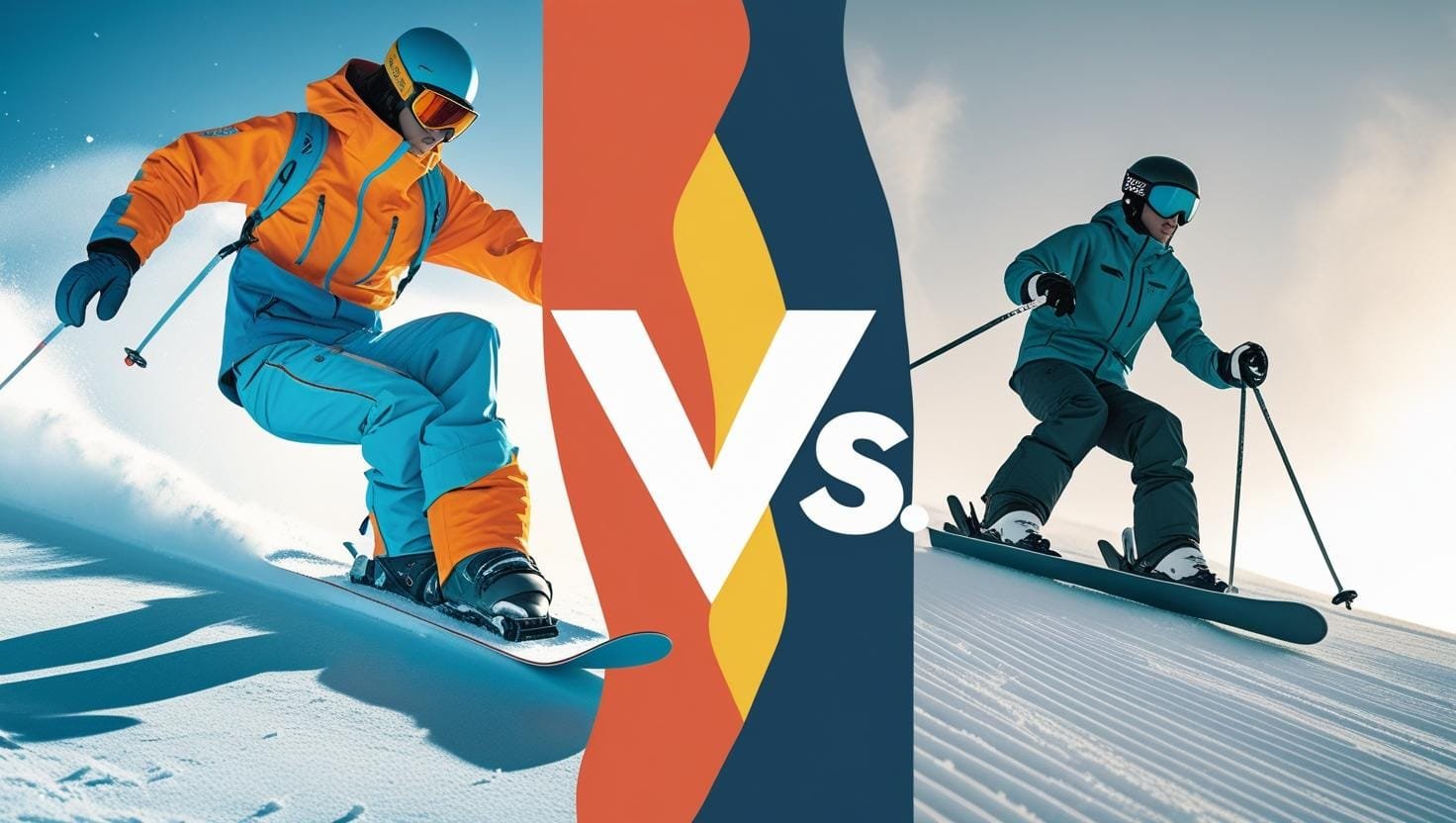
7 Reasons Why Snowboarding is Objectively Better Than Skiing
For decades, the great debate has echoed from the highest peaks to the chilliest chairlifts: snowboarding or skiing? Both are incredible ways to experience the magic of the mountains. But let’s be honest, while skiers are busy clicking into bindings and trying not to cross their tips, snowboarders are having more fun. Here’s the deep dive into why one plank is superior to two. If you’re already convinced and want to know why snowboarding is so fun, we’ve got that covered too.
The Learning Curve: Harder to Learn, Easier to Master
This is the classic argument, and it holds a profound truth about human biomechanics. Skiing is deceptively easy to pick up initially. Your legs are separate, you can use your poles for balance, and you can “pizza” or “snowplow” your way down the bunny hill on day one. However, this creates a false sense of security. Progressing to true technical mastery in skiing involves a grueling, lifelong journey of managing four separate edges, complex weight transfers between independent legs, and the constant fear of your tips crossing at high speeds.
Snowboarding, by contrast, is notoriously brutal for the first 48 hours. You will fall—frequently and hard. You will catch a “heel-side” edge and end up on your backside; you will catch a “toe-side” edge and faceplant into the snow. Learning how to fall safely is the first skill every beginner needs. This is the “baptism by ice” that every snowboarder must endure. But here is the secret: once you link that first turn, the progression isn’t linear—it’s exponential. Because you are managing only two edges (heel and toe) and your feet are locked into a single plane of existence, the core skill set you learn on a green run applies directly to a double-black diamond. Once your brain internalizes how to shift weight across the longitudinal axis of the board, the entire mountain opens up. Our snowboard turns for beginners guide covers this breakthrough in detail. Mastered a turn? Now you can carve. Mastered a carve? Now you can ride powder. The mastery of snowboarding is intuitive and deeply rewarding in a way that skiing’s rigid technicalities simply cannot match.
Furthermore, snowboarding teaches a level of core stability and spatial awareness that skiing bypasses through the crutch of poles. A snowboarder must find balance within their own center of gravity. This translates to a more refined “feel” for the terrain. While a skier relies on mechanical movements to navigate, a snowboarder relies on a fluid kinetic chain that begins at the ankles and ripples through the hips and shoulders. This is why intermediate snowboarders often look more graceful than intermediate skiers; the sport demands a unified body movement that skiing’s independent-leg mechanics often struggle to achieve without decades of training.
The Gear is Simply Better (and Less of It)
Let’s talk logistics and the “misery index” of the parking lot. A snowboarder carries exactly one item: their board. A skier is a walking yard sale of equipment. They have two skis, two poles, and the constant risk of dropping one or more of these items in a crowded lift line or while trekking through deep snow. The sheer ergonomics of carrying a snowboard—tucked under one arm—makes the transition from the car to the lift a breeze. Skiers, burdened by the “over-the-shoulder” ski carry and poles clacking in their hands, look like pack mules in comparison. Our guide to the best snowboard bags makes transport even easier.
But the real, undisputed victory for snowboarding lies in the footwear. Ask any skier about their boots, and they will likely recount stories of numbness, shin-bang, and the awkward, robotic waddle required to walk across the lodge. Ski boots are rigid, heavy plastic shells that lock your ankles into a fixed forward lean, designed more for medieval interrogation than for walking. They are slippery on ice and agonizing on stairs.
Snowboard boots, however, are essentially heavy-duty winter sneakers. They are soft, padded, and allow for a natural gait. You can walk into a grocery store, drive a car, or dance at an après-ski bar in your snowboard boots without looking like a malfunctioning cyborg. In 2026, the technology in snowboard boots has only improved, with dual-zone BOA systems providing a custom fit that remains comfortable for 12 hours straight. When the day is done, a snowboarder unstraps and walks to their car with a smile. A skier hobbles, curses, and desperately reaches for their “lodge shoes.” Our guide to the best snowboard boots shows you what you’re missing. Advantage: Snowboarding.
The Powder Day Experience is Unmatched
This is where snowboarding transcends from a sport into a spiritual experience. The physics of a snowboard are uniquely suited for deep snow. Because of the large, continuous surface area of a single board, you have a much higher “float” factor than a skier. When a skier hits deep powder, their tips want to dive, and they have to fight to keep their weight back to prevent an over-the-nose somersault. If one ski dives and the other stays up, they are headed for a ligament-tearing crash.
A snowboarder on a powder day is a surfer on a wave of white. The feeling is effortless. You lean back slightly, let the nose rise, and you are literally gliding on top of the crystalline structure of the snow. Every turn throws up a massive, silent wave of powder that envelopes you in a “white room” of pure joy. This is known as the “surf feel,” and it is the holy grail of winter sports. The wide edges of a snowboard allow for “buttering” and “slashing” maneuvers that are physically impossible on skis. You can surf the mountain, using the natural banks and rollers as waves. Our guide to the best bindings for powder will help you maximize this experience. Skiers, with their narrower planks, tend to plow through powder, creating a staccato, bouncing rhythm. Snowboarding allows for a continuous, flowing carve through the deep stuff that feels more like flying than sliding. Ask anyone who has done both: there is nothing in the world of skiing that compares to a high-speed heelside slash in waist-deep powder. It is soulful, artistic, and entirely addictive. Check out our guide to waxing your snowboard to keep your board performing at its best.
A Deeper Connection to Skate and Surf Culture
Snowboarding didn’t evolve from a desire to get down a hill faster for military or transport purposes; it was born from a desire to surf on snow. Its roots are firmly planted in the rebellious soil of skate and surf culture. This heritage brings with it a philosophy of creativity and personal expression that is often absent in the more rigid, traditional world of alpine skiing. In snowboarding, there is no “correct” way to turn—there is only your way. Style is just as important as technical proficiency.
The mountain becomes a giant skate park for a snowboarder. A simple mound of snow isn’t just an obstacle; it’s a “side hit” for a Method Grab. A flat transition isn’t just a boring catwalk; it’s a chance to practice “flat-ground” tricks like butters and spins. This mindset transforms the entire resort experience. While skiers are often focused on the speed and the “line,” snowboarders are looking for the flow. This creative DNA is baked into the equipment and the fashion. The relaxed fit of snowboarding gear isn’t just a style choice—it’s a functional requirement for the dynamic, full-body movements the sport requires. When you choose to snowboard, you’re joining a community that values innovation, art, and the relentless pursuit of “the vibe.” It’s one of the many reasons why snowboarding is the best winter sport.
You’re More Connected to the Mountain
Carving on a snowboard is a holistic, full-body engagement. When you initiate a heelside carve, your entire body—from your ankles to your neck—is part of the motion. You sink your hips, lay the board over, and look through the turn. The G-forces you feel as the board locks into the snow are distributed across your entire frame. This creates an intimate, tactile connection with the mountain’s topography. You don’t just ride over the snow; you feel the density, the temperature, and the texture of every inch of the run through the soles of your feet.
Skiing, by contrast, is more of a mechanical sequence. Your legs move independently, often in a “piston-like” motion. While technical and impressive, it lacks the “oneness” that comes from being locked onto a single edge. A deep toeside carve on a snowboard, where your chest is just inches from the snow as you arc across the hill, is one of the most visceral sensations in sports. It is a dance with gravity. This “flow state” is easier to achieve on a snowboard because the movements are more natural and rhythmic. Learn more about the flow state and why snowboarding is so fun. You aren’t managing two separate sticks; you are managing a single extension of your own body. This unified connection makes every run feel like a creative performance rather than just a technical descent.
No Poles, No Problem (and No Yard Sales)
Poles are the “training wheels” that skiers never grow out of. They are a constant annoyance. You drop them from the chairlift, they get stuck in the slush, and they are one more thing to lose in the car. Snowboarders enjoy the incredible freedom of having their hands completely free. This allows for better natural balance, the ability to easily adjust your goggles or helmet mid-run, and most importantly, the ability to grab your board. Grabs are the foundation of snowboarding style (Indy, Mute, Melon, Stalefish), and they are possible only because our hands are unencumbered.
Furthermore, snowboarders are immune to the most embarrassing event in the mountains: the “Yard Sale.” When a skier takes a high-speed tumble, their bindings are designed to release. This results in a 50-foot radius of scattered skis, poles, goggles, and gloves. The skier then has to hike up the hill to retrieve their gear while everyone on the lift watches in pity. If a snowboarder falls, their board stays attached. They might tumble, they might lose a hat, but their primary equipment is right where they left it. They simply stand up, brush off the snow, and keep shredding. The “crash and carry on” nature of snowboarding is much more efficient and much less publicly humiliating. Understanding why snowboarding can be dangerous helps you prepare for these moments.
It Just Looks Cooler.
Let’s be blunt: snowboarding has the aesthetic edge. Style is subjective, but the fluid, surf-inspired motions of a skilled rider are undeniably more graceful and modern than the rigid, vertical “bobbing” of most skiers. The equipment itself is a canvas—snowboard graphics are legendary for their art and design, whereas most skis look like corporate racing equipment. The fashion of snowboarding—relaxed, durable, and functional—has influenced street fashion for decades. Many riders prefer the fit of baggy snowboard pants for style and mobility. From the iconic “Method Grab” (widely considered the most beautiful move in snow sports) to the effortless “Lipslide” on a rail, snowboarding is a language of grace and power. Even a snowboarder sitting in the snow (a common skier complaint) looks like they are part of the landscape, waiting for the perfect moment to drop in. There is a “cool factor” to snowboarding that is rooted in its independence and its refusal to follow the traditional rules of alpine sport. It’s not just a way to get down the mountain; it’s a lifestyle. See our full exploration of why snowboarding is the best winter sport for more on the culture. For gear recommendations, check our guide to snowboard bindings.
Okay, But What About…?
We hear the common complaints from the two-plankers. Let’s set the record straight.
- Getting off the lift: Skiers think this is their “gotcha” moment. In reality, a snowboarder performing a smooth, one-footed glide off the chair is a masterclass in balance. It looks effortless and cool. Shuffling away with poles? Not so much.
- Traversing flat catwalks: Yes, we have to unstrap one foot and push. But this builds incredible leg strength, forces us to plan our lines better (momentum management), and provides a great opportunity to chat with friends without poles getting in the way.
- Moguls: Skiers claim they own the bumps. Snowboarders simply realize that moguls are just “tiny jumps” or “rhythm sections.” We don’t struggle in moguls; we play in them. Or, more often, we find the “secret” stash of powder in the trees next to the bumps that the skiers missed.
Regular vs. Goofy Stance: Finding Your Natural Footing
One of the very first questions a new snowboarder faces—before they even strap into a board—is which way to face down the mountain. Unlike skiing, where both feet point forward, snowboarding requires a sideways stance. This means one foot leads and one foot follows, and choosing the right orientation is a fundamental part of learning the sport correctly. Getting this wrong doesn’t make riding impossible, but it does make everything harder and less natural than it should be.
In snowboarding, a regular stance means riding with your left foot forward (pointing toward the nose of the board) and your right foot back (near the tail). This is the most common stance worldwide, used by roughly 70% of riders. A goofy stance is the opposite: right foot forward, left foot back. Neither is better than the other; it simply comes down to which feels more natural and powerful for your body.
Left foot forward
Right foot back
~70% of riders
Right foot forward
Left foot back
~30% of riders
Finding your natural stance is easy. The most reliable method is the “sliding sock test”: clear a path on a smooth floor, get a running start in your socks, and slide. Whichever foot you instinctively place forward to maintain balance is almost certainly your dominant “lead” foot. You can also ask a friend to give you a gentle push from behind without warning—the foot you instinctively step forward to catch yourself is typically your front foot on a snowboard. A third method is to think about skateboarding or surfing. If you’ve done either, you likely already know your stance, and it will transfer directly to snowboarding. For a deeper dive, see our guide to snowboard stance setup.
It’s worth noting that some snowboarders are “switch riders”—meaning they can ride comfortably in both directions, performing tricks and carving with equal confidence whether riding regular or goofy. This skill is the hallmark of an advanced freestyler and the goal of any serious park rider. Developing switch riding ability essentially doubles the mountain for you. A run you’ve ridden a hundred times becomes a fresh challenge when you drop in switch, and tricks in the park gain an entirely new dimension. Beginners shouldn’t worry about switch riding at first, but once you are comfortable linking turns, start practicing by traversing across the hill in your switch direction. The coordination awkwardness fades faster than you might expect, and the payoff is enormous.
🏔️ Pro Tip: Stance Width Matters Too
Most riders set their stance width slightly wider than shoulder-width for maximum stability. A wider stance lowers your center of gravity (great for carving and powder), while a narrower stance allows faster rotation for park tricks. Start at shoulder-width and adjust from there based on feel after a few sessions.
Snowboarding as Fitness: Calories, Muscles, and Full-Body Benefits
One of the best-kept secrets about snowboarding is that it’s a genuinely excellent workout—and in many respects, a more complete one than skiing. The common image of a snowboarder lazily gliding down a groomed run belies the enormous muscular demands the sport places on your body. From the moment you strap in to the moment you click out at the bottom of the last run, your body is constantly working to manage balance, control edges, absorb impact, and generate power through turns. The result is a calorie burn and muscle engagement that rival many gym-based workouts. Learn more about why snowboarding is the best winter sport for fitness.
According to data compiled by Snowsports Industries America, snowboarding burns approximately 400–450 calories per hour at a moderate pace on groomed runs. However, for more aggressive riders—those hitting the park, carving deep trenches on steep groomers, or charging through powder—caloric expenditure can exceed 600 calories per hour. The Compendium of Physical Activities, a database maintained by researchers to measure energy costs of various sports, rates both snowboarding and skiing with a Metabolic Equivalent (MET) of 5.3 for moderate effort—equal to a brisk jog. Vigorous snowboarding reaches MET ratings as high as 8.0, comparable to a sustained cycling effort.
Beyond simple calorie burn, the specific muscle groups targeted by snowboarding are different from those emphasized by skiing, and in many cases snowboarding provides superior engagement of stabilizing muscle groups that are chronically undertrained in everyday life. While skiing tends to isolate the glutes, outer hip muscles, and thigh extensors due to its “squat-in-place” mechanics, snowboarding’s rotational, dynamic movements draw in a much broader array of muscle groups, particularly in the core and lower legs.
Quadriceps
Primary power source for toe-side edge pressure and absorbing terrain impacts.
Calves & Ankles
Constantly engaged to steer the board and maintain balance on heel and toe edges.
Core & Abdominals
The deep psoas and lower abs stabilize every turn, especially in powder.
Hip Flexors
Rotational carving and switch riding demand constant hip engagement.
Upper Body
Getting up from falls, carving and grabbing are pushup-level upper body work.
Proprioception
The constant balance challenge sharpens the brain-body coordination system.
A notable additional benefit of snowboarding over skiing from a fitness standpoint is the upper-body activation. Because snowboarders must physically get up from a seated position every single time they strap in after the chairlift—and also after any fall—they perform what amounts to a modified push-up or full-body press multiple times per day. One experienced instructor famously noted that every run on a snowboard involves at least one “push-up from the snow,” which over the course of a full day on the mountain adds up to more upper-body work than most skiers encounter across an entire season. The abdominal and core engagement required to maintain dynamic balance while carving, especially at speed on steep terrain, is also substantially higher in snowboarding. Expert snowboarders who specialize in carving describe the sensation in the lower abdomen as comparable to sustained planking—except happening while traveling at 40 miles per hour across frozen terrain, which makes it considerably more interesting.
Beyond the muscular benefits, snowboarding is an excellent cardiovascular exercise. The interval-training nature of the sport—hard physical effort on the run, followed by relative rest on the chairlift, repeated throughout the day—mimics high-intensity interval training (HIIT) protocols that are well-documented for their fat-burning and cardiovascular benefits. The cold mountain environment further amplifies calorie burn, as the body must expend additional energy to maintain its core temperature. This thermogenic effect is not widely discussed but represents a meaningful additional calorie expenditure on a cold powder day. Harvard Medical School data indicates that even at moderate exertion, a 155-pound person burns between 216 and 252 calories per 30-minute session of downhill snow sports—numbers that scale upward rapidly as intensity increases. For many riders, a full seven-hour day on the mountain with back-to-back runs represents a 3,000–4,000 calorie day, making snowboarding one of the most calorie-intensive “fun” activities available anywhere in the world. Read more about why snowboarding is so fun.
Snowboarding with Kids and Families: The Complete 2026 Guide
One of the most common questions families face before a winter vacation is whether their children should learn to ski or snowboard. The answer depends significantly on age, temperament, and the family’s own experience level—but for many families, snowboarding is absolutely the right long-term choice for children, and the landscape for getting kids started on boards has never been better than it is in 2026. Modern equipment, specialized kids’ programs, and a deeper understanding of how children learn movement skills have all converged to make youth snowboarding more accessible than ever before. Our guide to choosing your first snowboard includes tips for picking kids’ boards.
Ages 3–5: Skis First (for most kids)
At this age, most children lack the core strength and balance control that snowboarding demands. Skiing, with its forward-facing stance and independently moving legs, aligns more naturally with a toddler’s existing motor patterns. Snowboard instruction in private lessons is technically possible from age 3, but group lessons typically don’t begin until age 6 at most resorts. For this age group, the ski hill is a snow playground; formal learning can wait.
Ages 6–8: The Sweet Spot for Starting Snowboarding
Most child development experts and certified snowboard instructors agree that 6–8 is the ideal window to introduce snowboarding. Children in this age group have developed enough core strength, proprioceptive awareness, and fearlessness to handle the initial learning curve. Their lower center of gravity—relative to their height—actually gives them a balance advantage over adult beginners, and their reduced fear of falling means the inevitable tumbles of the first two days are simply “part of the fun.” The U.S. Ski and Snowboard Association’s coach development manager recommends this age range as the optimal window.
Ages 9–12: Fast Learners, Big Progression
Children who start in this age group often have the best first-week experiences of any demographic. They have enough coordination to absorb technical instruction, enough courage to push through the initial difficulty, and enough time in the season to build real skill. By the end of a typical 5-day ski holiday, a motivated 10-year-old who started snowboarding on Day 1 will often be riding intermediate blue runs with confidence. The peer social aspect of snowboarding—its cool factor among kids—also provides powerful motivation to practice.
Ages 13+: Teenagers Take to It Naturally
Many teenagers who have skied for years make the switch to snowboarding simply because it looks cooler and aligns with skate and surf culture. The transition is easier than starting from scratch because the mountain sense, edge awareness, and physical conditioning transfer. Expect two days of frustration followed by a rapid breakthrough, and then a teenager who is absolutely obsessed with their new sport and will spend every available day on the mountain. Skateboarding or surfing experience dramatically accelerates the learning curve at this age.
One crucial piece of practical advice for families: always rent before you buy for children under 12. Kids grow rapidly, and snowboard equipment is expensive. At major resorts and reputable local rental shops, complete kids’ snowboard packages—board, boots, and bindings—can be rented for $30–$60 per day, with multi-day discounts available. This allows the child to try different board sizes and flex profiles as their skill develops, and it eliminates the heartbreak of buying an expensive setup in October and discovering by February that the child has either grown out of the boots or switched their allegiance back to skiing. Once a child has demonstrated at least two consecutive seasons of genuine enthusiasm, investing in their own quality equipment becomes a worthwhile commitment.
For families where parents are skiers and children want to snowboard—or vice versa—the practical implications are real. On most major North American and European resorts, skiers and snowboarders share lifts, gondolas, and the vast majority of terrain without issue. A skiing parent and a snowboarding child can absolutely enjoy the same runs together. The only meaningful divergence comes at the few remaining ski-only resorts (such as Alta and Deer Valley in Utah, which prohibit snowboards by historical policy), and on drag lifts or poma tows, where snowboarders must ride with one foot unstrapped, requiring a small but learnable additional skill. Families who ride together, regardless of the platform on their feet, tend to find that the shared experience of improving and exploring the mountain together far outweighs any equipment compatibility concerns.
🎿 Family Pro Tip: The “Ski First, Board Later” Strategy
Many experienced snow sports families recommend starting very young children (ages 3–5) on skis to build mountain familiarity, confidence on chairlifts, and general snow comfort—then transitioning to snowboarding around age 6–7 if they show interest. The foundational balance and “mountain sense” built on skis transfers surprisingly well to the snowboard and often shortens the learning curve significantly.
Snowboarding vs. Skiing Cost Comparison: Full 2026 Breakdown
Cost is one of the most frequently searched aspects of choosing between snowboarding and skiing, and the honest answer is that the two sports are roughly comparable in overall expense—but snowboarding holds meaningful advantages in specific cost categories that add up over a full season. Understanding the complete cost picture before you make any equipment decisions can save you hundreds of dollars. Our snowboard sizing guide helps you get the right fit the first time.
Complete Beginner Snowboard Setup Cost (2026)
Complete Beginner Ski Setup Cost (2026)
As the numbers show, a complete beginner snowboard setup typically costs $50–$200 less than an equivalent ski setup, primarily because snowboards don’t require separate pole purchases and the binding systems are generally simpler. The ongoing maintenance cost difference is also significant: you only have one base to wax and one set of edges to tune on a snowboard versus two separate bases and four edges on a pair of skis. Annual waxing and tuning for a snowboard costs roughly $40–$80; for skis, $60–$120. Over five years, the savings are modest but real.
Where the biggest financial variable lies is in lesson investment. Given snowboarding’s steeper initial learning curve, most beginners benefit from two to three days of professional instruction rather than just one. At major resorts, group lessons run $80–$130 per half-day; private instruction typically ranges from $150–$350 per session. Budget for at least two full days of lessons at the beginning. This upfront investment in instruction pays dividends for the rest of your life on the mountain—the difference between a well-taught beginner and a self-taught one is typically six months to a year of wasted progression, plus a much higher injury risk in the early stages.
💡 The “Rent First” Strategy for Beginners
If you’re taking your first one or two snowboard trips, rent everything from the resort or a nearby demo shop rather than buying. Resort rental packages for snowboards typically run $40–$70 per day inclusive of board, boots, and bindings. This allows you to try different board styles (softer flex beginner boards vs. stiffer all-mountain boards) before committing to a purchase, and eliminates the risk of buying equipment that doesn’t suit your developing riding style. Once you know you’ll be riding at least five or six days per season, buying becomes the economical choice.
Essential Snowboarding Safety Gear: What You Actually Need in 2026
Snowboarding is a thrilling sport, and like all thrilling sports, it comes with real injury risks. Understanding what safety gear you need—and more importantly, why—is the foundation of a long, injury-free snowboarding life. The injury profile of snowboarding is distinct from skiing: where skiers predominantly suffer knee injuries (ACL and MCL tears from the twisting motion of independent-leg binding releases), snowboarders are more likely to experience wrist and shoulder injuries from catching themselves with outstretched hands during falls, as well as coccyx (tailbone) injuries from backward falls on the heel-side edge. The good news is that the right protective gear addresses all of these specific risks directly. Our guide to back protectors for snowboarding covers the full safety lineup.
-
Certified Helmet — Non-Negotiable
A properly fitted, ASTM F2040 or CE EN 1077 certified helmet is the single most important piece of safety equipment for any snow sport. Unlike helmets for cycling or skateboarding, ski and snowboard helmets are designed to handle both high-energy impacts and cold temperatures. Look for helmets with MIPS (Multi-directional Impact Protection System) technology, which reduces rotational forces to the brain during oblique impacts. In 2026, MIPS helmets are available at all price points from $70 upward. Replace your helmet after any significant impact, even if it looks undamaged. See our picks for the best snowboard helmets. -
Wrist Guards — Critical for Beginners
Wrist injuries account for approximately 25–30% of all snowboarding injuries, making them the most common injury category in the sport. The mechanism is simple: when you fall backward (heel-side) or forward (toe-side), instinct is to catch yourself with your hands. A snowboard wrist guard uses a rigid splint to distribute impact forces across a larger area, preventing the hyperextension that causes fractures. Beginners should wear wrist guards inside their gloves for the first 10–15 days of riding. Many experienced snowboarders continue to wear them indefinitely in the park or in icy conditions where falls are more abrupt. Our guide to the best snowboard knee pads covers additional protective options. -
Impact Shorts / Padded Base Layer — Highly Recommended
Padded impact shorts with built-in protection over the coccyx, hips, and thighs are one of the most effective and underused pieces of protective gear in snowboarding. A hard fall on the heel-side edge directly onto your tailbone is extraordinarily painful and can sideline you for a week or an entire season if the bone is fractured or bruised severely. Modern impact shorts are thin enough to wear under regular snow pants with minimal bulk and provide meaningful protection that changes a “season-ending” fall into a “that hurt but I’m fine” fall. -
Back Protector — Park Riders and Advanced Terrain
For riders who explore the terrain park, backcountry, or steep technical lines, a spine protector worn under the jacket adds a meaningful layer of protection for high-speed backward falls. Available as standalone vests or integrated into jacket liners, spine protectors use hard plastic shells over foam padding to distribute impact forces away from the vertebrae. CE Level 1 and Level 2 ratings indicate the degree of impact protection; Level 2 is recommended for park and backcountry riding. -
Quality Goggles — Protection and Performance
Goggles are both a safety and performance item. UV protection at high altitude is critical—solar radiation increases approximately 4% for every 1,000 feet of elevation, meaning a day at 10,000 feet exposes your eyes to roughly 40% more UV radiation than at sea level. Quality goggles with 100% UV400 protection are essential. For performance, look for spherical lenses (which reduce glare and distortion compared to flat cylindrical lenses), anti-fog coatings, and interchangeable lens systems that allow you to swap between high-contrast low-light lenses and darker lenses for bright bluebird days. -
Proper Gloves or Mittens — Don’t Skimp
Cold, numb hands are both a comfort and a safety issue on the mountain—compromised grip and reduced sensation in the fingers affect your ability to manage strap adjustments, operate zippers, and respond to terrain changes. For snowboarding, mittens are generally warmer than gloves because they allow the fingers to share warmth; however, gloves provide more dexterity for strap adjustments and phone use. Look for waterproof membrane liners (Gore-Tex or similar), adequate insulation rated for at least -10°C/14°F, and reinforced palms for ground contact during falls. Compare options in our mittens vs gloves guide.
Snowboard Types Explained: Choosing the Right Board for Your Riding Style
Walk into any snowboard shop or browse any major online retailer and you will be confronted with an overwhelming array of board shapes, flex ratings, camber profiles, and construction technologies. For beginners and intermediates, this complexity can feel paralyzing. The good news is that the fundamental categories of snowboards map neatly onto riding styles and terrain preferences, and once you understand the basic framework, choosing the right board becomes significantly more intuitive. Understanding snowboard types is also one of the highest-volume search topics in the snowboarding niche. Our snowboard comparison tool can help you narrow down the options.
🏔️ All-Mountain Boards
Best for: Beginners through advanced riders who want one board for everything. These boards handle groomed runs, powder, and mild park features equally well. Directional-twin shape; medium flex (4–6). The safest first purchase for any rider.
🌊 Freestyle / Park Boards
Best for: Riders who spend most of their time in the terrain park hitting jumps, rails, and jibs. True twin shape (symmetrical nose and tail); soft flex (2–4) for easy buttering and ground tricks. Shorter length than all-mountain for faster spin initiation.
❄️ Powder / Freeride Boards
Best for: Advanced to expert riders who prioritize deep powder and off-piste terrain. Longer nose with setback stance; stiffer flex (6–8) for high-speed stability; directional shape. Tapered tail sinks into snow to naturally lift the nose.
⚡ Carving / Alpine Boards
Best for: Riders who live for precision high-speed edge-to-edge carving on hard groomed pistes. Narrower waist; very stiff flex (8–10); hard boots and plate bindings. A niche specialty; not recommended for beginners.
🧒 Kids’ / Junior Boards
Best for: Riders under approximately 100 lbs (45 kg). Shorter length, softer flex, and lighter construction for small-body control. Many quality brands—Burton, Ride, Capita—produce complete kids’ lines specifically engineered for young riders.
👶 Beginner-Specific Boards
Best for: First-timers who want maximum forgiveness. These boards have the softest flex available (1–3), forgiving “catch-free” edges that prevent edge-catching, and wide platforms for stability. Often sold as complete packages with bindings and boots.
Beyond shape and riding style, the most important technical choice for beginner and intermediate buyers is the camber profile of the board—the curvature of the base from tip to tail when the board is unloaded. Traditional camber (a slight upward arc in the middle) provides excellent edge hold and energy return for carving but is less forgiving for beginners as it makes edge-catching more likely. Rocker (sometimes called reverse camber, where the board tips upward toward the nose and tail) is the opposite: beginner-friendly, powder-friendly, and very forgiving, but with less edge hold on hard snow. Most beginner and all-mountain boards in 2026 use a hybrid camber profile that combines a central camber zone for pop and edge grip with rockered tip and tail sections for float and forgiveness—the best of both worlds, and the profile recommended for anyone who doesn’t yet have strong preferences based on experience. See our full snowboard comparison guide for more details.
How to Switch from Skiing to Snowboarding: A Step-by-Step Transition Guide
Every winter, thousands of intermediate and advanced skiers make the decision to try snowboarding—often because they’ve watched a friend or partner shred powder with effortless grace, or simply because they want a new challenge after years on two planks. The transition is absolutely achievable, but it’s critically important to approach it with the right expectations. Many skiers make the mistake of assuming their ski ability will translate directly to snowboard competence, and then become demoralized when they find themselves tumbling on the beginner slope alongside five-year-olds. The truth is more nuanced: your ski experience gives you enormous assets (mountain sense, edge awareness, physical conditioning, and cold-weather gear management), but the movement patterns are different enough that you should genuinely expect to feel like a beginner for your first two to three days.
Reset Your Expectations — Embrace Beginner Status
The single most important mental preparation for a skier switching to snowboarding is accepting that your first two days will be humbling. You will fall. You will fall a lot. Your body’s ski-trained muscle memory will actively fight the new movement patterns. This is normal, expected, and completely temporary. Skiers who go in with a “student mindset” progress far faster than those who expect their existing skills to shortcut the learning curve.
Book At Least Two Days of Professional Instruction
Even if you’re an expert skier, invest in at least two half-day lessons from a certified snowboard instructor for your first trip. Your instructor will immediately identify your dominant learning patterns (likely ski-influenced weight transfer habits that don’t apply to snowboarding) and give you targeted drills to correct them. The specific vocabulary of snowboarding—heel edge, toe edge, base flat, pressure leading leg—is different enough from skiing that self-teaching without guidance often leads to ingrained bad habits that take far longer to correct later.
Gear Up Specifically for the Learning Phase
Buy or rent wrist guards before your first day, and seriously consider impact shorts. As a skier, you’re accustomed to falling and recovering quickly because ski bindings release and your legs are free. On a snowboard, your feet are fixed to the board and the falls are different—more abrupt and often directly onto the hands, wrists, or tailbone. One wrist fracture can ruin your entire winter. Protective gear is cheap compared to medical treatment and lost mountain days.
Unlearn the Ski Upper-Body Position
The most common error skiers make when snowboarding is bringing their ski upper-body posture with them—facing downhill with square hips and arms forward. On a snowboard, your body needs to rotate to face partially across the slope, with your leading shoulder opening toward the fall line during toe-side turns and your trailing shoulder guiding heel-side turns. Practice this rotation on flat ground before you try it at speed. The shoulder position dictates everything else in snowboard turn mechanics.
Transfer Your Mountain Sense (It’s a Big Asset)
Your ski experience is genuinely valuable in ways you might not initially appreciate. You already understand how to read a slope’s pitch, how to identify the fall line, how to manage speed using terrain features, how to behave safely on a crowded mountain, and how to navigate chairlifts and resort systems. All of this translates directly and gives you a significant head start over a true beginner. Once your body learns the new movement language of snowboarding, your existing mountain intelligence will accelerate your progression dramatically. Master the fundamentals with our guide to snowboard stopping techniques.
Commit to at Least Three Days Before Making a Judgment
The critical rule of any snowboard learning process is to give it at least three consecutive days before evaluating whether it’s “for you.” Day one is typically a struggle. Day two is when things begin to click. Day three is when most people have the breakthrough run that makes them understand why snowboarders are so passionate about the sport. If you quit after Day 1 or even Day 2, you’ve spent the hard part of the learning investment without getting to the reward. Three days is the minimum meaningful trial period.
Snowboarding vs. Skiing: Groomed Runs, Off-Piste, and Trees Compared
One of the most nuanced aspects of the snowboarding vs. skiing debate is how the two sports compare across different terrain types. The honest answer is that both sports have terrain where they excel and terrain where they present challenges—but for the majority of recreational riders, snowboarding provides a more consistently enjoyable experience across more terrain types. Understanding these terrain-specific dynamics helps you make a more informed choice about which sport to invest in, and helps intermediate riders understand how to navigate the mountain most effectively on a snowboard.
🎿 Skiing Advantages
- Generally faster on groomed piste at elite level
- More efficient on flat catwalks and runouts
- Mogul skiing technique is highly specialized and effective
- Cross-country and backcountry skinning is skiing-exclusive
- Drag lifts (T-bars, button lifts) are easier for skiers
🏂 Snowboarding Advantages
- Significantly superior float in deep powder
- More intuitive off-piste technique (same as on-piste)
- Better in trees due to single-board maneuverability
- Easier traverse through deep snow without tip-crossing risk
- More natural and less exhausting in very variable snow conditions
On groomed runs: Both sports are equally enjoyable and capable on well-maintained piste. Expert skiers can reach higher absolute top speeds (the world speed skiing record of 252 km/h versus the snowboard speed record of 203 km/h indicates skiing’s aerodynamic advantage at the extreme end), but for recreational speeds of 30–60 km/h, the speed difference is negligible. What matters at recreational speeds is how a run feels—and the feedback is clear that a well-executed carving turn on a snowboard, with the entire board locked onto a hard edge as you lay the board over and feel G-forces build through the turn, is an experience that most skiers describe as qualitatively different from anything their sport offers.
In the trees: Snowboarding has a meaningful advantage in tight tree runs due to the single-board platform. There is no risk of one ski catching a branch, no poles to manage, and the ability to quickly shift weight and redirect the board in a confined space is enhanced by the unified foot platform. Expert tree riders on snowboards describe the experience as remarkably similar to surfing a natural wave—the trees become the walls of the wave, the gaps become the barrels, and the board flows naturally through the spaces. The key skill is looking further ahead through the trees than feels comfortable. Our guide to snowboard stopping techniques is essential for tree riding confidence.
Off-piste and powder: This is where snowboarding’s advantage is most decisive and most universally acknowledged—even by skiing purists. The technique for riding powder on a snowboard is essentially identical to groomed-snow technique: lean back slightly, initiate turns with the same heel-toe weight shifts, and let the board float. The learning transfer is seamless. Skiing in powder, by contrast, requires a substantially different weight distribution, a much wider stance (heavy wide-body or fat skis are needed), and a completely different body position from on-piste skiing. Many intermediate skiers who can handle double-black diamonds on groomed snow find themselves completely lost in even moderate off-piste conditions, while intermediate snowboarders often find powder surprisingly accessible after just a few runs of adjustment. This accessibility advantage represents one of the most compelling practical reasons to choose snowboarding as your primary winter sport. See our full comparison of why snowboarding is better than skiing for more terrain analysis.
Best Snowboard Resorts for Beginners in 2026
Not all ski resorts are created equal for the snowboard learner. The ideal beginner snowboard resort combines a generous dedicated beginner terrain area, a high-quality snowboard school with certified instructors using modern teaching progressions, a good rental fleet with well-maintained beginner-specific board setups, and ideally some natural snow (or excellent snowmaking) to provide the soft, forgiving surface that makes the inevitable early falls far more comfortable. Our guide to whether snowboard lessons are worth it covers what to look for in a ski school.
🏔️ Breckenridge, Colorado
One of the most beginner-friendly major resorts in North America. The dedicated “Ski & Ride School” area at the base of Peak 8 offers extensive beginner terrain, and the high-altitude snowpack is typically excellent. The town infrastructure is well-developed for first-timers.
🍁 Whistler Blackcomb, BC
North America’s largest ski area has extensive beginner zones at the base of both mountains and world-class snowboard instruction. The consistent Pacific snowpack and long season make it ideal for multiple learning trips within one season.
🎿 Park City, Utah
Utah’s legendary “Greatest Snow on Earth” provides the light, dry powder that makes beginner falls virtually painless. Park City’s Ski & Snowboard School is one of the highest-rated in the country, and the mountain layout is particularly beginner-logical.
⛷️ Mammoth Mountain, California
Mammoth’s long season (often November through June) gives beginners more opportunities to return and reinforce new skills. The base-area learning zone is extensive, and the resort’s commitment to snowboarding culture runs deep in its historical roots.
🌲 Keystone, Colorado
Keystone is often overlooked in favor of its flashier Summit County neighbors, but for beginners it may be the single best choice in Colorado. Night skiing is included in the lift ticket, and the A51 terrain park complex offers progressive features for those transitioning from green to blue terrain.
🏔️ Vail, Colorado
Vail’s beginner “Golden Peak” learning area is a world unto itself, with gentle rolling terrain that allows beginners to build speed gradually. The snow school here is very well-staffed, and the sheer size of the resort means beginners have an almost unlimited progression ladder as their skills improve.
When evaluating any resort for a first or early snowboard trip, look specifically for these features: a dedicated beginner learning area (separate from the main mountain traffic), a high ratio of certified snowboard instructors to skiers in the ski school, a rental fleet that includes beginner-specific soft-flex boards (not just universal all-mountain rentals), and proximity of beginner terrain to the main lodge facilities to minimize exhausting boot walks. Online reviews on specialized snow sports forums are often more reliable than resort marketing materials for assessing these specific qualities. In 2026, many resorts also offer “guarantee” programs for beginner lessons—if you don’t ski or ride a chairlift by the end of Day 1 of instruction, your lesson is free. These programs are a useful indicator of resort confidence in their beginner instruction quality.
How to Prepare for Your First Snowboard Trip: The Complete 2026 Checklist
Walking into your first snowboard experience without preparation is one of the most common mistakes new riders make. The mountains reward those who arrive ready—physically, mentally, and gear-wise—and punish those who don’t with a miserable, exhausting first day that unfairly colors their entire perception of the sport. A small investment of preparation time in the weeks before your trip can transform a potentially discouraging experience into the beginning of a lifelong passion. Here is everything you need to know before you strap in for the first time. Start with our guide to choosing your first snowboard.
🏋️ Physical Preparation (6–8 weeks before)
Snowboarding demands strong quads, calves, core muscles, and cardiovascular endurance. A targeted pre-trip fitness routine should include squats and wall sits for quad strength, calf raises for ankle stability, planks and rotational core exercises, and 20–30 minutes of cardio three times per week. Yoga or dynamic stretching for hip flexors and hamstrings is particularly valuable, as tight hips will limit your edge transitions. Our guide to snowboard stance setup explains how hip position affects your riding. Riders who arrive fit progress significantly faster and experience less next-day muscle soreness than those who don’t.
🎿 Gear Checklist
Snowboard, boots, bindings (rented or owned), helmet, goggles, wrist guards, impact shorts, waterproof snow pants and jacket, moisture-wicking base layers (top and bottom), wool or synthetic mid-layer, gloves or mittens, neck gaiter or balaclava, wool socks (avoid cotton—it holds moisture and causes cold feet — see our best snowboard socks guide), lip balm with SPF, sunscreen SPF 30+ for face and neck, and an emergency contact card in your jacket pocket.
📚 What to Know Before You Go
Study the difference between heel-side and toe-side edges. Watch tutorial videos from certified instructors (many resorts post free video curricula online). Learn the skier’s responsibility code—the rules of mountain etiquette and right-of-way that all mountain users must follow. Identify your stance (regular or goofy) using the sliding test — our regular vs goofy stance guide has detailed instructions. Know how the resort’s lift system works, particularly the difference between fixed-grip quads and gondolas, which have different boarding and exit dynamics for snowboarders.
🍽️ Day-Of Preparation
Eat a proper breakfast before hitting the mountain—snow sports burn calories rapidly and hypoglycemia is a real performance issue. Hydrate thoroughly: altitude and dry mountain air dehydrate you faster than you feel. Apply sunscreen before you dress, including ears and under the chin (snow reflects UV upward). Pack a mid-day snack and a reusable water bottle. Arrive at the mountain early enough to rent gear without the line pressure of a crowded mid-morning rental desk. Start in the lesson meeting area, not on the main lifts.
🏥 Injury Prevention Mindset
Fatigue causes most snowboarding injuries. When your legs are burning and your focus starts to drift, that’s when bad falls happen. Learn to recognize the signs of productive tiredness (normal, push through it) versus danger fatigue (shaky legs, compromised decision-making, difficulty maintaining edge control). Take genuine breaks—sit down, eat, hydrate, let your legs recover. A full mountain day for beginners should include at least two 20-minute rest breaks and should end at 3:00 PM rather than the last chairlift, when fatigue is at its peak. Learn about why snowboarding can be dangerous to understand the risks.
🧠 The Mental Game
Accept that Day 1 will be hard. Accept that you will fall, and fall repeatedly. Have a specific positive phrase you use to reset after a bad fall (something like “reset—find the edge”). Celebrate micro-victories: your first linked turn, your first run without a fall, your first time riding to the bottom without stopping. Set a concrete goal for each run (e.g., “this run I focus only on keeping my shoulders level”) rather than a vague goal to “get better.” Specific micro-goals are the fastest path to overall improvement.
Frequently Asked Questions
1. Is snowboarding actually harder to learn than skiing?
Initially, yes. The first two days of snowboarding involve a lot of falling as you learn the “heel” and “toe” edge balance. Skiers can usually stand up and glide on day one. However, the “intermediate plateau” in skiing is much harder to overcome than the learning curve in snowboarding. See our full breakdown of why snowboarding is better than skiing.
2. Why do snowboard boots feel so much better than ski boots?
Ski boots must be rigid to transfer force to the ski bindings, which release during a crash. Snowboard boots don’t need this mechanical rigidity because the bindings don’t release; they use the soft tissue of your leg and the board’s flex to absorb impact, allowing for a “walking-friendly” soft boot design.
3. Are snowboarders more prone to injuries?
Snowboarders tend to have more wrist and shoulder injuries due to falls on the hands, while skiers have more knee (ACL/MCL) injuries due to the independent twisting of the skis. In 2026, wrist guards and better technique training have significantly lowered injury rates for snowboarders.
4. How do I survive flat sections on a snowboard?
Momentum is your best friend. Look ahead, keep your base flat, and avoid unnecessary carving on flats. If you do stop, unstrap your back foot and push like a skateboard. It’s actually great exercise!
5. Can I switch from skiing to snowboarding easily?
Many people do! Your knowledge of “mountain sense” and edge-feel will help, but be prepared to feel like a beginner again for the first two days. Your “ski muscles” are different from your “snowboard muscles.” See our snowboard turns for beginners guide for the key differences.
6. Why do snowboarders sit down so much?
Usually, we are just strapping into our bindings after the lift! Also, because we are locked in, sitting is the most stable way to rest or wait for friends. Plus, our boots are comfortable enough that sitting in the snow is actually pleasant. Learn more about snowboard boots and why they’re so comfortable.
7. Do I need special gear for powder?
A “volume-shifted” board or a board with a “rocker” nose helps you float, but any modern snowboard is better in powder than standard skis. The surface area is simply in your favor. See our guide to the best bindings for powder for gear recommendations. For a deeper dive, check our snowboarding vs skiing comparison.
8. Is snowboarding more expensive?
Generally, no. Snowboard setups (board, boots, bindings) often cost less than a full ski setup (skis, boots, bindings, poles), and maintenance is simpler since you only have one base to wax.
9. What is a “Yard Sale” in skiing?
A classic skiing crash where the person’s gear (skis, poles, goggles, hat) is scattered all over the trail. Snowboarders are “all-in-one,” so we don’t have this problem.
10. Why is snowboarding called “shredding”?
It comes from skate and surf culture, referring to the way a board “shreds” through the snow or a wave. It reflects the energetic, powerful nature of the sport. Read more about why snowboarding is the best winter sport.
11. What age can kids start snowboarding?
Most experts recommend starting children on snowboards between ages 6 and 8, when they have developed sufficient core strength and balance. Some resort programs accept children as young as 3 in private one-on-one lessons, but group lessons typically don’t start until age 6. Very young children (under 5) are generally better served by starting on skis, then transitioning to a snowboard when they’re older.
12. How many calories does snowboarding burn?
Snowboarding burns approximately 400–450 calories per hour at moderate intensity on groomed terrain. At aggressive riding intensity—charging steep groomers, riding powder, or park riding—calorie burn can exceed 600 calories per hour. Over a full 7-hour mountain day, many active snowboarders burn 3,000–4,000 total calories when accounting for hiking, lift rides, and sustained effort on the mountain.
13. What is regular vs. goofy stance in snowboarding?
Regular stance means riding with your left foot forward (toward the nose of the board) and your right foot back. Goofy stance is the reverse: right foot forward, left foot back. Approximately 70% of riders are regular, and 30% are goofy. To determine your natural stance, slide across a smooth floor in socks—whichever foot you lead with is typically your front foot on a snowboard.
14. How much does a snowboard setup cost in 2026?
A complete beginner snowboard setup (board, bindings, boots) costs between $380 and $690 new in 2026. See our snowboard sizing guide to get the right fit. Add helmet, goggles, gloves, and protective padding and the total rises to approximately $570–$1,180. Mid-range performance setups run $800–$1,500. Renting from a resort shop costs approximately $40–$70 per day for the complete board package. Beginners taking their first one or two trips are strongly advised to rent before buying. Check out our guide to choosing your first snowboard for when you’re ready to purchase.
15. What safety gear do I need for snowboarding?
Essential safety gear for all snowboarders includes a certified helmet (ASTM F2040 or CE EN 1077) and quality goggles with UV protection. For beginners specifically, wrist guards are critical—wrist injuries are the most common snowboard injury and are highly preventable with proper guards. Impact shorts protecting the coccyx and hips are strongly recommended. Our guide to the best snowboard knee pads covers additional protection options. Back protectors are recommended for park riders and those exploring aggressive terrain.
16. What type of snowboard should a beginner buy?
Beginners should look for an all-mountain or beginner-specific board with a soft-to-medium flex rating (1–4 on a scale of 1–10) and a hybrid camber profile. Our snowboard comparison tool can help you find the perfect match. A twin-tip or directional-twin shape is forgiving and versatile. Board length should be roughly chin-height when standing for most beginner and intermediate riders. Avoid specialized powder, racing, or stiff park boards until you have at least 15–20 days on snow and a clear sense of your preferred riding style.
17. How do I switch from skiing to snowboarding?
Embrace being a beginner again for 2–3 days and don’t let your ski ego make you skip the beginner area. Book at least two days of lessons with a certified snowboard instructor. Invest in wrist guards and impact shorts before Day 1. Our snowboard fall safety guide explains why this gear is critical. Unlearn the forward-facing ski upper-body position and practice the rotational shoulder mechanics of snowboarding on flat ground before riding. Give yourself at least three full days before evaluating whether snowboarding is for you—most people have their breakthrough moment on Day 3. Check out our snowboard turns for beginners guide to understand what to expect.
18. Is snowboarding better than skiing for off-piste riding?
Most experienced riders of both disciplines agree that snowboarding provides a more intuitive and enjoyable off-piste experience for the majority of recreational riders. The single-board platform floats naturally in powder with the same technique used on groomed snow, while skiing off-piste requires a significantly different body position and often specialized wide “powder skis” for equivalent float. In trees, the snowboard’s lack of independent tips eliminates the branch-catching risk that challenges skiers in tight timber.
19. Which muscles does snowboarding work?
Snowboarding provides a comprehensive lower-body and core workout. Primary muscles engaged include the quadriceps (toe-side edge pressure and terrain absorption), calves and ankle stabilizers (board steering and balance), and the deep core muscles including the psoas and lower abdominals (rotational carving and balance maintenance). The upper body is engaged through terrain park riding, getting up from falls (a modified push-up), and the physical effort of stance maintenance at high speeds. Overall, snowboarding provides a more balanced whole-body workout than skiing due to its dynamic rotational demands.
20. What are the best snowboard resorts for beginners in 2026?
Top resorts for beginner snowboarders in 2026 include Breckenridge (Colorado) for its extensive dedicated beginner terrain and excellent ski school, Whistler Blackcomb (British Columbia) for its consistent snowpack and world-class instruction, Park City (Utah) for Utah’s legendary light dry powder that makes falls soft, Mammoth Mountain (California) for its long season giving beginners multiple opportunities to practice, and Keystone (Colorado) for its underrated beginner programs and night skiing included in the lift ticket. In Europe, Chamonix (France) and Zermatt (Switzerland) offer exceptional snowboard schools with multilingual instruction.
The Final Verdict: Join the Better Side
At the end of the day, any day in the mountains is a good day. But a day spent surfing on snow, with comfortable boots on your feet, a deeper connection to the terrain, and the whole mountain ahead of you—from powder chutes to park rails to off-piste tree runs—is a better day. The choice is clear. Stop shuffling and start shredding. Ready to get started? Read our guide to why snowboarding is so fun for the full picture.
This article was updated for the 2026 season. All opinions are in good fun.


