
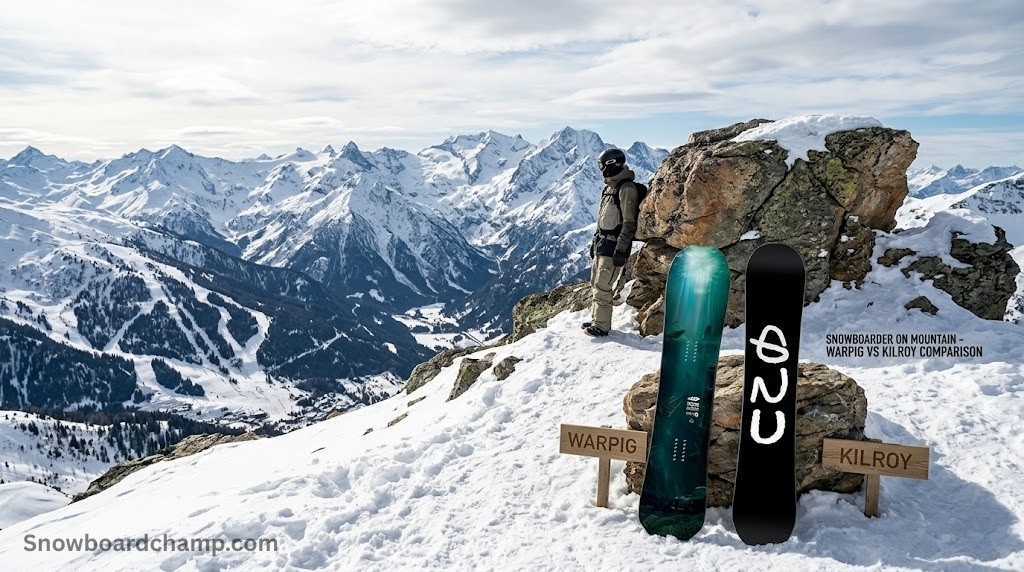
Warpig vs Kilroy:
Which Snowboard Rules?
Two cult-favorite short-wide boards that broke the rules. One built for chaos, one built for park precision. We dig deep so you know exactly which one belongs under your feet.
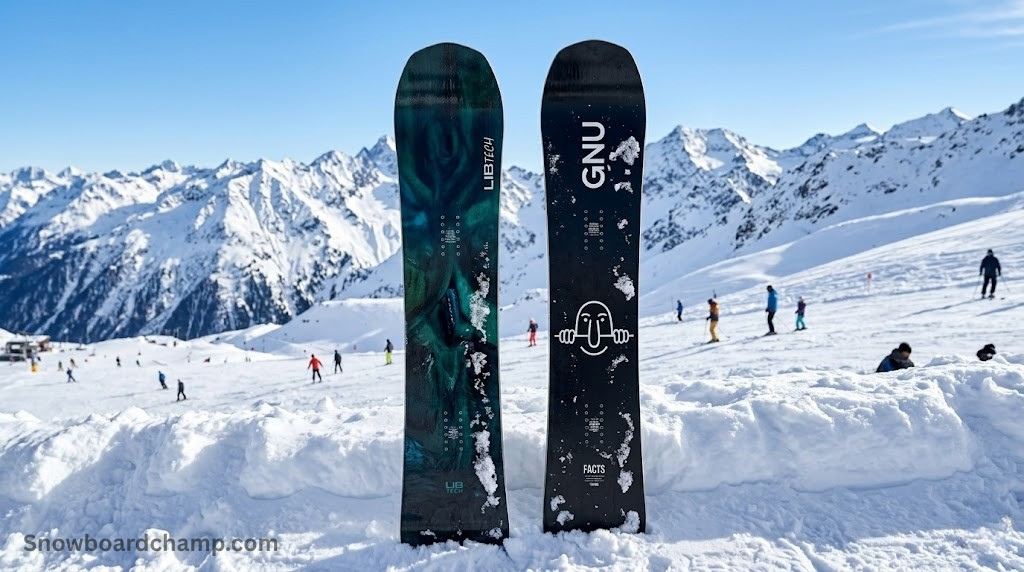
Two Boards That Broke the Mold
When Lib Tech unveiled the Warpig, the snowboard world had a collective identity crisis. A board shaped like a stubby rectangle — wide, thick, short — was never supposed to ride the way it does. Yet it became one of the most talked-about boards in recent memory, reshaping how riders think about board length, volume, and float. A few years later, GNU’s Kilroy entered the conversation as a disciplined, park-focused counterpart with its own set of unconventional ideas. Today, these two boards represent very different visions of what “short and wide” means — and choosing between them matters enormously for your riding.
This article gives you the full picture: every dimension, every camber nuance, every terrain scenario, every rider profile, and a verdict so clear you won’t second-guess yourself standing in the shop.
Before we get into the hard data, it’s worth understanding how these boards arrived at their respective designs. The Lib Tech Warpig emerged from Mervin Manufacturing’s obsession with volume-shifted technology — the idea that you can redistribute the mass and surface area of a traditional board shape into something shorter and wider without sacrificing performance. The GNU Kilroy, meanwhile, was designed in collaboration with pro rider Brendan Kilroy, reflecting his emphasis on technical park riding and precise edge control — hallmarks you can trace directly to GNU’s magnetraction heritage.
To ground this comparison in broader context, understanding how camber and rocker profiles affect control, pop, and float will help you interpret everything we’re about to cover. Similarly, if you’re new to the wide-body concept, brushing up on directional versus twin shapes will make the design philosophy discussion much clearer.
Now let’s get into it.
Board Overviews: Origins & Identity
Lib Tech Warpig
The Warpig is one of the most polarizing shapes Lib Tech has ever released — and that’s saying something for a brand that has made bizarre geometry its calling card. Designed around the volume-shifted principle, the Warpig runs dramatically shorter and wider than any board you’ve ridden before. The nose is pronounced and asymmetrical in its rocker lift, while the tail stays relatively flat to stiff. The effective edge runs setback, giving the board a distinctly directional character even without an official directional label in some versions.
Mervin Manufacturing’s BTX (Banana Tech Hybrid) construction underpins the Warpig, delivering a flex pattern that is soft underfoot with stiffer zones toward the tips. The sintered base is one of the fastest in the industry, and the triax fiberglass and vertical laminate combination keeps overall weight down despite the wide footprint. The result is a board that punches far above its length class in nearly every situation — especially powder, where the wide body generates float comparable to a board five or more centimeters longer.
GNU Kilroy
The GNU Kilroy wears its park heritage proudly. Developed with and named after Brendan Kilroy — a technical park rider known for precise, controlled style — this board is engineered for switch riding, rail work, and precise pop. It uses GNU’s C3 camber profile, a hybrid design that combines traditional camber underfoot with flat sections between the feet and rocker at the tip and tail. The result is a board that presses like a rocker board but pops like a camber board.
What makes the Kilroy distinctive is its magnetraction edge technology — GNU’s proprietary serrated edge design with multiple contact points along the running length of the edge. This gives the board outstanding grip on hardpack and ice, which you don’t normally associate with a primarily park-focused board. The Kilroy is also a true twin shape, meaning nose and tail are identical, and it rides equally well in both directions. This is non-negotiable for a park board built around switch riding.

Side-by-Side Specifications
Numbers tell only part of the story, but they tell it crisply. Here’s how the two boards line up across key measurable dimensions. Note that we’re comparing the most popular size pairing — a 154 Warpig against a 154 Kilroy — to isolate the design philosophy differences rather than raw size differences.
| Spec | Lib Tech Warpig | GNU Kilroy |
|---|---|---|
| Shape | Volume-Shifted Twin / Directional | True Twin |
| Camber Profile | BTX Hybrid (Rocker-Flat-Camber) | C3 (Camber-Flat-Rocker) |
| Effective Edge | Setback, longer relative run | Centered, magnetraction |
| Base Type | Sintered — Ultra Fast | Sintered |
| Edge Tech | Standard dual steel | Magnetraction (serrated) |
| Core Construction | Aspen/Paulownia vertical laminate | Aspen/Paulownia poplar blend |
| Fiberglass Layup | Triax + bio-plastic top | Biax/Triax Hybrid |
| Sidecut | Multi-radial / blended | Multi-radial magnetraction |
| Stance Setback | +15mm directional | Centered (0mm) |
| Primary Use | All-Mountain / Powder | Park / All-Mountain |
| Price (MSRP) | ~$549 | ~$539 |
| Weight Class | Light | Medium-Light |
Looking at these specs together, a few things stand out. The Warpig is slightly wider in the waist, which contributes more to its powder float capability. The Kilroy is narrower at the waist but wider relative to its length because of its true twin geometry, making it more balanced for switch riding. The Warpig’s setback stance creates inherent directional bias; the Kilroy’s centered stance is its park-first identity statement.
Camber Profiles: The Soul of Each Board
If you’ve ever wondered why two boards with similar dimensions ride completely differently, the answer is almost always in the camber profile. This is where the Warpig and Kilroy diverge most fundamentally — and where each board’s design philosophy becomes unmistakable.
Warpig BTX (Banana Tech Hybrid)
Lib Tech’s BTX profile has evolved significantly over the years, and the version in the Warpig is one of the more sophisticated iterations. At its core, BTX features a continuous rocker from tip to tail — giving the board its characteristic feel of riding slightly above the snow — punctuated by zones of camber underfoot that provide edge grip and pop when you need them. This creates a board that feels catch-free and forgiving on hardpack, loose and surfy in powder, and still capable of generating edge pressure when you commit to a carve.
The consequence of this profile in real-world riding is a board that doesn’t require aggressive edge pressure to initiate turns — it flows naturally into arcs. On powder days, the rocker nose lifts effortlessly, and the wide body creates the surface area that keeps you above the snow. On groomed runs, the camber underfoot provides enough spring that you won’t feel dead beneath your feet. The BTX profile is fundamentally a versatility machine.
GNU Kilroy C3 Camber Profile
The C3 profile stands for Camber-Flat-Rocker, and it is deliberately ordered that way — camber is the dominant characteristic. Traditional camber under both feet creates an arched shape when the board is unweighted, which stores tension and releases it as explosive pop. The flat sections between the feet reduce the likelihood of catching an edge in variable conditions, and the rocker at the tips adds a small amount of float and playfulness without undermining the fundamental pop of the camber core.
In practical terms, the C3 profile means the Kilroy is fundamentally a pop machine. Jumps, ollies, and presses feel springy and responsive in a way that the more rocker-dominant Warpig cannot fully replicate. On the other hand, the camber-dominant profile means the Kilroy requires more deliberate edge engagement — careless riding on hardpack will punish you with edge catching in a way the Warpig does not.
This is a critical distinction for intermediate riders. The Warpig is more forgiving in most terrain types; the Kilroy rewards precision. If you’re still developing your edge control, the Warpig will let you focus on technique without the board fighting you. If you’re past that stage and want a board that responds to intentional, technical input, the Kilroy pays dividends.
Flex & Feel: How They Respond Under Your Boots
Flex rating is one of those specifications that sounds objective but is deeply contextual. A “5/10” on one brand’s scale is completely different from a “5/10” on another’s. Even more importantly, how flex is distributed along the board changes everything about how it rides. Let’s break down both boards’ flex patterns in real terms.
Warpig Flex Distribution
The Warpig’s flex is generally described as medium-soft, landing around a 4–5 out of 10 depending on which size and year you’re riding. But that number obscures the important detail: the flex in the Warpig is stiffer tip-to-tail than side-to-side. This is a hallmark of Lib Tech’s construction philosophy and contributes to the board’s excellent torsional stiffness for edge hold, while maintaining a softer longitudinal flex that makes butter tricks, pressing, and powder surfing effortless.
The tip is noticeably softer than the tail, which helps the nose float in powder without requiring you to shift your weight dramatically back. The tail has enough stiffness to generate reliable pop when you want it, but you’ll need to put in more energy than you would with the Kilroy to get an equivalent spring response. The Warpig’s flex works in harmony with its rocker-dominated profile — soft enough to flow, stiff enough to trust.
Kilroy Flex Distribution
The Kilroy is consistently rated in the medium range — around 5–6 out of 10 — but its flex distribution tells a different story than the numbers suggest. Because it uses a C3 camber-dominant profile, the board carries more inherent tension than a rocker board of the same flex number. Under your feet, the camber arch stores energy and releases it explosively. This translates to noticeably snappier pop off the tail compared to the Warpig, which is exactly what park riders need for launch and trick execution.
The Kilroy is also stiffer in the mid-section than you’d expect from a park board, which helps it track better on rails and resist washout when landing sideways. The tips are softer, facilitating presses and butters without fighting you, but they’re slightly stiffer than the Warpig’s nose — a reflection of the Kilroy’s more disciplined, precise character. Riders who prioritize technical jib work and clean park runs will appreciate this balance. Riders who prefer a more surfy, flowing style will gravitate toward the Warpig’s softer personality.
It’s worth noting that understanding how flex interacts with binding choice is critical for getting the most out of either board. Both the Warpig and Kilroy respond meaningfully to stiffer versus softer bindings. If you’re pairing these boards, refer to our breakdown of park and all-mountain bindings to make an informed choice that complements each board’s natural character.
Terrain Versatility: Where Does Each Board Excel?
No board is great at everything, but understanding where each board’s range ends helps you make a rational decision. Let’s map out each board’s terrain suitability honestly and without marketing hyperbole.
Warpig Terrain Map
Kilroy Terrain Map
The terrain maps make a clear statement: the Warpig’s strengths cluster around variable, uncontrolled terrain — powder, glades, variable snow. The Kilroy’s strengths are concentrated in controlled, technical settings — park, rails, switch. This is an important data point. If your resort has limited park facilities or you spend more days off-piste than in the park, the Warpig is the logical choice. If you spend three days out of five in the park or pipe, the Kilroy earns its keep.
Where the two boards genuinely compete is on groomed runs. Both are capable carvers on blue and black groomed terrain. The Kilroy edges out the Warpig here slightly due to its magnetraction giving better grip through edge-set, but the Warpig’s BTX profile and wide effective edge mean it’s far from inadequate. Most intermediate and advanced riders would feel comfortable on either board for a groomed run day.

Powder Performance: The Warpig’s Home Court
This is where the conversation gets lopsided — in the Warpig’s favor. The entire design philosophy of the Warpig is anchored in making a short board float like a long board. Mervin’s volume-shifted geometry works by redistributing the nose rocker lift, waist width, and setback stance position to create the same hydrodynamic lift you’d get from a traditional powder board, packaged in a much shorter, more maneuverable shape.
In practical powder riding, the Warpig demonstrates several measurable advantages:
How the Warpig Floats in Deep Snow
The setback effective edge position (approximately +15mm on most sizes) means your weight naturally sits slightly back relative to the board’s center. This tilts the nose upward without requiring you to manually shift your weight backward, reducing fatigue on long powder runs and making it easier to maintain float in deep snow. For riders who have struggled to keep the nose up on traditional boards in deep powder, this is a game-changer.
The wide body creates a wider platform of surface area engaging with the snow. Basic physics applies here: a wider base generates more lift for the same forward speed. The Warpig’s nose rocker accelerates this by allowing the tip to plane above the snow rather than plowing through it. On days with 30–40cm of fresh snow, the Warpig genuinely rides like a dedicated powder board at a much shorter length than you’d expect.
This directly connects to the logic behind proper snowboard waxing — the Warpig’s sintered base, when maintained well, slides through powder exceptionally quickly, and that speed generates more lift. Don’t skip your wax jobs on this board.
How the Kilroy Handles Powder
The Kilroy is not a dedicated powder board, and it doesn’t pretend to be. Its C3 profile with centered stance means you’ll need to manually weight your back foot to keep the nose up in deeper snow. On a day with 20cm of fresh on groomed terrain, the Kilroy handles it comfortably. In ungroomed, thigh-deep powder, you’ll feel the difference — the nose wants to dive, and you’ll need to work harder to maintain float.
That said, the Kilroy’s magnetraction gives it a surprising advantage in variable snow — the mixed conditions you encounter after the first few riders have cut through a powder field. Where the Warpig can wash out slightly when edges engage unpredictably in chunky variable snow, the Kilroy’s multiple edge contact points provide a sense of grip and predictability that helps you navigate debris-heavy lines confidently.
Park & Freestyle: Kilroy’s Home Mountain
In the park, the dynamic reverses entirely. The GNU Kilroy’s true twin shape, C3 camber profile, and medium-stiff flex work together to create one of the most intuitive park boards in its price class. Let’s walk through each major park discipline.
Jump Performance: Pop, Launch & Landing
Off jumps, the Kilroy’s C3 camber gives it significantly more pop than the Warpig. When you load the tail at the lip of a kicker, the camber releases that stored energy in a way that is both predictable and explosive. Riders with strong edge technique will find they can generate height and distance from jumps with less physical effort than on the Warpig. The true twin shape means landing and riding away switch feels identical to landing regular — which is non-trivial when you’re learning 180s and 360s and need to build switch confidence progressively.
On the Warpig, you can certainly hit park features. The BTX profile gives it enough pop for airs, and the softer flex makes presses and butters on rollers feel intuitive. But the setback stance means switch riding takes conscious adjustment, and the wider nose can feel slightly awkward on park laps if you’re not used to the geometry. The Warpig is a capable park board for riders who do some park riding as part of a broader all-mountain day — it’s not the right choice if park is your primary focus.
Rails & Jib Work
On rails, boxes, and jib features, the Kilroy pulls further ahead. The stiffer mid-section prevents the board from flexing unpredictably mid-feature, which keeps you balanced and in control. The magnetraction edges engage and disengage on rail features in a way that feels deliberate rather than grabby — this is a benefit of the multiple contact point design that usually gets discussed only in terms of hardpack grip, but it applies here too.
The Warpig’s wide body is both a help and a hindrance on rails. The wider platform gives you more surface area to balance on box-style features, but the extra width can make precise foot placement on narrow rails more challenging, especially in switch. Experienced riders adapt; developing park riders will struggle more than they would on the Kilroy.
Half-Pipe
In the half-pipe, the Kilroy’s edge grip and camber pop make it a more natural choice. The ability to set an edge decisively in the transition and generate vertical pop off the lip is a direct result of the C3 profile. The true twin shape means backside and frontside walls feel equally accessible. For dedicated pipe riders, neither board is a specialist pipe board, but the Kilroy is closer to that category than the Warpig.

If you’re working through a progression of tricks and want to understand how each skill builds on the last, our snowboard trick progression guide maps out the sequence from butter tricks to full airs in detail — knowledge that pairs directly with what each of these boards enables.
Hardpack & Ice: Edge Technology Matters
This is the terrain type where the technology gap between the two boards is most visible. On firm, groomed, or icy surfaces, edge grip determines confidence — and the two boards achieve their grip through fundamentally different means.
GNU Kilroy Magnetraction on Hard Snow
GNU’s magnetraction serrated edge design multiplies the number of points where the board’s steel edge contacts hard snow. A standard smooth edge has a continuous curve, which in theory contacts the snow everywhere along its length — but in practice, micro-flex in the board means only certain points are actually engaged at any given moment. Magnetraction’s wavelike undulations create intentional high points that guarantee contact across a broader range of flex conditions. On ice, this translates to a level of grip that non-magnetraction boards struggle to match.
For East Coast riders or anyone who regularly encounters hard-packed or icy conditions, this is not a minor feature — it’s a decision-changing one. If your home mountain is known for icy mornings before the sun hits the slopes, the Kilroy has a clear advantage over the Warpig. This pairs well with proper boot selection; understanding the relationship between boot flex and kinetic response will help you calibrate your entire setup for maximum hardpack performance.
Warpig on Hardpack
The Warpig handles hardpack much better than its surfy, powder-focused reputation suggests. The BTX hybrid’s camber zones underfoot provide genuine edge pressure when you engage them intentionally, and the wide body gives you a stable platform even at speed on firm snow. The key is that the Warpig rewards a rounder, more flowing carving style rather than the sharp, aggressive edge sets you might use with a camber board.
On blue runs and moderate black runs with firm but not icy conditions, the Warpig is entirely competent. Where it starts to show its limits is in genuinely icy conditions — not just firm snow, but actual ice. The rocker-dominant profile means the tips and tail don’t engage the ice with the same precision, and without magnetraction’s multiple contact points, you’ll feel the board wash out if you push it too hard. Intermediate riders will stay within the Warpig’s range naturally; advanced riders pushing hard on icy terrain will notice the ceiling.
For more detail on how edge geometry affects performance, our guide on edge geometry and hardpack physics goes deeper into the science behind edge bevel angles and their measurable effects on grip.
Sizing Guide: Getting the Dimensions Right
Sizing is arguably more critical for these two boards than for any standard snowboard. Both the Warpig and Kilroy depart significantly from conventional sizing logic, and getting this wrong will make either board feel unnatural or underperforming. Let’s be specific.
How to Size the Lib Tech Warpig
The golden rule for Warpig sizing is simple: go shorter than you normally would. Most riders size down 2–4 centimeters compared to their usual board. This counter-intuitive advice is built into the design — the volume-shifted geometry provides the float and stability of a longer board at the shorter length. Going your normal size on the Warpig results in a board that feels too big and sluggish underfoot, negating the benefit of the short-wide shape entirely.
Width is also a consideration. The Warpig comes in standard and wide options. Riders with boot sizes of 10.5 US or larger should strongly consider the W (wide) version to avoid toe and heel drag on steeper edge angles. Boot-to-board width matching is more important on a wide board because the wider platform can accommodate larger boots, but the binding mounting width needs to match your actual boot length, not just the board’s general width category.
How to Size the GNU Kilroy
The Kilroy follows more conventional sizing logic since it’s built as a true twin without the dramatic volume-shift adjustment. Most riders can size to their normal length or up to 1 centimeter shorter than usual. The Kilroy also runs wider than many boards its length, which means riders with boot sizes of 10 US and above should check the width chart carefully to ensure adequate clearance.
Unlike the Warpig, going too short on the Kilroy will make the board feel skatey and unstable at speed — it needs enough effective edge length to track properly through park features and at the speeds you reach off jumps. Sizing on the Kilroy is therefore much less forgiving of dramatic under-sizing. Stay within one centimeter of your standard length.
For a comprehensive framework on board sizing beyond just these two boards, our detailed snowboard sizing guide by height and weight covers every scenario across different board types.
| Factor | Lib Tech Warpig | GNU Kilroy |
|---|---|---|
| Sizing Direction | Go 2–4cm shorter | Normal or 0–1cm shorter |
| Width Consideration | W version for US 10.5+ | Check width chart at US 10+ |
| Sizing Forgiveness | Wide range acceptable | Stay closer to standard |
| Available Sizes | 148–165cm range | 149–162cm range |
Binding Pairing: What Complements Each Board
Bindings are where your body connects to the board — and the wrong binding can neutralize everything the board was designed to do. Both the Warpig and Kilroy have specific preferences that emerge from their designs.
Best Bindings for the Lib Tech Warpig
The Warpig rewards bindings that are medium-stiff in their overall response, particularly in the lateral (side-to-side) plane. Because the board’s wide body already provides a stable platform, you don’t need extremely stiff bindings to feel grounded. What you do need is a binding that doesn’t fight the Warpig’s natural twist and flex — a binding that is too stiff longitudinally will dampen the board’s playful, surfy character and make it feel boardy and dead.
Union’s Force and Atlas series are consistent recommendations for the Warpig because of their excellent heel-cup security combined with a responsive baseplate that doesn’t over-damp. Burton’s Cartel range, specifically the standard Cartel, provides enough stiffness for edge control without killing the board’s flex. The Union Atlas in particular pairs well with the Warpig’s wide stance options since it’s designed for all-mountain use with tunable response. For a solid budget-friendly pairing, our review of affordable park and all-mountain bindings has tested options that work well with the Warpig’s short-wide geometry.
Best Bindings for the GNU Kilroy
The Kilroy’s park-focused design benefits from bindings that emphasize quick response and heel hold without being overly stiff. For park riding, you need a binding that lets you feel the board’s flex for pressing, but snaps back immediately when you need pop. Bindings that are too soft will feel mushy off jumps; too stiff will limit your pressing ability on rails.
Union’s Legacy and Contact series are natural partners for the Kilroy — they’re park-tuned with good heel-cup security and responsive but not rigid baseplates. Burton Freestyle and Custom bindings also pair well. For riders prioritizing rail and jib work, the Union Legacy is specifically designed to absorb landing impact without compromising snap, which aligns perfectly with the Kilroy’s technical park use case. See also our comprehensive women’s snowboard bindings guide if you’re shopping for a female-specific Kilroy setup.
- Union Force or Atlas — medium stiffness, heel hold
- Burton Cartel — balanced response, available in wide
- Salomon Hologram — responsive for all-mountain
- Flux PR — lightweight, surfy response
- Union Legacy — park-tuned, landing absorption
- Burton Freestyle — soft-medium, press-friendly
- Rome Cleaver — park-specific, quick response
- Ride A-8 — freestyle-focused, good snap
Step-On Compatibility
Both boards are compatible with step-on binding systems via standard 4×4 or channel mounting. If you’re considering the convenience of step-on, the Burton Step-On system works with both boards, though keep in mind that step-on bindings tend to be slightly stiffer than their strap equivalents, which affects the Kilroy’s park flex more than the Warpig’s all-mountain riding.
Who Should Buy Which Board
This is the most important section of the entire article. All the technical data matters — but only insofar as it tells you which board belongs in your quiver. Let’s map each board to the riders who will get the most out of it.
Buy the Lib Tech Warpig If…
Buy the GNU Kilroy If…
Who Shouldn’t Buy Either Board
Complete beginners should avoid both boards. The Warpig’s short-wide geometry feels unusual to riders who haven’t developed basic edge pressure and balance awareness, and the Kilroy’s camber-dominant profile is punishing for riders whose turn initiation is still inconsistent. If you’re in your first two seasons, a more conventional all-mountain board with forgiving rocker and medium flex will serve you better while you develop technique. Once you’re comfortable with edge control and can link turns confidently, come back to this comparison — it will be a different conversation at that point.
For beginner riders still building fundamentals, our beginner snowboarding blueprint and guide on learning curve expectations are better starting points.

Final Verdict: Head-to-Head Scorecard
After dissecting every dimension of these two boards across terrain types, rider profiles, and technical attributes, here’s how the scorecard reads. Each category is judged on a scale of relative performance — this is a head-to-head comparison, not an absolute rating of either board in isolation.
| Category | Lib Tech Warpig | GNU Kilroy | Winner |
|---|---|---|---|
| Powder Performance | Exceptional | Adequate | Warpig ★★★★★ |
| Park Performance | Capable | Exceptional | Kilroy ★★★★★ |
| Switch Riding | Decent | Excellent | Kilroy ★★★★½ |
| Hardpack & Ice | Good | Excellent | Kilroy ★★★★ |
| Tree Riding / Glades | Exceptional | Good | Warpig ★★★★★ |
| All-Mountain Versatility | Excellent | Very Good | Warpig ★★★★½ |
| Pop & Spring | Good | Excellent | Kilroy ★★★★½ |
| Butter / Pressing | Excellent | Very Good | Warpig ★★★★½ |
| Edge Technology | Standard dual | Magnetraction | Kilroy ★★★★★ |
| Base Speed | Excellent | Very Good | Warpig ★★★★★ |
| Learning Curve | More Forgiving | More Technical | Warpig ★★★★ |
| Wide Foot Accommodation | Excellent (W option) | Good | Warpig ★★★★★ |
All-Mountain & Powder Champion
Park & Technical Precision Champion
The Warpig wins more categories on paper, but that’s partly because this comparison covers the full breadth of snowboarding scenarios — and the Warpig is genuinely the broader tool. If you restricted this comparison to just park and freestyle performance metrics, the Kilroy would dominate. The numerical advantage doesn’t mean the Warpig is the universally better board — it means it covers more ground. The right board for you depends entirely on where you ride and what you want to do.
Choose the Kilroy if park riding, switch precision, technical freestyle, and icy-condition edge grip are your primary requirements.
Can You Own Both?
If budget allows, owning both boards is actually a compelling two-board quiver strategy. The Warpig as your powder and all-mountain board, the Kilroy as your park and technical day board. The two boards occupy almost non-overlapping performance niches and complement each other nearly perfectly. For riders who split their time between deep-snow days and park days, this pairing eliminates every compromise.
If you’re thinking about building a full quiver, our snowboard comparison framework gives you a systematic way to evaluate boards across your complete riding scenarios, and our piece on choosing the right first snowboard helps newer riders understand the decision framework before diving into advanced comparisons like this one.

Construction Deep-Dive: What You’re Actually Paying For
Price points of $539–$549 put both boards in the mid-premium tier. Understanding what’s inside explains why, and helps you evaluate whether the construction justifies the cost against competitors like the Capita DOA or Arbor Element Rocker.
Lib Tech Warpig Construction
Mervin Manufacturing produces all Lib Tech boards domestically in Sequim, Washington — a notable distinction in an industry dominated by overseas manufacturing. The vertical laminate wood core construction in the Warpig creates a layering direction perpendicular to the board’s length, which increases torsional rigidity and consistency relative to traditional horizontal laminate cores. This is part of why the Warpig feels more responsive to edge pressure than its rocker profile would suggest.
The triax fiberglass layup — fibers running at multiple angles rather than a single axis — distributes flex stress more evenly across the entire board and prevents the stress concentrations that can lead to delamination over time. Combined with Lib Tech’s bio-plastic topsheet, the Warpig is one of the more environmentally conscious boards in its class. The sintered base is genuinely fast — it requires regular waxing to maintain that speed, but the reward is a glide quality that cheaper extruded bases can’t match. For reference on the performance difference between base types, see our guide on sintered versus extruded bases.
GNU Kilroy Construction
GNU boards are also produced by Mervin Manufacturing, sharing the same Sequim, Washington facility as Lib Tech. This means both boards benefit from the same quality control standards and domestic manufacturing consistency. The Kilroy uses a poplar and aspen wood blend core, which provides a slightly different weight and flex characteristic than pure aspen or paulownia cores — the blend is specifically chosen to balance pop with weight efficiency for park riding.
The biax/triax hybrid fiberglass in the Kilroy is a deliberate choice for a park board: biax fiberglass oriented at 45-degree angles increases torsional flex (important for pressing and carving through park features), while the triax sections provide the longitudinal stiffness you need for pop and landing shock absorption. The magnetraction edges are integrated during the layup process rather than added as an afterthought, ensuring they maintain consistent contact with the board body throughout the life of the board.
Both boards share Mervin’s commitment to sustainable manufacturing practices, including water-based glues, non-toxic materials, and reduced VOC emissions in the production process. For riders who consider environmental impact alongside performance, this is a meaningful shared attribute.
Durability Assessment
Both boards are built to last. Under normal riding conditions — regular runs, the occasional serious impact, proper storage — either board should give you 100+ days of solid performance before showing significant wear. The Warpig’s sintered base will show scratches and core shots faster than you’d like if you’re an aggressive rider in rocky terrain early or late season. The Kilroy’s magnetraction edges can develop micro-fractures at the serrations under extreme stress, though this is uncommon in recreational park riding.
Regular maintenance is non-negotiable for both boards. Keep edges sharp, keep the base waxed, and store the board properly in the off-season. Our guides on home waxing technique and board maintenance basics cover everything you need to protect your investment.
Completing Your Setup: Boots, Bindings & Gear
A snowboard doesn’t exist in isolation — the system of board, bindings, boots, and protective gear works together, and your choices in each category affect how the board performs. Here’s how to build the complete setup around each board.
Boot Recommendations for the Warpig
The Warpig’s all-mountain character favors boots in the medium-stiff range (flex 6–7 out of 10). Too soft and you’ll lack the ankle support to control the board at speed in varied conditions; too stiff and you’ll fight the board’s natural flex pattern on powder and butter moves. Boots with good heel hold are especially important given the Warpig’s wide body — any heel lift will create a disconnect between your intention and the board’s response on deep snow. The best snowboard boots guide covers this in detail, but brands like Burton Ruler, Salomon Dialogue, and Thirty Two Lashed are consistently recommended pairings for all-mountain setups like the Warpig.
Boot width is another consideration with the Warpig specifically. The wider stance means your boots are positioned farther apart than on a standard board, which changes the mechanical leverage relationship between boot stiffness and board response. Medium-stiff boots amplify this leverage effectively without over-stiffening the whole system.
Boot Recommendations for the Kilroy
The Kilroy’s park-first design pairs best with medium-flex boots (flex 5–6 out of 10). Park boots prioritize freedom of movement for pressing and jibs without sacrificing the heel lock that jump landings demand. Thirtytwo, DC, and Burton Freestyle-category boots are designed around this balance. If you’re riding the Kilroy as your dedicated park board, you can afford to go slightly softer on boot flex than you would for all-mountain use.
For riders switching between the Kilroy and a stiffer all-mountain board in a two-board quiver, having two pairs of boots (one softer for park, one stiffer for all-mountain) is genuinely worth the investment if you’re serious about optimizing each board’s performance. The BOA vs speed lace debate is also worth considering for park boots specifically — BOA’s micro-adjustability is a genuine advantage when you’re making frequent small adjustments during a park session.
Protective Gear for Both
Regardless of which board you choose, protective gear is non-negotiable. Wrist injuries are the most common snowboarding injury category — wrist guards are your first line of defense. Impact shorts protect your hips and tailbone on falls, which happen to every rider at every level — see our review of impact shorts for kinetic energy dissipation. For park riders on the Kilroy in particular, a certified helmet with MIPS technology is essential — our guide on MIPS helmet technology explains exactly why this matters for rotational impact protection.
Frequently Asked Questions
The Bottom Line: Your Decision Made Clear
After thousands of words, dozens of data points, and terrain-by-terrain analysis, the verdict is this: the Lib Tech Warpig and the GNU Kilroy are both exceptional boards that happen to be exceptional at different things. This is not a case where one board is objectively superior — it’s a case where two boards represent two distinct and disciplined design philosophies, each executed with extraordinary craftsmanship by the same manufacturer.
The Warpig is the board for riders who want to ride everything the mountain offers and feel genuinely capable everywhere they point it. It’s short enough to be maneuverable, wide enough to float, fast enough to earn respect on groomers, and soft enough to butter with joy. It is, by most definitions, the better quiver-killer of the two.
The Kilroy is the board for riders who have identified their domain and want to own it. Park sessions, switch riding, rails, jumps — the Kilroy’s true twin geometry, C3 pop, and magnetraction edges are specifically engineered to make you better at these things. It’s a board that rewards technical precision and punishes lazy riding, which over time makes you a better rider.
Both boards come from the same factory, with the same commitment to quality and sustainable manufacturing. Both are worth their price points. Both will last you many seasons with proper maintenance. Your only real job is to be honest about where you ride and what you want to do there.
Now get off the fence and get on the snow. The mountain doesn’t wait for perfect research — it waits for you to show up with the right board under your feet and the willingness to push your limits. Whichever board you choose from this comparison, you’re choosing well.
For everything else you need to build the complete setup — from selecting the right protective gear to mastering maintenance at home — the resources at SnowboardChamp.com have you covered.


