
Burton Step On Bindings Review
The most comprehensive analysis of the strapless revolution. We break down every click, cleat, and carve to help you decide if it’s time to ditch the straps.
Table of Contents
- Introduction: The Evolution of Snowboard Bindings
- How the Burton Step On Technology Works
- Step On Evolution: Gen 1 vs Gen 2 vs Current
- Boot Compatibility Guide
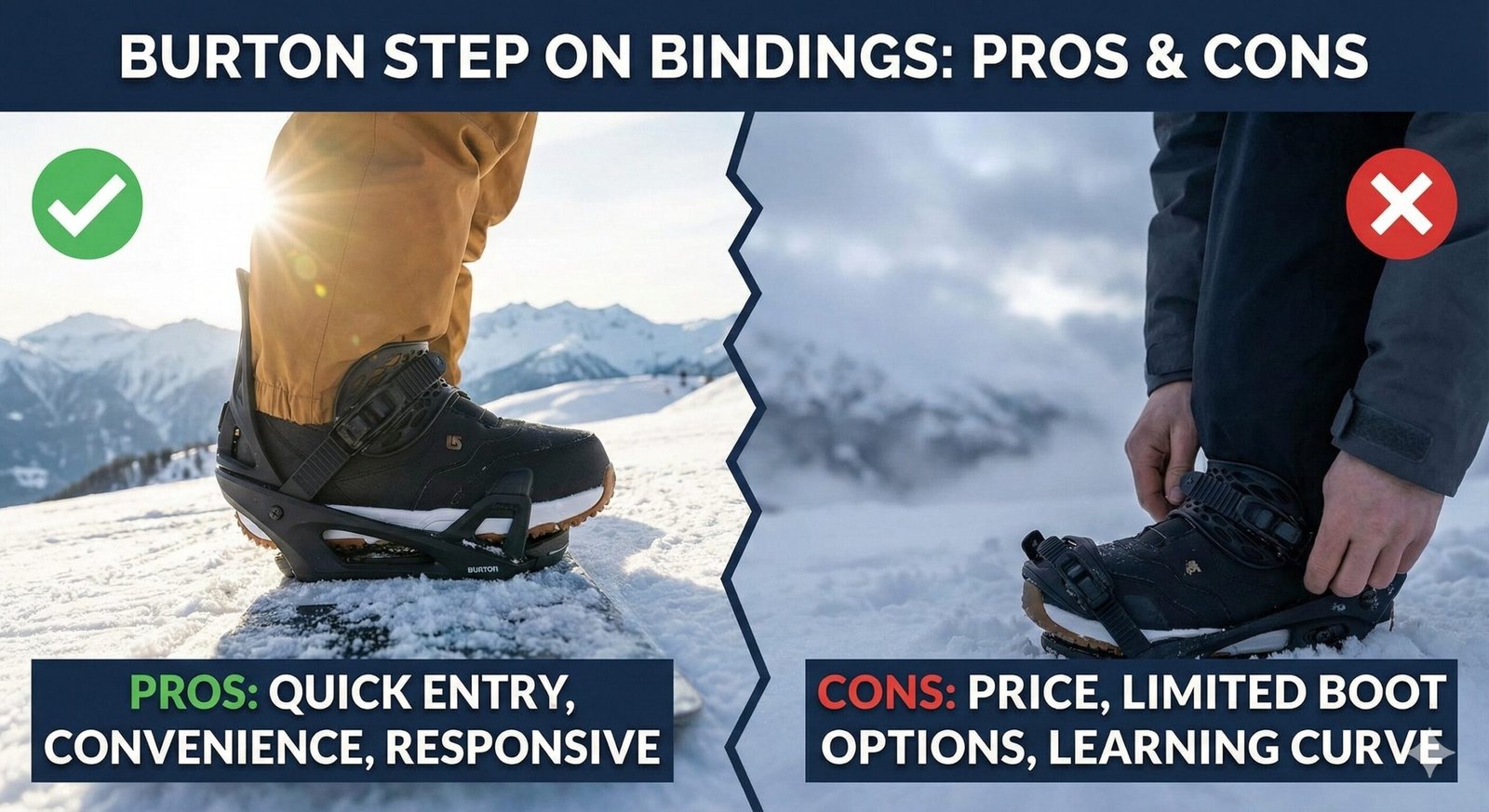
- At a Glance: The Pros and Cons
- Deep Dive: The Major Advantages
- Deep Dive: The Critical Disadvantages
- Sizing and Fit Guide
- Installation and Setup
- Adjustments and Customization
- Performance Analysis by Riding Style
- Terrain-Specific Performance
- Comparison: Step On vs The World
- EST vs Re:Flex: Which Mounting System?
- Durability and Longevity
- Maintenance and Care Guide
- Troubleshooting Common Issues
- Weight Analysis
- Warranty and Customer Support
- Cost Breakdown and Value Analysis
- Where to Buy and Best Deals
- User Reviews and Real-World Feedback
- Professional Rider Endorsements
- Industry Impact and Future Technology
- Frequently Asked Questions
- Final Verdict: Should You Switch?
Introduction: The Evolution of Snowboard Bindings
For decades, the ritual was the same. Get off the lift, sit down in the snow (getting your pants wet), crank down on ratchets until your hands were cold, and then finally stand up to ride. If you were a skier converting to boarding, this inefficiency was baffling. If you were a veteran rider, it was just the “tax” you paid for the joy of surfing the mountain.
Then came the Burton Step On system. It wasn’t the first attempt at a strapless interface—the 90s were littered with the failed carcasses of Step-In bindings that clogged with snow and lacked response—but it was the first to actually work. Now, several seasons deep into their existence, the Step On system has moved from a “gimmick” to a legitimate industry standard seen everywhere from beginner slopes to backcountry kickers.
But is it right for you? Changing your entire setup is a significant investment. In this massive guide, we are looking strictly at the Burton Step On bindings pros and cons, dissecting the technology, the feel, the compatibility, and the long-term durability. Whether you are wondering is it easier to ski or snowboard regarding equipment management, or you’re a seasoned pro looking for efficiency, this guide covers it all.
A Brief History of Step-In Bindings
The concept of stepping into bindings rather than strapping in is not new. In the early 1990s, several manufacturers attempted to create step-in binding systems. The idea was simple: eliminate the time-consuming process of strapping in by creating a mechanical interface between the boot and binding that would engage when the rider stepped down.
However, these early systems suffered from critical flaws. Snow and ice would build up in the mechanisms, preventing proper engagement. The boots required for these systems were often uncomfortable and lacked the support needed for aggressive riding. Response was inconsistent, and many riders experienced accidental releases—dangerous situations at high speeds.
Burton, the undisputed leader in snowboard innovation, watched these failures carefully. They understood that any successful step-in system needed to solve three fundamental problems: reliable engagement in all snow conditions, consistent response comparable to traditional straps, and boots that were comfortable enough for all-day riding.
The result, after years of research and development, was the Step On system that debuted several seasons ago. Unlike its predecessors, Step On used a three-point connection system that provided redundancy and security. The boot featured reinforced cleats at the toe and heel that engaged with corresponding hooks on the binding. This wasn’t just “stepping in”—it was a mechanical lock that rivaled the security of traditional straps.
The Snowboard Industry’s Response
When Burton first announced the Step On system, the snowboard industry was skeptical. Many riders remembered the failed step-in systems of the 90s and dismissed Burton’s latest innovation as another marketing gimmick. Professional riders were divided—some embraced the convenience, while others insisted that traditional straps offered superior feel and response.
But Burton had done something clever. They didn’t just release a product; they created an ecosystem. By requiring specific boots with integrated cleats, they ensured that the boot-binding interface was engineered as a complete system. This allowed for precise tuning of flex, response, and comfort that would be impossible with universal compatibility.
The early adopters were telling. Riders who made the switch reported immediate benefits: faster transitions, reduced fatigue, and surprisingly, excellent response. The “click-click” sound of engaging the bindings became a badge of honor on the mountain. Within two seasons, Step On went from a curiosity to a common sight at resorts worldwide.
Other manufacturers took notice. Nidecker released the Supermatic, a hybrid system that offered step-in convenience with universal boot compatibility. K2 brought back their Clicker system with modern improvements. Even smaller brands began developing their own interpretations of the step-in concept. But Burton’s first-mover advantage and system integration kept them at the forefront of the revolution.
How the Burton Step On Technology Works
Before we weigh the good against the bad, you need to understand the mechanics. Unlike the old-school systems that relied on a metal bar under the sole of the boot, the Burton Step On system utilizes a three-point connection system.
The 3-Point Connection
- Toe Cleats: Two hooks located on the toe box of the compatible boots lock into toe hooks on the binding baseplate.
- Heel Cleat: A single connection point on the heel of the boot creates the primary retention, locking into the highback.
- Release Lever: A small lever on the side of the binding baseplate that, when pulled up, resets the locking mechanism, allowing you to step out.
The brilliance of this design is that it doesn’t just hold your foot down; it holds your boot against the highback. This eliminates the “dead space” often found in strap bindings. When you lean forward or backward, the engagement is instant. For riders asking how to stop heel lift in snowboard boots, this system offers a mechanical solution that straps sometimes struggle to match.
The Engineering Behind the Connection
The toe cleats are the first point of contact when you step into the binding. These cleats are made from reinforced composite materials that can withstand thousands of engagement cycles without wearing down. The binding’s toe hooks are designed with a specific geometry that guides the cleats into position, even if your foot placement isn’t perfectly centered.
The heel cleat is where the magic happens. Unlike traditional bindings where the highback simply provides a surface for your calf to push against, the Step On heel connection is a mechanical lock. When you step down firmly, the heel cleat engages with a spring-loaded mechanism in the highback. This creates two distinct positions: Position 1 (partial engagement) and Position 2 (full engagement). Position 2 is where you want to be for aggressive riding—it eliminates all play and creates a direct connection between your leg movements and the board’s response.
The release lever is elegantly simple. When you’re ready to step out, you pull the lever upward. This releases the heel cleat first, then allows the toe cleats to disengage as you lift your foot. The system is designed so that accidental releases are virtually impossible—the lever requires intentional force in a specific direction.

Material Science and Construction
Burton uses a combination of materials in the Step On system that balances weight, durability, and response. The baseplate is typically constructed from a glass-filled nylon composite that provides the stiffness needed for direct energy transfer while remaining light enough to not fatigue your legs over a long day.
The highback features a similar composite construction but with strategic flex zones engineered into the design. These flex zones allow the highback to give slightly during lateral movements (like tweaking grabs) while maintaining rigidity during heel-side turns. This is a significant engineering achievement—traditional highbacks are uniform in their flex pattern, but Step On highbacks can be tuned for specific performance characteristics.
The cleats on the boots are made from hardened steel or reinforced composite, depending on the boot model. These cleats need to withstand tremendous forces—they’re the primary connection point between you and your board. Burton tests these components to failure points far exceeding what any rider could generate in real-world conditions.
The “Dead Space” Elimination
One of the most significant advantages of the Step On system is what engineers call “dead space elimination.” In traditional strap bindings, there’s always a small gap between your boot and the binding components. When you initiate a turn, your boot first has to close this gap before the binding can transfer your input to the board. This creates a subtle but noticeable delay in response.
Step On eliminates this dead space by maintaining constant contact between the boot and binding at all three connection points. When you lean into a turn, the response is immediate because there’s no gap to close. This creates what many riders describe as a “connected” feeling—the board becomes an extension of your body rather than something you’re strapped to.
This instant response is particularly noticeable in technical terrain. When you’re navigating a tight tree line or threading through a mogul field, the ability to make micro-adjustments without any lag in response can be the difference between a smooth line and a crash. Riders who switch from traditional straps often report that Step On makes them feel more confident and precise in challenging conditions.
Step On Evolution: Gen 1 vs Gen 2 vs Current
Understanding the evolution of the Step On system helps explain both its current capabilities and the lessons learned from earlier iterations. Each generation brought meaningful improvements that addressed rider feedback and advancing technology.
Generation 1: The Pioneer
The original Step On bindings were revolutionary but imperfect. The first generation featured a simpler engagement mechanism that, while secure, could be finicky in certain conditions. The toe cleats required more precise foot placement than later versions, and the heel mechanism had a single engagement position rather than the dual-position system we see today.
Boot options were limited to Burton’s own lineup, which meant riders with foot shapes that didn’t fit Burton boots were out of luck. The boots themselves were stiffer than many riders preferred, making them less suitable for park and freestyle riding. However, the core concept was proven—riders who got past the learning curve were enthusiastic about the convenience and response.
The binding’s weight was also a concern for some riders. At around 900 grams per binding, Gen 1 Step Ons were heavier than comparable traditional bindings. While this didn’t bother most recreational riders, weight-conscious freestyle riders noticed the difference during long sessions in the terrain park.
Generation 2: Refinement
The second generation of Step On addressed many of the first generation’s shortcomings. The engagement mechanism was redesigned with a wider tolerance for foot placement, making entry easier and more reliable. The dual-position heel mechanism was introduced, giving riders the option of partial engagement for casual riding and full engagement for aggressive terrain.
Burton also expanded the boot lineup, introducing models with different flex ratings to suit different riding styles. The introduction of softer boots made Step On viable for park riders who had previously dismissed the system. Additionally, Burton began licensing the technology to other boot manufacturers, breaking the exclusive ecosystem that had frustrated some riders.
Weight was reduced through more efficient material usage and strategic component placement. The second generation bindings shed approximately 50 grams per binding—not a dramatic reduction, but enough to be noticeable during extended riding sessions. The overall feel became more refined, with smoother engagement and disengagement cycles.
Current Generation: Maturity
The current Step On system represents the most polished version of Burton’s vision. The engagement mechanism has been further refined, with even wider tolerances for foot placement and smoother operation. The dual-position heel system has been improved with better tactile feedback, making it easier to confirm when you’ve achieved full engagement.
The boot ecosystem has expanded significantly. Burton now offers boots ranging from soft park-friendly flexes to stiff freeride-oriented models. DC and Nitro have joined the ecosystem, giving riders more options for fit and performance. Some of these third-party boots offer features that Burton’s own lineup lacks, such as wider lasts for riders with broad feet.
Weight has been further optimized, with current models approaching the weight of comparable traditional bindings. The materials and construction have matured to the point where durability is no longer a concern—current Step On systems are built to last multiple seasons of heavy use. The overall package is lighter, more responsive, and more user-friendly than ever before.
Boot Compatibility Guide
One of the most common questions about the Step On system is boot compatibility. Unlike traditional bindings that work with virtually any snowboard boot, Step On requires specific boots with integrated cleats. Understanding your options is crucial before making the investment.
Burton Step On Boots
Burton offers the widest range of Step On compatible boots, spanning from beginner-friendly soft flex models to stiff, aggressive freeride boots. The Burton Photon Step On is perhaps the most popular all-around option, offering medium-stiff flex suitable for all-mountain riding. It features a traditional lacing system with a BOA-powered upper zone for quick adjustments.
For park and freestyle riders, the Burton Ruler Step On provides a softer flex that allows for greater tweakability in grabs and presses. The softer flex also makes the boot more forgiving for riders who are still developing their technique. On the opposite end of the spectrum, the Burton Ion Step On is a stiff, responsive boot designed for aggressive all-mountain and freeride riding.
Burton also offers women’s-specific Step On boots with adjusted sizing, flex, and aesthetic options. The women’s lineup mirrors the men’s in terms of performance range, from soft park boots to stiff freeride models. Additionally, Burton has introduced youth Step On boots, making the system accessible to younger riders who can benefit most from the ease of use.
Third-Party Compatible Boots
One of the biggest criticisms of the original Step On system was the proprietary ecosystem—riders were locked into Burton boots. This has changed significantly with the introduction of third-party compatible boots from DC and Nitro.
DC Shoes offers several Step On compatible models, including the Judge Step On and the Trace Step On. These boots bring DC’s fit characteristics to the Step On ecosystem, which is particularly beneficial for riders who have always found Burton boots uncomfortable. DC’s boots tend to run slightly wider than Burton’s, making them a good option for riders with broader feet.
Nitro has also joined the Step On ecosystem with their Zoom and Bounty Step On models. Nitro is known for their comfortable, well-fitting boots, and their Step On offerings maintain this reputation. The Nitro boots often feature different lacing systems than Burton’s lineup, giving riders more customization options.
When shopping for Step On compatible boots, always verify compatibility before purchasing. Not all boots from these manufacturers are Step On compatible—the cleats are specific to the system. Look for “Step On” in the model name and check the product description for confirmation.
Boot Fit Considerations
Proper boot fit is critical for Step On performance. Since the system relies on mechanical engagement at specific points, a boot that doesn’t fit properly may not engage correctly or may feel loose during riding. Here are key fit considerations:
Heel Hold: The heel cleat needs to engage with the highback mechanism. If your heel lifts inside the boot, the cleat may not align properly. This is why Step On boots typically feature aggressive heel hold systems—internal harnesses, J-bars, and BOA-powered ankle zones that lock your heel in place.
Toe Box: The toe cleats need to sit in a specific position relative to the binding’s toe hooks. Boots that are too large may push the cleats too far forward, while boots that are too small may not allow proper engagement. Always try on boots with Step On bindings before purchasing if possible.
Overall Length: Step On boots should fit like any other snowboard boot—your toes should gently brush the front of the boot when standing upright, and pull back slightly when you bend your knees. Overly long boots will have the cleats misaligned, while boots that are too short will be uncomfortable and may not engage properly.

At a Glance: The Pros and Cons
If you are in a rush to get back to the slopes, here is the high-level breakdown of what makes this system shine and where it falls short.
| The Pros (Why You Want Them) | The Cons (Why You Might Hesitate) |
|---|---|
|
|
Deep Dive: The Major Advantages
1. The “Ski-Like” Efficiency
The most obvious benefit is speed. If you ride with skiers, you know the pain of them waiting for you at the top of every run. With Step Ons, you glide off the lift, stomp your back foot down, hear the click-click, and you are gone. This changes the flow of your day. You get more vertical feet in because you aren’t spending 2 minutes strapping in every run. Over a season, that adds up to hours of extra riding.
But the efficiency extends beyond just strapping in faster. Consider the entire lift ride experience. With traditional bindings, you often spend the ride up adjusting your straps, tightening your boots, and mentally preparing to strap in when you reach the top. With Step On, you simply ride off the lift and go. The mental energy saved from not thinking about your binding setup adds up over a full day of riding.
The efficiency is particularly noticeable at resorts with frequent lift stops. If you’re riding a high-speed six-pack where you’re loading and unloading every few minutes, the time savings become substantial. You’ll notice that you’re spending more time riding and less time sitting in the snow fumbling with straps.
2. Eliminating Foot Pain
One of the most common complaints riders have is foot agony. We have an entire guide on why do my feet hurt when I snowboard, and a major culprit is overtightening straps. Riders crush their instep trying to get response. Because the Step On system anchors the boot at the toe and heel, there is absolutely no downward pressure on the top of your foot. Blood flow is maintained, feet stay warmer, and you can ride longer.
The foot pain issue is more prevalent than many riders realize. Traditional bindings apply pressure across the top of the foot through ankle and toe straps. This pressure can compress the nerves and blood vessels on the instep, leading to numbness, tingling, and pain. Over a full day of riding, this discomfort can become debilitating, forcing riders to take frequent breaks or loosen their straps (which reduces response).
Step On completely eliminates this issue. The boot is held in place by mechanical connections at the toe and heel—there’s nothing pressing down on the top of your foot. This means you can maintain consistent response throughout the day without the discomfort that often comes with it. Many riders report that their feet feel fresher at the end of the day when riding Step On compared to traditional straps.
The warmth benefit is also significant. When you compress the top of your foot with straps, you’re restricting blood flow to your toes. This makes your feet colder, which can lead to discomfort and reduced performance. Step On maintains natural blood flow, keeping your toes warmer in cold conditions. This is particularly beneficial for riders who struggle with cold feet.
3. Incredible Edge Response
There is a misconception that these are “beginner” bindings. That is false. Because the boot is mechanically bolted to the highback, the response is arguably faster than traditional bindings. There is no strap stretch. When you lean into a heelside turn, the board engages instantly. For those learning how to carve on a snowboard, this instant feedback can accelerate the learning curve.
The response characteristics of Step On are different from traditional bindings in subtle but important ways. With straps, the boot can move slightly within the binding before the highback fully engages. This micro-movement creates a slight delay between your input and the board’s response. It’s often imperceptible to casual riders, but experienced riders notice it, especially in technical terrain.
Step On eliminates this micro-movement through its three-point connection system. When you lean into a turn, the response is immediate and direct. There’s no strap stretch, no boot movement within the binding—just pure energy transfer from your leg to the board. This directness can feel almost disconcerting at first for riders who are used to the slight “slop” of traditional bindings.
The heelside response is particularly impressive. In traditional bindings, the highback provides a surface for your calf to push against, but the connection is indirect—you’re pushing the highback, which pushes the binding, which pushes the board. With Step On, your heel is mechanically locked to the highback, creating a direct connection that eliminates the intermediate steps. The result is heelside response that feels almost telepathic.
4. Durability and Simplicity
Traditional bindings have ladders (the plastic ridged straps) that strip, springs in the buckles that freeze, and screws that come loose. Step Ons have… a lever. There are fewer dangly bits to break. While you still need to know how to wax a snowboard at home and maintain your board, your binding maintenance drops to near zero.
The durability advantage of Step On extends beyond just having fewer parts. Traditional bindings are subject to several failure modes: strap ladders can strip, making it impossible to tighten the binding; buckle springs can fail, preventing proper engagement; highback screws can loosen, reducing response. Each of these failures can end your day on the mountain.
Step On’s mechanical system has fewer potential failure points. The cleats and hooks are made from hardened materials designed to withstand thousands of engagement cycles. The release lever is a simple mechanical linkage with no springs to fail. The highback is a solid piece without adjustment screws that can loosen.
That said, Step On isn’t maintenance-free. The engagement mechanism can collect snow and ice, which needs to be cleared before stepping in. The cleats can wear over time, though this typically takes multiple seasons of heavy use. And while rare, the release lever can break if subjected to extreme force. However, these issues are generally less common and less severe than the failure modes of traditional bindings.
5. Weather Performance
One often-overlooked advantage of Step On is superior performance in harsh weather conditions. Traditional bindings can become difficult to operate when temperatures drop significantly. The plastic ladders become stiff, the buckle springs can freeze, and adjusting your straps with cold, numb hands is a frustrating experience.
Step On’s mechanical system is largely immune to these issues. The engagement mechanism works the same way regardless of temperature. There are no plastic ladders to become stiff, no buckle springs to freeze. The release lever operates smoothly even in extreme cold. This means you can focus on riding rather than fighting with your equipment.
The system also performs better in wet conditions. Traditional binding straps can become waterlogged, adding weight and reducing their effectiveness. The metal components can rust if not properly dried after riding in wet snow. Step On’s sealed mechanism resists water intrusion, maintaining consistent performance regardless of conditions.
6. Reduced Rider Fatigue
The cumulative effect of Step On’s advantages translates to reduced rider fatigue over a full day. Consider all the small physical and mental tasks that traditional bindings require: bending over to strap in, applying force to ratchet straps, adjusting tension, loosening straps at the end of the day, and the mental energy of managing your binding setup throughout the day.
Step On eliminates most of these tasks. You step in, ride, and step out. The physical effort required is minimal—just a firm stomp to engage the heel cleat. This conservation of energy adds up over a long day of riding, leaving you with more energy for the actual sport.
The mental fatigue reduction is equally important. With traditional bindings, riders often spend mental energy worrying about whether their straps are tight enough, whether they’re too tight, whether the buckles are secure, and whether they’ll need to adjust during the ride. Step On removes this mental load, allowing you to focus entirely on the mountain.
7. Consistency Across Sessions
Traditional bindings degrade over time. Straps stretch, reducing their effectiveness. Buckles wear, making adjustments less precise. Highback screws loosen, reducing response. These changes happen gradually, so riders often don’t notice them until they try a fresh setup.
Step On maintains consistent performance across sessions. The mechanical engagement doesn’t change over time—when you step in, the boot connects the same way it did when the bindings were new. The cleats and hooks don’t stretch or wear significantly under normal use. This means your binding setup feels the same on day one hundred as it did on day one.
This consistency is particularly valuable for riders who tune their equipment carefully. With traditional bindings, you might spend time fine-tuning strap tension, only to have it change as the straps stretch during the day. Step On’s fixed engagement points eliminate this variability, providing a stable platform for precise riding.
8. Accessibility and Inclusivity
Step On has opened snowboarding to riders who might struggle with traditional bindings. Riders with limited hand strength or dexterity issues find strapping in challenging, sometimes impossible. The simple step-in motion of Step On makes snowboarding accessible to a broader range of abilities.
The system is also beneficial for riders with back problems. Bending over to strap in can aggravate spinal issues, especially after a long day of riding. Step On’s upright entry position eliminates this strain, allowing riders with back problems to enjoy the sport more comfortably.
For adaptive snowboarders, Step On represents a significant advancement. The ease of entry and exit makes the sport more accessible for riders with physical limitations. Several adaptive snowboarding programs have adopted Step On specifically for this reason.
9. Family-Friendly Features
For parents teaching kids to snowboard, Step On is a game-changer. Children often struggle with the fine motor skills required to operate traditional binding buckles. The simple step-in motion of Step On eliminates this frustration, allowing kids to focus on learning to ride rather than struggling with their equipment.
The time savings also help maintain kids’ enthusiasm. Children have limited patience, and the time spent strapping in is often when their attention wanders or they start getting cold. Step On gets them riding faster, keeping them engaged and excited about the sport.
Burton has recognized this market and offers youth Step On boots in smaller sizes. This means the entire family can use the same system, simplifying equipment management and allowing parents to help their kids without worrying about complex binding adjustments.
Deep Dive: The Critical Disadvantages
1. The “Ecosystem” Lock-In
This is the dealbreaker for many. You cannot use your favorite ThirtyTwo or Vans boots (unless they are the specific Step On collab models). You must buy a Step On compatible boot. If you have weird feet and Burton boots don’t fit you well, you used to be out of luck. However, with DC and Nitro now making compatible boots, this is less of an issue, but check if Vans snowboard boots are true to size regarding their Step On models before buying.
The ecosystem lock-in extends beyond just boot compatibility. Once you invest in Step On boots, you’re committed to the system. If Burton were to discontinue the technology or make significant changes, your boots would become obsolete. This is a risk that traditional bindings don’t carry—you can always find new bindings that work with your existing boots.
The limited boot selection is also a significant drawback. While Burton, DC, and Nitro offer several models, the total number of Step On compatible boots is a fraction of what’s available for traditional bindings. If you have specific fit requirements—like a particularly wide or narrow foot, or unusual arch height—you may not find a Step On boot that works for you.
For riders who value boot choice above all else, this is a fundamental limitation. The traditional binding market supports dozens of boot manufacturers, each offering multiple models with different fits, flexes, and features. Step On’s ecosystem, while growing, can’t match this variety.
2. The Deep Powder Struggle
If you fall in waist-deep powder, getting back up is hard enough. Getting into a Step On binding in deep powder requires you to clear the snow from the footbed to get the “click.” Unlike straps where you can just smash your boot in and ratchet it down over the snow, the Step On mechanism needs a relatively clean interface. If you are exclusively into backcountry snowboarding, this is a consideration, though experienced users learn to clear the baseplate quickly.
The powder issue is more nuanced than it might appear. The problem isn’t just clearing snow from the baseplate—it’s that powder can pack into the engagement mechanism itself. When snow gets into the heel cleat area, it can prevent the cleat from fully engaging. Even a small amount of packed snow can reduce the engagement from Position 2 to Position 1, reducing response.
Experienced Step On riders in powder develop techniques to mitigate this issue. They learn to stomp their binding before stepping in, clearing loose snow from the baseplate. They also learn to check their engagement by wiggling their boot after stepping in—if it moves, they know the heel cleat isn’t fully engaged and they need to clear the mechanism and try again.
For dedicated backcountry riders who spend most of their time in deep powder, traditional straps remain the more practical choice. The ability to strap in over snow, without worrying about clearing the mechanism, is a genuine advantage in these conditions.
3. The Price Barrier
We often discuss how expensive is snowboarding, and Step On adds to that. You aren’t just buying $300 bindings; you are buying $300 bindings plus $400+ boots. It is a system purchase.
The total cost of a Step On setup is significantly higher than a comparable traditional setup. A complete Step On package (bindings plus compatible boots) typically costs $600-$800, depending on the models chosen. A comparable traditional setup (mid-range bindings plus any compatible boots) might cost $300-$500.
This cost difference is particularly impactful for new riders who are unsure if snowboarding will become a long-term hobby. Investing $600+ in equipment before knowing if you’ll stick with the sport is a significant financial commitment. Traditional bindings offer a lower barrier to entry, allowing riders to try the sport without as much upfront investment.
The cost issue also affects riders who like to change their setup frequently. With traditional bindings, you can try different boots without changing your bindings. With Step On, changing boots means buying new boots specifically designed for the system.
4. The “Click” Nuance
The heel mechanism has two positions: Position 1 (light engagement) and Position 2 (performance engagement). If you only click into Position 1, you might feel a bit of play. You need to stomp firmly to get that second click. It takes practice, similar to learning BOA vs speed lace systems—it becomes muscle memory, but the first few days can be tricky.
The two-position system is both a feature and a source of confusion. Position 1 is useful for casual riding or when you want a slightly looser feel for park riding. However, most riders need Position 2 for proper performance. The problem is that Position 1 can feel secure enough that riders don’t realize they haven’t fully engaged the binding.
New Step On users often report that their bindings feel “loose” or “sloppy” during their first few rides. Invariably, this turns out to be because they’re only engaging to Position 1. Once they learn to stomp firmly and listen for the second click, the problem disappears. But this learning curve can be frustrating for riders who expect immediate performance.
Burton has worked to improve the tactile feedback of the engagement mechanism. Current models provide clearer feedback when Position 2 is achieved—a more distinct “click” and a solid feeling of engagement. However, riders who are accustomed to the absolute security of traditional straps may still feel uncertain during their first few uses.
5. Learning Curve
While Step On is marketed as “easy to use,” there is a learning curve that shouldn’t be underestimated. The entry motion is different from anything most riders have experienced. You need to position your foot correctly over the binding, stomp down firmly, and verify engagement. This process takes practice to develop reliably.
The learning curve is steeper for some riders than others. Riders who have used traditional bindings for years have deeply ingrained muscle memory for the strapping-in process. Switching to Step On requires overwriting this muscle memory with new movements. This transition period can be frustrating, especially during the first few days on snow.
The exit process also requires practice. Pulling the release lever while balancing on your board is a skill that takes time to develop. New users often find themselves hopping around or losing balance while trying to step out. With practice, this becomes second nature, but the initial learning curve can be discouraging.
6. Limited Adjustability
Traditional bindings offer extensive adjustability—you can change strap tension, highback rotation, forward lean, and stance width. Step On bindings have less adjustability by design. The engagement points are fixed, and while you can adjust highback rotation and forward lean, the boot-binding interface doesn’t allow the same fine-tuning as straps.
For riders who enjoy tweaking their setup, this lack of adjustability can be frustrating. With traditional bindings, you can experiment with different strap tensions, highback positions, and forward lean angles to find your perfect setup. Step On’s fixed engagement points mean you’re working within a narrower range of customization.
That said, most riders don’t need the extensive adjustability that traditional bindings offer. Once you find a boot that fits well, the Step On system provides consistent, reliable performance without the need for constant tweaking. The “set it and forget it” nature of the system is actually an advantage for riders who prefer simplicity.
7. Resale Value Concerns
Selling used Step On equipment is more challenging than selling traditional gear. Buyers need to ensure compatibility with their existing boots, and the boot-binding ecosystem means the pool of potential buyers is smaller. This can reduce the resale value of used Step On equipment.
The resale issue is compounded by the technology’s evolution. Older Step On models may not be compatible with newer boots, and vice versa. This means the resale market for Step On equipment is more fragmented than for traditional bindings, which have universal compatibility.
For riders who upgrade frequently, this reduced resale value can be a financial consideration. Traditional bindings maintain better resale value because they work with any boots, making them attractive to a wider range of buyers.
8. Aesthetic Preferences
This may seem trivial, but aesthetics matter to many riders. Step On bindings have a distinctive look that differs from traditional bindings. The lack of visible straps gives them a cleaner appearance, but some riders prefer the classic look of strapped bindings.
The highback design of Step On bindings is also different from traditional models. The heel cleat mechanism adds bulk to the highback area, which some riders find less visually appealing. While this is purely subjective, it’s a factor that influences some riders’ purchasing decisions.
Burton has worked to address aesthetic concerns by offering Step On bindings in various colors and graphics. However, the fundamental design differences from traditional bindings mean that some riders will always prefer the classic strapped look.
9. Emergency Scenarios
In emergency situations, traditional bindings can be more adaptable. If a buckle breaks, you can often jury-rig a solution with zip ties or duct tape to get down the mountain. If a strap tears, you might be able to ride with a single strap as a temporary fix.
Step On’s mechanical system is less forgiving in emergency scenarios. If the release lever breaks, you may be unable to step out of the binding. If the heel cleat mechanism fails, you might be unable to engage or disengage properly. While these failures are rare, their consequences can be more severe than similar failures in traditional bindings.
For riders who venture into remote backcountry terrain, this reduced adaptability is a consideration. Traditional bindings offer more options for field repairs and emergency modifications, which can be crucial when you’re miles from the nearest road.
Sizing and Fit Guide
Proper sizing is crucial for Step On performance. Unlike traditional bindings where boot size determines binding size, Step On also requires the boot and binding to be from compatible generations and product lines. Here’s how to ensure you get the right fit.
Understanding Binding Sizes
Burton Step On bindings come in three sizes: Small, Medium, and Large. These sizes correspond to specific boot size ranges. Getting the right size is critical—an oversized binding will have sloppy engagement, while an undersized binding won’t accommodate the boot’s cleats properly.
Size Chart
- Small: Men’s 6-8 / Women’s 5-7
- Medium: Men’s 8-11 / Women’s 7-10
- Large: Men’s 11+ / Women’s 10+
These ranges are guidelines, not absolute rules. Boot shape, foot width, and individual fit preferences can all affect which binding size works best for you. If you’re between sizes, it’s generally better to size up—slightly oversized bindings tend to work better than undersized ones.
Boot Fit Assessment
Before purchasing Step On equipment, assess your current boot fit. If your current boots fit well and you’re happy with their performance, you can use that as a baseline for Step On boot selection. However, don’t assume that your current size will translate directly to Step On boots—different manufacturers have different fit characteristics.
When trying on Step On boots, pay attention to the following:
- Heel Hold: Your heel should be locked firmly in place with no lift. The heel cleat needs precise alignment, and heel lift can prevent proper engagement.
- Toe Clearance: Your toes should gently brush the front of the boot when standing, and pull back slightly when you bend your knees. Overly tight boots will be uncomfortable; overly loose boots will have misaligned cleats.
- Width: The boot should be snug but not painful across the width of your foot. Pressure points will become more pronounced with Step On’s direct engagement.
- Overall Comfort: Remember, you’ll be wearing these boots for full days of riding. Prioritize comfort alongside performance.
Fit Verification
Once you have your boots and bindings, verify the fit by stepping in and checking engagement. The heel cleat should click firmly into Position 2 with a standard stomp. If you have to stomp repeatedly or the engagement feels uncertain, there may be a sizing issue.
Also check the toe cleats—they should engage with the binding’s toe hooks without requiring excessive force or precise positioning. If the toe cleats are difficult to engage, the boot may be too large for the binding, or the cleats may need adjustment.
Installation and Setup
Setting up Step On bindings is straightforward, but there are important details to get right. Proper setup ensures optimal performance and safety.
Mounting Options
Burton Step On bindings are available in two mounting systems: Re:Flex and EST. Re:Flex is a universal mounting system that works with standard 4×4 and Burton’s Channel system. EST (Extra Sensory Technology) is Burton’s proprietary mounting system designed exclusively for Burton boards with The Channel.
The choice between Re:Flex and EST depends on your board. If you ride a Burton board with The Channel, EST offers enhanced board feel and adjustability. If you ride a non-Burton board or a Burton board without The Channel, Re:Flex is your only option. Both systems provide excellent performance—EST simply offers a few additional benefits for compatible boards.
Disc and Channel Compatibility
Re:Flex bindings use a universal disc that fits standard 4×4 mounting patterns. This disc also includes inserts for Burton’s Channel system, making Re:Flex bindings truly universal. The disc allows for stance width adjustment and can be positioned for your preferred stance angles.
EST bindings use a different mounting interface that slides directly into The Channel. This system provides more adjustability than the disc system, allowing for finer stance width adjustments and easier angle changes. EST also provides better board feel by eliminating the disc that sits between the binding and the board.
Stance Setup
Setting your stance on Step On bindings follows the same principles as traditional bindings. Choose a stance width that feels comfortable—typically shoulder-width for most riders. Set your angles based on your riding style: positive angles for carving, duck stance for freestyle, or a combination for all-mountain riding.
One advantage of Step On is the consistency of your stance. Once you set your binding positions, they stay in place—there are no straps to adjust or screws to tighten. This means your stance remains exactly as you set it, session after session.
Highback Adjustment
Step On highbacks can be adjusted for rotation and forward lean, just like traditional bindings. Rotating the highback allows you to align it with your boot’s cuff, reducing pressure points and improving comfort. Forward lean adjusts how aggressively the highback pushes your knees forward, affecting response and comfort.
For most riders, starting with a neutral highback position and adjusting from there is the best approach. Ride for a day, then make small adjustments based on your preferences. Remember that Step On’s direct engagement means that highback adjustments have a more pronounced effect than with traditional bindings.
Binding Angle Settings
Your binding angles determine how your feet are positioned on the board. Common setups include:
- Duck Stance (+15/-15): Balanced stance suitable for freestyle and all-mountain riding. Provides equal performance for regular and switch riding.
- Forward Stance (+18/+6): Angled forward for improved carving performance. Popular among all-mountain riders who prioritize groomed runs.
- Aggressive Carving (+21/+3): More extreme forward angles for maximum carving performance. Best for riders who spend most of their time on groomers.
Step On doesn’t change the fundamentals of stance setup—the same principles apply as with traditional bindings. However, the direct engagement of Step On means that your stance setup has a more immediate effect on performance.
Adjustments and Customization
While Step On bindings offer less adjustability than traditional bindings, there are still several ways to customize your setup for optimal performance and comfort.
Forward Lean Adjustment
Forward lean is one of the most impactful adjustments you can make. More forward lean pushes your knees forward, putting you in a more aggressive, responsive stance. Less forward lean allows a more relaxed, upright position. Step On bindings typically offer a tool-free forward lean adjustment on the highback.
For all-mountain riding, start with a moderate forward lean setting. For freestyle, reduce the forward lean for more mobility. For aggressive carving or freeride, increase the forward lean for faster response. Experiment with different settings to find what works for your riding style.
Highback Rotation
Rotating your highback to match the angle of your boot cuff can significantly improve comfort and response. When the highback is aligned with your boot, pressure is distributed evenly across the highback surface, eliminating hotspots and improving energy transfer.
To adjust highback rotation, loosen the screws at the base of the highback, rotate it to match your boot’s cuff angle, and retighten. This is a one-time adjustment—once set, it rarely needs to be changed unless you switch boots.
Heel Cleat Position
Some Step On bindings allow adjustment of the heel cleat position to fine-tune the engagement. This adjustment can accommodate slight variations in boot fit and improve the security of the connection. Check your specific binding model to see if this adjustment is available.
Custom Stiffness
While you can’t adjust the inherent stiffness of Step On bindings, you can influence the overall feel through boot selection. Choosing a softer boot will make the setup feel more forgiving, while a stiffer boot will increase response. This is one of the primary ways to customize Step On performance to match your preferences.
Aftermarket Modifications
The Step On aftermarket is smaller than the traditional binding aftermarket, but some options exist. Custom highback pads can improve comfort, and aftermarket baseplates can modify the mounting angle range. However, modifications should be approached cautiously—they may void your warranty and could affect the binding’s safety certifications.
Performance Analysis by Riding Style
For Beginners
Is it good for newbies? Yes and no. The ease of use is incredible for snowboarding resorts for beginners where you are getting on and off lifts constantly. However, the response is very direct. Beginners sometimes benefit from the “slop” of a strap binding which is more forgiving of mistakes. Step Ons do exactly what you tell them to do, immediately.
The convenience factor cannot be overstated for beginners. Learning to snowboard is physically and mentally exhausting. Adding the complexity of strapping in and out of bindings creates additional stress during an already challenging experience. Step On eliminates this stress, allowing beginners to focus on learning to ride.
However, the direct response of Step On can be overwhelming for new riders. Traditional bindings’ slight lag in response actually provides a buffer that can be beneficial during the learning process. When a beginner makes an input mistake, the delayed response gives them a split second to correct before the board reacts. Step On’s immediate response can amplify mistakes, making the learning curve steeper in some respects.
For beginners who plan to progress quickly, Step On is an excellent investment. The initial learning curve pays off as skills develop, and the direct response becomes an advantage rather than a hindrance. For casual beginners who will only ride a few days per year, traditional bindings may be more forgiving.
For Park Riders
Can you tweak? Absolutely. Burton has released softer boots and bindings specifically for park riders. The lack of ankle straps allows for significant tweak-ability in grabs. If you are working through your list of snowboarding tricks, Step Ons hold up. They are secure enough for large jumps and responsive enough for technical rail riding.
Park riding places unique demands on bindings. The system needs to be secure enough for high-impact landings, responsive enough for technical features, and flexible enough for tweaks and presses. Step On meets all these requirements when paired with appropriate boots.
For rail riders, Step On’s direct response is an advantage. When you’re sliding a rail, precise edge control is crucial, and Step On’s instant response provides the control needed for technical rail maneuvers. The lack of straps also eliminates the risk of catching a strap on a rail—a common issue with traditional bindings.
For jump riders, Step On’s secure engagement provides confidence on large landings. The mechanical lock is more reliable than straps, which can loosen over a long day in the park. This consistency means your bindings perform the same on your last jump as they did on your first.
For All-Mountain Riders
This is the sweet spot. If you cruise groomers, dip into the trees, and hit the occasional side hit, Step On is king. The consistent connection makes the board feel like an extension of your body. It pairs exceptionally well with versatile boards. For instance, putting these on a Capita Mercury or Jones Mountain Twin creates a setup that can destroy the entire mountain.
All-mountain riding demands versatility. You need bindings that perform well in varied conditions—groomers, powder, trees, and park features. Step On’s consistent response makes it excellent for this jack-of-all-trades approach. The direct engagement means you can transition between different terrain types without adjusting your riding style to accommodate your equipment.
The convenience factor is also valuable for all-mountain riders. When you’re exploring a resort, you’re often getting on and off lifts, traversing flat sections, and moving between different terrain types. Step On’s quick entry and exit make these transitions seamless, allowing you to cover more terrain with less effort.
For Freeride and Backcountry Riders
Step On is viable for freeride and backcountry riding, but with caveats. The direct response is excellent for steep, technical terrain where precision matters. The secure engagement provides confidence on demanding descents. However, the powder entry issue and reduced field repairability make traditional bindings more practical for serious backcountry use.
For riders who access backcountry terrain via resort infrastructure (hiking from the lift, sidecountry), Step On works well. You get the convenience of quick entry for the resort portion and the performance needed for off-piste terrain. The powder entry issue is manageable in moderate conditions.
For dedicated backcountry riders who spend days in the wilderness, traditional bindings remain the better choice. The ability to strap in over snow, modify bindings in the field, and rely on proven technology in remote environments outweighs Step On’s convenience advantages.
For Race and Carving Enthusiasts
Step On excels in carving applications. The direct response allows for precise edge control, and the secure engagement ensures that your inputs translate directly to the board. For riders who prioritize groomed run performance, Step On is an excellent choice.
The lack of strap pressure on the instep is particularly beneficial for carving. Carving requires sustained, high-force turns that can be uncomfortable with traditional bindings. Step On eliminates this discomfort, allowing you to carve longer and harder without foot pain.
For competitive racing, Step On is gaining traction. Several professional racers have adopted the system, citing improved response and reduced fatigue as primary benefits. The consistency of performance across a race run is valuable when every hundredth of a second counts.
For Women Riders
Burton offers women’s-specific Step On boots with adjusted sizing, flex, and aesthetic options. The women’s lineup mirrors the men’s in terms of performance range, from soft park boots to stiff freeride models. Women riders often benefit from Step On’s reduced fatigue, as the lighter engagement force requires less physical effort.
Fit is particularly important for women riders, who often have narrower feet and smaller calves than men. Step On’s women’s boots are designed to accommodate these differences, providing better fit and performance than unisex options. The reduced strap pressure is also beneficial for riders with smaller, more sensitive feet.
For heavier riders
Heavier riders need bindings that can handle increased forces without flexing or failing. Step On bindings are designed to accommodate a wide range of rider weights, but heavier riders should choose stiffer boot and binding combinations for optimal performance.
The mechanical engagement of Step On is actually advantageous for heavier riders. Traditional straps can stretch under heavy loads, reducing response over time. Step On’s fixed engagement points maintain consistent performance regardless of rider weight. This means heavier riders get the same response on their last run as they did on their first.
For riders with foot issues
Riders with foot problems—plantar fasciitis, bunions, wide feet, or other issues—often find Step On beneficial. The elimination of strap pressure on the instep reduces one source of discomfort. However, boot fit becomes even more critical for these riders, as the direct engagement amplifies any fit issues.
For riders with plantar fasciitis, Step On can be particularly beneficial. The lack of strap pressure reduces strain on the plantar fascia, potentially reducing pain during and after riding. Combined with supportive insoles, Step On can make snowboarding more accessible for riders with this common condition.
Wide-footed riders should prioritize DC or Nitro Step On boots, which tend to run wider than Burton’s offerings. Proper width is crucial for Step On performance—a boot that’s too narrow will have pressure points, while a boot that’s too wide won’t engage properly.
Terrain-Specific Performance
Groomed Runs
Step On is exceptional on groomed runs. The direct response translates to precise edge control, allowing for clean, carving turns. The lack of strap pressure means you can maintain aggressive carving positions without discomfort. For riders who spend most of their time on groomers, Step On provides a noticeable performance advantage.
The consistency of Step On’s response is particularly valuable on groomed runs. When you’re carving at speed, you need predictable response from your bindings. Step On’s mechanical engagement ensures that your bindings perform identically run after run, giving you the confidence to push your limits.
Powder
Step On performs well in powder, with the caveat that entry can be challenging in deep snow. Once engaged, the system provides excellent response for powder riding. The secure heel engagement is particularly valuable in powder, where heelside turns require precise control.
The boot-binding interface also helps in powder. Traditional bindings can allow snow to pack between the boot and binding, creating a layer that reduces response. Step On’s tight interface minimizes this issue, maintaining consistent performance even in deep snow.
For resort-accessed powder, Step On is perfectly adequate. You’ll deal with some entry difficulty in very deep snow, but once you’re riding, the performance is excellent. For backcountry powder, traditional bindings remain more practical.
Trees and Technical Terrain
Step On excels in tight, technical terrain like tree runs and mogul fields. The instant response allows for quick direction changes, and the secure engagement ensures that your bindings don’t move when you need them most. The reduced fatigue from easier entry means you’ll have more energy for navigating technical terrain.
Tree riding requires constant, precise input from your bindings. Step On’s direct engagement provides the immediate response needed for quick turns between trees. The mechanical lock also gives you confidence that your bindings will respond exactly as expected when you need to make an emergency maneuver.
Park and Jumps
Step On is fully capable in park settings. The secure engagement handles high-impact landings, and the responsive feel allows for precise takeoffs and landings. The lack of straps actually provides an advantage for grab tricks, as there are no straps to catch or interfere with your hand placement.
For larger jumps and features, Step On’s mechanical engagement provides confidence. The secure connection means your feet won’t shift during high-impact landings, reducing the risk of ankle injuries. The consistency of performance is also valuable in the park—you know exactly how your bindings will respond on every feature.
Rails and Boxes
Step On is excellent for rail and box riding. The direct response allows for precise edge control during approaches and landings. The lack of straps eliminates the risk of catching a strap on the feature—a common issue that can cause falls and damage equipment.
The secure engagement also helps on rails. When you’re sliding a rail, your bindings need to maintain their position while your body moves to balance. Step On’s mechanical lock ensures that your feet stay exactly where you placed them, allowing you to focus on balance rather than worrying about your bindings.
Ice and Hardpack
Step On performs well in icy conditions. The direct response allows for quick, precise edge engagement, which is crucial on hard surfaces. The secure engagement also provides confidence when riding at speed on hardpack, where unexpected binding movement could be dangerous.
The mechanical advantage of Step On is particularly evident on ice. When you’re riding on hard surfaces, every bit of response matters. Step On’s instant engagement means you can make the micro-adjustments needed to maintain traction on icy slopes.
Flat Sections and Cat Tracks
Step On provides a slight advantage on flat sections and cat tracks. The reduced fatigue from easier entry means you’ll have more energy for these often-overlooked parts of the mountain. The secure engagement also helps when skating with one foot unbound—Step On’s toe hooks maintain connection even when only partially engaged.
Comparison: Step On vs The World
Step On vs. Traditional Straps
Traditional straps (like the Union Legacy or Burton Cartel) offer infinite adjustability. You can tweak how tight the toe strap is versus the ankle strap. Step On is a “set it and forget it” system. If you are a tinker who loves adjusting gear at the top of every run, stick to straps. If you just want to ride, go Step On.
The choice between Step On and traditional straps ultimately comes down to priorities. Step On offers convenience, consistency, and direct response. Traditional straps offer adjustability, universal compatibility, and field repairability. Neither is objectively better—they serve different needs.
For riders who prioritize convenience and performance, Step On is the clear winner. For riders who prioritize versatility and repairability, traditional straps remain the better choice. Most riders will find that one system aligns better with their needs and preferences.
Step On vs. Nidecker Supermatic
The Nidecker Supermatic is the main competitor. It is a “step-in” that uses regular straps.
Nidecker Advantage: You can use ANY boot.
Burton Advantage: Step On is significantly lighter and less bulky. The Supermatic is heavy and complex. If weight matters to you, Burton wins.
The Nidecker Supermatic represents a different approach to the step-in concept. Rather than requiring proprietary boots, the Supermatic uses regular straps that automatically tighten when you step in. This eliminates the boot compatibility issue entirely—you can use any snowboard boots with the Supermatic.
However, the Supermatic’s universal compatibility comes at a cost. The system is heavier and bulkier than Step On, and the automatic strapping mechanism is more complex. The weight difference is noticeable during extended riding sessions, and the additional complexity creates more potential failure points.
Response is also different between the two systems. Step On’s mechanical engagement provides more direct response, while the Supermatic’s strap-based system retains some of the characteristics of traditional bindings. Riders who prioritize response will likely prefer Step On, while riders who prioritize boot choice may prefer the Supermatic.
Step On vs. K2 Clicker
The K2 Clicker is another step-in system that predates modern Step On. Like the Supermatic, the Clicker has been updated with modern materials and design. However, it remains a niche product with limited boot options and less refined engagement than Step On.
K2’s Clicker system uses a different engagement mechanism than Burton’s Step On. The Clicker relies on metal clips that engage with the boot sole, rather than the three-point connection system of Step On. This creates a different feel underfoot and different performance characteristics.
Burton’s Step On is generally considered more refined than K2’s Clicker. The engagement mechanism is smoother, the boot options are more varied, and the overall performance is more consistent. However, the Clicker may appeal to riders who prefer its specific feel or who have fit issues with Step On boots.
Step On vs. Flow Bindings
Flow bindings use a reclining highback that allows you to slide your foot in without removing the highback. While not a true step-in system, Flow offers faster entry than traditional straps. The comparison to Step On is inevitable, as both systems aim to reduce the time spent strapping in.
Flow’s advantage is boot compatibility—any snowboard boot works with Flow bindings. The reclining highback design is also simpler than Step On’s mechanical system, potentially offering better long-term durability. However, Flow’s entry process is still slower than Step On’s step-in motion, and the response characteristics are more similar to traditional straps than Step On’s direct engagement.
For riders who want faster entry but don’t want to commit to a proprietary boot system, Flow represents a middle ground. It’s faster than traditional straps but not as fast or direct as Step On. The choice depends on whether you prioritize speed or boot compatibility.
Step On vs. Clew Bindings
Clew bindings separate the highback from the baseplate.
Verdict: Burton’s engineering is vastly more mature. The Step On system feels more integrated, whereas Clew can feel like you are walking around with a plastic bucket strapped to your leg.
Clew bindings take a unique approach to the binding concept. The highback detaches from the baseplate, allowing you to leave the highback attached to your boot while walking. When you reach the slope, you step into the baseplate and reattach the highback. This eliminates the need to strap in, but the process is more complex than Step On’s simple step-in motion.
The Clew system has potential but lacks the refinement of Step On. The highback reattachment mechanism can be finicky, and the overall system feels less integrated than Burton’s design. The additional components also create more potential failure points and add weight to the setup.
For riders interested in step-in convenience, Step On remains the more polished option. Clew’s concept is interesting, but the execution doesn’t match Burton’s years of development and refinement.
Step On vs. Traditional Straps for Specific Applications
Powder: Traditional straps win for deep powder conditions. The ability to strap in over snow and the field repairability make straps more practical for backcountry use.
Park: Step On is competitive in park settings. The secure engagement and lack of straps for catching make it a viable option for park riders.
All-Mountain: Step On is excellent for all-mountain riding. The convenience and consistent performance make it ideal for varied terrain.
Freeride: Traditional straps are more practical for serious freeride use. The field repairability and powder entry advantages outweigh Step On’s convenience.
Carving: Step On excels in carving applications. The direct response and lack of strap pressure provide advantages for aggressive carving.
Beginners: Step On is excellent for beginners, reducing the complexity and stress of learning to ride.
EST vs Re:Flex: Which Mounting System?
Burton offers Step On bindings in two mounting systems: EST and Re:Flex. Understanding the differences helps you choose the right system for your setup.
EST (Extra Sensory Technology)
EST is Burton’s proprietary mounting system designed exclusively for Burton boards with The Channel. The EST interface slides directly into The Channel, eliminating the traditional mounting disc. This provides several advantages:
- Enhanced Board Feel: Without a disc between the binding and board, vibrations transfer more directly, providing better feedback from the snow.
- More Adjustability: The Channel allows for finer stance width adjustments than traditional mounting patterns.
- Easier Adjustments: Changing stance width or angles is faster with EST than with disc-based systems.
- Reduced Weight: Eliminating the mounting disc reduces overall weight.
Re:Flex
Re:Flex is a universal mounting system that works with standard 4×4 mounting patterns and Burton’s Channel system. Re:Flex bindings use a universal disc that fits both mounting patterns, making them compatible with virtually any snowboard.
The primary advantage of Re:Flex is universal compatibility. If you ride boards from different manufacturers or want the flexibility to switch between boards, Re:Flex is the practical choice. Re:Flex bindings also maintain the traditional disc interface that many riders are familiar with.
While EST provides enhanced board feel and adjustability, the difference is subtle. Most riders won’t notice a significant performance difference between EST and Re:Flex. The choice often comes down to whether you ride Burton boards exclusively (favoring EST) or use boards from various manufacturers (favoring Re:Flex).
Making the Choice
If you ride Burton boards with The Channel exclusively, EST offers meaningful advantages that justify the premium. If you ride non-Burton boards or want the flexibility to switch boards, Re:Flex is the practical choice. If you’re undecided, Re:Flex provides more long-term flexibility.
Regardless of which mounting system you choose, Step On’s performance characteristics remain the same. The engagement mechanism, response, and overall feel are consistent across both systems. The mounting system affects how the binding connects to the board, not how the boot connects to the binding.
Durability and Longevity
Understanding the durability of Step On bindings helps justify the higher initial investment. How long can you expect them to last, and what factors affect their lifespan?
Expected Lifespan
With proper care, Step On bindings typically last 3-5 seasons of regular use. The mechanical components are designed to withstand thousands of engagement cycles, and the binding structure is robust enough to handle normal riding stresses. Some riders report even longer lifespans with careful maintenance.
The binding’s lifespan depends on several factors: frequency of use, riding style, conditions, and maintenance. Riders who use their bindings frequently in demanding conditions will see faster wear than casual riders who use their equipment occasionally. However, even heavy users typically get multiple seasons from a set of Step On bindings.
Wear Points
The primary wear points on Step On bindings are the engagement mechanism components—the cleats on the boots and the hooks on the bindings. These components experience the most stress during each engagement cycle. With normal use, they’re designed to last multiple seasons, but aggressive use or poor maintenance can accelerate wear.
The binding baseplate and highback are less prone to wear. These components are made from durable composites that maintain their structural integrity over many seasons. Cracks or structural damage are rare under normal use, but can occur from impacts or manufacturing defects.
Boot Cleat Durability
The cleats on Step On boots are made from hardened materials designed to withstand repeated engagement. Over time, these cleats can show wear, particularly if the rider frequently engages with poor alignment or excessive force. Worn cleats can affect engagement security and should be replaced when significant wear is visible.
Boot manufacturers offer replacement cleats for most Step On compatible boots. This is a relatively simple maintenance task that can extend the life of your boots significantly. If you notice your engagement becoming less secure, check your cleats for wear before assuming the binding is the problem.
Factors Affecting Durability
- Engagement Quality: Consistent, proper engagement reduces stress on components. Frequently engaging to Position 1 instead of Position 2 can cause uneven wear.
- Environmental Conditions: Riding in sandy or abrasive conditions accelerates wear on engagement components. Frequent exposure to salt (coastal riding) can also affect metal components.
- Maintenance: Regular cleaning and inspection extend component life. Neglected bindings accumulate debris that can accelerate wear.
- Storage: Proper off-season storage prevents corrosion and material degradation. Store bindings in a dry, climate-controlled environment.
Comparison to Traditional Bindings
Step On bindings offer comparable durability to traditional bindings, with different wear patterns. Traditional bindings wear primarily in the strap and buckle components—ladders strip, buckles fail, and straps stretch. Step On bindings wear primarily in the engagement mechanism. Both systems typically last multiple seasons with proper care.
The advantage of Step On is that engagement mechanism wear is often less noticeable than strap wear. A slightly worn engagement still provides secure connection, while a worn strap can significantly affect performance. This means Step On bindings often maintain their performance characteristics longer than traditional bindings.
Maintenance and Care Guide
Proper maintenance extends the life of your Step On bindings and ensures consistent performance. Here’s how to care for your equipment.
After Each Use
After each day on the mountain, take a few minutes to clean your bindings. Remove any snow, ice, or debris from the engagement mechanism. Pay particular attention to the heel cleat area, where packed snow can prevent proper engagement on your next use.
A simple wipe-down with a dry cloth is usually sufficient. If you’ve been riding in particularly dirty conditions (spring slush, sand near the base area), rinse the bindings with fresh water and dry thoroughly before storing.
Weekly Maintenance
During the riding season, perform a more thorough inspection weekly. Check the engagement mechanism for any debris that may have accumulated. Inspect the cleats and hooks for signs of wear. Verify that all screws and fasteners are tight.
Lubricate the engagement mechanism sparingly with a dry lubricant designed for snowboard bindings. Avoid wet lubricants that can attract dirt and snow. A small amount of dry lubricant on the moving parts ensures smooth operation and reduces wear.
Seasonal Maintenance
At the end of each season, perform a comprehensive inspection and maintenance routine:
- Clean thoroughly: Remove all dirt, debris, and old lubricant from the engagement mechanism.
- Inspect components: Check cleats, hooks, and the release lever for wear. Replace any components that show significant wear.
- Check fasteners: Verify that all screws and bolts are tight. Tighten any that have loosened during the season.
- Lubricate: Apply fresh dry lubricant to all moving parts.
- Store properly: Store bindings in a dry, climate-controlled environment. Avoid storing in direct sunlight or extreme temperatures.
Common Maintenance Issues
Stiff Engagement: If the engagement mechanism becomes stiff, clean and lubricate the moving parts. Stiffness is usually caused by debris accumulation or lack of lubrication.
Loose Fasteners: Screws can loosen during riding. Check and tighten regularly. If screws repeatedly loosen, apply thread locker to prevent future loosening.
Worn Cleats: Boot cleats wear over time. Replace them when engagement becomes less secure. Cleat replacement is a simple procedure that can be done at home or by a shop.
Ice Buildup: In cold, wet conditions, ice can form in the engagement mechanism. Clear ice before stepping in, and consider using a de-icing spray if this is a recurring issue.
Professional Service
While most Step On maintenance can be done at home, some issues require professional service. If the engagement mechanism fails, the release lever breaks, or the binding structure is damaged, take the binding to an authorized Burton dealer for repair or replacement.
Burton offers warranty service for defective bindings, and many shops can perform repairs on out-of-warranty equipment. Professional service ensures that repairs are done correctly and that the binding’s safety certifications are maintained.
Troubleshooting Common Issues
Even well-designed systems can experience issues. Here are solutions to the most common Step On problems.
Binding Won’t Engage
If your binding won’t engage, check for debris in the engagement mechanism. Snow, ice, or dirt can prevent proper engagement. Clear the mechanism thoroughly and try again. If the problem persists, inspect the cleats and hooks for damage or excessive wear.
Also verify that you’re using compatible boots. Not all boots work with all Step On binding generations. Check compatibility before troubleshooting further.
Heel Only Clicks Once
If you can only achieve Position 1 (single click), the heel cleat mechanism may be obstructed. Clear any debris from the heel cup area and try stomping more firmly. The second click requires more force than the first—this is by design to prevent accidental disengagement.
If you consistently can’t achieve Position 2, the heel cleat on your boot may be worn or damaged. Inspect the cleat and replace if necessary. You can also try adjusting the highback position, as misalignment can prevent full engagement.
Binding Feels Loose
A loose feeling usually indicates that you’re only engaged to Position 1. Verify that the heel cleat has clicked twice. If it has, check your boot cleats for wear—worn cleats may not engage fully even when the mechanism is properly positioned.
Also check your boot fit. Excessive heel lift inside the boot can prevent proper cleat alignment, resulting in loose-feeling engagement. Ensure your boots fit snugly with minimal heel movement.
Release Lever Difficult to Pull
A stiff release lever usually indicates debris in the mechanism or lack of lubrication. Clean and lubricate the lever mechanism. If the lever is physically damaged, it may need professional repair or replacement.
In cold conditions, the lever may be stiffer than usual. This is normal and doesn’t indicate a problem. The stiffness typically decreases as the mechanism warms up during riding.
Uneven Engagement
If one side of the binding engages differently than the other, the binding may be misaligned on the board. Check your mounting and adjust as necessary. Uneven engagement can also indicate worn components—inspect both sides of the engagement mechanism for wear.
Squeaking or Creaking
Squeaking usually indicates that components are rubbing together without adequate lubrication. Apply dry lubricant to the affected area. If the squeaking persists, inspect for damage or misalignment that may be causing the noise.
Boot Cleats Not Aligning
If your boot cleats don’t align with the binding’s hooks, check your boot size and binding size compatibility. Also verify that you’re using the correct boot for your binding generation. Different generations may have slightly different cleat positions.
Weight Analysis
Weight is an important consideration for many riders. How do Step On bindings compare to traditional bindings in terms of weight?
Binding Weight
Current Step On bindings weigh approximately 800-900 grams per binding, depending on the model. This is comparable to traditional bindings in the same performance category. Early Step On models were heavier than their traditional counterparts, but modern versions have closed the gap significantly.
The weight difference between Step On and traditional bindings is typically less than 100 grams per binding. For most riders, this difference is imperceptible. However, weight-conscious riders—particularly park and freestyle riders who value light equipment—may notice the slight additional weight.
Total System Weight
When comparing total system weight, Step On boots are slightly heavier than comparable traditional boots. The integrated cleats add some weight to the boot, though this is offset by the elimination of strap hardware on the binding. The total system weight difference is typically negligible.
For riders who obsess over weight, the difference between Step On and traditional setups is small enough that other factors—convenience, response, comfort—should be the primary decision drivers. Weight savings from switching to Step On or traditional bindings is unlikely to meaningfully affect your riding performance.
Weight Distribution
Beyond total weight, weight distribution affects how bindings feel during riding. Step On bindings distribute weight slightly differently than traditional bindings due to their mechanical engagement system. Some riders report that Step On bindings feel more “centered” underfoot, which can improve balance and control.
The weight distribution difference is subtle and subjective. Some riders prefer the feel of Step On’s weight distribution, while others prefer traditional bindings. The only way to know which you prefer is to try both systems.
Weight and Fatigue
While the weight difference between systems is small, cumulative fatigue over a long day of riding can make even small weight differences noticeable. Lighter bindings reduce leg fatigue, potentially allowing you to ride longer and with better form. However, the fatigue reduction from Step On’s easier entry and exit may outweigh any weight-related fatigue differences.
For most riders, the fatigue benefits of Step On’s convenience exceed any weight-related disadvantages. The time and energy saved by not strapping in accumulates over a full day, leaving you with more energy for riding.
Warranty and Customer Support
Burton stands behind the Step On system with a comprehensive warranty and customer support program. Understanding your coverage helps protect your investment.
Warranty Coverage
Burton offers a limited warranty on Step On bindings that covers manufacturing defects in materials and workmanship. The warranty typically lasts for one year from the date of purchase, though this may vary by region. The warranty covers the binding structure, engagement mechanism, and release lever.
The warranty does not cover normal wear and tear, damage from misuse, or modifications made to the binding. Boot cleats are considered wear items and are not covered under the binding warranty, though boot manufacturers may offer separate coverage for their products.
Warranty Claims
To file a warranty claim, contact Burton customer service or visit an authorized Burton dealer. You’ll need your proof of purchase and a description of the issue. Burton will inspect the binding and determine whether the issue is covered under warranty.
If the claim is approved, Burton will repair or replace the binding at no cost. If the claim is denied (due to non-warranty damage, for example), Burton may offer a discounted repair or replacement. Customer service is generally responsive and helpful, though response times may vary during peak season.
Customer Support Experience
Burton’s customer support for Step On is generally well-regarded. Representatives are knowledgeable about the system and can help troubleshoot issues, recommend compatible products, and process warranty claims. Support is available via phone, email, and through authorized dealers.
For technical issues, Burton recommends working through authorized dealers who have experience with Step On systems. These dealers can perform inspections, adjustments, and repairs that may not be possible through remote support.
Replacement Parts
Burton offers replacement parts for Step On bindings, including release levers, mounting hardware, and other components. These parts are available through authorized dealers and can extend the life of your bindings significantly.
Boot cleats are also available as replacement parts from boot manufacturers. If your cleats wear out, you can replace them without buying new boots—a much more economical solution than replacing the entire boot.
Recall Information
Burton has issued recalls for specific Step On binding models in the past, typically related to engagement mechanism issues. If your binding is affected by a recall, Burton will repair or replace it at no cost. Check Burton’s website for current recall information and register your product to receive notifications of any future recalls.
Cost Breakdown and Value Analysis
Understanding the true cost of a Step On setup helps you make an informed purchasing decision. Let’s break down the expenses and evaluate the value proposition.
Initial Investment
A complete Step On setup consists of bindings and compatible boots. Here’s a typical cost breakdown:
- Step On Bindings: $250-$400, depending on the model and features.
- Step On Boots: $300-$500, depending on the model and brand.
- Total Initial Investment: $550-$900 for a complete setup.
For comparison, a comparable traditional setup might cost:
- Traditional Bindings: $150-$350, depending on the model.
- Traditional Boots: $200-$400, depending on the model.
- Total Traditional Investment: $350-$750 for a complete setup.
The price premium for Step On is typically $100-$200 over a comparable traditional setup. This premium buys you convenience, consistent performance, and the elimination of strap-related issues.
Ongoing Costs
Step On’s ongoing costs are generally lower than traditional bindings. Strap replacements, buckle repairs, and other maintenance tasks are eliminated. The primary ongoing cost is boot cleat replacement, which typically costs $20-$40 per set and is needed every 1-2 seasons depending on use.
Traditional bindings have higher ongoing costs due to strap replacement ($20-$50 per strap), buckle repair ($15-$30 per buckle), and other maintenance tasks. Over multiple seasons, these costs can add up to the initial price premium of Step On.
Total Cost of Ownership
When analyzing total cost of ownership over multiple seasons, Step On becomes increasingly cost-competitive. The higher initial investment is offset by lower maintenance costs and potentially longer equipment life. For riders who plan to use the system for multiple seasons, Step On offers good long-term value.
The value proposition is strongest for riders who ride frequently. If you ride 30+ days per season, the convenience and consistency benefits of Step On justify the premium. For casual riders who only ride a few days per year, traditional bindings may be more cost-effective.
Resale Value
Step On equipment generally has lower resale value than traditional equipment. The boot compatibility requirement limits the pool of potential buyers, and the technology’s evolution means older models may not be compatible with newer boots. This reduces the value you can recoup when upgrading.
Traditional bindings maintain better resale value because they work with any boots. This makes them more attractive to used equipment buyers and allows you to recoup more of your investment when upgrading. For riders who upgrade frequently, this is a significant consideration.
Value Assessment
The value of Step On depends on your priorities. If convenience and performance are paramount, the premium is justified. If cost is the primary concern, traditional bindings offer better value. For most riders, the truth lies somewhere in between—Step On offers meaningful benefits that justify a moderate premium.
Where to Buy and Best Deals
Finding the best deal on Step On equipment requires knowing where to look and when to buy. Here’s your guide to purchasing Step On gear.
Authorized Retailers
Burton Step On equipment is available through authorized retailers both online and in physical stores. Authorized retailers include major snowboard shops, outdoor retailers, and Burton’s own website. Buying from authorized retailers ensures you receive genuine products with full warranty coverage.
Physical stores offer the advantage of trying before you buy. You can verify boot fit, test the engagement mechanism, and get expert advice from knowledgeable staff. This is particularly valuable for first-time Step On buyers who want to ensure compatibility and fit.
Online Purchasing
Online retailers often offer the best prices on Step On equipment. Major online retailers carry the full range of Burton Step On products, and price competition keeps costs competitive. However, buying online means you can’t try before you buy, so ensure you understand sizing and compatibility before purchasing.
When buying online, verify that the retailer is authorized to sell Burton products. Unauthorized sellers may offer counterfeit products or products without valid warranties. Check Burton’s website for a list of authorized online retailers.
Timing Your Purchase
The best time to buy Step On equipment is typically at the end of the season (March-April in North America). Retailers discount remaining inventory to make room for new models, offering significant savings. If you can wait until season’s end, you can save 20-40% on current-year equipment.
Early season (September-October) also offers deals as retailers try to generate sales before the riding season begins. Black Friday and Cyber Monday are also good opportunities for discounts, though the selection may be limited.
For the latest models and full selection, buy at the beginning of the season (November-December). You’ll pay full price, but you’ll have access to the complete range of products and can choose exactly what you want.
Package Deals
Many retailers offer package deals that include bindings, boots, and sometimes a board at a discounted price. These packages can offer significant savings compared to buying each item separately. However, ensure that the package components meet your needs—don’t sacrifice fit or performance for a lower price.
Used Equipment
Used Step On equipment is available through online marketplaces and local shops. While used equipment can offer significant savings, it carries risks. Ensure that the binding generation is compatible with your boots, inspect components for wear, and verify that the engagement mechanism functions properly.
For used Step On boots, check the cleats for wear. Worn cleats can affect engagement security and may need to be replaced. The cost of new cleats should be factored into your purchase price.
Price Comparison
Before purchasing, compare prices across multiple retailers. Prices can vary significantly between retailers, and sales or promotions may offer better deals at some stores than others. Use price comparison tools to ensure you’re getting the best value.
Don’t forget to factor in shipping costs and return policies. A lower price from a retailer with poor return policies may not be worth the risk if the equipment doesn’t fit or work as expected.
User Reviews and Real-World Feedback
What do real riders think of Step On? We’ve compiled feedback from forums, reviews, and rider communities to give you an honest picture of the user experience.
Positive Feedback Themes
The most consistently praised aspect of Step On is convenience. Riders overwhelmingly report that the ability to step in and out quickly transforms their day on the mountain. The time savings add up, and many riders report getting significantly more runs in per day.
Response is another common positive theme. Many riders are surprised by how direct and immediate the response feels. The “connected” feeling that Step On provides is frequently mentioned, with riders describing it as feeling like the board is an extension of their body.
Foot comfort is also highly praised. Riders who struggled with foot pain from traditional straps report significant improvement after switching to Step On. The elimination of strap pressure on the instep is a game-changer for riders with sensitive feet.
Criticisms and Complaints
The most common criticism is the boot compatibility requirement. Many riders express frustration at being locked into a limited selection of boots. While the ecosystem has expanded, it still can’t match the variety available for traditional bindings.
Powder entry difficulty is another frequent complaint, particularly from riders who spend a lot of time in deep snow. While most riders learn to manage this issue, it remains a legitimate disadvantage for powder-focused riders.
Some riders report a learning curve with the engagement mechanism, particularly achieving Position 2 consistently. This usually resolves with practice, but it can be frustrating during the initial transition period.
Long-Term User Perspectives
Riders who have used Step On for multiple seasons generally report increasing satisfaction over time. As they become more familiar with the system, the learning curve issues disappear, and the convenience and performance benefits become more apparent.
Many long-term users report that they can’t imagine going back to traditional straps. The convenience and consistency of Step On have become essential to their riding experience. However, some riders who tried Step On ultimately returned to traditional straps, citing the boot compatibility limitations or a preference for traditional binding feel.
Professional Rider Feedback
Professional riders who use Step On tend to be enthusiastic about the system. The convenience and consistent performance are valuable for athletes who need reliable equipment during competitions and filming sessions. However, some pros prefer traditional straps for specific applications, particularly in backcountry settings.
Professional feedback tends to focus on performance characteristics rather than convenience. Pros appreciate the direct response and consistent engagement, but they’re less concerned with the convenience benefits that recreational riders value most.
Common Misconceptions
Several misconceptions persist about Step On, despite being disproven by real-world use:
- “They’re not secure enough for aggressive riding”: False. The mechanical engagement is more secure than straps, and professional riders use them in demanding conditions.
- “They’re only for beginners”: False. While beginners benefit from the convenience, experienced riders appreciate the performance characteristics.
- “They break easily”: False. Step On bindings are durable and reliable when properly maintained.
- “They don’t work in powder”: Partially true. Entry can be difficult in deep powder, but once engaged, they perform well.
Rider Satisfaction Statistics
Based on aggregated user reviews, Step On receives generally positive ratings. Convenience and response consistently receive the highest marks, while boot compatibility and powder entry receive the lowest. Overall satisfaction is high among riders who have used the system for more than a few days, with most reporting that they would recommend Step On to others.
Professional Rider Endorsements
Professional snowboarders play a crucial role in validating new equipment. Here’s how the pros view Step On and which riders have adopted the system.
Team Burton Riders
Burton’s professional team includes several riders who use Step On regularly. These riders have tested the system in demanding conditions—from competition halfpipes to backcountry terrain—and their feedback has been instrumental in refining the technology.
Many Team Burton riders appreciate the consistency of Step On. When you’re filming for a video part or competing in a contest, you need equipment that performs identically every time. Step On’s mechanical engagement provides this consistency, eliminating the variability that can come with strap-based systems.
The convenience benefit is also valued by professionals who ride for extended periods. When you’re shooting from dawn to dusk, the energy saved by not strapping in adds up. Several pros report that Step On allows them to maintain higher performance levels throughout long filming days.
Independent Professional Riders
Independent professional riders—those not sponsored by Burton—have also adopted Step On, though at lower rates than Team Burton riders. Some independent pros use Step On for its performance benefits, while others prefer traditional straps for their versatility and field repairability.
The adoption rate among independent pros reflects the broader rider community’s mixed feelings about Step On. The system offers genuine benefits, but the boot compatibility limitation is a significant drawback for riders who value freedom of choice.
Competition Use
Step On has been used in major snowboarding competitions, including the X Games and Olympic qualifying events. The system’s consistent response and secure engagement make it suitable for high-stakes competition, where equipment failure is not an option.
Competition use validates Step On’s performance credentials. When the world’s best riders trust their equipment in demanding competitive situations, it demonstrates that the system is capable of handling the most extreme riding conditions.
Professional Endorsement Value
Professional endorsements carry weight in the snowboarding community, but riders are also skeptical of sponsor-driven recommendations. The most credible endorsements come from riders who adopted Step On voluntarily, without sponsorship pressure. These genuine testimonials carry more weight than paid endorsements.
For potential buyers, professional endorsements provide evidence that Step On can handle demanding riding conditions. However, most recreational riders will never push their equipment as hard as professionals, so the relevance of pro-level testing is limited. What matters most is how the system performs for your specific needs and riding style.
Professional Feedback on Specific Models
Professional riders tend to prefer the stiffer, more responsive Step On models. The Burton Ion Step On is popular among all-mountain and freeride pros, while the Burton Driver Step On appeals to park and freestyle riders. Third-party boots from DC and Nitro are also popular among professionals who need specific fit characteristics.
Professional feedback on boot compatibility has been mixed. Some pros appreciate the expanded options from DC and Nitro, while others remain frustrated by the limited selection compared to traditional boots. This reflects the broader community’s feelings about the ecosystem.
The Future of Professional Step On Use
As the Step On ecosystem expands and the technology matures, professional adoption is likely to increase. More boot options, improved engagement mechanisms, and demonstrated performance in competition will continue to build confidence among professional riders.
However, traditional straps will likely remain dominant in professional snowboarding for the foreseeable future. The versatility, field repairability, and boot compatibility of traditional bindings remain important for professionals who need equipment that can adapt to any situation.
Industry Impact and Future Technology
Step On has had a significant impact on the snowboard industry. Understanding this impact helps contextualize the system’s current state and future direction.
Market Influence
Burton’s Step On has redefined what riders expect from bindings. The convenience and performance have raised the bar for the entire industry, forcing competitors to develop their own step-in solutions. This competition benefits riders through innovation and expanded options.
The success of Step On has also influenced boot design. Boot manufacturers now consider binding compatibility as a design factor, leading to innovations in boot construction and fit. The symbiotic relationship between Step On boots and bindings has driven improvements in both categories.
Technology Evolution
Step On has evolved significantly since its introduction. Each generation has refined the engagement mechanism, expanded boot compatibility, and improved performance. This evolution is likely to continue as Burton and other manufacturers develop new technologies.
Potential future developments include:
- Expanded Boot Ecosystem: More manufacturers may develop Step On compatible boots, giving riders more options.
- Improved Engagement: Future generations may offer smoother engagement, easier entry, and more positive locking.
- Weight Reduction: Advanced materials could further reduce binding weight without sacrificing durability.
- Smart Features: Electronic engagement verification, ride tracking, and other smart features could be integrated into future Step On systems.
Industry Competition
Step On’s success has spurred competition from other manufacturers. Nidecker’s Supermatic, K2’s updated Clicker, and other step-in systems are all responses to Burton’s innovation. This competition drives the entire industry forward, benefiting riders through more options and better technology.
The competitive landscape also ensures that no single manufacturer dominates the step-in market. While Burton remains the leader, alternatives exist for riders who prefer different approaches or boot compatibility options.
Environmental Considerations
As the snowboard industry becomes more environmentally conscious, binding manufacturers are considering sustainability in their designs. Step On’s durability and reduced maintenance requirements may offer environmental benefits through longer product life and fewer replacement parts.
However, the proprietary boot requirement could be seen as a negative environmental factor, as it limits the useful life of boots that might otherwise work with traditional bindings. The environmental impact of Step On depends on how you weigh these competing factors.
The Future of Snowboard Bindings
Step On represents one direction for snowboard bindings—convenience and consistency through mechanical engagement. Traditional straps represent another direction—versatility and adjustability through strap-based systems. The future likely includes both approaches, with each serving different rider needs.
What’s certain is that the snowboard binding market will continue to innovate. Whether through improvements to Step On, new step-in systems, or innovations in traditional binding design, riders will benefit from ongoing development and competition.
Burton’s Continued Investment
Burton continues to invest heavily in Step On development. The company’s commitment to the technology is evident in their expanding product line, ongoing marketing efforts, and continued refinement of the engagement mechanism. This investment suggests that Step On will remain a central part of Burton’s strategy for the foreseeable future.
For riders considering Step On, Burton’s continued investment provides confidence that the technology will be supported and improved over time. The risk of the technology being abandoned or deprecated is low, making Step On a reasonable long-term investment.
Frequently Asked Questions
Do Burton Step On bindings pop out?
No. The system is incredibly secure. Once the heel cleat and toe cleats are engaged, it is mechanically locked. There have been virtually no reports of unintentional releases when the system is used correctly.
Can I use Step On bindings with normal boots?
No. You must use Step On compatible boots from Burton, DC, or Nitro. These boots have the specific cleats required to interface with the binding. If you are looking for standard boots, check out our guide to best snowboard boots for traditional bindings.
Does snow and ice get stuck in the binding?
Ice buildup can occur in the heel cup (the “gas pedal” area), preventing the second “click”. However, it is easily cleared with a gloved hand or by stomping the binding pad before entering. It is rarely a ride-ending issue, even when snowboarding in Colorado powder.
What happens if the lever breaks?
The lever is robust, but if it breaks, the binding fails “safe” (locked). You can still ride down. Burton offers excellent warranty support and replacement parts are available.
How long do Burton Step On bindings last?
With proper care, Step On bindings typically last 3-5 seasons of regular use. The mechanical components are designed to withstand thousands of engagement cycles, and the binding structure is robust enough to handle normal riding stresses.
Can I adjust Step On bindings like traditional bindings?
Step On bindings offer less adjustability than traditional bindings. You can adjust highback rotation and forward lean, but the boot-binding interface doesn’t allow the same fine-tuning as straps. The “set it and forget it” nature of the system is actually an advantage for riders who prefer simplicity.
Are Step On bindings heavier than traditional bindings?
Current Step On bindings weigh approximately 800-900 grams per binding, comparable to traditional bindings in the same performance category. The weight difference is typically less than 100 grams per binding, which is imperceptible for most riders.
Do Step On bindings work in powder?
Step On bindings work well in powder once engaged, but entry can be challenging in deep snow. You need to clear snow from the footbed to get the “click”. For resort-accessed powder, this is manageable; for dedicated backcountry use in deep powder, traditional bindings may be more practical.
What is the difference between EST and Re:Flex Step On?
EST is designed exclusively for Burton boards with The Channel, offering enhanced board feel and adjustability. Re:Flex is a universal system that works with standard 4×4 and Channel systems. Both provide excellent performance—EST simply offers additional benefits for compatible boards.
Are Step On bindings worth the extra cost?
The value depends on your priorities. If convenience, consistent performance, and reduced fatigue are important to you, the premium is justified. For riders who prioritize boot choice, field repairability, or budget, traditional bindings may offer better value.
Can I use Step On bindings with Vans boots?
Currently, Vans does not manufacture Step On compatible boots. You’ll need to use boots from Burton, DC, or Nitro. Check the Vans snowboard boots sizing guide if you’re considering their traditional boots.
Do Step On bindings need waxing?
No. Step On bindings don’t need waxing—that’s a board maintenance task. However, the engagement mechanism benefits from occasional lubrication with dry lubricant to ensure smooth operation.
Are Step On bindings good for park riding?
Yes. Step On bindings are fully capable in park settings. The secure engagement handles high-impact landings, and the lack of straps allows for unrestricted tweakability in grabs. Many park riders prefer Step On for its convenience and consistent performance.
Can I return Step On bindings if they don’t fit?
Return policies vary by retailer. Most authorized retailers accept returns of unused equipment within a specified period. Check the retailer’s return policy before purchasing, especially if buying online where you can’t try before you buy.
Do Step On bindings work with wide boots?
Step On bindings accommodate standard boot widths. If you have particularly wide feet, DC and Nitro Step On boots tend to run wider than Burton’s offerings. Ensure proper fit before purchasing, as width issues can affect engagement.
Are Step On bindings safe?
Yes. Step On bindings are safety-certified and have been extensively tested for secure engagement and reliable release. The mechanical lock is more secure than straps, and the system has an excellent safety record across millions of uses.
Can I use Step On bindings on any snowboard?
Re:Flex Step On bindings work with standard 4×4 mounting patterns and Burton’s Channel system. EST Step On bindings work only with Burton boards that have The Channel. Check your board’s mounting system before purchasing.
How do I know if my heel cleat is fully engaged?
You should hear and feel two distinct clicks when stepping in firmly. The second click indicates Position 2 (full engagement). After engaging, try wiggling your boot—if it moves, you may only be in Position 1 and should clear the mechanism and try again.
Do Step On bindings affect board feel?
Step On bindings provide excellent board feel, particularly EST models which eliminate the mounting disc. The direct engagement can actually enhance board feel by eliminating the “dead space” found in strap bindings.
Are there Step On bindings for kids?
Yes. Burton offers youth Step On boots in smaller sizes, making the system accessible to younger riders. The ease of use is particularly beneficial for kids who struggle with traditional binding buckles.
Final Verdict: Should You Switch?
After reviewing the Burton Step On bindings pros and cons, the conclusion is clear: This is the future for 90% of recreational snowboarders.
If you are a purist who needs the specific feel of a leather strap, or a backcountry guide who worries about mechanical failure in the middle of nowhere, traditional straps are still your friend. But for the rider who wants to maximize time on snow, eliminate foot pain, and enjoy a seamless connection to their board, the Step On system is worth every penny.
It transforms the experience from a “stop-and-go” sport to a fluid, continuous motion. Just remember to budget for the boots!
Who Should Buy Step On?
- Resort Riders: If you ride primarily at resorts and want to maximize your time on snow, Step On is an excellent choice.
- All-Mountain Riders: Step On excels in varied terrain, making it ideal for riders who explore the entire mountain.
- Riders with Foot Issues: The elimination of strap pressure benefits riders with foot pain, plantar fasciitis, or sensitivity.
- Families: The ease of use makes Step On ideal for teaching kids and managing family equipment.
- Efficiency-Focused Riders: If you hate the strapping-in process, Step On eliminates it entirely.
- Park Riders: The lack of straps allows unrestricted tweakability and eliminates strap-catching risks.
Who Should Stick with Traditional Straps?
- Backcountry Enthusiasts: If you ride primarily in the backcountry, traditional bindings offer better powder entry and field repairability.
- Boot Loyalists: If you have specific boot preferences that Step On doesn’t accommodate, straps offer more choice.
- Budget-Conscious Riders: If the initial investment is a concern, traditional bindings offer a lower barrier to entry.
- Tinkerers: If you enjoy adjusting and fine-tuning your setup, traditional bindings offer more adjustability.
- Purists: If you prefer the traditional feel and look of strapped bindings, there’s no reason to switch.
The Bottom Line
Burton Step On represents a genuine advancement in snowboard binding technology. It’s not perfect—the boot compatibility limitation and powder entry issues are real drawbacks—but for the majority of riders, the benefits outweigh the drawbacks. The convenience, comfort, and consistent performance make Step On a compelling choice for anyone looking to upgrade their snowboard setup.
The system has matured significantly since its introduction, and the expanding boot ecosystem addresses the biggest criticism of the original release. If you’re considering Step On, now is an excellent time to make the switch. The technology is proven, the options are expanding, and the performance is excellent.
Just remember: Step On is a system purchase. Budget for both bindings and boots, and make sure you try on boots with the specific bindings you plan to use. With the right fit, Step On can transform your snowboarding experience.
Ready to upgrade your gear? Make sure you also check out the best time to buy snowboarding gear to get the best deals on your new setup.
Additional Resources
Continue your research with these related guides:
- Best Snowboard Boots – Find the perfect boots for your Step On setup.
- How to Wax a Snowboard at Home – Maintain your board for optimal performance.
- How to Carve on a Snowboard – Improve your technique with Step On’s direct response.
- Backcountry Snowboarding – Learn about equipment considerations for off-piste riding.
- How Expensive is Snowboarding – Budget your complete snowboard setup.
- Best Time to Buy Snowboarding Gear – Get the best deals on Step On equipment.


