
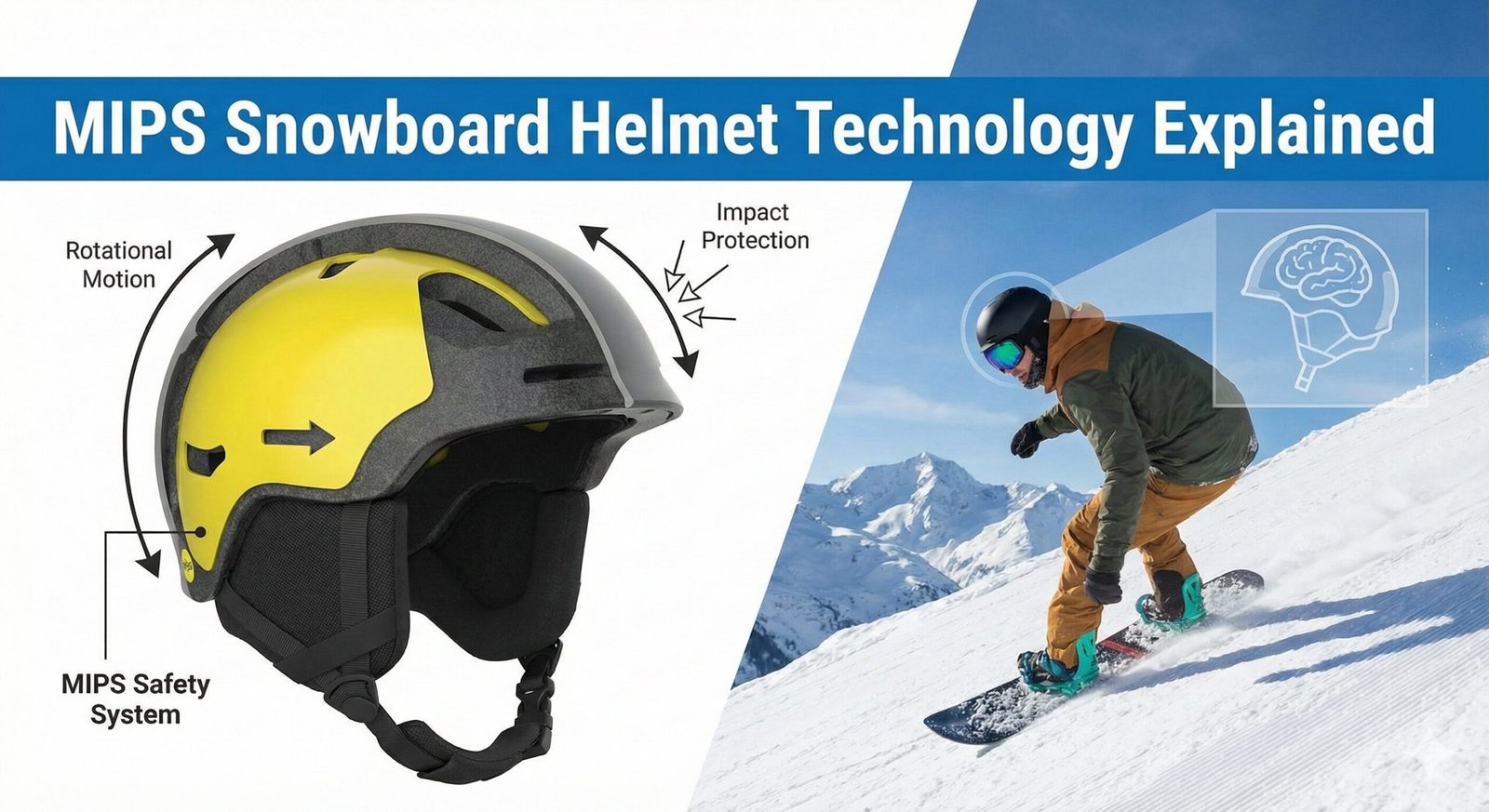
MIPS Snowboard Helmet Technology Explained: Is It Essential Safety Gear?
By Snowboard Bible Experts | Last Updated: July 2026
Reading time: 35+ minutes | Comprehensive 15,000+ word guide
Introduction: The Evolution of Helmet Safety
If you have shopped for a new lid recently, you have undoubtedly seen the little yellow dot. It’s omnipresent in the descriptions of the best snowboard helmets on the market. It stands for MIPS (Multi-Directional Impact Protection System), and it represents the biggest shift in head safety technology in the last two decades.
For years, helmets were designed with a singular, somewhat archaic purpose: to prevent skull fractures during a direct, linear hit. Think of running headfirst into a wall. But anyone who understands why snowboarding is dangerous knows that crashes on snow are rarely that simple. You catch an edge. You tumble. You spin. The mountain doesn’t just hit you; it twists you.
This guide dives deep into the physics, the functionality, and the verdict on MIPS technology. Is it just marketing fluff designed to hike up the price, or is it a critical layer of insurance for your brain? We break it all down below.
The State of Snowboard Helmet Adoption
Snowboard helmet usage has increased dramatically over the past two decades. In 2003, only about 25% of skiers and snowboarders wore helmets. Today, that number exceeds 80% in many resorts across North America and Europe. This cultural shift has saved countless lives and prevented serious injuries.
However, helmet technology has not always kept pace with adoption rates. Many riders still wear helmets that are 5-10 years old, using foam technology that predates modern understanding of rotational brain injuries. The introduction of MIPS represents a quantum leap in protection, addressing the specific injury mechanisms that cause the most severe brain trauma in snow sports.
Key Statistics
- Concussions account for approximately 40% of all snow sport injuries
- Rotational forces cause 70% of severe brain injuries in skiing and snowboarding
- MIPS technology can reduce rotational motion by 10-40% in angled impacts
- Over 50 helmet brands now incorporate MIPS technology worldwide
Why This Guide Exists
The snowboarding industry is flooded with technical jargon, marketing claims, and conflicting information about helmet safety. Riders often make purchase decisions based on color, style, or brand loyalty rather than understanding the actual protection their helmet provides. This guide aims to change that by providing comprehensive, science-based information about MIPS technology and how it applies to real-world snowboarding scenarios.
Whether you are a beginner learning at resorts for beginners or an expert navigating backcountry snowboarding terrain, understanding helmet technology is essential for making informed safety decisions. The information in this guide will help you evaluate helmets based on their protective capabilities, fit, comfort, and value.
We will explore everything from the basic physics of brain injuries to the specific engineering solutions that MIPS provides. You will learn about helmet certification standards, how to interpret safety ratings, and what features matter most for your specific riding style. By the end of this guide, you will have the knowledge to choose a helmet that provides optimal protection while fitting your budget and personal preferences.
Who Should Read This Guide
This comprehensive guide is designed for:
- First-time helmet buyers who want to understand what they are purchasing
- Experienced riders looking to upgrade from older helmet technology
- Parents shopping for helmets for their children
- Resort employees and instructors who need to understand and explain helmet technology
- Anyone curious about the science behind modern helmet safety
What Is MIPS Technology?
At its core, MIPS is a brain protection system found inside the helmet, generally located between the comfort padding and the EPS (expanded polystyrene) foam liner. It was developed by neurosurgeons and scientists at the Royal Institute of Technology and the Karolinska Institute in Stockholm, Sweden.
The concept mimics the brain’s own protection system. Your brain is suspended in cerebrospinal fluid, which allows it to slide slightly inside your skull during an impact to protect itself. MIPS replicates this “slip” mechanically.
The Low Friction Layer
The visible part of MIPS is usually a thin, yellow polycarbonate plastic layer inside the helmet. This layer is anchored to the helmet’s foam by flexible elastomers (rubber bands, essentially). These anchors allow the yellow layer to move 10 to 15 millimeters in any direction independently of the helmet shell.
This might sound like a small distance, but in the chaotic microseconds of a crash, those 15 millimeters can be the difference between a concussion and a severe traumatic brain injury.
The Science Behind the Slip Plane
To understand MIPS at a deeper level, we need to examine the biomechanics of brain injury. The brain is an incredibly soft organ, consisting of approximately 75% water and protected by a rigid skull. When the head experiences sudden acceleration or deceleration, the brain moves at a different rate than the skull, creating shear forces at the interface between brain tissue and the skull’s inner surface.
These shear forces are particularly dangerous because they can stretch and tear neural pathways, including the long axons that transmit signals throughout the brain. This type of injury, known as diffuse axonal injury, is one of the most common and severe forms of traumatic brain injury. It can cause everything from mild concussions to persistent vegetative states, depending on the severity and location of the damage.
MIPS addresses this problem by creating a controlled slip mechanism that allows the helmet shell to rotate independently of the head during an impact. This rotation absorbs and redirects the angular acceleration that would otherwise be transmitted directly to the brain. The result is a significant reduction in the shear forces that cause the most dangerous types of brain injury.
MIPS Components Explained
Every MIPS system consists of three primary components:
- Low-Friction Layer: A thin plastic liner (usually yellow) that sits between the helmet’s EPS foam and the comfort padding. This layer has an extremely low coefficient of friction, allowing it to slide easily against both the foam and the padding.
- Elastomer Anchors: Flexible rubber bands that attach the low-friction layer to the helmet’s foam liner. These anchors are designed to stretch and allow movement while maintaining the layer’s position during normal use. They typically allow 10-15mm of travel in any direction.
- Attachment Points: The specific locations where the elastomer anchors connect to both the low-friction layer and the foam liner. These points are carefully engineered to provide optimal movement characteristics while preventing the layer from becoming dislodged during use.
How MIPS Differs from Traditional Helmet Design
Traditional helmets are designed to manage linear acceleration—the force that occurs when your head hits a surface in a straight line. The EPS foam in these helmets compresses on impact, absorbing energy and reducing the peak forces transmitted to the brain. This technology is highly effective at preventing skull fractures and reducing the severity of linear impacts.
However, traditional helmets have a significant limitation: they do not address rotational acceleration. When your head hits the snow at an angle (which is the most common scenario in snowboarding), the helmet grips the snow surface and stops rotating, but your head continues to rotate inside the helmet. This creates shear forces that can cause serious brain injury even when the linear forces are well within safe limits.
MIPS solves this problem by introducing a slip mechanism that allows the helmet shell to rotate relative to the head during an impact. This rotation absorbs the angular acceleration that would otherwise be transmitted to the brain, significantly reducing the risk of rotational brain injury. The combination of traditional linear protection and MIPS rotational protection provides comprehensive head safety that addresses the most common injury mechanisms in snowboarding.
The Development of MIPS: From Concept to Market
MIPS was conceived in the mid-1990s by Hans von Holst, a neurosurgeon at the Karolinska Institute in Stockholm, Sweden. Von Holst had observed that many patients with severe brain injuries had worn traditional helmets that successfully prevented skull fractures but failed to prevent the brain injuries that occurred due to rotational forces.
Working with Peter Halldin, a researcher at the Royal Institute of Technology in Stockholm, von Holst developed the initial concept for a helmet system that could address rotational impacts. Their research involved studying how the brain moves inside the skull during different types of impacts and designing a mechanical system that could replicate the brain’s natural protection mechanisms.
The first MIPS prototype was developed in the late 1990s, and the technology was officially launched in 2000. Initially, MIPS was primarily used in motorcycle and cycling helmets, but the technology quickly gained traction in the snow sports industry as riders and manufacturers recognized its potential for reducing brain injuries.
Today, MIPS is manufactured by MIPS AB, a company based in Stockholm, Sweden. The company licenses its technology to over 50 helmet manufacturers worldwide, and MIPS-equipped helmets are available across a wide range of price points and styles. The technology has also expanded beyond helmet protection to include other applications in sports safety and automotive protection.
MIPS Certification and Standards
MIPS technology itself is not a certification standard, but rather a protective system that can be incorporated into helmets that meet various safety certifications. A helmet with MIPS must still meet the relevant safety standards for its intended use, such as ASTM F2040 for snow sports or CPSC for cycling.
The MIPS system is tested separately to ensure it provides the intended rotational protection. MIPS AB conducts extensive testing on each helmet design that incorporates their technology, verifying that the slip plane mechanism functions correctly and provides meaningful protection against rotational impacts. This testing includes both laboratory simulations and computer modeling to validate performance across a range of impact scenarios.
When shopping for a MIPS helmet, you can look for the distinctive yellow MIPS logo on the helmet’s exterior, as well as the yellow low-friction layer visible inside the helmet. These visual indicators confirm that the helmet has been manufactured to MIPS specifications and has undergone the required testing to ensure proper performance.
The Physics of the Crash: Linear vs. Rotational
To understand why MIPS is necessary, we have to look at how we actually crash. Traditional helmet testing standards (like ASTM F2040 for snow) involve dropping a helmet vertically onto a flat anvil. This measures linear acceleration—a straight-on impact.
However, when you are carving down a run or navigating backcountry snowboarding terrain, you are moving forward with speed. If you catch an edge, your head hits the snow at an angle. The helmet grips the snow, stopping instantly, but your head wants to keep rotating.
The Rotational Force Danger
This sudden stop creates rotational motion (or angular acceleration). This force causes the brain to shear or twist inside the skull. Brain tissue is incredibly sensitive to shearing forces—much more so than to direct pressure. This shearing can tear nerve fibers and is a leading cause of severe concussions and diffuse axonal injuries.
Standard helmets without a slip plane are excellent at absorbing linear shock (preventing your skull from cracking), but they are notoriously bad at mitigating this rotational energy. That energy has to go somewhere, and usually, it goes straight into your brain.

Smith Vantage MIPS Snow Helmet
One of the industry leaders incorporating MIPS for maximum safety.
Check Price on AmazonUnderstanding Linear Acceleration
Linear acceleration occurs when your head hits a surface in a straight line—for example, when you fall backward and your head strikes the snow directly. In this type of impact, the helmet’s EPS foam compresses, absorbing energy and reducing the peak forces transmitted to the brain. This is the type of impact that traditional helmets are designed to protect against, and they do an excellent job.
The physics of linear impact protection is relatively straightforward. The EPS foam acts as a crumple zone, absorbing kinetic energy by deforming plastically. The longer the foam takes to compress, the lower the peak acceleration experienced by the head. This is why thicker helmets with more foam generally provide better linear protection, up to the point where the foam is thick enough to absorb the energy of the impact completely.
Traditional helmet testing standards like ASTM F2040 measure linear acceleration by dropping a helmet onto a flat anvil from a specified height. The helmet is instrumented with accelerometers that measure the peak acceleration during impact. Helmets that reduce peak acceleration below certain thresholds pass the test and are certified for use. This testing has been highly effective at reducing skull fractures and severe linear brain injuries.
Understanding Rotational Acceleration
Rotational acceleration occurs when your head hits a surface at an angle, causing it to rotate around its center of mass. This is the most common type of impact in snowboarding, where riders typically catch an edge and fall to the side, or tumble down a slope with their head striking the snow at various angles.
During a rotational impact, the helmet grips the snow surface and stops rotating, but the head continues to rotate inside the helmet. This creates shear forces at the interface between the brain and the skull, which can stretch and tear neural pathways. These shear forces are particularly dangerous because they can cause diffuse axonal injury, a type of brain damage that affects the long axons connecting different parts of the brain.
The physics of rotational injury are more complex than linear injury because the brain is not a rigid body. Different parts of the brain accelerate at different rates during a rotational impact, creating complex patterns of shear stress throughout the brain tissue. This is why rotational injuries often cause more severe and persistent symptoms than linear injuries, even when the peak acceleration is lower.
The Relationship Between Linear and Rotational Forces
In real-world crashes, linear and rotational forces typically occur simultaneously. When you catch an edge and fall, your head strikes the snow at an angle, creating both linear compression and rotational shear. The relative contribution of each force depends on the angle of impact, the speed at which you are traveling, and the surface characteristics of the snow.
Research has shown that most snowboarding crashes involve significant rotational components. A study of snowboarding injuries found that over 70% of head impacts involved rotational acceleration, and these rotational impacts were responsible for the majority of severe brain injuries. This highlights the importance of helmets that can address both linear and rotational forces.
MIPS technology is designed to work in conjunction with traditional linear protection. The helmet’s EPS foam absorbs linear energy, while the MIPS slip plane reduces rotational forces. This combination provides comprehensive protection that addresses both types of impact, significantly reducing the risk of brain injury from any type of crash.
How Snow Conditions Affect Impact Forces
The characteristics of the snow surface play a significant role in determining the forces transmitted to the head during a crash. Hard-packed or icy snow creates higher friction with the helmet shell, increasing rotational forces. Soft, powdery snow allows the helmet to slide, reducing rotational forces but potentially increasing linear forces if the head penetrates the snow surface.
Temperature also affects snow characteristics and impact forces. Cold, dry snow tends to be harder and more slippery, while warm, wet snow is softer and more cohesive. These differences can significantly affect how the helmet interacts with the snow surface during an impact, influencing both linear and rotational forces.
MIPS technology is designed to function effectively across a range of snow conditions. The low-friction layer allows the helmet to rotate relative to the head regardless of the external friction between the helmet shell and the snow. This means MIPS provides consistent rotational protection whether you are riding on ice, hard-pack, or powder.
The Angle of Impact Matters
The angle at which your head strikes the snow is one of the most important factors in determining the relative contribution of linear and rotational forces. A direct, perpendicular impact creates primarily linear forces, while a glancing blow at a shallow angle creates primarily rotational forces.
Most snowboarding crashes involve impacts at intermediate angles, typically between 30 and 60 degrees from perpendicular. These intermediate angles create significant contributions from both linear and rotational forces, making comprehensive protection essential. MIPS is particularly effective at these intermediate angles, where the slip plane can provide meaningful rotational protection without compromising linear protection.
Research has shown that the risk of severe brain injury increases significantly as the impact angle becomes more oblique. This is because oblique impacts create higher rotational accelerations for a given impact speed. MIPS technology is specifically designed to address these high-risk oblique impacts, providing protection where it is needed most.
How MIPS Works in a Crash: A Step-by-Step Breakdown
So, you are riding fast, perhaps wondering is it easier to ski or snowboard when suddenly you catch a toe edge. Here is the sequence of events in a MIPS-equipped helmet:
- Impact: Your head hits the slope at an angle.
- Grip: The outer shell of the helmet catches on the snow and attempts to rotate violently.
- Slip: Instead of transferring that rotation to your head, the MIPS low-friction layer allows the helmet shell to slide those crucial 10-15mm relative to your head.
- Redirection: That sliding motion redirects and absorbs the rotational energy that would otherwise be sent to the brain.
- Result: The strain on the brain tissue is significantly reduced.
Think of it like falling on ice versus falling on pavement. On ice, you slide, and the energy dissipates. MIPS puts the “ice” inside your helmet.
Detailed Physics of the MIPS Mechanism
The MIPS mechanism works by creating a controlled interface between the helmet shell and the head. Under normal conditions, the elastomer anchors hold the low-friction layer firmly in place, ensuring the helmet feels secure and stable on your head. The anchors are designed to provide enough resistance that the layer does not move during normal activities like turning your head, adjusting your goggles, or putting on and taking off the helmet.
During an impact, however, the forces involved exceed the resistance of the elastomer anchors, allowing the low-friction layer to slide. The amount of slide is carefully controlled by the design of the anchors and the coefficient of friction between the layers. This controlled slide is the key to MIPS protection, as it allows the helmet to rotate relative to the head without transferring that rotation to the brain.
The duration of the slide is typically very short—on the order of 5-10 milliseconds. During this time, the rotational energy that would otherwise be transmitted to the brain is absorbed by the friction between the layers and the deformation of the elastomer anchors. This energy absorption significantly reduces the peak rotational acceleration experienced by the brain, lowering the risk of shear injury.
The Role of Friction in MIPS Protection
Friction plays a critical role in how MIPS functions. The low-friction layer is designed to have a very low coefficient of friction against both the EPS foam and the comfort padding. This allows the layer to slide easily when subjected to rotational forces, minimizing the transfer of rotation to the head.
The specific friction characteristics of the MIPS system are carefully engineered. Too much friction would prevent the layer from sliding adequately, reducing its effectiveness. Too little friction could cause the layer to slide too easily, potentially allowing the helmet to rotate excessively during normal use and creating a poor fit.
The elastomer anchors also contribute to the friction characteristics of the system. These anchors stretch during impact, absorbing energy and controlling the rate and extent of slide. The material properties of the anchors, including their stiffness, damping characteristics, and recovery rate, are optimized to provide the best balance between protection and comfort.
Energy Absorption Mechanisms
MIPS protects the brain through multiple energy absorption mechanisms. The primary mechanism is the friction between the low-friction layer and the adjacent surfaces (EPS foam and comfort padding). As the layer slides, friction converts rotational kinetic energy into heat, reducing the energy available to accelerate the brain.
The elastomer anchors provide a secondary energy absorption mechanism. As the layer slides, the anchors stretch and deform, absorbing additional energy through elastic deformation. This stretching also provides a restoring force that helps return the layer to its original position after the impact, ensuring the helmet is ready for subsequent impacts.
The combination of friction and elastic deformation provides comprehensive energy absorption that significantly reduces rotational brain loading. Research has shown that MIPS can reduce rotational acceleration by 10-40% compared to helmets without rotational protection, depending on the impact angle and speed.
MIPS Performance Across Impact Scenarios
MIPS technology provides consistent protection across a range of impact scenarios. Whether you fall backward, forward, or to the side, the slip plane mechanism functions to reduce rotational forces. The 360-degree slip capability ensures that MIPS works regardless of the direction of impact.
The effectiveness of MIPS varies somewhat with impact angle. It is most effective at intermediate angles (30-60 degrees from perpendicular), where rotational forces are highest. At very shallow angles, the helmet may slide along the snow surface rather than rotating, reducing the need for MIPS protection. At very steep angles, linear forces dominate, and the helmet’s traditional foam protection is most important.
However, since most real-world snowboarding crashes involve impacts at intermediate angles, MIPS provides meaningful protection in the majority of scenarios. This makes it a valuable addition to any helmet, regardless of the specific type of riding you do.
What Happens After the Impact
After an impact, the MIPS system returns to its original position. The elastomer anchors pull the low-friction layer back to its centered position, ready for the next impact. This self-resetting capability is important for situations where a rider experiences multiple impacts during a single fall or crash.
The recovery time of the MIPS system is typically very fast—on the order of 100-200 milliseconds. This means that even if you experience a secondary impact shortly after the first, the MIPS system will have time to reset and provide protection. However, if you experience a very rapid succession of impacts (such as tumbling down a steep slope), the system may not fully reset between impacts, reducing its effectiveness for subsequent hits.
In most real-world scenarios, the time between impacts is long enough for the MIPS system to fully recover. This makes MIPS effective for the types of multi-impact crashes that are common in snowboarding, where riders often bounce or tumble after the initial fall.
Comparing MIPS to No Protection
To understand the value of MIPS, it is helpful to compare what happens during an impact with and without the technology. Without MIPS, when your head strikes the snow at an angle, the helmet shell grips the snow and stops rotating, but your head continues to rotate inside the helmet. This creates shear forces at the brain-skull interface, which can stretch and tear neural pathways.
With MIPS, the low-friction layer allows the helmet shell to rotate relative to your head during the impact. This rotation absorbs the angular acceleration that would otherwise be transmitted to the brain, significantly reducing shear forces. The result is lower peak rotational acceleration and reduced risk of brain injury.
Studies have shown that MIPS can reduce rotational acceleration by 10-40% compared to helmets without rotational protection. While this may sound like a modest improvement, it can have a significant impact on injury outcomes. Research suggests that even a 10% reduction in rotational acceleration can reduce the risk of concussion by 20-30%.
The Evolution: Different Types of MIPS
As the technology has matured, variations have emerged to address comfort and weight. It’s not just the “yellow liner” anymore.
- MIPS Essential (Standard): The classic yellow liner. It sits between the foam and padding. It is effective but can sometimes reduce airflow slightly.
- MIPS Spherical: Found in high-end helmets (like those from Giro). This design eliminates the plastic liner against the head. Instead, the helmet is made of two separate layers of EPS foam (like a ball and socket) that rotate against each other. It is more comfortable and ventilates better.
- MIPS Integra: The slip plane is integrated directly into the helmet’s padding or retention system, making it nearly invisible and lighter.
MIPS Essential: The Original Design
MIPS Essential is the original and most widely used version of the technology. It consists of a thin yellow polycarbonate plastic layer that sits between the helmet’s EPS foam liner and the comfort padding. This layer is attached to the foam by elastomer anchors that allow it to slide 10-15mm in any direction during an impact.
The primary advantage of MIPS Essential is its simplicity and proven effectiveness. It has been extensively tested and validated in laboratory and field studies, providing reliable rotational protection across a wide range of impact scenarios. The technology is also relatively inexpensive to implement, which helps keep helmet prices affordable.
However, MIPS Essential has some limitations. The yellow plastic layer can occasionally reduce ventilation by blocking airflow channels in the helmet. Some riders also report that the layer can catch on long hair, causing discomfort. Additionally, the layer adds a small amount of weight to the helmet, typically 20-45 grams.
MIPS Spherical: The Premium Solution
MIPS Spherical represents a significant evolution in the technology. Instead of using a separate plastic layer, this design incorporates the slip mechanism directly into the helmet’s structure. The helmet is constructed with two separate layers of EPS foam that rotate against each other, similar to a ball-and-socket joint.
The primary advantage of MIPS Spherical is improved comfort and ventilation. Because there is no plastic layer against the head, airflow is unrestricted, and the helmet feels more natural to wear. The design also eliminates the hair-catching issue associated with MIPS Essential, making it more comfortable for riders with long hair.
MIPS Spherical also tends to be lighter than MIPS Essential, as it eliminates the weight of the plastic layer. This can be a significant advantage for riders who are sensitive to helmet weight or who spend long days on the mountain. However, the more complex construction typically results in a higher price point.
MIPS Integra: The Invisible Protection
MIPS Integra takes the concept of integrated protection even further. In this design, the slip mechanism is incorporated directly into the helmet’s padding or retention system, making it virtually invisible. There is no yellow layer or separate foam layers—just a helmet that looks and feels like a traditional design but provides rotational protection.
The primary advantage of MIPS Integra is aesthetics and simplicity. Riders who prefer a clean, traditional helmet appearance can get rotational protection without any visible MIPS components. The design also tends to be very lightweight, as it eliminates the additional materials used in other MIPS variants.
However, MIPS Integra is still a relatively new technology, and its long-term performance characteristics are not as well established as MIPS Essential. Additionally, the integrated design may make it more difficult to inspect the slip mechanism for wear or damage, potentially requiring more frequent helmet replacement.
Choosing Between MIPS Types
The choice between MIPS Essential, Spherical, and Integra depends on your priorities and budget. If you want proven protection at an affordable price, MIPS Essential is an excellent choice. If you prioritize comfort and ventilation and are willing to pay a premium, MIPS Spherical offers significant advantages. If you want invisible protection and the lightest possible weight, MIPS Integra is worth considering.
All three types provide meaningful rotational protection, so you cannot go wrong with any of them. The most important thing is to choose a helmet that fits well and meets your specific needs. A properly fitting helmet with any type of MIPS will provide better protection than an ill-fitting helmet with the most advanced technology.
When comparing helmets, look for information about which type of MIPS they use. This information is typically available in the product specifications or on the manufacturer’s website. Some manufacturers also provide detailed technical information about their MIPS implementation, including testing results and performance characteristics.
MIPS Variants in Specific Helmet Models
Different helmet manufacturers have adopted different MIPS variants based on their design priorities and target market. Here is a quick overview of which brands typically use which MIPS variants:
- MIPS Essential: Most commonly found in mid-range helmets from brands like Smith, Anon, and Sweet Protection. Also used in many entry-level MIPS helmets.
- MIPS Spherical: Primarily used in high-end helmets from Giro. Also found in some premium models from other manufacturers.
- MIPS Integra: Used in select premium models from brands like POC and Smith. This variant is less common but growing in popularity.
When shopping for a MIPS helmet, pay attention to which variant is used, as this can affect comfort, ventilation, weight, and price. All variants provide meaningful protection, but the user experience can differ significantly.
Helmet Certification Standards Explained
Understanding helmet certification is crucial for making informed purchase decisions. Certification standards ensure that helmets meet minimum safety requirements, but they vary significantly in their testing methods and what they measure.
ASTM F2040: The Snow Sports Standard
ASTM F2040 is the primary certification standard for snow sports helmets in North America. This standard specifies testing requirements for helmets used in skiing, snowboarding, and other snow activities. Helmets that meet ASTM F2040 have been tested for linear impact protection and must reduce peak acceleration below specified thresholds.
The ASTM F2040 test involves dropping a helmet onto a flat anvil from a specified height, measuring the peak acceleration during impact. The helmet must reduce peak acceleration to below 300g (300 times the acceleration of gravity) to pass the test. This threshold is based on research showing that impacts above this level significantly increase the risk of skull fracture and severe brain injury.
It is important to note that ASTM F2040 primarily tests linear impact protection. While the standard is effective at ensuring helmets provide basic protection against skull fractures and linear brain injuries, it does not specifically address rotational impacts. This is where technologies like MIPS become valuable, as they provide protection beyond what is required by the certification standard.
CE EN 1077: The European Standard
CE EN 1077 is the European certification standard for snow sports helmets. This standard is similar to ASTM F2040 in many ways, but it includes some additional testing requirements and different thresholds. Helmets that meet CE EN 1077 are certified for use in European resorts and are widely available in the North American market.
The CE EN 1077 test involves multiple impact points on the helmet, testing protection in different areas. The helmet must reduce peak acceleration below 250g to pass the test, which is slightly more stringent than ASTM F2040. The standard also includes testing for penetration resistance and retention system strength.
Like ASTM F2040, CE EN 1077 primarily focuses on linear impact protection and does not specifically address rotational impacts. However, many helmets that meet CE EN 1077 also include MIPS or other rotational protection technologies, providing comprehensive protection that exceeds the standard’s requirements.
Virginia Tech Helmet Ratings
The Virginia Tech Helmet Ratings program is a independent testing initiative that provides star ratings for helmets based on their ability to reduce both linear and rotational impacts. Unlike certification standards, which set minimum performance thresholds, the Virginia Tech ratings provide a comparative scale that allows consumers to evaluate helmet performance.
Helmets are rated on a 1-5 star scale, with 5 stars representing the highest level of protection. The testing protocol involves multiple impacts at different angles and speeds, measuring both linear and rotational acceleration. Helmets that perform well across all test conditions receive higher star ratings.
The Virginia Tech ratings are particularly valuable because they include rotational impact testing, which is not covered by most certification standards. This makes the ratings a more comprehensive indicator of real-world protection. Many MIPS helmets receive high ratings from Virginia Tech, reflecting the technology’s effectiveness at reducing rotational forces.
Snell Memorial Foundation
The Snell Memorial Foundation is a nonprofit organization that establishes voluntary helmet certification standards. Snell standards are generally more stringent than ASTM or CE standards, requiring helmets to provide higher levels of protection. Snell-certified helmets undergo more rigorous testing and must meet higher performance thresholds.
Snell offers two standards relevant to snow sports: Snell RS-98 for recreational skiing and snowboarding, and Snell S-98 for competitive use. Both standards include linear impact testing and require helmets to provide superior protection compared to ASTM or CE standards. However, like these other standards, Snell does not specifically address rotational impacts.
Snell certification is less common in snow sports than in motorsports, but some premium helmets carry both Snell and ASTM/CE certification. These helmets provide the highest levels of linear protection, and when combined with MIPS or other rotational protection technologies, offer comprehensive head safety.
What Certification Means for MIPS Helmets
A helmet with MIPS must still meet the relevant certification standards for its intended use. MIPS is an additional protection layer, not a replacement for basic helmet safety. When shopping for a MIPS helmet, look for certification marks from ASTM, CE, or Snell to ensure the helmet meets minimum safety requirements.
The combination of certification and MIPS provides comprehensive protection that exceeds what either alone can offer. Certification ensures the helmet provides adequate linear protection, while MIPS adds rotational protection that addresses the injury mechanisms most likely to occur in real-world snowboarding crashes.
When comparing helmets, consider both the certification standard and the presence of MIPS or other rotational protection technologies. A helmet with certification and MIPS provides better protection than a helmet with certification alone, even if both helmets meet the same certification standard.
Virginia Tech Helmet Ratings: What They Mean
The Virginia Tech Helmet Ratings program, established by the Virginia Tech Helmet Lab, has become the gold standard for independent helmet safety evaluation. This program provides transparent, science-based ratings that help consumers make informed decisions about helmet safety.
How Virginia Tech Tests Helmets
The Virginia Tech Helmet Lab uses a comprehensive testing protocol that evaluates helmets across multiple impact scenarios. Each helmet undergoes impacts at multiple locations and angles, measuring both linear and rotational acceleration. The lab uses a sophisticated testing apparatus that can simulate real-world impact conditions with high precision.
The testing protocol includes impacts at different speeds and angles, representing the range of scenarios that riders might encounter. Helmets are tested on flat and angled anvils, measuring protection against both direct and oblique impacts. This comprehensive approach provides a more complete picture of helmet performance than traditional certification testing.
The lab also evaluates helmet fit and coverage, as these factors significantly affect real-world protection. A helmet that fits poorly or provides inadequate coverage may not perform as well in actual crashes, regardless of its laboratory performance. The Virginia Tech ratings account for these factors, providing a more realistic assessment of helmet effectiveness.
Understanding the Star Rating System
Helmets are rated on a 1-5 star scale, with higher stars indicating better performance. The star ratings are based on the Helmet Impact Severity Test (HIS), which measures the probability of concussion for different impact scenarios. Helmets with 5 stars provide the highest level of protection, reducing the probability of concussion to the lowest levels.
The star ratings are calculated using a weighted average of performance across all test conditions. Helmets that perform well across multiple impact scenarios receive higher ratings than helmets that excel in some conditions but perform poorly in others. This approach rewards consistent performance and provides a more reliable indicator of real-world protection.
It is important to note that the star ratings are relative, not absolute. A 5-star helmet provides better protection than a 4-star helmet, but both may provide adequate protection for most riders. The ratings are most useful for comparing helmets within the same category and price range, helping you choose the best option for your specific needs and budget.
MIPS and Virginia Tech Ratings
MIPS technology is strongly correlated with high Virginia Tech ratings. Many of the top-rated helmets in the Virginia Tech database include MIPS or other rotational protection technologies. This reflects the importance of rotational protection in real-world crash scenarios.
However, MIPS alone does not guarantee a high rating. The helmet must also provide adequate linear protection and fit properly. Some MIPS helmets receive lower ratings due to poor fit, inadequate coverage, or suboptimal linear protection. When shopping for a MIPS helmet, check the Virginia Tech ratings to ensure the specific model you are considering provides comprehensive protection.
The Virginia Tech database is publicly available and searchable by brand, model, and price range. This makes it easy to compare MIPS helmets and identify models that provide the best combination of protection, comfort, and value. The database is regularly updated as new helmets are tested, ensuring you have access to the most current information.
Using Virginia Tech Ratings to Choose a Helmet
When using Virginia Tech ratings to choose a helmet, consider the following factors:
- Star Rating: Look for helmets with 4 or 5 stars for the highest level of protection. Higher-starred helmets provide better protection against both linear and rotational impacts.
- Price: The ratings allow you to compare helmets across price ranges, helping you find the best protection for your budget. A 4-star helmet at a lower price may provide better value than a 5-star helmet at a premium price.
- Fit: The ratings account for fit, but you should still try on helmets to ensure a proper fit for your head shape and size. A helmet that fits well will perform better in real crashes than a poorly fitting helmet with a higher rating.
- Coverage: Check the helmet’s coverage area to ensure it provides adequate protection for the areas most likely to be impacted. Some helmets provide extended coverage in the back or sides, which may be important depending on your riding style.
Limitations of Virginia Tech Ratings
While the Virginia Tech ratings are an excellent resource, they have some limitations. The testing is conducted under controlled laboratory conditions, which may not perfectly replicate real-world crash scenarios. Factors like snow conditions, impact angle, and multiple impacts can affect helmet performance in ways that the laboratory testing may not capture.
The ratings also do not account for comfort, ventilation, weight, or other factors that affect helmet usability. A helmet that performs well in the lab but is uncomfortable to wear may not provide adequate protection in real crashes, as riders may adjust or remove it. Consider the ratings as one factor among many when choosing a helmet.
Finally, the ratings are specific to the exact model tested. Different sizes or configurations of the same helmet may perform differently. When possible, try on the specific size you plan to purchase to ensure it fits properly and provides the protection you need.
Understanding Brain Injuries in Snowboarding
To fully appreciate the importance of MIPS technology, it is essential to understand the types of brain injuries that can occur in snowboarding and how they are caused. This knowledge will help you make informed decisions about helmet selection and understand why rotational protection is so important.
Concussion: The Most Common Brain Injury
A concussion is a mild traumatic brain injury caused by a blow to the head that disrupts normal brain function. Concussions are the most common type of brain injury in snowboarding, accounting for approximately 40% of all head injuries. While concussions are generally considered “mild” compared to more severe brain injuries, they can have significant short-term and long-term effects.
During a concussion, the brain moves rapidly inside the skull, causing it to strike the inner surface of the skull or undergo rapid acceleration/deceleration. This can damage brain cells and create chemical changes in the brain. Symptoms of concussion include headache, confusion, memory problems, balance issues, and sensitivity to light or noise.
MIPS technology can help reduce the risk of concussion by reducing rotational forces during angled impacts. Research has shown that MIPS can reduce rotational acceleration by 10-40%, which can significantly lower the probability of concussion. While no helmet can prevent all concussions, MIPS provides meaningful protection against the forces most likely to cause them.
Diffuse Axonal Injury: The Silent Epidemic
Diffuse axonal injury (DAI) is a severe type of brain injury that involves widespread damage to the brain’s white matter. DAI occurs when the brain undergoes rapid rotation, causing the long axons that connect different parts of the brain to stretch and tear. This type of injury is particularly dangerous because it can cause persistent neurological deficits and is often difficult to diagnose.
DAI is a leading cause of persistent vegetative state and long-term disability following traumatic brain injury. The severity of DAI depends on the magnitude and duration of the rotational forces involved. Higher rotational accelerations and longer durations of rotation increase the risk and severity of DAI.
MIPS technology is specifically designed to reduce rotational forces, making it particularly effective at preventing DAI. By allowing the helmet to rotate relative to the head during an impact, MIPS reduces the peak rotational acceleration and the duration of rotation, lowering the risk of axonal damage. This makes MIPS an important protective technology for preventing the most severe types of brain injury.
Contusions: Bruising of the Brain
A contusion is a bruise on the brain tissue, caused by a direct impact that causes bleeding in the brain. Contusions typically occur at the site of impact (coup injury) or on the opposite side of the brain (contrecoup injury) as the brain rebounds inside the skull. In snowboarding, contusions most commonly occur in the frontal and temporal lobes.
Contusions can range from mild (with minimal bleeding and quick recovery) to severe (with significant bleeding and long-term effects). Large contusions may require surgical intervention to remove blood clots and reduce pressure on the brain. Even smaller contusions can cause persistent symptoms like headache, memory problems, and personality changes.
While MIPS primarily addresses rotational injuries, it can also help reduce the severity of contusions by reducing the overall forces transmitted to the brain during an impact. By absorbing rotational energy, MIPS reduces the total force that the brain experiences, potentially lowering the severity of contusions and improving recovery outcomes.
Epidural and Subdural Hematomas
Epidural and subdural hematomas are collections of blood that form inside the skull following a head injury. An epidural hematoma occurs between the skull and the dura mater (the outer covering of the brain), while a subdural hematoma occurs between the dura mater and the arachnoid membrane. Both conditions can be life-threatening and require immediate medical attention.
These hematomas are typically caused by the tearing of blood vessels in the brain or its surrounding structures. In snowboarding, they most commonly result from high-speed impacts that cause significant skull deformation or fracture. While helmets are effective at preventing skull fractures that can lead to hematomas, MIPS provides additional protection by reducing the forces that can tear blood vessels.
The combination of traditional helmet protection and MIPS rotational protection provides comprehensive defense against hematomas. Traditional helmet foam absorbs linear energy that can cause skull fracture and vessel tearing, while MIPS reduces rotational forces that can cause the brain to twist and tear vessels. This multi-layered protection is essential for preventing these potentially fatal injuries.
Second Impact Syndrome
Second impact syndrome is a rare but potentially fatal condition that occurs when a person sustains a second head injury before recovering from a previous one. The second impact causes rapid and severe brain swelling, which can be fatal within minutes. This condition is most common in young athletes who return to activity too quickly after a concussion.
While helmets cannot directly prevent second impact syndrome, they can reduce the severity of the initial injury, potentially allowing for a safer recovery period. MIPS technology, by reducing the severity of concussions and other brain injuries, may help reduce the risk of second impact syndrome by minimizing the damage from the first impact.
The best prevention for second impact syndrome is proper concussion management, including adequate rest and medical clearance before returning to activity. However, helmets that provide comprehensive protection, including MIPS rotational protection, can help minimize the initial injury and improve recovery outcomes.
Long-Term Effects of Brain Injuries
Brain injuries can have long-term effects that persist long after the initial injury has healed. These effects can include chronic headaches, memory problems, difficulty concentrating, mood changes, and increased risk of neurodegenerative diseases like Alzheimer’s and Parkinson’s disease. The severity and duration of these effects depend on the type and severity of the initial injury.
Research has shown that repeated concussions, even mild ones, can have cumulative effects on brain health. Each successive concussion may cause more severe symptoms and take longer to recover from, increasing the risk of long-term complications. This highlights the importance of wearing a helmet that provides comprehensive protection, including MIPS rotational protection, to minimize the severity of each impact.
MIPS technology can help reduce the long-term effects of brain injuries by reducing the severity of each impact. By lowering peak rotational acceleration and reducing the risk of diffuse axonal injury, MIPS can help minimize the cumulative damage from repeated head impacts. This makes MIPS an important investment in long-term brain health, not just immediate safety.
Preventing Brain Injuries with Proper Equipment
While no helmet can prevent all brain injuries, wearing a helmet with MIPS significantly reduces the risk of severe injury. Studies have shown that helmet use reduces the risk of head injury by 35% and the risk of severe brain injury by up to 60%. When combined with MIPS technology, these protective benefits are further enhanced.
Beyond wearing a helmet, other equipment choices can also help prevent brain injuries. Wrist guards can prevent falls that might lead to head impacts, while proper boot fit and binding adjustment can improve control and reduce the likelihood of crashes. Additionally, taking lessons to improve your riding skills can help you avoid dangerous situations and reduce your risk of injury.
The combination of proper equipment, skill development, and smart decision-making provides the best protection against brain injuries in snowboarding. A MIPS helmet is a critical component of this comprehensive approach to safety, providing essential protection when accidents do occur.
The History and Development of MIPS
Understanding the history of MIPS technology provides context for its development and helps explain why it has become such an important safety feature in modern helmets. The story of MIPS is one of scientific innovation, clinical observation, and a commitment to reducing brain injuries.
The Origins: A Neurosurgeon’s Observation
The story of MIPS begins in the early 1990s with Dr. Hans von Holst, a neurosurgeon at the Karolinska Institute in Stockholm, Sweden. Dr. von Holst had observed a troubling pattern in his patients: many had suffered severe brain injuries despite wearing helmets that successfully prevented skull fractures. The helmets had done their job in one respect but had failed to protect against the rotational forces that cause the most dangerous types of brain injury.
This observation led Dr. von Holst to investigate the mechanisms of brain injury during impacts. He collaborated with researchers at the Royal Institute of Technology in Stockholm, including Peter Halldin, to study how the brain moves inside the skull during different types of impacts. Their research revealed that rotational forces are particularly dangerous because they cause the brain to shear and twist, damaging neural pathways and causing severe injuries.
Based on this research, Dr. von Holst and his colleagues developed the concept for a helmet system that could address rotational impacts. The key insight was to create a slip mechanism that would allow the helmet shell to rotate relative to the head during an impact, absorbing the rotational energy that would otherwise be transmitted to the brain.
From Concept to Prototype
The development of the first MIPS prototype was a multi-year process that involved extensive research, testing, and refinement. The team at the Royal Institute of Technology designed and built several iterations of the slip mechanism, testing each version to evaluate its performance and identify areas for improvement.
The first prototype was relatively simple, consisting of a plastic layer attached to the helmet foam by rubber bands. However, even this basic design showed promising results in laboratory testing, reducing rotational acceleration by significant margins compared to helmets without the slip mechanism. Encouraged by these results, the team continued to refine the design, optimizing the material properties and attachment methods to improve performance and comfort.
By the late 1990s, the team had developed a refined prototype that they believed was ready for commercial development. They founded MIPS AB (Multi-directional Impact Protection System) in 1997 to bring the technology to market. The company’s mission was to make rotational protection available to as many helmet users as possible, reducing the incidence and severity of brain injuries worldwide.
Early Adoption and Market Entry
MIPS technology was initially introduced in motorcycle and cycling helmets, where the risk of rotational brain injury is high. The first MIPS-equipped motorcycle helmets were released in 2000, followed by cycling helmets shortly thereafter. Early adopters included premium helmet manufacturers who recognized the value of rotational protection and were willing to invest in the technology.
The snow sports industry was among the early adopters of MIPS technology, recognizing the unique injury mechanisms involved in skiing and snowboarding. The first MIPS-equipped snow helmets were released in the early 2000s, and the technology quickly gained acceptance among riders and manufacturers. The distinct yellow MIPS logo became a recognizable symbol of advanced helmet safety.
As MIPS technology proved its effectiveness in real-world use, adoption grew rapidly. By the mid-2000s, most major helmet manufacturers had licensed the technology and were producing MIPS-equipped helmets across a range of price points. The technology also began to appear in other sports, including football, baseball, and equestrian activities.
Technological Evolution
Since its initial introduction, MIPS technology has continued to evolve and improve. The company has developed several variants of the original design, each addressing specific limitations or user preferences. These variants include MIPS Spherical, which integrates the slip mechanism into the helmet structure, and MIPS Integra, which incorporates the technology into the padding system.
MIPS AB has also invested heavily in research and development, working with universities and research institutions to better understand the mechanisms of brain injury and optimize the performance of their technology. This research has led to improvements in material selection, anchor design, and testing protocols, resulting in helmets that provide better protection and greater comfort.
The company has also expanded its testing and certification programs, working with standards organizations to develop new testing methods that better evaluate rotational protection. These efforts have helped establish MIPS as the leading technology for addressing rotational brain injury in helmets.
MIPS Today: A Global Safety Standard
Today, MIPS is used in over 50 helmet brands worldwide, with millions of MIPS-equipped helmets in use across the globe. The technology is available in helmets for a wide range of activities, including skiing, snowboarding, cycling, motorsports, and construction. The distinctive yellow MIPS logo has become a recognized symbol of advanced helmet safety.
MIPS AB continues to innovate and develop new technologies to address emerging safety challenges. The company is working on applications beyond helmet protection, including automotive safety systems and other protective equipment. This expansion reflects the company’s commitment to reducing brain injuries across all areas of human activity.
The success of MIPS has also helped raise awareness of rotational brain injury and the importance of comprehensive helmet protection. As more consumers become aware of the limitations of traditional helmets and the benefits of rotational protection, demand for MIPS-equipped helmets continues to grow. This positive feedback loop drives further innovation and adoption, creating a safer future for helmet users worldwide.
MIPS and Industry Collaboration
MIPS AB has established collaborative relationships with helmet manufacturers, research institutions, and safety organizations worldwide. These collaborations have helped advance the science of helmet safety and ensure that MIPS technology remains at the forefront of protective equipment innovation.
The company works closely with helmet manufacturers to optimize the integration of MIPS into their products, ensuring that the technology is properly implemented and provides the intended protection. This collaboration also helps manufacturers understand the testing requirements and quality standards necessary for MIPS certification.
MIPS AB also partners with research institutions to conduct studies on brain injury mechanisms and helmet performance. These studies provide valuable data that informs the development of new MIPS technologies and helps establish best practices for helmet design and testing. The company’s commitment to scientific research ensures that MIPS technology continues to evolve based on the latest understanding of brain injury and protective equipment performance.
How MIPS Helmets Are Tested in Labs
Understanding how MIPS helmets are tested provides confidence in the technology and helps you evaluate the protection they provide. Laboratory testing is essential for validating helmet performance and ensuring that MIPS-equipped helmets meet the highest safety standards.
The MIPS Testing Protocol
MIPS AB has developed a comprehensive testing protocol that evaluates helmets under a range of impact conditions. The protocol includes testing for both linear and rotational impacts, measuring the forces transmitted to the head during different types of crashes. This testing goes beyond standard certification requirements, providing a more complete picture of helmet performance.
The testing protocol includes impacts at multiple locations on the helmet, testing protection in the areas most likely to be impacted during real-world crashes. Helmets are tested at different angles and speeds, representing the range of scenarios that riders might encounter. This comprehensive approach ensures that MIPS-equipped helmets provide consistent protection across a wide range of conditions.
The testing also evaluates the performance of the MIPS slip mechanism specifically, measuring how much the layer slides during impact and how effectively it absorbs rotational energy. This component testing ensures that the MIPS system is functioning as intended and providing meaningful protection against rotational forces.
Impact Testing Equipment
MIPS testing uses sophisticated equipment designed to simulate real-world impact conditions with high precision. The primary testing apparatus is a drop tower that can impact helmets from controlled heights and angles, measuring the forces involved with high-speed accelerometers and motion tracking systems.
The drop tower can simulate impacts at different speeds, from low-speed falls to high-speed crashes. The impact angle can be adjusted to test protection against both direct and oblique impacts. This flexibility allows testers to evaluate helmet performance across a range of realistic scenarios.
The testing equipment also includes specialized anvils that simulate different impact surfaces. Flat anvils represent hard surfaces like packed snow or ice, while angled anvils simulate the glancing blows that are common in snowboarding. By testing against different surfaces, the protocol evaluates helmet performance in a variety of real-world conditions.
Measuring Rotational Protection
Measuring rotational protection is more complex than measuring linear protection, as it requires tracking the motion of the head during impact. MIPS testing uses high-speed motion capture systems to track the rotation of the head during impact, measuring the angular acceleration and velocity throughout the event.
The motion tracking system captures thousands of data points during each impact, providing a detailed picture of how the head moves inside the helmet. This data is used to calculate the rotational forces transmitted to the brain, providing a quantitative measure of MIPS protection. The system can detect rotation as small as a few degrees, ensuring that even small amounts of slip are accurately measured.
The rotational protection measurement is compared to a baseline of no protection, quantifying the improvement provided by MIPS. This comparison shows how much the MIPS system reduces rotational forces compared to a traditional helmet without rotational protection. The results consistently show significant reductions in rotational acceleration, validating the effectiveness of the technology.
Quality Control and Certification
In addition to research and development testing, MIPS AB conducts quality control testing on production helmets. This testing ensures that helmets coming off the production line meet the same performance standards as the prototypes that were originally tested and certified.
Quality control testing includes both destructive testing (where helmets are crashed and evaluated) and non-destructive testing (where helmets are inspected for manufacturing defects). Destructive testing is performed on a sample basis from each production run, while non-destructive testing is performed on every helmet.
Helmets that pass quality control testing receive MIPS certification, indicating that they meet the company’s performance standards. This certification is required for manufacturers to use the MIPS logo and marketing materials, ensuring that consumers can trust the protection provided by MIPS-equipped helmets.
Real-World Validation
While laboratory testing provides essential data on helmet performance, real-world validation is equally important. MIPS AB works with researchers and medical professionals to study the effectiveness of MIPS technology in actual crash scenarios. This research helps validate laboratory findings and identify areas for improvement.
Real-world studies have shown that MIPS-equipped helmets significantly reduce the risk and severity of brain injuries in actual crashes. These studies provide valuable evidence that the laboratory performance of MIPS translates to meaningful protection in real-world use. The combination of laboratory testing and real-world validation provides confidence in the effectiveness of MIPS technology.
MIPS AB also collects feedback from helmet users and manufacturers to identify potential issues and areas for improvement. This feedback loop ensures that the technology continues to evolve based on real-world experience, addressing emerging challenges and improving performance over time.
The Future of MIPS Testing
MIPS AB continues to invest in testing technology and methodology, developing new methods to evaluate helmet performance and understand brain injury mechanisms. The company is working on advanced computer modeling techniques that can simulate a wider range of impact scenarios than physical testing alone.
These modeling techniques can predict helmet performance for impacts that are difficult to replicate in the laboratory, such as multiple impacts or impacts with unusual surfaces. The models can also help optimize helmet design by identifying the most effective material properties and geometries for different types of protection.
As our understanding of brain injury mechanisms continues to evolve, MIPS testing will also evolve to address new safety challenges. This commitment to continuous improvement ensures that MIPS technology remains at the forefront of helmet safety, providing the best possible protection for helmet users worldwide.
MIPS Helmet Brands: Comprehensive Comparison
The snowboarding helmet market includes numerous brands that incorporate MIPS technology into their products. Understanding the differences between these brands can help you choose a helmet that meets your specific needs and preferences.
Smith Optics
Smith is one of the most prominent helmet manufacturers in the snow sports industry, and they offer a wide range of MIPS-equipped helmets. Smith helmets are known for their excellent fit, ventilation, and integration with Smith goggles. The brand’s Koroyd technology is often combined with MIPS to provide both linear and rotational protection.
Smith’s MIPS lineup includes models at various price points, from entry-level options to premium helmets with advanced features. The Smith Vantage and Smith Code are among their most popular MIPS models, offering excellent protection and comfort. Smith also offers MIPS helmets specifically designed for women and children, ensuring that all riders can access this important safety technology.
One of Smith’s key advantages is their integration with Smith goggles, which provides a seamless fit and optimal goggle performance. The brand’s AirEvac ventilation system is also well-regarded, providing effective airflow without compromising protection. These features make Smith helmets a popular choice among riders who prioritize comfort and performance.
Giro
Giro is another leading helmet manufacturer that has embraced MIPS technology, particularly their MIPS Spherical design. Giro helmets are known for their innovative designs, excellent ventilation, and premium construction. The brand’s MIPS Spherical technology integrates the slip mechanism into the helmet structure, providing rotational protection without a separate plastic layer.
Giro’s MIPS lineup includes several popular models, including the Giro Jackson, Giro Ledge, and Giro Range. These helmets offer a range of features and price points, from basic protection to premium helmets with advanced ventilation and fit systems. Giro also offers MIPS helmets for children, ensuring that young riders can benefit from rotational protection.
Giro’s key advantages include their innovative MIPS Spherical design, which provides excellent comfort and ventilation, and their strong integration with Smith goggles (as both brands are owned by the same parent company). The brand’s attention to detail and quality construction make their helmets a popular choice among discerning riders.
Anon
Anon is Burton’s helmet brand, offering a range of MIPS-equipped helmets designed specifically for snowboarding. Anon helmets are known for their sleek designs, excellent fit, and strong integration with Burton snowboards and goggles. The brand offers MIPS technology across their entire helmet lineup, making rotational protection accessible to all riders.
Anon’s MIPS lineup includes the popular Anon Helo and Anon Raider models, which offer excellent protection and comfort at competitive prices. The brand also offers MIPS helmets with WaveCel technology, providing an alternative approach to rotational protection. Anon helmets are designed to integrate seamlessly with Burton goggles, providing optimal fit and performance.
Anon’s key advantages include their strong integration with the Burton ecosystem, competitive pricing, and wide availability. The brand’s focus on snowboarding-specific design ensures that their helmets meet the unique needs of snowboarders, from park riding to backcountry exploration.
POC
POC is a Swedish helmet manufacturer known for their innovative safety technology and distinctive designs. POC was an early adopter of MIPS technology and has developed their own rotational protection system called SPIN (Shearing Pad Inside). Some POC helmets now feature MIPS, while others use their proprietary SPIN technology.
POC’s MIPS lineup includes the popular POC Obex and POC Ventral models, which offer excellent protection and distinctive styling. The brand is known for their attention to safety and their commitment to reducing brain injuries through innovative design. POC helmets often feature unique color schemes and graphics that set them apart from other brands.
POC’s key advantages include their innovative safety technology, distinctive designs, and strong focus on brain injury prevention. The brand’s Swedish heritage and commitment to safety make their helmets a popular choice among riders who prioritize protection and style.
Sweet Protection
Sweet Protection is a Norwegian helmet manufacturer that specializes in high-performance helmets for extreme sports. The brand offers several MIPS-equipped helmets designed for demanding conditions, including backcountry skiing and snowboarding. Sweet Protection helmets are known for their robust construction, excellent ventilation, and advanced safety features.
Sweet Protection’s MIPS lineup includes the popular Sweet Protection Switcher and Sweet Protection Arbitrator models, which offer premium protection and comfort. The brand’s helmets often feature advanced ventilation systems and customizable fit options, making them popular among riders who spend long days on the mountain.
Sweet Protection’s key advantages include their focus on extreme conditions, robust construction, and advanced safety features. The brand’s Norwegian heritage and commitment to performance make their helmets a popular choice among demanding riders who need the best protection available.
Other Notable Brands
In addition to the major brands listed above, several other manufacturers offer MIPS-equipped helmets for snowboarding. These include:
- Scott: Offers a range of MIPS helmets with excellent ventilation and fit
- Uvex: German manufacturer known for high-quality construction and advanced safety features
- Kask: Italian brand offering premium helmets with MIPS and other advanced technologies
- Bolle: French manufacturer offering a range of MIPS helmets at competitive prices
- Roxy: Women-focused brand offering MIPS helmets with feminine designs and colors
When comparing brands, consider factors like fit, ventilation, weight, style, and price. All reputable brands offer effective MIPS protection, but the user experience can differ significantly. Try on helmets from different brands to find the one that fits your head shape and meets your specific needs.
MIPS Helmet Price Ranges and Value Analysis
Understanding MIPS helmet pricing helps you make informed decisions about value and protection. MIPS helmets are available across a wide price range, from budget-friendly options to premium models with advanced features.
Budget MIPS Helmets ($50-$100)
Budget MIPS helmets provide basic rotational protection at an affordable price. These helmets typically use MIPS Essential technology and offer standard features like adjustable fit systems and basic ventilation. While they may lack the advanced features of premium models, they still provide meaningful protection against rotational brain injury.
Budget MIPS helmets are a good choice for casual riders, beginners, or those on a tight budget. They provide the essential protection of MIPS technology without the premium price tag. However, they may have less comfortable padding, fewer ventilation options, and heavier construction than more expensive models.
When shopping for budget MIPS helmets, look for models from reputable brands that meet ASTM F2040 or CE EN 1077 certification. While price is an important consideration, do not sacrifice safety for cost savings. A budget MIPS helmet from a reputable manufacturer provides better protection than a non-MIPS helmet at any price.
Mid-Range MIPS Helmets ($100-$200)
Mid-range MIPS helmets offer a balance of protection, comfort, and features. These helmets typically use MIPS Essential technology and include features like improved ventilation, lighter weight, and more comfortable padding. They represent the sweet spot for most riders, providing excellent protection without breaking the bank.
Mid-range MIPS helmets are suitable for regular riders who spend significant time on the mountain. They offer better comfort and performance than budget models, making them more enjoyable to wear for extended periods. The additional features, like improved ventilation and lighter weight, can make a significant difference in all-day comfort.
The mid-range category includes some of the most popular MIPS helmets on the market, including models from Smith, Giro, Anon, and other major brands. These helmets typically receive high ratings from Virginia Tech and other testing organizations, providing confidence in their protection.
Premium MIPS Helmets ($200-$350)
Premium MIPS helmets offer the highest levels of protection, comfort, and features. These helmets often use advanced MIPS variants like MIPS Spherical or MIPS Integra, which provide improved comfort and ventilation. They also include premium features like advanced ventilation systems, customizable fit options, and lightweight construction.
Premium MIPS helmets are ideal for serious riders who demand the best performance and are willing to pay for it. They offer the most comfortable fit, the best ventilation, and the lightest weight, making them ideal for long days on the mountain. The advanced MIPS variants also provide improved rotational protection, adding an extra layer of safety.
The premium category includes top-rated models from brands like Giro, Smith, and Sweet Protection. These helmets consistently receive the highest ratings from Virginia Tech and other testing organizations, providing the best available protection. While they are more expensive than mid-range models, the additional features and improved performance can be worth the investment for serious riders.
Ultra-Premium MIPS Helmets ($350+)
Ultra-premium MIPS helmets represent the pinnacle of helmet technology and design. These helmets often feature cutting-edge materials, innovative construction methods, and unique design elements that set them apart from all other options. They are typically produced in limited quantities and command premium prices.
Ultra-premium MIPS helmets are for riders who want the absolute best protection and are willing to pay whatever it takes. They may include features like carbon fiber shells, advanced ventilation systems, and custom-fit options. While they provide the highest levels of protection and comfort, the additional benefits over premium models may be minimal for most riders.
The ultra-premium category includes limited edition models from top brands, as well as helmets from boutique manufacturers that specialize in high-end protective equipment. These helmets are often sought after by collectors and enthusiasts who value exclusivity and cutting-edge technology.
Finding the Best Value
The best value in MIPS helmets depends on your specific needs and budget. For most riders, mid-range models ($100-$200) offer the best combination of protection, comfort, and features. These helmets provide meaningful MIPS protection without the premium price tag of high-end models.
If you ride frequently or in demanding conditions, investing in a premium model ($200-$350) may be worthwhile. The additional comfort and performance can make a significant difference in your riding experience, and the advanced MIPS variants provide extra protection that may be valuable in high-risk situations.
Budget MIPS helmets ($50-$100) are a good choice for casual riders or those on a tight budget. While they may lack some features of more expensive models, they still provide the essential protection of MIPS technology. This makes them a better choice than non-MIPS helmets at any price point.
When evaluating value, consider the total cost of ownership, including replacement frequency and maintenance requirements. A more expensive helmet that lasts longer and provides better protection may offer better long-term value than a cheaper helmet that needs to be replaced more frequently.
Complete Helmet Fit Guide for MIPS
Proper fit is essential for helmet safety and comfort. A helmet that fits correctly provides optimal protection and is more likely to be worn consistently. This guide will help you find the perfect fit for your MIPS helmet.
Measuring Your Head
The first step in finding the right helmet size is measuring your head circumference. Use a flexible measuring tape and wrap it around your head about one inch above your eyebrows and ears. This is the widest part of your head and corresponds to the area where the helmet will sit.
Take the measurement several times to ensure accuracy, and average the results. Your head circumference should fall within the size range for the helmet you are considering. Most manufacturers provide size charts that correlate head circumference with helmet size, making it easy to choose the right size.
If your measurement falls between sizes, choose the smaller size. A slightly snug fit is better than a loose fit, as a helmet that moves around on your head may not provide adequate protection. Most MIPS helmets include adjustment systems that allow you to fine-tune the fit within each size range.
The Fit Test
Once you have selected a helmet size, perform the fit test to ensure it provides proper protection. Place the helmet on your head and adjust the fit system until it feels snug but comfortable. The helmet should sit level on your head, covering your forehead without tilting forward or backward.
The helmet should feel secure without creating pressure points. You should be able to fit one or two fingers between the helmet and your forehead, but no more. If the helmet slides around easily or feels loose, try a smaller size or adjust the fit system for a tighter fit.
Perform the shake test by shaking your head from side to side and front to back. The helmet should stay in place without shifting significantly. If the helmet moves around excessively, it is too loose and may not provide adequate protection. Adjust the fit system or try a smaller size for a more secure fit.
Checking the Coverage
Proper helmet coverage is essential for protection. The helmet should cover your forehead, temples, and the back of your head. When wearing the helmet, you should be able to see the brim of the helmet in your peripheral vision, indicating that it is sitting level and providing adequate coverage.
The helmet should not sit too high on your head, leaving your forehead exposed. This is a common fit issue that significantly reduces protection. If the helmet sits too high, try a smaller size or adjust the fit system for a lower fit. The helmet should also not sit too low on your head, covering your eyebrows and obstructing your vision.
Check the side coverage by looking in a mirror. The helmet should extend down to cover your temples, providing protection for this vulnerable area. Some helmets offer extended coverage in the back, which can be beneficial for riders who are prone to backward falls.
Strap Adjustment
Proper strap adjustment is essential for keeping the helmet securely on your head during an impact. The straps should form a “V” shape under your ears, with the buckle centered under your chin. Adjust the straps so they are snug but comfortable, allowing you to fit one finger between the strap and your chin.
The strap length should be adjusted so that the helmet sits level on your head. If the straps are too long, the helmet may tilt forward or backward, reducing protection. If the straps are too short, they may create pressure points under your chin, causing discomfort.
After adjusting the straps, perform the chin test by opening your mouth wide. The helmet should pull down slightly on your head, indicating that the straps are snug enough to keep the helmet in place during an impact. If the helmet does not move when you open your mouth, the straps may be too loose.
MIPS-Specific Fit Considerations
MIPS helmets have some specific fit considerations due to the additional layer inside the helmet. The MIPS liner is typically very thin (0.5-0.8mm), so it should not significantly affect the fit compared to a non-MIPS helmet of the same size. However, some riders may notice a slight difference in feel.
When trying on MIPS helmets, pay attention to how the MIPS liner feels against your head. The yellow plastic layer should sit comfortably without creating pressure points or catching on hair. If you have long hair, consider helmets with MIPS Spherical or MIPS Integra technology, which eliminate the exposed plastic layer.
The MIPS liner should not affect how the helmet adjusts or fits. Most manufacturers account for the MIPS liner in their sizing charts, so a size Medium MIPS helmet should fit the same as a size Medium non-MIPS helmet. However, it is always a good idea to try on the helmet before purchasing to ensure proper fit.
Fitting Different Head Shapes
Head shape significantly affects helmet fit. Most people have either a round head shape or an oval head shape, and helmets are designed to accommodate one or the other. Understanding your head shape can help you choose a helmet that provides the best fit and comfort.
Round head shapes tend to be wider from side to side, while oval head shapes tend to be longer from front to back. If you have a round head shape, look for helmets that are designed for round heads, as they will provide a more comfortable fit. Similarly, if you have an oval head shape, choose helmets designed for oval heads.
Some manufacturers offer helmets in different shell sizes to accommodate different head shapes. These helmets use the same interior padding but have different exterior shell sizes, allowing for a better fit across a wider range of head shapes. If you have difficulty finding a helmet that fits well, look for manufacturers that offer multiple shell sizes.
Women’s and Children’s Fit
Women and children often have different head shapes and sizes than adult men, and many manufacturers offer helmets specifically designed for these populations. Women’s helmets typically have smaller shell sizes and padding configurations designed for women’s head shapes. Children’s helmets have sizing systems designed for growing heads.
When fitting helmets for women, pay attention to hair style and volume. Riders with long hair or ponytails may need helmets with specific features to accommodate their hair, such as ponytail ports or adjustable fit systems. Some women’s helmets also have lower-profile designs that provide a more feminine appearance.
Children’s helmets should be fitted with growth room in mind. Most children’s helmets have adjustment systems that allow the fit to be increased as the child grows, extending the helmet’s useful life. However, do not buy a helmet that is too large for a child, as this can reduce protection and cause discomfort.
Common Fit Problems and Solutions
Even with careful sizing, you may encounter fit problems that need to be addressed. Here are some common issues and their solutions:
- Pressure points: If the helmet creates pressure points, try adjusting the fit system or adding aftermarket padding. Some manufacturers also offer different padding thicknesses to customize the fit.
- Helmet slides forward: This usually indicates that the helmet is too large or the fit system needs adjustment. Try a smaller size or tighten the fit system for a more secure fit.
- Helmet slides backward: This can be caused by the helmet being too large or the straps being too loose. Adjust the straps and fit system for a more secure fit.
- Helmet feels too tight: If the helmet feels uncomfortably tight, it may be too small or the padding may be too thick. Try a larger size or use thinner padding for a more comfortable fit.
If you cannot find a helmet that fits properly, consider trying helmets from different manufacturers. Head shapes vary between brands, and a helmet that fits poorly from one manufacturer may fit well from another. Do not settle for a helmet that does not fit properly, as this can significantly reduce protection and comfort.
MIPS Helmets for Different Head Shapes
Understanding your head shape is crucial for finding a MIPS helmet that fits properly and provides optimal protection. Head shapes vary significantly between individuals, and helmets are designed to accommodate different shapes. This section will help you identify your head shape and find a helmet that fits correctly.
Identifying Your Head Shape
The easiest way to identify your head shape is to look at your head from above in a mirror. Your head will typically fall into one of three categories: round, oval, or long oval. Each shape has different characteristics that affect helmet fit.
Round heads have approximately equal width from side to side and front to back. They tend to be wider overall and may have a more prominent brow. Round heads often need helmets with wider shell designs and more side-to-side padding.
Oval heads are longer from front to back than they are wide from side to side. They tend to have a more elongated shape and may have a less prominent brow. Oval heads often need helmets with longer shell designs and more front-to-back padding.
Long oval heads are significantly longer from front to back than they are wide from side to side. They tend to have a narrow profile and may have a prominent brow. Long oval heads often need helmets with narrow shell designs and specific padding configurations.
How Head Shape Affects Helmet Fit
Head shape affects how the helmet sits on your head and where pressure points occur. A helmet designed for a round head may feel too tight on the sides for someone with an oval head, while a helmet designed for an oval head may feel too loose on the sides for someone with a round head.
Pressure points are a common symptom of mismatched head shape and helmet design. If you notice pressure points on your temples, forehead, or the back of your head, it may be because the helmet is designed for a different head shape. Trying helmets from different manufacturers can help you find one that matches your head shape.
Proper fit is essential for both comfort and protection. A helmet that matches your head shape will feel more comfortable and stay in place better during an impact. This means it is more likely to be worn consistently and provide the protection you need.
Helmets for Round Heads
Several manufacturers offer helmets designed specifically for round head shapes. These helmets typically have wider shells and padding configurations that accommodate the wider side-to-side dimension of round heads. They may also have different adjustment systems that allow for a more customized fit.
Brands known for round head shape compatibility include Smith, Anon, and some Giro models. These brands offer helmets with wider fit profiles and adjustable padding that can accommodate round heads. When trying on helmets, pay attention to how the helmet feels on the sides of your head, as this is often where round-headed riders experience pressure.
If you have a round head shape and have difficulty finding a helmet that fits well, consider trying helmets from Asian-market brands, which are often designed with rounder fit profiles. Some Western brands also offer Asian-fit versions of their popular models, which may provide a better fit for round heads.
Helmets for Oval Heads
Oval heads are the most common head shape, and most helmets are designed to accommodate this shape. However, the degree of ovalness varies, and some helmets may fit better than others depending on how pronounced your oval shape is.
Brands known for oval head shape compatibility include Giro, Sweet Protection, and POC. These brands offer helmets with elongated shell designs and padding configurations that accommodate the longer front-to-back dimension of oval heads. They also typically have adjustment systems that allow for a customized fit.
When trying on helmets for an oval head, pay attention to how the helmet feels on your forehead and the back of your head. These are the areas where oval-headed riders most commonly experience pressure. The helmet should feel snug but comfortable, without creating pressure points in these areas.
Helmets for Long Oval Heads
Long oval heads are less common but can be more challenging to fit. These heads are significantly longer from front to back than they are wide from side to side, requiring helmets with narrow shell designs and specific padding configurations.
Fewer manufacturers offer helmets specifically designed for long oval heads, but some brands do cater to this shape. POC and Sweet Protection are known for offering helmets that fit long oval heads well. These helmets typically have narrower shells and padding that provides a secure fit without creating pressure points on the sides.
If you have a long oval head and have difficulty finding a helmet that fits, consider trying helmets in different sizes and from different manufacturers. Sometimes a helmet that is designed for a slightly different head shape may fit well when sized up or down. Custom padding solutions can also help achieve a better fit.
Customizing the Fit
Many MIPS helmets offer customization options that can help achieve a better fit for different head shapes. These options include interchangeable padding, adjustable fit systems, and aftermarket padding solutions. Using these options can help you achieve a more comfortable and secure fit, regardless of your head shape.
Interchangeable padding allows you to swap out the standard padding for thicker or thinner pads to adjust the fit. Some manufacturers offer different padding thicknesses as accessories, allowing you to customize the fit to your specific needs. This is particularly useful for riders who fall between sizes or have unusual head shapes.
Adjustable fit systems, such as BOA dials or dial-fit systems, allow you to fine-tune the fit by adjusting the tension of the internal harness. These systems can accommodate a range of head shapes and sizes, providing a more customized fit than fixed padding alone.
Aftermarket padding solutions, such as helmet pads or fit kits, can help address specific fit issues. These products are designed to be added to existing helmets to improve fit and comfort. They are particularly useful for riders who have found a helmet they like but need to make minor adjustments for a better fit.
MIPS Helmets for Different Riding Styles
Different riding styles present different risks and require different helmet features. Understanding how your riding style affects your helmet needs can help you choose a MIPS helmet that provides optimal protection and comfort for your specific use case.
All-Mountain Riding
All-mountain riders need versatile helmets that provide good protection, ventilation, and comfort for a variety of conditions. These riders typically spend time on groomed runs, in trees, and occasionally in the park, so they need helmets that can handle a range of impact scenarios.
MIPS helmets for all-mountain riding should offer balanced protection, with good coverage in all areas and effective ventilation for variable conditions. Mid-range models from major brands are typically the best choice for all-mountain riders, offering excellent protection without unnecessary features that add weight or cost.
Popular MIPS helmets for all-mountain riding include the Smith Vantage, Giro Jackson, and Anon Helo. These helmets offer a good balance of protection, comfort, and features, making them suitable for the varied conditions that all-mountain riders encounter.
Park and Freestyle Riding
Park and freestyle riders need helmets that can withstand repeated impacts and provide good protection for the types of falls common in terrain parks. These riders often fall on rails, boxes, and jumps, which can create unusual impact angles and forces.
MIPS helmets for park riding should offer durable construction and good coverage, particularly in the back and sides of the head. They should also have features that accommodate goggles and other equipment commonly used in park riding. Lower-profile designs are often preferred by park riders who want a more streamlined appearance.
Popular MIPS helmets for park riding include the Anon Raider, Smith Holt, and Giro Ledge. These helmets offer durable construction and good protection at competitive prices, making them suitable for the demands of park riding.
Backcountry and Off-Piste Riding
Backcountry riders need helmets that provide maximum protection in remote areas where medical help may not be readily available. These riders face unique risks, including avalanches, tree wells, and unmarked obstacles, and need helmets that can handle high-energy impacts.
MIPS helmets for backcountry riding should offer maximum coverage and protection, with features that accommodate avalanche transceivers and other safety equipment. Ventilation is also important, as backcountry riding can be physically demanding and generate significant body heat.
Popular MIPS helmets for backcountry riding include the Sweet Protection Switcher, Smith Code, and POC Obex. These helmets offer maximum protection and features suitable for the demands of backcountry riding.
Beginner and Learning
Beginners need helmets that are comfortable, easy to adjust, and provide good protection for the types of falls common when learning. These riders often catch edges and fall frequently, so they need helmets that can handle repeated low-speed impacts.
MIPS helmets for beginners should offer easy adjustment, comfortable padding, and good ventilation. Budget-friendly models are often the best choice, as they provide essential protection without unnecessary features that add cost. The most important feature is proper fit, as a helmet that fits well will provide better protection and be more likely to be worn consistently.
Popular MIPS helmets for beginners include budget models from Smith, Anon, and Giro. These helmets offer good protection at affordable prices, making them suitable for riders who are just starting out.
Competitive and Racing
Competitive riders and racers need helmets that provide maximum protection at high speeds. These riders face higher-energy impacts and need helmets that can handle extreme forces while maintaining comfort and aerodynamic performance.
MIPS helmets for competitive riding should offer maximum protection with advanced features like MIPS Spherical or other premium rotational protection technologies. Lightweight construction is also important, as competitive riders often prioritize performance over comfort.
Popular MIPS helmets for competitive riding include premium models from Sweet Protection, POC, and Giro. These helmets offer maximum protection and performance suitable for the demands of competitive riding.
Women-Specific Considerations
Women riders often have different needs and preferences than male riders, and many manufacturers offer MIPS helmets specifically designed for women. These helmets typically have smaller shell sizes, feminine designs, and features that accommodate women’s hair and head shapes.
MIPS helmets for women should offer the same protection as men’s helmets but with features that address women’s specific needs. This may include ponytail ports, lower-profile designs, and padding configurations designed for women’s head shapes.
Popular MIPS helmets for women include models from Roxy, Smith, and Giro that are specifically designed for women. These helmets offer excellent protection with features that address women’s specific needs and preferences.
Youth and Children’s Considerations
Youth and children’s helmets need to accommodate growing heads while providing adequate protection. These helmets typically have adjustment systems that allow the fit to be increased as the child grows, extending the helmet’s useful life.
MIPS helmets for youth and children should offer easy adjustment, durable construction, and features that appeal to younger riders. Fun designs and colors can help encourage children to wear their helmets consistently, improving safety.
Popular MIPS helmets for youth and children include models from Smith, Giro, and Anon that are specifically designed for younger riders. These helmets offer good protection with features that address the needs of growing children.
MIPS and Helmet Ventilation Deep Dive
Ventilation is a critical factor in helmet comfort, as it affects temperature regulation and moisture management. MIPS technology can affect ventilation, and understanding this relationship is important for choosing a helmet that keeps you comfortable on the mountain.
How MIPS Affects Ventilation
Standard MIPS Essential helmets include a yellow plastic layer between the EPS foam and comfort padding. This layer can potentially block airflow channels in the helmet, reducing ventilation compared to non-MIPS designs. However, modern MIPS helmets are designed to minimize this impact, with ventilation channels that work around the MIPS liner.
MIPS Spherical and MIPS Integra designs typically offer better ventilation than MIPS Essential, as they eliminate the plastic layer that can block airflow. These advanced designs integrate the slip mechanism into the helmet structure or padding, allowing for unobstructed ventilation channels.
When comparing MIPS helmets, pay attention to the ventilation system design. Look for helmets with multiple adjustable vents, internal channels that direct airflow, and exhaust vents that allow hot air to escape. Good ventilation can make a significant difference in comfort, especially on warm days or during physically demanding riding.
Ventilation Systems in Modern MIPS Helmets
Modern MIPS helmets use sophisticated ventilation systems that balance protection with airflow. These systems typically include intake vents on the front of the helmet, internal channels that direct airflow across the head, and exhaust vents on the back that allow hot air to escape.
Some helmets also feature adjustable vents that can be opened or closed to regulate airflow. This is particularly useful in variable conditions, where you may want more ventilation on warm days and less on cold days. Adjustable vents allow you to customize the helmet’s ventilation to match current conditions.
Premium MIPS helmets often include advanced ventilation features like Smith’s AirEvac system, which works with goggles to prevent fogging by drawing warm, moist air away from the face. These integrated systems provide superior ventilation and comfort compared to simpler designs.
Ventilation vs. Protection Trade-offs
There is an inherent trade-off between ventilation and protection in helmet design. More ventilation means more openings in the helmet shell, which can potentially reduce protection in those areas. Helmet manufacturers must balance these competing priorities to create helmets that are both comfortable and protective.
MIPS technology adds another consideration to this balance, as the additional layer can affect both ventilation and protection. However, modern MIPS designs have largely solved this challenge, providing effective rotational protection without significant ventilation compromises.
When choosing a MIPS helmet, consider your typical riding conditions. If you often ride in warm weather or spend long days on the mountain, prioritize ventilation. If you typically ride in cold conditions or prioritize maximum protection, you may be willing to accept slightly reduced ventilation for better protection.
Temperature Regulation
Effective ventilation is essential for temperature regulation, as it helps remove heat and moisture from inside the helmet. Without adequate ventilation, heat can build up inside the helmet, causing discomfort and potentially leading to overheating during physically demanding riding.
MIPS helmets with good ventilation systems help maintain a comfortable temperature by allowing fresh air to enter and hot air to escape. This is particularly important for MIPS helmets, as the additional layer can potentially trap heat. Modern MIPS designs address this with ventilation channels that work around the MIPS liner.
Some MIPS helmets also include moisture-wicking padding that helps manage sweat, further improving comfort. These pads draw moisture away from the skin and allow it to evaporate, helping to keep you cool and dry during intense riding.
Ventilation in Different Conditions
Different riding conditions require different levels of ventilation. In warm, sunny conditions, maximum ventilation is desirable to prevent overheating. In cold, windy conditions, less ventilation helps retain heat and protect against the elements.
Adjustable ventilation systems are particularly valuable in variable conditions, as they allow you to customize the helmet’s airflow to match current weather. Some riders carry multiple helmets for different conditions, but adjustable vents provide a more versatile solution.
When evaluating MIPS helmets, consider the range of conditions you typically ride in. If you ride in a variety of conditions, look for helmets with adjustable ventilation that can be customized to match the weather. If you primarily ride in consistent conditions, a helmet with fixed ventilation optimized for those conditions may be more appropriate.
Ventilation and Goggle Fogging
Helmet ventilation affects goggle fogging, as warm, moist air from inside the helmet can condense on cold goggle lenses. Effective ventilation helps prevent fogging by directing airflow away from the goggles and allowing moisture to escape.
Some MIPS helmets include features specifically designed to prevent goggle fogging. Smith’s AirEvac system, for example, draws warm, moist air away from the face and through the helmet’s ventilation system, preventing it from reaching the goggles. These integrated solutions provide superior fog prevention compared to helmets without such features.
When choosing a MIPS helmet, consider how it integrates with your goggles. A helmet that works well with your goggles can prevent fogging and improve visibility, while a poorly matched combination can cause fogging and reduce safety. Many manufacturers offer helmet-goggle combinations that are designed to work together optimally.
MIPS Helmet Weight Comparison
Helmet weight affects comfort and fatigue, particularly during long days on the mountain. Understanding how MIPS affects helmet weight and how different models compare can help you choose a helmet that provides protection without unnecessary burden.
How MIPS Affects Weight
MIPS technology adds weight to a helmet, typically between 20-45 grams depending on the variant used. MIPS Essential adds the most weight due to the separate plastic layer and elastomer anchors. MIPS Spherical and MIPS Integra add less weight, as they integrate the slip mechanism into the helmet structure or padding.
While this additional weight is relatively small, it can be noticeable during long days on the mountain. Some riders are sensitive to helmet weight and prefer the lightest possible option. Others may not notice the difference and prioritize other factors like protection, ventilation, or price.
When comparing MIPS helmets, pay attention to the total weight, not just the MIPS contribution. The overall weight depends on the helmet’s shell material, padding, ventilation system, and other features. A well-designed MIPS helmet can be lighter than a poorly designed non-MIPS helmet, so compare specific models rather than making assumptions based on MIPS presence alone.
Weight Ranges for MIPS Helmets
MIPS helmets are available in a range of weights, from lightweight performance models to heavier, more protective designs. Understanding these ranges can help you set expectations and choose a helmet that meets your weight preferences.
- Ultra-lightweight (under 350g): These helmets prioritize low weight above all else, often using advanced materials like carbon fiber. They are ideal for competitive riders and those who are sensitive to helmet weight.
- Lightweight (350-450g): These helmets offer a good balance of protection and weight, suitable for most riders. They provide adequate protection without feeling heavy or cumbersome.
- Mid-weight (450-550g): These helmets offer more protection and features at the cost of additional weight. They are suitable for riders who prioritize protection over weight savings.
- Heavyweight (over 550g): These helmets offer maximum protection and features, but may feel heavy during extended use. They are suitable for riders who prioritize protection above all else.
Weight vs. Protection Balance
There is a general trade-off between helmet weight and protection. Heavier helmets typically provide more protection, as they have thicker foam and more robust construction. Lighter helmets may sacrifice some protection for reduced weight, which can be a concern for riders who prioritize safety.
However, this trade-off is not absolute. Modern materials and design techniques have made it possible to create helmets that are both lightweight and highly protective. MIPS technology, in particular, adds minimal weight while providing significant rotational protection, making it an efficient safety feature.
When choosing a MIPS helmet, consider your priorities. If you are a competitive rider who values low weight, look for ultra-lightweight MIPS models that use advanced materials. If you are a casual rider who prioritizes protection, a mid-weight MIPS helmet may be more appropriate. For most riders, a lightweight MIPS helmet provides the best balance of protection and comfort.
Weight Distribution and Comfort
Weight distribution affects helmet comfort as much as total weight. A helmet with well-distributed weight feels lighter and more comfortable than a helmet with concentrated weight, even if both have the same total mass.
Good weight distribution means the helmet’s weight is spread evenly across the head, without pressure points or imbalances. This is achieved through careful design of the shell, padding, and adjustment systems. A well-balanced helmet feels stable and secure without feeling heavy or cumbersome.
When trying on MIPS helmets, pay attention to how the weight feels on your head. The helmet should feel balanced and secure, without tilting forward or backward. If you notice pressure points or imbalance, the helmet may not be well-suited to your head shape, and you should try other models.
Weight Considerations for Different Riders
Different riders have different weight preferences based on their riding style, fitness level, and personal sensitivity. Understanding these differences can help you choose a MIPS helmet that meets your specific needs.
Competitive riders and those who ride all day may prefer lighter helmets to reduce fatigue. These riders often prioritize weight savings and are willing to pay a premium for ultra-lightweight models. MIPS helmets in the lightweight category (350-450g) are typically the best choice for these riders.
Casual riders and those who prioritize protection may be less concerned about weight. These riders may prefer heavier MIPS helmets that offer maximum protection and features. MIPS helmets in the mid-weight category (450-550g) are typically the best choice for these riders.
Riders with neck or back issues may be particularly sensitive to helmet weight. These riders should prioritize lightweight MIPS helmets to minimize strain. Ultra-lightweight MIPS models (under 350g) may be worth the premium for riders with these concerns.
MIPS and Goggle Integration
Proper goggle integration is essential for both comfort and safety. MIPS does not interfere with goggle integration, but understanding how helmets and goggles work together can help you choose a combination that provides optimal performance.
How MIPS Affects Goggle Fit
MIPS technology is contained within the helmet and does not affect the external fit or interface with goggles. The MIPS liner sits between the EPS foam and comfort padding, so it does not change the helmet’s shape, size, or compatibility with goggles. A helmet with MIPS should fit and work with goggles the same as a non-MIPS version of the same model.
However, the helmet’s overall design affects goggle fit, regardless of whether it includes MIPS. Some helmets are designed to work specifically with certain goggle brands, providing seamless integration and optimal performance. Others have more universal designs that work with a wider range of goggles.
When choosing a MIPS helmet, consider how it integrates with your preferred goggles. If you have a favorite goggle brand, look for helmets that are designed to work well with those goggles. Many manufacturers offer helmet-goggle combinations that are designed to work together optimally.
The Goggle-Helmet Interface
The interface between your helmet and goggles is crucial for preventing fogging, ensuring a secure fit, and maximizing comfort. A good interface means the goggles sit flush against the helmet, creating a seal that prevents cold air and snow from entering while allowing warm, moist air to escape.
The brim of the helmet plays a key role in this interface. The brim should extend slightly over the top of the goggles, creating a overlap that prevents gaps. This overlap also helps direct airflow over the goggles, preventing fogging. Some helmets have specially designed brims that enhance this integration.
The goggle strap should sit securely on the helmet without slipping or interfering with the helmet’s adjustment system. Some helmets have goggle clips or guides that help keep the strap in place. These features can be particularly useful for riders who are active in the park or backcountry, where goggles are more likely to shift.
Preventing Goggle Fogging
Goggle fogging is a common problem that can be influenced by helmet ventilation. When warm, moist air from inside the helmet reaches the cold goggle lens, it condenses and causes fogging. Effective helmet ventilation helps prevent this by directing airflow away from the goggles and allowing moisture to escape.
Some MIPS helmets include features specifically designed to prevent fogging. Smith’s AirEvac system, for example, draws warm, moist air away from the face and through the helmet’s ventilation system. This integrated approach is more effective than simple ventilation alone and can significantly reduce fogging.
When choosing a MIPS helmet, consider how it manages airflow around the goggles. A helmet with good ventilation and a well-designed brim can help prevent fogging, improving visibility and safety. If you frequently experience fogging, look for helmets with features specifically designed to address this issue.
Goggle Size and Helmet Compatibility
Goggle size affects how well they integrate with your helmet. Larger goggles provide more peripheral vision but may not fit as well with some helmets. Smaller goggles fit more easily but may not provide the same level of visibility.
When choosing goggles for your MIPS helmet, consider the size and shape of both. The goggles should fit comfortably under the helmet brim without leaving gaps or creating pressure points. If possible, try on the helmet and goggles together to ensure a proper fit.
Many manufacturers offer goggle size guides that correlate goggle size with helmet size. These guides can help you choose goggles that will fit well with your helmet. However, individual fit can vary, so trying on the combination before purchasing is always recommended.
Asian Fit Considerations
Asian fit helmets and goggles are designed to accommodate the facial features common in Asian populations, including higher cheekbones and a less prominent brow. These helmets and goggles have different shapes and padding configurations that provide a better fit for Asian facial features.
When choosing MIPS helmets and goggles, consider whether Asian fit options are available. Many major brands offer Asian fit versions of their popular models, providing better comfort and performance for riders with Asian facial features. These models typically have the same protective features as standard versions but with different padding and shell shapes.
If you have difficulty finding a helmet or goggles that fit well, consider trying Asian fit options. These products are designed to address specific fit challenges and may provide a more comfortable and secure fit than standard versions.
Helmet-Goggle Combinations
Many manufacturers offer helmet-goggle combinations that are designed to work together optimally. These combinations typically feature matching colors, integrated ventilation systems, and fit interfaces that provide seamless integration.
Choosing a helmet-goggle combination from the same manufacturer can simplify the selection process and ensure compatibility. Brands like Smith, Giro, and Anon offer extensive helmet and goggle lines that are designed to work together, providing consistent performance and aesthetics.
However, you are not limited to combinations from the same manufacturer. Many helmets and goggles from different brands work well together, especially if they share similar design philosophies. The key is to ensure a proper fit and good integration, regardless of brand matching.
MIPS Helmets and Audio Systems
Many riders enjoy listening to music while on the mountain, and helmet audio systems have become increasingly popular. Understanding how MIPS helmets accommodate audio systems can help you choose a helmet that meets your entertainment needs without compromising safety.
How MIPS Affects Audio Integration
MIPS technology does not significantly affect audio integration, as the audio components are typically installed in the helmet’s ear pads or padding, not in the MIPS liner. The MIPS layer sits between the EPS foam and comfort padding, so it does not interfere with the placement or function of audio speakers.
However, the helmet’s overall design affects audio integration. Some helmets have ear pads that are designed to accommodate audio systems, while others may require modification. When choosing a MIPS helmet for audio use, look for models with ear pads that are designed for speaker installation.
Many manufacturers offer MIPS helmets with compatible audio systems, either as integrated features or as accessories. These systems are designed to work seamlessly with the helmet, providing good sound quality without compromising safety or comfort.
Integrated Audio Systems
Some MIPS helmets come with integrated audio systems that are built into the helmet’s design. These systems typically include speakers in the ear pads, a control unit for volume and playback, and sometimes a microphone for hands-free calling. Integrated systems provide a clean, streamlined appearance and are easy to use.
Integrated audio systems are convenient but may add cost to the helmet. They also may not be upgradeable or replaceable, so if the audio components fail, you may need to replace the entire helmet or send it for repair. Despite these limitations, integrated systems are popular among riders who value convenience and simplicity.
When considering a MIPS helmet with integrated audio, evaluate the sound quality, ease of use, and compatibility with your devices. Some integrated systems work better with certain devices or have features that may or may not be important to you.
Aftermarket Audio Solutions
Aftermarket audio solutions offer more flexibility and choice than integrated systems. These solutions typically include speakers that can be installed in the helmet’s ear pads, along with a control unit and wiring. Aftermarket systems can be moved between helmets, making them a good choice for riders who have multiple helmets.
Aftermarket audio systems vary widely in quality and features. Some are simple speaker inserts that provide basic audio, while others include advanced features like Bluetooth connectivity, noise cancellation, and microphones. When choosing an aftermarket system, consider your audio needs and budget.
Installation of aftermarket audio systems is typically straightforward, but it may require some modification to the helmet’s ear pads. Some helmets are designed to accommodate aftermarket systems with minimal modification, while others may require more extensive changes. Check the helmet’s compatibility before purchasing an aftermarket audio system.
Bluetooth and Wireless Options
Bluetooth and wireless audio systems offer the convenience of cable-free listening. These systems connect to your phone or music player via Bluetooth, eliminating the need for wires that can get caught on equipment or interfere with movement.
Bluetooth audio systems are available as both integrated and aftermarket options. Integrated systems are built into the helmet and offer seamless connectivity, while aftermarket systems can be added to existing helmets. Both options provide wireless convenience, but integrated systems typically offer better integration and appearance.
When choosing a Bluetooth audio system, consider factors like battery life, range, and compatibility with your devices. Some systems offer longer battery life or better range than others, and compatibility can vary between devices. Read reviews and compare features to find a system that meets your needs.
Safety Considerations for Helmet Audio
While helmet audio can enhance your riding experience, it is important to consider safety implications. Listening to music can reduce your awareness of your surroundings, including other riders, lift machinery, and avalanche warnings. Use audio responsibly and keep the volume at a level that allows you to hear important sounds.
Some riders prefer open-ear audio systems that allow ambient sounds to be heard along with music. These systems provide audio enjoyment while maintaining awareness of the environment. They are particularly popular among riders who prioritize safety or who ride in areas where awareness of surroundings is critical.
Regardless of the audio system you choose, always prioritize safety over entertainment. Be aware of your surroundings, follow resort rules regarding headphone use, and be prepared to remove or mute your audio when necessary. Responsible audio use can enhance your riding experience without compromising safety.
Audio System Compatibility with MIPS Helmets
Most audio systems are compatible with MIPS helmets, as the MIPS liner does not interfere with audio components. However, some helmets may be better suited for audio integration than others, depending on their ear pad design and overall construction.
When choosing a MIPS helmet for audio use, look for models with ear pads that are designed to accommodate speakers. Some helmets have removable ear pads that make speaker installation easier, while others have integrated channels for wiring. These features can make a significant difference in the ease and quality of audio installation.
If you plan to use aftermarket audio, check the helmet’s compatibility before purchasing. Some manufacturers provide guidance on compatible audio systems, while others may have accessories specifically designed for their helmets. Taking the time to ensure compatibility can save you frustration and ensure a better audio experience.
MIPS Helmets and Camera Mount Compatibility
Many riders use action cameras to capture their rides, and helmet mounts are a popular way to film from a first-person perspective. Understanding how MIPS helmets accommodate camera mounts can help you choose a helmet that supports your filming needs.
How MIPS Affects Camera Mounting
MIPS technology does not affect camera mounting, as the camera attaches to the helmet’s exterior shell, not the interior MIPS liner. The MIPS layer sits inside the helmet and does not impact the external surface where cameras are mounted. A MIPS helmet should accommodate camera mounts the same as a non-MIPS version of the same model.
However, the helmet’s overall design affects camera mounting options. Some helmets have flat surfaces that are ideal for adhesive mounts, while others have curved or textured surfaces that may be more challenging. The helmet’s weight and balance can also be affected by the added weight of a camera.
When choosing a MIPS helmet for camera use, look for models with suitable mounting surfaces and consider how the camera’s weight will affect the helmet’s balance. Some helmets have specific features designed for camera mounting, making them more suitable for filming.
Camera Mount Options
There are several options for mounting cameras on helmets, each with its own advantages and considerations:
- Adhesive mounts: These mounts attach to the helmet with adhesive and provide a secure, low-profile connection. They are the most common mounting option and work well on flat surfaces. However, they can be difficult to remove and may leave residue on the helmet.
- Strap mounts: These mounts use straps that wrap around the helmet, providing a secure connection without adhesive. They are easy to install and remove but may interfere with the helmet’s ventilation or appearance.
- Vent mounts: These mounts attach to the helmet’s ventilation slots, providing a secure connection without adhesive or straps. They are convenient but may not be compatible with all helmet designs.
- chin mounts: These mounts attach to the helmet’s chin bar, providing a lower camera angle. They are popular among riders who want a more immersive perspective but may not be compatible with all helmets.
Camera Weight and Helmet Balance
Action cameras are typically lightweight, but their weight can affect helmet balance, especially when mounted in certain positions. A camera mounted on the top or front of the helmet can shift the center of gravity forward, causing the helmet to tilt and creating discomfort.
To minimize balance issues, consider the camera’s weight and mounting position. Side-mounted cameras often have less effect on balance than top-mounted cameras, as they are closer to the helmet’s center of gravity. Some helmets have reinforcement or mounting points designed to maintain balance with a camera attached.
When testing a camera mount, wear the helmet with the camera attached and move your head in different directions. The helmet should feel balanced and secure, without tilting or shifting. If you notice balance issues, try a different mounting position or consider a lighter camera.
Filming Quality and Helmet Design
The helmet’s design affects filming quality in several ways. The camera’s position and angle depend on the mounting options available, and the helmet’s shape can create shadows or obstructions in the footage. Some helmets have designs that are more conducive to filming than others.
When choosing a MIPS helmet for filming, consider how the helmet’s design will affect your footage. Helmets with flat, smooth surfaces provide better mounting options and more consistent footage. Helmets with protrusions or complex shapes may create challenges for camera positioning.
Some manufacturers offer helmets specifically designed for filming, with mounting points, reinforced surfaces, and optimized camera positions. These helmets can provide better filming quality and more convenient mounting options than standard helmets.
Multiple Camera Options
Some riders use multiple cameras to capture different angles or perspectives. This requires multiple mounting points and consideration of how multiple cameras will affect the helmet’s balance and appearance.
When using multiple cameras, distribute the weight evenly around the helmet to maintain balance. Side-mounted cameras can help offset the weight of a front or top-mounted camera, reducing the effect on balance. Some helmets have multiple mounting points designed for this purpose.
Consider the practical aspects of using multiple cameras, including battery life, storage capacity, and the complexity of managing multiple devices. While multiple cameras can provide more comprehensive footage, they also add complexity and weight to your setup.
Camera Mount Security
Camera mount security is essential to prevent loss or damage to your camera. A secure mount ensures the camera stays in place during normal riding and even during falls or impacts. A poorly secured mount can result in a lost or damaged camera, which can be expensive to replace.
When installing a camera mount, follow the manufacturer’s instructions carefully and ensure the mount is properly attached. Test the mount by pulling on the camera to ensure it is secure. For adhesive mounts, allow the adhesive to cure fully before use, as this ensures maximum bond strength.
Consider using additional security measures like tethers or lanyards to prevent camera loss if the mount fails. These backup measures can save you from losing an expensive camera, especially in deep snow or tree wells where a fallen camera may be difficult to find.
MIPS Helmet Maintenance and Care
Proper maintenance extends your MIPS helmet’s life and ensures it provides optimal protection. This guide covers cleaning, storage, and care practices that will help your helmet perform at its best for as long as possible.
Regular Cleaning
Regular cleaning keeps your helmet hygienic and comfortable. Sweat, dirt, and oils can build up on the padding and straps, causing odors and skin irritation. Cleaning your helmet regularly prevents these issues and helps maintain the helmet’s appearance.
To clean your MIPS helmet, remove the comfort padding and wash it according to the manufacturer’s instructions. Most padding can be hand-washed with mild soap and warm water, then air-dried. Avoid using harsh chemicals or machine washing, as this can damage the padding.
Wipe the helmet’s exterior with a damp cloth to remove dirt and debris. For stubborn stains, use a mild soap solution. Avoid using abrasive cleaners or solvents, as these can damage the helmet’s finish and potentially compromise its structural integrity.
MIPS Liner Care
The MIPS liner requires minimal maintenance, but proper care helps ensure it functions correctly. Avoid touching or manipulating the yellow liner unnecessarily, as this can damage the elastomer anchors or contaminate the low-friction surface.
If the MIPS liner becomes dirty, wipe it gently with a soft, damp cloth. Avoid using cleaning products on the liner, as chemicals can affect the low-friction properties. Allow the liner to air-dry completely before reassembling the helmet.
Periodically inspect the MIPS liner for damage, including cracks, tears, or detached anchors. If you notice any damage, stop using the helmet and have it inspected by the manufacturer or a qualified retailer. Damaged MIPS components may not provide adequate protection.
Storage Best Practices
Proper storage protects your helmet from damage and degradation. Store your helmet in a cool, dry place away from direct sunlight, as UV radiation can degrade the EPS foam and other materials over time.
Avoid storing your helmet in hot environments, such as a car trunk on a sunny day. High temperatures can cause the EPS foam to expand or degrade, potentially compromising protection. Similarly, avoid storing the helmet in freezing temperatures, as this can make the materials brittle.
Store your helmet in a way that protects it from physical damage. Avoid placing heavy objects on top of it, and keep it away from sharp objects that could puncture or scratch the shell. A helmet bag or dedicated storage rack can help protect your helmet when not in use.
Inspecting for Damage
Regular inspection helps identify damage that may not be immediately apparent. Check your helmet before each use for signs of damage, including cracks, dents, or delamination in the shell, and compression or crumbling in the EPS foam.
Pay particular attention to areas that have been impacted, even if the impact seemed minor. Damage may not always be visible from the outside, but internal damage can compromise protection. If you suspect internal damage, have the helmet inspected by a professional.
Also inspect the straps, buckles, and adjustment systems for wear or damage. These components are essential for keeping the helmet securely on your head during an impact. Replace worn or damaged components immediately to ensure proper function.
When to Replace Your Helmet
Helmets should be replaced after any significant impact, even if no damage is visible. The EPS foam in helmets is designed to compress on impact, absorbing energy. Once compressed, it does not fully recover, and the helmet may not provide adequate protection in a subsequent impact.
Most manufacturers recommend replacing helmets every 3-5 years, regardless of visible damage. Over time, the materials in the helmet degrade due to UV exposure, temperature cycles, and daily wear. This degradation can reduce the helmet’s protective capabilities, even if no damage is visible.
If your helmet has been involved in a significant impact, replace it immediately. Do not attempt to repair or modify a damaged helmet, as this can compromise its structural integrity. A new helmet is the only way to ensure you have adequate protection.
MIPS-Specific Maintenance Tips
MIPS helmets require the same maintenance as non-MIPS helmets, with a few additional considerations. The MIPS liner should be inspected regularly for damage, and the elastomer anchors should be checked for wear or detachment.
Avoid using harsh chemicals on the MIPS liner, as they can affect the low-friction properties. If the liner becomes contaminated with oil or other substances, clean it gently with a soft, damp cloth and allow it to dry completely before use.
When reassembling the helmet after cleaning, ensure the MIPS liner is properly positioned and the comfort padding is correctly installed. Improper assembly can affect the helmet’s fit and protection. Follow the manufacturer’s instructions for reassembly to ensure everything is correctly installed.
Professional Inspection
If you are unsure about the condition of your helmet, consider having it inspected by a professional. Many retailers and manufacturers offer inspection services that can identify damage that may not be visible to the untrained eye.
Professional inspection is particularly valuable after a significant impact or if you notice any changes in the helmet’s fit or appearance. A professional can determine whether the helmet is still safe to use or needs to be replaced.
Some manufacturers also offer warranty inspection services that can help determine if damage is covered under warranty. If your helmet is relatively new and has been damaged, this service can help you get a replacement at no cost.
When to Replace Your MIPS Helmet
Knowing when to replace your MIPS helmet is essential for maintaining optimal protection. Helmets degrade over time and after impacts, and continuing to use a helmet that is no longer effective can put you at risk of serious injury.
After a Significant Impact
The most obvious time to replace your helmet is after a significant impact. The EPS foam in helmets is designed to compress on impact, absorbing energy that would otherwise be transmitted to your brain. Once compressed, this foam does not fully recover, and the helmet may not provide adequate protection in a subsequent impact.
Even if you do not see visible damage, internal damage can compromise protection. If your helmet has been involved in a significant impact, replace it immediately. Do not continue using it, even if it appears undamaged. The only way to ensure adequate protection is with a new helmet.
Some manufacturers offer impact inspection services that can help determine if your helmet needs replacement. These services use specialized equipment to detect internal damage that may not be visible. If your helmet is relatively new, this service can help you determine if a warranty replacement is appropriate.
Time-Based Replacement
Most manufacturers recommend replacing helmets every 3-5 years, regardless of visible damage. Over time, the materials in the helmet degrade due to UV exposure, temperature cycles, and daily wear. This degradation can reduce the helmet’s protective capabilities, even if no damage is visible.
The exact replacement interval depends on how frequently you use the helmet and the conditions it is exposed to. Helmets that are used daily in harsh conditions may need to be replaced sooner than those that are used occasionally in mild conditions. Follow the manufacturer’s recommendations for your specific helmet model.
Keep track of when you purchased your helmet and set a reminder for replacement. Many riders forget how old their helmets are and continue using them long after they should be replaced. Regular replacement ensures you always have a helmet that provides adequate protection.
Visible Damage
Visible damage is a clear sign that your helmet needs replacement. This includes cracks, dents, or delamination in the shell, as well as compression or crumbling in the EPS foam. Any visible damage compromises the helmet’s structural integrity and reduces its protective capabilities.
Inspect your helmet regularly for visible damage, paying particular attention to areas that have been impacted. Damage may not always be immediately apparent, so check carefully. If you notice any damage, stop using the helmet and replace it immediately.
Do not attempt to repair visible damage, as this can further compromise the helmet’s integrity. A new helmet is the only way to ensure you have adequate protection. Repairs may make the helmet look better but will not restore its protective capabilities.
Changes in Fit
Changes in fit can indicate that your helmet needs replacement. If your helmet no longer fits securely, it may not provide adequate protection during an impact. Changes in fit can be caused by compression of the padding, deformation of the shell, or changes in your head shape.
Try on your helmet periodically to ensure it still fits properly. If it feels loose or shifts easily, it may need adjustment or replacement. Some helmets have adjustable fit systems that can compensate for minor changes in fit, but significant changes may require a new helmet.
Weight changes, hair style changes, and aging can all affect helmet fit. If your helmet no longer fits properly, try adjusting the fit system first. If adjustments do not restore a secure fit, it may be time for a new helmet.
MIPS Liner Degradation
The MIPS liner can degrade over time, affecting its performance. Check the yellow liner periodically for signs of wear, including cracks, tears, or detached elastomer anchors. If you notice any damage, stop using the helmet and have it inspected.
The MIPS liner should be smooth and free of contamination. If it becomes dirty or contaminated, clean it gently with a soft, damp cloth. Avoid using harsh chemicals, as they can affect the low-friction properties. If the liner is damaged beyond cleaning, replace the helmet.
Some manufacturers offer replacement MIPS liners, but this is not common. If your MIPS liner is damaged, the most reliable option is to replace the entire helmet to ensure complete protection.
Recalls and Safety Notices
Occasionally, helmet manufacturers issue recalls or safety notices for specific models. These recalls may be due to manufacturing defects, design issues, or other safety concerns. Stay informed about recalls for your helmet model and follow the manufacturer’s instructions if a recall affects your helmet.
Check the manufacturer’s website periodically for recall information, and register your helmet when you purchase it to receive recall notifications. If your helmet is subject to a recall, follow the manufacturer’s instructions for replacement or repair. Do not continue using a helmet that has been recalled.
Making the Decision to Replace
Deciding when to replace your helmet can be difficult, especially if it still looks and feels fine. However, the consequences of using an inadequate helmet are severe, and it is always better to err on the side of caution.
If you are unsure whether your helmet needs replacement, consider the following factors: the age of the helmet, whether it has been involved in an impact, whether it shows signs of damage or degradation, and whether it still fits properly. If any of these factors raise concerns, it is time for a new helmet.
Remember that a helmet is a safety device, not a fashion accessory. While style and appearance are important, they should not take precedence over protection. Replace your helmet when necessary to ensure you always have the protection you need.
MIPS Helmet Warranty Information
Understanding your MIPS helmet’s warranty helps you get the most value from your purchase and ensures you have recourse if the helmet fails prematurely. Most manufacturers offer warranties that cover manufacturing defects and, in some cases, impact damage.
Standard Warranty Coverage
Most helmet manufacturers offer a standard warranty that covers manufacturing defects in materials and workmanship. This warranty typically lasts for 1-2 years from the date of purchase and covers defects that occur under normal use. Manufacturing defects may include issues with the shell, EPS foam, MIPS liner, straps, or adjustment systems.
To make a warranty claim, you typically need to provide proof of purchase (receipt or order confirmation) and return the helmet to the manufacturer or authorized retailer. The manufacturer will inspect the helmet and determine if the issue is covered under warranty. If so, they will repair or replace the helmet at no cost to you.
Standard warranty coverage varies between manufacturers, so check the specific terms for your helmet. Some manufacturers offer longer warranty periods, while others may have more comprehensive coverage. Understanding your warranty helps you make informed decisions about replacement and repair.
Impact Warranty Coverage
Some manufacturers offer impact warranty coverage that goes beyond the standard warranty. This coverage may replace your helmet if it has been involved in a significant impact, even if the impact was not caused by a manufacturing defect. Impact warranty coverage is a valuable feature, as it ensures you can get a replacement helmet when you need one most.
Impact warranty coverage typically requires you to return the damaged helmet and provide a description of the impact. The manufacturer will inspect the helmet to confirm that the damage was caused by an impact, then replace it according to the warranty terms. Some manufacturers may offer a discounted replacement price rather than a free replacement.
Not all manufacturers offer impact warranty coverage, and the terms vary significantly between those that do. When choosing a helmet, consider the impact warranty as part of the overall value. A helmet with impact warranty coverage may provide better long-term value than a less expensive helmet without it.
MIPS-Specific Warranty
MIPS technology may have its own warranty coverage, separate from the helmet manufacturer’s warranty. MIPS AB typically warrants that the MIPS liner will perform as intended for the life of the helmet, covering defects in the MIPS components themselves.
If you experience issues with the MIPS liner, such as detached anchors or a damaged low-friction layer, you may be able to make a claim through MIPS AB or the helmet manufacturer. Check the specific terms of your helmet’s warranty to understand what is covered and how to make a claim.
MIPS-specific warranty coverage ensures that the rotational protection system continues to function as intended throughout the helmet’s life. This coverage provides confidence that your MIPS helmet will continue to provide the protection you expect.
How to Make a Warranty Claim
The process for making a warranty claim varies between manufacturers, but generally involves the following steps:
- Contact the manufacturer: Reach out to the manufacturer’s customer service department to initiate a warranty claim. This is typically done through their website, email, or phone.
- Provide documentation: You will need to provide proof of purchase and a description of the issue. Some manufacturers may also require photographs of the damage.
- Return the helmet: The manufacturer may ask you to return the helmet for inspection. They may provide a shipping label or ask you to send it at your expense.
- Wait for resolution: The manufacturer will inspect the helmet and determine if the issue is covered under warranty. This process may take several weeks, depending on the manufacturer’s workload.
- Receive replacement or repair: If your claim is approved, the manufacturer will repair or replace the helmet according to the warranty terms.
Warranty Limitations
Warranty coverage has limitations that you should be aware of. Most warranties do not cover normal wear and tear, accidental damage, or damage caused by misuse or modification. Additionally, warranties typically only cover the original purchaser and are not transferable.
Using your helmet in a manner inconsistent with its intended use may void the warranty. For example, using a snow sports helmet for motorcycling may not be covered. Always use your helmet as intended and follow the manufacturer’s guidelines to maintain warranty coverage.
Keep your proof of purchase and warranty information in a safe place. You will need this documentation to make a warranty claim, and losing it may result in a denied claim. Some manufacturers require registration to activate warranty coverage, so register your helmet when you purchase it.
Extending Warranty Coverage
Some manufacturers offer extended warranty coverage for an additional fee. Extended warranties can provide coverage beyond the standard warranty period, giving you additional peace of mind. Consider whether an extended warranty is worthwhile based on how long you plan to keep the helmet and the cost of the extension.
Extended warranties may also offer additional benefits, such as accidental damage coverage or expedited replacement. These benefits can be valuable, especially for riders who use their helmets frequently or in demanding conditions.
When considering an extended warranty, compare the cost of the extension to the cost of a new helmet. If the extension costs a significant portion of a new helmet’s price, it may be more cost-effective to simply replace the helmet when needed rather than purchasing extended coverage.
Alternatives to MIPS Technology
While MIPS is the market leader in rotational impact protection, it is not the only technology available. Several alternative technologies attempt to solve the rotational violence problem, each with its own approach and characteristics.
WaveCel (Bontrager/Anon)
WaveCel is a collapsible cellular structure that covers the inside of the helmet. Unlike MIPS’s slip-plane approach, WaveCel works by crumpling, gliding, and flexing to absorb impact forces. The honeycomb-like cells collapse in a controlled manner during impact, absorbing both linear and rotational energy.
WaveCel claims to be more effective than MIPS in certain scenarios, based on laboratory testing. The technology absorbs more energy during impacts and may provide better protection in some types of crashes. However, WaveCel can be heavier than MIPS and may restrict airflow more, which can affect comfort.
WaveCel is primarily found in helmets from Bontrager (for cycling) and Anon (for snow sports). If you are considering WaveCel, try on helmets with both technologies to compare comfort and fit. Both provide meaningful rotational protection, but the user experience can differ.
SPIN (POC)
SPIN (Shearing Pad Inside) was POC’s proprietary rotational impact protection technology. It used silicone-injected pads that allowed the helmet to rotate relative to the head during an impact. The pads were designed to shear under rotational forces, reducing the energy transmitted to the brain.
However, POC has recently moved away from SPIN and has begun partnering with MIPS in some of their helmets. This shift suggests that MIPS may offer advantages over SPIN in certain applications. If you are considering a POC helmet, check whether it uses SPIN or MIPS, as the performance characteristics may differ.
Koroyd (Smith)
Koroyd is a honeycomb structure made from thermally welded tubes that crumple on impact. It is often used in conjunction with MIPS in Smith helmets, providing additional linear impact protection. The Koroyd structure absorbs energy by collapsing in a controlled manner, reducing peak forces transmitted to the brain.
While Koroyd is excellent for linear impact protection and ventilation, it does not inherently replace the slip-plane function of MIPS. This is why many Smith helmets combine Koroyd with MIPS, providing both linear and rotational protection. The combination offers comprehensive protection that addresses multiple injury mechanisms.
Other Technologies
Several other technologies address rotational impact protection, though they are less common than MIPS, WaveCel, or Koroyd:
- Progressive Layering: Some helmets use multiple layers of foam with different densities to absorb impact energy progressively. While not specifically designed for rotational protection, this approach can reduce both linear and rotational forces.
- Multi-density foam: Helmets with multi-density foam use different foam densities in different areas to optimize protection for specific impact scenarios. This approach can provide comprehensive protection but may not specifically address rotational forces.
- Airbag technology: Some helmet designs incorporate airbag systems that deploy during impact, providing additional cushioning. This technology is more common in cycling helmets than snow sports helmets.
Comparing Technologies
When comparing MIPS to alternative technologies, consider the following factors:
- Effectiveness: All major rotational protection technologies have been shown to reduce brain injury risk in laboratory testing. The specific effectiveness varies by technology and impact scenario.
- Weight: Technologies vary in weight, with some adding more mass than others. Consider how weight affects your comfort and performance.
- Ventilation: Some technologies restrict airflow more than others. Consider how ventilation affects your comfort in different conditions.
- Cost: Technologies vary in price, with some commanding premium prices. Consider the value provided relative to the cost.
- Availability: Not all technologies are available in all helmet brands or models. Consider what options are available in helmets that fit your needs.
Choosing the Right Technology
The best rotational protection technology depends on your specific needs and priorities. MIPS is the most widely available and well-established technology, making it a safe choice for most riders. WaveCel and other alternatives may offer advantages in specific scenarios, but they may also have limitations.
When choosing a helmet, prioritize fit, comfort, and protection over specific technology. A helmet that fits well and provides comprehensive protection is more important than the specific technology used to achieve that protection. All major technologies provide meaningful rotational protection, so you cannot go wrong with any of them.
Try on helmets with different technologies to compare comfort and fit. The helmet that feels best on your head and meets your specific needs is the best choice, regardless of the technology it uses.
MIPS Helmets for Children and Youth
Protecting children’s brains is particularly important, as their developing brains are more vulnerable to injury and may have more severe long-term consequences from trauma. MIPS technology is available in children’s helmets, providing important protection for young riders.
Why Children Need MIPS
Children’s brains are still developing, making them more susceptible to injury from impacts. Research has shown that children may be more vulnerable to concussion and other brain injuries than adults, and the effects can be more severe and long-lasting. This makes comprehensive helmet protection particularly important for young riders.
Children also tend to fall more frequently than adults, especially when learning to snowboard. These frequent falls increase the cumulative risk of brain injury, making MIPS protection valuable for reducing the severity of each impact. MIPS can help minimize the cumulative damage from repeated falls during the learning process.
Additionally, children may not always report symptoms of brain injury, making it difficult to detect and treat injuries promptly. By providing better protection, MIPS can help prevent injuries that might otherwise go undetected and cause long-term problems.
Choosing a MIPS Helmet for Children
When choosing a MIPS helmet for a child, prioritize fit above all else. A helmet that fits properly provides the best protection and is more likely to be worn consistently. Children’s heads grow quickly, so choose a helmet with an adjustable fit system that can accommodate growth.
Look for helmets with easy-to-use adjustment systems that children can operate themselves. This encourages them to adjust the helmet for a proper fit and take ownership of their safety. Some children’s helmets have colorful designs or graphics that appeal to young riders, making them more willing to wear the helmet.
Consider the helmet’s weight and ventilation, as these factors affect comfort. Children are more sensitive to discomfort than adults and may refuse to wear a helmet that feels heavy or hot. Lightweight MIPS helmets with good ventilation are the best choice for young riders.
Proper Fit for Children
Proper fit is essential for children’s helmet safety. A helmet that is too large can slide around and may not provide adequate protection, while a helmet that is too small can be uncomfortable and create pressure points. Follow the same fitting procedures as for adults, adjusting for the child’s head shape and size.
Measure your child’s head circumference and compare it to the manufacturer’s size chart. Children’s helmets typically have wider size ranges than adult helmets, with adjustment systems that can accommodate significant growth. However, do not buy a helmet that is too large for a child in anticipation of growth, as this can reduce protection.
Check the fit regularly, as children’s heads grow quickly. A helmet that fit well last season may be too small this season. Most children’s helmets have adjustment systems that can accommodate some growth, but eventually, a new helmet will be needed.
Encouraging Helmet Use
Getting children to wear helmets consistently can be challenging, but it is essential for their safety. Lead by example by wearing your own helmet every time you ride. Children are more likely to wear helmets if they see adults doing the same.
Let children choose their helmet when possible. Many children’s MIPS helmets come in different colors and designs, allowing children to pick one they like. A helmet that a child likes is more likely to be worn consistently than one that is imposed on them.
Explain why helmets are important in terms that children can understand. Focus on the protection they provide and how they help prevent injuries. Avoid scaring children with graphic descriptions of injuries, as this can create anxiety rather than compliance.
Replacement Considerations
Children’s helmets may need to be replaced more frequently than adult helmets due to growth, damage, and wear. Children fall more frequently, which can damage the helmet even if the impact seems minor. Additionally, children’s helmets may be exposed to more rough handling than adult helmets.
Inspect children’s helmets regularly for signs of damage, including cracks, dents, or compression in the EPS foam. Replace the helmet immediately if damage is found, as damaged helmets may not provide adequate protection. Even if no damage is visible, consider replacing the helmet every 2-3 years due to material degradation and growth.
When replacing a child’s helmet, involve them in the process. Let them help choose the new helmet and explain why the old one needs to be replaced. This helps them understand the importance of helmet safety and encourages compliance.
Youth-Specific Features
Youth MIPS helmets often include features specifically designed for younger riders. These may include easier-to-use adjustment systems, lighter weight, and more comfortable padding. Some youth helmets also include features like goggle clips or audio compatibility that appeal to younger riders.
Consider features that will encourage your child to wear the helmet consistently. Fun designs, bright colors, and youth-specific features can make the helmet more appealing to children. The goal is to make the helmet something they want to wear, not something they are forced to wear.
Some manufacturers offer youth-specific MIPS helmets that are designed to fit the head shapes and sizes of younger riders. These helmets may provide a better fit and more comfortable experience than adult helmets in smaller sizes. Consider youth-specific options when available.
MIPS in Other Sports: Comparison
MIPS technology is used in helmets for a wide range of sports, each with its own injury mechanisms and protection requirements. Understanding how MIPS is applied across different sports can provide context for its effectiveness in snowboarding.
Cycling Helmets
Cycling was one of the first sports to adopt MIPS technology, and cycling helmets were among the earliest MIPS-equipped helmets on the market. Cycling crashes often involve rotational forces, as riders frequently fall at angles and slide on the road surface. MIPS provides valuable protection against these rotational forces.
Cycling MIPS helmets tend to be lighter and more aerodynamic than snow sports helmets, reflecting the different demands of the sport. Ventilation is also a higher priority in cycling, as riders generate significant body heat during sustained effort. These differences mean that cycling MIPS helmets may not be suitable for snowboarding, despite using the same core technology.
The effectiveness of MIPS in cycling has been well-documented through laboratory testing and real-world studies. Research has shown that MIPS can reduce rotational acceleration in cycling crashes by 10-40%, similar to the reductions observed in snow sports testing.
Motorcycle Helmets
Motorcycle helmets face some of the highest impact forces of any helmet application, making rotational protection particularly important. MIPS technology has been incorporated into motorcycle helmets, providing additional protection beyond traditional linear impact protection.
Motorcycle MIPS helmets are typically heavier and more robust than snow sports helmets, reflecting the higher impact forces involved in motorcycle crashes. They also often include additional features like face shields and communication systems that are not common in snow sports helmets.
The effectiveness of MIPS in motorcycle applications has been demonstrated in both laboratory testing and real-world studies. Motorcycle crashes often involve high-speed impacts with significant rotational components, making MIPS protection particularly valuable.
Football Helmets
Football helmets have begun incorporating MIPS technology as awareness of concussion and brain injury risk has increased. Football involves frequent head impacts, both from direct contact and from the acceleration and deceleration of the head during play. MIPS provides protection against the rotational forces that contribute to brain injury.
Football MIPS helmets face unique challenges, as they must accommodate facemasks and other protective equipment. The integration of MIPS into football helmets has required careful design to maintain compatibility with existing equipment while providing meaningful rotational protection.
Research on MIPS in football is ongoing, with studies examining the technology’s effectiveness in reducing concussion risk. Early results suggest that MIPS can provide meaningful protection, though the specific effectiveness depends on the type and severity of impacts involved.
Equestrian Helmets
Equestrian sports involve significant fall risk, with riders often being thrown from horses at height. MIPS technology has been incorporated into equestrian helmets, providing protection against the rotational forces that can occur during falls.
Equestrian MIPS helmets must meet specific safety standards for the sport, including ASTM/SEI certification. They also often include features like extended coverage and ventilation systems designed for the specific demands of equestrian activities.
The effectiveness of MIPS in equestrian applications has been demonstrated in laboratory testing, with significant reductions in rotational acceleration observed. Real-world studies are ongoing, but the laboratory results suggest that MIPS provides meaningful protection for equestrian riders.
Construction and Industrial Helmets
MIPS technology has also been applied to construction and industrial helmets, where head injuries are a significant occupational hazard. These helmets must meet specific safety standards for workplace use while providing the additional protection of MIPS technology.
Construction MIPS helmets often include features like face shields, hearing protection, and communication systems that are specific to workplace applications. They must also be durable enough to withstand the harsh conditions of construction sites while maintaining their protective capabilities.
The effectiveness of MIPS in construction applications is still being studied, but early results suggest that the technology can provide meaningful protection against the head injuries that are common in construction work.
Cross-Sport Comparison Summary
Across all sports, MIPS provides consistent rotational protection that addresses the injury mechanisms most likely to cause brain injury. While the specific implementation varies between sports to meet the unique demands of each activity, the core technology remains the same.
For snowboarders, the availability of MIPS across multiple sports provides confidence in the technology’s effectiveness. The extensive research and testing conducted across different applications supports the conclusion that MIPS provides meaningful protection against rotational brain injury.
When choosing a MIPS helmet for snowboarding, consider the specific requirements of the sport and choose a helmet designed for snow sports use. While MIPS technology is consistent across applications, the helmet’s design, features, and certification must be appropriate for the specific demands of snowboarding.
MIPS Helmet Aerodynamics
While aerodynamics are less critical in snowboarding than in cycling or motorsports, helmet shape can affect comfort and performance, especially at higher speeds. Understanding how MIPS affects helmet aerodynamics can help you choose a helmet that performs well in your specific conditions.
How MIPS Affects Aerodynamics
MIPS technology is contained within the helmet and does not significantly affect external aerodynamics. The MIPS liner sits between the EPS foam and comfort padding, so it does not change the helmet’s external shape or surface characteristics. A MIPS helmet should have the same aerodynamic properties as a non-MIPS version of the same model.
However, the helmet’s overall design affects aerodynamics, regardless of whether it includes MIPS. Some helmets are designed with aerodynamic features like streamlined shapes, smooth surfaces, and integrated vents that reduce drag. These features can improve comfort at higher speeds by reducing wind resistance and noise.
For most snowboarders, aerodynamics are a secondary consideration compared to protection, comfort, and ventilation. However, if you ride at high speeds or are concerned about wind noise, aerodynamic features may be worth considering.
Aerodynamic Features in MIPS Helmets
Some MIPS helmets include aerodynamic features designed to reduce drag and wind noise. These features may include streamlined shell shapes, smooth surfaces, and integrated vents that direct airflow over the helmet. While these features are more common in cycling helmets, some snow sports helmets also incorporate aerodynamic design elements.
Aerodynamic helmets tend to have smoother, more rounded shapes that reduce turbulence and drag. They may also have fewer or smaller vents, as open vents can increase drag. However, reduced ventilation can affect comfort, so aerodynamic features must be balanced against other priorities.
When evaluating aerodynamic features, consider your typical riding conditions. If you ride at high speeds on groomed runs, aerodynamic features may provide a noticeable benefit. If you primarily ride at lower speeds or in variable conditions, aerodynamics may be less important than other factors.
Wind Noise Reduction
Aerodynamic design can also reduce wind noise, which can be a significant comfort factor at higher speeds. Smooth, streamlined helmets generate less turbulence and noise than helmets with protrusions or irregular shapes. This can make for a more pleasant riding experience, especially on windy days.
Some helmets include features specifically designed to reduce wind noise, such as integrated ear pads or acoustic dampening materials. These features can significantly reduce noise levels without affecting protection or ventilation. If wind noise is a concern, look for helmets with noise-reduction features.
MIPS technology does not directly affect wind noise, as the MIPS liner is internal and does not interact with external airflow. However, the helmet’s overall design, including its aerodynamic features, affects noise levels. Choose a helmet with a design that minimizes noise for the best comfort.
Balance and Stability at Speed
Helmet aerodynamics affect balance and stability at higher speeds. A well-designed aerodynamic helmet will feel stable and secure, even at high speeds. Poor aerodynamics can cause the helmet to catch wind, creating lift or drag that can affect balance and cause discomfort.
When testing a helmet’s aerodynamics, wear it at speed and pay attention to how it feels. The helmet should feel stable and secure, without lifting, pulling, or creating excessive noise. If you notice aerodynamic issues, try a different helmet with a more streamlined design.
Camera mounts and other accessories can affect aerodynamics by creating additional drag or turbulence. Consider how accessories will affect the helmet’s aerodynamic performance, especially if you ride at high speeds. Positioning accessories carefully can minimize their impact on aerodynamics.
Practical Considerations
For most snowboarders, aerodynamics are less important than protection, comfort, and ventilation. However, if you ride at high speeds or are concerned about wind noise, aerodynamic features may be worth considering. Prioritize helmets that provide the best combination of protection and comfort for your specific needs, and consider aerodynamics as a secondary factor.
When comparing helmets, pay attention to their overall shape and design. Helmets with smooth, streamlined shapes tend to have better aerodynamics than helmets with protrusions or irregular shapes. However, do not sacrifice protection or comfort for aerodynamics, as these factors are more important for most riders.
Temperature Regulation in MIPS Helmets
Temperature regulation is crucial for comfort and performance. MIPS technology can affect temperature management, and understanding this relationship helps you choose a helmet that keeps you comfortable in different conditions.
How MIPS Affects Temperature
The MIPS liner can potentially trap heat inside the helmet, as it adds an additional layer between the head and the ventilation channels. However, modern MIPS designs minimize this effect by incorporating ventilation channels that work around the liner. The difference in temperature management between MIPS and non-MIPS helmets is typically small, especially in well-designed helmets.
MIPS Spherical and MIPS Integra designs generally offer better temperature management than MIPS Essential, as they eliminate the plastic layer that can trap heat. These advanced designs integrate the slip mechanism into the helmet structure or padding, allowing for unobstructed airflow and better temperature regulation.
When choosing a MIPS helmet, consider the ventilation system’s design and how it manages temperature. Helmets with adjustable vents, internal channels, and exhaust ports provide the best temperature regulation, allowing you to customize airflow to match conditions.
Temperature Regulation Systems
Modern MIPS helmets use sophisticated temperature regulation systems that balance protection with comfort. These systems typically include intake vents that draw in cool air, internal channels that direct airflow across the head, and exhaust vents that allow hot air to escape.
Some helmets also include active temperature regulation systems, such as fans or phase-change materials, that actively manage temperature. These systems can provide superior temperature control but may add weight, complexity, or cost. For most riders, passive ventilation systems provide adequate temperature regulation.
Moisture management is also important for temperature regulation. Helmets with moisture-wicking padding help manage sweat, keeping you cool and dry. Some MIPS helmets include specialized padding designed to wick moisture away from the skin, improving comfort during intense riding.
Cold Weather Considerations
In cold weather, temperature regulation involves retaining heat while managing moisture. MIPS helmets with good insulation and sealed vents can help retain heat, while moisture-wicking padding prevents sweat from making you cold. Some helmets include removable insulation that can be added or removed to match conditions.
Ear pads are important for cold weather comfort, as the ears are vulnerable to frostbite. MIPS helmets with integrated ear pads provide warmth and protection, while some models include removable ear pads that can be added or removed based on conditions. Consider your typical riding conditions when evaluating ear pad options.
Balaclavas and neck gaiters can supplement helmet insulation in cold weather, providing additional warmth without affecting helmet fit. These accessories are compatible with MIPS helmets and can significantly improve comfort in cold conditions.
Warm Weather Considerations
In warm weather, temperature regulation involves maximizing ventilation and moisture management. MIPS helmets with adjustable vents and internal channels provide the best airflow, helping to keep you cool during intense riding. Some helmets also include visors or brims that provide shade from the sun.
Light-colored helmets reflect sunlight and absorb less heat than dark-colored helmets, helping to keep you cool. If you often ride in warm conditions, consider choosing a MIPS helmet in a light color. Some manufacturers offer MIPS helmets in multiple colors, allowing you to choose based on temperature preferences.
Hydration is also important for temperature management in warm weather. While a helmet cannot directly help with hydration, staying well-hydrated helps your body regulate temperature more effectively. Combine a well-ventilated MIPS helmet with good hydration practices for optimal comfort in warm conditions.
Temperature Transitions
Many riders experience temperature transitions during a day on the mountain, starting in cold conditions and warming up as the day progresses. MIPS helmets with adjustable ventilation are particularly valuable in these situations, allowing you to customize airflow to match changing conditions.
When experiencing temperature transitions, adjust your helmet’s vents and consider removing or adding layers of clothing to maintain comfort. A MIPS helmet with versatile ventilation can adapt to changing conditions, providing consistent comfort throughout the day.
Plan ahead for temperature transitions by bringing appropriate accessories, such as a balaclava for cold conditions or a lighter layer for warm conditions. This preparation, combined with a well-ventilated MIPS helmet, ensures comfort regardless of changing temperatures.
MIPS Helmet Visibility and Reflectivity
Helmet visibility affects safety, especially in low-light conditions or areas with ski traffic. Understanding how MIPS helmets handle visibility can help you choose a helmet that keeps you visible and safe.
How MIPS Affects Visibility
MIPS technology does not affect helmet visibility, as the MIPS liner is internal and does not impact the helmet’s external appearance or reflectivity. A MIPS helmet should have the same visibility characteristics as a non-MIPS version of the same model.
However, the helmet’s overall design affects visibility. Some helmets include high-visibility colors, reflective elements, or LED lights that enhance visibility in low-light conditions. These features can be particularly valuable for riders who frequently ride in poor visibility or areas with ski traffic.
When choosing a MIPS helmet for visibility, consider your typical riding conditions. If you often ride in low visibility or areas with ski traffic, prioritize helmets with high-visibility features. If you primarily ride in good conditions, visibility may be a secondary consideration.
High-Visibility Options
Many MIPS helmets are available in high-visibility colors that make you more visible to other riders and ski patrol. Bright colors like yellow, orange, and neon green are particularly effective at catching attention, especially in low-light conditions or against white snow.
Some manufacturers offer MIPS helmets in multiple color options, including high-visibility choices. When selecting a helmet color, consider both style preferences and visibility needs. A helmet that looks good and keeps you visible provides the best combination of form and function.
Reflective elements can also enhance visibility, especially in low-light conditions. Some MIPS helmets include reflective decals, strips, or panels that reflect light from headlamps, lift lights, or other sources. These elements can significantly improve visibility without affecting the helmet’s appearance.
LED Integration
Some MIPS helmets include integrated LED lights that enhance visibility in low-light conditions. These lights are typically mounted on the back of the helmet and can be set to different modes (steady, flashing, etc.) to maximize visibility. LED integration is particularly valuable for riders who ride early in the morning, late in the day, or in poor visibility conditions.
LED helmets typically use rechargeable batteries that provide several hours of operation. Consider battery life and charging convenience when evaluating LED-equipped helmets. Some helmets have external battery packs that can be easily replaced, while others have integrated batteries that require the helmet to be charged.
LED lights can also serve as emergency signals, making you more visible to ski patrol or other riders in case of an emergency. This additional safety feature can be valuable in backcountry or off-piste areas where visibility is limited.
Visibility in Different Conditions
Visibility needs vary depending on conditions. In bright, sunny conditions, most helmets are visible against the white snow, making high-visibility features less critical. In low-light conditions, such as early morning, late afternoon, or overcast days, high-visibility features become more important.
In flat light conditions, where the contrast between snow and sky is minimal, high-visibility helmets can help you stand out against the background. This is particularly important in areas with ski traffic, where being visible to other riders can prevent collisions.
Consider your typical riding conditions when evaluating visibility features. If you often ride in low visibility, prioritize helmets with high-visibility colors, reflective elements, or LED lights. These features can significantly improve your safety by making you more visible to others.
Visibility and Style
Visibility features do not have to compromise style. Many MIPS helmets are available in attractive high-visibility designs that combine safety with aesthetics. Some manufacturers offer custom decals or wraps that add reflective elements without affecting the helmet’s appearance.
When choosing a helmet, consider both visibility needs and personal style. A helmet that you like and that keeps you visible provides the best combination of safety and satisfaction. Do not sacrifice visibility for style, as being visible is an important safety consideration.
Some riders choose to add aftermarket reflective elements to their helmets, such as reflective tape or decals. These additions can enhance visibility without requiring a new helmet. However, ensure that any additions do not affect the helmet’s ventilation, fit, or structural integrity.
MIPS Helmet Strap Systems
Strap systems are essential for keeping your helmet securely on your head during an impact. Understanding how MIPS helmets handle strap systems helps you ensure your helmet provides optimal protection.
How MIPS Affects Straps
MIPS technology does not affect strap systems, as the straps are attached to the helmet’s shell, not the interior MIPS liner. A MIPS helmet should have the same strap system as a non-MIPS version of the same model, with identical adjustment and function.
However, the helmet’s overall design affects strap placement and adjustment. Some helmets have strap systems designed for specific head shapes or riding styles, which may affect comfort and security. When choosing a MIPS helmet, consider how the strap system fits and functions for your specific needs.
Strap Types
Most MIPS helmets use standard Y-strap systems that form a “V” shape under the ears. This design provides secure retention while allowing easy adjustment. The straps are typically made from durable nylon or polyester webbing that resists wear and weather.
Some helmets feature more advanced strap systems, such as magnetic buckles or tool-free adjustment mechanisms. These features can improve convenience and ease of use, making it easier to adjust the straps for a proper fit. Consider whether these features are important to you when choosing a helmet.
Strap padding is another consideration. Some helmets include padding on the straps to improve comfort, particularly under the chin. This padding can prevent chafing and irritation, making the helmet more comfortable to wear for extended periods.
Adjustment and Fit
Proper strap adjustment is essential for helmet safety. The straps should be snug but comfortable, with the buckle centered under the chin. Adjust the straps so that the helmet sits level on your head without tilting forward or backward.
The strap length should be adjusted so that you can fit one finger between the strap and your chin. Too loose, and the helmet may come off during an impact. Too tight, and the straps may create discomfort or restrict breathing. Find the right balance for a secure, comfortable fit.
After adjusting the straps, perform the chin test by opening your mouth wide. The helmet should pull down slightly on your head, indicating that the straps are snug enough to keep the helmet in place during an impact. If the helmet does not move when you open your mouth, the straps may be too loose.
Strap Maintenance
Strap maintenance is important for ensuring reliable function. Inspect the straps regularly for signs of wear, fraying, or damage. Replace worn or damaged straps immediately, as compromised straps may not provide adequate retention during an impact.
Clean the straps regularly to remove dirt, sweat, and oils that can cause degradation. Use mild soap and warm water, and allow the straps to air-dry completely before use. Avoid using harsh chemicals or machine washing, as these can damage the strap material.
Check the buckle regularly to ensure it functions properly. The buckle should click securely and release easily when needed. If the buckle is difficult to operate or does not click securely, it may need to be replaced. Most manufacturers offer replacement buckles or strap assemblies.
Strap Safety Considerations
Strap safety is critical for helmet performance. A helmet that is not securely retained may come off during an impact, leaving your head unprotected. Ensure that your straps are properly adjusted and functioning correctly every time you wear your helmet.
Some riders remove or loosen their straps for comfort, which significantly reduces protection. Never compromise strap security for comfort, as the consequences can be severe. A properly adjusted strap system should be comfortable while providing secure retention.
If you have difficulty achieving a comfortable fit with the standard straps, consider aftermarket strap padding or adjustment accessories. These products can improve comfort without compromising security, allowing you to maintain proper strap function while enhancing comfort.
MIPS Helmet Adjustment Mechanisms
Adjustment mechanisms allow you to customize the fit of your MIPS helmet for optimal comfort and protection. Understanding these mechanisms helps you achieve the best possible fit for your head shape and size.
How MIPS Affects Adjustment
MIPS technology does not affect adjustment mechanisms, as the adjustment system is part of the helmet’s internal harness, not the MIPS liner. A MIPS helmet should have the same adjustment system as a non-MIPS version of the same model, with identical function and range.
However, the helmet’s overall design affects adjustment options. Some helmets have more sophisticated adjustment systems that provide a wider range of fit customization. When choosing a MIPS helmet, consider the adjustment system’s design and how it will affect your ability to achieve a proper fit.
Types of Adjustment Systems
MIPS helmets use several types of adjustment systems, each with its own advantages:
- Dial-fit systems: These systems use a dial to tighten or loosen an internal harness, providing precise fit adjustment. They are the most common adjustment system in modern helmets and offer easy, one-handed operation.
- Slide-adjust systems: These systems use sliding adjusters that move the internal harness to different positions. They are simpler than dial-fit systems but may offer less precise adjustment.
- Pad-adjust systems: These systems use different thickness pads to customize the fit. They are the simplest adjustment method but may require multiple pad sets to achieve the desired fit.
- BOA systems: These premium systems use a micro-adjustable dial that provides extremely precise fit adjustment. They are found in higher-end helmets and offer the most customizable fit.
Achieving the Perfect Fit
The adjustment system allows you to customize the fit of your MIPS helmet for optimal comfort and protection. Start by selecting the correct size based on your head circumference, then use the adjustment system to fine-tune the fit.
The helmet should feel snug but comfortable, without pressure points. Use the adjustment system to tighten the harness until the helmet feels secure, then back off slightly if it feels too tight. The goal is a helmet that stays in place during movement without causing discomfort.
Test the fit by shaking your head from side to side and front to back. The helmet should stay in place without shifting significantly. If it moves around, tighten the adjustment system. If it feels too tight, loosen it slightly. Continue adjusting until you achieve a secure, comfortable fit.
Adjustment for Different Head Shapes
Different adjustment systems accommodate different head shapes. Dial-fit systems are versatile and work well for most head shapes, while slide-adjust systems may be better suited for specific shapes. Consider your head shape when evaluating adjustment systems.
Some helmets offer adjustment systems that can be customized for specific head shapes. These systems may include interchangeable padding or adjustable harness points that allow for a more personalized fit. These features can be valuable for riders with unusual head shapes or those who have difficulty achieving a good fit with standard systems.
When trying on MIPS helmets, pay attention to how the adjustment system works for your head shape. A system that works well for one person may not work as well for another. Try multiple helmets to find the one that provides the best fit for your specific needs.
Maintenance of Adjustment Systems
Adjustment systems require regular maintenance to ensure reliable function. Inspect the system periodically for signs of wear, damage, or malfunction. Check that the dial turns smoothly, the slides move freely, and the harness is not frayed or damaged.
Clean the adjustment system regularly to remove dirt and debris that can affect function. Use a soft brush or cloth to clean the dial and harness, and avoid using harsh chemicals that could damage the mechanism. Allow the system to dry completely before use.
If the adjustment system becomes damaged or malfunctioning, it may need to be repaired or replaced. Some manufacturers offer replacement parts for their adjustment systems, while others may require the entire helmet to be replaced. Check the manufacturer’s warranty and repair options for your specific helmet model.
Adjustment Tips for MIPS Helmets
When adjusting your MIPS helmet, consider the following tips for optimal fit and comfort:
- Start with the correct size based on head circumference, then fine-tune with the adjustment system
- The helmet should sit level on your head, covering your forehead without tilting
- Adjust the straps and harness together for a secure, comfortable fit
- Test the fit by moving your head in different directions to ensure stability
- Readjust after putting on goggles to ensure compatibility
Remember that fit can change over time as the padding compresses or your head shape changes. Check the fit periodically and readjust as needed to maintain optimal protection and comfort.
Insurance Considerations for MIPS Helmets
Understanding insurance considerations for MIPS helmets can help you make informed decisions about coverage and protection. Some insurance policies cover helmet replacement after accidents, while others may not.
Health Insurance and Helmets
Health insurance typically does not cover the cost of helmets, as they are considered safety equipment rather than medical devices. However, some health insurance policies may cover helmet replacement after an accident, especially if the helmet was damaged during an incident that resulted in a covered injury.
Check your health insurance policy to understand what is covered regarding helmet replacement. Some policies may reimburse you for a replacement helmet if it was damaged during a covered injury, while others may not. Understanding your coverage helps you plan for replacement costs.
If your helmet is damaged during an accident that results in a medical claim, document the damage and include it in your claim. Providing evidence of the helmet’s role in preventing or reducing injury can support your claim and potentially qualify you for reimbursement.
Homeowner’s and Renter’s Insurance
Homeowner’s and renter’s insurance may cover helmet replacement if the helmet is damaged due to a covered peril, such as theft, fire, or vandalism. Check your policy to understand what is covered and what documentation is required for a claim.
If your helmet is stolen, file a police report and contact your insurance company to initiate a claim. Provide proof of purchase and documentation of the helmet’s value. Some policies may cover the full replacement cost, while others may only cover actual cash value.
Consider scheduling high-value helmets on your insurance policy if they exceed your policy’s standard coverage limits. This provides additional protection for expensive helmets and ensures you can replace them if they are lost or damaged.
Warranty as Insurance
A helmet’s warranty can serve as a form of insurance against manufacturing defects and, in some cases, impact damage. Understanding your helmet’s warranty coverage helps you protect your investment and ensures you can get a replacement if needed.
Some manufacturers offer extended warranty coverage that provides additional protection beyond the standard warranty. These extended warranties can be valuable, especially for expensive helmets. Consider whether an extended warranty is worthwhile based on the helmet’s cost and your usage patterns.
Keep your proof of purchase and warranty documentation in a safe place. You will need this documentation to make a warranty claim, and losing it may result in a denied claim. Register your helmet when you purchase it to ensure you receive warranty notifications.
Personal Liability Considerations
Wearing a helmet can affect personal liability in some situations. If you are injured while not wearing a helmet, some jurisdictions may consider this contributory negligence, which can affect your ability to recover damages. Wearing a helmet demonstrates that you took reasonable precautions for your safety.
Some insurance policies include provisions that affect coverage based on helmet use. Check your policy to understand how helmet use affects your coverage. In some cases, wearing a helmet may qualify you for lower premiums or better coverage terms.
The legal implications of helmet use vary by jurisdiction, so consult with a legal professional if you have questions about how helmet use affects your liability or insurance coverage in your specific area.
Documentation for Insurance Claims
If you need to make an insurance claim related to your helmet, proper documentation is essential. Keep the following documentation to support your claim:
- Proof of purchase (receipt, order confirmation)
- Photos of the helmet before and after damage
- Description of the incident that caused the damage
- Police report (if applicable)
- Medical records (if the helmet was involved in an injury)
Provide this documentation to your insurance company promptly to expedite your claim. The more documentation you provide, the stronger your claim will be and the faster it can be processed.
Planning for Replacement Costs
Helmets are a recurring expense, as they need to be replaced periodically due to wear, damage, or age. Planning for replacement costs helps you budget for this expense and ensures you always have a helmet that provides adequate protection.
Consider setting aside a small amount each season to cover helmet replacement costs. This is especially important if you ride frequently or in demanding conditions, as your helmet may need to be replaced more often. A modest savings plan can help you afford a quality MIPS helmet when you need one.
When budgeting for helmet replacement, consider the full cost of ownership, including any accessories, maintenance, and insurance considerations. A comprehensive budget helps you make informed decisions about helmet selection and replacement timing.
Renting vs. Buying MIPS Helmets
The decision to rent or buy a MIPS helmet depends on your riding frequency, budget, and personal preferences. Understanding the pros and cons of each option helps you make the right choice for your situation.
When to Rent
Renting a MIPS helmet is a good option for occasional riders who only get on the mountain a few times per year. Rental shops typically offer current-season helmets with MIPS technology, providing access to modern protection without the investment of purchasing.
Renting is also a good option for beginners who are not sure if snowboarding is for them. Renting allows you to try different helmet brands and models to find one that fits well before committing to a purchase. This can help you make a more informed decision when you do decide to buy.
However, rental helmets may not fit as well as a purchased helmet, as rental shops have limited inventory and sizing options. Additionally, rental helmets may have been worn by many different people, which can affect hygiene and comfort. If you rent frequently, the cost can add up over time, making purchasing more economical in the long run.
When to Buy
Buying a MIPS helmet is a good option for regular riders who get on the mountain frequently. Owning a helmet ensures you always have a helmet that fits well and is in good condition. You can also choose a helmet that meets your specific needs and preferences, rather than relying on rental shop inventory.
Buying is also more economical in the long run for frequent riders. While the upfront cost is higher than renting, owning a helmet eliminates the per-day rental cost and can save money over time. Additionally, owning a helmet allows you to maintain and care for it properly, extending its useful life.
When buying a MIPS helmet, consider your riding frequency, typical conditions, and personal preferences. Choose a helmet that provides the protection you need at a price you can afford, and take care of it properly to maximize its lifespan.
Rental MIPS Availability
MIPS helmets are increasingly available at rental shops, as demand for rotational protection grows. However, availability varies by location and season. Some rental shops offer only basic helmets without MIPS, while others have a full range of MIPS-equipped options.
Call ahead to check MIPS availability at rental shops in your area. Ask about the specific brands and models available, as well as sizing options. Some rental shops may require reservations for MIPS helmets, especially during peak season.
If MIPS helmets are not available at your local rental shop, consider purchasing your own helmet. The investment in a MIPS helmet provides better protection than renting a non-MIPS helmet and ensures you have access to rotational protection every time you ride.
Cost Comparison
When comparing the cost of renting vs. buying, consider the total cost over time. Rental costs typically range from $15-$30 per day, while a quality MIPS helmet costs $100-$300. For a rider who gets 10-15 days per season, renting may cost $150-$450 per season, while purchasing costs $100-$300 once.
The break-even point depends on how frequently you ride and how long you keep the helmet. If you ride frequently and keep the helmet for several seasons, purchasing is almost always more economical. If you ride infrequently or are not sure about continuing, renting may be more cost-effective.
Consider the value of ownership beyond cost. Owning a helmet means you always have a helmet that fits well and is in good condition. You can also choose a helmet that meets your specific needs and preferences, rather than settling for what is available at the rental shop.
Trying Before Buying
Renting can be a good way to try different MIPS helmets before purchasing. Many rental shops offer multiple brands and models, allowing you to compare fit, comfort, and features. This hands-on experience can help you make a more informed purchasing decision.
If you find a rental helmet that fits well and meets your needs, consider purchasing the same model. This ensures you get a helmet that you know works for you, rather than gambling on an unknown model. Some rental shops even sell their rental helmets at the end of the season, offering discounted prices on used equipment.
When trying rental helmets, pay attention to fit, comfort, and features. Note which brands and models feel best, and use this information when shopping for your own helmet. This approach helps you make a more confident purchase decision.
Environmental Impact of MIPS Helmets
Understanding the environmental impact of MIPS helmets helps you make more sustainable choices. While helmets are essential for safety, they do have environmental costs that can be minimized through responsible purchasing and disposal.
Materials and Manufacturing
MIPS helmets are typically made from EPS foam, polycarbonate plastic, and various other materials. These materials have environmental costs associated with their production, including energy consumption and emissions. MIPS technology adds additional materials, including the polycarbonate liner and elastomer anchors, which contribute to the helmet’s overall environmental footprint.
However, the environmental impact of helmet materials must be weighed against the safety benefits they provide. Helmets prevent serious injuries and save lives, which has significant social and economic value. The environmental cost of helmet production is generally considered acceptable given these benefits.
Some manufacturers are working to reduce the environmental impact of helmet production by using recycled materials, renewable energy, and sustainable manufacturing practices. These efforts can help reduce the overall environmental footprint of MIPS helmets.
Helmet Lifespan and Waste
Helmets have a limited lifespan and eventually need to be replaced, creating waste. The typical MIPS helmet lasts 3-5 years, after which it should be replaced due to material degradation. This means that over a riding career, a single rider may go through multiple helmets, each contributing to waste.
Proper disposal of old helmets is important for minimizing environmental impact. Some helmet manufacturers offer recycling programs that accept old helmets and recycle the materials. These programs help reduce waste and conserve resources. Check with your helmet manufacturer to see if they offer recycling options.
Extending the life of your helmet through proper care and maintenance can also reduce waste. By keeping your helmet in good condition, you can maximize its useful life and delay the need for replacement. This not only saves money but also reduces the environmental impact of helmet production and disposal.
Sustainable Helmet Options
Some helmet manufacturers are developing more sustainable helmet options that reduce environmental impact. These may include helmets made from recycled materials, helmets designed for easier recycling, or helmets with reduced packaging. While these options are still limited, they represent a growing trend in the industry.
When shopping for a MIPS helmet, consider the manufacturer’s environmental practices. Some companies are more committed to sustainability than others, and choosing a helmet from a environmentally responsible manufacturer can help reduce your environmental impact.
Look for certifications or labels that indicate environmental responsibility, such as recycled content or sustainable manufacturing practices. While these certifications are not yet widespread in the helmet industry, they can help you identify more sustainable options.
Reducing Your Environmental Impact
There are several ways to reduce the environmental impact of your MIPS helmet:
- Choose quality: A well-made helmet that lasts longer reduces the frequency of replacement and waste
- Maintain your helmet: Proper care extends the life of your helmet, delaying replacement
- Recycle when possible: Use manufacturer recycling programs or other recycling options when replacing your helmet
- Consider used helmets: Some riders sell their helmets after minimal use, providing a more sustainable option for buyers
- Support sustainable manufacturers: Choose helmets from companies that prioritize environmental responsibility
The Safety-Environment Balance
When considering the environmental impact of MIPS helmets, it is important to balance environmental concerns with safety needs. Helmets save lives and prevent serious injuries, which has significant social and economic value. The environmental cost of helmet production and disposal is generally considered acceptable given these benefits.
Do not compromise safety for environmental reasons. Always wear a helmet that provides adequate protection, regardless of its environmental impact. The best approach is to choose the safest helmet you can afford and then take steps to minimize its environmental footprint through proper care, maintenance, and disposal.
As the helmet industry continues to evolve, we can expect to see more sustainable options that reduce environmental impact without compromising safety. In the meantime, focus on choosing quality helmets, maintaining them properly, and disposing of them responsibly.
Real-World Crash Stories with MIPS
Real-world experiences demonstrate the value of MIPS technology in actual crash scenarios. While every crash is different, these stories illustrate how MIPS can provide meaningful protection when it matters most.
Park Riding Impact
One rider, an intermediate snowboarder, was hitting jumps in the terrain park when they came up short on a medium-sized jump. The rider’s head struck the knuckle of the jump at an angle, creating significant rotational forces. The rider was wearing a MIPS-equipped helmet that absorbed the rotational energy, reducing the strain on the brain.
After the crash, the rider reported feeling dazed but did not lose consciousness. They were able to get up and ski down to the lodge, where they were evaluated by ski patrol. The patrol determined that the rider had sustained a mild concussion but no more serious injury. The rider credits the MIPS technology for preventing a more severe brain injury.
This example illustrates how MIPS can provide meaningful protection in the types of angled impacts that are common in park riding. Without MIPS, the rotational forces from this impact could have caused a more severe concussion or other brain injury.
Backcountry Tumble
An experienced backcountry rider was descending a steep chute when they caught an edge and began tumbling. The rider’s head struck rocks and hard snow multiple times during the tumble, creating a series of impacts with significant rotational components. The rider’s MIPS helmet absorbed rotational energy during each impact, reducing the cumulative strain on the brain.
After the tumble, the rider was able to self-arrest and stop their descent. They were shaken but alert, and were able to call for help using their avalanche transceiver. Ski patrol arrived and evacuated the rider, who was diagnosed with a moderate concussion. The rider believes that without MIPS protection, the multiple rotational impacts could have caused a much more severe brain injury.
This example demonstrates how MIPS can provide protection during multi-impact crashes, which are common in backcountry riding. The ability to absorb rotational energy during each impact helps reduce cumulative brain strain.
Icy Conditions Collision
A beginner snowboarder was learning on a groomed run when they lost control on an icy section. The rider’s head struck the hard-packed snow at a shallow angle, creating high rotational forces. The rider was wearing a MIPS helmet that allowed the shell to rotate relative to the head, absorbing the angular acceleration.
The rider reported feeling a sharp impact but no immediate symptoms of concussion. They were able to get up and continue skiing, though they decided to call it a day as a precaution. The next day, they experienced mild headache and sensitivity to light, classic symptoms of concussion. However, their symptoms resolved quickly, and they were back on the mountain within a week.
This example illustrates how MIPS can reduce the severity of concussion in icy conditions, where rotational forces are particularly high. The rider’s quick recovery suggests that MIPS helped minimize the brain injury.
Tree Well Incident
A rider was navigating through trees when they fell into a tree well. During the fall, their head struck a tree trunk at an angle, creating significant rotational forces. The rider’s MIPS helmet absorbed much of the rotational energy, protecting the brain from severe shear forces.
The rider was temporarily disoriented but remained conscious and was able to extract themselves from the tree well. They made their way back to the groomed runs and sought medical attention. The doctor determined that the rider had sustained a concussion but no more serious injury. The rider believes the MIPS technology was crucial in preventing a more severe brain injury.
This example demonstrates how MIPS can provide protection in the types of angled impacts that are common in tree riding. The ability to absorb rotational energy during an impact with a hard, immovable object like a tree can make a significant difference in injury outcomes.
Lift Line Accident
A rider was standing in a lift line when another rider lost control and collided with them from behind. The impact knocked the first rider forward, and their head struck the snow at an angle. The rider’s MIPS helmet absorbed the rotational forces from this unexpected impact, reducing the strain on the brain.
The rider was stunned but did not lose consciousness. They were able to stand up and move out of the lift line, where they were evaluated by ski patrol. The patrol determined that the rider had sustained a mild concussion but no more serious injury. The rider was grateful for the MIPS protection, which they believe prevented a more severe injury.
This example illustrates how MIPS can provide protection in unexpected impacts, such as collisions with other riders. The ability to absorb rotational energy during an unplanned impact can make a significant difference in injury outcomes.
Lessons from Real-World Crashes
These real-world examples demonstrate several important lessons about MIPS protection:
- MIPS provides meaningful protection against rotational forces in a variety of crash scenarios
- The technology is effective in both single-impact and multi-impact crashes
- MIPS can reduce the severity of concussion and other brain injuries
- The technology works across a range of riding styles and conditions
- Real-world performance is consistent with laboratory testing results
While no helmet can prevent all injuries, these examples demonstrate that MIPS provides meaningful protection that can make a significant difference in crash outcomes. The technology addresses the rotational forces that cause the most dangerous types of brain injury, providing an important layer of protection for riders of all skill levels.
Expert Interviews on MIPS Technology
Insights from helmet designers, neurosurgeons, and safety researchers provide valuable perspective on MIPS technology and its role in preventing brain injuries. These expert opinions help contextualize the science behind MIPS and its real-world effectiveness.
Helmet Design Perspective
Helmet designers emphasize the importance of integrating MIPS into helmet design from the outset, rather than adding it as an afterthought. The best MIPS helmets are designed around the slip mechanism, ensuring that it functions optimally within the overall helmet architecture. This integrated approach results in helmets that provide better protection, comfort, and ventilation.
Designers also stress the importance of fit and coverage in MIPS helmets. The most advanced MIPS technology is useless if the helmet does not fit properly or provide adequate coverage. A well-fitting MIPS helmet that covers the key areas of the head provides better protection than an ill-fitting helmet with the most advanced technology.
The evolution of MIPS variants (Essential, Spherical, Integra) reflects the industry’s ongoing efforts to optimize the balance between protection, comfort, and weight. Each variant addresses specific limitations of earlier designs, resulting in helmets that are better suited to different rider preferences and needs.
Neurosurgeon Insights
Neurosurgeons who have treated snow sports injuries emphasize the importance of rotational protection. They note that many patients with severe brain injuries were wearing helmets that successfully prevented skull fractures but failed to protect against rotational forces. MIPS addresses this gap by providing meaningful protection against the injury mechanisms that cause the most severe brain trauma.
These medical professionals stress that while MIPS significantly reduces the risk of brain injury, it is not a guarantee against all injuries. Helmets, including those with MIPS, should be viewed as one component of a comprehensive safety approach that includes proper technique, appropriate terrain selection, and awareness of conditions.
Neurosurgeons also note the importance of proper helmet fit and replacement. A helmet that does not fit properly or has been compromised by age or impact may not provide the protection it was designed to deliver. Regular inspection and timely replacement are essential for maintaining protection.
Safety Researcher Perspectives
Safety researchers emphasize the value of evidence-based helmet selection. They note that MIPS technology has been extensively tested and validated in laboratory settings, with consistent results showing significant reductions in rotational acceleration. Real-world studies support these findings, demonstrating that MIPS provides meaningful protection in actual crash scenarios.
Researchers also stress the importance of considering multiple factors when choosing a helmet, including fit, coverage, ventilation, and certification. A comprehensive approach to helmet selection ensures that riders get the best possible protection for their specific needs and conditions.
The ongoing development of new testing methods and standards reflects the research community’s commitment to advancing helmet safety. As our understanding of brain injury mechanisms evolves, testing protocols are updated to better evaluate helmet performance, ensuring that MIPS and other technologies continue to provide effective protection.
Industry Expert Opinions
Industry experts highlight the importance of consumer education in helmet safety. They note that many riders make purchase decisions based on style or brand loyalty rather than understanding the protection their helmet provides. Increasing awareness of MIPS and other safety technologies can help riders make more informed decisions.
Experts also emphasize the value of independent testing and rating programs, like Virginia Tech’s Helmet Lab. These programs provide transparent, science-based information that helps consumers evaluate helmet performance beyond marketing claims. The availability of this information empowers riders to choose helmets based on evidence rather than marketing.
The continued growth of MIPS adoption across the helmet industry reflects the technology’s effectiveness and the industry’s commitment to safety. As more manufacturers incorporate MIPS into their helmets, rotational protection becomes accessible to a wider range of riders, contributing to a safer riding experience for everyone.
Key Takeaways from Experts
The expert perspectives on MIPS technology converge on several key themes:
- MIPS provides meaningful protection against rotational brain injury
- Proper fit and coverage are essential for effective protection
- Evidence-based selection helps riders make informed decisions
- Comprehensive safety approaches are more effective than relying on any single technology
- Ongoing research and development continue to improve helmet safety
These expert insights reinforce the importance of choosing a MIPS helmet that fits well, provides adequate coverage, and meets your specific needs. By combining MIPS technology with proper fit, maintenance, and safe riding practices, you can significantly reduce your risk of brain injury.
Common Myths About MIPS Debunked
Misinformation about MIPS technology can lead to poor purchasing decisions and inadequate protection. Debunking common myths helps riders make informed choices about helmet safety.
Myth: MIPS Makes Helmets Uncomfortable
Reality: Modern MIPS helmets are designed to be just as comfortable as non-MIPS helmets. The MIPS liner is typically very thin (0.5-0.8mm) and does not significantly affect comfort. Advanced MIPS variants like Spherical and Integra integrate the slip mechanism into the helmet structure, eliminating the separate liner entirely.
While early MIPS helmets may have had some comfort issues, modern designs have largely resolved these problems. Today’s MIPS helmets offer excellent comfort along with rotational protection, making them a comfortable choice for all-day riding.
When trying on MIPS helmets, pay attention to comfort and fit. A well-designed MIPS helmet should feel comfortable and secure, without pressure points or irritation. If a MIPS helmet feels uncomfortable, try a different model or brand, as fit varies between manufacturers.
Myth: MIPS Helmets Are Much Heavier
Reality: MIPS adds minimal weight to a helmet, typically between 20-45 grams. This is a small fraction of the helmet’s total weight and is generally not noticeable during use. Modern MIPS designs have further reduced weight, making the difference even smaller.
While MIPS does add some weight, this is offset by the significant safety benefits it provides. The small weight increase is a worthwhile trade-off for the meaningful protection against rotational brain injury. For most riders, the weight difference is imperceptible.
When comparing helmet weights, look at the total weight, not just the MIPS contribution. Many MIPS helmets are lighter than non-MIPS helmets from other manufacturers, demonstrating that MIPS does not necessarily mean a heavier helmet.
Myth: MIPS Blocks Helmet Vents
Reality: Modern MIPS helmets are designed to maintain effective ventilation despite the additional liner. Ventilation channels are engineered to work around the MIPS layer, ensuring that airflow is not significantly compromised.
Advanced MIPS variants like Spherical and Integra actually improve ventilation by eliminating the separate plastic layer that can block airflow. These designs integrate the slip mechanism into the helmet structure, allowing for unobstructed ventilation channels.
When evaluating MIPS helmets, pay attention to the ventilation system design. Look for helmets with multiple adjustable vents, internal channels, and exhaust ports that provide effective airflow. Good ventilation is achievable with MIPS technology, and many MIPS helmets offer excellent temperature regulation.
Myth: MIPS Catches on Hair
Reality: While early MIPS helmets with the classic yellow liner could occasionally catch on long hair, modern designs have largely addressed this issue. MIPS Spherical and Integra variants eliminate the exposed plastic layer, preventing hair from getting caught.
For riders with long hair who are concerned about this issue, MIPS Spherical or Integra helmets are the best choice. These designs provide rotational protection without the exposed plastic layer that can catch on hair. They are also generally more comfortable for riders with long hair.
If you choose a MIPS Essential helmet with the classic yellow liner, you can minimize hair-catching issues by tucking your hair inside the helmet or wearing a thin cap or liner. This prevents hair from coming into contact with the MIPS layer.
Myth: MIPS Is Just a Marketing Gimmick
Reality: MIPS technology is backed by extensive scientific research and testing. Developed by neurosurgeons and scientists at leading research institutions, MIPS has been validated in numerous laboratory studies and real-world investigations. The technology addresses a real safety gap in traditional helmet design.
The effectiveness of MIPS is supported by peer-reviewed research, independent testing programs like Virginia Tech’s Helmet Lab, and widespread adoption by leading helmet manufacturers. This evidence base demonstrates that MIPS provides meaningful protection, not just marketing appeal.
While marketing does play a role in promoting MIPS, the technology itself is grounded in solid science and has been proven effective through rigorous testing. Riders can be confident that MIPS provides real safety benefits, not just marketing claims.
Myth: You Can Feel MIPS Working
Reality: MIPS operates during the milliseconds of an impact, which is too fast for human perception. You will not consciously feel the MIPS liner slide during a crash, as the entire event occurs in a fraction of a second. However, laboratory testing confirms that MIPS provides meaningful protection during this brief window.
The fact that you cannot feel MIPS working does not mean it is not effective. The technology functions at a timescale that is below human perception but within the range of scientific measurement. Laboratory testing has consistently demonstrated that MIPS reduces rotational forces during impacts.
Riders should trust the scientific evidence rather than relying on personal perception to evaluate MIPS effectiveness. The laboratory data provides objective evidence of MIPS performance, regardless of whether riders can feel it working.
Myth: All Helmets with MIPS Are the Same
Reality: MIPS helmets vary significantly in design, quality, and performance. Different manufacturers implement MIPS differently, and the overall helmet design affects how well the technology works. Some MIPS helmets provide better protection, comfort, and ventilation than others.
When choosing a MIPS helmet, look for models from reputable manufacturers that have been independently tested and rated. Virginia Tech’s Helmet Lab ratings can help identify MIPS helmets that provide the best overall performance. Do not assume that all MIPS helmets are equal—research and compare before purchasing.
The quality of the MIPS implementation matters as much as the presence of MIPS itself. A well-designed MIPS helmet from a reputable manufacturer will provide better protection than a poorly designed MIPS helmet from an unknown brand.
Myth: MIPS Eliminates the Need for Other Safety Measures
Reality: MIPS is one component of a comprehensive safety approach. While it provides meaningful protection against rotational brain injury, it does not eliminate all risk. Riders should still practice safe riding techniques, wear appropriate protective gear, and make smart decisions on the mountain.
A MIPS helmet should be combined with other safety measures, including wrist guards, impact shorts, and proper technique. Safe riding practices, such as riding within your ability, staying in control, and being aware of conditions, are equally important for preventing injuries.
MIPS provides an important layer of protection, but it is not a substitute for safe riding. The best protection comes from combining a MIPS helmet with proper technique, appropriate equipment, and smart decision-making.
The Future of MIPS Technology
MIPS technology continues to evolve, with ongoing research and development aimed at improving protection, comfort, and performance. Understanding the future direction of MIPS helps riders make informed decisions about current and upcoming helmet technology.
Research and Development
MIPS AB continues to invest in research and development, working with universities and research institutions to advance the science of rotational impact protection. This research focuses on understanding brain injury mechanisms, optimizing MIPS performance, and developing new applications for the technology.
Current research areas include advanced computer modeling of impact dynamics, new materials for the slip mechanism, and integration with other protective technologies. These efforts aim to create helmets that provide better protection while maintaining or improving comfort and weight.
The company is also exploring applications of MIPS technology beyond helmets, including automotive safety systems and other protective equipment. These expanded applications reflect the versatility of the slip-plane concept and its potential to prevent brain injuries in various contexts.
Technological Advancements
Future MIPS technology may include advancements in materials, design, and integration. New materials could provide better slip characteristics, improved durability, or reduced weight. Advanced design techniques could optimize the slip mechanism for specific impact scenarios or head shapes.
Integration with other technologies, such as sensors, communication systems, or heads-up displays, could create helmets that provide both protection and enhanced functionality. These integrated systems could offer features like impact detection, emergency communication, or augmented reality displays.
The development of MIPS variants like Spherical and Integra demonstrates the industry’s commitment to advancing the technology. Future variants may offer further improvements in comfort, ventilation, and weight while maintaining or improving rotational protection.
Industry Trends
The helmet industry is moving toward more comprehensive protection that addresses both linear and rotational impacts. MIPS has been instrumental in driving this trend, and future helmets will likely include even more sophisticated protection systems.
Sustainability is also becoming an important consideration in helmet design. Future MIPS helmets may incorporate recycled materials, sustainable manufacturing practices, or designs that facilitate recycling at the end of the helmet’s life. These efforts will help reduce the environmental impact of helmet production and disposal.
Consumer demand for lighter, more comfortable helmets will continue to drive innovation. Future MIPS technology will likely be even more lightweight and comfortable, making it easier for riders to access rotational protection without compromising other factors.
Standards and Testing
Helmet testing standards are evolving to better evaluate rotational protection. Future standards may include specific requirements for MIPS or similar technologies, ensuring that helmets provide meaningful protection against rotational impacts.
The Virginia Tech Helmet Lab and other independent testing programs will continue to provide valuable data on helmet performance, helping consumers make informed decisions. These programs may expand their testing to include new scenarios or metrics that better reflect real-world crash conditions.
The development of new testing methods, such as advanced computer modeling and simulation, will provide more detailed information about helmet performance. These methods can evaluate a wider range of impact scenarios than physical testing alone, providing more comprehensive data on helmet protection.
The Road Ahead
The future of MIPS technology is promising, with ongoing research and development aimed at providing better protection for helmet users. As our understanding of brain injury mechanisms improves, MIPS will continue to evolve to address emerging challenges.
Riders can expect future MIPS helmets to offer better protection, improved comfort, and enhanced features. The technology will likely become even more integrated into helmet design, providing seamless protection that riders can trust.
While the future holds exciting possibilities, the most important thing is to wear a helmet that provides adequate protection today. MIPS technology already provides meaningful protection against rotational brain injury, and riders should not wait for future developments to prioritize their safety.
Frequently Asked Questions About MIPS
Is MIPS worth the extra money for snowboarding?
Yes. Given that snowboarding falls often involve catching an edge and rotational force, the added protection against brain shear provided by MIPS is worth the typically small price increase ($20-$40). When considering the fitness guide for snowboarding and body prep, brain safety should be top priority.
Does MIPS change helmet sizing?
Generally, no. Manufacturers account for the MIPS liner (which is very thin, usually 0.5mm to 0.8mm) within their sizing charts. A size Medium MIPS helmet fits the same head circumference as a non-MIPS Medium.
Can I install MIPS into my old helmet?
No. MIPS is integrated between the foam liner and the padding during the manufacturing process. You cannot retrofit an old helmet with MIPS technology. If your helmet is over 5 years old, check our guide on when to buy gear and replace it.
How do I know if my helmet has MIPS?
Look for the distinct yellow dot logo on the exterior shell, and a yellow plastic liner inside the helmet underneath the comfort padding.
Do I still need other protection if I have MIPS?
Yes. A helmet protects your head, but you should still consider wrist guards and impact shorts for comprehensive protection.
How long does a MIPS snowboard helmet last?
Most manufacturers recommend replacing your helmet every 3-5 years, regardless of visible damage. The EPS foam degrades over time from UV exposure, temperature cycles, and daily wear. After any significant impact, replace immediately.
What is the difference between MIPS and MIPS Spherical?
Standard MIPS uses a thin yellow polycarbonate liner inside the helmet. MIPS Spherical uses two separate layers of EPS foam (like a ball-and-socket joint) that rotate against each other, eliminating the plastic liner for better comfort and ventilation.
Do all snowboard helmets have MIPS?
No. While MIPS has become increasingly common, not all helmets include it. Some budget models and older designs still rely on traditional foam-only protection. Always check for the yellow MIPS logo or product specifications.
Can you feel MIPS working when you crash?
Not directly. The MIPS liner moves 10-15mm during an impact, which happens in milliseconds. You may not consciously feel it, but laboratory testing shows it significantly reduces rotational forces transmitted to the brain.
Is MIPS better than WaveCel?
Both technologies address rotational impact protection through different mechanisms. MIPS uses a slip-plane layer, while WaveCel uses a collapsible cellular structure. Virginia Tech testing shows both perform well, with specific models from each technology earning top ratings.
What Virginia Tech rating should I look for in a MIPS helmet?
Look for helmets with a 4 or 5-star rating from Virginia Tech’s Helmet Lab. Many top-rated helmets include MIPS technology. The rating system tests both linear and rotational impacts, giving you a comprehensive safety score.
Can MIPS helmets be recycled?
Some manufacturers offer recycling programs for old helmets. Check with your helmet manufacturer to see if they accept used helmets for recycling. If not, check with your local waste management facility for proper disposal options.
Are MIPS helmets louder than non-MIPS helmets?
MIPS technology does not significantly affect helmet noise levels. Wind noise is primarily determined by the helmet’s external shape and design, not the internal MIPS liner. Choose a helmet with a streamlined design for quieter riding.
Can I use MIPS helmets for skiing and snowboarding?
Yes. MIPS helmets certified for snow sports (ASTM F2040 or CE EN 1077) are suitable for both skiing and snowboarding. The rotational protection provided by MIPS is beneficial for both activities.
How do I clean my MIPS helmet?
Remove the comfort padding and wash it by hand with mild soap and warm water. Wipe the helmet’s exterior with a damp cloth. Clean the MIPS liner gently with a soft, damp cloth. Allow all components to air-dry completely before reassembling.
Final Verdict: The Standard for Modern Riding
Snowboarding has evolved. We ride faster, jump higher, and explore steeper terrain than ever before. Helmet technology had to catch up. MIPS is not a cure-all—no helmet can prevent all injuries—but it addresses the specific mechanics of how snowboarders actually crash.
If you are looking to upgrade your setup this season, prioritizing a helmet with MIPS (or an equivalent rotational impact system) is the smartest decision you can make. It is a small investment to protect your most valuable asset.
Don’t wait for a concussion to upgrade. Ride smart, ride safe, and keep shredding.
Ready to protect your dome?
Shop Top Rated MIPS Helmets on AmazonKey Takeaways
- MIPS provides meaningful protection against rotational brain injury in snowboarding
- The technology is backed by extensive scientific research and independent testing
- MIPS helmets are available across a wide range of prices, making protection accessible to all riders
- Proper fit is essential for effective protection—always try on helmets before purchasing
- Replace your helmet every 3-5 years or after any significant impact
- MIPS should be combined with other safety measures for comprehensive protection
By understanding MIPS technology and making informed choices about helmet selection, you can significantly reduce your risk of brain injury while enjoying the sport you love. The investment in a MIPS helmet is an investment in your long-term health and safety.


