
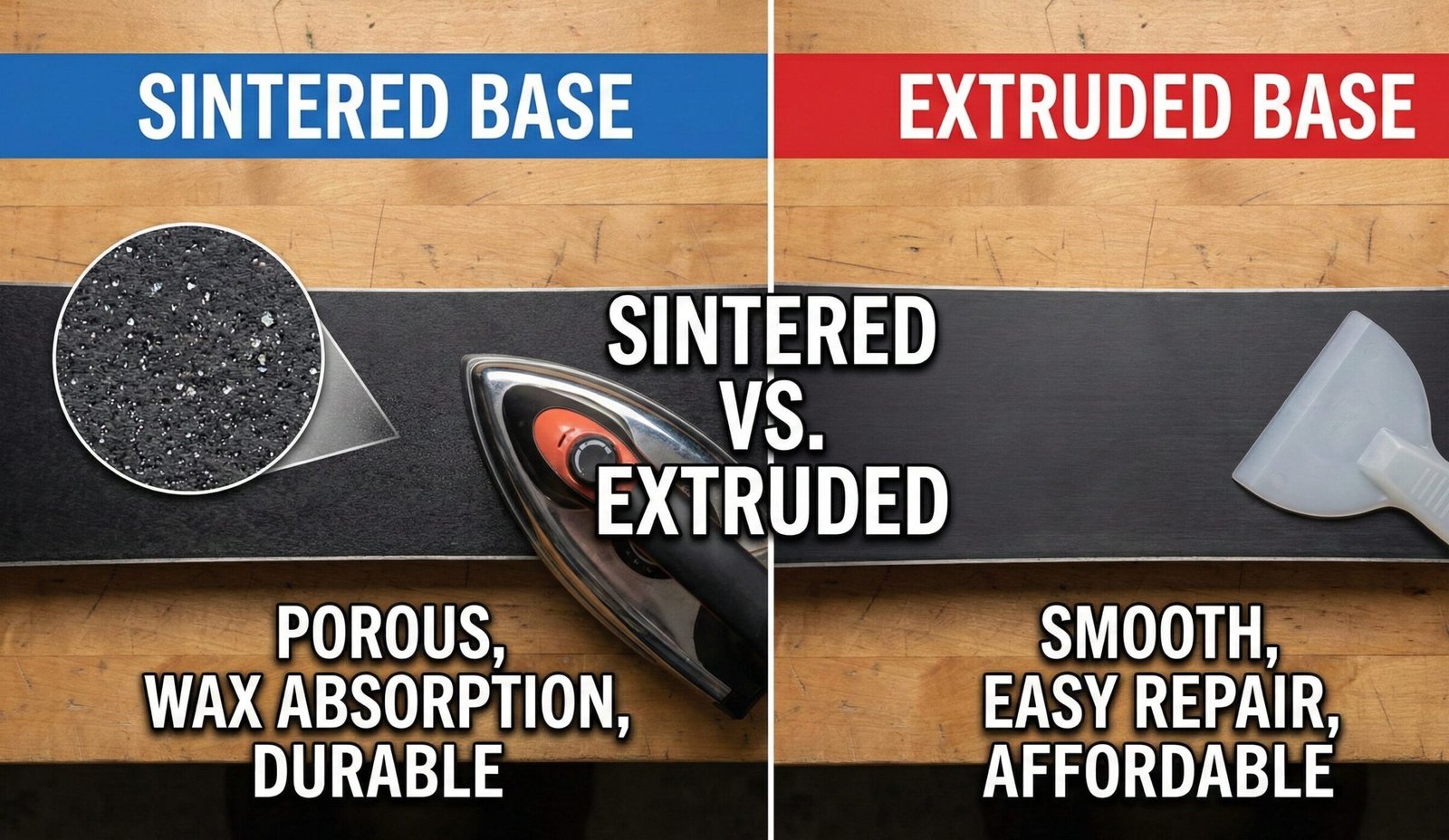
Sintered vs. Extruded Base: Which Snowboard is Right for You?
When you are standing in the shop, staring at the wall of graphics, or browsing online trying to decide when is the best time to buy snowboarding gear, you will inevitably encounter two technical terms: Extruded and Sintered. These refer to the construction of the snowboard’s base—the P-Tex material that actually touches the snow.
It sounds like a minor detail compared to the board’s shape or flex, but your base material dictates your speed, your durability, and, most importantly, how much maintenance you need to do. Choosing the wrong one can lead to frustration on the flats or unexpected repair bills.
The Quick Answer:
Extruded bases are durable, low-maintenance, and cheaper to repair, making them ideal for beginners and park riders who hit rails. Sintered bases are porous, holding more wax for superior speed and glide, but they are more expensive and require frequent waxing to perform. If you hate getting stuck on cat tracks, go Sintered. If you hate waxing your board, go Extruded.
The Science of P-Tex: How They Are Made
Both bases are made from Polyethylene pellets (often referred to as P-Tex), but the manufacturing process creates two very different molecular structures. Understanding this helps explain how expensive snowboarding is when comparing entry-level gear to pro-level decks.
Extruded Bases: Melt and Cut
Imagine taking plastic pellets, melting them into a liquid goo, and spreading it out into a flat sheet. That is essentially an extruded base. It is a solid, non-porous sheet of plastic.
- Pros: Very tough, waterproof, and cheap to make.
- Cons: Holds very little wax because there are no “pores” for the wax to soak into.
Sintered Bases: Crush and Fuse
Sintering involves taking those same pellets and crushing them together under immense pressure and heat without fully melting them. This fuses the particles but leaves microscopic gaps (pores) between them.
- Pros: The pores absorb wax like a sponge. A well-waxed sintered base is significantly faster than an extruded base.
- Cons: If you don’t wax it, it dries out, oxidizes, and becomes slower than an extruded base.
For a deeper dive into the manufacturing specifics, Burton has an excellent breakdown of sintered vs. extruded materials.
Performance on the Mountain
How does this translate to your actual riding? It affects everything from how you clear jumps to how much energy you use.
1. Speed and Glide
If you have ever wondered why snowboarding is fun, it’s the sensation of effortless glide. A sintered base provides this. On warm slushy days or freezing cold powder days, a waxed sintered base adapts to the friction better. If you are into backcountry snowboarding or riding deep powder, you want a sintered base to keep your momentum up in the deep stuff.
2. Durability and Repairs
This is where extruded bases shine. If you are a park rat hitting metal rails and concrete ledges, you will gouge your base. An extruded base is easier to repair with a P-Tex candle because the repair material bonds easily to the base. Sintered bases are harder (more dense) but more difficult to repair perfectly at home. This durability factor is why many snowboarding resorts for beginners use rental fleets with extruded bases.
| Feature | Extruded Base | Sintered Base |
|---|---|---|
| Speed | Moderate | Fast (if waxed) |
| Wax Retention | Low (Surface only) | High (Absorbs deep) |
| Maintenance | Low (Wax occasionally) | High (Wax every 3-5 days) |
| Durability | High (Easy to repair) | High (Harder to repair) |
| Cost | Affordable | Expensive |
| Best For | Park, Beginners, Jibbing | Freeride, Racing, All-Mountain |
The Maintenance Factor
This is the deciding factor for most riders. Be honest with yourself: Will you actually wax your snowboard?
If you own a sintered board (like the high-performance Capita Mercury or Jones Mountain Twin), you need to commit to the ritual. You should read up on how often you should wax your snowboard. If you let a sintered base dry out, it turns white (base burn), creates drag, and can actually ruin the board over time.
Conversely, an extruded base is forgiving. You can wax it once a month, and it will slide “okay.” It won’t be a rocket ship, but it won’t punish you for neglect. If you don’t know where to start, check our guide on how to wax a snowboard at home.
Essential Gear for Base Care
Regardless of which base you choose, you need the right tools to keep it moving. Here are the top-rated maintenance kits available on Amazon:

Demon Complete Tune Kit
The ultimate kit for Sintered bases. Includes iron, wax, brushes, and P-Tex for repairs.
View on Amazon
XCMAN Waxing Iron
Consistent heat is key for Sintered bases to open the pores without burning the P-Tex.
View on Amazon
Hertel Super Hot Sauce
An all-temperature wax that works wonders on both extruded and sintered bases.
View on AmazonWhich Base Fits Your Style?
The Park Rat / Rail Rider
If you spend your day sliding steel and smashing concrete, go Extruded. You need a base that is cheap to fix. Plus, you don’t need Mach 10 speed to hit a down-flat-down rail. Pair this with some baggy snowboard pants and impact shorts, and you are ready for the streets.
The Weekend Warrior / Beginner
If you ride 5 days a year and don’t want to buy a waxing iron, go Extruded. It’s reliable and low fuss. You can focus on learning basics like how to carve without worrying if your board is hydrated.
The Charger / Powder Hound
If you want to beat your friends to the bottom, ride Colorado steeps, or explore the European Alps, you need Sintered. The speed advantage is undeniable, helping you clear flat sections and traverse across the mountain with ease.
Frequently Asked Questions
Is a sintered base worth the extra money?
Yes, if you are an intermediate to advanced rider. The performance upgrade is noticeable. However, if you are on a budget and looking for budget snowboard bindings and gear, an extruded base saves you money upfront and over time.
Can I use a sintered base in the park?
Absolutely. Many pro-level park boards (like the Yes Jackpot or similar) use sintered bases for speed into big jumps. Just know that repairs will be harder if you catch a nail on a feature.
Does base type affect boot fit?
No. Your base has nothing to do with whether your Vans snowboard boots are true to size. However, a faster base might require more responsive boots to handle the increased speed and G-forces.
Conclusion
The “Sintered vs. Extruded” debate ultimately comes down to a trade-off between performance and convenience. There is no “bad” choice, only the right choice for your specific needs.
If you crave speed and enjoy the ritual of tuning your gear, the sintered route rewards you with an incredible ride. If you prefer a “grab and go” approach or punish your board on rails, the extruded base is your trusty companion. Whatever you choose, ensure your other gear—from your helmet to your goggles—is up to par so you can enjoy the mountain safely.
Understanding Snowboard Base Types in Detail
Now that we’ve covered the basics, let’s dive deeper into each base type and explore everything you need to know about maintaining, repairing, and optimizing your snowboard base. Whether you’re a complete beginner trying to understand what makes your board slide or an experienced rider looking to fine-tune your setup, this comprehensive guide will answer all your questions about snowboard base materials and care.
What Is P-Tex and Why Does It Matter?
P-Tex is a brand name for ultra-high molecular weight polyethylene (UHMWPE), a thermoplastic polymer that has become the industry standard for snowboard and ski bases. The material was originally developed for industrial applications requiring extreme durability and low friction, including artificial hip joints and military-grade armor. When snowboard manufacturers discovered its properties, it revolutionized the sport.
The key properties that make P-Tex ideal for snowboard bases include:
- Low coefficient of friction: P-Tex naturally slides easily over snow, reducing drag and allowing for smooth gliding.
- Impact resistance: The material absorbs impacts from rocks, rails, and other obstacles without cracking or shattering.
- Water resistance: P-Tex is hydrophobic, meaning it repels water and prevents the base from becoming waterlogged.
- Temperature stability: The material maintains its properties across a wide range of temperatures, from sub-zero conditions to warm spring slush.
- Wax compatibility: P-Tex bonds well with wax molecules, allowing the base to absorb and retain wax for enhanced performance.
Understanding P-Tex is crucial because it explains why both extruded and sintered bases share similar fundamental properties while performing differently. The manufacturing process, not the raw material, creates the distinction between these two base types.
Extruded Base: The Complete Breakdown
Extruded P-Tex is created through a process called extrusion, where polyethylene pellets are melted at high temperatures (around 300°F or 150°C) and then forced through a die to create a continuous sheet. This molten plastic is then cooled and cut to the appropriate thickness for snowboard bases.
The resulting material has several characteristics that make it ideal for certain types of riding:
Surface Texture: Extruded bases have a smooth, glossy surface with minimal texture. While this might seem ideal for speed, the lack of porous structure actually limits wax absorption. The wax sits on top of the base rather than penetrating into it, which means it wears off more quickly during riding.
Durability Profile: One of the biggest advantages of extruded bases is their resilience. When you hit a rock or rail, the base tends to gouge rather than tear. These gouges are relatively easy to repair because the P-Tex repair material bonds well with the extruded surface. The repair process is straightforward and can be done at home with basic tools.
Cost Effectiveness: Extruded bases are significantly cheaper to produce than sintered bases. This cost savings is passed on to the consumer, making extruded-base snowboards more affordable. For beginners or casual riders who don’t need maximum performance, this price difference can be substantial.
Maintenance Requirements: Extruded bases are forgiving when it comes to maintenance. While regular waxing is still recommended for optimal performance, an unwaxed extruded base will still slide reasonably well. This makes them ideal for riders who don’t want to spend time on regular maintenance or who ride infrequently.
Common Applications: You’ll find extruded bases on most beginner and intermediate snowboards, rental equipment, park-specific boards, and budget-friendly models. They’re also popular with riders who frequently damage their bases on rails and features.
Sintered Base: The Complete Breakdown
Sintered P-Tex is created through a process called sintering, where polyethylene pellets are compressed under extreme pressure (around 30,000 PSI) and heat (around 200°F or 93°C) without fully melting. This causes the pellets to bond together while maintaining their individual crystalline structure, creating microscopic gaps between the particles.
These microscopic pores are what give sintered bases their superior performance characteristics:
Wax Absorption: The porous structure of sintered bases allows wax to penetrate deep into the material rather than just sitting on the surface. This means the wax lasts longer and provides consistent performance throughout your riding day. A well-waxed sintered base can maintain its speed for 8-10 hours of riding, compared to 2-3 hours for an unwaxed sintered base.
Speed Potential: When properly waxed, sintered bases are significantly faster than extruded bases. The wax fills the pores and creates a smooth, hydrophobic surface that reduces friction with the snow. Professional racers and advanced riders who prioritize speed almost exclusively choose sintered bases.
Structure and Grinding: Sintered bases can be stone-ground to create specific structure patterns that optimize performance for different snow conditions. These structures help channel water away from the base, reducing suction and improving glide. The ability to fine-tune the base structure is a significant advantage for competitive riders.
Temperature Sensitivity: Sintered bases perform better across a wider range of temperatures when properly waxed. The deep wax absorption allows the base to adapt to changing snow conditions, from icy groomers to warm spring slush.
Durability Considerations: While sintered bases are harder and more dense than extruded bases, they can be more difficult to repair. The porous structure means that repair materials don’t always bond as well, and deep gouges may require professional attention. Additionally, sintered bases can become brittle if not properly maintained, especially in extremely cold conditions.
How to Wax Your Snowboard: Complete Step-by-Step Guide
Whether you have an extruded or sintered base, regular waxing is essential for maintaining your snowboard’s performance. Here’s a comprehensive guide to waxing your snowboard at home, including tips for both base types.
What You’ll Need
Before you begin, gather the following supplies:
- Waxing iron: A dedicated waxing iron with temperature control (not a household iron)
- Snowboard wax: Choose the appropriate wax for your riding conditions
- Scraper: A plastic scraper for removing excess wax
- Brushes: Nylon, horsehair, and copper brushes for different stages of the process
- Base cleaner: To remove old wax and contaminants before applying new wax
- Rags or paper towels: For cleaning and buffing
- Drop cloth or newspaper: To protect your workspace
Step 1: Clean the Base
Start by removing any old wax, dirt, or contaminants from the base. Apply base cleaner to a rag and wipe down the entire base, paying special attention to areas with visible wax buildup or dirt. For stubborn residue, you may need to use a scraper gently. Allow the cleaner to dry completely before proceeding.
Step 2: Prepare the Wax
Cut your wax into small pieces or shave it using the edge of your iron. This will make it easier to melt and distribute evenly. If you’re using temperature-specific wax, choose the appropriate formula for the current conditions:
- Cold wax (below 20°F / -6°C): Harder formula for icy conditions
- All-temperature wax (20-32°F / -6 to 0°C): Versatile option for most conditions
- Warm wax (above 32°F / 0°C): Softer formula for spring conditions
Step 3: Apply the Wax
Set your waxing iron to the temperature recommended on the wax packaging (usually between 250-300°F or 120-150°C). Hold the wax against the iron and let it drip onto the base in a zigzag pattern, covering the entire surface. Then, use the iron to spread the wax evenly across the base, moving in smooth, consistent strokes from tip to tail.
Important Tips:
- Keep the iron moving to avoid overheating any single area
- Apply enough wax to create a thin, even layer (about 1-2mm thick)
- For sintered bases, you may want to apply a slightly thicker layer to ensure deep penetration
- Avoid getting wax on the edges or top sheet
Step 4: Let It Cool
Allow the wax to cool completely for at least 20-30 minutes. For best results, some riders prefer to let the wax cure overnight, especially with sintered bases. This allows the wax to fully penetrate the pores and bond with the base material.
Step 5: Scrape the Wax
Using your plastic scraper, remove the excess wax by scraping from tip to tail. Hold the scraper at a 45-degree angle and apply firm, even pressure. You should see curls of wax coming off the base. Continue scraping until no more wax comes off easily.
Step 6: Brush and Buff
Start with a nylon brush to remove any remaining wax from the base structure. Follow with a horsehair brush to polish the base and remove fine wax particles. Finally, use a copper brush for sintered bases to help open the pores and prepare the base for riding.
Buff the base with a soft rag or paper towel to remove any remaining residue. The base should feel smooth and look slightly glossy when you’re finished.
Step 7: Test the Results
Run your hand along the base from tip to tail. It should feel smooth and slightly tacky (this indicates the wax is properly applied). You can also perform the “drip test” by placing a few drops of water on the base—if they bead up and roll off easily, your wax job is successful.
How Often Should You Wax Your Snowboard?
The frequency of waxing depends on several factors, including your base type, riding style, and conditions. Here’s a general guideline:
Extruded Base Waxing Schedule
- Casual riders (5-10 days per season): Wax once at the beginning of the season and touch up every 3-4 days of riding
- Regular riders (15-25 days per season): Wax every 5-7 days of riding
- Aggressive riders (30+ days per season): Wax every 3-5 days of riding
Sintered Base Waxing Schedule
- Casual riders (5-10 days per season): Wax every 2-3 days of riding for optimal performance
- Regular riders (15-25 days per season): Wax every 2-3 days of riding
- Aggressive riders (30+ days per season): Wax every 1-2 days of riding, or use a race wax that lasts longer
Signs Your Base Needs Waxing:
- The base looks white or dry (base burn)
- Your board feels slower than usual
- Water doesn’t bead up on the base
- You’re struggling to maintain speed on flats
- The base feels rough to the touch
Snowboard Base Repair: Complete Guide
Even with careful riding, your snowboard base will eventually need repairs. Here’s how to handle common base damage:
Types of Base Damage
Minor Scratches: Superficial scratches that don’t penetrate the base material are mostly cosmetic and don’t affect performance. These can be ignored or filled with a quick wax job.
Deep Gouges: Scratches that penetrate deep into the base material but don’t reach the core. These should be repaired to prevent water infiltration and further damage.
Core Shots: Damage that penetrates all the way through the base to the wood core. These require immediate repair to prevent water damage to the core, which can cause delamination and ruin the board.
Edge Damage: Dings, cracks, or bends in the metal edges. While not technically base damage, edge repairs are often done in conjunction with base repairs.
How to Repair Minor Scratches
- Clean the damaged area with base cleaner
- Use a P-Tex candle or drip gun to fill the scratch
- Allow the repair to cool completely
- Scrape flush with the surrounding base
- Brush and buff to blend the repair
How to Repair Deep Gouges
- Clean the damaged area thoroughly
- Use a P-Tex candle or drip gun to fill the gouge, building up slightly above the surrounding base
- For extruded bases, the repair material will bond well and can be scraped flush
- For sintered bases, you may need to use a special repair material designed for porous bases
- Allow the repair to cure completely (24 hours recommended)
- Scrape, sand, and buff the repair to match the surrounding base
How to Repair Core Shots
Core shots are serious damage that should be repaired immediately to prevent water damage:
- Dry the damaged area completely (use a hair dryer on low heat if necessary)
- Apply a thin layer of epoxy to seal the wood core
- Allow the epoxy to cure completely
- Fill the remaining cavity with P-Tex repair material
- Build up the repair slightly above the surrounding base
- Allow to cure for 24-48 hours
- Scrape, sand, and buff to match the surrounding base
Pro Tip: For critical repairs or if you’re not confident in your skills, take your board to a professional repair shop. The cost of a professional repair is often less than the cost of ruining your board with a bad repair.
Snowboard Base Structure: What You Need to Know
Base structure refers to the pattern of fine grooves ground into the base surface. These grooves help channel water away from the base, reducing suction and improving glide. Understanding base structure is important for optimizing your board’s performance in different conditions.
Types of Base Structures
Linear Structure: Fine grooves running from tip to tail. This is the most common structure and works well in a variety of conditions. Linear structure helps channel water straight back, reducing drag and improving straight-line speed.
Cross Structure: A combination of linear and perpendicular grooves. This structure is designed for wet or slushy conditions, where the cross-hatch pattern helps break surface tension and prevent suction.
Structured vs. Flat: A structured base (with grooves) generally performs better than a completely flat base, especially in variable conditions. The grooves create channels for water to escape, preventing the “suction cup” effect that can slow you down.
Stone Grinding: Professional stone grinding uses a precision machine to create consistent, uniform structures in the base. This process is typically done at the factory but can be repeated to refresh the base structure or customize it for specific conditions.
Choosing the Right Structure
The optimal base structure depends on the conditions you’ll be riding in:
- Cold, dry snow: Fine linear structure or no structure (flat)
- Warm, wet snow: Coarser linear or cross structure
- Variable conditions: Medium linear structure
- Racing: Very fine structure for maximum speed
Snowboard Base Temperature and Performance
Temperature plays a crucial role in how your snowboard base performs. Understanding the relationship between temperature, wax, and base material will help you optimize your setup for any conditions.
How Temperature Affects Base Performance
Cold Temperatures (Below 20°F / -6°C): Snow crystals are harder and more abrasive in cold conditions. The base needs a harder wax that can resist abrasion while maintaining a low friction coefficient. Cold wax is typically formulated with harder hydrocarbons that bond well with the base material in these conditions.
Medium Temperatures (20-32°F / -6 to 0°C): This is the most common temperature range for snowboarding. All-temperature waxes work well here, providing a good balance of durability and glide. The snow is neither too abrasive nor too wet, allowing for consistent performance.
Warm Temperatures (Above 32°F / 0°C): In warm conditions, snow becomes wet and slushy. The water film between the base and snow can create suction, slowing you down. Warm waxes are formulated to be hydrophobic, repelling water and preventing suction. They’re also softer, which helps them maintain their properties in the higher temperatures.
Base Material and Temperature
Extruded Bases: Extruded bases perform consistently across a wide temperature range because they don’t rely on wax absorption for their basic performance. However, they still benefit from appropriate waxing to optimize glide in specific conditions.
Sintered Bases: Sintered bases are more sensitive to temperature because their performance depends on wax absorption. Using the wrong wax for the conditions can result in poor performance, even with a high-quality sintered base. Always match your wax to the current temperature range.
Snowboard Base Color and Design
While base color doesn’t affect performance, it can influence how your board looks and how visible it is in certain conditions. Here’s what you need to know about base aesthetics:
Does Base Color Affect Performance?
No, base color has no impact on performance. The color is purely aesthetic and is achieved through pigments added to the P-Tex during manufacturing. Whether your base is black, white, or a bright neon color, it will perform the same way (assuming the same base material and construction).
Visibility Considerations
Some riders prefer lighter-colored bases because they’re easier to see in flat light or when the board is buried in powder. Bright colors or high-contrast designs can also make your board more visible to other riders, which can be a safety consideration in crowded conditions.
Graphics and Branding
Base graphics are an important part of snowboard design and branding. Many manufacturers use the base as a canvas for bold graphics, logos, or artwork. While these don’t affect performance, they can be a factor in your purchasing decision if aesthetics are important to you.
Carbon Fiber and Advanced Base Materials
In recent years, snowboard manufacturers have begun incorporating advanced materials into their bases to enhance performance. Here’s a look at some of the most common innovations:
Carbon Fiber Bases
Some high-end snowboards feature bases with carbon fiber reinforcement. The carbon fiber adds stiffness and responsiveness without significantly increasing weight. These bases are typically found on race-oriented or high-performance all-mountain boards.
Graphite-Infused Bases
Graphite is sometimes added to the P-Tex to reduce static electricity and improve glide. The graphite particles create a more slippery surface, which can be beneficial in cold, dry conditions. Graphite bases are common on race skis and some premium snowboards.
UHMWPE Variations
Manufacturers continue to develop new variations of UHMWPE with enhanced properties. Some newer formulations offer improved wax absorption, greater durability, or better temperature stability. While these innovations are promising, the fundamental differences between extruded and sintered bases remain the primary consideration for most riders.
Snowboard Base Edge and Bevel
The edge of your snowboard base plays a crucial role in carving, stopping, and overall control. Understanding base edge and bevel will help you optimize your board’s performance.
What Is Base Edge Bevel?
Base edge bevel refers to the angle at which the base edge is ground relative to the base surface. Most snowboards come with a factory bevel of 1-2 degrees, which provides a good balance of edge hold and forgiveness.
Types of Base Bevel
- 0-degree bevel (flat): Maximum edge contact with the snow, providing aggressive edge hold. This setup is unforgiving and can catch edges easily, making it suitable only for advanced riders or racing.
- 1-degree bevel: The most common setup for all-mountain riding. Provides good edge hold while remaining forgiving enough for intermediate riders.
- 2-degree bevel: More forgiving setup that reduces the chance of catching edges. Ideal for beginners, park riders, and riders who prefer a looser feel.
- 3+ degree bevel: Very forgiving setup that significantly reduces edge catch. Common on park boards and jib-specific setups.
Adjusting Your Base Bevel
Base bevel can be adjusted using a diamond stone or base file. However, be cautious when modifying your base bevel, as removing too much material can damage the edge. If you’re not confident in your ability to adjust bevel, take your board to a professional shop.
Stone Grinding: What It Is and When You Need It
Stone grinding is a maintenance process that refreshes the base structure and removes minor damage. Here’s what you need to know about this important service:
What Is Stone Grinding?
Stone grinding uses a precision machine with a rotating stone to shave a thin layer of material from the base surface. This process removes minor scratches, refreshes the base structure, and restores the base to like-new condition.
When Do You Need Stone Grinding?
- End of season: A stone grind at the end of the season removes any accumulated damage and prepares the base for storage.
- Start of season: A stone grind at the start of the season ensures your base is fresh and ready for the new season.
- After significant damage: If your base has accumulated many scratches or gouges, a stone grind can restore it to smooth condition.
- Before applying structure: If you want to change your base structure for specific conditions, stone grinding provides a clean slate.
Stone Grinding Frequency
For most recreational riders, one stone grind per season is sufficient. Aggressive riders or those who ride frequently may benefit from stone grinding every 50-100 days of riding. Racing or high-performance riders may stone grind more frequently to maintain optimal base structure.
Snowboard Base Repair Cost
Understanding the cost of base repairs can help you decide whether to repair damage yourself or take your board to a professional shop.
DIY Repair Costs
- P-Tex candles: $5-10 for a pack of multiple candles
- P-Tex drip gun: $20-40 for a reusable tool
- Base cleaner: $10-15 for a bottle
- Scraper and brushes: $20-30 for a complete set
Professional Repair Costs
- Minor scratch repair: $10-20 per scratch
- Deep gouge repair: $20-40 per gouge
- Core shot repair: $40-80 per repair
- Full base grind: $30-50
- Complete tune-up: $50-100 (includes edge sharpening, base grind, and wax)
Cost-Benefit Analysis:
For minor damage, DIY repairs are usually more cost-effective. However, for serious damage like core shots or extensive base damage, professional repairs may be worth the investment to ensure the repair is done correctly and doesn’t void your warranty.
Snowboard Base Delamination: Prevention and Repair
Base delamination occurs when the base separates from the core or other layers of the snowboard. This is a serious issue that can ruin your board if not addressed promptly.
Causes of Delamination
- Water infiltration: The most common cause. Water enters through a core shot or damaged edge and freezes, expanding and forcing the layers apart.
- Impact damage: Severe impacts can cause the layers to separate, especially if the impact occurs near the edge of the base.
- Manufacturing defects: Rare, but possible. Poor bonding during the manufacturing process can lead to delamination over time.
- Temperature extremes: Repeated cycles of extreme cold and warm temperatures can stress the bonds between layers.
Signs of Delamination
- Bubbles or bulges in the base: Visible raised areas that indicate separation between layers
- Hollow sound: Tapping the base produces a hollow sound instead of a solid thud
- Visible separation: In severe cases, you can see the layers pulling apart
- Reduced performance: The board feels less responsive or “dead” compared to normal
Preventing Delamination
- Repair core shots immediately: Don’t let water reach the core
- Store your board properly: Keep it in a cool, dry place away from extreme temperatures
- Avoid prolonged water exposure: Don’t leave your board sitting in wet conditions
- Inspect regularly: Check for signs of damage before each ride
Repairing Delamination
Minor delamination can sometimes be repaired with epoxy, but serious delamination usually requires professional attention or may be unrepairable. If you notice signs of delamination, take your board to a professional shop as soon as possible to assess the damage and determine the best course of action.
Snowboard Base Camber and Rocker Profiles
While base material determines speed and durability, the base profile (camber, rocker, or hybrid) affects how the board interacts with the snow. Understanding these profiles helps you choose the right board for your riding style.
Camber Profile
Traditional camber features an upward curve in the center of the board, with the contact points near the tip and tail. When weighted, the board flattens, providing even edge contact and powerful energy return. Camber boards offer excellent edge hold, pop, and precision, making them ideal for carving, freestyle, and aggressive all-mountain riding.
Rocker Profile
Rocker (or reverse camber) features a downward curve in the center, with the contact points moved toward the center of the board. Rocker boards are more forgiving, float better in powder, and are less likely to catch edges. They’re popular with beginners, park riders, and powder enthusiasts.
Hybrid Profiles
Many modern boards use hybrid profiles that combine camber and rocker elements. Common hybrid profiles include:
- Camber-Rocker-Camber: Rocker between the feet with camber underfoot. Provides a balance of forgiveness and edge hold.
- Rocker-Camber-Rocker: Camber between the feet with rocker at the tip and tail. Offers float in powder with edge hold on groomers.
- Flat-Rocker: Flat section between the feet with rocker at the tip and tail. Provides stability with forgiveness.
Choosing Between Extruded and Sintered: Decision Framework
To help you make the right choice, here’s a decision framework based on your specific needs and priorities:
Choose Extruded If:
- You’re a beginner or intermediate rider
- You ride primarily in the park or on rails
- You don’t want to wax your board frequently
- You’re on a tight budget
- You ride infrequently (less than 10 days per season)
- You prioritize durability over speed
- You want easy, low-cost repairs
Choose Sintered If:
- You’re an intermediate to advanced rider
- You prioritize speed and performance
- You’re willing to wax regularly
- You ride frequently (15+ days per season)
- You ride in varied conditions (powder, groomers, park)
- You want the best possible glide
- You’re competitive or race-oriented
Snowboard Base Maintenance Schedule
Here’s a comprehensive maintenance schedule to keep your base in optimal condition throughout the season:
Before Each Ride
- Visual inspection for damage
- Check edges for burrs or damage
- Quick wipe-down to remove dirt and debris
Every 3-5 Days of Riding
- Apply a coat of appropriate wax
- Check for and repair any new damage
- Brush and buff the base
Every 10-15 Days of Riding
- Full tune-up (edge sharpening, base repair, wax)
- Inspect base structure
- Check for signs of delamination
End of Season
- Full tune-up and stone grind
- Apply a thick coat of storage wax
- Store in a cool, dry place
- Release binding tension
Snowboard Base FAQ: Advanced Questions
Can I mix extruded and sintered wax on my board?
While you can use any wax on any base, it’s not recommended to mix wax types. Different waxes are formulated for different base materials and conditions. Using the wrong wax can reduce performance and potentially damage the base over time. Always use wax designed for your specific base type.
How do I know if my base is extruded or sintered?
The easiest way is to check your board’s specifications or ask the retailer. If you’re looking at an existing board, sintered bases often have a slightly rougher texture when new, while extruded bases are smoother. However, this isn’t always reliable, especially on well-maintained boards.
Does base thickness matter?
Base thickness affects durability and weight. Thicker bases (2-3mm) are more durable and can withstand more damage, but they add weight. Thinner bases (1-2mm) are lighter but more susceptible to damage. Most recreational boards use a base thickness of around 2mm, which provides a good balance of durability and weight.
Can I repair a sintered base with extruded P-Tex?
While it’s possible, it’s not ideal. Sintered and extruded P-Tex have different properties, and using extruded repair material on a sintered base may not bond as well or perform as consistently. For best results, use repair material designed specifically for your base type.
How does altitude affect base performance?
At higher altitudes, the air is thinner and drier, which can affect snow conditions and base performance. The snow tends to be drier and more abrasive, which can wear down wax more quickly. At high altitudes, you may need to wax more frequently and use harder wax formulations to maintain optimal performance.
The Future of Snowboard Base Technology
Snowboard base technology continues to evolve, with manufacturers exploring new materials and processes to improve performance. Here are some trends to watch:
Nano-Wax Technology
Some companies are developing nano-particle waxes that can penetrate deeper into the base material and last longer than traditional waxes. These formulas promise to extend the time between waxing while maintaining or improving performance.
Fluorocarbon-Free Waxes
Due to environmental concerns, the industry is moving away from fluorocarbon-based waxes toward more environmentally friendly alternatives. These new formulas aim to match the performance of fluorocarbon waxes without the environmental impact.
3D-Printed Bases
Some manufacturers are experimenting with 3D-printed bases that can be customized for specific conditions or riding styles. While still in the early stages, this technology could revolutionize base design by allowing for complex structures and materials that are impossible with traditional manufacturing.
Sustainable Materials
As sustainability becomes increasingly important, manufacturers are exploring bio-based and recycled materials for snowboard bases. These materials aim to reduce environmental impact while maintaining the performance characteristics riders expect.
How to Store Your Snowboard Properly
Proper storage is essential for maintaining your base’s condition between seasons. Here’s how to store your snowboard correctly:
End-of-Season Storage Checklist
- Clean the base: Remove all dirt, wax residue, and contaminants
- Apply storage wax: Apply a thick coat of warm-temperature wax without scraping it off. This protects the base from oxidation and moisture during storage
- Loosen bindings: Release the tension on your binding screws to prevent damage to the board’s core
- Choose the right location: Store your board in a cool, dry place away from direct sunlight, heat sources, and extreme temperatures
- Use a board bag: If possible, store your board in a padded bag to protect it from accidental damage
- Store vertically or horizontally: Both orientations are acceptable, but avoid leaning the board against a wall at an angle, which can cause warping over time
What NOT to Do When Storing
- Don’t store in direct sunlight: UV rays can damage the base material and fade graphics
- Don’t store near heat sources: Heaters, fireplaces, or cars can cause the base to warp or the wax to melt
- Don’t store in wet conditions: Moisture can cause rust on edges and damage to the base
- Don’t leave bindings tight: This can create pressure points and potentially damage the board’s core
- Don’t store with heavy objects on top: This can cause warping or damage to the base
Common Snowboard Base Myths Debunked
There are many misconceptions about snowboard bases. Let’s separate fact from fiction:
Myth: Darker bases are faster
Fact: Base color has no effect on speed. A well-waxed white base will outperform an unwaxed black base every time. Performance depends on base material, wax quality, and maintenance—not color.
Myth: You should never wax a new board
Fact: While new boards come with a factory wax, it’s often a cheap, temporary application. Most experts recommend applying your own wax before your first day riding to ensure optimal performance from the start.
Myth: More wax is always better
Fact: Applying too much wax without properly scraping and brushing it off can actually create drag and reduce performance. The goal is a thin, even layer that’s properly bonded to the base—not a thick coating sitting on top.
Myth: Sintered bases are always faster
Fact: A sintered base is only faster than an extruded base when it’s properly waxed. An unwaxed sintered base can actually be slower than a waxed extruded base because the dry pores create friction and drag.
Myth: You can’t repair base damage at home
Fact: Most base repairs can be done at home with basic tools and materials. While professional repairs are recommended for serious damage, minor scratches and gouges are well within the scope of DIY maintenance.
Myth: Base structure doesn’t matter for recreational riders
Fact: While competitive riders benefit most from customized base structure, recreational riders can also notice performance differences. A properly structured base provides better glide and control in various conditions.
Snowboard Base Care in Different Snow Conditions
Different snow conditions require different approaches to base care. Here’s how to optimize your base for various conditions:
Powder Days
In deep powder, your base needs maximum glide to stay afloat. Use a warm-temperature wax that creates a hydrophobic surface, helping your board plane on top of the snow rather than sinking. Sintered bases excel in powder because their wax absorption provides consistent glide even in deep, dry snow.
Icy Conditions
On ice, your base needs to be as smooth as possible to maintain contact with the hard surface. A cold-temperature wax helps reduce friction on ice, while a well-maintained base structure prevents suction. Edge tuning is particularly important in icy conditions—make sure your edges are sharp and properly beveled.
Spring Slush
Warm, wet spring snow creates a lot of friction as the water film between your base and the snow creates suction. Use a warm-temperature wax with good water repellency to minimize this effect. Cross-structure on sintered bases can also help break surface tension and prevent suction.
Variable Conditions
When you’re riding a mix of powder, groomers, and crud, an all-temperature wax provides the best balance of performance across conditions. Focus on keeping your base smooth and well-maintained rather than trying to optimize for any single condition.
Man-Made Snow
Man-made snow is often more abrasive than natural snow, which can wear down wax more quickly. In these conditions, use a harder wax formulation and plan to wax more frequently to maintain optimal performance.
The Environmental Impact of Snowboard Bases
As outdoor enthusiasts, it’s important to consider the environmental impact of our gear. Here’s what you need to know about the environmental aspects of snowboard bases:
P-Tex Production
P-Tex is a petroleum-based product, and its production has environmental implications. However, the durability of snowboard bases means they don’t need to be replaced frequently, which helps offset the environmental cost of production.
Wax Environmental Considerations
Traditional snowboard waxes often contain fluorocarbons, which are persistent organic pollutants. The industry is moving toward more environmentally friendly wax alternatives, including plant-based and fluorocarbon-free formulas. When choosing wax, consider the environmental impact of the product.
Recycling and Disposal
Snowboard bases are difficult to recycle due to the composite nature of the board. When your board reaches the end of its life, look for recycling programs that specialize in sporting goods. Some manufacturers offer take-back programs for old equipment.
Extending Board Life
The most environmentally friendly approach is to extend the life of your equipment through proper maintenance and repair. By taking care of your base, you can significantly extend the life of your snowboard, reducing waste and the need for replacement.
Snowboard Base Maintenance Tools: Complete Guide
Having the right tools makes base maintenance easier and more effective. Here’s a comprehensive guide to the tools you’ll need:
Essential Tools
- Waxing iron: A dedicated iron with temperature control for applying wax
- Plastic scraper: For removing excess wax after it cools
- Nylon brush: For removing wax from the base structure
- Horsehair brush: For polishing and finishing the base
- Copper brush: For sintered bases, helps open pores and remove contaminants
- Base cleaner: For removing old wax and contaminants before re-waxing
Advanced Tools
- P-Tex drip gun: For precise application of repair material
- File guide: For adjusting edge bevel
- Diamond stone: For deburring and polishing edges
- Gummy stone: For removing rust and fine-tuning edges
- Base structure tool: For adding structure to the base (advanced use)
Tool Maintenance
Keep your tools in good condition for best results:
- Clean your brushes regularly to remove wax buildup
- Keep your scraper sharp and free of nicks
- Store your iron clean and dry to prevent rust
- Replace worn or damaged tools as needed
Understanding Snowboard Base Wax Types
Not all waxes are created equal. Here’s a breakdown of the different types of snowboard wax available:
Hydrocarbon Wax
The most common and affordable type of wax. Hydrocarbon waxes are made from petroleum-based products and provide good all-around performance. They’re easy to apply and remove, making them ideal for recreational riders.
Fluorocarbon Wax
Contains fluorinated compounds that provide excellent water repellency. Fluorocarbon waxes are faster than hydrocarbon waxes, especially in wet conditions. However, they’re more expensive and have environmental concerns due to the persistence of fluorocarbons in the environment.
Graphite Wax
Contains graphite particles that reduce static electricity and improve glide. Graphite waxes are particularly effective in cold, dry conditions and are popular with racing and high-performance riders.
All-Temperature Wax
A versatile option that performs well across a range of temperatures. All-temperature waxes are a good choice for riders who don’t want to switch waxes frequently or who ride in variable conditions.
Temperature-Specific Wax
Formulated for specific temperature ranges (cold, medium, or warm). These waxes provide optimized performance for their target conditions but require more attention to match the wax to the current temperature.
Race Wax
High-performance waxes designed for competitive racing. Race waxes often combine multiple technologies (fluorocarbon, graphite, nano-particles) for maximum speed. They’re expensive but provide measurable performance advantages.
Snowboard Base Repair: Professional vs. DIY
Knowing when to repair your base yourself and when to seek professional help can save you time and money:
DIY Repairs
DIY repairs are appropriate for:
- Minor scratches and surface damage
- Small gouges that don’t reach the core
- Routine maintenance and waxing
- Edge deburring and minor tuning
Professional Repairs
Seek professional help for:
- Core shots that expose the wood core
- Delamination or structural damage
- Major edge damage or bends
- Stone grinding and base structure work
- Warranty claims or complex repairs
Finding a Good Repair Shop
Look for repair shops that:
- Specialize in snowboard or ski repair
- Use quality materials and tools
- Have experience with your board’s brand and construction
- Offer warranties on their work
- Can explain what they’re doing and why
Snowboard Base Care for Different Riding Styles
Your riding style significantly impacts how your base wears and what maintenance it needs. Here’s a detailed breakdown of base care for different types of riders:
Park and Freestyle Riding
Park riders subject their bases to extreme abuse from rails, boxes, and concrete features. Here’s how to care for your base if you spend your days in the terrain park:
- Choose extruded bases: The durability and ease of repair make extruded bases ideal for park riding
- Inspect frequently: Check your base after every session for new damage
- Repair promptly: Fill gouges quickly to prevent water infiltration
- Wax regularly: Even extruded bases benefit from wax to maintain glide on features
- Consider base grinds: A stone grind every 20-30 days of park riding can refresh your base
All-Mountain Riding
All-mountain riders encounter varied conditions and need a versatile base setup:
- Either base type works: Choose based on your maintenance commitment and performance priorities
- Temperature-specific wax: Match your wax to the day’s conditions for optimal performance
- Regular maintenance: Wax every 3-5 days of riding for consistent performance
- Edge tuning: Keep edges sharp for variable conditions
- Seasonal stone grind: One stone grind per season keeps your base in top condition
Freeride and Backcountry
Backcountry riders need reliable performance in remote locations:
- Sintered bases preferred: The speed advantage helps in deep powder and on long traverses
- Thorough waxing: Wax before every backcountry trip for maximum reliability
- Carry repair supplies: Bring P-Tex candles and a scraper for field repairs
- Pre-trip inspection: Check your base thoroughly before heading into the backcountry
- Post-trip care: Clean and wax immediately after backcountry sessions to remove debris
Racing and High-Performance
Competitive riders need maximum performance from their bases:
- Sintered bases mandatory: No competitive racer uses extruded bases
- Race-specific wax: Use high-performance waxes designed for competition
- Frequent stone grinding: Professional racers stone grind before every race
- Temperature matching: Match wax precisely to race-day conditions
- Professional tuning: Have your board professionally tuned before重要 competitions
Snowboard Base and Binding Interaction
While your base doesn’t directly interact with your bindings, the overall board setup affects how your base performs. Here’s what you need to know:
Stance Width and Base Wear
Your stance width affects how pressure is distributed across the base. A wider stance distributes weight more evenly, which can reduce wear in the center of the base. A narrower stance concentrates pressure, potentially causing more wear under the bindings.
Binding Mounting and Base Integrity
When mounting bindings, be careful not to over-tighten the screws, as this can create pressure points that affect the base. Use the manufacturer’s recommended torque specifications and check mounting hardware regularly throughout the season.
Boot Size and Base Contact
Larger boots can affect how the board flexes and how the base contacts the snow. If you have large feet, consider a wider board to ensure proper base contact and prevent toe or heel drag, which can affect your riding and potentially damage the base edges.
Snowboard Base in Different Terrain Parks
Different terrain park features affect your base in different ways. Here’s how to protect your base in various park settings:
Rail Parks
Rails are the most damaging feature for snowboard bases. Here’s how to minimize damage:
- Wax before riding: A well-waxed base slides better and sustains less damage
- Choose the right approach: Hit rails with enough speed to slide cleanly without catching
- Inspect after each hit: Check for new damage after each rail session
- Repair immediately: Fill any gouges as soon as possible to prevent water damage
Box Features
Boxes are generally less damaging than rails but still cause wear:
- Maintain speed: Consistent speed prevents the base from catching on the box surface
- Even weight distribution: Keep your weight centered to prevent excessive wear on one area
- Regular maintenance: Wax frequently to maintain glide on box surfaces
Jumps and Kickers
Jumps primarily affect the base through landing impacts:
- Land cleanly: Proper landing technique reduces impact damage to the base
- Check landings: Inspect the base after hard landings for any new damage
- Maintain edges: Sharp edges help you maintain control on approach and landing
Snowboard Base Care for Different Budgets
You don’t need to spend a fortune to maintain your base properly. Here’s how to care for your base at different budget levels:
Budget-Friendly Maintenance
For riders on a tight budget:
- Basic wax kit: A simple iron, scraper, and all-temperature wax ($30-50 total)
- P-Tex candles: Affordable repair material for basic fixes ($5-10)
- DIY learning: Watch tutorials and learn to do basic maintenance yourself
- End-of-season sales: Buy supplies during off-season sales for best prices
Mid-Range Maintenance
For riders willing to invest in better tools:
- Quality waxing iron: A dedicated iron with temperature control ($40-80)
- Complete brush set: Nylon, horsehair, and copper brushes ($30-50)
- Multiple wax types: Cold, all-temperature, and warm waxes ($20-40)
- P-Tex drip gun: More precise repair tool ($20-40)
Premium Maintenance
For riders who want the best:
- Professional-grade iron: High-quality iron with precise temperature control ($80-150)
- Complete tuning kit: Everything you need for full board maintenance ($100-200)
- Race-quality waxes: High-performance waxes for maximum speed ($30-60 per wax)
- Professional tuning: Annual professional tune-up ($50-100)
Snowboard Base Care Across Different Riding Seasons
Different times of the season present unique challenges for base care. Here’s how to adapt your maintenance routine throughout the year:
Early Season (November-December)
Early season conditions often feature man-made snow and variable conditions:
- Stone grind before the season: Start with a fresh, clean base
- Wax for cold conditions: Early season snow is often cold and abrasive
- Frequent inspections: Check for damage from early-season obstacles
- Edge sharpening: Sharp edges help on icy early-season conditions
Peak Season (January-February)
Peak season offers the best conditions but also the most riding:
- Regular waxing: Wax every 3-5 days of riding for consistent performance
- Match wax to conditions: Adjust wax type based on daily conditions
- Prompt repairs: Fix damage quickly to prevent further issues
- Monitor base condition: Watch for signs of wear or base burn
Late Season (March-April)
Late season brings warm temperatures and spring conditions:
- Switch to warm wax: Use softer, warm-temperature wax for slushy conditions
- Wax more frequently: Warm conditions wear wax faster
- Cross-structure: Consider adding cross-structure to prevent suction
- Clean thoroughly: Remove dirt and debris that accumulates in spring conditions
Snowboard Base Care for Different Rider Levels
Different skill levels have different base care needs. Here’s what each level should focus on:
Beginner Riders
Beginners should focus on simplicity and durability:
- Choose extruded bases: Durable and forgiving for learning
- Basic waxing: Wax a few times per season for basic maintenance
- Learn basic repairs: Know how to fill minor scratches
- Professional tune-up: Consider a professional tune-up at season’s end
Intermediate Riders
Intermediate riders can start optimizing their setup:
- Consider sintered bases: If you’re ready for better performance
- Regular waxing: Wax every 5-7 days of riding
- Learn to tune: Basic edge sharpening and base repair
- Match wax to conditions: Start using temperature-specific waxes
Advanced Riders
Advanced riders should focus on optimization:
- Sintered bases: Maximize performance with porous bases
- Frequent waxing: Wax every 2-3 days for consistent performance
- Stone grinding: Annual stone grind for optimal base structure
- Race wax: Consider high-performance waxes for demanding conditions
Professional Riders
Professional riders need meticulous base care:
- Custom base structures: Tailored to specific conditions and events
- Daily waxing: Wax before every session for maximum performance
- Professional tuning: Regular professional maintenance
- Multiple board quiver: Different boards for different conditions
Snowboard Base Care Troubleshooting
Here are solutions to common base care problems:
Problem: Base Looks White and Dry
Solution: This is base burn, caused by lack of wax. Apply a fresh coat of wax, allowing it to soak in for several hours or overnight. For severe cases, you may need to apply multiple coats.
Problem: Wax Won’t Stay on the Base
Solution: The base may be contaminated with dirt or old wax. Clean thoroughly with base cleaner before applying new wax. You may also need to stone grind the base to remove contaminants.
Problem: Base Feels Rough After Waxing
Solution: You likely didn’t scrape and brush thoroughly enough. Re-scrape the base, then brush with nylon and horsehair brushes until smooth.
Problem: Repair Material Won’t Bond to Base
Solution: Make sure the base is clean and dry before applying repair material. For sintered bases, use repair material specifically designed for porous bases. You may need to flame-polish the repair for better adhesion.
Problem: Edges Are Rusting
Solution: Remove rust with a gummy stone or diamond stone, then sharpen the edges. Dry your board thoroughly after riding and store it in a dry location.
Problem: Base Has Deep Gouges
Solution: Clean the gouge thoroughly, then fill with P-Tex repair material. Build up slightly above the surrounding base, then scrape and sand flush when cured.
The Complete Snowboard Base Care Glossary
Here’s a comprehensive glossary of terms related to snowboard bases and maintenance:
- Base burn: White, dry appearance caused by lack of wax
- Base structure: Pattern of grooves ground into the base surface
- Base thickness: The measurement of the base material, typically 1-3mm
- Bevel: Angle at which the edge is ground relative to the base
- Camber: Traditional upward curve in the center of the board
- Core shot: Damage that penetrates through the base to the wood core
- Cross structure: Perpendicular grooves in the base for wet conditions
- Delamination: Separation of the base from other board layers
- Extruded: Base material created by melting and forming polyethylene
- Gouge: Deep scratch in the base material
- Linear structure: Grooves running from tip to tail
- Nano-wax: Wax containing nano-particles for enhanced performance
- P-Tex: Brand name for UHMWPE base material
- Rocker: Reverse camber profile with downward curve in center
- Sintered: Base material created by compressing polyethylene particles
- Stone grinding: Process of smoothing and structuring the base with a stone
- Structure: Pattern of grooves that help channel water away from base
- UHMWPE: Ultra-high molecular weight polyethylene, the material used in bases
- Wax absorption: The ability of the base to hold wax in its pores
Snowboard Base Care Resources and Further Reading
For more information about snowboard base care, consider these resources:
- Manufacturer websites: Most snowboard manufacturers provide detailed care guides for their products
- Snowboard forums: Online communities where riders share tips and experiences
- YouTube tutorials: Video guides for waxing, repairs, and tuning
- Local shops: Your local snowboard shop can provide personalized advice and services
- Snowboard magazines: Published guides and product reviews
Snowboard Base Care in Extreme Weather
Extreme weather conditions require special attention to your snowboard base. Here’s how to handle the most challenging conditions:
Extremely Cold Temperatures (Below -20°F / -29°C)
When temperatures drop well below zero, your base needs special care:
- Use cold-specific wax: Harder wax formulas designed for extreme cold provide the best glide
- Apply extra wax: Cold conditions wear wax faster, so apply a thicker coat
- Check for brittleness: Extremely cold bases can become brittle and more susceptible to damage
- Warm your board gradually: Don’t bring a frozen board directly into a warm room, as rapid temperature changes can cause damage
Windy Conditions
Wind can affect your base performance in several ways:
- Increased evaporation: Wind accelerates wax evaporation, requiring more frequent waxing
- Wind chill effect: Wind chill can make conditions colder than the actual temperature, affecting wax performance
- Debris protection: Wind-blown debris can scratch your base, so inspect frequently
High Humidity Conditions
High humidity affects snow conditions and base performance:
- Wetter snow: High humidity creates wetter snow that can cause suction
- Use warm wax: Warm-temperature wax repels water better in humid conditions
- Cross-structure helps: Base structure with cross-hatch patterns breaks surface tension
- Wax more frequently: Moisture in the air can affect wax performance
UV Exposure and Sun
Strong sunlight can affect your base, especially at high altitudes:
- UV degradation: Prolonged UV exposure can degrade P-Tex over time
- Wax melting: Direct sunlight can soften wax, reducing its effectiveness
- Protect during storage: Keep your board out of direct sunlight when not in use
- Higher altitude consideration: UV radiation is stronger at higher elevations
Snowboard Base Care for Women Riders
While base care fundamentals are the same for all riders, women may have some specific considerations:
Board Selection
Women-specific snowboards are designed with typically lighter weights and different flex patterns in mind. These design differences don’t affect base care requirements, but choosing the right board for your body type and riding style will affect how the base wears over time.
Weight Considerations
Lighter riders may experience different base wear patterns than heavier riders. Lighter riders may find that their bases last longer between repairs, while heavier riders may need to pay more attention to edge wear and base compression.
Boot Size and Board Width
Women typically have smaller feet, which means narrower board widths. This can affect how the base contacts the snow and how edges wear. Ensure your board width is appropriate for your boot size to prevent drag and ensure optimal base performance.
Snowboard Base Care for Youth Riders
Young riders have unique considerations for base care:
Growth Considerations
Children grow quickly, which means they may outgrow their boards before the base wears out. Consider this when investing in high-end base materials—a less expensive board with an extruded base may be more practical for rapidly growing kids.
Learning Curve
Youth riders are often harder on their equipment as they learn. Extruded bases are typically better for beginners because they’re more durable and easier to repair when inevitable learning-related damage occurs.
Parent Maintenance
Many youth riders rely on parents for base maintenance. Learning basic waxing and repair skills will help you keep your child’s board in good condition without frequent shop visits.
Snowboard Base Care for Rental Boards
If you’re renting a snowboard, understanding base care can help you have a better experience:
What to Expect from Rental Bases
Rental boards almost always have extruded bases because they need to withstand abuse from many different riders. These bases are durable and easy to repair, making them ideal for rental fleets.
Inspect Before You Ride
Before heading out, inspect the base for any significant damage that might affect your ride. While minor scratches are normal, deep gouges or core shots should be reported to the rental shop.
Return Condition
Most rental shops expect some wear and tear on their boards. Normal riding damage won’t result in additional charges, but deliberately damaging the board (like riding on rocks) might.
Final Thoughts
Understanding snowboard base types is essential for making an informed purchasing decision and maintaining your board properly. Whether you choose extruded for its durability and low maintenance or sintered for its speed and performance, the key is to match your choice to your riding style and commitment level.
Remember that even the best base material won’t perform well without proper maintenance. Regular waxing, prompt repairs, and proper storage will extend the life of your board and ensure you get the best possible performance from your investment.
The relationship between you and your snowboard base is ongoing. As you progress as a rider, your needs will change, and so will your approach to base care. Start with the basics, learn as you go, and don’t be afraid to experiment with different waxes and maintenance techniques to find what works best for you.
Most importantly, don’t let base maintenance become a burden that keeps you from riding. The goal is to keep your board in good condition so you can enjoy the mountain—not to obsess over every minor scratch or imperfection. A well-maintained base will reward you with better performance, but the most important thing is to get out there and ride.
Whatever base type you choose, the most important thing is to get out there and ride. The best snowboard is the one that gets you on the mountain and having fun. So wax up, strap in, and enjoy the ride!


