
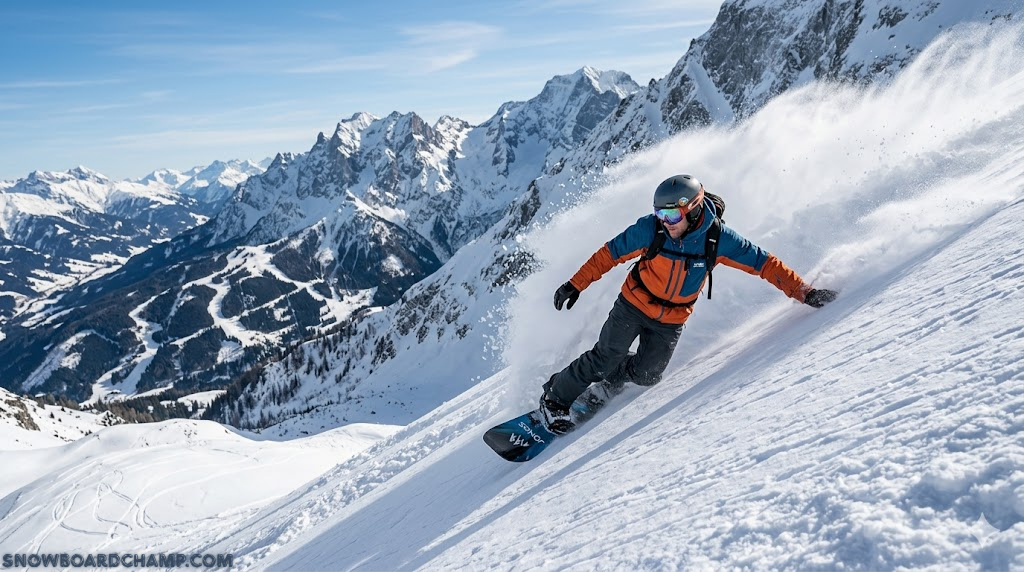
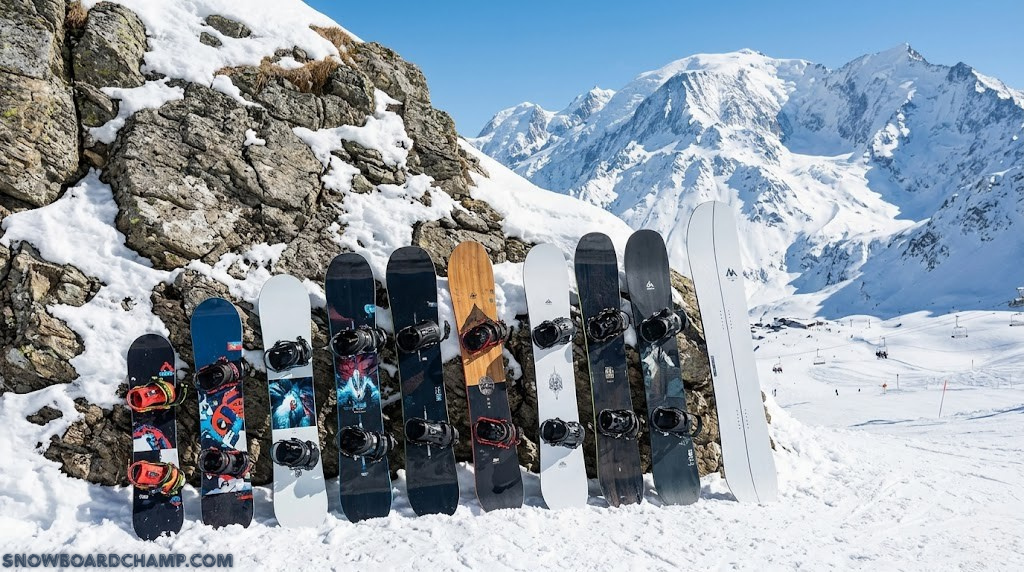
CHOOSING THE RIGHT SNOWBOARD SIZE AFFECTS EVERY CARVE, EVERY TRICK, AND EVERY POWDER FLOAT — GET IT WRONG AND YOU’LL FIGHT YOUR BOARD ALL SEASON.
Walk into any snowboard shop — physical or digital — and you’re immediately confronted with a wall of boards ranging from 138cm to 168cm, stamped with cryptic flex numbers, profile diagrams, and enough technical jargon to fill a physics textbook. Getting the right size isn’t just a formality. It’s the single most important equipment decision you’ll make. A board that’s too long becomes a stubborn, slow-to-turn plank that will physically exhaust a beginner in two runs. A board that’s too short robs an expert carver of the edge hold, stability, and speed they need to charge hard at 40+ mph.
This comprehensive snowboard sizing guide covers everything: length charts by height and weight, waist width versus boot size, flex ratings by riding style and terrain, camber profile effects on feel, junior and women-specific sizing, and the most common mistakes even experienced riders make when shopping for a new board. By the end, you’ll size any board with the same confidence as a professional bootfitter.
Why Snowboard Size Matters More Than You Think
Most beginners assume that snowboard sizing is roughly like shoe sizing — there’s a “right” size and everything else is a bit wrong. In reality, snowboard length is a spectrum, and where you land on that spectrum is a nuanced conversation between your body dimensions, your skill level, the terrain you prefer, and even the specific shape and profile of the board you’re looking at. The same rider might correctly ride a 154cm twin for park, a 158cm all-mountain directional for groomers, and a 160cm powder-rocker for deep snow days.
Understanding why size matters requires a quick look at the physics. Your effective edge — the portion of the edge that contacts the snow during a carved turn — is longer on a longer board. This increases grip, reduces chatter at high speeds, and floats better in powder. The tradeoff is rotational inertia: more board to swing through a spin, more resistance when pivoting through tight trees or park boxes.
Weight is another critical variable that most simplified charts ignore. A 5’10” rider who weighs 210 lbs is going to need a meaningfully longer board than a 5’10” rider who weighs 155 lbs. The lighter rider will float on a shorter board; the heavier rider needs the additional surface area to prevent punching through the snow and the extra stiffness range that comes with more length. Our dedicated height-and-weight sizing chart breaks this down with granular precision for every combination.
The diagram above illustrates why a longer effective edge makes a board more stable — there’s simply more steel biting into the snow at any given moment during a carved turn. But that same length is what makes a short park board so satisfying when you’re trying to butter across a box or pop a 360 off a small kicker. The right length is the right tool for the right job.
Before we dive into the charts, it’s worth reading our overview of how to choose your first snowboard if you’re completely new to the sport — it covers the full decision tree beyond just sizing.
Snowboard Length by Height & Weight
The “chin rule” — the old shorthand that says your board should reach somewhere between your chin and nose when stood on end — is a decent starting point but breaks down badly for riders at weight extremes. A 6’0″ rider who weighs 145 lbs should often ride shorter than their height suggests; a 5’8″ rider who weighs 220 lbs typically needs a board that reaches well above their chin.
The table below gives a comprehensive starting range. The “Light” column applies to riders on the lower end of the average weight for that height, and “Heavy” applies to those on the higher end. When in doubt, lean toward the upper number in the range if you’re primarily a groomer carver, and toward the lower number if you’re a park rider or beginner.
| Rider Height | Light Weight | Avg. Weight | Heavy Weight | Beginner Bias | Expert Bias |
|---|---|---|---|---|---|
| 4’10” (147cm) | <100 lbs | 100–120 lbs | 120+ lbs | 128–133cm | 133–136cm |
| 5’0″ (152cm) | <110 lbs | 110–130 lbs | 130+ lbs | 131–135cm | 135–139cm |
| 5’2″ (157cm) | <120 lbs | 120–145 lbs | 145+ lbs | 133–138cm | 138–142cm |
| 5’4″ (163cm) | <130 lbs | 130–155 lbs | 155+ lbs | 136–141cm | 141–145cm |
| 5’6″ (168cm) | <140 lbs | 140–165 lbs | 165+ lbs | 139–144cm | 144–148cm |
| 5’8″ (173cm) | <150 lbs | 150–175 lbs | 175+ lbs | 142–147cm | 147–152cm |
| 5’10” (178cm) | <160 lbs | 160–185 lbs | 185+ lbs | 148–152cm | 152–156cm |
| 6’0″ (183cm) | <170 lbs | 170–195 lbs | 195+ lbs | 152–155cm | 155–160cm |
| 6’2″ (188cm) | <180 lbs | 180–205 lbs | 205+ lbs | 155–159cm | 159–163cm |
| 6’4″ (193cm) | <195 lbs | 195–220 lbs | 220+ lbs | 159–163cm | 163–168cm |
The Weight Factor in Detail
One of the most underappreciated aspects of sizing is how significantly body weight should shift your target length. Consider two riders, both 5’9″: Rider A weighs 145 lbs and Rider B weighs 205 lbs. Using a generic height chart, both would land around 153–157cm. But Rider A may actually perform better on a 151–153cm board — they’re light enough that a shorter board won’t feel unstable, and the shorter length will allow quicker edge changes. Rider B, however, should be on 157–160cm minimum; they need the surface area and edge hold to prevent the board from chattering aggressively and washing out in firm snow.
This is particularly relevant for heavier riders searching for boards that match their power output. Many high-end boards also list a “recommended rider weight range” in their spec sheet — always check this alongside height.
Skill level also acts as a secondary modifier. A beginner on a board that’s too long will struggle enormously with turn initiation — they simply don’t have the edge-pressure technique to engage a long board efficiently. Most instructors recommend beginners size down 2–4cm from the ideal adult range until they’ve mastered basic linked turns.
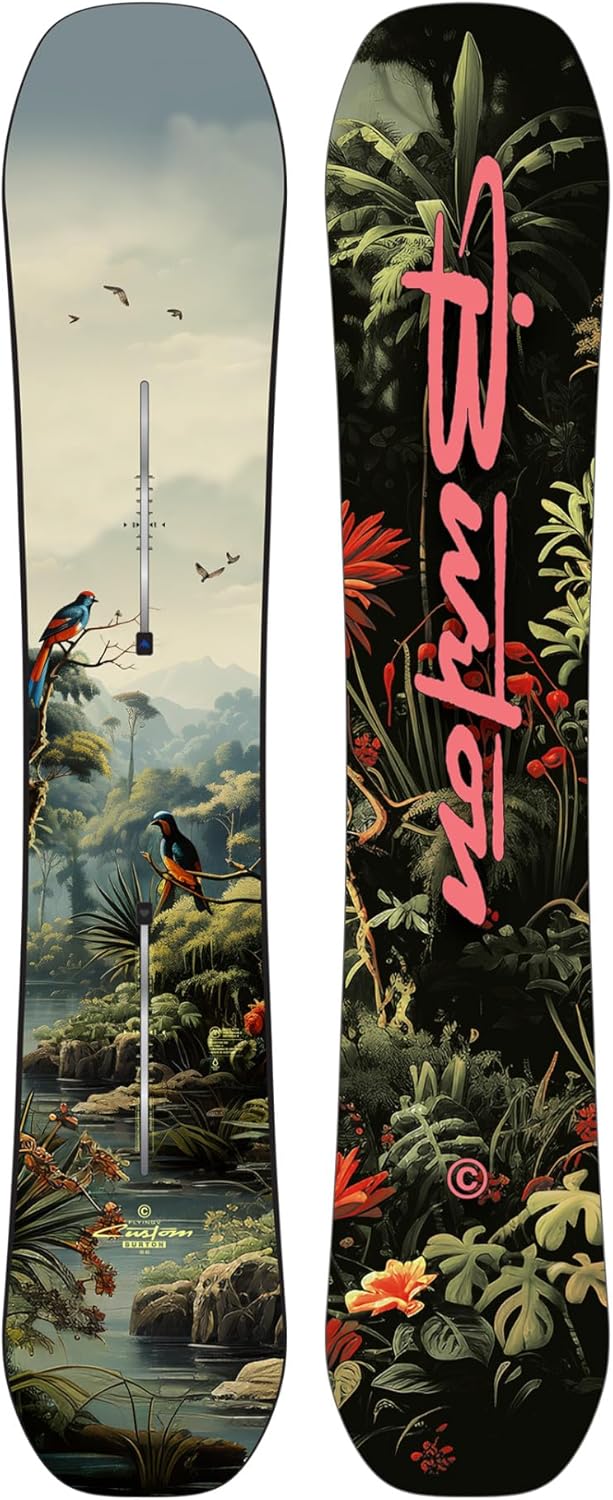
Burton Custom Flying V — Most Versatile All-Mountain
The gold standard for all-mountain riding. Available in sizes 150–162cm to match every height/weight combo in the chart above.
🛒 CHECK PRICE ON AMAZON Affiliate link · juhain-20Snowboard Width: The Boot Size Factor Everyone Gets Wrong
Board length gets all the attention, but waist width may actually be the more critical measurement for rider comfort and safety. The waist width — the narrowest point of the board, measured at the center stance — determines whether your boot overhangs the edge, and how that overhang affects your carving performance.
The goal is to have your toes and heels extend 5–15mm beyond the edge on each side. This “overhang” is intentional and necessary — it allows you to tilt the board onto its edge without your boot hitting the snow before the edge does. Too little overhang (boots too narrow for the board) means sluggish edge response and delayed turns. Too much overhang (greater than ~20mm) means your toe or heel will dig into the snow mid-carve, which causes sudden, dangerous falls — sometimes called “toe drag” or “heel drag.”
Waist Width by Boot Size — The Definitive Chart
| Boot Size (US Men’s) | Boot Size (EU) | Min Waist Width | Ideal Waist Width | Max Before Wide Board | Wide Board Needed? |
|---|---|---|---|---|---|
| 6.0–6.5 | 38–39 | 235mm | 240–246mm | 248mm | No |
| 7.0–7.5 | 39.5–40.5 | 240mm | 244–250mm | 252mm | No |
| 8.0–8.5 | 41–42 | 245mm | 248–254mm | 256mm | No |
| 9.0–9.5 | 42.5–43.5 | 248mm | 251–257mm | 260mm | Borderline |
| 10.0–10.5 | 44–44.5 | 252mm | 255–261mm | 265mm | Often Yes |
| 11.0–11.5 | 45–46 | 256mm | 260–266mm | 270mm | Yes |
| 12.0–12.5 | 46.5–47 | 260mm | 265–272mm | 275mm | Yes, always |
| 13.0+ | 47.5+ | 266mm | 270–278mm | 280mm | Yes, always |
Wide boards (typically 256mm+ waist) are specifically designed for riders with US size 10.5 and larger feet. Brands like Burton, Capita, and Jones offer wide or “wide” variants of their most popular shapes. The Burton Custom Wide, for example, shares its exact profile and flex with the standard Custom but at a waist width that prevents drag for big-footed riders. If you’re experiencing foot pain while snowboarding, width mismatch combined with poor boot fit is often the culprit.
There’s also a lesser-known issue on the other side of the spectrum: riders with very small feet (size 6 or smaller) on wide boards. If your boot is significantly narrower than the board’s waist, your edge response feels mushy and disconnected — you’re physically not reaching the edge efficiently. This is why women’s boards (discussed later) have narrower waists than men’s equivalents at the same length.
Be sure to dial in your stance setup in conjunction with width — your binding angles interact directly with how boot overhang feels underfoot.
Snowboard Flex Rating Explained: From Noodle to Board-Plank
Flex rating is the stiffness of the board, measured on a scale that most manufacturers rate from 1 to 10 (soft to stiff). Some brands use 1–5, others describe it in terms like “soft,” “medium-soft,” “medium,” “medium-stiff,” and “stiff.” Whatever the scale, the underlying physics are the same: flex affects how the board responds to rider input, how forgiving it is of mistakes, and how it performs at different speeds and in different terrain types.
Soft (1–3)
Maximum forgiveness. Ideal for beginners, butter tricks, and park jibbing. Very responsive to light pressure. Washes out at high speed.
Medium-Soft (4–5)
All-mountain freestyle sweet spot. Handles groomed runs and park equally well. Most popular rating for intermediate riders.
Medium-Stiff (6–7)
All-mountain performance territory. Carves crisply, handles variable snow, holds speed. Requires solid technique to ride well.
Stiff (8–10)
Expert carving and freeride boards. Maximum stability at speed. Locks into hard carves. Punishing for beginners or light riders.
Flex and Body Weight: The Critical Interaction
Flex rating is calibrated for a rider of average weight for that category. A 120-lb rider and a 200-lb rider do not experience the same flex rating the same way. Heavier riders “compress” a soft board more easily — what feels like a 5/10 to a 160-lb rider might feel more like a 3/10 to a 220-lb rider because their mass deflects the board further with every flex cycle. This means heavier riders often need to size up in flex to get the same performance feel.
Conversely, lighter riders — and especially women, youth, and smaller adults — are often better served by going softer than the generic recommendation. A stiff board under a light rider doesn’t flex meaningfully, which kills pop, reduces turn initiation feel, and makes the board feel like a plank that doesn’t respond to input. Many top women’s boards are built with softer flex explicitly for this reason, not as a compromise but as an engineering choice.
For riders focused on carving, flex also interacts with the board’s longitudinal flex (tip-to-tail) vs torsional flex (twist across the width). A board can be stiff longitudinally but soft torsionally — this creates a specific carving feel where the board holds a clean arc but the tip can still smear. Understanding these interactions is one of the deeper layers of board selection. For more on carving technique and the boards that enable it, our edge control guide goes deep on this.

Capita DOA — Best All-Mountain Medium Flex
Consistent 5/10 flex, poplar core, responsive tip-to-tail. The benchmark all-mountain board for intermediate to advanced riders.
🛒 CHECK PRICE ON AMAZON Affiliate link · juhain-20Sizing by Riding Style: Park, All-Mountain, Freeride, Powder
Riding style is where generic sizing charts start to break down and rider-specific advice becomes essential. The same rider — same height, same weight — can correctly ride boards of meaningfully different lengths depending on what they want to do on the mountain. Understanding the size preferences for each riding style is one of the most practically useful skills you can develop as a gear-savvy snowboarder.
Park riders almost universally size down 2–4cm from the all-mountain recommendation. The reasons are mechanical: shorter boards are lighter (less weight to throw into spins), respond faster to butter and press movements, and are generally easier to land when you’re upside-down or spinning through the air. Twin shapes dominate this category, and when you’re riding switch 50% of the time (as park riding demands), symmetry of length and flex matters more than ever.
Flex: Soft to medium-soft (3–5/10). Trick progression is easier on a softer board, though intermediate park riders often step up to 5/10 once they’re comfortable with basic features.
✅ Sizing Down for Park
- Easier spin initiation
- More playful buttering
- Lighter overall weight
- Quicker on boxes and rails
⚡ Tradeoffs
- Less stable at high speed
- Less float in powder
- Can feel squirrelly at 35+ mph
- Less edge hold on hard ice
All-mountain riders size right in the middle of their range — no need to bias up or down. The mid-range length provides the sweet spot between stability on groomers and enough maneuverability for occasional park laps or powder runs. Most all-mountain boards have a slight directional twin or directional shape that performs best going forward, so the rider’s nose preference (stiff vs. soft, directional vs. twin) plays a role here too.
Flex: Medium (5–6/10). This range covers the most ground: forgiving enough for variable snow, stiff enough for confident high-speed carving, versatile enough for a powder day or a park hit.
Freeride riders size up 2–5cm from the all-mountain baseline. Longer boards carry more momentum through variable, tracked-up powder. The extended nose cuts through breakable crust and soft snow without submarining. A longer effective edge provides better stability when you’re hauling through off-piste terrain at unpredictable speeds with no groomed surface to fall back on.
For serious backcountry riding, check out the snowpack science behind choosing backcountry gear — it goes well beyond simple sizing into terrain-specific decision making.
Flex: Medium-stiff to stiff (6–9/10). Stiffer boards hold better lines at speed in variable snow. They also tend to have stiffer tips that push through crust rather than diving under it.
Powder boards exist in their own sizing universe. Many powder shapes — particularly fish, swallow-tail, and asymmetric sidecut designs — run significantly shorter than all-mountain equivalents because their wide noses and specialized rockers create float through volume rather than length. A 5’10” rider might ride a 162cm all-mountain board but only a 154cm powder-specific shape.
Always defer to the brand’s specific recommended weight range for powder boards. Volume-shift technology (popularized by Lib Tech and others) means volume-shifted boards ride shorter by design while still delivering full float.
Riding Style Size Modifier Chart
| Riding Style | Size vs. Mid-Range | Flex (1–10) | Width Priority | Key Shape |
|---|---|---|---|---|
| Beginner | −3 to −4cm | 3–4 | Standard | Twin or Directional Twin |
| Park / Freestyle | −2 to −3cm | 3–5 | Standard | True Twin |
| All-Mountain | 0cm | 5–6 | Standard/Wide | Directional Twin |
| Groomer/Carving | 0 to +2cm | 6–8 | Standard | Directional |
| Freeride | +2 to +4cm | 7–9 | Standard | Directional |
| Powder Specialist | −4 to −8cm* | 5–7 | Wide Nose | Powder / Fish |
| Women’s All-Mountain | Standard W | 4–6 | Narrow | Directional Twin |
| Kids / Junior | Chin–nose | 2–4 | Narrow | Twin |
* Powder-specific shapes use volume-shift geometry; shorter length compensates with wider nose. Always use brand’s weight chart for these.
How Camber Profile Affects Sizing Decisions
The camber profile of a board doesn’t change the number on the length sticker, but it fundamentally changes how long a board feels and rides. Understanding this relationship is crucial to making sense of why two 155cm boards from different brands feel utterly different underfoot.
Profile and Sizing: What Changes
Traditional camber boards feel more responsive and grippy for their size, meaning you can often size down 1–2cm from a rocker equivalent and still get solid all-mountain performance. The camber arch creates energy that loads and releases through turns, compensating for reduced effective edge through active riding mechanics. The full camber-vs-rocker breakdown is worth reading before making a final selection.
Rocker (reverse camber) boards have a significantly reduced effective edge — the tips are raised off the snow, so only the center section contacts the slope. This catch-free feel is great for beginners and powder, but it means you need a slightly longer board (1–3cm) to achieve equivalent carving stability to a traditional cambered design of the same size. Many riders on their first board do well on a rocker precisely because it’s more forgiving, but they should keep this effective-edge reduction in mind when sizing.
Hybrid profiles — where camber lives underfoot and rocker lives in the tips — represent the modern all-mountain sweet spot. Boards like the Burton Custom Flying V (Flying V is Burton’s hybrid rocker profile) use this geometry to blend pop and precision from the camber zone with catch-free ease from the tip-and-tail rockers. These boards can typically be sized at the standard all-mountain range without adjustment.
For a comprehensive side-by-side comparison, our camber vs rocker deep-dive covers every profile variant with real-world riding feedback.

Lib Tech Skate Banana — King of Rocker Profiles
The board that popularized rocker. Magne-Traction edges give back the grip that rocker removes. Size up 1–2cm from your all-mountain range.
🛒 CHECK PRICE ON AMAZON Affiliate link · juhain-20Men’s vs Women’s Boards: What Actually Differs
The snowboard industry has historically been guilty of making “shrink it and pink it” women’s versions of men’s boards — same core, same camber, just a different graphic. Today’s leading women’s boards are engineering-differentiated products, not cosmetic variants. Understanding the technical differences helps women choose the right board — and helps smaller male riders understand why a “women’s” designation might actually mean a better fit for their body type.
| Specification | Men’s Board | Women’s Board | Why It Matters |
|---|---|---|---|
| Waist Width | 246–260mm standard | 232–248mm standard | Women typically have smaller boot sizes |
| Flex Rating | 5–7 average | 4–6 average | Optimized for lighter average rider weight |
| Weight | 2.8–3.6 kg typical | 2.2–3.0 kg typical | Lighter boards respond better to lighter riders |
| Core Material | Full poplar/maple | Poplar + lighter woods | Reduces weight, maintains pop |
| Stance Width | Wider default | Narrower default | Reflects average shoulder width difference |
| Binding Inserts | Standard spread | Closer together | Aligns with narrower stance preference |
| Sidecut Radius | 7–9m typical | 6–8m typical | Tighter radius → easier turn initiation |
| Length Range | 148–168cm | 136–154cm | Covers women’s typical height range |
One critically underappreciated factor: sidecut radius. Women’s boards average a slightly tighter sidecut radius, which means the curved edge bites sooner and turns initiate with less pressure. For riders who find all-mountain men’s boards feel sluggish at turn entry, trying a women’s equivalent (or a board with a shorter sidecut radius) often solves the issue immediately.
The full women’s snowboarding gear guide covers not just boards but bindings, boots, and outerwear with the same technical depth. For binding-specific questions, our best women’s snowboard bindings guide is a must-read before you complete the setup.
Kids & Junior Snowboard Sizing: Keeping It Simple
Kids’ and junior snowboard sizing is more forgiving than adult sizing because younger riders are lighter, more flexible, and fall more safely. The old chin-to-nose rule actually applies well to children up to about age 12 — their weight relative to height is more consistent than adults, so height-based sizing works reliably in this range.
| Child’s Age | Height Range | Weight Range | Board Length | Boot Size (US Kids) | Flex |
|---|---|---|---|---|---|
| 3–4 years | 36–42″ | 30–45 lbs | 70–80cm | 7–8K | 1–2 |
| 4–6 years | 40–48″ | 38–58 lbs | 80–100cm | 8–11K | 2–3 |
| 6–8 years | 46–54″ | 50–72 lbs | 100–115cm | 10–13K | 2–3 |
| 8–10 years | 52–58″ | 62–90 lbs | 110–125cm | 12–2J | 2–4 |
| 10–12 years | 56–62″ | 78–110 lbs | 120–135cm | 1–4J | 3–4 |
| 12–14 years | 60–66″ | 95–135 lbs | 130–145cm | 3–7J | 3–5 |
| 14–16 years | 63–70″ | 110–160 lbs | 138–153cm | 5–9J | 4–5 |
For children, prioritize soft flex above all other considerations. A soft board forgives the awkward weight transfers, unexpected falls, and unpredictable edge engagement that define learning snowboarders of any age. The only time to bump up flex for a junior rider is if they’re significantly above average weight for their age and the board is visibly bending too easily underfoot.
The best age to teach a child to snowboard is a genuinely interesting question with nuanced research behind it — highly recommended reading before committing to early training. Also, if you’re comparing skiing and snowboarding for a young one, our skiing vs snowboarding for kids piece covers the learning curve comparison in depth.
10 Snowboard Sizing Mistakes (And How to Fix Them)
Even experienced snowboarders get sizing wrong. The following mistakes show up repeatedly in buying guides, forum threads, and shop conversations — they’re worth knowing before you make a multi-hundred-dollar purchase.
The Top 10 Sizing Mistakes
- Buying based on height alone, ignoring weight. A 180-lb rider and a 140-lb rider of the same height need meaningfully different boards. Always cross-reference the weight chart.
- Sizing too long as a beginner because “you’ll grow into it.” Beginners need shorter boards to learn turn initiation. A board that’s too long will slow down their progress significantly and make falls harder to recover from.
- Ignoring toe/heel overhang. Boot size must be matched against waist width. Many riders experience toe drag or heel drag for years without realizing their board is simply too narrow for their foot size.
- Comparing flex ratings across brands. There is no industry standard for flex rating. A 6/10 from one brand may be a 4/10 from another. Read independent reviews and test if possible.
- Buying a park board and expecting all-mountain performance. A 150cm soft park twin at 5’10” 180 lbs will feel unstable at speed and wash out in hard snow. Riding style must match board specification.
- Not accounting for camber profile in effective edge. A 155cm full rocker board has a meaningfully shorter effective edge than a 155cm traditional camber board. They don’t carve equivalently.
- Buying last year’s rental board without checking condition. Edge damage, base gouges, and delamination significantly affect performance regardless of size. Always assess condition.
- Sizing a powder board like an all-mountain board. Powder-specific shapes are designed to run shorter. Always consult the brand’s specific volume-to-rider-weight chart for specialty shapes.
- Forgetting that bindings add weight. The board-plus-binding system weight affects performance, particularly for freestyle riders. Ultra-light bindings can make a mid-flex board feel notably more playful.
- Not re-evaluating size as skills improve. A board you bought as a beginner may be too short, too soft, or the wrong shape for your riding now. Reassess your board after every major skill jump.
How to Test a Snowboard Before You Buy
The best size is the one you’ve physically confirmed. No chart or guide — including this one — replaces a real on-snow demo. Most major resorts and brand-sponsored demo events offer board testing, and many resorts have a dedicated demo fleet. Here’s how to get the most out of a test session.
Book a Demo Day
Many resorts host brand demo events at the start of season. You can usually test 3–5 boards in one day, often for free or a small fee ($30–50). Check brand websites for upcoming events.
Shop Demo Programs
Specialty shops often run demo programs where the cost of a rental applies toward purchase. Test the exact board you’re considering on terrain you actually ride.
Same-Day Comparison
Test your target size AND one size up and one size down in the same session on the same terrain. The difference will be immediately apparent in how turns initiate and how stable high speed feels.
Evaluate These Specifically
Turn initiation ease, high-speed stability, edge chatter on firm snow, how quickly the board recovers from mistakes, and whether it feels “plugged in” or vague underfoot.
If a demo isn’t possible, reading targeted reviews for your riding profile is the next best thing. The comprehensive board comparison tool aggregates rider feedback across weight and skill categories, which goes well beyond manufacturer marketing copy.
One thing that’s easy to overlook: your boot setup directly affects how a board feels. Before evaluating a board, make sure your boots are properly fitted and your bindings are set to your preferred stance. A well-set-up boot-and-binding combo on the wrong board can feel better than a perfect board under poorly adjusted gear. Our complete snowboard boots guide covers fit, flex, and lacing systems in depth.
Top Board Picks by Size Category (2025–26)
With sizing principles clearly established, here are standout boards for each major size-driven category. These represent the best current options based on independent testing, rider feedback, and technical specification analysis.
Best All-Mountain Board (Standard Sizing): Capita DOA
The Capita DOA (Defenders of Awesome) is one of the most consistently praised all-mountain boards in its class. Available in 148–162cm (men’s) and 138–150cm (women’s), it runs at true-to-size dimensions, making it ideal for verifying your sizing formula. Medium flex (5/10), directional twin shape, and a hybrid camber profile (camber underfoot, flat in tips) make it perform predictably across the full range of resort conditions. Full Capita DOA review here.
Best Park Board (Size Down 2–3cm): Burton Custom Flying V
The Flying V camber profile (rocker at center, camber outboard) gives this board a distinctly playful feel without sacrificing the edge hold that serious park riders need when hitting transitions. If you normally ride a 156cm all-mountain, try the 153cm Custom Flying V for park. Soft-medium flex, symmetric sidecuts, and a centered stance work beautifully for switch riding. Detailed Flying V analysis here.
Best Freeride Board (Size Up 2–4cm): Jones Flagship
The Jones Flagship is one of the best-regarded freeride boards for serious all-mountain and off-piste charging. It runs with a tapered directional shape and full camber, which means it sizes true-to-length in effective edge feel — size it 2–4cm longer than your all-mountain board for optimal freeride performance. Medium-stiff flex (7/10) rewards aggressive, committed riding. Jones Flagship vs Mountain Twin comparison here.
Best Beginner Board (Size Down 3–4cm): Arbor Element Rocker
The rocker profile in the Arbor Element makes it one of the most forgiving beginner boards available. Its catch-free tips and soft flex allow new riders to make mistakes and recover rather than catching an edge and falling. The rocker also means you should size this at the lower end of your recommended range — a 5’8″ beginner at 165 lbs should try the 150cm rather than the 155cm. Full Arbor Element review here.
Quick-Reference: Top Boards by Rider Profile 2025–26
| Board | Style | Flex | Profile | Size Modifier | Best For |
|---|---|---|---|---|---|
| Capita DOA | All-Mountain | 5/10 | Hybrid Camber | 0cm | Intermediate–Advanced |
| Burton Custom Flying V | All-Mountain/Park | 5.5/10 | Flying V Hybrid | −1 to −2cm | Beginner–Expert |
| Lib Tech Skate Banana | Freestyle/Powder | 4/10 | BTX Rocker | +1 to +2cm | Intermediate–Advanced |
| Jones Flagship | Freeride | 7/10 | Full Camber | +2 to +4cm | Advanced–Expert |
| GNU Banked Country | All-Mountain | 6/10 | Hybrid Camber | 0cm | Intermediate–Advanced |
| Arbor Element Rocker | Beginner/All-Mountain | 4/10 | Full Rocker | −2 to −3cm | Beginner–Intermediate |
| Lib Tech Travis Rice Pro | Freeride/Powder | 8/10 | C3 Camber + Tip Rocker | +2cm | Expert |
| Capita Mercury | All-Mountain Race | 7.5/10 | Full Camber | 0 to +1cm | Advanced–Expert |
For complete setup advice beyond the board itself, our snowboard bindings guide and snowboard boots guide will round out every element of the package. Both binding flex and boot flex should complement your board flex — running stiff boots and bindings on a soft board undermines both components.

Jones Mountain Twin — Best Directional Twin for All-Mountain
Perfectly balanced twin shape with medium-stiff flex. Great for riders who want versatility without going full park or full freeride.
🛒 CHECK PRICE ON AMAZON Affiliate link · juhain-20Advanced Sizing: Stance Width, Sidecut Radius & Setback
Once you’ve nailed the fundamentals, three additional parameters refine the sizing decision for experienced riders: stance width, sidecut radius, and directional setback. These don’t appear on most sizing charts but they significantly affect how a board feels for your specific riding style.
Stance Width
Recommended stance width is typically 60–65% of your height, measured from the outside edge of each binding. Most boards come with default stance placement marked in the insert pattern, but the range of adjustment varies by board length and insert layout. Wider stances improve stability and leverage on edge; narrower stances make spin initiation easier and buttering more accessible. For a complete guide to dialing this in, read our snowboard stance setup guide — it covers angles, width, and setback with rider-specific examples.
Sidecut Radius
The sidecut radius is the radius of the circular arc formed by the board’s curved edge when laid flat. A shorter radius (5–7m) turns tighter and quicker but can feel hooky on hard snow. A longer radius (8–12m) turns more slowly but holds a cleaner high-speed carve. Most all-mountain boards land between 7.5–9m. For carving focused riders, our guide on camber profiles and edge control goes deep on how radius interacts with pressure to create different carving experiences.
Directional Setback
Setback refers to how far back from center your stance is positioned. A board with 2cm of setback has the recommended stance placement 2cm behind the board’s geometric center, which naturally puts more weight on the tail for better float in powder. True twin boards have zero setback; directional boards typically have 1.5–3cm. For powder riding, some riders add stance setback beyond the default by moving bindings to the rearmost insert positions — this is especially effective on rocker boards where added tail weight improves float without requiring a longer board.
The Complete Snowboard Sizing Checklist
Before finalizing any board purchase, run through this checklist. It consolidates every factor discussed in this guide into a single decision-making framework.
| # | Factor | What to Measure / Know | How It Affects Sizing |
|---|---|---|---|
| 1 | Height | Your height in cm | Primary length baseline |
| 2 | Weight | Body weight in lbs or kg | Shifts range up or down 2–4cm |
| 3 | Boot Size | US/EU snowboard boot size | Determines required waist width |
| 4 | Riding Style | Park / All-Mountain / Freeride / Powder | Shifts size ±3–5cm from baseline |
| 5 | Skill Level | Beginner / Intermediate / Expert | Beginners go −3–4cm from range top |
| 6 | Camber Profile | Traditional / Rocker / Hybrid | Rocker feels shorter; adjust +1–2cm |
| 7 | Board Shape | Twin / Directional Twin / Directional | Affects setback and which end sizes to |
| 8 | Flex | Target flex rating for your weight/style | Light riders go softer; heavy riders stiffer |
| 9 | Terrain Preference | Groomers / Trees / Powder / Park | Specialist terrain warrants specialist sizing |
| 10 | Demo Availability | Can you test before buying? | Always verify final size on snow if possible |
Once you have your board, gear up the rest of the setup correctly. The best snowboard boots for your riding style should complement your board’s flex — a stiff board with very soft boots creates a disconnected feel. Similarly, bindings should be matched: all-mountain bindings under $200 perform excellently when paired with an appropriate board setup.
Don’t neglect safety and protection gear either. A properly fitted snowboard helmet and high-quality goggles are essential regardless of board size. And for beginners especially, wrist guards and impact shorts are strongly recommended.
Frequently Asked Questions
Height is the primary factor, but weight is nearly as important. As a starting point: riders 5’0″–5’3″ typically ride 131–140cm, 5’4″–5’7″ ride 139–148cm, 5’8″–5’11” ride 147–156cm, and 6’0″+ ride 154–165cm. Always cross-reference with weight and riding style — a heavy rider at any height needs to add 2–4cm to these baselines.
It depends on your riding style. Beginners and park riders should size down 2–3cm for easier turn initiation and playful feel. Freeride and powder riders should size up 2–4cm for stability and float. All-mountain riders ride right in the middle of their range. In general, if you’re between two sizes, beginners go shorter and advanced riders go longer.
Height determines the starting length range, but weight is often the deciding factor within that range. Two riders of the same height but different weights can end up on boards 4–6cm apart in length. Heavier riders need more surface area and edge contact; lighter riders can ride shorter boards effectively. Always use a height-and-weight chart, never height alone.
A snowboard that’s too short will feel unstable at higher speeds — you’ll notice vibration, chatter, or “squirrelyness” when pushing above moderate speed. You may also feel like you’re sinking in powder rather than floating. Additionally, a short board can feel “overly playful” to experienced riders — every edge input creates an exaggerated response that makes high-speed carving feel unpredictable.
A board that’s too long is one of the most common reasons beginners struggle or plateau. Long boards require precise edge pressure and confident commitment through turns — skills that beginners are still developing. On a too-long board, learning linked turns takes significantly longer, falls are harder to recover from, and the whole experience becomes physically exhausting. Size down as a beginner; you can always go longer as your skills improve.
You likely need a wide board if your US snowboard boot size is 10.5 or larger. A regular-width board at those sizes will cause toe drag or heel drag during hard carves — a safety and performance issue. Wide boards (typically 256mm+ waist width) are offered by most major brands in their popular shapes. Boot size 9.5–10 is borderline; try on the board and check overhang before committing.
Modern women’s boards are genuinely different products, not just scaled-down men’s boards. They typically feature narrower waist widths (matching smaller average boot sizes), softer flex ratings (optimized for lighter average rider weight), lighter construction, slightly tighter sidecut radii for easier turn initiation, and closer-set binding inserts. These differences meaningfully improve performance for the intended rider — and can also benefit smaller male riders.
Camber profile significantly affects how a board’s listed length translates to feel. Traditional full-camber boards have maximum effective edge contact — they feel “long” for their size in terms of carving stability. Rocker (reverse camber) boards have reduced effective edge (the tips are lifted off the snow), so they feel “shorter” and catch-free for their actual length. Hybrid profiles fall between these extremes. When moving from a camber to a rocker board of the same size, many riders find they need to go 1–2cm longer to achieve equivalent all-mountain stability.
Beginners should start with a soft to medium-soft flex, roughly 3–4 on a 10-point scale. Soft boards are more forgiving of the weight transfer errors, timing mistakes, and tentative edge engagement that characterize learning. They also flex more easily with light pressure, giving immediate tactile feedback that helps beginners understand how their body weight affects the board. A stiff beginner board is a miserable experience — save stiff boards for when you have solid technique to drive them properly.
The “chin to nose rule” is a reasonable rough guide for average-weight adult riders buying all-mountain boards, but it’s neither precise nor universally correct. Heavy riders for their height should often have boards that reach above their nose; light riders for their height can ride boards that only reach their chin or even below. Powder boards specifically are often designed to run much shorter than this rule suggests. Use the height/weight charts in this guide rather than physical proportion rules for a more reliable sizing outcome.
With proper maintenance, a quality snowboard can last 5–10 seasons of regular riding. Watch for delamination (bubbling or separation at tips/tails), core damage from significant base gouges, edge cracking or severe rust that can’t be tuned out, and loss of pop (the snap when you flex the board and release). If your board passes a tune and wax but still feels dead, the core may be fatigued. Our snowboard maintenance guide covers how to maximize board lifespan.
Board shape doesn’t change the length number, but it affects which size you should favor. True twin boards are sized the same for both directions of riding since they’re symmetric. Directional boards are designed to be ridden in one direction, with a stiffer tail and more flexible nose — these are sometimes sized slightly longer because their effective forward-riding edge is the key performance driver. For all-mountain riders who ride switch occasionally, a directional twin offers the best of both. Our directional vs twin comparison goes deep on this.
FIND YOUR PERFECT BOARD SIZE — AND RIDE WITH CONFIDENCE
Snowboard sizing is part science, part art, and a small but meaningful part personal preference. The charts, tables, and principles in this guide give you the science. The art comes from test riding and developing your own awareness of how board length, width, and flex interact with your weight, skill level, and riding ambitions. Once you’ve made an informed, well-reasoned size decision, everything else in snowboarding gets better — turns feel more intentional, landings feel more stable, and the mountain feels more alive under your feet.
Start with the height/weight chart. Cross-reference boot size against waist width. Factor in your riding style. And whenever possible, get on snow before you commit. The right board doesn’t just fit — it disappears under you and lets you focus entirely on the mountain.
🏔 EXPLORE FULL BOARD COMPARISONS →
Complete the Setup: Burton Step On System
Once you’ve nailed your board size, complete the setup with the most convenient binding system on the market. Compatible with all Burton boards and Step On boots.
🛒 CHECK PRICE ON AMAZON Affiliate link · juhain-20


