
Camber Snowboard vs. Rocker: The Ultimate Guide to Snowboard Profiles
Walking into a snowboard shop or browsing online can be overwhelming. You see terms like “Camber,” “Rocker,” “Banana,” “Mustache,” and “Hybrid” thrown around. It feels like you need a degree in engineering just to pick a plank. If you have ever wondered when is the best time to buy snowboarding gear, knowing exactly what profile you need is the first step before the sales drop.
The “profile” of a snowboard refers to the shape of the board when viewed from the side, resting on a flat surface. This curvature dictates how the board interacts with the snow, how it turns, how it pops, and ultimately, whether you have the ride of your life or end up wondering why do my feet hurt when I snowboard due to fighting the equipment.
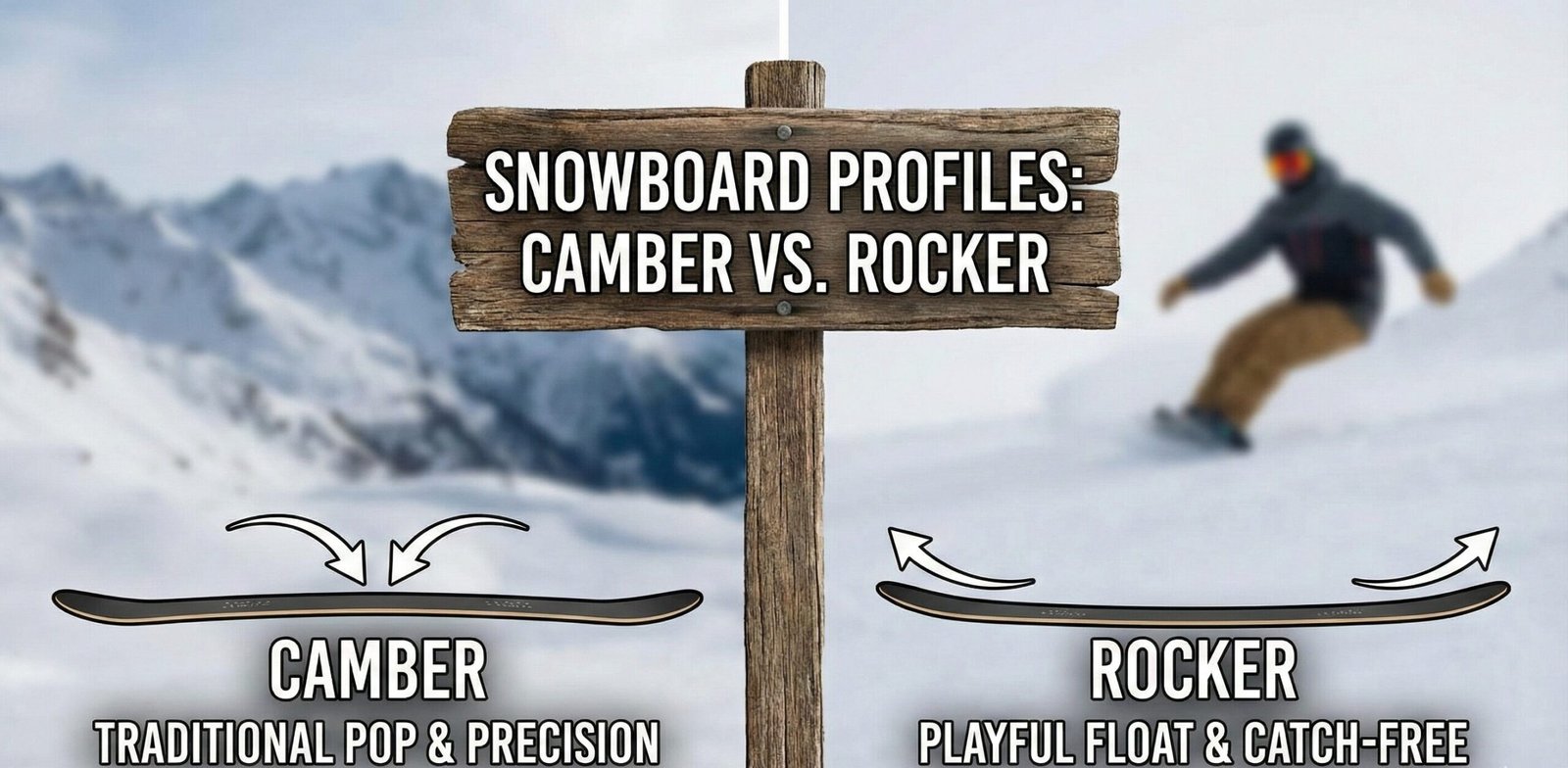
Camber is the traditional profile (arched up in the center). It offers maximum pop, precision, and edge hold. It is best for carving, jumps, and advanced riders.
Rocker (or Reverse Camber) bows downwards like a banana. It offers better float in powder, is more forgiving (less catchy), and is easier to press. It is best for beginners and powder hounds.
1. Traditional Camber: The Powerhouse
For decades, Camber was the only game in town. If you lay a camber board flat on the floor, the center of the board rises off the ground, while the contact points (near the tip and tail) touch the floor. It looks like a frown or a bridge.
The Physics of Camber
Think of a camber board as a loaded spring. When you stand on it, your weight flattens the board against the snow. This stores kinetic energy. When you unweight (at the lip of a jump or out of a turn), that energy releases, giving you “pop.”
This shape also pushes the contact points firmly into the snow. This is crucial for riding icy conditions, which you might encounter at some of the top European ski resorts or the East Coast. The entire length of the edge is engaged, providing stability at high speeds.
How Camber Affects Turn Initiation
When you initiate a turn on a camber board, the loaded energy distributes across the full effective edge. The board arcs smoothly from tip to tail, creating a clean, predictable turn shape. This is why camber boards are favored for carving on a snowboard — the turn radius stays consistent from start to finish. Unlike rocker boards that can feel washy in the middle of a turn, camber maintains constant snow contact along the entire edge, giving you that locked-in, railed feeling that advanced riders crave.
The trade-off is that camber demands precise input. If you lean too far onto your toe edge without proper alignment, the board will catch and throw you. This is the “catchy” reputation camber has earned. However, for riders who have developed proper technique, this catchiness transforms into responsiveness — the board goes exactly where you point it, with zero hesitation.
Camber and Speed: Why It Dominates at Velocity
At high speeds, the camber profile provides a distinct advantage. The continuous edge contact creates a stable platform that resists chatter. When you are bombing a groomer at 40+ mph, a rocker board will vibrate and skip across the snow surface. A camber board stays planted, absorbing micro-bumps and maintaining traction. This is why virtually every alpine snowboard race board uses a full camber profile — there is simply no substitute for edge engagement at speed.
The energy storage properties of camber also help with speed maintenance. Each compression cycle (going over a bump) stores and releases energy, propelling the rider forward rather than decelerating. Over a long run, this translates to significantly less fatigue in your legs, because the board is doing some of the work for you.
Who is Camber For?
- The Carver: If you are learning how to carve on a snowboard, camber gives you the rail-like grip you need.
- The Jumper: Park riders who hit big kickers need the stability of camber for landings and the pop for takeoffs.
- The Speed Demon: Camber doesn’t chatter as much at high speeds.
- The Ice Rider: East Coast and spring riders who deal with hardpack and boilerplate conditions need camber’s edge hold.
- The Technical Rider: If you ride steep terrain, couloirs, or variable conditions where precision matters, camber gives you the control you need.
Camber and Board Flex: The Stiffness Connection
Not all camber boards feel the same. The flex rating of a camber board dramatically changes how the profile performs. A stiff camber board (8-10 flex rating) is a precision instrument — it charges through crud, holds an edge on ice, and launches you into the stratosphere off jumps. But it will punish sloppy technique and tire out weaker riders quickly.
A medium camber board (5-7 flex) offers a balance of power and playfulness. This is the sweet spot for most intermediate to advanced riders who want camber benefits without the unforgiving nature of a stiff charger. These boards can still carve, still pop, but they forgive small mistakes and allow for some freestyle creativity.
A soft camber board (3-4 flex) is a niche product — typically found in park-specific camber boards. The camber provides snap for ollies and nollies, but the soft flex allows for presses, butters, and tweakability on rails. These boards bridge the gap between freestyle forgiveness and camber performance.
2. Rocker (Reverse Camber): The Fun Shape
Rocker is the opposite of camber. The center of the board touches the ground, while the tip and tail curve upward early. It looks like a smile or a rocking chair rail (hence the name).
The Physics of Rocker
By lifting the contact points off the snow, the board becomes much less “catchy.” You are less likely to catch an edge and slam, which is a huge relief if you aren’t wearing your best impact shorts for snowboarding.
Furthermore, because the nose and tail are already lifted, the board naturally wants to float on top of deep snow rather than diving under it. This makes it a favorite for backcountry snowboarding.
How Rocker Changes Turn Shape
Rocker boards initiate turns differently than camber. Because the contact points are closer to the center of the board, turning requires less effort and less edge angle. The board pivots from a shorter effective edge, making turns feel quicker and more surfy. This is why beginners love rocker — you can link turns without much experience or strength.
However, this shorter effective edge means that at high speeds, rocker boards feel less stable. The board can wash out in hard turns, and the lack of full-edge engagement means you lose the locked-in carving feeling. For riders who primarily cruise groomers at moderate speeds, this is rarely an issue. For chargers who want to attack the mountain, it becomes a limitation.
Rocker in Deep Powder: The Float Advantage
Powder riding is where rocker truly shines. The upward-curving nose acts like a natural plow, pushing snow aside and keeping the board on top of the surface. With a camber board in powder, you have to shift your weight far back to keep the nose up, which burns out your back leg and reduces control. With rocker, the board does the float work for you, allowing you to maintain a centered stance and ride with less fatigue.
The surf-like feel of rocker in powder is unmatched. You can slash turns, bounce through pillow lines, and ride through trees with confidence that the board won’t dive and catch. For anyone who rides powder regularly, at least some rocker element in the nose is almost mandatory.
Rocker and Flatland Tricks
Beyond powder, rocker excels in the terrain park’s jib section. When you press a rail or box, the rocker profile naturally contacts the feature without requiring you to fight the board’s spring. With camber, pressing requires you to overcome the board’s desire to return to its arched shape. With rocker, the board already wants to be flat against the feature, making presses feel effortless.
Butter tricks (nose and tail presses on flat ground) are also easier on rocker. The lifted tip and tail provide a natural pivot point, and the lack of camber energy means you can hold a press longer without the board snapping back. This playfulness is what gives rocker its “fun” reputation.
Who is Rocker For?
- The Beginner: It simplifies turning. The board spins easily underfoot. This is why many snowboarding resorts for beginners use rocker boards in their rental fleets.
- The Jibber: If you slide rails and boxes, rocker allows you to “press” the board without fighting the spring of camber.
- The Powder Hound: Less back-leg burn in deep snow.
- The Lightweight Rider: If you weigh under 140 lbs, you may not have enough body weight to fully engage a camber board’s edge. Rocker provides better performance for lighter riders.
- The Style Rider: If you ride with a laid-back, surf-inspired approach and prioritize fun over precision, rocker matches that mentality.
Rocker Limitations You Should Know
Rocker is not without downsides. The reduced effective edge means less grip on hard snow and ice. If you ride in the Pacific Northwest where you encounter rain crust and ice patches, a pure rocker board will feel sketchy at speed. The lack of stored energy also means less pop for ollies and jumps. While you can still pop a rocker board, it will never match the explosive snap of camber.
Rocker boards also tend to have less stability at speed. The contact points are closer together, creating a shorter wheelbase that becomes twitchy when you push the pace. For riders who like to open it up on groomers, this can feel nerve-wracking. This is why most riders ultimately transition to some form of hybrid profile — they want rocker’s forgiveness but need camber’s performance.
3. Flat (Zero Camber): The Underrated Middle Ground
Flat camber — also called zero camber — is exactly what it sounds like: the board is completely flat from contact point to contact point. When you place it on the ground, the entire base touches the surface with no arch and no rocker curve. It is the true neutral profile, and it is often overlooked in the camber vs. rocker debate.
What Flat Camber Feels Like
Riding a flat camber board feels predictable and stable. There is no loaded energy trying to throw you into a turn, and there is no lifted contact point trying to wash out. The board goes where you point it with a neutral, balanced feel. It is like driving a car with perfectly neutral steering — nothing pulls left or right, and you have full control over the output.
For intermediate riders who find camber too aggressive and rocker too loose, flat camber is often the revelation they have been searching for. It provides a stable platform for learning carving technique without the unforgiving catch of camber. It offers decent edge hold on hard snow without requiring the precise input that camber demands.
Flat Camber for Park Riding
Flat camber boards have a devoted following in the terrain park. The flat base provides a stable platform for riding boxes and rails, with predictable contact that doesn’t catch or slip. Unlike rocker, which can feel washy on features, flat camber locks you in. Unlike camber, it doesn’t try to throw you off when your weight isn’t perfectly centered.
Many park-specific boards use flat camber as their base profile, sometimes with subtle rocker in the tips for catch-free presses. This combination gives you the stability of flat with the forgiveness of rocker — a popular choice for dedicated park riders.
Flat Camber vs. Camber: When to Choose Flat
Choose flat camber when you want stability without aggression. If you are transitioning from rocker to camber, flat camber serves as an excellent stepping stone. You get more edge hold than rocker, better stability at speed, and a more predictable feel — but you don’t have to deal with camber’s catchiness or its demand for precise technique.
Flat camber is also excellent for beginners who are past the absolute first-timer stage. Once you can link turns and want to start exploring faster riding and harder snow, flat camber provides a platform that rewards good technique without punishing small mistakes.
The Downside of Flat
Flat camber’s greatest strength — its neutrality — is also its weakness. It doesn’t have camber’s explosive pop or rocker’s effortless float. In deep powder, a flat board will sink more than a rocker board. On icy slopes, it won’t grip as hard as a full camber board. It occupies a middle ground that excels at nothing but handles everything reasonably well.
For riders who specialize in one discipline, flat camber may feel like a compromise. But for all-mountain riders who encounter a bit of everything, that compromise is exactly what they need.
4. The Hybrid Revolution: Best of Both Worlds?
Manufacturers eventually realized that riders wanted the pop of camber with the float of rocker. Enter the Hybrid profiles. These mix both shapes in various configurations to create boards that attempt to deliver the best properties of each profile.
Understanding Hybrid Configurations
- Rocker-Camber-Rocker (The “W” Profile): This is the most popular hybrid configuration. The center of the board has camber between the bindings, providing pop and edge hold. The nose and tail feature rocker, providing float and forgiveness. When you look at the board from the side, it forms a subtle “W” shape. This profile is incredibly versatile — it carves well on groomers, floats in powder, and still allows for presses in the park. It is the closest thing to a “do-everything” profile available.
- Camber-Rocker-Camber: This configuration places camber at the nose and tail with rocker in the middle. It provides good float (the camber tips act like shovels) while maintaining some pop and edge hold. This is common on powder-specific boards that still need to handle groomed runs. The camber tips help the board initiate turns on hard snow, while the rocker center provides the float needed in deep conditions.
- Flat-Rocker-Flat: Flat sections near the bindings provide stability and edge hold, while the nose and tail rocker upward for float. This is a more subtle hybrid that prioritizes stability over pop. It is a good choice for riders who want rocker’s forgiveness without sacrificing too much edge hold.
- CamRock (Burton’s Term): Burton uses the term CamRock to describe their rocker-camber blends. Their specific implementation varies by model, but the principle is the same — camber underfoot for power, rocker in the tips for float and catch-free riding.
Why Hybrids Have Become the Standard
Walk into any snowboard shop today and you will notice that the majority of boards on the wall are hybrids of some kind. Pure camber and pure rocker still exist, but they are increasingly niche products. The reason is simple: most riders are not specialists. They ride groomers, hit some park features, occasionally encounter powder, and deal with varying snow conditions throughout the day.
A hybrid profile handles all of these scenarios reasonably well. It won’t be the absolute best at any single thing, but it will be good at everything. For the average rider who doesn’t want to own multiple boards, this versatility is invaluable.
Hybrid Profile Selection by Riding Style
Not all hybrids are created equal. The specific configuration matters. If you ride mostly groomers with occasional off-piste, look for a hybrid with more camber and subtle rocker tips (like a Camber-Rocker-Camber). If you ride powder regularly but also hit the park, look for a hybrid with more rocker and camber underfoot (like a Rocker-Camber-Rocker). If you want a true 50/50 split, the “W” profile is your best bet.
Understanding this nuance is key to choosing the right hybrid. A “W” profile board from one manufacturer may feel completely different from a “W” profile board from another, because the depth of the camber, the length of the rocker zones, and the overall flex profile all affect the ride. Always try to demo boards before buying, or at minimum, read detailed reviews from riders with similar styles and weights.
5. Brand-Specific Profile Technologies
Every major snowboard manufacturer has developed their own branded profile technologies. Understanding these proprietary names helps you decode what you are actually getting when you read a board’s spec sheet.
Lib Tech: Banana Technology and C2
Lib Tech pioneered the modern rocker movement with their “Banana Technology” (BTA). Their original Skate Banana used a full rocker profile with Magne-Traction edges (serrated edge technology that increases grip). Over the years, they refined this into the “C2” profile — a hybrid that places camber between the feet and rocker in the nose and tail. The C2 BTX (Banana Tech eXtended) is their most popular all-mountain configuration, while the C3 uses more camber for riders who want more power and edge hold.
Lib Tech’s approach is unique because they combine profile shape with edge technology. The Magne-Traction edges work with any profile to increase grip, but they are especially valuable on rocker and hybrid boards where the reduced effective edge would otherwise compromise hard-snow performance.
Burton: The Channel and S-Rocker
Burton has invested heavily in profile innovation. Their “S-Rocker” places camber under the back foot with continuous rocker from the front binding forward. This provides pop and power in the rear for ollies and turns, while the rocker nose provides effortless float in powder. It is an asymmetric approach that recognizes how riders actually use their boards.
Burton’s “Flying V” profile is their take on the rocker-camber hybrid, with a rocker nose, camber underfoot, and a slight rocker in the tail. They have also developed “Super Fly II” core profiles that vary the wood density across the board, working in conjunction with the profile shape to fine-tune flex and response.
The Channel mounting system (Burton’s proprietary binding interface) allows for infinitely adjustable stance width and angle, which means you can fine-tune how the profile interacts with your specific stance. This is a significant advantage for riders who want to optimize their setup.
GNU: Magne-Traction and C3
GNU (Lib Tech’s sister brand) uses many of the same technologies but often in slightly different configurations. Their C3 profile is a camber-dominant hybrid — more camber than the C2, with subtle rocker in the tips. This provides the edge hold and pop of camber with just enough rocker forgiveness to keep things fun. GNU boards often pair C3 with Magne-Traction for ice-destroying performance.
Capita: HyperDrive and Alpine Hover
Capita has developed several innovative profiles. Their “Alpine Hover” system uses a specific camber-rocker combination designed for all-mountain versatility. Their “Deathwish” uses a triple-base technology (3BT) that combines camber with a three-dimensional base shape — the center is camber, but the edges are slightly lifted, creating a profile that handles variable snow exceptionally well.
YES. Snowboards: UnderBite and 3D
YES. (Yes Snowboards) has developed “UnderBite” — an edge profile that redistributes edge grip to the parts of the board that need it most. Combined with their various camber/rocker configurations, this creates boards that punch above their weight in edge hold. Their “3D” base shapes add another dimension to profile performance, creating boards that feel different from anything else on the market.
Understanding these brand-specific technologies helps you cut through marketing language. When you see “C2” or “Flying V” or “S-Rocker,” you now know what shape lies beneath the branding. This knowledge empowers you to compare boards across brands and find the profile that matches your needs, regardless of what the manufacturer calls it.
6. How Profile and Flex Work Together
Understanding snowboard profiles in isolation is only half the picture. The flex rating of a board interacts with its profile to create the overall ride feel. Two boards with identical profiles but different flex ratings will ride completely differently.
Stiff Camber: The Charger
A stiff camber board (flex 8-10) is built for speed and precision. The stiff construction amplifies camber’s natural energy storage, creating explosive pop and powerful edge hold. These boards charge through crud, hold an edge on ice, and provide unmatched stability at speed. However, they demand perfect technique and significant leg strength. Riding a stiff camber board all day is physically demanding — your quads will burn, and any mistake in your technique will be punished with a hard fall.
Who should ride stiff camber: Advanced to expert riders over 160 lbs who primarily ride groomers, big mountain terrain, or competition-level park. If you are a racer, a big-mountain charger, or a pipe specialist, stiff camber is your profile.
Soft Camber: The Playful Carver
A soft camber board (flex 3-4) retains camber’s pop and edge hold but with a more forgiving, playful feel. These boards are easier to press, easier to butter, and less demanding on your legs. The trade-off is stability at speed — a soft camber board will chatter and lose composure when you push the pace. But for riders who want camber benefits without the punishment, soft camber is an excellent choice.
Who should ride soft camber: Intermediate riders, lighter riders (under 150 lbs), and park riders who want camber pop for ollies but need soft flex for presses and jibs.
Stiff Rocker: The Powder Charger
A stiff rocker board is an unusual combination, but it exists in powder-specific and big-mountain boards. The stiffness provides stability at speed and through chop, while the rocker profile provides float and catch-free riding. These boards are designed for riders who charge through deep snow and variable conditions at high speed. They sacrifice edge hold on hard snow for exceptional performance in soft conditions.
Who should ride stiff rocker: Advanced powder riders and backcountry enthusiasts who need float and stability but don’t ride hardpack much.
Soft Rocker: The Beginner’s Best Friend
A soft rocker board (flex 2-3) is the most forgiving snowboard you can ride. The soft flex makes turning effortless, and the rocker profile eliminates edge catches. These boards are designed for learning and progressing. They provide a smooth, confidence-building experience that helps beginners link turns quickly and enjoy the sport from day one.
Who should ride soft rocker: First-timers, beginners, lightweight riders, and anyone who prioritizes ease of use over performance. This is the profile most rental shops stock for their beginner fleets.
Medium Hybrid: The Jack of All Trades
A medium-flex hybrid board (flex 5-7) is the most popular configuration for all-mountain riding. It provides enough stiffness for stable carving and decent pop, while remaining soft enough for park riding and forgiving enough for variable conditions. The hybrid profile handles groomers, powder, and park reasonably well, making it the ideal one-board quiver for most riders.
Who should ride medium hybrid: Intermediate to advanced all-mountain riders, weekend warriors, and anyone who wants one board that does everything reasonably well. If you can only own one board, this is probably it.
7. Choosing Your Profile Based on Snow Conditions
The snow conditions you ride most often should heavily influence your profile choice. A board that performs brilliantly in Colorado powder may feel terrible on East Coast ice, and vice versa.
Powder: Rocker or Camber-Rocker-Camber
In deep powder (12+ inches), rocker is king. The lifted nose naturally floats on top of the snow, and the reduced effective edge means less drag. You can ride with a centered stance and minimal back-leg fatigue. If you ride powder regularly — whether in the Cascades, Japan, or the Rockies — at minimum you need a board with significant rocker in the nose.
The Camber-Rocker-Camber configuration works well for powder days that also include groomed runs. The camber tips provide edge hold on hard snow, while the rocker center provides float. This is the ideal configuration for riders who encounter powder occasionally but don’t want a dedicated powder board.
Ice and Hardpack: Camber or Camber-Dominant Hybrid
On ice and hardpack, edge hold is everything. Pure camber provides the most edge contact and the most reliable grip. The full-length effective edge bites into hard snow and holds through the entire turn. If you ride East Coast conditions, Midwest ice, or spring slush that has refrozen overnight, camber is your best friend.
Camber-dominant hybrids (like Lib Tech’s C3 or a subtle rocker-camber-rocker) provide good ice performance with slightly more forgiveness. The camber underfoot maintains edge hold, while the subtle rocker tips reduce the chance of catching an edge on variable snow.
Choppy / Variable Conditions: Medium-Stiff Hybrid
Choppy conditions — wind-affected snow,crud, refrozen bumps — require a board that can absorb impacts while maintaining control. A medium-stiff hybrid (flex 6-7) with camber underfoot and rocker tips handles these conditions best. The camber provides power and edge hold, the stiffness absorbs chatter, and the rocker tips prevent the board from diving into soft patches.
This is the profile that most all-mountain riders should target. Unless you ride exclusively in one condition type, you will encounter variable snow at some point. Having a board that handles it gracefully makes your entire season more enjoyable.
Spring / Slush: Rocker or Flat-Rocker
Spring conditions — heavy, wet slush — benefit from rocker profiles. The lifted contact points prevent the board from grabbing in the sticky snow, and the surfy feel of rocker matches the playful nature of spring riding. Flat-rocker configurations also work well, providing a stable platform that doesn’t catch in the heavy snow.
The key in spring conditions is avoiding aggressive camber. The wet snow creates more friction, and camber’s full-edge engagement can feel grabby and unpredictable. Rocker lets you滑 through the slush with a relaxed, playful approach.
Consistency Across Conditions: The “W” Profile
If you ride in everything — powder, ice, groomers, park — the “W” profile (rocker-camber-rocker) is your best bet. It provides camber underfoot for edge hold and pop, with rocker tips for float and forgiveness. No single condition will feel perfect, but every condition will feel manageable. This is the true one-board-quiver profile.
8. How Your Weight Affects Profile Performance
A snowboard’s profile is designed to perform optimally within a specific rider weight range. A board that feels perfect for a 180 lb rider may feel completely different for a 120 lb rider — even if they are the same height and skill level.
Lightweight Riders (Under 140 lbs)
If you weigh under 140 lbs, you may not have enough body weight to fully engage a stiff camber board’s edge. The board will feel dead and unresponsive, because you aren’t compressing the camber enough to store energy. For lightweight riders, softer camber boards, rocker boards, or flat-rocker hybrids provide better performance. The reduced stiffness allows your weight to properly load the board, activating its performance characteristics.
Lightweight riders should also consider shorter board lengths. A shorter board is easier to flex and turn, which compensates for the reduced force you can apply. Check the manufacturer’s weight chart for every board you consider — most brands now provide recommended weight ranges for each size.
Heavyweight Riders (Over 200 lbs)
If you weigh over 200 lbs, you need a stiffer board to support your weight. A soft board will feel washy and unstable under you, because you are flexing it beyond its design parameters. For heavyweight riders, stiff camber or stiff hybrid boards provide the support and response you need. You should also consider longer board lengths for better stability and float.
Heavyweight riders often find that rocker boards feel unstable at speed, because their weight causes the board to flex excessively. A camber-dominant hybrid provides the stability of camber with enough rocker forgiveness to prevent catching edges.
The Goldilocks Zone (140-200 lbs)
Riders in the 140-200 lb range have the widest profile options. Most boards are designed for this weight range, so you can choose any profile without worrying about whether your weight will properly engage the board. Focus on your riding style and preferred conditions rather than weight-related considerations.
Within this weight range, medium-flex boards (5-7) provide the best all-around performance. They respond to your input without requiring excessive force, and they maintain composure at speed without being punishing. This is the sweet spot for the majority of snowboarders.
9. How Stance and Bindings Interact with Profile
Your stance width, angles, and binding setup all affect how the board’s profile performs. A perfectly chosen profile can feel wrong if your stance doesn’t complement it.
Stance Width and Profile
Your stance width determines how much of the camber or rocker zone you are standing on. A wider stance spreads your feet across more of the board’s profile, which can reduce the effectiveness of the camber underfoot. A narrower stance concentrates your weight over the camber, maximizing its pop and energy storage.
For camber boards, a stance width that places your feet directly over the camber’s highest point provides the most pop and stability. Too wide, and you flatten the camber, reducing its effectiveness. Too narrow, and the board feels twitchy and unstable. Most riders find their optimal stance width by starting with shoulder-width and adjusting from there.
For rocker boards, stance width is less critical, because the board’s center is already on the ground. However, a wider stance provides more stability at speed, while a narrower stance makes the board feel more playful and easier to spin.
Binding Angles and Profile
Your binding angles affect how you engage the board’s edges, which directly impacts profile performance. A positive/positive angle setup (both bindings angled forward) promotes carving and groomed riding, and it works best with camber profiles. This stance encourages you to drive through turns with your knees and hips, maximizing the board’s edge hold.
A duck stance (front foot positive, back foot negative) promotes switch riding and park performance. This stance works well with rocker and hybrid profiles, because it provides equal control in both directions. For park riders who spend significant time riding switch, duck stance is almost mandatory.
A positive/zero or positive/negative stance (back foot flat or slightly negative) is common among powder riders. This stance shifts your weight slightly back, helping with float in deep snow. It pairs well with rocker and camber-rocker profiles that have significant nose rocker.
Binding Stiffness and Profile Response
Your binding stiffness should match your board’s flex and profile. Stiff bindings on a stiff camber board amplify every input, providing maximum response but requiring perfect technique. Stiff bindings on a soft rocker board create a mismatch — the bindings will try to force the board to respond to inputs it can’t handle, resulting in a harsh, unpredictable ride.
Soft bindings on a stiff camber board dampen the board’s response, reducing its performance potential. Soft bindings on a soft rocker board create a forgiving, playful setup that is great for beginners and jibbers. Match your binding stiffness to your board’s flex for optimal performance.
Highback Forward Lean and Profile
Highback forward lean affects how quickly your heel-side turns engage. More forward lean pushes your knees forward, which drives the heel edge into the snow faster. This is beneficial for camber boards, where quick edge engagement maximizes the board’s carving potential. For rocker boards, excessive forward lean can feel harsh, because the board’s shorter effective edge means edge engagement happens faster naturally.
Most bindings allow you to adjust forward lean without tools. Experiment with different settings to find what feels best with your board’s profile. A good starting point is medium forward lean for all-mountain riding, more forward lean for carving, and less forward lean for park and freestyle.
10. Profile Recommendations by Riding Style
Different riding styles demand different profile characteristics. Here is a detailed breakdown of which profiles work best for each discipline.
All-Mountain: Hybrid (Rocker-Camber-Rocker)
All-mountain riders encounter everything: groomers, powder, park, trees, and variable conditions. The rocker-camber-rocker hybrid provides the versatility needed to handle all of these scenarios. The camber underfoot provides edge hold and pop, while the rocker tips provide float and forgiveness. This is the most popular profile for riders who want one board that does everything reasonably well.
Look for medium-stiff flex (5-7) for the best all-around performance. A board that is too soft will lack stability at speed, while a board that is too stiff will be punishing in the park and trees.
Powder: Rocker or Camber-Rocker-Camber
Powder riders need float above all else. Full rocker provides the most float, with effortless surf-like turns in deep snow. The Camber-Rocker-Camber configuration provides good float with better hard-snow performance, making it ideal for powder riders who also ride groomers.
Look for a set-back stance (rear binding mounted further back) to shift your weight over the tail, which helps the nose float. Many powder-specific boards come with set-back stance holes pre-drilled.
Park and Pipe: Camber or Flat-Rocker
Park riders have different needs depending on whether they ride jumps or rails. For jumps and halfpipe, camber provides the pop and stability needed for big airs and clean landings. The loaded energy helps you launch off lips and provides a stable platform for landing.
For rails and boxes, flat-rocker provides a stable, catch-free platform. The flat center locks onto features, while the rocker tips prevent catching on entry and exit. Many park-specific boards use this configuration for maximum versatility in the park.
Pipe riders almost universally prefer camber. The pipe’s transitions require precise edge control, and camber’s full-edge engagement provides the grip needed to maintain speed through the walls. Soft camber boards work best in the pipe, because they provide the snap needed for airs while remaining playful enough for creative riding.
Freeride: Stiff Camber or Camber-Dominant Hybrid
Freeride riders who charge big mountain terrain, steep chutes, and variable conditions need the stability and edge hold of camber. A stiff camber board provides maximum control at high speeds and through challenging conditions. Camber-dominant hybrids (like Lib Tech’s C3) provide similar performance with slightly more forgiveness in variable snow.
Freeride boards are typically directional (longer nose, shorter tail) with a set-back stance. The directional shape works in conjunction with the profile to optimize float and stability in big mountain conditions.
Freestyle: Soft Camber or Soft Hybrid
Freestyle riders who focus on creative expression — butters, presses, spins, and trick combinations — need a soft, playful board. Soft camber provides pop for ollies while remaining flexible enough for presses and butters. Soft hybrid boards provide similar performance with slightly more versatility in varying conditions.
The key for freestyle is a true twin shape (symmetrical nose and tail) with a centered stance. This ensures the board performs identically in both regular and switch, which is essential for creative trick combinations.
Splitboard / Backcountry: Camber-Rocker-Camber
Splitboarders need a profile that works in both uphill touring mode and downhill riding mode. The Camber-Rocker-Camber configuration is popular for splitboards because the camber tips provide skin traction on the ascent, while the rocker center provides float on the descent. Some splitboard-specific profiles add additional rocker in the nose for enhanced powder float.
When choosing a splitboard profile, consider the terrain you will be riding most often. If your backcountry is primarily steep and technical, a camber-dominant split provides the edge hold you need. If you are riding deep powder in open bowls, a rocker-dominant split provides better float.
11. Complete Profile Comparison Table
| Feature | Traditional Camber | Rocker (Reverse) | Flat / Zero | Hybrid (W) |
|---|---|---|---|---|
| Edge Hold | Excellent (Precise) | Moderate (Loose) | Good (Balanced) | Good (Balanced) |
| Pop/Energy | High (Explosive) | Low (Playful) | Medium (Neutral) | Medium-High |
| Powder Float | Requires Effort | Effortless | Moderate | Good |
| Forgiveness | Low (Catchy) | High (Catch-free) | Medium | Medium-High |
| Stability at Speed | Excellent | Moderate | Good | Good |
| Ice/Hardpack | Excellent | Poor | Good | Good |
| Park (Jumps) | Excellent | Moderate | Good | Good |
| Park (Rails) | Moderate | Excellent | Good | Good |
| Turn Initiation | Requires Commitment | Effortless | Easy | Easy-Moderate |
| Switch Riding | Good (if twin) | Good (if twin) | Good (if twin) | Good (if twin) |
| Best For | Racing, Pipe, Big Mountain | Rails, Powder, Beginners | All-Mountain, Park | All-Mountain, Versatile |
| Learning Curve | Steep | Gentle | Moderate | Gentle-Moderate |
| Physical Demand | High | Low | Low-Medium | Medium |
12. Top Gear Picks by Profile
Choosing the right board is expensive, contributing to how expensive snowboarding is. Here are some top-rated options available on Amazon that represent these profiles perfectly.

Burton Custom Camber
The legendary camber board. Known for precision, power, and pop. The choice for aggressive all-mountain riders.
View on Amazon
Lib Tech Skate Banana
The board that changed the game. Features “Banana” rocker between your feet for catch-free jibbing and float.
View on Amazon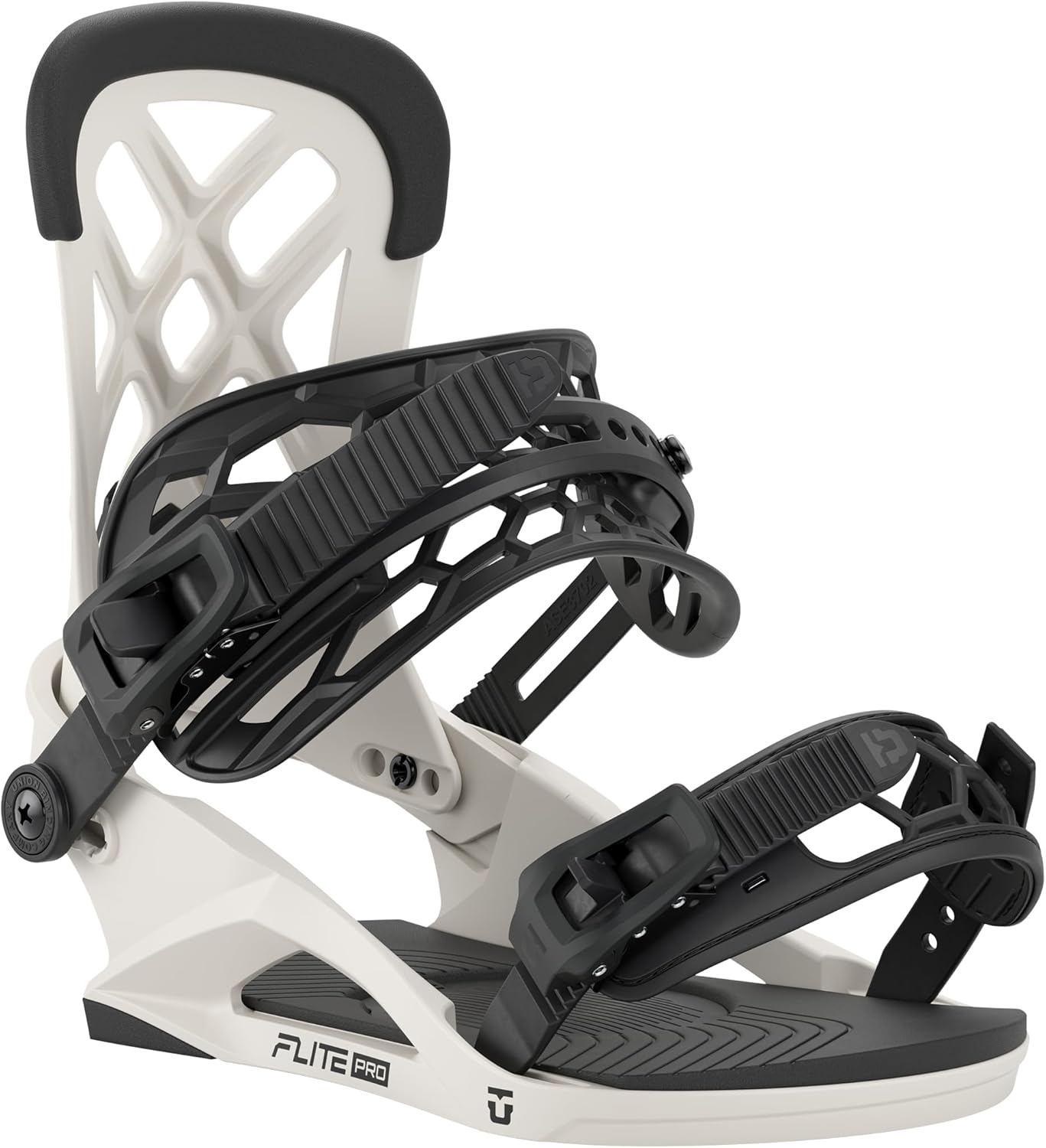
Union Flite Pro Bindings
Your profile means nothing without good bindings. Lightweight and responsive to transfer energy to those edges.
View on Amazon13. How to Test a Board’s Profile Before You Buy
Reading about profiles is helpful, but nothing replaces actually feeling a board under your feet. Here is how to test a board’s profile characteristics, whether you are in a shop or on the mountain.
The Flex Test
If you are in a shop, pick up the board and flex it. Place one hand on the nose and one on the tail, and push the board against the floor. Feel how much force it takes to flatten the board. This gives you an idea of the flex rating and how the camber will respond to your weight. A board that flattens easily is soft; a board that resists is stiff.
Also try pressing the board’s center against the floor. A camber board will resist this pressure (because it wants to stay arched), while a rocker board will flex more easily (because it is already curved the opposite way). This simple test tells you a lot about the board’s profile and flex characteristics.
The Edge Engagement Test
If you are on the mountain, pay attention to how quickly the board’s edge engages when you initiate a turn. A camber board requires you to roll the board onto its edge before the contact points grip the snow. This creates a deliberate, powerful turn initiation. A rocker board engages almost immediately, because the contact points are closer together. This creates a quick, surfy turn initiation.
Test this on a gentle, groomed slope. Make slow, deliberate turns and feel how the board responds. Does it feel locked-in and powerful? That is camber doing its job. Does it feel loose and playful? That is rocker at work. Does it feel neutral and predictable? That is flat or hybrid doing what it was designed to do.
The Pop Test
Find a gentle slope and try olling (popping the board off the snow). A camber board will feel springy and explosive — you load the board by compressing it, and it releases that energy upward. A rocker board will feel less snappy but more playful — the pop comes from your legs rather than the board’s stored energy. A flat board will feel neutral, with moderate pop that doesn’t feel explosive or dead.
This test is especially important if you plan to ride park. The pop characteristic of the board directly affects how high you can ollie, how well you can pop off lips, and how much energy the board provides for jumps.
The Speed Test
If you are comfortable at speed, find a long groomer and open it up. Pay attention to how the board behaves at 30+ mph. Does it feel stable and planted? Or does it start to chatter and feel nervous? Camber boards generally feel most stable at speed, because the full-edge engagement provides a solid platform. Rocker boards may feel twitchy, because the shorter effective edge reduces stability.
Also pay attention to how the board handles chop. Does it plow through bumps, or does it get bounced around? Stiffer boards with more camber handle chop better, while softer rocker boards may feel overwhelmed in rough conditions.
The Powder Test (If Available)
If you are lucky enough to test in powder, pay attention to how much effort it takes to keep the nose up. A rocker board will float naturally with minimal effort. A camber board will require you to shift your weight back, which tires your back leg. A hybrid will float well but may require some weight shift in very deep snow.
Also notice how the board turns in powder. Rocker boards feel surfy and playful, with quick, responsive turns. Camber boards feel more deliberate and powerful, with wider, more sweeping turns. The type of powder riding you prefer should guide your profile choice.
14. Common Misconceptions About Snowboard Profiles
There are many myths and misconceptions floating around about snowboard profiles. Let’s address the most common ones.
Misconception: “Camber is Only for Experts”
This is perhaps the most damaging misconception in snowboarding. While camber demands more technique than rocker, it is absolutely suitable for intermediate riders. Many riders progress faster on camber because it teaches proper edge control and turn technique from the start. Starting on rocker and transitioning to camber later can actually be harder, because you have to unlearn the loose, forgiving habits that rocker taught you.
The key is choosing the right camber board for your level. A soft camber board (flex 4-5) provides camber benefits with enough forgiveness for intermediate riders. You don’t need to jump straight to a stiff camber charger — ease into it with a more forgiving camber board.
Misconception: “Rocker is Only for Beginners”
While rocker is excellent for beginners, it is also the preferred profile for many advanced riders. Expert powder riders love rocker for its float. Professional jibbers prefer rocker for its press-friendly characteristics. Some of the most progressive snowboarders in the world ride rocker because it enables a creative, surf-inspired style that camber cannot replicate.
Misconception: “Hybrid Boards Are Just Compromises”
While hybrids don’t excel at any single thing, calling them “just compromises” undersells their versatility. A well-designed hybrid board can handle 80% of what you encounter on the mountain at a high level. For the vast majority of riders who don’t specialize in one discipline, that versatility is more valuable than camber’s edge hold or rocker’s float.
Misconception: “Profile is the Most Important Factor”
Profile matters, but it is not the only factor. Board length, width, flex, sidecut radius, core construction, and base material all affect performance. A perfectly chosen profile on a board that is too long, too wide, or the wrong flex will still perform poorly. Think of profile as one piece of the puzzle, not the entire picture.
Misconception: “You Can Feel the Difference Immediately”
Subtle profile differences — like a few millimeters of camber depth or a slightly longer rocker zone — may not be immediately obvious on your first ride. It can take several runs to get a feel for how a board’s profile affects its performance. This is why demo days and extended test rides are so valuable. Don’t judge a board’s profile after one run in the park — give it a full day of varied riding before forming an opinion.
Misconception: “More Rocker Always Means More Float”
While rocker does improve float, the amount of float also depends on the board’s setback, surface area, and construction. A well-designed camber powder board with significant setback can float better than a poorly designed rocker board. Profile is important for float, but it’s not the only variable.
15. How Board Dimensions Interact with Profile
A snowboard’s dimensions — length, width, and sidecut — work in conjunction with its profile to determine performance. Understanding these interactions helps you choose the right board for your needs.
Length and Profile
Longer boards provide more stability and float, but they are harder to turn. With camber, a longer board stores more energy (more camber to compress), which increases pop and power. With rocker, a longer board provides more surface area for float, but the reduced effective edge means it may feel less stable than a shorter camber board of the same length.
When choosing length, consider your riding style and profile preference. Camber riders can often go slightly longer for more stability and pop. Rocker riders may want to go slightly shorter for easier turning and maneuverability. Hybrid riders can choose length based on their primary discipline — longer for powder-focused, shorter for park-focused.
Width and Profile
Board width affects how the profile interacts with your boots. If your boots hang over the edges too much (toe drag), you will catch edges during turns regardless of the profile. If the board is too wide, you won’t be able to engage the edges properly, reducing the profile’s effectiveness.
The ideal width depends on your boot size and the profile. Camber boards are slightly more forgiving of width issues, because the full-edge engagement provides more grip even with slight boot overhang. Rocker boards are less forgiving, because the reduced effective edge means any boot drag will cause immediate edge catching.
Sidecut and Profile
The sidecut radius determines how tight the board turns. A deeper sidecut (smaller radius) creates tighter turns, while a shallower sidecut (larger radius) creates wider turns. This interacts with the profile in important ways.
Camber boards with deep sidecuts carve incredibly tight, powerful turns — the full-edge engagement combined with the tight radius creates a railed, locked-in feel. Rocker boards with deep sidecuts can feel too loose, because the reduced edge contact doesn’t provide enough grip to hold the tight turn. Rocker boards often work better with shallower sidecuts that match their surfy, loose feel.
Hybrid boards typically use medium sidecuts that complement their balanced performance. The camber underfoot provides enough grip for medium-radius turns, while the rocker tips prevent catching in variable snow.
16. The History and Evolution of Snowboard Profiles
Understanding where snowboard profiles came from helps appreciate how far the technology has come. The evolution of profiles tells a story of innovation driven by rider demand and manufacturing capability.
The Early Days: Everything Was Camber
When snowboards first emerged in the 1960s and 1970s, they were essentially flat wooden planks. As the sport evolved through the 1980s and into the 1990s, camber became the standard. Every snowboard was cambered, because that was what worked — it provided the edge hold and pop needed for the aggressive riding that defined early snowboarding.
During this era, camber was so dominant that riders didn’t even think about alternatives. If you wanted to snowboard, you rode camber. The technology was refined over the years — better wood cores, more precise camber shapes, improved base materials — but the fundamental profile remained unchanged.
The Rocker Revolution: 2003-2010
The rocker revolution began in the early 2000s when riders and manufacturers started experimenting with reverse camber shapes. The Lib Tech Skate Banana (2003) was one of the first commercially successful rocker boards, and it changed the industry overnight. Suddenly, riders had an alternative to camber — a board that was forgiving, playful, and incredibly fun.
The timing was perfect. Snowboarding was experiencing a massive growth period, and many new riders were struggling with camber’s unforgiving nature. Rocker provided an easier learning curve, which helped attract and retain new riders. The terrain park movement also favored rocker, because the catch-free profile was ideal for rails and jibs.
The Hybrid Era: 2010-Present
As the initial excitement about rocker settled down, riders began to notice its limitations. Edge hold on ice suffered, stability at speed declined, and pop was lacking. Manufacturers responded with hybrid profiles that combined camber and rocker elements to create boards that offered the best of both worlds.
Today, the market is dominated by hybrid profiles. Pure camber and pure rocker still exist, but they are niche products. The hybrid era has produced an incredible variety of profile configurations, each designed for specific riding styles and conditions. This variety means that modern riders can find a board that perfectly matches their needs — something that was impossible in the camber-only or rocker-only eras.
The Future: What’s Next?
Profile technology continues to evolve. 3D base shapes, variable camber zones, and computer-optimized profiles are pushing the boundaries of what is possible. Some manufacturers are experimenting with adjustable profiles that change based on riding conditions. While these innovations are exciting, the fundamental profiles — camber, rocker, flat, and hybrid — will likely remain the foundation of snowboard design for years to come.
17. Profile Guide for Terrain Park Features
Different terrain park features demand different profile characteristics. Here is a detailed breakdown of which profiles work best for each type of feature.
Small to Medium Jumps: Soft Camber or Hybrid
For small to medium park jumps (under 20 feet), soft camber or medium hybrid boards work best. The camber provides enough pop to clear the knuckle, while the moderate flex allows you to tweak grabs and adjust in the air. A stiff board on small jumps feels overpowered — you don’t need that much energy, and the stiffness makes it harder to absorb imperfect landings.
Large Jumps (30+ feet): Stiff Camber
For large park jumps, stiff camber is the standard. The explosive pop helps you clear the distance, and the stiff construction provides stability at the high speeds needed to reach the lip. When you are hitting 30+ foot jumps, you need a board that won’t wobble or chatter on the approach, and stiff camber delivers that stability.
Rails and Boxes: Flat-Rocker or Soft Rocker
Rails and boxes demand a catch-free, press-friendly board. Flat-rocker provides the stability of flat with the forgiveness of rocker, making it ideal for sliding features. Soft rocker is also excellent for rails, because the lack of camber means you can press the board without fighting its natural spring. Many dedicated rail riders prefer pure rocker for maximum press potential.
Halfpipe: Camber with Moderate Stiffness
Halfpipe riding requires precise edge control, powerful pop, and stability at speed. Camber provides all three. The full-edge engagement gives you the grip needed to maintain speed through the pipe walls, while the camber pop helps you launch above the coping. A medium-stiff camber board (flex 6-7) provides the best balance of power and playfulness in the pipe.
Wallrides and Quarterpipes: Soft Camber or Flat
Wallrides and quarterpipes require a board that can handle unique angles and pressures. Soft camber provides enough pop for launches while remaining forgiving enough for the unusual edge angles involved. Flat boards also work well, because they provide a neutral platform that doesn’t favor any particular angle. The key is avoiding stiff boards, which can feel harsh on these features.
Butter Parks: Soft Rocker or Soft Camber
Butter parks — areas designed for flat-ground tricks like nose presses, tail presses, and spins — require the softest, most playful boards. Soft rocker makes pressing effortless, because the board is already curved for nose and tail contact. Soft camber also works, providing more pop for ollies and nollies while remaining flexible enough for presses. Choose based on your style: rocker for surfy, playful tricks; camber for snappy, explosive tricks.
18. Profile Considerations for Backcountry Riding
Backcountry snowboarding presents unique challenges that affect profile choice. Unlike resort riding, the backcountry throws unpredictable conditions at you — deep powder, wind crust, ice, rocks, and everything in between.
Splitboard Profiles
Splitboards (boards that separate into two halves for uphill touring) have specific profile requirements. The profile must work for both climbing (uphill) and descending (downhill). Most splitboards use a Camber-Rocker-Camber configuration because the camber sections provide skin grip on the ascent, while the rocker center provides float on the descent.
The profile also affects how the two halves lock together. A well-designed splitboard profile ensures a solid connection that doesn’t flex or wobble during descents. Poorly designed profiles can create gaps between the halves that affect performance and safety.
Variable Backcountry Conditions
Backcountry conditions change rapidly — you might start in deep powder and end up on wind-affected crust. This variability demands a versatile profile. A medium-stiff hybrid (camber underfoot, rocker tips) handles the widest range of backcountry conditions. The camber provides edge hold on hard snow, while the rocker provides float in soft snow.
Pure camber in the backcountry is risky, because the catchiness can be dangerous in variable snow. Pure rocker lacks the edge hold needed for hard snow and ice, which are common in exposed alpine terrain. Hybrid provides the balance needed for safe, enjoyable backcountry riding.
Weight and Efficiency
Backcountry riding involves significant hiking and skinning, so board weight matters more than in resort riding. Lighter boards are easier to carry and climb with, but they may sacrifice performance on the descent. Profile affects weight — rocker boards tend to be lighter (less material in the tips), while camber boards can be heavier (more material to maintain the arch). Consider the trade-off between uphill efficiency and downhill performance when choosing a backcountry profile.
19. Maintenance Differences by Profile
Believe it or not, your profile affects your maintenance. Camber boards rely heavily on their edges. If your edges are rusty, a camber board becomes dangerous and unpredictable. You must know how to remove rust from snowboard edges to keep that precision alive.
Rocker boards, while more forgiving, rely heavily on base speed to get through flat sections since they have less stored energy. Keeping them waxed is vital. Check our guide on how often you should wax your snowboard. Also, consider the material; whether you have a sintered vs. extruded base will change your maintenance schedule.
Camber Board Maintenance
Camber boards require diligent edge maintenance. The full-edge engagement means that any damage, dullness, or rust on the edges directly affects performance. Sharpen your edges regularly — at least every 5-10 riding days, or whenever you notice reduced grip. Use a diamond stone for light tuning and a file for more significant repairs.
Camber boards also benefit from regular waxing. The compressed base (from standing on the camber) creates more friction than a rocker board’s lifted base. A well-waxed camber board glides faster and maintains speed through flat sections. Use temperature-appropriate wax for your conditions — cold wax for hard snow, warm wax for slush, all-temperature for mixed conditions.
Rocker Board Maintenance
Rocker boards are more forgiving on edge maintenance, because the reduced edge contact means less wear. However, this doesn’t mean you can ignore your edges entirely. Even with reduced contact, dull edges will affect your ability to hold turns on hard snow. Sharpen your edges every 10-15 riding days, or as needed.
Rocker boards rely heavily on base speed to maintain momentum, especially through flat sections where the lack of stored energy (from camber) means you can’t rely on the board to propel you. Keep your base waxed and smooth to minimize friction. A dry, unwaxed rocker board will feel sluggish and may not carry speed through flat sections.
Hybrid Board Maintenance
Hybrid boards fall between camber and rocker in terms of maintenance. The camber sections require regular edge attention, while the rocker sections benefit from consistent waxing. A good maintenance schedule for hybrid boards is edge sharpening every 8-12 days and waxing every 3-5 days (or whenever the base looks dry).
Storage Considerations
How you store your board affects its profile over time. Camber boards should be stored with the base down and minimal pressure on the camber. Do not lean them against a wall with the camber compressed — this can permanently flatten the camber. Use a board bag or rack that supports the board evenly.
Rocker boards are less sensitive to storage, because their curve is in the natural direction of gravity. However, they should still be stored flat or on a rack to prevent warping. All boards should be stored in a cool, dry place away from direct sunlight, which can damage the base and top sheet.
20. Which One Should You Buy? Detailed Scenarios
Scenario A: The First Timer
If you are just figuring out why snowboarding is fun and spend most of your time falling, get a Rocker or a forgiving Hybrid. It will speed up your learning curve and save your tailbone. Pair it with good snowboard boots that fit well (check if Vans are true to size for you) to maximize comfort.
Look for a board in the 148-156 cm range (depending on your height and weight), with a soft flex (2-4). The soft flex makes turning effortless, and the rocker profile eliminates edge catches. Many rental shops use this exact configuration for their beginner fleets, so if you rent before buying, you will likely be on a similar board.
Scenario B: The Colorado Cruiser
If you are heading to Colorado to ride wide-open groomers and bowls, a Hybrid Camber is often the sweet spot. It handles the morning ice and the afternoon slush equally well. Look for a medium-stiff hybrid (flex 6-7) with a “W” profile or camber-dominant hybrid.
Colorado’s high altitude means variable conditions — you might encounter powder, ice, slush, and wind-affected snow all in the same day. A hybrid board handles this variety without compromise. Consider a board in the 156-162 cm range for stability at speed on Colorado’s wide-open terrain.
Scenario C: The Park Rat
This is divided. If you hit large jumps, stick to Camber for safety. If you only hit rails and boxes, Rocker will make you look like a pro with easier presses. Make sure you rock baggy snowboard pants for the style points.
For dedicated park riders, consider a true twin shape with a centered stance. This ensures equal performance in both regular and switch, which is essential for creative park riding. If you ride both jumps and rails, a medium hybrid (flex 5-6) provides the versatility you need.
Scenario D: The East Coast Warrior
East Coast riders deal with ice, hardpack, and man-made snow more often than natural powder. For these conditions, Camber or a camber-dominant hybrid is essential. The edge hold provided by camber is non-negotiable on icy slopes. Look for boards with Magne-Traction or similar serrated edge technology for maximum ice grip.
Avoid pure rocker on the East Coast. The reduced edge contact will leave you struggling to hold turns on ice, which is not only frustrating but dangerous. Camber provides the control and confidence you need for East Coast conditions.
Scenario E: The Pacific Northwest Explorer
Pacific Northwest riders face a unique mix of conditions: deep powder in the trees, rain crust on exposed slopes, and slush in the spring. A Hybrid (Rocker-Camber-Rocker) handles this variety well. The rocker tips provide float in powder, while the camber underfoot provides edge hold on the rain crust and slush.
Look for a board with significant rocker in the nose for the deep snow that the Cascades are famous for. A directional hybrid (longer nose, shorter tail) optimizes float while maintaining hard-snow performance.
Scenario F: The Utah Powder Hound
Utah’s famous dry powder demands a board with significant float. A rocker-dominant hybrid or a dedicated rocker powder board works best. The lifted nose and tail provide effortless float in Utah’s legendary light snow. Look for a board with setback stance holes to shift your weight back for maximum float.
However, don’t go pure rocker if you also ride Park City’s groomers. A Camber-Rocker-Camber powder board provides good float with hard-snow performance, making it ideal for Utah riders who split their time between powder days and groomer laps.
Scenario G: The Midwest Beginner on a Budget
Midwest riders deal with flat terrain, small hills, man-made snow, and often icy conditions. For beginners, a soft rocker or flat-rocker hybrid provides the easiest learning experience. The forgiving profile makes the most of the limited terrain, allowing you to practice turns and build confidence without fighting the board.
As you progress, consider transitioning to a flat or camber-dominant board for better edge hold on the icy conditions common in the Midwest. The investment in proper edge control will pay dividends when you eventually ride bigger mountains.
Scenario H: The Weekend Warrior with One Board
If you ride 10-20 days per season and can only own one board, a medium-stiff hybrid (Rocker-Camber-Rocker) is the best choice. It handles everything reasonably well — groomers, powder, park, and variable conditions. Look for a flex rating of 5-7 for the best all-around performance. This board will never be the absolute best at anything, but it will never leave you wishing you had something different.
Scenario I: The Growing Teenager
For teenagers who are still growing, a soft rocker or soft hybrid is ideal. The forgiving profile accommodates developing technique, and the lower price point of beginner-friendly boards makes sense given that the board may be outgrown in a season or two. As technique improves, transition to a camber or stiffer hybrid board for better performance.
Scenario J: The Senior Rider Returning to the Sport
Snowboarders returning to the sport after a long break often find that their bodies don’t respond the way they used to. A medium-soft hybrid provides the forgiveness of rocker with enough camber performance to maintain edge hold and pop. The lower physical demand of a softer hybrid board means you can ride all day without excessive fatigue. Prioritize comfort and enjoyment over performance — you are riding for fun, not competition.
21. Matching Your Bindings to Your Profile
Your bindings are the critical link between your body and the board’s profile. Choosing the right bindings for your profile maximizes performance and comfort.
Stiff Bindings for Camber
Stiff bindings (response rating 8-10) complement camber boards by transferring energy directly to the edges. When you lean into a turn, stiff bindings immediately drive the edge into the snow, activating the camber’s full potential. This is essential for carving, pipe, and big mountain riding where precise edge control is critical.
However, stiff bindings on a soft camber board create a mismatch. The bindings will overpower the board, making it feel harsh and unforgiving. Match binding stiffness to board flex for optimal performance.
Soft Bindings for Rocker
Soft bindings (response rating 2-5) complement rocker boards by providing a playful, forgiving feel. They absorb vibrations, forgive sloppy technique, and make pressing and buttering easier. For jibbers and beginners, soft bindings on a rocker board create the most forgiving setup possible.
Avoid stiff bindings on a soft rocker board. The stiffness will fight the board’s natural playfulness, creating a harsh, unpredictable ride. The binding’s energy transfer will overwhelm the board’s ability to absorb it.
Medium Bindings for Hybrid
Medium bindings (response rating 5-7) work with hybrid boards to provide balanced performance. They transfer enough energy for solid edge hold while remaining forgiving enough for park riding and variable conditions. This is the most versatile binding choice and works well with the majority of hybrid boards.
Highback Design and Profile
The highback design affects how your binding interacts with the board’s profile. A stiff, responsive highback provides immediate heel-side response, which benefits camber boards during carving. A softer, more flexible highback provides a surfy, playful feel that benefits rocker boards during presses and butters.
Some bindings offer adjustable highback rotation, which allows you to fine-tune the response. For camber boards, rotate the highback to match your natural leg angle for maximum efficiency. For rocker boards, experiment with different rotations to find the feel you prefer.
22. How Your Boots Affect Profile Performance
Your boots are the foundation of your snowboard setup. Even the best board and binding combination will underperform if your boots don’t fit properly. Boot stiffness, flex, and fit all interact with the board’s profile.
Stiff Boots for Camber
Stiff boots (flex 8-10) provide the ankle support and energy transfer needed to drive a camber board’s edges. When you lean into a turn, stiff boots transfer that force through the bindings to the board’s edges, activating the camber’s full potential. This is essential for carving, racing, and pipe riding where precise edge control is critical.
However, stiff boots can be uncomfortable for all-day riding. If you prioritize comfort over performance, a medium-stiff boot (flex 6-7) provides a good balance. You sacrifice some response, but gain significant comfort.
Soft Boots for Rocker
Soft boots (flex 2-5) complement rocker boards by providing a playful, comfortable feel. They allow more ankle mobility, which makes pressing, buttering, and flat-ground tricks easier. For beginners and jibbers, soft boots on a rocker board create the most forgiving, enjoyable experience.
Avoid stiff boots on a soft rocker board. The boots will try to force more response than the board can handle, creating a harsh, uncomfortable ride. Match boot stiffness to board flex for optimal comfort and performance.
Boot Fit and Profile
Proper boot fit affects how you interact with the board’s profile. Boots that are too loose create lag in your inputs — you lean, but the boot moves before transferring force to the binding. This reduces the board’s responsiveness and makes camber boards feel dead and rocker boards feel washy.
Boots that are too tight restrict your movement and cause pain, which reduces your ability to properly engage the board’s edges. This is especially problematic on camber boards, which require precise edge input. A properly fitted boot — snug but not painful, with minimal heel lift — maximizes your connection to the board’s profile.
Boot Break-In and Profile
New boots are stiff and may not properly transfer energy to the board until they break in. This is especially noticeable on camber boards, which demand precise input. Allow 3-5 riding days for boots to break in before judging your board’s performance. A board that feels dead with new boots may feel explosive once the boots conform to your feet.
23. How Profile Affects Turn Shape and Style
Your board’s profile directly influences the shape and character of your turns. Understanding these differences helps you choose a profile that matches your preferred riding style.
Camber Turns: Arcs and Carves
Camber boards create smooth, predictable arc turns. The full-edge engagement ensures that the turn shape remains consistent from initiation to completion. When you carve on camber, you feel the board railing through the turn with zero washout. The turn feels locked-in and powerful, with a clear beginning, middle, and end.
Camber turns are efficient — they maintain speed through the turn because the board’s energy storage helps propel you forward. This is why camber boards feel fast on groomers. The board is literally adding energy to your turns, keeping your speed up even through long carves.
Rocker Turns: Surf and Slash
Rocker boards create shorter, surfier turns. The reduced effective edge means the board pivots more quickly, creating a snappy, responsive feel. Rocker turns feel playful and loose, with less commitment required. You can slash, pivot, and change direction with minimal effort.
The trade-off is that rocker turns are less efficient at maintaining speed. The reduced edge contact creates more friction, which slows you down through turns. This is why rocker boards feel slower on groomers. For powder and park, this doesn’t matter — the playful feel is more valuable than raw speed. For carving and racing, it’s a limitation.
Hybrid Turns: The Best of Both
Hybrid boards create turns that combine camber’s power with rocker’s playfulness. The camber underfoot provides edge hold and speed maintenance, while the rocker tips allow for quick pivots and surfy feel. Hybrid turns feel versatile — they can be carved on groomers and slashed in powder, depending on how you ride them.
The specific hybrid configuration affects the turn character. More camber creates more powerful, carved turns. More rocker creates more playful, surfy turns. Understanding this spectrum helps you choose a hybrid that matches your preferred turn style.
Turn Initiation by Profile
Camber boards require deliberate turn initiation. You must roll the board onto its edge before the contact points engage. This creates a deliberate, powerful feel that rewards proper technique. Rocker boards initiate turns effortlessly, because the contact points are closer together. This creates a quick, responsive feel that rewards playfulness. Hybrid boards fall between these extremes, with turn initiation that feels natural and intuitive.
24. How Board Construction Supports Profile Performance
A board’s construction — its core, laminates, and materials — directly supports its profile performance. The best profile in the world won’t perform well if the construction doesn’t match.
Wood Core and Profile
The wood core is the heart of the board, and its density and flex pattern affect how the profile performs. A dense, stiff core amplifies camber’s energy storage and edge hold, while a lighter, softer core makes rocker more playful and forgiving. Many manufacturers use variable-density cores — stiffer underfoot for edge hold, softer in the tips for playfulness — to optimize profile performance across the board.
Premium cores use species like poplar, bamboo, or paulownia for specific properties. Poplar provides a good balance of flex and strength. Bamboo adds pop and snap, which enhances camber’s energy storage. Paulownia is lightweight and responsive, making it ideal for rocker boards where weight reduction improves playfulness.
Fiberglass Laminates and Profile
Fiberglass laminates control the board’s torsional flex (how much it twists). Biaxial fiberglass (fibers at 90 degrees) provides a softer, more playful feel that benefits rocker and hybrid boards. Triaxial fiberglass (fibers at 0 and +/- 45 degrees) provides a stiffer, more responsive feel that benefits camber boards. Some boards use carbon stringers or other materials to further tune flex and response.
The laminate schedule (number and orientation of fiberglass layers) directly affects how the profile performs. A board with heavy triaxial fiberglass on top of camber will feel like a weapon — incredibly responsive and powerful. The same laminate on rocker would feel harsh and unforgiving. Match the laminate to the profile for optimal performance.
Base Material and Profile
The base material affects how the board glides, which is especially important for rocker boards that rely on base speed. Sintered bases (porous, wax-absorbing) provide the best glide and are ideal for rocker boards that need to maintain speed. Extruded bases (smooth, durable) are less fast but require less maintenance, making them ideal for beginner rocker boards and park boards that take a beating.
For camber boards, the base material is less critical for speed (camber stores energy), but it still affects durability and maintenance. A sintered base on a camber board provides the best glide, while an extruded base provides the best durability for park riding.
Edge Material and Profile
The edge material affects grip and durability. Steel edges are standard, providing good grip and durability. Some boards use serrated edges (like Lib Tech’s Magne-Traction) that increase contact points for better ice grip. This technology is especially valuable on rocker and hybrid boards, where the reduced effective edge would otherwise compromise hard-snow performance.
Top Sheet and Profile
The top sheet provides protection and aesthetics, but it also affects weight and flex. Some top sheets are designed to reduce weight (like bamboo or carbon top sheets), which improves the board’s overall performance. Lighter boards are easier to swing in the air, more responsive to input, and less fatiguing over a full day of riding.
25. How to Adjust Your Riding for Seasonal Conditions
Snow conditions change throughout the season, and your board’s profile interacts differently with each condition type. Here is how to adjust your riding based on the time of year.
Early Season (November-December)
Early season conditions often include thin coverage, ice, and man-made snow. Camber or camber-dominant hybrid boards perform best in these conditions, because the full-edge engagement provides grip on hard surfaces. Avoid pure rocker in early season — the reduced edge contact can feel dangerous on thin, icy coverage.
Focus on edge control and speed management. The hard snow and thin coverage demand precision, which camber provides. This is not the time for playful rocker riding — save that for deeper conditions.
Mid-Season (January-February)
Mid-season typically brings the best conditions — natural snow, varied terrain, and good coverage. This is when all profiles perform well. Camber excels on groomers and hardpack, while rocker shines in powder and park. Hybrid handles everything in between. Choose your board based on the day’s conditions and your mood.
This is the time to experiment. Try different boards, different profiles, and different riding styles. The consistent conditions provide a reliable baseline for testing and comparison.
Late Season (March-April)
Late season brings spring conditions — heavy slush, warm temperatures, and variable snow. Rocker and flat-rocker profiles perform best in these conditions, because the lifted contact points prevent catching in the sticky snow. Camber can feel grabby in heavy slush, because the full-edge engagement creates too much friction.
Spring riding is about fun and playfulness. Don’t worry about carving perfect lines — focus on enjoying the warm weather and soft snow. A rocker or flat-rocker board provides the most enjoyable spring experience.
Summer Glaciers (June-August)
Summer glacier riding offers unique conditions — often hardpack in the morning and slush in the afternoon. A medium hybrid board handles these transitions well. The camber provides morning edge hold, while the rocker tips handle afternoon slush. Avoid pure camber (too grabby in slush) and pure rocker (not enough grip for morning hardpack).
26. Board Sizing for Different Body Types
Your height and boot size affect which board length and width you should choose, which in turn affects how the profile performs.
Height-Based Sizing
Traditional sizing charts recommend board length based on height — the board should reach between your chin and nose when stood on end. However, this is a rough guideline. Modern boards are sized more accurately by weight and riding style. A 5’10” rider who weighs 140 lbs should ride a different board than a 5’10” rider who weighs 200 lbs.
When choosing length, consider your profile preference. Camber riders can go slightly longer for more stability and pop. Rocker riders may want to go slightly shorter for easier turning. Hybrid riders should choose based on their primary discipline — longer for powder-focused, shorter for park-focused.
Boot Size and Board Width
Your boot size determines the minimum board width you need. If your boots hang over the edges (toe or heel drag), you will catch edges during turns regardless of the profile. This is especially problematic on camber boards, where the full-edge engagement means any boot drag will cause immediate catching.
Use the manufacturer’s width chart to find the minimum width for your boot size. Then consider your profile preference — camber boards can handle slightly more boot overhang (because the full-edge engagement provides more grip), while rocker boards need more width clearance (because the reduced edge contact makes them more sensitive to boot drag).
Wide Boards and Profile
Wide boards (26cm+ waist width) are designed for riders with large feet (size 11+). The extra width prevents boot drag and allows proper edge engagement. Wide boards are available in all profiles, but they may feel slightly different than standard-width versions of the same board. The extra material adds weight and changes the board’s torsional flex, which can affect how the profile performs.
When riding a wide board, you may need to adjust your stance angles to prevent boot drag. A slight duck stance (front foot positive, back foot slightly negative) provides clearance for both toes and heels while maintaining proper edge engagement.
27. Building a Two-Board Quiver Around Profiles
If you are fortunate enough to own multiple boards, building a quiver around complementary profiles maximizes your versatility. Here is how to structure a two-board quiver for different riding styles.
The All-Mountain + Powder Quiver
Board 1: Medium-stiff hybrid (Rocker-Camber-Rocker) for everyday riding. This handles groomers, park, trees, and variable conditions. Board 2: Dedicated rocker powder board for deep snow days. This provides maximum float when the conditions demand it. Together, these two boards cover every condition you might encounter.
The All-Mountain + Park Quiver
Board 1: Medium-stiff hybrid for all-mountain riding. This provides stability, edge hold, and versatility for the majority of your riding. Board 2: Soft camber or flat-rocker park board for terrain park sessions. This provides the pop for jumps and the stability for rails. Together, these boards optimize both all-mountain and park performance.
The Carve + Play Quiver
Board 1: Stiff camber for carving and charging. This provides maximum edge hold and stability for aggressive groomer riding. Board 2: Soft rocker for playful, surfy riding. This provides forgiveness and fun for casual days. Together, these boards cover both performance and playfulness.
The Resort + Backcountry Quiver
Board 1: Medium hybrid for resort riding. This handles everything the resort offers. Board 2: Splitboard with Camber-Rocker-Camber profile for backcountry. This provides uphill efficiency and downhill performance. Together, these boards cover both inbounds and out-of-bounds riding.
When building a quiver, the key is complementarity. Choose boards with different profiles that cover different conditions, rather than two boards with similar profiles. This maximizes your versatility while minimizing overlap.
28. Profile Progression: From Beginner to Advanced
As you progress as a snowboarder, your profile needs will change. Here is a roadmap for how to transition through profiles as your skills develop.
Stage 1: Learning (First 10 Days)
Start with a soft rocker or flat-rocker board. The forgiving profile allows you to focus on technique without fighting the board. Prioritize balance, edge control, and turn linking. Don’t worry about performance — focus on building foundational skills.
Many riders rent boards during this stage, which is smart. Renting allows you to try different profiles and find what works for you before committing to a purchase. Most rental shops offer beginner-friendly rocker or flat boards that are perfect for learning.
Stage 2: Intermediate (10-50 Days)
As your skills develop, consider transitioning to a medium-soft hybrid or soft camber board. The added edge hold and pop will help you progress to faster riding and more aggressive turns. The camber elements teach proper edge control, while the rocker elements maintain forgiveness.
This is the most critical transition in your snowboard progression. The board you choose at this stage will shape your technique and preferences for years to come. Take the time to demo different boards and find one that matches your developing style.
Stage 3: Advanced (50-100 Days)
As an advanced rider, you have developed preferences and specialties. Choose a profile that complements your riding style. If you love carving, move to full camber. If you love powder, move to rocker-dominant hybrid. If you love park, choose a profile specific to your park discipline. Your quiver may expand to two or three boards, each optimized for different conditions.
Stage 4: Expert (100+ Days)
Expert riders have refined their preferences and often own multiple boards for different conditions. Your quiver should cover your primary discipline (camber for carving, rocker for powder, etc.) with complementary boards for secondary conditions. At this stage, you understand your preferences well enough to make confident choices without demoing every board.
29. Frequently Asked Questions About Snowboard Profiles
Can I ride switch on any profile?
Yes, you can ride switch on any profile. However, the ease of switch riding depends on the board’s shape (twin vs. directional) more than the profile. A true twin board with any profile will feel similar in both directions. A directional board will feel different in switch regardless of the profile. If switch riding is important to you, prioritize a true twin shape over a specific profile.
Does profile matter more than board length?
Both matter, but in different ways. Profile determines the board’s character (poppy, playful, stable, forgiving), while length determines the board’s size (stability, float, maneuverability). A perfectly chosen profile on a board that is too long or too short will still perform poorly. Choose length first (based on weight and riding style), then choose the profile that matches your preferences and conditions.
How often should I replace my board?
Most snowboarders replace their boards every 3-5 seasons, depending on how often they ride and how well they maintain them. Signs that you need a new board include: delamination (layers separating), permanent base damage (deep gouges that can’t be repaired), reduced performance (the board feels dead or unresponsive), and outdated technology (newer boards offer significantly better performance). A well-maintained board can last 5+ seasons with regular waxing, edge maintenance, and proper storage.
Can I modify my board’s profile?
No, you cannot modify a board’s profile. The profile is set during manufacturing and is a permanent characteristic of the board. You can modify other aspects (edge sharpness, base structure, binding setup), but the profile shape is fixed. This is why choosing the right profile upfront is so important — you cannot change it later.
Do profile preferences change with age?
Yes, many riders find that their profile preferences change as they age. Younger riders often prefer rocker and soft camber for playfulness and park riding. As riders age, many transition to camber and hybrid profiles for stability and edge hold. This is a natural progression — your body’s ability to absorb impacts and recover from falls decreases with age, making stability and control more valuable than playfulness.
Is there a “best” profile for all conditions?
No single profile is best for all conditions. However, the “W” hybrid profile (rocker-camber-rocker) comes closest. It handles groomers, powder, park, and variable conditions reasonably well. If you can only own one board and ride in varied conditions, this is the profile to choose. For riders who specialize in one condition, a dedicated profile (camber for ice, rocker for powder) will always outperform a hybrid.
Does wax type need to change with profile?
Wax type depends on temperature and snow conditions, not profile. Use cold wax for cold snow, warm wax for warm snow, and all-temperature wax for mixed conditions. However, rocker boards benefit more from regular waxing than camber boards, because they rely on base speed to maintain momentum. Keep any board well-waxed for optimal performance.
Can beginners ride camber?
Yes, beginners can ride camber, and some instructors recommend it. Starting on camber teaches proper edge control from the beginning, which can accelerate your progression. The key is choosing a soft camber board (flex 4-5) that provides camber benefits with enough forgiveness for learning. A stiff camber board, however, is too demanding for beginners and will make learning unnecessarily difficult.
How does weight distribution affect profile performance?
Weight distribution (how you center your weight over the board) directly affects how the profile performs. On camber boards, centered weight maximizes edge engagement and pop. On rocker boards, a centered stance provides the best float and playfulness. On hybrid boards, the optimal weight distribution depends on the specific configuration. Experiment with different stances and weight distributions to find what works best for your board’s profile and your riding style.
Do I need different boards for different mountains?
Not necessarily, but it can help. If you ride East Coast ice and then visit Colorado powder, the same board may not perform optimally in both conditions. However, a well-chosen hybrid board can handle both reasonably well. The key is knowing what conditions you will encounter most often and choosing a profile that matches. If you travel frequently, a versatile hybrid or a two-board quiver provides the best coverage.
Conclusion: Finding Your Perfect Profile
The “Camber vs. Rocker” debate doesn’t have a single winner. It has a winner for you. Technology has advanced so much that modern Yes Snowboards, DC Snowboards, and Gilson Snowboards all offer incredible variations of these profiles.
Don’t get too lost in the specs. The best board is the one that makes you want to wake up at 6 AM, grab your gear bag, and hit the first chair. Assess your riding style, be honest about your ability level, and choose the profile that complements your goals. See you on the mountain!
To recap the key takeaways from this guide:
- Camber delivers maximum pop, edge hold, and stability — ideal for carving, pipe, and aggressive riding on hard snow.
- Rocker provides effortless float, forgiveness, and playfulness — ideal for powder, jibbing, and beginners.
- Flat offers neutral stability and predictability — a balanced option for all-mountain and park riders.
- Hybrid combines camber and rocker properties — the most versatile choice for riders who encounter varied conditions.
- Flex matters — match your board’s flex to your weight, strength, and riding style for optimal performance.
- Profile is one piece of the puzzle — consider length, width, sidecut, construction, and bindings alongside profile when choosing a board.
- Demo when possible — nothing replaces the experience of actually riding a board to understand its profile characteristics.
Remember that your profile choice is not permanent. As your skills develop and your preferences evolve, you can transition to different profiles that better match your current riding style. The beauty of modern snowboarding is that there is a perfect board out there for every rider — you just have to find it.
Ride safe, have fun, and enjoy the mountain!


