
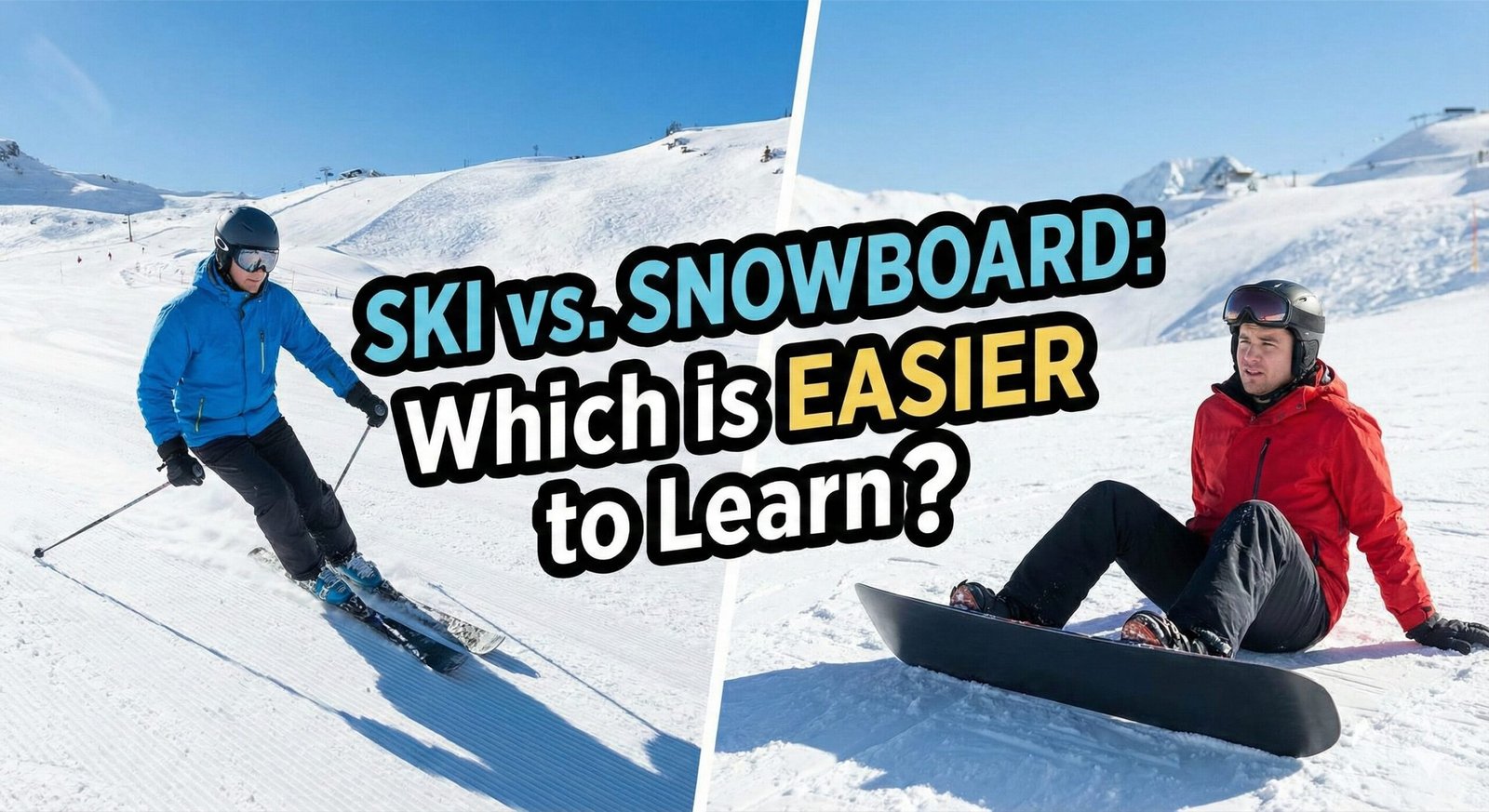
Is It Easier to Ski or Snowboard? The Definitive Beginner’s Guide
It is the most common debate in every rental shop from Colorado to the top European ski resorts. You are standing at the counter, the smell of wax and wet boots in the air, and you have to make a choice: two planks or one? Skiing or snowboarding? This decision often dictates your relationship with the mountains for decades to come.
The answer isn’t just about which one “looks cooler” (though we all know why snowboarding is better than skiing in that department). It comes down to your learning style, your physical strengths, and how much patience you have for the first three days. If you are wondering why snowboarding is fun but terrified of the learning curve, you are in the right place. In this deep dive, we explore every mechanical, physical, and psychological facet of these two winter titans.
Skiing is easier to learn but harder to master. Beginners can often separate their legs to balance and use a “pizza” wedge to stop on day one. Mastery requires technical precision in weight transfer and edge control.
Snowboarding is harder to learn but easier to master. The first 3 days are physically punishing, often resulting in falls. However, once you learn to link turns and find your balance, progression to advanced terrain and park riding comes much faster than in skiing.
1. The Learning Curve: Day 1 vs. Day 100
The progression of these two sports is fundamentally different. When we talk about “difficulty,” we have to distinguish between the struggle of a first-timer and the struggle of someone trying to tackle a double-black diamond mogul run.
Skiing: The “Instant Gratification” Plateau
On your first day of skiing, your legs are independent. This is the biggest psychological advantage. If you feel off-balance, you can instinctively widen your stance or move one foot to catch yourself. You face forward—a natural human position that mimics walking or running. Most beginners can make it down the bunny hill without falling by lunch. By using the “snowplow” or “pizza” technique, you have a built-in brake system that feels intuitive.
However, the plateau hits hard around Day 5 to Day 10. Moving from a snowplow to parallel skiing (where your skis stay side-by-side) is a massive technical hurdle. It requires subtle weight shifts, core rotation, and overcoming the fear of pointing your skis straight down the fall line. Perfecting parallel turns and carving technique can take years of lessons. High-level skiing is a game of millimeters; a slight lean too far back can lead to a spectacular “yard sale” (losing all your gear in a crash).
Snowboarding: The “School of Hard Knocks”
Snowboarding requires you to stand sideways with both feet strapped to a single board. This feels completely unnatural to the human vestibular system. You have no independent leg movement to save you. During the first few days, you will catch edges—meaning the edge of your board digs into the snow unexpectedly—and slam onto your wrists, knees, or tailbone. This is why snowboarding is dangerous for beginners who don’t wear protection.
But there is a silver lining. Once it “clicks”—usually around day 3 or 4—you are flying. Because you only have one “tool” to manage (the board), the mechanics of turning are more consolidated. Once you understand how to transition from your toe-edge to your heel-edge, you’ve unlocked 80% of the sport’s foundational movement. The transition from linking basic turns to riding powder and exploring backcountry terrain happens much faster than for skiers. Within one or two seasons, a dedicated snowboarder can often keep up with skiers who have been riding for five years.
2. Physical Demands: Legs vs. Core
Your fitness level plays a huge role in which sport will feel “easier.” Both sports are full-body workouts, but they target different muscle groups with varying intensities.
- Skiing (Leg Day Mastery): Skiing is notoriously brutal on the thighs (quads) and knees. You are constantly in a semi-squat position, using your legs as shock absorbers to handle the terrain. Because your legs can move independently, there is also a significant amount of lateral (side-to-side) stress on the ligaments. If you have a history of ACL or MCL issues, skiing can be particularly taxing. You’ll find that your “ski legs” take a few days to develop each season, often resulting in that deep, burning sensation by 2 PM.
- Snowboarding (Core & Balance): Snowboarding relies heavily on core strength for balance and turning. You aren’t just using your legs; you are using your obliques and abdominals to rotate the board. Furthermore, beginners spend a lot of time pushing themselves up off the snow from a seated position, which is an incredible upper-body and core workout. This is why our fitness guide for snowboarding emphasizes planks, rotational exercises, and squats. Snowboarding is generally more forgiving on the knees than skiing, but much more demanding on the midsection.
In addition to the muscular demand, there is the “fatigue factor.” Skiers can “rest” while standing on flat ground by simply standing upright. Snowboarders must either stay on an edge or sit down. This means snowboarders often take more frequent, shorter breaks, whereas skiers might go for longer periods but experience more intense leg burn during the descent.
3. The Comfort Factor: Boots and Walking
This is the one area where there is almost zero debate: snowboarding wins hands down. The lifestyle aspect of the sport—the “apres-ski”—is significantly impacted by your choice of footwear.
The Walk of Shame vs. The Snowboard Stroll
Ski boots are rigid plastic shells designed for maximum power transfer to the ski. Walking in them is like walking in cement blocks on ice. They force a clunky, robotic gait and offer very little traction. Snowboard boots, by contrast, feel like stiff sneakers or heavy-duty hiking boots. They are soft, warm, and comfortable. You can walk to the bar, drive a car, and even dance in them with relative ease. If you have ever wondered why feet hurt, it’s often due to bad fit, but generally, the snowboard experience is far more ergonomic. Check out our best snowboard boots guide to see the modern tech making them even better.
Furthermore, carrying gear is a different experience. A skier has to juggle two long skis and two poles, which often results in the “clatter” of equipment while walking through the parking lot. A snowboarder simply tucks their board under one arm and walks. This portability makes a big difference when navigating crowded resorts or taking public transit to the mountain.
4. Injury Risks: Knees vs. Wrists
Safety is a primary concern for any beginner. The mechanics of how you fall—and you *will* fall—differ greatly between the two disciplines.
Skiing: The Knee Twister
Because skis are long levers attached to your feet, they act as mechanical magnifiers. If you fall and your ski doesn’t eject from the binding properly, the torque of the ski hitting the snow goes straight to your knee joint. ACL tears and meniscus damage are the most common long-term ski injuries. Modern bindings have come a long way in terms of safety releases, but the inherent risk of leg twisting remains the hallmark of ski-related trauma.
Snowboarding: The Upper Body Impact
When snowboarders fall, they usually “catch an edge,” which results in a sudden slam either forward (faceplant) or backward (tailbone slam). The natural human instinct is to put your hands out to break the fall. This makes wrist fractures and shoulder dislocations the #1 and #2 injuries. However, these are often “one-and-done” injuries that heal well, compared to the chronic knee issues skiers face. We highly recommend wearing wrist guards and impact shorts to mitigate this risk during the first 10 days of riding.
5. The Cost: Gear and Maintenance
While lift tickets and lodge food cost the same, the equipment investment varies. Skiing generally requires more individual pieces of hardware: two skis, two bindings, two boots, and two poles. This often leads to a higher entry price point for high-quality gear. Snowboarding is more streamlined: one board, two bindings, and one pair of boots.
Maintenance is also a factor. Both require regular waxing and edge sharpening, but skiers have more “edges” to maintain. Additionally, ski bindings require professional calibration (the DIN setting) based on your weight and ability to ensure they release safely. Snowboard bindings are simpler and can usually be adjusted at home with a screwdriver. Knowing when to buy gear—usually in the late spring—can save you up to 50% on both setups. For a detailed breakdown, read our analysis on how expensive is snowboarding.
Detailed Comparison Matrix
| Feature | Skiing | Snowboarding |
|---|---|---|
| Initial Learning | Easier (Day 1-3) – Instinctive forward stance. | Harder (Lots of falling) – Sideways stance. |
| Mastery | Harder (Technique heavy) – Years for parallel. | Easier (Quick progression) – Fast to off-piste. |
| Comfort | Low (Rigid boots) – Difficult to walk. | High (Soft boots) – Very comfortable. |
| Lifts | Easy – Simply slide on and off. | Hard – Must unstrap one foot to skate. |
| Terrain Type | Great for moguls and steep ice. | Superior for deep powder and park. |
| Injury Risk | Lower body (Knees/Ligaments). | Upper body (Wrists/Shoulders/Tailbone). |
Top Gear to Make Learning Easier

Yes. Basic Snowboard
The “UnderBite” edge technology helps you grip ice without catching edges, making your first turns significantly smoother and less painful.
View on Amazon
Leatt Impact Shorts
Snowboarding involves sitting on the snow and falling backward. These shorts protect your tailbone and keep your seat warm on the lift.
View on Amazon
Burton Moto BOA Boots
The BOA system makes tightening them a breeze compared to traditional laces, getting you on the hill faster.
View on AmazonCommon Beginner Struggles (and Fixes)
The Chairlift Anxiety
Skiers just sit down and stand up. Snowboarders have to unstrap one foot, “skate” to the line, and then ride off the lift with only one foot attached. It is terrifying at first because you have 50% less control. A stomp pad is essential—it provides a grippy surface for your unattached foot. Also, ensure you aren’t experiencing heel lift, as this makes controlling the board on off-ramps impossible.
The dreaded “Flat Spots”
Skiers have poles to push themselves. Snowboarders get stuck on flat sections of the trail. If you lose momentum, you have to unstrap and walk. This is why beginners should avoid long, flat “catwalks” and learn to maintain a “base” speed. Understanding the resort map to avoid these traps is half the battle for a new rider.
6. How Weather and Snow Conditions Affect Your Learning
One factor that rarely appears in beginner guides is how snow conditions and weather dramatically change the difficulty of each sport. The same trail can feel like a green circle on Monday and a black diamond on Thursday depending on temperature, wind, and recent snowfall. Understanding these variables helps you choose the right day to learn and set realistic expectations for your first sessions.
Powder Days: Snowboarding’s Natural Advantage
When fresh powder falls—four to twelve inches of light, fluffy snow—snowboarders have a distinct advantage. The wider surface area of a snowboard distributes your weight across a larger plane, allowing you to “float” on top of the snow. The sensation is often described as surfing or flying. For beginners, powder is actually softer to fall on, making it a surprisingly forgiving surface for learning basic turns. The deep snow naturally slows you down and cushions every tumble.
Skiers, by contrast, tend to sink in deep powder with each ski independently. This requires a specific technique shift—leaning back to keep the tips above the snow, using a rhythmic bouncing motion to generate momentum. For a beginner who hasn’t yet mastered parallel turns on groomed terrain, deep powder can feel like quicksand. Even intermediate skiers often struggle in powder until they’ve spent several dedicated sessions learning the technique. The independent leg movement that makes skiing easy on groomed runs becomes a liability when both skis are at different depths in the snow.
Icy Conditions: Everyone’s Enemy
Hardpack and ice are where both sports become genuinely dangerous, but the failure modes are different. On ice, a snowboarder who catches an edge will slam down with full force because both feet are locked to the board—there’s no way to spread the impact. The board slides out from under you in a predictable direction, which at least means you can prepare for the fall. Experienced snowboarders learn to keep their edges sharp and their center of gravity low on icy days.
Ice is arguably more treacherous for skiers because the independent skis can slip in different directions simultaneously. A beginner on ice may find one ski shooting forward while the other stays put, resulting in a painful “doing the splits” scenario. More advanced ice situations can cause both skis to lose grip at the same time, sending you sliding down the mountain with no control. Both sports require sharper edges in icy conditions, but the consequences of losing edge grip are more dramatic for skiers because of the split-leg mechanics.
Slush and Spring Conditions
Spring skiing, typically March through May depending on latitude, brings warm temperatures that create slushy, heavy snow. This slush slows both skiers and snowboarders significantly because the wet snow creates drag on the base of whatever you’re riding. For snowboarders, slush is particularly frustrating because it can grab the base of the board and throw you off balance mid-turn. The heavy, wet snow requires more aggressive edge engagement and more physical effort to push through.
Skiers handle slush slightly better because they can use their poles for balance and can independently adjust each ski’s angle of attack. However, the slush ball buildup on ski bases is a real nuisance—it adds weight, creates drag, and can make turning feel sluggish. Wax designed for warm temperatures helps both sports, but neither is immune to the “slow snow” frustration of spring conditions.
Visibility and Flat Light
Overcast days, fog, and “flat light” conditions—where the lack of shadows makes the snow surface look uniformly white—are particularly challenging for beginners in both sports. When you can’t see bumps, dips, or changes in terrain texture, every turn becomes a surprise. Snowboarders tend to handle flat light slightly better because their lower center of gravity and wider base provide more stability when they hit unexpected terrain features. Skiers, with their higher center of gravity and narrower base (even when both skis are parallel), are more easily thrown off balance by unseen bumps.
The solution for both sports is the same: invest in quality goggles with low-light or flat-light lens tints (typically yellow, rose, or persimmon-colored lenses). These lenses increase contrast and help you see terrain variations that would otherwise be invisible. This is one of the most underrated pieces of beginner gear and can dramatically improve your confidence and safety on overcast days.
Wind and Cold Extremes
High winds and extreme cold affect both sports, but snowboarders are more exposed because they ride sideways, presenting their full body profile to the wind. Skiers, who face forward, have a more aerodynamic stance and can tuck behind trees and terrain features more easily. At temperatures below -10°F (-23°C), exposed skin is at risk of frostbite for both sports, but snowboarders spend more time sitting on the snow (when resting or strapping in), which can transfer cold to their pants and base layers faster. Windproof outerwear is critical for both, but snowboarders should pay extra attention to waterproof seat panels and windproof gloves.
Optimal Learning Conditions
The ideal conditions for learning either sport are: temperatures between 20-32°F (-6 to 0°C), light winds (under 15 mph), fresh snow cover (even 2-3 inches helps), and good visibility. Early morning runs on freshly groomed terrain offer the smoothest, most predictable surface for building confidence. Avoid learning on icy mornings after a freeze-thaw cycle—the hardpack surface amplifies every mistake and increases fear and injury risk.
7. Navigating Lifts: The Hidden Skill Nobody Warns You About
Lifts are the circulatory system of any ski resort, and how each sport interacts with them is one of the most practical, day-to-day differences between skiing and snowboarding. This is a topic that can make or break your first day, yet it receives surprisingly little attention in most comparison guides.
The Magic Carpet and Conveyor Lifts
For absolute beginners on the bunny hill, both sports use “magic carpets”—essentially conveyor belts embedded in the snow surface. Both skiers and snowboarders stand on the carpet and ride it uphill. For snowboarders, this means unstrapping one foot and skating onto the carpet, then riding it up while balancing on one edge. For skiers, it means sliding both skis onto the carpet side by side. The magic carpet is equally easy for both sports, and this is where you’ll spend your first few hours regardless of your choice.
Chairlifts: Where Skiers Shine
The standard chairlift is where skiing has an enormous practical advantage. A skier simply slides into the loading area, sits down when the chair arrives, and rides up with both skis hanging naturally. At the top, the skier stands up and glides away smoothly. The entire process is natural and requires almost no special skill.
Snowboarders face a multi-step process that requires practice. First, you must unstrap your back foot from the binding before approaching the lift line. You then “skate” forward using your free foot—similar to pushing a skateboard—which requires a basic level of balance that beginners may not yet possess. When the chair arrives, you sit down while holding your board perpendicular to the direction of travel (to prevent it from catching on anything). At the top, you must stand up and immediately transition to riding with only one foot strapped in. This one-footed riding is a skill unto itself and takes most beginners 5-10 chairlift rides to feel comfortable with.
The most common snowboarder mishap on chairlifts is “catching a edge” on the unloading ramp, which typically results in a slow-motion fall right in front of the lift operator and any waiting skiers. It’s embarrassing but universal—virtually every snowboarder has experienced this at least once. The key to avoiding it is keeping your weight centered over the board’s uphill edge and maintaining a slight forward lean as you glide off the ramp.
Gondolas and Tramways
Gondolas—the enclosed cabins that carry passengers uphill—are the great equalizer. Both skiers and snowboarders simply carry their equipment inside, sit down, and ride up. The only difference is that snowboarders may need to unstrap their board before entering, while skiers can keep their skis on and simply walk into the gondola (though many resorts ask skiers to remove skis and carry them inside for safety). Gondolas are the preferred lift type for nervous snowboarders because they eliminate the balance and timing challenges of chairlifts. Many resorts with large snowboarder populations have invested heavily in gondola infrastructure for this reason.
Surface Lifts: T-Bars, Pomas, and Rope Tows
Surface lifts—where you stay on the snow while being pulled uphill—are common at European resorts and at some North American areas. For skiers, these lifts are relatively straightforward: you clip the T-bar or poma under your seat and let it pull you uphill while your skis glide on the snow. For snowboarders, surface lifts are notoriously difficult. The pulling force is applied to one side of the body (since you’re standing sideways), which creates a constant rotational pull that fights against your natural stance. Many snowboarders find T-bars nearly impossible to ride without falling, which is why resorts with significant snowboarder traffic tend to invest in chairlifts and gondolas instead.
Rope tows and handle tows are the simplest lifts but also the most challenging for snowboarders. You grip a rope or handle and it pulls you uphill while you slide on your board’s base. The constant grip strength required can exhaust your forearms, and the jerky start-stop motion often throws snowboarders off balance. Skiers handle rope tows more easily because they can distribute the pulling force across both skis and maintain a forward-facing, stable stance.
Lift Line Etiquette for Both Sports
Lift line etiquette differs slightly between the two sports. Skiers generally queue with their skis on and poles in hand, which takes up a predictable amount of space. Snowboarders who have unstrapped one foot take up similar space but are less mobile while waiting, which can cause minor congestion. The key etiquette rule for both sports is to stay in your lane, move forward when the line advances, and be aware of your equipment’s footprint. Skiers should watch their pole tips, and snowboarders should be mindful of their board’s width when weaving through tight spaces. Both sports should always yield to people loading and unloading lifts—this is a safety non-negotiable.
8. Teaching Kids: Skiing vs. Snowboarding for Children
If you are a parent deciding which sport to introduce your child to, the calculus is different from the adult decision. Children’s bodies, attention spans, and developmental stages all play significant roles in which sport will provide the safest, most enjoyable introduction to the mountains.
The Age Factor: When Can Kids Start?
Children can begin skiing as young as age 3 to 4, when they have enough leg strength and coordination to stand on small skis and follow basic instructions. The “pizza” wedge is intuitive enough for most preschoolers to learn within a few hours, and the forward-facing stance aligns with their natural movement patterns. Many resorts offer “ski school” programs specifically designed for 3-5 year olds, complete with colorful learning areas, mini terrain parks, and gentle conveyor lifts.
Snowboarding typically requires children to wait until age 7 to 10. The reason is primarily physical: snowboarding demands a level of core strength, ankle stability, and falling tolerance that younger children haven’t yet developed. A 4-year-old who falls repeatedly while snowboarding will likely cry, lose interest, and refuse to try again. The same child who falls while skiing can often stand back up with minimal drama and keep going. For this reason, most resort ski schools do not accept snowboard students under age 6 or 7, and some wait until age 8 or 9.
Which Sport Keeps Kids Engaged Longer?
This depends heavily on the individual child’s personality. Kids who love speed, independence, and exploration often gravitate toward skiing because the early competence allows them to start exploring the mountain sooner. A 6-year-old skier who has mastered the pizza can ride green and easy blue runs with a parent, experiencing the thrill of real mountain riding within their first season.
Kids who love board sports—skateboarding, surfing, BMX—may prefer snowboarding despite the steeper learning curve. These children often have the balance and falling experience from other sports, which shortens the snowboarding learning curve. The single-board experience also appeals to kids who find the concept of two separate planks confusing or who enjoy the “cool factor” that snowboarding carries in youth culture.
A key consideration is siblings. If you have one child skiing and one snowboarding, the family dynamic at the resort becomes complicated. The skier will progress much faster in the first season and will want to explore more terrain, while the snowboarder may still be on the bunny hill. This can create frustration for both children. Many families solve this by putting all children in ski school initially, then allowing interested kids to switch to snowboarding after they’ve developed basic mountain skills.
Kids and Injury Prevention
Children’s bodies are more resilient than adults in some ways (bones are more flexible, recovery is faster) but more vulnerable in others (growth plates, developing joints). For skiing, the primary risk remains knee injuries, though children experience these at a much lower rate than adults because they are lighter, more flexible, and typically not skiing at speeds that generate dangerous torque. Helmet use is mandatory in many resorts for children and should be non-negotiable regardless of local law.
For snowboarding, wrist injuries are the main concern for kids, just as they are for adults. Children’s wrists are particularly vulnerable because their bones are still growing and haven’t fully hardened. Wrist guards should be standard equipment for any child learning to snowboard, and many kids’ snowboard gloves now come with built-in wrist protection. Additionally, children learning to snowboard should always wear padded shorts to protect their tailbone, as they will be spending significant time sitting on the snow.
Expert Recommendation for Parents
Start all children with skiing between ages 3-7, regardless of which sport you ultimately want them to learn. Skiing builds foundational mountain skills—balance on snow, understanding of terrain, comfort with speed, and lift etiquette—that transfer directly to snowboarding. Once your child is a competent intermediate skier (comfortable on blue runs), they can switch to snowboarding with a massive head start in mountain awareness. This “ski first, snowboard second” approach is the most common path among resort professionals and instructors.
9. Terrain Parks and Freestyle: Where Snowboarding Dominates
If your ultimate goal is to ride terrain parks—rails, boxes, jumps, halfpipes, and creative features—then snowboarding has a significant cultural and mechanical advantage. The terrain park is snowboarding’s spiritual home, and the sport’s identity is deeply intertwined with creative, freestyle expression.
Why Snowboarders Own the Park
Snowboarding emerged from skateboarding and surfing culture, both of which prize creativity, style, and tricks over pure speed or technical precision. When snowboarders enter a terrain park, they bring this freestyle DNA. The sideways stance provides natural balance for grinding rails and pressing boxes. The single board surface creates a unified platform for spinning, flipping, and sliding across features. The bindings’ ankle straps provide a secure connection that allows for aggressive, high-commitment maneuvers.
More importantly, the snowboarding community’s cultural emphasis on park riding means that progression happens faster. A beginner snowboarder who spends their second or third season in the park will have access to a vast ecosystem of YouTube tutorials, Instagram inspiration, and peer mentorship that is specifically designed for snowboard freestyle progression. The learning path from basic turns to first rail to first jump to first 180 is well-documented and well-traveled in the snowboarding world.
Freestyle Skiing: The Underdog Making a Comeback
Freestyle skiing has grown enormously in the past two decades, thanks partly to the X Games and Olympic inclusion of slopestyle, halfpipe, and big air events. Modern twin-tip skis (skis that are curved up at both ends) allow skiers to ride backward and land tricks that were once impossible. Skiers can also perform tricks that snowboarders cannot—most notably, the ability to spin in both directions (left-foot-forward and right-foot-forward) and to perform corked rotations where the body inverts mid-air.
However, the learning curve for ski freestyle is steeper. Balancing on two separate skis while sliding a rail requires a different kind of precision than balancing on one board. Landing jumps on skis demands that both skis make contact simultaneously, which adds a coordination challenge that snowboarders don’t face. For this reason, most terrain park regulars are snowboarders, and many resorts build their park features with snowboarders as the primary audience—rail heights, jump spacing, and halfpipe dimensions are often optimized for single-board riders.
Park Etiquette and Safety
Both sports share the same terrain park etiquette, but the dynamics differ. In a typical park session, snowboarders tend to ride together in “trains” (following each other through a feature line), while skiers tend to ride individually. Snowboarders are more likely to “session” a single feature repeatedly to dial in a trick, while skiers often prefer to flow through the entire park in one continuous run. These are generalizations, of course, but they reflect the different cultural approaches to park riding.
Safety-wise, both sports carry similar risks in the park: falls from height, collisions with features, and collisions with other riders. The most important safety rule is the same for both: always call “dropping” before starting your run, always look before entering a feature, and never stop in a landing zone. Park injuries tend to be more severe than trail injuries because of the height and hard surfaces involved, so helmets are absolutely mandatory for park riding regardless of which sport you choose.
Park Progression Timeline
Snowboarding: Beginner turns (Season 1) → Straight airs on small jumps (Season 1-2) → 180s and basic grabs (Season 2) → Rail slides and boxes (Season 2-3) → Switch riding and larger features (Season 3+)
Skiing: Parallel turns (Season 1-2) → Straight airs on small jumps (Season 2-3) → Grabs and basic spins (Season 3-4) → Rail slides (Season 3-4) → Corks and switch riding (Season 4+)
The snowboarding timeline is approximately 1-2 seasons faster for each freestyle milestone, largely because the single-board platform simplifies the mechanics of each trick.
10. Backcountry and Off-Piste: Leaving the Resort Behind
Beyond the groomed trails and maintained terrain of ski resorts lies the backcountry—ungoverned, unpatrolled wilderness where avalanches, tree wells, and unmarked obstacles present genuine life-threatening dangers. Understanding how each sport handles backcountry terrain is essential for anyone who dreams of exploring beyond the resort boundary.
Snowboarding in the Backcountry
Snowboarding has deep roots in backcountry exploration. The sport’s culture of adventure and independence naturally extends to riding untracked powder far from the crowds. Snowboards excel in deep powder because their large surface area provides natural flotation, allowing riders to stay on top of the snow rather than sinking. The turning mechanics in powder—heel-to-toe weight transitions—are the same as on groomed runs, just executed more gently and with more centered weight distribution.
The main backcountry challenge for snowboarders is uphill travel. Since snowboards don’t have a “skin” mode like touring skis, snowboarders must either hike uphill in snowshoes or use splitboards—snowboards that separate into two ski-like halves for uphill travel and rejoin into a single board for the descent. Splitboarding has become enormously popular and has its own dedicated gear market, but it adds weight, complexity, and cost compared to resort snowboarding.
Backcountry Skiing: The Efficiency Advantage
Backcountry skiing benefits from decades of equipment development focused on uphill efficiency. Modern touring bindings allow the heel to lift freely during the uphill stride (similar to a cross-country skiing motion) while locking down for the descent. Climbing skins—fabric strips that attach to the ski base and provide traction on snow—allow skiers to walk uphill at a steady pace. Lightweight ski boots designed for touring are comfortable enough to walk in for hours, unlike the rigid resort boots that would make a long hike miserable.
The dual-ski platform also provides stability in variable backcountry conditions. When navigating exposed ridgelines, crossing icy traverses, or making precise turns through tight trees, the independent leg movement of skiing offers more control options than snowboarding. This doesn’t mean snowboarders can’t handle these situations—they absolutely can—but the learning curve for backcountry competence is generally shorter for experienced skiers.
Avalanche Safety: Non-Negotiable for Both Sports
Regardless of which sport you choose, backcountry travel requires avalanche education and equipment. Both skiers and snowboarders must carry a beacon (transceiver), probe, and shovel, and both must know how to use them. The Avalanche Level 1 certification course is the minimum recommended training before venturing into backcountry terrain, and both sports participate equally in avalanche awareness and rescue training. The physics of avalanches don’t care whether you’re on one board or two—terrain assessment, snow stability evaluation, and rescue technique are universal skills.
One practical difference in avalanche scenarios: skiers can remove their skis and move on foot through deep snow, while snowboarders must either unstrap and carry their board or keep it attached and hop/slide on one foot. In a rescue scenario where seconds count, the ability to quickly shed equipment and move on foot gives skiers a marginal advantage. However, this advantage is small compared to the importance of proper avalanche training and decision-making.
11. Fitness Preparation: How to Train Before You Arrive
One of the most overlooked aspects of choosing between skiing and snowboarding is how your pre-season fitness routine differs. While both sports benefit from general cardiovascular fitness and lower-body strength, the specific muscle groups and movement patterns that matter most are quite different.
Pre-Season Training for Skiers
Skiing demands eccentric quadriceps strength—the ability to control your quads while they lengthen under load, which is exactly what happens when you’re absorbing bumps and controlling speed in a semi-squat position. The most effective exercises for this are eccentric squats (lowering slowly on a single leg), wall sits (holding the ski tuck position), and lateral lunges (mimicking the side-to-side weight transfer of turning). Skiers also benefit from single-leg balance exercises, as the sport requires constant micro-adjustments on each leg independently.
Cardiovascular endurance is important for skiing because the sport involves short, intense bursts of effort (the descent) followed by passive recovery (the lift ride). High-intensity interval training (HIIT) mimics this pattern more effectively than steady-state cardio. Knee health is paramount for skiers, so incorporating exercises that strengthen the muscles around the knee—hamstrings, glutes, and hip stabilizers—can significantly reduce injury risk. Exercises like Romanian deadlifts, clamshells, and monster walks are particularly valuable.
Pre-Season Training for Snowboarders
Snowboarding demands core rotational strength and balance more than pure leg power. The primary muscles used in snowboarding are the obliques (for toe-to-heel transitions), the hip flexors (for lifting the board into the air), and the calves (for edge control). The most effective exercises include Russian twists (rotational core strength), single-leg deadlifts (balance and posterior chain strength), and calf raises (edge control endurance). Planks and side planks are foundational for the constant isometric core engagement required during riding.
Snowboarders also benefit from wrist and forearm strengthening, not only for injury prevention but because the upper body plays a larger role in balance and recovery than in skiing. Push-ups, wrist curls, and grip strength exercises can help build the upper-body resilience that snowboarding demands. Upper body “push” strength (push-ups, dips) helps snowboarders recover from falls more quickly and with less fatigue.
ski Training Priorities
- Eccentric quad strength
- Single-leg balance
- Knee stability exercises
- HIIT cardio intervals
- Hip mobility and flexibility
- Lateral movement drills
Snowboard Training Priorities
- Core rotational strength
- Single-leg deadlifts
- Wrist and forearm conditioning
- Calf raises and ankle stability
- Upper body push strength
- Balance board training
The Off-Season Advantage
Skiers and snowboarders can both benefit from off-season activities that maintain their snow sports fitness. For skiers, mountain biking, rollerblading, and trampoline work all develop the balance and leg strength needed on the mountain. For snowboarders, skateboarding is the most direct cross-training activity because it develops the same balance, edge awareness, and core engagement patterns. Surfing and wakeboarding also translate well. Both sports benefit from yoga and Pilates, which develop the flexibility, balance, and body awareness that prevent injuries on the snow.
For a comprehensive, sport-specific training program, we recommend consulting our fitness guide for snowboarding, which includes week-by-week training plans, sport-specific exercises, and nutritional guidelines for peak mountain performance.
12. Speed and Adrenaline: Which Sport Is Faster?
For thrill-seekers and adrenaline junkies, the question of which sport offers more speed is a critical consideration. The answer is nuanced because “speed” means different things in different contexts.
Raw Speed: Skiing Wins
In terms of pure, straight-line velocity, skiing is faster. The world speed record on skis is over 156 mph (251 km/h), set by Ivan Origone in 2015. The snowboard speed record, while still impressive, is significantly lower at around 126 mph (203 km/h). The reason is aerodynamic: a skier can tuck into a tight, forward-facing position that minimizes wind resistance, while a snowboarder’s sideways stance creates more drag.
For recreational riders, the speed difference is less dramatic but still noticeable. On a steep, groomed run, most recreational skiers will naturally reach higher speeds than recreational snowboarders because of the lower aerodynamic profile and the ability to tuck during straight-line sections. However, a confident snowboarder carving hard on a steep groomer can absolutely keep pace with most skiers—the difference at recreational speeds is largely about confidence and terrain choice rather than physical limitations.
Speed Perception: Snowboarding Feels Faster
Here’s where it gets interesting: snowboarders consistently report that they *feel* faster than they actually are, while skiers report the opposite. This is because snowboarders ride closer to the snow surface (their center of gravity is lower), which makes the ground rush past more dramatically. The sideways stance also means the snow is rushing past your peripheral vision in a way that amplifies the sensation of speed. This “perceived speed” makes snowboarding feel more intense at lower actual velocities, which is why many riders describe snowboarding as the more “exhilarating” sport even when skiers are objectively moving faster.
Speed Control: Different Mechanics
Speed control is a critical skill in both sports, and the mechanics are fundamentally different. Skiers control speed by varying the angle of their edges against the snow, creating a “hockey stop” by turning both skis sideways simultaneously. The wedge or pizza is a speed control technique available from day one. Snowboarders control speed by tilting the board onto its uphill edge, creating friction against the snow surface. The snowboarder’s heel-side and toe-side edges provide two distinct braking surfaces, but using them requires the kind of balance that beginners may not yet possess.
This means that on steep terrain, skiers have an easier time managing speed because they have more braking options (two independent edges plus the wedge) and can make quick, incremental speed adjustments. Snowboarders on steep terrain must rely entirely on edge engagement, which requires more commitment and confidence. This is one reason why many beginner snowboarders avoid steep runs even when they feel “ready”—the speed control challenge on steep terrain is genuinely harder on a snowboard.
13. Night Skiing and Evening Sessions
Night skiing and evening riding sessions have grown enormously in popularity, with many resorts now offering lit terrain until 8 or 9 PM. This extends the riding day and provides a unique atmosphere that differs from daytime sessions in important ways.
Night Skiing: The Skier’s Extended Day
Night skiing is slightly more popular among skiers than snowboarders, partly because the equipment logistics are easier (skis go on and off quickly) and partly because the typically hard-packed evening conditions favor the precise edge control that skiing offers. As temperatures drop after sunset, the snow surface often refreezes from soft afternoon slush to firm, fast hardpack. Skiers handle these conditions well because their edge engagement technique can adapt to the harder surface.
The visual experience of night skiing is also unique. The artificial lighting creates dramatic shadows and highlights that can make familiar runs feel entirely new. However, the limited visibility and potential for icy patches make night skiing more challenging for beginners in both sports. If you’re learning to ski or snowboard, it’s best to wait until you’re comfortable on groomed terrain before trying night sessions.
Night Snowboarding: A Different Vibe
Snowboarders who ride at night often describe a different cultural experience than daytime riding. The crowds thin out, the lift lines disappear, and the music pumping from the resort’s speakers seems louder and more immersive. Many resorts designate specific terrain park sessions under the lights, creating a festival-like atmosphere that draws dedicated park riders. The snowboard community’s connection to music, art, and counterculture finds its natural expression in these night sessions.
The main challenge for night snowboarding is the cold. Temperatures drop significantly after sunset, and snowboarders—who spend more time in contact with the snow surface—feel the cold more acutely than skiers. Investing in high-quality base layers, heated insoles, and insulated mittens is essential for comfortable night riding. Hand warmers and toe warmers can extend your session by hours in extreme cold.
14. Après-Ski Culture and the Social Experience
The social dimension of mountain sports—the “après-ski” (after skiing) tradition—has evolved significantly in the past two decades, and the cultural differences between skiing and snowboarding communities remain distinct even as they converge.
The Historical Divide
Historically, skiing was the sport of country clubs, European aristocracy, and the American upper class. The culture was formal, expensive, and exclusive. Snowboarding emerged in the 1980s and 1990s as a rebellion against this establishment—born in parking lots, built by surfers and skaters, and initially banned from most ski resorts. This outsider status created a strong counterculture identity that persists today. While the formal barriers between the two sports have largely dissolved (most resorts welcome both, and many athletes participate in both), the cultural DNA of each community remains distinct.
Modern Après-Ski
Today’s après-ski culture is more unified than ever. The same bars and restaurants at the base of most resorts serve both skiers and snowboarders, and the conversation topics—great runs of the day, gear recommendations, weather forecasts—are universal. Snowboarders tend to congregate at the base lodge’s more casual spots (think: loud music, beer specials, and standing room), while skiers may gravitate toward the more traditional lodge settings (think: fireplaces, wine lists, and sit-down dining). These are generalizations, of course, and the reality at most resorts is a happy blend of both cultures.
The lifestyle comfort of snowboarding extends into après-ski culture. Snowboarders can walk directly from the slopes to the bar in their soft boots without changing, while skiers must first navigate the awkward process of removing stiff boots or walking clumsily through the lodge in them. This might seem like a minor point, but after a long day on the mountain, the ability to walk normally and comfortably makes a real difference in how you experience the post-ride social scene.
Building Community
Both sports offer excellent opportunities for building social connections. Ski resorts host group lessons, clinic days, and social events that bring riders together. Snowboard culture tends to be slightly more informal and spontaneous—riders are more likely to strike up conversations in lift lines, share tips on the chairlift, or organize impromptu group rides. Ski culture can be slightly more structured, with organized club events, race leagues, and formal clinic series. Neither approach is better; it simply depends on what kind of social experience you’re looking for.
15. Season Progression: What to Expect Month by Month
Understanding how conditions change throughout the season helps you plan your learning timeline and set appropriate expectations. Both sports are affected by seasonal snow patterns, but the timing of your learning can significantly impact your experience.
November/Early December: Opening Season
Early season typically features limited terrain, man-made snow, and thin coverage. The snow surface is often hard-packed and icy due to the thin base layer. For beginners, this is a challenging time to learn either sport because the unforgiving surface amplifies every mistake. If possible, wait for natural snowfall before starting your lessons. Early-season snowboarders face additional challenges because thin coverage means more rocks and obstacles to catch edges on.
Late December/January: Peak Winter
This is typically the best time for learning. Resorts have their full terrain open, snow coverage is at its deepest, and the snow quality is usually good. Cold temperatures keep the snow in excellent condition, and regular snowfall refreshes the surface frequently. For beginners, January offers the best combination of forgiving snow, full terrain availability, and smaller crowds (after the holiday rush subsides). Both sports are well-served by peak winter conditions.
February: The Sweet Spot
February is often considered the ideal month for mountain sports. The snow base is deep, conditions are stable, and daylight hours are increasing. Many resorts host special events, competitions, and festivals during February. For learning, this is an excellent time because the snow is typically at its most consistent—neither too hard (as in early season) nor too soft (as in spring). This is also peak season for beginner-friendly resorts to offer their best programming and lesson packages.
March: Spring Transition Begins
March marks the beginning of spring conditions at lower elevations while higher elevations maintain good winter snow. Temperatures warm during the day, creating soft, slushy conditions in the afternoon, but mornings often offer excellent groomed runs. This is a great time for intermediate riders to progress because the softer snow is more forgiving. For beginners, March can be excellent if you stick to morning sessions on groomed terrain. Both sports benefit from the warmer temperatures, which make falls more comfortable and extended sessions more enjoyable.
April/May: Late Season and Spring Riding
Late season brings its own unique joys: warm temperatures, sunny skies, and a relaxed atmosphere. Many resorts close lower-elevation terrain and concentrate operations on higher peaks. Snow conditions are variable—corn snow (a grainy, icy texture created by repeated freeze-thaw cycles) can be excellent in the morning and slushy by afternoon. Spring riding rewards adaptability and a sense of adventure. Both sports are fun in spring conditions, though snowboarders may find the late-season slush more challenging due to the base drag effect. Many resorts offer discounted lift tickets during this period, making it an affordable time to practice.
16. Women-Specific Considerations
While the fundamental physics of skiing and snowboarding are the same regardless of gender, there are some practical considerations that can influence which sport feels easier for women. These are generalizations based on common physiological differences, and individual variation is always significant.
Biomechanical Factors
Women generally have a lower center of gravity relative to height, which can benefit snowboarding by improving balance and stability on the board. The wider hip structure that many women have creates a slightly different turning dynamic on both skis and snowboards, but this is typically accommodated by proper equipment sizing rather than being a limiting factor. Women’s generally greater flexibility (particularly in the hips and ankles) can make snowboarding’s deep knee bends and toe-side turns slightly more comfortable.
For skiing, women may find the independent leg movement particularly advantageous because it allows them to use their natural flexibility to absorb terrain variations and make fluid, graceful turns. The forward-facing stance also aligns well with women’s typically wider pelvic structure, providing a stable base for balance. However, women are at higher risk for ACL injuries in skiing due to differences in knee anatomy (a wider pelvis creates a greater Q-angle at the knee, which can increase ACL strain during twisting falls). This is a significant consideration and should factor into the safety discussion.
Equipment Considerations
The snow sports industry has made significant strides in gender-specific equipment design. Women’s snowboard boots are designed with a narrower heel pocket, lower calf profile, and softer flex ratings to accommodate typical women’s foot and leg shapes. Women’s ski boots feature similar adjustments: narrower lasts, lower cuffs, and softer flex options. Women’s-specific snowboards are typically shorter, lighter, and have a more centered stance width to match women’s proportions. These equipment differences are important—a properly fitted women’s-specific setup will always outperform a “shrink it and pink it” approach where men’s gear is simply made smaller.
The Community Factor
Women-specific learning environments have become increasingly common and have proven to be one of the most effective ways to introduce women to both sports. Women-only clinics, lessons, and riding groups create a supportive atmosphere where questions are encouraged and the pace is set by the participants rather than by mixed-gender dynamics. Many resorts now offer dedicated women’s programming, and organizations like professional lesson programs have developed curricula specifically designed for adult women learners.
Research consistently shows that women who learn in women-specific groups progress faster and report higher satisfaction than those in mixed groups. This is attributed to reduced self-consciousness, more relevant instruction, and the social bonding that occurs when women share the learning experience together. For women choosing between skiing and snowboarding, the availability and quality of women-specific programming at your local resort can be a deciding factor.
17. The Mental Game: Fear, Confidence, and Psychological Resilience
Learning any new sport involves psychological challenges that are just as important as physical ones. The mental game often determines whether a beginner persists through the difficult early days or gives up and never returns to the mountain.
Fear Management in Skiing
Skiing’s primary psychological challenge is the fear of speed and loss of control. Because skiers face forward and can see directly down the fall line, the visual information can be overwhelming for beginners. Looking down a steep slope from a standing position creates a primal fear response that is difficult to override intellectually. The “pizza” technique helps manage this fear by providing a reliable braking mechanism, but as beginners progress to steeper terrain, the fear of going too fast becomes a real barrier.
Common psychological patterns in skiing include: the “backseat” position (leaning back in fear, which paradoxically reduces control and increases the likelihood of a fall), the “stiff legs” response (locking the knees in fear, which prevents proper shock absorption and edge engagement), and the “speed freeze” (becoming unable to turn or stop because fear has overwhelmed the motor skill system). Overcoming these patterns requires both physical technique work and mental strategies like visualization, breathing techniques, and gradual exposure to increasingly challenging terrain.
Fear Management in Snowboarding
Snowboarding’s psychological challenge is different: it’s primarily about trust and commitment. Because snowboarders must shift their weight onto an edge to turn, there’s a moment of commitment where you’re essentially choosing to fall in a controlled direction. For beginners who have already experienced the painful consequences of catching an edge (the sudden, violent slam), this commitment requires genuine courage. The fear of falling is more immediate and physical in snowboarding because falls tend to be harder and more sudden.
The psychological progression in snowboarding follows a distinct pattern: initial confidence (day 1, before the first falls), followed by fear and frustration (days 2-3, after experiencing hard falls), followed by cautious hope (day 3-4, when basic turns start working), followed by exhilaration (day 4+, when the turns link up and speed increases). The “valley of despair” between days 2 and 4 is where most snowboarders quit, and mental resilience is the primary factor that determines who pushes through.
Building Confidence in Both Sports
Regardless of which sport you choose, confidence-building strategies are essential for long-term success. Start each day on terrain that’s well within your ability level, and only progress when you feel genuinely comfortable. Celebrate small victories—a clean turn, a successful chairlift exit, a run without falling—and don’t compare your progress to others. Take breaks before you’re exhausted, because fatigue is the enemy of both technique and confidence. And remember that every expert rider was once a terrified beginner who fell hundreds of times before finding their rhythm.
18. Switch (Backwards) Riding: A Critical Skill Comparison
Learning to ride “switch” (backwards) is a milestone that separates intermediate from advanced riders in both sports. This skill is essential for terrain park progression, improves overall board/ski control, and opens up new dimensions of creative riding. The ease of learning switch varies significantly between the two disciplines.
Switch Skiing
Learning to ski switch is relatively straightforward because the forward and backward skiing motions are mechanically similar. Your body position doesn’t change dramatically—you’re still facing the same direction relative to your skis, just moving in reverse. The main challenge is the unfamiliarity of seeing the terrain behind you and the psychological adjustment to reversed visual information. Most intermediate skiers can learn basic switch skiing in a few sessions on gentle terrain.
The advantage of switch skiing is that it directly improves your forward skiing. The balance adjustments required for switch riding strengthen the stabilizer muscles around the knees and ankles, and the increased awareness of body position translates directly to more precise forward turns. Many ski instructors emphasize switch riding as a training tool even for students who have no interest in terrain park riding.
Switch Snowboarding
Switch snowboarding is significantly more challenging because it essentially requires you to become proficient in the sport’s opposite stance. If you normally ride regular (left foot forward), riding switch means operating as if you were a goofy-footed rider (right foot forward). This requires relearning every turn, every edge transition, and every balance point from scratch. Your “natural” foot becomes your “back” foot, and all the muscle memory you’ve built must be adapted to the new orientation.
However, the rewards of switch snowboarding are proportionally greater. Learning to ride switch doubles your creative possibilities in the park, allows you to land tricks in either direction, and fundamentally improves your understanding of the board’s dynamics. Most competitive snowboarders spend hundreds of hours developing their switch riding, and it’s considered one of the defining skills that separates casual riders from advanced ones.
19. The Rental vs. Buy Decision Framework
For beginners, the question of whether to rent or buy equipment is one of the most practical financial decisions you’ll face. The right answer depends on your commitment level, budget, and how quickly you plan to progress.
The Rental Case: First 1-3 Seasons
For your first season—or even your first two or three seasons—renting is almost always the better financial decision. Rental equipment is maintained by professionals, updated regularly, and available at every resort. You’ll pay approximately $40-$70 per day for a complete rental package (skis or snowboard, boots, and bindings), which sounds expensive until you compare it to the $500-$1,500 you’d spend on a beginner setup that you’ll outgrow within two seasons.
Renting also allows you to experiment with different equipment types, brands, and sizes. You might try a shorter snowboard one day and a longer one the next, discovering your preferences without any financial commitment. This trial-and-error approach is invaluable for beginners who don’t yet know what they want from their equipment. Most importantly, rental shops can swap out damaged or inappropriate equipment immediately—you’re never stuck with a board that’s the wrong size or a pair of boots that don’t fit.
The Buy Case: When You’re Ready
The transition from renting to buying typically happens when you’re riding 10 or more days per season and have developed clear preferences for equipment characteristics. At this point, owning your own gear provides consistent performance (rental equipment varies in quality and condition), better fit (your own boots can be heat-molded and customized), and long-term cost savings (after about 20-30 rental days, the cost of ownership breaks even).
When you do buy, focus your investment on the items that affect comfort and performance most: boots for both sports, the snowboard for snowboarders, and properly fitted bindings for both. For more detailed guidance on timing your purchase, see our guide on when to buy snowboarding gear. End-of-season sales (March through May) typically offer 30-50% discounts on the previous year’s models, which are functionally identical to current-year equipment.
20. Resort Selection: Where to Take Your First Lessons
The resort you choose for your first experience can make or break your relationship with mountain sports. Not all resorts are created equal when it comes to beginner experience, and the differences matter more than you might think.
What Makes a Great Beginner Resort
The ideal beginner resort has several key characteristics: extensive, well-designed beginner terrain (green circles and easy blue squares), modern high-speed lifts that minimize time waiting in lines, dedicated learning areas separated from advanced terrain, well-trained and patient instructors, and a welcoming atmosphere that doesn’t intimidate newcomers. The best beginner resorts also offer “learn to ride” packages that bundle lessons, rentals, and lift tickets at a discount.
Terrain variety matters more than total acreage. A resort with 100 acres of well-designed beginner terrain is better for learning than a resort with 3,000 acres where beginner trails are afterthoughts. Look for resorts with long, gentle green runs that allow you to practice linking turns without fear of running out of space or encountering advanced riders at high speeds. Resorts with multiple learning areas at different elevations offer the best progression path, allowing you to advance from the bunny hill to easy greens without a dramatic jump in difficulty.
Resort Considerations for Snowboarders Specifically
Snowboarders should pay extra attention to a resort’s lift infrastructure. Resorts with many surface lifts (T-bars, pomas, rope tows) are significantly less enjoyable for snowboarders because these lifts are difficult to ride on a snowboard. Chairlifts and gondolas are the snowboarder’s friends. Additionally, resorts with long, flat connecting trails (“catwalks”) between runs can be frustrating for snowboarders who lose momentum and must unstrap and walk. Resorts with good natural fall-line terrain—where trails flow naturally downhill without flat sections—are ideal for snowboard progression.
Check out our detailed guide to snowboarding resorts for beginners for specific recommendations that prioritize beginner-friendly terrain and snowboarder-friendly infrastructure.
21. The Environmental Impact: Sustainability in Mountain Sports
As outdoor recreationists, both skiers and snowboarders have a responsibility to consider their environmental impact. Mountain ecosystems are fragile, and the winter tourism industry has significant effects on local environments.
Carbon Footprint Comparison
At the equipment level, snowboarding has a slightly lower carbon footprint because it requires fewer raw materials—one board versus two skis, one pair of bindings versus two, and simpler boot construction. Manufacturing a snowboard typically involves less material processing and energy than manufacturing a complete ski setup. However, these differences are marginal compared to the carbon impact of transportation to and from the resort, which is the dominant factor in both sports’ environmental footprints.
On the mountain, both sports have essentially identical environmental impacts: lift energy consumption, snowmaking water usage, and terrain management. Resorts that invest in renewable energy, efficient snowmaking, and habitat conservation benefit both sports equally. The choice between skiing and snowboarding has minimal environmental implications compared to choices like driving an electric vehicle to the resort, carpooling, or choosing resorts that prioritize sustainability.
Backcountry Ethics
Both backcountry skiers and snowboarders share responsibility for minimizing their impact on wilderness areas. This includes following Leave No Trace principles, respecting wildlife closures, staying off sensitive vegetation, and properly disposing of waste. The “earn your turns” ethos of backcountry travel—where you hike up rather than taking a lift—reduces your environmental impact while deepening your connection to the mountain landscape. Both sports’ backcountry communities generally maintain strong environmental ethics, though education and awareness remain ongoing needs.
22. Competitive Paths: Racing, Freestyle, and Big Mountain
For those who aspire to compete, both sports offer multiple competitive disciplines, but the landscape differs significantly in terms of accessibility, cost, and cultural emphasis.
Competitive Skiing
Skiing’s competitive landscape is broader and more established. Alpine racing (downhill, slalom, giant slalom, super-G, and combined) has been an Olympic sport since 1936 and has deep roots in European ski culture. Cross-country skiing, ski jumping, freestyle skiing, and moguls all offer competitive pathways with well-defined progression ladders from local races to national championships to international competitions. The infrastructure for competitive skiing—race clubs, coaching networks, and funding sources—is mature and well-funded, particularly in European nations with strong alpine traditions.
Ski racing requires a specific body type and skill set that favors long limbs, quick reflexes, and technical precision. The equipment is expensive (race skis, speed suits, race gates), and the training commitment is significant (daily on-snow training plus off-season conditioning). For most recreational skiers, competitive racing remains aspirational rather than practical, but the pathway exists and is well-established.
Competitive Snowboarding
Snowboarding’s competitive scene is younger but incredibly vibrant. Slopestyle, halfpipe, big air, and boardercross are the primary disciplines, with all four now Olympic events. The culture of snowboarding competitions is more relaxed and personality-driven than ski racing—judges score style and creativity alongside technical difficulty, and competitors’ individuality is celebrated. This cultural difference reflects snowboarding’s roots in skateboarding, where personal expression is valued as highly as trick difficulty.
Getting into competitive snowboarding typically starts with local rail jams and small park competitions, which are widely available at resorts throughout the season. These low-pressure events are the ideal entry point for aspiring competitors, offering experience in a competition environment without the intensity of formal racing. From there, athletes can progress to regional and national events, with the most talented riders reaching international competitions and the Olympic level.
23. Dual-Sport Athletes: Why Many People Do Both
One of the most interesting trends in winter sports is the growing number of athletes who participate in both skiing and snowboarding. Once considered mutually exclusive (and the subject of heated tribal loyalty), the boundary between the two sports has blurred significantly in the past decade.
The Case for Learning Both
Learning both sports doubles your enjoyment of the mountain. On days when conditions favor one sport over the other—powder days for snowboarding, icy groomers for skiing—you can choose the right tool for the job. When riding with friends who participate in the other sport, you can join them instead of splitting up. And the cross-training benefits are real: skiing improves your independent leg balance and quick-turning ability, while snowboarding enhances your core strength and edge awareness.
Many resort instructors are certified in both disciplines, which makes them more versatile teachers and more valuable employees. For recreational riders, being dual-certified (or at least competent in both) opens up more social and travel opportunities. There’s no rule that says you must choose one forever—in fact, many experienced mountain athletes switch between skiing and snowboarding depending on conditions, mood, and companions.
The Transition Challenge
Switching between sports requires what instructors call “resetting.” Your body needs a session or two to adjust to the different balance points, turning mechanics, and muscle engagement patterns. A snowboarder who switches to skis will initially feel “tall” and unstable because the forward-facing stance and independent legs create a completely different center of gravity. A skier who switches to snowboarding will feel “locked” and unable to make the subtle adjustments that skiing allows. Both transitions are temporary—most competent riders can readjust within a few runs—but they do require patience and humility.
Our detailed comparison of why snowboarding offers unique advantages provides more context on what makes each sport distinct at the advanced level.
24. Long-Term Health Considerations
When choosing between skiing and snowboarding, it’s worth considering the long-term physical impact on your body. Both sports are physically demanding, but the wear patterns differ in important ways that become more significant with age.
Skiing and Joint Health
Skiing’s primary long-term health concern is knee wear. The sport places significant stress on the knee joint through repetitive turning motions, impact absorption from bumps, and the potential for traumatic injury (ACL tears, meniscus damage). Studies have shown that long-term recreational skiers have higher rates of knee osteoarthritis than the general population, with the severity correlating to the number of years and intensity of skiing. Skiers with a history of knee injuries face even higher risks of chronic knee problems later in life.
However, skiing’s impact on other joints is relatively mild. The sport promotes cardiovascular health, maintains leg muscle mass (which declines naturally with age), and supports bone density through weight-bearing activity. Many skiers remain active well into their 70s and 80s, skiing on well-groomed terrain at moderate speeds. The key to longevity in skiing is proper equipment (well-adjusted bindings, properly fitted boots), progressive terrain selection (matching difficulty to ability), and consistent off-season conditioning (particularly knee-strengthening exercises).
Snowboarding and Joint Health
Snowboarding’s long-term health profile is generally more favorable for joint longevity. Because both feet are fixed to a single board, the knee doesn’t experience the independent twisting forces that characterize skiing injuries. Studies show that snowboarders have significantly lower rates of knee osteoarthritis compared to skiers. However, snowboarders face their own long-term concerns: wrist injuries that may lead to chronic wrist pain, shoulder issues from repeated falls, and lower back strain from the rotational forces of turning.
Snowboarding’s impact on the lower back is worth noting: the sport requires constant rotational engagement of the spine, and over decades, this can lead to disc degeneration or chronic muscular pain. Proper technique (using the hips and legs to turn rather than twisting the spine) and core strengthening can mitigate this risk significantly. As with skiing, equipment quality and terrain selection play major roles in long-term health outcomes.
| Health Factor | Skiing | Snowboarding |
|---|---|---|
| Knee Stress | High (ACL, meniscus risk) | Low (both feet on same plane) |
| Wrist Risk | Low | High (falls onto outstretched hands) |
| Back Health | Moderate (impact absorption) | Moderate-High (rotational stress) |
| Cardiovascular | Excellent (interval-style exertion) | Excellent (core-engaged effort) |
| Longevity | High (many 70+ year old skiers) | High (but less data due to sport’s youth) |
| Recovery from Falls | Varies (can be severe knee injuries) | Generally faster (wrist/shoulder injuries heal well) |
25. The Technology Gap: How Gear Innovation Shapes the Experience
The equipment you use profoundly affects your learning experience, and the technology landscape differs between the two sports in ways that can make one feel easier than the other.
Ski Technology Evolution
Modern ski technology has advanced enormously in the past two decades. Rocker profiles (where the tips and tails curve upward) have made skis much more forgiving and easier to turn. Sidecut innovations allow skis to turn more naturally with less effort from the rider. Twin-tip designs allow backward skiing and park riding. Intermediate “crossover” skis—slightly narrower than powder skis, slightly wider than race skis—have become incredibly versatile, allowing beginners to progress through multiple skill levels on a single pair of skis.
Binding technology has also improved dramatically. Modern bindings offer precise release settings that reduce knee injury risk (though they can’t eliminate it), and lightweight touring bindings make backcountry access possible without sacrificing downhill performance. Ski boot technology, while still favoring stiffness and power transfer, has become more comfortable with customizable footbeds, heat-moldable liners, and walk modes that allow limited movement for hiking and touring.
Snowboard Technology Evolution
Snowboard technology has evolved along different lines, prioritizing forgiveness and versatility over pure performance. The shift from camber (traditional upturned board shape) to rocker, hybrid, and flat profiles has dramatically reduced the “catch an edge” problem that plagues beginners. A beginner-friendly rocker board is much more forgiving than the camber boards that early snowboarders learned on, which is why modern beginners progress faster than their predecessors.
Binding technology in snowboarding has focused on comfort and adjustability rather than release mechanisms. Modern snowboard bindings offer tool-free adjustment, customizable strap positions, and cushioned baseplates that absorb vibration. Unlike ski bindings, snowboard bindings don’t release during falls (which contributes to the higher wrist injury rate), but this also means the board stays attached during tricks and creative maneuvers that would eject a ski binding.
Boot technology has been perhaps the most transformative area of snowboarding innovation. The BOA closure system (a dial-and-cable tightening mechanism) has largely replaced traditional laces and even ratchet straps, offering precise, even fit with one-handed adjustment. For a detailed comparison of closure systems, see our analysis of BOA vs. speed lace systems.
26. Which Sport Is Easier to Learn After 30, 40, or 50?
Age shouldn’t be a barrier to learning either sport, but the practical considerations change as you get older. The good news: adults of all ages can learn to ski or snowboard, and the mountain sports community is increasingly welcoming to older beginners.
Learning to Ski as an Adult
Skiing is generally recommended for adults over 40 who are learning for the first time. The forward-facing stance is more intuitive, the independent leg movement provides more balance options, and the learning curve for basic proficiency is shorter. Adult ski lessons are widely available and specifically designed for older beginners who may have different physical limitations and learning styles than younger students. Many resorts offer “never-ever” programs specifically for adults who have never been on snow.
The primary concern for older skiers is knee health. Decades of daily living—even without sports injuries—take a toll on knee joints, and skiing’s knee-intensive mechanics can aggravate pre-existing conditions. Starting with properly fitted boots (which provide ankle support and transfer energy efficiently) and well-adjusted bindings (which release appropriately during falls) is critical. Taking lessons from a qualified instructor who understands adult learning (rather than simply demonstrating techniques) is the single most important investment an older beginner can make.
Learning to Snowboard as an Adult
Adults can absolutely learn to snowboard, but the physical demands of the learning process are more intense. The repeated falls—onto wrists, tailbone, and knees—take a greater toll on bodies that are less resilient than those of 20-year-olds. Recovery from a hard fall is slower, and the cumulative bruising of the first few days can be discouraging. This doesn’t mean adults can’t learn; it means they should prepare physically (core and wrist strengthening), mentally (expect the first 3 days to be hard), and practically (invest in protective gear like wrist guards and impact shorts).
The silver lining for older snowboarders is that once the basic skills are established, snowboarding’s progression is faster and less physically demanding at higher levels. A 50-year-old snowboarder who has put in the work to learn can enjoy the sport for decades with less knee wear than a skier of the same age. The key is surviving the learning phase—which requires patience, protective gear, and realistic expectations.
Ages 30-40: Either sport works well. Choose based on your physical condition and personality. If you’re fit and resilient, snowboarding offers a faster long-term progression. If you prefer immediate enjoyment, skiing gets you having fun on day one.
Ages 40-55: Skiing is the safer recommendation for most people. The shorter learning curve, easier lift navigation, and reduced falling frequency make it more accessible. However, fit and motivated adults can absolutely learn to snowboard at this age—just invest in extra lessons and protective gear.
Ages 55+: Skiing is strongly recommended. The lower falling frequency, easier recovery, and more gradual learning curve make it the practical choice. Many resorts offer senior-specific programs that account for different physical capabilities and learning styles.
27. Mental Health Benefits: More Than Just Exercise
Beyond the physical fitness benefits, both skiing and snowboarding offer profound mental health advantages that are increasingly recognized by researchers and healthcare professionals.
The Flow State
Both sports are excellent at inducing “flow states”—moments of complete absorption where self-consciousness disappears and time seems to slow down. The combination of physical activity, environmental beauty, required focus, and moderate risk creates ideal conditions for flow. Researchers have found that snow sports practitioners report significantly higher flow frequency than participants in many other recreational activities, and this flow experience is strongly correlated with life satisfaction and psychological well-being.
For snowboarders, the flow state is particularly accessible because the sport demands total body awareness and real-time decision-making. There’s no time to worry about work emails or relationship problems when you’re navigating a steep run on a single board—the present moment demands your complete attention. Skiers experience similar flow, though the independent leg mechanics create slightly different “rhythms” of attention and action.
Nature Therapy
Mountain environments are proven to reduce cortisol levels (the stress hormone), lower blood pressure, and improve mood. The combination of cold air, sunlight (even on overcast days, UV exposure at altitude is significant), and natural beauty creates a therapeutic environment that many riders describe as essential to their mental health. This “nature therapy” effect is identical for both sports—the mountain doesn’t care whether you’re on one board or two.
Social Connection and Belonging
Both sports create communities of practice where belonging and identity are central. Regular riders develop social networks around their sport—friends they ride with, instructors they trust, and online communities where they share experiences. This sense of belonging is a powerful predictor of psychological well-being, and it’s one reason why people who adopt mountain sports often describe them as life-changing rather than merely enjoyable.
The snowboarding community, in particular, has a strong identity and sense of mutual support. The shared experience of the brutal learning curve creates bonds between riders that transcend age, background, and other social distinctions. Many snowboarders describe the community as “family”—a welcoming, encouraging network that celebrates progression and supports struggle. This communal identity is one of snowboarding’s most underappreciated psychological benefits.
Mental Health by the Numbers
Studies on winter sport participants show: 68% report significant stress reduction after riding, 73% report improved mood lasting 24-48 hours after a session, 81% report that mountain sports contribute to their overall life satisfaction, and 89% say that the social connections formed through the sport are important to them. These benefits are consistent across skiing and snowboarding, with no significant difference in psychological outcomes between the two sports.
28. Advanced Progression: The Journey from Beginner to Expert
Understanding the full progression path—from first day to expert-level riding—helps you set realistic long-term goals and appreciate where each sport’s challenges lie at every level.
Skiing Progression Path
Beginner (Season 1): Snowplow turns, basic stopping, green runs.
Early Intermediate (Season 1-2): Beginning parallel turns, easy blue runs, basic speed control.
Intermediate (Season 2-4): Confident parallel turns, all blue runs, basic moguls, comfortable with moderate speed.
Advanced (Season 4-8): Carving turns, all terrain including black diamonds, confident in variable conditions, beginning to ride switch.
Expert (Season 8+): Full-speed carving, expert terrain including double blacks, comfortable in all conditions, proficient switch riding, backcountry access.
Snowboarding Progression Path
Beginner (Season 1): Falling, catching edges, basic heel-side and toe-side turns, green runs.
Early Intermediate (Season 1-2): Linking turns consistently, beginning to link heel-to-toe transitions, easy blue runs.
Intermediate (Season 2-3): Confident turns on all blue terrain, beginning to ride switch, basic speed control, exploring varied snow conditions.
Advanced (Season 3-5): Carving turns, all terrain including blacks, comfortable in powder and variable conditions, beginning terrain park progression.
Expert (Season 5+): Full-speed carving, expert terrain, proficient switch riding, park and freestyle skills, backcountry capability.
Notice the timeline difference: snowboarding’s expert level is typically reached 2-3 years sooner than skiing’s, primarily because snowboarding’s mechanics consolidate more quickly once the initial learning barrier is overcome. This doesn’t mean skiing is “harder” at the expert level—it means the skill acquisition curve follows a different shape. Skiing requires more technical refinement over more years, while snowboarding front-loads the difficulty into the first season and then offers faster progression thereafter.
29. Practical Tips: Your First Day on the Mountain
Regardless of which sport you choose, your first day sets the tone for your entire mountain sports journey. Here are specific, actionable tips for making day one as positive as possible.
The Night Before
Prepare your clothing and gear the night before. Layer system: moisture-wicking base layer, insulating mid-layer, and waterproof outer layer. Avoid cotton at all costs—it absorbs sweat and snow, stays wet, and chills you rapidly. Synthetic and merino wool fabrics are ideal. Pack extra socks (one pair for morning, one for afternoon), hand warmers, lip balm with SPF, and sunscreen (yes, even in winter—the sun at altitude is intense). For snowboarders, also pack a change of pants, as you’ll likely get wet from sitting on the snow.
Morning Routine
Arrive early. Lifts typically open at 8:30-9:00 AM, and the first hour on freshly groomed terrain is the best learning environment you’ll find. Take a lesson. This cannot be overstated: a qualified instructor will save you hours of frustration, prevent bad habits from forming, and accelerate your progression dramatically. For skiers, a half-day morning lesson is usually sufficient for day one. For snowboarders, a full-day lesson is recommended because the extended learning curve requires more instruction time.
Pacing and Nutrition
Both sports burn 300-600 calories per hour, and the combination of cold temperatures, physical exertion, and altitude can cause dehydration and energy depletion faster than you expect. Eat a substantial breakfast (complex carbohydrates and protein), drink water consistently throughout the day (not just when you feel thirsty), and take regular breaks in the lodge to refuel. A common beginner mistake is pushing through fatigue—tired muscles don’t learn new skills well, and exhausted riders make poor decisions that increase injury risk.
Knowing When to Stop
The single most important skill for your first day is knowing when to stop. Both skiing and snowboarding become progressively more dangerous as fatigue increases. The standard recommendation is to stop riding when your technique starts to deteriorate—when turns become less controlled, when you can’t maintain your preferred speed, or when you start making decisions based on exhaustion rather than judgment. For most first-timers, this happens around 2-3 PM. Quit while you’re still having fun, and you’ll be eager to return the next day. Push too hard, and you’ll be sore, exhausted, and questioning your life choices.
30. The Verdict: Making Your Decision
After exploring every dimension of these two incredible sports—learning curves, physical demands, comfort, injury risks, costs, weather considerations, lift systems, children’s learning, terrain parks, backcountry access, fitness preparation, speed, night riding, social culture, seasonal progression, gender considerations, mental game, switch riding, equipment, resort selection, environmental impact, competitive paths, dual-sport participation, long-term health, technology, age considerations, mental health benefits, advanced progression, and first-day tips—it’s time to make your decision.
Choose Skiing If:
- You want to have fun on day one and don’t want to endure several days of painful falls
- You have bad knees but strong quads (skiing is more quad-intensive but less rotational on the knee)
- You want easy mobility around the resort (walking in ski boots aside, the on-snow mobility is superior)
- You are learning with young children (kids can start skiing at age 3-4)
- You are over 50 and looking for the lowest barrier to entry
- You want to race or pursue alpine competitive disciplines
- You prefer the forward-facing, natural stance that mimics walking
- You want to ride chairlifts without the anxiety of one-footed skating
Choose Snowboarding If:
- You have a background in skate, surf, wake, or board sports
- You prioritize boot comfort and lifestyle (walking, hanging out, après-ski)
- You love the idea of “surfing” the mountain with a single, unified tool
- You have the mental toughness to endure 3 hard days for a faster long-term progression
- You are interested in terrain park riding, freestyle, or creative expression
- You want to ride deep powder (snowboards float better)
- You are 30-50 and willing to invest in protective gear to mitigate the learning curve
- You value the strong, identity-driven community that snowboarding offers
- You want to avoid the long-term knee wear that skiing can cause
Whatever you choose, grab your gear, wax your base (learn how to wax here), and get out there! The mountain is waiting.
Remember: the “best” sport is the one you’ll actually do. If snowboarding’s learning curve scares you away from the mountain entirely, then skiing is the better choice for you. If skiing’s lack of “cool factor” and boot discomfort make you dread going to the resort, then snowboarding will keep you engaged and excited. The mountains are big enough for both, and the community is welcoming to everyone who shares a love of snow, speed, and the freedom of the mountain.
Frequently Asked Questions (FAQ)
Yes, but be prepared for a “reset.” While you’ll have “mountain sense” (knowing how snow feels), the physical mechanics are totally different. Most people find the switch takes about 3 full days of struggle before it feels fun.
Snowboarding is generally safer for knees because both feet are locked onto a single plane, preventing the twisting motions that cause ACL tears. However, it is harder on wrists and shoulders.
For skiing, 1-2 lessons will get you moving. For snowboarding, we recommend at least 3 consecutive days of lessons to get past the “falling stage” safely and effectively.
No. Snowboarders use their arms and core for balance. Poles would actually be dangerous as they could lead to arm injuries during the frequent falls beginners experience.
It can be, primarily because the falls are more jarring (onto ice). Older beginners often prefer skiing because it’s more upright and involves less “getting up from the ground.”
Waterproof pants are non-negotiable, especially for snowboarders who spend time sitting. Layers are key, and always wear a helmet and wrist guards.
Snowboards are unstable when flat. Sitting down is the only way to rest without having to actively balance on an edge. It also makes strapping back into bindings much easier.
Absolutely. Peripheral vision is important for both, so a good pair of goggles works perfectly regardless of your choice of planks.
Snowboarding is often considered superior in deep powder because the surface area of the board allows you to “float” or “surf” more naturally than two separate skis.
Both require a yearly tune-up (around $50-$80). Snowboarding is slightly cheaper in the long run as there are fewer moving parts to break or lose.
Children can begin skiing as young as 3-4 years old, while snowboarding typically requires age 7-10 due to the core strength and balance demands. Most instructors recommend starting with skiing and transitioning to snowboarding later if the child shows interest.
Snowboard length is primarily based on weight (use our snowboard size calculator). Ski length is based on height and ability level. Both can also be estimated at a rental shop, where experienced technicians will match equipment to your body and skill level.
It’s possible but requires extra precautions. High-quality wrist guards are essential, and some riders use wrist braces that limit range of motion to prevent hyperextension. If your wrist issues are severe, skiing may be the safer choice, as it places minimal stress on the wrists.
For a first-timer, expect to spend $100-$200 per day at a resort (lift ticket + rental + lesson). A complete beginner setup to purchase ranges from $400-$800. We recommend renting for your first season and purchasing gear after you’ve developed preferences. Check our guide on how expensive is snowboarding for a detailed cost breakdown.
Both are excellent full-body workouts. Skiing burns slightly more calories per hour (400-600) due to the constant quad engagement. Snowboarding burns 300-500 calories per hour with more emphasis on core and upper body. The “better” workout depends on which muscle groups you want to target and which activity you’ll stick with consistently.
Skiing is easier to learn at any age because the learning curve is gentler. Snowboarding in your 30s is absolutely possible but requires more physical preparation (core and wrist strengthening) and a higher tolerance for falls. The long-term progression advantage of snowboarding may make it worth the investment if you’re committed to mountain sports.
A directional board is designed to be ridden primarily in one direction (nose forward) and excels at carving and powder. A twin board is symmetrical and designed for park riding and switch (backward) riding. A directional twin combines elements of both—slightly setback stance for all-mountain riding with enough symmetry for occasional switch. Beginners should start with a twin or directional twin for maximum versatility.
Private lessons provide personalized instruction and faster progression but cost significantly more ($200-$500 per day). Group lessons ($50-$150) are more affordable and offer social learning opportunities. For your very first day, a group lesson is usually sufficient. If you’re struggling after 2-3 group lessons, a private session can help break through specific barriers.
Prevention: proper warm-up, equipment that fits correctly, lessons from qualified instructors, stopping when fatigued, and wearing protective gear (helmet, wrist guards for snowboarders). Treatment: RICE protocol (Rest, Ice, Compression, Elevation) for acute injuries, professional medical evaluation for suspected fractures or ligament tears, and gradual return to activity with proper rehabilitation.
Absolutely. Many mountain enthusiasts participate in both sports. The recommended approach is to learn skiing first (which builds mountain skills and confidence), then transition to snowboarding if interested. The transition typically takes 3-5 days of dedicated practice. Some athletes alternate between sports depending on conditions: skiing for icy groomers and moguls, snowboarding for powder and park days.
Skiing: Most people reach a comfortable intermediate level (linking parallel turns on blue runs) within 5-10 days of instruction spread across 1-2 seasons. Snowboarding: Most people reach a similar intermediate level within 5-7 days, but those days are typically concentrated in 1-2 intense weeks. Snowboarding’s front-loaded difficulty means faster progression once the initial barrier is cleared.
Look for resorts with extensive beginner terrain, modern lift infrastructure, and dedicated learning areas. Our guide to snowboarding resorts for beginners covers the best options in North America. Key features to look for: magic carpet lifts, separate beginner areas, good ski school programs, and terrain that progresses gradually from green to blue.
Both provide excellent cardiovascular and muscular exercise. Skiing typically burns 400-600 calories per hour due to the constant quad engagement and independent leg movement. Snowboarding burns 300-500 calories per hour with greater core and upper body activation. Use our snowboarding calorie burn calculator for personalized estimates based on your weight and riding intensity.
Fear management is normal and healthy—it keeps you safe. Start on the flattest, softest terrain available. Take lessons from patient instructors who understand fear psychology. Wear protective gear (helmet, wrist guards, impact shorts) to reduce injury risk and psychological anxiety. Set small, achievable goals for each session. Celebrate progress, no matter how small. And remember: every expert rider fell hundreds of times during their learning phase. Falling is not failure—it’s learning.
Both have vibrant, welcoming communities, but they differ in character. Skiing’s community tends to be broader (more participants, more resorts, more diversity of backgrounds) with a focus on family activities and mountain lifestyle. Snowboarding’s community tends to be tighter-knit, with stronger identity markers and a more countercultural spirit. Neither is “better”—it depends on which community resonates with your personality and values. Many athletes participate in both communities, enjoying the strengths of each.
Conclusion: Which Should You Pick?
Ultimately, the choice depends on your personality and physical condition. Choose Skiing If: You want to have fun immediately, you have bad knees but strong quads, you’re learning with young children, you’re over 50 and want the lowest barrier to entry, you want easy mobility around the resort, or you’re drawn to racing and competitive disciplines. Choose Snowboarding If: You have a background in skate/surf/wakeboarding, you prioritize boot comfort, you love the idea of “surfing” the mountain, you have the mental toughness to endure a few days of falling to reach a faster mastery level, you’re interested in terrain park and freestyle riding, or you want the deep powder experience and strong community identity that snowboarding offers.
Whatever you choose, grab your gear, wax your base (learn how to wax here), and get out there! The mountain is waiting. And remember—the best mountain sports athletes are the ones who never stopped being beginners, who never stopped learning, and who never stopped finding joy in the simple act of sliding down a snow-covered mountain.


