
Burton Mission vs Cartel Bindings: The Real Difference Explained
Two iconic Burton bindings, one hard decision. Here’s exactly what separates them — and which one belongs under your board.
✓ Verified for current models | By the snowboardbible Editorial Team

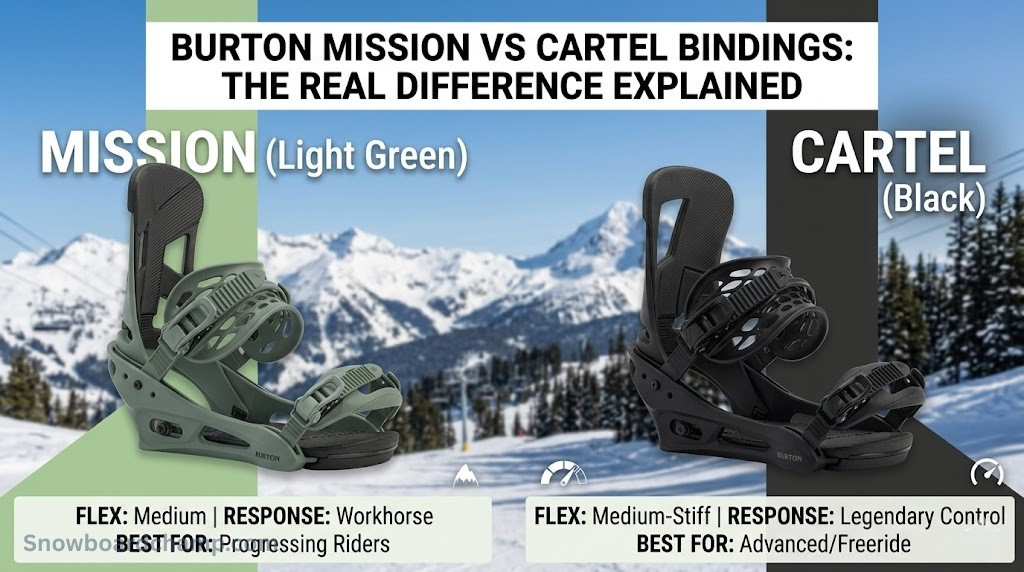
Medium-flex all-mountain charmer. Built for versatility, comfort, and everyday park riders.

Stiffer, more assertive all-mountain binding. Built for aggressive riders who demand power transfer.
Why Comparing the Mission and Cartel Actually Matters
Walk into any proper ski shop or browse Burton’s lineup online, and two names appear on almost every shortlist for intermediate-to-advanced riders: the Mission and the Cartel. They’re both legitimate all-mountain bindings, both made by the same company, and both priced within a similar range. Yet the snowboarders who choose one over the other tend to ride very differently — and when you dig into the details, you understand exactly why.
The confusion around these two bindings is real, and it’s not your fault for finding the choice difficult. Burton doesn’t make it easy. The marketing copy for each suggests “versatility” and “all-mountain performance,” which tells you almost nothing. What actually separates them is flex rating philosophy, baseplate stiffness architecture, highback geometry, and the type of riding feel each one was engineered to optimize.
Whether you’re picking bindings for your first serious setup or upgrading a quiver board, this comparison walks you through everything — component by component, terrain by terrain — so that by the time you finish reading, the right choice will feel obvious. If you’re also weighing broader gear questions, our deep-dive on the complete snowboard bindings guide is the perfect companion to this article.
The quick summary before we get into the weeds: the Mission is a medium-flex all-mountain binding with a softer, more playful character that excels in park, groomers, and casual all-mountain riding. The Cartel is a medium-stiff binding with more direct energy transmission, engineered for riders who want their input felt immediately — especially at higher speeds, on hard pack, and in big-mountain terrain.
Both use Burton’s Re:Flex insert system, which means they’re compatible with any board using standard 4×4, EST, or Channel mounts. But compatibility is just the start of what matters here. Let’s get into how these things are actually built.
Construction and Build Quality: What’s Inside Each Binding
Burton invests seriously in materials engineering across its binding lineup, and both the Mission and Cartel reflect that. However, the components chosen for each tell you immediately about the intended use case and price positioning.
Burton Mission: The Anatomy of a Forgiving Ride
The Mission’s baseplate uses a co-molded composite construction. That means it combines multiple materials in a single molded piece — typically a fiberglass-reinforced nylon core with rubber dampening zones strategically placed to absorb chatter and vibration. The result is a baseplate that flexes slightly underfoot, which contributes to that characteristic “softer” feel Mission riders love.
The highback is the Mission’s most telling component. It uses a Supergrip Canted Highback with a forward-lean adjuster built into the ratchet system. The highback has a moderate amount of longitudinal flex — meaning it can flex forward and back with your ankle movement rather than acting as a rigid wall behind your leg. For freestyle riders and those who spend time progressing through tricks, this compliance is genuinely useful. Butters, presses, and manuals all benefit from a highback that works with you rather than fighting your ankle movement.
The Mission’s ankle strap uses Speed Entry Technology straps — a wide, padded design with multiple flex zones along its length. This is not just marketing. The multi-zone flex strap distributes clamping force more evenly across the foot, reducing hot spots on long days.
The toe strap is an Auto-Cantilever toe strap that can be worn either over the toe or around the toe cap depending on preference. Both riding positions are secure; the cap-toe position tends to feel more locked-in for aggressive carving, while the over-toe position offers a little more wiggle room — better for park jibbing where ankle freedom matters.
Burton Cartel: Built for Riders Who Mean Business
The Cartel starts from a different baseplate philosophy. Its EST (Extra Sensory Technology) baseplate — available in the RE:Flex configuration for non-Channel boards — uses a 45% composite fiberglass layup, meaning the glass fibers are oriented at a diagonal to the baseplate’s long axis rather than aligned with it. This angular orientation dramatically increases torsional stiffness without adding significant weight.
What that means in practice: the Cartel baseplate twists less under lateral loading. When you drive hard into a heelside carve at speed, the baseplate doesn’t flex away from your input — it transmits it directly to the board’s edge. For the detailed breakdown of that 45% composite architecture, there’s an entire analysis worth reading if you want the full physics picture.
The Cartel’s highback is a Smooth Glide Highback — stiffer than the Mission’s and with a factory-set forward lean that’s adjustable but starts in a more aggressive position. The stiffness here isn’t about making the binding uncomfortable; it’s about reducing the energy loss that happens when a highback flexes rearward under heel pressure. The Cartel wants to transfer your weight shift to the board edge as instantaneously as possible.
The ankle strap on the Cartel is an EST Speed Entry strap, similar to the Mission’s but with denser padding and less longitudinal flex — the firmness supports more direct ankle locking without moving around under load. The toe strap mirrors the Mission’s cap-toe compatible design, keeping comfort consistent across both models.
Weight Comparison
Both bindings come in around the same weight class. The Mission sits slightly lighter due to its more flexible composite makeup, though the difference is marginal — we’re talking grams, not kilograms. If you’re serious about weight reduction for park use, the Mission has a negligible edge, but neither binding is heavy by modern standards.
Medium flex · Re:Flex insert compatible · EST & Channel ready
View on Amazon ↗Flex Ratings, Ride Feel, and What They Mean on Snow
Flex ratings in snowboard bindings are notoriously non-standardized across brands, but Burton’s internal scale is at least consistent within its own lineup. Understanding where the Mission and Cartel sit on that scale — and more importantly, understanding what that flex feels like when you’re actually riding — is essential to making the right call.
How to Read Flex Ratings Without Getting Fooled
Burton rates its bindings on a 1–10 scale where 1 is completely noodle-soft and 10 is full competition plate stiffness. The Mission sits around a 6 out of 10 — genuinely medium. The Cartel comes in around 7–7.5 out of 10 — medium-stiff, firmly in the “aggressive all-mountain” category.
That one or two points of difference sounds negligible, but it’s absolutely noticeable underfoot. Flex ratings in bindings don’t scale linearly — a 7.5 doesn’t feel 25% stiffer than a 6. It can feel dramatically different in specific conditions, particularly at higher speeds and on harder snow surfaces.
The Real-World Feel Difference
When you strap into Mission bindings and start riding, the first thing most riders notice is how comfortable and natural they feel. There’s a certain “give” when you press your weight into heel or toe edge that makes the binding feel almost like an extension of your boot rather than a mechanical clamp holding you to the board. This quality makes the Mission forgiving on imperfect technique — if you’re slightly late on a turn initiation or your weight distribution isn’t perfect, the binding absorbs some of that error rather than amplifying it.
The Cartel communicates differently. When you initiate a turn, the stiffer baseplate and highback transmit your input more directly. There’s less “buffer” between your body movement and the board’s edge engagement. Riders with clean technique find this deeply satisfying — the board responds precisely to intention. But riders who are still developing their fundamentals can find the Cartel exhausting, because every imperfection in posture or timing gets sent straight to the snow.
This is one reason experienced riders who spend time studying edge control and angulation techniques often migrate toward stiffer bindings like the Cartel — because when your technique is dialed, direct response becomes a feature rather than a liability.
Highback Forward Lean: A Dialed-In Variable
Both bindings allow forward lean adjustment on their highbacks, but the Cartel’s factory position is notably more forward — typically around 12–15 degrees. The Mission comes set closer to 8–10 degrees. More forward lean loads the toe-side edge more aggressively and creates more immediate response to leg pressure, which suits aggressive carving and high-speed riding. But it can feel tiring on casual days when you just want to cruise.
If you’re planning to set your Cartel highback back to a very neutral position to mimic the Mission’s feel, you should question whether you needed the Cartel at all — the stiffness difference in the baseplate would still be there, but you’d be undermining the binding’s primary advantage. The Cartel earns its identity when run with moderate-to-aggressive forward lean.
Board Compatibility: Re:Flex, EST, and Channel Explained
One of the biggest selling points of both the Mission and Cartel is Burton’s Re:Flex insert system, which massively expands board compatibility compared to older proprietary systems. Understanding how this works can save you a lot of headaches at the binding aisle.
What Re:Flex Actually Does
Traditional snowboard bindings bolt to a fixed 4×4 insert pattern on the board and transfer vibration directly through the baseplate. Burton’s Re:Flex system adds a layer of independent baseplate movement — the baseplate sits in a frame that allows slight flex and movement relative to the board, effectively decoupling some of the energy between binding and board. The result is a more natural flex pattern when riding, particularly noticeable on boards with pronounced longitudinal flex profiles.
Both the Mission and Cartel are available in Re:Flex versions that work with standard 4×4 insert patterns, Burton’s proprietary Channel system, and the older 2×4 insert pattern. This means you can put either binding on nearly any board — Burton or otherwise.
EST: Channel-Only and Its Advantages
Burton also makes EST (Extra Sensory Technology) versions of both bindings — these are Channel-compatible-only but offer the most direct board communication because the baseplate extends fully across the Channel, almost like a continuous ridge of material. EST bindings have the shallowest stack height of any Burton system, bringing your foot closer to the snow surface and improving responsiveness.
The Cartel in EST configuration is particularly compelling for advanced riders on Burton boards. The combination of the Cartel’s already-stiff baseplate and the EST’s low-stack geometry creates one of the most direct, communication-rich setups Burton offers outside of its competition-level bindings. If you’re riding a Burton board with a Channel and you’re an advanced rider, the Cartel EST is worth serious consideration.
For riders on non-Burton boards, the Re:Flex version of each binding is the correct pick. The difference between Re:Flex and EST in real riding is noticeable but not dramatic for most recreational riders.
| Mount Type | Mission Compatible? | Cartel Compatible? |
|---|---|---|
| 4×4 Standard | ✓ Re:Flex | ✓ Re:Flex |
| 2×4 Insert | ✓ Re:Flex | ✓ Re:Flex |
| Burton Channel | ✓ EST & Re:Flex | ✓ EST & Re:Flex |
| 3D / M6 Inserts | ✓ with adapter | ✓ with adapter |
| Nidecker SuperMatic | ✗ | ✗ |
| Step-On Compatible | ✗ | ✗ |
If you’re exploring step-in binding systems as an alternative path entirely, the comparison between Nidecker SuperMatic and Burton Step-On is worth a separate read. But for traditional strap systems, both the Mission and Cartel offer exceptional flexibility across board brands and models.
Stance Width and Disk Adjustability
Both bindings use Burton’s standard disk-and-bolt binding mounting disks, which allow stance angle adjustment in 3-degree increments. The Re:Flex version adds additional lateral adjustment along the insert row. If you’re still dialing in your stance setup, both bindings give you enough range to experiment comfortably.
The Cartel in EST configuration allows continuous lateral repositioning along the full length of the Channel — more precise than insert-based systems and particularly useful for riders with asymmetrical stances or very specific binding placement preferences. This infinite adjustability is one of the more underrated advantages of the EST system for experienced riders.
Medium-stiff flex · 45% composite baseplate · EST & Re:Flex
View on Amazon ↗Feature-by-Feature Breakdown: Every Component Compared
| Feature | Burton Mission | Burton Cartel |
|---|---|---|
| Flex Rating | Medium (~6/10) | Medium-Stiff (~7.5/10) |
| Baseplate Material | Co-Molded Composite | 45% Composite Fiberglass |
| Highback Type | Supergrip Canted | Smooth Glide |
| Highback Flex | Moderate Longitudinal | Minimal (stiff) |
| Ankle Strap | Speed Entry Multi-Flex | EST Speed Entry |
| Toe Strap | Auto-Cantilever Cap-Toe | Auto-Cantilever Cap-Toe |
| Forward Lean | ~8–10° factory | ~12–15° factory |
| Mount Systems | Re:Flex, EST, Channel | Re:Flex, EST, Channel |
| Canting | Canted Footbed | Canted Footbed |
| Heel Cup | Hammock Straps | Hammock Straps |
| Dampening | Rubber zones in baseplate | Rubber perimeter zones |
| Ideal Rider | Freestyle / All-Mtn | Aggressive All-Mountain |
| Skill Level | Intermediate → Expert | Adv. Intermediate → Expert |
| Best Terrain | Park, Groomers, Powder | Groomers, Hardpack, Backcountry |
Canting: The Biomechanics Behind the Comfort
Both bindings feature a canted footbed — meaning the platform your boot sits on is not perfectly flat but angled slightly outward on each foot. This mirrors the natural angle of your knees when standing in a snowboard stance and reduces internal knee rotation over long days. The Mission and Cartel use the same canting geometry, so riders who prioritize knee comfort aren’t choosing between them based on this feature.
If you’ve ever had foot or knee discomfort while snowboarding, canted footbeds combined with quality insoles can make a substantial difference. Both bindings support aftermarket insole replacement if you want to customize the footbed further.
Hammock Heel Straps: What They Do and Why They Work
Both the Mission and Cartel use Burton’s Hammock Heel strap design — a separate, elasticated strap that wraps around the heel cup rather than relying solely on the ankle strap to hold the heel down. The logic is simple and effective: by independently securing the heel, you prevent the subtle heel lift that causes imprecise edge engagement, particularly on heelside turns.
Heel lift is a chronic issue in snowboard binding design and is worth taking seriously. If you struggle with heel lift from other sources, there’s an entire resource on stopping heel lift with J-bar and insole solutions that goes beyond what bindings alone can solve.
The Highback in Detail: Supergrip vs Smooth Glide
The highback names themselves are worth unpacking. The Mission’s “Supergrip” highback refers to the textured inner surface that contacts your boot — it grips the boot’s shaft and reduces slippage between boot and highback during dynamic movements. For freestyle riding where you’re constantly shifting weight forward and backward, this grip keeps everything feeling locked even when you’re not cinched tight.
The Cartel’s “Smooth Glide” highback is a counterintuitive name — it doesn’t mean the highback is slippery or loose. “Smooth” refers to the high-quality finish on the plastic used for the highback itself, which is more injection-molded precision rather than the rougher composite texture of the Mission’s highback. The Smooth Glide highback is optimized for even contact pressure distribution across the boot cuff rather than surface grip — it works by conforming precisely to boot shapes rather than grabbing them.
Terrain Match: Where Each Binding Truly Performs
Perhaps more than any other single factor, terrain preference should drive your binding choice. The Mission and Cartel have different optimal environments — understanding these helps you stop trying to find a universal winner and start finding the right tool for how you actually ride.
Burton Mission — Terrain by Terrain
Park and Freestyle: The Mission belongs in the park. Its medium flex creates the kind of board feel that makes jibbing, pressing, and butter tricks feel intuitive. When you’re trying to pop into a 50-50 on a box or hold a nose press through a long feature, the binding’s compliance lets you manipulate the board without fighting against a stiff system that wants to resist those movements. The softer highback allows more ankle movement, which means tweaking grabs, spins, and stylish riding feels more natural. For deeper context on progressing through freestyle tricks, the Mission is genuinely one of the best-suited bindings in this price range.
Groomed Terrain: On blue and black groomers at moderate speeds, the Mission is excellent. You’ll feel confident and comfortable, and the binding is forgiving enough to make cruising enjoyable rather than demanding. Where the Mission starts to show its limits is on steep, fast groomed runs where you’re pushing into higher-speed carving territory. At that point, the flex starts to feel a little vague.
Powder: The Mission performs admirably in powder, particularly when paired with a directional board or a soft, surfier shape. The binding’s compliance complements the fluid, weight-shifting style of deep powder riding. There’s no reason to avoid powder with Missions on your feet.
Park and Backcountry Crossover: Riders who split time between resort laps and occasional off-piste explorations will find the Mission comfortable across all of that. It’s not the best binding for serious backcountry charging, but for intermediate explorers checking out trees and side-country features, it works perfectly well. Explore our guide to backcountry snowboarding snowpack dynamics if you’re moving in that direction.
Burton Cartel — Terrain by Terrain
High-Speed Groomed Terrain: This is the Cartel’s absolute home. On long, fast groomers where you’re laying down hard carves and running strong edge angles at speed, the Cartel’s stiff baseplate earns its reputation. The energy transmission is exceptional — your weight shifts translate directly to edge angle changes without the micro-delays that softer bindings introduce. If you’re working on proper carving angulation, the Cartel gives you the most honest feedback about whether your technique is correct.
Hardpack and Icy Conditions: The Cartel excels where the Mission struggles most. On glazed, icy morning groomers or firm early-season snow, the Cartel’s stiff system maintains edge hold far more effectively. Stiffer bindings don’t slip as easily on hard snow because there’s less flex to allow the board edge to momentarily disengage. If your home mountain tends to run on the firmer side, or you often ride after the main crowds have hardened up the snow, the Cartel is the smarter pick.
Backcountry and Big Mountain: Serious off-piste riders tend to prefer stiffer setups for the same reason as hardpack — precision matters more when the consequences of losing control are higher. The Cartel’s stiffness helps in variable off-piste snow conditions where mixed hardpack, crud, and soft snow can create unpredictable resistance. For riders planning serious backcountry adventures, the Cartel is the more appropriate choice.
Park with the Cartel: It can be done, and some riders prefer the Cartel’s precision even in park. But it requires cleaner technique. A stiffer binding in park means every error feels more amplified, and pressing features requires more deliberate effort. Advanced park riders who want a different feeling sometimes prefer the Cartel — there’s something satisfying about the precision — but for most people, the Mission is the better park binding.
Choose the Mission If You…
- Ride park regularly or primarily
- Are an intermediate rider building skills
- Value all-day comfort on varied terrain
- Enjoy buttering, pressing, and jibbing
- Ride moderate speeds on typical groomers
- Want a forgiving, playful ride feel
- Are pairing with a softer or medium board
Choose the Cartel If You…
- Ride hard, fast groomers and hardpack
- Are an advanced-to-expert level rider
- Prioritize power transfer and precision
- Ride steep terrain at higher speeds
- Spend time in backcountry or off-piste
- Want a more aggressive, athletic ride
- Are pairing with a stiff all-mountain board
On-Snow Performance: An Honest Rip-by-Rip Analysis
Specs and feature lists only tell part of the story. What matters is how these bindings actually feel when you’re moving down a mountain at speed, in real conditions, with real fatigue setting in by run four. Here’s what extensive on-snow experience with both bindings reveals.
Turn Initiation and Edge Engagement
The Cartel initiates turns faster. That’s not a subjective impression — it’s a function of stiffness physics. A stiffer system transfers the rider’s weight shift to the board edge sooner in the movement sequence. With the Mission, there’s a fractional delay where the binding system “takes up” the slack of its own compliance before engaging the edge. Expert riders time their movements to compensate for this in softer bindings naturally. But the Cartel requires less of that compensation.
In practical terms: carving long, arcing turns at medium speed feels roughly equivalent between both bindings. Performing quick, sharp edge transitions — switchbacks, short-radius turns on steep terrain, quick reaction to unexpected obstacles — these are where the Cartel feels measurably more responsive.
Energy Retention and Pop
Pop — the ability of the binding-board system to propel you off the snow when ollieing or taking natural features — comes from stored energy. The Cartel’s stiffer baseplate stores and releases energy more effectively than the Mission’s compliant baseplate. This is the binding equivalent of a stiffer arch in a running shoe: it returns energy rather than absorbing it.
For freestyle riders, this matters in a specific context: transition hits. When you’re hitting a natural roller or a cat track lip, the Cartel gives you more pop to work with. In park, where features are more controlled and the lip shapes are designed to generate pop independently of your setup, the difference is less pronounced. Learning proper ollie mechanics matters more than binding stiffness here.
Dampening and Vibration Management
One area where the Mission genuinely outperforms the Cartel is vibration dampening. The softer composite baseplate absorbs road noise — the small-frequency vibrations that come from riding over variable snow surfaces, hardpack edges, and rough cat-track terrain. On a firm, chunky day when the mountain is beat up after a weekend crowd, the Mission feels noticeably smoother and less fatiguing to ride for extended periods.
The Cartel’s stiffer construction transmits more of this road noise back to the rider. Some experienced riders actually prefer this feedback — it tells them more about what the snow is doing underfoot. But for casual riders and those prone to foot or knee fatigue, it can become tiring toward the end of a long day. Proper preseason fitness preparation and core strength help mitigate this fatigue significantly.
Switch Riding Performance
For riders who spend significant time riding switch — meaning facing their non-dominant direction — the Mission has an edge. The softer, more symmetrical flex feel of the binding means that riding switch doesn’t feel dramatically different from forward riding. The Cartel, with its stiffer response and more aggressive forward lean factory setting, can feel noticeably less natural in switch because the highback geometry is less accommodating of the reversed body position.
If you’re working on switch riding as part of your freestyle progression, this is a real consideration. For riders who rarely ride switch and prioritize forward riding performance, it doesn’t matter at all.
Powder Performance Head-to-Head
Deep powder riding favors certain binding characteristics — particularly responsiveness to subtle weight shifts, as powder snow doesn’t telegraph pressure changes as clearly as packed surfaces. In deep snow, both bindings perform well. The Mission’s compliance allows the natural weight-rocking motion of powder surfing to feel more fluid. The Cartel’s precision is somewhat wasted in soft, deep snow where the board’s planing dynamics take over from edge control.
If powder is your primary reason for riding — if you check snow reports and make decisions based on snowfall — the Mission is arguably the better powder binding of the two. For everything about maximizing your powder days, including gear setups and destinations, the guides on best bindings for powder riding and top snowboarding destinations are worth exploring.
Medium flex · All-mountain versatility · Park-friendly compliance
Check on Amazon ↗Comfort, Fit, and Long-Day Wearability
Raw performance is important, but comfort over a full day of riding — six to eight hours across varied terrain with significant physical exertion — matters just as much. Bindings that cause pressure points, restrict circulation, or create hotspots will limit your sessions no matter how technically impressive their specs are.
Strap Comfort: The Mission Advantage
The Mission’s multi-zone flex ankle strap distributes clamping force more evenly than most bindings in its class. The wider strap footprint means the same tightening force is spread over a larger area, reducing localized pressure. For riders with higher-volume ankles or boots that run slightly wider, this is genuinely noticeable after several hours of riding.
The Cartel’s ankle strap is firmer and less flexible along its length. For performance riders who want to feel locked in with precision, this is desirable. For riders who experience foot swelling during long days, or who have had issues with ankle-area pressure from tight bindings, the Mission’s strap is more comfortable.
Both bindings use Burton’s cam lever ratchet system, which is among the most reliable and consistent-adjusting ratchet mechanisms available. The micro-adjustment per ratchet click is small enough to dial in exactly the tension you want, and the release mechanism is smooth and predictable even in cold temperatures when some binding ratchets stiffen uncomfortably.
Canted Footbed and Ergonomics
As mentioned earlier, both bindings use the same canted footbed geometry. This is not a differentiating feature between the two, but it’s worth emphasizing as a comfort positive for both. The canting reduces the knee-inward tracking that flat footbeds impose, and over the course of a season, this can meaningfully reduce cumulative knee stress. If you’ve had knee issues from snowboarding, canting is one of the more evidence-backed ergonomic improvements in binding design.
If knee problems have been a recurring issue, reading about injury prevention specifically for snowboarders will give you a broader picture of what else you can do beyond binding selection.
Boot Compatibility and Fit Integration
Both bindings are designed to work well with Burton’s own boot lineup, but they’re also genuinely compatible with third-party boots. The straps and highbacks are designed to generic boot shapes that most manufacturers follow. Where you might notice fit variation is in highback-to-boot-cuff contact — different boot cuff heights and stiffness levels interact differently with each binding’s highback.
If you’re wearing softer, more flexible boots like the Vans snowboard boot lineup or the K2 Endo construction boots, the Mission’s softer highback will feel more natural. Stiffer boots pair better with the Cartel — the combined stiffness of boot + binding works in harmony rather than fighting each other. A very stiff boot in a soft binding can create a floaty, disconnected feel; a very stiff binding on a soft boot can make the highback feel like it’s torquing the boot cuff uncomfortably.
For a comprehensive look at the best boots to pair with either binding, the best snowboard boots guide covers the full spectrum of flex-to-performance tradeoffs.
Cold Weather Performance
Both bindings use plastics that maintain reasonable performance in very cold conditions. Neither is prone to the catastrophic brittleness that plagued older binding materials below -15°C. The ratchet buckles function correctly in extreme cold, though any metal components will feel colder to the touch — worth knowing if you frequently adjust bindings with bare hands in freezing temperatures.
The rubber dampening zones in both baseplates stiffen slightly in very cold conditions, which effectively shifts both bindings’ flex ratings up by a half-point or so. In practice, this means a Cartel at -20°C feels noticeably stiffer than a Cartel at 0°C. Worth accounting for if you ride frequently in extreme cold.
Durability, Lifespan, and Long-Term Value Analysis
Snowboard bindings are a meaningful investment, and both the Mission and Cartel are priced in the mid-to-upper range of recreational binding offerings. Understanding how long they last, what fails first, and what maintenance they require is essential to calculating their actual cost-per-ride value.
What Wears Out First
In both bindings, the components that degrade first are predictable: ankle strap cushioning, ratchet teeth, and highback pivot hardware. These wear at similar rates in the Mission and Cartel because both use the same ratchet system and similar strap materials. With typical use — three to six weeks of riding per season — you can expect the straps to show meaningful compression after three or four seasons, and the ratchets to become slightly less precise after five or six.
Burton sells replacement straps, highbacks, and hardware for both models, which is genuinely important. The ability to replace individual components means you’re not discarding an entire binding just because one strap wore out. This modularity is one of the practical advantages of staying within the Burton ecosystem. If you’re thinking broadly about gear cost amortization over time, the repairability factor meaningfully improves the long-term economics of both bindings.
Baseplate Durability: Where the Cartel Has an Edge
The Cartel’s stiffer 45% composite baseplate is arguably more durable than the Mission’s co-molded composite. Stiffer materials are generally more resistant to fatigue cracking — the repeated micro-flexing that eventually causes softer materials to develop stress fractures. This is a minor difference in normal use, but riders who log very high mileage in a season, or who are particularly hard on gear, may notice the Cartel aging more gracefully over a four-to-six season lifespan.
The Mission’s flexible baseplate, while comfortable and playful, does mean the composite material is working through more flex cycles per ride. Over several seasons, this can lead to slight softening — the binding may feel slightly less precise in its older seasons than it did when new. This is subtle and most recreational riders won’t notice it as a discrete event — more a gradual drift in feel.
Highback Longevity and UV Exposure
Both highbacks are made from nylon-based polymers that are susceptible to UV degradation over time. If you store your gear in direct sunlight between seasons — in a car trunk or a sunny garage — the highbacks can develop surface cracking and become more brittle. Storing bindings in a bag or dark space protects them significantly. Burton’s highbacks are generally rated for five-plus years in proper storage conditions.
Given the investment in a quality binding setup, learning proper snowboard maintenance including binding care extends the useful life of both the Mission and Cartel meaningfully.
The Replacement Cost Math
If we’re being honest about long-term value, the Mission and Cartel sit close enough in price that the question of “which is the better value” mostly comes down to fit with your riding rather than raw economics. Both are well-built mid-tier bindings that should deliver five or more seasons of reliable performance with normal care. Neither is a budget product that needs to be replaced every two years, and neither is a professional-grade racing product with exotic materials.
For riders who want to stretch their gear budget further, our analysis of the best affordable all-mountain bindings under $200 covers some interesting alternatives — though for most riders, the Mission and Cartel’s durability justifies their price point relative to cheaper options.
Medium-stiff flex · Built for performance carving · EST & Re:Flex versions
View on Amazon ↗Pros, Cons, Price, and Who Should Actually Buy Each One
Burton Mission — Full Assessment
✓ Pros
- Comfortable all-day wearability
- Excellent park and freestyle performance
- Forgiving for developing intermediate riders
- Great for powder and softer snow
- Re:Flex works with virtually any board
- Good vibration dampening on rough snow
- Natural flex for butters and presses
- Lighter weight feel underfoot
✗ Cons
- Feels vague at higher speeds on hardpack
- Less precise energy transfer for carvers
- Softer highback can feel imprecise in switch
- Not ideal for very aggressive, fast riders
- Can feel slightly “noodly” on steep icy terrain
- Less pop for natural kicker hits
Burton Cartel — Full Assessment
✓ Pros
- Outstanding precision at high speeds
- Excellent hardpack and icy conditions performance
- Direct, honest feedback for skill development
- Strong pop and energy retention for natural hits
- Pairs beautifully with stiff all-mountain boards
- Durable baseplate construction for heavy riders
- Great for carving-focused riding
- Performs well in backcountry variable conditions
✗ Cons
- Less forgiving for riders still developing technique
- More fatiguing on long, variable-condition days
- Stiffer feel transmits more vibration on rough snow
- Less natural for park jibbing and pressing
- Factory forward lean not suited to casual cruising
- More demanding of technical riding fundamentals
Pricing Context and Timing
Both bindings are typically priced in a similar bracket, with the Cartel sometimes running slightly higher due to its more complex composite baseplate engineering. Prices fluctuate with sales cycles, and there are predictable windows where both bindings can be found at significant discounts. If budget timing matters to you, understanding the optimal timing for buying snowboard gear can save meaningful money on either choice.
Who Should Buy the Mission
The Mission is the right binding for intermediate and advanced riders who prioritize versatility and comfort over maximum precision. If your home mountain has solid park terrain, or if you ride a wide variety of conditions including powder days, varied groomers, and occasional park sessions — the Mission’s balanced, forgiving character will serve you well season after season. It’s also the correct choice for riders who are still building their technical foundations and benefit from a system that minimizes the amplification of errors.
The Mission also makes sense for riders who own a versatile quiver — perhaps one park-specific board and one all-mountain shape. Having Mission bindings on the all-mountain stick gives you consistent feel across riding styles without asking you to fight a stiff binding on casual days.
Who Should Buy the Cartel
The Cartel is for riders who have developed clean technique and want their binding system to stop cushioning their riding and start communicating directly. If you’re consistently riding fast, charging steep terrain, seeking out hardpack carving sessions, or exploring backcountry routes, the Cartel’s precision and stiffness become genuine advantages rather than demands on your skill level.
Advanced-intermediate riders who feel like their bindings are the limiting factor in their progression — who feel like they’re trying to send precision input through an imprecise interface — will find the Cartel immediately satisfying. The step up in directness is noticeable within the first run.
For riders choosing between the Union Atlas or Union Force as alternatives in the same stiffness category, note that the Cartel offers more board compatibility thanks to Re:Flex. Union’s EST-equivalent (the Tool-Less baseplate) is excellent but only works optimally with certain board types. The Cartel’s Re:Flex compatibility is broader.
Alternatives Worth Considering Before You Decide
The Mission and Cartel are not the only quality options in their respective flex and performance categories. Before finalizing your decision, it’s worth knowing what else exists — both within Burton’s lineup and in the broader market.
Within Burton’s Lineup
Burton Custom: Sits above the Cartel in stiffness and performance orientation. Uses a more aggressive composite formulation and is clearly aimed at expert-level riders. If the Cartel feels like the direction you want to go but you want even more precision, the Custom is the next step. Worth checking the Cartel X review to understand the X variant’s specific positioning.
Burton Freestyle: Sits below the Mission in flex, around a 4/10. For dedicated jib and park riders who want maximum board manipulation and minimum interference from the binding, the Freestyle is the tool. Less versatile than the Mission for all-mountain use but genuinely specialized for park performance.
Burton Step On: A completely different system worth considering if strap convenience matters to you. For the full picture of that technology and its tradeoffs, the Burton Step On three-point connection analysis is comprehensive. Note that Step On requires compatible boots, adding cost to the system.
Outside Burton
Union Atlas: A strong Cartel competitor in the medium-stiff category. The Union Atlas uses a different baseplate construction — an aluminum frame rather than composite — which some riders prefer for its specific feel and durability profile. The full Union Atlas review covers it thoroughly.
Union Legacy: A closer competitor to the Mission, sitting slightly softer with excellent dampening characteristics from VaporLite construction. The Union Legacy review specifically discusses its park landing performance which is relevant if freestyle is your priority.
Union Strata: A newer, lighter alternative with impressive performance across terrain. The Union Strata review highlights how it compares in the all-mountain medium-stiff space — worth reading before assuming the Cartel is the only option in that zone.
Rome Ravine Pro: A strong park-oriented alternative to the Mission from Rome SDS, with impressive freestyle credentials. The Rome Ravine Pro review covers its specific park performance credentials.
Women’s Binding Consideration
Both the Mission and Cartel are unisex/men’s offerings by default, though they work for riders of any gender. Burton’s women’s binding lineup includes the Citizen and Escapade as counterparts that incorporate narrower sizing and lighter-weight construction alongside gender-tuned flex profiles. For detailed coverage of that space, our women’s snowboard bindings guide covers the landscape comprehensively.
Our Final Head-to-Head Verdict
The Burton Mission wins for park riders, intermediate-to-advanced all-mountain riders who value comfort, and anyone who rides diverse terrain including powder days and casual resort laps. Its forgiving medium flex and compliance make it a genuinely enjoyable binding to ride across a wide variety of conditions and speeds.
The Burton Cartel wins for advanced riders focused on precision, high-speed groomed terrain, hardpack performance, and aggressive all-mountain charging. Its stiff baseplate and direct energy transmission reward clean technique with exceptional responsiveness. If you ride hard, the Cartel is worth every dollar.
Frequently Asked Questions
The main difference is flex stiffness and riding character. The Mission is a medium-flex binding (~6/10) designed for versatility, comfort, and park-friendly performance. The Cartel is a medium-stiff binding (~7.5/10) built for direct energy transfer, high-speed precision, and aggressive all-mountain riding. The Cartel uses a stiffer 45% composite baseplate and a stiffer highback for more immediate edge response.
The Mission is suitable for advancing intermediate riders rather than absolute beginners. Its medium flex is forgiving enough to accommodate developing technique, but true beginners may find a softer option more appropriate. For riders who are comfortable on easy terrain and working toward more varied riding, the Mission is an excellent step-up binding.
Yes. Both bindings are available in Re:Flex versions compatible with standard 4×4, 2×4, and 3D insert patterns found on virtually all major brand snowboards. The EST versions are Channel-only. If you’re riding a non-Burton board, choose the Re:Flex version of either binding.
The Cartel can be used in park but it’s not the optimal choice for most park riders. Its stiffness makes pressing features, buttering, and jib tricks require more deliberate effort. For most riders spending significant time in park terrain, the Mission’s medium flex is more intuitive and enjoyable.
The Cartel is definitively better for carving. Its stiffer baseplate transmits edge pressure more directly and maintains precision at higher carving speeds. Riders focused on developing carving technique will get more honest feedback and better performance from the Cartel.
With normal care — three to six weeks of riding per season — both bindings typically last five or more seasons before components need replacement. Burton sells replacement parts for both models, which significantly extends their useful lifespan. Proper storage away from UV exposure improves longevity.
The Mission has a slight edge in powder conditions. Its compliant flex allows the natural weight-rocking and board pivoting motions that deep powder riding requires to feel more fluid. That said, both bindings are capable in powder — the difference is noticeable but not dramatic.
The Mission pairs well with soft-to-medium stiffness boots (flex rating 3–6). The Cartel pairs best with medium-to-stiff boots (flex rating 5–9). A stiffer boot combined with the Cartel’s stiff binding system creates a cohesive setup that communicates precisely. Pairing a very soft boot with the Cartel can create an uncomfortable mismatch.
If you’re an advanced rider who regularly pushes high speeds, charges steep terrain, or rides hardpack and icy conditions, the Cartel’s performance advantages are worth any price premium. If you’re primarily an intermediate rider, casual all-mountain rider, or park-focused rider, the Mission offers everything you need.
No. The Mission and Cartel are traditional strap bindings and are not compatible with Burton Step-On boots, which require dedicated Step-On receiver bindings. These are entirely separate systems that require specific compatible boots.
Re:Flex versions work with standard insert patterns making them universally compatible. EST versions are designed exclusively for Burton’s Channel system and feature a lower-profile baseplate that sits closer to the board, improving board feel and responsiveness. Choose EST if you ride a Burton board with Channel — otherwise choose Re:Flex.
Union Legacy and Force are the closest Mission counterparts in the Union lineup, with similar medium-flex versatility. Union Atlas and Strata compete with the Cartel in the medium-stiff category. Burton’s advantage is Re:Flex’s broader board compatibility. Union’s advantage is often found in aluminum frame construction. Both brands make excellent bindings — the decision often comes down to board compatibility needs and personal preference.
Conclusion: Making the Right Call for Your Riding
After dissecting every component, comparing on-snow performance characteristics, and examining the real-world use cases for each binding, the choice between Burton Mission and Cartel bindings ultimately comes down to one core question: how do you actually ride?
The Mission is the binding for riders who want versatility, comfort, and a forgiving ride that rewards creativity and keeps them energized through a full day on varied terrain. It’s the right tool for park enthusiasts, powder day enjoyers, and intermediate-to-advanced riders who want a binding that works with their style rather than demanding that they meet it halfway. It’s not a beginner binding — it’s a binding for riders who value the experience of riding as much as the technical precision of it.
The Cartel is the binding for riders who have moved beyond comfort as the primary concern and now want precision as the defining feature. When you’ve developed your technique to the point where you’re actively looking for a binding that stops cushioning your errors and starts amplifying your intentional movements, the Cartel delivers that experience in a durable, universally compatible, well-supported package. It’s demanding in the best possible way — it pushes you to ride better.
Neither binding is inherently superior. They’re different tools for different riders at different points in their snowboarding journey. The real mistake would be buying the Cartel because it sounds more advanced when your riding genuinely benefits from the Mission’s character — or staying with the Mission out of comfort when your skills have outgrown what it can offer.
If you’re still building your broader gear knowledge before making a final call, our complete snowboard bindings guide covers the full spectrum of what matters in binding selection. And if binding choice is part of a larger gear refresh, resources like the snowboard sizing guide and the comprehensive breakdown of snowboard boots by flex and performance can help you build a cohesive setup where every piece reinforces the others.
Both the Mission and Cartel are excellent bindings. The right one for you is the one that matches how you ride — not the one with the higher number on its flex rating.
Park · Versatility · Comfort
Buy on Amazon ↗
Precision · Power · Performance
Buy on Amazon ↗


