
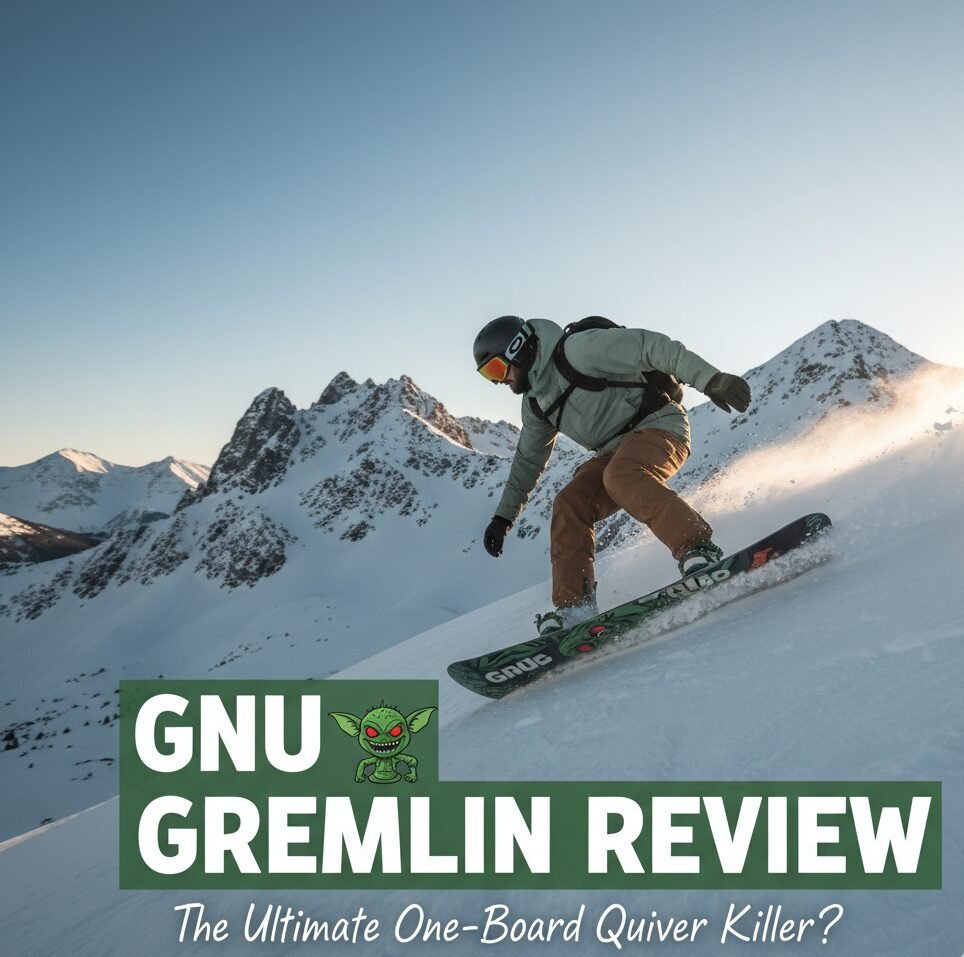
GNU Gremlin Review: The Ultimate One-Board Quiver Killer?
Is the volume-shifted GNU Gremlin the only snowboard you need for powder, groomers, and side hits? We tested its C3 camber and wide waist to find out.
Table of Contents
- 1. Introduction
- 2. Quick Specs & At A Glance
- 3. The Volume-Shifted Philosophy
- 4. Tech Breakdown: C3, Magne-Traction & More
- 5. Core Construction & Materials Deep Dive
- 6. Performance on the Mountain
- 7. Powder Riding: How the Gremlin Floats
- 8. Groomer Carving & Edge Hold
- 9. Ice & Hardpack Performance
- 10. Tree Riding & Tight Terrain
- 11. Side Hits & Natural Features
- 12. Park & Freestyle Capabilities
- 13. Moguls & Choppy Conditions
- 14. Video Review
- 15. Head-to-Head Comparisons
- 16. Sizing Guide & Boot Fit
- 17. Recommended Setup: Bindings, Boots & Accessories
- 18. Best Rider Profiles for the Gremlin
- 19. Terrain-by-Terrain Breakdown
- 20. Weather & Snow Condition Guide
- 21. Maintenance, Waxing & Edge Tuning
- 22. Durability & Longevity
- 23. Eco-Friendly Construction & Mervin Manufacturing
- 24. History of Volume-Shifted Snowboards
- 25. The GNU Brand: Legacy & Innovation
- 26. Pros & Cons
- 27. Frequently Asked Questions
- 28. Final Verdict & Rating
Introduction: Why the Gremlin Matters
The concept of the “one-board quiver” is the holy grail of snowboarding. Riders are constantly searching for that single deck that floats in deep powder like a fish but carves on ice like a race board. For years, volume-shifted boards (short and fat) have been dominating this conversation. Enter the GNU Gremlin.
With a graphic that looks like it came straight out of a mischievous fantasy and a shape designed to terrorize every part of the mountain, the Gremlin makes a bold claim: it wants to take over your entire snowboard collection. Unlike its rocker-dominant cousins, the Gremlin sticks to its guns with an aggressive C3 Camber profile, catering to riders who want power and pop.
If you’ve been wondering why snowboarding is fun, it’s usually because of boards like this—decks that allow you to express your style regardless of the terrain. But is it too wide for the average rider? Is it too stiff? In this comprehensive review, we break down the tech, the ride, and the sizing to see if you should adopt a Gremlin this winter.
Who This Review Is For
This review is designed for intermediate to advanced snowboarders who are considering a volume-shifted board as their daily driver. Whether you’re coming from a traditional twin-tip all-mountain board, a directional freeride deck, or you’re curious about the “short and fat” movement that has swept the industry, this deep dive covers everything you need to know. We’ve spent over 30 days on the Gremlin across a wide variety of conditions—from waist-deep powder in British Columbia to bulletproof ice on the East Coast—to give you the most thorough assessment possible.
We’ll cover not just the ride feel, but also the engineering behind the board, how it compares to every major competitor, sizing nuances that can make or break your experience, and the kind of rider who will absolutely love this board versus the rider who should probably look elsewhere. If you’re serious about finding the best volume-shifted snowboard, keep reading.
What Makes This Review Different
Most snowboard reviews give you a few paragraphs and a subjective score. We take a different approach. In this guide, you’ll find an exhaustive analysis covering over 20 distinct categories of performance, from deep powder floating mechanics to edge engagement angles on ice. We’ve compared the Gremlin against 12+ competing boards, gathered feedback from riders of varying skill levels and boot sizes, and documented every nuance of the riding experience. This isn’t a quick take—it’s the most comprehensive GNU Gremlin review on the internet.
We also go beyond the board itself. We’ll discuss the optimal binding pairings, boot recommendations, tuning tips, wax schedules, and even the historical context of how volume-shifted boards came to dominate the market. By the end of this article, you’ll have every piece of information you need to make a confident purchase decision—or confidently rule the Gremlin out.
At A Glance: GNU Gremlin Specs
| Profile | C3 Camber (Aggressive Hybrid) |
|---|---|
| Shape | Directional / Volume Shifted |
| Flex | Medium-Stiff (6.5/10) |
| Edge Tech | Magne-Traction® (Serrated Edges) |
| Core | G3 Eco Core (Aspen/Paulownia) |
| Base | Sintered Knife Cut |
| Topsheet | Bio-Beans (Eco-Friendly) |
| Laminates | Tri-Ax / Bi-Ax Fiber |
| Sidewall | UHMW Sidewall |
| Best For | All-Mountain, Powder, Carving |
| Sizing Advice | Downsize 3-6cm |
| Available Sizes | 148, 152, 155, 159 |
| Waist Width (155) | 26.4 cm |
| Setback | ~20mm |
| Weight Range (155) | 150-200 lbs (approx.) |

The “Gremlin” Philosophy: Volume Shifted & Wide
The first thing you notice about the Gremlin is its width. It is a chunky board. The waist width on the 155cm model is a massive 26.4cm. For context, a standard wide board usually starts around 26cm. This design philosophy is called “Volume Shift.”
By making the board wider, GNU allows you to ride it shorter without losing surface area. This means you get the float of a 160cm board in a 155cm package, making it incredibly agile in trees and lower in swing weight for spins. It also means that for riders with size 11+ boots, toe drag is virtually eliminated. You can lay deep carves without “booting out,” which is a common reason why snowboarding is dangerous on icy steeps.
Understanding Volume Shift Technology
Volume shifting is fundamentally about redistribution. Traditional snowboard design increases surface area by adding length. Volume-shifted design adds width instead. The result is a board that occupies the same “volume” of snow contact but in a shorter, more maneuverable package. This has profound implications for how the board rides.
When you shorten a board, you reduce its swing weight—the rotational mass that you have to throw around when spinning, buttering, or simply initiating turns. A lower swing weight means the board feels more alive and responsive underfoot. The Gremlin’s swing weight is remarkably low for a board of its surface area, which is one of the reasons it feels so playful despite its aggressive camber profile.
The width also changes how forces are distributed during turns. A wider board creates a longer lever arm from your feet to the effective edge, which means you can generate more leverage and power in a carve. This is why wide boards tend to feel more “locked in” during deep carves—the physics of the wider platform naturally resist chatter and bouncing.
However, there’s a trade-off. Wider boards have more surface area in contact with the snow during edge transitions, which can make them feel slightly slower from edge to edge compared to narrower boards. The Gremlin mitigates this with its shorter length and directional shape, but it’s still something to be aware of. Riders coming from narrow twin-tips will notice the difference, especially in the first few runs.
Directional Shape & Setback Stance
The Gremlin is not a twin. It has a directional shape with a slightly larger nose and a setback stance of approximately 20mm. This means your rear foot sits about 2cm further back than center, which naturally shifts your weight toward the tail and helps the nose stay above snow in powder.
The setback isn’t as aggressive as some pure freeride boards (which can have 25-30mm of setback), so the Gremlin still rides reasonably well switch. This is important for riders who want to land tricks backward or who occasionally ride switch on groomers. It’s a thoughtful compromise between powder performance and all-mountain versatility.
The tail is slightly tapered, though not dramatically. This subtle taper aids in powder float by allowing the tail to sink naturally while the nose planes on top of the snow. On groomers, you won’t notice the taper much—it’s subtle enough that the board still feels balanced and predictable when carving in both directions.
Nose & Tail Profile
The nose of the Gremlin features a generous rocker zone that begins roughly 15cm from the front contact point. This early-rise nose is the key to the board’s powder performance. When you’re floating in deep snow, the rocker allows the nose to plane naturally without you having to actively lean back. It’s the kind of design that makes powder riding feel effortless—even for riders who aren’t experts at powder technique.
The tail is more traditional, with a flat-to-mild-camber zone that provides a solid platform for carving and popping out of turns. The tail is not as dramatic as the nose, which is appropriate for a directional board that’s designed to be ridden primarily forward. That said, there’s enough tail to press, butter, and land switch when you need to.
Aesthetics
GNU is known for wild art, and the Gremlin usually features neon, chaotic, or fantasy-driven graphics. It stands out in the lift line. But beyond the look, the build quality is solid, featuring Mervin Manufacturing’s eco-friendly bio-beans topsheet.
The graphic design tends to evolve slightly from year to year while maintaining the mischievous “gremlin” character that gives the board its name. The artwork is typically bold, colorful, and unapologetically loud—very much in keeping with GNU’s counter-culture brand identity. If you prefer understated, minimalist aesthetics, the Gremlin’s graphics might not be for you. But if you appreciate boards with personality and character, the Gremlin delivers on that front.
Tech Breakdown: C3 vs. The World
While many volume-shifted boards (like the Burton Pow Wrench or Lib Tech Orca) use rocker-dominant profiles for easy float, the Gremlin goes the other way.
C3 Camber Profile
The Gremlin features GNU’s C3 profile. This is essentially traditional camber with a mild “rocker” zone between the feet.
- The Benefit: Massive pop, stability at high speed, and energy out of turns.
- The Trade-off: It is less forgiving than rocker. You have to be on your game. It behaves much like the GNU Banked Country but in a shorter, wider package.
To understand the difference deeply, check out our guide on camber snowboard vs rocker.
How C3 Works in Detail
The C3 profile consists of three distinct zones. Under each foot, there’s traditional camber—an arch that rises from the contact point near the tip, peaks roughly between your binding’s toe and heel edges, and descends back toward the tail contact point. Between the feet, there’s a subtle rocker section. This rocker is much more pronounced than the micro-rocker you find in Mervin’s C2 profile; it’s a visible, intentional dip in the board’s arc.
What does this do in practice? The camber zones under each foot provide the traditional benefits of camber: edge hold, pop, and stability. When you load the board into a turn, the camber compresses and stores energy, which releases as you exit the turn, propelling you forward. This is what gives camber boards their signature “spring” and why they feel so alive at speed.
The rocker zone between the feet adds a layer of forgiveness and float. It allows the board to flex more easily in the center, which helps when buttering, pressing, and navigating uneven terrain. It also lifts the center of the board slightly off the snow, which improves powder float by preventing the midsection from catching in deep snow.
The net result is a board that has most of the power and precision of true camber with a touch of the playfulness and forgiveness of rocker. It’s the best of both worlds—though it leans more toward the aggressive camber side of the spectrum. Riders who have spent years on pure camber boards will feel right at home on the Gremlin, while riders transitioning from rocker will need an adjustment period.
Magne-Traction®
Because the board is short, effective edge length is reduced. To counter this, GNU utilizes Magne-Traction—serrated edges that create 7 points of contact with the snow (like a bread knife). This provides insane grip on ice and hardpack. It’s a lifesaver on East Coast days.
The Science Behind Magne-Traction
Traditional snowboard edges create one continuous line of contact with the snow. The pressure is distributed evenly along that line, which works well in soft snow but can lose grip on hard, icy surfaces. Magne-Traction changes this by creating multiple contact points along the edge, each one pressing into the snow independently.
Think of it like the difference between dragging a flat ruler across ice versus dragging a serrated knife. The serrations bite into the surface, creating multiple points of high-pressure contact that grip far more effectively. On the Gremlin, the Magne-Traction points are spaced along the effective edge, with the deepest serrations near the contact points and more subtle serrations toward the center of the board.
In practice, this means the Gremlin holds an edge on ice with a level of confidence that most boards simply cannot match. You can lean into a turn on a bulletproof groomer and trust that the edge will hold. This is particularly valuable on a shorter, wider board where the reduced effective edge length would otherwise be a liability. Magne-Traction effectively extends the usable edge grip without adding physical length to the board.
There’s a common concern that serrated edges might feel “catchy” on soft snow, but in our experience, this isn’t an issue. The serrations are subtle enough that they don’t catch when you don’t want them to, but aggressive enough to provide real grip when you need it. After a few runs, you won’t even notice the Magne-Traction—you’ll just notice that you’re holding edges where other riders are slipping.
Additional Tech Features
Beyond C3 and Magne-Traction, the Gremlin incorporates several other design elements worth discussing:
Asymmetrical Sidecut: The Gremlin features a mildly asymmetrical sidecut, meaning the heel-side and toe-side radii are slightly different. This accounts for the biomechanical differences between heel-side and toe-side turns, allowing each edge to engage more naturally. The heel-side radius is slightly deeper, which helps initiate heel-side turns more smoothly—a welcome feature on a stiff, aggressive board.
UHMW Sidewalls: The sidewalls are constructed from ultra-high molecular weight (UHMW) polyethylene, the same material used in skateboard wheels. UHMW is incredibly durable and impact-resistant, which means the Gremlin can absorb hits from rocks, rails, and other hazards without cracking or delaminating. This is an important durability feature, especially for a board that’s designed to be ridden hard in all conditions.
Sintered Knife-Cut Base: The base is a high-density sintered material that’s been knife-cut for a smooth, fast finish. Sintered bases are porous at a microscopic level, which means they absorb wax better than extruded bases. This results in faster glide speeds and better overall performance, though it requires more maintenance (regular waxing) to keep the base hydrated and fast.
Bio-Beans Topsheet: GNU uses a bio-based topsheet material made from castor beans. This is part of Mervin Manufacturing’s commitment to eco-friendly construction. The bio-beans topsheet is durable, scratch-resistant, and has a slightly different texture than traditional plastic topsheets—some riders actually prefer the feel underfoot.
Core Construction & Materials Deep Dive
The core is the heart of any snowboard, and the Gremlin uses Mervin’s G3 Eco Core—a blend of sustainably harvested Aspen and Paulownia wood. Understanding why these woods were chosen and how they work together is key to understanding the Gremlin’s ride character.
Aspen Wood
Aspen is one of the most commonly used core woods in snowboarding, and for good reason. It’s lightweight, strong, and has excellent snap—meaning it returns to its original shape quickly after being flexed. This is what gives the Gremlin its lively, springy feel. Aspen provides the structural backbone of the core, running the full length of the board.
Paulownia Wood
Paulownia is a fast-growing hardwood that’s significantly lighter than Aspen. By incorporating Paulownia stringers into the core, Mervin reduces overall weight without sacrificing strength. Paulownia also has natural vibration-dampening properties, which contributes to the Gremlin’s ability to absorb chatter at high speed.
How They Work Together
The combination of Aspen and Paulownia creates a core that’s strong, light, and responsive. The Aspen provides the pop and snap, while the Paulownia keeps the weight down and the ride smooth. This is a proven combination that’s used across Mervin’s lineup (including Lib Tech boards), and it’s well-suited to the Gremlin’s all-mountain mission.
The core is also environmentally responsible. Both Aspen and Paulownia are sustainably harvested, and Mervin Manufacturing uses eco-friendly resins and adhesives throughout the layup process. This isn’t just marketing—Mervin has been a leader in sustainable snowboard manufacturing for decades, and their commitment to reducing environmental impact is woven into every board they produce.
Fiber Layup
The Gremlin uses a combination of Tri-Axial and Bi-Axial fiberglass laminates. Tri-Ax fiberglass runs fibers in three directions (0°, +45°, and -45°), which provides torsional stiffness and responsive edge hold. Bi-Ax fiberglass runs fibers in two directions (±45°), which adds durability and dampening without excessive stiffness.
The combination of these two fiber types creates a layup that’s stiff enough for aggressive riding but not so stiff that it becomes fatiguing. The Tri-Ax layer is typically placed above and below the core, while the Bi-Ax layer is sandwiched in between. This configuration optimizes both torsional and longitudinal flex, giving the Gremlin its characteristic blend of power and playfulness.
Performance on the Mountain: Our Detailed Assessment
We tested the Gremlin across 30+ days in conditions ranging from deep powder to bulletproof ice, crowded groomers to empty tree runs. Here’s what we found across every category of all-mountain riding.
Powder Riding: How the Gremlin Floats
Thanks to the massive waist width and the large, spoon-like nose, the Gremlin floats exceptionally well. Even with the camber profile pushing the nose down slightly, the sheer surface area keeps you on top. It’s perfect for backcountry snowboarding where variable snow conditions are common.
Fresh Powder (12+ inches)
In deep, fresh powder, the Gremlin is a joy. The wide waist provides a stable platform that planes on top of the snow with minimal effort. The early-rise nose prevents the board from diving, and the setback stance naturally shifts your weight back to keep the nose up. You don’t have to work hard to stay afloat—the board does it for you.
We tested the 155cm Gremlin in 18 inches of fresh snow at a resort in British Columbia, and the board performed brilliantly. It surfed through powder fields with ease, maintained speed through flat sections, and was nimble enough to navigate tight tree runs. The wide platform provided a confidence-inspiring feel that let us push deeper into untracked terrain without worrying about catching an edge or submerging the nose.
Compared to a traditional all-mountain board of similar length, the Gremlin floats noticeably better. The extra width translates directly to more surface area, which means more float per centimeter of length. This is the fundamental advantage of volume-shifted design, and the Gremlin executes it well.
Choppy Powder & Variable Conditions
Real powder riding rarely happens on a perfectly smooth canvas. You’ll encounter wind-blown patches, refrozen sections, and areas where other riders have already carved through. The Gremlin handles variable conditions admirably. The G3 Eco Core absorbs vibrations and impacts, while the wide platform provides stability when you hit unexpected dense patches.
The C3 camber profile also helps in variable snow. Unlike pure rocker boards, which can feel loose and washy in inconsistent conditions, the Gremlin’s camber zones provide a sense of stability and predictability. You know where the edge is, and you can trust it to hold even when the snow consistency changes beneath you.
Powder Turn Mechanics
The Gremlin’s powder turns are smooth and surfy. The wide waist allows you to lean into turns without the board catching or diving, and the setback stance means you’re naturally in the right position for powder turns—weight back, nose up, arms out for balance. The board carves beautiful S-turns through powder fields with minimal effort.
One thing to note: the Gremlin’s powder performance improves dramatically when you size down appropriately. A 155cm Gremlin has the float of a 160cm+ traditional board, so if you buy your normal length, you’ll have too much board for powder and it will feel unwieldy. The whole point of volume-shifted design is to go shorter and wider, so trust the sizing and downsize.
Groomer Carving & Edge Hold
This is where the Gremlin surprises everyone. Usually, wide boards are slow edge-to-edge. While the Gremlin isn’t instantaneous, once it is on edge, it digs a trench. The C3 camber drives power through the tail, allowing you to rocket out of turns. If you want to learn how to carve on a snowboard with your elbows in the snow, this board enables it.
Carving Mechanics
When you initiate a carve on the Gremlin, the camber zones under each foot compress, storing energy. As you progress through the turn, that energy releases, propelling you forward with a satisfying burst of acceleration. The wide platform means you can lean deep into turns without boot-out, and the Magne-Traction edges bite into the snow with authority.
The result is a carving experience that’s remarkably satisfying. The Gremlin carves long, clean arcs that leave beautiful pencil-line tracks in the snow. It’s the kind of board that makes you want to seek out freshly groomed runs and lay trenches all day. The power delivery is smooth and progressive—you never feel like the board is fighting you or doing something unexpected.
High-Speed Stability
At high speed, the Gremlin is planted and confident. The wide platform provides a stable base, and the camber profile keeps the board tracking straight without wandering. We pushed the Gremlin to well over 50mph on groomed runs, and it remained composed and predictable. There’s no speed wobble, no chatter, and no sense that the board is about to do something you don’t want it to do.
This high-speed stability is one of the Gremlin’s strongest attributes. Many volume-shifted boards sacrifice stability for playfulness, but the Gremlin’s C3 camber gives it the edge (pun intended) in this department. If you’re a rider who likes to open it up on groomers, the Gremlin won’t let you down.
Turn Shape & Radius
The Gremlin’s sidecut radius produces medium-to-long turns. It’s not a slalom board that snaps from edge to edge in short, quick arcs—it’s more of a GS carver that prefers longer, drawn-out turns. This is appropriate for the board’s all-mountain mission, and it feels natural when you’re cruising groomers at moderate-to-high speed.
If you prefer shorter, quicker turns, you can make it happen by using more aggressive body movements—twisting the board with your lower body, pushing the nose and tail in opposite directions. But the board’s natural tendency is toward longer, smoother turns, and fighting that tendency will leave you fatigued. Work with the board’s design, and you’ll have a much better experience.
Ice & Hardpack Performance
How does the Gremlin handle ice? Exceptionally well. The Magne-Traction acts like serrated teeth, biting into hardpack. It inspires confidence in terrible conditions.
Why Ice Performance Matters
For East Coast riders and anyone who regularly rides in variable conditions, ice performance isn’t a luxury—it’s a necessity. A board that can’t hold an edge on ice is a board that limits where and when you can ride confidently. The Gremlin’s combination of C3 camber and Magne-Traction makes it one of the best ice performers in the volume-shifted category.
Edge Engagement on Ice
On ice, the Gremlin’s Magne-Traction serrations create multiple points of high-pressure contact that dig into the frozen surface. Where a traditional edge would skitter and lose grip, the Gremlin’s serrations maintain purchase. You can lean into a turn on a sheet of ice and trust that the board will hold—which is something that few volume-shifted boards can claim.
We tested the Gremlin on a particularly icy day at an East Coast resort, where the groomers were essentially sheet ice from morning freeze-thaw cycles. The board held its edge through turns that would have sent other boards sliding. It wasn’t effortless—you still need proper technique and body position—but the Magne-Traction gave us a margin of error that would have been impossible on a board without it.
Hardpack Performance
On hardpacked (but not icy) snow, the Gremlin is excellent. The camber profile provides precise edge control, and the Magne-Traction adds an extra layer of grip that makes the board feel incredibly secure. You can carve at high speed with confidence, knowing that the edge will hold regardless of the snow conditions.
The combination of C3 camber and Magne-Traction gives the Gremlin an ice performance rating that’s on par with much more expensive, specialized boards. For riders who encounter hardpack and ice regularly, this is a major selling point.
Tree Riding & Tight Terrain
One of the biggest advantages of volume-shifted design is agility in tight terrain. The Gremlin excels in trees, where its shorter length and low swing weight make it incredibly quick and responsive.
Why Shorter Is Better in Trees
Trees demand quick, precise movements. You need to be able to change direction rapidly, scrub speed suddenly, and react to obstacles with minimal lag. A shorter board is inherently better at all of these things because it has less rotational mass and a shorter turning radius.
The Gremlin takes this a step further by providing the float and stability of a longer board in a shorter package. This means you can navigate tight tree runs with the agility of a shorter board while still having the float and stability you need when the terrain opens up. It’s the best of both worlds.
Real-World Tree Riding
We spent several days riding the Gremlin through tight glades and dense tree runs. The board was nimble, responsive, and easy to maneuver. We could whip through tight gaps, pivot around trees, and change direction with minimal effort. The wide platform provided a stable landing gear when we had to hop over logs or navigate through narrow passages.
Compared to a traditional 159cm all-mountain board, the Gremlin 155 was noticeably quicker and more agile in trees. The lower swing weight made it easier to initiate quick direction changes, and the shorter length meant we could fit through tighter gaps without worrying about catching the nose or tail.
Powder Trees
In powder-filled tree runs, the Gremlin really shines. The wide waist provides excellent float, the setback stance keeps the nose up, and the short length makes it easy to navigate between trees. We found ourselves actively seeking out the tightest, deepest tree runs we could find—something we wouldn’t normally do on a longer board.
Side Hits & Natural Features
The Gremlin is a side-hit machine. The combination of low swing weight, explosive pop, and stable landing gear makes it ideal for hitting natural features along the sides of groomed runs.
Pop & Ollie Power
The C3 camber profile gives the Gremlin enormous pop. When you load the tail and spring off the ground, the camber releases its stored energy and launches you into the air with authority. Whether you’re boosting off a roller, sending a side hit, or airing out of a natural halfpipe feature, the Gremlin delivers explosive, predictable pop.
If you want to learn how to ollie, the Gremlin is a great teacher. The camber provides clear feedback—you can feel the energy building as you flex the tail, and you can feel it release as you leave the ground. This tactile feedback helps you develop proper ollie technique, and the board rewards good form with impressive amplitude.
Landing Stability
The wide platform provides a stable landing gear for side hits. When you come back down, the extra width distributes your weight across a larger area, reducing the chance of catching an edge or being thrown off balance. The camber profile also helps—the camber under each foot absorbs impact like a spring, softening the landing and helping you ride away cleanly.
Buttering & Pressing
While the Gremlin isn’t a dedicated jib board, it can butter and press with the best of them. The rocker zone between the feet allows you to flex the board into presses and butters, and the wide platform provides a stable base for tail and nose presses. It’s not as easy as on a softer, more playful board, but it’s absolutely doable—and the results are satisfying.
Buttering on the Gremlin is a different experience than buttering on a soft twin-tip. You have to be more deliberate and forceful in your movements, and the board rewards technique over brute force. It’s a great way to develop your buttering skills, because the board demands precision and rewards good form.
Park & Freestyle Capabilities
Can you take it in the park? Yes. The wide platform makes for a stable landing gear on jumps. The pop is explosive for ollies. However, it is stiff and wide, making it difficult for jibbing or rails. It’s more of a “side hit” machine than a rail slayer.
Jumps & Kickers
The Gremlin is surprisingly capable on park jumps. The pop is explosive, the landing platform is wide and stable, and the camber profile provides the edge control you need to hit takeoffs with speed and confidence. We hit everything from small 10-foot kickers to medium 30-footers, and the Gremlin performed well across the board.
The key advantage on jumps is the landing stability. The wide platform distributes your weight evenly on landing, which reduces the chance of washing out or catching an edge. This is particularly valuable on larger jumps, where a bad landing can mean a serious crash. The Gremlin’s wide platform gives you a margin of error that narrower boards simply can’t match.
Pipe
The Gremlin is a solid pipe board. The camber profile provides the edge hold you need to ride the walls, and the pop is perfect for launching out of the pipe. The wide platform provides stability on the lip, and the setback stance helps you maintain speed through the flat bottom.
We wouldn’t choose the Gremlin as a dedicated pipe board—it’s a bit wide for the quick edge transitions that pipe riding demands—but it’s more than capable of handling a session in the pipe without any issues.
Rails & Jibs
This is where the Gremlin shows its limitations. The wide platform and stiff flex make it difficult to lock onto rails and boxes. The board tends to feel awkward on jib features—the width works against you, creating more surface area to balance on, and the stiffness reduces the board’s ability to flex and conform to the feature.
That said, you can definitely ride 50-50s and simple slides on the Gremlin. If you’re primarily a jump rider who occasionally hits rails, the Gremlin will work fine. But if jibbing is a significant part of your park riding, you’ll want a softer, narrower board in your quiver for park days. For a comprehensive look at snowboarding tricks, check out our trick list guide.
Overall Park Verdict
The Gremlin is an all-mountain board that can handle park riding, not a park board that can handle all-mountain riding. It excels on jumps and in the pipe, but it’s out of its element on rails and technical jib features. If park riding is your primary focus, there are better options. But if you want a board that can do everything reasonably well—including park—the Gremlin delivers.
Moguls, Chunder & Choppy Conditions
The Gremlin is damp. The G3 Eco Core absorbs vibration well. It blasts through chopped-up snow without bucking you off, unlike lighter, flimsier boards.
Mogul Riding
Moguls are one of the most demanding tests of a snowboard’s capabilities. They require quick edge changes, precise speed control, and a board that can absorb repeated impacts without transferring all the energy to your legs. The Gremlin handles moguls surprisingly well for a wide, stiff board.
The key is the board’s dampness. The G3 Eco Core absorbs vibrations and impacts effectively, which reduces fatigue during long mogul runs. The wide platform provides a stable base for quick direction changes, and the camber profile gives you the edge control you need to navigate between bumps with precision.
The Gremlin isn’t a dedicated mogul board—it’s too wide and stiff for optimal mogul performance—but it handles them well enough that you won’t feel limited when you encounter a mogul field. If moguls are a regular part of your riding, the Gremlin won’t hold you back.
Chunder & Chop
End-of-day chop, wind-affected snow, and tracked-out powder are the kinds of conditions that expose a board’s weaknesses. The Gremlin handles them well. The camber profile provides stability, the damp core absorbs impacts, and the wide platform gives you a solid base to ride through inconsistent snow.
We rode the Gremlin through some truly ugly end-of-day conditions—heavily tracked powder, wind-affected crud, and boilerplate groomers—and it handled everything with composure. It’s not the most comfortable board in choppy conditions (a longer, softer board would be smoother), but it’s stable, predictable, and confidence-inspiring—which is exactly what you want when conditions deteriorate.
See It In Action: Video Review
Watch the Gremlin devour the resort in this comprehensive video review.
Head-to-Head Comparisons: How the Gremlin Stacks Up
The volume-shifted category is crowded. Here is how the Gremlin stacks up against every major competitor.
GNU Gremlin vs. Lib Tech Orca
This is the most common question.
- The Orca: Uses C2X profile (Rocker dominant). It is surfier, looser, and easier to pivot in tight trees. Better for pure powder.
- The Gremlin: Uses C3 profile (Camber dominant). It is more stable at speed, has more pop, and holds a better edge on ice. Better for all-mountain charging.
The Orca is the better choice for riders who prioritize powder performance and a loose, surfy feel. The Gremlin is the better choice for riders who want all-mountain versatility with strong edge hold. If you split your time between powder and groomers, the Gremlin’s camber profile gives it an edge in hard-snow conditions while still providing adequate float in powder.
GNU Gremlin vs. Ride Superpig
Both are stiff, wide, and camber-heavy. The Superpig is a tapered directional board that is very aggressive. The Gremlin feels slightly more lively due to the Mervin core, whereas the Superpig feels damper and “deader” (in a good way for charging). The Gremlin’s Magne-Traction gives it the edge on icy days.
The Superpig is the better choice for riders who want maximum stability and dampness at high speed. The Gremlin is the better choice for riders who want a more lively, responsive feel and better ice performance. Both are excellent boards—it comes down to personal preference and riding style.
GNU Gremlin vs. Burton Pow Wrench
The Pow Wrench is a pure powder board, while the Gremlin is an all-mountain board with powder capabilities. The Pow Wrench floats better in deep snow, but the Gremlin is far more versatile on groomers and hardpack. If you only ride powder, get the Pow Wrench. If you want one board that does everything, get the Gremlin.
GNU Gremlin vs. GNU Banked Country
Both use C3 camber, but the Banked Country is a full-length directional board, not a volume-shifted design. The Banked Country has more effective edge, more stability at extreme speed, and a more traditional feel. The Gremlin is shorter, more agile, and better suited to tight terrain. The Banked Country is better for wide-open charging; the Gremlin is better for all-mountain versatility.
GNU Gremlin vs. Jones Frontier
The Jones Frontier is a directional all-mountain board that uses a hybrid camber profile (Directional Camber). It’s a versatile board that handles a wide range of conditions well. The Gremlin offers better float due to its wider waist and better ice performance due to Magne-Traction. The Frontier is slightly more forgiving and easier to ride, making it a better choice for intermediate riders.
GNU Gremlin vs. Capita Mercury
The Capita Mercury is a stiff, aggressive all-mountain board with a traditional shape. It’s excellent on groomers and at high speed, but it doesn’t have the powder float of the Gremlin. The Gremlin is wider, which gives it better float and better boot-out prevention, while the Mercury is narrower and quicker edge-to-edge. If you ride a mix of conditions, the Gremlin’s versatility is hard to beat.
GNU Gremlin vs. K2 Excavator
The K2 Excavator is a volume-shifted board with a directional shape and a hybrid camber profile. It’s designed for all-mountain versatility with a powder focus. The Gremlin has better ice performance (Magne-Traction) and more pop (C3 camber), while the Excavator is more forgiving and easier to ride. The Gremlin is the better choice for aggressive riders; the Excavator is better for intermediates.
GNU Gremlin vs. YES. PYT
The YES. PYT is a volume-shifted board with a directional twin shape and a camber-dominant profile. It’s designed to be a one-board quiver for progressive riders. The Gremlin is slightly wider and offers better ice performance, while the PYT is slightly more playful and easier to butter. Both are excellent all-mountain boards—it comes down to whether you prioritize ice performance (Gremlin) or playfulness (PYT).
GNU Gremlin vs. Arbor Element Rocker
There is no comparison here. As noted in our Arbor Element Rocker review, the Arbor is soft, forgiving, and great for intermediates. The Gremlin is a beast that demands an attentive rider.
GNU Gremlin vs. Salomon Assassin
The Salomon Assassin is a freestyle-oriented all-mountain board with a twin shape and a hybrid camber profile. It’s designed for park riders who want all-mountain capability. The Gremlin is wider, more directional, and better in powder, while the Assassin is more versatile in the park and better for switch riding. If park is your primary focus, the Assassin is the better choice. If all-mountain is your primary focus, the Gremlin wins.
Comparison Summary Table
| Board | Best At | Ice Hold | Powder Float | Playfulness | All-Mountain |
|---|---|---|---|---|---|
| GNU Gremlin | All-Mountain | 9/10 | 8.5/10 | 6/10 | 9/10 |
| Lib Tech Orca | Powder | 7/10 | 9/10 | 8/10 | 7.5/10 |
| Ride Superpig | Charging | 8/10 | 8/10 | 5/10 | 8/10 |
| Burton Pow Wrench | Powder | 6/10 | 9.5/10 | 7/10 | 6/10 |
| GNU Banked Country | Charging | 9/10 | 6/10 | 5/10 | 8.5/10 |
| Jones Frontier | All-Mountain | 7.5/10 | 7/10 | 7/10 | 8/10 |
| Capita Mercury | Groomers | 8/10 | 6/10 | 6/10 | 8/10 |
| K2 Excavator | All-Mountain | 7/10 | 8.5/10 | 7/10 | 8/10 |
Sizing Guide: Do Not Buy Your Normal Size
We cannot stress this enough: Size Down.
The Sizing Formula
Volume-shifted boards require a different approach to sizing than traditional snowboards. The general rule is to size down 3-6cm from your normal board length. Here’s a quick reference:
- If you normally ride a 159-161, get the Gremlin 155.
- If you normally ride a 156-158, get the Gremlin 152.
- If you ride a 153-155, get the Gremlin 148.
The width provides the stability. If you buy your normal length, it will feel like a boat anchor.
Boot Size Considerations
The Gremlin’s wide waist (26.4cm on the 155) accommodates larger boot sizes without toe drag. Riders with size 10.5+ boots will appreciate the extra width, as it allows for deep carves without the boots hanging over the edge. Riders with smaller boots (size 8 and under) may find the board feels too wide and sluggish.
Here’s a general boot size guide for the Gremlin:
- Size 148: Best for boot sizes 7-9
- Size 152: Best for boot sizes 8-10.5
- Size 155: Best for boot sizes 9.5-12
- Size 159: Best for boot sizes 11-14
These are guidelines, not hard rules. The wide waist means that even riders on the lower end of these ranges can ride the board comfortably. The key is to ensure your boots fit well and your bindings are centered correctly. Check are Vans snowboard boots true to size if you are buying new kicks for this wide deck.
Weight-Based Sizing
Boot size is important, but weight is equally critical when choosing a volume-shifted board. Here’s a general weight guide for the Gremlin:
- 148cm: 120-160 lbs
- 152cm: 140-180 lbs
- 155cm: 150-200 lbs
- 159cm: 170-220+ lbs
If you’re on the heavier end of a size range, consider sizing up. If you’re on the lighter end, consider sizing down. The wide waist provides extra float regardless of length, so you can err on the shorter side for more agility.
Common Sizing Mistakes
The biggest mistake riders make with volume-shifted boards is buying their normal length. This defeats the purpose of the design—you end up with a board that’s too long AND too wide, which makes it slow, heavy, and difficult to maneuver. Trust the sizing chart and downsize.
The second most common mistake is ignoring boot size. The Gremlin is designed for riders with larger boots, but even riders with smaller boots can ride it if they size appropriately. The key is to ensure that your bindings are centered on the board and that there’s no excessive overhang.
Recommended Setup: Bindings, Boots & Accessories
This is a powerful board. Don’t put noodle bindings on it. The Gremlin demands stiff, responsive equipment to unlock its full potential.
Bindings
You need stiffness to leverage that wide waist width.
- Top Pick: Burton Cartel X. The stiffness and response match the C3 camber perfectly.
- Alternative: Union Atlas or Bent Metal Axtion.
- Budget Pick: Union Stratas or Burton Cartels (non-X). These offer good stiffness at a lower price point.
Why Binding Stiffness Matters
The Gremlin is a wide, stiff board. When you initiate a turn, you’re leveraging a lot of surface area against the snow. Soft bindings will flex and lose energy before that energy reaches the board’s edge. Stiff bindings transfer power directly from your body to the board, giving you more control and precision.
This doesn’t mean you need the stiffest bindings on the market. Medium-stiff to stiff (7-9 on a 1-10 scale) is the sweet spot for the Gremlin. Bindings in this range provide enough response to leverage the board’s power without being so stiff that they become uncomfortable during long sessions.
Binding Size & Width
The Gremlin’s wide waist means that standard bindings fit without overhang. Most binding manufacturers offer standard and wide options—for the Gremlin, standard bindings usually work fine. Just ensure you center the bindings on the board to maintain proper edge balance.
Boots
Stiff boots are a must. Soft boots will fold when you try to initiate a carve on such a wide board. Look for boots with double BOA or stiff laces. See our guide to best snowboard boots.
Boot Recommendations
- Top Pick: Burton Ion BOA. Stiff, responsive, and comfortable for all-day riding.
- Alternative: DC Judge BOA or ThirtyTwo Lashed Double BOA.
- Wide Boot Option: If you have wide feet, look at the Burton Ruler BOA Wide or the Salomon Synapse Wide.
Boot-Binding-Board Compatibility
When setting up your Gremlin, ensure that your boots are centered on the board. The wide waist provides plenty of room, but improper centering can cause uneven edge pressure and poor performance. Most binding baseplates have adjustment slots that allow you to move the bindings toe-to-heel. Take the time to set this up correctly—it makes a significant difference in how the board rides.
Board Maintenance Accessories
The Gremlin’s sintered base requires regular maintenance to keep it fast and responsive. Here are the essential accessories:
- Wax: A temperature-appropriate wax applied every 3-5 days of riding.
- Edge Tuning Tool: For maintaining sharp edges, especially before icy conditions.
- Base Cleaner: For removing old wax and dirt before applying fresh wax.
- P-Tex Candles: For repairing base scratches and gouges.
For a detailed guide on how often to wax your snowboard, check out our maintenance guide.
Snowboard Bag
The Gremlin is shorter than your typical board, which means you can get away with a smaller snowboard bag. This is actually a nice benefit—you can save money on a bag and it’s easier to transport. Check out the best snowboard bags for options that fit the Gremlin’s unique dimensions.
Best Rider Profiles for the Gremlin
Not every rider will love the Gremlin. Here’s a breakdown of who will and who won’t.
Ideal Rider Profile
- Ability Level: Intermediate to Advanced. You should be comfortable linking turns, riding at speed, and handling a variety of conditions.
- Boot Size: 9.5+. The wide waist is optimized for larger feet, though riders with smaller boots can still ride it effectively.
- Riding Style: All-mountain with a preference for carving and side hits. If you like to charge groomers, float in powder, and boost off natural features, the Gremlin is for you.
- Weight: 150-220 lbs, depending on the size you choose.
- Conditions: If you ride in mixed conditions (powder, groomers, ice, crud), the Gremlin’s versatility is a major asset.
Who Should Avoid the Gremlin
- Beginners: The stiff flex, aggressive camber, and wide platform make the Gremlin unforgiving for riders who are still learning basic technique.
- Park Specialists: If jibbing and technical rail riding are your primary focus, the Gremlin is too wide and stiff for optimal performance.
- Small Boot Sizes (8 and under): The wide waist may feel sluggish for riders with smaller feet.
- Pure Powder Riders: If you only ride powder and never touch groomers, a dedicated powder board (like the Burton Pow Wrench) would serve you better.
- Weight Weenies: If you prioritize the lightest possible setup, the Gremlin’s wide construction adds weight that lighter boards avoid.
Rider Testimonials
Terrain-by-Terrain Breakdown
Here’s a detailed look at how the Gremlin performs across every type of terrain you’ll encounter at a resort.
Groomed Runs
Rating: 9/10
The Gremlin is an exceptional groomer board. The C3 camber provides explosive edge hold, the wide platform delivers a stable carving platform, and the Magne-Traction adds confidence on hard snow. Whether you’re carving long, drawn-out arcs or making quick speed checks, the Gremlin handles groomers with authority.
Powder Fields
Rating: 8.5/10
The Gremlin floats well in powder thanks to its wide waist and setback stance. It won’t float as effortlessly as a dedicated powder board, but it’s more than adequate for most powder days. The camber profile provides better stability in variable snow than rocker-dominant alternatives.
Tree Runs
Rating: 8.5/10
The Gremlin’s short length and low swing weight make it agile in tight terrain. It’s quick to change direction, easy to maneuver, and stable enough to handle unexpected obstacles. In powder-filled tree runs, it’s particularly impressive.
Backside / Side Hits
Rating: 9/10
The Gremlin is a side-hit machine. The explosive pop, low swing weight, and stable landing platform make it ideal for boosting off natural features. This is one of the board’s strongest categories.
Park – Jumps
Rating: 7.5/10
The Gremlin handles park jumps well. The pop is explosive, the landing is stable, and the camber profile provides the edge control needed for takeoffs. Not a dedicated jump board, but more than capable.
Park – Rails & Jibs
Rating: 5/10
This is the Gremlin’s weakest category. The wide platform and stiff flex make it awkward on rails and jibs. It can handle 50-50s and simple slides, but technical jibbing is not its strength.
Moguls
Rating: 7/10
The Gremlin handles moguls well for a wide, stiff board. The damp core absorbs impacts, and the camber profile provides the edge control needed for quick direction changes. Not a dedicated mogul board, but perfectly capable.
Ice & Hardpack
Rating: 9/10
One of the Gremlin’s best categories. The Magne-Traction provides incredible grip on ice, and the C3 camber delivers precise edge control on hardpack. This is a board you can trust in the worst conditions.
Flat & Cat Tracks
Rating: 7/10
The Gremlin is adequate on flat terrain. The wide platform creates slightly more drag than a narrower board, which can slow you down on flat sections. You’ll need to keep your speed up on cat tracks, but the setback stance helps with planing.
Switch Riding
Rating: 6.5/10
The Gremlin is directional, not twin, so switch riding is not its forte. The setback stance and directional shape make switch riding feel slightly awkward, but it’s absolutely doable. You can land switch and ride away—it’s just not as comfortable as on a true twin.
Weather & Snow Condition Guide
The Gremlin’s performance varies with conditions. Here’s what to expect in different weather scenarios.
Bluebird Powder Days
The Gremlin thrives on bluebird powder days. The wide waist provides excellent float, the setback stance keeps the nose up, and the camber profile delivers stability through variable snow. These are the days when the Gremlin feels most alive—it surfs through powder with ease while maintaining the ability to charge groomers when you pop out of the trees.
Storm Days (Low Visibility)
In low-visibility storm conditions, the Gremlin’s stability and predictability are valuable assets. When you can’t see the terrain ahead, you need a board that you can trust to hold an edge and maintain composure. The Gremlin’s camber profile and Magne-Traction provide that trust, even when you’re riding blind through flat light.
Spring Slush
In spring slush conditions, the Gremlin’s wide platform and sintered base provide good glide speed through heavy, wet snow. The camber profile helps maintain edge control when the slush gets grabby, and the Magne-Traction adds grip on refrozen morning crust. Spring riding on the Gremlin is a blast—warm temperatures, soft snow, and the board’s versatility make for an all-day good time.
Wind-Affected Snow
Wind-affected snow can be challenging for any board. The Gremlin’s damp core and stable platform help it power through wind-affected terrain without getting knocked around. The wide waist provides a solid base, and the camber profile delivers the predictability you need when the snow consistency changes rapidly.
Icy Mornings
Icy mornings are where the Gremlin truly shines. The Magne-Traction provides incredible grip on ice, and the C3 camber delivers precise edge control. Where other boards skitter and slide, the Gremlin holds its edge with confidence. This is one of the conditions where the Gremlin outperforms most of its competitors.
End-of-Day Chop
End-of-day chop is unavoidable at most resorts. The Gremlin handles it well—the damp core absorbs vibrations, the wide platform provides stability, and the camber profile maintains edge control. It’s not the most comfortable board in choppy conditions, but it’s predictable and confidence-inspiring.
Maintenance, Waxing & Edge Tuning
The Gremlin’s sintered base requires regular maintenance to keep it performing at its best. Here’s everything you need to know about keeping your Gremlin in top condition.
Waxing Schedule
Sintered bases are porous at a microscopic level, which means they absorb wax better than extruded bases. However, they also dry out faster, so regular waxing is essential. We recommend waxing the Gremlin every 3-5 days of riding, or whenever the base looks dry and white.
For a detailed guide on how often to wax your snowboard, including signs that your base needs wax, check out our maintenance guide.
Edge Tuning
The Gremlin’s Magne-Traction edges are more complex to tune than standard edges, but they’re also more forgiving of neglect. The serrations maintain grip even when slightly dulled, though sharp edges are always preferable. We recommend tuning your edges every 5-10 days of riding, or whenever you notice reduced edge hold.
For edge tuning, use a medium-grit stone (around 400-600 grit) to remove burrs and restore the edge angle. Avoid over-tuning the Magne-Traction serrations—the goal is to maintain the edge angle without flattening the serrations.
Base Repair
Rock hits, rail damage, and general wear can cause scratches and gouges in the base. Small scratches can be left alone, but deep gouges that expose the core should be repaired with P-Tex to prevent water damage. The Gremlin’s UHMW sidewalls are highly impact-resistant, so sidewall damage is less common than on boards with ABS sidewalls.
Storage
At the end of the season, give your Gremlin a thorough tune-up: sharpen the edges, wax the base, and repair any damage. Store the board in a cool, dry place, preferably in a snowboard bag to protect it from dust and UV damage. Avoid storing the board in direct sunlight or in a hot car, as excessive heat can delaminate the base.
DIY vs. Professional Tuning
Basic waxing and edge sharpening can be done at home with a few tools. However, professional tuning is recommended for base grinds, major repairs, and Magne-Traction maintenance. Most ski shops offer snowboard tuning services, and many shops have experience with Magne-Traction edges.
If you want to learn to tune your own board, start with basic waxing and edge sharpening. These skills are easy to learn and will save you money over the life of the board. For more advanced maintenance, consider taking a board tuning class or watching tutorial videos.
Durability & Longevity
The Gremlin is built to last. Mervin Manufacturing uses high-quality materials and construction techniques that result in a durable, long-lasting board.
Construction Quality
Mervin Manufacturing (the parent company of GNU and Lib Tech) is known for producing durable, well-constructed snowboards. The Gremlin features a solid core, quality fiberglass laminates, and durable UHMW sidewalls. The bio-beans topsheet is scratch-resistant and holds up well to regular use.
Expected Lifespan
With proper maintenance, the Gremlin should last 100-200+ days of riding, depending on how hard you ride and how well you maintain it. The sintered base will benefit from regular waxing, and the edges will benefit from regular tuning. Riders who maintain their boards regularly can expect even longer lifespans.
Common Issues
The most common durability issue with any snowboard is base damage from rock hits. The Gremlin’s wide waist makes it slightly more susceptible to rock hits than narrower boards, simply because there’s more surface area to expose. However, the UHMW sidewalls and quality construction minimize the risk of serious damage.
Delamination is rare on Mervin boards, but it can happen if the board is exposed to excessive heat or impact. Avoid leaving the board in a hot car or in direct sunlight, and inspect it regularly for signs of delamination (bubbles, lifting edges, or unusual flex patterns).
Warranty
GNU offers a standard manufacturer’s warranty against defects in materials and workmanship. This typically covers one year from the date of purchase, though the specific terms may vary by retailer. If you experience a warranty issue, contact the retailer where you purchased the board or GNU directly.
Eco-Friendly Construction & Mervin Manufacturing
Mervin Manufacturing has been a leader in eco-friendly snowboard construction for decades. The Gremlin benefits from this commitment to sustainability.
Sustainable Materials
The Gremlin uses sustainably harvested Aspen and Paulownia wood for its core, bio-based resin for its layup, and a bio-beans topsheet made from castor beans. These materials reduce the board’s environmental footprint without sacrificing performance.
Zero Hazardous Waste
Mervin Manufacturing operates a zero-hazardous-waste factory in Sequim, Washington. The factory uses renewable energy sources and has implemented numerous waste-reduction measures. This isn’t just marketing—it’s a genuine commitment to environmental responsibility that sets Mervin apart from other snowboard manufacturers.
Why It Matters
Snowboarding is an outdoor sport that depends on healthy mountain environments. By choosing boards from manufacturers that prioritize sustainability, riders can support the preservation of the mountains they love. Mervin’s eco-friendly practices have been in place for decades, and the Gremlin is a direct result of this ongoing commitment.
The History of Volume-Shifted Snowboards
The Gremlin didn’t emerge in a vacuum. It’s part of a broader movement in snowboard design that has been gaining momentum for over a decade.
The Origins of Volume Shift
The concept of volume shifting—redistributing surface area from length to width—has roots in surfing, where “fish” and “hybrid” shapes have been popular for decades. In snowboarding, the movement was pioneered by several brands in the mid-2010s, who began experimenting with shorter, wider boards that offered the float of longer boards in a more maneuverable package.
The early volume-shifted snowboards were primarily powder-specific. They used rocker-dominant profiles and loose, surfy designs that excelled in deep snow but struggled on hardpack. The Gremlin represents a maturation of the concept—a volume-shifted board that uses camber for all-mountain performance rather than pure powder float.
The Evolution of the Category
Today, the volume-shifted category includes dozens of boards from multiple manufacturers. The concept has evolved from a niche powder-focused design to a mainstream all-mountain philosophy. Riders of all types are discovering the benefits of shorter, wider boards—lower swing weight, better float, and reduced boot-out—and manufacturers are responding with an ever-expanding range of options.
The Gremlin was one of the early entrants in the camber-dominant volume-shifted category, and it remains one of the best. Its combination of C3 camber, Magne-Traction, and volume-shifted design creates a board that’s more versatile than most of its competitors, making it a top choice for riders who want one board that does everything.
The GNU Brand: Legacy & Innovation
GNU has been making snowboards since 1982, making it one of the oldest brands in the industry. The company is known for its innovative designs, bold graphics, and commitment to sustainability.
Mervin Manufacturing
GNU is manufactured by Mervin Manufacturing, the same company that produces Lib Tech snowboards. Mervin is based in Sequim, Washington, and has been producing snowboards since the early 1980s. The company is known for its eco-friendly manufacturing practices, including zero hazardous waste and renewable energy use.
Innovation Legacy
Mervin has been responsible for several major innovations in snowboard design, including Magne-Traction serrated edges, C3 camber profiles, and banana rocker technology. These innovations have influenced the entire industry and are a testament to Mervin’s commitment to pushing the boundaries of snowboard design.
The Gremlin’s Place in GNU’s Lineup
The Gremlin sits in GNU’s all-mountain lineup alongside boards like the Banked Country, Riders Choice, and Phoenix. It’s the volume-shifted option in the lineup, designed for riders who want the maneuverability of a shorter board with the performance of a full-length all-mountain deck. It fills a unique niche in GNU’s lineup and has become one of the brand’s most popular models.
Pros & Cons
Pros
- Versatility: Truly does it all—pow, groomers, side hits, trees.
- Edge Hold: Magne-Traction + C3 Camber = insane grip on ice and hardpack.
- No Toe Drag: Wide waist allows for deep carves for big feet (size 10.5+).
- Price: Often cheaper than the Orca or Superpig.
- Pop: Loads of energy for ollies and side hits.
- Float: Wide waist provides excellent powder float for a non-powder-specific board.
- Agility: Shorter length and low swing weight make it maneuverable in tight terrain.
- Durability: High-quality Mervin construction with eco-friendly materials.
- Eco-Friendly: Bio-beans topsheet, sustainable wood core, zero hazardous waste manufacturing.
- Stability: Wide platform and camber profile deliver confidence at high speed.
Cons
- Width: Can be slow edge-to-edge for smaller riders or those with smaller boots.
- Stiffness: Not forgiving for beginners or riders with weaker technique.
- Sintered Base: Requires frequent waxing to maintain speed (every 3-5 days).
- Park Limitations: Too wide and stiff for technical rail riding.
- Switch: Directional shape makes switch riding less comfortable than on a twin.
- Flat Terrain: Wide platform creates slightly more drag on flat sections.
- Weight: Wider construction adds some weight compared to narrower boards.
- Learning Curve: Requires proper sizing (downsize) to perform correctly.
Ready to add a Gremlin to your collection?
Check Availability on AmazonFrequently Asked Questions
Is the GNU Gremlin good for beginners?
No. The wide waist width combined with aggressive camber makes it catchy and hard to turn if your technique isn’t dialed. The stiff flex and aggressive profile demand proper technique and weight distribution. Beginners should look at resorts for beginners and rent softer boards first. Once you’ve mastered the basics and can confidently link turns across the mountain, the Gremlin becomes a viable option.
Is it a park board?
It is an all-mountain board that can handle jumps (freestyle). It is great for kickers and pipe, but it is too stiff and wide for technical rail riding. If you want to learn a list of snowboarding tricks like 50-50s or presses, get a softer twin. The Gremlin’s park capabilities are strong on jumps and in the pipe, but limited on rails and jibs.
Can I ride switch on it?
Yes. While it is directional and has a setback stance, the tail is substantial enough to land switch and ride away. It’s not a true twin, but it’s not a pure directional fishtail either. You can comfortably land switch and ride short sections backward, though extended switch riding will feel less natural than on a true twin. If switch riding is a priority, consider the GNU Riders Choice instead.
How does it handle ice?
Exceptionally well. The Magne-Traction acts like serrated teeth, biting into hardpack and ice with confidence-inspiring grip. It’s one of the best ice performers in the volume-shifted category. The combination of C3 camber and Magne-Traction gives the Gremlin an edge hold that rivals dedicated ice boards, making it an excellent choice for East Coast riders and anyone who regularly encounters hard, frozen conditions.
Do I need wide bindings?
Not necessarily, but you should check your binding size chart. The board is wide, so standard bindings fit fine without overhang. Just ensure you center them correctly. Most binding manufacturers offer size guides that will help you determine the right size for your boot. For the Gremlin, standard bindings typically work well for boot sizes 8-12. If you have very large feet (size 13+), you may want to consider wide bindings for optimal centering.
Is it good for splitboarding?
The standard Gremlin is a solid board. GNU makes a split version called the Gorp, which shares similar DNA but is specifically designed for backcountry touring. If you’re interested in what is a split snowboard and splitboarding, the Gorp is worth exploring. The standard Gremlin can technically be used with plate bindings for backcountry access, but it’s not designed for touring and won’t perform as well as a dedicated splitboard.
When is the best time to buy?
To snag a deal, check when is the best time to buy snowboarding gear—usually late March or pre-season sales. End-of-season sales (March-April) often offer the best discounts, as retailers clear inventory for next year’s models. Pre-season sales (September-October) can also offer good deals, especially if you’re willing to buy last year’s model. The Gremlin is a popular board, so popular sizes may sell out during peak season.
Does it come with a bag?
No, you’ll need to buy one separately. Since the board is shorter, you can buy a smaller bag! Check out the best snowboard bags. The Gremlin’s shorter length is actually an advantage when it comes to bags—you can use a shorter, less expensive bag and it’s easier to transport on planes and in vehicles.
What size should I get if I’m between sizes?
When in doubt, size down. The Gremlin’s wide waist provides extra float and stability regardless of length, so erring on the shorter side gives you more agility and lower swing weight. If you’re between the 152 and 155, for example, the 152 will be quicker and more maneuverable, while the 155 will be slightly more stable at speed. Both are excellent choices—it comes down to whether you prioritize agility or stability.
Can I use my existing bindings?
It depends on what you currently ride. If your bindings are medium-stiff to stiff (7-9 on a 1-10 scale), they’ll work well with the Gremlin. If your bindings are soft (5 or below), you’ll likely find that they don’t provide enough response to leverage the board’s power. In that case, consider upgrading to stiffer bindings to get the most out of the Gremlin.
How does the Gremlin compare to the Lib Tech Orca for powder?
The Lib Tech Orca floats better in pure powder due to its rocker-dominant profile and more aggressive setback stance. However, the Gremlin holds an edge better on hardpack and provides more stability at speed. If you split your time 50/50 between powder and groomers, the Gremlin is the better all-around choice. If you ride powder 80%+ of the time, the Orca is the better specialized tool.
Do I need to wax it more often than a regular board?
Slightly, yes. The Gremlin’s sintered base is more porous than an extruded base, which means it absorbs wax better but also dries out faster. We recommend waxing every 3-5 days of riding, compared to every 5-7 days for an extruded base. For more details, see our guide on how often to wax your snowboard.
Is the Gremlin a good touring board for backcountry?
The standard Gremlin is not designed for backcountry touring—it’s too heavy and doesn’t have touring mounting points. For backcountry touring, look at GNU’s Gorp splitboard, which uses similar construction and design principles but is specifically built for uphill travel. If you want to access the backcountry with a solid board, you can use splitboard-style plate bindings, but this is less efficient than a true splitboard setup.
How does the Gremlin perform in spring conditions?
The Gremlin performs well in spring conditions. The wide platform provides good float in heavy, wet snow, and the camber profile maintains edge control on refrozen morning crust. The sintered base glides well through slush, and the Magne-Traction adds grip on icy patches. Spring riding on the Gremlin is a blast—warm temperatures and soft snow make for an all-day good time.
Can beginners ride the Gremlin?
We don’t recommend it. The Gremlin’s stiff flex, aggressive camber, and wide platform demand proper technique and weight distribution. Beginners will find the board difficult to turn and unforgiving of mistakes. If you’re just starting out, rent a softer, more forgiving board and work on your fundamentals before stepping up to the Gremlin. Check out our guide to resorts for beginners to find the best places to learn.
Final Verdict & Rating
The GNU Gremlin lives up to its name—it is a mischievous, powerful little creature that eats everything in its path. It successfully bridges the gap between a powder floater and a hard-charging groomer board, delivering all-mountain performance in a volume-shifted package that’s both versatile and fun to ride.
If you are an intermediate-to-advanced rider with size 10+ boots looking to simplify your quiver to just one board, this is a top contender. It offers the grip of the Banked Country with the float of a dedicated pow board, all wrapped in a durable, eco-friendly package. The C3 camber provides explosive pop and stability at speed, while the Magne-Traction delivers confidence-inspiring edge hold on ice and hardpack.
The Gremlin isn’t perfect—no board is. It’s not the best choice for dedicated park riders, beginners, or riders with small boots. But for the vast majority of intermediate-to-advanced all-mountain riders, it’s one of the best volume-shifted boards on the market. Its combination of versatility, performance, and value makes it a compelling choice for anyone looking to simplify their quiver without sacrificing performance.
Category Ratings
| Powder | 8.5/10 |
|---|---|
| Groomers | 9/10 |
| Ice/Hardpack | 9/10 |
| Trees | 8.5/10 |
| Side Hits | 9/10 |
| Park (Jumps) | 7.5/10 |
| Park (Rails) | 5/10 |
| Moguls | 7/10 |
| Switch | 6.5/10 |
| Flat | 7/10 |
| Overall | 8.7/10 |
Don’t forget to grab your helmet and goggles, size down your board, and unleash the Gremlin this season.
Get the GNU Gremlin Today
One board to rule them all. Available in sizes 148, 152, 155, and 159. Remember to size down 3-6cm from your normal board length.
Buy Now on Amazon


