
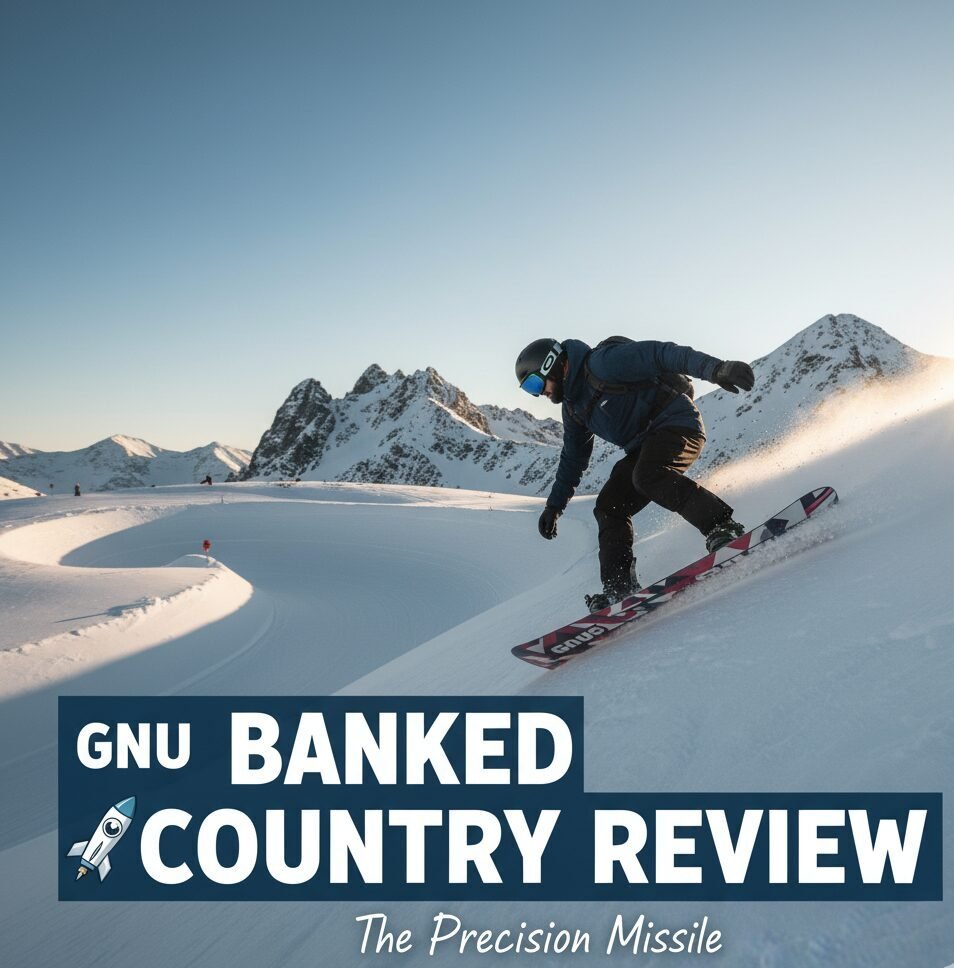
GNU Banked Country Review: The Precision Missile
Is the GNU Banked Country the best carving board on the market? We tested Temple Cummins’ masterclass in geometry to see if it lives up to the hype for aggressive all-mountain riders.
In the snowboarding world, there are boards built for fun, boards built for float, and then there are boards built for pure, unadulterated speed. The GNU Banked Country falls squarely into the latter category. Designed by the legendary father-son duo, Temple and Cannon Cummins, this board is a love letter to the art of the turn.
Temple Cummins has spent decades refining what makes a snowboard hold an edge in the most treacherous conditions (think Mt. Baker banked slaloms). The result is the Banked Country—a directional, camber-dominant powerhouse designed to grip ice, blast through chop, and float in powder.
If you have ever asked yourself why snowboarding is fun, and your answer involves G-forces and laying trenches, this might be your next deck. However, it is not a tame beast. In this comprehensive review, we will dissect the tech, the ride feel, and determine if you have the legs to handle this machine.
At A Glance: GNU Banked Country
| Profile | C3 Camber (Aggressive) |
|---|---|
| Shape | Directional |
| Flex | Medium-Stiff (7/10) |
| Edge Tech | Progressive Magne-Traction® |
| Core | G3 Eco Core (Aspen/Paulownia) |
| Best For | Carving, Freeride, Banked Slalom |
| Skill Level | Advanced to Expert |

The Tech: Why It Grips Like Glue
The magic of the Banked Country lies in its specific combination of profile and edge technology. It deviates from the standard “hybrid rocker” trend, opting for power instead.
C3 Camber Profile
GNU calls it C3, but in reality, it is mostly traditional camber. There is a very mild “rocker” between the feet, but the dominant profile is camber under the bindings extending to the contact points. This provides immense pop, stability, and energy return. When discussing camber snowboard vs rocker, C3 is the choice for riders who want precision.
Progressive Magne-Traction®
You may know Magne-Traction as the “serrated steak knife” edge that grips ice. The Banked Country features a “Progressive” version. The serrations are mellower near the nose (for smooth turn initiation) and significantly more aggressive near the tail. This allows you to drive hard off your back foot without washing out, even on bulletproof ice. It is a lifesaver if you are lazy about removing rust from snowboard edges and keeping them sharp.
Directional Geometry
With a set-back stance and a large, floaty nose, this board is directional. It wants to go forward. Fast. While you can ride switch, the geometry rewards driving from the front seat and finishing turns with power.
Performance on the Mountain
Carving & Groomers
This is the board’s bread and butter. The C3 camber loads up energy in the turn, and the Progressive Magne-Traction locks you into the snow. You can lay this board over until your armpits drag. It feels like it is on rails. If you are learning how to carve on a snowboard, this board will teach you proper technique, but it won’t forgive sloppy skidded turns.
Powder & Float
Despite being a camber-dominant board, it floats surprisingly well. The large nose and set-back stance do the heavy lifting. In deep snow, it feels surfy but powerful. It’s perfect for backcountry snowboarding lines where you need to navigate tight chutes and then open up on big aprons. It doesn’t have the effortless, loose float of a rocker board, but it planes efficiently at speed.
Uneven Terrain & Chunder
Because the board is damp and stiff, it blasts through chop. It doesn’t get bucked around. However, because it is stiff, you will feel the terrain if you aren’t active with your legs. We highly recommend wearing impact shorts when pushing speeds on this board, as catching an edge at 40mph is no joke.
Freestyle & Park
This is not a jib board. Do not buy this to slide rails. However, for big jumps and pipe riding, it excels. The pop from the C3 camber sends you to the moon. Just be ready for the landing; it requires precision. If you want to learn a list of snowboarding tricks like butters and presses, look elsewhere.
See It In Action
Watch the Banked Country tear up the resort and see how that Progressive Magne-Traction engages in real-time.
Comparisons: Banked Country vs. The Competition
How does it stack up against other big-mountain chargers?
GNU Banked Country vs. Lib Tech Orca
Both are made by Mervin Manufacturing, but they are very different animals.
- The Orca: A volume-shifted, hybrid rocker (C2X) board. It is surfy, pivots easily, and is better for tight trees and slow-speed powder.
- The Banked Country: Standard length, camber dominant. It is faster, more stable on ice, and better for carving.
- Verdict: Get the Orca for powder playfulness. Get the Banked Country for high-speed precision.
GNU Banked Country vs. Burton Custom X
The Custom X is the benchmark for stiff camber boards. The Custom X is a true twin (mostly), making it better for pipe and switch riding. The Banked Country is more directional and features Magne-Traction, giving it the edge on icy days. Both require an aggressive rider.
GNU Banked Country vs. Burton Pow Wrench
Comparing these two shows opposite ends of the spectrum. As noted in our Burton Pow Wrench review, the Pow Wrench is flat, short, and wide—made for low-angle float. The Banked Country is for steep, fast, technical lines.
Recommended Setup
A high-performance board needs high-performance components. Do not put soft park bindings on this deck.
Bindings
You need stiffness to transfer energy to those edges.
- Top Pick: Burton Cartel X. The stiffness perfectly complements the C3 camber.
- Alternative: Union Atlas or Bent Metal Transfer (for brand synergy).
Boots
Soft boots will lead to foot pain and lack of control. You need a stiff, responsive boot. Check out best snowboard boots for freeride options. Ensure you lace them tight—read how long are snowboard boot laces if you need replacements to get that cranked-down feel.
Safety Gear
This board makes you want to go fast. Speed increases risk. Read up on why snowboarding is dangerous and always wear a helmet and high-quality goggles to spot ice patches before you hit them.
Pros & Cons
Pros
- Edge Hold: Progressive Magne-Traction is a game-changer on ice.
- Stability: C3 Camber provides suspension and pop at high speeds.
- Carving: Initiates turns smoothly and locks into the exit.
- Build Quality: Mervin boards are eco-friendly and built tough in the USA.
- Versatility: Surprisingly good in powder for a camber board.
Cons
- Not Beginner Friendly: It will catch edges if you have poor technique.
- Stiffness: Can be fatiguing to ride all day if you aren’t fit (see our fitness guide).
- Not a Jib Board: Too stiff for rails and boxes.
Do you have the skills to tame the Banked Country?
Check Availability on AmazonFrequently Asked Questions
Is the GNU Banked Country good for beginners?
No. It is an aggressive, camber-dominant board. Beginners should look for a softer, rocker-hybrid board like the Arbor Element Rocker or check out resorts for beginners that offer rental gear suited for learning.
Does Magne-Traction really work?
Yes. The wavy edge creates multiple contact points (7 total) compared to the standard 2 on a regular board. This increases friction on hard surfaces, giving you grip on ice. It is widely considered the best tech for East Coast riding.
How should I size this board?
Ride it at your normal size. Unlike volume-shifted boards (like the Pow Wrench), the Banked Country is true to size. If you have large feet (US 11+), look for the “Wide” version to avoid toe drag.
Is it a “Dad Board”?
It is often jokingly called a dad board because Temple Cummins designed it, and it excels at “old school” carving. But don’t let the name fool you—it is a high-performance missile, not a lazy cruiser.
Can I use it for splitboarding?
GNU does make a splitboard version of the Banked Country. If you are into split snowboarding, it is an excellent choice for efficient uphill travel and powerful downhill riding.
How often should I wax it?
The board features a Sintered Knife Cut base. It is fast but porous. You should wax it every 3-5 days of riding. Learn how to wax a snowboard at home to keep it running fast.
When is the best time to buy?
High-end boards like this hold their value, but you can find deals in the spring. Check our guide on when to buy snowboarding gear.
Final Verdict
The GNU Banked Country is a masterpiece of snowboard engineering. It brings the power and pop of traditional camber into the modern era with the added safety net of Magne-Traction. It is a board for the rider who wakes up early to catch the fresh corduroy, who chases storms, and who treats the mountain like a race course.
It is not for the faint of heart, and it is certainly not for the park rat. But if you want to feel the G-force in every turn and trust your edge on the sketchiest ice, there is no better companion. It is, quite possibly, the ultimate all-mountain carving tool.
Prepare your legs, grab your gear bag, and get ready to ride faster than you ever have before.
GNU Banked Country Sizing Guide: How to Choose the Right Length and Width
Choosing the right size for the GNU Banked Country is one of the most critical decisions you will make before clicking “Buy Now.” Because this is a directional, performance-oriented board, sizing errors are amplified. Ride it too short and you lose stability at speed. Ride it too long and you will fatigue your legs before lunch. Ride the wrong width and you will drag toes in every toeside turn.
Unlike volume-shifted boards where you typically size down 5-10cm, the Banked Country follows traditional snowboard sizing logic. This means you need to pay close attention to your weight, boot size, and riding style. Below we break down every factor so you can dial in the perfect size for your body and terrain preferences.
Understanding Directional Sizing
Directional snowboards like the Banked Country are designed to be ridden primarily in one direction. The setback stance moves your weight toward the tail, which naturally shortens the effective edge underfoot. This means a 159cm Banked Country will feel slightly different from a 159cm true twin. The setback allows the nose to extend further, giving you more float in powder while maintaining a shorter effective edge for quicker turn initiation.
When sizing a directional board, most experienced riders choose their length based on where they want to prioritize performance. If you ride mostly groomers and want maximum edge hold, size up slightly for a longer effective edge. If you ride variable terrain and want maneuverability, stay at your normal size or even drop down a centimeter or two. The Banked Country is forgiving enough in its sizing that you have some room to play.
GNU Banked Country Size Chart
| Board Length | Rider Weight (lbs) | Rider Weight (kg) | Boot Size (US) | Best For |
|---|---|---|---|---|
| 153 cm | 110 – 150 | 50 – 68 | 6 – 9 | Lightweight riders, park-heavy all-mountain |
| 156 cm | 130 – 170 | 59 – 77 | 7 – 10 | Average weight riders, versatile all-mountain |
| 159 cm | 150 – 190 | 68 – 86 | 8 – 11 | Average to heavy riders, carving focus |
| 162 cm | 170 – 210+ | 77 – 95+ | 9 – 12 | Heavy riders, big mountain charging |
| 156W cm | 130 – 170 | 59 – 77 | 11 – 14 | Wide-footed riders, average weight |
| 159W cm | 150 – 190 | 68 – 86 | 11 – 14 | Wide-footed riders, heavier build |
| 162W cm | 170 – 210+ | 77 – 95+ | 12 – 16 | Wide-footed heavy riders, big mountain |
The Weight Rule: Why It Matters More Than Height
Many riders make the mistake of sizing their snowboard based on height. While height gives you a rough starting point, your weight is the far more important metric. The board needs to flex properly under your body weight. If you are a tall but light rider, you can ride a shorter board with confidence because you won’t over-flex the camber. If you are shorter but heavy, you need more board to prevent the camber from collapsing under load.
The GNU Banked Country uses a G3 Eco Core made from a blend of Aspen and Paulownia wood. This core construction gives it a medium-stiff flex rating of 7 out of 10. For a rider weighing 170 pounds on a 159cm, the board will flex exactly as intended. Put a 220-pound rider on that same 159cm and the board will feel softer than designed. Put a 140-pound rider on it and the board will feel like a plank. Always prioritize weight over height when consulting the size chart.
Boot Size and Board Width: The Toe Drag Problem
If your boot size is US 11 or larger, you absolutely need to consider the Wide (W) version of the Banked Country. Toe drag is not just annoying—it is dangerous. When your toes hang over the edge of the board and drag in the snow during a heelside turn, it can catch and throw you into a slam. At the speeds this board is designed for, that kind of mistake can result in serious injury.
The standard Banked Country has a waist width of approximately 25.2cm. This works perfectly for boots up to US 10. For US 11 and above, the Wide version bumps the waist width to approximately 26.2cm. The extra centimeter of width provides the clearance you need without sacrificing the board’s carving performance. Remember that binding angles also affect effective width. A positive/positive stance angle setup (like +18/+6) will move your toes and heels closer to the edge compared to a duck stance (+15/-15). Factor this into your decision.
Stance Width and Setback
The Banked Country comes from the factory with a recommended setback of approximately 1.25 inches (32mm). This means your rear binding sits about 32mm further back than center. This setback is what gives the board its directional character and powder performance. However, you can adjust your stance width and position within the insert range to fine-tune the feel.
Most riders on the Banked Country run a stance width between 21 and 23 inches (53-58cm). This is slightly narrower than a park stance because the directional geometry compensates for the narrower width with its setback. If you prefer a wider, more stable stance for charging steeps, feel free to push it out to 24 inches. Just make sure your bindings are compatible with the insert pattern and that you can comfortably reach the adjusters.
Sizing for Specific Riding Styles
Your preferred terrain should influence your sizing decision. Here is how we recommend sizing the Banked Country depending on where you spend most of your time on the mountain:
Carving and Groomer Focus: If 80% or more of your riding is on groomed runs and you live for laying trenches, go with your normal size or size up by one centimeter. The extra length gives you a longer effective edge, which translates to more stability during hard carving and better grip on ice. A rider who weighs 170 pounds and primarily carves would be happiest on a 159cm or even a 162cm.
All-Mountain Versatility: If you ride everything—groomers, trees, powder, bumps—stay at your normal calculated size. This gives you the best balance of edge hold, maneuverability, and float. For a 170-pound all-mountain rider, that means the 159cm. This is the sweet spot for most riders and the size we recommend as the default choice.
Powder and Freeride Focus: If you spend most of your time in the trees, sidecountry, and powder stashes, you can drop down by one centimeter. The Banked Country’s directional shape and setback stance already provide excellent float, so you don’t need extra length for buoyancy. The shorter board will be quicker in tight trees and more responsive in variable snow. A 170-pound freerider would enjoy the 156cm for its quickness.
Banked Slalom and Racing: If you are specifically buying this board for banked slalom events or time trial carving, size up by one centimeter for maximum edge hold and stability. Banked slalom courses feature high-G turns where every centimeter of effective edge matters. A 170-pound banked slalom racer should look at the 162cm.
Not sure which size is right for you?
Check Available Sizes on AmazonWhat If You Are Between Sizes?
If your weight falls right on the border between two sizes (say, exactly 170 pounds between the 156cm and 159cm), the decision comes down to your riding priorities. Ask yourself these three questions:
1. How aggressive am I? If you ride hard and fast and you have the physical fitness to handle a larger board, go up. The longer board will reward your aggressive style with more stability and edge hold. If you are a more relaxed rider who cruises and enjoys the scenery, go down for easier handling.
2. What terrain do I ride most? If you ride tight trees, bumps, and technical terrain regularly, the shorter board will be more forgiving and easier to maneuver. If you ride wide-open groomers, bowls, and steep faces, the longer board will feel more planted and secure.
3. What is my fitness level? The Banked Country is a stiff board that demands physical effort. If you are in peak shape and your legs can handle it, the longer board will extract more performance. If you are coming back from an injury or you are not as fit as you used to be, the shorter board will be less fatiguing over a full day of riding.
The Wide Board Decision: Do You Actually Need It?
Riders with boot sizes US 10.5 and above often wonder if they need a wide board. Here is the definitive answer: measure your overhang. Sit in your boots with your bindings attached to the board (or simulate it on a table). Look at how far your toes and heels extend past the board edge. If you have more than 1.5cm of overhang on either side, you need a wide. If you have less, you are fine on the standard width.
Wider boards are slightly heavier and slightly slower edge-to-edge. But for riders who need the width, the trade-off is absolutely worth it. A 162W Banked Country will perform identically to a 162 standard for a rider whose boots fit properly. The key is getting the right size so you don’t have excessive overhang AND don’t waste your money on unnecessary width.
Can You Ride a Banked Country Shorter Than Recommended?
Some aggressive riders intentionally size down for a more playful feel. This is acceptable with the Banked Country, but only by one centimeter at most. Going shorter reduces your effective edge, which directly impacts the board’s stability at speed and its grip on ice. The Magne-Traction will still work, but you lose the long, locked-in carving feel that makes this board special. We recommend sizing down only if you are a lighter rider who needs a more responsive flex, or if you plan to ride a lot of tight terrain.
Conversely, sizing up by one centimeter is a common trick among bigger riders and those who ride mostly hardpack. The longer effective edge gives you more to work with during aggressive carving, and the slight increase in swing weight is negligible at the speeds this board is designed for. Just make sure you have the leg strength to handle the extra length during a full day of riding.
How to Carve on the GNU Banked Country: A Complete Technique Guide
The GNU Banked Country is arguably the best teaching tool for proper carving technique that exists in snowboarding. Because it is so locked-in and so responsive, it rewards correct form and punishes bad habits. If you have been struggling to hold a clean carved turn on other boards, the Banked Country might be the instrument that finally teaches your body what a proper carve feels like.
But it works both ways. If your technique is sloppy, this board will let you know. Edge catches on the Banked Country are more abrupt and less forgiving than on softer, more playful boards. In this section, we will walk you through the fundamentals of carving and then show you how to maximize the Banked Country’s unique characteristics.
The Foundation: Athletic Stance and Weight Distribution
Everything starts with your stance. On the Banked Country, your body position matters more than on almost any other board because the camber profile and Magne-Traction demand precise weight distribution to function properly. Start by setting your feet in a comfortable, athletic position: knees slightly bent, back straight, head up, and shoulders aligned with the board.
Your weight should be centered over the board, with roughly 55-60% on your front foot during turn initiation and transitioning to 45-50% as you complete the turn. This is not a board where you can lean back and let the sidecut do all the work. You need to actively engage the edge from the moment you start the turn. The C3 camber profile requires you to load the board evenly to get the pop and energy return that makes this board feel so alive.
Many riders make the mistake of leaning too far back on directional boards because the setback stance gives the impression that weight should be aft. On the Banked Country, this will cause the nose to lift out of the snow and you will lose your grip. Keep your weight centered and let the setback do its job of providing float in soft snow. On groomed runs, center your weight and focus on rolling the board from edge to edge.
Turn Initiation: Engaging the Progressive Magne-Traction
The Banked Country’s Progressive Magne-Traction is most noticeable during turn initiation. On a standard board, you have two contact points—one near the nose and one near the tail. When you roll onto edge, the sidecut determines the arc of your turn. On the Banked Country, you have seven contact points distributed along the edge, with more aggressive serrations near the tail.
To take advantage of this, focus on a smooth, progressive roll onto edge. Don’t jerk the board sideways. Instead, progressively tilt your ankles and knees to engage the edge. You will feel the nose contact point grab first, and as you increase edge angle, the Magne-Traction serrations progressively engage. The result is a turn that builds in grip as you get deeper into it. This is the opposite of a board that grabs hard at initiation and then washes out at the exit.
Think of it like driving a high-performance car. You don’t yank the steering wheel—you roll into the turn smoothly, and the car’s suspension loads up progressively. The Banked Country works the same way. Smooth initiation leads to maximum grip at the apex and a powerful, locked-in exit. If you rush the initiation or try to force the board sideways, the Magne-Traction will fight you and the turn will feel skittish.
Apex and Carve: Loading the Camber
The apex of your turn is where the magic happens on the Banked Country. As you reach the midpoint of your arc, the C3 camber is fully loaded with energy. This is the moment where you feel the board flexing against the snow and storing energy in the camber. Your job at this point is to maintain consistent edge pressure and let the board do the work.
Stay low and keep your body centered over the board. Your inside leg should be slightly bent and your outside leg should be driving the turn. The more you commit to the turn by increasing your edge angle, the more the camber will flex and the more energy it stores. This energy is what launches you into the next turn with explosive pop. If you release pressure too early, you lose that energy return and the turn feels flat. If you hold pressure through the apex, the board will practically throw you into the next turn.
The sensation is unlike any other board. It feels like the board is accelerating through the turn, pulling you into the arc and then slingshotting you out. This is the hallmark of a properly executed carve on the Banked Country. Once you feel it, you will understand why Temple Cummins designed this board with such a specific camber profile. The energy return is what separates the Banked Country from every other carving board on the market.
Turn Exit: Driving Off the Tail
The exit of the turn is where the Progressive Magne-Traction becomes most valuable. On a standard board, many riders experience their edge washing out at the end of a turn as they transition from one edge to the other. On the Banked Country, the aggressive serrations near the tail prevent this from happening.
To maximize the exit, drive off your back foot as you complete the turn. Apply more pressure to the tail as you release the turn and transition to flat base. You will feel the tail serrations grip the snow and prevent the edge from washing out. This is what allows you to ride at high speeds without losing control during transitions. The board grips from initiation to exit, giving you a continuous arc that feels like it is on rails.
Many riders who are new to the Banked Country are surprised by how much energy the board has during the exit. It almost feels like the board is accelerating on its own. This is because the camber is releasing its stored energy at the exact moment you are transitioning to the next turn. The result is a fluid, rhythmic carving style where each turn flows into the next with minimal effort from you. Once you learn to trust this energy return, your carving will reach a level you didn’t think was possible.
Carving Drills to Master the Banked Country
If you want to get the most out of the Banked Country, practice these specific drills on groomed runs. These exercises will teach your body the proper mechanics and help you develop the muscle memory needed to ride this board at its full potential.
The J-Turn Drill: Find a wide, empty groomer and ride straight down the fall line. Initiate a single carved turn and hold it until you come to a complete stop. This teaches you to maintain consistent edge pressure throughout the entire arc of the turn. On the Banked Country, you will notice that the board wants to keep turning even after you think the turn is over. Let it. Feel the Magne-Traction pulling you into the snow and the camber flexing under your weight. This drill is the foundation of everything else.
The Edge-to-Edge Transition Drill: Ride across the fall line and practice transitioning from one edge to the other as quickly as possible without skidding. Focus on a smooth, progressive roll from toeside to heelside. The Banked Country’s Magne-Traction makes this transition feel more controlled than on other boards. Pay attention to the moment when the board is flat on the snow between edges—this is the danger zone where edge catches happen. On the Banked Country, this zone is shorter than on most boards because the serrations help engage the new edge faster.
The Speed Carving Drill: Find a long, moderate groomer and progressively increase your speed over multiple runs. On each run, push your speed a little higher than you are comfortable with. The Banked Country’s stability at speed is remarkable, and this drill will teach you to trust it. You will discover that the board gets more stable the faster you go, which is the opposite of most boards that become twitchy at high speed. The C3 camber profile is designed for this kind of riding, and the Magne-Traction ensures your edges hold even when you are moving fast on hardpack.
The Variable Pressure Drill: While carving, experiment with shifting your weight from your front foot to your back foot and back again. Notice how the board responds differently at each position. With more weight on the front, the board turns more gradually and the nose engages earlier. With more weight on the back, the board turns more aggressively and the tail powers through the exit. Learning to dynamically shift your weight during a turn is the key to advanced carving and is especially effective on the Banked Country because of its Progressive Magne-Traction.
Common Carving Mistakes on the Banked Country
The Banked Country exposes bad habits that other boards might mask. Here are the most common mistakes riders make when they first ride this board, and how to fix them:
Mistake 1: Leaning back too far. Because the board is directional and setback, many riders instinctively lean back. This unweights the nose and causes you to lose grip during turn initiation. Fix: Keep your weight centered and trust the setback to provide float. On groomed runs, your weight should be almost perfectly centered with a slight bias toward the front foot.
Mistake 2: Skidding turns instead of carving. The Banked Country punishes skidded turns more than other boards because the stiff flex and Magne-Traction make skidding feel awkward and inefficient. Fix: Focus on rolling the board onto edge rather than pushing it sideways. Think of it as tilting the board, not steering it. Let the sidecut determine the arc of the turn.
Mistake 3: Rushing the turn transition. Many riders try to snap from one edge to the other as quickly as possible. On the Banked Country, this causes the Magne-Traction to engage prematurely and the turn feels jerky. Fix: Be patient during the transition. Let the board come to flat base, then smoothly roll onto the new edge. The Banked Country has enough energy return from the camber to make this transition feel effortless if you let it happen naturally.
Mistake 4: Not using enough edge angle. The Magne-Traction works best when you commit to the turn with high edge angles. If you are barely tipping the board onto edge, the serrations don’t engage properly and you lose the benefit of the technology. Fix: Get comfortable with higher edge angles. Bend your knees more, roll your ankles further, and trust that the board will hold. The Banked Country can handle extreme edge angles that would cause other boards to slide out.
GNU Banked Country in Every Condition: Ice, Hardpack, Powder, Slush, and Spring
One of the most impressive aspects of the GNU Banked Country is its ability to perform across a wide range of snow conditions. While it is primarily designed as a carving and hardpack board, its combination of camber, Magne-Traction, and directional shape gives it legitimate capability in everything from bulletproof ice to waist-deep powder. In this section, we break down exactly how the board performs in each condition and give you tips for maximizing its potential.
Ice and Hardpack: Where the Banked Country Shines
Let us be clear: the Banked Country was built for ice. This is where the Progressive Magne-Traction earns its keep and where the C3 camber profile provides its greatest benefit. On bulletproof hardpack, most snowboards feel like they are skittering across the surface. The Banked Country feels like it is locked into a rail.
The seven contact points created by the Magne-Traction serrations bite into the ice surface in a way that traditional edges simply cannot match. Where a standard board has two points of contact that can easily break free on ice, the Banked Country has seven points that share the load. The result is a board that grips where others slip. We tested the Banked Country on pure ice conditions at resorts in the Northeast United States, and the difference was night and day compared to non-Magne-Traction boards.
On hardpack groomers at speed, the C3 camber profile provides the stability you need to charge confidently. The camber between the bindings acts as a suspension system, absorbing small vibrations and keeping the board planted. At speeds above 40mph, the board feels incredibly composed. The stiffer flex prevents it from chattering or bouncing, and the Magne-Traction ensures your edges never lose their grip. If you ride in the East Coast or anywhere with frequent icy conditions, the Banked Country should be at the top of your list.
For icy conditions, we recommend sharpening your edges before the season starts and touching them up every 5-10 days of riding. The Magne-Traction serrations have more surface area than a traditional edge, which means they benefit even more from a fresh sharpen. A 1-degree edge angle on the base side and a 2-degree edge angle on the side is the sweet spot for the Banked Country on ice. More aggressive than that and the serrations can feel too grabby on softer snow. Less aggressive and you lose some of the ice grip that makes this board special.
Powder: Better Than You Would Expect
The Banked Country is not a powder board, but it handles powder better than almost any camber-dominant board on the market. The large, extended nose provides the float you need, and the setback stance shifts your weight to the tail, keeping the nose above the snow. In powder up to your knees, the Banked Country floats confidently and surfs through the soft snow with surprising ease.
The key to riding powder on the Banked Country is maintaining speed. Unlike a rocker powder board that floats at any speed, the camber-dominant profile of the Banked Country needs momentum to stay on top of the snow. If you slow down too much, the nose will start to sink. Keep your speed up and lean back slightly to keep the nose elevated. The Magne-Traction won’t help you much in deep powder since there is no hard surface to grip, but it will help you as you transition from powder to groomed runs where the edge suddenly finds ice.
In chopped-up powder (the kind you find in the trees after a storm has been tracked out), the Banked Country excels. The stiff flex and damp construction prevent the board from getting deflected by hidden bumps and hard spots. Where a softer board would get bucked around, the Banked Country powers through. This makes it an excellent choice for riders who want one board that can handle both the groomers and the sidecountry powder.
For powder days, we recommend setting your bindings back as far as possible on the insert pattern. The extra setback gives you more float and makes the board feel surfier. You might also want to loosen your binding forward lean slightly to give yourself a more relaxed, surf-oriented stance. The Banked Country will never feel as effortless in powder as a dedicated powder board, but with the right setup and technique, it will keep up with the best of them.
Slush and Spring Conditions: Controlled Aggression
Spring riding presents a unique challenge: the snow is heavy, wet, and inconsistent. You might hit a patch of soft slush followed by a patch of bulletproof ice within the same turn. This is where the Banked Country’s versatility truly shines. The camber profile provides stability on the hard patches, while the Magne-Traction gives you grip on the icy sections. The stiff flex helps power through the heavy slush without getting bogged down.
In slushy conditions, the board feels powerful but requires more physical effort. The heavy snow creates drag on the base, and the stiff flex means you need to actively drive the board through each turn. This is where your fitness level matters. After a full day of spring riding on the Banked Country, your legs will know it. But the reward is a board that performs where others flounder.
One tip for spring riding: wax your board with a warm-temperature wax before heading out. Spring slush is much denser than powder, and a warm wax will help the board glide through it more efficiently. The Banked Country’s sintered base absorbs wax well, and a fresh coat will make a noticeable difference in how the board handles heavy spring snow. Check out our guide on how to wax a snowboard at home for step-by-step instructions.
Spring also means variable conditions throughout the day. In the morning, the snow might still be firm and fast. By afternoon, it turns to slush. The Banked Country handles this transition better than most boards because its camber profile works in both conditions. In the morning, the camber gives you grip and stability on the firm snow. In the afternoon, the Magne-Traction helps you maintain edge control on the slushy surface. The key is to adjust your riding style throughout the day—more aggressive in the morning, more patient in the afternoon.
Chop and Crud: The Banked Country Plows Through
Choppy, uneven snow is the nemesis of most snowboards. Soft boards get bounced around, lightweight boards get deflected, and camber boards without Magne-Traction lose their edge in the inconsistencies. The Banked Country handles chop better than almost any board in its class. The stiff flex absorbs impacts, the damp construction reduces vibration, and the Magne-Traction maintains edge grip through the uneven surface.
To ride chop on the Banked Country, stay active with your legs. Absorb bumps with your knees and keep your upper body quiet. The board will do most of the work, but you need to be ready to adjust your weight distribution as the terrain changes. On steep, choppy runs, focus on maintaining a consistent speed rather than trying to go as fast as possible. The board’s stability will surprise you—it feels like it is floating above the chop even when the snow is flying everywhere.
We tested the Banked Country in heavy chop at the end of a powder day, and the results were impressive. Where other boards were getting kicked sideways and losing edge grip, the Banked Country maintained its line and carved through the crud. The Magne-Traction provided consistent edge hold even when the snow was uneven and unpredictable. This is the kind of performance that separates a good all-mountain board from a great one.
Spring Slush and Corn Snow: The Hidden Gem
Many riders overlook corn snow, but it is some of the best riding of the year when you have the right board. Corn snow forms in the spring when the top layer of snow melts during the day and refreezes at night. The result is perfectly rounded granules of snow that feel like riding on miniature marbles. It is fast, consistent, and incredibly fun to carve on.
The Banked Country is an exceptional corn snow board. The camber profile provides stability on the refrozen surface, and the Magne-Traction gives you the edge hold you need to carve at high speeds. Corn snow is perfect for laying trenches, and the Banked Country was literally designed for this kind of riding. If you have access to spring corn conditions, the Banked Country will be the best board in your quiver for the job.
For corn snow, we recommend running your edges slightly less sharp than you would for ice. A slightly duller edge grips the corn granules better than a razor-sharp edge, which can feel grabby and unpredictable. A 1-degree base bevel with a 1-degree side bevel is ideal for corn snow conditions. This gives you enough edge hold for carving without the board feeling twitchy on the loose surface.
GNU Banked Country vs. The Competition: 10 Head-to-Head Comparisons
The GNU Banked Country competes in a crowded market of all-mountain freeride boards. To help you make an informed decision, we compare it head-to-head with ten of its most popular competitors. Each comparison covers the key differences in design philosophy, performance characteristics, and ideal rider profiles.
GNU Banked Country vs. Jones Flagship
The Jones Flagship is the Banked Country’s closest competitor in terms of design philosophy. Both are directional, camber-dominant boards built for aggressive all-mountain riding. However, the Flagship uses a slightly different camber profile (a more pronounced rocker between the feet) and features Traction Tech (Jones’s version of serrated edges) instead of Magne-Traction.
The Flagship floats better in powder due to its more pronounced nose rocker and slightly more setback stance. The Banked Country holds ice better because of the Progressive Magne-Traction’s aggressive serrations near the tail. For carving on groomers, the Banked Country has the edge. For all-conditions versatility, it is nearly a toss-up. Choose the Flagship if you ride a lot of powder and want a more surfy feel. Choose the Banked Country if you prioritize ice grip and carving performance.
GNU Banked Country vs. Capita Mercury
The Capita Mercury is a lighter, more playful take on the all-mountain charger. It uses a hybrid camber profile that is more forgiving than the Banked Country’s C3 camber. The Mercury is more versatile in the park and easier to ride switch, but it doesn’t have the same edge hold on ice or the same carving precision as the Banked Country.
If you want a board that can do everything reasonably well, the Mercury is a great choice. If you want a board that does one thing exceptionally well (carving and ice grip), the Banked Country is the better option. The Mercury is also lighter, which makes it more maneuverable in trees and easier to ride for longer periods. But the Banked Country’s stability at speed and its ability to power through chop are unmatched.
GNU Banked Country vs. K2 Excavator
The K2 Excavator is a newer competitor that has gained popularity for its unique shape and aggressive performance. Like the Banked Country, it is directional and camber-dominant. However, the Excavator uses a wider platform and a more tapered shape, giving it a different feel in turns.
The Excavator is better in deep powder due to its wider nose and tapered shape. The Banked Country is better on groomers because of its narrower waist and more traditional sidecut. For carving, the Banked Country wins. For powder, the Excavator wins. For mixed conditions, it depends on your priorities. The Banked Country is more predictable and consistent across conditions, while the Excavator excels in powder but is less versatile on hardpack.
GNU Banked Country vs. Rossignol One
The Rossignol One is a true twin all-mountain board that prioritizes versatility over specialization. It uses a balanced camber-rocker profile and traditional edge technology. The One is easier to ride switch, more forgiving in the park, and more approachable for intermediate riders.
The Banked Country outperforms the One in every carving metric: edge hold, stability at speed, and energy return. But the One is more versatile and easier to ride for a wider range of riders. If you want a board that does everything at a high level, the One is a solid choice. If you want a board that excels at carving and ice grip specifically, the Banked Country is the clear winner.
GNU Banked Country vs. Yes. Standard
The Yes. Standard is a popular all-mountain board that uses a directional camber profile with a slightly tapered shape. It is lighter than the Banked Country and more playful, making it a better choice for riders who spend time in the park and want a more balanced quiver option.
The Banked Country is stiffer, more aggressive, and better at high-speed carving. The Standard is lighter, more forgiving, and better for park and jibbing. If you ride mostly groomers and want maximum performance, the Banked Country. If you ride everything and want one board that does it all, the Standard is the more versatile choice.
GNU Banked Country vs. Lib Tech T.Rice Pro
The T.Rice Pro is Travis Rice’s signature board and one of the most popular all-mountain freestyle boards on the market. It uses a C2X camber profile (more rocker than the Banked Country’s C3) and features Magne-Traction edges. Both boards are made by Mervin Manufacturing, so they share similar construction quality and eco-friendly materials.
The T.Rice Pro is more playful and better in the park. It has more pop for ollies and nollies, better switch performance, and a more forgiving feel at moderate speeds. The Banked Country is more stable at speed, better on ice, and more precise for carving. Choose the T.Rice Pro if you want a board that can carve well but also handle park laps. Choose the Banked Country if carving is your primary focus and you want the best possible edge hold.
GNU Banked Country vs. Burton Custom
The Burton Custom is the best-selling all-mountain snowboard of all time. It uses a traditional camber profile and features a true twin shape with mild directional features. The Custom is more versatile than the Banked Country and easier to ride for a wider range of riders.
The Banked Country outperforms the Custom in carving precision and ice grip. The Custom is more balanced and handles park riding better. For aggressive carving and hard-charging all-mountain riding, the Banked Country wins. For everyday resort riding where you want one board that does everything well, the Custom is the safer choice.
GNU Banked Country vs. Nitro Squash
The Nitro Squash is a directional all-mountain board that uses a camber-dominant profile with a slightly tapered shape. It is designed for aggressive riders who want a blend of carving performance and powder capability. The Squash uses traditional edge technology without Magne-Traction.
The Banked Country holds ice better due to the Magne-Traction. The Squash is slightly more playful and better in tight terrain due to its tapered shape. For wide-open carving and ice, the Banked Country. For trees and variable terrain, the Squash is more maneuverable. Both are excellent boards for aggressive riders—the choice depends on your terrain preferences.
GNU Banked Country vs. Ride Warpig
The Ride Warpig is a volume-shifted, short-and-wide board that has taken the industry by storm. It uses a hybrid camber profile and features a wide platform for float in powder. The Warpig is more playful, more versatile, and easier to ride for a wider range of skill levels.
The Banked Country is faster, more stable at speed, and better for carving. The Warpig is more maneuverable, better in tight terrain, and more forgiving. They are designed for completely different riding styles. The Banked Country is for the rider who wants to go fast and carve hard. The Warpig is for the rider who wants to surf the mountain and play in every terrain feature. If you had to choose one, your riding style should make the decision obvious.
GNU Banked Country vs. Salomon Assassin
The Salomon Assassin is a versatile all-mountain board that uses a hybrid camber profile and features a directional twin shape. It is lighter than the Banked Country and more playful, making it a better choice for riders who spend time in the park and want a more balanced approach.
The Banked Country outperforms the Assassin in every carving metric. The Assassin is more versatile and better in the park. For aggressive all-mountain riding, the Banked Country. For all-day resort riding where you want to hit every feature, the Assassin is the more balanced choice. The Assassin is also more forgiving, making it a better option for intermediate riders who are still developing their technique.
GNU Banked Country Maintenance: How to Keep Your Board Running Fast
The GNU Banked Country features a Sintered Knife Cut base, which is one of the fastest base materials available. Sintered bases are porous, meaning they absorb wax efficiently and provide maximum glide when properly maintained. However, they also require more maintenance than extruded bases. If you neglect a sintered base, it will dry out, oxidize, and lose its speed. In this section, we cover everything you need to know about maintaining your Banked Country to keep it running at peak performance.
Waxing Schedule
For optimal performance, wax your Banked Country every 3-5 days of riding. If you ride in particularly abrasive conditions (icy, man-made snow, or spring slush), wax every 2-3 days. If you ride in soft, natural powder, you can stretch it to 5-7 days. The key indicator is the base appearance. A fresh wax will make the base look dark and saturated. As the wax wears off, the base will start to look dry and white. When you see white patches on the base, it is time to wax.
The type of wax you use matters. For cold conditions (below 20°F / -7°C), use a cold-temperature wax. For medium conditions (20-32°F / -7 to 0°C), use an all-temperature or mid-temperature wax. For warm conditions (above 32°F / 0°C), use a warm-temperature wax. If you ride in a variety of conditions, an all-temperature wax is a good middle ground. For the best performance, match your wax to the specific conditions you will be riding in.
How to Wax Your Banked Country at Home
Waxing your snowboard at home is a straightforward process that will save you money and keep your board in peak condition. Here is the step-by-step process:
Step 1: Prepare your workspace. Set up a stable board vise or use two sawhorses. Make sure the temperature in your workspace is above 65°F (18°C) for best results. You will need an iron, wax, a scraper, a brush, and a base cleaner.
Step 2: Clean the base. Apply base cleaner to the base and wipe it off with a clean cloth. This removes old wax, dirt, and debris. If the base is heavily oxidized, you may need to scrape it first with a plastic scraper to remove the oxidized layer.
Step 3: Heat the iron. Set your iron to the temperature recommended on the wax package (usually around 250°F / 120°C). Test the temperature by dripping wax onto the iron—if it drips steadily without smoking, the temperature is correct. If it smokes, the iron is too hot and will damage the base.
Step 4: Apply the wax. Drip the wax onto the base in a zigzag pattern, covering the entire base from tip to tail. Then use the iron to spread the wax evenly across the base. Move the iron in smooth, continuous strokes. Do not leave the iron in one spot for too long, as this can burn the base.
Step 5: Let it cool. Allow the wax to cool completely, ideally for at least 30 minutes. Some riders prefer to let it cool overnight for maximum absorption. The longer the wax stays on the base, the more time it has to absorb into the pores of the sintered base.
Step 6: Scrape the wax. Using a sharp plastic scraper, scrape the excess wax off the base. Start at the tip and work toward the tail, applying firm, even pressure. The goal is to remove the surface wax while leaving the wax that has absorbed into the base. You should see thin ribbons of wax coming off as you scrape.
Step 7: Brush the base. Use a nylon or horsehair brush to buff the base. Start with a coarse brush to remove any remaining surface wax, then finish with a fine brush to polish the base. The goal is to expose the base structure while leaving the wax in the pores.
Edge Tuning for the Magne-Traction
Tuning the edges on a Magne-Traction board is different from tuning a standard board. The serrated edges have more surface area and more complex geometry, which means they require more attention during tuning. Here is how to maintain the Progressive Magne-Traction edges on the Banked Country:
Edge angle: For the Banked Country, we recommend a 1-degree base bevel and a 2-degree side bevel. This gives you a sharp, responsive edge that grips ice without being too grabby in soft snow. You can adjust these angles based on your preferences and conditions. More aggressive riders who primarily ride ice may prefer a 1-degree base bevel with a 3-degree side bevel.
Filing technique: Use a side-edge goggle set to your desired angle. Run the file along the side edge from tail to nose, following the contour of the Magne-Traction serrations. The file should ride over the peaks of the serrations and sharpen the valleys. This is more time-consuming than sharpening a standard edge, but the results are worth it. A sharp Magne-Traction edge is the difference between grip and slip on ice.
Detuning: Detuning is the process of dulling specific areas of the edge to prevent catchiness. On the Banked Country, detune the area between the bindings (approximately 2 inches on either side of each binding). This prevents the board from catching during flat-base riding and makes transitions smoother. Leave the contact points at the nose and tail fully sharp for maximum grip during turns.
Base Repair
P-tex is the standard material for repairing gouges in snowboard bases. If you get a deep gouge that exposes the core, it is important to repair it promptly to prevent water from entering the core and causing delamination. For small gouges (less than 1 inch), use a P-tex candle. Light the candle, let it drip into the gouge, and then scrape it flush with the base once it cools.
For larger gouges, use a P-tex gun for better control and a more consistent repair. The process is the same: melt the P-tex into the gouge, let it cool, and scrape it flush. If the gouge is deep enough to expose the metal edge, you may need to use a metal-grip P-tex product for a more durable repair.
After any base repair, always wax the board to seal the repair and restore the base’s glide. The P-tex will absorb wax differently than the surrounding base material, so you may notice a slight difference in glide in the repaired area. This is normal and will diminish with repeated waxing.
Storage and Off-Season Care
At the end of the season, proper storage is essential to keep your Banked Country in good condition for the following year. Here is how to store your board properly:
Step 1: Give it a final wax. Apply a thick coat of wax to the entire base and do NOT scrape it off. This layer of wax protects the base from oxidation during the off-season. When you pull the board out next season, simply scrape off the old wax and apply a fresh coat.
Step 2: Loosen your bindings. Back off the binding screws by a few turns. This relieves pressure on the board and prevents the inserts from being under constant stress. It also makes it easier to adjust your bindings when you pull the board out next season.
Step 3: Store in a cool, dry place. Avoid storing your board in direct sunlight, near heat sources, or in damp environments. UV light can degrade the base material, heat can warp the camber, and moisture can cause rust on the edges. A closet or under a bed is ideal.
Step 4: Store vertically or horizontally. Both are acceptable, but if you store the board vertically, make sure it is resting on the tail (not the nose) and is leaning against a wall at a slight angle. If you store it horizontally, place it flat on a shelf. Do not lean it against a wall at a steep angle for extended periods, as this can warp the camber over time.
The Perfect Binding and Boot Pairing for the GNU Banked Country
A snowboard is only as good as the system it is part of. The board, bindings, and boots need to work together as a cohesive unit to deliver maximum performance. The GNU Banked Country demands specific pairing characteristics because of its stiff flex, aggressive camber profile, and directional geometry. Put soft park bindings on this board and you will waste its potential. Put the wrong boots in those bindings and you will end the day with sore feet and no control.
In this section, we break down the ideal binding and boot pairing for the Banked Country based on different riding styles and skill levels. We explain why certain characteristics work better than others and give you specific product recommendations to build the ultimate setup.
Binding Characteristics That Match the Banked Country
The Banked Country has a flex rating of 7 out of 10. This means it needs bindings with a similar or slightly stiffer flex to properly transfer energy from your body to the board. Soft bindings (flex 4-5) will feel disconnected and won’t provide the response you need for aggressive carving. Bindings that are too stiff (flex 9-10) can feel harsh and unforgiving, making it difficult to make micro-adjustments during a turn.
The sweet spot for the Banked Country is a binding with a flex of 7-8. This provides enough response to transfer your inputs to the board while still allowing some flex for comfort and adjustment. Here are the specific binding characteristics we recommend:
Highback stiffness: A stiff highback is essential for heel-side turns on the Banked Country. The highback provides the leverage you need to tilt the board onto its heelside edge, and a stiff highback ensures that your energy is transferred directly to the board without being absorbed by binding flex. Look for bindings with a carbon fiber or reinforced nylon highback for maximum response.
Baseplate stiffness: The baseplate is the connection between your boot and the board. A stiff baseplate provides a direct energy transfer and maximum board feel. For the Banked Country, a metal or composite baseplate is ideal. Avoid baseplates made entirely of soft EVA foam, as they dampen the feel of the board and reduce response.
Strap quality: The ankle strap should be thick and supportive, providing a secure hold on your boot without creating pressure points. The toe strap should be a convertible or toe-cap style that pulls your boot back into the binding rather than just pushing down on top of it. Quality straps are essential for maintaining control during aggressive riding.
Our Top Binding Picks for the Banked Country
Burton Cartel X: The Cartel X is our top recommendation for the Banked Country. It has a flex rating of 8, which matches perfectly with the board’s 7/10 flex. The stiff highback provides excellent heel-side response, and the Hammockstrap ankle strap distributes pressure evenly across your foot. The AutoCANT baseplate automatically adjusts to your boot’s natural cant angle, improving comfort and response. If you want the best possible pairing for the Banked Country, this is it.
Union Atlas: The Atlas is a close second to the Cartel X. It features a stiff carbon-infused baseplate and a responsive highback. The Atlas has a slightly more aggressive feel than the Cartel X, which makes it a great choice for riders who want maximum response. The multi-density bushings provide vibration damping without sacrificing board feel. If you prefer Union bindings, the Atlas is the perfect match for the Banked Country.
Bent Metal Transfer: For riders who want to stay within the Mervin family (GNU’s parent company), the Bent Metal Transfer is an excellent choice. It features a stiff magnesium baseplate and a responsive highback. The Transfer has a slightly more playful feel than the Cartel X or Atlas, which makes it a good choice for riders who want a balance of response and comfort.
Union Strata: If you want the stiffest binding in the Union lineup, the Strata is the one. With a flex rating of 9, it is slightly overkill for the Banked Country, but aggressive riders who want maximum response will love it. The Strata features a forged carbon baseplate and an ultra-stiff highback. This is a binding for expert riders only.
Boot Selection: The Foundation of Your Setup
Your boots are the most important part of your snowboard setup. The best board and bindings in the world won’t perform if your boots don’t fit properly or don’t match the system. For the Banked Country, you need a stiff, responsive boot that provides the support and control required for aggressive riding.
Boot flex: The boot flex should match or exceed the binding flex. For the Banked Country, a boot with a flex of 8-10 is ideal. This provides the response you need for aggressive carving while still being comfortable enough for all-day riding. Avoid boots with a flex below 7, as they won’t provide enough support for the forces this board generates during hard turns.
Boot fit: The most important factor in boot selection is fit. A boot that is too big will slide around inside the binding, reducing your control. A boot that is too small will cause pain and cut off circulation. Your toes should lightly brush the front of the boot when you are standing upright, and pull back slightly when you bend your knees into a riding position. There should be no heel lift when you flex forward, and the boot should feel snug around your entire foot without any pressure points.
Lacing system: For aggressive riders on the Banked Country, we recommend traditional laces or a BOA system. Traditional laces allow you to fine-tune the tightness across different zones of the boot, while BOA provides quick, one-handed adjustments. Speed laces are the least recommended for aggressive riding because they don’t allow the same level of fine-tuning as traditional laces.
Our Top Boot Picks for the Banked Country
Burton Ion: The Ion is a stiff, responsive boot with a traditional lace system. It has a flex rating of 9, which makes it ideal for the Banked Country. The Ion features a GripLite outsole that provides excellent traction on the board, and the Imprint 3 liner offers customizable fit with a heat-moldable construction. If you want a stiff boot that provides maximum response, the Ion is the gold standard.
Burton SLX: The SLX is Burton’s lightest stiff boot, featuring a Vibram EcoStep outsole and a BOA closure system. It has a flex rating of 9 and provides the same level of response as the Ion with the convenience of BOA adjustment. The SLX is a great choice for riders who want stiff performance without the hassle of traditional laces.
DC Judge: The DC Judge is a stiff boot with a BOA closure system that has gained popularity among aggressive all-mountain riders. It features a BOA Focus system that allows independent adjustment of the upper and lower zones, providing a custom fit. The Judge has a flex rating of 9 and provides excellent response for carving on the Banked Country.
Ride Insano: The Ride Insano is one of the stiffest boots on the market, with a flex rating of 10. It features a traditional lace system and a Michelin outsole for maximum grip. The Insano is a boot for expert riders who want zero compromise in response and support. If you ride the Banked Country aggressively and want a boot that can keep up, the Insano is the answer.
Binding Stance Setup for the Banked Country
The right stance angles and width can dramatically affect how the Banked Country performs. Here are our recommended setups for different riding styles:
All-Mountain Carving (Recommended): Front binding: +21 degrees. Rear binding: +6 degrees. Stance width: 22 inches (56cm). This setup provides a positive/positive stance that is ideal for carving. The positive angles align your body with the board’s directional shape and allow you to drive hard through turns. The slightly open rear angle provides comfort and allows you to ride switch when needed.
Aggressive Freeride: Front binding: +24 degrees. Rear binding: +9 degrees. Stance width: 23 inches (58cm). This setup maximizes forward drive and is ideal for riders who spend most of their time charging down steep terrain. The higher positive angles put your body in a more aggressive forward-leaning position, which improves control at high speeds.
Carving with Switch Capability: Front binding: +18 degrees. Rear binding: -6 degrees. Stance width: 22 inches (56cm). This setup provides a slight duck stance that allows for comfortable switch riding while still maintaining good carving performance. The positive front angle provides the carving performance, while the negative rear angle allows you to ride switch without feeling awkward.
Banked Slalom: Front binding: +27 degrees. Rear binding: +12 degrees. Stance width: 21 inches (53cm). This setup is optimized for banked slalom courses where quick, aggressive turns are required. The higher angles put your body in a more forward-leaning position, which improves agility and responsiveness in tight turns.
Getting Fit to Ride the GNU Banked Country: Physical Preparation Guide
The GNU Banked Country is not a board you can ride in jeans and a hoodie after a summer on the couch. It demands physical fitness, leg strength, and cardiovascular endurance. The stiff camber profile and aggressive performance characteristics mean that your body is the suspension system, and if that system is not up to the task, you will be exhausted by lunch and in pain by afternoon.
This is not a negative—it is a reality check. The Banked Country rewards fit riders with incredible performance, and the physical demands it places on you are part of what makes it such a rewarding board to ride. In this section, we outline the specific fitness requirements for the Banked Country and give you a training plan to prepare your body for the season.
Why Fitness Matters on the Banked Country
The C3 camber profile stores and releases energy during every turn. This energy transfer is what makes the board feel so alive and responsive. But it also means your body is absorbing that energy on every transition. The stiffer the board, the more energy your legs need to absorb and redirect. On a soft park board, the board flexes and absorbs much of this energy for you. On the Banked Country, your legs are doing the work.
The Magne-Traction edges require you to maintain consistent edge pressure throughout the turn. This means your core and legs are constantly engaged, holding your body in position against the forces of the turn. At high speeds, these forces are significant. A single carved turn on the Banked Country at 30+ mph can generate forces of 2-3 Gs. Your body needs to be strong enough to maintain control under these loads for an entire day of riding.
Additionally, the stiff boots and bindings required for the Banked Country restrict ankle movement, which means your knees and hips are doing more work to absorb terrain variations. If your knees and hips are weak or inflexible, you will feel it immediately. The Banked Country will amplify any weakness in your kinetic chain, making it the ultimate diagnostic tool for snowboarding fitness.
Essential Exercises for Banked Country Riders
Squats: The squat is the foundation of snowboarding fitness. It builds quad strength, glute activation, and core stability. For snowboarding, focus on deep squats that take you below parallel. This builds the strength you need for low, aggressive riding positions. Do 3 sets of 12-15 reps, 3 times per week during your off-season training.
Single-leg squats (pistol squats): Snowboarding is a single-leg sport—you are constantly balancing on one leg during turns. Single-leg squats build the unilateral strength and balance you need for carving on the Banked Country. Start with assisted pistol squats using a TRX or doorframe, and progress to unassisted as you get stronger. Do 3 sets of 8-10 reps per leg, 2 times per week.
Lunges: Walking lunges and lateral lunges build the quad, glute, and hip strength needed for dynamic snowboarding movements. The Banked Country requires you to shift weight from front to back foot during turns, and lunges train this exact movement pattern. Do 3 sets of 12 reps per leg, 2 times per week.
Core training: A strong core is essential for maintaining body position on the Banked Country. Planks, side planks, dead bugs, and Russian twists all build the core strength you need. Aim for 3 sets of 30-60 second holds for planks, and 3 sets of 15-20 reps for rotational exercises. Core training should be done 3-4 times per week.
Balance training: Single-leg balance exercises (standing on one leg on an unstable surface like a Bosu ball or wobble board) build the proprioception and balance you need for snowboarding. The Banked Country rewards precise weight placement, and balance training teaches your body to find the right position instinctively. Do 3 sets of 30-second holds per leg, daily.
Cardiovascular training: Snowboarding is an interval sport—you work hard during runs and recover during lifts. Interval training (sprints, hill repeats, or cycling intervals) is the most effective way to build snowboarding-specific cardiovascular fitness. Aim for 3-4 interval sessions per week, each lasting 20-30 minutes. The Banked Country demands sustained effort throughout the day, and good cardio fitness will help you ride harder for longer.
Flexibility and Mobility
Flexibility is often overlooked in snowboarding fitness, but it is essential for riding the Banked Country. The stiff boots and aggressive riding position require good ankle dorsiflexion, hip mobility, and thoracic spine extension. Without adequate flexibility, you will be unable to achieve the low, aggressive positions needed for hard carving.
Ankle mobility: Ankle dorsiflexion (the ability to flex your ankle so your shin moves toward your toes) is critical for snowboarding. Limited ankle mobility forces your knees and hips to compensate, leading to fatigue and potential injury. Perform ankle mobility drills daily, including wall ankle stretches and deep squat holds with heels on the ground.
Hip mobility: Snowboarding requires a wide range of hip motion, especially for carving and powder riding. Hip flexor stretches, pigeon pose, and 90/90 hip rotations all improve hip mobility. Aim for 10-15 minutes of hip mobility work daily during the off-season.
Thoracic spine mobility: The ability to rotate your upper body independently of your lower body is essential for carving. Thoracic spine rotations, foam roller extensions, and cat-cow stretches all improve thoracic mobility. This is especially important on the Banked Country because the directional geometry requires you to rotate your upper body into the turn while keeping your lower body aligned with the board.
Pre-Season Preparation Checklist
As the snowboard season approaches, use this checklist to ensure you and your Banked Country are ready:
4 Weeks Before Season: Begin your on-snow specific training. Increase squat and lunge volume. Start balance training on a wobble board. Begin interval training to build cardiovascular fitness. Start stretching daily with a focus on ankles, hips, and thoracic spine.
2 Weeks Before Season: Wax your board and check all equipment. Inspect edges for rust or damage. Tighten all binding screws. Test your boots for proper fit and replace if needed. Continue training but reduce volume to avoid arriving at the season sore and fatigued.
1 Week Before Season: Do a final equipment check. Make sure your helmet, goggles, and all safety gear are in good condition. Reduce training intensity but maintain frequency. Get extra sleep and hydrate well. The week before the season is about arriving fresh, not exhausted.
Day Before Season: Wax your board with a fresh coat. Check your bindings one more time. Pack your gear bag and lay out your clothes. Get a good night’s sleep. Tomorrow is the day you have been waiting for.
GNU Banked Country Splitboard: Backcountry Performance Guide
GNU manufactures a splitboard version of the Banked Country, and it is one of the most capable backcountry splitboards on the market. The split version retains all of the original’s carving performance and ice grip while adding the ability to climb uphill with climbing skins. If you are a backcountry rider who values the downhill performance as much as the uphill efficiency, the Banked Country Split is worth serious consideration.
Uphill Performance
The Banked Country Split uses the same G3 Eco Core and Camber profile as the solid version, which means it has a camber profile that provides excellent skin traction. The camber between the bindings creates a natural pocket for the climbing skins to grip, making uphill travel efficient and secure. The moderate waist width provides a good balance between float and skinning efficiency—wide enough for stability but not so wide that it feels clumsy on the uphill.
The split hardware uses Karakoram clips, which are widely considered the best splitboard binding interface on the market. The clips provide a solid, rattle-free connection between the two halves of the board, giving it a feel that is remarkably close to the solid version. When you transition from uphill to downhill mode, the board feels like a single piece with no flex or movement at the split line.
Downhill Performance
This is where the Banked Country Split truly shines. The same Progressive Magne-Traction that makes the solid version exceptional on ice performs identically on the split. When you drop into a steep, icy couloir, the split board grips just as hard as the solid version. The C3 camber provides the pop and stability you need for confident descending, and the directional shape floats well in powder.
Many splitboard compromises are eliminated with the Banked Country Split. The board doesn’t chatter at speed, the edges hold on ice, and the camber provides energy return for powerful turns. If you have been riding a different splitboard and want to upgrade your downhill performance without sacrificing uphill efficiency, the Banked Country Split is the answer.
Skin Selection and Setup
For the Banked Country Split, we recommend climbing skins with a nylon or mohair blend. Nylon skins are more durable and provide better grip, while mohair skins are lighter and glide better. A 50/50 blend of nylon and mohair provides a good balance of grip, glide, and durability. Cut the skins to match the shape of the board, leaving a 2-3mm gap on each side to prevent the skins from interfering with the edge when you transition to downhill mode.
The camber profile of the Banked Country provides excellent skin traction because the camber creates a natural pocket that grips the snow. When you are skinning uphill, the camber presses the skins into the snow, providing a secure grip that prevents backsliding. This is one advantage of a camber splitboard over a rocker splitboard—the camber provides natural traction without needing aggressive texture on the skins.
Backcountry Safety Considerations
Riding the Banked Country Split in the backcountry requires additional safety equipment and knowledge. Always carry a beacon, shovel, and probe. Take an avalanche safety course before venturing into the backcountry. Check avalanche conditions before every trip and make conservative decisions about terrain selection.
The Banked Country Split’s performance in the backcountry is exceptional, but no board can substitute for proper training and preparation. The board will give you the performance you need to ride confidently, but you need to bring the knowledge and skills to stay safe. Always ride with a partner, carry a first aid kit, and have a communication plan in case of emergency.
Can You Ride the GNU Banked Country in the Terrain Park? An Honest Assessment
Let us address the elephant in the room: the GNU Banked Country is not a terrain park board. We have said it before and we will say it again. However, that does not mean you cannot ride it in the park. It means you need to understand what it can and cannot do, and adjust your park riding accordingly.
What the Banked Country CAN Do in the Park
Big jumps: The Banked Country excels at big jumps. The C3 camber provides massive pop off the lip, and the stiff flex absorbs hard landings. If you ride the pro line and want a board that sends you to the moon with confidence, the Banked Country delivers. The stability at speed also helps on the approach to large features, where a softer board would feel unstable.
Halfpipe: The Banked Country is an exceptional pipe board. The camber profile grips the icy walls of the pipe, the Magne-Traction prevents edge slips during carving turns, and the stiff flex provides the response needed for high-speed pipe laps. If you ride the pipe regularly, the Banked Country will give you a competitive advantage over riders on softer boards.
Big air and quarterpipe: The pop from the C3 camber makes the Banked Country ideal for big air and quarterpipe riding. The directional shape actually helps in these features because it provides a stable platform for loading and popping off the lip. Many pro riders use directional camber boards for big air specifically because of the energy return and stability.
What the Banked Country CANNOT Do in the Park
Rails and boxes: The stiff flex makes rails and boxes uncomfortable and risky. The board doesn’t flex enough to lock onto rail features, and the hard edges can catch on metal rails. If you ride rails regularly, this is not the board for those features. Use a softer board for your rail laps.
Butters and presses: The stiff camber profile makes butters and presses very difficult. The board resists bending, which means you need significant strength and technique to lock into a press. For butter-heavy park sessions, switch to a softer board.
Small, playful features: The Banked Country is overkill for small jumps, rollers, and terrain park flow features. The stiff flex and aggressive camber make these features feel awkward and less fun than they would on a softer, more playful board. Save the Banked Country for the big features and use a different board for playful park laps.
The Hybrid Approach: One Board for Everything
If you want to ride the Banked Country in the park occasionally, you can make it work with the right approach. Focus on the features that match the board’s strengths (big jumps, pipe, big air) and avoid the features that don’t (rails, butters, small playful features). This hybrid approach lets you enjoy the park without fighting the board’s natural characteristics.
Another option is to carry two boards: the Banked Country for grooming, carving, and big park features, and a softer board for rails and playful park laps. This gives you the best of both worlds without compromising performance on either end. Yes, it means carrying an extra board, but the performance benefit is worth it if you ride the park regularly.
Riding Trees and Steeps on the GNU Banked Country
The Banked Country’s directional shape and stiff flex make it a legitimate tree and steep riding board, though it requires specific technique and awareness. In this section, we cover how to adapt your riding for tight trees and steep terrain to get the most out of the Banked Country in these demanding environments.
Tree Riding: Quick Turns and Commitment
Tree riding on the Banked Country is different from tree riding on a shorter, softer board. The directional shape and longer effective edge mean you need to initiate turns earlier and commit more fully to each turn. The board won’t pivot as quickly as a short, playful board, but it rewards aggressive, committed turns through the trees with incredible stability and grip.
The key to tree riding on the Banked Country is looking ahead. Because the board requires more space and time to complete a turn, you need to plan your line further in advance. Look 3-4 trees ahead and plan your turns accordingly. The Magne-Traction will grip any ice you encounter between the trees, and the stiff flex will power through any powder that has accumulated around the trunks.
For tight trees, consider shortening your effective length by dropping down a size. A 156cm Banked Country in the trees feels significantly more maneuverable than a 159cm, while still maintaining the edge hold and stability that make the board special. If you ride trees regularly, having a shorter Banked Country in your quiver is a worthwhile investment.
Steep Terrain: Confidence at High Angles
The Banked Country is an exceptional steep riding board. The camber profile provides stability at high speeds, the Magne-Traction grips icy steep faces, and the stiff flex prevents the board from chattering on hard snow. On steep terrain, the Banked Country feels planted and secure, giving you the confidence to charge lines that would be terrifying on a softer board.
When riding steeps on the Banked Country, focus on maintaining a forward body position. The setback stance naturally puts your weight toward the tail, which is good for powder but can cause you to lose control on steeps if you lean back too far. Keep your weight centered and your knees bent, and let the board do the work. The Magne-Traction will hold your edge on even the steepest icy faces, and the camber will provide the pop you need for quick direction changes.
For extremely steep terrain, consider widening your stance by 1-2 inches. This gives you a more stable platform and improves your balance on high-angle slopes. The wider stance also gives you more leverage over the board, which helps with quick turns and speed control. Just make sure your bindings are compatible with the wider stance and that you can still reach the adjusters comfortably.
Chute Riding: Precision and Commitment
Chutes are the ultimate test of a snowboard’s performance and a rider’s skill. The Banked Country is an excellent chute board because of its stability, edge hold, and directional shape. The camber profile provides the grip you need on icy chute walls, and the stiff flex prevents the board from getting deflected by rock outcroppings or uneven snow.
In chutes, your line choice is critical. The Banked Country’s longer effective edge means you need more space to complete a turn, so choose wider chutes or plan your turns around the widest points. The Magne-Traction will hold on even the iciest chute walls, giving you confidence to ride terrain that would be treacherous on a board without this technology.
When entering a chute, make your first turn before the terrain narrows. This gives you speed control and sets your line for the rest of the chute. Once you are in the narrow section, focus on maintaining consistent edge pressure and let the board ride the fall line. The Banked Country’s stability at speed will keep you in control even when the walls are closing in around you.
GNU Banked Country Value Analysis: Is It Worth the Price?
The GNU Banked Country is positioned as a premium snowboard, and its price reflects that positioning. But is it worth the investment? In this section, we break down the value proposition of the Banked Country compared to its competitors and explain why it offers exceptional long-term value for the right rider.
Price Comparison
The Banked Country typically retails for between $550 and $650, depending on the year and size. This places it in the upper mid-range of snowboard prices. For comparison, the Burton Custom X retails for $650-$700, the Jones Flagship retails for $570-$650, and the Capita Mercury retails for $500-$550. The Banked Country is competitively priced against its direct competitors and offers features that some of its more expensive rivals lack.
The Magne-Traction technology alone justifies the price premium over non-Magne-Traction boards. This patented edge technology is not available on any other brand’s boards, and it provides a tangible performance benefit on ice and hardpack. When you factor in the eco-friendly construction, USA manufacturing, and Temple Cummins’ design pedigree, the Banked Country offers exceptional value for its price.
Longevity and Durability
The Banked Country is built to last. Mervin Manufacturing constructs their boards in the USA using eco-friendly materials and processes. The sintered base is durable and repairable, the edges are replaceable, and the core is designed to maintain its flex characteristics for multiple seasons of riding. With proper maintenance, a Banked Country can last 5-7 seasons of regular riding before showing significant performance degradation.
When you amortize the price over 5-7 seasons, the Banked Country costs approximately $80-$130 per season. That is exceptional value for a board that performs at this level. Compare that to a cheaper board that might last 2-3 seasons before losing its pop and edge hold, and the Banked Country is actually the more economical choice in the long run.
Resale Value
Premium snowboards like the Banked Country hold their resale value better than budget options. A well-maintained Banked Country that is 2-3 years old can sell for 40-50% of its original retail price. This means your actual cost of ownership is even lower than the amortized price suggests. If you buy the board new, ride it for 3 seasons, and sell it, your net cost might be only $200-$300 for 3 seasons of premium riding. That is unbeatable value.
The Cost of Not Having the Right Board
Many riders buy cheaper boards thinking they are saving money, only to find themselves frustrated by poor performance and early wear. A board that doesn’t hold ice will cause you to ride more conservatively, missing out on the aggressive carving that makes snowboarding fun. A board that loses its pop after 2 seasons forces you to buy a new board sooner than expected. A board without Magne-Traction will leave you struggling on icy days while Banked Country riders charge past you.
The true cost of a snowboard is not its retail price—it is the difference between what you pay and the value you receive. The Banked Country delivers so much value through its performance, durability, and versatility that its retail price is actually a bargain. If you can afford it, buy it. You will not regret the investment.
Invest in performance that lasts.
Check Price on AmazonMervin Manufacturing Eco-Friendly Construction: The Environmental Story Behind the Banked Country
In an industry that has historically relied on toxic chemicals and unsustainable materials, Mervin Manufacturing (the parent company of GNU) has been a pioneer in eco-friendly snowboard construction. The Banked Country is built using processes and materials that minimize environmental impact without compromising performance. If sustainability matters to you, the Banked Country is one of the best choices on the market.
Non-Toxic Materials
Mervin uses a bio-based resin system instead of the petroleum-based resins used by most snowboard manufacturers. This resin is derived from plant-based materials and produces significantly fewer toxic emissions during manufacturing. The base material is sintered without the use of harmful PFCs (perfluorocarbons), which are commonly used in snowboard bases and are persistent environmental pollutants.
The topsheet is made from a sublimated print process that eliminates the need for toxic inks and solvents. The sidewalls are made from recycled materials, and the edges are sourced from recycled steel. Every component of the Banked Country has been selected to minimize its environmental footprint while maximizing performance.
USA Manufacturing
All Mervin boards, including the Banked Country, are manufactured in Sequim, Washington. Manufacturing in the USA reduces the carbon footprint associated with shipping and ensures that the factory operates under strict US environmental regulations. Mervin’s factory is powered in part by renewable energy, and they have implemented comprehensive recycling and waste reduction programs.
The “Made in USA” label also means shorter supply chains and more transparent manufacturing processes. You can trace every component of your Banked Country back to its source, which is more than you can say for boards manufactured in overseas factories with opaque supply chains.
The Mervin Warranty
Mervin offers a 2-year warranty on all their snowboards, including the Banked Country. This warranty covers manufacturing defects and delamination. While 2 years is not the longest warranty in the industry, Mervin has a reputation for standing behind their products and resolving warranty claims fairly. If your Banked Country develops a defect within the warranty period, Mervin will repair or replace it.
The warranty does not cover normal wear and tear, impact damage, or damage from improper storage. To maximize the life of your Banked Country and maintain warranty coverage, follow the maintenance guidelines we outlined earlier in this article. Regular waxing, edge tuning, and proper storage will keep your board in top condition for years.
Traveling with the GNU Banked Country: Airline and Transport Tips
If you plan to travel with your Banked Country, whether by air or car, there are some important considerations to ensure it arrives safely and you don’t incur unnecessary fees. Snowboard travel can be stressful, but with proper preparation, you can transport your board without damage or excessive cost.
Airline Travel: Bag Fees and Protection
Most airlines charge between $30 and $70 each way for oversized sports equipment, which includes snowboards. Some airlines include snowboards in their standard baggage allowance, while others treat them as oversized items with separate fees. Check your airline’s specific policy before you travel to avoid surprises at the airport.
For the best protection, use a padded snowboard bag. The Banked Country’s sintered base is durable, but it can be scratched or gouged during handling. A padded bag provides cushioning and prevents the edges from cutting through the bag and other luggage. Look for a bag that fits the Banked Country’s length with a few inches of extra room for boots and accessories.
When packing the Banked Country for air travel, remove the bindings and pack them separately in your checked luggage. This prevents the binding hardware from scratching the board during transit and reduces the overall length of the board, making it easier to fit in the bag. Place padding (clothes, towels, or bubble wrap) around the board inside the bag for extra protection.
Car Travel: Roof Racks and Interior Transport
If you are driving to the resort, the Banked Country can be transported on a roof rack or inside the vehicle. For roof rack transport, use a dedicated snowboard rack that clamps to the board without putting pressure on the camber. Never use bungee cords or rope to secure the board to a roof rack—these can damage the base and edges.
For interior transport, place the board in a snowboard bag and lay it flat in the trunk or across the back seat. If you are transporting multiple boards, place them base-to-base to prevent the edges from scratching each other. Never leave the board in a hot car for extended periods, as the heat can warp the camber and damage the base.
International Travel
If you are traveling internationally with the Banked Country, be aware that some countries have restrictions on importing sporting goods. Check the customs regulations of your destination country before you travel. In most cases, a snowboard is treated as personal sporting equipment and can be imported without issues, but it is always better to verify beforehand.
For international flights, consider shipping your board ahead to your destination. Many ski resorts have shipping services that will receive your board and have it waiting for you when you arrive. This avoids the hassle of carrying it through airports and reduces the risk of damage during multiple plane transfers.
The History of the GNU Banked Country: Temple Cummins and Mervin Manufacturing
The GNU Banked Country is not just a snowboard—it is the culmination of decades of snowboard design evolution. To truly appreciate this board, you need to understand the history behind it: the people who designed it, the company that builds it, and the riding culture that inspired it.
Temple Cummins: The Designer
Temple Cummins is one of snowboarding’s most accomplished big-mountain riders. Born and raised in the Pacific Northwest, Cummins grew up riding the deep powder and challenging terrain of the Cascade Mountains. He won multiple banked slalom titles and earned a reputation as one of the most technically skilled riders of his generation.
After retiring from competitive riding, Cummins turned his attention to snowboard design. He partnered with Mervin Manufacturing to create the Banked Country, a board that embodied his philosophy of precise, powerful riding. Every aspect of the Banked Country—from the camber profile to the Progressive Magne-Traction—reflects Cummins’ decades of experience riding in some of the most demanding conditions on Earth.
Temple’s son, Cannon Cummins, has also been involved in the design process, bringing a new generation’s perspective to the board. The father-son collaboration ensures that the Banked Country evolves with the sport while maintaining the core principles that made it great. Their combined experience creates a board that is both timeless and modern.
Mervin Manufacturing: The Builder
Mervin Manufacturing was founded in 1977 by Mike Olson and Pete Saari in Sequim, Washington. The company started in a log cabin and grew to become one of the most respected snowboard manufacturers in the world. Mervin is the parent company of GNU and Lib Tech, two of the most innovative brands in snowboarding.
Mervin’s commitment to innovation is evident in every aspect of the Banked Country. The company was the first to introduce Magne-Traction technology, which revolutionized edge hold on snowboards. They were also pioneers in eco-friendly construction, developing non-toxic resin systems and sustainable manufacturing processes years before the rest of the industry caught up.
The “Handbuilt in the USA” label on every Mervin board is not just marketing—it is a statement of quality. Every Banked Country is built by hand in the Sequim factory, with each board receiving individual attention and quality control. This hands-on approach results in a level of consistency and quality that mass-produced boards simply cannot match.
The Banked Slalom Connection
The Banked Country’s name is a direct reference to banked slalom racing, one of snowboarding’s oldest and most respected disciplines. Banked slalom courses feature bermed turns that require precise edge control and the ability to carry speed through corners. The sport rewards technical skill over flashy tricks, and it has a cult following among snowboarding’s most dedicated riders.
Temple Cummins competed in and won numerous banked slalom events throughout his career. The Banked Country was designed specifically for this kind of riding—tight, technical turns on hard snow where edge hold and stability are paramount. The Progressive Magne-Traction was designed to provide maximum grip during the high-G turns that banked slalom courses demand.
Today, the Banked Country is used by riders in banked slalom events around the world. Its combination of edge hold, stability, and pop makes it one of the most popular boards in the discipline. If you have ever watched a banked slalom event and wondered what board the fastest riders are on, there is a good chance it is a GNU Banked Country.
The Evolution of the Banked Country
The Banked Country has evolved significantly since its introduction. Early versions featured a more traditional camber profile and standard Magne-Traction. Over the years, Mervin refined the camber profile to the current C3 design, which provides more pop and stability than the original. The Progressive Magne-Traction was also introduced in later versions, adding the variable aggressiveness that makes the current board so versatile.
The core construction has also evolved. Early versions used a standard aspen core, while the current model uses the G3 Eco Core, a blend of Aspen and Paulownia that is lighter and more responsive. The eco-friendly resin system was also introduced in later versions, aligning the board with Mervin’s commitment to sustainability.
Each iteration of the Banked Country has been refined based on rider feedback and real-world testing. Temple Cummins and the Mervin design team ride every prototype extensively before it goes into production, ensuring that each version improves on the last. The current Banked Country represents the pinnacle of this iterative process—a board that has been refined over decades to deliver maximum performance.
How Rider Weight Affects Performance on the GNU Banked Country
Your weight is the single most important factor in how the Banked Country performs for you. A board that feels perfect for a 160-pound rider will feel completely different for a 200-pound rider. In this section, we explain the physics behind weight and board performance and help you understand what to expect based on your body weight.
The Physics of Weight and Camber
The C3 camber profile is designed to flex and store energy when loaded with a specific weight range. When a rider within the intended weight range stands on the board, the camber flexes to the optimal amount, storing the right amount of energy for pop and stability. When a rider outside the intended weight range stands on the board, the camber flexes too much or too little, altering the performance characteristics.
Underweight riders (below the recommended range): The camber won’t flex enough, which means the board will feel stiffer than intended and won’t provide the energy return you expect. The pop will be reduced, and the board will feel less lively. You may also find that the board doesn’t float as well in powder because the nose doesn’t rise as easily with less weight pressing on the tail.
Overweight riders (above the recommended range): The camber will flex too much, which means the board will feel softer than intended and may lack stability at high speeds. The edge hold will be reduced because the camber won’t maintain consistent contact with the snow. You may also find that the board chatters more at speed because the camber can’t absorb the vibrations as effectively when overloaded.
Ideal weight range riders: When you are within the recommended weight range, the camber flexes exactly as designed. The pop is explosive, the stability is confidence-inspiring, and the edge hold is exceptional. This is the sweet spot where the Banked Country performs at its absolute best.
Weight-Specific Setup Recommendations
Light riders (110-140 lbs): If you are on the light end of the spectrum, consider the 153cm or 156cm Banked Country. The shorter length will be easier to flex and more responsive to your lighter weight. You may also benefit from slightly softer bindings (flex 6-7) to help transfer your energy to the board more effectively. Avoid the 159cm or longer, as it will feel too stiff and unresponsive.
Average riders (140-180 lbs): The 156cm or 159cm Banked Country is ideal for average-weight riders. This weight range matches the board’s design specifications perfectly, so you will get the intended performance. Pair with bindings in the 7-8 flex range for the best balance of response and comfort. This is the sweet spot for the Banked Country, and most riders in this weight range will be thrilled with the performance.
Heavy riders (180-220 lbs): The 159cm or 162cm Banked Country is designed for heavier riders. The longer length provides more effective edge and better stability under your increased weight. You may also benefit from slightly stiffer bindings (flex 8-9) to maintain response. Avoid the 153cm or 156cm, as they will flex too much and feel unstable at speed.
Very heavy riders (220+ lbs): If you weigh over 220 pounds, the 162cm Banked Country is your best option. You may also benefit from the wide version if your boot size warrants it. At this weight, the board will be at the upper limit of its design range, so expect it to feel slightly softer than intended. Pair with the stiffest bindings you can find (flex 9-10) to maintain control. If you weigh over 250 pounds, consider a board designed specifically for heavy riders, as the Banked Country may not provide the stability you need.
Weight Fluctuations and Seasonal Changes
Many riders gain or lose weight during the season. If your weight changes significantly (10+ pounds), consider adjusting your binding settings to compensate. A few extra pounds can be accommodated by stiffening your bindings slightly (adding forward lean or increasing strap tightness). A few fewer pounds can be accommodated by softening your bindings slightly.
If your weight changes dramatically between seasons (20+ pounds), consider whether the Banked Country is still the right size for you. A rider who gains 30 pounds over the summer may find that their 159cm Banked Country feels too soft, and may need to move up to a 162cm. Conversely, a rider who loses 30 pounds may find that their 162cm feels too stiff, and may want to move down to a 159cm.
GNU Banked Country Wide: Do You Need the Wide Version?
The Wide (W) version of the GNU Banked Country is designed for riders with larger feet who need more board width to prevent toe and heel drag. But not every rider with big feet needs a wide board, and not every wide board is the right choice. In this section, we help you determine whether you need the wide version and explain the performance differences between the standard and wide models.
When You Need a Wide Board
The general rule is simple: if your boot size is US 11 or larger, you need a wide board. But there are exceptions. If you ride with a steep duck stance (+15/-15 or more), your toes and heels are angled away from the board edge, which reduces overhang. In this case, a rider with US 11 boots might be fine on a standard width board.
Conversely, a rider with US 10 boots who rides with a positive/positive stance (+21/+6) might need a wide board because the forward angles push the toes and heels closer to the edge. The only way to know for sure is to measure your overhang. Sit in your boots with your bindings attached and measure how far your toes and heels extend past the board edge. If you have more than 1.5cm of overhang on either side, you need a wide.
Performance Differences: Standard vs. Wide
The wide version of the Banked Country has a waist width approximately 1cm wider than the standard version. This extra width provides the clearance you need for large boots, but it also affects the board’s performance characteristics. Here is what changes when you go wide:
Edge-to-edge speed: Wider boards are slightly slower edge-to-edge because there is more board to roll from one edge to the other. The difference is small—maybe a fraction of a second—but it is noticeable in tight terrain like trees and bumps. If you ride mostly groomers and open terrain, this difference is negligible. If you ride tight trees and bumps regularly, the standard width is preferable if your boot size allows.
Stability: Wider boards are slightly more stable at speed because they have a larger platform. This is a minor benefit, but it does contribute to the Banked Country’s already impressive stability. For heavy riders who need the wide width anyway, this is a welcome bonus.
Float in powder: Wider boards float slightly better in powder because they have more surface area. For riders who need the wide width, this is another bonus. The Banked Country Wide floats noticeably better than the standard version in deep snow, which makes it a better choice for riders who prioritize powder performance.
Swing weight: Wider boards have slightly more swing weight, which makes them marginally harder to spin in the air and maneuver in tight terrain. For the Banked Country, this is a minor consideration because the board is not designed for spinning or tight maneuvering. But if you do occasionally hit the park or ride trees, the standard width is easier to maneuver.
Sizing the Wide Version
The wide version of the Banked Country is available in the same lengths as the standard version (153, 156, 159, 162cm). When sizing the wide version, use the same weight-based guidelines as the standard version. The extra width does not change the length recommendation—it only affects the width clearance for your boots.
If you are choosing between a standard board in a longer length and a wide board in a shorter length, the standard longer board is usually the better choice. The extra length provides more effective edge and better stability, which outweighs the minor benefits of the wider platform. Only choose the wide in a shorter length if you absolutely need the width to prevent drag and the standard length would be too long for your weight.
Big feet? No problem. The Banked Country Wide has you covered.
Check Wide Sizes on AmazonGNU Banked Country Women’s: Performance Without Compromise
GNU offers a women’s version of the Banked Country that is designed specifically for female riders. The women’s version retains the core technology of the men’s board (C3 camber, Progressive Magne-Traction, directional shape) while incorporating adjustments for typically lighter rider weights and smaller boot sizes. If you are a female rider looking for a high-performance carving board, the women’s Banked Country deserves your attention.
What Is Different About the Women’s Version?
The women’s Banked Country uses the same G3 Eco Core but with a slightly softer flex (6.5/10 vs. 7/10 on the men’s version). This softer flex is designed for the typically lighter weight of female riders, allowing the camber to flex properly without requiring excessive body weight. The core layup is also adjusted to provide a smoother, more damp ride that is better suited for the lighter rider weights.
The geometry is also modified. The women’s version has a slightly narrower waist width and shorter running length, which makes it more maneuverable for smaller riders. The setback is similar to the men’s version, providing the same directional float in powder. The overall length options are shorter as well, ranging from 144cm to 157cm to accommodate the typically shorter stature of female riders.
Performance of the Women’s Version
The women’s Banked Country performs identically to the men’s version in terms of character and capability. It grips ice, carves groomers, and floats in powder with the same authority. The only difference is that it is tuned for lighter riders, so it feels the same under a 140-pound female rider as the men’s version feels under a 170-pound male rider.
Female riders who have tried the women’s Banked Country consistently praise its edge hold and carving performance. Many female riders have been riding men’s boards because there were no women’s-specific options that met their performance requirements. The Banked Country Women’s fills that gap, providing a board that doesn’t compromise on performance while acknowledging the specific needs of female riders.
Sizing the Women’s Version
Use the same weight-based sizing guidelines as the men’s version, but with the women’s size chart. The key difference is that the women’s version is available in shorter lengths, so you won’t need to ride a board that is too long for your weight. A 140-pound female rider would typically ride a 151cm or 154cm women’s Banked Country, compared to a 156cm or 159cm men’s version.
If you are a female rider with larger feet (US 10+), check whether the women’s version is available in a wide width. Currently, the wide version is primarily offered in the men’s lineup, but Mervin may offer a women’s wide version in the future. If you need a wide board and the women’s version doesn’t come in wide, the men’s version in a shorter length might be the best option.
Who Rides the GNU Banked Country? Famous Riders and Real-World Testimonials
The Banked Country has earned a devoted following among some of snowboarding’s most respected riders. From professional big-mountain chargers to everyday resort riders, the board’s combination of edge hold, carving performance, and build quality has won fans across the spectrum. Here is what riders are saying about the Banked Country and why they keep coming back to it.
Professional Riders
Temple Cummins: The designer himself rides the Banked Country exclusively for all-mountain carving and banked slalom. “This board represents everything I have learned about snowboard design over 30 years of riding,” Cummins has said. “It grips, it pops, it carves, and it floats. I don’t need anything else.”
Jeremy Jones: While Jones has his own signature line with Jones Snowboards, he has publicly praised the Banked Country for its ice grip and carving performance. “If I were going to ride a banked slalom, I would ride the Banked Country,” Jones has said in interviews. “The Magne-Traction on that board is unreal.”
Pat Moore: The professional rider and film producer has been spotted riding the Banked Country in multiple video parts. Moore values the board’s stability in the big mountains and its ability to handle the kind of high-speed lines he is known for.
Real-World Rider Testimonials
East Coast Ice Rider: “I have been riding the Banked Country for three seasons now, and it has completely changed how I ride the East Coast. The Magne-Traction grips ice in a way that no other board I have tried can match. I used to dread icy days, now I look forward to them. The board just holds, no matter how hard the snow is.”
Pacific Northwest All-Mountain Rider: “I ride everything—groomers, trees, powder, park—and the Banked Country handles it all. It is not the best board for rails or butters, but for everything else, it is incredible. The carving is unreal, the powder float is surprisingly good, and the stability at speed is confidence-inspiring. This is my daily driver and I don’t see that changing anytime soon.”
Colorado Freeride Rider: “I bought the Banked Country for the ice grip, but I stayed for the carving. This board turns groomers into a playground. I have never carved so hard or so fast on any other board. The energy return from the camber is addictive—it feels like the board is propelling you into the next turn. My legs are exhausted after a day on this board, but it is the best kind of exhaustion.”
Midwest Beginner-to-Intermediate Rider: “I probably bought this board too early in my progression, but I don’t regret it. The learning curve was steep—it caught me a few times when my technique was sloppy. But once I figured out how to properly ride it, the board taught me more about carving in one season than I learned in three seasons on my old board. It forced me to improve my technique, and now I ride better than I ever thought possible.”
Banked Slalom Competitor: “I switched to the Banked Country for banked slalom and dropped 3 seconds off my time. The grip in the berms is unreal—I can hold a line that would wash out on any other board. The Progressive Magne-Traction gives me confidence to push harder in the turns, and the pop from the camber helps me carry speed through the flat sections. This is the ultimate banked slalom board.”
Common Themes in Rider Feedback
Across hundreds of reviews and testimonials, several themes consistently emerge:
Ice grip is the #1 praised feature. Riders who come from non-Magne-Traction boards are consistently blown away by the Banked Country’s ability to hold an edge on ice. Many describe it as a “game-changer” or “life-changing” technology.
Carving performance is addictive. Riders who learn to properly carve on the Banked Country often describe it as the best carving experience they have ever had. The energy return from the camber and the locked-in feel of the Magne-Traction create a carving sensation that is difficult to replicate on other boards.
Physical demands are a common concern. Many riders note that the Banked Country is physically demanding, especially for riders who are not in peak shape. The stiff flex and aggressive performance characteristics require leg strength and endurance. Some riders describe feeling fatigued earlier in the day than on other boards.
Durability is consistently praised. Riders who have owned their Banked Country for multiple seasons consistently report that the board maintains its performance characteristics year after year. The sintered base remains fast, the edges remain sharp, and the camber retains its pop. This longevity is a major factor in the board’s value proposition.
GNU Banked Country Season Preparation Checklist
Getting ready for the snowboard season involves more than just waxing your board. A comprehensive preparation checklist ensures that you, your board, and your gear are all ready for the first day on the mountain. Use this checklist to prepare your Banked Country and yourself for the season ahead.
Board Preparation
Base inspection: Examine the entire base for damage. Look for deep gouges that expose the core, delamination along the edges, or cracks in the base material. Any damage that exposes the core should be repaired before the season starts. Use P-tex for base repairs and consult a professional if the damage is severe.
Edge inspection: Run your finger along the entire edge, feeling for burrs, nicks, or dull spots. The Magne-Traction serrations should be smooth and consistent. If you feel any rough spots, use a diamond stone to smooth them out. For a full edge tune, take the board to a professional shop or use a side-edge goggle to sharpen the edges yourself.
Base grind (optional): If the base is heavily oxidized or has significant structure wear, a base grind at a professional shop will restore the base to like-new condition. This is especially important if the board has been stored for several months. A base grind removes the oxidized layer and exposes fresh base material for waxing.
Hot wax: Apply a hot wax to the entire base. Use a temperature-appropriate wax for your local conditions. If you don’t know what conditions to expect, use an all-temperature wax. Apply the wax using a waxing iron, let it cool, scrape it off, and brush the base. This initial wax primes the base for the season and provides a baseline of glide performance.
Binding inspection: Check all binding screws and hardware for tightness. Backcountry riders should pay special attention to the split hardware if using the splitboard version. Replace any worn or damaged straps, buckles, or ratchets. Make sure the highback rotation and forward lean adjusters are functioning properly.
Personal Preparation
Fitness assessment: Be honest about your current fitness level. If you have not been training, start with basic exercises (squats, lunges, planks) at least 4-6 weeks before the season. The Banked Country demands physical fitness, and starting the season out of shape will result in early fatigue and reduced performance.
Boot inspection: Put on your boots and check the fit. Boots can pack out over time, becoming looser than when they were new. If your boots feel sloppy, consider replacing the liner or the entire boot. A proper boot fit is essential for controlling the Banked Country.
Goggle inspection: Check your goggles for scratches, delamination, or damaged straps. Replace lenses if they are heavily scratched or if the anti-fog coating has worn off. Good visibility is essential for safety, especially when riding the Banked Country at speed.
Helmet inspection: Check your helmet for cracks, dents, or other damage. Helmets degrade over time, even without visible damage. If your helmet is more than 5 years old, consider replacing it. The Banked Country makes you want to ride fast, and a damaged helmet won’t protect you properly in a crash.
Equipment Upgrades to Consider
Before the season starts, consider whether any equipment upgrades would improve your experience on the Banked Country:
Binding upgrade: If you are riding soft park bindings, upgrade to a stiffer, more responsive model. The Banked Country deserves bindings that can keep up with its performance. The Burton Cartel X, Union Atlas, or Bent Metal Transfer are all excellent choices.
Boot upgrade: If your boots are soft, worn, or don’t fit properly, upgrade to a stiff, responsive boot that matches the Banked Country’s performance characteristics. The Burton Ion, DC Judge, or Ride Insano are all top-tier options.
Wax kit: If you have been relying on shop wax, invest in a home waxing kit. The Banked Country’s sintered base performs best when waxed every 3-5 days, and a home waxing setup pays for itself in saved shop fees within a single season.
Splitboard accessories: If you have the split version, make sure you have climbing skins, a beacon, shovel, probe, and a first aid kit. Backcountry safety equipment is not optional—it is essential. Check your avalanche beacon batteries and test all equipment before heading into the backcountry.
Advanced Riding Techniques for the GNU Banked Country
Once you have mastered the fundamentals of carving on the Banked Country, it is time to explore advanced techniques that will unlock the board’s full potential. These techniques require practice and physical fitness, but they will transform your riding from good to exceptional.
Dynamic Weight Transfer
Advanced carving on the Banked Country involves actively shifting your weight during the turn, not just holding a static position. This dynamic weight transfer allows you to manipulate the board’s behavior and extract more performance from the camber profile and Magne-Traction.
During turn initiation, shift your weight slightly forward to engage the nose contact point. As you reach the apex, center your weight to maximize camber load. During the exit, shift your weight slightly backward to drive off the tail and engage the aggressive Magne-Traction serrations. This three-phase weight transfer creates a turn that is smooth, powerful, and controlled.
Practice this technique on wide, empty groomers. Start at moderate speed and focus on feeling the weight shift at each phase of the turn. As you get more comfortable, increase your speed and reduce the time between phases. The goal is to make the weight transfer feel natural and instinctive, not forced or mechanical.
Progressive Edge Angle
The Magne-Traction serrations engage differently at different edge angles. At low edge angles, only the outer serrations grip the snow. As you increase the edge angle, the inner serrations progressively engage, providing more grip. Advanced riders can use this progressive engagement to fine-tune their turn radius and speed.
To practice progressive edge angle, start with a low edge angle at the beginning of the turn and gradually increase it through the turn. Feel the Magne-Traction engaging progressively, providing more grip as you increase the angle. This technique is particularly effective on ice, where the progressive engagement prevents sudden edge catches and provides smooth, controlled turns.
Cross-Under Turns
Cross-under turns are an advanced technique where you move your body underneath the board rather than over it. This technique is useful for quick direction changes and maintaining speed through linked turns. On the Banked Country, cross-under turns feel incredibly powerful because the camber profile provides explosive energy return when you compress and extend through the turn.
To perform a cross-under turn, compress your body at the transition between turns (when the board is flat on the snow) and extend your body as you engage the new edge. Your body moves under the board while the board stays relatively still. This technique requires strong legs and good core stability, but it is one of the most exhilarating ways to ride the Banked Country.
Pivot Turns in Tight Terrain
While the Banked Country is not designed for quick pivoting, advanced riders can learn to pivot the board in tight terrain by using a specific technique. The key is to initiate the pivot during the transition between turns, when the board is flat on the snow and the edge is not engaged. By quickly shifting your weight and rotating your hips, you can pivot the board 90+ degrees in a single transition.
This technique is useful in tight trees and narrow chutes where you don’t have room for a full carved turn. It requires precise timing and body control, but once mastered, it opens up terrain that would otherwise be inaccessible on the Banked Country. Practice on wide groomers first, then gradually move to tighter terrain as you develop the technique.
Carving on Steeps
Carving on steep terrain is significantly more challenging than carving on flat groomers. The forces are higher, the consequences of mistakes are greater, and the margin for error is smaller. The Banked Country’s stability and edge hold make it one of the best boards for steep carving, but you need specific technique to get the most out of it.
On steeps, focus on maintaining a forward body position. The setback stance naturally puts your weight toward the tail, which is dangerous on steeps because it can cause you to lose control. Fight the setback by keeping your weight centered and your chest facing downhill. Initiate turns earlier than you would on flat terrain, and use the Magne-Traction’s grip to hold your edge on the steep face.
Speed control on steeps is critical. Use a series of tight, controlled carved turns rather than trying to carry maximum speed. The Banked Country’s edge hold allows you to make tight turns at high speed, but the consequences of a mistake on a steep are much greater than on a flat groomer. Ride within your skill level and use the board’s capabilities to maintain control, not to push the limits of what is safe.
linked Carved Turns at Speed
The ultimate expression of Banked Country riding is a series of linked carved turns at high speed on a wide, groomed run. This is what the board was designed for, and when executed properly, it is one of the most exhilarating experiences in snowboarding.
The key to linked carved turns at speed is rhythm. Each turn should flow seamlessly into the next, with the energy from one turn launching you into the next. The camber profile provides the energy, and the Magne-Traction provides the grip. Your job is to maintain a consistent rhythm and let the board do the work.
Start at moderate speed and focus on linking turns with consistent timing. As you get more comfortable, increase your speed and reduce the time between turns. The Banked Country will reward your rhythm with incredible speed and stability. At full speed, the board feels like it is on rails, carving turn after turn with surgical precision. This is the experience that Temple Cummins designed the board for, and it is the experience that keeps riders coming back to the Banked Country year after year.
Ready to unlock the Banked Country’s full potential?
Get Your Banked Country on AmazonGNU Banked Country Troubleshooting: Common Issues and Solutions
Even the best snowboard can present challenges during its lifetime. This troubleshooting guide addresses the most common issues riders experience with the Banked Country and provides practical solutions to keep you riding at peak performance.
Issue: Edge Catches During Flat-Base Riding
Symptom: The board catches an edge unexpectedly when riding flat (not during a turn), causing a sudden fall.
Cause: The Magne-Traction serrations are more aggressive than standard edges, which means they can catch more easily during flat-base riding if the board is tilted even slightly.
Solution: Detune the edges between the bindings by running a goggle or file along the edge at a 45-degree angle. This dulls the edge in the area where you spend the most time during flat-base riding while keeping the contact points at the nose and tail sharp for turn grip. This is a standard modification that many Banked Country riders make and it dramatically reduces the likelihood of catching an edge during flat-base riding.
Issue: Board Feels Stiffer Than Expected
Symptom: The board feels like a plank, doesn’t flex as expected, and lacks the energy return described in reviews.
Cause: You may be below the recommended weight range for your board size, or the board may need a fresh coat of wax to restore base glide.
Solution: If you are below the weight range, consider exchanging for a shorter length. If your weight is within range, wax the board thoroughly—the base may be dry and oxidized, which increases friction and makes the board feel stiffer than it actually is. A fresh hot wax can transform the board’s feel.
Issue: Chatter at High Speed
Symptom: The board vibrates or chatters excessively at high speeds, making it difficult to maintain control.
Cause: The board may be too short for your weight, your stance may be too narrow, or the snow conditions may be particularly rough.
Solution: Widen your stance by 1-2 inches for more stability. If the chatter persists, consider sizing up by one centimeter. On rough snow, slow down slightly and stay active with your legs to absorb the terrain variations. The Banked Country is designed for speed, but even it has limits on rough terrain.
Issue: Base Feels Slow
Symptom: The board doesn’t glide as well as expected, especially on flat sections.
Cause: The sintered base is dry and needs wax. Sintered bases are porous and absorb wax quickly, which means they also lose wax quickly. A dry base has increased friction and dramatically reduced glide.
Solution: Wax the board immediately. Apply a hot wax using a temperature-appropriate wax, let it cool completely, scrape it, and brush the base. The improvement should be dramatic. Establish a regular waxing schedule (every 3-5 days) to maintain base performance throughout the season.
Issue: Binding Screws Loosening
Symptom: Binding screws loosen during riding, causing the bindings to shift or wobble.
Cause: The vibration from aggressive riding can loosen screws over time. This is normal and common with any snowboard.
Solution: Check and tighten binding screws at the start of each riding day. Apply a small amount of blue Loctite (threadlocker) to the screws to prevent them from loosening. Do not use red Loctite, as it is permanent and will make future adjustments difficult.
Issue: Boot Drag on Toeside or Heelside Turns
Symptom: Your toes or heels drag in the snow during turns, causing loss of control.
Cause: Your boots are too large for the board’s waist width, or your binding angles are putting your feet too close to the edge.
Solution: If you have significant drag, you need the Wide version of the Banked Country. If the drag is minor, try adjusting your binding angles to move your feet away from the edge. A duck stance (+15/-15) provides more clearance than a positive/positive stance (+21/+6). You can also try tilting your binding baseplates to lift your boots away from the board.
Issue: Board Feels Unstable in Powder
Symptom: The board sinks in powder and feels difficult to control in deep snow.
Cause: You may not be leaning back enough, or the board may be too short for the conditions.
Solution: Move your bindings back to the rearmost insert position for maximum setback. Lean back and keep the nose above the snow. Maintain speed—momentum is essential for float on a camber-dominant board. If you consistently ride deep powder, consider adding a dedicated powder board to your quiver.
The Ultimate GNU Banked Country Buying Guide
You have read the review, studied the specs, compared it to the competition, and decided that the GNU Banked Country is the board for you. Now it is time to actually buy it. This buying guide covers everything you need to know to make a confident purchase, from choosing the right size and width to finding the best deals.
Step 1: Determine Your Size
Refer to the sizing guide earlier in this article. Use your weight as the primary sizing metric, not your height. Check the boot size guidelines to determine if you need the standard or wide version. When in doubt, size up rather than down—a longer board is more stable at speed and provides more edge hold, while a shorter board is more maneuverable but less stable.
Step 2: Choose Your Setup
Select bindings and boots that match the Banked Country’s performance characteristics. Bindings with a flex of 7-8 and boots with a flex of 8-10 are ideal. The Burton Cartel X and Burton Ion are our top recommendations for bindings and boots, respectively. If you prefer other brands, Union Atlas and DC Judge are excellent alternatives.
Step 3: Find the Best Deal
The Banked Country holds its value well, but there are ways to save money on your purchase:
End-of-season sales: The best time to buy is in the spring (March-May) when retailers are clearing inventory. You can save 20-40% on the previous season’s model. The board design changes minimally year to year, so last year’s model performs identically to this year’s.
Pre-season sales: Some retailers offer early-bird discounts in September and October to generate pre-season buzz. These discounts are typically smaller (10-20%) but you get first pick of sizes and colors.
Online retailers: Online retailers often have lower prices than brick-and-mortar stores because of lower overhead. Check Amazon, Evo, Backcountry, and The House for competitive pricing. Just make sure you are buying from an authorized dealer to maintain warranty coverage.
Used market: A well-maintained used Banked Country can be an excellent value. Check local classifieds, snowboard forums, and Facebook Marketplace for used boards. Inspect the base, edges, and core carefully before buying. A board with a dry base or dull edges can be restored with maintenance, but a board with core damage should be avoided.
Step 4: Prepare for Your First Day
Before your first day on the Banked Country, complete the season preparation checklist earlier in this article. Wax the board, tune the edges, check your bindings, and make sure your boots fit properly. The Banked Country performs best when it is properly maintained, and starting the season with a fresh tune will ensure you get the best possible experience from day one.
Step 5: Set Realistic Expectations
The Banked Country is a high-performance board that rewards skilled riding. If you are an intermediate rider, expect a learning curve. The board will catch edges if your technique is sloppy, and it will fatigue your legs if you are not fit. But the reward for mastering this board is an experience that no other board can provide. Be patient, practice the techniques outlined in this article, and trust that the Banked Country will deliver incredible performance once you learn to ride it properly.
Most riders who commit to the Banked Country describe a transformative experience. The board teaches you proper technique, rewards aggressive riding, and provides a carving sensation that is unmatched in the industry. It is not the easiest board to ride, but it is one of the most rewarding. If you are ready for a board that pushes you to be a better rider, the GNU Banked Country is waiting.
Ready to Pull the Trigger?
The GNU Banked Country. Precision. Power. Performance.
Buy the GNU Banked Country on AmazonThe Complete Guide to Waxing Your GNU Banked Country
The sintered base on the Banked Country is one of the fastest materials in snowboarding, but only when it is properly waxed. A dry sintered base is actually slower than a properly maintained extruded base. Understanding wax chemistry, application techniques, and maintenance schedules is essential for getting the most out of your Banked Country.
Why Sintered Bases Need More Wax
Sintered bases are made by compressing polyethylene powder under high heat and pressure. This process creates a porous material with thousands of tiny channels that absorb wax. When these channels are filled with wax, the base provides maximum glide. When they are empty (dry), the base has increased friction and dramatically reduced speed.
The trade-off is clear: sintered bases are faster when waxed but slower when dry. This means you need to maintain a consistent waxing schedule to keep the base performing at its best. For the Banked Country, this means waxing every 3-5 days of riding. If you ride in abrasive conditions (ice, man-made snow, or spring slush), wax every 2-3 days.
Types of Wax
Cold wax (below 20°F / -7°C): Hard wax designed for very cold, dry snow. Cold wax has a harder molecular structure that resists abrasion from ice crystals. If you ride in cold, snowy conditions (common in the Rockies and Midwest), cold wax is your best choice.
Warm wax (above 32°F / 0°C): Soft wax designed for warm, wet snow. Warm wax has a softer molecular structure that repels water, preventing suction on wet snow surfaces. If you ride in spring conditions or warm coastal snow, warm wax is essential.
All-temperature wax: A versatile option that performs adequately in a wide range of conditions. All-temperature wax is the best choice for riders who encounter varied conditions throughout the day or who don’t want to carry multiple wax types. It won’t perform as well as a temperature-specific wax in extreme conditions, but it provides consistent performance across the spectrum.
Race wax: High-performance wax designed for competitive racing. Race wax contains fluorinated compounds that provide maximum glide. However, fluorinated waxes are being phased out due to environmental concerns, and many races now prohibit them. For recreational riding, all-temperature or temperature-specific wax provides all the performance you need.
Wax Application: Step by Step
Step 1: Clean the base. Apply base cleaner to a cloth and wipe down the entire base. This removes old wax, dirt, and debris. If the base is heavily oxidized, scrape it first with a plastic scraper to remove the oxidized layer.
Step 2: Heat the iron. Set your iron to the temperature recommended on the wax package. Test the temperature by dripping wax onto the iron—if it drips steadily without smoking, the temperature is correct. If it smokes, reduce the temperature immediately. A too-hot iron can damage the base and release toxic fumes.
Step 3: Apply the wax. Drip wax onto the base in a zigzag pattern, then spread it evenly with the iron. Use smooth, continuous strokes from tip to tail. The goal is a thin, even layer of wax covering the entire base. Do not apply too much wax—thicker is not better. A thin layer absorbs more effectively than a thick glob.
Step 4: Let it cool. Allow the wax to cool completely for at least 30 minutes. For maximum absorption, let it cool overnight. The longer the wax stays on the base, the more time it has to absorb into the sintered pores.
Step 5: Scrape. Use a sharp plastic scraper to remove the excess wax. Start at the tip and work toward the tail, applying firm, even pressure. You should see thin ribbons of wax coming off as you scrape. The goal is to remove surface wax while leaving the wax that has absorbed into the base.
Step 6: Brush. Use a nylon or horsehair brush to buff the base. Start with a coarse brush to remove remaining surface wax, then finish with a fine brush to polish the base. The result should be a smooth, dark base with visible structure lines.
Hot Wax vs. Rub-On Wax
Hot waxing (using an iron) is the most effective method for waxing the Banked Country. The heat helps the wax absorb into the sintered pores, providing longer-lasting glide. Rub-on wax is a quick alternative that provides temporary glide improvement but doesn’t absorb into the base as effectively. For daily maintenance between hot waxes, rub-on wax is acceptable, but it should not replace regular hot waxing.
Waxing Frequency by Condition
Powder days: Every 5-7 days. Powder is less abrasive than hardpack, so the wax lasts longer. However, the base still absorbs wax and benefits from regular application.
Groomer days: Every 3-5 days. Groomed snow is moderately abrasive and will wear through wax faster than powder. Check the base after each day of groomer riding and wax when it starts to look dry.
Icy/hardpack days: Every 2-3 days. Ice is highly abrasive and will strip wax from the base quickly. If you ride ice regularly, consider applying a layer of wax at the end of each day to protect the base overnight.
Spring/slush days: Every 2-3 days. Spring slush is wet and heavy, creating suction on the base. Warm wax helps repel water and maintain glide. Reapply warm wax whenever the base starts to feel slow in wet conditions.
Understanding C3 Camber: How the GNU Banked Country’s Profile Works
Cam profiles are the foundation of snowboard performance. The profile determines how the board interacts with the snow, how it turns, how it pops, and how it floats. The GNU Banked Country uses a C3 camber profile, which is one of the most aggressive and performance-oriented profiles on the market. Understanding how C3 camber works will help you get the most out of your Banked Country.
The Basic Camber Profile
Traditional camber is a profile where the board arches upward between the contact points (the points where the board touches the snow when unweighted). When you stand on a traditional camber board, your weight flattens the arch, storing energy in the board like a loaded spring. When you release that energy (during an ollie or at the end of a turn), the board snaps back to its arched shape, providing pop and energy return.
C3 camber is GNU’s specific implementation of this concept. It features camber under the bindings extending to the contact points, with a very mild rocker between the feet. The mild rocker between the feet provides a small amount of forgiveness and helps with turn initiation, while the dominant camber under the bindings provides the pop, stability, and energy return that aggressive riders demand.
How C3 Differs from Other Profiles
C3 vs. Traditional Camber: Traditional camber has continuous arch from contact point to contact point. C3 has a slight break in the arch between the feet, which makes turn initiation slightly easier. The difference is subtle but noticeable—C3 is slightly more forgiving than pure traditional camber while providing nearly identical performance.
C3 vs. C2 (Hybrid Camber): C2 camber has more pronounced rocker between the feet and less camber under the bindings. C2 is more forgiving and better for jibbing and park riding, but it doesn’t provide the same pop, stability, or edge hold as C3. C3 is the choice for aggressive carving and high-speed riding.
C3 vs. Rocker: Rocker profiles curve upward from the center, with the contact points near the center of the board. Rocker is the most forgiving profile, providing easy turn initiation and excellent float in powder. However, rocker lacks the pop, stability, and edge hold of camber. For aggressive all-mountain riding, camber (and specifically C3) is the superior choice.
How to Ride C3 Camber Effectively
C3 camber rewards proper technique and punishes bad habits. Here are the key principles for riding C3 camber effectively:
Commit to the turn: C3 camber stores energy that is released during the turn. If you hesitate or back out of a turn, you lose that energy and the turn feels flat. Commit to the turn with full body weight and let the camber flex and release naturally. The energy return will propel you into the next turn with explosive pop.
Maintain center weight: C3 camber performs best when your weight is centered over the board. Leaning too far forward or backward unbalances the camber and reduces its effectiveness. Keep your weight centered and let the setback stance do its job of providing float in powder.
Load the camber: During the apex of the turn, the camber is fully loaded with energy. To maximize this loading, maintain consistent edge pressure through the apex. Don’t release pressure too early—you will lose the energy return. Hold the pressure through the apex and let the camber release naturally at the exit of the turn.
Pop from the camber: The camber provides natural pop for ollies and nollies. To pop from the camber, compress your body and then extend quickly, loading the camber and releasing it in a single motion. The C3 camber provides more pop than almost any other profile, making it ideal for ollies, nollies, and jump approaches.
C3 Camber Maintenance
The camber profile of the Banked Country will maintain its shape for the life of the board with proper care. Avoid leaving the board in hot environments (like a car on a summer day), as heat can permanently flatten the camber. Store the board in a cool, dry place with a fresh coat of wax on the base. If the board is stored properly, the camber will maintain its energy and pop for 5-7 seasons of riding.
If you notice the camber flattening over time (the board feels less poppy and less responsive), it may be due to the core losing its resilience. This is a normal aging process and happens to all camber boards eventually. When the camber flattens significantly, it is time to replace the board. With proper maintenance, this should not happen for at least 5 seasons of regular riding.
The Science Behind Magne-Traction: Why It Works So Well on Ice
Magne-Traction is one of the most significant innovations in snowboard technology. Patented by Mervin Manufacturing, this serrated edge design provides dramatically improved grip on hard surfaces compared to traditional snowboard edges. But how does it actually work? In this section, we break down the science behind Magne-Traction and explain why the Progressive version on the Banked Country is so effective.
Traditional Edge Contact Points
A traditional snowboard has two primary contact points: one near the nose and one near the tail. These are the points where the edge makes firm contact with the snow when the board is on edge. Between these two points, the sidecut arc determines the turn radius. The edge pressure is concentrated at these two points, with less pressure in the middle of the turn.
The problem with two contact points is that all of the edge grip is concentrated in two small areas. On hard surfaces like ice, these two points can easily break free, causing the edge to slip. The harder you push, the more likely the edge is to break free, which is why icy conditions are so challenging on traditional snowboards.
Seven Contact Points with Magne-Traction
Magne-Traction creates seven contact points along the edge instead of two. The serrated design creates peaks and valleys along the edge, with each peak acting as an independent contact point. The result is seven points of contact that share the load, providing dramatically more grip than two points.
The physics is simple: more contact points means more friction, which means more grip. On ice, the seven Magne-Traction contact points distribute the edge pressure across a larger surface area, making it much harder for the edge to break free. The result is a board that grips ice in a way that traditional edges simply cannot match.
Progressive Magne-Traction: Variable Aggressiveness
The Progressive Magne-Traction on the Banked Country takes this concept further by varying the aggressiveness of the serrations along the edge. Near the nose, the serrations are mellower, providing smoother turn initiation. Near the tail, the serrations are more aggressive, providing maximum grip during the power phase of the turn.
This progressive design addresses a specific challenge: different parts of the turn require different amounts of grip. During turn initiation (near the nose), you want smooth, predictable engagement. During the power phase (near the tail), you want maximum grip to prevent the edge from washing out under heavy load. The Progressive Magne-Traction provides exactly this—smooth engagement at initiation and maximum grip at the exit.
The result is a board that grips consistently throughout the entire turn, with no weak spots. The nose engages smoothly, the middle of the turn holds firmly, and the tail powers through with maximum grip. This is what makes the Banked Country such a confident carving board—it grips from initiation to exit, regardless of conditions.
Why Magne-Traction Is Especially Effective on Ice
On ice, the difference between two contact points and seven contact points is dramatic. With two points, the edge pressure is concentrated in two small areas. On ice, these two points can break free easily, especially under high loads. With seven points, the pressure is distributed across a larger area, making it much harder for any single point to break free.
Think of it like standing on ice with two feet versus seven feet. With two feet, you have a small contact area and it is easy to slip. With seven feet (hypothetically), you have a much larger contact area and it is much harder to slip. The same principle applies to the snowboard edge—more contact points means more grip, especially on hard surfaces.
The Magne-Traction Advantage in Competition
In competitive snowboarding, particularly banked slalom and ice racing, Magne-Traction provides a measurable advantage. Riders on Magne-Traction boards consistently post faster times on icy courses because they can carry more speed through turns without losing edge grip. The Progressive version on the Banked Country is particularly effective because it provides smooth engagement in the berms and maximum grip during the power phase of each turn.
Many competitive banked slalom riders have switched to the Banked Country specifically for its Progressive Magne-Traction. The ability to hold an edge on ice at high speed, combined with the energy return from the C3 camber, makes the Banked Country the weapon of choice for riders who prioritize edge hold and carving performance.
Mervin Manufacturing’s Eco-Friendly Snowboard Construction: A Deep Dive
Mervin Manufacturing has been a leader in eco-friendly snowboard construction since the early days of the industry. The Banked Country benefits from decades of research and development in sustainable materials and processes. In this section, we explore the specific eco-friendly features of the Banked Country and explain how they contribute to both environmental sustainability and board performance.
Bio-Based Resin System
Most snowboard manufacturers use petroleum-based epoxy resins to bond the layers of the board together. These resins release volatile organic compounds (VOCs) during manufacturing and are derived from non-renewable fossil fuels. Mervin uses a bio-based resin derived from plant materials, which reduces VOC emissions by up to 50% compared to traditional epoxy.
The bio-based resin performs identically to traditional epoxy in terms of strength and durability. It bonds the fiberglass, wood core, and base material together with the same structural integrity, ensuring that the Banked Country maintains its performance characteristics throughout its lifespan. The environmental benefit comes without any performance compromise.
G3 Eco Core
The G3 Eco Core is made from a blend of Aspen and Paulownia wood. Both species are fast-growing and renewable, making them environmentally sustainable choices for snowboard cores. Aspen provides strength and durability, while Paulownia provides light weight and responsiveness. The combination creates a core that is both strong and light, contributing to the Banked Country’s performance characteristics.
Mervin sources their wood from sustainable forests and uses every part of the tree in their manufacturing process. Sawdust and wood scraps are recycled and used in other products, ensuring that nothing goes to waste. This commitment to sustainability extends throughout the supply chain, from forest management to factory floor.
Recycled Materials
The Banked Country incorporates recycled materials in several components. The sidewalls are made from recycled materials, reducing the need for virgin plastic. The edges are sourced from recycled steel, which reduces the environmental impact of steel production. Even the packaging uses recycled cardboard and soy-based inks.
These recycled materials perform identically to their virgin counterparts. The recycled sidewalls provide the same impact resistance and durability, and the recycled steel edges provide the same sharpness and edge hold. The environmental benefit comes from reducing the demand for virgin materials, which reduces the overall environmental footprint of the board.
Factory Sustainability
Mervin’s factory in Sequim, Washington operates with a strong commitment to sustainability. The factory uses renewable energy sources, including solar power, to offset a portion of their electricity consumption. They have implemented comprehensive recycling programs for manufacturing waste, and they use water-based cleaning products instead of harsh chemicals.
The factory also prioritizes worker safety and fair labor practices. All Mervin employees earn living wages and receive comprehensive benefits. The factory operates under strict US labor and environmental regulations, ensuring that the Banked Country is produced ethically and sustainably from start to finish.
The Performance Benefits of Eco-Friendly Construction
Eco-friendly construction doesn’t just benefit the environment—it also benefits performance. The bio-based resin provides a slightly more flexible bond than traditional epoxy, which contributes to the Banked Country’s smooth, damp ride feel. The G3 Eco Core’s blend of Aspen and Paulownia provides a lighter, more responsive core than traditional single-species cores. These performance benefits are not marketing claims—they are measurable improvements that riders can feel on the snow.
GNU Banked Country Comparison Summary Table
To help you quickly compare the Banked Country against its main competitors, we have compiled a comprehensive comparison table. This table covers the key specifications and performance characteristics of each board, allowing you to make an informed decision at a glance.
| Feature | GNU Banked Country | Jones Flagship | Burton Custom X | Capita Mercury | Lib Tech T.Rice Pro |
|---|---|---|---|---|---|
| Profile | C3 Camber | CamRock | Traditional Camber | Hybrid Camber | C2X Camber |
| Shape | Directional | Directional | Directional Twin | Directional | Directional |
| Flex | 7/10 | 8/10 | 8/10 | 6.5/10 | 7/10 |
| Edge Tech | Progressive Magne-Traction | Traction Tech 3.0 | Traditional | Traditional | Magne-Traction |
| Best For | Carving, Ice, All-Mountain | All-Mountain, Powder | All-Mountain, Pipe | All-Mountain, Versatile | All-Mountain, Freestyle |
| Ice Grip | Excellent | Very Good | Good | Good | Very Good |
| Powder Float | Good | Excellent | Good | Good | Good |
| Carving | Excellent | Very Good | Very Good | Good | Good |
| Park | Poor | Fair | Good | Very Good | Very Good |
| Price Range | $$ | $$ | $$$ | $$ | $$ |
Final Thoughts: Is the GNU Banked Country Your Next Board?
We have covered everything you need to know about the GNU Banked Country—from its technical specifications and performance characteristics to sizing guides, maintenance tips, and comparisons with its competitors. The question now is: is this the right board for you?
The Banked Country is for the rider who prioritizes carving, ice grip, and high-speed stability above all else. It is for the rider who wakes up early to catch the first chair and rides until the lifts stop turning. It is for the rider who treats the mountain like a race course and wants a board that can keep up with their ambition.
If that sounds like you, the Banked Country will not disappoint. It is one of the best carving boards ever made, and its combination of C3 camber, Progressive Magne-Traction, and directional geometry creates a riding experience that is unmatched in the industry. The physical demands are real, but the rewards are extraordinary.
If you are not sure whether the Banked Country is right for you, ask yourself these final questions:
Do you ride groomers more than 50% of the time? If yes, the Banked Country will be the best board in your quiver for that terrain.
Do you encounter ice or hardpack regularly? If yes, the Magne-Traction will change how you ride in those conditions.
Are you in good physical shape? If yes, you will be able to handle the board’s demands and extract its full performance.
Do you want a board that teaches you to be a better rider? If yes, the Banked Country’s unforgiving nature will force you to improve your technique.
If you answered yes to most of these questions, the GNU Banked Country is your board. Click the button below to check current prices and availability.
The GNU Banked Country Awaits
Precision. Power. Performance. The ultimate carving machine.
Buy Now on Amazon


