
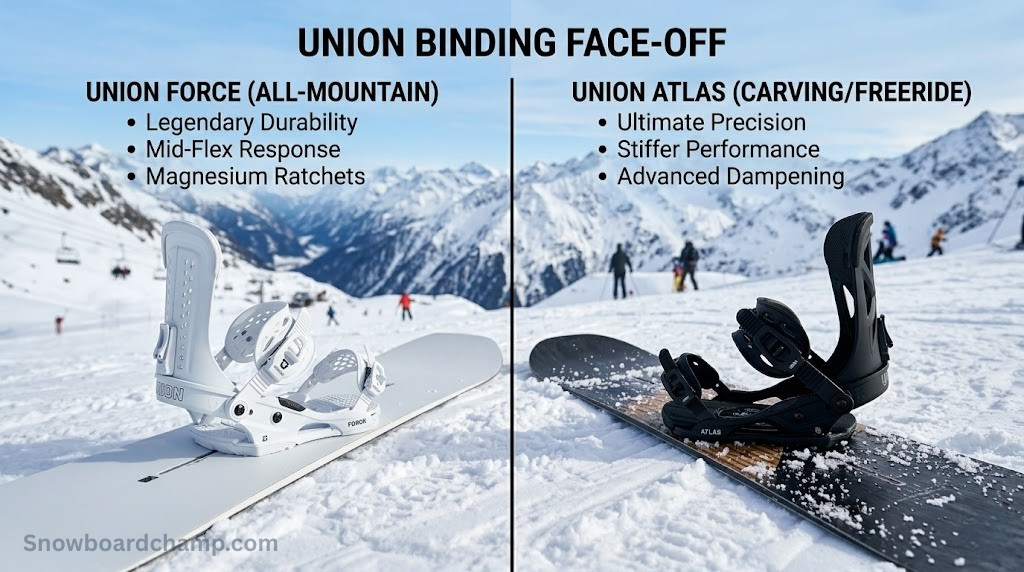

Ask any serious snowboarder to name the most reliable binding brand on the mountain and Union’s name comes up within seconds. They’ve earned that reputation by building bindings that actually last, respond exactly as advertised, and — critically — don’t make you compromise between performance and comfort. The Union Force and Union Atlas sit at the heart of their lineup, and they’re close enough in design philosophy to make the choice genuinely confusing. This guide cuts through that confusion completely. We’re going deep on construction, flex, on-snow feel, riding style fit, price, and every meaningful difference between these two exceptional bindings.
Why Union Bindings Dominate the Conversation
Before getting into the Force vs Atlas debate, it helps to understand why Union has become the benchmark that other brands are measured against. The company has spent years refining a single core philosophy: build bindings that transfer rider input to the board with minimal energy loss. That sounds technical, but the real-world result is simple — Union bindings feel alive underfoot. When you push, the board pushes back. When you flex, the binding flexes with purpose. There’s no mushiness, no dead spots, no delayed response.
Both the Force and the Atlas embody this philosophy. The difference lies in where they sit on the flex spectrum and who they’re optimized for. The Force is Union’s workhorse all-mountain binding — the one that shows up under world-class riders who need to be competent everywhere. The Atlas is Union’s high-performance response binding — the one for riders who spend most of their time carving hard lines or charging variable terrain where precision is non-negotiable.
- Medium flex — the sweet spot for all-mountain
- Lighter build than the Atlas
- Slightly more forgiving response
- Works equally well park-to-powder
- More accessible price point
- Strong seller for intermediate to advanced riders
- Stiffer flex — built for aggressive riding
- Heavier but more robust construction
- Extremely precise, immediate energy transfer
- Best on carving, big-mountain, freeride
- Premium price reflects premium materials
- Favored by advanced to expert freeriders
Neither of these bindings is entry-level. If you’re brand new to snowboarding and still figuring out your riding style, the complete snowboard bindings guide is a better starting point — it’ll help you understand what flex rating actually means for your specific situation before you invest in a high-performance option.
Union also deserves credit for their hardware ecosystem. Both bindings use the Uni-Disc mounting system, which is compatible with 4×4, 2×4, and 3D hole patterns, and works with Burton’s Channel (with the appropriate Channel adapter). The result is that whichever Union binding you choose, it’ll mount cleanly to virtually any board you currently ride or plan to ride.
Instead of asking “which binding is better,” ask “which binding matches what I actually ride?” A Force on an all-mountain twin ridden across groomers, park, and occasional powder is a near-perfect setup. An Atlas on a directional carving board charging hardpack and big mountain terrain is equally perfect. Mismatching the binding to your riding style is where things go wrong.
Union Force Classic Bindings
Medium-flex all-mountain perfection. The Force delivers versatile response from groomed cruisers to park laps to powder days.
🛒 Check Price on AmazonFull Specs Comparison: Force vs Atlas
Numbers tell part of the story. Here’s the raw specification breakdown between the two bindings, covering every spec that actually affects how they ride.
| Specification | Union Force | Union Atlas | Advantage |
|---|---|---|---|
| Flex Rating | Medium (5–6/10) | Stiff (7–8/10) | Depends on riding style |
| Baseplate Material | Aluminium | Aluminium / Die-Cast | Atlas (stiffer platform) |
| Highback Material | Extruded Aluminium | Extruded Aluminium | Tied |
| Ankle Strap | Pro-Buckle Strap | Pro-Buckle Strap | Tied |
| Toe Strap | Toe Cap / Strap Hybrid | Toe Cap / Strap Hybrid | Tied |
| Mounting System | Uni-Disc (4×4, 2×4, 3D) | Uni-Disc (4×4, 2×4, 3D) | Tied — universal |
| Highback Rotation | ✓ Adjustable | ✓ Adjustable | Tied |
| Forward Lean | ✓ Adjustable | ✓ Adjustable | Tied |
| Weight (per binding) | ~900–950g | ~980–1050g | Force (lighter) |
| Dampening System | EVA Cushioning | EVA + Vaporlite | Atlas (more dampening) |
| Compatibility | All brands + Channel | All brands + Channel | Tied |
| Sizing | S / M / L / XL | S / M / L / XL | Tied |
| Price Range | $$$ | $$$$ | Force (better value) |
| Best Terrain | All-mountain, park, powder | Carving, freeride, big mountain | Riding style dependent |
On paper, the two bindings look remarkably similar — and that’s intentional. Union’s philosophy is to build the same fundamental quality into their entire lineup and differentiate primarily through flex characteristics and target riding style, not through dramatic construction differences. Where the Atlas earns its premium price is in the subtle upgrades to its dampening system and baseplate rigidity that compound over aggressive, high-speed riding.
Flex & Feel: The Defining Difference
Flex is the characteristic that will most directly determine whether a binding feels right for your riding style. It affects everything: how the binding initiates turns, how much feedback it transmits from the snow, how it handles landings, and how quickly it responds to subtle weight shifts. Get the flex wrong and even a technically excellent binding feels wrong underfoot.
Union Force Flex Profile
The Force sits at a genuine medium flex — not the soft-medium that some brands label as “medium” to make their product sound more approachable, but a real, substantive medium that actually requires deliberate engagement to flex fully. The highback has meaningful give in the lateral direction, allowing you to move through bumps and absorb landings without the binding fighting you every step. At the same time, it’s stiff enough to transfer heelside and toeside pressure accurately when you’re pushing hard into a turn.
Union Force Flex — Visual Scale
Medium (3.5 / 10 scale) — versatile across terrain
The Force’s flex makes it particularly well-suited to riders who want to play on a variety of terrain in a single day. When you’re hitting features in the park and need the binding to absorb a sketchy landing, the Force gives without punishing you. When you’re dropping into a steep groomer and cranking a hard heelside turn, the same binding snaps back and transfers your pressure to the edge with authority. This adaptability is the Force’s superpower.
Union Atlas Flex Profile
The Atlas is a different conversation entirely. Where the Force invites you to play, the Atlas demands intentional riding. The stiffer flex means that every movement you make is amplified — which is exactly what high-performance riders want. When you initiate a turn, the Atlas responds immediately and with precision. There’s no flex to absorb before the force reaches the board — it goes straight there, and you feel the snow’s texture, the edge’s grip, and the board’s response in real time.
Union Atlas Flex — Visual Scale
Stiff (7 / 10 scale) — precision performance for aggressive riders
The tradeoff is that the Atlas is unforgiving of sloppy technique. A loose upper body or passive stance that the Force might let slide will result in the Atlas amplifying that error directly to the board. In conditions with variable snow — chunky, wind-affected, or icy — the Atlas transfers all that feedback to your legs with less filtration than the Force provides. This is a feature for riders who want to feel everything; it’s a fatigue source for riders who aren’t yet dialing in their technique.
Matching binding flex to board flex matters significantly. A stiffer Atlas pairs beautifully with a medium-to-stiff directional board. Pairing a stiff binding with a very soft board creates a stiff-soft-stiff sandwich that can feel disconnected underfoot. The Force, being medium flex, pairs harmoniously with almost any board from soft park planks to medium all-mountain shapes.
Construction & Build Quality: Inside the Union Difference
Union’s construction quality is one of the reasons they’ve maintained a loyal following of professional and serious recreational riders. Both the Force and Atlas share the same fundamental build philosophy — they just execute it at different stiffness levels with some material upgrades on the Atlas side.
Baseplates: The Foundation of Everything
Both bindings use aluminium baseplates — which immediately puts them ahead of many competitors that rely on nylon or composite baseplates in this price range. An aluminium baseplate transmits energy more efficiently because it doesn’t flex or warp under load. The Atlas’s baseplate is reinforced with a stiffer alloy construction compared to the Force, creating a more rigid platform that’s particularly noticeable during aggressive heelside turns and high-speed edge engagement.
The difference between the two isn’t dramatic to look at — both are precision-machined, properly mounted units. But underfoot, at speed, on hard snow, the Atlas’s additional rigidity is palpable. It feels planted in a way that inspires confidence, especially on icy groomers or technical terrain where a slightly flexing baseplate would create uncertainty.
Highback Design and Material
Both the Force and Atlas feature extruded aluminium highbacks — a significant differentiator from the injection-moulded plastic highbacks used by many bindings in lower price tiers. Extruded aluminium highbacks don’t degrade or soften over time the way plastic does. In cold temperatures, a plastic highback can become unpredictably stiff; an aluminium highback maintains consistent feel across temperature ranges. After five seasons, your Union highbacks will feel the same as they did on day one.
The Atlas highback is slightly taller and features a more aggressive cant angle than the Force, which supports the forward lean position preferred by aggressive carvers and freeriders. The Force’s highback is tuned for a more neutral position that works across a wider range of riding stances and styles. Both feature adjustable forward lean — typically a small tool or tool-free adjustment at the base of the highback — which lets you fine-tune response to your preference.
Strap Systems
Both bindings use Union’s Pro-Buckle ankle strap and toe cap system. This is one of the cleanest strap designs in the industry — the buckle mechanism is strong, the micro-adjust ratchet is smooth even in cold gloves, and the strap geometry holds your boot firmly without creating pressure points that lead to foot pain. If you’ve ever dealt with that specific burning sensation from a binding that’s strapped correctly but still pressing wrong on your instep, Union’s strap geometry is notably better engineered to avoid this.
Speaking of foot pain — chronic foot discomfort on the mountain is often blamed on boots but is frequently a binding issue. How the binding holds your boot affects pressure distribution through your entire foot and ankle. This is why understanding plantar fascia strain in snowboarding often starts with the binding-boot interface, not just boot fit alone.
Dampening: Where the Atlas Steps Up
The Atlas includes an enhanced dampening system that combines EVA cushioning in the baseplate with additional Vaporlite material in strategic zones. Vaporlite is a lightweight, closed-cell material that absorbs high-frequency vibration from rough snow without adding meaningful weight. The practical effect is that the Atlas — despite being stiffer — doesn’t transmit the kind of chattery feedback that can fatigue your legs on a long day of aggressive charging.
The Force uses a simpler EVA cushioning system. It’s effective and perfectly adequate for all-mountain riding, but you’ll notice a slightly rawer feel on variable snow compared to the Atlas’s more sophisticated dampening stack. Whether that raw feel is a positive or negative depends on what you want from your bindings — pure riders who want every piece of snow feedback will appreciate the Force’s more direct connection.
Both bindings benefit from the same maintenance routine: rinse hardware after salt exposure, periodically lubricate buckle pivots with a small amount of silicone spray, and check disc screws for tightness after the first few hard days. Union’s snowboard maintenance basics applies directly to keeping your bindings in top condition season after season.

Union Atlas Bindings
Stiff, precise, built for high-performance carving and freeride terrain. The Atlas is Union’s response-focused powerhouse.
🛒 View Atlas on AmazonOn-Snow Performance: How They Actually Ride
Specifications and construction tell you what’s in a binding. Riding tells you what it actually does. Both of these bindings belong to Union’s upper tier, and both perform extremely well — but they perform extremely well at different things.
Groomers and Hardpack
On groomed hardpack — the terrain where most resort riding happens — both bindings shine but in distinct ways. The Force delivers confident, predictable edge engagement that lets you carve with authority without demanding perfection from every turn. Push your heels hard and the board responds quickly. Release the edge and transition to toeside and the binding follows you without lag. Riding the Force on a perfectly groomed corduroy run is genuinely satisfying — it’s athletic and connected but never exhausting.
The Atlas on hardpack is a different level of intensity. Because the binding transmits your movements to the board with almost zero loss, the edge engagement feels sharper and more committed. When you initiate a turn on the Atlas, the edge bites immediately and the board rails — it doesn’t drift into the turn, it snaps into it. This is exactly what a strong carver wants, and carving with proper edge angulation feels noticeably more rewarding with the Atlas’s immediate response.
Variable Snow and Crud
Crud — the broken-up, chopped snow that develops after a powder day or in the afternoon on popular runs — is where binding construction really matters. Variable snow exerts unpredictable, high-frequency forces on the board and binding, and a binding that can’t manage those forces causes that dreaded chattery, skittery feeling where the board keeps catching and releasing.
The Atlas’s enhanced dampening system specifically targets this scenario. The Vaporlite compound absorbs the micro-vibrations from crud and icy patches without sacrificing the macro-responsiveness that makes the binding feel precise during intentional turn inputs. The Force handles crud well too, but without the same level of refinement — on a particularly broken-up run, you’ll feel more of what the snow is doing under your feet.
Powder Days
In deep powder, the binding’s role changes. You’re not relying on edge-to-edge transitions the same way, and the flex of the binding becomes more about comfort and allowing the board to flex naturally through deep snow rather than about precision edge engagement. Both bindings perform admirably in powder — neither fights the board’s natural flex in a way that becomes problematic.
The Force’s slightly lighter weight and medium flex make it marginally more comfortable during the repeated deep-snow turns that define a powder day. The Atlas’s additional weight is barely noticeable during normal riding but can become a fatigue factor during extended powder sessions with deep turn after deep turn. If you’re planning extended backcountry snowboarding missions, the Force’s weight advantage starts to matter meaningfully.
Park and Freestyle
In the terrain park, the Force is the clear winner between the two. Its medium flex absorbs landings more forgivingly, allows for the exaggerated body movements and pop that freestyle tricks require, and doesn’t punish the slight imprecisions that are inherent to park riding even at a high level. Butters, presses, and technical rail slides all benefit from a binding that moves with you rather than resisting.
The Atlas can be ridden in the park by experienced riders who know how to work with its stiffer response, but it’s not optimized for this context. A stiffer binding on rails means more energy required to match the binding to the feature’s geometry, and on landings from bigger jumps, the Atlas’s reduced dampening compliance can be harder on your knees. If park is a significant part of your riding diet, this is a real functional difference, not just a nuance. Check out the trick progression guide from buttering to airs — the Force is consistently the recommended binding choice for riders working through that progression.
Which Riding Style Does Each Binding Fit?
The most important question in this entire comparison isn’t “which binding is better?” — it’s “which binding is better for me?” Answering that requires honest self-assessment about where you spend your time on the mountain.
- An all-mountain rider who does a bit of everything
- Someone who regularly hits park features
- A powder-focused rider who needs versatility
- An intermediate building toward advanced
- A weight-conscious rider or splitboard tourer
- Riding a twin-tip or all-mountain board
- Someone who values forgiveness alongside response
- A dedicated carver or freeride-focused rider
- Charging hard, variable, or steep terrain frequently
- An advanced or expert-level rider
- Someone who almost never rides the park
- Riding a directional or freeride-specific board
- Prioritizing precision and response over forgiveness
- Comfortable with aggressive technique and stiff setups
The Honest Answer About “Intermediate vs Advanced”
You’ll see both bindings marketed with flexible audience targeting, but the reality is more specific. The Atlas is not an appropriate choice for an intermediate rider who wants to grow into it. A binding that amplifies every movement — including imprecise ones — doesn’t help you learn; it punishes you for the imprecision that’s inherent to developing skill. An intermediate rider on the Atlas will fatigue faster, experience more edge catches, and feel less in control than the same rider on the Force.
The Force, by contrast, grows with the rider. It’s responsive enough to reward improving technique but forgiving enough to smooth over the edges (pun intended) while you’re still developing. This makes it the better choice for the wide range of riders between “early intermediate” and “solidly advanced.”
If you primarily ride aggressive, off-piste terrain — think variable snow, variable pitch, and committing to lines that demand exact body position — the Atlas’s unfiltered feedback is genuinely valuable. You want to know exactly what the snow is doing under your edge because that information changes your next move. The Atlas tells you. The Force tells you a slightly friendlier version of the same story.
For riders exploring their binding options more broadly, the guide to affordable park and all-mountain bindings under $200 gives useful context for how the Force and Atlas compare to the broader market. And if you’re curious how Union’s full lineup stacks up, the dedicated Union Atlas review and Union Strata review give additional comparison context.
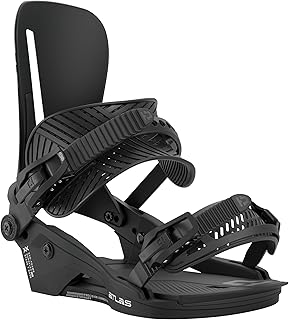
Union Atlas — Multiple Colorways Available
The Atlas comes in several colorway options each season. Current inventory varies — check Amazon for the latest available sizes and colors.

Comfort, Fit, and Boot Compatibility
A binding is only as good as the interface it creates between your boot and your board. You can have the most technically impressive baseplate and highback in the industry, but if the strap system cuts into your instep or the heel cup doesn’t hold your boot securely, none of those engineering details matter. Both Union bindings pass this test — but there are nuances worth understanding.
Sizing and Boot Compatibility
Both the Force and Atlas come in Small, Medium, Large, and X-Large sizing, covering the full spectrum of boot sizes from approximately US men’s size 5 up through size 15+. Unlike some binding brands that use vague sizing, Union’s sizing is fairly precise and well-documented on their website and most retail pages.
An important note on sizing: binding size should match your boot size, not your snowboard length. A binding that’s too large for your boot creates slop in the connection — your foot moves within the binding before the binding moves the board. A binding that’s too small can’t hold your boot firmly and may cause pressure points. Take the time to match sizes correctly before purchase.
Boot compatibility extends beyond size. Both bindings feature a heel cup that works well with most boot profiles, including those from Burton, Vans, K2, and most other major brands. If you’re pairing with Vans boots, the Vans snowboard boot true-to-size guide is a useful reference for getting the binding size right. K2 boot riders should reference the K2 urethane endo boot review for specifics on how that boot’s construction affects binding interaction.
Ankle Strap Comfort on Long Days
This is where both bindings genuinely excel and where Union separates itself from the competition. The Pro-Buckle ankle strap is wide enough to distribute pressure across the entire ankle without creating a hot spot, and the strap geometry follows the natural curve of the ankle rather than pressing straight across the widest point. After a full day of riding — six or seven hours with only brief breaks — the Force and Atlas both feel significantly more comfortable than most other bindings in their price range.
The toe strap deserves mention too. Union’s toe cap design wraps over the toe box of your boot rather than pressing against just the top. This matters because a traditional flat toe strap can cause the front of your boot to lift slightly within the binding over the course of a day — called toe lift — which directly reduces your control of the toeside edge. The toe cap eliminates this by hugging the entire toe box, keeping your boot planted in the binding precisely where it needs to be.
Persistent heel lift is a related issue that plagues many riders and is often misattributed to boot quality. If you’re experiencing heel lift, the complete guide to stopping heel lift in snowboard boots explains the binding and boot adjustments that actually solve it.
Cold Weather Performance
Aluminium highbacks maintain their stiffness across temperature ranges in a way that plastic highbacks don’t. On a particularly cold day, a plastic highback binding can become significantly stiffer than its rated flex — which means a medium-flex binding might ride like a stiff binding in sub-zero temperatures. Union’s aluminium construction means the Force rides like a medium-flex binding and the Atlas rides like a stiff binding regardless of temperature. This consistency is more valuable than it sounds when you’re heading out for a dawn-patrol pow session.
Weight, Durability, and Long-Term Value
Weight and durability sit at opposite ends of a common gear tension: lighter usually means more fragile, heavier usually means more robust. Union manages this tension remarkably well in both the Force and Atlas, but in different ways that align with their target use cases.
Weight Comparison
The Force weighs approximately 900–950 grams per binding, depending on colorway and exact model variant. The Atlas comes in slightly heavier at 980–1050 grams per binding. At roughly 100 grams difference per binding — about 200 grams for a pair — the weight difference is noticeable but not dramatic for most resort riding scenarios.
Where the weight difference becomes meaningful is in extended touring contexts. If you’re using a splitboard for backcountry access, those extra 200 grams on your bindings add to the rotational weight you’re carrying during every skinning stride. Over a 5-hour skinning approach, that adds up. The Force’s lighter build makes it the better choice for backcountry snowboarding setups where every gram counts.
| Use Case | Force Weight Impact | Atlas Weight Impact | Preference |
|---|---|---|---|
| Resort All-Day Riding | Negligible difference | Negligible difference | Tied — neither matters |
| Park Tricks & Butters | Slightly easier rotations | Slightly heavier swing weight | Force advantage |
| Backcountry Touring | Noticeably lighter on climbs | Extra grams felt over hours | Force clearly wins |
| Aggressive Downhill | Adequate weight and feel | Extra mass adds stability | Atlas advantage |
| Air Tricks (Big Jumps) | Lighter for rotation control | Weight felt on big spins | Force slight edge |
Durability Expectations
Union builds both the Force and Atlas to last multiple seasons with normal care — and Union’s warranty and customer service reputation backs this claim up in practice. The aluminium construction of the highbacks and baseplates resists the gradual softening that shortens the lifespan of plastic-heavy bindings. The buckle systems are replaceable, straps are replaceable, and Union sells spare parts for their bindings — which is not universal in this industry and significantly extends effective binding life.
The Atlas, being the stiffer and heavier of the two, holds up particularly well under aggressive riding. Hard landings, rail impacts, and the general abuse that comes with freeride and big-mountain riding are where the Atlas’s more robust construction pays dividends. The Force is no slouch in durability, but riders who consistently push binding hardware to its limits will find the Atlas’s sturdier build reassuring.
For context on snowboard gear investment and how to think about amortization across seasons, the snowboarding gear cost amortization guide provides a useful framework. A $300 binding that lasts six seasons and performs consistently throughout is better value than a $200 binding that softens noticeably by season three.
Shop Both Union Force & Atlas
Both bindings are available on Amazon with Prime shipping. Check current pricing, colorways, and availability — stock on specific sizes sells out quickly mid-season.
🛒 Force on Amazon 🛒 Atlas on AmazonPrice Comparison and Value Analysis
Pricing for both bindings fluctuates by retailer, season timing, and colorway. Generally speaking, the Force comes in at a lower price point than the Atlas, typically in the $200–$280 range for the Force and $260–$350+ for the Atlas. These ranges can shift significantly depending on end-of-season sales and which retailer you’re buying from.
Is the Atlas Worth the Premium?
The answer is honest and specific: yes, if you’re the target rider. If you’re a dedicated carver or freerider who will actually use the Atlas’s additional stiffness and precision on every single run, the premium is justified. The performance gap between the two bindings on aggressive terrain is real, and the Atlas’s enhanced dampening and stiffer highback genuinely improve the experience in ways that matter.
If you’re a versatile all-mountain rider who occasionally charges hard but also hits the park, takes powder days seriously, and rides a variety of board shapes, the Force delivers 90% of the Atlas’s performance at the terrain types where they overlap — and outperforms the Atlas in the park and freestyle contexts where the Atlas’s stiffness becomes a liability. In that scenario, spending up for the Atlas represents a meaningful price increase for a binding that’s actually less suited to your riding.
Timing Your Purchase
The best time to buy snowboarding gear is late season (March through May) when retailers liquidate prior-season inventory, often at 30–50% off. Both the Force and Atlas follow this pattern reliably, which means a Force that costs $260 at peak season can frequently be found for $150–$180 in April. If you’re not urgently mid-season and can plan ahead, the savings are significant.
✅ Force Value Strengths
- Lower entry price for comparable Union quality
- High versatility means fewer specialized gear compromises
- Lighter weight extends useful life in more contexts
- Medium flex suits the widest range of skill levels
- Strong resale value as a well-known model
⚠️ Force Value Limitations
- Less advanced dampening than Atlas
- Medium flex loses out on aggressive hardpack vs Atlas
- Not the optimal choice for dedicated carving setups
✅ Atlas Value Strengths
- Premium construction justifies price for target riders
- Enhanced dampening pays off in variable conditions
- Stiffer highback offers more precision at speed
- Robust build holds up under aggressive riding
- Best-in-class for carve/freeride performance
⚠️ Atlas Value Limitations
- Higher price point requires specific riding style to justify
- Park and freestyle riders pay for features they won’t use
- Heavier weight penalizes touring use cases
- Stiff flex narrows the rider profile it suits
How Force & Atlas Compare to the Broader Market
The Force and Atlas don’t exist in a vacuum. Understanding how they compare to competing bindings — both from within Union’s lineup and from other brands — gives you a fuller picture before committing.
Within Union’s Lineup
Union makes several other bindings that bracket the Force and Atlas. Below the Force sits the Union Legacy — a softer, more park-focused binding that trades some all-mountain versatility for freestyle performance. The Union Legacy review covers it thoroughly for riders interested in the softer end of Union’s range. Above the Atlas sits the Union Contact Pro — the company’s most aggressive binding, typically reserved for professional and expert-level freeriders.
There’s also the Union Strata, which sits between the Legacy and Force in Union’s hierarchy and offers a different take on medium-flex binding construction. The Union Strata review is useful context if you’re considering the full range. For female riders specifically, Union makes the Rosa binding which is worth exploring via the Union Rosa review alongside the best women’s snowboard bindings guide.
Against Burton
The most natural competitor comparison is Union Force vs Burton Cartel and Union Atlas vs Burton Cartel X. The Cartel occupies a similar market position to the Force — medium-flex all-mountain binding with broad appeal. The Force tends to feel slightly more direct and athletic; the Cartel has a slightly plusher, more cushioned feel that some riders prefer. The Burton Cartel X review covers that binding’s construction and performance in detail. The Burton Mission vs Cartel comparison also provides useful context on how Burton’s own internal lineup differs. For riders with Burton boards using the Channel system, both the Force and Atlas are compatible with the Channel adapter — but this is worth confirming before purchase, particularly for setups involving Burton’s Step-On binding system which works differently.
Against Non-Union Competition
In the medium-flex all-mountain space competing with the Force, serious contenders include bindings from Rome, Nitro, Salomon, and NOW. Each has a distinct flex and dampening signature. The Force consistently stands out for its combination of energy transmission and everyday comfort — a hard combination to beat. In the stiff performance space where the Atlas lives, competition from Salomon’s Phantom or Drake’s SuperSport bindings exists but the Atlas’s aluminium construction and Union’s brand consistency give it an edge in the durability-performance equation most riders care about.
| Binding | vs Force | vs Atlas | Key Differentiator |
|---|---|---|---|
| Burton Cartel | Similar flex, plusher feel | Softer, less precise | Burton ecosystem advantage |
| Burton Cartel X | Stiffer, more burly | Comparable performance | Channel system native |
| Union Legacy | Softer, more park-focused | Much softer | Park/freestyle preference |
| Salomon Hologram | Similar versatility | Less stiff | Different strap system feel |
| NOW Pilot | Similar range | Less aggressive | Different binding mechanism |
Final Verdict: Force or Atlas?
After everything — specs, construction, on-snow performance, riding style fit, weight, durability, and price — here’s the honest, direct answer most people actually need.
Choose the Union Force If…
You ride a variety of terrain in a given session or across a season. You hit the park at least occasionally. You value a binding that feels alive but doesn’t demand perfect technique. You tour or care about weight. You’re an intermediate building toward advanced, or an advanced rider who genuinely rides everything. You want the best-value high-performance binding in Union’s range. The Force is the binding that most riders on most mountains should put on their boards. It’s not a compromise — it’s a genuine performance binding that happens to work brilliantly across the widest range of scenarios.
Choose the Union Atlas If…
You are an advanced or expert rider who primarily carves, charges freeride terrain, or rides aggressive all-mountain lines. You rarely or never touch the park. You want maximum information from the snow surface at speed. You ride technical or steep terrain where that extra level of precision actually changes your lines and your safety. You’re willing to pay more and accept less versatility in exchange for the best possible performance in those specific contexts. The Atlas is a specialized tool — extraordinary within its domain, excessive outside it.
The versatile pick for 85% of snowboarders.
- All-mountain enthusiasts
- Park crossover riders
- Intermediate to advanced level
- Weight and cost conscious
- Anyone who rides everything
The precision pick for serious performance riders.
- Dedicated carvers and freeriders
- Big mountain riders
- Advanced to expert level
- Riders prioritizing precision
- Those who want maximum response
If you could only own one of these bindings and rode a variety of terrain, the Force is the right answer for the majority of riders. If you know yourself to be a dedicated carver or freerider who almost never touches the park, the Atlas’s precision is worth every dollar of the premium. The worst outcome is buying the Atlas for its performance reputation when your actual riding calls for the Force’s versatility — or buying the Force and holding back an aggressive riding style that the Atlas was built to support.
Complete Buying Guide: Setting Up Your Union Binding
Choosing the right binding is only part of the equation. Getting it set up correctly — on the right board, with the right stance, and properly tuned — determines whether it performs the way it’s designed to. Here’s everything you need to know to get the most from whichever Union binding you choose.
Board Pairing Recommendations
The Force pairs best with medium-flex twin or directional-twin boards — shapes like a Capita DOA, an all-mountain deck, or a powder-friendly volume-shifted shape. The binding’s medium flex complements these boards’ responsive flex patterns without overwhelming them. Pairing the Force with an ultra-stiff freeride board can feel slightly disconnected because the binding has more flex than the board’s stiffer platform demands.
The Atlas pairs best with medium-to-stiff directional boards designed for carving and all-mountain performance — shapes like a dedicated carver, a freeride directional, or a stiff all-mountain deck. The Atlas’s stiffer highback and baseplate match the energy transmission that these board constructions are designed to handle. Pairing the Atlas with a soft park board creates a setup where the binding is actually stiffer than the board can efficiently use.
Understanding camber vs rocker profiles matters here too. A cambered board paired with the Atlas creates an extremely responsive, edge-focused setup that’s hard to beat on hardpack. A rockered board with the Force creates a forgiving, float-friendly setup ideal for varied mountain conditions.
Stance Setup for Both Bindings
Both the Force and Atlas work with any stance configuration, but they each have a natural default that aligns with their design intent. The Force works well with a duck stance (+15°/−15°) or a mild forward-angled stance (+18°/+6°) — configurations that support versatile, two-direction riding. The Atlas is often set up with a slightly more forward-angled stance (+21°/+9° or similar) that supports the directional carving and freeride riding it excels at.
Stance width is largely a personal preference, but both bindings perform best when the rider can achieve proper knee flex without feeling cramped or overextended. A good starting point is shoulder-width stance, referenced against your natural standing position. If you’re unsure about stance configuration, the snowboard stance setup guide walks through the decision systematically.
Completing Your Gear Setup
Bindings are one component of a system. Your board, bindings, boots, and outerwear all interact. Once you’ve selected your Union binding, the best snowboard boots guide will help you match boot flex to binding flex — a combination that matters significantly for how the setup feels underfoot. For protective gear to complete the kit, the impact shorts guide and MIPS helmet guide are worth reviewing.
For outerwear, a binding’s performance benefits are partially contingent on being warm, dry, and comfortable enough to ride confidently. The snowboard layering guide and best snowboard pants guide cover that side of the equation. A complete setup deserves complete attention — the investment in a quality binding like the Force or Atlas is well spent, but only when everything else in the system supports it.
Ready to Pick Your Union Binding?
Both the Force and Atlas are available now with Prime shipping. Stock moves fast mid-season — especially in popular sizes. Lock in your size before it sells out.
🛒 Union Force — Check Price 🛒 Union Atlas — Check PriceFrequently Asked Questions
The Right Binding Changes Everything
The Union Force and Union Atlas are both genuinely exceptional pieces of hardware built by a company that understands what snowboarders actually need from their gear. The Force wins for its extraordinary versatility and all-mountain competence. The Atlas wins for its precision, response, and carve-focused performance that satisfies the most demanding riders on the mountain.
Neither binding is a compromise — they’re just different tools built for different missions. Pick the one that matches your riding, set it up correctly, and get out there. The mountain doesn’t care which binding you choose; it cares whether you’re riding with confidence and intention. Both of these Union bindings give you exactly that.


