
Directional vs. Twin Snowboard: The Ultimate Shape Guide
You are standing in the snowboard shop, surrounded by graphics and specs. You know you want to ride, but the terminology is daunting. Shape is arguably the most critical factor in how a snowboard performs, yet it is often the most misunderstood. The debate of Directional vs. Twin Snowboard isn’t just about aesthetics; it’s about physics, biomechanics, and how you intend to interact with the mountain.
Choosing the wrong shape is frequently the reason why feet hurt when snowboarding—you are fighting the board’s natural inclination. Whether you are wondering when is the best time to buy snowboarding gear or simply trying to upgrade your setup, understanding shape is step one.
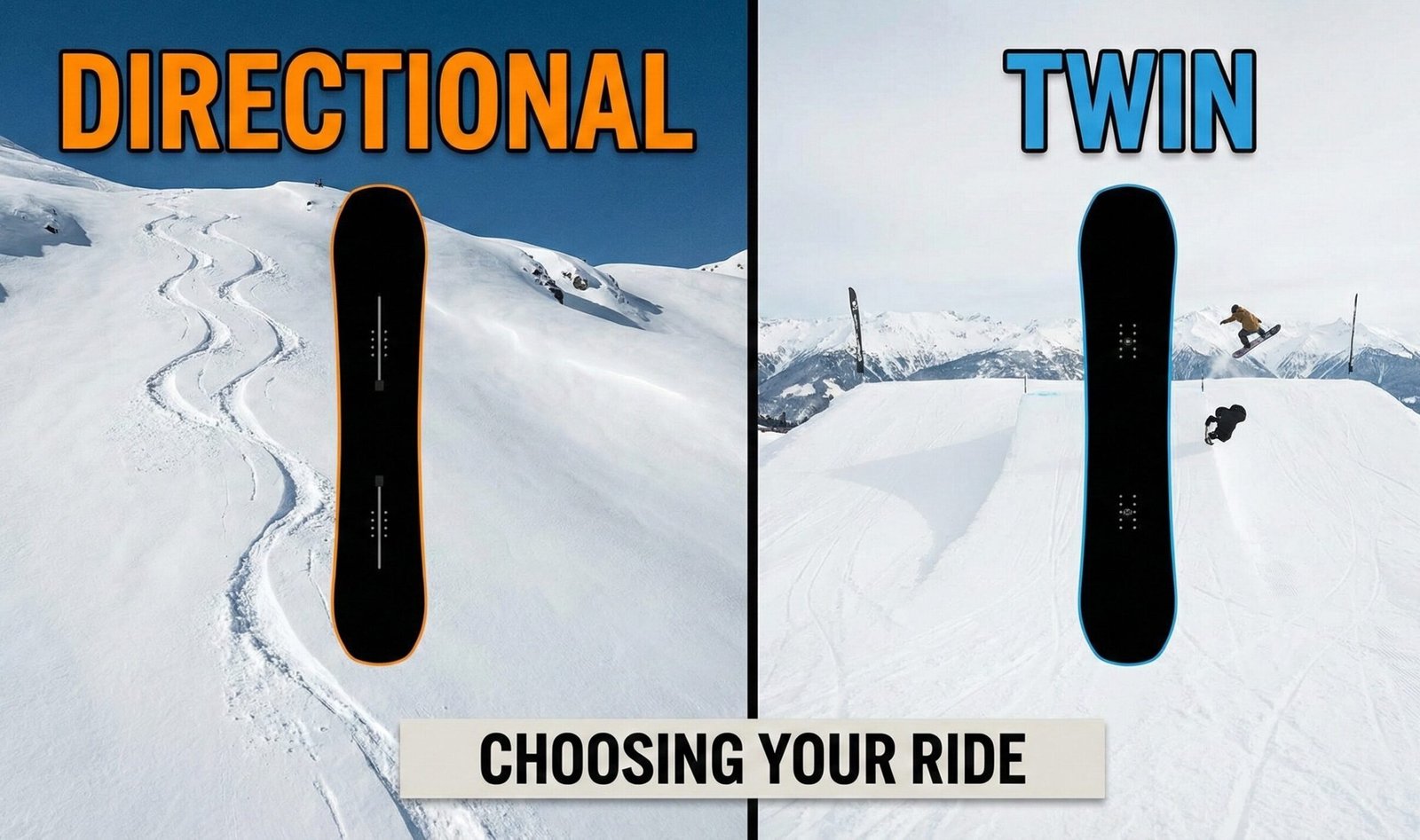
Twin Snowboards are completely symmetrical (nose and tail are identical). They are designed for park riding, freestyle, and riding switch (backwards). Ideally paired with a centered stance.
Directional Snowboards are asymmetrical. They usually feature a longer nose, a stiffer tail, and a setback stance. They are engineered for speed, carving, and floating in powder. Ideally paired with a setback stance.
1. The True Twin: The Freestyle Specialist
A “True Twin” is exactly what it sounds like. If you were to cut the board in half at the exact center, the nose and tail would be mirror images of each other. The flex pattern, the sidecut radius, and the tip/tail length are identical.
Who is it for?
True Twins are the weapon of choice for park rats and freestyle riders. If your idea of why snowboarding is fun involves spinning 360s, sliding rails, or riding switch 50% of the time, you need a twin.
The Pros and Cons
- Pro: Perfect balance in the air (swing weight).
- Pro: Predictable landing switch.
- Con: Less float in deep powder (nose tends to sink).
- Con: Less power exiting turns compared to a stiff directional tail.
When riding a twin, you often want freedom of movement. This pairs well with best baggy snowboard pants for style and mobility. Also, because park riding involves falling, make sure you are equipped with the best impact shorts for snowboarding.
2. The Directional Board: The All-Mountain Charger
Directional boards are designed to go one way: Forward (down the mountain). They are the traditional soul of snowboarding. The nose is usually longer and softer to absorb chatter and float over snow, while the tail is shorter and stiffer to provide power when you drive out of a turn.
The Stance Difference
On a directional board, the binding inserts are “set back” towards the tail. This naturally puts your weight over the back of the board, lifting the nose. This is crucial if you are planning a trip to snowboarding in Colorado or the top European ski resorts where powder and big mountain lines are common.
Who is it for?
This is for the rider who loves the “turn.” If you are learning how to carve on a snowboard, a directional board will make it easier. It initiates turns smoothly and holds an edge firmly at speed.
3. The Hybrid: The Directional Twin
Confusion often arises here. A “Directional Twin” (or Twin-ish) attempts to bridge the gap. It might have a twin shape (symmetrical outline) but a directional flex (stiffer tail). Or, it might be a twin shape with a slightly setback stance.
This is the most versatile category. Boards like the Capita Mercury or Jones Mountain Twin fall into this realm. They allow you to ride switch if you need to, but perform better in powder than a true twin. For a deeper technical dive into these nuances, check out Rome Snowboards’ guide on snowboard shapes explained.
Detailed Comparison Table
| Feature | True Twin | Directional | Directional Twin |
|---|---|---|---|
| Symmetry | 100% Symmetrical | Asymmetrical | Mixed (Shape or Flex) |
| Stance | Centered | Setback (20mm+) | Slight Setback (10-15mm) |
| Best Terrain | Park, Rails, Jumps | Groomers, Powder, Steeps | All-Mountain |
| Switch Riding | Excellent | Difficult | Good |
| Powder Float | Poor to Fair | Excellent | Good |
Top Gear Recommendations by Shape
Knowing how expensive snowboarding is, you want to buy the right board the first time. Here are three distinct options available on Amazon that represent these categories perfectly.
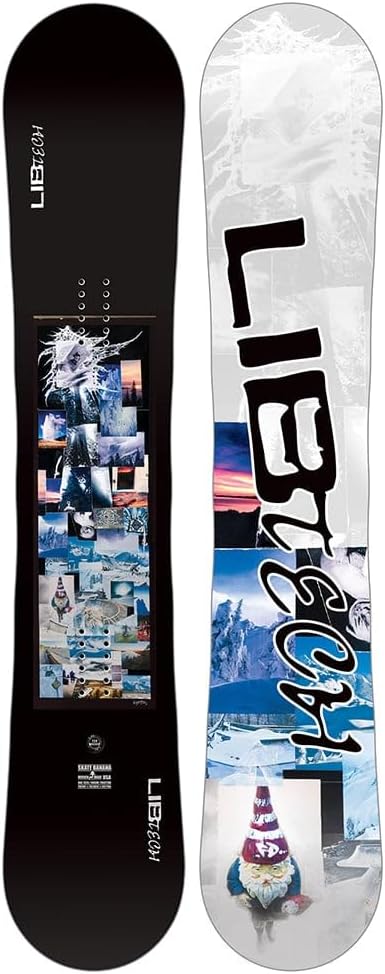
The Twin Icon: Lib Tech Skate Banana
A legendary True Twin with rocker. Perfect for jibbing, buttering, and learning. It spins effortlessly and won’t catch edges.
View on Amazon
The Directional King: Burton Custom
A directional shape with a twin flex feel. It offers power and precision for charging the whole mountain.
View on Amazon
Dakine Low Roller Bag
Protect your investment. Whether twin or directional, keep your edges sharp and your base safe during travel.
View on AmazonDoes Shape Affect Maintenance?
Surprisingly, yes. Directional boards often have different base pressure distributions. Because you ride a directional board primarily in one direction, the “toe-side” and “heel-side” wear might be more pronounced in specific zones.
Regardless of shape, you need to maintain your base. Check if your board has a sintered vs. extruded base, as this dictates how thirsty it is for wax. Read our guide on how often you should wax your snowboard. Also, keep an eye on your edges. A directional carver needs razor-sharp edges, so knowing how to remove rust from snowboard edges is non-negotiable.
Compatibility with Other Gear
Your board shape should influence your boot and binding choice.
- Boots: If you ride a Twin in the park, you might want softer boots for tweaking grabs. If you ride a stiff Directional board, you need stiff boots for energy transfer. Check our best snowboard boots guide and ensure you know how long your laces need to be.
- Bindings: Park riders often choose budget bindings with flexible highbacks, while freeriders need stiff response.
Safety and Shape
Is one shape safer? Not inherently, but using the wrong shape for the terrain can be dangerous. Taking a stiff directional board into an icy pipe when you don’t have the skills is a recipe for disaster. This is why snowboarding is dangerous if you are ill-equipped. Always wear a helmet and proper goggles (consider the Oakley Flight Deck vs Flight Path debate).
Final Verdict: Which One Do You Choose?
Choose a TWIN if:
- You spend >50% of your time in the terrain park.
- You want to master switch riding.
- You view the mountain as a playground for tricks.
- You are looking at DC Snowboards or Gilson Snowboards (known for freestyle decks).
Choose a DIRECTIONAL if:
- You love speed, carving, and powder.
- You rarely ride switch.
- You want to explore backcountry snowboarding.
- You believe snowboarding is better than skiing because of the surf-like flow.
Ultimately, many riders end up with a quiver—one of each. But if you have to choose one, look at where you ride most. Are you at beginner resorts? Go twin or directional twin. Are you chasing storms? Go Directional. Whatever you pick, wax it up using our home waxing guide and get out there.
Understanding Snowboard Shape Fundamentals
Before you can decide between directional and twin, you need to understand what “shape” actually means in snowboard design. Shape is one of several variables that determine how a board rides. The others—profile (camber vs. rocker), flex (stiff vs. soft), and construction (core materials, laminates)—all work in concert with shape. But shape is the starting point because it defines the outline of the board: how the nose and tail are shaped, how wide the waist is, how the sidecut curves, and where the contact points sit relative to your stance.
Think of a snowboard as a lever. Your two feet are the fulcrum points, and the nose and tail extend outward. A symmetrical board distributes that lever equally in both directions. An asymmetrical board tips the balance. Every design decision—from the length of the nose to the width of the waist—changes the physics of how the board interacts with snow, and therefore, how your body must interact with the board.
The Five Key Dimensions of Snowboard Shape
When manufacturers talk about shape, they are referring to five measurable dimensions. Understanding these will help you decode any spec sheet you encounter in a shop or online.
- Total Length: Measured in centimeters from the tip of the nose to the tip of the tail. Common lengths range from 140cm (small women’s/junior) to 165cm+ (large men’s/freeride). Length affects stability at speed, float in powder, and ease of turning. Longer boards are more stable but harder to maneuver. Shorter boards are nimble but less stable at high speed.
- Waist Width: The narrowest point of the board, measured in millimeters. Typical waist widths range from 240mm to 265mm. A wider waist accommodates larger boots (to prevent toe and heel drag) and provides more float in powder. A narrower waist allows for quicker edge-to-edge transitions, which is ideal for carving and park riding.
- Sidecut Radius: The arc of the curve along the board’s edge, measured in meters. A smaller sidecut radius (e.g., 6-7m) creates tighter, quicker turns. A larger sidecut radius (e.g., 8-10m+) produces longer, sweeping turns. Some boards feature progressive or multiple radii sidecuts that blend two or more arcs for a more natural turning feel.
- Nose and Tail Dimensions: The length, width, and shape of the nose and tail. On a true twin, these are identical. On a directional board, the nose is typically 2-5cm longer, sometimes wider, and often has a different shape (more rounded, more pointed, or more tapered).
- Setback: The distance (in millimeters) that the binding inserts are shifted toward the tail relative to the board’s true center. A board with 0mm setback is “centered.” A board with 20-30mm setback puts more of the board’s length in front of you (nose) and less behind you (tail). This is one of the most important dimensions for powder performance.
How Shape Interacts with Profile
Shape and profile are separate concepts, but they are deeply intertwined. Profile refers to the curvature of the board when viewed from the side—the camber, rocker, or flat zones between the contact points. A directional shape can be paired with camber, rocker, or a hybrid profile. Similarly, a twin shape can come in any profile.
However, certain combinations are more common because they serve specific purposes:
- Directional + Camber: The classic carver. Camber underfoot provides edge hold and pop, while the directional shape adds float and stability at speed. Example: the Burton Custom Camber.
- Directional + Rocker (or flat-to-rocker): A more playful directional board. The rocker in the nose enhances float in powder without requiring as much speed. Example: the Burton Instigator Flat-to-Rocker.
- Twin + Camber: A park weapon with serious pop. The camber provides energy for ollies and nollies, while the twin shape ensures balanced switch performance. Example: the Capita DoA.
- Twin + Rocker: A forgiving freestyle board. The rocker makes it less likely to catch edges on rails and boxes, while the twin shape keeps things balanced. Example: the Lib Tech Skate Banana.
Understanding this relationship matters because two boards with identical shapes but different profiles will ride very differently. Always consider shape and profile together when making a decision.
Detailed Guide to Twin Snowboard Shapes
The twin category is more nuanced than many riders realize. Not all twins are created equal. There are actually three distinct sub-categories, and understanding the differences will help you find the right board for your specific freestyle needs.
True Twin vs. Directional Twin vs. Asymmetrical Twin
A True Twin has identical nose and tail dimensions, flex, and sidecut. A Directional Twin may have the same outline but features different flex in the nose versus tail. An Asymmetrical Twin has a different heel-side and toe-side sidecut radius to account for the biomechanical differences between your heel edge and toe edge.
The True Twin: Deep Dive
A true twin is the purest expression of freestyle design. Every measurement—nose length, tail length, nose width, tail width, nose flex, tail flex, sidecut radius—is identical from nose to tail. If you flipped the board end-for-end, it would ride exactly the same.
The primary advantage is swing weight balance. When you spin in the air—whether it’s a 180, 360, 540, or 720—the distribution of mass around your axis of rotation determines how fast and clean the spin is. A true twin distributes mass evenly, making spins more predictable and easier to control. This is why you will see Olympic halfpipe riders and slopestyle competitors overwhelmingly riding true twins or near-true-twin shapes.
However, the symmetry comes with trade-offs. Because the nose and tail are identical, there is no “designed” direction. The board does not inherently prefer one direction over the other. This means there is no engineering advantage for forward riding—no extended nose for float, no stiffer tail for power. You get pure neutrality.
Who Should Ride a True Twin?
- Park and pipe riders: If you spend most of your time hitting features, rails, and jumps, the true twin is your best friend.
- Switch-dominant riders: If you ride switch as much as—or more than—regular, the twin’s symmetry ensures a consistent feel.
- Beginners learning fundamentals: A true twin makes it easier to practice riding switch, which is an essential skill. When the board feels the same in both directions, the learning curve is gentler.
- Slopestyle competitors: In competition, you need maximum consistency and predictability. The true twin delivers that.
True Twin Specifications to Look For
When shopping for a true twin, look for these specifications:
- Setback: 0mm. The binding inserts should be centered on the board’s running length. Some manufacturers measure setback from the board’s total center, others from the effective edge center—check both.
- Nose and tail measurements: The manufacturer should list identical dimensions for nose length, tail length, and tip/tail width.
- Flex rating: The flex should be uniform from tip to tail. Most true twins have a medium flex (5-6 on a 10-point scale) to balance pop with forgiveness.
- Effective edge: The metal edge that contacts the snow during a turn should be the same length on both the nose and tail sides.
The Directional Twin: The Best of Both Worlds
The directional twin is the most popular snowboard shape on the market, and for good reason. It typically features a twin-like outline (similar nose and tail dimensions) but incorporates directional elements such as a setback stance, a stiffer tail, or a different nose shape.
This hybrid approach means you can still ride switch comfortably, but the board has a clear “forward” direction that performs better in powder and at speed. The slight setback (usually 10-15mm) shifts your weight back just enough to help the nose float in soft snow, without making switch riding feel awkward.
Many all-mountain riders prefer directional twins because they cover the widest range of conditions. If you ride groomers in the morning, hit the park at lunch, and explore off-piste in the afternoon, a directional twin handles all three without compromise.
Real-World Examples
- Capita Mercury: A directional twin with a setback stance and medium-stiff flex. Excellent all-mountain performer.
- Jones Mountain Twin: A directional twin with a slight setback and a 3D Contour Base for enhanced float.
- Ride Warpig: A short, wide directional twin that uses volume shifting to maintain float despite its compact length.
- Burton Hideaway: A women’s directional twin with a women-specific flex pattern and slightly setback stance.
The Asymmetrical Twin: Biomechanical Innovation
An asymmetrical (or “asym”) twin is a relatively recent innovation that addresses a fundamental biomechanical reality: your toe-side and heel-side edges are not the same. Your toe edge is controlled by the smaller muscles of your calves and shins, while your heel edge relies on the larger muscles of your hamstrings and glutes. This means you have more natural power on your heel edge and less on your toe edge.
Asymmetrical twins compensate by giving the toe-side edge a deeper sidecut (smaller radius) than the heel-side edge. The toe-side edge turns more sharply because it needs help, while the heel-side edge uses a shallower radius because your body already provides more power. The result is more balanced turning feel, especially at speed and on steep terrain.
This shape is gaining popularity among park riders and all-mountain riders who want more refined turning performance without sacrificing the twin’s switch capability.
Detailed Guide to Directional Snowboard Shapes
Directional snowboards are engineered for one purpose: to perform optimally when ridden forward. Every element—nose length, tail stiffness, setback, sidecut—is optimized for forward-traveling performance. Within the directional category, there are several sub-types that serve different riding styles.
Standard Directional
The standard directional board features a longer, often softer nose and a shorter, stiffer tail. The binding inserts are setback 20-30mm from center. The nose may be slightly wider than the tail, and the overall outline tapers from nose to tail. This shape excels in powder, on groomers, and on steep terrain.
Key Characteristics
- Nose: Longer, softer, often upturned more aggressively to prevent submersion in powder.
- Tail: Shorter, stiffer, designed to snap out of turns and provide stability at speed.
- Setback: 20-30mm or more, shifting the rider’s weight toward the tail to keep the nose elevated.
- Sidecut: Often a single, progressive radius designed for smooth, flowing turns.
- Flex: Typically medium-stiff to stiff (7-9 on a 10-point scale), providing stability and edge hold.
Tapered Directional
A tapered directional board takes the directional concept further by making the nose measurably wider than the tail. This taper (typically 5-15mm) serves a specific purpose: the wider nose floats on top of powder like a surfboard, while the narrower tail sinks slightly, naturally angling the board uphill and keeping you afloat with less effort.
Tapered directional boards are the gold standard for powder riding. The taper works in conjunction with the setback stance and the rockered nose to create an almost effortless float. If you are planning a trip to chase deep powder in British Columbia, Japan, or the Swiss Alps, a tapered directional board will transform your experience.
How Taper Affects Turn Initiation
The taper also changes how the board initiates and completes turns. The wider nose tracks smoothly into a turn, while the narrower tail releases quickly, allowing for quick direction changes in tight trees or variable terrain. This “quick-in, quick-out” turning behavior is highly prized by freeriders who navigate technical terrain.
Volume-Shifted Boards
Volume-shifted boards represent a revolutionary approach to snowboard shape design. Instead of relying on traditional length for float, these boards use increased width and reduced length to achieve the same or greater volume. A volume-shifted board might be 10-15cm shorter than a traditional board of the same width, yet it provides equivalent float and stability.
The benefits of volume shifting include:
- Reduced swing weight: A shorter board spins more easily and is more maneuverable in trees and tight terrain.
- Increased surface area: The wider platform provides excellent float in powder and stability on groomers.
- Easier storage and transport: A shorter board fits in smaller bags and car trunks.
- Lower center of gravity: The wider stance and shorter length create a more stable platform for aggressive riding.
Popular volume-shifted boards include the Ride Warpig, Ride Superpig, Jones Stratos, and K2 Excavator. These boards have carved out a dedicated following among riders who want the float of a powder board with the versatility of an all-mountain deck.
The Powder Board: Extreme Directional
At the far end of the directional spectrum sits the dedicated powder board. These are extreme directional shapes designed for one thing: floating in deep, untracked snow. They feature massive rockered noses (sometimes 30cm+ longer than the tail), aggressive taper, deep setback (30-50mm), and ultra-soft noses paired with stiff tails.
Some powder boards go even further with pointed noses (like surfboards), swallow tails (which reduce tail surface area to help it sink), or 3D base contours (which create channels for water-like flow). These boards are not designed for groomed runs or park riding—they are specialist tools for powder days.
While you would not ride a powder board as your only board (unless you live somewhere that gets consistent deep snow), having one in your quiver for powder days will completely change how you experience the mountain. If you are interested in building a quiver, check out our guide on maintaining multiple boards and keeping them in top condition.
How Snowboard Shape Affects Riding Mechanics
Understanding how shape influences the physics of snowboarding will help you make a more informed choice. Every aspect of shape—length, width, sidecut, setback, taper—changes how the board interacts with snow, and therefore, how your body must respond.
Turn Initiation and Completion
Turn initiation—starting a new turn—is affected by several shape factors. The sidecut radius is the primary determinant: a tighter sidecut (smaller radius) initiates turns more quickly, while a larger sidecut radius requires more speed and commitment to engage.
Setback also plays a role. A setback stance puts more of your weight over the tail, which means you are initiating turns from the tail rather than the center. This creates a distinctive riding feel where the nose naturally rises and falls through the turn. On a centered-twin board, the turn initiation feels more balanced and neutral.
Nose shape affects how the board enters a turn. A longer, softer nose absorbs terrain variations and “drops” into the turn more gradually, while a shorter, stiffer nose (like on a twin) responds more immediately to rider input. This is why directional boards feel smoother in long, drawn-out carves, while twins feel snappier and more responsive in quick, aggressive turns.
Edge Hold and Stability
Waist width directly impacts edge hold. A narrower waist (240-250mm) provides quicker edge-to-edge transitions and feels more “locked in” on hardpack and ice. A wider waist (255-265mm) provides a more stable platform and resists the “squirmy” feeling that can occur at high speed on a narrow board.
Total length affects stability at speed. A longer board has a longer effective edge, which means more metal in contact with the snow during a turn. This creates a more stable, planted feel at high speed. A shorter board has a shorter effective edge, which feels more playful but less stable in aggressive conditions.
Flex pattern interacts with shape to determine overall stability. A stiff directional board with a long effective edge and setback stance will be the most stable at speed. A soft twin with a short effective edge and centered stance will be the least stable but the most playful and forgiving.
Powder Float Mechanics
Powder float is perhaps the most shape-dependent aspect of snowboard performance. Three shape variables determine float:
- Nose length and shape: A longer, wider, rockered nose creates more lift, keeping the board on top of the snow rather than plowing through it. This is why directional powder boards have such exaggerated noses.
- Setback: By shifting your weight toward the tail, you naturally lift the nose. This is the same principle as leaning back in deep snow—you are using your body weight to create a “ramp” effect.
- Taper: A tapered tail sinks into powder, creating a natural uphill angle that keeps the nose elevated. Combined with setback, this creates the effortless float that directional riders prize.
A true twin in powder requires much more rider effort to stay afloat. Without the extended nose, setback, or taper, the twin tends to sink at both ends, forcing the rider to constantly shift weight back and fight the terrain. This is why powder riding on a twin is possible but exhausting.
Switch Riding Dynamics
Switch riding—riding with your opposite foot forward—is one of the most demanding skills in snowboarding, and shape plays a critical role. On a true twin, switch riding feels identical to regular riding. The symmetrical shape means the same edge hold, turn initiation, and pop characteristics apply in both directions.
On a directional board, switch riding is noticeably different. The setback stance means you have more board in front of you and less behind you, which feels “off-balance.” The stiffer tail (which is now in front of you) is less forgiving, and the softer nose (now behind you) provides less power. The result is a less stable, less responsive feel that requires significant adaptation.
Directional twins occupy the middle ground. The slight setback and directional flex create a mild difference between regular and switch, but it is manageable for most riders who want occasional switch capability.
Snowboard Shape for Different Riding Styles
Now that we understand the mechanics, let’s map specific riding styles to the shapes that serve them best. This is where the practical decision-making begins.
Park and Terrain Park
For terrain park riding, the ideal shape is a true twin or a very close directional twin with minimal setback. Park riding demands:
- Balanced swing weight for spinning on jumps and rails.
- Predictable switch performance for landing and riding away switch.
- Even flex for pressing on rails and boxes without the board “fighting back.”
- Medium-soft flex (3-5 on a 10-point scale) for forgiveness on landings and playful feel.
A shorter board relative to your weight also helps in the park. Shorter boards spin faster, are easier to manipulate in the air, and feel more responsive on features. Many park riders choose boards that are 3-5cm shorter than their all-mountain recommendation.
All-Mountain Riding
All-mountain riding covers the widest range of conditions, from groomers to powder to park. The ideal shape for all-mountain is a directional twin with a medium flex. This shape provides:
- Good switch capability for occasional freestyle maneuvers.
- Moderate setback for improved powder float.
- Medium flex (5-7 on a 10-point scale) for a balance of playfulness and stability.
- Standard waist width for edge-to-edge quickness on groomers.
If you are looking for the single most versatile board, an all-mountain directional twin is your answer. It will not excel at any one thing, but it will perform competently in everything. For riders who want one board to do it all, this is the sweet spot.
Freeride and Big Mountain
Freeride riding—charging down steep, ungroomed terrain—demands a directional or tapered directional shape. This style requires:
- Maximum float for deep powder and variable snow.
- Stiff flex (7-9 on a 10-point scale) for stability at high speed and through choppy terrain.
- Aggressive setback (25mm+) for weight distribution.
- Long effective edge for powerful, confident turns on steep slopes.
Freeride boards are typically longer than all-mountain boards, with longer noses and stiffer construction. They are designed for experienced riders who demand performance and are comfortable at high speeds in challenging terrain. If you are planning to ride backcountry terrain, a directional freeride board is essential.
Carving and Groomer Performance
If your idea of a perfect day is laying deep carves on freshly groomed runs, you want a directional camber board with a tight sidecut and stiff flex. Carving demands:
- Camber profile for maximum edge hold and spring.
- Tight sidecut radius (6-7m) for aggressive, locked-in carves.
- Stiff flex to prevent the board from “washing out” during hard carves.
- Narrower waist width for quick edge-to-edge transitions.
- Directional shape to optimize forward-traveling performance.
Carving-specific boards are a growing category. Brands like Korua, Donek, and even mainstream manufacturers like Burton (Custom X) and Jones (Frontier) are producing boards optimized for pure carving performance. If you are learning how to carve on a snowboard, a carving-oriented directional board will accelerate your progress dramatically.
Powder Days
For dedicated powder riding, you want either a tapered directional board or a dedicated powder board. Powder demands:
- Long, rockered nose for maximum float.
- Significant taper (10mm+) to sink the tail.
- Deep setback (30mm+) to keep weight over the tail.
- Softer flex to allow the board to “surf” through variable snow.
- Wider platform for float and stability in deep snow.
Dedicated powder boards are a luxury for most riders—you only need them a handful of times per season. But on those deep days, the difference between a powder board and an all-mountain board is night and day. If you live in an area with regular powder, or if you plan a powder trip, consider adding one to your quiver.
How to Choose the Right Snowboard Shape: A Step-by-Step Guide
Choosing the right shape requires honest self-assessment. Here is a systematic approach to making the right decision.
Step 1: Assess Your Riding Style
Be honest about where you spend (or plan to spend) most of your time on the mountain. Use this breakdown:
- 70%+ Park: True Twin
- 50%+ Powder/Freeride: Directional or Tapered Directional
- Mixed (no dominant terrain): Directional Twin
- Mostly Groomers/Carving: Directional Camber
- Occasional everything: Directional Twin (most versatile)
Step 2: Evaluate Your Skill Level
Your skill level influences which shapes you can effectively use:
- Beginner: A softer directional twin or true twin is ideal. You want forgiveness and predictability. Avoid stiff directional boards—they will punish mistakes.
- Intermediate: You have the skills to ride most shapes. This is where personal preference becomes the primary factor.
- Advanced: You can ride anything. Choose based on your dominant terrain and style preferences.
If you are just starting out, check out our beginner resort recommendations to find the best places to learn.
Step 3: Consider Your Physical Characteristics
Body weight and boot size affect how shape performs for you:
- Weight: Heavier riders need longer, stiffer boards for adequate float and stability. Lighter riders can use shorter, softer boards without sacrificing performance. Always consult the manufacturer’s weight chart.
- Boot size: If you wear size 11+ boots (US men’s), you likely need a wide board (260mm+ waist width) to prevent toe and heel drag. Some manufacturers offer “wide” versions of their standard shapes.
- Height: Height is less important than weight, but taller riders generally prefer longer boards for the proportional feel.
Step 4: Think About Your Local Conditions
The terrain and snow conditions you ride most often should heavily influence your shape choice:
- East Coast (hardpack, ice): A stiffer directional board with a tight sidecut will hold an edge on ice better than a soft twin.
- Rockies (variable, occasional powder): A directional twin offers the versatility for both groomers and powder days.
- Pacific Northwest (heavy snow, trees): A slightly softer directional board with good float handles the variable conditions.
- Lake Effect (deep, consistent powder): A tapered directional or dedicated powder board will maximize your powder days.
- Resort Park (terrain park focus): A true twin is purpose-built for this.
Step 5: Test Before You Commit
If possible, demo boards before buying. Many resorts and shops offer demo fleets that let you try different shapes on the mountain. Even one day of demoing can save you from buying the wrong board. Pay attention to how the board feels in different conditions—groomers, powder, park, and at speed.
Also, talk to experienced riders at your local resort. The snowboard community is generally helpful, and riders who have tried multiple shapes can offer valuable perspective on what works for your local terrain.
Understanding Snowboard Width and Size
Width and size are aspects of shape that directly affect comfort, performance, and safety. Getting these wrong can lead to foot pain, toe drag, and a frustrating riding experience.
Snowboard Width: Regular vs. Wide
Snowboard width is measured at the waist (the narrowest point) and is categorized as:
- Narrow: Under 240mm. Designed for small feet (women’s size 6 and under, men’s size 7 and under).
- Regular: 240-255mm. Suitable for most riders with average boot sizes (women’s 6-9, men’s 7-10).
- Wide: 255-270mm. Designed for riders with larger boots (men’s 11+) to prevent toe and heel drag.
How to Determine Your Ideal Width
The general rule is: when standing centered on the board with your boots on, the tips of your boots should hang over the edge by approximately 1-2 centimeters on each side. If your boots extend more than 2cm over the edge, you will experience drag during turns, which can throw you off balance at speed. If your boots are completely inside the edge, the board is too wide, and you will have difficulty engaging the edge.
Toe and heel drag is not just uncomfortable—it is dangerous. When your boot contacts the snow during a deep carve, it can lift the edge off the snow, causing a sudden loss of grip. At high speed, this can result in a serious crash. Always verify width before purchasing.
Snowboard Length: The Size Chart
Length is typically determined by rider weight (more than height), and it varies by shape category:
| Rider Weight (lbs) | Twin/Park | All-Mountain | Freeride/Powder |
|---|---|---|---|
| 100-120 | 138-146 | 142-150 | 148-156 |
| 120-140 | 144-152 | 148-156 | 154-162 |
| 140-160 | 148-156 | 152-160 | 158-166 |
| 160-180 | 152-160 | 156-164 | 162-170 |
| 180-200 | 156-162 | 160-168 | 166-174 |
| 200+ | 158-165 | 164-172 | 170-178 |
Note: These are general guidelines. Always defer to the specific manufacturer’s weight chart for their boards, as construction and profile differences can shift the ideal range by several centimeters. Volume-shifted boards, for example, are designed to be ridden 10-15cm shorter than these charts suggest.
The “Right Size” Myth
There is no single “right” size for any rider. The ideal length depends on the board’s profile, flex, shape, and your personal preference. Some riders prefer a shorter, more playful board for their weight range. Others prefer a longer, more stable board. The chart above is a starting point—not a rule.
If you are between sizes, consider this: a shorter board will be easier to turn, spin, and maneuver, but less stable at speed. A longer board will be more stable at speed and in choppy conditions, but harder to turn and spin. Your riding style and preference should tip the balance.
Snowboard Shape and Camber Profile: A Complete Guide
We touched on the relationship between shape and profile earlier, but this topic deserves a comprehensive treatment. The camber profile—the curvature of the board when viewed from the side—is the second most important factor after shape in determining how a board rides.
Camber
Camber is the traditional snowboard profile. When unweighted, the center of the board arches upward, and the contact points (near the nose and tail) touch the snow. When you stand on the board, your weight flattens the arch, distributing pressure evenly across the base.
Advantages of camber:
- Maximum edge hold on hardpack and ice.
- Powerful pop for ollies and nollies.
- Stable at high speed.
- Precise, responsive turning.
Disadvantages of camber:
- Less forgiving—catching an edge is more likely and more severe.
- Requires more rider skill and commitment.
- Less float in powder without a directional shape.
Camber works exceptionally well in directional shapes for carving and freeride. It also works in twin shapes for park riders who want maximum pop and edge hold on rails and jumps.
Rocker (Reverse Camber)
Rocker is the opposite of camber. The center of the board touches the snow, and the nose and tail curve upward. This profile is more forgiving and provides natural float in powder.
Advantages of rocker:
- Very forgiving—harder to catch an edge.
- Natural float in powder (the upturned nose acts like a ski tip).
- Playful, surfy feel.
- Easier to initiate turns.
Disadvantages of rocker:
- Less edge hold on hardpack and ice.
- Less pop compared to camber.
- Can feel “washy” or unstable at high speed.
Rocker profiles are popular in twin shapes for beginners and park riders (like the Lib Tech Skate Banana) and in directional shapes for powder boards where float is the priority.
Flat
A flat profile means the base is completely flat between the contact points. This provides a middle ground between camber and rocker—more stable than rocker, more forgiving than camber. Flat profiles are common in entry-level boards and park boards that prioritize a predictable feel.
Hybrid Profiles
Most modern snowboards use some form of hybrid profile that combines camber and rocker zones. The most common hybrid profiles include:
- Camber-Rocker-Camber (CRC): Camber under the feet for edge hold and pop, with rocker between the feet for playfulness and float. Also known as “rocker-camber-rocker” or “banana-tech” (Lib Tech’s term).
- Rocker-Camber-Rocker (RCR): Rocker at the tip and tail for float and forgiveness, with camber underfoot for edge hold and pop. This is the most common all-mountain profile.
- Flat-to-Rocker: Flat underfoot transitioning to rocker at the tip and tail. Provides a stable platform with mild float and forgiveness.
- Camber-Flat-Camber: Camber underfoot for pop and edge hold, with a flat zone between the feet for stability. Good for aggressive all-mountain and freeride.
- S-Camber (or “Early Rise”): Camber through the middle with an early-rising nose. The camber provides edge hold, while the early rise provides float. Popular in directional freeride boards.
The best profile for you depends on your riding style, skill level, and the terrain you ride. There is no universally “best” profile—only the best profile for your specific needs.
Women’s Snowboard Shapes: What Is Different?
Women’s snowboards are not simply smaller versions of men’s boards. They incorporate specific design differences that account for physiological differences between male and female riders.
Key Differences in Women’s Snowboard Design
- Narrower waist width: Women generally have smaller feet, so women’s boards are typically 5-10mm narrower at the waist.
- Shorter length: Women’s boards are generally shorter to account for lower average weight and height.
- Softer flex: Women’s boards typically have a slightly softer flex (1-2 points on a 10-point scale) to account for lower average body weight. A board that is too stiff will feel unresponsive for lighter riders.
- Centered stance: Women’s boards often feature a stance that is centered for a woman’s body proportions, which tend to have a different hip-to-foot ratio than men’s.
- Specific shape adjustments: Some manufacturers design women’s boards with a slightly different sidecut radius and profile to optimize for female biomechanics.
Top Women’s Snowboard Shapes
The same shape categories apply to women’s boards. The ideal shape for a woman depends on the same factors: riding style, skill level, terrain, and personal preference. The main difference is that you should look for a board specifically designed for women’s proportions rather than simply choosing a smaller men’s board.
Brands like Burton (Feelgood, Custom She-Wro), Lib Tech (Roxie, Banana), Jones (Mind Expander, Dream Catcher), and Capita (Birds of a Feather) all make excellent women-specific shapes across the twin, directional, and directional twin categories.
Kids and Junior Snowboard Shapes
Children’s snowboard shape selection follows the same principles as adult selection, with some important modifications. Kids’ boards are designed to be lighter, softer, and shorter to accommodate developing muscles and coordination.
Recommended Shapes for Young Riders
- Beginners (ages 3-7): A soft true twin or directional twin is ideal. The forgiving flex and balanced shape make it easier to learn. Many kids’ boards come with a “learn-to-ride” rocker profile that prevents edge catches.
- Intermediate (ages 8-12): As skills develop, a slightly stiffer directional twin provides more stability and performance. Kids who are starting to ride park should look for true twins.
- Advanced (ages 13+): By this age, the rider’s skill and preference should drive the choice. Teens who ride aggressively can use adult-shaped boards in the appropriate size.
Kids’ Board Sizing
Kids’ board length is determined by weight, not age. A common guideline is that the board should come up to the child’s chin when stood on end. However, this is a rough estimate. Consult the manufacturer’s weight chart for the most accurate sizing.
When in doubt, a slightly shorter board is better for kids. Shorter boards are easier to turn and control, which builds confidence and accelerates learning. A board that is too long can be frustrating and counterproductive.
Advanced Shapes: Splitboards and Specialty Designs
Beyond the standard twin, directional, and directional twin categories, there are specialty shapes designed for specific use cases. These shapes serve niche but passionate communities of riders.
Splitboards
A splitboard is a snowboard that separates into two ski-like halves for uphill travel (skinning) and reconnects for the downhill ride. Splitboards are almost exclusively directional or tapered directional shapes, since backcountry touring prioritizes float and stability over freestyle versatility.
The key shape considerations for splitboards include:
- Taper: More taper provides better downhill float but can feel less balanced on the uphill.
- Nose shape: A wider, rockered nose prevents the tips from diving in deep snow.
- Tail shape: Some splitboards feature a “pin tail” or “swallow tail” to reduce tail surface area and enhance float.
- Insert pattern: Splitboards use a specific binding interface that allows the bindings to convert from touring mode (free heel) to ride mode (locked heel).
If you are interested in backcountry snowboarding, a splitboard is an essential tool. The best splitboards combine directional shape with lightweight construction and reliable touring hardware.
Surf-Inspired Shapes
A growing category of snowboards draws inspiration from surfboard design. These boards feature wide platforms, aggressive taper, deep sidecuts, and exaggerated nose shapes. They are designed to create a “surf on snow” feel that emphasizes flow, carving, and natural terrain navigation.
Brands like Korua, Gentemstick, and Moss lead this category. Their boards often feature unconventional shapes—wider noses, narrower tails, unique sidecut profiles—that prioritize feeling and flow over traditional snowboard performance metrics.
Safety-Innovative Shapes
Several manufacturers have introduced innovative safety features through shape design. These include:
- 3D base contours (Fish3D, 3D convex bases): Bases that are contoured in three dimensions rather than flat. This reduces the likelihood of catching an edge and provides a smoother turning experience.
- Beveled edges: Edges that are slightly angled inward to reduce the chance of catching on terrain features.
- Soft contact points: Nose and tail contact points that are softer or more rounded to reduce the severity of edge catches.
These innovations are particularly beneficial for beginners and intermediate riders who are still developing edge control skills. If you are worried about why snowboarding is dangerous, these shapes provide an added layer of safety.
Snowboard Shape and Turning Mechanics: The Science
To truly understand how shape affects riding, you need to understand the physics of snowboard turning. This is not as complicated as it sounds, and the knowledge will make you a better rider and consumer.
How a Snowboard Turns
A snowboard turns through the interaction of three forces: gravity (pulling you downhill), centrifugal force (pushing you outward in the turn), and edge pressure (the force you apply to the board’s edge through your feet). The sidecut radius determines the natural arc the board follows when tilted on edge.
When you initiate a turn, you shift your weight and tilt the board onto its edge. The curved sidecut contacts the snow, and the board begins to carve along the arc defined by the sidecut radius. The longer the effective edge (more metal in contact with the snow), the more grip and stability you have. This is why shape matters: it determines the length of the effective edge, the radius of the arc, and the distribution of pressure along the edge.
How Shape Influences Turn Shape
- Longer board = longer effective edge = more stability but slower turn initiation.
- Shorter board = shorter effective edge = quicker turn initiation but less stability.
- Tighter sidecut = tighter turns = better for trees and technical terrain.
- Wider sidecut = broader turns = better for open groomers and carving.
- More setback = tail-heavy turn initiation = better for powder and freeride.
- More centered = balanced turn initiation = better for freestyle and switch.
The Role of Taper in Turning
Taper (where the nose is wider than the tail) creates a specific turning behavior. The wider nose enters the turn smoothly, while the narrower tail exits quickly. This “slow in, fast out” behavior is ideal for freeride and powder riding. It allows you to set up a turn carefully and then release the tail quickly for a responsive exit.
Reverse taper (where the tail is wider than the nose) is rare but exists in some specialty shapes. It creates the opposite behavior: “fast in, slow out.” This can be useful for carving-focused boards where you want maximum power at the end of the turn.
How Flex Pattern Interacts with Shape
The flex pattern—how the board bends along its length—works in concert with shape to determine turning behavior. A stiff board with a long effective edge will hold an edge through aggressive carves without “washing out.” A soft board with a short effective edge will be playful and forgiving but less powerful.
Most directional boards feature a progressive flex: softer nose, stiffer tail. This creates a natural turning motion where the soft nose absorbs terrain and initiates the turn, while the stiff tail powers through the exit. Most twins feature a symmetrical flex: equal nose and tail stiffness for balanced performance in both directions.
The History and Evolution of Snowboard Shapes
Snowboard shapes have evolved dramatically since the sport’s inception. Understanding this evolution provides context for the design choices we see today.
The 1960s-1970s: The Origins
The earliest snowboards were crude wooden planks, often handmade by surfers looking to replicate the surfing experience on snow. These boards were long (often 7 feet+), wide, and had no sidecut. They were essentially surfboards for snow, and they rode like it—slow, difficult to turn, and only functional in deep powder.
The 1980s: The Sidecut Revolution
The introduction of sidecut—a curved edge profile—was the single most important innovation in snowboard design. Jake Burton Carpenter and Tom Sims, among others, began manufacturing boards with sidecut that allowed riders to make carved turns rather than simply skidding. This transformed snowboarding from a novelty into a legitimate sport.
The 1990s: Shape Diversification
The 1990s saw the first major diversification of snowboard shapes. As the sport grew and riders began specializing in different disciplines (park, freeride, racing), manufacturers started producing boards optimized for each. Twin shapes emerged for park riders. Directional shapes became more refined for freeride. Racing boards developed narrow, stiff profiles for gates.
The 2000s: The Rocker Revolution
Lib Tech’s introduction of the Skate Banana in 2006 (with its full rocker profile) sparked the “rocker revolution.” Suddenly, the traditional camber-only approach was challenged, and manufacturers rushed to develop hybrid profiles. This era also saw the rise of the directional twin as the dominant all-mountain shape.
The 2010s: Volume Shaping and Innovation
The 2010s introduced volume-shifted boards, tapered directional designs, and 3D base contours. Brands like Ride (Warpig), Jones (Hovercraft), and Korua (Tranny Finder) pushed the boundaries of what a snowboard shape could be. The market became more diverse than ever, with shapes optimized for specific conditions and riding styles.
The 2020s: Refinement and Sustainability
Today’s snowboard shapes represent the culmination of decades of refinement. Manufacturers are focusing on incremental improvements—optimizing flex patterns, refining sidecut profiles, and developing sustainable materials—rather than radical redesigns. The market now offers shapes for virtually every riding style, condition, and skill level.
Common Mistakes When Choosing a Snowboard Shape
Even experienced riders make mistakes when selecting a new board. Here are the most common pitfalls and how to avoid them.
Mistake 1: Choosing Based on Graphics
It sounds obvious, but many riders choose their board primarily based on how it looks. While there is nothing wrong with wanting a board that looks good, graphics have zero impact on performance. Always prioritize shape, profile, flex, and size over aesthetics.
Mistake 2: Buying Too Stiff
Many beginners and intermediates buy stiff boards because they believe “stiffer = better.” In reality, a stiff board requires more skill and strength to ride effectively. If the board is too stiff for your ability, it will feel unresponsive and unforgiving. Start with a medium or medium-soft flex and progress to stiffer boards as your skills develop.
Mistake 3: Ignoring Width
Width is the most overlooked dimension. A board that is too narrow will cause toe and heel drag, which is uncomfortable and dangerous. A board that is too wide will feel sluggish and difficult to edge. Always check the waist width against your boot size.
Mistake 4: Buying Based on Someone Else’s Recommendation
Your riding style, skill level, physical characteristics, and local conditions are unique to you. A board that works perfectly for your friend may be completely wrong for you. Use recommendations as starting points, but always verify against your own needs.
Mistake 5: Not Considering the Full Quiver
If you plan to own multiple boards, think about how the new shape fits with your existing quiver. Buying two directional twins is less useful than having one directional twin and one true twin, because the two shapes cover different terrain. A well-planned quiver provides options for every condition.
Mistake 6: Falling for Marketing Hype
Every year, manufacturers introduce “revolutionary” new shapes and technologies. While some innovations are genuine improvements, many are marketing-driven changes that provide minimal real-world benefit. Focus on proven shapes and profiles, and be skeptical of claims that sound too good to be true.
Mistake 7: Neglecting Maintenance
Even the best shape will perform poorly if the board is not maintained. Regular waxing, edge tuning, and base repair are essential. Learn how often you should wax your snowboard and how to keep your edges in top condition. A well-maintained board will outperform a neglected one regardless of shape.
Brand-Specific Shape Philosophies
Different manufacturers approach shape design with distinct philosophies. Understanding these can help you narrow your search.
Burton
Burton, the largest snowboard manufacturer, offers the widest range of shapes. Their philosophy is to provide a board for every rider and every condition. Their shape categories include True Twin (Process, Custom Flying V), Directional (Custom Camber, Feelgood), and Directional Twin (Custom, Hideaway). Burton’s innovation in binding interface (Channel system) allows micro-adjustable setback, making their boards more shape-flexible than most.
Lib Tech / Gnu
Lib Tech and its sister brand Gnu are known for Magne-Traction (serrated edge technology) and their banana rocker profile. Their shapes tend to be playful and forgiving, with a focus on edge hold through their Magne-Traction technology. Their true twins (Skate Banana, Box Knife) are legendary in the park scene, while their directional boards (T.Rice Pro, Hot Knife) offer aggressive performance with Lib Tech’s signature edge technology.
Jones
Jones Snowboards, founded by freeride legend Jeremy Jones, specializes in directional and tapered directional shapes. Their philosophy centers on mountain performance—float, stability, and control in natural terrain. The Jones Flagship, Hovercraft, and Stratos represent the pinnacle of directional design, while the Jones Mountain Twin and Mercury offer directional twin versatility. Jones also leads in splitboard innovation with the Jones Solution and Frontier.
Ride
Ride is known for its innovative approach to volume shifting and specialty shapes. The Warpig and Pig series (Superpig, Dirt Pig, War pig) popularized the short-wide concept that has since been adopted by many other brands. Ride’s shapes emphasize versatility and playfulness, with their directional twins being particularly popular among all-mountain riders.
Capita
Capita combines innovative shape design with a strong sustainability ethos. Their shapes range from true twins (Defenders of Awesome, Birds of a Feather) to directional (Mega Merc, Navigator) to directional twin (Mercury). Capita’s “Mother Ship” factory in Austria uses 100% clean energy, and their construction techniques (including their “Carbon Fleece” and “Hover Core” technologies) often work in concert with their shape designs.
Korua
Korua is a boutique brand that has carved out a niche in carving and surf-inspired shapes. Their boards feature aggressive sidecuts, directional shapes, and unique outlines that prioritize turning performance over freestyle versatility. The Korua Tranny Finder, Café Racer, and Dart are benchmarks in carving-focused directional design.
Rome
Rome SDS focuses on freestyle-oriented shapes with a punk-rock ethos. Their boards often feature playful shapes, creative graphics, and a focus on rider expression. The Rome Mechanic, Ravine, and Agent series cover the twin-to-directional spectrum with a focus on fun and progression.
For a comprehensive comparison of brand approaches, check out our detailed review of Capita Mercury vs. Jones Mountain Twin.
Snowboard Shape and Snow Conditions
Different snow conditions demand different shape characteristics. Here is a detailed breakdown of how shape should change based on what you are riding.
Hardpack and Ice
Hardpack conditions (packed snow on groomed runs) and ice demand maximum edge hold. The ideal shape features:
- Directional or directional twin for stability at speed.
- Stiff flex to maintain edge contact through the turn.
- Narrower waist width for quick edge transitions.
- Camber profile for maximum edge pressure.
- Tight sidecut for aggressive, locked-in carves.
On ice, every millimeter of edge contact matters. A stiff, cambered directional board with a tight sidecut will outperform a soft, rockered twin in these conditions by a wide margin. If you ride primarily on the East Coast or in regions with hard-packed conditions, prioritize edge hold over playfulness.
Fresh Powder
Powder conditions are the polar opposite of hardpack. Instead of maximizing edge hold, you want to maximize float. The ideal shape features:
- Directional or tapered directional for nose float.
- Longer, rockered nose for lift.
- Significant setback (25mm+) to shift weight rearward.
- Taper to sink the tail.
- Wider platform for float and stability.
- Softer flex to allow the board to conform to variable snow.
Deep powder is where shape makes the most dramatic difference. A dedicated powder board will feel like a different sport compared to a twin on a powder day. If you have the opportunity to ride deep snow, invest in a shape designed for it.
Slush and Spring Conditions
Spring conditions—warm temperatures, heavy snow, and slushy surfaces—present unique challenges. The ideal shape features:
- Directional twin for versatility.
- Medium flex for a balance of playfulness and stability.
- Hybrid profile (rocker-camber-rocker) for forgiveness in variable snow.
- Standard to wide waist for a stable platform in heavy snow.
Slush is heavy and inconsistent, making it harder to maintain edge hold. A board with too much camber and stiffness can feel harsh in these conditions, while a fully rockered board may feel washy. A hybrid profile provides the best balance.
Choppy and Variable Conditions
Off-piste terrain that has been tracked out, wind-affected, or otherwise variable demands:
- Directional shape for stability and float.
- Stiff flex to plow through chop without being deflected.
- Longer length for a more stable platform.
- Camber-dominant profile for edge hold on hard variable snow.
- Moderate setback for weight distribution.
Variable conditions are the ultimate test of a board’s versatility. A stiff, directional, cambered board provides the stability and edge hold needed to navigate unpredictable terrain safely.
Park and Groomed Runs
Park features (jumps, rails, boxes) and groomed runs both favor:
- Twin or directional twin for balanced performance.
- Medium flex for pop and forgiveness.
- Centered or near-centered stance for switch capability.
- Camber or hybrid profile for edge hold and pop.
Park riders often prefer boards 3-5cm shorter than their all-mountain recommendation for increased maneuverability and spin speed.
Understanding Snowboard Sidecut in Depth
Sidecut is one of the most important—and most misunderstood—aspects of snowboard shape. It directly determines how your board turns, how tightly it carves, and how it responds to your input.
What Is Sidecut?
Sidecut is the inward curve along the edge of the snowboard. If you were to extend the curve into a full circle, the radius of that circle is the sidecut radius. A smaller radius (e.g., 6m) means a tighter curve and a tighter turn. A larger radius (e.g., 9m) means a broader curve and a wider, more sweeping turn.
Types of Sidecut
- Single Radius: The most common type. One continuous curve from nose to tail. Predictable and consistent. Found in most mainstream snowboards.
- Progressive (Multi-Radius): Two or more radii blended together. Typically tighter near the tip/tail and larger in the middle. This creates a turn that starts tight and opens up through the arc. Found in many carving-specific boards.
- Wedge (Asymmetrical): Different sidecut radii on the heel and toe edges. The toe edge typically has a tighter radius to compensate for the biomechanical disadvantage of toe-side turns. Found in asymmetrical twin boards.
- 3D (Tri-radial): Three different radii blended together. Provides the most nuanced turning behavior but is more complex to manufacture. Found in premium carving boards.
Sidecut and Turn Radius
The relationship between sidecut radius and actual turn radius is not 1:1. Your actual turn radius depends on:
- Sidecut radius: The primary determinant.
- Board length: Longer boards make wider turns for the same sidecut.
- Edge angle: More aggressive edging creates tighter turns.
- Speed: Higher speed generally produces wider turns.
- Rider input: How actively you steer the board.
A board with a 7m sidecut radius will not make a 7m radius turn in practice. The actual turn will be wider, typically 1.5-2x the sidecut radius depending on the above factors. Understanding this helps you choose the right sidecut for your turning style.
Sidecut and Speed
At low speed, sidecut is the primary factor in turn shape. At high speed, centrifugal force becomes more dominant, and the board’s flex and profile play a larger role. A stiff, cambered board with a moderate sidecut will maintain its turn shape at high speed, while a soft, rockered board may “wash out” (lose edge grip) in the same conditions.
This is why freeride and carving boards often feature stiffer flex and camber profiles: they maintain their sidecut behavior at high speed. Park and playful all-mountain boards often feature softer flex and hybrid profiles: they are more forgiving at low speed but less stable at high speed.
Detailed Guide to Snowboard Construction and Shape
The materials and construction methods used to build a snowboard interact with shape to determine overall performance. Understanding these interactions helps you appreciate why two boards with similar shapes can ride very differently.
Core Materials
The core is the structural heart of the snowboard. It determines the board’s weight, flex, pop, and durability. The most common core materials include:
- Poplar: The most common core wood. Lightweight, affordable, and responsive. Used in the majority of snowboards. Provides a balanced feel.
- Bamboo: Stronger and more flexible than poplar. Provides increased pop and a snappier feel. Often used in premium boards.
- Ash: Heavier than poplar but with superior durability and pop. Often used in high-performance boards where weight is less critical than strength.
- Paulownia: Extremely lightweight. Used in premium boards to reduce swing weight while maintaining strength.
- Honeycomb/Aerospace materials: Ultra-lightweight cores used in top-tier boards. Significantly reduce weight while maintaining or increasing strength.
Laminates and Reinforcements
Wood cores are reinforced with laminates that add stiffness, pop, and durability:
- Fiberglass: The standard reinforcement material. Biaxial fiberglass (fibers woven at 90°) provides a balanced, forgiving flex. Triaxial fiberglass (fibers at 0°/45°/-45°) adds torsional stiffness for better edge hold and response.
- Carbon fiber: Used in premium boards to add significant stiffness and pop without adding weight. Carbon stringers or sheets can dramatically change a board’s character.
- Basalt: A natural fiber alternative to carbon. Provides similar benefits with a slightly different feel—often described as “smoother” or “more organic.”
- Kevlar: Used for vibration damping and impact resistance. Reduces chatter at speed and protects against impact damage.
Base Materials
The base is the part of the board that contacts the snow. Its material affects speed, durability, and maintenance requirements. Learn more about sintered vs. extruded base materials in our detailed comparison.
How Construction Interacts with Shape
A stiff, carbon-reinforced board in a directional shape will feel like a different animal compared to a soft, fiberglass-only board in the same shape. The shape defines the outline and dimensions; the construction determines how the board responds to forces within that outline.
This is why two boards with identical shapes but different constructions can serve completely different riders. A stiff, directional shape can be a race carver for an advanced rider or an unresponsive plow for a beginner, depending on the construction.
Snowboard Shape for Heavy and Light Riders
Body weight is the most important factor in snowboard sizing, and it interacts with shape in specific ways. Heavy and light riders face unique challenges that require shape-specific considerations.
Heavy Riders (200+ lbs)
Heavier riders need boards that can handle increased force without bottoming out or becoming unstable. Considerations include:
- Longer board: A longer board distributes weight over more surface area, preventing the board from sinking too deeply into soft snow and providing more stability at speed.
- Stiffer flex: A stiffer board resists the increased forces generated by a heavier rider. A board that feels medium for a 150lb rider may feel soft and unstable for a 220lb rider.
- Wider waist: A wider platform provides more float and stability. Heavy riders should consider wide versions of standard boards.
- Reinforced construction: Boards with carbon, basalt, or additional fiberglass layers provide the durability needed for heavier riders.
If you are a heavier rider, always check the manufacturer’s weight range for their boards. Many manufacturers now specify weight ranges rather than height ranges, which is much more accurate.
Light Riders (Under 130 lbs)
Lighter riders face the opposite challenge: standard boards may be too stiff, too long, and too heavy. Considerations include:
- Shorter board: A shorter board is easier to turn and control for a lighter rider.
- Softer flex: A lighter rider cannot generate the same forces as a heavier rider, so a softer board will respond better to their input.
- Lighter construction: Premium lightweight cores (paulownia, bamboo) reduce swing weight and make the board easier to maneuver.
- Narrower waist: Lighter riders typically have smaller feet, so a narrower waist provides better edge-to-edge response.
Women-specific boards are often ideal for light riders (both male and female) because they are designed for lighter body weights. However, always prioritize the weight chart over gender-specific marketing.
Snowboard Shape and Rider Height: Does Height Matter?
Height matters less than weight for snowboard sizing, but it still plays a role. A 6’0″ rider at 160lbs has different proportions than a 5’6″ rider at 160lbs, and this affects how the board feels underfoot.
How Height Affects Board Feel
- Taller riders: May prefer slightly longer boards for proportional feel. A taller rider on a short board can feel “over the nose” or unbalanced. Adding 1-2cm to the recommended length can improve comfort.
- Shorter riders: May prefer slightly shorter boards for control. A shorter rider on a long board can feel overwhelmed by the board’s length and may struggle to initiate turns.
However, these are preferences, not rules. Some short riders prefer long boards for the stability, and some tall riders prefer short boards for the playfulness. The most important factor is always weight.
Stance Width and Height
Your height also affects your ideal stance width. A general starting point is to set your stance width at approximately 50-60% of your height in centimeters. For example, a 180cm tall rider might start with a stance width of 54cm. Adjust from there based on personal preference.
Stance width interacts with shape: a wider stance on a narrower board can create toe and heel drag, while a narrow stance on a wide board can feel unstable. Always consider the relationship between your stance width and the board’s waist width.
How to Adjust Your Stance for Different Shapes
Your binding stance—where you position your bindings on the board—directly affects how the board rides. Different shapes benefit from different stance positions.
Centered Stance
A centered stance positions your bindings at the exact center of the board (or the effective edge center). This is the standard for true twin boards and provides balanced performance in both directions. A centered stance is essential for park riding, switch performance, and freestyle.
Setback Stance
A setback stance positions your bindings toward the tail. This is the standard for directional boards and provides several advantages:
- Improved powder float: More weight over the tail lifts the nose.
- Better carving stability: The setback provides a longer effective edge in front of you.
- More powerful tail turns: The stiffer tail is engaged more effectively.
Most directional boards come with a pre-set setback through their insert pattern. You can adjust this within the available insert positions, but you cannot exceed the maximum setback provided by the inserts.
Wide vs. Narrow Stance
Stance width (distance between your feet) also affects performance:
- Wider stance: More stability, better balance, and a more “locked-in” feel. Preferred by park riders and freeriders.
- Narrower stance: Quicker edge-to-edge transitions, more responsive turns. Preferred by carving riders and those who want a surf-like feel.
Forward Angles
Your binding angles (the direction your feet point) interact with shape and stance width:
- Duck stance (e.g., +15/-15): Both feet angled outward. Ideal for park and freestyle. Provides balanced switch performance.
- Forward stance (e.g., +21/+6): Both feet angled forward. Ideal for carving and directional riding. Provides maximum power in forward-traveling turns.
- Mixed stance (e.g., +18/0): A common all-mountain setup. The front foot is angled for turn initiation, while the back foot is flat for stability.
Experiment with different angles to find what feels best for your shape and riding style. There is no single “correct” angle—only what works for you.
Snowboard Shape Myths Debunked
Several persistent myths about snowboard shape continue to mislead riders. Let’s address the most common ones.
Myth 1: “Directional Boards Cannot Ride Switch”
Reality: You can ride switch on any snowboard. The question is how well it performs. A directional board with a setback stance and stiff tail will feel less comfortable and less responsive when ridden switch, but it is entirely possible. Many skilled riders ride switch on directional boards as a challenge or for specific terrain features. The directional shape just means the board is optimized for forward riding, not that it prohibits switch.
Myth 2: “Twin Boards Are Only for Park”
Reality: While twins excel in the park, they are perfectly capable on groomers, in trees, and even in moderate powder. Many riders use twins as their daily driver across all terrain. The disadvantage in powder is real but not prohibitive in shallow or moderate powder. If you rarely encounter deep snow, a twin can work well everywhere.
Myth 3: “Longer Boards Are Always Better for Speed”
Reality: A longer board provides more stability at speed, but it also has more swing weight and is harder to turn. A well-designed shorter board with appropriate construction can be just as fast and more maneuverable. Speed is a function of many factors—base material, wax, rider skill, and snow conditions—not just board length.
Myth 4: “You Need a Powder Board for Powder”
Reality: A dedicated powder board is optimal for deep snow, but a directional board with good setback and a rockered nose can handle most powder conditions adequately. A powder board is a luxury, not a necessity. If you only see powder a few times per season, a good all-mountain directional board will serve you well.
Myth 5: “The Best Board Is the Most Expensive One”
Reality: Price does not guarantee the right shape for you. A $700 board in the wrong shape will perform worse than a $300 board in the right shape. Always prioritize shape, profile, flex, and size over price. The best board is the one that matches your needs, not the one with the highest price tag.
Myth 6: “Men’s and Women’s Boards Are the Same”
Reality: As we discussed in the women’s section, women’s boards incorporate specific design differences that account for physiological differences. Simply buying a smaller men’s board is not the same as buying a women-specific board. If you are a woman, invest in a board designed for your body.
The Quiz: Which Snowboard Shape Is Right for You?
Still unsure? Answer these questions honestly, and the most common answer will point you to your ideal shape.
- Where do you spend most of your time? (A) Terrain park and pipes, (B) Groomed runs and occasional off-piste, (C) Deep powder and backcountry, (D) Everywhere—no dominant terrain.
- How often do you ride switch? (A) Frequently—50% or more of my riding, (B) Sometimes—I enjoy switching it up, (C) Rarely—only when I accidentally land switch, (D) Never—I always ride forward.
- What is your priority? (A) Tricks, spins, and style, (B) Versatility and all-conditions performance, (C) Speed, carving, and powder float, (D) Just getting down the mountain safely.
- How would you rate your skill level? (A) Beginner—I’m still learning the basics, (B) Intermediate—I can ride most terrain confidently, (C) Advanced—I charge hard and seek challenges, (D) Expert—there is nothing I won’t ride.
- What is your local snow like? (A) Park-focused resort with good features, (B) Variable—some powder, some hardpack, (C) Deep and consistent powder, (D) Hardpack and ice (East Coast style).
If you answered mostly (A):
You want a True Twin. Your focus on park and freestyle riding demands the balanced performance and switch capability that only a true twin provides.
If you answered mostly (B):
You want a Directional Twin. The versatility of this shape matches your all-mountain riding style and provides a good balance of performance across terrain types.
If you answered mostly (C):
You want a Directional or Tapered Directional shape. Your focus on speed, carving, and powder demands a board optimized for forward-traveling performance.
If you answered mostly (D):
You are likely a beginner, and a softer Directional Twin or True Twin with a forgiving rocker profile is your best starting point. You can always progress to a more specialized shape as your skills develop.
Snowboard Shape and Terrain Park: A Deep Dive
Since terrain park is one of the most shape-sensitive riding disciplines, let’s explore how different park features interact with board shape.
Jumps
Park jumps demand a board that provides consistent pop, stable landings, and balanced swing weight for spins. The ideal shape is a true twin with camber or hybrid-camber profile. The camber provides the energy for ollies and nollies, while the symmetrical shape ensures that landings feel the same regardless of rotation.
A slightly shorter board (relative to your all-mountain recommendation) is beneficial for jumps because it reduces swing weight, making spins faster and easier to control. Many park riders ride boards 3-5cm shorter than their all-mountain size.
Rails and Boxes
Rail and box riding demands a board that provides forgiving flex, even pressure distribution, and resistance to edge catches. The ideal shape is a true twin with a softer flex and often a rocker or hybrid-rocker profile.
The rocker profile is particularly beneficial for rails because it reduces the likelihood of catching an edge on the feature. A soft, rockered twin is the most forgiving board for rail riding. Some park-specific boards feature base reinforcements (thicker base material or additional layers) to resist the abrasion from sliding on metal and plastic features.
Halfpipe
Halfpipe riding demands a board that provides strong edge hold, powerful pop out of the walls, and stable transitions. The ideal shape is a true twin with camber profile and medium-stiff flex. The camber provides edge hold on the pipe walls and pop for aerial maneuvers.
Many Olympic halfpipe riders use true twins with traditional camber and a medium-stiff flex (6-7 on a 10-point scale). The symmetry ensures consistent performance on both walls, while the camber provides the energy needed for high-amplitude airs.
Urban and Street Riding
Urban snowboarding—riding man-made features in city environments—demands a board that is tough, forgiving, and easy to control. The ideal shape is a true twin with a soft-to-medium flex and durable construction. The short, urban features are usually small, so a shorter board provides maximum maneuverability.
Snowboard Shape and Backcountry Riding
Backcountry snowboarding—riding outside of resort boundaries—has unique shape requirements that differ from in-bounds riding.
The Backcountry Shape Priorities
- Float: Untracked backcountry snow is often deep. You need a shape that provides effortless float to conserve energy for the uphill climb (if splitboarding) and the multiple descents.
- Stability: Backcountry terrain is unpredictable. Variable snow, wind lips, rocks, and trees demand a board that remains stable and predictable in all conditions.
- Efficiency: If you are splitboarding, the downhill shape must work with the uphill hardware. Most splitboard shapes are directional or tapered directional.
- Durability: Backcountry riding exposes the board to rocks, ice, and other hazards. A durable construction with reinforced edges and base is essential.
Splitboard Shape Considerations
Splitboards present unique shape considerations because the board must perform in two modes: uphill (skinning) and downhill (riding). The key factors are:
- Weight: Lighter is better for uphill efficiency. Carbon reinforcement and lightweight cores reduce fatigue on long ascents.
- Touring hardware compatibility: The binding interface must integrate with the splitboard’s touring brackets and climbing wires. Ensure your bindings are compatible with the splitboard’s interface.
- Downhill performance: Despite the uphill compromise, the downhill shape must still provide adequate float, stability, and edge hold. Modern splitboards have largely eliminated the performance gap between splitboards and solid boards.
If you are exploring backcountry snowboarding, invest in a purpose-built splitboard rather than trying to convert a solid board. The engineering differences are significant and affect both uphill and downhill performance.
Snowboard Shape and Carving Technique
Carving—the art of riding the board’s edge through a clean, arcing turn—is one of the most satisfying aspects of snowboarding. Shape plays a critical role in how well you can carve.
The Anatomy of a Carve
A true carve (as opposed to a skidded turn) involves the board tracking along its edge in a clean arc, with the sidecut defining the turn radius. The board’s base remains in contact with the snow throughout the turn, creating a thin line in the snow surface rather than a wide skidded path.
How Shape Enables Carving
- Camber profile: Camber provides maximum edge pressure and spring. It allows the board to flex and rebound through the turn, creating a powerful, dynamic carving feel.
- Tight sidecut radius: A tighter sidecut (6-7m) creates more aggressive, locked-in carves. This is the radius you want for high-speed carving on groomed runs.
- Stiff flex: A stiff board maintains edge contact throughout the turn, preventing the edge from “washing out” under the forces generated by aggressive carving.
- Narrower waist: A narrower waist allows for quicker edge-to-edge transitions, making it easier to initiate the next carve.
- Directional shape: A directional shape with setback puts more weight over the tail, creating a more powerful and controlled turn exit.
Carving-Specific Boards
The carving-specific snowboard category has grown significantly in recent years. Brands like Korua, Donek, and F2 produce boards optimized exclusively for carving performance. These boards typically feature:
- Aggressive sidecut radii (6-7m or tighter)
- Stiff camber profiles
- Narrow waist widths (240-250mm)
- Directional shapes with significant setback
- Hardwood or carbon-reinforced cores
While these boards are not versatile (they perform poorly in powder and park), they deliver an unparalleled carving experience on groomed runs. If you are learning how to carve on a snowboard, a carving-specific board will accelerate your progress more than any other shape.
Carving Technique Tips by Shape
- On a twin: Focus on even weight distribution and clean edge engagement. Use a duck stance for balanced turning in both directions.
- On a directional: Lean into the setback and use the stiffer tail to power through the turn. Initiate with your front foot and finish with the tail.
- On a directional twin: Find the balance between the twin’s playfulness and the directional’s power. Experiment with slight weight shifts to see how the board responds.
Snowboard Shape and Safety: A Comprehensive Guide
Safety should always be a priority in snowboarding, and shape plays a role in how safe you are on the mountain. Understanding the safety implications of shape helps you make better decisions about equipment and terrain.
How Shape Affects Crash Risk
- Stiff directional boards: Higher speed potential + stiffer flex = higher crash severity. These boards reward skill but punish mistakes.
- Soft twin boards: Lower speed potential + forgiving flex = lower crash severity. These boards are more forgiving for beginners and park riders.
- Full camber boards: Maximum edge hold, but less forgiving of edge catches. A caught edge on a cambered board snaps to the snow more aggressively.
- Rocker boards: More forgiving of edge catches, but less edge hold on hard snow. May wash out unexpectedly on ice.
Protective Gear by Shape and Style
Your shape and riding style should influence your protective gear choices:
- Park riders (twin): Prioritize a impact shorts, wrist guards, and a helmet. Park riding involves frequent falls on hard features.
- Freeride riders (directional): Prioritize a helmet with MIPS, back protector, and avalanche safety gear (beacon, probe, shovel) for backcountry riding.
- All-mountain riders (directional twin): A helmet is essential. Consider impact shorts and knee pads for added protection on variable terrain.
- Beginners (any shape): Helmet, wrist guards, and impact shorts are the most important. Beginners fall frequently, and these items prevent the most common injuries.
Terrain-Shape Mismatch Dangers
Using the wrong shape for the terrain is one of the most common safety mistakes. Specific dangerous combinations include:
- Soft twin in steep, icy terrain: The board lacks the edge hold and stability for aggressive terrain. Loss of control is likely.
- Stiff directional in the terrain park: The board is too unforgiving for park riding. Crashes on features are more severe.
- Twin in deep powder: The board sinks, requiring extreme rider effort. Exhaustion leads to loss of control.
- Full camber beginner board: The board catches edges easily, leading to frequent falls. This is why many beginners start with rockered beginner boards.
Always match your shape to the terrain. If you are venturing into new terrain, be aware that your familiar shape may not perform as expected.
Advanced Snowboard Shape Concepts
For riders who want to go beyond the basics, these advanced shape concepts provide deeper insight into board design.
Contact Points and Effective Edge
The contact points are the points where the board’s edge first contacts the snow when the board is tilted on edge. On a cambered board, the contact points are near the tip and tail, where the arch meets the snow. On a rockered board, the contact points are closer to the bindings.
The effective edge is the length of metal edge that contacts the snow during a turn. It runs from one contact point to the other, excluding the sections of the nose and tail that do not contact the snow. A longer effective edge provides more grip and stability; a shorter effective edge provides less grip but more playfulness.
Nose and Tail Kick
The kick refers to the upturn at the nose and tail. A higher kick angle (more upturn) lifts the tip off the snow more aggressively, which helps prevent the nose from diving in powder. A lower kick angle provides a longer effective edge but is more likely to catch on terrain features.
Freestyle boards typically have moderate kick for a balance of float and edge length. Powder boards have aggressive kick for maximum float. Carving boards have minimal kick for maximum effective edge.
Stance Decoupling
Some boards feature stance decoupling, where the binding inserts are not centered on the effective edge. This allows the rider to position their stance differently relative to the board’s running length, fine-tuning the turning behavior. This is particularly useful in directional boards where the rider may want to experiment with more or less setback.
3D Base Contours
Traditional snowboard bases are flat between the edges. 3D base contours add curvature to the base, creating channels or raised areas that affect how the board interacts with snow. Examples include:
- Convex base: A slightly raised center that reduces the contact area with snow, making the board less likely to catch an edge. Used by Jones (3D Contour Base) and Lib Tech (Banana Technology).
- Concave base: A slightly lowered center that increases edge pressure. Rare but used in some racing and carving boards.
- Multi-contour: A combination of convex and concave zones that create specific flow patterns. Used in powder-specific boards to channel snow away from the base.
The Concept of “Pop”
Pop refers to the board’s ability to store and release energy during an ollie or nollie. Pop is influenced by:
- Camber profile: Camber provides more pop because the arch stores more energy when compressed.
- Core materials: Stiffer, more resilient materials (bamboo, carbon) store and release energy more efficiently.
- Shape: A longer effective edge and stiffer flex provide more pop, while a shorter effective edge and softer flex provide less.
- Length: Longer boards can store more energy due to the increased camber arc.
Pop is important for park riding (ollies over features), freeride (ollies over obstacles), and general playfulness. If pop is a priority, look for a camber or hybrid-camber profile with stiff construction.
Volume Shifting Explained: The New Frontier of Snowboard Shape
Volume shifting has been one of the most significant shape innovations in the past decade. Understanding this concept can help you find a board that performs better than traditional length-based sizing would suggest.
What Is Volume Shifting?
Traditional snowboard sizing relies on length: a heavier rider uses a longer board. Volume shifting reimagines this by using width and thickness to provide the same float and stability as a longer board, but in a shorter, more maneuverable package.
A volume-shifted board might be 158cm long but have the same volume (and therefore the same float) as a traditional 165cm board. The extra volume comes from increased width (often 265mm+ at the waist) and sometimes increased thickness.
Benefits of Volume-Shifted Shapes
- Reduced swing weight: A shorter board spins more easily and is more responsive in tight terrain.
- Improved float: The wider platform provides excellent float in powder without needing extra length.
- Better storage: A shorter board fits in smaller vehicles, elevators, and storage spaces.
- Lower center of gravity: The wider stance and shorter length create a more stable platform.
- Playful feel: Shorter boards are inherently more playful and responsive.
Drawbacks of Volume-Shifted Shapes
- Boots drag: On very wide boards, riders with small feet may experience toe and heel drag.
- Different feel: The wider platform and shorter length create a distinctly different feel that some riders may not prefer.
- Less effective edge: Despite the wider platform, the shorter length means a shorter effective edge, which can feel less stable at very high speed.
Notable Volume-Shifted Boards
- Ride Warpig: The board that popularized volume shifting. Short, wide, and incredibly versatile.
- Ride Superpig: A stiffer, more aggressive version of the Warpig for freeride performance.
- Jones Stratos: A directional, 3D-contoured volume-shifted board for all-mountain performance.
- K2 Excavator: A wide, directional, cambered board for carving and all-mountain performance.
- Burton Custom X Wide: While not marketed as “volume-shifted,” the wide version provides similar benefits for larger riders.
The Future of Snowboard Shape
Snowboard shape continues to evolve as manufacturers push the boundaries of design and materials. Several trends are shaping (pun intended) the future of snowboard design.
Modular and Adjustable Shapes
Some manufacturers are experimenting with boards that can be adjusted—changing setback, flex, or even outline—through mechanical systems. While these are still in early stages, the concept of a single board that can be tuned for different conditions and styles is compelling.
3D Printing and Custom Shapes
Advances in manufacturing technology are making it possible to produce boards with complex 3D contours that were previously impossible or prohibitively expensive to create. 3D-printed cores and bases allow for designs optimized for specific conditions or riding styles.
Sustainable Materials
Environmental concerns are driving the adoption of sustainable materials in snowboard construction. Bamboo cores, recycled bases, bio-based resins, and responsibly sourced wood are becoming more common. These materials must perform as well as traditional materials while reducing the environmental impact of manufacturing.
AI-Optimized Shapes
Machine learning is beginning to influence snowboard design. By analyzing data from thousands of riders—weight, skill level, riding style, terrain, conditions—manufacturers can optimize shapes for specific rider profiles. This data-driven approach may eventually lead to more personalized board recommendations.
The Convergence of Disciplines
The boundaries between riding disciplines are blurring. Park riders are venturing into powder. Freeriders are trying park features. All-mountain riders are experimenting with carving. This convergence is driving the development of shapes that perform well across multiple disciplines—the directional twin is the most prominent example, but expect more hybrid shapes in the future.
Frequently Asked Questions About Snowboard Shape
What is the difference between a true twin and a directional twin?
A true twin is 100% symmetrical—nose and tail are identical in length, width, flex, and sidecut. A directional twin may have a similar outline but incorporates directional elements like a setback stance, stiffer tail, or different nose shape. The true twin performs identically in both directions; the directional twin has a preferred forward direction.
Can I ride switch on a directional snowboard?
Yes, you can ride switch on any snowboard. However, a directional board with a setback stance and stiff tail will feel less comfortable and responsive when ridden switch. The board is optimized for forward riding, so switch performance is a compromise. If you ride switch frequently, choose a twin or directional twin.
What is the best snowboard shape for beginners?
For beginners, a softer directional twin or true twin with a rocker or hybrid-rocker profile is ideal. The forgiving flex prevents edge catches, the balanced shape makes it easier to learn both regular and switch, and the rocker profile provides a surfy, playful feel. Avoid stiff, cambered directional boards as a beginner—they are too unforgiving.
How does snowboard width affect performance?
Waist width affects edge-to-edge quickness and boot drag. A narrower waist (240-250mm) provides quicker edge transitions but may cause toe/heel drag for riders with larger boots. A wider waist (255-265mm) provides more float and stability but feels slower edge-to-edge. Choose based on your boot size: size 11+ boots typically need wide boards.
Is a longer snowboard better for speed?
A longer board provides more stability at speed due to the longer effective edge. However, “better for speed” depends on other factors too—base material, wax, flex, profile, and rider skill all matter. A well-maintained shorter board can be faster than a neglected longer one. For most riders, the recommended length for their weight provides adequate stability.
Should I buy a directional or twin snowboard?
It depends on your riding style. If you spend most of your time in the park and ride switch frequently, choose a twin. If you prefer speed, carving, and powder, choose a directional. If you do a bit of everything, choose a directional twin. Consider your terrain, skill level, and local conditions when deciding.
What is a tapered snowboard?
A tapered snowboard has a nose that is wider than the tail. The taper helps the tail sink in powder, naturally lifting the nose for better float. Tapered boards are popular among freeride and powder riders. The taper also affects turning behavior, creating a “slow in, fast out” feel that is prized in technical terrain.
Does snowboard shape affect how often I need to wax?
Shape affects pressure distribution, which can influence wax wear patterns. Directional boards, ridden primarily in one direction, may develop uneven wax wear. However, the type of base (sintered vs. extruded) and riding conditions have a much larger impact on wax frequency. Learn more in our guide on how often you should wax your snowboard.
What is the best snowboard shape for powder?
For dedicated powder riding, a tapered directional board with a long, rockered nose, significant setback (30mm+), and taper is optimal. If you want one board for everything, a directional twin with a hybrid profile provides good (not optimal) powder performance alongside all-mountain versatility.
Can I use the same shape for park and powder?
You can use a directional twin for both, but it will be a compromise in each. A true twin excels in park but struggles in powder. A directional board excels in powder but is less ideal in the park. If you need to choose one board for both, a directional twin is the best compromise. If possible, build a quiver with different shapes for different conditions.
How do I know if I need a wide snowboard?
You likely need a wide board if you wear US men’s size 11+ boots. The general rule: with boots on, your toes and heels should extend 1-2cm over the edge of the board. If they extend more than 2cm, you will experience drag during turns. Check the manufacturer’s boot size recommendations for each board’s waist width.
What is the difference between camber and rocker?
Camber is an arch that touches the snow at the tip and tail, providing edge hold and pop. Rocker (reverse camber) curves upward from the center, providing forgiveness and powder float. Most modern boards use hybrid profiles that combine both. Camber is better for carving and park; rocker is better for powder and beginners.
How does board shape affect my stance?
Shape determines your available stance options through the insert pattern. Twins typically have centered inserts for a balanced stance. Directional boards have setback inserts for rearward weight distribution. Some boards allow micro-adjustable stance width and setback through specific insert patterns or channel systems.
Is a volume-shifted board right for me?
Volume-shifted boards are ideal for riders who want a shorter, more maneuverable board without sacrificing float. They are particularly popular among intermediate and advanced riders who want improved performance in powder and trees. However, riders with smaller feet should be cautious—very wide boards can feel unwieldy and cause boot drag.
How often should I replace my snowboard based on shape?
Snowboard shapes do not change over time—your board’s shape is fixed. However, the board’s performance will degrade as the core loses pop, the edges dull, and the base becomes damaged. Most boards last 100-200+ days of riding. When the board no longer feels responsive or the base damage is beyond repair, it is time to replace it—not because the shape changed, but because the construction has degraded.
What shape snowboard do the pros ride?
Professional riders ride shapes optimized for their discipline. Park and pipe pros typically ride true twins. Freeride pros ride directional or tapered directional boards. All-mountain pros ride directional twins. However, pros often have access to custom shapes and prototypes that are not available to the public. Their choices are influenced by sponsorship obligations as well as performance.
Does snowboard shape matter for beginners?
Absolutely. Shape is one of the most important factors for beginners. A soft, forgiving twin or directional twin with a rocker profile makes learning much easier and more enjoyable. A stiff, cambered directional board can make learning frustrating and even dangerous. Starting with the right shape accelerates your progression and keeps you safer.
How do I maintain a snowboard with a directional shape?
Maintenance is similar regardless of shape, but directional boards may develop uneven wear patterns because they are ridden primarily in one direction. Pay extra attention to the base condition and wax regularly. Keep your edges sharp—especially important for directional carvers. Check our guides on waxing at home and removing rust from edges.
Can I use a directional board in the terrain park?
You can, but it is not optimal. A directional board’s setback stance and stiffer tail make switch landings and rail riding less comfortable. If the park is only a small part of your riding, a directional twin offers a better balance. If park is your primary focus, invest in a true twin.
What is the most versatile snowboard shape?
The directional twin is widely considered the most versatile shape. It provides a balance of freestyle capability, all-mountain performance, and decent powder float. It will not excel in any single discipline but will perform competently across all of them. For riders who want one board to handle everything, the directional twin is the answer.
Does snowboard shape affect speed?
Shape influences speed through its effect on drag, stability, and aerodynamics. Longer boards with narrower waists tend to be faster due to reduced drag. Stiffer boards maintain their shape at high speed, while softer boards flex and create more drag. However, the most significant speed factors are base material, wax, snow conditions, and rider skill.
How Snowboard Shape Affects Your Riding Progression
The shape of your board influences not just how you ride today, but how you progress as a rider over time.
Beginner Progression
Beginners benefit from shapes that are forgiving and predictable. A soft twin or directional twin with a rocker profile allows beginners to focus on fundamental skills (turning, stopping, balance) without fighting the board’s natural tendencies.
The most important skill for beginners is linking turns—the ability to transition smoothly from one edge to the other. A forgiving shape allows this skill to develop naturally. An unforgiving shape (stiff, cambered) creates frustrating edge catches that disrupt the learning process.
Intermediate Progression
Intermediates benefit from shapes that challenge them to improve. As skills develop, a slightly stiffer board with more camber provides the edge hold and pop needed to advance. This is the stage where most riders move from a rocker beginner board to a hybrid or camber all-mountain board.
Intermediate progression also involves developing terrain versatility. A directional twin provides the platform to explore different terrain types while maintaining enough forgiveness to experiment without severe consequences.
Advanced Progression
Advanced riders benefit from specialized shapes that maximize performance in their chosen discipline. This is where the choice between true twin, directional, and directional twin becomes most impactful. An advanced rider who specializes in carving benefits enormously from a carving-specific directional board. An advanced park rider benefits from a true twin optimized for their specific park style.
Advanced progression also involves building a quiver. As skills develop, the limitations of a single “do-everything” board become more apparent. A well-planned quiver provides the right shape for every condition.
The Plateau Effect
Many riders experience a progression plateau where they stop improving despite regular riding. Often, the wrong shape contributes to this plateau. A beginner who progresses to an intermediate level on a rocker twin may find that the board’s lack of edge hold and pop prevents them from advancing further. Switching to a stiffer, more cambered board can break through this plateau by demanding and enabling more advanced technique.
Similarly, an intermediate who rides a heavy, stiff directional board may find that the board’s unforgiving nature discourages experimentation. Switching to a lighter, more playful directional twin can unlock new terrain and skills.
The Complete Snowboard Shape Glossary
Here is a comprehensive glossary of snowboard shape terms to help you decode any spec sheet or marketing material.
| Term | Definition |
|---|---|
| Asymmetrical | A board with different heel-side and toe-side sidecut radii to compensate for biomechanical differences. |
| Camber | An arch profile where the center of the board rises above the snow, providing edge hold and pop. |
| Contact Points | The points on the board’s edge that first contact the snow when tilted on edge. |
| Directional | A board designed primarily for forward riding, with a longer nose, setback stance, and often a stiffer tail. |
| Directional Twin | A hybrid shape with a twin outline but directional flex, stance, or both. |
| Effective Edge | The length of metal edge in contact with snow during a turn, running from contact point to contact point. |
| Flex | How easily the board bends. Rated on a scale (typically 1-10), with softer numbers being more forgiving. |
| Hover Core | A lightweight core technology used by Jones Snowboards for reduced swing weight. |
| Kick | The upturn angle at the nose and tail. Higher kick helps prevent nose-diving in powder. |
| Magne-Traction | Lib Tech’s serrated edge technology that provides multiple contact points for improved edge hold. |
| Profile | The curvature of the board when viewed from the side (camber, rocker, flat, hybrid). |
| Rocker | A reverse-camber profile where the center touches snow and the tips curve upward. |
| Setback | The distance (in mm) that binding inserts are shifted toward the tail from center. |
| Sidecut | The inward curve along the board’s edge that determines turn radius. |
| Sidecut Radius | The radius (in meters) of the arc formed by the sidecut. Smaller = tighter turns. |
| Swallow Tail | A V-shaped cutout in the tail that reduces surface area for better powder float. |
| Swing Weight | The weight distribution of the board relative to its center of rotation. Lower swing weight = easier spins. |
| Taper | The difference in width between nose and tail. Positive taper means the nose is wider. |
| True Twin | A 100% symmetrical board where nose and tail are identical in every dimension. |
| Volume Shifting | Using width and thickness instead of length to provide float and stability in a shorter board. |
| Waist Width | The narrowest point of the board, measured in millimeters. |
Final Thoughts: Making the Right Choice
Choosing between directional and twin snowboard shapes is one of the most important decisions you will make as a rider. The shape of your board affects every aspect of your riding experience—from how you turn, to how you float in powder, to how you perform in the park.
There is no universally “best” shape. The best shape is the one that matches your riding style, skill level, body characteristics, and local conditions. A true twin is perfect for the dedicated park rider. A directional board is essential for the powder hound. A directional twin offers the widest range of versatility for the all-mountain explorer.
Take the time to honestly assess your needs. Use the quiz, the comparison table, and the detailed guides in this article to narrow your choices. Demo boards when possible. Talk to experienced riders. And remember: the wrong shape will fight you, but the right shape will elevate your riding to new heights.
Whether you are learning how to carve on a snowboard, exploring backcountry terrain, or just looking for why snowboarding is fun, the right shape will make every moment on the mountain better. Wax it up, strap in, and ride.
And remember—regardless of which shape you choose, always prioritize safety. Wear a helmet, dress appropriately with the best snowboard jackets and best baggy snowboard pants, and never ride beyond your ability level. The mountain will be there tomorrow—make sure you are too.


