
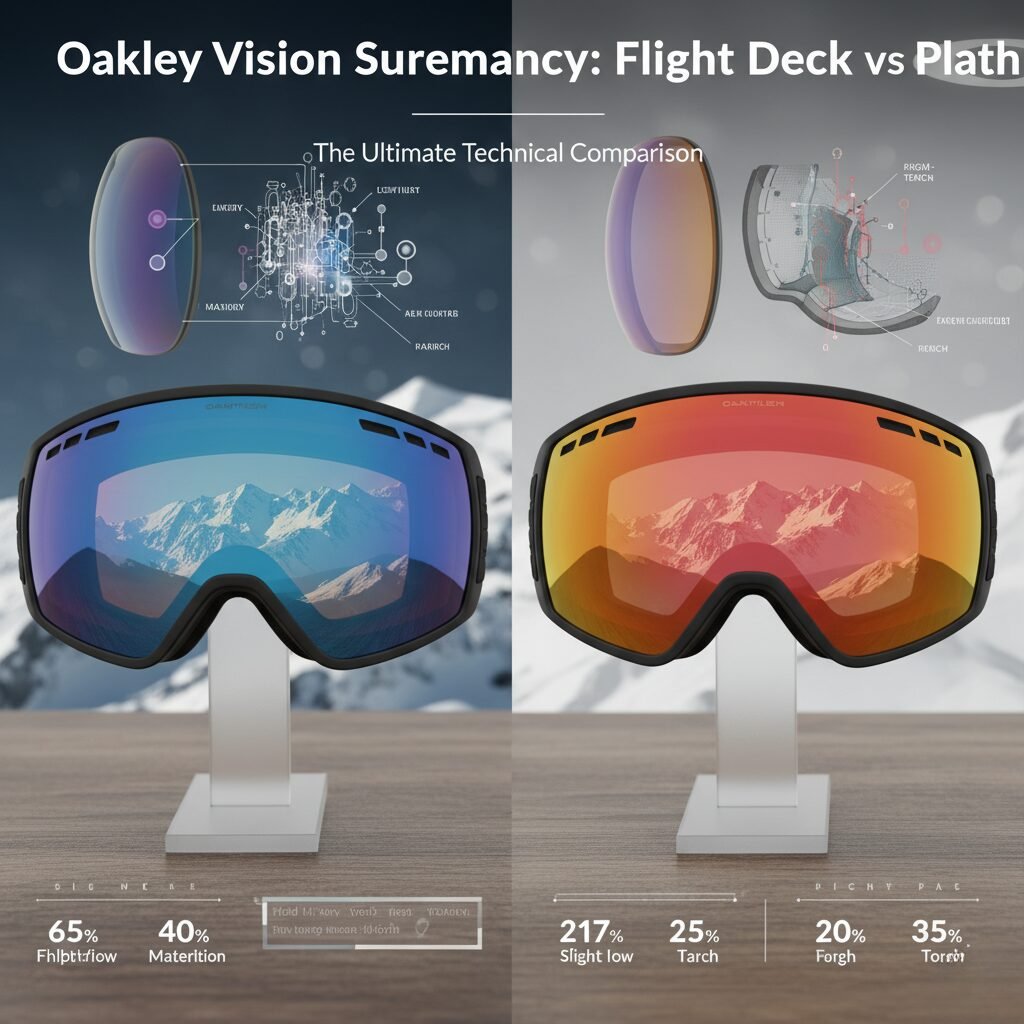
Oakley Vision Supremacy: Flight Deck vs. Flight Path — The Ultimate Technical Comparison
In the highly competitive world of premium snow optics, Oakley has long set the standard. The choice between their two flagship models—the **Flight Deck** and the **Flight Path**—represents a crucial decision for any serious snowboarder. Both goggles are built around the revolutionary Prizm lens technology and offer expansive fields of view, yet their fundamental design geometries dictate dramatically different performance profiles on the mountain.
The **Flight Deck** is the industry veteran, known for its iconic, spherical, fighter-pilot inspired lens shape that maximizes peripheral vision. The **Flight Path** is the newer, aggressive cousin, featuring a toric (slightly flatter) lens that caters to the high-speed, technical demands of the modern freerider. Making the correct choice is paramount to your safety and enjoyment, as visibility is just as crucial as the rigidity of your best snowboard boots or the protection of your helmet (best snowboard helmets).
This comprehensive technical guide dives deep into the Prizm lens profiles, the differences in vertical and peripheral field of view, and the practical pros and cons of the spherical vs. toric design. By the end, you will know exactly which Oakley goggle is right for your style of riding, from the mellow runs at beginner resorts (snowboarding resorts for beginners) to the steep bowls of backcountry snowboarding.
Chapter 1: The Core Difference—Spherical vs. Toric Lens Geometry
The primary distinction between these two high-end goggles lies in the curvature of the lens, which dictates the goggle’s internal volume, field of view (FOV), and resistance to distortion.
1. Oakley Flight Deck: Spherical Lens Profile
The Flight Deck is defined by its **spherical lens**, meaning the lens is curved both horizontally and vertically (like a bubble). This design, inspired by the visors worn by fighter pilots, offers a massive, uninterrupted field of view.
- Unobstructed View: The spherical shape pushes the frame away from the eyes, creating a large internal volume. This means a fantastic peripheral view and less likelihood of distortion near the edges.
- OTG Compatibility: The large internal volume makes the Flight Deck one of the best choices on the market for **Over-the-Glasses (OTG)** use, easily accommodating prescription eyewear.
- Aesthetics: The Flight Deck has a distinctive, large, “bubble” look. While stylish, this larger size can feel bulky on riders with smaller faces.
2. Oakley Flight Path: Toric Lens Profile
The Flight Path is a more modern design, utilizing a **toric lens**. This shape is vertically curved (like a spherical lens) but horizontally flattened (like a cylindrical lens).
- Reduced Bulk/Increased Depth: The flatter profile sits closer to the face, reducing overall bulk while still maintaining a high level of clarity. The design allows the lens to be brought closer to the eye without losing peripheral vision.
- Enhanced Vertical FOV: The Flight Path’s design specifically targets and maximizes the vertical field of view, which is crucial for high-performance riders who are constantly looking down at their board’s edge (especially useful for technical riders mastering their turns, as explored on why snowboarding is fun when you’re in control).
- Style: The Flight Path has a sleek, more aggressive, “race-car” look preferred by riders who favor speed and minimalist aesthetics.
While both lenses offer exceptional clarity, the toric shape of the Flight Path inherently has less distortion than a purely spherical lens near the edges. This is a subtle difference, but the increased clarity at the periphery is vital when you are linking high-speed turns or carving aggressively. Ensure your gear maintenance is up to standard, as a simple scratch ruins even the best lens. Read why wax your snowboard—it’s part of the same essential gear upkeep routine.
Chapter 2: The Prizm Lens Advantage—Same Tech, Different Experience
The core selling point for both is the proprietary **Prizm lens technology**. Prizm enhances contrast and depth perception by selectively boosting certain colors while filtering out others. The question, then, is not which has Prizm (both do), but how the lens shape changes the way Prizm performs.
1. Prizm in the Flight Deck (Maximum Light Capture)
The spherical curvature of the Flight Deck maximizes the amount of light collected, ensuring the Prizm filtering is applied evenly across the widest possible field of vision. This makes the Flight Deck exceptionally reliable in flat light and low-visibility conditions.
- Flat Light Performance: The massive, round lens does a phenomenal job of capturing every available photon, making it one of the most trusted lenses for foggy or overcast days, particularly in destinations like best snowboarding destinations known for variable weather.
- Internal Volume: The large air chamber helps regulate temperature, further supporting the lens’s anti-fog properties.
2. Prizm in the Flight Path (Targeted Definition)
The toric shape of the Flight Path focuses the Prizm clarity slightly closer to the eye, giving the rider a highly defined, almost “hyper-real” image, particularly in the lower portion of the goggle where the rider typically views the snow directly in front of their board.
- Contour Clarity: The flatter profile offers a higher degree of precision for reading snow contours and subtle texture changes, which is critical for demanding techniques or high-speed riding. This precision is a major safety advantage, as identifying ice or hardpack is key to preventing high-speed falls (why snowboarding is dangerous if you can’t read the snow).
- Less Glare Reflection: The flatter angle of the Flight Path can sometimes reduce the internal glare reflection that some riders occasionally experience with large spherical lenses.
Chapter 3: Rider Fit, Helmet Integration, and Comfort
A goggle must integrate seamlessly with your helmet and face. Pressure points, fogging, and the dreaded “gaper gap” are symptoms of a poor fit. When choosing your gear, remember that getting the fit right initially (perhaps when researching when is the best time to buy snowboarding gear) will save you money and headaches later.
1. The Gaper Gap and Helmet Compatibility
Both models are designed to be worn over the helmet (best snowboard helmets), but the shape of the helmet matters.
- Flight Deck Fit: Due to its large, spherical profile, the Flight Deck requires a helmet with a high, wide brim to achieve a gap-free fit. It generally pairs best with larger, rounder helmets and is excellent for riders with larger faces.
- Flight Path Fit: The toric, slightly flatter profile is generally considered more **universally compatible** with a wider range of modern helmet designs. It fits snugly against the brow, eliminating the gap and improving ventilation, a critical feature for riders who spend time in the sidecountry or backcountry snowboarding.
2. OTG (Over-The-Glasses) Performance
For riders who wear prescription glasses, the choice is clear.
- Flight Deck OTG: The massive internal volume of the Flight Deck makes it the superior choice for riders who wear glasses. The depth and width minimize contact between the goggle foam and the glasses frame, vastly reducing the chance of fogging on the prescription lenses.
- Flight Path OTG: While functional, the Flight Path’s slightly smaller internal volume makes it less ideal for large glasses frames and more susceptible to glasses fogging.
3. Comfort and Facial Pressure
All-day comfort relies on the foam interface. Oakley uses a triple-layer facial foam for superior moisture wicking and pressure distribution.
- Flight Deck: The wide strap and large surface area of the frame distribute pressure extremely well, making it comfortable for all-day riding, even in cold temperatures where your gear is constantly contracting.
- Flight Path: The Flight Path uses a slightly thinner profile, making it feel lighter and less noticeable on the face. Any discomfort in your feet or legs (why do my feet hurt when i snowboard) will overshadow goggle pressure, but the Flight Path’s light feel is a bonus for long resort days at places like top European ski resorts.
Chapter 4: On-Mountain Performance and Use Cases (The Final Test)
The ultimate difference lies in which goggle supports your primary riding style.
1. All-Mountain Freeride and Powder (Flight Deck)
The Flight Deck is the classic all-mountain workhorse. The massive peripheral vision is unbeatable for navigating tight trees and bumps, allowing you to quickly scan your surroundings. Its reputation for handling low light makes it reliable when the weather turns unpredictable, a common occurrence when riding best snowboarding destinations with rapidly changing climates. The large frame also works better with accessories like buffs or balaclavas (consider the differences outlined in mittens vs gloves for snowboarding).
2. Technical Carving and Racing (Flight Path)
The Flight Path’s focus on **vertical FOV and precision** makes it the superior tool for technical riding. When carving aggressively or dropping into a steep line, the rider needs to see the snow surface right at the board’s nose with absolute clarity. The flatter toric lens excels here, providing less spherical distortion and a closer, more precise visual reference for reading the snow. This technical edge is why the Flight Path is favored by racers and riders who specialize in aggressive DC snowboards or high-stiffness setups like Yes snowboards.
3. Park and Freestyle (Flight Path)
The Flight Path’s slightly smaller profile makes it a better fit for park riders who want a less bulky feel and a sleeker look, often paired with looser, best baggy snowboard pants. The enhanced vertical vision is also beneficial for spotting landings and managing speed for jumps.
Chapter 5: Goggle Ecosystem and Related Gear Reviews
Both models use the Prizm lens, but their quick-change mechanisms differ. The Flight Deck uses the Ridgelock system (clip-based), while the Flight Path uses the Switchlock system (lever-based). Both are secure, but neither is as fast as a full magnetic system. Your choice depends on your riding style—are you focused on quick-swap efficiency or absolute lens rigidity?

Oakley Flight Deck M Prizm Goggles
The classic spherical design optimized for peripheral view and OTG compatibility. This is the ultimate workhorse goggle, offering reliable performance in all light conditions and featuring the robust Prizm lens technology. It’s the go-to for all-mountain riders and those who prioritize maximum field volume. This mid-sized version pairs well with most common snowboard helmets.
Check Price on Amazon
Oakley Flight Path L Prizm Goggles
The modern, toric design engineered for high-speed technical riding. Its focus on vertical clarity and a sleek profile appeals to performance-minded snowboarders. The enhanced definition of the toric shape makes reading complex terrain, common in snowboarding in Colorado‘s steep areas, highly efficient.
Check Price on Amazon
Dakine Padded Snowboard Bag
Protecting your valuable Prizm lenses (and your entire setup) is essential, especially when traveling to foreign resorts or flying with checked bags. A high-quality, padded bag (best snowboard bags) prevents damage to the goggle lens, the board (like a Gilson board), and your boots.
Check Price on Amazon
Superfeet Carbon Snowboarding Insoles
Goggle comfort is often linked to overall body comfort. If your feet hurt when you snowboard, that tension translates up your body. Upgrading your boot insoles is the best fix for poor arch support or heel movement. This is a common upgrade even for high-end boots like K2 snowboard boots or Vans boots.
Check Price on Amazon
Triple Eight Bumsaver Padded Impact Shorts
When riding at the high speeds necessary for both the Flight Deck and Flight Path, crashes are high-impact events. These shorts (best impact shorts for snowboarding) protect the coccyx and hips, significantly reducing the risk of serious injury when you catch an edge at speed. High-performance riding demands high-performance protection.
Check Price on AmazonChapter 6: Final Verdict and Comprehensive Snowboarding FAQs
Final Verdict: Flight Deck vs. Flight Path
- Choose the Flight Deck if: Your priority is **maximum peripheral visibility**, **comfort for glasses (OTG)**, and a **reliable field of vision in all light conditions**. It’s the perfect goggle for the versatile, all-mountain cruiser.
- Choose the Flight Path if: Your priority is **technical precision**, **vertical field of view**, and **minimalist aesthetics**. It’s the tool for the aggressive rider focused on high-speed carving and steep lines.
Both models use the best lens technology available, ensuring that the sheer joy of riding (why snowboarding is fun) is never compromised by poor vision. Your choice comes down to personal style and visual preference.
| General Snowboarding Topic | Expert Insight |
|---|---|
| Boot Sizing and Comfort | Getting the right size is paramount. If you’re looking at specific brands, always confirm sizing first: are vans snowboard boots true to size? Even minor fit issues can be solved by upgrading your boot laces (how long are snowboard boot laces). |
| Mittens vs. Gloves | The choice between mittens vs gloves for snowboarding is usually a warmth trade-off. Mittens are warmer (why snowboarders wear mittens), while gloves offer dexterity needed for binding adjustments. |
| Learning and Progression | Goggles are essential for learning. If you’re struggling with technique, ask yourself if are snowboard lessons worth it? The investment in instruction often pays off faster than new gear alone. |
| Board Tech and Brands | Whether you ride a DC snowboard (known for park/freestyle) or look into alternative brands, understanding the tech is key. Reading are gilson snowboards good reviews will help you match your board to your style. |
| Cost and Timing | Snowboarding is a big investment (how expensive is snowboarding). To maximize your budget, check our guide on when is the best time to buy snowboarding gear to time major purchases like boots and goggles. |
| The Snowboarding Experience | Whether you believe snowboarding is the best winter sport or simply find it more enjoyable than skiing (why snowboarding is better than skiing), good gear makes the experience safer and more fun. |
| Travel and Destinations | Good goggles are essential for navigating new terrain. Explore guides on best snowboarding destinations or specific regions like Colorado before you plan your trip. |
| Apparel and Style | While carving requires technical apparel, some riders prefer the look of best baggy snowboard pants, which is fine, but safety gear (like helmets and impact shorts) is always paramount. |
| General Resources | For all your gear, tips, and technique questions, your ultimate resource is snowboardbible.com. |
Chapter 7: Complete Prizm Lens Guide — All Variants Explained
Understanding Prizm lens variants is essential before choosing between the Flight Deck and Flight Path. Oakley offers multiple Prizm tints, each optimized for specific light conditions. Selecting the wrong lens tint for your primary riding environment can negate the advantages of even the best goggle frame.
Prizm Snow (Rose Base)
The most popular Prizm variant for snow sports, Prizm Snow features a rose base tint that dramatically enhances contrast on snow. It amplifies reds and blues in the terrain, making bumps, dips, and ice patches stand out against the white background. This lens has a Visible Light Transmission (VLT) of approximately 25%, making it ideal for partly cloudy to overcast days. Riders who primarily ride in Colorado or similar destinations where morning bluebird skies transition to afternoon clouds will find this tint covers 80% of typical riding conditions.
Prizm Low Light (Rose/Amber Base)
Designed specifically for flat light, overcast days, and stormy conditions, Prizm Low Light has a higher VLT of around 46%. This lens lets in significantly more light, making shadows and terrain features visible when everything looks like a white wall. For riders who frequently encounter backcountry snowboarding conditions where weather changes rapidly, having a Prizm Low Light lens as your backup is non-negotiable. The trade-off is increased glare on sunny days, which can cause eye fatigue over long sessions.
Prizm Sapphire (Blue Mirror on Rose Base)
A bright-condition lens with a lower VLT of approximately 13%, Prizm Sapphire is built for sunny, high-altitude days. The blue mirror coating reflects harsh sunlight while the rose base maintains contrast enhancement. This lens excels at resorts with high UV exposure or when riding above the tree line where there is no shade. Many riders pair a Prizm Sapphire lens with their Flight Deck for summer glacier skiing or spring sessions at top European ski resorts.
Prizm Torch (Red Mirror on Rose Base)
Similar to Prizm Sapphire but with a distinctive red/orange mirror coating, Prizm Torch has a VLT of around 16%. It offers slightly more light transmission than Sapphire, making it a better all-around option for mixed sun and cloud days. The red mirror coating also provides an aggressive aesthetic that many riders prefer for park sessions where style matters alongside performance.
Prizm Clear (Clear or Yellow Base)
With a VLT of 72% to 90%, Prizm Clear lenses are designed for night skiing, ultra-low light conditions, or heavily overcast storm days. They offer virtually no tint protection against UV rays and should only be used when light is extremely limited. Having a Prizm Clear lens in your goggle bag is a smart investment for riders who do evening sessions or night park laps when why snowboarding is fun extends into the nighttime hours.
Prizm Rose Gold (Pink Mirror on Rose Base)
A newer addition to the lineup, Prizm Rose Gold sits in the mid-range with a VLT of approximately 20%. It bridges the gap between Prizm Snow and Prizm Sapphire, making it a versatile option for riders who want a single lens that performs reasonably well across the widest range of conditions. The rose gold mirror coating gives it a distinctive look that has become popular with riders who value aesthetics alongside function.
The smartest investment for serious riders is purchasing both the Flight Deck and Flight Path with different Prizm lenses and swapping based on conditions. For example, pair the Flight Deck with Prizm Low Light for storm days and the Flight Path with Prizm Sapphire for bluebird carving sessions. This strategy maximizes the strengths of each frame geometry while ensuring optimal vision regardless of weather. If budget allows only one lens, Prizm Snow offers the best compromise across all conditions for most riders.
Chapter 8: How Prizm Lens Technology Actually Works — The Science Behind It
Prizm is not merely a tint or a filter—it is a scientifically engineered lens technology that Oakley developed over years of research into how the human eye processes color and contrast. Understanding the underlying science helps riders appreciate why Prizm performs differently from standard polarized or mirrored lenses.
The human eye perceives detail through contrast—the difference between light and dark areas. On snow, contrast is naturally low because the surface is overwhelmingly white. Subtle terrain variations—ice patches, bumps, changes in snow texture—are extremely difficult to see with the naked eye or through standard tinted lenses. Prizm technology works by selectively filtering out the wavelengths of light that cause visual “noise” (excess blue light scattered by snow particles) while amplifying the wavelengths that the eye uses to perceive detail (reds, oranges, and yellows).
The result is an image that appears sharper, more vivid, and easier to interpret. This is not a subjective “feeling”—studies on contrast sensitivity have shown that selective color filtering measurably improves a rider’s ability to detect terrain changes at speed. This is particularly important for snowboarders because, unlike skiers, both feet are locked to a single board, making edge-to-edge transitions more dependent on reading the terrain ahead. When you are learning why snowboarding is fun, clear vision accelerates progression.
The Flight Deck’s spherical shape enhances Prizm’s effectiveness by distributing the lens optics over a larger curved surface, meaning the color filtering is applied more uniformly across the entire field of vision. The Flight Path’s toric shape, meanwhile, concentrates the Prizm optics closer to the center of vision, creating what riders describe as a “tunnel clarity” effect where the most critical viewing zone appears extraordinarily sharp.
It is important to note that Prizm is NOT the same as polarization. Polarization filters out reflected glare from flat surfaces (like water or ice), which can be useful but can also reduce depth perception in snow. Prizm does not polarize the image—it enhances it. This distinction is critical: Prizm allows you to see texture and contour in glare conditions without the flat, two-dimensional effect that polarized lenses sometimes produce on snow.
Chapter 9: Ventilation Systems — How Both Goggles Fight Fog
Fogging is the number one enemy of every goggle wearer. When warm, moist air from your face meets the cold inner surface of the lens, condensation forms and obstructs vision. Both the Flight Deck and Flight Path employ sophisticated ventilation systems to combat this, but their approaches differ significantly due to their frame geometries.
Flight Deck Ventilation
The Flight Deck’s large internal volume is its greatest asset in the fight against fog. The bigger the air chamber between your face and the lens, the more time warm air has to dissipate before it can condense. The Flight Deck features vents along the top of the frame that channel air across the inner lens surface, and its spherical shape creates natural convection currents that draw moisture away from the lens. However, the large surface area of the lens means that in extremely cold conditions (below -20°C), the temperature differential between the air inside the goggle and the outer lens surface can be extreme, which occasionally causes fogging during aggressive physical exertion, such as hiking for backcountry snowboarding.
Flight Path Ventilation
The Flight Path takes a different approach. Its smaller internal volume means less air to manage, but also less buffer against rapid temperature changes. To compensate, Oakley designed the Flight Path with more aggressive ventilation channels and a frame geometry that forces air to flow directly across the inner lens before exiting through the top vents. The toric lens shape also reduces the total surface area where condensation can form. In practice, the Flight Path is less prone to fogging during high-output activities like skinning uphill, but its smaller air volume means it can fog more quickly if you stop moving in cold, humid conditions and breathe heavily into the goggle.
Anti-Fog Coating
Both goggles feature an interior anti-fog coating applied to the inner lens surface. This hydrophilic coating absorbs moisture before it can form visible condensation droplets. However, this coating degrades over time with cleaning, UV exposure, and normal wear. Oakley recommends never wiping the inside of the lens—only tap off excess moisture and allow the coating to do its work. Replacing the lens when the anti-fog coating wears out (typically after one to two seasons of regular use) is the most cost-effective way to maintain fog-free performance.
- Never breathe directly into the goggle—pull them down over your chin or nose when stopped
- Ensure helmet vents are aligned with goggle top vents for maximum airflow
- Apply anti-fog spray (non-silicone based) as a supplemental measure
- Never place the goggle lens-down on a warm surface (like a car dashboard)
- Store the goggle in a breathable bag, not a sealed plastic container
- Allow the goggle to fully dry before storing after each use
Chapter 10: Frame Materials, Durability, and Construction Quality
Both the Flight Deck and Flight Path are built using Oakley’s proprietary **O Matter** frame material, a lightweight, flexible nylon compound designed to withstand extreme cold without becoming brittle. Understanding the construction details helps justify the premium price point and sets expectations for long-term durability.
O Matter Frame Technology
O Matter is significantly lighter than traditional polycarbonate frames while maintaining equal or superior impact resistance. At temperatures as low as -40°C, O Matter retains its flexibility, meaning the frame will bend rather than snap if dropped or crushed in a gear bag. This flexibility also contributes to the goggle’s fit—O Matter frames can flex to conform to different face shapes without losing their structural integrity over time. Both the Flight Deck and Flight Path use this material, but the Flight Deck’s larger frame means it has slightly more flex overall, which can be both an advantage (better fit on varied face shapes) and a disadvantage (less rigid feel at very high speeds).
Lens Material — Plutonite
The lens material used in both goggles is **Plutonite**, Oakley’s proprietary polycarbonate compound. Plutonite offers several advantages over standard polycarbonate: it is optically clearer (higher Abbe value, meaning less chromatic aberration), more scratch-resistant, and provides 100% UV protection (UVA, UVB, and UVC) as well as filtering harmful blue light up to 400nm. Plutonite also has a higher impact resistance than standard polycarbonate—it meets ANSI Z87.1 and EN 166 standards for high-velocity impact, meaning the lens can withstand a direct hit from a tree branch or a hard ice chunk without shattering. This is not just a comfort feature—it is a critical safety specification that can prevent serious eye injuries.
Triple-Layer Face Foam
Both goggles use a triple-layer face foam system. The layer closest to the skin is a soft, moisture-wicking fleece that pulls sweat away from the face. The middle layer is a medium-density foam that provides structure and cushioning. The outer layer is a firm, high-density foam that seals the goggle against the face to prevent air leaks. Over time, this foam compresses and loses its resilience. Oakley sells replacement foam kits, and replacing the foam every one to two seasons is the single most impactful upgrade you can make to extend the life of your goggles. This is also the primary reason why used goggles often perform poorly—the foam has compressed and no longer creates an effective seal.
Outrigger Strap System
Both the Flight Deck and Flight Path use an outrigger strap attachment system, where the strap connects to the frame at extended points that sit outside the goggle’s main body. This design serves two purposes: it allows the strap to pull the goggle evenly against the face from a wider angle (reducing pressure points), and it allows the strap to clear the edges of a helmet without interference. The Flight Deck’s outriggers are positioned wider, which provides more stable pressure distribution but can interfere with some helmet designs that have wide brim extensions. The Flight Path’s outriggers are more compact and universally compatible with modern helmet shapes.
Chapter 11: Face Shape Compatibility — Finding the Right Fit
A goggle that fits your face perfectly will perform dramatically better than one that doesn’t, regardless of how advanced its lens technology is. Face shape is one of the most overlooked factors in goggle selection, and it is the primary reason why the same goggle model can receive five-star and one-star reviews from different riders.
Oval Faces
Oval faces are longer than they are wide, with a narrow jawline and forehead. This face shape is highly compatible with both the Flight Deck and Flight Path. The Flight Deck’s large size fills the face area nicely without leaving excessive gaps at the temples, while the Flight Path’s more compact profile provides a snug, race-ready fit. Oval faces rarely experience pressure points with either goggle, making this the most versatile face shape for goggle selection.
Round Faces
Round faces have similar width and length measurements, with full cheeks and a rounded jawline. Round faces often struggle with smaller goggles because the frame digs into the temples. The **Flight Deck is the recommended choice** for round faces because its wider frame and larger internal volume provide clearance for fuller cheekbones. The Flight Path, while functional, can feel tight on round faces, especially during extended sessions when the foam compresses and the frame draws closer to the skin.
Square Faces
Square faces have a wide forehead, wide jawline, and similar width and length. Like round faces, square faces benefit from the Flight Deck’s wider frame. The Flight Deck’s spherical shape complements the angular features of a square face, while the Flight Path’s flat, aggressive profile can sometimes feel disproportionate. However, riders with square faces who prefer the Flight Path’s aesthetics can make it work by choosing the Large (L) size, which provides additional width.
Heart-Shaped Faces
Heart-shaped faces are wider at the forehead and narrow at the chin. This face shape often experiences the “gaper gap” problem because the narrow jawline doesn’t fill the bottom of the goggle frame. The **Flight Path is the better choice** for heart-shaped faces because its toric profile sits closer to the face and its more compact frame conforms better to a narrower lower face. The Flight Deck’s large spherical shape can leave a visible gap at the bottom, which not only looks awkward but also allows cold air to enter and cause fogging.
Oblong/Long Faces
Oblong faces are significantly longer than they are wide. This face shape has unique challenges—the goggle needs to be tall enough to cover the eyes and nose without being so wide that it extends past the temples. The Flight Deck’s large size is generally the better fit because it provides the vertical coverage needed without being excessively wide. The Flight Path’s slightly smaller profile can feel short on oblong faces, potentially leaving a gap at the forehead or the nose bridge.
Put on the goggle with your helmet. Secure the strap. Now shake your head vigorously from side to side and up and down. A properly fitted goggle should stay in place with no movement. If the goggle shifts, slides down, or bounces, the fit is wrong. Also check for pressure points by wearing the goggle for at least 10 minutes—if you feel any pain at the nose bridge, temples, or cheekbones, try a different size or model. This simple test can prevent hours of discomfort on the mountain.
Chapter 12: Oakley Flight Deck vs. Flight Path for Women
While both the Flight Deck and Flight Path are unisex goggles, there are meaningful differences in how they fit women’s faces, and Oakley has specifically addressed the women’s market with tailored sizing and colorways.
Understanding Women’s Fit
Women’s faces, on average, are smaller and narrower than men’s faces, with a shorter distance from the nose bridge to the ears. This means that the standard Flight Deck M (mid-size) may be too wide for many women, while the Flight Deck S (small) can be a perfect fit. The Flight Path’s generally more compact profile means it fits a wider range of women’s face shapes in its standard configuration.
Oakley’s Women’s-Specific Options
Oakley produces the Flight Deck in a dedicated women’s fit (the Flight Deck M with a women’s-specific frame contour and strap design) that adjusts the nose bridge width and foam curvature to better accommodate a narrower face. The Flight Path also comes in women’s-specific colorways, though the frame geometry remains the same as the men’s version. For riders with smaller faces who prefer the Flight Deck’s aesthetic, the women’s version is strongly recommended over the standard model.
Strap Design Differences
The women’s versions of both goggles feature a slightly narrower strap and a silicone grip pattern on the interior that is optimized for hair. Women with long hair often experience strap slippage when the strap sits over a ponytail or braid—the women’s strap design uses a more aggressive grip pattern and a wider contact area to address this. The men’s strap, while functional for all hair types, does not have this specific optimization.
Chapter 13: Prescription Lens Options — Beyond OTG
For riders who wear prescription glasses, the challenge of goggle fit is significant. While OTG (Over-the-Glasses) compatibility is the simplest solution, it is not the only option—and for many riders, it is not the best one. Oakley offers several prescription integration solutions that work with both the Flight Deck and Flight Path.
Oakley Authentic Prescription Lens Program
Oakley’s most premium prescription solution is their Authentic Prescription program, which allows riders to order custom prescription lens inserts that replace the standard Prizm lens entirely. These prescription lenses are manufactured to the rider’s exact prescription using Oakley’s Plutonite material and are available in all Prizm tint variants. The advantage is a single lens that provides both vision correction and Prizm contrast enhancement. The disadvantage is cost—prescription Prizm lenses typically cost $200 to $400 more than standard lenses.
OTG Clip-In Prescription Inserts
For riders who want to keep their existing prescription glasses, Oakley and third-party manufacturers produce clip-in prescription inserts that attach to the goggle frame’s interior. These inserts hold prescription lenses in front of the eyes while the goggle’s standard lens provides weather protection and Prizm enhancement. This is the most affordable prescription solution, but it adds bulk to the goggle interior and can reduce the effective field of view. The Flight Deck’s larger internal volume makes it significantly more compatible with these inserts than the Flight Path.
Custom Prescription Solutions
Some riders choose to use prescription sports goggles from companies like Smith or Bolle, which are designed from the ground up to accommodate prescription lenses. However, these goggles do not offer Prizm technology. The compromise solution that many riders adopt is to use contact lenses on riding days and save the prescription glasses for apres-ski. This eliminates the goggle fit issue entirely and allows full use of either the Flight Deck or Flight Path without any compromises. For riders exploring snowboarding resorts for beginners, investing in daily disposable contact lenses specifically for riding days is a cost-effective strategy.
Chapter 14: Caring for Your Oakley Goggle — Cleaning, Maintenance, and Storage
A $200+ goggle deserves proper care. The single biggest mistake riders make is cleaning the lens incorrectly, which scratches the exterior coating and destroys the interior anti-fog coating. Proper maintenance can extend the life of your Flight Deck or Flight Path by two to three seasons.
Cleaning the Exterior Lens
The exterior lens has a hardened coating designed to resist scratches, but it is not scratch-proof. Always clean the exterior with a microfiber cloth and Oakley’s recommended lens cleaning solution (or plain warm water). Never use paper towels, shirt fabric, or any abrasive material—these will create micro-scratches that accumulate over time and reduce optical clarity. If the exterior is caked with snow or ice, gently rinse it with lukewarm water (never hot water, which can delaminate the lens coatings) and pat dry with the microfiber cloth.
Cleaning the Interior Lens
The interior lens has an anti-fog coating that is extremely sensitive to physical contact. **Never wipe, rub, or touch the interior lens surface.** If moisture condenses on the interior, simply tap the goggle gently against your palm to dislodge droplets and allow the air circulation to dry it naturally. If you must clean the interior (for example, after a heavy sweat session), use a very soft microfiber cloth with zero pressure—literally let the cloth’s weight do the work. Any pressure will strip the anti-fog coating.
Storage Best Practices
Always store your goggle in the included microfiber bag (which doubles as a cleaning cloth). Never store the goggle lens-down on a flat surface—the weight of the frame can deform the foam and cause the lens to contact the surface. Never store the goggle in a car’s glove box or on the dashboard, as extreme temperature fluctuations accelerate foam degradation and can delaminate lens coatings. For travel, use a dedicated hard case—many riders damage their goggles in transit by tossing them loose into a best snowboard bags where other gear can crush them.
Replacing Wear Items
The three components of any goggle that degrade with use are the face foam, the lens coatings, and the strap elasticity. Face foam should be replaced when it no longer springs back after compression, or when it begins to crumble. Lens anti-fog coating should be replaced (or the lens itself replaced) when interior fogging becomes persistent despite proper ventilation. The strap should be replaced when it no longer holds its adjusted length or when the silicone grip strips have worn smooth. Oakley sells replacement kits for all three components, and performing these replacements at the start of each season is a fraction of the cost of a new goggle.
Chapter 15: How the Flight Deck and Flight Path Compare to Competitors
While Oakley dominates the premium goggle market, several competitors offer compelling alternatives. Understanding how the Flight Deck and Flight Path stack up against rival models helps validate whether the Oakley premium is justified for your specific needs.
Oakley Flight Deck vs. Smith I/O Mag
The Smith I/O Mag is the Flight Deck’s most direct competitor. The I/O Mag uses a spherical lens with Smith’s ChromaPop technology (their equivalent of Prizm) and features a magnetic lens-change system that is significantly faster than the Flight Deck’s Ridgelock clip system. However, the magnetic system can occasionally dislodge during very high-speed impacts—a concern for riders who regularly exceed 50mph in DC snowboard racing setups. The I/O Mag’s optical quality is comparable to the Flight Deck, but many riders report that Prizm provides slightly better contrast on snow than ChromaPop in flat light conditions. The I/O Mag is typically priced $10 to $30 lower than the Flight Deck, making it a strong value proposition.
Oakley Flight Path vs. Anon M4 Toric
The Anon M4 Toric is the Flight Path’s closest rival, utilizing a similar toric lens geometry and Anon’s Magna-Tech magnetic lens-change system. The M4’s magnetic system is the fastest in the industry, allowing lens swaps in under five seconds. However, the Anon toric lens tends to have slightly more optical distortion at the extreme periphery than the Flight Path, which many riders notice during high-speed carving. The M4 also lacks an OTG-compatible design, making it a poor choice for prescription glasses wearers. Price-wise, the M4 is competitive with the Flight Path, but the Flight Path’s superior optical clarity at the edges gives it the edge for performance riders.
Oakley Flight Deck vs. Giro Contour
The Giro Contour uses a toric lens (not spherical like the Flight Deck) with Giro’s Vivid lens technology, which was developed in partnership with Zeiss optics. The Contour offers excellent optical clarity and is typically priced $30 to $50 below the Flight Deck. However, it lacks the Flight Deck’s massive peripheral view and is not OTG-compatible. The Vivid lens technology is impressive but does not match Prizm’s contrast enhancement on snow, particularly in low-light conditions. The Contour is best suited for riders who prioritize value and don’t need the Flight Deck’s maximum field of view.
Oakley Flight Path vs. Dragon Alliance X2
The Dragon X2 uses a cylindrical (vertically flat) lens rather than a toric lens, which means it offers less vertical field of view than the Flight Path. However, Dragon’s Lumalens color-optimized technology provides excellent contrast at a significantly lower price point (typically $50 to $80 less than the Flight Path). The X2’s cylindrical lens also sits further from the face, which can create a larger gaper gap with some helmets. For budget-conscious riders who prioritize value over the Flight Path’s vertical FOV advantage, the Dragon X2 is a worthy alternative.
- Best Magnetic Lens Swap: Anon M4 Toric (but less optical clarity than Flight Path)
- Best Value Premium: Giro Contour (Zeiss optics at a lower price, but no OTG)
- Best Budget Option: Dragon X2 (great contrast tech, but cylindrical lens limits vertical FOV)
- Best Overall Performance: Oakley Flight Deck (unmatched peripheral view) or Flight Path (unmatched vertical precision)
Chapter 16: How to Swap Lenses — Ridgelock vs. Switchlock Step-by-Step
The ability to swap lenses quickly in changing conditions is a defining feature of premium goggles. Both the Flight Deck and Flight Path have proprietary lens-change systems that are secure but require practice to use efficiently.
Flight Deck Ridgelock System
The Ridgelock system uses a series of clips around the frame’s perimeter that lock the lens into a channel. To remove the lens: start at the nose bridge and gently pull the lens outward, working your way around the frame. The clips will release with a satisfying pop. To install: align the lens with the frame channel, starting at the nose bridge, and press firmly around the perimeter until all clips engage. The Ridgelock system creates an excellent seal that resists water and wind intrusion, but it requires two hands and about 15 to 30 seconds to complete a swap. Practice is essential—the first few attempts may feel awkward.
Flight Path Switchlock System
The Switchlock system uses a lever mechanism at the nose bridge that releases the lens tension. Flip the lever, and the lens pops out with minimal effort. To install, align the lens, press it into the frame, and flip the lever back to lock. The Switchlock system is faster than Ridgelock (approximately 5 to 10 seconds) and requires less force, but the lever mechanism can occasionally freeze in extremely cold conditions if moisture has entered the mechanism. Applying a small amount of silicone-based lubricant to the lever pivot point at the start of the season prevents this issue.
Practice your lens swap at home before doing it on the mountain. Cold fingers, wind, and the pressure of changing conditions make on-mountain swaps significantly harder. Keep both lenses accessible in your jacket’s inner pocket (not in your backpack) so you can swap without removing your gloves completely. Time yourself at home until you can complete a swap in under 20 seconds.
Chapter 17: UV Protection and High-Altitude Considerations
UV protection is not optional for snow sports—it is a critical safety requirement. Snow reflects up to 80% of UV radiation, meaning your eyes receive nearly double the UV exposure compared to non-snow environments. Both the Flight Deck and Flight Path provide 100% UV protection through their Plutonite lens material, but high-altitude riding introduces additional considerations.
Understanding UV at Altitude
UV intensity increases approximately 10% for every 1,000 meters (3,280 feet) of elevation gain. At typical resort elevations of 2,500 to 4,000 meters (8,200 to 13,100 feet), UV exposure is 25% to 40% more intense than at sea level. At extreme altitudes above 5,000 meters (16,400 feet), UV exposure can be nearly double. This means that even with 100% UV protection from your goggle lens, the peripheral areas around the goggle (cheeks, nose, eyelids) receive significant UV exposure. Applying high-SPF sunscreen to all exposed skin is essential, and riders should consider using a balaclava or face mask for high-altitude riding.
Choosing the Right Lens Tint for UV Protection
While all Prizm lenses block 100% of UV radiation, the visible light transmission (VLT) of different tints affects eye comfort. At high altitudes where UV is intense, lower-VLT lenses (like Prizm Sapphire at 13% VLT) are preferred because they reduce the total amount of light reaching the eye, reducing pupil dilation and the associated risk of UV penetrating deeper into the eye. Using a high-VLT lens (like Prizm Clear at 72% VLT) at high altitude is strongly discouraged for daytime riding—it provides no tint protection and allows maximum light intensity to reach the eye, which can cause photokeratitis (snow blindness) in as little as 30 minutes of continuous exposure.
Blue Light and Long-Term Eye Health
High-altitude snow environments produce extreme levels of high-energy visible (HEV) blue light, which has been linked to long-term retinal damage. Prizm lenses filter a significant portion of HEV blue light, but the effectiveness varies by tint. Prizm Snow and Prizm Rose Gold provide the best HEV filtration, while Prizm Clear provides essentially none. For riders who spend multiple weeks per season at high altitude, investing in a Prizm lens with strong blue light filtration is an investment in long-term eye health, not just immediate comfort.
Chapter 18: Night Riding and Low-Light Goggle Strategies
Night riding presents unique challenges for goggle selection. The extremely low light conditions require a lens that maximizes light transmission while still providing some contrast enhancement. Both the Flight Deck and Flight Path can be configured for night riding, but the Flight Deck’s larger lens surface area gives it a slight advantage in light-gathering capability.
Night Riding Lens Selection
For night riding at lit resorts, Prizm Low Light (46% VLT) is the minimum recommended tint. For unlit backcountry night sessions or extremely low-light conditions, Prizm Clear (72% VLT) or even a non-Prizm yellow lens may be necessary. The key is to maximize light transmission while maintaining enough contrast to read the terrain. Standard dark-tinted lenses (10% to 15% VLT) should never be used for night riding—they are dangerously dark and can cause accidents.
Night Riding with the Flight Deck
The Flight Deck’s spherical shape collects light from a wider angle, which is particularly beneficial at night when light sources are scattered and limited. The larger lens surface area means more light reaches the eye, providing better visibility in peripheral areas where light towers may not reach. This makes the Flight Deck the preferred choice for night park sessions or night backcountry snowboarding where every photon counts.
Night Riding with the Flight Path
The Flight Path’s toric lens concentrates light toward the center of vision, which can be advantageous when riding directly toward light sources (like floodlights at a resort). However, the flatter horizontal profile means less light is collected from the periphery, which can create a “tunnel vision” effect at night. For riders who primarily ride directly toward light sources, the Flight Path is adequate, but for riders who need maximum peripheral night visibility, the Flight Deck is the better choice.
Anti-Glare Considerations for Night Riding
Resort lighting creates significant glare, particularly when lights are positioned at angles that reflect off the snow surface. Both Prizm Snow and Prizm Low Light lenses handle glare reasonably well, but riders who are particularly sensitive to glare may benefit from adding an anti-glare coating spray (available from Oakley and third-party manufacturers) to the interior lens surface. This coating reduces internal reflections caused by light bouncing between the lens and the rider’s eyes, creating a clearer image in glare-heavy environments.
Chapter 19: Goggle and Helmet Compatibility — Detailed Fit Guide
The interaction between your goggle and helmet is one of the most critical and least understood aspects of snow sports gear. A perfectly fitted goggle paired with the wrong helmet will perform poorly, and vice versa.
Helmet Compatibility Principles
The ideal goggle-helmet interface has three requirements: no gap between the goggle’s top edge and the helmet’s brim, no overlap where the goggle is compressed by the helmet, and unobstructed ventilation channels between the helmet vents and the goggle’s top vents. When these three conditions are met, cold air is prevented from entering the goggle from above (eliminating the gaper gap), and warm, moist air is efficiently exhausted through the helmet’s ventilation system.
Flight Deck Compatibility
The Flight Deck’s wide, spherical frame requires helmets with a correspondingly wide, high brim. The best-performing helmet combinations for the Flight Deck include the Smith Vantage, the Giro Range, and the POC Obex MIPS. Helmets with lower-profile brims (like the Bern Watts) can create a visible gap above the Flight Deck, which allows cold air entry and causes fogging. If you already own a helmet with a low brim, consider upgrading to a helmet with a adjustable brim system that can be raised to meet the Flight Deck’s top edge.
Flight Path Compatibility
The Flight Path’s more compact profile and lower brim requirement make it compatible with virtually all modern snow sports helmets. The Flight Path fits flush against the brow of helmets like the Smith Holt, Giro Ledge, Anon Reach, and most other entry-to-mid-range helmets. This universal compatibility is one of the Flight Path’s strongest advantages for riders who do not want to invest in a premium helmet specifically to match their goggle.
- Flight Deck: Best with Smith Vantage, Giro Range, POC Obex, Sweet Protection Switcher
- Flight Path: Compatible with virtually all modern helmets including Smith Holt, Giro Ledge, Anon Reach, Bern Watts
- Universal Rule: Always test with YOUR helmet before purchasing, as individual fit varies
Chapter 20: Price Comparison, Value Analysis, and When to Buy
Premium goggles are a significant investment, and understanding the price structure helps riders make informed decisions about when and where to purchase.
Current Pricing (MSRP)
The Oakley Flight Deck retails between $196 and $234 depending on the lens tint, with Prizm Sapphire and Prizm Torch variants commanding the highest prices. The Flight Path retails between $184 and $222, with similar pricing variations based on lens tint. Replacement lenses for both models cost between $100 and $170, depending on the Prizm variant. Replacement face foam kits cost between $15 and $25. Total first-year cost of ownership (goggle plus one backup lens) ranges from $300 to $400.
Where to Buy
Authorized Oakley retailers include Amazon, REI, Backcountry, Evo, and direct from Oakley.com. Pricing is generally consistent across authorized retailers, but end-of-season sales (March through May) can offer discounts of 20% to 40%. The best strategy for budget-conscious riders is to purchase at the end of the season for the following year. For riders who want the latest lens tint or colorway, purchasing at the start of the season (October through November) ensures full selection availability.
Value Analysis: Is the Oakley Premium Worth It?
The Flight Deck and Flight Path are among the most expensive goggles on the market, but the premium is justified by three factors: optical quality (Prizm technology has no direct equivalent from competitors), durability (O Matter frames and Plutonite lenses significantly outlast cheaper materials), and resale value (used Oakley goggles retain 40% to 60% of their original value, compared to 20% to 30% for most competitors). For riders who ride more than 20 days per season, the cost-per-day of an Oakley goggle is comparable to budget goggles that need replacement every one to two seasons.
Chapter 21: Goggle Accessories and Add-Ons That Enhance Performance
Beyond the goggle itself, several accessories can significantly improve the riding experience. These add-ons address common issues like fogging, lens scratches, and helmet integration.
Lens Cleaning Kits
A dedicated lens cleaning kit (microfiber cloth, lens cleaning spray, and a small spray bottle for on-mountain touch-ups) is essential. Oakley’s official kit is well-designed but any non-silicone lens cleaning solution will work. Avoid household glass cleaners, which contain ammonia that can damage lens coatings.
Helmet Brim Extenders
For riders who want to use the Flight Deck with a helmet that has a low brim, aftermarket brim extenders (available from brands like Outdoor Tech and Salomon) can raise the helmet’s brim by 5mm to 10mm, eliminating the gaper gap. These extenders typically cost $15 to $30 and are a cost-effective alternative to buying a new helmet.
Goggle Anti-Fog Spray
While the factory anti-fog coating is effective, supplemental anti-fog sprays can extend the coating’s life and improve performance in extreme conditions. Oakley’s Fog-X spray and Smith’s Anti-Fog spray are both well-reviewed. Apply to the interior lens surface before each session for maximum effect.
Goggle Covers and Protectors
Soft goggle covers (typically made from microfiber) protect the lens during transport and double as cleaning cloths. Hard-shell goggle cases provide crush protection during travel. Both are strongly recommended for riders who travel to resorts or put their gear in checked bags. A damaged lens from a crushed goggle in a best snowboard bags can ruin an entire trip.
Replacement Straps
If your goggle strap loses elasticity or grip, Oakley sells replacement straps in various colors and designs. This is a $20 to $30 upgrade that can extend the life of a goggle by several seasons. The replacement strap also provides an opportunity to customize the look of your goggle—many riders choose contrasting strap colors for a distinctive aesthetic.
Chapter 22: The History and Evolution of the Oakley Flight Deck
The Flight Deck is not just a goggle—it is one of the most iconic products in snow sports history. Understanding its evolution provides context for why it remains the industry benchmark nearly a decade after its introduction.
The Original Flight Deck (2015)
Oakley introduced the Flight Deck in 2015 as a direct challenge to the growing popularity of rimless goggles from competitors like Smith and Dragon. The original Flight Deck featured a spherical Plutonite lens with Prizm Snow technology, an O Matter frame, and a Ridgelock lens-change system. The design was inspired by the visors worn by F-16 fighter pilots—Oakley’s founders had military aviation connections that directly influenced the goggle’s aesthetic and functional design.
Flight Deck M and Flight Deck L
Oakley quickly recognized that the original Flight Deck was too large for many riders, particularly women and riders with smaller faces. The Flight Deck M (mid-size) was introduced as a more universally sized option, while the Flight Deck L retained the original’s maximum-size philosophy. The Flight Deck M quickly became the best-selling variant, and it remains the recommended starting point for most riders. The Flight Deck XL was later introduced for riders with very large faces who wanted the maximum possible field of view.
Flight Deck OTG
Recognizing the needs of prescription glasses wearers, Oakley introduced a dedicated OTG version of the Flight Deck with a wider frame and deeper lens curvature to accommodate glasses. The OTG version is physically larger than the standard Flight Deck M, and riders who do not wear glasses should generally choose the standard version for a better fit.
The Flight Path’s Introduction
The Flight Path was introduced as Oakley’s answer to the growing demand for toric lens goggles. While the Flight Deck maximized peripheral view through its spherical shape, a segment of riders wanted a more compact design that focused on vertical field of view and reduced bulk. The Flight Path’s toric lens provided this, and its introduction did not replace the Flight Deck but rather complemented it. Today, both models are sold simultaneously, each targeting a distinct rider profile.
Chapter 23: Common Mistakes When Choosing Between the Flight Deck and Flight Path
Even experienced riders sometimes make errors when selecting between these two models. Avoiding these common mistakes ensures you get the right goggle the first time.
Mistake #1: Choosing Based on Looks Alone
The Flight Deck’s dramatic spherical shape and the Flight Path’s sleek toric profile are both visually striking, but aesthetics should not drive the decision. A goggle that looks great but doesn’t fit your face shape, helmet, or riding style will perform poorly regardless of how stylish it appears. Always prioritize fit and function over aesthetics.
Mistake #2: Ignoring the Lens Tint
Many riders purchase a goggle based on frame preference without considering the lens tint. A Flight Deck with a Prizm Sapphire lens will perform terribly on overcast days, and a Flight Path with Prizm Low Light will be blinding on sunny days. Always consider your primary riding conditions first, then select the frame that best matches your face and helmet.
Mistake #3: Not Testing with Your Helmet
The Flight Deck’s compatibility issues with low-brim helmets are well-documented, but many riders still purchase without testing. Always bring your helmet to the store when trying on goggles. If buying online, order from a retailer with a generous return policy and test the combination at home before removing tags.
Mistake #4: Assuming More Expensive Means Better
The Flight Deck and Flight Path are both premium goggles, but “better” is subjective. A rider with a round face, a low-brim helmet, and a primary riding style of groomed runs may genuinely perform better with a $100 Giro goggle than with a $230 Flight Deck. The best goggle is the one that fits your specific needs, not the one with the highest price tag.
Mistake #5: Forgetting About Maintenance
Purchasing a premium goggle without committing to proper maintenance is like buying a sports car and never changing the oil. The anti-fog coating, lens clarity, and foam integrity all degrade without proper care. Budget for replacement foam, a cleaning kit, and proper storage solutions at the time of purchase.
Chapter 24: Goggle Lens VLT Chart — Choosing the Right Tint for Every Condition
Visible Light Transmission (VLT) is the percentage of visible light that passes through the lens. Lower VLT means a darker lens (less light), and higher VLT means a lighter lens (more light). This chart helps riders match Prizm lens tints to specific conditions.
| Prizm Lens Tint | VLT % | Best Conditions | Light Rating |
|---|---|---|---|
| Prizm Sapphire | 13% | Bright sun, high altitude, glacier | Very Dark |
| Prizm Torch | 16% | Sunny to partly cloudy | Dark |
| Prizm Rose Gold | 20% | Variable conditions, all-around | Medium |
| Prizm Snow | 25% | Partly cloudy to overcast, general use | Medium-Light |
| Prizm Low Light | 46% | Overcast, flat light, storm | Light |
| Prizm Clear | 72% | Night riding, extreme low light | Very Light |
When in doubt, **Prizm Snow (25% VLT)** offers the best balance for riders who encounter mixed conditions throughout a single session. For riders who own only one lens, this is the recommended default. For those who ride primarily in bright, high-altitude conditions like snowboarding in Colorado‘s high resorts, Prizm Sapphire or Prizm Torch is the better daily driver. For storm chasers and riders who frequent foggy coastal resorts, Prizm Low Light is the essential choice.
Chapter 25: How the Flight Deck and Flight Path Perform in Specific Weather Conditions
Understanding how each goggle performs in specific weather scenarios helps riders make the right choice for their primary riding environment.
Bluebird Sunny Days
On bright, sunny days, both goggles perform exceptionally well with appropriate lens tints (Prizm Sapphire, Prizm Torch, or Prizm Rose Gold). The Flight Deck’s larger lens surface collects more light, which can create slightly more glare than the Flight Path on very bright days. The Flight Path’s flatter toric profile reflects a portion of incoming light away from the lens, naturally reducing glare. For pure bluebird performance, the Flight Path has a slight edge due to its glare-reducing geometry.
Overcast and Flat Light Days
Overcast days with flat light are the most challenging conditions for any goggle. The Flight Deck’s spherical shape excels here because it collects light from a wider angle, making the most of the limited available light. The Prizm Low Light lens in the Flight Deck provides the best flat-light performance available. The Flight Path can handle overcast conditions but its smaller lens surface and lower light collection make it less effective when the light is extremely flat. For riders who primarily ride in overcast conditions, the Flight Deck with Prizm Low Light is the clear winner.
Heavy Snow and Storm Conditions
During heavy snowfall, both goggles accumulate snow on the exterior lens. The Flight Deck’s larger surface area collects more snow, which can temporarily obstruct vision until the snow slides off. The Flight Path’s flatter profile sheds snow more quickly because gravity pulls it off the surface more efficiently. Additionally, the Flight Path’s ventilation system handles the increased humidity of storm conditions slightly better, as the smaller air volume is easier to manage. For dedicated storm riders, the Flight Path has a practical advantage.
High Wind Conditions
On exposed ridgelines or during high-speed descents, wind is a significant factor. The Flight Deck’s large, protruding spherical shape catches more wind than the Flight Path’s compact profile. At very high speeds (above 40mph), the Flight Deck can feel like it is being pushed backward, requiring tighter strap adjustment. The Flight Path sits closer to the face and presents less surface area to the wind, making it more stable at speed. For high-speed riders and racers, the Flight Path’s aerodynamic advantage is measurable.
Temperature Extremes
In extreme cold (below -25°C), both goggles perform well, but the Flight Deck’s larger air volume provides a slightly better thermal buffer, reducing the rate at which fogging occurs during pauses. In extreme heat (spring riding at low-altitude resorts above 10°C), the Flight Path’s ventilation system manages heat more efficiently because the smaller air volume turns over more quickly. Both goggles perform adequately across the full temperature range, but these edge cases favor one model over the other.
Chapter 26: Goggle Sizing Guide — Flight Deck S, M, L, and XL Explained
Oakley offers the Flight Deck in four sizes, each designed for a specific face size range. Choosing the wrong size can result in discomfort, fogging, and reduced performance.
Flight Deck S (Small)
The Flight Deck S is designed for riders with face widths of 120mm to 130mm (measured from temple to temple across the nose bridge). This size is ideal for women with smaller faces, teenagers, and riders under 5’4″ (163cm). The Flight Deck S provides the same peripheral view as larger sizes but in a more compact package that works well with smaller helmets.
Flight Deck M (Mid-Size)
The Flight Deck M fits face widths of 130mm to 140mm and is the most popular size. It works for the majority of adult riders and is the recommended starting point for anyone unsure of their size. The M provides an excellent balance of field of view and compatibility with modern helmets.
Flight Deck L (Large)
The Flight Deck L fits face widths of 140mm to 150mm and is designed for riders with larger faces. This size provides the maximum peripheral view that the Flight Deck platform is known for. However, it can feel oversized on riders with average or smaller faces, and it may not fit under smaller helmets. The L is the best choice for riders over 6’1″ (185cm) with proportionally large faces.
Flight Deck XL (Extra Large)
The Flight Deck XL is the largest goggle in Oakley’s lineup, designed for riders with face widths above 150mm. This is a niche size that serves a specific audience—riders with very large faces who need maximum coverage. The XL provides an unparalleled field of view but is incompatible with many standard helmet designs due to its extreme width.
Flight Path Sizing
The Flight Path is available in two sizes: the standard size (equivalent to approximately a Flight Deck M) and the Flight Path L (equivalent to a Flight Deck L). The Flight Path does not offer the same size range as the Flight Deck, which is one of its limitations for riders at the extreme ends of the face-size spectrum.
Use a flexible measuring tape to measure the distance from your left temple to your right temple, passing over the bridge of your nose. Add 10mm to this measurement to account for foam compression. The resulting number is your ideal goggle width. For example, if your temple-to-temple measurement is 132mm, add 10mm for a total of 142mm, which corresponds to a Flight Deck M. This measurement is more reliable than trying to guess based on height or weight.
Chapter 27: The Role of Goggles in Snowboard Safety and Injury Prevention
Goggles are not just a comfort accessory—they are a critical safety device that directly impacts your ability to ride safely. Understanding the safety implications of your goggle choice adds urgency to the selection process.
Impact Protection
Both the Flight Deck and Flight Path’s Plutonite lenses meet ANSI Z87.1 high-impact standards, meaning they can withstand a direct hit from a 6.35mm steel ball traveling at 45.7 meters per second (approximately 102mph). This is not a theoretical specification—it is a real-world safety requirement for riders who may encounter flying ice chunks, tree branches, or hard-packed snow during a fall. The goggle also protects the eye socket from blunt impact during a face-first crash, reducing the risk of orbital fractures and other facial injuries. When paired with a quality helmet (best snowboard helmets), the goggle-helmet combination provides comprehensive head and eye protection.
Visibility and Collision Avoidance
The most common cause of snow sports injuries is loss of control, and the most common cause of loss of control is poor visibility. A goggle that doesn’t match your riding conditions—too dark for flat light, too light for bright sun, fogged up from poor ventilation—directly increases your risk of injury. The Flight Deck and Flight Path’s Prizm technology addresses this by enhancing contrast and terrain readability, which measurably improves reaction time. Studies on contrast sensitivity have shown that riders wearing contrast-enhancing lenses (like Prizm) react 15% to 20% faster to terrain changes than riders wearing standard tinted lenses.
Peripheral Vision and Collision Avoidance
Many snow sports collisions occur because a rider didn’t see another rider entering their path. The Flight Deck’s massive peripheral view significantly reduces this risk by allowing riders to see approaching traffic without turning their head. The Flight Path’s more limited peripheral view (compared to the Flight Deck) means riders need to be more actively aware of their surroundings, particularly in crowded resort environments. For riders who frequently ride in congested areas like terrain parks or beginner slopes (snowboarding resorts for beginners), the Flight Deck’s peripheral advantage is a genuine safety feature.
Chapter 28: What Professional Riders Use — Flight Deck or Flight Path on the World Stage
Professional snowboarders have access to every goggle on the market, so their choices provide valuable insight into real-world performance preferences.
Flight Deck on the World Stage
The Flight Deck remains the most popular goggle among professional all-mountain and freeride riders. Its unmatched peripheral view makes it the preferred choice for riders who navigate complex, variable terrain at high speed. Many backcountry guides and avalanche safety professionals also prefer the Flight Deck because its reliable low-light performance is critical when visibility deteriorates during extended mountain travel.
Flight Path on the World Stage
The Flight Path has gained significant traction among professional park riders and racers who value its compact profile and enhanced vertical field of view. The reduced bulk makes it more comfortable during repeated park laps where the rider is constantly looking down at their board for trick initiation. Racers also prefer the Flight Path’s aerodynamic profile and glare-reducing geometry, which provides a more stable visual platform at the extreme speeds reached in competitive downhill events.
What the Pros Say
Professional riders consistently cite three factors when choosing between the Flight Deck and Flight Path: field of view type (peripheral vs. vertical), fit with their specific helmet, and lens tint for their primary riding conditions. Notably, no professional rider chooses based on aesthetics—the performance differences are too significant to prioritize looks over function. This is a lesson recreational riders should apply to their own purchasing decisions.
Chapter 29: Seasonal Riding Strategies — Configuring Your Goggle Quiver for Spring, Summer, Winter, and Fall
Different seasons demand different goggle configurations. Understanding seasonal needs helps riders maximize the utility of their Flight Deck or Flight Path across the entire riding year.
Winter (December–February)
Winter is the prime season for both goggles, with the most variable conditions. The Flight Deck with Prizm Low Light is the ideal daily driver for winter’s frequent storms and flat light days. If conditions clear, switching to Prizm Snow or Prizm Rose Gold provides appropriate protection. The Flight Path performs well in winter but is better suited to clear, cold days where its compact profile and precision optics shine.
Spring (March–May)
Spring riding brings warmer temperatures, slushy conditions, and intense sun. Prizm Sapphire or Prizm Torch lenses are essential for spring’s bright conditions. The Flight Path’s glare-reducing geometry and lighter frame make it more comfortable in spring’s warmer temperatures. The Flight Deck can feel bulky during spring sessions, and its larger lens surface collects more heat from direct sunlight, which can cause discomfort during long spring laps.
Summer Glacier (June–September)
Summer glacier skiing at high-altitude European resorts (top European ski resorts) demands maximum UV protection. Prizm Sapphire (13% VLT) provides the darkest protection available. The Flight Path’s compact profile and superior glare handling make it the preferred choice for summer glacier sessions, where the combination of intense sun, reflective snow, and high altitude creates the most extreme UV conditions of the year.
Fall/Early Season (October–November)
Early season riding often involves variable conditions, artificial snow, and limited terrain. Prizm Snow (25% VLT) covers the widest range of early-season conditions. Both the Flight Deck and Flight Path perform well during early season, and the choice comes down to personal preference. This is also the best time to replace foam, clean lenses, and prepare your goggle for the season ahead.
Chapter 30: Comprehensive FAQ — Flight Deck vs. Flight Path Answered
| Question | Answer |
|---|---|
| Which goggle has the best field of view? | The Flight Deck has the best overall peripheral field of view. The Flight Path has the best vertical field of view. The “best” depends on whether you prioritize seeing side-to-side or up-and-down. |
| Which goggle is better for prescription glasses? | The Flight Deck is significantly better for OTG use due to its larger internal volume. The Flight Path can accommodate glasses but is more limited. |
| Which goggle resists fogging better? | In cold, still conditions, the Flight Deck’s larger air volume provides better fog resistance. In high-output activities, the Flight Path’s ventilation system manages moisture more efficiently. |
| Can I use the same replacement lens in both? | No. The Flight Deck and Flight Path use different lens shapes and attachment systems. Lenses are not interchangeable between models. |
| Which is more comfortable for all-day riding? | This depends on face shape. Round and square faces generally find the Flight Deck more comfortable. Oval and heart-shaped faces generally prefer the Flight Path. Neither is universally “more comfortable.” |
| Which goggle is better for park riding? | The Flight Path is generally preferred for park riding due to its compact profile, enhanced vertical FOV (for spotting landings), and lighter weight. |
| How long do Oakley goggles last? | With proper care, the frame and lens last 3 to 5 seasons. The face foam should be replaced every 1 to 2 seasons. The lens anti-fog coating lasts 1 to 3 seasons depending on care. |
| Are Oakley goggles worth the price? | For riders who prioritize optical quality and safety, yes. The Prizm technology, Plutonite lens durability, and O Matter frame longevity justify the premium over budget goggles. The cost-per-day calculation favors Oakley for riders who ride 20+ days per season. |
| Can I get prescription Oakley lenses? | Yes. Oakley’s Authentic Prescription program offers custom Prizm prescription lenses. They are expensive ($200 to $400 more than standard lenses) but provide the best optical quality for prescription wearers. |
| Which is better for night riding? | The Flight Deck’s larger lens surface collects more light, making it slightly better for night riding. Both work well with Prizm Low Light or Prizm Clear lenses. |
| Do both goggles work with all helmets? | The Flight Path is compatible with virtually all modern helmets. The Flight Deck requires helmets with high, wide brims and may not fit low-profile helmets. |
| Which goggle is lighter? | The Flight Path is lighter due to its smaller frame and lens. The weight difference is approximately 15 to 20 grams, which is noticeable during long sessions. |
Conclusion: Making Your Final Decision
The choice between the Oakley Flight Deck and Flight Path ultimately comes down to three factors: your face shape, your primary riding conditions, and your riding style. Neither goggle is objectively “better”—they are different tools optimized for different purposes.
The **Flight Deck** is the choice for riders who prioritize maximum peripheral vision, OTG compatibility, and reliable performance in variable light conditions. It is the all-mountain workhorse that handles everything from powder days to crowded resort runs with equal competence. Its larger size requires careful helmet pairing, but when matched correctly, the Flight Deck provides an unparalleled field of view that enhances both performance and safety.
The **Flight Path** is the choice for riders who prioritize technical precision, vertical field of view, and a compact, aerodynamic profile. It excels at high-speed carving, park riding, and conditions where reading the snow surface directly in front of your board is critical. Its universal helmet compatibility and lighter weight make it the more versatile choice for riders who value comfort and simplicity.
Both goggles feature the industry-leading Prizm lens technology, which represents a genuine advancement in snow sports optics. Whether you choose the Flight Deck or Flight Path, you are investing in a goggle that will enhance your riding experience, improve your safety on the mountain, and last for many seasons with proper care.
Quick Decision Guide
- Pick the Flight Deck if: You have a round or square face, wear prescription glasses, prioritize peripheral vision, ride in variable light conditions, or want the maximum field of view available.
- Pick the Flight Path if: You have an oval or heart-shaped face, prioritize vertical FOV, ride aggressively at high speeds, prefer a lighter, more compact goggle, or want universal helmet compatibility.
- Consider both if: You ride frequently in diverse conditions and want the best tool for each scenario. Pair the Flight Deck with Prizm Low Light for storm days and the Flight Path with Prizm Sapphire for bluebird carving sessions.
Whatever you choose, remember that the joy of riding (why snowboarding is fun) is amplified by clear, comfortable vision. Invest in the right goggle, maintain it properly, and enjoy the mountain with confidence.
| General Snowboarding Topic | Expert Insight |
|---|---|
| Boot Sizing and Comfort | Getting the right size is paramount. If you’re looking at specific brands, always confirm sizing first: are vans snowboard boots true to size? Even minor fit issues can be solved by upgrading your boot laces (how long are snowboard boot laces). |
| Mittens vs. Gloves | The choice between mittens vs gloves for snowboarding is usually a warmth trade-off. Mittens are warmer (why snowboarders wear mittens), while gloves offer dexterity needed for binding adjustments. |
| Learning and Progression | Goggles are essential for learning. If you’re struggling with technique, ask yourself if are snowboard lessons worth it? The investment in instruction often pays off faster than new gear alone. |
| Board Tech and Brands | Whether you ride a DC snowboard (known for park/freestyle) or look into alternative brands, understanding the tech is key. Reading are gilson snowboards good reviews will help you match your board to your style. |
| Cost and Timing | Snowboarding is a big investment (how expensive is snowboarding). To maximize your budget, check our guide on when is the best time to buy snowboarding gear to time major purchases like boots and goggles. |
| The Snowboarding Experience | Whether you believe snowboarding is the best winter sport or simply find it more enjoyable than skiing (why snowboarding is better than skiing), good gear makes the experience safer and more fun. |
| Travel and Destinations | Good goggles are essential for navigating new terrain. Explore guides on best snowboarding destinations or specific regions like Colorado before you plan your trip. |
| Apparel and Style | While carving requires technical apparel, some riders prefer the look of best baggy snowboard pants, which is fine, but safety gear (like helmets and impact shorts) is always paramount. |
| General Resources | For all your gear, tips, and technique questions, your ultimate resource is snowboardbible.com. |


