
Can You Snowboard in Australia? Everything Riders Need to Know
Yes — Australia has a real, rideable snow season, and it surprises a lot of first-timers. Here’s what the terrain, snow quality, resorts, costs, and logistics actually look like on the ground.
Quick Answer: Yes, You Can Snowboard in Australia
Australia has a genuine winter snowboarding season, concentrated in the alpine regions of New South Wales, Victoria, and a small pocket of Tasmania. The season generally runs from June through early October, with the terrain, lift infrastructure, and lesson programs you’d expect from a mid-sized international resort — just with a distinctly Australian character.
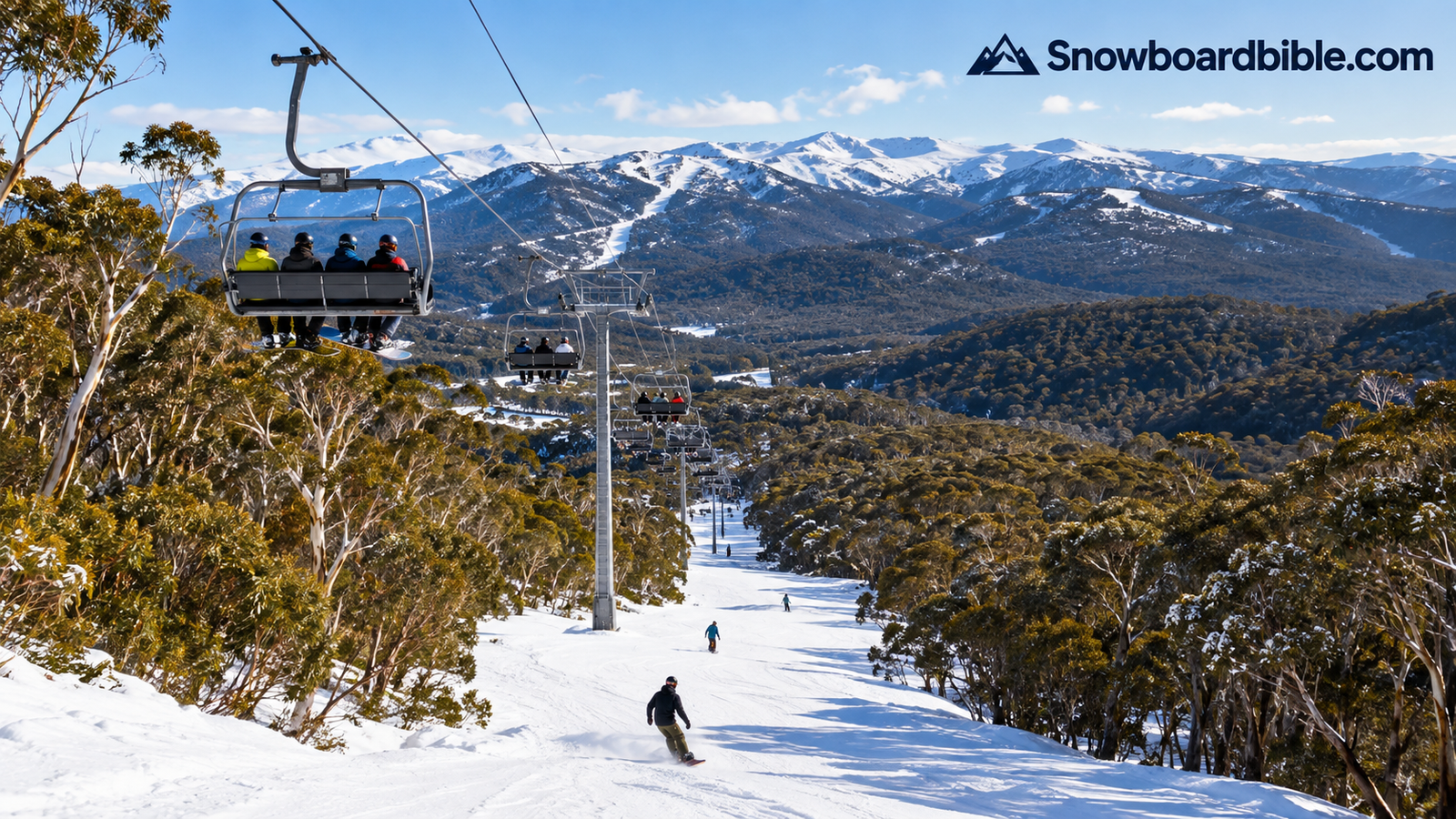
If your mental image of Australia is beaches, deserts, and kangaroos, the idea of strapping into a snowboard there can feel almost like a trick question. But the Great Dividing Range, the mountain spine running down the eastern side of the continent, climbs high enough in its southern reaches to hold consistent snowpack for roughly three to four months a year. Resorts like Thredbo, Perisher, Mt Buller, and Falls Creek run full lift networks, terrain parks, ski and snowboard schools, and a nightlife scene that riders from the Northern Hemisphere often find catches them off guard in the best way.
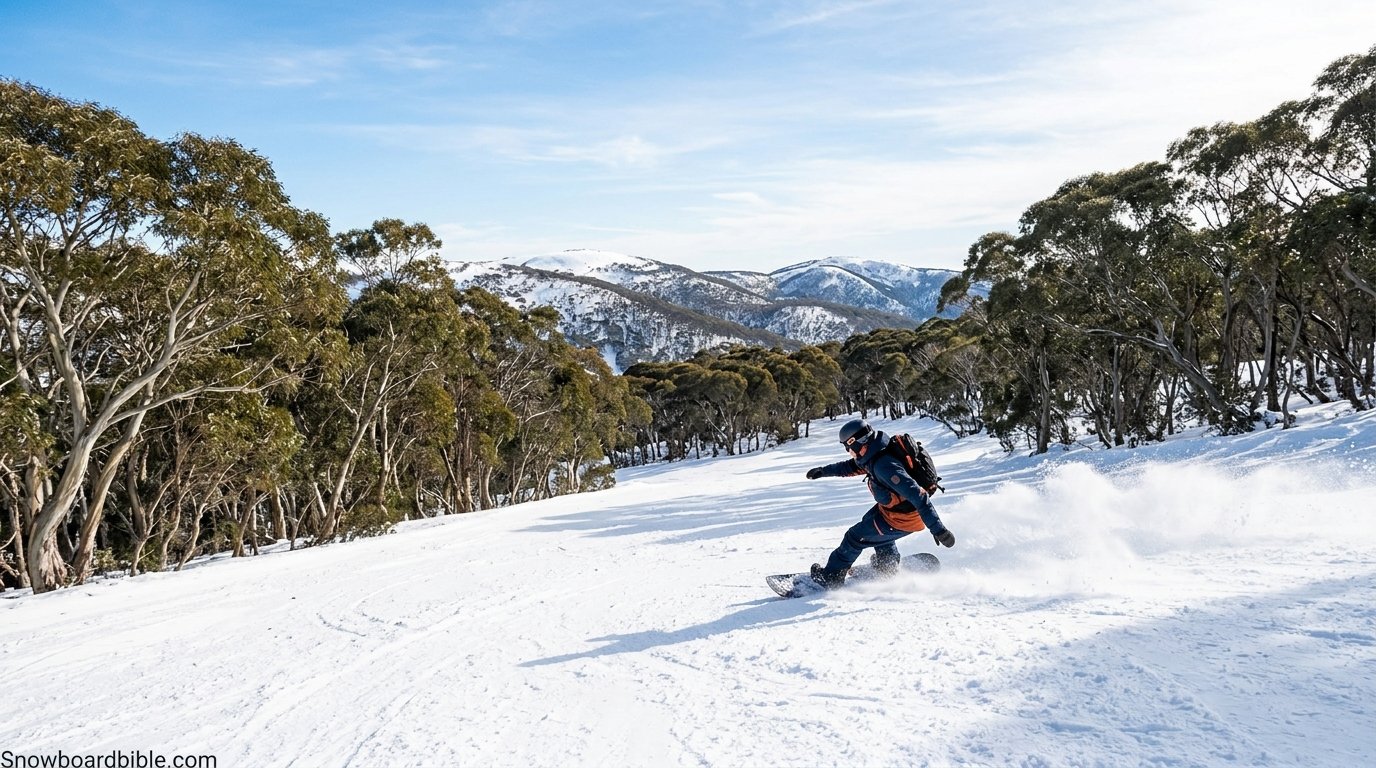
What makes Australian snowboarding distinct isn’t the size of the mountains — nothing here rivals the vertical drop of the Rockies or the Alps — it’s the contrast. You can be snowboarding through a light dusting of fresh powder in the morning and driving past gum trees still holding their leaves an hour later. That juxtaposition, more than anything, is what defines riding in Australia.
This guide walks through where the snow actually falls, which resorts are worth your time, what the snow quality is realistically like compared to bigger international destinations, how much a trip costs, and what to pack so you’re not caught off guard by conditions that behave a little differently than what you’re used to.
It’s also worth saying upfront who this guide is really for. If you’re already deep into a Northern Hemisphere season and simply curious whether Australia has anything worth riding, the honest answer is that it’s a fun, worthwhile detour rather than a bucket-list centerpiece. But if you live in Australia, are relocating there, or have travel plans that put you on the continent during the June-through-October window anyway, the calculus changes completely — you have a real, well-run season on your doorstep, and skipping it because it’s “not Japan” would be selling the experience short. The resorts here have decades of operating history, established coaching pathways, and a rider culture that’s every bit as passionate as anywhere else in the world, just smaller in scale.

Australia’s Snow Season: When to Go
Because Australia sits in the Southern Hemisphere, its snow season runs on the opposite calendar to North America, Europe, and Japan. Winter falls between June and August, which means the official snowboarding season typically opens around the June long weekend and runs through early October, weather and snowmaking permitting.
Season Breakdown by Month
| Period | What to Expect | Who It’s Best For |
|---|---|---|
| Early-Mid June | Season opening, heavy reliance on snowmaking, limited terrain, quieter slopes | Early-season enthusiasts, budget-conscious riders |
| Late June – July | Best chance of consistent natural snowfall, peak school holiday crowds mid-July | Powder chasers, families |
| August | Deepest average base of the season, coldest temperatures, most reliable coverage | Anyone prioritizing snow quality |
| September | Longer daylight, warmer afternoons, spring-corn conditions, terrain parks in full swing | Freestyle riders, spring-skiing fans |
| Late Sept – Early Oct | Season closing, patchy lower-mountain coverage, festival atmosphere | Closing-weekend traditions, budget deals |
Snowfall in Australia is notoriously variable year to year, which is a large part of why snowmaking infrastructure at the major resorts is so extensive. A resort like Perisher or Mt Buller can, and often does, open on schedule even in a lean natural-snow year purely because of the volume of man-made snow they can lay down before the gates open. Riders coming from regions with more dependable snowpack sometimes underestimate how much Australian resorts lean on this technology, and it genuinely changes what an “opening weekend” run feels like underfoot.
If you’re building a trip around fresh snow rather than groomed corduroy, late July through August is statistically your best window. If you want warmer temperatures, better park conditions, and cheaper accommodation, aim for September.
It’s also worth understanding that Australian snowfall is heavily influenced by broader Pacific climate patterns, particularly the El Niño-Southern Oscillation cycle. During La Niña years, the alpine region tends to see wetter, more frequent snowfall events; during El Niño years, seasons can run noticeably drier and leaner, with resorts pulling harder on snowmaking to compensate. This is genuinely useful to know if you’re booking a trip more than a season in advance — a quick search on the current outlook for the alpine region can help you set realistic expectations before you commit to flights and accommodation.
School holidays are the other major variable to plan around, independent of the weather entirely. The first two to three weeks of July line up with Australian winter school holidays across most states, and that period is by far the busiest, most expensive, and most crowded stretch of the season at every major resort. If your schedule allows any flexibility at all, shifting even a week either side of that window can mean shorter lift lines, easier accommodation bookings, and noticeably lower prices across the board.
Where the Snow Actually Is: Australia’s Snowfields Explained
Snowboarding in Australia is concentrated almost entirely in three regions: the Snowy Mountains of New South Wales, the Victorian High Country, and a small, hardy scene in the Tasmanian highlands. There is no meaningful snowboarding in Queensland, the Northern Territory, South Australia, or Western Australia — elevation in those states simply doesn’t get high enough to reliably hold snow.
Elevation matters enormously here. Even the tallest Australian ski fields sit at modest heights by global standards — the top of Thredbo’s lift network is a little over 2,000 metres, compared with base elevations at that height or higher in resorts across Colorado or the Alps. That relatively low elevation, combined with Australia’s latitude, is exactly why the season window is shorter and why snowmaking plays such a central role.
For a broader sense of how this compares globally, our roundup of the best snowboarding destinations worldwide puts Australia’s scene in context alongside bigger mountain ranges.
Geographically, all of this terrain sits within national parks — Kosciuszko National Park in NSW and the Alpine National Park in Victoria — which means the snowfields are genuinely embedded in protected wilderness rather than standalone resort developments. That has practical implications for riders: development is tightly controlled, so village footprints stay compact, and the surrounding bushland is never far from the lift network. It’s not unusual to ride a groomed run with snow gums, Australia’s iconic gnarled alpine eucalyptus trees, lining the trail edge, a sight that simply doesn’t exist at most Northern Hemisphere resorts.
Best Snowboarding Resorts in New South Wales
New South Wales is where most visiting riders start, and for good reason — it’s home to the two biggest, most fully-featured resorts on the continent.
Thredbo
Thredbo is generally regarded as Australia’s premier snowboarding resort, largely because of its vertical drop — at roughly 672 metres, it’s the longest continuous descent in the country. The village sits in a valley, which gives it a more European, ski-town feel than most other Australian fields, with a genuine main street, restaurants, and a lively après scene. Thredbo’s terrain parks are consistently rated among the best in the country, and the resort draws a strong freestyle crowd for that reason alone.
Perisher
Perisher is the largest resort by skiable area in the Southern Hemisphere, spread across four interconnected base areas. What Perisher lacks in Thredbo’s dramatic vertical, it makes up for in sheer terrain volume and beginner-friendly rolling groomers, making it a favorite for first-timers and families. Perisher also tends to hold snow well thanks to its higher average base elevation and extensive snowmaking coverage.
Charlotte Pass
Charlotte Pass is Australia’s highest resort and one of its most remote, accessible only by oversnow transport in winter. It’s a smaller, quieter field, better suited to riders who want a genuine backcountry-adjacent feel without leaving lift-served terrain entirely.
All three resorts sit inside Kosciuszko National Park, and access requires a park entry pass in addition to your lift ticket, which is an easy thing for first-time visitors to overlook when budgeting a day trip. Road access into the park can also close temporarily during severe weather, particularly for vehicles without chains fitted, so it’s worth checking the live road status the morning of any drive up rather than assuming conditions from the night before will still hold.

Best Snowboarding Resorts in Victoria
Victoria’s High Country resorts sit a little lower and closer to Melbourne than the NSW fields, making them a popular weekend option for riders based in the southern states.
Mt Buller
Mt Buller is Victoria’s largest resort and the closest major snowfield to Melbourne, which makes it the busiest on weekends. It has a well-regarded terrain park scene and a village built directly on the mountain, so you can genuinely ride in and ride out from most accommodation.
Falls Creek
Falls Creek has a reputation as one of the friendliest, most learner-oriented resorts in the country, with a gentle, ski-in-ski-out village layout that beginners tend to love. It also has a strong cross-country and backcountry-access culture on its fringes for riders who want to explore beyond the lift network.
Mt Hotham
Mt Hotham sits at a higher average elevation than most of its Victorian counterparts, which tends to translate into better natural snow retention. It has a reputation among locals as having some of the state’s most technical, advanced terrain, including steep chutes and gladed runs.
Victoria is also home to two smaller fields, Mt Baw Baw and Mt Buffalo, both of which see far less visitor traffic than the big four. Mt Baw Baw in particular is popular with Melbourne families looking for an affordable, low-pressure introduction to snow sports without the crowds or costs of the bigger resorts, though its terrain and lift network are modest by comparison.
| Resort | State | Best For | Vibe |
|---|---|---|---|
| Thredbo | NSW | Longest runs, terrain parks | Alpine village, lively |
| Perisher | NSW | Beginners, terrain volume | Sprawling, family-friendly |
| Charlotte Pass | NSW | Remote, quiet riding | Backcountry-adjacent |
| Mt Buller | VIC | Park riders, weekend trips | Busy, mountain-village |
| Falls Creek | VIC | Beginners, families | Relaxed, ski-in-ski-out |
| Mt Hotham | VIC | Advanced terrain | Technical, local favorite |
For a rider deciding between the two states, the honest answer is that neither is dramatically better — it comes down to proximity, budget, and whether you value terrain volume (NSW) or a shorter drive and strong park scene (VIC). Our general snowboard comparison hub covers how to weigh similar trade-offs when choosing gear, and the same logic of matching setup to terrain applies to choosing a resort.
Tasmania’s Hidden Snowboarding Scene
Tasmania rarely comes up in conversations about Australian snowboarding, and that’s mostly fair — the terrain is small, the lift infrastructure is basic, and conditions are far less predictable than the mainland. But for riders who’ve already ticked off Thredbo and Buller and want something with more character, it’s worth knowing it exists.
Ben Lomond
Ben Lomond is Tasmania’s main lift-serviced field, a short drive from Launceston. It’s small — a handful of lifts and a limited terrain footprint — but it offers a genuinely low-key, uncrowded alternative to the mainland’s bigger resorts, with conditions that can swing from excellent powder to thin, rocky coverage within the same week.
Mt Mawson
Mt Mawson is even smaller and more old-school: a club-run field with rope tows rather than chairlifts, run largely by volunteers. It’s not a destination most visiting riders will build a trip around, but it’s a fascinating snapshot of what Australian snowboarding looked like decades ago, and still appeals to a niche of riders chasing something unpolished.
If your trip is centered on Tasmania for other reasons — hiking, wildlife, the food and wine scene around Hobart — Ben Lomond is a reasonable half-day detour if conditions line up. It’s not, on its own, worth flying to Australia for.
What Tasmania lacks in scale it partly makes up for in unpredictability that some riders find genuinely appealing. Because the terrain is smaller and less heavily managed with snowmaking than the mainland giants, a good natural dump can produce conditions that feel wilder and less groomed than anything you’ll find at Thredbo or Perisher. It’s a gamble rather than a sure thing, but for riders chasing something less curated, it’s a gamble worth knowing about.
Snow Quality & Conditions: What to Expect vs. the US, Europe, and Japan
This is the section that matters most for setting expectations, because it’s where visiting riders are most often surprised. Australian snow is, on average, heavier, wetter, and less consistent than what riders from Japan, the Rockies, or the Alps are used to. It’s not unrideable — far from it — but it behaves differently underfoot, and gear choices matter more here than in a resort with bottomless dry powder.
| Destination | Typical Snow Type | Season Length | Natural Snow Reliability |
|---|---|---|---|
| Australia | Wet, variable, sometimes icy | ~14-16 weeks | Low-Moderate (snowmaking-dependent) |
| Japan | Dry, consistent powder | ~16-20 weeks | Very High |
| Colorado / US Rockies | Light, dry powder | ~18-24 weeks | High |
| European Alps | Mixed, resort-dependent | ~18-22 weeks | Moderate-High |
On a good day, particularly during a cold snap in July or August, Australian resorts absolutely can produce genuine, memorable powder turns. But the more common experience is groomed corduroy over a machine-made or partially natural base, with conditions that can go from soft morning snow to firmer, wind-affected surfaces by afternoon. Riders who’ve spent time in Japan’s famously dry powder or the drier climate of Colorado’s Rockies should recalibrate expectations rather than assume the same board and layering setup will feel identical.
One quirk worth knowing: Australian weather can shift fast, and rain at the base of a mountain while it’s snowing higher up isn’t unusual, particularly early and late season. If you’re wondering whether that ends your day entirely, our piece on snowboarding in the rain covers how to manage exactly that scenario.
Wind is another factor that catches visiting riders off guard. The exposed, treeless upper sections of resorts like Perisher and Falls Creek can see genuinely strong alpine wind events, occasionally strong enough to shut down chairlifts for safety on the most exposed days. It rarely closes an entire resort, but it can push riders toward lower, more sheltered runs for part of a session, so it’s worth checking each resort’s live lift status rather than assuming every lift will be spinning when you arrive.

Terrain Parks & Freestyle Scene in Australia
Given the relatively short season, Australia’s terrain park culture punches above its weight. Thredbo, Mt Buller, and Perisher all run dedicated park teams that build and maintain multiple park lines through the season, ranging from small progression features to large jump lines and rail gardens aimed at experienced riders.
What Makes Australian Parks Distinct
Because natural snowfall can be inconsistent, park crews here lean heavily on snowmaking and grooming to keep features rideable, which in practice often means firmer, more predictable takeoffs and landings than you’d find in a resort relying purely on natural snow. For freestyle riders, that consistency can actually be an advantage — features tend to stay in shape for longer stretches without the unpredictability of natural snow burying or eroding them.
Mt Buller in particular has built a strong reputation on the competitive circuit, regularly hosting national-level slopestyle and rail jam events. If terrain parks are the priority for your trip, Buller and Thredbo should be at the top of your list over the bigger but more groomer-focused Perisher.
Perisher shouldn’t be written off for park riders entirely, though — its sheer scale means it can run multiple park zones simultaneously, from beginner-friendly progression lines through to larger advanced features, which makes it a genuinely strong option for riders working through a freestyle progression rather than only chasing the biggest jumps. Falls Creek and Mt Hotham both run smaller but well-maintained park setups too, so a multi-resort trip across a season pass can give a rider a genuinely varied freestyle diet without ever leaving the country.
For riders building or refining a freestyle-oriented quiver, it’s worth reading up on board shape and flex before you land on a park-specific setup — our breakdown of the Lib Tech Skate Banana and our wider look at freestyle snowboarding tricks are both useful starting points.
Cost of Snowboarding in Australia: Lift Tickets, Gear, Accommodation
This is often where the biggest surprise lands for international visitors: Australian snowboarding is expensive, and it’s worth budgeting for accordingly. Between a smaller domestic market, high operating costs, and heavy reliance on snowmaking infrastructure, resort pricing here sits noticeably above many comparable Northern Hemisphere destinations.
Some practical ways riders manage the cost: buying multi-day or season passes if you’re staying more than a few days, avoiding the peak July school holiday window if your schedule allows it, and basing yourself in a valley town rather than paying premium on-mountain accommodation rates. Our detailed breakdown of how expensive snowboarding really is applies globally, but the general cost-cutting strategies there translate directly to an Australian trip.
Transport is a cost category that’s easy to underestimate. Between fuel, snow chain hire or purchase, park entry fees, and the occasional need for a shuttle or coach transfer during a chain-required road closure, getting to and from the resort each day can add up over a multi-day trip almost as much as lift tickets themselves. Booking a coach package that bundles transfers with lift access is often cheaper than piecing together a self-drive trip once all of these smaller costs are added up, particularly for solo travelers who can’t split fuel and parking costs across a car full of people.
Food and drink on-mountain also carries a premium typical of any alpine resort environment worldwide — packing lunch and snacks rather than buying every meal at a mountain lodge is one of the simplest ways to trim a daily budget without cutting into actual riding time.
| Cost Category | Budget Approach | Higher-Spend Approach |
|---|---|---|
| Lift Access | Midweek, multi-day pass | Peak weekend, single-day tickets |
| Stay | Valley town, shared accommodation | Ski-in-ski-out on-mountain lodge |
| Gear | Bring your own from home | Full on-mountain rental package |
| Timing | Early or late season | School holiday peak weeks |
Getting There & Getting Around: Travel Logistics
Both major snowfield regions are reachable from Australia’s largest cities within a manageable drive, which is part of why domestic weekend trips are so common here.
From Sydney to the NSW Snowfields
Thredbo and Perisher sit roughly a five to six hour drive south-west of Sydney, making them a realistic long-weekend trip for Sydney-based riders and a common add-on for international visitors already spending time in the city.
From Melbourne to the Victorian Snowfields
Mt Buller and Falls Creek are closer still to Melbourne, typically a three to four hour drive, which is why Victorian resorts see such heavy weekend traffic from city-based day-trippers and weekend warriors.
International Access Points
International visitors typically fly into Sydney or Melbourne and either rent a car or book a coach transfer service directly to the resorts; some regional airports also operate seasonal shuttle connections during peak winter months. Snow chains are a legal requirement on many alpine access roads during winter, even for experienced drivers, so factor that into any self-drive plan.
If you’re not confident driving in snow and ice, coach transfer services running directly from Sydney or Melbourne CBD to the major resorts are a genuinely good option, removing the chain-fitting, mountain-road learning curve entirely. These services run daily during peak season and less frequently on the shoulders, so it’s worth booking ahead rather than assuming a seat will be available on the day you want to travel. For riders planning to explore multiple resorts across one trip, renting a car still offers the most flexibility, but be prepared for narrow, winding alpine roads and, in the coldest stretches of the season, genuinely icy conditions that call for slower, more deliberate driving than most visitors are used to.
Packing & Gear Considerations for Australian Conditions
Because Australian snow tends to run wetter and more variable than powder-focused destinations, your packing list should lean toward waterproofing and versatility over pure cold-weather insulation.
Outerwear
Prioritize a genuinely waterproof shell over a heavily insulated one — Australian conditions rarely get brutally cold by international standards, but wet snow will find any weak seam in cheap outerwear fast. Our snowboard layering guide and comparison of merino wool vs. synthetic base layers are both worth a read before you pack.
Board Setup
An all-mountain or directional-twin board tends to handle Australia’s mixed groomer-and-variable-snow conditions better than a pure powder-specific shape, simply because deep, dry powder days are the exception rather than the rule. If you’re picking a first board or deciding between shapes, our guide on how to choose your first snowboard walks through exactly this trade-off.
Wax and Base Prep
Because Australian snow runs wetter than the dry powder found at higher-latitude resorts, wax selection matters more than a lot of visiting riders expect. A wax formulated for warmer, wetter conditions will glide noticeably better across Australian corduroy than a cold-climate wax pulled straight from a Japan or Colorado trip. If you’re bringing your own board, it’s worth a fresh warm-temperature wax before you fly, and checking our guide on how often you should wax your snowboard if you’re planning multiple sessions across a longer trip.
Pack For
- Fully waterproof (not just water-resistant) jacket and pants
- Layering system you can adjust through the day
- Goggles with a lens suited to variable/flat light
- Gloves or mittens with genuine waterproofing
Don’t Over-Pack
- Extreme sub-zero insulation rated for far colder climates
- Powder-only board shapes as your only option
- Non-waterproof cotton base layers

Tips for First-Timers Snowboarding in Australia
If this is your first time riding in Australia, whether you’re a complete beginner or an experienced rider new to the region, a few local realities will save you time and frustration.
For riders wondering whether it’s even worth the trip compared with learning somewhere with more consistent conditions, it’s a fair question — but for anyone based in or visiting Australia during winter, it’s a genuinely solid, underrated place to learn or refine your riding, without needing to fly across the globe. If you’re still deciding between skiing and snowboarding for your first time out, our comparison of the ski vs. snowboard learning curve is worth reading before you book lessons.
It’s also worth setting expectations around sunburn and eye protection, which surprises a lot of first-time visitors. Australia’s UV levels run higher than much of the Northern Hemisphere even in winter, and that intensity, combined with reflection off snow at altitude, means sunburn and snow-blindness risk is genuinely elevated compared with equivalent elevation resorts elsewhere. High-SPF sunscreen and properly rated UV-blocking goggles or sunglasses aren’t optional extras here the way they might feel at a heavily overcast Northern Hemisphere resort — they’re a basic part of a safe day on the mountain.
Frequently Asked Questions
Is snowboarding in Australia actually good, or just a novelty?
It’s genuinely good, particularly during a cold, snowy stretch in July or August — it’s just smaller in scale and shorter in season than the world’s biggest mountain destinations. For riders based in or visiting Australia during winter, it’s a legitimate destination in its own right, not just a curiosity.
When is the best time to snowboard in Australia?
Late July through August generally offers the most reliable natural snow and coldest, best-holding conditions, while September brings warmer weather, longer days, and stronger park conditions.
Which is better for snowboarding, NSW or Victoria?
Neither is objectively better — NSW resorts like Thredbo and Perisher offer more terrain and a longer signature run, while Victorian resorts like Mt Buller and Falls Creek are closer to Melbourne and known for strong terrain parks and a relaxed, beginner-friendly village feel.
How does Australian snow compare to Japan or Colorado?
Australian snow tends to be heavier and wetter, with less reliable natural snowfall than Japan’s famously dry powder or the light, dry snow common in Colorado, though a good cold snap can still produce excellent powder days.
Do I need to bring my own snowboard to Australia?
It’s not necessary — rental shops at every major resort and in nearby towns stock a wide range of boards, boots, and outerwear, though bringing your own gear can save money on a longer trip and ensures a setup you already trust.
How much does a snowboarding trip in Australia typically cost?
Australian resorts sit on the pricier end globally for lift tickets, rentals, and on-mountain accommodation; budgeting more than you would for a comparable mid-size US or European resort is realistic, especially during peak school holiday weeks.
Can beginners learn to snowboard in Australia?
Yes — resorts like Perisher and Falls Creek are particularly well set up for beginners, with dedicated learning areas, structured lesson programs, and gentle terrain suited to first-timers.
Is Tasmania worth visiting for snowboarding?
Only as a secondary stop — Tasmania’s Ben Lomond and Mt Mawson offer a small, uncrowded, old-school experience, but the terrain and lift infrastructure are far more limited than the mainland resorts.
Does it rain a lot at Australian ski resorts?
Rain at lower elevations while it snows higher up isn’t unusual, particularly in the shoulder months of June and September, so waterproof outerwear matters more here than in colder, drier climates.
How far are the snowfields from Sydney and Melbourne?
The NSW snowfields are roughly five to six hours from Sydney, while the Victorian snowfields are closer to Melbourne at around three to four hours, making both realistic weekend trip destinations.
Are terrain parks good in Australia?
Yes — Thredbo and Mt Buller in particular run well-maintained, competition-standard terrain parks throughout the season, helped by heavy reliance on snowmaking that keeps features consistent.
What should I pack differently for Australian conditions vs. other destinations?
Prioritize genuine waterproofing over extreme cold-weather insulation, pack a flexible layering system, and consider goggle lenses suited to flat, overcast light, since Australian conditions run wetter and more variable than many international destinations.
Conclusion: Australia Belongs on Your Snowboarding Map
So, can you snowboard in Australia? Absolutely — and for riders based in the region, or anyone curious about a snowboarding experience unlike anywhere else on the map, it’s well worth a trip. The season is shorter and the mountains smaller than the world’s headline destinations, but the resorts are well-run, the terrain parks are genuinely strong, and the experience of riding through a landscape that still looks distinctly Australian is something you won’t find replicated anywhere else.
Go in with realistic expectations about snow quality, pack gear that handles wet, variable conditions well, and time your trip for late July through August if fresh snow is your priority. Do that, and Australia earns its place as a legitimate, memorable stop on any serious rider’s list.


