
Is It Easier to Ski or Snowboard? An Honest, Data-Backed Breakdown
Every first-timer standing at the base of a beginner hill asks the same question. Here’s the real answer, backed by how each sport actually feels on day one, day ten, and day one hundred.
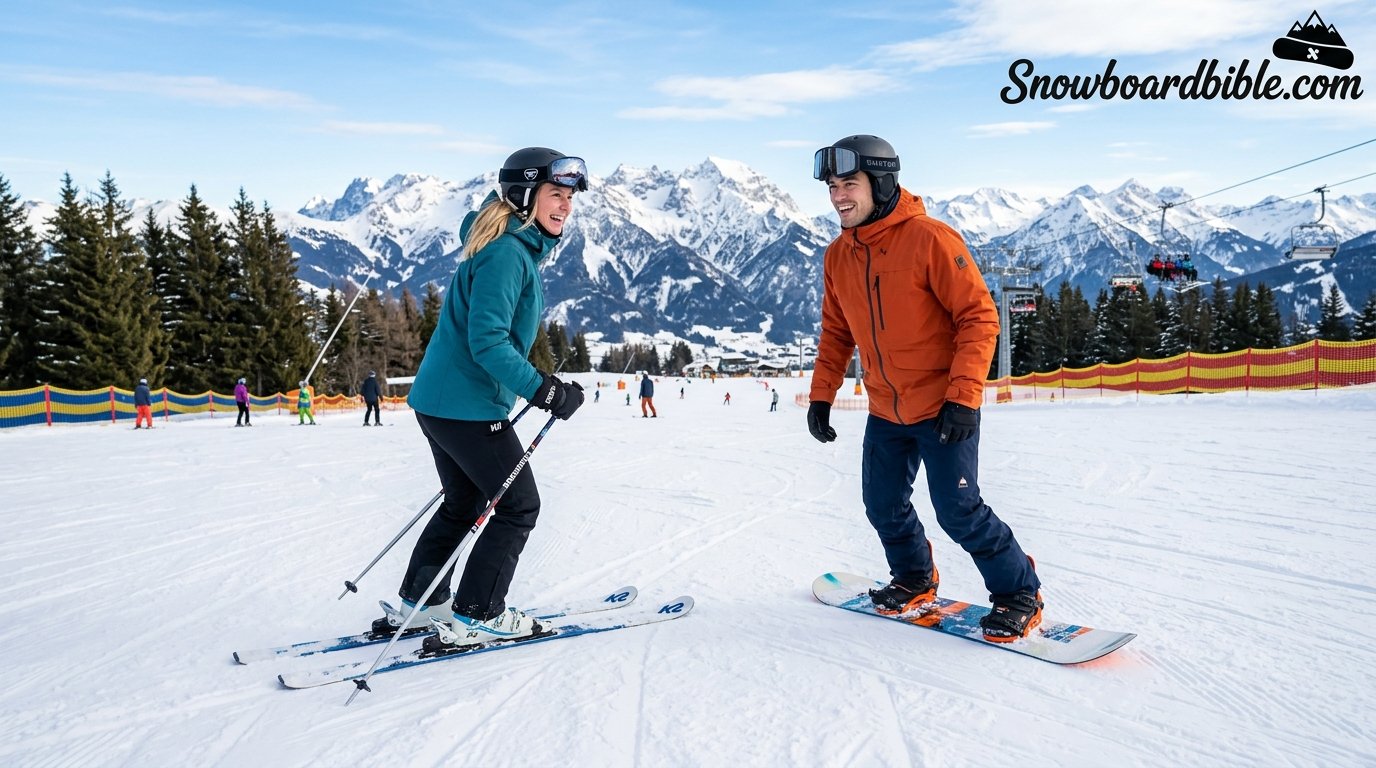
If you’ve never clipped into a binding or buckled a ski boot, you’ve probably heard some version of this advice: “Skiing is easier to start but harder to master. Snowboarding is brutal at first but clicks fast once it does.” Like most oversimplified advice, it’s not wrong — but it’s not the whole story either. The honest answer depends on your athletic background, your tolerance for a rough first day, your body type, and what “easier” even means to you. This guide breaks the question down piece by piece so you can walk into your first lesson with realistic expectations instead of internet folklore.
1. What “Easier” Actually Means
Before comparing the two sports, it helps to separate “easier” into three distinct questions, because skiing and snowboarding trade places depending on which one you ask. There’s the question of how painful your first day will be. There’s the question of how quickly you’ll go from “barely surviving” to “comfortably cruising a green run.” And there’s the question of how long it takes to reach an advanced, all-mountain level of competence. Most people who say one sport is “easier” are really only answering the first question — and that’s exactly where the two sports diverge the most dramatically.
Skiing has what instructors often call a gentle, linear learning curve. You’ll likely be making basic turns and stopping under control within your first hour or two, and each subsequent day builds fairly smoothly on the last. Snowboarding has more of a plateau-and-breakthrough curve: your first day can feel like nothing but falling, followed by a rapid jump in competence once your brain and legs figure out how to link heel-side and toe-side turns. Neither pattern is objectively “easier” — they’re just shaped differently, and which one suits you better depends heavily on your personality and your patience for early frustration.
It also helps to think about “easier” in terms of feedback loops. Skiing gives you almost constant positive feedback in the first hour: every small adjustment produces a visible, controllable result, which keeps motivation high even through the inevitable falls. Snowboarding’s feedback loop is more delayed and less linear — you can do everything “right” technically and still fall simply because your balance hasn’t caught up yet, which is often more discouraging in the moment even though it isn’t a sign you’re doing anything wrong. Understanding this distinction ahead of time can make a huge difference in how you interpret your own progress on day one, since a slower-feeling snowboard session doesn’t necessarily mean you’re worse at the sport than a skier is at theirs — it just means the two sports reward effort on different timelines.
2. The First-Day Experience: Skiing vs Snowboarding
Ask any ski instructor and they’ll tell you the same thing: most beginner skiers are making wedge turns and stopping with a “pizza” shape within the first hour. Because your feet move independently, your brain can rely on familiar walking-and-pivoting instincts, and balance is distributed across two separate points of contact. The result is a first day that feels productive. You’ll fall, but you’ll also feel like you’re making visible progress from run to run.
Snowboarding first days look different. Both feet are locked to a single board, which means every micro-adjustment in balance has to come from your core, hips, and ankles rather than from stepping one foot to correct yourself. New snowboarders spend a significant chunk of their first session simply learning to stand up from a seated position and get moving in a straight line before they even attempt a turn. It’s common to fall dozens of times in a single session — not because snowboarding is inherently more dangerous, but because the margin for balance error is much smaller with both feet fixed together.
This is the root of the “skiing is easier to start” reputation, and it’s largely accurate for a single day’s experience. If your only goal is to survive one beginner lesson without frustration, skiing usually wins.
It’s also worth accounting for group lesson dynamics, since most people don’t learn in isolation. Beginner ski classes can often move a whole group along together fairly evenly, because independent-leg balance tends to click for most people at a similar pace. Beginner snowboard classes, by contrast, frequently show wider variation within the same group — someone with a skateboarding background might be linking turns by lunch while someone else is still working on standing up, and that spread can affect how a first day feels socially as well as physically. Knowing this ahead of time can help set realistic expectations if you’re learning alongside friends or family members who don’t share your athletic background.
3. Why Snowboarding Feels Harder at First
The biggest reason snowboarding feels harder in the beginning comes down to a concept instructors call “linked movement.” On skis, your left and right sides can move independently — one ski can turn slightly ahead of the other, and you can use a wedge stance to control speed almost immediately. On a snowboard, your entire lower body moves as a single unit. There’s no way to “cheat” your way into control the way a ski wedge allows; your board either tracks a controlled edge or it doesn’t.
There’s also the “getting up” problem. Skiers who fall can typically use their poles and independent legs to stand back up within seconds. Snowboarders who fall — especially on their first day — often need to fully unstrap one foot, plant it in the snow, and use it as leverage to stand, especially on flat sections. This adds friction to every single fall, and early sessions can include 40 or more falls, each one interrupting flow and momentum. For a deeper look at exactly how the two learning curves diverge minute by minute, our first-time rider learning curve comparison breaks this down lesson by lesson.
The good news is that this difficulty is front-loaded. Most people who push through the first one or two sessions report a noticeable breakthrough by day three, once their body learns to balance across the board’s edges instinctively. If you’ve ever wondered whether that reputation is exaggerated, our full answer to is snowboarding hard to learn goes deeper into the timeline.
One underrated factor in this early difficulty is mental fatigue rather than physical fatigue. Because every fall on a snowboard requires a conscious, multi-step recovery process — unstrapping, repositioning, restrapping — beginners often report feeling mentally drained well before their legs actually give out. This is different from skiing, where recovery from a fall is largely automatic and doesn’t require the same level of conscious problem-solving each time. Recognizing that the exhaustion is more cognitive than physical can help first-time riders push through an extra run or two instead of calling it quits after an unusually frustrating fall.
4. How Skiing Progresses Over Time
Skiing’s easy start comes with a trade-off further down the road. While a first-time skier can be making basic turns within an hour, the road from “competent beginner” to “confident all-mountain skier” is longer and more technical than most people expect. Parallel turns, proper pole timing, carving on steeper terrain, and handling variable snow conditions all require refined technique that can take dozens of days on snow to develop.
This is where the old saying “easy to learn, hard to master” earns its reputation. Many recreational skiers plateau at an intermediate level — comfortable on groomed blue runs but never quite graduating to confident black-diamond or off-piste skiing — because the technical ceiling for advanced skiing is genuinely high. Ski racers and instructors spend years refining edge angles, weight transfer, and rhythm that casual skiers never fully need, but that gap becomes very visible once you compare a weekend skier to a lifelong one.
None of this makes skiing a bad choice. It simply means the “easy” label mostly applies to the entry point, not the entire journey. If your goal is casual, comfortable cruising on groomed runs, skiing will get you there fast and keep you satisfied for years without much additional technical work.
It’s also worth noting that the intermediate plateau in skiing tends to be more forgiving to live with than the equivalent plateau in snowboarding. A skier stuck at an intermediate level can usually still comfortably enjoy the vast majority of groomed terrain at most resorts, simply riding a little slower and a little less aggressively than an expert. Snowboarders stuck at a similar plateau sometimes struggle more with specific terrain types — steep icy pitches or narrow catwalks, for example — where the connected-stance mechanics that make powder so enjoyable can become a liability without more refined edge control. This doesn’t mean either plateau is “worse,” but it does explain why some lifelong skiers never feel pressure to push past intermediate, while some snowboarders feel more motivated to keep progressing simply to unlock comfortable access to more of the mountain.
5. Physical Demands & Fitness Differences
Both sports are more demanding than they look from the lodge window, but they tax the body in different ways. Skiing relies heavily on quadriceps endurance, since maintaining a slightly flexed knee position for hours at a time is what keeps you stable and in control. Skiers who skip leg-strength conditioning often find their thighs burning out well before their technique does, especially on longer runs or bumpier terrain.
Snowboarding places more demand on core strength, hip mobility, and ankle stability, since your entire body has to rotate and flex as a single connected unit to initiate turns. Riders with strong obliques and hip flexors tend to progress noticeably faster because so much of a snowboard’s turning power comes from rotating the upper body and letting the lower body follow. Our detailed breakdown of core strength for snowboarding outlines specific exercises that translate directly to the slope, and the broader fitness guide for snowboarding covers a full pre-season conditioning plan.
In terms of raw calorie burn, the two sports are closer than people assume, though snowboarding’s constant micro-adjustments and higher fall frequency for beginners can push the number slightly higher on early sessions. If you’re curious about the numbers, we’ve broken down exactly how many calories snowboarding burns across different skill levels.
Flexibility and joint mobility also matter more than most beginners expect. Skiers benefit from strong, flexible ankles and hips to absorb terrain changes while keeping their upper body quiet and stable, while snowboarders rely heavily on ankle dorsiflexion — the ability to flex the ankle forward — to control toe-side turns without lifting the heel of the back foot off the board. Riders who spend time on mobility work before the season, even something as simple as daily ankle circles and hip-opener stretches, often report feeling noticeably less sore after their first few days on snow, regardless of which sport they choose.
6. Balance, Coordination & Stance
One of the most overlooked differences between the two sports is how they use your dominant side. Skiing doesn’t require you to identify a “front foot,” since both skis operate independently and symmetrically. Snowboarding, on the other hand, requires you to ride in either a “regular” stance (left foot forward) or a “goofy” stance (right foot forward) — and figuring out which one feels natural is a small but important first step that has no equivalent on skis. Most people determine this instinctively through a simple push test, which our regular vs goofy stance guide walks through in detail, alongside a broader look at how goofy vs regular stance affects turning mechanics later on.
This sideways stance is also why snowboarding feels so foreign to people with no skateboard or surf background. If you’ve spent years riding a skateboard or wakeboard, your brain already understands how to balance sideways across a moving platform, and the snowboard learning curve tends to compress dramatically as a result. Skiers, by contrast, can lean more on general two-legged balance and walking-adjacent coordination, which most people already have in abundance from everyday life.
Coordination demands aside, both sports eventually train an entirely new sense of edge awareness — the subtle feel of how much a ski edge or board edge is biting into the snow. This is arguably the single hardest concept for beginners in both sports to internalize, and it’s part of why plateaus happen in both disciplines around the intermediate level.
Vision and spatial awareness play a subtler but real role here too. Skiers generally look further down the slope, scanning several turns ahead since both feet are already pointed in the direction of travel. Snowboarders, especially when riding heel-side, often have to consciously turn their head and shoulders to look downhill past their own body position, since the sideways stance naturally orients part of the torso across the fall line. New riders who forget to actively look where they’re going — rather than down at their board — tend to struggle with speed and direction control far more than their actual balance ability would suggest, which is why most snowboard instructors spend real time on “look where you want to go” cueing in the first lesson.
7. Falling, Injuries & Safety Comparison
Injury patterns differ meaningfully between the two sports, and understanding them can help you choose gear and technique priorities before you ever hit the slope. Skiing injuries tend to concentrate around the knees — ACL and MCL sprains are common because a ski can twist independently of the leg during a fall, putting rotational stress directly on the knee joint. Snowboarding injuries, by contrast, are more commonly wrist and shoulder related, since the natural reflex when falling on a board is to catch yourself with an outstretched hand.
This is exactly why wrist guards are considered near-essential gear for beginner snowboarders but are rarely used by skiers. Our best wrist guards for snowboarding roundup covers the most protective options, and our broader look at injury prevention for snowboarding covers posture and falling technique that reduce risk further. For a full breakdown of fall mechanics and how to fall safely on a board, see our dedicated snowboard fall safety guide.
It’s worth noting that overall injury rates between the two sports are fairly comparable once you control for skill level and terrain choice — the sport isn’t inherently “more dangerous,” it just tends to injure different body parts, in different ways, at different points in the learning curve. If you want the full picture on where snowboarding’s dangerous reputation comes from, and how much of it is overstated, our piece on why snowboarding is dangerous puts the statistics in context.
8. Gear & Equipment Setup Differences
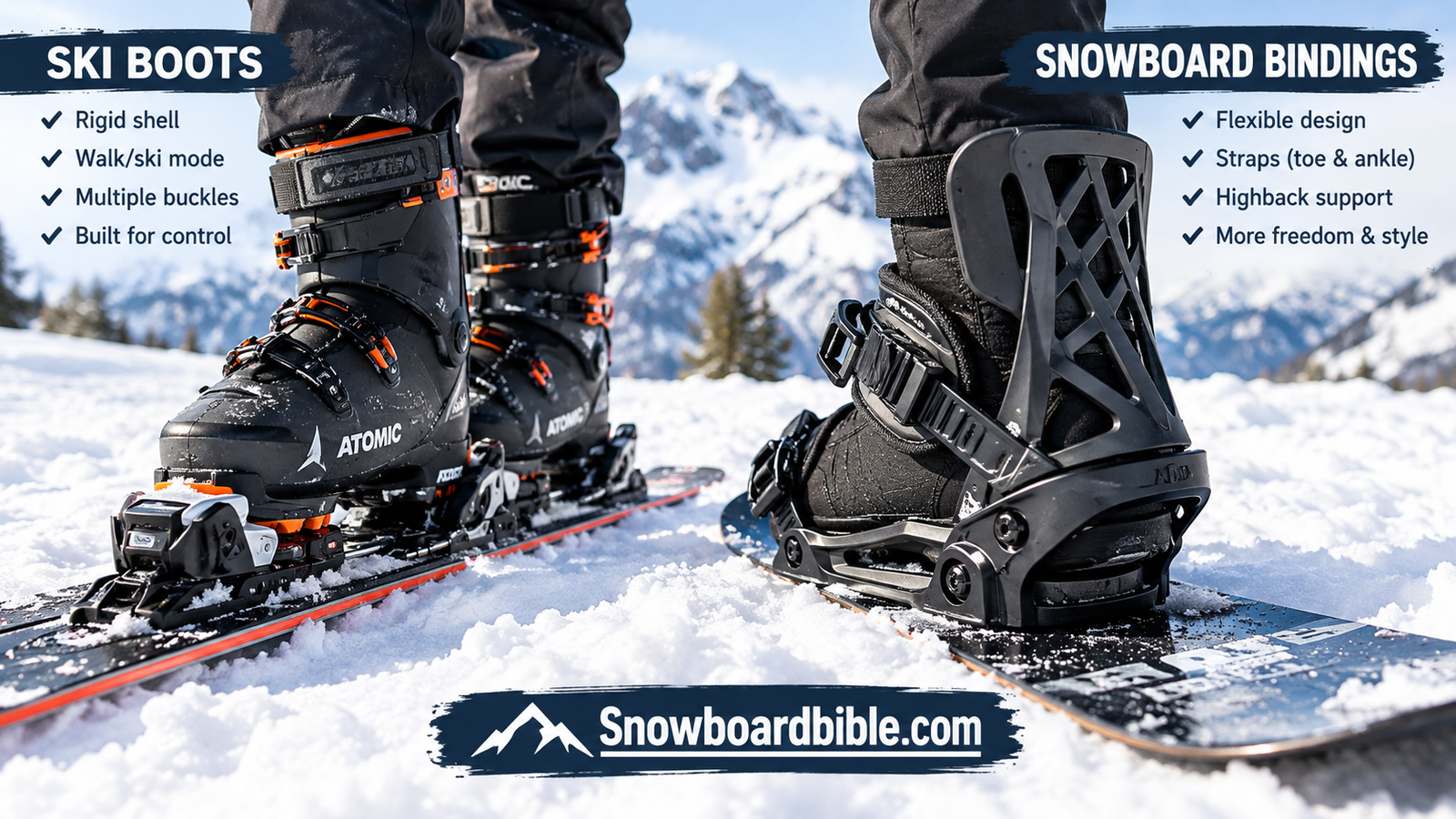
Gear complexity is another quiet factor in how “easy” each sport feels, particularly during your first few outings. Ski boots are rigid and can feel uncomfortable at first, but the buckling system is intuitive and boots can be adjusted for fit in under a minute. Skis themselves require no assembly beyond clicking into a binding your boot fits directly into, and most rental shops can get a new skier fully set up in about ten minutes.
Snowboard boots are softer and generally more comfortable straight out of the box, but the board itself requires a stance width and angle setup — decisions that affect how the board feels underfoot from the very first run. Beginners renting snowboard gear should lean on shop staff to dial in a comfortable, slightly duck-footed stance rather than guessing. Our snowboard boots guide and snowboard bindings guide both cover exactly what a first-time rider should ask for at the rental counter.
One clear advantage snowboarding holds here: once you’re strapped in, there’s very little gear-related friction until you need to walk on flat ground. Skiers, meanwhile, deal with two independent skis, two poles, and boots that make walking around the lodge notably clumsier. Neither system is objectively better — they simply create friction in different moments of your day.
| Setup Factor | Skiing | Snowboarding |
|---|---|---|
| Time to get set up at rental | ~10 minutes | ~15 minutes (stance adjustment) |
| Comfort of boots on day one | Rigid, needs buckling adjustment | Soft, generally comfortable immediately |
| Walking on flat ground | Awkward in ski boots | Easy once unstrapped |
| Independent limb movement | Yes (two skis, two poles) | No (single connected board) |
9. Cost Comparison: Lessons, Gear, and Long-Term Investment
Cost rarely factors into the “easier” debate directly, but it does affect how many days you’ll realistically spend learning — which in turn affects how quickly you improve. Group lesson pricing is usually similar across both sports, though some resorts price beginner snowboard packages slightly higher because instructor-to-student ratios tend to be smaller for boarding lessons, a reflection of how much more individual attention new riders often need in the first session or two.
Gear costs follow a similar pattern. A beginner ski setup (skis, boots, poles, bindings) and a beginner snowboard setup (board, boots, bindings) land in a comparable price range, though snowboard boots are often cheaper than ski boots because they don’t require the same rigid, custom-fit shell. Our full how expensive is snowboarding breakdown covers lesson packages, gear tiers, and season-pass math in detail if you’re budgeting your first year on snow.
Where snowboarding sometimes saves money long-term is in outerwear and layering, since boarders spend more time sitting in snow and often invest in slightly more durable, weatherproof pants and jackets up front — a purchase that tends to last longer overall. Whichever sport you choose, budgeting for at least one or two professional lessons in your first season will shorten your learning curve far more than any piece of gear will.
10. Terrain & Riding Style Fit
Certain terrain types genuinely favor one sport over the other, and this can influence which one will feel easier for you depending on where you typically ride. Deep powder, for example, is often considered more forgiving on a snowboard, since the board’s wide surface area and connected stance provide natural buoyancy without requiring the ski-specific technique needed to keep two independent skis tracking evenly through soft snow.
Groomed, well-packed runs tend to favor skiing, where the ability to make quick, independent-leg adjustments helps maintain speed control and precision on firm snow. Terrain park features — rails, boxes, and jumps — are generally considered more approachable on a snowboard because the connected stance makes balancing on rails and absorbing landings more intuitive, though plenty of skiers thrive in park settings as well.
Your board or ski shape also plays a role here. Riders exploring different terrain often start comparing camber vs rocker profiles once they notice how differently a board behaves in powder versus on groomers, and understanding the difference between directional vs twin snowboards can meaningfully change how “easy” a given terrain type feels once you’ve moved past the total-beginner stage.
11. Age & Who Progresses Faster
Age plays a bigger role in this comparison than most people expect. Young children often pick up skiing faster than snowboarding because the independent-leg mechanics of skiing map more naturally onto a young child’s developing balance and coordination, and gear like ski poles gives them an extra point of stability. This is part of why many family-focused resorts recommend skiing first for kids under roughly seven or eight, a topic our skiing vs snowboarding for kids guide covers in more depth, alongside recommendations on the best age to teach a child to snowboard.
Teenagers and adults, on the other hand, often find snowboarding’s learning curve compresses faster than expected, especially if they’ve ever skateboarded, surfed, or wakeboarded. Older adult beginners sometimes gravitate toward skiing specifically because falling is generally gentler and joint stress from repeated snowboard falls (particularly on wrists) can be a bigger concern later in life.
None of this is a hard rule — plenty of adults in their 40s, 50s, and beyond learn to snowboard successfully every season — but if you’re choosing a sport for a mixed-age family group, these general tendencies are worth factoring into the decision.
12. Long-Term Skill Ceiling: Which Sport Goes Deeper?
Once you move past the beginner and intermediate stages, the “easier” question flips entirely into a “which has more to offer” question. Snowboarding’s trick vocabulary — from basic ollies to full freestyle spins and grabs — tends to build on itself in an accessible, incremental way once a rider has solid edge control. Our list of snowboarding tricks and deeper look at freestyle snowboarding tricks show just how far that progression can go, while learning to carve on a snowboard or ollie on a snowboard opens the door to that whole style of riding.
Skiing’s advanced ceiling leans more toward speed, precision carving, and technical mogul or off-piste skill — disciplines that reward years of refined technique rather than trick repertoire. Both paths offer a genuine lifetime of improvement, and neither sport “runs out” of things to learn, which is part of why so many riders end up passionately loyal to whichever one they started with. If you want the case for snowboarding’s particular appeal once you’re past the early struggle, our piece on why snowboarding is the best winter sport makes that argument in full.
Head-to-Head Summary
| Category | Skiing | Snowboarding |
|---|---|---|
| First-day difficulty | Easier | Harder |
| Speed of early progress | Steady and linear | Slow start, fast breakthrough |
| Common early injuries | Knee strain/sprains | Wrist/shoulder impacts |
| Best for young children | Generally yes | Usually after age 7-8 |
| Best in deep powder | Requires more technique | Naturally more buoyant |
| Long-term skill ceiling | Very high (carving, speed, technique) | Very high (freestyle, tricks, style) |
| Gear setup speed | Faster | Slightly slower (stance dial-in) |
Skiing: Pros
- Faster, more comfortable first day
- Independent-leg balance feels natural
- Easier for young kids to pick up
- Quick gear setup at the rental counter
Skiing: Cons
- Longer path to advanced technique
- Knee-related injury risk
- Two skis and poles to manage
- Awkward walking in rigid boots
Snowboarding: Pros
- Comfortable boots from day one
- Faster breakthrough once basics click
- Great in deep powder
- Natural fit for skaters/surfers
Snowboarding: Cons
- Rough, fall-heavy first sessions
- Wrist/shoulder injury risk
- Stance setup takes extra time
- Harder for very young children
Frequently Asked Questions
Is snowboarding harder than skiing to learn?
For most people, yes — the first one to three days of snowboarding tend to involve more falling and slower initial progress than skiing. However, many riders report a rapid breakthrough around day three or four, after which snowboarding often feels more intuitive than skiing did at the same point.
How many days does it take to get good at snowboarding versus skiing?
Most beginner skiers feel comfortable on easy green runs within one to two days, while most beginner snowboarders need three to five days before reaching a similar comfort level. Both sports typically take 10 or more days on snow to feel truly confident on varied terrain.
Which sport is safer, skiing or snowboarding?
Overall injury rates are fairly similar between the two sports. Skiing carries a higher risk of knee injuries, while snowboarding carries a higher risk of wrist and shoulder injuries, largely due to how each sport’s falls tend to happen.
Is snowboarding easier if you’ve skateboarded or surfed before?
Yes, noticeably. The sideways stance and edge-based balance required for snowboarding closely mirrors the mechanics of skateboarding, surfing, and wakeboarding, which is why people with that background often skip much of the typical beginner struggle.
Is skiing easier for kids to learn than snowboarding?
Generally yes, especially for children under seven or eight. The independent-leg mechanics of skiing align better with a young child’s developing coordination, and ski poles provide extra stability that snowboarding doesn’t offer.
Which sport hurts more when you fall?
Snowboarding falls are usually more frequent for beginners, but skiing falls can carry more serious injury risk to the knees due to twisting forces on independently mounted skis.
Is snowboarding cheaper than skiing overall?
Gear and lesson costs are broadly comparable between the two sports, though snowboard boots are often less expensive than ski boots since they don’t require the same rigid, custom-fitted shell construction.
Can you switch from skiing to snowboarding easily, or vice versa?
Switching is possible at any point, but most riders find it easiest to fully commit to one sport for at least a full season before trying the other, since the balance mechanics are different enough that mixing them too early can slow progress in both.
Which sport is more physically demanding?
Skiing places more sustained demand on the quadriceps, while snowboarding places more demand on the core and hip mobility. Overall fitness demands are comparable, just distributed across different muscle groups.
Do skiers or snowboarders progress faster on the mountain overall?
Skiers tend to progress faster in the first few days, while snowboarders often catch up or even surpass that pace once they get past the initial learning plateau, particularly if they have prior board-sport experience.
Is snowboarding harder to learn if you’re older?
It can be, mainly because falling more frequently is tougher on joints later in life. Many older adult beginners choose skiing for this reason, though plenty of people successfully learn to snowboard well into their 40s, 50s, and beyond.
Which sport is more fun in the long run?
This comes down entirely to personal preference. Skiers often love the speed and precision of carving, while snowboarders often love the terrain-park versatility and freestyle trick progression. Both sports offer a genuinely lifelong skill ceiling.
Final Verdict: So, Which Is Actually Easier?
If you’re measuring “easier” by your very first day on snow, skiing wins — it’s more intuitive, less physically punishing early on, and gets most beginners making basic turns within an hour. If you’re measuring “easier” by how quickly you’ll feel genuinely comfortable and how much long-term versatility you’ll get in powder and terrain parks, snowboarding often pulls ahead once you push through that rough first stretch.
The honest, unsatisfying-but-true answer is that there’s no universally easier sport — only a better fit for your body, your background, and your patience level. The best way to find out which one is right for you is still the simplest one: book a beginner lesson in each, give yourself two or three sessions before judging either, and let your own progress make the decision for you.
Shop Beginner Gear


