

The Complete Snowboard Boots Guide: Flex, Fit, Lacing Systems & Expert Picks
Everything you need to know to choose, fit, and maintain snowboard boots — from beginner softies to aggressive all-mountain slayers.
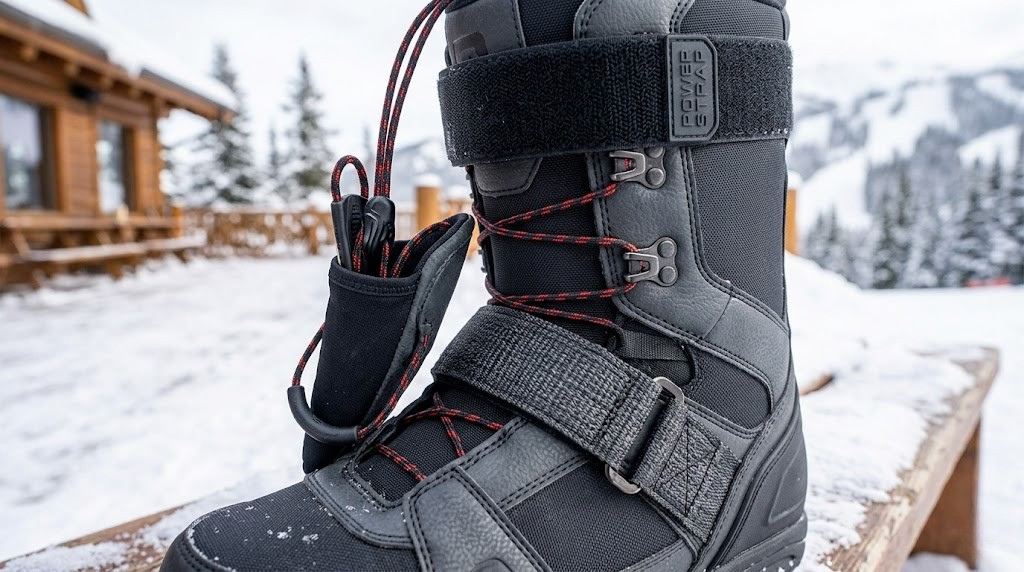
Why Snowboard Boots Are the Most Important Piece of Gear
Walk into any ski shop and you’ll notice the board wall gets the dramatic lighting, the binding display gets the technical explainers, and the boot wall gets… a few scattered hang tags. This is backwards. Your boots are the single interface between your nervous system and your snowboard. Every intention your brain sends — toe-side edge pressure, a subtle heel-side unweight, the precise moment to initiate a turn — travels through the soles of your feet first.
The mechanics are compelling. A stiff, well-fitting boot reduces the amount of energy lost between ankle movement and board response. Conversely, a packed-out liner or oversized boot creates a “dead zone” where your leg movement has to fill empty space before any energy reaches the binding. In performance carving, this lag is the difference between a clean arc and a skidded turn. In the park, it’s the difference between feeling the nose press smoothly or getting bucked on landing.
Beyond performance, there’s the physiological argument. Poorly fitting boots cause compression injuries, pressure hotspots, and plantar fascia strain that can turn a $3,000 trip into a chair-lift tour. Understanding the inherent risks of snowboarding and how proper gear mitigates them is essential for every rider.
The investment argument also holds up. Quality boots from Burton, ThirtyTwo, Ride, or K2 spread their cost across multiple seasons. A $420 boot worn for 100 days costs just $4.20 per riding day — far less than even budget replacements cycled annually.
Pro tip: Most professional snowboard instructors recommend spending at least 30–35% of your total boot-binding-board budget on boots alone. If your total setup is $600, $200–$220 on boots is a reasonable floor, not a ceiling. See our guide on snowboard bindings for the binding side of the equation, and our snowboard gear showdown for a head-to-head framework.
Anatomy of a Snowboard Boot
To choose intelligently, you need to know what you’re actually buying. A snowboard boot is a multi-layered system — each layer serves a distinct mechanical and comfort function. Modern premium boots contain up to seven distinct engineered components.
The Outer Shell
The shell is the rigid or semi-rigid exterior that wraps your foot. Modern shells are built from layered thermoplastic urethane (TPU), nylon-reinforced composites, or traditional rubber compounds. The shell’s primary function is lateral stiffness — resisting torsional flex so your ankle movement transfers cleanly to the board’s edge.
High-end shells feature zonal stiffness construction, where the heel counter and ankle wrap are stiffer than the toe box and tongue. K2’s urethane endo-construction, explored in our K2 snowboard boots review, is a landmark example of this approach. Similarly, brands like Lib Tech and YES Snowboards have pushed shell engineering in their board designs, which complement stiff boot shells for maximum edge hold.
The shell also houses the lacing architecture. Shell geometry varies significantly between brands: narrower last shapes (Burton, ThirtyTwo) versus wider last builds (Vans, Adidas) can make a substantial difference for wide-foot riders.
The Liner: The Heart of Boot Performance
The liner is the inner bootie that contacts your foot directly. It is, without exaggeration, the single most important factor in long-term boot performance and comfort. Liners are responsible for:
- Heat retention: Closed-cell foam densities and moisture-wicking lining materials determine thermal efficiency. Cold feet can be further mitigated with quality merino wool socks
- Custom fit: Heat-moldable liners physically reshape to your foot contours
- Heel lock: The liner’s heel cup geometry determines how much lift you feel mid-turn
- Flex feel: Liner thickness modulates the boot’s flex feel — crucial when choosing your stance
- Pack-out rate: Lower-density foams compress faster; premium liners maintain loft longer
The highest-quality liners — found in boots like the Burton Ion, ThirtyTwo TM-Two, and Salomon Dialogue — use multi-density foam construction. For Vans-specific sizing and liner compression details, our dedicated guide covers everything.
Pack-out is real: Budget boot liners can pack out noticeably within 15–30 riding days. When your liner packs out, the boot goes from snug to sloppy — and no amount of over-lacing fully compensates. Consider proper snowboard socks and an aftermarket footbed to manage fit from the start.
Outsole, Midsole & Cushioning Systems
The outsole is your contact patch with the world — both the parking lot and the binding footpad. Most quality boots use a two-layer sole system:
- Outsole: Rubber (Vibram, or proprietary compounds) for grip and durability
- Midsole / EVA foam: A compression layer between the outsole and footbed that absorbs impact
Shell Stiffness
Zonal TPU/nylon construction. Determines lateral stiffness and energy transfer.
Liner Foam Grade
Premium Intuition® foam holds shape 3–4× longer than budget alternatives.
Outsole Compound
Vibram® or proprietary rubber. Affects grip, weight, and durability.
Footbed / Insole
Aftermarket orthotics can dramatically improve comfort and power transfer.
Heel Counter
Rigid internal cup that prevents heel lift. The most-overlooked feature.
Lacing Architecture
Zone-specific tension control from laces, cables, or BOA dials.

Shop Best Snowboard Boots on Amazon
Compare top-rated boots from Burton, ThirtyTwo, Salomon, K2, and Vans with fast shipping and easy returns.
🛒 View Snowboard Boots on AmazonUnderstanding Snowboard Boot Flex Ratings
Flex rating is the most widely cited and least consistently defined specification in snowboard boots. Unlike ski boots, which use standardized DIN flex indexes, snowboard boot flex is an informal 1–10 scale set by each brand independently. A “5 flex” from Burton is not the same as a “5 flex” from Salomon.
Despite this imprecision, the scale provides useful relative reference within a brand’s lineup. For a technical breakdown of how lacing systems interact with perceived flex, our detailed comparison is highly relevant here. It’s also worth understanding how flex affects stopping power and speed control — a stiffer boot gives you more leverage for aggressive braking, while a softer boot is more forgiving for beginners learning to make their first turns.
Flex 1–3: Soft / Beginner
Ultra-soft boots in the 1–3 range are designed for learners and children. They flex forward easily, reducing fatigue when your shins are constantly banging the front of the cuff. The trade-off is imprecise edge control. Key boots in this range: Burton Ruler (3), Ride Anthem (3), K2 Maysis (3.5). If you’re buying your first boots, look for something in the 3–4 range that you won’t outgrow in your first season. See our first snowboard buying guide for context.
Flex 4–6: Medium / Freestyle
The medium flex range is the most popular segment. At flex 4–5, boots are still forgiving enough for beginners advancing past their first season, while providing enough response for intermediate all-mountain riding. At 5–6, you’re moving into dedicated freestyle territory. If you’re eyeing park boards like the Capita DOA or the Lib Tech Skate Banana, a medium flex boot is your sweet spot.
Flex 7–8: Medium-Stiff / All-Mountain Performance
Boots in the 7–8 range are where serious all-mountain and resort carvers live. They provide the stiffness for high-edge-angle arcs and fast speeds. Heavier riders (180 lbs / 82 kg+) often find medium-soft boots feel closer to a 3–4 due to their body mass — a stiff boot calibrated for their weight may be the better choice. Pair boots in this range with versatile all-mountain boards like the Burton Flight Attendant, Jones Mountain Twin, or the Burton Skeleton Key.
Flex 9–10: Stiff / Alpine & Aggressive Freeride
Stiff boots at 9–10 are specialist tools. They’re for advanced freeriders carving at speed, splitboard-to-hardpack transitions, or alpine carvers. These boots are unforgiving — you must commit to a clean carving technique because the boot will amplify imprecision. For freeride terrain, pair with boards like the Lib Tech T.Rice Pro, Ride Warpig, or GNU Mullair for maximum control.
Flex + weight: A 130-lb rider in a stiff flex 8 boot will feel it as a 9. A 220-lb rider in the same boot may feel it as a 7. Always factor your body weight into the flex equation. And remember: proper stance setup can further fine-tune how flex translates to response.
Lacing Systems Compared: BOA, Speed Lace, Traditional & Hybrid
The lacing system is the second most critical performance variable after fit. It determines how quickly you can get into your boots, how precisely you can control zone-by-zone tension, and how easy it is to operate with frozen, gloved hands at 7,000 feet in the dark. There are four major categories.
Dial-and-Cable
A coiled steel cable runs through the shell and liner, cinching evenly when the dial is turned. Single-dial systems tighten the whole boot; dual-dial BOA splits upper and lower zones.
Lace-and-Ratchet
Traditional laces threaded through a ratcheting system with pull tabs. Faster than traditional laces but less precise than BOA.
Full Manual Control
Classic individual-lace design with full zone customization. The most personal control, but the slowest and hardest with gloves.
Best of Both Worlds
Upper zone controlled by BOA dial, lower zone by traditional or speed laces. The preferred setup of many professional riders.
The verdict: For most riders, dual-dial BOA or hybrid BOA + lace delivers the optimal combination of speed, precision, and zone control. Traditional laces are best for budget-conscious buyers and riders who want maximum fine-tuning. Once your lacing system is dialed, make sure your bindings are properly matched to your boot’s flex profile. Also relevant: our Vans boot sizing guide covers how different lacing systems affect perceived fit.
Fit, Sizing & Heat Molding: Getting It Right the First Time
Boot fit is arguably more important than any spec on the hang tag. A properly fitted boot in a mid-tier price range will outperform a premium boot that fits incorrectly every single time. Here’s what a correct snowboard boot fit actually feels like:
- Standing upright: Your toes should be lightly touching or barely kissing the toe box
- Flexed forward: In a bent-knee stance, your heel should be firmly locked with zero lift
- Zero side-to-side slop: Your foot should not rock laterally inside the boot
- No pressure hotspots: Any pain after 10 minutes is a fit problem
The Half-Size Down Rule
One of the most consistent pieces of advice from boot fitters is to size down a half-size from your street shoe size. Boot liners will pack out 0.5–1.5 shoe sizes over their first 30–50 days of use. Sizing down creates a snug feel on day one that settles into an ideal fit over time. Vans boots, which run true to size due to their wider last design, are an exception — see our Vans sizing guide for details.
Heat Molding Process
Most boots priced above $300 feature heat-moldable liners:
- Put on your riding socks. Pre-warm your feet if possible.
- Heat the liner: conventional oven at 175–185°F (80–85°C) for 8–12 minutes.
- Insert the liner immediately — the window for molding is 3–5 minutes.
- Lace to riding tension. The mold takes shape under your actual riding tension.
- Adopt riding stance for 10–15 minutes while the liner cools.
- Let it fully cool for 30–60 minutes before riding.
Oven temps matter: Exceeding the manufacturer’s recommended temperature can damage liner foam irreversibly. Always use an oven thermometer rather than relying on dial settings.
Riding Socks: The Often-Ignored Fit Variable
The socks you wear during boot fitting are a precision variable. Our full guide to best snowboard socks goes deep on materials and thickness profiles. Key rules: always bring the exact socks you’ll ride in when trying on boots; merino wool mid-weight socks are the most widely compatible; never ride in cotton socks. While you’re at it, consider your full layering system — proper snow pants and even your glove choice affect overall comfort and warmth on the mountain.
Matching Boots to Your Riding Style
Snowboard boot design has diverged considerably across riding disciplines. Understanding which style aligns with your riding opens up the right range of boots immediately.
| Riding Style | Ideal Flex | Key Features | Top Boot Examples |
|---|---|---|---|
| Beginner / Learning | 3–4 | Soft flex, comfort liner, simple lacing | Burton Ruler, K2 Maysis |
| Park / Freestyle | 4–6 | Reinforced toe/heel, cushioned midsole | ThirtyTwo Lashed, Ride Anthem |
| All-Mountain | 5–7 | Versatile flex, heat mold liner | Salomon Dialogue, Burton Photon |
| Freeride / Powder | 7–9 | Stiff shell, aggressive heel lock | Burton Ion, Nitro Team |
| Backcountry Split | 6–8 | Walk-mode compatible, Vibram outsole | Burton SLX, Nitro Venture |
Powder day bonus: When the deep stuff hits, boot fit becomes even more critical — you need maximum heel lock and zero cold spots. Pair stiff freeride boots with a powder-optimized binding setup and check our guide on Warpig vs. Kilroy for the ultimate powder quiver.
Top Snowboard Boot Brands: In-Depth Brand Profiles
Spans every price point from entry-level Ruler to flagship ION. The Burton Step On system is a genuine paradigm shift. Also see our Mission vs Cartel binding comparison and our deep-dive on Burton vs. Capita boards.
One of the deepest pro rider rosters in snowboarding. The Lashed and TM-Two are perennial top-sellers.
Decades of ski boot engineering DNA. The Dialogue is one of the most versatile all-mountain boots ever made. Compare with Salomon snowboards.
Signature urethane endo construction delivers distinctive flex-and-rebound. See our K2 boots review for the technical breakdown.
Wider lasts than most competitors. True-to-size fit makes online sizing more reliable. See our Vans sizing guide.
Consistently delivers above their price point. The Insano and Trident offer premium-feeling performance at mid-range prices. Also check out our Union bindings comparison for pairing options.
Methodical precision in durability and build quality. Compare with Nitro snowboards.
Strong skate-culture aesthetic with surprisingly competent technical performance. Compare with DC snowboards.
Hand-built in the USA with eco-friendly materials. Known for Magne-Traction edges and playful board designs like the Pickle BTX and Mullair.
Mervin Manufacturing’s flagship — home of the Skate Banana and the legendary Travis Rice Pro. Pushes boundaries in board design that complement aggressive boot choices.
Jeremy Jones’ brainchild for dedicated backcountry and freeride. See our Flagship vs. Mountain Twin comparison.
Innovative tapered shapes and creative profiles. See if YES snowboards are right for you.
Full Snowboard Boot Comparison Table: 2025–2026 Season
The following table covers 20 of the most widely recommended boots across all price tiers and riding styles. For the broader picture, see our best snowboard boots roundup.
| Boot | Brand | Flex | Lacing | Best For | Price | Rating |
|---|---|---|---|---|---|---|
| ION | Burton | 8 | Dual BOA | Advanced All-Mtn | $500–570 | |
| Photon | Burton | 6 | Speed Lace | Intermediate All-Mtn | $280–340 | |
| TM-Two XLT | ThirtyTwo | 6 | Dual BOA | Freestyle / Park | $400–460 | |
| Dialogue | Salomon | 7 | Speed Lace | All-Mountain | $350–420 | |
| Maysis | K2 | 3–4 | BOA | Beginner | $220–270 | |
| Aura Pro | Vans | 4 | Traditional | All-Mtn / Wide Foot | $260–310 | |
| Insano | Ride | 9 | BOA Hybrid | Aggressive Freeride | $400–460 | |
| Team | Nitro | 8 | Speed Lace | Freeride / All-Mtn | $360–420 |
Want to see how these boots stack up against each other in real-world testing? Check our full head-to-head snowboard gear showdown and our detailed Capita board review for boots-to-board pairing insights.
Break-In Process, Boot Care & Maintenance
Even the best boots in the world need a proper break-in period and consistent maintenance. Most riders skip maintenance entirely and wonder why their boots feel “off” by the second season. Here’s a comprehensive approach to both.
The Break-In Timeline
- Days 1–3 (0–15 riding hours): Liner foam at peak density. Boots feel tighter than normal. Focus on even lacing tension.
- Days 4–10 (15–40 riding hours): Liner begins conforming to foot shape. Hotspots start resolving. Performance-optimized fit begins to emerge.
- Days 10–25 (40–80 riding hours): Near-complete liner conformation. Boot at its performance peak.
- Days 25+ (80+ riding hours): Pack-out begins. Higher-quality boots take longer to reach this phase.
Boot Drying: The Most Important Maintenance Task
Wet liners degrade faster. After every riding day: remove the liner from the shell, loosen all laces, dry both separately at room temperature. Never use direct heat sources (radiators, boot dryers on high heat). Storing boots properly also means checking if your shell needs cosmetic repair and keeping your full kit organized in one of our recommended snowboard bags. See our guide on why and how to maintain your snowboard gear for more details.
✓ Boot Care Best Practices
- Remove liners after every ride to dry
- Use snowboard bags to protect during travel
- Store boots in a cool, dry environment
- Inspect lacing hardware for fraying
- Use aftermarket insoles to extend liner life
- Keep your helmet and goggles stored with your boots for easy grab-and-go
✗ Things That Destroy Boots
- Storing wet liners in shells overnight
- Drying with high heat (car heater vents)
- Walking extensively on abrasive surfaces
- Ignoring BOA dial clicks or cable fraying
- Never checking heel lift as liners pack out
Common Snowboard Boot Problems and How to Fix Them
Heel Lift: The #1 Performance Thief
Heel lift is the most pervasive boot problem. Every millimeter equals lost energy during edge transitions. Fixes include: sizing down half a size at purchase, using a J-bar insole, over-lacing the upper ankle zone tighter, or switching to a boot with a more pronounced heel lock. Learn more about snowboard fall safety — proper boot fit reduces injury risk. Also read about stopping techniques where heel lift can be most dangerous at speed.
Shin Bang
Shin bang is nearly always a combination of flex rating and boot size issues. Solutions: size up the flex, tighten the upper zone more aggressively, add tongue padding, and adjust binding highback angle. See our guide on stance setup for context.
Cold Feet
Cold feet are often a wet liner problem rather than an insulation failure. The solution chain: ensure liner is fully dry before each use, upgrade to merino wool snowboard socks, consider a liner with superior insulation, and add protective gear that keeps your core warm. Don’t forget your hands — mittens vs. gloves is another warmth decision worth optimizing, and there’s a reason snowboarders prefer mittens for heat retention.
Safety check: Poorly fitting boots are a leading cause of snowboarding injuries. Wearing a certified helmet and back protector won’t fix bad boots, but proper fit combined with protective gear dramatically reduces risk. Read our full guide on why snowboarding can be dangerous and how to stay safe.
Budget vs. Premium Snowboard Boots: Where the Money Actually Goes
The most common question at the boot wall is “is it worth spending more?” The honest answer depends on how often you ride. But the difference between a $180 boot and a $450 boot is not marketing — it’s engineering.
| Feature | Budget ($150–250) | Mid-Range ($250–380) | Premium ($380–550+) |
|---|---|---|---|
| Liner Foam | Basic EVA, fast pack-out | Improved density, 50–80 day life | Intuition® or equiv., 100–150+ day life |
| Lacing Hardware | Basic speed lace or trad | Quality speed lace or single BOA | Dual BOA / hybrid with warranty |
| Shell Construction | Single-density nylon | Zonal stiffness, reinforced zones | Multi-zone TPU with anatomical shaping |
| Typical Lifespan | 1–2 seasons | 2–3 seasons | 3–6 seasons |
| Cost Per Day | $3–8 | $2.50–5 | $2–4.50 |
For the broader economic picture, see our analysis of why snowboarding is the best winter sport and the gear investments that make it worthwhile. If you’re wondering about lesser-known board brands that offer value at every price point, our comprehensive brand reviews have you covered.
Frequently Asked Questions About Snowboard Boots
Conclusion: Your Path to the Perfect Snowboard Boot
After working through this guide, the framework for choosing your boots should be clear. Start with riding style and terrain — this locks in your flex range. Then narrow by lacing system based on your tolerance for speed vs. precision. Fit everything in person with your actual riding socks, and budget for heat molding if you’re spending $300 or more.
Maintain them well. Dry liners after every ride. Heat mold at the start of each season. Replace liners before you replace boots — the shell almost always outlasts the liner.
For your next steps, explore our bindings guide to match your new boot choice with the right binding flex, read our board sizing guide to ensure your boot sole length is compatible with your board’s waist width, and check our beginner turns guide if you’re heading out for your first season. Good boots don’t just improve your riding — they make riding something you want to do again the very next day.
Ready to build the complete quiver? Browse our board-specific reviews: Burton Flight Attendant, Ride Warpig vs. Kilroy, GNU Mullair, Jones Flagship vs. Mountain Twin, and Burton Skeleton Key — all designed to complement the boots you just chose.
Ready to Find Your Perfect Boot?
Browse the complete selection of snowboard boots across all brands, flex ratings, and lacing systems on Amazon with fast shipping and easy returns.
🛒 Shop All Snowboard Boots on Amazon


