
Should I Ski or Snowboard? The Complete Beginner’s Comparison
Learning curve, cost, injury risk, gear, and which one actually fits your goals on the mountain.
If you only have thirty seconds: snowboarding is generally easier on your first afternoon because a single edge and a wide stance make basic balance intuitive, but skiing is faster to feel “in control” of because you can wedge and stop almost immediately with a snowplow. Beyond day one, the two sports diverge in cost, injury pattern, terrain feel, and even social culture. Neither sport is objectively “better” — the right one depends on your body, your budget, your goals on the mountain, and honestly, which one looks more fun to you when you picture yourself doing it.
This guide breaks the decision down into the categories that actually matter: how long each sport takes to learn, what it costs to get started, which one is harder on your joints, how each one feels underfoot, and which is the smarter pick if you are teaching kids. We also cover the gear side of things, because a huge share of the “which is better” debate really comes down to how much you enjoy shopping for and maintaining your own equipment. If you are still torn after the first few sections, our dedicated breakdown of which sport is objectively easier to learn digs even deeper into the mechanics of that first week on snow.
It’s also worth being honest with yourself about motivation. Some people choose skiing because a partner or parent already skis and it’s the path of least resistance for a family trip. Others choose snowboarding because they’ve watched park edits online and want to chase that specific style of riding. Both are perfectly valid reasons to start, and neither locks you in forever — plenty of lifelong skiers tried snowboarding first and vice versa. What actually matters is picking one, committing to at least three or four days on snow before judging it, and giving your body time to adapt before deciding it “isn’t for you.”
Skiing vs. Snowboarding: The Core Differences
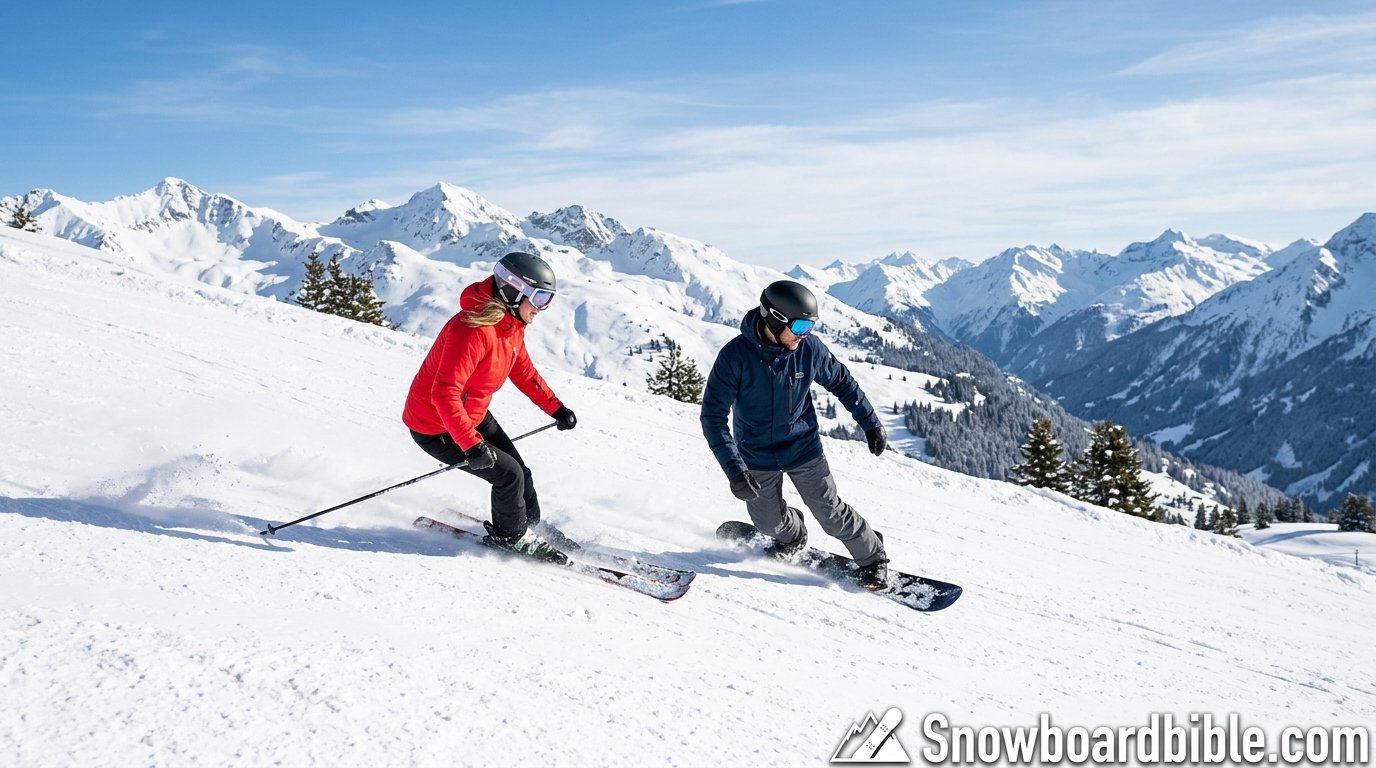
At the most basic mechanical level, skiing puts one boot on each ski, so your legs move independently and you face forward down the fall line the entire time. Snowboarding locks both feet onto a single board at an angle, so your body sits sideways to the slope and your legs move as a single unit. That one structural difference cascades into almost every other distinction between the two sports.
Because skiers have independent legs, they can wedge their skis into a pizza shape to slow down from the very first run, which is why so many first-timers feel “safe” on skis almost immediately. Snowboarders, on the other hand, spend their first day or two falling on their heel edge and toe edge while their brain learns to balance sideways — a skill that has no real analog in walking or running. The tradeoff is that once a snowboarder gets past that initial hump, turning becomes a much more fluid, whole-body motion, while skiers often keep refining technique (parallel turns, carving, mogul skills) for years.
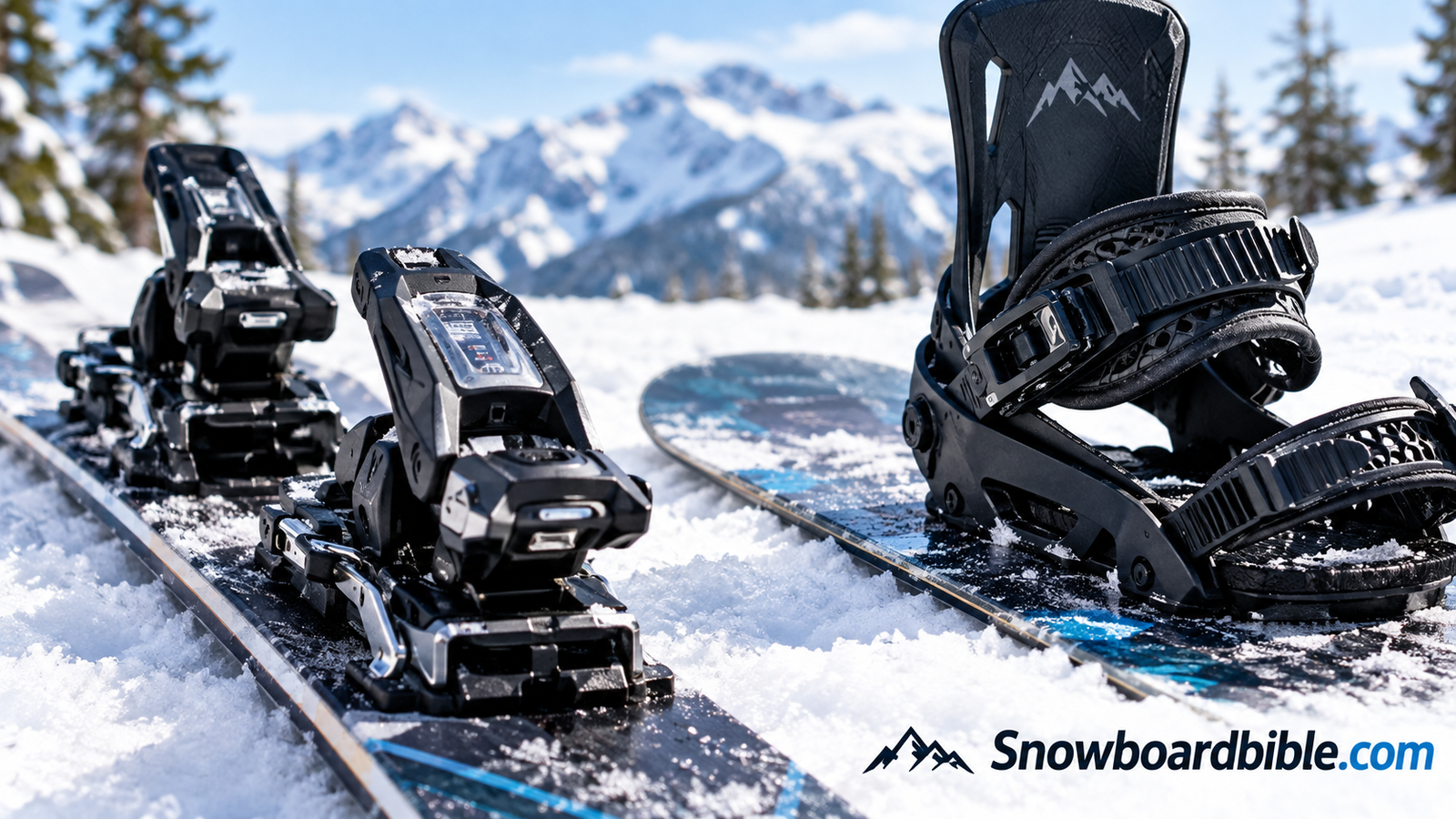
Equipment mounting is another core difference. Ski bindings release your boot in a fall to protect your knees, which is part of why skiing has a different injury profile than snowboarding. Snowboard bindings, by contrast, keep both feet locked to the board at all times, which changes how falls happen and where the impact lands. We cover this in more detail in the safety section below, but it is worth flagging here because it shapes almost every other comparison in this guide.
Finally, the sports feel different in the body. Skiing is knee- and hip-dominant, with a more upright stance and quad-heavy turning mechanics. Snowboarding is more core- and ankle-dominant, with a lower, more athletic stance similar to skateboarding or surfing. If you already have a background in skateboarding, surfing, or wakeboarding, snowboarding’s sideways stance will likely feel familiar within the first day.
There is also a stance difference that surprises a lot of first-timers. Skiers face forward, square to the fall line, with both bindings pointed downhill. Snowboarders ride with their body turned roughly perpendicular to the slope, leading with either their left foot (regular) or right foot (goofy). Figuring out which stance feels natural is one of the first things a new rider has to sort out, and our guide to regular vs. goofy stance walks through the simple tests instructors use to figure out your natural lead foot before you even strap in.
The Learning Curve: Which Is Harder to Pick Up?
Ski instructors and snowboard instructors will usually agree on this: skiing has an easier first hour, but snowboarding has an easier first week. On day one, most beginner skiers can snowplow down a green run under some form of control, because keeping the skis in a wedge naturally slows you down and independent legs make balance more forgiving. Most beginner snowboarders, meanwhile, spend day one falling repeatedly while learning to balance on a single edge, and many people feel discouraged before their body catches up.
The curve reverses by day two or three. Skiers who master the wedge often plateau there, needing real coaching to graduate to parallel turns, while snowboarders who survive the falling phase tend to link basic turns fairly quickly because the board naturally wants to turn once you shift your weight from edge to edge. Our full breakdown of how long it actually takes to learn to snowboard puts the average timeline at roughly three to five days of lift-served practice before most riders can link turns confidently on a green or easy blue run, and our companion piece on whether snowboarding is genuinely hard to learn walks through exactly why that early plateau happens and how to push through it.
If you want the most rigorous side-by-side answer, our dedicated learning curve comparison for first-time riders tracks actual lesson-by-lesson progress for both sports and is the single best resource if this question is the deciding factor for you. The short version: lessons help enormously with both sports, but they help snowboarding more, because a good instructor can shortcut the falling-down phase that otherwise eats up an entire first day. Our take on whether snowboard lessons are worth the extra cost is a clear yes for anyone serious about sticking with the sport past a single trip.
Muscle memory also plays out differently as skills advance. Skiers spend years refining edge angle, pole timing, and weight transfer between two independent skis, which is part of why expert skiing looks so precise and technical. Snowboarders reach a “comfortable and fun” plateau faster, but climbing from intermediate to advanced — linking dynamic carved turns, riding switch, or hitting bigger park features — still takes serious mileage. In both sports, the first ten days on snow matter more than almost anything else you’ll do in your first two seasons, which is exactly why so many resorts bundle multi-day lesson packages for new skiers and riders rather than selling single one-off lessons.
Physical Demands & Fitness Requirements
Both sports are more demanding than they look from the lodge window, but they tax the body differently. Skiing relies heavily on quadriceps and hip stabilizers because you are constantly absorbing terrain through bent knees while keeping your upper body facing downhill. A long ski day leaves most beginners with sore thighs and tired hip flexors, especially on bump runs or in soft, heavy snow.
Snowboarding is more of a full-body and core exercise. Because both feet are fixed to one platform, your obliques, lower back, and ankles do most of the stabilizing work, and your first few sessions will likely leave your core and glutes sorer than your legs. Falling also uses different muscles — snowboarders tend to catch themselves with their wrists and tailbone, which is one reason wrist guards are so commonly recommended for beginners.
Cardiovascular demand is fairly similar between the two once you account for lift time versus riding time, though snowboarding involves more sitting and standing (buckling in and out at every lift and flat section), which some riders find tiring in its own right, especially on days with a lot of flat cat-track traverses. Our pre-season fitness guide for snowboarding and our breakdown of core strength training for snowboarders are both useful if you want to show up in September and actually be ready by opening weekend, and if you are curious about the numbers, our estimate of calories burned snowboarding usually surprises people — a moderate day on the mountain burns roughly as much as an hour of steady jogging, once lift time is factored out.
Cost Comparison: Gear, Lessons & Ongoing Spend
Sticker shock hits both sports, but the breakdown looks slightly different. A beginner snowboard setup (board, bindings, boots) typically runs a bit cheaper than a comparable beginner ski setup (skis, boots, bindings, poles) simply because you are buying one fewer major component and boots tend to be less complex than ski boots, which require a proper fit at a boot-fitter to avoid pain.
Where skiing tends to save money is in rentals and lesson efficiency: because beginners progress to “controlled and safe” faster on skis, some resorts price beginner ski lesson packages slightly lower, and many families rent skis for years before buying, since kids outgrow ski length less dramatically than they outgrow snowboard length relative to riding style. Our full cost breakdown for snowboarding walks through first-year costs in detail, covering everything from lift tickets and lessons to wax, tuning, and outerwear that most beginners forget to budget for.
Long-term, the two sports end up fairly close in annual cost once you own your own gear, factor in resort passes, and add routine maintenance like edge tuning and waxing. The real cost differentiator tends to be how often you can get to the mountain and whether you buy a season pass versus day tickets, which is a resort-and-region question more than a ski-versus-snowboard question.
Safety and Injury Risk Profiles
Neither sport is inherently more dangerous overall, but the injury patterns are genuinely different, and this is worth understanding before you choose. Skiing’s release bindings are designed to pop off in a hard fall, which protects the knees but can result in the classic ACL and MCL tears skiers are known for, particularly among intermediate skiers who ski aggressively enough to generate real torque but haven’t yet developed the technique to avoid awkward falls.
Snowboarders don’t release from their bindings, so falls transmit force differently — typically to the wrists, shoulders, and tailbone rather than the knees. Wrist fractures are the single most common snowboarding injury, especially among beginners who instinctively put a hand out to catch a fall, which is exactly why wrist guards are such a strongly recommended piece of beginner gear. Our detailed look at snowboarding injury risk and our companion injury prevention guide both cover the specific mechanisms and how to reduce your risk with the right gear and technique.
Helmets meaningfully reduce head injury risk in both sports and are considered standard equipment at essentially every modern resort, regardless of ability level. If you are still deciding on a lid, our guide to whether you actually need a helmet to snowboard lays out the data plainly, and it applies just as directly to skiers.
Fall technique also matters more than most beginners realize. Skiers are taught to fall sideways and let their skis release rather than fighting to stay upright, while snowboarders are taught to fall onto their forearms rather than their open palms, which is the single biggest habit change that reduces wrist injuries. A short lesson focused purely on how to fall safely, before you ever try to link turns, pays for itself many times over in avoided injuries and lost days.
Terrain choice plays a role too. Beginners in both sports are safest sticking to groomed green and easy blue runs while their bodies adapt, and avoiding crowded, icy, or end-of-day slushy conditions until you have basic control. Backcountry and ungroomed terrain carry additional risks — avalanche exposure chief among them — that go well beyond the skiing-versus-snowboarding question, and anyone heading off-piste in either sport should look at our backcountry safety protocol before venturing past resort boundaries.
Terrain, Style & How Each Sport Feels
This is the category that ultimately decides most people’s preference, and it is almost entirely a matter of feel. Skiing lets you point your body straight downhill and carve wide, fast, sweeping turns, which many riders describe as feeling closer to a controlled sprint. It also gives you the option to ski switch-footed terrain and moguls with independent leg movement that snowboarding simply can’t replicate.
Snowboarding feels closer to surfing or skateboarding on snow — the sideways stance, the ability to slash powder, and the natural fit with terrain parks, rails, and jumps are a huge draw for riders who came from board sports. Deep powder days are often cited as snowboarding’s best terrain, since a wide board floats more naturally in soft snow than two narrower skis, though modern powder-specific skis have closed that gap considerably.
If freestyle and terrain parks are the goal, snowboarding has historically had the edge in tricks, rail features, and park culture, though twin-tip skis have brought a huge amount of freestyle capability to the ski side as well. Our running list of snowboarding tricks by difficulty and our freestyle progression guide are good starting points if park riding is what’s pulling you toward a board.
Board and ski shape have both evolved to blur these old lines. Directional twin snowboards let riders carve confidently in one direction while still landing switch in the park, and our explainer on directional twin snowboard shapes is worth a read if you’re shopping for your first board and keep seeing that term. On the ski side, rocker and camber profiles change how a ski floats in powder versus how it grips on groomers, and understanding camber versus rocker will save you from buying the wrong pair for the terrain you actually ride most.
Teaching Kids: Which Sport Fits Your Family
For families deciding what to put young kids on, skiing is usually the more forgiving starting point. Independent legs and the ability to snowplow give small children a faster path to feeling in control, and most ski schools are built around a well-tested progression of wedge turns that works well for the attention span of a five- or six-year-old. Snowboarding, by comparison, asks a young child to balance sideways on a single edge, which tends to be harder for kids under about seven or eight to grasp quickly.
That said, plenty of kids take to snowboarding just fine, especially if they’ve already spent time skateboarding or on a balance board. Our detailed look at skiing versus snowboarding for kids covers the age-by-age breakdown, and our guide to the best age to introduce a child to snowboarding generally lands around seven to eight years old as the sweet spot for most kids, though every child develops balance and coordination on a different timeline.
Many ski schools also simply offer more availability for young children’s ski lessons than snowboard lessons, purely because demand skews that direction, which can be a practical tiebreaker if you’re booking lessons at a busy resort during a holiday week.
Gear & Equipment Overview
Skiing requires more individual pieces of gear: skis, ski boots, bindings (usually sold mounted to the ski), and poles, plus a helmet and goggles. Ski boot fit is notoriously particular and is widely considered the single most important piece of ski equipment to get properly fitted, since a poorly fitted boot can cause pain that ruins an entire trip.
Snowboarding simplifies the equipment list to a board, bindings, and boots, with no poles required. Snowboard boots are generally more forgiving to fit off the shelf than ski boots, since they’re closer to a snug hiking boot than a rigid shell, though riders who push harder into carving eventually explore stiffer boots for more precise edge control. Our complete snowboard boots guide and snowboard bindings guide are good starting points for a first purchase, and our board sizing guide walks through matching board length and width to your height, weight, and riding style.
Outerwear needs (jacket, pants or bibs, base layers, gloves or mittens, goggles, helmet) are nearly identical between the two sports, so that part of your budget doesn’t really change based on which one you choose. One small but real difference: skiers almost always wear gloves for pole grip and dexterity, while a meaningful share of snowboarders prefer mittens for extra warmth on the lift, since they aren’t gripping anything continuously the way a skier grips poles. If you’re not sure which to buy, our comparison of mittens versus gloves covers the tradeoffs in warmth, dexterity, and price.
Poles are a subtler difference than people expect. Skiers use them constantly — for timing turns, pushing across flats, and getting up after a fall — while snowboarders have no poles at all, relying entirely on edge control and body rotation to initiate turns. Some new skiers find managing poles awkward at first, one more small motor-skill layer on top of everything else they’re learning, while some new snowboarders miss having poles to push themselves across flat sections and end up unstrapping one foot to scoot along instead.
Maintenance is another quiet cost difference. Both skis and snowboards need regular edge tuning and base waxing to perform well and glide smoothly, but a snowboard’s single base means one wax job covers your whole setup, while skis require you to tune and wax two bases every time. If you plan to maintain your own gear rather than paying a shop, our guide to how often to wax a snowboard and our walkthrough of waxing at home are good starting points, and the same core process applies to skis with minor adjustments.
Does Body Type or Age Matter?
Age and body type genuinely do influence how comfortable each sport feels, though neither rules anyone out. Adults who start snowboarding later in life often find the initial falling phase harder on the body — and harder on the wrists specifically — than adults who start skiing later in life, since skiing’s early progression involves fewer falls. This is one reason many first-time adult skiers report feeling “successful” faster than first-time adult snowboarders, even if the two end up at a similar skill level after a full season.
Knee health is a relevant consideration for skiing, since the twisting, independent-leg mechanics put more rotational stress through the knees, particularly for people with prior ACL or meniscus issues. Snowboarding’s fixed stance removes that specific stress but shifts load onto the ankles, lower back, and wrists instead, which matters more for people with prior wrist fractures or chronic lower-back issues.
Neither sport meaningfully favors a particular height, weight, or build beyond the practical reality that properly sized gear matters more than body type. A well-fitted board or a well-fitted ski will outperform an ill-fitted one regardless of who’s standing on it.
Renting vs. Buying: What Beginners Should Do First
Almost every instructor gives the same advice: rent before you buy, no matter which sport you’re leaning toward. Renting lets you test different ski lengths or board flex patterns across a few sessions without committing hundreds of dollars to gear you might outgrow in skill level within a single season. Most resorts and local shops bundle rental packages with lift tickets or lesson packages, which is usually the cheapest way to try both sports back to back before deciding.
Buying makes sense once you know you’ll be on snow at least several times a season, since properly fitted personal gear — especially boots — almost always outperforms rental equipment. When you do buy, prioritize boots first, since a bad boot fit ruins a day faster than any other piece of gear, then build outward to skis or a board and bindings once you know your preferred width, length, and flex. Our sizing guide by height and weight is a useful reference once you’re ready to purchase your own board.
One practical tip that applies to both sports: buy your outerwear (jacket, pants, gloves, base layers) before you buy your ski- or snowboard-specific hardware. Outerwear doesn’t change based on which sport you choose, so it’s a safe first purchase even if you’re still deciding between the two, and quality layering makes a bigger difference to how much you enjoy a cold day than most beginners expect.
Making Your Final Decision
If you want a simple way to decide, run through these questions honestly:
- Do you want to feel in control on day one, or are you okay with a rougher first day for a faster payoff afterward? Choose skiing for the former, snowboarding for the latter.
- Have you skateboarded, surfed, or wakeboarded before? That experience transfers directly to snowboarding’s sideways stance.
- Do you have prior knee injuries? Snowboarding’s fixed stance removes rotational knee stress, though it shifts load to the wrists and ankles.
- Are you teaching a child under eight? Skiing’s progression is generally more forgiving for young kids.
- Is terrain park riding or powder your main goal? Snowboarding has a slight historical edge here, though modern twin-tip skis compete closely.
Whichever way you lean, the single biggest factor in long-term enjoyment isn’t which sport you pick — it’s whether you take a lesson or two at the start. Riders and skiers who invest in even a half-day of instruction consistently progress faster and enjoy the sport more than those who try to figure it out entirely on their own, which is reflected in nearly every resort survey on the topic.
Skiing vs. Snowboarding at a Glance
| Category | Skiing | Snowboarding |
|---|---|---|
| First-day difficulty | Easier — wedge/snowplow gives immediate control | Harder — balancing sideways on one edge takes time |
| First-week progress | Often plateaus at the wedge stage | Tends to accelerate once falls decrease |
| Typical injury area | Knees (ACL/MCL) | Wrists, shoulders, tailbone |
| Muscles worked most | Quads, hips | Core, obliques, ankles |
| Gear pieces needed | Skis, boots, bindings, poles | Board, boots, bindings |
| Best for young kids | Generally more forgiving under age 8 | Works well from about age 7–8 up |
| Terrain park culture | Strong with twin-tip skis | Historically dominant |
| Deep powder feel | Great with powder-specific skis | Naturally floats due to wide single platform |
| Beginner setup cost | Slightly higher (more components) | Slightly lower |
Pros & Cons Side by Side
Skiing — Pros
- Faster sense of control on day one
- Independent legs give more balance recovery options
- Release bindings reduce some fall-related injuries
- Often the more forgiving choice for young children
Skiing — Cons
- More gear pieces to buy, fit, and carry
- Higher rate of knee injuries among intermediates
- Boot fit can be finicky and occasionally painful
- Progression past the wedge stage often needs coaching
Snowboarding — Pros
- Faster overall progression once past the first few days
- Simpler gear list and generally easier boot fit
- Strong natural fit for powder and terrain parks
- Familiar feel for skaters, surfers, and wakeboarders
Snowboarding — Cons
- Harder, more fall-heavy first day
- Higher rate of wrist and shoulder injuries
- Sitting down often to strap in on flats and lift lines
- Can feel slower to reach “in control” than skiing
Frequently Asked Questions
Skiing is easier on your very first day because the snowplow technique gives beginners immediate control, but snowboarding often overtakes skiing in overall progress by the end of the first week. Our full learning comparison breaks down the exact timeline.
Neither sport is categorically safer; they carry different injury risks. Skiing is more associated with knee injuries like ACL and MCL tears, while snowboarding is more associated with wrist, shoulder, and tailbone injuries, especially in beginners.
Yes, and many riders do. Expect a genuine adjustment period, since the sideways stance and single-edge balance don’t transfer directly from skiing, even for experienced skiers.
A beginner snowboard setup is usually slightly cheaper than a beginner ski setup since it has one fewer major gear category. See our full cost breakdown for a detailed first-year budget.
Most instructors suggest waiting until around age seven or eight for snowboarding, since younger children typically progress faster on skis. Our guide to the best age to start snowboarding covers this in more depth.
Yes, for both. Helmets are considered standard safety equipment at nearly all modern resorts regardless of skill level, and they meaningfully reduce the risk and severity of head injuries in both sports.
Snowboarding has a slight natural edge in deep powder because a single wide platform floats more easily than two narrower skis, though modern powder-specific and rockered skis have closed much of that gap.
The two sports stress the body differently rather than one being universally harder. Skiing loads the knees and quads more; snowboarding loads the core, ankles, and wrists more, particularly during the beginner falling phase.
Lessons help significantly in both sports, but especially in snowboarding, where a good instructor can shortcut the early falling phase. Our take on whether snowboard lessons are worth it lays out exactly why.
Yes, and it’s the recommended approach. Renting both skis and a snowboard over separate trips (or even the same trip at some resorts) is the cheapest way to find out which one you genuinely enjoy before investing in your own gear.
Snowboarding has historically been the dominant sport in terrain parks and rail culture, though twin-tip freestyle skis have made park skiing extremely capable as well. See our trick progression guide if park riding is your main goal.
Choosing based on which sport looks cooler rather than which one matches their goals, body, and tolerance for a rough first day. The sport you’ll actually stick with long-term is almost always the better choice.
Yes, in almost all cases. Modern resorts share chairlifts, gondolas, and the vast majority of groomed runs between skiers and snowboarders, with only a small number of specialty terrain-park features or Nordic trails restricted to one group.
Many experienced riders eventually try both, since each sport sharpens different balance and edge-control skills that can carry over. There’s no downside to learning both beyond the added cost and time, and it gives you flexibility to ride with friends or family who prefer either one.
The Bottom Line
There is no universally “right” answer to should I ski or snowboard — there’s only the right answer for your body, your budget, and the way you want your first season to feel. If you want a controlled, forgiving first day and you’re teaching young kids, lean toward skiing. If you’re comfortable with a rougher first few days in exchange for a sport that clicks quickly afterward, especially if you already have a board-sports background, snowboarding is likely the better fit.
The best move for most undecided beginners is simple: rent both, take a lesson in each, and pay attention to which one you’re already thinking about the next morning. That instinct is usually a better guide than any comparison chart, including this one.
You May Also Like
Snowboard Reviews
Binding Reviews
Boot Reviews
Gear Guides & Accessories
Apparel & Layering
Setup & Maintenance
Board Types & Profiles
Techniques & Learning
Safety & Fitness
Destinations & Travel
Comparisons & Buying Advice
More From Snowboard Bible
As an Amazon Associate, Snowboard Bible earns from qualifying purchases made through links on this page. This comes at no extra cost to you and helps support the independent gear testing and reviews on this site.


