
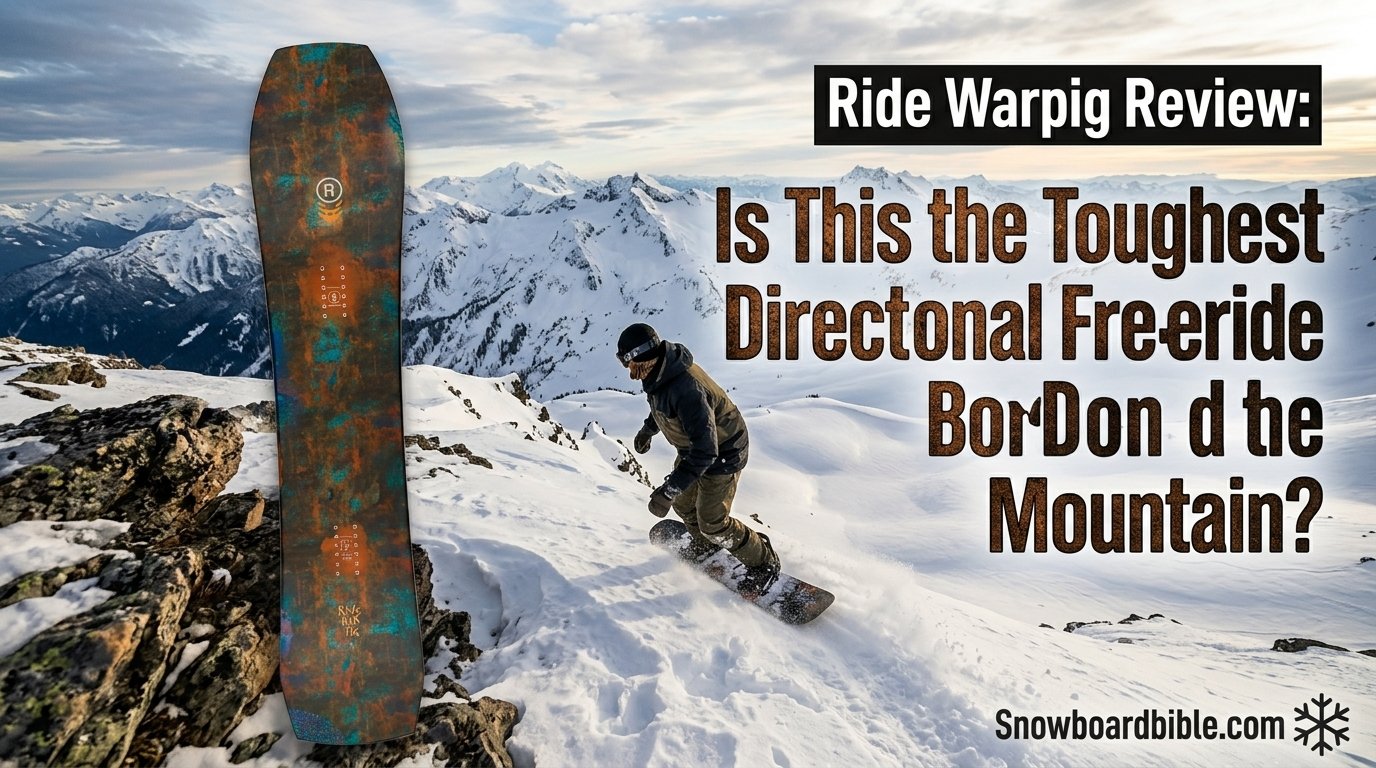
Ride Warpig Review: Is This the Toughest Directional Freeride Board on the Mountain?
A rider’s honest breakdown of flex, pop, edge hold, and value for anyone hunting a do-it-all freeride deck.

Quick Overview
The Ride Warpig has built a cult following among riders who want one board that can bulldoze through variable snow, punch through crud without folding, and still hold an edge when the trail turns to boilerplate. It’s not trying to be the lightest, flashiest, or most park-friendly board on the wall. It’s trying to be the board you grab when the forecast is uncertain and you want a deck that simply won’t let you down. After spending real days on it across groomers, backcountry sidecountry laps, and a few park sessions just to see how far it could be pushed, this review breaks down exactly where the Warpig shines, where it struggles, and who should actually buy one.
If you’re comparing it against other stiff directional boards, our Warpig vs Kilroy breakdown is worth a read alongside this review, since the two boards get cross-shopped constantly.
What makes this board interesting to write about is how unfashionable it is. Snowboard marketing loves buzzwords — hybrid rocker, magne-traction, all-terrain versatility — and plenty of boards try to be everything at once. The Warpig takes the opposite approach. It picks a lane, commits fully to that lane, and doesn’t apologize for the tradeoffs that come with it. That’s refreshing in a market saturated with boards trying to check every box on a spec sheet while actually excelling at none of them.
This review is built around actual time spent on the board across a full range of conditions: early-morning groomers before the crowds show up, mid-day slush, a couple of storm days with real accumulation, and a handful of park laps just to stress-test its limits. The goal isn’t to repeat a manufacturer’s marketing copy back at you — it’s to tell you plainly where this board is a phenomenal choice and where your money is better spent elsewhere.

Check current pricing and availability for the Ride Warpig before your next season kicks off.
Check Price on AmazonWho the Warpig Is Built For
This board rewards riders who already know how to drive a snowboard rather than let it drive them. It’s stiff, directional, and unapologetically aggressive underfoot, which means beginners are going to find it exhausting rather than confidence-inspiring. If you’re still working on linking turns confidently or you’re brand new to the sport, there are friendlier decks that will get you progressing faster — check our guide on how to choose your first snowboard before committing to something this demanding.
Where the Warpig earns its reputation is with intermediate-to-advanced riders who split their time between groomers and everything off the beaten path — chopped-up powder stashes, tree runs, wind-affected ridgelines, and the kind of variable snow that punishes soft, playful boards. It’s also a strong pick for heavier riders or those who like to go fast, since the stiffness that overwhelms a lighter or newer rider becomes exactly the damping and stability that a confident, aggressive rider wants at speed.
Freestyle-first riders who live for jibbing rails and spinning off every lip in the park should look elsewhere. This isn’t that board, and trying to force it into that role will only lead to disappointment. For that crowd, something like the Lib Tech Skate Banana or GNU Gremlin makes far more sense.
There’s also a body-type and riding-weight consideration that’s worth calling out directly. Lighter riders under roughly 140 pounds often report the board feeling like a chore to move — the stiffness that heavier riders love simply doesn’t get activated the same way without enough mass and force behind each turn. If that’s you, don’t let a friend’s glowing endorsement talk you into buying a board that fights your build every run. Weight-appropriate gear matters more than brand loyalty, and our general sizing guide explains why matching board stiffness to rider weight is just as important as matching length.
On the other end of the spectrum, bigger and stronger riders who have historically felt like every board they try is “too soft” finally have an answer here. The Warpig doesn’t fold, doesn’t wash out, and doesn’t feel undersized underfoot the way a lot of mid-flex boards do once you’re pushing real speed and real mass through a turn.
Backcountry and sidecountry riders are another group who should pay close attention. The combination of directional float, edge hold, and durable construction makes this a sensible one-board quiver for someone who splits time between resort laps and short backcountry missions, provided they’re already comfortable with the added risk and have reviewed proper backcountry safety protocol before heading past the ropes.
Shape, Camber Profile & Flex
The Warpig runs a directional shape with a setback stance, a longer nose than tail, and a camber-dominant profile that’s been tuned to stay predictable at speed rather than playful at slow speed. This is a board that wants momentum. At a crawl, it feels stubborn and a little planky; once you’re actually moving, everything clicks into place and the camber starts rewarding aggressive, committed turns.
Flex Pattern
Flex is stiff, both underfoot and through the nose and tail, landing on the firmer end of most manufacturers’ flex charts. This isn’t a board that folds up on landings or gets nervous in chatter — it’s built to plow through irregular snow without deflecting off every bump. The tradeoff is that it takes real effort to press, butter, or manual, and it’s simply not going to feel lively at low speeds the way a softer-flexing twin like the Burton Custom Flying V does.
Camber vs Rocker Considerations
If you’re unfamiliar with how camber profiles change a board’s personality, our deep dive on camber vs rocker and the more technical camber snowboard vs rocker comparison are good primers before you commit to a camber-heavy board like this one.
Camber underfoot means the board’s contact points sit slightly elevated off the snow when it’s unweighted, with the middle of the board arching upward between the tip and tail contact points. When you step onto it and drive into a turn, that arch flattens out and stores energy, then releases that energy as pop and rebound as you come out of the turn. This is the mechanism behind the board’s confident edge hold and lively pop off jumps — but it also means the board wants to be actively driven rather than passively ridden. Riders who spend most of their time on rocker or hybrid-rocker boards will need an adjustment period.
Nose and Tail Length
The directional shape isn’t subtle. The nose is noticeably longer than the tail, and the sidecut is asymmetric to match. This isn’t a board you can ride switch with much confidence, and it’s not trying to be. Everything about the shape says “point it downhill and commit,” which lines up with the intended use case of aggressive all-mountain and freeride performance rather than park versatility. If switch riding and symmetrical shape matter to your style, our regular vs goofy stance guide and general directional vs twin comparison explain why a true twin shape might suit you better.
Torsional Stiffness
Beyond the longitudinal flex most riders think about first, torsional stiffness — how much the board twists along its length — plays a huge role in how the Warpig behaves on edge. High torsional stiffness means the entire edge engages nearly simultaneously when you tip the board over, rather than engaging progressively from tip to tail. That translates to the razor-sharp edge hold on hardpack this board is known for, at the cost of some of the smearing, forgiving feel that softer torsional boards offer in slow, technical terrain.
Construction & Materials
Underneath the topsheet, the Warpig uses a full wood core reinforced with additional layers aimed squarely at durability rather than shaving grams. The base is a sintered material that runs faster and holds wax longer than cheaper extruded bases, which matters if you’re the type of rider who actually keeps a wax and tune schedule. If you’re unsure how base material affects your ride, our guide on sintered vs extruded bases explains the practical differences in plain language.
Sidewalls are reinforced to survive rock strikes and rail contact without delaminating, which lines up with the board’s overall mission: this is a workhorse, not a showpiece. Edges are thick enough to take repeated tuning over multiple seasons without disappearing, something budget boards often skimp on.
The wood core itself uses a blend of species selected for a mix of light weight and consistent flex memory — meaning the board is less likely to develop dead spots or lose its factory pop after a few dozen days compared to cheaper single-species cores. Reinforcement layers, likely fiberglass or a fiberglass-carbon blend depending on the specific model year, are laid in strategic zones underfoot and through the nose and tail rather than uniformly across the whole deck. This targeted reinforcement approach is why the board can be stiff exactly where it needs to be — underfoot for edge hold and through the tip for float — without becoming an unmanageable plank everywhere else.
Topsheet graphics lean utilitarian and rugged rather than flashy, which fits the board’s whole identity. This isn’t a deck designed to turn heads in the lift line; it’s designed to survive whatever terrain you point it at and keep performing after the graphics have taken a few scuffs. If aesthetics matter a lot to you, it’s worth browsing photos closely before buying, since the visual language here is deliberately more “tool” than “fashion accessory.”
Base material quality also affects how the board behaves in cold, dry snow versus wet, warm snow. Sintered bases like the one on the Warpig absorb wax more effectively, which means better glide in a wider range of temperatures once properly maintained. Neglect the wax job, though, and a sintered base can actually feel slower than a well-maintained extruded base — so factor in your willingness to do (or pay for) regular tuning when weighing this against cheaper alternatives.
| Spec | Detail |
|---|---|
| Shape | Directional, setback stance |
| Camber Profile | Traditional camber dominant |
| Flex | Stiff (7–8 out of 10) |
| Core | Full wood core with reinforcement layers |
| Base | Sintered |
| Best Conditions | Variable snow, chopped powder, groomers at speed |
| Rider Level | Intermediate to advanced |
On-Snow Performance
The single word that keeps coming up when describing this board is “stable.” At speeds where softer boards start to feel skittish and nervous, the Warpig planted itself and held a line without demanding constant correction. That stability comes from the combination of stiff flex, camber underfoot, and a directional shape that isn’t trying to be symmetrical or playful.
The tradeoff shows up in tight, technical terrain where quick direction changes matter more than raw stability. Slalom-style turns through trees at low speed take more physical input than they would on a shorter, softer board, and new riders working on their stance setup may find it demanding until their legs catch up to what the board is asking of them.
One thing that stood out across multiple days on the board was how little it “talked back” over rough terrain. Chunked-up moguls, refrozen chatter left over from an overnight freeze-thaw cycle, and wind-scoured patches near ridgelines all got absorbed rather than transmitted straight up through the boots and into your knees. That damping quality alone is worth calling out, since it’s often the difference between a comfortable day of riding and a day that leaves your legs wrecked by lunchtime.
Response time — how quickly the board reacts once you initiate a turn — is slightly slower than a shorter, softer board simply because of the increased stiffness and the additional leverage required to flex it into a turn. This isn’t a flaw so much as a characteristic you need to plan around: initiate turns a beat earlier than you might on a softer deck, especially in tighter terrain, and the board will reward that anticipation with a smoother, more connected-feeling run.
Riders coming off an injury or working through injury prevention protocols should be cautious here. The extra physical demand this board places on your legs and core, especially over a full day, isn’t ideal for someone easing back into riding after time off. A more forgiving board might be the smarter short-term choice even if you plan to return to something like the Warpig once you’re fully recovered.

Ready to see if the Warpig fits your riding style? Check today’s price and current stock.
View on AmazonPowder & Deep Snow Handling
This is where the Warpig earns most of its reputation. The setback stance and longer effective nose length keep the tip floating rather than diving, even in genuinely deep snow, without needing a fully rockered nose to do it. In chopped-up, tracked-out powder — the kind most of us actually ride rather than the untouched stuff in magazine photos — the stiffness that feels excessive on groomers becomes a huge asset, plowing through inconsistent snow density instead of getting deflected by every hidden chunk.
Riders planning a dedicated powder trip should still cross-reference our list of best snowboarding destinations for powder and consider whether a dedicated powder shape or splitboard setup, discussed in our splitboard explainer, might serve a backcountry-focused trip better than an all-mountain freeride deck like this one.
The way the Warpig handles powder is fundamentally different from a rocker-heavy powder-specific shape. Rather than relying on a dramatically upturned nose to stay on top of the snow, it uses mass distribution and setback stance geometry to keep the nose from diving. Practically, that means it takes slightly more speed to plane up onto the surface of deep snow compared to a dedicated powder board, but once it’s up and planing, it holds that float with impressive consistency, even as you carve turns through it rather than just riding it straight.
Where this shows its real advantage over a dedicated powder board is in the transition zones — the areas where fresh snow gives way to wind-affected crust, tracked-out chop, or exposed patches of hardpack near rocks and trees. A soft powder-specific board can feel completely lost in these transitions, deflecting unpredictably as the snow density changes underfoot. The Warpig’s stiffness and camber profile smooth over these transitions far more gracefully, which is exactly the kind of real-world, not-quite-perfect powder day this board seems built for.
If you’re planning a trip specifically chasing deep snow, it’s still worth reading through our list of best snowboarding destinations to understand which resorts actually deliver the consistent, high-quality powder days that let a board like this shine, versus resorts where you’ll spend more time on groomers than in fresh snow anyway.
Groomers, Carving & Speed
On groomed runs, the Warpig transforms into a high-speed carving machine. The camber profile grips hard through the turn, edge hold on hardpack and boilerplate ice is genuinely impressive for a board in this price range, and the stiffness that felt like overkill at low speed becomes the exact quality that keeps the board locked to the snow at 30+ mph. If you like to point it downhill and let the board run, this is one of its strongest environments.
Riders coming from a softer all-mountain board, like something covered in our Burton vs Capita comparison, will notice the jump in required input almost immediately — the Warpig doesn’t forgive a lazy edge transition the way a softer board might.
Long, drawn-out carves on wide-open groomers might be the single best use case for this board outside of powder days. There’s a specific feeling that comes from a stiff, well-cambered board locking onto an edge at speed and holding that arc without any of the chatter or wash-out you’d get from a softer deck — and the Warpig delivers that feeling consistently, run after run, in a way that keeps you coming back for one more lap even when your legs are telling you to head in.
Speed checks and quick stops are also worth mentioning. Because the board holds an edge so confidently, scrubbing speed on a steep groomer takes a firmer, more deliberate edge set than you’d need on a softer board. If your stopping technique is still developing, expect a bit of a learning curve here specifically — the board simply doesn’t wash out and slide the way a softer, less-edge-hungry deck will when you ask it to check speed quickly.
Park, Jumps & Freestyle Chops
The Warpig can hit jumps — the pop off a well-built kicker is solid thanks to the camber, and it lands large airs without folding. But rails, boxes, and anything requiring a quick press or a playful ollie exposes its stiffness as a genuine limitation. If freestyle terrain is your priority most days out, a dedicated park deck or a softer all-mountain twin will serve you better; our list of snowboarding tricks and freestyle-focused reviews like the GNU Mullair review are better starting points for that riding style.
To be fair to the board, it never claims to be a park deck, so criticizing it for underperforming there is a bit like criticizing a pickup truck for handling like a sports car. That said, if your riding is genuinely mixed — some park laps mixed in with all-mountain and powder days — you’ll feel the compromise most acutely in the park. Butters require deliberately overpowering the board’s natural stiffness, quick spins off small features feel labored compared to a twin shape, and rail presses demand a level of leg strength that most riders simply don’t want to bring to every single park lap.
Large, well-built jumps are the one park feature where the Warpig genuinely competes with dedicated park boards. The camber profile stores and releases energy efficiently, giving confident, predictable pop that translates into solid airtime on bigger features, even if the approach into those jumps feels less playful than it would on a softer deck.
Sizing & Setup Recommendations
Because the Warpig is directional and stiff, getting your stance and size right matters more than usual. Riders should size according to their actual weight range rather than just height, and our sizing guide by height and weight is a solid reference point before ordering. A slightly shorter length within your recommended range can make the board marginally easier to whip around without sacrificing much of its signature stability.
Stance width and setback matter here too. Riders new to setting up a directional board should read our full bindings guide alongside the manufacturer’s recommended stance chart, and consider pairing the deck with bindings built for stiffer boards — the Union Strata or Union Atlas both complement this kind of aggressive freeride setup well.
| Rider Weight | Recommended Length Range |
|---|---|
| 120–150 lbs | Shorter end of size chart |
| 150–180 lbs | Mid-range length |
| 180–220+ lbs | Longer end of size chart |
Boot selection also matters more on a stiff directional board like this than it might on a softer twin. Stiffer boots transmit input more efficiently and help you actually flex a board this demanding, so if your current boots are on the softer, more freestyle-oriented end of the spectrum, it might be worth reviewing our full snowboard boots guide or checking out specific stiffer options in our K2 boots review before pairing them with this deck.
Stance angle is another lever worth experimenting with. A slightly more forward-leaning front foot angle, paired with a duck or neutral back foot, tends to complement the directional shape and setback stance well, helping you get into a strong carving position more naturally. Riders who normally run a fully duck stance for park riding will likely want to adjust their angles specifically for this board rather than carrying over a park-oriented setup unchanged.
How It Compares
The Warpig doesn’t exist in a vacuum — it competes directly with a handful of other stiff, directional freeride boards. Here’s how it stacks up against two common cross-shops.
| Board | Flex | Best For | Weak Point |
|---|---|---|---|
| Ride Warpig | Stiff | Variable snow, chopped powder, speed | Park, low-speed maneuvering |
| Capita DOA | Medium-stiff | All-mountain freestyle hybrid | Deep powder float |
| Arbor Element Rocker | Medium | Beginners and easy all-mountain days | High-speed stability |
For a full head-to-head against a similarly aggressive board, our dedicated Warpig vs Kilroy article goes deeper on the differences, and if you’re still deciding between shapes entirely, the general directional vs twin snowboards guide explains why shape matters as much as flex.
It’s also worth comparing this board against options from brands with a more freestyle-leaning catalog, if only to understand what you’d be giving up. The GNU Pickle BTX, for instance, takes almost the opposite approach with a banana-style rocker profile that prioritizes playfulness and forgiveness over raw stability. Riding both back to back makes the philosophical difference between these two approaches to snowboard design incredibly obvious — neither is “better” in an absolute sense, but they’re built for completely different days on the mountain.
For riders who want something between the extremes, boards like the setups paired with the Burton Cartel X bindings or a more moderate all-mountain shape might represent a reasonable middle ground worth test-riding before committing fully to something as specialized as the Warpig.
Pros & Cons
Pros
- Exceptional stability at speed and in variable snow
- Strong edge hold on hardpack and ice
- Durable construction that holds up over multiple seasons
- Confident powder float thanks to setback stance
- Solid pop for big-air jumps
Cons
- Too stiff and demanding for beginners
- Not playful at low speed
- Weak fit for park and rail-focused riding
- Requires more physical effort to maneuver in tight terrain
Durability & Long-Term Ownership
Reinforced sidewalls and a thicker edge profile mean this board tunes up well season after season rather than developing edge cracks or base chatter after heavy use. Riders who put this board through rocky, low-snow early season conditions reported it shrugging off impacts that would chip a lighter freestyle deck. Regular maintenance still matters — our guides on waxing at home and removing rust from edges will help you keep any board, including this one, performing at its best for years.
Delamination — where the layers of a board’s construction start to separate, often visible as bubbling along the edges or topsheet — is one of the most common failure points on cheaper boards, especially ones ridden hard in rocky, low-coverage conditions. The Warpig’s reinforced sidewall construction is specifically aimed at resisting this failure mode, and it shows: riders who’ve put multiple full seasons on this board report minimal to no delamination issues even after regular exposure to rock strikes and rough terrain.
Storage habits also affect longevity regardless of how well a board is built. Storing the Warpig in a proper padded snowboard bag during transport and off-season storage, keeping it away from extreme heat, and doing a proper wax-and-store routine at the end of the season will all extend the life of this board well beyond what casual maintenance alone would achieve.
If you tend to leave your board leaning against walls or car interiors where the edges take repeated small dings, investing in a simple snowboard lock and a bit more care during transport will pay off, especially on a board like this one whose edge quality is central to its performance.
Price & Value
Positioned in the mid-to-upper price range for freeride boards, the Warpig delivers genuine value for the rider it’s built for. You’re not paying for flashy graphics or trend-chasing shape gimmicks — you’re paying for a board that will do exactly what it promises for multiple seasons. If budget is the primary constraint, timing your purchase matters; our guide on the best time to buy snowboarding gear can help you land this board for less during end-of-season liquidation windows.
It’s worth framing value in terms of cost-per-day-ridden rather than sticker price alone. A board that lasts five or six seasons of hard riding without needing a full base grind or edge replacement, and that continues to perform close to its original level the whole time, often ends up cheaper in the long run than a less durable board bought at a lower upfront price but replaced every two seasons. Given the reinforced construction discussed earlier, the Warpig is positioned to be exactly that kind of long-term investment for the right rider.
Resale value is another factor worth a brief mention. Stiff, well-regarded freeride boards from established brands tend to hold their value reasonably well on the used market, particularly among riders who already know they want this specific type of board and are shopping secondhand to save money. If you do decide down the line that this board isn’t the right fit for your riding style, it’s unlikely to be a total loss financially.

See current deals and confirm sizing availability before you buy.
Shop the Ride WarpigWorthwhile Alternatives
If, after reading through this, you suspect the Warpig might be a bit much for your current skill level or riding style, a few alternatives are worth considering. The Capita DOA softens the stiffness slightly while keeping strong all-mountain versatility. The Burton Flight Attendant trades some of the Warpig’s raw stability for a more freestyle-friendly, directional-twin feel. And if you’re set on the stiff freeride category but want a second opinion, our GNU Banked Country review covers a similarly aggressive board with a slightly different shape philosophy.
Riders specifically chasing versatility across a wide range of conditions without quite as steep a learning curve might also look at boards discussed in our broader snowboard comparison roundup, which weighs multiple shapes and flex profiles against each other rather than focusing on a single specialist deck. And for anyone still unsure whether a directional or twin shape suits their riding better in the first place, revisiting the fundamentals in our directional vs twin guide before spending money on any specialized board like the Warpig is time well spent.
Final Verdict
The Ride Warpig is a specialist’s board, and it makes no apology for that. If your riding lives in variable snow, chopped powder, and high-speed groomer laps, and you already have the technical foundation to drive a stiff, camber-dominant deck, this board will reward you every single day you ride it. If you’re newer to the sport, primarily chase park laps, or want something playful and forgiving, this isn’t your board — and that’s by design, not by flaw.
For the rider it’s built for, the Warpig earns a strong recommendation. Confirm current pricing and sizing availability before your next trip, since stock on popular lengths can move quickly during peak season.
Stepping back from the specifics, what this board really represents is a philosophy: build one thing extremely well rather than many things adequately. In a gear category that often rewards vague, everything-for-everyone marketing claims, there’s something genuinely valuable about a manufacturer being upfront about who a product is for and, just as importantly, who it isn’t for. That clarity makes the buying decision easier, even if it means a chunk of the riding population will correctly conclude this isn’t the board for them.
If you’ve read through this whole review and found yourself nodding along at the sections on powder float, groomer carving, and edge hold on ice, while shrugging off the concerns about park performance and low-speed maneuverability, that’s about as clear a signal as you’ll get that this board belongs in your quiver. If instead the cons list felt more relevant to your actual riding days, trust that instinct and look toward one of the more versatile alternatives mentioned above instead.
Get the full details, current price, and available sizes right now.
Check Availability on AmazonFrequently Asked Questions
Is the Ride Warpig good for beginners?
No. Its stiff flex and camber-dominant profile demand solid fundamentals. Newer riders will progress faster on a softer, more forgiving board — see our first snowboard guide for better starting options.
What type of terrain is the Warpig best suited for?
Variable snow, chopped powder, and high-speed groomer runs are where it performs best. It’s less suited to park laps or slow, technical tree runs.
Can the Warpig handle deep powder?
Yes, reasonably well. The setback stance and longer nose help keep the tip up in deep snow, though dedicated powder shapes will still outperform it in the deepest conditions.
How does the Warpig compare to the Kilroy?
Both are stiff, directional freeride boards, but they differ in flex distribution and shape nuances. Our full Warpig vs Kilroy comparison breaks down the specifics.
Is the Warpig good for carving?
Yes, this is one of its strongest attributes. The camber profile and stiff flex provide excellent edge hold on groomers and hardpack.
Will the Warpig work well in the park?
It can handle big jumps thanks to strong pop, but its stiffness makes rails, boxes, and presses more difficult than on a dedicated park board.
What size Warpig should I get?
Size according to your weight range rather than height alone. Check our sizing guide by height and weight for specific recommendations.
What bindings pair well with the Warpig?
Stiffer, more responsive bindings complement this board’s character. The Union Strata and Union Atlas are both solid matches.
How durable is the Ride Warpig over multiple seasons?
Very durable. Reinforced sidewalls and a thick edge profile hold up well to repeated tuning and rocky early-season conditions.
Is the Warpig worth the price?
For the intermediate-to-advanced freeride rider it’s designed for, yes — it delivers strong performance and longevity that justifies its position in the mid-to-upper price range.
How does the Warpig perform on ice or hardpack?
Very well. Edge hold on firm, icy snow is a standout strength thanks to the camber profile and stiff construction.
What’s a good alternative to the Warpig for freestyle riders?
Consider the Burton Flight Attendant or GNU Mullair for a more freestyle-friendly ride.


