
Best Snowboard Jackets: 10 Top Picks for Staying Warm, Dry, and Free to Move
A snowboard jacket is the one piece of gear between you and every storm, chairlift wind tunnel, and slow-motion face-plant in wet snow. Here is how to choose one that actually keeps up with you.
Why Your Jacket Matters More Than You Think
Ask a room full of snowboarders what ruined their worst day on the mountain and you will hear the same stories again and again. Soaked sleeves by 11 a.m. A zipper that froze on the second lift ride. A jacket so stiff that reaching for a heel-edge turn felt like fighting a cardboard box. Almost nobody blames the board. They blame the layer that was supposed to protect them.
The reason is simple. Your body is a furnace, and a day of snowboarding asks it to operate in a freezer. You sweat on the climb to the lift, then sit still and get blasted by wind at thirty feet per second on the chair. You slide on wet snow, kneel in slush while strapping in, and sometimes tumble into a drift that finds every gap in your clothing. A jacket that handles all of that quietly is worth far more than its price tag suggests, because it protects the thing you are really buying: a full day of riding.
The good news is that the market for snowboard outerwear has never been stronger. Whether you want a roomy, street-inspired shell, a technical Gore-Tex layer for storm days, or a budget-friendly insulated jacket that gets you through a weekend trip, there is a well-built option waiting. The hard part is knowing which features are real performance upgrades and which are just marketing copy on a hang tag.
This guide walks through everything that matters: waterproof and breathability ratings, insulation styles, fit, pockets, hoods, and care. After that, we dig into ten jackets from brands including Burton, Columbia, The North Face, Helly Hansen, Volcom, Obermeyer, and Outdoor Research, with honest pros, cons, and who each one is really for. If you are still putting together the rest of your kit, our snowboard layering guide and women’s snowboarding gear roundup pair well with everything below.
How to use this guide
You can read straight through, or jump to the part that matches your situation. If you are brand new to outerwear shopping, start with the first five sections, which explain the vocabulary and the features. If you already know what you want, skip ahead to the comparison table and the detailed reviews. Riders on a tight budget should go directly to the rider-type section, which maps each jacket to a specific kind of snowboarder.
One note on how we write these guides: we focus on how a jacket behaves in real riding situations rather than repeating marketing claims. Where a manufacturer’s specifications matter, we tell you to confirm them on the current product page, because brands revise their lines often and a detail that was true last season may have changed.
Shop Top-Rated Snowboard Jackets on Amazon
View on Amazon1. What Makes a Great Snowboard Jacket
A ski jacket and a snowboard jacket can look nearly identical on a rack, but riders feel the difference quickly. Snowboarding means sitting in the snow while you strap in, catching edges that send you sliding on your forearms, and spending a lot of time with your arms out for balance. A jacket made for this sport is built around those realities.
Four things separate a great snowboard jacket from an average one. First is weather protection: a genuine waterproof membrane, sealed or taped seams, and fabric with a durable water-repellent finish on the outside. Second is temperature management, which covers insulation, venting, and how well the fabric lets sweat escape. Third is mobility, meaning articulated sleeves, a cut that does not ride up when you reach, and enough room to layer. Fourth is the small stuff that you only notice when it fails: zipper quality, cuff design, pocket placement, and how the hood works with a helmet.

The snowboard-specific details
Snowboarders spend plenty of time on their backsides, so quality jackets use tougher fabric through the hem and elbows. Cuffs are usually roomy enough to fit over gloves or mittens, and many models include a wrist gaiter with thumb loops to seal out snow during a fall. Riders who prefer mittens will understand why that matters; our look at mittens versus gloves for snowboarding covers it in more depth.
Length also tends to differ. Snowboard jackets typically run longer than skiing cuts, often falling past the hip, which keeps snow out when you sit and covers the gap between your jacket and pants. That overlap is critical. If you are weighing your lower half as well, read our breakdown of snowboard pants versus ski pants to make sure the two pieces work as a system.
Why the sport is harder on clothing than skiing
Skiers stay upright for most of the day and let their legs do the work. Snowboarders alternate between being on the move and being on the ground. You sit on the snow to buckle in at the top of every run. You roll onto your hands, knees, and forearms while learning to link turns. Even experienced riders spend surprising amounts of time kneeling to adjust a binding or catching a breath on a flat section. All of that contact with wet snow means abrasion resistance and genuine waterproofing matter more than they do for a skier who rarely touches the surface.
The upper body moves differently too. Snowboarding is a rotational sport. Your shoulders twist ahead of your hips on every toe-side turn, and your arms swing out to balance on every transition. A jacket that binds across the shoulder blades or lifts at the hem every time you turn will wear you out long before your legs give up. This is why snowboard-specific patterning and generous sleeve articulation are not luxuries.
Think in systems, not single pieces
Even the best jacket cannot fix a bad layering setup. A jacket is the outer shell of a system that includes a base layer, a mid layer, pants, gloves, a helmet, and goggles. If any piece is wrong, the whole setup suffers. Think of the jacket as the keystone, but build around it thoughtfully.
A practical way to think about it is to decide first what kind of days you ride most. If you mostly ride cold, dry resort days, you might want warmth built into the jacket. If you chase storms or ride in wet coastal snow, waterproofing should come first. If you ride in all kinds of weather, a versatile shell with a flexible layering plan will serve you better than a single heavy jacket that is perfect on one day and wrong on all the others.
See Today’s Snowboard Jacket Deals
View on Amazon2. Waterproofing and Breathability Ratings Explained
Product pages love to throw numbers at you: 10K, 15K, 20K, 10,000 g, and so on. These figures are not random, and understanding them is the fastest way to avoid buying the wrong jacket.
How waterproof ratings work
The first number, usually written in millimeters or “K,” describes how tall a column of water the fabric can hold before it leaks through. A 10K rating means the fabric withstood roughly ten thousand millimeters of water pressure in a lab test. As a rough guide, 5K to 10K handles light snow and dry cold, 10K to 15K suits typical resort conditions, and 20K or more is built for wet storms and sustained abuse. Gore-Tex products are waterproof by design rather than by a headline number, which is part of why they command a premium.
It helps to remember that lab numbers are measured on new, clean fabric under controlled pressure. In real life, pressure comes from your knees when you kneel in slush, from a pack strap pressing against your shoulder, or from sitting on a wet chairlift seat. Those moments push water against the fabric harder than a gentle snowfall does, which is why riders who spend long days in wet snow benefit from a higher rating even when the forecast looks mild.
How breathability ratings work
The second number, often in grams, indicates how much water vapor can pass out through the fabric over a day. Higher is better. This matters more than most riders think, because a jacket that traps sweat leaves you damp from the inside and cold the moment you stop moving. Hiking to a stash, riding moguls, or doing park laps all generate heat, and you want it to leave the jacket.
A useful rule: if you run hot or ride hard, prioritize breathability almost as much as waterproofing. A jacket that keeps rain out but holds your sweat in is only half a solution. Many riders who think their jacket is leaking are actually feeling condensation from the inside, which is a breathability problem rather than a waterproofing one.
| Waterproof Rating | Best For | Typical Conditions |
|---|---|---|
| 5K to 10K | Casual or occasional riders | Dry, cold snow and short sessions |
| 10K to 15K | Most resort riders | Mixed snow, light storms |
| 15K to 20K | Frequent riders | Wet snow, strong storms |
| 20K and above, or Gore-Tex | Storm chasers, backcountry riders | Heavy precipitation, long days |
Seams, zippers, and the finish
A waterproof fabric is only as good as its weakest point. Look for seam taping, which seals the tiny holes created by stitching. Water-resistant zippers or storm flaps over the main zip help too. Finally, the outer fabric carries a durable water-repellent (DWR) finish that makes water bead up. DWR wears off, but it can be restored, which we cover in the care section.
Fully taped seams are better than critically taped seams. Critically taped means only the most exposed seams, such as the shoulders and hood, are sealed. Fully taped means every seam is. For most resort riders critical taping is acceptable, but if you ride in wet climates or fall often, fully taped construction is worth looking for.
Membrane versus coating
Waterproof jackets achieve their protection in two main ways. A laminated membrane, like Gore-Tex, is a thin layer bonded to the fabric that contains microscopic pores, small enough to block liquid water but large enough to let vapor out. A coated fabric, by contrast, has a waterproof polyurethane layer applied to the inside. Membranes tend to breathe better and last longer, while coatings keep costs down and perform well for casual use. Neither is wrong; they simply serve different budgets and riding styles.
If you ride in warmer climates where rain shows up, it is worth knowing how gear handles wet days. Our article on snowboarding in the rain explains why a high waterproof rating becomes especially valuable.
Browse Gore-Tex and High-Rated Jackets
View on Amazon3. Shell, Insulated, or 3-in-1: Which Jacket Style Fits You?
Once you understand weatherproofing, the next big decision is warmth strategy. Snowboard jackets generally fall into three families, and each solves a different problem.
Hardshell and softshell jackets
A shell has no insulation. It blocks wind and water and relies on your layers for warmth. Shells are favored by riders who run hot, ride in changing temperatures, or travel across climates, because one jacket works with a thin base layer on spring days and a stack of mid layers in January. They are also popular with backcountry riders who want full control over their heat. The tradeoff is that you must own and manage your layers.
Within the shell category, hardshells prioritize waterproofing and durability, and they feel crisp and slightly stiff. Softshells prioritize stretch and breathability, and they feel more like a heavy sweatshirt. Most resort snowboarders choose a hardshell because wet snow and falls demand the extra protection, while softshells appeal to riders who spend long hours climbing and rarely get dumped on.
Insulated jackets
Insulated jackets build warmth into the jacket itself using synthetic fill. They are simple and forgiving: put one on and ride. Insulation weight varies, so a light fill is flexible across many temperatures while a heavier fill suits cold regions. If you tend to feel cold, this style is hard to beat for ease. The downside is flexibility, since an insulated jacket can feel too warm on bright spring days.
Synthetic insulation is the standard in snowboard jackets because it keeps much of its warmth even when damp, unlike down, which clumps and loses loft when wet. Fill weight is often listed in grams, with lower numbers suiting active riders and higher numbers suiting cold-weather riders. If a listing does not mention insulation weight at all, treat that as a reason to read reviews carefully.
3-in-1 and interchange jackets
Interchange jackets pair an outer waterproof shell with a zip-in fleece or insulated liner. You can wear the shell alone, the liner alone, or both together. Columbia built a loyal following with this format, and two of our picks, the Bugaboo II and the Whirlibird IV, use it. They are an excellent value because you effectively get multiple jackets in one purchase.
Why choose 3-in-1
- Three ways to wear one jacket
- Strong value for the price
- Liner works off the mountain too
Watch-outs
- Can be bulkier than a dedicated shell
- Liner zip-in system adds a bit of weight
- Less tailored, more traditional fit
How to decide
Ask yourself three questions. Do you usually feel cold or warm on the chairlift? Do you ride in one climate or many? And do you like managing layers, or do you want one piece that simply works? Cold-natured riders in a single climate usually do best with an insulated jacket. Hot-natured riders and travelers usually prefer a shell. Riders who want maximum value and flexibility often land on a 3-in-1.
Not sure how much warmth you really need? A look at the best mid layers for snowboarding will help you decide whether to buy an insulated jacket or a shell and build your own warmth.
Compare Interchange and Insulated Jackets
View on Amazon4. Fit, Length, and Freedom of Movement
A jacket can have flawless specs and still be miserable if the fit is off. Snowboarding is an athletic sport with dramatic range of motion, so mobility is not a luxury; it is a requirement.
Regular, relaxed, and slim cuts
Regular fits sit close but not tight and work well for general riding. Relaxed or loose fits, common in freestyle brands, offer more room for layers and the baggy look many riders prefer. Slim fits suit riders who value a clean silhouette and plan to wear thinner layers. Pick based on how you ride, not just how you look in the mirror.
Fit also affects warmth. A jacket that is too loose lets cold air circulate and pulls heat away from your core. A jacket that is too tight compresses your insulation and eliminates the thin layer of warm air that keeps you comfortable. The goal is a snug-but-free feeling, where you can move easily but the fabric does not flap in the wind.
The mobility test
When trying on a jacket, put on the layers you normally wear underneath. Then reach both arms overhead, cross them in front of your chest, and squat as if strapping into your bindings. The hem should not rise above your waistband and the cuffs should not slide halfway up your forearms. If you buy online, repeat this test at home immediately and keep the tags on until you do.
Also rotate your torso as if making a toe-side turn, and mime reaching down to tighten a binding. These are the motions you will repeat hundreds of times in a day. If the collar rubs your neck or the shoulder seams pinch, the annoyance will grow with every run.
Length and coverage
For riders who spend time on powder or in the terrain park, longer jackets are a smart choice because they cover the seat and block snow. Shorter hems feel nimble but leave gaps. If you are riding in deep powder, you might also care about bindings for powder days, since a long jacket and a powder-focused setup work together.
Think of the jacket and pants as overlapping armor plates. The jacket hem should extend well below your belt line, and your pants should rise high enough to meet it. If you can feel a gap when you bend forward, snow will find it. Some riders solve this with bib pants, which we compare in our guide to ski bibs versus pants.
Fit for women, kids, and bigger riders
Women’s jackets, like the Obermeyer Raya in this guide, are shaped for different proportions through the shoulders, chest, and hips. Kids’ jackets, such as the Arctix option below, often include features that make growing easier, like adjustable cuffs. Larger riders should check size charts carefully, since European, American, and Asian sizing can vary by brand.
Many brands now offer extended sizing, and some women’s lines include tall and petite options. If a jacket comes in only a narrow range, read customer reviews that mention height and build; riders usually describe fit in practical terms, such as whether sleeves ran short or the hem rode up, and those comments are often more useful than a size chart.
Find Your Size on Amazon
View on Amazon5. Features That Earn Their Keep
Every jacket advertises a laundry list of features. Some genuinely improve your day, while others are filler. Here are the ones worth paying attention to, and why.
Pit zips and ventilation
Underarm vents are the closest thing to an air conditioner on a jacket. Opening them on a long traverse or a sunny run dumps heat quickly without removing a layer. They are especially valuable on insulated jackets and become close to mandatory for active riders. Look for zippers on both sides that open and close smoothly with gloves on, and a mesh backing that keeps snow out when the vents are open.
Powder skirt
This elasticized inner hem snaps or buttons around your waist and keeps snow from crawling up your back during a tumble. It is one of the most important features for beginners, who fall often, and for powder riders, who sink into it. Some skirts attach to compatible pants; if yours does, take advantage.
Hood design
A good hood fits over a helmet with room to turn your head. A bad one traps snow and blocks your vision. If you ride with a helmet, and you should (see our piece on whether you need a helmet to snowboard), check that the hood has adjustment points at the back and sides. Pair the jacket with one of the best snowboard helmets to confirm the combination works.
Some riders never use a hood and prefer a clean collar. Others rely on it every storm day. If you ride in cold or windy regions, a hood that cinches down over a helmet without pulling on your chin is a real comfort upgrade, and removable hoods give you flexibility for warm days.
Pockets that make sense
Look for a secure chest pocket for your phone, a hand-warmer pocket that does not collide with a backpack hip belt, an internal goggle pocket with a soft lining, and a media port if you listen to music. A dedicated pass pocket on the sleeve saves you from digging into zipped compartments at every lift line.
An internal mesh pocket is useful for drying gloves or stashing a spare layer, and a zippered inner pocket protects a wallet or keys. Cold temperatures drain phone batteries quickly, so a pocket close to your body keeps your phone warm and working.
Cuffs, gaiters, and closure details
Wrist gaiters with thumb loops help seal the gap between your sleeve and glove. Hook-and-loop cuff tabs let you cinch down over thin gloves or loosen for bulky mittens. Chin guards stop zippers from rubbing your face. These small touches feel unimportant in a shop and invaluable at minus ten.
Zippers and storm flaps
The main zipper is the most stressed part of any jacket. Look for sturdy coil or reverse-coil zippers with large, glove-friendly pulls, plus a storm flap that covers the zip and blocks wind. A zipper that sticks or splits is the most common reason a good jacket fails early, so quality here is a sign of a well-made garment.
| Feature | Why It Matters | Priority |
|---|---|---|
| Taped seams | Stops leaks at stitched joins | Essential |
| Powder skirt | Keeps snow out after falls | Essential |
| Pit zips | Fast temperature control | High |
| Helmet-compatible hood | Weather protection without blocking vision | High |
| Goggle pocket | Protects lenses from scratches | Medium |
| Wrist gaiters | Seals gap at the glove | Medium |
| Media port | Convenience for music | Low |
If you wear goggles every day, you may also appreciate our guide to the best snowboarding goggles, because a jacket’s collar height and a goggle strap can interact more than you would expect.
Shop Jackets With Pit Zips and Powder Skirts
View on Amazon6. The Top 10 Snowboard Jackets at a Glance
Before we dive into detailed write-ups, here is a quick comparison. Specifications change as brands update their lines, so confirm details on the current product page before you buy. Use this table as a starting point to narrow your shortlist.
| Jacket | Style | Best For | Standout Trait |
|---|---|---|---|
| Burton Covert 2.0 | Insulated, snowboard-specific | All-mountain resort riding | Rider-friendly fit and trusted snowboard pedigree |
| Columbia Bugaboo II | 3-in-1 interchange | Value seekers, cold climates | Shell plus fleece liner |
| The North Face Freedom Insulated | Insulated | Riders who want a classic, relaxed cut | Dependable warmth and durable build |
| Helly Hansen Alpha 3.0 | Insulated, technical | Cold, active days | Performance-focused construction |
| Columbia Whirlibird IV | 3-in-1 interchange | Versatile, all-season use | Flexible warmth and multiple wear options |
| Volcom Stone GORE-TEX | Shell | Storm days, layering fans | Gore-Tex weather protection |
| Obermeyer Raya | Women’s insulated | Female riders and skiers | Shaped women’s fit |
| Wantdo Men’s Waterproof | Budget insulated | Beginners and tight budgets | Low price, solid feature list |
| Arctix Kids Insulated | Kids’ insulated | Young riders | Value and practical kid features |
| Outdoor Research Foray II | Technical shell | Backcountry and side-country riders | Mountain-ready weather protection |
How we approached the picks
We weighted four things: weather protection, versatility across conditions, fit across different rider types, and overall value. We also considered brand track record, because a company that has made winter gear for decades has usually worked out the details that newer labels are still learning, such as how a hood should sit over a helmet or where to place a lift pass pocket.
We did not chase a single winner, because no jacket is best for everyone. A storm-ready Gore-Tex shell is wasted on a rider who visits the mountain for two weekends a year, and a budget insulated jacket will frustrate a backcountry rider on a long climb. The list is deliberately varied so that nearly every rider, from kids to experts, can find a strong match.
See These Jackets and More on Amazon
View on Amazon7. Detailed Reviews: Picks 1 Through 5
The first five jackets cover the sweet spot of the market, from snowboard-native designs to dependable interchange options. As you read, keep your own conditions in mind, whether that is damp coastal storms or dry powder days. For each pick we explain what it does well, where it falls short, and which kind of rider will be happiest wearing it.
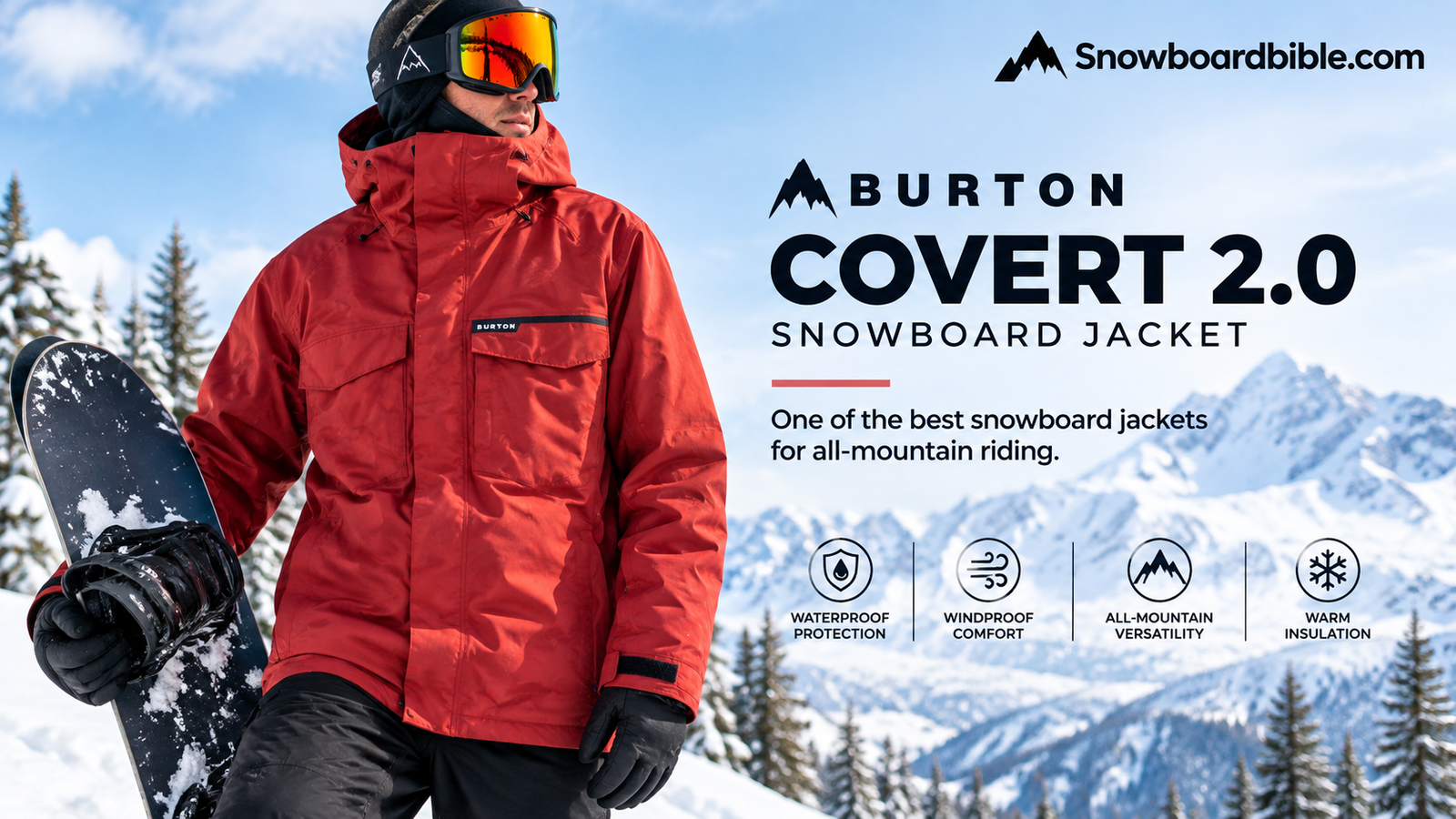
1. Burton Covert 2.0 Jacket

Burton helped shape modern snowboarding, and the Covert 2.0 carries that heritage into a practical, resort-ready insulated jacket. Its cut gives you room to move without looking oversized, and the overall design follows what snowboarders actually need: a roomy hem, easy-access pockets, and a hood built to fit over a helmet. It is the kind of jacket that disappears while you ride, which is the best compliment a layer can earn.
Riders who already enjoy Burton gear, such as the boards covered in our Burton Custom Flying V review or the Burton Skeleton Key review, will find the Covert 2.0 a natural match.
In practice, the appeal of this jacket is how little you have to think about it. Because it comes from a company that designs around riders first, details like hem length, sleeve length, and pocket placement tend to suit the way snowboarders move. It is a strong fit for the rider who wants to buy one dependable jacket, wear it through a typical winter, and not fuss with layers beyond a base and a light mid layer.
Best for: Resort riders who want a snowboard-first design that handles most days without drama.
Pros
- Designed by a snowboard-first brand
- Comfortable, rider-friendly fit
- Works for most resort conditions
Cons
- Not a storm-proof Gore-Tex product
- May feel warm on spring days
Check Price: Burton Covert 2.0
View on Amazon2. Columbia Men’s Bugaboo II Fleece Interchange Jacket

The Bugaboo II is a workhorse. It combines a waterproof outer shell with a zip-in fleece liner, so you can wear the pieces together on frigid mornings, the shell alone in milder weather, or the fleece around town after the lifts close. For riders on a budget who need real versatility, few jackets deliver this much utility per dollar.
It is not the most technical option on this list, and the fit leans traditional rather than baggy. But if you want one jacket that handles snowboarding, shoveling the driveway, and weekend hikes, the Bugaboo II makes a strong case.
The real benefit shows up over a full season. A cold January week calls for the shell and liner together, a bright March afternoon calls for the shell alone, and a chilly evening walk calls for the fleece on its own. That kind of range is difficult to match with a single-purpose jacket, and it explains why interchange designs stay popular year after year.
Best for: Budget-minded riders and families who want one jacket that covers many situations.
Pros
- Three-way versatility from one purchase
- Excellent value
- Fleece liner is usable on its own
Cons
- Traditional cut, less freestyle-focused
- Bulkier than a dedicated shell
Check Price: Columbia Bugaboo II
View on Amazon3. The North Face Freedom Insulated Jacket

The North Face Freedom Insulated is beloved for its relaxed, street-friendly look and straightforward, dependable warmth. It does not try to be a feature-packed technical shell. Instead, it offers a clean design, durable fabric, and enough insulation for chilly resort days, all in a silhouette that looks good in the lodge too.
It makes an excellent partner for roomier pants, and if you need help choosing those, our list of the best baggy snowboard pants is a good starting point.
The Freedom suits riders who value simplicity. There is no steep learning curve, no complicated layering system, and no need to study fabric charts. You put it on, zip it up, and ride. That straightforward character is exactly why it has become a familiar sight on chairlifts, and why it appeals to riders who care as much about the après-ski hour as the last run of the day.
Best for: Riders who prefer a relaxed fit, a classic look, and warmth without fuss.
Pros
- Recognizable, durable build
- Comfortable relaxed fit
- Warm enough for cold days
Cons
- Fewer technical extras than premium shells
- Insulation limits flexibility in warm weather
Check Price: The North Face Freedom Insulated
View on Amazon4. Helly Hansen Alpha 3.0 Jacket

Helly Hansen has a long history making gear for harsh weather, and the Alpha 3.0 reflects it. This is a performance-oriented insulated jacket built for riders who spend long days on the hill and care about construction. Expect a more athletic fit, solid weather protection, and thoughtful details that show up when conditions turn ugly.
If you are an active rider who moves fast and sweats a lot, the Alpha 3.0 is worth a look, especially when paired with a quality mid layer and a moisture-wicking base.
The athletic cut is the main decision point. Riders who like a trim silhouette and a jacket that stays out of the way on fast, aggressive runs will appreciate it, while riders who love an oversized, skate-inspired look may prefer a roomier alternative from this list. Since fit shapes comfort more than almost any other factor, try it with your usual layers before committing.
Best for: Active riders who ride hard, ride long, and want performance-minded construction.
Pros
- Technical, performance-minded design
- Strong brand pedigree in cold climates
- Great for active riders
Cons
- Athletic fit may not suit baggy-style fans
- Higher price than entry-level jackets
Check Price: Helly Hansen Alpha 3.0
View on Amazon5. Columbia Whirlibird IV Interchange Jacket

The Whirlibird IV is another interchange option from Columbia and one of the most popular multi-purpose jackets around. The outer shell protects against snow and wind, the inner layer adds warmth, and together they cover a wide temperature range. It is a smart choice for riders who travel to different resorts or ride across a long season.
The trade-off is the same as with other 3-in-1 designs: it prioritizes flexibility over a streamlined, freestyle-ready silhouette. For most recreational riders, that is a worthwhile bargain.
Travelers benefit most. If you plan a trip to a cold northern resort one month and a milder range the next, a jacket that adapts means you pack once and stay comfortable in both. It also doubles as everyday winter wear, which spreads its cost across far more days than a pure snowboard shell.
Best for: Recreational riders and travelers who want flexible warmth from a familiar, widely available brand.
Pros
- Flexible warmth for changing conditions
- Good value for multiple uses
- Familiar, widely available brand
Cons
- Not the lightest option
- Classic cut over trend-driven style
Check Price: Columbia Whirlibird IV
View on Amazon8. Detailed Reviews: Picks 6 Through 10
The second half of our list includes premium shells, a women’s jacket, a budget pick, a kids’ jacket, and a technical option for riders who want to leave the groomers behind. These picks tend to serve more specific needs, so reading the “best for” line under each will help you spot the right match quickly.
6. Volcom Stone GORE-TEX Jacket
Volcom’s Stone jacket has been a snowboard staple for years, and the Gore-Tex version elevates it into serious storm gear. With a trusted membrane doing the waterproofing, the jacket stays dry in conditions that overwhelm cheaper fabrics, and its relaxed cut suits park laps and powder days alike.
Because it is a shell, warmth depends on what you wear underneath. That is a feature rather than a flaw for riders who like to tune their layers. Learn more in our merino wool versus synthetic base layer comparison.
The value of a Gore-Tex shell shows up on the worst days. When a wet storm rolls in and other riders are heading for the lodge with soaked sleeves, a membrane jacket lets you keep riding. Over several seasons, that reliability, along with durable construction, helps offset the higher purchase price.
Best for: Frequent riders and storm chasers who want top-tier weather protection and layering control.
Pros
- Gore-Tex weather protection
- Relaxed, snowboard-friendly fit
- Highly versatile with layers
Cons
- Premium price
- Requires thoughtful layering for cold days
Check Price: Volcom Stone GORE-TEX
View on Amazon7. Obermeyer Raya Jacket

Obermeyer is one of the most respected names in winter apparel, and the Raya is a women’s jacket shaped to flatter and move. It offers a feminine silhouette without sacrificing the weather protection and warmth riders expect, and its design works equally well for snowboarders and skiers.
Women building a full setup will want to browse our women’s snowboarding gear guide and the best women’s snowboard bindings to round out the look and the performance.
A women-specific pattern matters because proportions differ from men’s cuts. Shoulders, bust, waist, and hips are shaped differently, and a jacket that respects those differences moves better and traps less cold air. Riders who have struggled with sleeves that run long or a boxy torso often find a dedicated women’s cut a relief.
Best for: Women who want a shaped, stylish jacket that still delivers real warmth and weather protection.
Pros
- Women-specific shaping
- Respected winter-wear brand
- Suitable for skiing and snowboarding
Cons
- Skews fashion-forward over technical
- Limited layering room in slim cuts
Check Price: Obermeyer Raya
View on Amazon8. Wantdo Men’s Waterproof Ski Jacket

Not everyone wants to spend premium money on a jacket they will wear a handful of days each winter. The Wantdo offers a waterproof outer, insulation, and a respectable list of features at a price that welcomes beginners. It will not match a Gore-Tex shell in a blizzard, but for dry-to-moderate conditions and occasional trips, it punches well above its price.
New riders especially benefit from smart spending. Our guide on how expensive snowboarding is shows where your money goes furthest, and it is often better to invest in boots and a good board first.
Think of this as a sensible starter jacket. If you discover you love the sport, you can upgrade later and keep the Wantdo as a spare for friends, guests, or rough days. If you decide snowboarding is not for you, you will not have spent a fortune finding out.
Best for: Beginners, occasional riders, and anyone who needs a warm, waterproof jacket on a tight budget.
Pros
- Budget-friendly entry point
- Insulated and waterproof for casual use
- Good feature list for the price
Cons
- Not built for extreme storms
- Less refined materials than premium brands
Check Price: Wantdo Waterproof Ski Jacket
View on Amazon9. Arctix Kids Snow Sports Insulated Jacket

Kids grow quickly and fall constantly, which is a recipe for gear that needs to be affordable and tough. The Arctix Kids jacket delivers insulation, a water-resistant outer, and practical kid-friendly touches without a high price tag. Parents often appreciate that it holds up across a season and can be handed down.
When you are choosing the sport for your child, our comparison of skiing versus snowboarding for kids and the article on the best age to teach a child to snowboard offer helpful guidance.
Warmth matters more for children than for adults, because kids lose heat faster and often stop moving to rest, play, or wait for a parent. A jacket that is easy to zip, comfortable to wear, and simple to pull on in a hurry also keeps a young rider happy, and a happy child is far more likely to want another run.
Best for: Parents outfitting young riders who need affordable, practical, hand-me-down-friendly outerwear.
Pros
- Affordable for growing kids
- Warm and practical
- Easy to hand down
Cons
- Not designed for extreme conditions
- Basic feature set
Check Price: Arctix Kids Insulated Jacket
View on Amazon10. Outdoor Research Foray II Jacket

Outdoor Research builds gear for people who spend long days in the mountains, and the Foray II is a technical shell suited to riders who venture beyond the lift. Think side-country laps, long approaches, and variable weather where ventilation and reliable protection matter more than a trendy silhouette.
If that sounds like you, pair it with the knowledge in our guides to backcountry snowboarding and backcountry safety protocol before you head out.
A technical shell rewards riders who understand layering. You will add and remove mid layers as you climb and descend, and the jacket supplies the protective outer barrier. That flexibility is exactly what hard-working backcountry riders need, since exertion on the way up and exposure on the way down call for very different levels of warmth.
Best for: Side-country and backcountry riders who value ventilation, durability, and adaptable layering.
Pros
- Technical, mountain-ready design
- Breathable for active riders
- Pairs well with layering systems
Cons
- Less cushy than insulated resort jackets
- Pricier than casual options
Check Price: Outdoor Research Foray II
View on Amazon9. Layering Under Your Jacket
Even the finest jacket depends on what you wear beneath it. The classic three-layer system works because each layer has a job, and when they cooperate you can ride comfortably from dawn patrol to last chair.
Base layer: moisture management
Your base layer sits next to your skin and moves sweat away from it. Avoid cotton, which holds moisture and chills you. Choose merino wool or synthetic fabric instead. Merino resists odor and regulates temperature, while synthetics dry quickly and cost less. For the full comparison, see our guide to merino versus synthetic base layers.
Fit matters here too. A base layer should be snug against the skin so it can pull moisture away; a loose one cannot do its job. Pick a weight that matches the day, with lighter fabrics for spring and heavier ones for deep cold.
Mid layer: insulation
The mid layer traps warm air. Fleece, light synthetic puffies, and grid-style insulating tops all work. Choose thinner mid layers if your jacket is already insulated, and thicker ones if you wear a shell. We cover options in our roundup of the best mid layers for snowboarding.
The advantage of a removable mid layer is control. If the sun comes out, you can strip it off and stash it in a pocket or pack. If the temperature drops, you can add a second one. That adjustability is why many experienced riders prefer a shell and a mid layer to a single heavy insulated jacket.
Outer layer: your jacket
This is where everything in this guide comes together. The shell stops wind and water while letting vapor out. Pair it with pants that match its performance, since a premium jacket with budget pants leaves a weak link.
Accessories that finish the system
Warm hands, head, and feet change the whole feel of a day. Consider the best snowboard gloves, a good snowboard beanie for off-mountain hours, and snowboard socks that wick moisture. For protection, riders who push harder often add impact shorts or a back protector, both of which fit neatly under a roomy jacket.
Common layering mistakes
The most frequent error is overdressing. Many beginners bundle up as if they were standing still, then overheat within an hour of riding and soak their layers with sweat. Start slightly cool; you will warm up within a few minutes of moving. The second mistake is wearing cotton, which feels fine at first and turns clammy and cold once wet. The third is ignoring the neck and wrists, where small gaps let in drafts. A neck gaiter and well-fitted gloves solve both problems for very little money.
| Conditions | Base Layer | Mid Layer | Jacket Style |
|---|---|---|---|
| Spring, mild | Light synthetic | None or thin fleece | Shell |
| Typical winter | Midweight merino or synthetic | Fleece or light puffy | Shell or light insulated |
| Deep cold | Midweight to heavyweight | Insulated mid | Insulated or 3-in-1 |
| Storm or wet snow | Moisture-wicking | Light fleece | High-rated or Gore-Tex shell |
Shop Base Layers and Mid Layers
View on Amazon10. Best Jacket by Rider Type and Budget
The best snowboard jacket on paper might not be the best one for you. Here is how the ten picks stack up against different riders.
Beginners and casual riders
If you are still deciding whether snowboarding is your sport, do not overspend. The Wantdo and the Columbia Bugaboo II both deliver warmth and weather protection at friendly prices. New riders will also benefit from reading our beginner tips and how to choose your first snowboard, and the guide to resorts for beginners helps you pick a gentle place to start.
Beginners spend an unusual amount of time on the snow, so waterproofing and a powder skirt matter more than fashion. Prioritize a jacket that keeps you dry through repeated falls, and do not worry about premium fabrics until you know how often you will ride.
Freestyle and park riders
Park riders want a relaxed fit and freedom to move. The Burton Covert 2.0, The North Face Freedom Insulated, and the Volcom Stone suit that style. If tricks are on your radar, check out our freestyle snowboarding tricks and the full list of snowboarding tricks.
Durable fabric around the hem, elbows, and shoulders is worth seeking out for park riding, since rails, boxes, and landings put extra wear on those areas. Roomy sleeves help with grabs and rotations too.
Storm chasers and frequent riders
For deep days and heavy weather, the Volcom Stone GORE-TEX stands out. Combine it with a smart layering system and you can ride in conditions that send other riders home.
Backcountry and side-country riders
The Outdoor Research Foray II is built for people who earn their turns. It handles variable weather and big exertion. If you are curious about that world, our article on what a splitboard is is a natural next read.
Women and kids
The Obermeyer Raya serves women who want a shaped fit, and the Arctix Kids jacket covers young riders affordably. Families planning a trip will find inspiration in our lists of best snowboarding destinations and snowboarding in Colorado.
Riders who run cold or run hot
Body temperature varies widely from person to person. If you are always the first to reach for extra layers, lean toward an insulated jacket such as the Burton Covert 2.0, the North Face Freedom Insulated, or the Helly Hansen Alpha 3.0. If you overheat easily, choose a shell like the Volcom Stone or the Outdoor Research Foray II and add layers only as needed.
Value versus premium
A good rule: spend more on your jacket if you ride more than ten days a year or in wet climates. A premium shell lasts for many seasons, which lowers its cost per day dramatically. If you ride less, a quality budget jacket is a perfectly smart decision.
To see how this works, imagine a jacket that costs a few times more than a budget option but lasts four or five times as many days. The premium jacket costs less per day of riding and usually performs better in every one of them. The budget jacket only wins if you ride so rarely that durability never becomes a factor.
Find the Best-Value Jackets
View on Amazon11. Care, Washing, and Re-Proofing
A good snowboard jacket can last years with basic care, and a little maintenance preserves its performance. Many riders skip this step and then wonder why their jacket stops beading water.
Washing without ruining the membrane
Dirt, body oils, and sunscreen clog fabric pores and reduce breathability. Wash your jacket once or twice a season using a technical-fabric cleaner, not regular detergent with fabric softener, which coats fibers and kills waterproofing. Follow the care label, zip all the zippers, and use a gentle cycle on cool or warm water.
Before washing, empty every pocket, close the vents, and fasten the cuff tabs so they do not snag the fabric. Run an extra rinse cycle if your machine has one, which helps remove any leftover cleaner that could attract dirt.
Restoring the water-repellent finish
After washing, tumble dry on low heat if the label allows. The gentle warmth often reactivates the DWR finish. If water no longer beads on the surface, apply a spray-on or wash-in DWR treatment according to the product directions. Doing this at the start of each season keeps the jacket performing like new.
A simple test tells you when it is time. Sprinkle a little water on the sleeve. If it beads and rolls off, the finish is healthy. If it soaks in and darkens the fabric, the finish needs attention. This does not mean the jacket has stopped being waterproof, only that the outer fabric is wetting out, which reduces breathability and makes the jacket feel heavy and cold.
Storage and quick fixes
Store the jacket dry and uncompressed in the off-season. A small tear can be fixed with a fabric repair patch, and sticky zippers usually respond to a clean-up and a dab of zipper lubricant. Pay attention to your board gear as well; keeping your equipment tuned is part of the same routine. Our guide to snowboard maintenance and article on snowboard tune kits help you keep everything in shape.
Drying after a day on the snow
Never leave a wet jacket balled up in a bag overnight. Hang it on a wide hanger in a room with good airflow, with the zippers open and the pockets turned out where possible. Keep it away from direct heat sources such as radiators and fireplaces, which can damage seam tape and warp the fabric. Moisture trapped in insulation breeds odor and wears down performance, so a few minutes of care each night pays off over the season.
Shop Gear Care and Re-Waterproofing Products
View on Amazon12. Sizing and Smart Buying Tips
You now know what to look for. Here are the final practical tips for turning research into a purchase you will not regret.
Try it on the way you will ride
Wear your usual layers, your gloves, and, if possible, your helmet when trying a jacket. Walk around, squat, and reach. If something feels restricting in a store, it will feel worse after four hours on a mountain.
Check the return policy
When ordering online, buy from a retailer with easy returns and try the jacket indoors with tags still attached. Fit varies between brands, and the model you love in a photo may sit differently on your body.
Read reviews the smart way
Customer reviews are most useful when you look for patterns instead of single opinions. If several riders mention that the sleeves run short or the hood is too small for a helmet, take that seriously. If one reviewer complains about a problem nobody else mentions, it may be a one-off. Pay special attention to reviews from riders with a similar height, build, and riding style to yours.
Time your purchase
Winter apparel follows a predictable retail cycle, with the best discounts generally appearing at the end of the season and during major sale events. Our analysis of the best time to buy snowboarding gear explains the patterns in detail.
Match your jacket to your wider setup
Your jacket is one part of a bigger system that includes a board, boots, bindings, and protective gear. If you are still shopping for the rest, start with our guides to snowboard boots, snowboard bindings, and snowboard sizing. Packing for a trip? Our snowboard bag packing checklist helps you bring everything you need.
Set a realistic budget
Decide how much you can spend before you start browsing, and decide where it matters most. Many riders get the best results by spending generously on the layers that touch their body and the shell that protects them, while saving on accessories. If your budget is tight, a mid-priced jacket combined with a good base layer will outperform an expensive jacket worn over cotton.
Remember the basics of staying safe
No jacket makes you invincible. Pair good gear with good habits, including smart falling technique from our snowboard fall safety guide and the strategies in injury prevention for snowboarding. If you want to understand the sport’s risks more fully, read why snowboarding can be dangerous.
Shop Snowboard Jackets Now
View on AmazonFinal Thoughts: Pick the Jacket That Lets You Forget About the Weather
The best snowboard jacket is the one you stop thinking about the moment you start riding. It keeps snow out, lets sweat escape, moves when you move, and holds up to season after season of falls, lift rides, and hot chocolate stops.
If you want a trusted snowboard-first design, start with the Burton Covert 2.0. For storm-ready protection and layering flexibility, the Volcom Stone GORE-TEX is hard to beat. Value seekers will love the Columbia Bugaboo II or Whirlibird IV, women riders will appreciate the Obermeyer Raya, and families can outfit young riders with the Arctix Kids jacket. Backcountry fans should look closely at the Outdoor Research Foray II, while The North Face Freedom Insulated and Helly Hansen Alpha 3.0 cover relaxed and performance-driven approaches, and the Wantdo shows how far a small budget can go.
Whichever you choose, remember the core checklist: a real waterproof rating, taped seams, a powder skirt, ventilation, a helmet-compatible hood, and a fit that lets you move. Add a smart layering system and a little care between trips, and your jacket will reward you for years.
Whichever you choose, you will be better prepared for whatever the mountain throws at you. Now go get out there and ride.
Pick Your Snowboard Jacket on Amazon
View on AmazonFrequently Asked Questions About Snowboard Jackets
What is the best snowboard jacket overall?
It depends on how you ride. The Burton Covert 2.0 is a strong all-rounder for resort riders, while the Volcom Stone GORE-TEX leads for wet storms. Match the jacket to your climate, budget, and layering preferences, and try to think about the conditions you face most often rather than the rare extreme day.
Do I need a special jacket for snowboarding, or can I use a ski jacket?
A ski jacket works in a pinch, but snowboard jackets are usually longer, roomier, and tougher around the hem and elbows. Those traits make a real difference when you sit and fall often. If you already own a ski jacket, use it for a trip or two before deciding whether to upgrade.
How waterproof should a snowboard jacket be?
For most resort riders, a rating of roughly 10K to 15K is plenty. If you ride in wet storms or spend long days outside, look for 15K to 20K or Gore-Tex. Remember that taped seams and a healthy water-repellent finish matter as much as the number itself.
Should I buy an insulated jacket or a shell?
Insulated jackets are simpler and warm out of the box. Shells offer flexibility, since you control warmth through layers. Riders who run cold usually prefer insulation, and those who run hot or ride varied conditions like shells.
What is a 3-in-1 snowboard jacket?
It combines a waterproof outer shell with a removable fleece or insulated liner. You can wear them together, separately, or swap based on the weather, which delivers strong value. The Columbia Bugaboo II and Whirlibird IV are popular examples.
How should a snowboard jacket fit?
It should leave room for a base layer and mid layer without restricting your arms. The hem should cover your hips and the cuffs should reach your gloves when you reach overhead. Test it by squatting and rotating your torso before you commit.
Are Gore-Tex jackets worth the money?
If you ride often or in wet climates, yes. Gore-Tex offers dependable waterproofing and breathability, and a quality jacket can last many seasons, which lowers the cost per day. Occasional riders can often do just as well with a quality budget jacket.
How do I wash a snowboard jacket?
Use a technical-fabric cleaner on a gentle cycle, avoid fabric softener, and follow the care label. Afterward, tumble dry on low if permitted to help revive the water-repellent finish. Wash once or twice a season, or more if the jacket looks dirty or stops beading water.
What should I wear under a snowboard jacket?
Use a moisture-wicking base layer in merino or synthetic fabric and a fleece or lightweight puffy as a mid layer. Avoid cotton, which holds sweat and makes you cold. Adjust the thickness of your mid layer to match the weather and the insulation in your jacket.
Can I use a snowboard jacket for other activities?
Absolutely. Many jackets, especially 3-in-1 designs, work well for hiking, shoveling, and cold-weather travel. Just make sure the style suits the activity, since a heavily insulated jacket may feel too warm on an active hike.
Is a budget snowboard jacket good enough for beginners?
Yes. Beginners do not need premium shells right away, and affordable options like the Wantdo can keep you warm and dry. Invest in boots and a well-fitted board first.
When is the best time to buy a snowboard jacket?
Prices usually drop toward the end of the season and during large retail sale events. If you can wait, you can often save a meaningful amount on last-season styles.
How long does a snowboard jacket last?
With regular care, a quality jacket can last five years or more, and premium shells often last longer. Frequent washing with the right products, timely re-proofing, and proper drying all extend its life. Budget jackets may show wear sooner, particularly at the cuffs and zippers.
Do I need a jacket with a hood?
Most riders benefit from one, especially in wind and storms. Choose a hood that fits over a helmet and adjusts snugly. If you prefer to go without, look for a jacket with a removable hood so you keep the option.
You May Also Like
Keep exploring the Snowboard Bible library for more gear guides, reviews, and riding tips.


